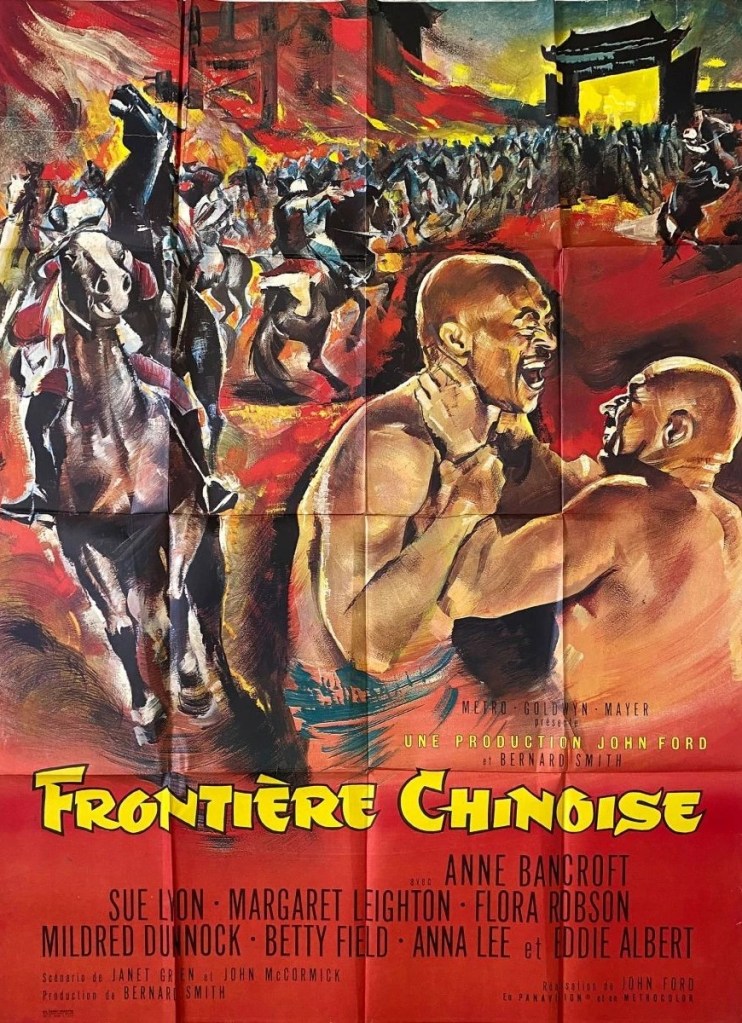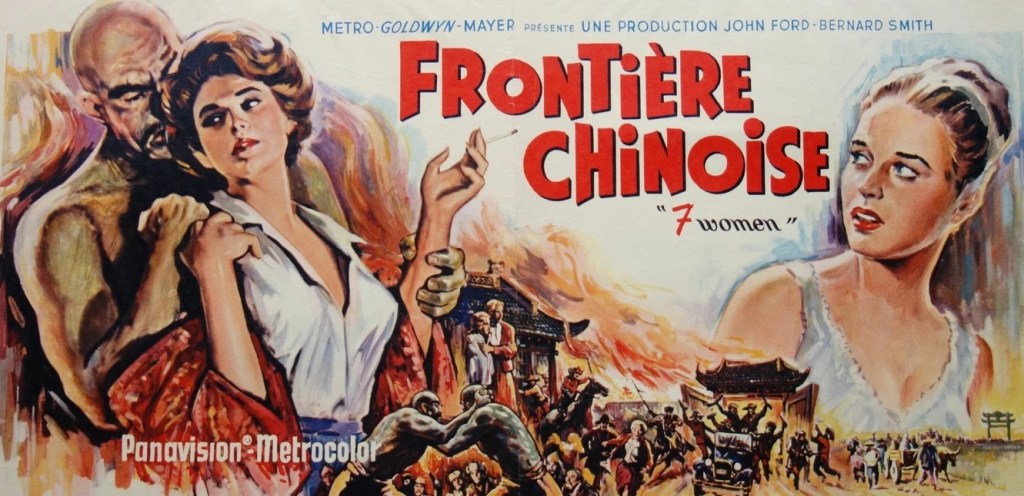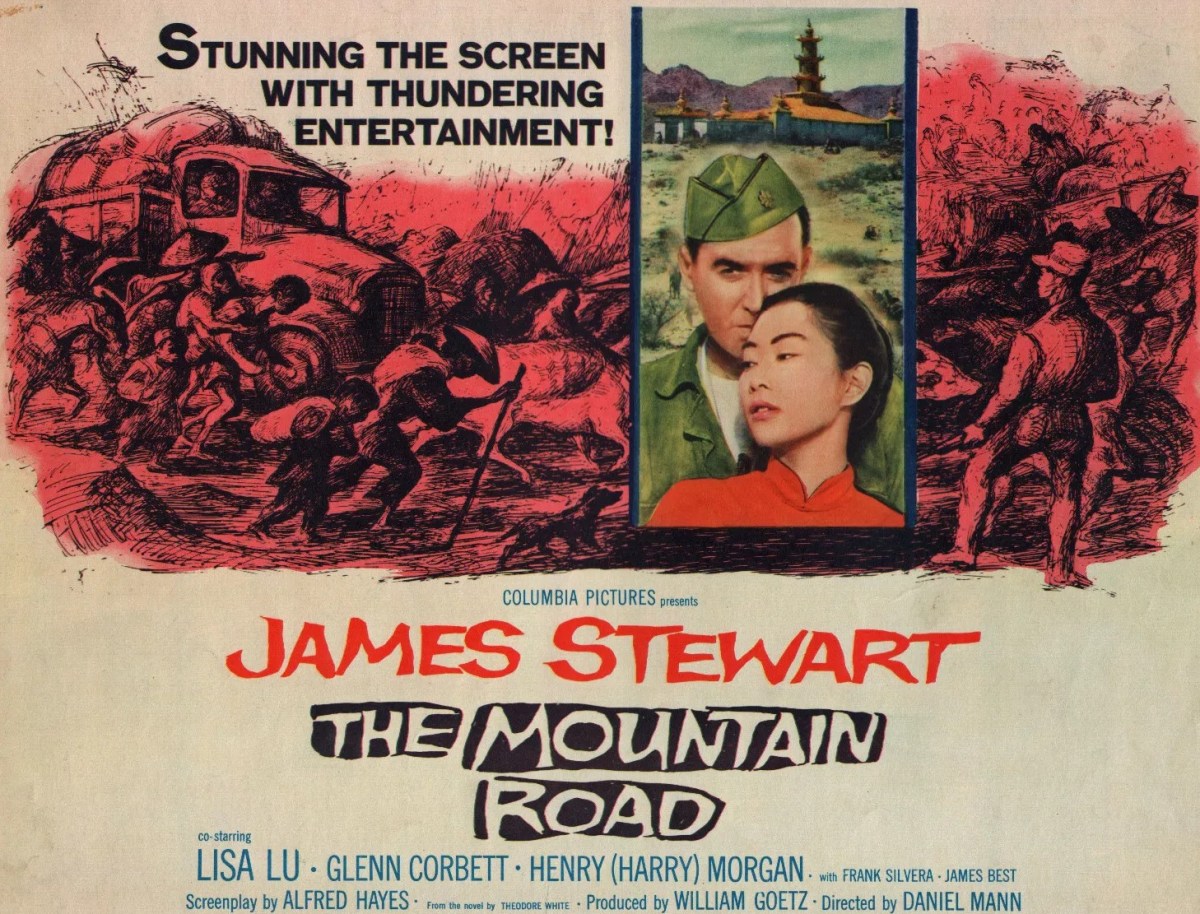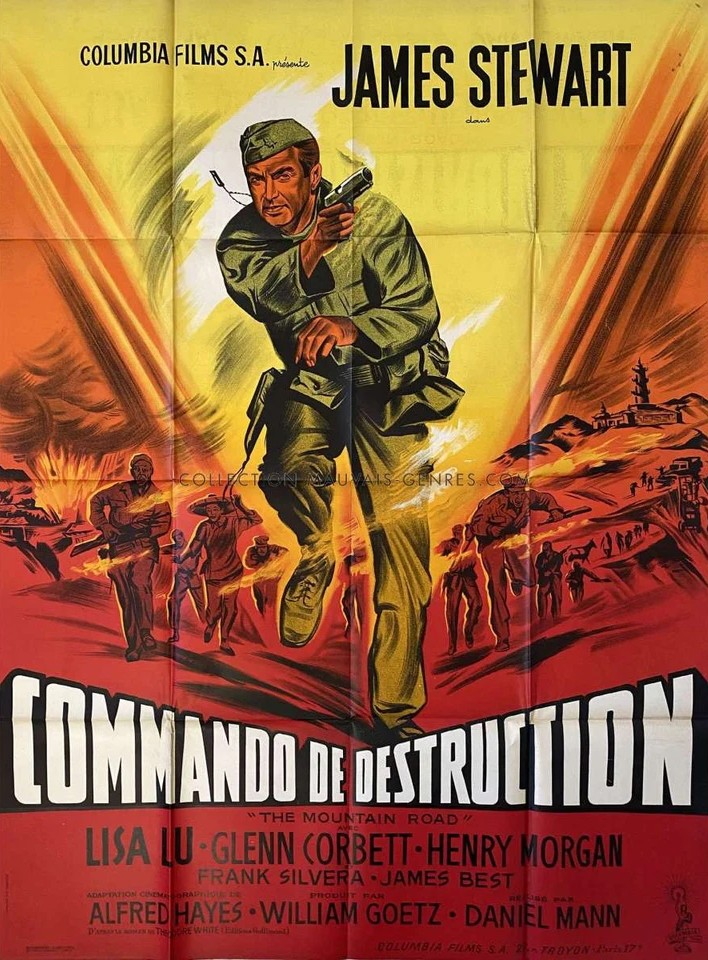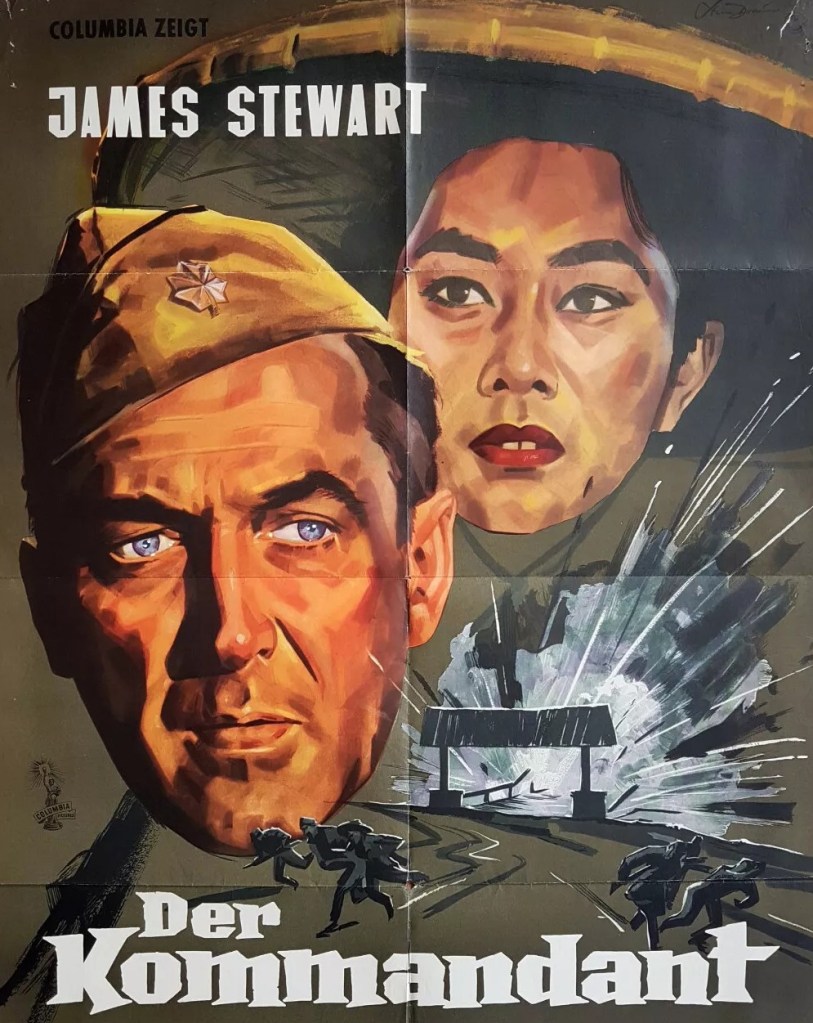
The Mountain Road (1960) ****

First film to deal with U.S. Army war crimes. Though here’s it’s tabbed as abuse of power but amounts to the same thing when it relates to the wanton killing of innocents. Not the first film to examine a commander totally unsuited to command – The Caine Mutiny (1953) would be your first port of call for that, although that was a career officer rather than a conscript. But the blistering under-rated Oscar-ignored performance by James Stewart (The Rare Breed, 1966) is easily comparable to the Oscar-nominated Humphrey Bogart.

And director Daniel Mann (A Dream of Kings, 1969) is helluva sly. He dupes the audience into thinking this is a mission picture, blowing up a massive ammunition dump to prevent it falling into enemy hands. And if you’re one for the easy action of explosions, this is for you, the kind of fireworks not seen till MCU entered the equation.

And here’s a line that’s going to knock you for six. “China and America are friends.” Say again? You what? As far as I can remember in all my decades of moviegoing, China has always been the enemy, either providing a succession of nefarious villains, or on the brink of starting a nuclear war, or just totally ungrateful for all the efforts the West has made bringing to the country Christianity and the western idea of civilization.

But it’s true. Before Communist China reared its ugly head, the U.S. and China were allies against the Japanese in the Second World War. But towards the end of that conflict, the Japanese had invaded and the Yanks were pulling out. Not wanting to leave anything behind for the enemy – like a huge arsenal or thousands of gallons of diesel – is the trigger for the story.

Except it’s not. Major Baldwin (James Baldwin) doesn’t have to go on any mission. His job is just to blow up a much smaller ammunition dump that’s easily accessible without the need to go on a long trek through the mountains. It’s his choice to take on the bigger job. There’s not even any pressure to do so. It’s entirely at his “discretion.” And you can see in the tone of his superior’s voice that it’s not such a good idea. He can just complete the small job and high-tail it out of there.

But Major Baldwin wants to experience command in action. He’s not a glory hunter in the normal sense but there’s definitely something off in a backroom soldier who’s got that on his wish list. It never occurs to him that there’s more to command than ordering about grunts, many of whom he considers “slobs,” and that the position comes with the task of making difficult decisions.

He’s got a very small team, chief among whom is Sgt Michaelson (Harry Morgan) and translator Collins (Glenn Corbett). Chinese officer Col Kwan (Frank Silvera) is meant to smooth his path and the widow of a Chinese general, Sue Mei (Lisa Lu), is thrown his way, initially you would guess to sweeten the load by becoming a love interest, but actually to become his conscience.

Just to fill you in on the background. China and Japan had been at war since 1937. After Pearl Harbor China became critical to US operations in the Pacific by tying down Japanese forces and after the fall of Burma the US airlifted supplies over the Himalayas.

Baldwin soon discovers that leadership equates to callousness. He has little sympathy for the refugees swarming over the mountain roads seeking sanctuary from the invading Japanese. He blows up a bridge and creates an impasse on the road to delay the Japanese without giving any thought to how that will endanger the natives.

He’s pretty inhuman in his treatment of one of his men, suffering, it later transpires, from pneumonia and might be taking all his cues from General Patton who hated all wounded soldiers. While he’s trying to convince the soldier to get back on his feet all the grunt can do is whimper, “Milk! Milk” like a child. Baldwin even sees little problem in stacking the ill man beside a corpse on the back of a lorry.

It would help if Baldwin had been trained in command, in making decisions, rather than picking faults everywhere and letting the pedantic side of his nature run wild. Sei Lei to some extent tries to rein him in, accusing him of blatant racism, treating the Chinese as if they were a lower form of humanity.

When he does relent and orders surplus food to be handed out one of his men is killed in the stampede. The last straw is Chinese bandits who kill and strip three of his men. So he leads a raid on a Chinese village, rolling a barrel of fuel stacked with dynamite down a hill to destroy the village and innocent villagers.

Up till then things were going along nicely on the romantic front, Sei Lei clinging to him when the massive ammunition dump goes up, and kissing on the cards. She’s westernized after all, spent a lot of time in America, well educated, and so easily a contender for marriage. But she tries to stop the barrel-rolling, telling him this action is unjustified, pure revenge.

He thinks she’ll accept an apology, that some madness came over him, he was consumed by power. But she’s having none of it.

Mission accomplished but human flaws exposed.

This isn’t the James Stewart you’ve come to expect, far from it. There’s certainly times in his career when he’s been mean or ornery and in his Hitchcock excursions a bit creepy, but he’s never been so awful as here, the guy desperate for power without knowing how to use it or draw the line. Purely in a technical capacity, working out where to plant explosives and plan a demolition, he’s in his element, but let him loose on human beings and he’s a loose cannon trying to rein himself in, stuck in a mess of his own making, unable to understand consequence. But sometimes even guilt isn’t enough.

This was an unlikely role for Stewart because, after his own experience in World War Two, a pilot in Bomber Command flying missions over Europe, he had turned down every war picture. Perhaps this movie reflected the guilt he felt of dropping bombs and knowing there would be civilian collateral damage, that sense of power over the powerless might equate to the feelings Baldwin has over the Chinese.

This is by far the most human character Stewart ever played, doing away with both the aw shucks everyman and the commanding often truculent cowboy, and instead portraying someone who’s way out of his comfort zone.

Ace scene-stealer Harry Morgan (Support Your Local Sheriff, 1969) is the pick of the support though Lucy Lu (One Eyed Jacks, 1961), being the conscience of the piece, has all the best lines.

Just as with A Dream of Kings, Daniel Mann takes a flawed individual and doesn’t hang him out to dry. But in retrospect, the war crime, of blowing up the innocent civilians, would not have received such a free pass, which puts a different slant on Baldwin. Alfred Hayes (Joy in the Morning,1965) wrote the script from the Theodore H. White bestseller.

Much to ponder.

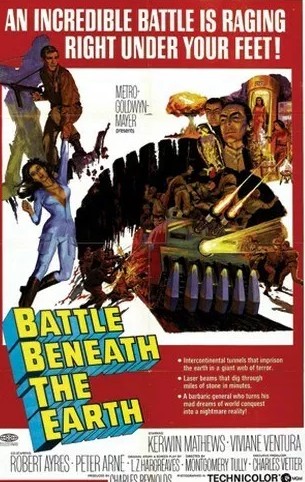
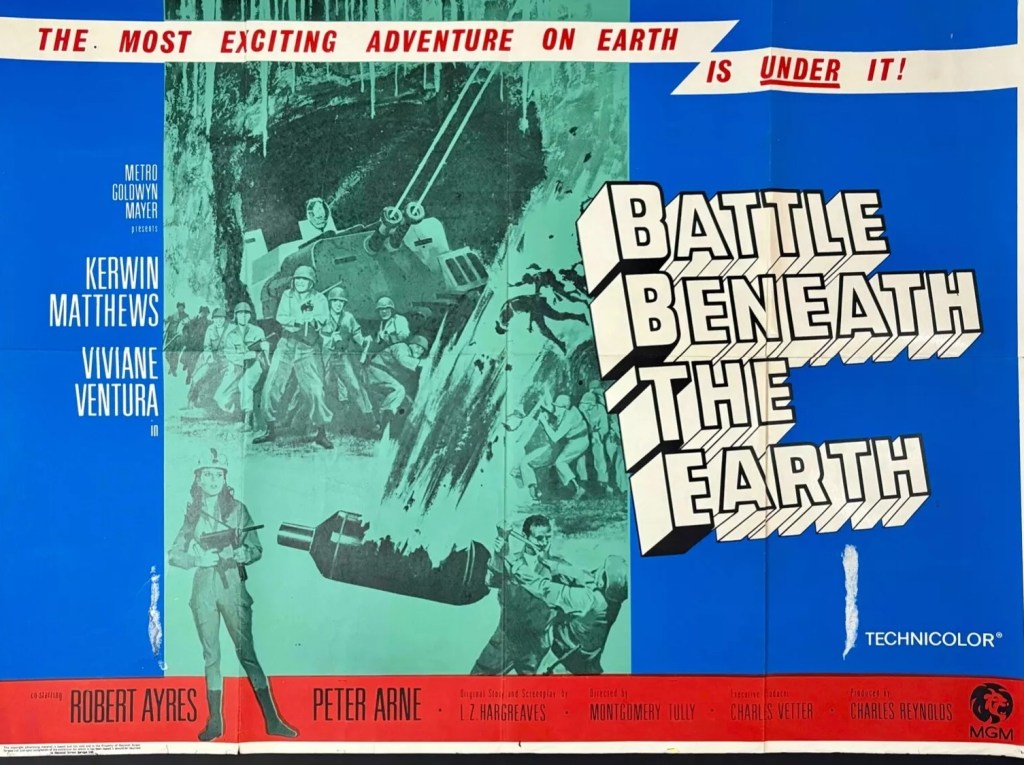
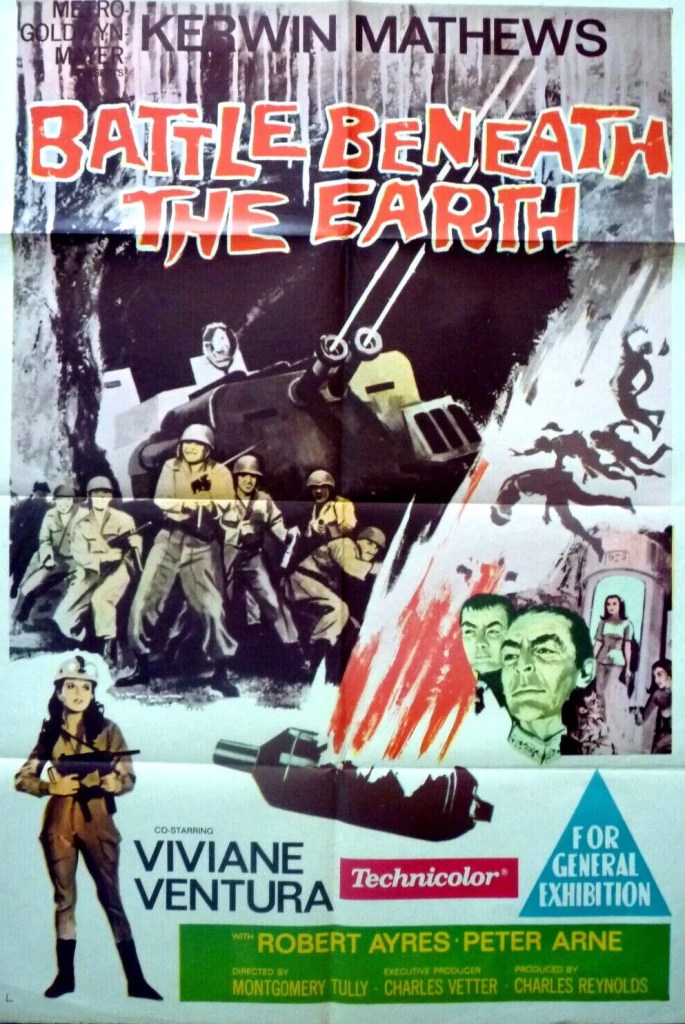
Battle Beneath the Earth (1967) ***

Aliens, would be your first guess these days should you happen upon strange disturbances emanating from underneath the earth’s surface, citing the examples of War of the Worlds or an iteration of Transformers, whereby creatures from outer space had remained dormant buried in our habitat for millions of years, like inveterate moles, waiting to spring into action. But this is the 1960s and domination of the Universe is not on the cards. Instead, it’s mere global domination. And as James Bond and others in the espionage game have persuaded us if it’s not some supervillain we’re under threat from it’s the Russians or Chinese.

Even if you detected odd goings-on there was more chance of you being stuck in a mental institution, as is the fate of seismologist Arnold Kramer (Peter Arne), who makes the mistake of causing a “listening disturbance,” arrested lying down on the streets of Las Vegas with his ear pressed to the ground.

Navy Commander Jonathan Shaw (Kerwin Mathews) is on an equally sticky wicket, his latest undersea project resulting in the death of 27 men. However, his assistant Susan (Norma West) prevails upon Shaw to take a look at her brother Arnold. But he isn’t impressed. Until he hears about a mining disaster in Oregon, the deepest mine in the USA, and recalls that Kramer had mentioned discovering unusual activity underground in Oregon.

So off Shaw goes to investigate and finds a laser-drilled tunnel and a lair with missiles. There’s a vehicle with some kind of death ray and before your mind jumps to the notion that this is alien-induced we’re in the command post of Chinese General Chan Lu (Martin Benson) who, as well as planning whatever devilish destruction he aims to visit upon the Americans, has also been in the business of mining gold and growing plants packed with vitamins.

Turns out there’s more than one tunnel – they run from China underwater across the Pacific and underground through America – and although Chan Lu’s stock of nuclear warheads is depleted after being defused by the Yanks he’s still got enough left in the tank to turn America in a desert and kill 100 million people. And there’s not much time to waste – the Chinese plan to strike in 48 hours.

Meanwhile, to buff up the story, Shaw’s team adds volcanologist Tila Yung (Viviane Ventura), providing the opportunity for extra peril and a touch of incipient romance. The Yanks plan to locate the Chinese in a tunnel under the Pacific  and detonate a 10-megaton atom bomb. But things don’t go according to plan. One of the team is hypnotized and Shaw and crew are ambushed and imprisoned.

Chan Lu is far from the lunatic villain and invites Shaw post-conflagration to team up to help to peacefully reconstruct the broken world. Being a pragmatic sort, the General is somewhat surprised to be turned down. Naturally, Shaw’s gang break out of the cell, Arnold the one with the clever idea, and sabotage the Chinese bombs, so it doesn’t end well for the villain, while our hero has the beginnings of a romance.

This was the final movie for director Montgomery Tully (The Terrornauts, 1967, Fog for a Killer, 1962, The Third Alibi, 1961) and he brings some of the pacing he demonstrated in the B-film crime thrillers to the material so it rattles along. The background is well handled and the two male leads are unusually damaged for a sci-fi romp. Audiences might have felt duped that Viviane Ventura (A High Wind in Jamaica, 1965) doesn’t appear until about halfway through. Kerwin Mathews (Maniac, 1963) leads with his chin but the movie’s not expecting much else. Written by L.Z. Hargreaves (Devil Doll, 1964) aka Charles Vetter, the film’s producer.

Decent hokum.

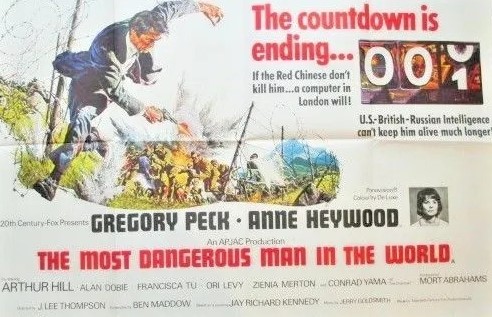
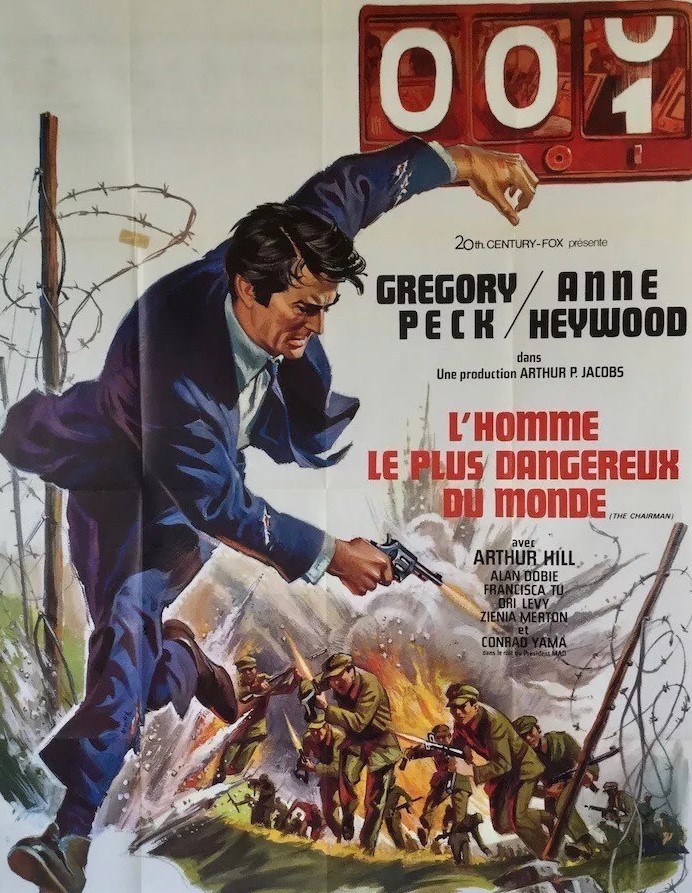
The Chairman / The Most Dangerous Man in the World (1969) ****

The sci-fi elements in this tidy paranoia thriller set in Communist China are not the only issues overlooked at the time and worthy of reconsideration now. Anyone who blasted it for supposedly political jingoism conspicuously failed to read a subtext that chimed with young left-wingers for whom Chairman Mao was not, as now, perceived as a tyrant du jour but as a political god. There’s a distinct whiff of Philip K. Dick in the implanting in a spy’s head of not just a tracking/listening device but one laced with explosive that can be remotely triggered for suicidal or murderous gain. Needless to say, the spy, ignorant of this fact, was a de facto sacrificial lamb. And a key plot thread about genetically modified crops as a means of solving world hunger came about four decades too early.  

Widowed Nobel prize winning scientist Dr Hathaway (Gregory Peck) is despatched into China via Hong Kong to contact a missing scientist with a revolutionary formula for an enzyme. A series of crisp flashbacks set up the scenario of the tracking device and a reverse echo of Marooned (1969) where Army chiefs back at base, led by one-eyed Shelby (Arthur Hill,) can listen in but are helpless to intervene – except in sinister manner. Shelby considers Hathaway “the wrong brilliant man” for the task and that they have sent in “a civilian to do a soldier’s job.”

Not able to trust the Brits to know who the title referred to, they came up with a lame alternative. The taglines reveal way too much of the plot.

The hidden transmitter allows Hathaway to keep his superiors posted but the listening device also picks up a creaking bed as Hathaway almost falls into a honey trap in Hong Kong. Amazingly, he doesn’t have to sneak into China but is welcomed with open arms and hustled along to a meeting, and a game of ping-pong (the real thing and the verbal equivalent) with Chairman Mao (Conrad Yama). While spouting some propaganda, Mao is surprisingly open about sharing the secret of the enzyme rather than blackmailing a starving world. Meanwhile, it’s the Americans who are more interested in the double cross, Shelby itching to blow up Hathaway’s head in the assumption the explosion would dispose of the Chinese leader.

Emissions from the transmitter are tangling up the airwaves, making the Chinese secret police highly suspicious of Hathaway as he heads for the secret scientific compound housing Professor Soong Li (Keye Luke), creator of the enzyme, and his daughter Chu (Francesca Tu).

Turns out Hathaway has been summoned by the professor to help find a missing link in molecular chains. Hathaway has to burgle his way to steal the formula, but fails to find it, but when the professor commits suicide and is denounced by his daughter and the Chinese secret police close in, Hathaway has to scarper and head for the Russian border, that country, oddly enough for a spy movie, being on the same side as the Yanks. Meanwhile, Shelby’s trigger finger it itching to blow his man sky high for fear he might give away details of his mission.  

The French, too, had trouble with the original title.

Turns on its head many of the spy film’s truisms: firstly that Hathaway effectively fails in his mission; secondly that patriotism doesn’t blind him to his country’s greed or folly; thirdly that’s he not in constant seduction mode.

Political argument that one point seemed to excessively delay the narrative thrust, now, at half a century’s move, seems more considered and providing an interesting balance between opposing views.

Gregory Peck (Marooned, 1969) is at his quizzical best, deeply-rooted scepticism helping to anchor his character. But if you were attracted by seeing Anne Heywood (The Fox, 1967) second-billed you’re in for a disappointment as she just tops and tails the picture. Arthur Hill (Moment to Moment, 1966) is good value as always.

But it’s testament to J. Lee Thompson (Mackenna’s Gold, 1969, also starring Peck) that his direction brings together diverse political/sci fi/spy/thriller elements in a winning formula, ignoring the obvious. Some interesting detail: someone handing out coffee on a tray to the inmates of the command station; Hathaway’s guilt at his role in the death of his wife barely touched upon, but it explains a lot; Mao’s famous Little Red Book provides a twist.

Occasional flaw: surely the Chinese would have bugged Hathaway’s room and catching him, however soft voiced, filling in his superiors. The idea that the Chinese could be technologically more advanced than the U.S. would have had John Sturges in a fit of fury, but Thompson takes it in his stride. Screenplay by Ben Maddow (The Way West, 1967) and Jay Richard Kennedy (I’ll Cry Tomorrow, 1955).

Reassessment overdue.

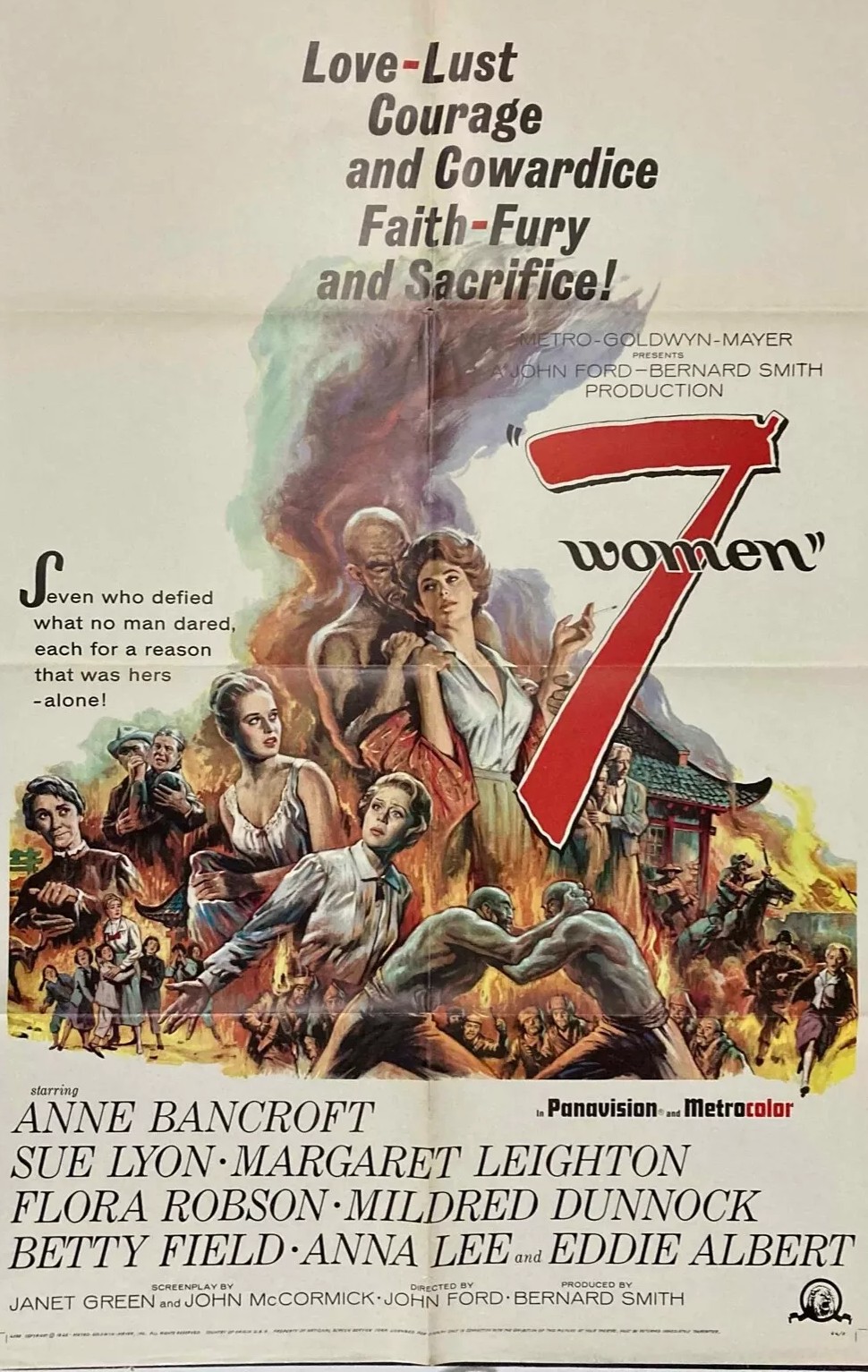
55 Days at Peking (1963) ***

Imperialism is hard to stomach these days but at the start of the twentieth century it was rampant and not restricted to the main culprit, the British. China was Imperialism Central, round about a dozen nations including the USA and Russia claiming control of sections of the country or its produce. So they had all set up diplomatic shop in Peking. And the film begins with an early morning roll call of national anthems before this domination by outside interests is shattered by rebellion.

Just as hard to stomach, of course, was the movie mainstream notion in those days that all rebellions must perforce be put down regardless of how put-upon the peasant classes were. Audiences had to rally round people in other circumstances they would naturally hate. So one of the problems of 55 Days at Peking is to cast the rebels (known as Boxers) and the complicit Chinese government in a bad light while ensuring that those under siege are not seen as cast-iron saints. There’s no getting round the fact that the rebels are shown as prone to butchery and slaughter while the Chinese rulers are considered ineffective and traitorous.

So it’s left to the likes of Major Mark Lewis (Charlton Heston) heading up the U.S. Marines stationed in the city to bring some balance to proceedings. “Don’t get the idea you’re better than these people because they can’t speak English,” he expounds. British Consul Sir David Robertson (David Niven) tries to keep this particular league of nations onside while negotiating with one hand tied behind his back – “we must play this game by Chinese rules” – with the Chinese Dowager Empress Tzu-Hsi (Flora Robson) while knowingly endangering his wife Lady Sarah (Elizabeth Sellars) and two children. Unscrupulous Russian baroness Natalie Ivanoff (Ava Gardner) exhibits little loyalty to her home country.

The picture is one-part action, one-part politics and one-part domesticity, if you include in the last section the major’s romance with the baroness, the consul’s guilt when his son is wounded in an attack and Lewis’s conflict over a young native girl fathered by one of his own men who is then killed. Two of the best scenes are these men coping with parental obligation, Sir Arthur managing a wounded son, Lewis finding it impossible to offer succor to the child.

The action is extremely well-handled. The siege goes on longer than expected when the expected troops fail to arrive, tension rising as casualties mount and supplies fall low. As with the best battle pictures, clever maneuvers save the day. Two sections are outstanding. The first has Lewis marshalling artillery to prevent the Chinese gaining the high ground. The second is a daring raid – Sir Arthur’s idea, actually – through the city’s sewers to the enemy’s ammunition dump. Personal heroism is limited – Lewis volunteers to go 70 miles through enemy territory to get help but has to turn back when his men are wounded or killed.

There’s a fair bit of stiff upper lip but while Lewis, in familiar chest-baring mode, has the baroness to distract him, Sir Arthur is both clever, constantly having to outwit the opposition and hold the other diplomats together, and humane, drawn into desperation at the prospect of his comatose son dying without ever having visited England.  The baroness  moves from seducer to sly traitorous devil to angel of mercy, wapping glamorous outfits for a nurse’s uniform, at the same time as changing her outlook from selfish to unselfish.

Charlton Heston (Diamond Head, 1962), David Niven (Eye of the Devil, 1966) and Ava Gardner (The Angel Wore Red, 1960) acquit themselves well as does Flora Robson (Eye of the Devil) in a thankless role. In supporting roles are John Ireland (The Swiss Conspiracy, 1976), Harry Andrews (The Charge of the Light Brigade, 1968) and Leo Genn (Ten Little Indians, 1965).

This was the third of maverick producer Samuel Bronston’s big-budget epics after King of Kings (1961) and El Cid (1961) with a script as usual from Philip Yordan – sharing the credit with Robert Hamer (Kind Hearts and Coronets, 1949) and Bernard Gordon (Custer of the West, 1967) – and directed by Nicholas Ray (King of Kings) who also had assistance from Guy Green (Diamond Head).and Andrew Marton  (Africa: Texas Style, 1967)

All in all it is a decent film and does not get bogged down in politics and the characters do come alive but at the back of your mind you can’t help thinking this is the wrong mindset, in retrospect, for the basis of a picture.

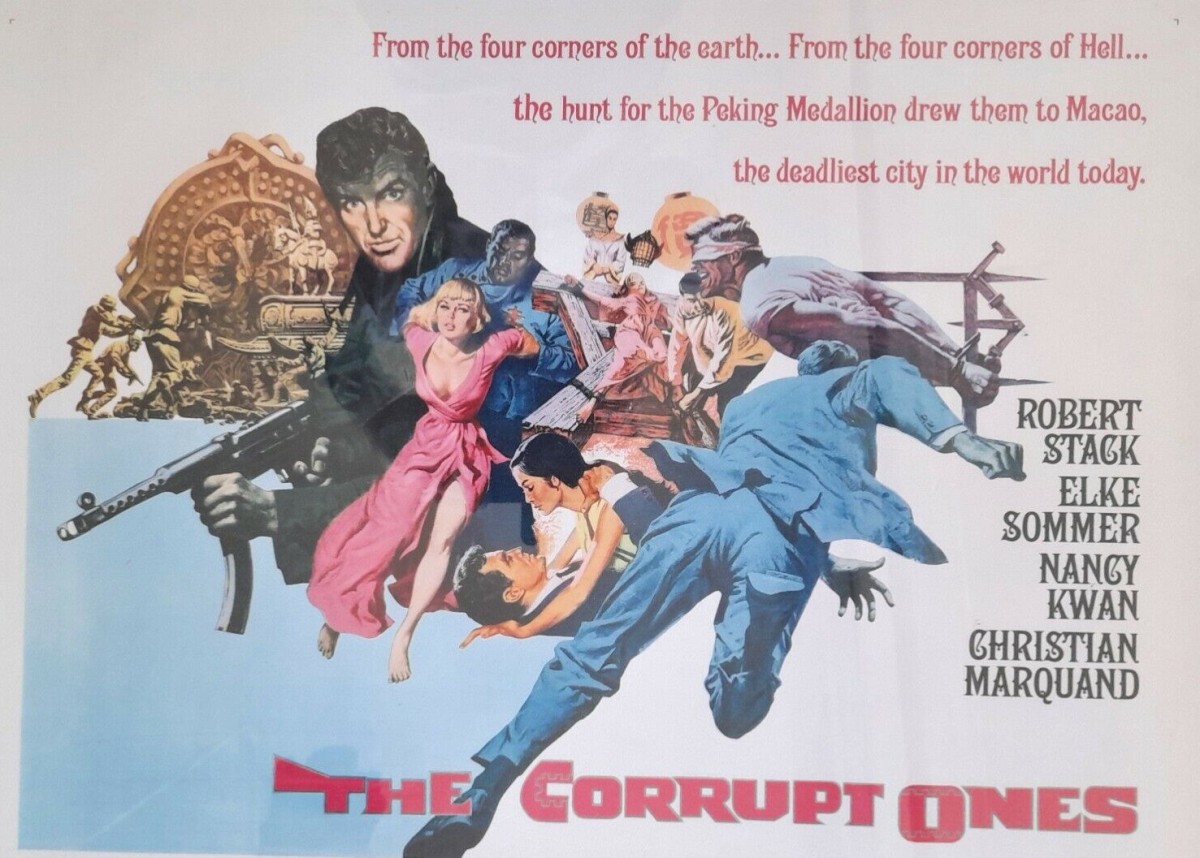
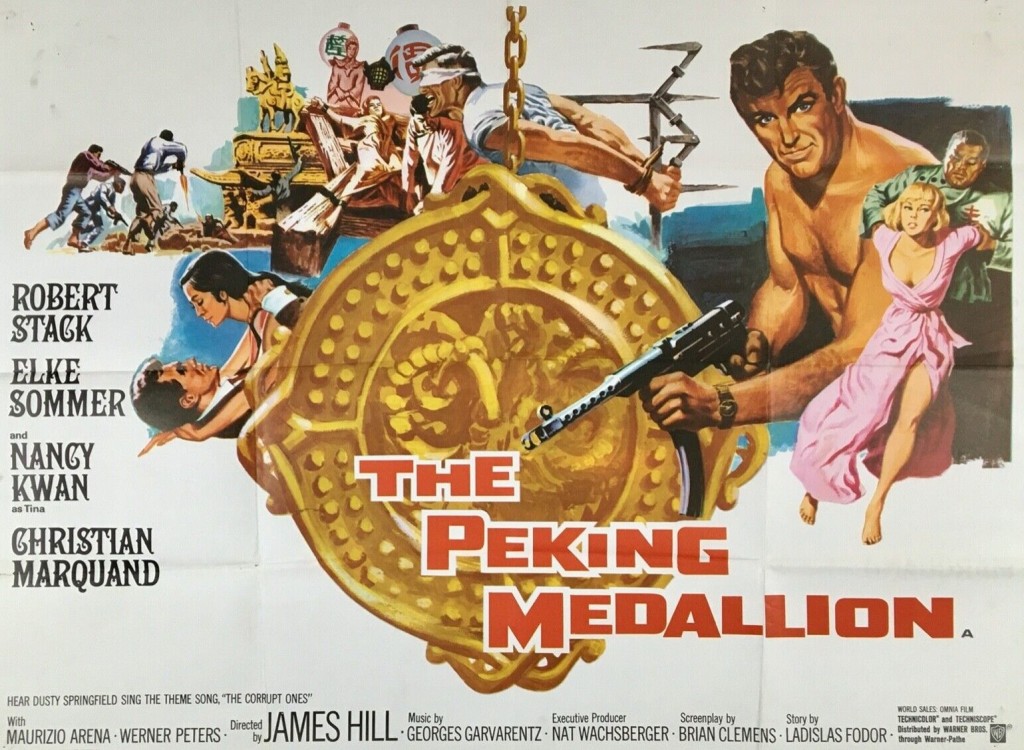
The Corrupt Ones / The Peking Medallion (1967) ****

Non-stop action as spy Cliff Wilder (Robert Stack) battles a variety of crooks in Macao on the Chinese border as they seek to recover the legendary Peking medallion. Wilder hails from the James Bond school of espionage, duty bound to kiss every girl he meets. He might wonder at their compliance until he realizes they are only after his knowledge of the missing medallion.

The violence is criminally brutal – punch-ups, gunfights, samurai swordfights, murder and torture by blowtorch and acid and being dragged behind a motorboat. The string of sexy women is matched by handsome men, Brandon (Christian Marquand) and Danny (Maurizio Arena) in addition to Stack. The thriller pitches helter-skelter through nightclubs, casinos, caves, temples and palatial mansions, the pace only slowing down for, naturally, a scene in a stately rickshaw.

As well as Wilder who briefly – and unknowingly – has the medallion in his hands, others in the hunt include Lilly Mancini (Elke Sommer), wife of Danny who had passed it to Wilder before being killed. Mancini is on the wrong side of the femme fatale equation. Once Wilder  is wise to her seductive charm,s he quips, “Maybe you’re telling the truth but I can’t trust you.”

Also in hot pursuit are gangster Brandon and a Chinese mob headed by Tina (Nancy Kwan) That’s on top of a corrupt cop (“I have never feared death, only poverty” is his mantra) who doesn’t care who wins the prize as long as he gets his share. Double cross is the order of the day, alliances forged then broken. The action never stops long enough for one of those tension-building scenes of which Alfred Hitchcock or imitators like Stanley Donen (Charade, 1963, and Arabesque, 1966) were so fond.

Wilder faces danger with a quip, a kiss or gritted teeth, an old-fashioned tough guy without the James Bond self-awareness. He carries out his manly duties until his brain kicks in and he realizes this isn’t a spy picture after all but a genuine treasure hunt with clues that have to be deciphered. After that, the pictures sidetracks down another route. For a moment, the movie seems to have lost the plot. But then all hell breaks loose and we are back on the safe ground of fistfights, double-crossing and shooting.

Fans of improbable storylines, exotic settings, action, interesting bad guys and twists and turns will love this. How can you fail to love a movie with a samurai vs camera tripod swordfight?

An exemplary cast for this kind of malarkey, a French-Italian-German co-production with English as the mother tongue. Scarcely creditable that Robert Stack, in his biggest picture since The Untouchables tv series (1959-1963), was once Oscar-nominated given subtlety is never required. Nancy Kwan (The World of Suzie Wong, 1960) steals the show as the villainess but she’s run close by Elke Sommer (The Prize, 1963). In supporting roles are Werner Peters (Istanbul Express, 1968) and Christian Marquand (The Flight of the Phoenix, 1965).  

Might seem a considerable change of pace for director James Hill after Born Free (1966) but that’s only if you ignore his work on the equally complicated A Study in Terror (1965).  Screenplay punched out by Englishman Brian Clemens (And Soon the Darkness, 1970), Hungarian Ladislas Fodor (best know for the Dr Mabuse series) and Harald Bloom, his only known credit.

Great fun.

PREVIOUSLY REVIEWED IN THE BLOG: Robert Stack in Is Paris Burning? (1966); Elke Sommer in The Prize (1963), The Art of Love (1965), The Money Trap (1965), The Oscar (1966), The Venetian Affair (1966), Deadlier than the Male (1967), They Came to Rob Las Vegas (1968) and The Swiss Conspiracy (1976); and James Hill’s A Study in Terror (1965); Nancy Kwan in Tamahine (963), Fate Is the Hunter (1964), The Wild Affair (1965).

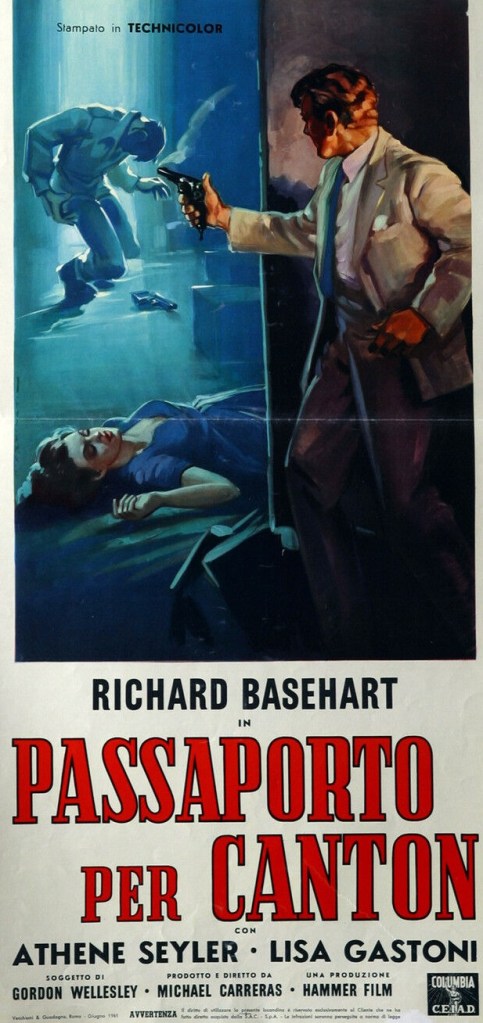
Passport to China / Visa to Canton (1961) **

Marked down for sheer laziness. Another Hammer “thriller,” this time with fading American star Richard Basehart and Italian glamor puss Lisa Gastoni. But mostly a hodge-podge travelog of stock footage with dialog taking the place of action, a tedious voice-over far removed from the snappy one-liners we are accustomed to getting from Chandleresque investigators. And let’s forget the red-eyed Chinese replete with drooping moustaches who pepper the picture.

A plane has gone down in Red China with an American courier carrying vital “scientific” information, Approached to help by US government personnel, snappily-dressed Hong Kong travel agent Benton (Richard Basehart) refuses. But when he discovers the pilot is Jimmy (Burt Kwouk), a member of a Chinese family he has befriended during World War Two, he mounts his own rescue mission. Which consists, by the way, of nothing more than floating a sampan up a river, avoiding a few bullets and whisking the lad away.

But he is blackmailed into rescuing the courier when Hong Kong police imprison Jimmy. So off he trots to Macao and then Canton aided along the way, in the opulent back room of a casino, by Chinese businessman Kong (Eric Pohlmann) who you might mistake for a James Bond villain such is his fondness for being surrounded by women – or such is his girth mistake him for a Robert Morley lookalike. Kong happens to be a Russian spy.

No sneaking into China by parachute or perhaps motor boat is required, Kong simply furnishes him with the visa of the title. Benton, vaguely assisted by a maker of fake porcelain, has clues –  Three Fishes, The Stream of the Willows.

In his hotel bedroom sits the courier, blonde Lola (Lisa Gastoni), held prisoner. But no sooner have they kissed, as you might expect of any self-respecting travel agent doubling as a spy, than they are interrupted by Kong. She disappears. Naturally, Benton finds her easily enough. She doesn’t have papers, instead a photographic memory.

But she’s not working for the Americans. She’s an espionage freelance, working for the highest bidder. She does it for the danger, perhaps like a certain James Bond, danger is the drug, heightens her senses.

But she’s also pretty damn clever. Knowing Kong is a double agent and can’t just snatch her out of China, she starts an auction for her information. Benton offers more. Therefore she is his property. To get over the tickly issue of Kong, in revenge, keeping her prisoner in China, he is conveniently accidentally shot.

So now they have to escape. But in the shoot-out at the docks (in a barn full of hay for some reason she gets shot) so the movie suddenly turns into one of those post-Bond thrillers where all that effort has been expended for no result.

But you might have thought a producer (Michael Carreras) would have introduced Lola much earlier in femme fatale fashion. But then this producer who, as it happens was also the director, seems to think that voice-over will solve all the tedious problems of actually creating a screenplay that works.

You shouldn’t have cared less about a snappy-suited character such as the one played by Gene Barry in his informal espionage trilogy – Maroc 7 (1967), Istanbul Express (1968) and Subterfuge (1968) – he’s about on a par as an actor as Basehart. But those movies at least had proper stories that made sense and were not just a series of jumps explained by voice-over, the hero neither having to undertake any shamus digging or go into harm’s way, or battle his way out of perilous situation.

It’s not even bad enough to eventually win over a cult audience. The problem is it’s well-made up to a point and the story is intriguing up to a point, but that mark is very low.

Richard Basehart (The Satan Bug, 1965) isn’t called upon to do much except act as the storyteller he’s okay and Lisa Gastoni (Maddalena, 1971) isn’t accorded sufficient screen time to really make a mark. Which is the biggest shame because an amoral spy like her would have made a brilliant femme fatale had she been introduced early on and then turned out to be the mercenary she was.

The rest of the cast are caricatures, though interesting to see Burt Kwouk in pre-Pink Panther persona but cringe-worthy to see Bernard Cribbins (You Must Be Joking, 1965)  mangle a foreign accent. Clearly Carreras learned a lesson from this implosion of talent and story because two pictures on he directed taut thriller Maniac (1963).  

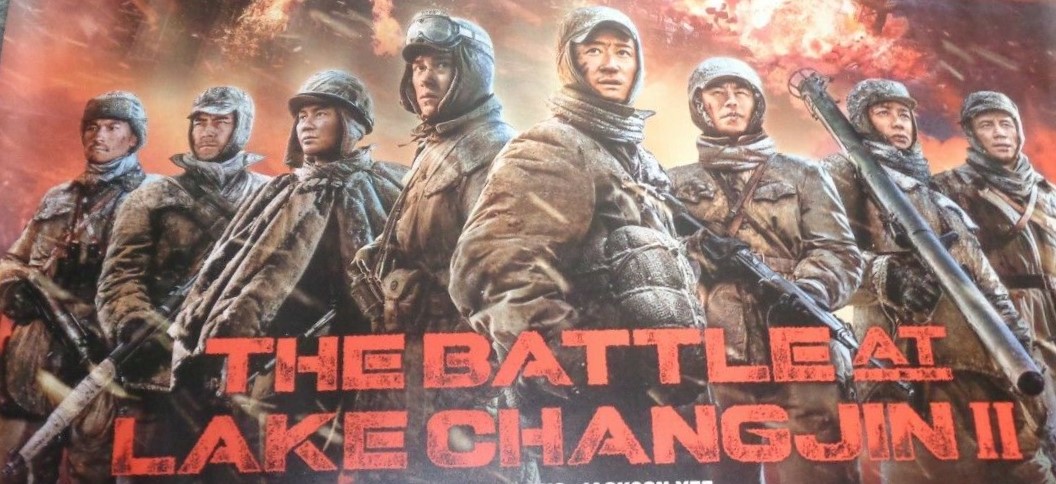
The Battle at Lake Changjin II / Water Gate Bridge (2022) **** – Seen at the Cinema

A raw visceral cinematic experience. After defeating superior American forces at Lake Changjin at the start of the Korean War, Chinese soldiers must prevent their retreat – and the arrival of reinforcements – by blowing up the Watergate Bridge in a blizzard. The bitter winter conditions, making it impossible to see more than a few yards ahead as the troops cross a mountain, freeze their weapons, compass and radio batteries. The assault is uphill over exposed ground.

This is non-stop battle told from the perspective of the grunts. Exposition regarding characters is minimal. That first hour or so in most Hollywood war movies where little happens except to build tension between participants and explore romantic elements is eliminated here. It’s all battle, beginning, middle and end, with no respite, brutal, bloody, horrific. The Americans have tanks, flamethrowers  and airpower, the Chinese don’t, so they are strafed, burned and blown up.

Setting aside politics and propaganda, and the questions of historical accuracy that haunt all war pictures, this is the most extraordinary on-the-ground combat as the Chinese seek to employ various strategies against another superior force, knowing U.S. reinforcements are on their way, and the defending Americans seek to suck them into a trap.  The fighting is intense, sacrifice the order of the day.

Best performances are delivered by brothers Wu Qiangli (Wu Jing), commander of the seventh company, and the undisciplined Wu Wanli (Jackson Lee) who grows up during battle. While emotions are necessarily reined in, no time for showboating here, intensity of feelings are still revealed, several wordless scenes between disparate characters show everything with just the eyes. As with all war pictures, comradeship under fire is all that matters, the connections between the band of brothers no less applicable here than when  William Shakespeare invented the phrase.

Like the best war films, strategy is vital. Here, the Chinese employ a variety of diversionary tactics while attempting to destroy key American positions, the HQ, the pump room. There are some brilliant battlefield observations. The Chinese work out the Americans have positioned their forces twenty meters apart because in between are their military supplies, so these are also targeted via mortar rounds. But basically it is scrapping for position inch by inch.

And this is not a film devoid of irony. Using captured American weapons, the Chinese, unable to read English, fire an ineffective piece of artillery against a tank. Seizing the HQ, the Chinese, unable to speak English, ask for the commanding office while the Americans, unable to speak Chinese and intent on surrender, respond they are unarmed, the matter resolved by an explosion. A flamethrower burning to death a wounded soldier melts the ice sufficiently for his companion to slide downhill to safety. And there are rare bursts of humour, one soldier preferring to chew “plastic” – captured chewing gum – in preference to beans so frozen they could chip your teeth.

This is as much a picture about the effect of war, and special effects show the impact of not just the destructive power but the energy imparted by exploding bombs, the part played in dismembering soldiers by the metal and stone of the defences, the flamethrowers that turn men from walking one minute to charred skeletons the next.

There are occasional cuts to the American high command, General Douglas Macarthur (James Filbird) attempts to persuade President Truman (Ben Z. Orenstein) to use the atom bomb. The Americans are not shown as idiots and there’s no upbraiding of their society and there is, among the carnage, at least one American hero in Bradley Bixler (Rudy van Gelderen). And there’s none of the bombastic or poetic influence of Apocalypse Now (1979) or The Thin Red Line (1998), no attempt to glamorize war, except of course that for the victors victory is always unforgettable. But the cost here is easily measured, the mortality rate enormous, at least two-thirds of the attackers died in the assault and in one company, out of 137 men involved, only one man was left standing.

I never saw the first film so I’ve no idea how this compares, but generally that movie got poor reviews, I guess as much to do with political stances as anything else. I suspect this picture will get as derisory a stack of reviews and, without taking sides, that would be unfair from a cinematic perspective because this is a wholly immersive encounter, with some brilliant action direction and stunning visuals in the main by Tsui Hark (The Taking of Tiger Mountain, 2104) with some assistance from the uncredited Kaige Chen (Farewell My Concubine, 1993) and Dante Lam (The Stool Pigeon, 2010).   

This is what comes of being an inveterate moviegoer and on those weeks when you have seen virtually everything else worthwhile on offer and still want to go to a movie, you end up seeing anything. Usually, this turns out to be some bedraggled horror picture or a lame rom-com like Marry Me (2022) but occasionally it means that you stumble across something exceptional.

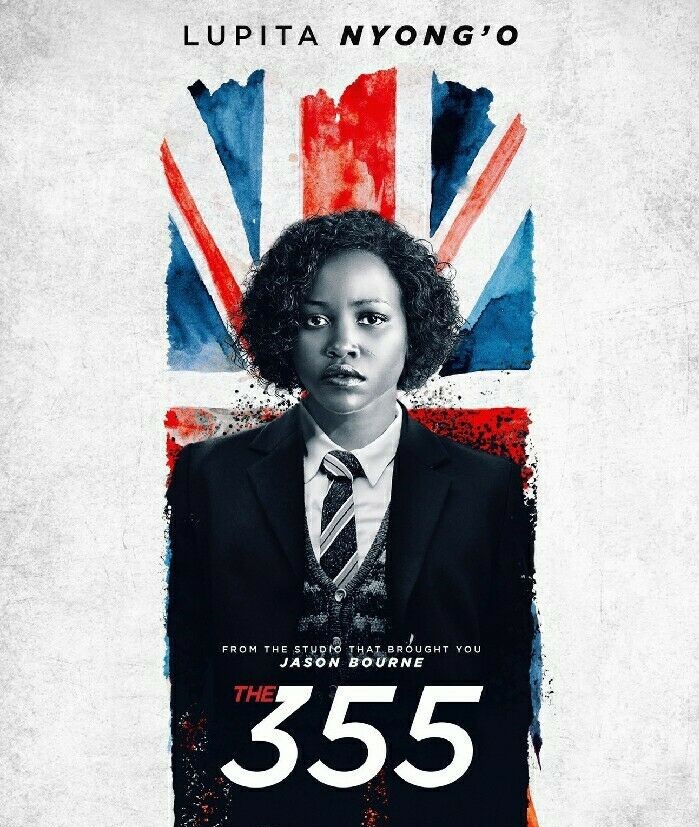
The 355 (2022) *** – Seen at the Cinema

Serviceable actioner but proof that if you don’t have a star big enough to front  a shoot-‘em-up then sticking in another three – or four – actresses of equal, middling, or up-and-coming, status won’t do the trick, not if the characters lack the originality of a Bourne or Bryan Mills (Taken, 2008). There’s plenty of bang for your buck, but the story hangs on the old trope of an electronic device that can blackout the world.

I am not sure why Jessica Chastain has never become a bigger box office star. She certainly has the kudos – two Oscar nominationss – and is not shy of taking on difficult subjects (Miss Sloane, 2016) and she’s certainly enjoyed the occasionally leg-up from a series (The Huntsman: Winter’s War, 2015; It Chapter Two, 2019) to boost her box office credentials. But her last venture into the action arena (Ava, 2020) was a box office flop, though possibly you could put the blame on the pandemic. By my count she has been the top-billed star (excluding her X-Men appearance) in her last eight pictures and none have been a hit.

Her presence in the credits would encourage me to stump up my money at the box office but apparently I am in the minority. I could say the same about Penelope Cruz (Parallel Mothers, 2021), the second biggest star here, and while she certainly retains top-billed status in her native Spain, otherwise she is occasionally a female lead but more likely a supporting player.

If I had been putting my money on anyone to take the action box office by storm it would be Diane Kruger who has the meanest stare this side of Lee Van Cleef. But she’s gone down this route to no commercial response before in The Operative (2019) and The Infiltrator (2016), neither fulfilling the promise she showed in Liam Neeson crackerjack Unknown (2011). Bingbing Fan, (Cell Phone 2, 2019) another X-Men alumni, has only recently achieved box office success, but in limited markets. Mexican Oscar-winner Lupita Nyong’o – here billed fourth and sporting a British accent – may well have the biggest fan base of the lot having clocked up appearances in three Star Wars pictures, taken top billing in Us (209) and third billing in Black Panther (2018).

But back to our story. On the run from the C.I.A. Mace (Jessica Chastain) teams up with Marie (Diane Kruger), a loner working for the German secret service, and Khadjiah (Lupito Nyong-o), a digital wizard formerly of the British secret service. Bing, who turns up later, represents the Chinese good guys. Graciela (Penelope Cruz) is the rank outsider, a therapist just caught up in the shenanigans. The action rattles through Paris en route to Marrakesh before a final stop in Shanghai. As you might expect, traitors lurk in various corners.

There are plenty shootouts and opportunities for the team to show off their hand-to-hand skills, but the action is slowed down by soap opera, having to spell out all the backstories of the principals, only one of whom, Marie, has anything worth listening to. Far be it for me to complain about too much emotion, but it took us over a dozen movies to learn anything significant about James Bond’s past, Bourne had no idea who he was, and at the other end of the scale Bryan Mills was so emotionally driven from the outset it formed the film’s core. Here, emotional quandary pops up when convenient. A bit of mystery would have helped more and cut a good 15 minutes off an overlong playing time.

As to the title, that is the only thing that is kept hidden to the end and when the revelation is made you realize it won’t mean a damn thing to the vast majority of the audience. As an origin story, I doubt the current box office receipts are sufficient to spawn future episodes. Which is a shame because having dumped all the emotional baggage in this picture, the characters could have focused more straightforwardly on action and story in the next.

The Shoes of the Fisherman (1968) ****

Thought-provoking drama with a surprisingly contemporary slant set against the grandeur of the Vatican amid geo-political turmoil. At a time of global crisis, dissident Russian archbishop Lakotov (Anthony Quinn) is unexpectedly freed from a labour camp by the Russian premier (Laurence Olivier). Arriving at the Vatican, he is promoted to cardinal by the dying Pope (John Gielgud) before becoming an unexpected contender for Papal office.

The spectacular wealth of the Catholic Church is contrasted with the spectacular poverty of China, on the brink of starvation due to trade sanctions by the United States, nuclear war a potential outcome. The political ideology of Marxism is compared to the equally strict Christian doctrine, of which Lakotov’s friend Father Telemond (Oskar Werner) has fallen foul. There is a sub-plot so mild it scarcely justifies the term concerning television reporter George Faber (David Janssen) torn between wife Ruth (Barbara Jefford) and younger lover Chiara (Rosemary Dexter).

Lakotov is drawn into the Russian-Chinese-American conflict and the battle for the philosophical heart of the Christian faith while bringing personal succour to the lovelorn and performing the only modern miracle easily within his power, which could place the Church in jeopardy, while condemned to the solitariness of his position.

The political and philosophical problems addressed by the picture, which was set 20 years in the future, are just as relevant now. The film’s premise, of course, while intriguing, defies logic and although the climax has a touch of the Hollywood about it nonetheless it follows an argument which has split the Church from time immemorial.

You would not have considered this an obvious candidate for the big-budget 70mm widescreen roadshow treatment, but MGM, after the Church not surprisingly refused access to the Vatican, spent millions of dollars on fabulous sets, including the Sistine Chapel. The roadshow version of the picture, complete with introductory musical overture and an entr’acte at the intermission, is leisurely and absorbing, held together by a stunning – and vastly under-rated – performance by Anthony Quinn (The Lost Command, 1966) who has abandoned his usual bombastic screen persona in pursuit of genuine humility and yet faces his moments when he questions his own faith.

Ruth has a pivotal role in bringing Lakotov down to earth but George has the thankless task, setting aside the quandaries of his love life, of talking the audience through the sacred ceremonies unfolding sumptuously on screen as the cardinals bury one Pope and elect another.

You wouldn’t think, either, that Hollywood could find room in such a big-budget picture for philosophical discussion but questions not only of the existence of God but whether he has abandoned Earth are given considerable scope, as are discussions about Marxism and practical solutions to eternal problems. None of these arguments are particularly new but are given a fair hearing. There is a hint of the Inquisition about the “trial” Telemond faces. Oskar Werner (Interlude, 1968) carries off a difficult role.

David Janssen (Warning Shot, 1967) is mere window dressing and Rosemary Dexter (House of Cards, 1968) mostly decorative but Barbara Jefford (Ulysses, 1967) is good as the wounded wife. Laurence Olivier (Khartoum, 1966) is the pick of the sterling supporting cast which included John Gielgud (Becket, 1964), Burt Kwouk (The Brides of Fu Manchu, 1966), Vittorio de Sica (It Happened in Naples, 1960), Leo McKern (Assignment K, 1968), Frank Finlay (A Study in Terror, 1965), Niall McGinnis (The Viking Queen, 1967) and Clive Revill (Fathom, 1967). In a small role was Isa Miranda, the “Italian Marlene Dietrich,” who had made her name in Max Ophuls Everybody’s Woman (1934) and enjoyed Hollywood success in films like Hotel Imperial (1939) opposite Ray Milland.

Michael Anderson (Operation Crossbow, 1965) directed with some panache from a script by veteran John Patrick (The World of Suzie Wong, 1960) and Scottish novelist James Kennaway (Tunes of Glory, 1960) based on the Morris West bestseller.

I found the whole enterprise totally engrossing, partly because I did not know what to expect, partly through Anderson’s faultless direction, partly it has to be said by the glorious backdrop of the Vatican and the intricacy of the various rites, but mostly from the revelatory Quinn performance. And even if the plot is hardly taut, not in the James Bond clock-ticking class, it still all holds together very well. From the fact that it was a big flop at the time both with the public and the critics, I had expected a stinker and was very pleasantly surprised.

55 Days at Peking (1963) ***

Imperialism is hard to stomach these days but at the start of the twentieth century it was rampant and as shown in this picture not just restricted to the main culprit, the British. China was Imperialism Central, round about a dozen nations including the USA and Russia claiming control of sections of the country or its produce. So they had all set up diplomatic shop in Peking. And the film begins with an early morning roll call of national anthems before this domination by outside interests in shattered by rebellion.

Just as hard to stomach, of course, was the movie mainstream notion in those days that all rebellions must perforce be put down regardless of how put-upon the peasant classes were. Audiences had to rally round people in other circumstances they would naturally hate. So one of the problems of 55 Days at Peking is to cast the rebels (known as Boxers) and the complicit Chinese government in a bad light while ensuring that those under siege are not seen as cast-iron saints. There’s no getting round the fact that the rebels are shown as prone to butchery and slaughter while the Chinese rulers are considered ineffective and traitorous.

Producer Samuel Bronston built his Peking set on a 250-acre site at a ranch 16 miles from Madrid, Spain, near the foot of the Sierra Guadarrama mountains. To ensure authenticity, a canal was enlarged to supply 15,000 gallons of water a day from a specially-prepared reservoir holding half a million gallons. Over 1.3 million feet of tubular steel – all the scaffolding available in Madrid, Barcelona, Seville and Valencia – was used in the set construction.

So it’s left to the likes of Charlton Heston as the leader of U.S. Marines stationed in the city to bring some balance to proceedings. “Don’t get the idea you’re better than these people because they can’t speak English,” he expounds. David Niven plays the British Consul trying to keep this particular league of nations onside while negotiating with one hand tied behind his back – “we must play this game by Chinese rules” – with the Chinese Dowager Empress (Flora Robson) while knowingly endangering his wife (Scottish actress Elizabeth Sellars, a one-time big British star) and two children. Ava Gardner is an unscrupulous Russian baroness with little loyalty to her home country.

To ensure journalists provided authentic coverage of the siege, press materials included a copy of the detailed map printed in the Saturday October 13, 1900, edition of British daily newspaper “The Times” and its account of the action. Producer Samuel Bronston claimed that some of the costumes worn by Flora Robson in her role as the Dowager Empress were actual ones worn by the empress and purchased from an Italian family who had connections in the Italian embassy during the siege.

The picture is one-part action, one-part politics and one-part domesticity, if you include in the last section Heston’s romance with Gardner, Niven’s guilt when his son is wounded in an attack and Heston’s conflict over a young native girl (Lynne Sue Moon) fathered by one of his own men who is then killed. Two of the best scenes are these men coping with parental obligation, Niven coping with a wounded son, Heston finding it impossible to offer succour to the child.

The action is extremely well-handled. The siege goes on longer than expected when the expected troops fail to arrive, tension rising as casualties mount and supplies fall low. As with the best battle pictures, clever maneuvers save the day. Two sections are outstanding. The first has Heston marshalling artillery to prevent the Chinese gaining the high ground. The second is a daring raid – Niven’s idea, actually – through the city’s sewers on the enemy’s ammunition dump. Personal heroism is limited – Heston volunteers to go 70 miles through enemy territory to get help but has to turn back when his men are wounded or killed.

The film was not released in 70mm roadshow in the United States as originally planned but like “El Cid” went straight into general release in a 35mm version. but it was seen in 70mm in Europe. Among suggested promotional activities were a “guess-the-flag” competition since 11 nations were involved. The tie-ins included a Corgi paperback, the original soundtrack by Dmitri Tiomkin and four singles – Andy Williams singing the theme song “So Little Time,” The Brothers Four with “55 Days at Peking” (also recorded by Kenny Ball and his Jazzmen) and Tommy Riley with “Peking Theme.”

There’s a fair bit of stiff upper lip but while Heston, in familiar chest-baring mode, has Gardner to distract him, Niven is both clever, constantly having to outwit the opposition and hold the other diplomats together, and humane, drawn into desperation at the prospect of his comatose son dying without ever having visited England.  Gardner moves from seducer to sly traitorous devil to angel of mercy, shifting out of her beautiful outfits and glamorous hats to don a nurse’s uniform, at the same time as shifting her outlook from selfish to unselfish. All three stars acquit themselves well as does Flora Robson in a thankless role.

This was the third of maverick producer Samuel Bronston’s big-budget epics after King of Kings (1961) and El Cid (1961) with a script as usual from Philip Yordan and directed by Nicholas Ray.

All in all it is a decent film and does not get bogged down in politics and the characters do come alive but at the back of your mind you can’t help thinking this is the wrong mindset, in retrospect, for the basis of a picture.

Many of the films from the 1960s are to be found free of charge on TCM and Sony Movies and the British Talking Pictures as well as mainstream television channels. This one I noticed is available on YouTube at the point where I was reviewing it. But if this film is not available through these routes, then here is the link to the DVD and/or streaming service.

Discover WordPress

A daily selection of the best content published on WordPress, collected for you by humans who love to read.

The Atavist Magazine

by Brian Hannan

WordPress.com News

The latest news on WordPress.com and the WordPress community.