Otto Preminger (Hurry Sundown, 1967) returns to his film noir roots (Laura, 1944; Whirlpool, 1950) for this crisply-told tale, mixing police procedural with psycho-drama, of a missing child who may the figment of her mother’s imagination. It’s beautifully filmed and for anyone brought up on modern cinema of short takes and the camera bouncing from one close-up to the next, it will be a revelation, as Preminger favors classic Hollywood style, long takes, in a single shot the camera often following a person in and out of several rooms, and equally classical composition, scenes containing three or four characters where everyone acts within the frame.
Single-mother Ann (Carol Lynley) turns up to collect her four-year-old daughter Bunny from her first day at a London nursery only to discover not just the child gone but nobody has any recollection of the child being there in the first place. That is, apart from the school cook (Lucie Mannheim), who promised to look out for the child but who has subsequently disappeared. Ann is anxious anyway because she is moving house and in her new apartment has an encounter with her creepy landlord Horacio (Noel Coward), a master of the innuendo and the casual stroke of the arm.
It’s a very English school with stiff-upper-lip not to mention snippy teachers. “We mustn’t get emotional,” school administrator Miss Smollett (Anna Massey) warns the distraught mother. Ann’s brother Steven (Keir Dullea), a journalist, kicks up more of a stink, arguing with staff, and with a very threatening manner. Things get creepier still. Upstairs, they hear voices but it’s just the school’s founder Ada (Martita Hunt) who records children talking about nightmares. Steven seems over-protective towards his sister, which is understandable, and somewhat over-affectionate, which is not.
Detective Superintendent Newhouse (Laurence Olivier) and sidekick Sgt Andrews (Clive Revill) investigate. He is an unusual cop. A university graduate but not of the excitable Inspector Morse persuasion for one thing, and reasonable to an irritating degree in that he keeps all his options open. But the cops are thorough, descriptions of the missing child issued, search of the premises and surrounding area undertaken. But it turns out there is no record of Bunny in the school ledger, no sign of her existence in the flat, and it transpires that as a child herself Ann had an imaginary companion called Bunny.
As Steven becomes more obstreperous and the intense Ann verges on the hysterical, not helped by the unwanted attentions of the landlord, a BBC performer with a melodious voice he believes irresistible to women and more than a passing interest in sadism, the case appears to be heading in the direction of a quick visit to a psychiatry ward. The usual anchor in these situations, the policeman, is not as definite as normal, Newhouse not pushing the investigation in a direction the audience will find acceptable, but largely standing back, as if yet to make up his mind, which adds to the sense of mystery.
Carol Lynley with the potential landlord from hell Noel Coward.
Preminger isn’t in the business of piling twist upon twist, but as these arrive in due course, the options they offer are even more psychologically damaging. And from setting off at a steady pace with everything apparently settled down by the steady superintendent, the minute he departs the scene, the story takes on a different dimension and there are three superb chilling scenes, one in hospital, another in a doll’s hospital and the last in a garden as the question of just who is unhinged becomes more apparent. There is certainly madness in the movie but it comes when you least expect it and from a direction you may not have considered. On another level, the world of children is entirely alien to the adult and the reconciliation between the two worlds impossible to bridge.
Preminger extracts a performance from Laurence Olivier (Khartoum, 1966) that cuts the character to the bone, eliminating many of the actor’s tropes and tics, but at the same time making him perfectly human, unable to resist, for example, a traditional school pudding, and finding ways to curb Steven’s excesses while comforting Ann. By controlling the actor who always exerts screen presence, Preminger makes him come across with even greater authority. It’s an achievement in itself to ensure that Olivier never raises his voice.
Carol Lynley (The Pleasure Seekers, 1964) is excellent as the distraught mother, one step away from losing her mind and Keir Dullea (The Fox, 1967) constantly raises the stakes. Noel Coward (The Italian Job, 1969) possibly does the best job of the lot, his normal high levels of sophistication eschewed in favour of the downright creepy. In supporting roles look out for Clive Revill (Kaleidoscope, 1966), Finlay Currie (Vendetta for the Saint, 1969), Anna Massey (De Sade, 1969) and Adrienne Corri (The Viking Queen, 1967). Pop group The Zombies featuring Rod Argent and Colin Blunstone put in an appearance.
Husband-and-wife team John Mortimer (John and Mary, 1969) and Penelope Mortimer (The Pumpkin Eater, 1964) wrote the screenplay from the besteller by Evelyn Piper. But it is most assuredly an Otto Preminger production. He has a surprisingly good grasp of British custom and character, shot all the movie on location, but in black-and-white so it is not dominated by the tourist London of red buses or red pillar boxes, and his probing camera and long takes are a marvel for any cinematic scholar.
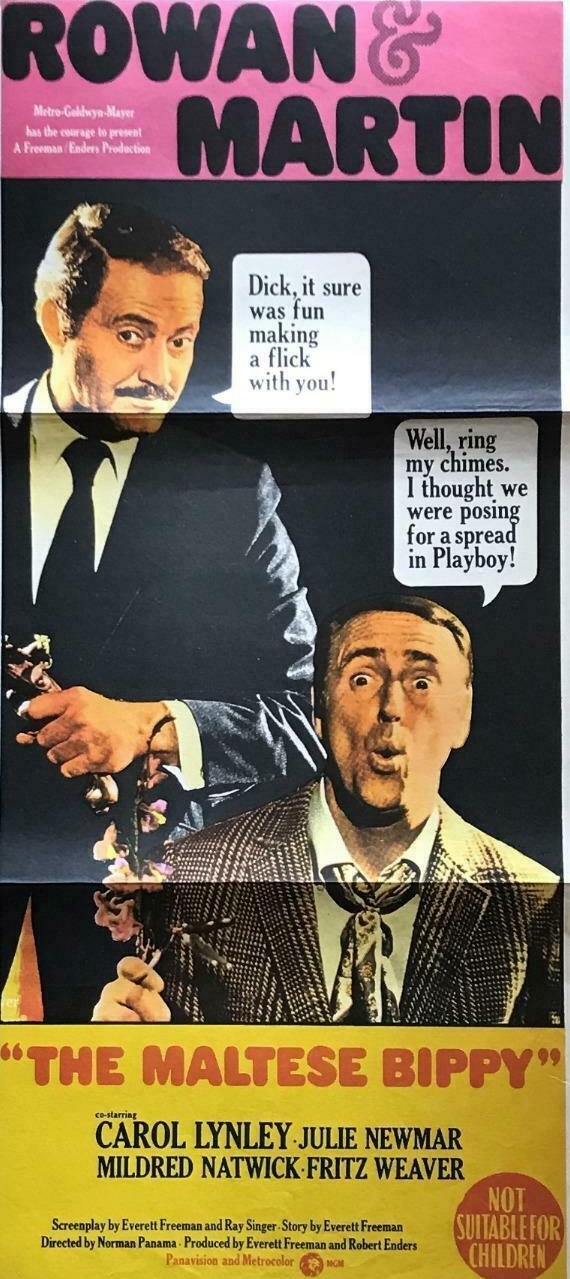
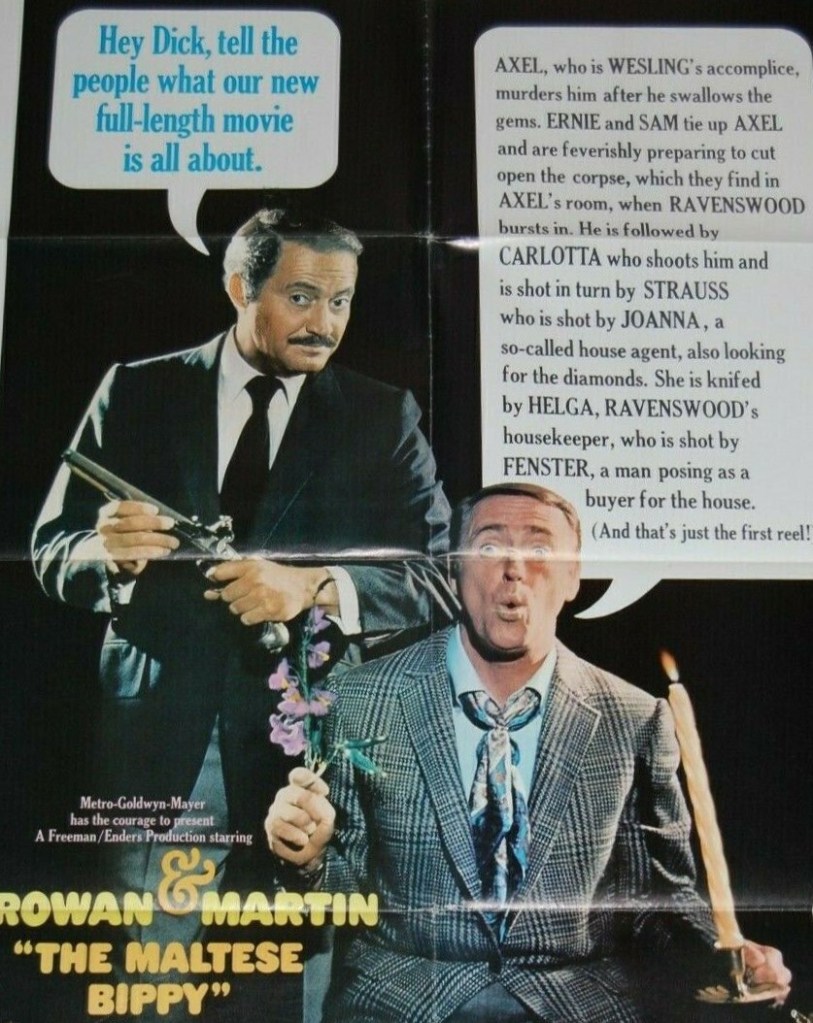
The start is promising. Three decent laughs in the first three scenes, all jests at the expense of Hollywood. But when the movie settles down to a werewolf spoof, there’s a nary a chuckle to be found. It was rare in the 1960s for television shows to be given a big-screen outing, but it did occasionally happen. This came two years into the six-year run of Rowan and Martin’s Laugh-In television show, an innovative mixture of gags, punchlines and sketches stitched together in random fashion. A huge hit in the U.S., it was considered a slam dunk to turn it into a movie. Perhaps if they had stuck to the same format it might have worked.
Sam Smith (Dan Rowan) and Ernest Grey (Dick Martin) are down-on-their-luck soft-porn movie makers living in a mansion on the edge of a cemetery. After suffering a bite on the neck, Dick turns into a werewolf. You can see the comic possibilities, I’m sure. Either Rowan and Martin failed to find them or lacked the expertise to turn the material into laughs. Sure, there’s a creepy family, the Ravenswoods, next door who could be auditioning for The Munsters but that goes nowhere except the obvious and certainly not in the direction of laughs.
A few good actresses – Carol Lynley (Danger Route, 1967), Julie Newmar (Mackenna’s Gold, 1969) and Mildred Natwick (Barefoot in the Park, 1967) – were snookered into this alongside Fritz Weaver (To Trap a Spy, 1964) without hope of redemption. It was almost as though the picture was conceived as a piece of merchandising that Rowan and Martin just had to put their names to and not do much else.
It was strange it was so awful because director Norman Panama had a track record in comedy. Among other pictures he had made The Court Jester (1955) starring Danny Kaye – “the vessel with the pestle” – displayed an abundance of great comic timing and in some respects was a spoof of the historical genre. He had also directed Bing Crosby and Bob Hope in The Road to Hong Kong (1962) so you would expect him to be familiar with the workings of screen comedic partnerships.
The laughs were meant to be supplied by Everett Freeman (The Glass Bottom Boat, 1966) and Ray Singer, a specialist in television sitcom and creator of Here’s Lucy (1968-1974). But either they couldn’t come up with sufficient gags or Rowan and Martin’s delivery was out of key with the lines. Or something.
Maybe nostalgia was what was missing from my viewing of the picture. I don’t recall holding any particular affection for the television show, though I was aware it provided a star-making platform for performers like Goldie Hawn (Cactus Flower, 1969), Judy Carne (All the Right Noises, 1970) and Lily Tomlin (Nine to Five, 1980) and that John Wayne put in a guest appearance.
But don’t take my word for it. Variety called the picture “as zany and fast a funfest as has come down the pike in years” and a “ cinch for heavy box office reception.” Mainstream critics were less kind, four out of the most prominent five giving unfavorable reviews. Even though the stars made the cover of Life magazine and the film received a seven-page spread inside, the movie barely made a ripple with audiences, a total of just $22,000 garnered in its opening week in two cinemas in New York with a total capacity of over 2,000 seats. British kids film Ring of Bright Water made more at a 360-seater.
The expected audience did not materialize, either from poor word-of-mouth or because customers resisted paying for something they could get for free every week on the small screen. So poorly did it perform that its initial run was truncated and a few weeks later when it went wide in a Showcase opening in New York MGM stuck on a reissue of Grand Prix (1966) as the support. Variety estimated it barely took $1 million in rentals (the amount returned to studios once cinemas take their share of the box office). Final proof of its unpopularity was being sold to television a couple of months after its debut.
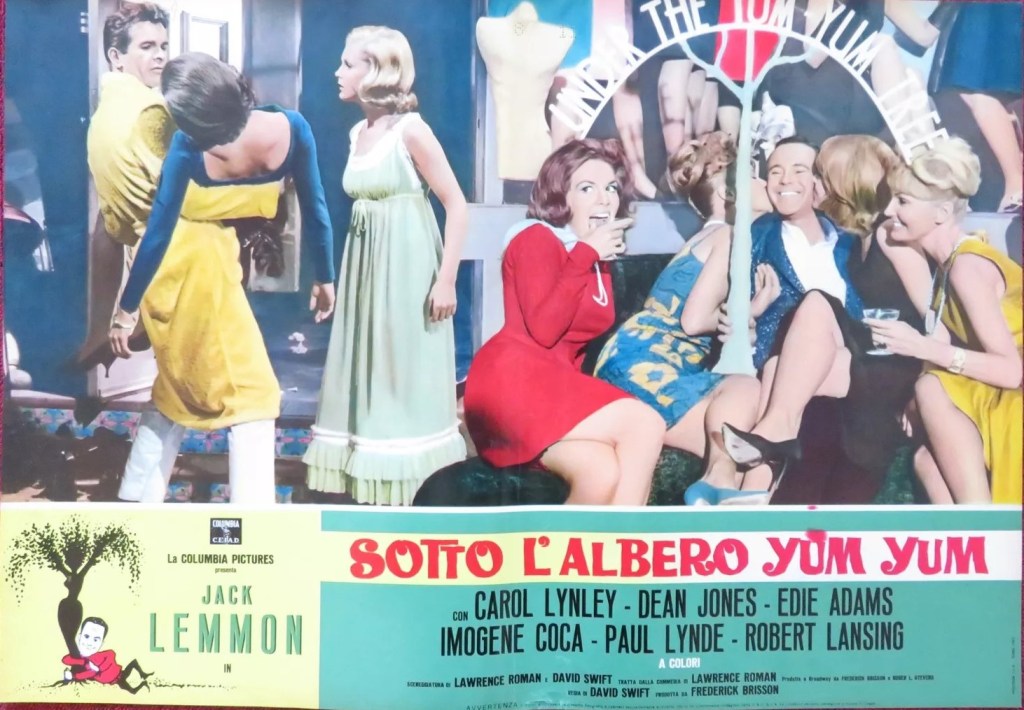
Must have seemed a good idea at the time. A switcheroo from The Apartment (1960), where Jack Lemmon is the sap caught in middle of illicit affairs, to setting him up as the ace seducer with a string of girls at his beck and call. Except this won’t wash for contemporary audiences given that, effectively, he’s a sexual predator (seducer if you want to be nice about it), peeping tom (no way to dress that up) and eavesdropper (could have taught a class in The Conversation, 1974). He lets out plush apartments to beautiful girls who either pay no rent or very low rents in return for favors granted.
He uses his own key to let himself into apartments and he’s got a telescope at the ready although that’s hardly required since all the ladies leave windows and doors open permitting him to gawk whenever he wishes.
Luckily, he’s not the mainstay of the tale. Nope, that’s breaking down another barrier, and very cleverly for the times. At this time, sex on the screen was usually the result of illegitimate affairs, involving at least one husband or wife, or it was a sex worker by any other name (Elizabeth Taylor in Butterfield 8, 1960, expects presents in lieu of cash). The idea of living in sin, as it used to be called, i.e. cohabiting without a marriage licence, was not generally on the cards.
So the deal here, to get round the snippy censor, was that Robin (Carol Lynley) and Dave (Dean Jones) set up home together to test out their compatibility but without sex entering the equation, him sleeping in a separate bed. Their apartment is let out by Hogan (Jack Lemmon), the predatory landlord. He has just been dumped by Robin’s aunt Irene (Edie Adams), hence the vacancy, and believes it’s two beautiful women moving in, not a couple. So his plan to offer two damsels a romantic meal with candles and violins (these play automatically) and a roaring fire (also electronic) falls apart.
That doesn’t prevent him from using his own key to enter the apartment at inappropriate moments and continuing his ardent wooing while trying to get rid of Dave or cause the kind of ruckus that’s going to cause the boyfriend to quit, leaving the coast clear.
Luckily, which gives the movie some acceptable life of its own, the dodgy landlord aspect takes second place to the lust vs logic argument that’s intrinsic to the idea of marriage. The couple spend most of the time arguing, and the movie is quite specific, much more than you might expect, on the ways in which a lusty young fellow can keep his ardor in check.
It’s based on a stage play, of the farce kind, so it relies on misunderstandings and misalignments and finds various ways of getting various combinations of the trio (and occasionally a quartet when Irene returns) in the room at the same time. There’s the usual problems when exchanges get heated.
Lurking in the background are married housekeeper Dorkus (Imogene Coca) and handyman Murphy (Paul Lynde), at opposite ends of the approval scale, the man even creepier than his employer.
Previously, I hadn’t found Jack Lemmon’s schtick so wearing, but his acting style is so frenetic you wonder how it ever found expression except in madcap comedy. It’s not just that his jaw constantly drops, but his eyebrows go up at the same time, and he might even be chucking in that trademark cackle. He toned it down for Days of Wine and Roses (1962) and jacked it up for The Great Race (1965) and somehow anything in between doesn’t quite work unless he’s got Billy Wilder on his tail.
But there are several pluses here. Carolyn Lynley (Bunny Lake Is Missing, 1965) proves an adept comedienne and Dean Jones was clearly in rehearsal for his later Disney pictures like The Love Bug (1967). Imogene Coca had been a legendary television staple, with her own show in the 1950s. There are fleeting glimpses of Bill Bixby (The Incredible Hulk, 1977-1982) and Variety columnist Army Archerd and James Darren (The Guns of Navarone, 1961), who died recently, sings the title song, and has a more robust voice than I had assumed for a pop singer.
David Swift (The Interns, 1962) directed and co-wrote the script with Lawrence Roman (The Swinger, 1966) from the latter’s Broadway hit.
A film of two halves. You can only cringe at the attitudes on display but enjoy the pre-marital ding-dongs between the couple.
Too many hidden secrets turn this into a Peyton Place of a western. When the final unexpected zinger strikes home the movie has nowhere to go and undercuts the climax. Director Robert Aldrich also lets Kirk Duglas off the leash so there’s too much of him festering to put the outcome in any doubt. Strangling a vicious dog with your bare hands is usually a sign of heroism but here it just undermines Douglas’s character.
Wanted murderer O’Malley (Kirk Douglas) has skipped to Mexico away from the long arm of the American law. Nonetheless, lawman Stribling (Rock Hudson) is in pursuit, presumably hoping to kidnap him and drag him back over the Rio Grande into U.S. jurisdiction. The story, in a major narrative flaw, finds another way to head O’Malley north.
Anyways, O’Malley is in Mexico not just to escape, but for a more sentimental reason, he wants to hook up again with first love Belle (Dorothy Malone). The fact that she’s married to limping ex-Confederate soldier Breckenridge (Joseph Cotten) appears to make no difference. And when O’Malley strikes up a deal to help Breckenridge drive his herd of cattle to Crazy Horse, a town over the Rio Grande, he tells the husband of his romantic intent.
This would usually spell trouble except the narrative conveniently disposes of the husband. However, by this point the lawman has also thrown his hat into the romantic ring, having signed up to become trail boss. You can see the logic in Stribling’s decision. If O’Malley’s heading in the right direction then it makes it easier for Stribling to get him over the border.
What doesn’t make any real sense is Breckenridge’s hiring of O’Malley in the first place, or the deal the outlaw negotiates. O’Malley would go along in any case for a meal of beans a day just to keep track of Belle who’s the appointed cook for the ride. Instead, and with no cattle herding skills in evidence, he manages to get Breckenridge to agree to give him one-fifth of the herd as a bonus in addition to the normal pay of a dollar a day. Although the audience has already guessed O’Malley’s romantic purpose, he spells it out to the rancher, “I want your wife” the rider to the deal.
O’Malley takes little notice of Belle’s diffidence. The man who was once an enticing prospect to an inexperienced young girl is now presented in a different light. “You carry your own storm wherever you go,” she tells him. She no longer has a hankering to end up just “a survivor,” not convinced by his plan to settle down with the money from the sale of his share of the herd.
As usual, the trail ride has sufficient incident – lightning storm, stampede, a brush with Native Americans, saloon gunfight, a trio of no-goods hitching a ride, a sighting of St Elmo’s Fire and that old trope quicksand – to keep the story moving without the love triangle and what actually turns out to be a revenge tale.
The story takes some unexpected turns. Stribling is a pretty efficient cowboy, seeped in western lore, knows how to keep a herd in shape. He heads off a marauding tribe by trading some of the herd, in compensation for the innocent man O’Malley instinctively shot dead. Belle needs to kill a man to defend herself. And O’Malley, romantic ambitions thwarted by Stribling, starts wooing Belle’s daughter Missy (Carol Lynley) who, no surprises there, reminds him of Belle at a younger age.
As the secrets come spilling out, it becomes apparent that O’Malley has seduced Stribling’s sister whom the outlaw disses as an easy lay – “your sister was a free drink on the house” – and more importantly that his sister has hung herself after O’Malley killed her lover. Double revenge, I guess, to steal Belle and take O’Malley back to face justice.
You might have wondered how Belle ended up with Breckenridge in the first place and it’s not the soldier-wounded-in-battle routine. It’s because he made an honest woman out of her after – or maybe before – Missy was born out of wedlock. And when Belle sees how serious Missy is about O’Malley she reveals that he’s the father. Leaving O’Malley to do the right thing and not load his pistol when he heads for his shoot-out with Stribling once they have crossed the Rio Grande.
The ending smacks of star redemption. Kirk Douglas can play a mean guy better than most and he’s got no problem being tagged an outlaw but to lose a shoot-out would render him the loser whereas noble sacrifice turns him into some kind of winner. That notion doesn’t take into account that Stribling was guaranteed to win the shoot-out anyway since O’Malley’s weapon of choice is the Derringer, ideal for shooting someone standing right next to you, not a lot of good in a shoot-out where your opponent is twenty feet away.
The narrative twists and turns enough to keep you interested but with every secret revealed the flaws are only too apparent. Rock Hudson (Seconds, 1966) wins the duel of the big stars, a wider range of emotions on show but as tough as his rival and with western skills to boot. We’ve seen this brooding Kirk Douglas (The Arrangement, 1969) too many times before. Dorothy Malone (who had partnered Hudson in Douglas Sirk number The Tarnished Angels, 1957) is good as the woman who knows her own mind. Joseph Cotten (The Oscar, 1966) probably signed up not for the chance to show off his limp but for the scene in the saloon where his myth of Civil War heroism is cruelly exposed. Carol Lynley (Bunny Lake Is Missing, 1965) convincingly transforms from dutiful daughter with a Disney-esque affinity with animals to woman.
Robert Aldrich (The Flight of the Phoenix, 1965) looks hamstrung by the Dalton Trumbo (The Fixer, 1968) script based on the novel Sundown at Crazy Horse by Howard Rigsby.
If the producers had not signalled Bond-style ambitions with a big credit sequence theme song by Anita Harris, moviegoers might have come at this with more fitting expectations in the Harry Palmer and John Le Carre vein. So although slipping into the late decade spy boom flourish don’t expect villains planning world domination, gadgets or a flotilla of bikinis.
Seth Holt’s bread-and-butter espionage thriller sets government agent Jonas Wild (Richard Johnson) – on his “last assignment” no less after eight licensed murders in five years – to kill off a defector in the far from exotic location of a Dorset country house not realizing that he is also being set up. That his liquidator will be a woman puts the mysterious Mari (Barbara Bouchet) in pole position.
Wild gains access to the heavily-guarded mansion by seducing housekeeper Rhoda (Diana Dors) but after completing his mission is captured and tortured by Luciana – pronounced with a “k” – (Sam Wanamaker) who explains he is a patsy and that there is a mole in M.I.5. When his boss Tony Canning (Harry Andrews) disappears and another friend is murdered, Wild goes on the run with Mrs Canning (Sylvia Syms) and eventually makes his way back to his bolt-hole in Jersey to solve the mystery.
There is a decent amount of action, including a fight with a guard dog and a battle on a fog-bound yacht. Clever maneuvers abound – a bug is planted in a bandage. Treachery is always just round the corner and there is no shortage of suspects.
The film’s down-to-earth approach is somewhat refreshing after half a decade of spy thrillers and spoofs. Wild doesn’t employ anything more hi-tech than masquerading as a brush salesman to win over Rhoda. And although that relationship ends up in bed, there is no sex, Wild having drugged her to avoid that complication. Tony Canning is nagged by his wife. Wild’s girlfriend (Carol Lynley) is a sweet girl, sexy in a languid rather than overt fashion. And Luciana takes enormous pride in telling Wild just how stupid he has been.
But that comes with a caveat. The plot doesn’t quite hang together and the movie sometimes fails to connect.
That said, Johnson (Deadlier than the Male, 1967) is excellent, quite an accomplished actor rather than a brand name. Both Barbara Bouchet (Casino Royale) and Carole Lynley (Harlow, 1965) play against type while Sylvia Sims (East of Sudan, 1964) and Harry Andrews (The Hill, 1965) present variations to their normal screen personas. Sam Wanamaker (The Warning Shot, 1967) has a peach of a role and Gordon Jackson (The Long Ships, 1964) and Maurice Denham (The Long Duel, 1967) are afforded small but critical parts.
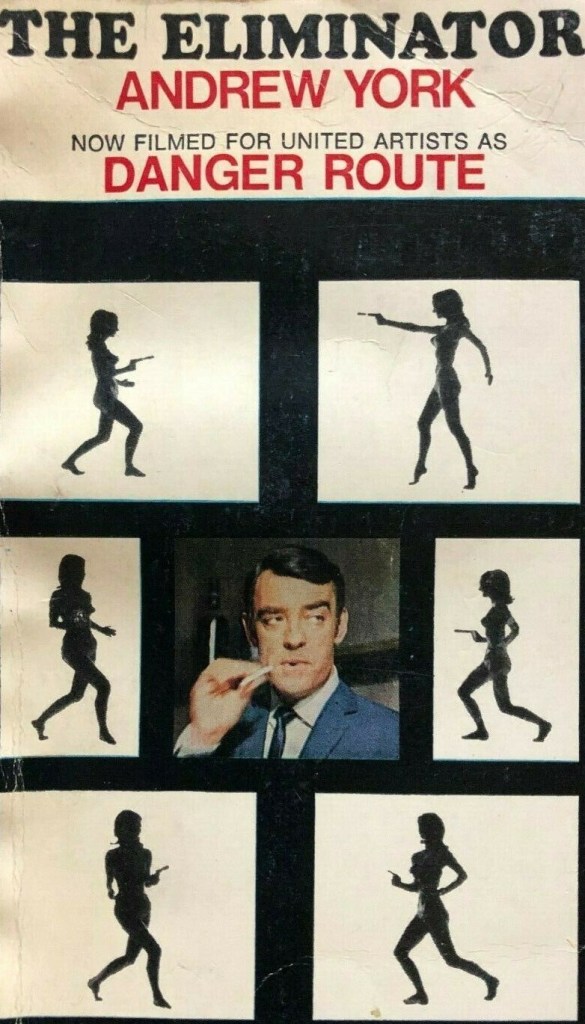
Seth Holt (Station Six Sahara, 1963) directs from a script by Meade Roberts (In the Cool of the Day, 1963) and Robert Banks Stewart (Never Mention Murder, 1965) based on the bestseller by Andrew York.
The Stuart Whitman (The Mark, 1961) retrospective sees another great performance as an inmate in a mental institution but perhaps put in the shade by Roddy McDowall (5 Card Stud, 1968) as a murderous gardener and Lauren Bacall, in her first movie in five years, as a psychiatrist in the Nurse Ratchet mold.
Though killing his wealthy boss earns Martin (Roddy MacDowall) a return to the mental asylum, the dead woman’s executor Harley Manning (Judson Laire) believes the gardener is faking it and has hidden a million dollars he says he burned. So Manning hires actor Dale (Stuart Whitman) to fake insanity, thus gaining entrance to the institution and finding out whether Martin is pretending.
Dale is pretty good at the mad act and appears initially to fool resident psychiatrist Dr Beighley (Lauren Bacall). On the other hand, he is sane enough to develop a relationship with another inmate Cynthia (Carol Lynley) whose rejection of men is equally an act.
Turns out Beighley is not fooled by either Martin or Dale. The former she takes under her wing, hoping to discover for herself the missing million bucks, the latter she had sussed out from the start, pointing to the obvious flaws in his role playing. She has a bunch of nasty medicines up her sleeve and when that doesn’t pipe Dale down she has the recourse of sending him in for electric shock treatment.
That doesn’t seem to go so far as the lobotomy in One Flew over the Cuckoo’s Nest (1975) but it renders our hero helpless, or put him out of the picture long enough for her to engage in her unscrupulous scheme of hypnotising Martin to get to the truth.
In reality, this isn’t so much an expose of the goings-on in mental hospitals so much as portrait of femme fatale going overboard. You might think Beighley would be better off getting treatment herself rather than dishing it out so deluded is she in convincing herself that Martin is sane. And there’s an absolutely fabulous pay-off in that department.
For the rest of it, she is the antithesis of the liberal psychiatrists we have mostly seen during this decade, the ones that try to find the good in their patients, helping them along to sanity, or at the very least getting them to understand the depth of their problems. That Beighley and Dr Fleming in Signpost of Murder (1964) conspire to give psychiatrists a bad name is an anomaly when mostly, as with The Mark (1961), they are of an encouraging rather than venal disposition.
Perhaps it was the very nature of the gentle psychiatrist as depicted in Hollywood that gave vent to movies that showed the darker side of the mental institutions where inmates are not only robbed of their freedom but are powerless to prevent being treated either as guinea pigs or being drugged to just shut them up or lobotomised to rid society of their unnerving instincts.
That said, seeing the patients strapped down in gurneys or incapacitated in other ways while the psychiatrist plays God is pretty strong stuff, even viewing it now nearly sixty years later. Some of the other inmates are cliché material, but by concentrating on the three characters with charisma, the enigmatic gardener, the actor attempting to put on the performance of his life and the charming duplicitous psychiatrist there’s enough meat for an entertaining drama with a powerful twist.
Of course, one of the tropes of any prison drama is that someone is innocent of their perceived guilt, and here only Dale really fits that bill, but equally since the rules relating to incarceration in this facility differ entirely from those of a prison, there is every chance that someone sane could be locked up for ever, especially if a powerful psychiatrist deems it so.
Stuart Whitman certainly plays around with his screen persona, the dandified actor entrancing a courtroom and police station with his performance, but fooling them proves easier work than duping the psychiatrist so there’s a couple of great scenes where he realizes this could be a trap of his own making – and there’s a twist in his tale, too. You might well accuse Roddy McDowall hamming it up, but actually, although he appears extrovert in fact he is introverted, concerned only with his flowers and plants, his violent side only emerging when that existence is threatened.
But Lauren Bacall (Harper, 1966) steals the show, cleverly concealing her true nature behind a convincing professional front and undone by greed.
Denis Sanders (One Man’s Way, 1964) directs from a screenplay by Sidney Boehm (Rough Night in Jericho, 1967) based on the bestseller by Winifred von Atta.
Riveting performances drive this one more than the expose elements.
PREVIOUSLY REVIEWED IN THE BLOG: Stuart Whitman in Murder Inc (1960), The Mark (1961), Rio Conchos (1964), Signpost to Murder (1964) and Sands of the Kalahari (1965); Joanne Woodward in From the Terrace (1960) and A Fine Madness (1966); and Carol Lynley in The Cardinal (1963), The Pleasure Seekers (1964), Harlow (1965) Bunny Lake is Missing (1965); Danger Route (1967) and The Maltese Bippy (1969).
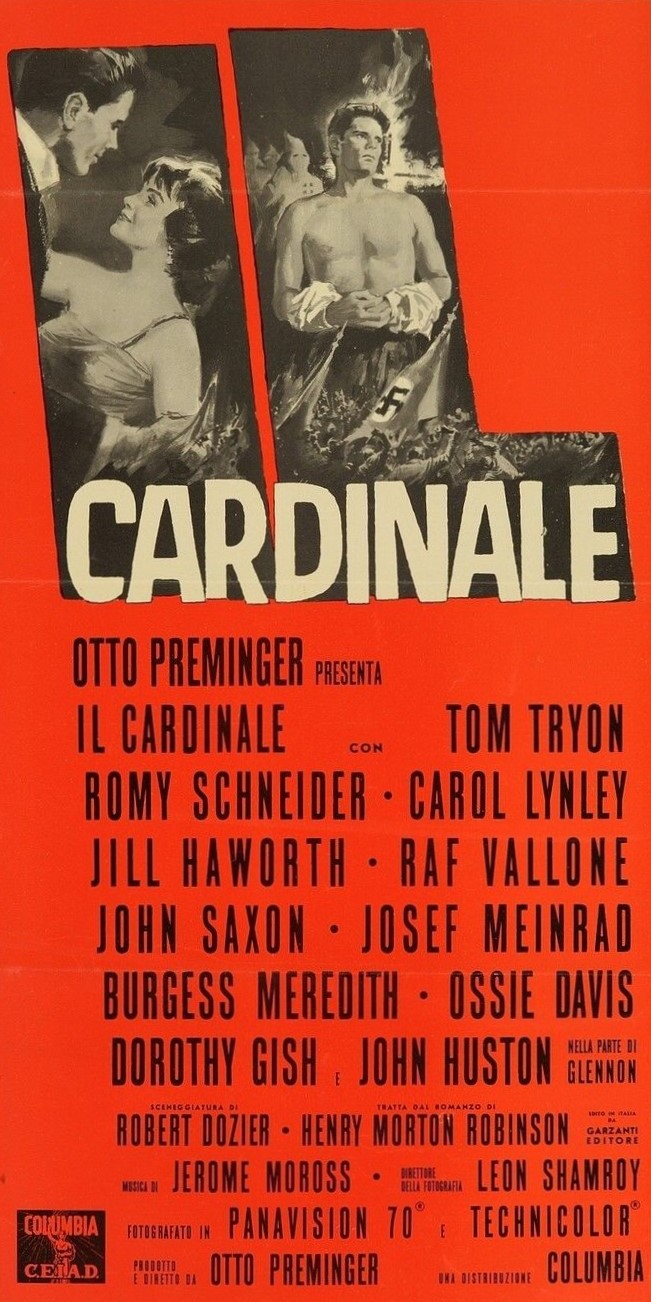
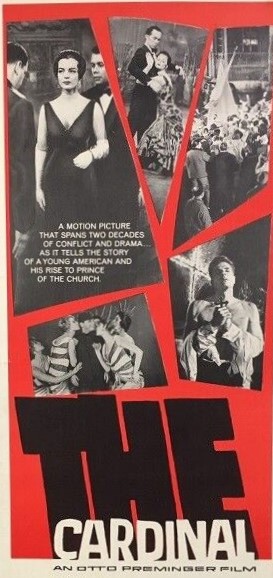
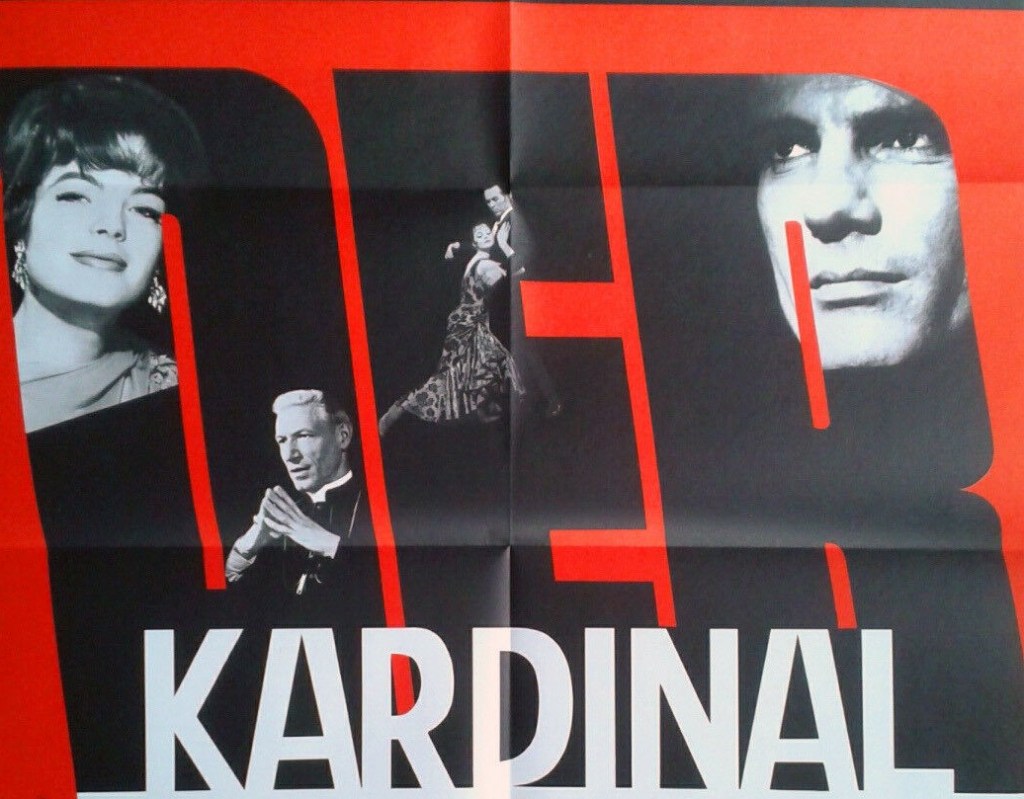
Otto Preminger was beaten to the punch on this one, the scandalous Henry Morton Robinson bestseller snapped up in 1955 by producer Louis de Rochemont (The Roman Spring of Mrs Stone, 1961) who had a tie-up with Columbia. Due to interference from the Catholic Church, de Rochemont dropped his option which Preminger picked up in 1961 while working on Advise and Consent (1962).
The last section of the novel, set in Austria during the Anschluss, reverberated with the director who was born in what was then the Austro-Hungarian Empire and although a Jew was well acquainted with Catholic society. One of his most significant changes to the book was introducing the Austrian cardinal who endorsed Hitler.
The first two screenwriters James Lee (Banning, 1967) and Daniel Taradash (Castle Keep, 1969) failed to whittle down the complex novel to cinematic proportions. So Preminger brought in Robert Dozier (The Big Bounce, 1969) and began working with him in summer 1962 making other alterations to heighten the drama. The incident involving the unborn child of the sister of Fr Fermoyle (Tom Tryon) acquires greater emotional power in the film, touching on the ambiguities inherent in any institution and provoking the priest’s guilt.
Gore Vidal (The Best Man, 1964) also worked on the script, swapping the novel’s Italian countess for the Viennese Annemarie (Romy Scheider) who, abandoned by the priest had married and was reunited with him prior to the Anschluss, and is sympathetic to Hitler until her husband’s faith endangers them both. Ring Lardner, who had satirized the Catholic church in a recent novel, was the final screenwriter added, his main task to rewrite scenes “to achieve what he (Preminger) wanted,” and, more importantly, to introduce the flashback structure. Ironically, both Vidal and Lardner were atheists.
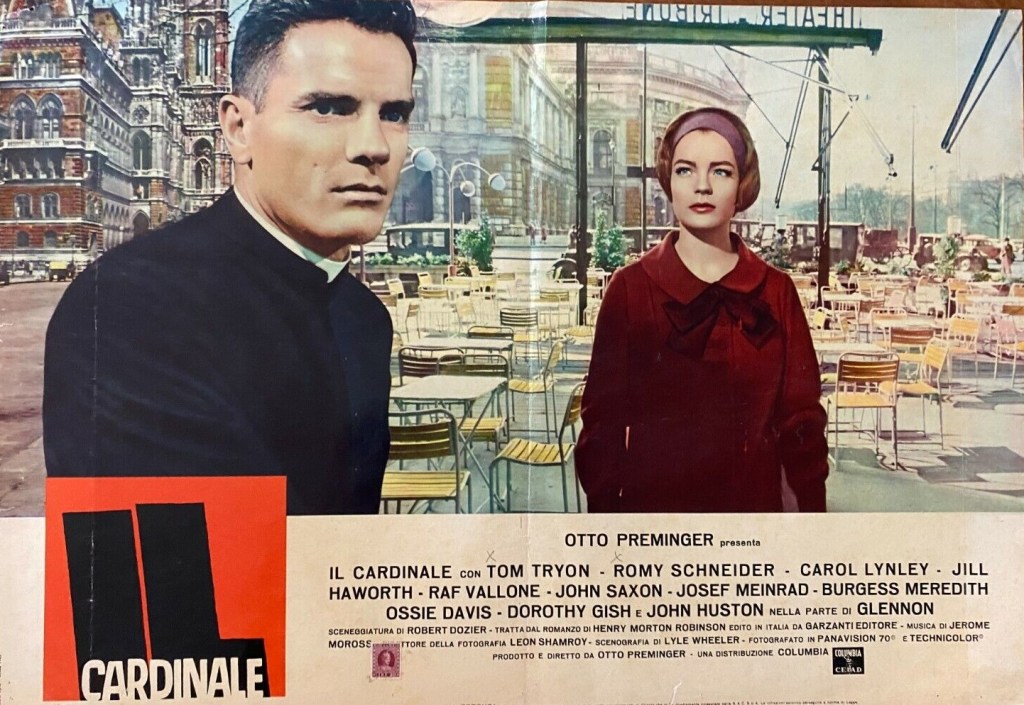
Tom Tryon and Romy Scheider meet again in Vienna.
The director considered five actors for the leading role – Hugh O’Brian (Africa – Texas Style, 1967), Stuart Whitman (The Commancheros, 1961), Cliff Robertson (The Devil’s Brigade, 1968), Bradford Dillman (Circle of Deception, 1960) and Tom Tryon (In Harm’s Way, 1965), the latter three advancing to the screen-testing stage. The 34-year-old Tryon won the role and a five-picture contract he would later regret. Carol Lynley (Bunny Lake Is Missing, 1965) who plays the priest’s sister also pacted for five movies.
Romy Scheider’s (Triple Cross, 1966) part was enhanced by the work of cinematographer Leon Shamroy who “fell madly in love with her,” resulting in the actress virtually shimmering on screen, never before “looking as beautiful.” Held in warm regard by the director, she was exempt from his tirades.
It took considerable persuasion on the part of Preminger for John Huston to participate. Curd Jurgens, initially cast as the Austrian cardinal, pulled out and was replaced by character actor Josef Meinrad whose lack of English meant he had to learn his lines phonetically.
Tom Tryon described Preminger as “tyrant who ruled by terror.” He was fired on the first day and probably wished the director had not rescinded the decision, for thereafter the actor was tabbed “lazy…a fool…stupid and unprofessional.” Commented Tryon, “I was so frightened he was going to scream that…I (just) wanted the experience to end.”
One scene with John Huston took 78 takes because Tryon could not deliver what the director wanted. And at one point first assistant director Gerry O’Hara (later director of The Bitch, 1979) found the star in tears and refusing to return unless the director agreed not to shout at him. Eventually, during the Italian section of the shoot, Tryon collapsed from nervous exhaustion, and was prescribed two days rest, and after this incident Preminger let up on his demands of the actor.
Explained Preminger, “I probably chose him without deliberation because he is weak.” He felt than an ordinary person would not side with the Church against a family member in a predicament, and that only a person “with weakness in his character” would be believable in the role. The character “fails because when you become a priest you substitute your own judgement and your own feelings for the law of the Church…The big decisions are made for him.” (Quite why he never chose an actor who could portray such weakness is not known.)
Tryon admitted that he owed a brief let-up in the bullying to “Schneider’s benign presence.” He commented, “The only fun I ever had on The Cardinal was a (ballroom) scene I did with Romy.” Prior to turning the cameras, Prior called both over, appeared ready to issue instructions, but instead waved them away “you know what to do.”
Added Schneider, “Preminger taught me an important thing: work fast. It’s true that it greatly helps our acting. Each of his directions, whether of gesture or of intonation, is precise and correct. Even better, it’s the only one possible…Each phrase, each world, each syllable are minutely weighed.” That dexterity applied to his positioning of the camera. He made decisions immediately, never hesitating “over the placement of the camera and each time…it was the simplest, the most natural and, dramatically, the best.”
Ossie Davis (The Scalphunters, 1968), who professed to have enjoyed a marvellous relationship with the director, observed: “I met actors whom Otto liked, I met actors that had no relationship or feelings one way or the other and I met actors who were almost absolutely destroyed, almost literally in panic because of Otto Preminger (who) was always looking for a spark…whether you had the spark or not, he was going to find it and even put it in you.”
But Patrick O’Neal stood his ground. “I woiuld not take it from him.” And they became friends.
The unit shot for five weeks in New England before heading to Vienna, Preminger choosing to stay in the same suite in the Hotel Imperial as appropriated by Hitler when visiting the city. Permission to shoot in the National Library, “one of the most beautiful monuments in the city” was attacked by the current minister of education who wanted the Hitler era erased from memory. And he was barred from using other government buildings for spurious reasons.
After four and a half months in Austria, the unit shifted to Rome, locations including St Peter’s Square and inside St Peter’s Cathedral and the Santa Maria sopra Minerva church, with priests and monks hired as extras for the various ceremonies. The Georgia scenes were shot in Hollywood on the Universal back lot.
Although generally dismissed by the critics and given a hard time as you might expect from the Catholic Church, The Cardinal hit a chord with audiences, who turned it into Premigner’s second-biggest hit of the decade.
Would appear resolutely old-fashioned except for Forrest Gump (1994) adopting same premise of the main character present at major events. Here it’s issues affecting the Catholic Church between last century’s two world wars and the protagonist is an American priest, Father Stephen Fermoyle (Tom Tryon) of Irish stock, who rises to the position of Cardinal.
So we move at a relatively stately pace through abortion, inter-denominational marriage, racism, a miracle, challenging church philosophy, and Hitler’s annexation of Austria on the eve of the Second World War, in which the church played an inglorious part. Along the way Fr Fermoyle is afflicted so badly by doubt that he takes a sabbatical only for his flesh to be sorely tempted.
Astonishingly, I saw this on YouTube (it’s still there) in a beautiful 70mm print preserved by the National Film and Television Archive. The roadshow print, to be exact, which begins with a marvellous five-minute overture. Oddly enough there’s something very settling about sitting in the darkness with the curtains drawn watching a blank (black) screen and listening to the majestic score by Jerome Moross (The Big Country, 1958).
And then it’s another few minutes of a stunning credit sequence, all sunlight and shadow, before the movie begins. The movie itself is over three hours long, so if you are put off by this kind of epic now’s the time to check out. But if you do, you will miss something genuinely to be savored.
For Otto Preminger (Hurry Sundown, 1967) certainly knows how to tell a story, even one as sweeping as this. For all its pomp, he manages to retain intimacy.
Immediately after his ordination just as America enters the First World War, Fr Fermoyle faces a crisis. His sister Mona (Carol Lynley) wants to marry a Jewish dentist (John Saxon) who refuses to convert to Catholicism. Fermoyle’s advice, in keeping with the church’s stringent rules: give him up.
A noted intellectual, Fermoyle is astonished to be sent by the worldly piano-playing cigar-chomping Archbishop Glennon (John Huston) to an impoverished parish to learn humility. There, he encounters the blind faith of parishioners and a pastor, Fr Halley (Burgess Meredith), so inclined to put others first that he will not seek help for a debilitating disease.
Meanwhile Mona, now a dancer and drinker, has become pregnant, and not by the dentist. But complications arise and she is forced to choose between herself and the unborn child. According to Church doctrine, as Fermoyle, advises, abortion being illegal, the mother must die to save the baby. Mona, not the sacrificial kind, does the opposite. Fermoyle, racked with guilt, wants to quit the church. Instead, he is promoted to Monsignor, and given a two-year timeout which he spends lecturing in Vienna.
There he falls in love with Annemarie (Romy Scheider). In the nick of time, he is recalled to the States and sent to the Deep South to help the black Fr Gillis (Ossie Davis) who is being harassed by the Ku Klux Klan. In standing by his colleague, Fermoyle undergoes a brutal whipping. Promoted to bishop, he is despatched to Austria “to instruct the princes of the church in the realities of the modern world.” Unfortunately, the clergy, siding with the Nazis, presides over the marriage of Germany and Austria.
Meanwhile, he is reacquainted with Annemarie, who has married a Jewish banker, and witnesses at first-hand Nazi treatment of the Jews, her husband so fearful of his future he jumps out a window. When a mob ransacks a church, Fermoyle isn’t so intent on facing up to them and instead, with Annemarie, manages to escape.
At its best and its worst by the narrative being forced through the prism of an individual. His reactions to issues are regulated by his employers, the Church, which exerts as much control over personal thought as the Communist Party, so, in effect, it becomes a tale of a person initially bristling against authority until, it turns out, the Church shares the same antipathy to the worst of the century’s scandals, the Ku Klux Klan and the Nazis.
Father Fermoyle hardly seems suited to high office, given he is so often inclined to temptation, either in a sexual sense, or in taking the opposite view of the Church. And it’s almost as though the splendid backdrop as represented by the immense wealth of the Church has only been achieving by subjugation of the individual. That the worldly Glennon appears as the poster boy for the Church hierarchy is almost Preminger playing with the audience.
It might be sumptuously mounted, but once again Preminger takes no prisoners, showing up an institution that while purportedly set up for the benefit of mankind so often sabotages noble endeavor.
Tom Tryon (In Harm’s Way, 1965) is excellent in the leading role, personal conviction getting in the way of the easy path to the top. But the pick of the performers are the supporting stars, especially John Huston, more famous as a director (The Night of the Iguana, 1964) and here making his acting debut, and Romy Scheider (Triple Cross, 1966). Look out for Carol Lynley (Bunny Lake Is Missing, 1965), silent film star Dorothy Gish in her final movie appearance, Maggie McNamara (The Moon Is Blue, 1953) in her first picture in eight years, and John Saxon (The Appaloosa, 1966) before he was typecast as a heavy.
Otto Preminger (In Harm’s Way) directs in stately fashion from a screenplay by Robert Dozier (The Big Bounce, 1969) and Ring Lardner Jr. (The Cincinnati Kid, 1965).
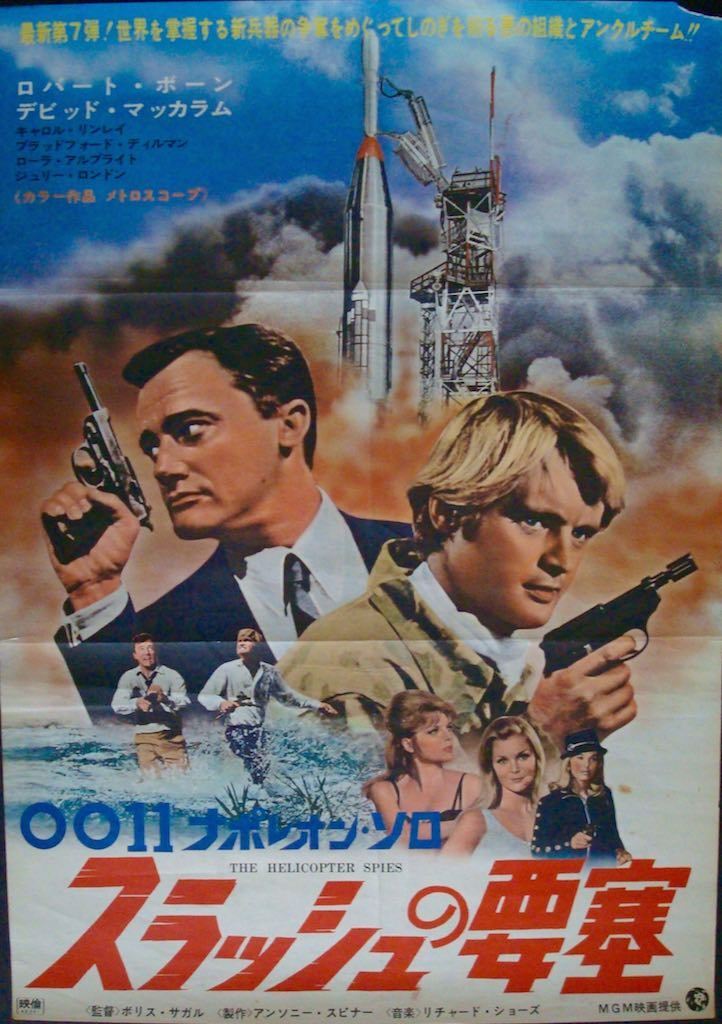
Takes a little while to come to the boil what with disreputable women, a crew of platinum-white-haired thugs, a religious cult, some very dry dialog, a high priestess with her own chorus line of psychedelic dancers, four identical brothers, and a female lead parading a prize shaggy dog story. Our intrepid heroes appear more capable this time round, the previously inept Napoleon Solo (Robert Vaughn) not beaten up quite so often, though he does end up being drowned in sand (water too precious to spare, apparently).
This time round, too, the good guys are taken for a ride by mad scientist Luther Sebastian (Bradford Dillman) who hoodwinks the U.N.C.L.E. organisation into stealing a “thermal prism” from the fortress of another mad scientist Dr Kharmusi (John Dehner). To put his own grand plan into operation Sebastian just has to hijack a rocket. And you should be aware going into this that there’s not the amount of helicoptering you might expect given the title.
This time round, too, there’s hardly a good gal in sight. Azalea (Lola Albright), aforementioned high priestess of cult The Third Way, has betrayed the good doctor in favor of Sebastian. Sebastian’s wife Laurie (Julie London) pretends to a) be out of contact with him for years and b) maintain a virtuous existence. And that’s before we come to the plainly bonkers, but still traitorous, Annie (Carol Lynley) who will make up any story in a bid to free an imprisoned unseen husband.
Sebastian has some neat touches as a leader, rewarding his team of thugs with booze and women as a prelude to killing them all off. He’s got an ejection seat in his car for getting rid of troublesome passengers. He prefers efficiency, to the point of iciness, to sexiness in his paramour and female underlings. And he has a very dry manner, which elicits a good few laughs.
But some of his thugs just ain’t that bright, the one instructed to follow Solo has just allowed him access to Laurie’s house. Laurie ain’t that bright, either, falling for an old trick by Solo who, as usual, is less bright that Ilya Kuryakin (David McCallum).
Some of the set pieces are excellent. Sebastian’s followers meet in an abandoned movie theater where Azalea gives the lowdown on the grand plan assisted by her bevy of dancers. Infiltrating the organisation by the simple device of dying his hair, Solo ‘s disguise is uncovered after being sprayed with champagne.
There are a surprising number of human touches. Head henchman Carl (Roy Jenson) vowing to take “Mom” away from her dingy life running her eponymous diner finds she enjoys too much her dingy life. Carl, appreciative of the disguised Solo’s efforts, apologises for making him ride in the baggage train. Annie can stretch innocence to breaking point, to an extent where nobody cares about her problems.
But where The Karate Killers had a straightforward storyline – find the five daughters of a dead scientist – this gets a tad lost in the first section introducing the thermal prism, the cult, doubling down on mad scientists, and giving Annie all the importance of a red herring.
I thought for a moment that this was the end of the line in my appreciation of the U.N.C.L.E. franchise, the one where it all fell flat on its face and we could see the joins, but after the shaky start it picked up and became quite enjoyable in the series’ inimitable barmy fashion. I suppose I should applaud the initial narrative boldness, audience pretty much fooled from the off, the fortress assault not much more than an extended MacGuffin, with neither Sebastian nor Azalea what they seemed.
I could quibble about the guest stars but in fact this is a superb deadpan performance from Bradford Dillman (Sanctuary, 1961) and quite a departure for the Carol Lynley of Bunny Lake Is Missing (1965). And you could say the same for Lola Albright, previously seen essaying a different kind of character in The Way West (1967).
Boris Sagal (The Omega Man, 1971) directed from a screenplay by Dean Hargrove (One Spy Too Many, 1966).
I’ve only got a couple to go to wrap up the entire series and for your sake I will persevere. If you’ve not already done so, it’s back to the box set.
In October 1962 Otto Preminger bought the rights to Harm’s Way, a thumping big bestseller by Ronald Basset with a host of characters and sub-plots which serve, like Advise and Consent by Allen Drury, to analyse an American institution, in this case the Navy, pre- and post-Pearl Harbor. In some respects, it was an odd choice, Preminger better known for pictures that filleted such august institutions, The Cardinal (1964) exposed the inner workings of the Catholic Church. On the other hand, it rubbed shoulders quite happily with Exodus (1960), a tale of battle against the odds.
Preminger’s aim was to blunt the current onslaught of movie pessimism with a picture that ended on an optimistic note. He observed: “We are attacked, we are unprepared in every way, and manage by sheer guts, character and resourcefulness to start to work out of it.” He concluded that such action “should remind us and perhaps other people that there is never any reason to give up or to give in to anything that is not right or dignified.”
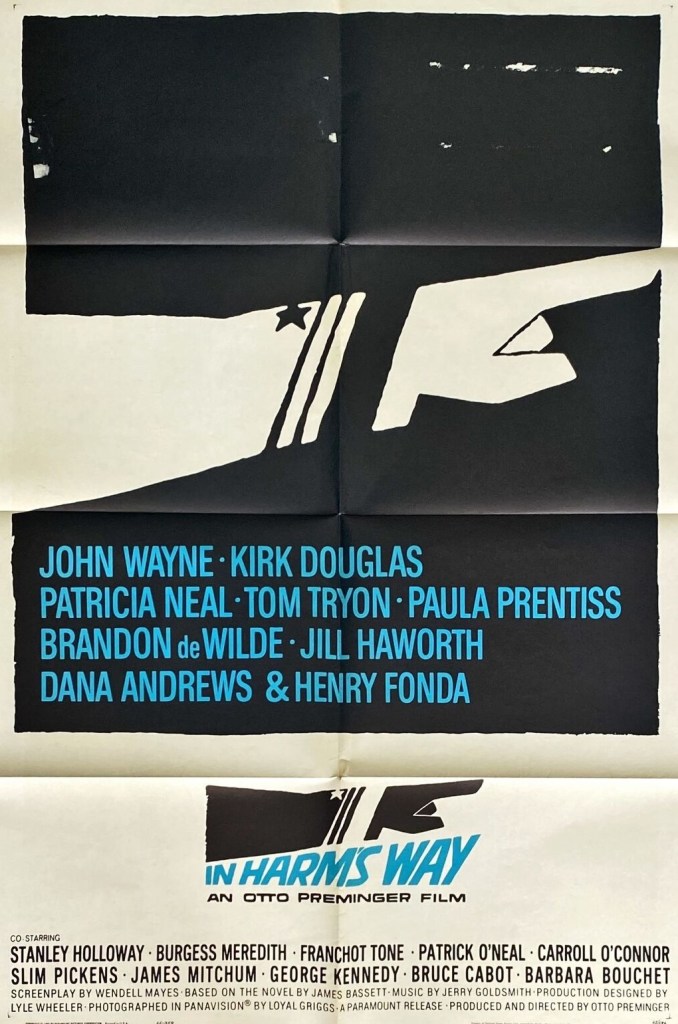
Celebrated Saul Bass poster.
“One of the reasons I made In Harm’s Way,” explained the director, “is that it is a big step away from most of the films I have made so far. I try not to repeat myself too much…not to make pictures in just one category…I was very fascinated by the characters and the story..,(which) shows that people will act even if they are unprepared and don’t want war.”
Wendell Mayes (Advise and Consent, 1962) started on the screenplay right away, taking it so far as embarking on a rewrite with the director in London. But the project was unexpectedly shelved for a couple of years. In the meantime Preminger assigned a different writer, Richard Jessup. But when the concept received the director’s full attention once again Mayes was at the wheel and with a different approach. “I had a fresher point of view and did many things that were not in the book at all. I think we improved it for that reason, since we had quite forgotten the novel.”
But collaboration with Preminger was exacting. “We sat together and and worked over almost every line,” explained the director. “I always work very closely with the writer on the screenplay…There is one man, the independent producer-director, who from very beginning takes the whole responsibility and has complete autonomy. I feel responsible for the script: I engaged the writer and I worked with him. Like I direct actors, I feel a director also directs the script.”
In particular, into sharper focus came the son, Jeremiah (played in the film by Brandon de Wilde) of Rockwell Torrey (John Wayne). In the book he had been a passing, insignificant character, who quickly befriended his father. “He had no feelings about the fact that his father had left his mother, and we changed that in the script,” said Mayes. This provided not just a source of dramatic tension but a more mature role for Wayne, who had to express regret for the estrangement, all his fault. (Although the idea of a son enlisting against the mother’s wishes reflect a similar situation in Rio Grande, 1950).
Wayne was Preminger’s first choice. “Because it has passive elements, a strong actor like Wayne is ideally cast,” said the director. Despite being sent an incomplete script, the star signed up – for $500,000. “I don’t look for stars and I don’t avoid them,” he said. The leading roles in Bunny Lake Missing (1965) and The Cardinal (1964) went to relative unknowns. “I would not ask John Wayne to play, say, a coward because his image is not the image of a coward, or have him play a Greek philosopher…He at least fulfilled all my expectations more than I could possibly hope for. Kirk Douglas, too, came to my mind almost immediately.”
The movie should have ended up at Columbia which had funded the director’s last two movies and would back Bunny Lake. But Preminger had just struck a deal for seven pictures with Paramount and in January 1964 that agreement was announced with the re-titled In Harm’s Way (a phrase associated with John Paul Jones).
Mayes completed the new draft two months later with the rest of the cast now assembled, including Preminger contract players Tom Tryon (The Cardinal) and Jill Haworth (Exodus) who replaced original choice Carol Lynley (Bunny Lake). Keir Dullea turned down the part of Jeremiah. Advise and Consent’s Henry Fonda came on board as the overall Navy commander at the expense of Chill Wills who was fired after shooting had begun.
One uncredited recruitment was Hugh O’Brian (Africa, Texas Style, 1967) who undertook the part of Liz Eddington’s lover. “He played a role as a favor without compensation,” recalled Preminger. “He did not want billing and only asked that I give some money to a charity. I needed somebody who was a secure actor and right for the part because I used a complete beginner (Barbara Bouchet) for the girl he plays opposite. And if I used some other young actor with her, people would have felt that this couple would disappear almost immediately at the beginning of the film. It was important to me to establish this young couple as an important episode at the beginning of the film and he helped that.”
The director spent three days scouting locations in Hawaii but decided to shoot in black-and-white because “ a picture like this has much more impact and you can create more of the feeling, the illusion of reality, than when you shoot it in color.” False guns mounts were attached to more recent ships since the older relevant vessels were no longer available.
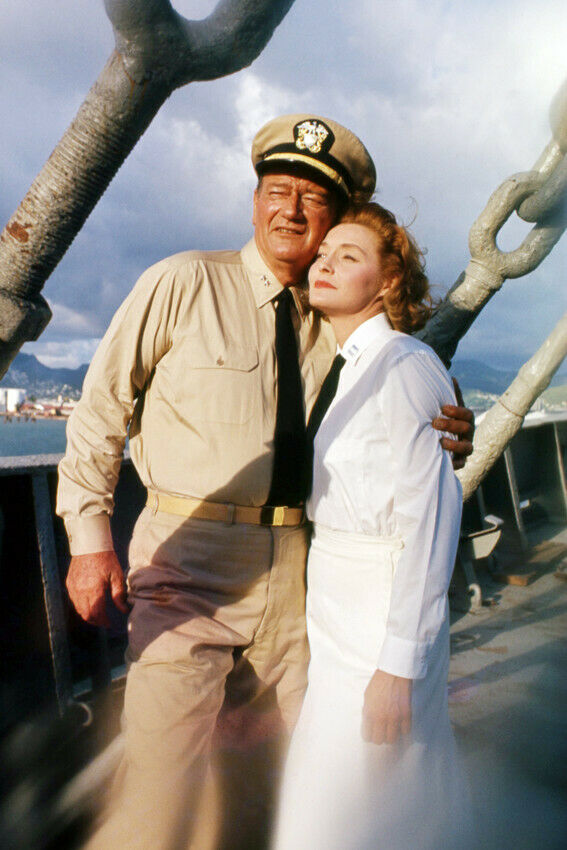
Wayne with co-star Patricia Neal.
Shooting started on June 23. The biggest issue was transportation, drivers getting lost reaching locations for the night-for-night sequences. Preminger struggled to meet his shooting schedule and the movie was soon over budget thanks to long hours, Sunday working and extra local staff. Even so, the Hawaii shoot came in 17 days ahead of schedule. Five days were assigned for shooting at sea. Larger than usual miniatures – some as much as 55ft long – were shot over a month on a lake in Mexico and in the Gulf of Mexico, the battle of Leyte Gulf costing an estimated $1 million. “I needed the real horizon,” said Preminger.
Some scenes were proving impossible to capture first time out. A second unit had two attempts filming a car going over a cliff, a marine landing was spoiled by water on the lens, and technical problems prevented Preminger achieving a “mystic-hour shot” of a plane taking off. Part of the director’s problem was his insistence on rehearsal. “I could make every picture in ten days if I slough it. Some actors just need more time and more rehearsal.”
Despite observers expecting – perhaps hoping – for volatile confrontation between the director and star, the pair enjoyed a cordial relationship based on mutual respect. Of Wayne, Preminger commented that he was “the most cooperative actor, willing to rehearse, willing to do anything as long as anybody. I was surprised really how disciplined a professional Wayne is and he liked this particular part very much.”
From Wayne’s perspective, “He had my respect and I had his respect. He is terribly hard on the crew and he’s terribly hard on people that he thinks are sloughing. But this is a thing that I can understand because I’ve been there (directing The Alamo) and I know that if a fellow comes on and he’s careless and he hasn’t thought at all about his…I come ready and that he appreciated that. I was usually there ahead of him on the set and he couldn’t believe that. So we had a really nice relationship.”
It was surprising Wayne remained on such an even keel since he was beginning to suffer from the cancer that would eventually kill him. “He looked ill,” Tryon remembered, “He was coughing badly, I mean, really awful. It was painful to see, so God knows what it was like for him. He’d begin coughing in the middle of a scene and Preminger would have to stop filming.” Although he refused to consult a doctor during filming, he agreed to a check-up once shooting of his role was complete, three weeks earlier than scheduled. He may indeed have owed his life to Preminger’s speedy shooting.
Kirk Douglas had a bone to pick with Preminger after the director stole the glory of being the first director to publicly announce, on Exodus, that he had employed a blacklisted writer, pre-empting Douglas who had done the same for Spartacus (1960). Although Douglas didn’t rank Preminger as a director he enjoyed a good relationship with him except for one minor confrontation.
Douglas got on well with Wayne: “There was a mutual respect…We got along quite well…He was a strange fellow. I’ll never forget the talk we had about my playing in Lust for Life (1956). Although emotionally we were not close and politically we were antipodal he asked me to work with him several times.” (Not entirely true – Douglas would have been the driving force for their collaboration on Cast a Giant Shadow in 1966 and he fell out spectacularly with Wayne on The War Wagon in 1967).
But others suffered from Preminger’s notorious temper, Tom Tryon in particular. The bullying became so bad Kirk Douglas once walked off the set. Douglas advised Tryon to fight back but Tryon could not pluck up the courage. Chill Wills who endured Preminger at his “absolute worst” did stand up to him and was fired. Patrick O’Neal turned on actors who refused to fight their corner. “Stand up to him once and find out he’s a human being,” was his advice.
Myth has it that Paula Prentiss’s role was truncated after she fell foul of the director but rumour was baseless. In fact, Prentiss was another of the director’s defenders, claiming he was “absolutely wonderful to work with. For a scene to work, tension needs to be put into a scene. There have to be genuine efforts to make the scene work. And Preminger understood this and was able to get much conflict and tension into the scenes.” And he was not all tough talk. She recalls him as particularly gentle guiding her through the scene where she asks her husband to make her pregnant.
Although surpassing the original $5 million budget, it was not by much, an extra $436,000. The Production Code had objected to the phrase “screw the captain,” a line Preminger refused to remove and despite further protest from the censor, who threatened to withhold the precious official approval,the director got his way. Preminger had shot the scene where Barbara Bouchet was dancing topless from the rear but the still photographs were sensational enough for publication in Playboy in its May 1965 issue.
The decision to shoot in black-and-white probably accounted for the picture’s relatively poor box office. Its length and the all-star cast should have qualified it for roadshow. (It was roadhsow for all of one day at two prestigious new York first houses; the next day it went continuous, but you could advance book a seat for an extra 50 cents). It was a sign of how quickly audience perceptions had changed that only three years previously the black-and-white The Longest Day had appeared as a roadshow and proved a resounding hit.
As a result of Wayne’s illness The Sons of Katie Elder was postponed. Preminger moved onto a smaller project, Bunny Lake Is Missing and Douglas reverted to top billing for The Heroes of Telemark (1965). Tom Tryon never worked for Preminger again and after top-billing in The Glory Guys (1965) faded from Hollywood view, re-emerging as the bestselling author of The Other. Paula Prentiss shifted sideways into television with He and She (1967-1968) and Jill Haworth made very few films after this, of which most were horror.
SOURCES: Chris Fujiwara, The World and Its Double, The Life and Work of Otto Preminger (Faber and Faber, 2008), p317-329; Scott Eyman, John Wayne, The Life and Legend, (Simon & Schuster, 2015) p385-387; Maurice Zolotow, Shooting Star, A Biography of John Wayne (Simon & Schuster, 1974) p361-362; Michael Munn, John Wayne: The Man Behind the Myth (Robson Books, 2003) p254-255; Kirk Douglas, The Ragman’s Son (Simon & Schuster, 2012), p387-381; Ian Cameron, Mark Shivas, Paul Mayersberg, “Interview with Otto Preminger,” Movie 13 (Summer 1965), p15-16; Patrick McGilligan, Backstory 3, p266; Otto Preminger, “Keeping Out of Harm’s Way,” Films and Filming, June 1965, p6; Newsweek, April 20, 1964; New York Herald Tribune, October 17, 1965, p55.














 The Magnificent 60s