Modesty Blaise (1966) ***

You might well enjoy this if a) you are in a very good mood, b) you love psychedelia, Pop Art and the Swinging Sixties, c) you fancy a spy film spoof or more likely d) you are a big fan of one or all concerned. Otherwise, you might be well advised to steer clear because it either takes the mickey out of a number of genres, not just espionage, or plays merry hell with narrative and character and is only loosely based on the source material by Peter O’Donnell.

Bear in mind it originated in a comic strip – later turned into a series of novels – that had more in common with the likes of Danger: Diabolik than the more straightlaced adventures emanating from DC Comics or Marvel. In particular, Modesty had a neat habit of distracting the villains by appearing topless in moments of crisis – a trick adopted in movies like 100 Rifles (1969) and El Condor (1970).

Fans of the comic strip/book may have been left indignant by the audacity of the filmmakers to introduce romance between Modesty and her sidekick Willie Gavin since in the book their relationship was strictly platonic. There was no place, in either comic strip or book, for the musical numbers that pepper the movie. And – check out The Swinger (1966) – for the notion of a character acting out a fictionalized version of herself.

You should be aware that Modesty is a very rich version of the gentleman sleuth, an idea that belonged to the old school, of a person, such as The Saint, bored with wealth, who takes on dangerous assignments in the eternal battle between good and evil.

Anyways, on with the story.

Modesty Blaise (Monica Vitti) is hired by the British government in the shape of MI5 chief Sir Gerald Tarrant (Harry Andrews), in return for immunity for her previous crimes, to deliver a secret shipment of diamonds, part-payment for oil imports, to Sheik Abu Tahir (Clive Revill). Modesty happens to be the sheik’s adopted daughter. Meanwhile, criminal mastermind Gabriel (Dirk Bogarde), believed to be dead, has his eyes on the consignment.

Meanwhile (again), Modesty upsets current lover Hagen (Michael Craig), Tarrant’s aide, by hooking up with old flame Willie Garvin (Terence Stamp). Meanwhile (again again), Garvin hooks up with another of his old flames, magician’s assistant Nicole (Tina Marquand), who has information on Gabriel.

Various assassins employing a variety of methods are sent to kill Modesty so a good chunk of the picture is her avoiding her demise. Gabriel is a pretty touchy employer, so upset by failure that he assigns his Amazonian bodyguard Mrs Fothergill (Rosella Falk) to eliminate all such assassins. Gabriel, however, is something of a contradiction, very sensitive to violence. And just in case you are not keeping up with the plot, conveniently, the bulk of the conversations between Tarrant and his superior (Alexander Knox) will fill you in.

Through a whole bunch of clever maneuvers on Gabriel’s part, Modesty and Willie are forced to steal the diamonds themselves. And, meanwhile, Hagen is on their tail, infuriated at being jilted.

In between the umpteen shifts in plot, which basically lurches like a ship in a storm, the screen is ablaze with color. Nobody complained much when Raquel Welch found it necessary to change her bikini ever few seconds, or that a musical required continuous costume changes, and Modesty here seems to have fallen into the same pattern, the changes in outfit often so swift you imagine she has a disorder.

And be warned, this is a poster film for Pop Art, so if it’s not clothes that are being swapped, it’s décor. You might put Terence Stamp’s blond barnet in the discordant category. You can’t really complain about the plot because espionage storylines are usually something of a conjuring trick with the impossible little more than a standard mission. There’s much to enjoy if you’re of a mind and subscribe to one of the four ideas outlined in the opening paragraph and like the idea of the otherwise critical darling Joseph Losey (Accident, 1967) giving way to stylistic overkill.

Monica Vitti (Girl with a Pistol, 1968) inhabits the role with the necessary verve though Terence Stamp (The Collector, 1963) looks as if he has walked into a spoof and Dirk Bogarde (H.M.S. Defiant / Damn the Defiant!) appears still in experimental mode, having dumped the British matinee idol, unsure of what his screen persona should be. Evan Jones (Funeral in Berlin, 1966) is generally to be blamed/praised for the screenplay.

A movie for which the word confection was invented.

The Thomas Crown Affair (1968) *****

Employs Hitchcock’s trick of having you rooting for the bad guy. The caper picture remade. Steve McQueen (Nevada Smith, 1966) reinvented. Faye Dunaway (The Extraordinary Seaman, 1969) making the most stunning entrance this side of Ursula Andress in Dr No (1962). The technological dream of the split screen. Film noir filmed in bright sunshine with a femme fatale on the right side, only just, of the law.

Takes the insurance agent of Psycho (1960) and switches the gender. Nabs the Hitchcock crown (Notorious, 1942) for the longest screen kiss. Steals from Ingmar Bergman (The Seventh Seal, 1957) the title of best chess scene.

Female sleuth at a time when I don’t think the idea of a female detective crossed anyone’s minds in Hollywood. And one so sexy, stylish and uber-confident that she attracts not one sexist remark. Not dumb enough either like Lila in Psycho to walk into a trap.

And, incredibly, given wealth has been a movie trope since day one, luxuriates in a lifestyle – gliders, dune buggies, polo – never seen before. Not just a mesmerising song (“The Windmills of Your Mind”) but an absolutely outstanding score from Michel Legrand (Play Dirty, 1968). Almost works as a visual greatest hits collection, one memorable scene after another, a cat-and-mouse scenario, twists aplenty and smart, smart dialog.

Ignores back story and dark hidden secrets. Dispenses with the usual robbery cliches of planning the heist and the robbers irritating the hell out of each other. Theft here is carried out with mathematical precision, the crew members never meeting, mastermind Thomas Crown (Steve McQueen) hidden from view at initial interview behind a bank of blinding lights. But the investigation is clever, too, donkey work – tracking everyone who flew to Geneva (where the stolen cash is banked) – coupled with instinct, insurance agent Vicki (Faye Dunaway) choosing Crown as the most likely criminal from his photograph, and a piece of inspiration, offering a huge reward for anyone noticing their spouse had been in Boston on the day of the robbery and been behaving oddly.

Crown is a fabulous invention, savvy businessman, bursting with competitive instinct, unable to prevent himself crowing, his opening line – “you overpaid” – puncturing the triumph of businessmen who believed they bettered him in a deal. But he’s bored, riches and all the toys that brings including sexy girlfriend Gwen (Astrid Heeren) not enough, and he seeks to test himself against the law.

But he’s always testing himself, regardless of how high or how low the stakes. He’s the kind of guy who just bets for the thrill. The only reversal in the whole movie is a golf match where he employs the old sucker punch, double-or-quits routine, to be able to repeat an unexpectedly successful shot. When he loses spouts another brilliant line, “What else can we do on Sunday?”

But he’s up against as steely a competitor. Has any character ever delivered such an immortal line with such panache – “I’m immoral” – as Vicki who has no qualms about invading Crown’s house on a flimsy pretext or  kidnapping the son of one of the gang. “You won that round,” she tells Crown after bringing gang member Erwin (Jack Weston) in for questioning and stationing him in the same room as Crown, hoping to elicit recognition.

You’d hardly be surprised to discover she’s more than capable of using her body as a weapon, but you’d be hard put to work out who is seducing who. For both, part of the attraction must be danger, being up close (and very personal) with your rival. It wouldn’t take much to imagine this is a reversal, that Vicki is being hunted, that in the throes of romance she will give away too much. Or that the arrogant Crown believes he can have his cake and eat it. He doesn’t need the money, he can give it back, avoid arrest and sail off into the sunset with a woman his match in style and intellect.

If there’s one flaw in the spellbinding narrative, it’s here. We all know insurance exists outside the law. Retrieving money for clients is the sole aim, justice not on the agenda. No bank chief executive wants to suffer the embarrassment of being hauled into a courtroom to explain just how fallible their security systems are. Hand back the money, bury the publicity and all’s well. I’m not entirely sure why Vicki had to seek the approval of detective Eddy (Paul Burke), leading the police side of the investigation, when she could as easily have bypassed him and picked up her ten per cent of the money as reward and sailed off into the sunset.

Unless, of course, it’s not a flaw. And that for Vicki, as resolute a competitor as Crown, she requires official recognition of victory and to prove her superiority over the criminal by allowing him to be set free, giving her if you like the upper hand in the relationship.

Director Norman Jewison was on a box office roll after turning conspiracy upside down with The Russians Are Coming, The Russians Are Coming (1966), and exploring racism with In the Heat of the Night (1967). Where most critics prefer directors who reveal thematic consistency, Jewison seemed to be headed every which way – although in the cat-and-mouse stakes you could look at The Cincinnati Kid (1965) – with elan his ace in the hole.

And if you ever sat in a movie theater and thought you could do better than the drivel you were watching, then screenwriter Alan R. Trustman would be your patron saint. A lawyer by profession, he wrote The Thomas Crown Affair in a couple of weeks and, hardly surprising, given its audacity, it found its way to an agent. He went on to write Bullitt (1969), Lady Ice (1973) –  almost a remake of Thomas Crown – and The Next Man (1974) for Sean Connery.

The best fun crime movie since Hitchcock paired Cary Grant and Grace Kelly in To Catch a Thief (1955) and never bettered since.

Dazzling.

Seven Thieves (1960) ****

You wouldn’t figure director Henry Hathaway for a caper movie. He seemed more at home with action, whether that be war (The Desert Fox, 1951), adventure (Legend of the Lost, 1957) or western (Nevada Smith, 1966) although he was a dab hand at film noir (Kiss of Death, 1947). And before the big-budget all-star Oceans 11 entered the equation in the same year as Seven Thieves – and stole much of its thunder – the heist movie ran mostly on B-movie steam such as Rififi (1955), The Killing (1956) and Big Deal on Madonna Street (1958).

And probably judged against other glossy efforts of the 1960s like Topkapi (1964) and Gambit (1967) Seven Thieves would appear on the surface to come up a bit short. No doubt accounting for it being so under-rated. But while this is in itself a neat little thriller the kick comes in the emotional entanglements and a succession of twists at the end that sends it in my book into a higher category.

And it’s so outrageously clever that the mystery of why French-based criminal mastermind Theo Wilkins  (Edward G. Robinson) would reach out across the Atlantic Ocean to recruit former jailbird Paul Mason (Rod Steiger) to spearhead the heist of a cool four million dollars from a Monte Carlo casino is not resolved until the end, and in spectacular fashion.

Technically, there are actually only six thieves, the other is an inside man, Raymond (Alexander Scourby), who has fallen for the seductive charms of nightclub dancer Melanie (Joan Collins). Making up the rest of the septet are safe cracker Louis (Michael Dante) and muscle-cum-driver Hugo (Berry Kroeger) with Poncho (Eli Wallach) playing the key role of the pretend crippled, arrogant, irascible millionaire – and contrary to the claims of one poster he is the decoy not Melanie.

Distrust of his team makes Theo bring in Paul, who ruthlessly knocks them into shape, putting into seamless action the plan devised by Theo. Simply put, Poncho is going to act as a distraction by having a heart attack at the gambling table while Paul and Louis climb out a window along a ledge to the casino director’s flat which provides, by means of an elevator, direct access to the underground vaults. Once they’ve stolen the cash, they clamber back along the ledge and hide in the flat where, by this time, Theo, playing the role of Poncho’s personal physician, has taken him. The money will be hidden in Poncho’s wheelchair and removed to a waiting ambulance.

But Paul is a rather suspicious character and wants to know what he’s letting himself in for so in turn works out the weaknesses of his team. Melanie hides behind a façade of high birth, Pancho is too reckless, “measuring danger only in terms of profit,” Hugo prone to unnecessary violence, while Louis has omitted to mention he is terrified of heights, the ledge on which the operation depends standing on a 100ft high cliff.   

In some posters, this was promoted as Al Capone (Steiger)
vs Little Caesar (Robinson).

The plan relies on Poncho actually appearing to be dead, so dead that the casino director (Sebastian Cabot) will not hesitate, at Theo’s insistence, to shift him out of sight of the rest of the gamblers into his flat. But Complication No 1 is that Poncho doesn’t want to be dead, even if it is a ruse, skeptical of Theo’s plan to convincingly knock him out by means of a carefully measured dose of cyanide. Complication No 2 is that a night club client recognizes Melanie and casts doubt on her credentials as a lady of quality. Complication No 3 is that English physician Dr Halsey (Alan Caillou) questions whether Poncho is as dead as he seems.

But such complications are nothing compared an extraordinary range of twists that raise tension sky-high at the movie’s denouement. I challenge you to guess what these three superbly-conceived twists would be, all of them one by one turning the project on its head, and it rapidly shifts from one direction to another, ending with an unbelievable – and yet so in keeping with the premise – climax.

Attention to character detail lifts this out of the rut, whether it be Theo’s penchant for collecting seashells, Paul resplendent in a white suit, Melanie resisting the blandishments of becoming a kept woman, Raymond trying to climb out the murky depths into which the lure of Melanie has taken him, and a series of subtle relationships, some developing through the robbery, others which began long before the heist working themselves out.

The heist itself is well done, tension kept constant mostly through the failings of the crew and the suspicions of the dupes. All in all an excellent picture.

This was a critical film in the careers of most of the cast. Edward G. Robinson (The Cincinnati Kid, 1965) was handed his first top-billed role in four years. It was a deliberate change of pace for Rod Steiger (The Pawnbroker, 1964). For Eli Wallach, best known at the time for stage work, it was the first of three films that year that would launch him into the higher ranks of top supporting stars; it was followed by The Magnificent Seven and The Misfits. After being leading lady to the likes of Gregory Peck and Richard Burton, this spelled the end of Twentieth Century Fox’s belief in Joan Collins’ star qualities while for Michael Dante (The Naked Kiss, 1964) it was a step up.

Wallach and Dante could be accused of over-acting but Robinson, Steiger and Collins all act against type with considerable effect. Hathaway does a superb job working from a script by Sydney Boehm (Rough Night in Jericho, 1967) based on the Max Catto bestseller.

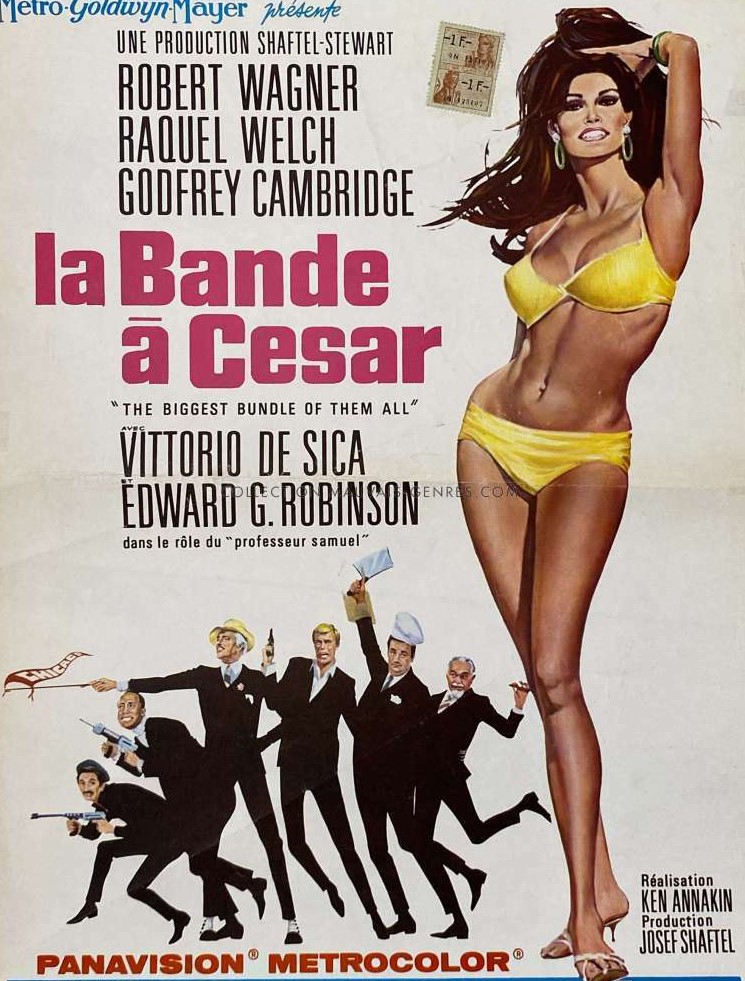
The Biggest Bundle of Them All (1968) ***

Bunch of incompetent crooks kidnap an impoverished Mafia boss who pays his ransom by setting up a major heist. By a stroke of casting alchemy this brings together Cesare (Vittorio De Sica), the epitome of old world Italian charm, knock-out gangster’s moll and scene-stealer-in-chief Juliana (Raquel Welch) replete with scanty knock-out outfits, and criminal mastermind Professor Samuels (Edward G. Robinson). In order to acquire the funds necessary to steal $5 million of platinum ingots from a train – that plan involving a tank and an WW2 bomber – the crew, initially headed by American Harry (Robert Wagner), need to carry out smaller jobs.

Problem is, none of them are any good, not even Cesare, who has lost his flair and botches an attempt to rob an old flame of her jewels. This is a twist on Topkapi (1964) which employed effective amateurs. This bunch can’t even carry out a simple theft from a restaurant. The heist itself is pretty spectacular and innovative. And the movie is quirky, with a darker edge. While there are few belly laughs, the light tone is enough to carry the gentle humor, mostly inspired by the misplaced team, amateurs for various reasons, not necessarily outright lawbreaking, on the run. These include London Cockney mechanic Davey (Davy Kaye), chef Antonio (Francesco Mule) distracted by hunger at every turn, cowardly violinist Benny (Godfrey Cambridge) and Joe (Mickey Knox) with a helluva brood to feed.

The story does a good bit of meandering, as does the camera, much of its focus on the voluptuous charms of Juliana, but the hurt pride of Cesare and the grandiose machinations of the professor keep it on course. The Italian settings, incorporating grand villas and ruins, do no harm either. The heist is terrific and there is a final twist you may or may not see coming. The interplay of characters works best when it involves Juliana, who attempts to twist Cesare around her little finger, that tactic mutual it has to be said, and who keeps the professor on his toes by dancing with him in a disco, and it soon becomes apparent that she has the upper hand over lover-boy Harry.

You could be forgiven for thinking the title refers to Raquel Welch – a cinematic infant at this stage with only One Million Years B.C (1966) in her portfolio – especially when her cleavage and looks receive such prominence, but the caper is classy and different. As well as being obvious she is both sinuous and seductive and clearly has a mind of her own, possibly the most criminally intent of the entire outfit, with weapons the others lack. By this point, she had invented the pop-out bikini, pictures of which had flooded Europe, making her the pin-up par excellence, but those who came to simply gawp quickly realized there was talent behind the body. Although of course there would be those who didn’t care.

De Sica constantly plays around with the idea of being a defunct godfather and Robinson is the antithesis of the gangster roles on which his fame relied. Robert Wagner is less effective, miscast and out of place in such august acting company and losing out to Welch in every scene.

This was a considerable change of pace for British director Ken Annakin after Those Magnificent Men in Their Flying Machines (1965) and Battle of the Bulge (1965) and he brings to this the comedy of the former coupled with the narrative complications of the latter, wrapping everything up in an easy inviting style that makes the most of his stars and the locations. Screenwriter Sy Salkowitz was a television veteran (Perry Mason, The Untouchables et al) , this marking his first venture into the big screen.     

Not in the Topkapi class – very little is – but a pleasant diversion nonetheless and for avid Raquel Welch fans, setting aside her outfits, a chance to see her develop more of a screen persona than was permitted in her debut One Million Years B.C.

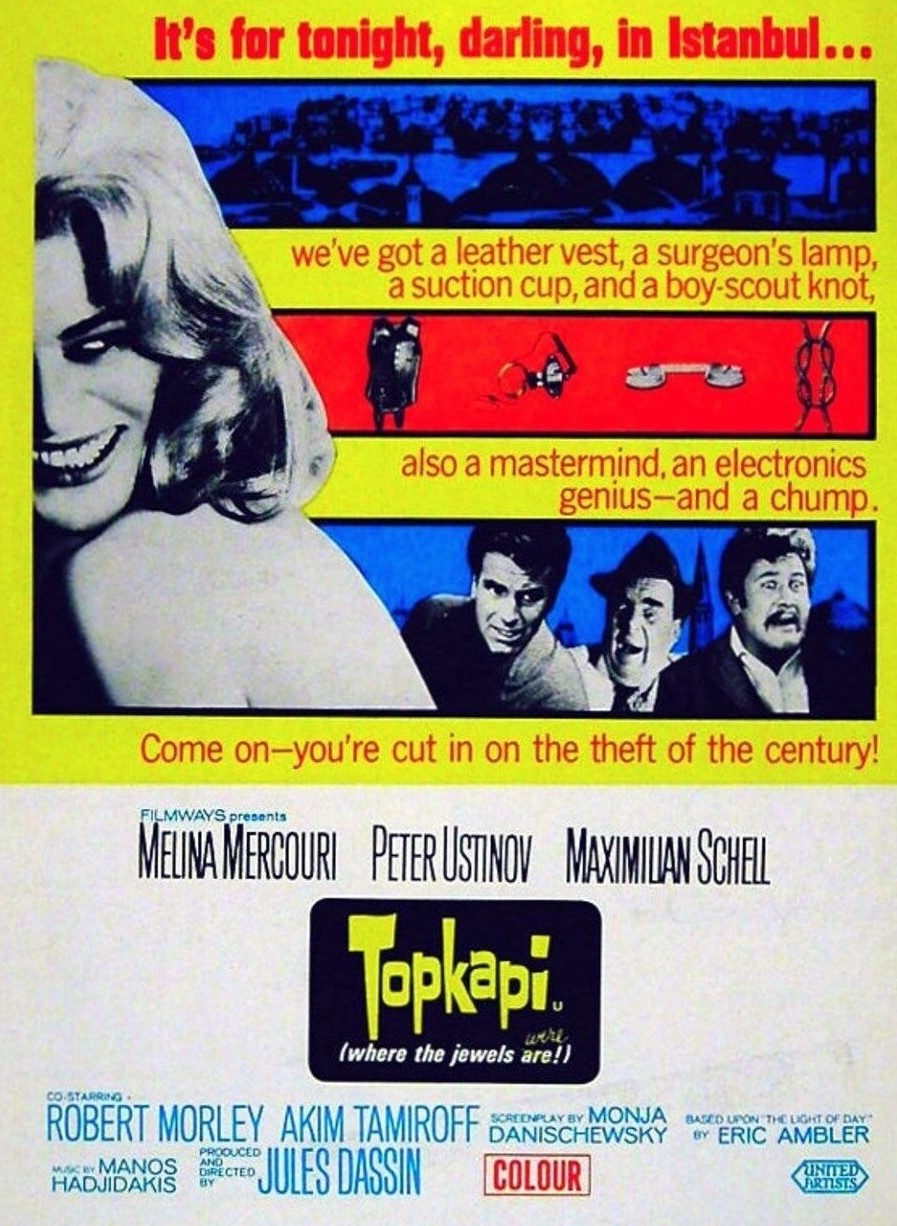
Topkapi (1964) *****

The mother of all heists directed by the father of all heist pictures.

Films as diverse as The Italian Job (1969), Mission Impossible (1996) and Ocean’s Eleven (2001) owe director Jules Dassin a massive debt since he pretty much invented this genre with the French-made Rififi (1955). But that involved professional criminals. Outside of masterminds Elizabeth (Melina Mercouri) and Walter (Maximilian Schell), this crew are amateurs, deliberately chosen for their lack of criminal records and with a mind to the specific tasks required. So we have acrobat Giulio (Gilles Segal), upper-class English gadget inventor Cedric (Robert Morley), strongman Hans (Jess Fisher) and driver Arthur (Peter Ustinov).

The target is the impenetrable, complete with sound-sensitive floor, Topkapi Palace in Istanbul where they plan to steal a priceless emerald-encrusted dagger. The plan is ingenious. Arthur is initially only hired to smuggle the weapons essential to the audacious heist across the border. But when he is caught and forced to cooperate with the Turkish secret police, he is enlisted as a replacement for Hans. Minus the rifles and grenades which at first appeared indispensable to the plan, the thieves come up with an even more inspired alternative involving among other things scampering across rooftops, abseiling, a parrot and slowing down the revolutions of a lighthouse.

Originally intending to betray his colleagues as soon as possible, Arthur falls under the seductive spell of Elizabeth and finds himself recruited as the replacement muscles. Elizabeth exudes such sexuality she has the entire gang in her thrall and makes the cowardly, weak, acrophobic Arthur believe he can overcome all his fears. Like current television sensation Money Heist, Walter engages in a cat-and-mouse game with the police, always one step ahead, with a bagful of red herrings at his disposal, eventually giving the pursuers the slip during a wresting competition held in a massive outdoor arena.

Interestingly, too, this doesn’t have the trope of gangsters at each other’s throats, planning to double-cross one another or bearing old grudges. Nor is this the last robbery for anyone prior to retirement. Equally, nobody challenges the leader. In fact, the entire crew could not be more docile, content to sit at the feet of Elizabeth and Walter, lapping up the former’s flirtation, wondering at the latter’s skill, as if they are all honored to have been chosen.

The climactic heist, carried out minus music, and lasting over 30 minutes is absolutely superb, setting a very high bar for future imitators, and there is a twist ending. Dassin mixes light comedy and high tension with the sultry attractions of Elizabeth to produce an at times breathtaking picture. As well as the heist itself, the wrestling sequence is stunning and the transition of Arthur forms the acting highlight (he won the Best Supporting Actor Oscar).

But all four main stars are superb. Audiences accustomed to a more uptight Maximilian Schell (The Condemned of Altona (1962) will have been surprised by his charming performance. Melina Mercouri (Oscar-nominated for Never on Sunday, 1960) is the archetypal blonde bombshell, liberal with her favours but careful not to favour just one. Although Walter devises the plan, she is actually the criminal supremo, selecting the targets, and then delegating to ensure the tasks are carried out. Robert Morley is having the time of his life. Akim Tamiroff (Lord Jim, 1965) has a cameo as a chef.

A film noir star after Brute Force (1947) and The Naked City (1948) Dassin’s Hollywood career collapsed in the wake of the anti-Communist McCarthy hearings and he was blacklisted. Rififi opened few doors but even the success of Never on Sunday (1960) brought negligible offers. Despite returning to the mainstream with such elan through the conduit of Topkapi, albeit with a European cast, he remained on the Hollywood periphery and although the American-set Uptight (1968) – previously reviewed in the Blog – involved another heist that was primarily the wrapping for social documentary.

More at home with comedies screenwriter Monja Danischewsky (The Battle of the Sexes, 1960) draws out more humour than the source material, Light of Day by noted thriller writer Eric Ambler, would ostensibly suggest.

A delight from start to finish, the crème de la crème of the heist genre, this is unmissable. Dassin can lay claim to being the John Ford of the crime picture.

Gambit (1966) ****

The heist movie – as epitomised by The Asphalt Jungle (1950), The Killing (1958) and Jules Dassin’s Rififi (1955) and Topkapi (1954) – had tended to be a relatively low-budget affair. Top-ranking stars steered clear because complicated plot often got in the way of character development  In the highly polished and entertaining Gambit British director Ronald Neame’s riff on the genre involved a narrative shift worthy of Christopher Nolan, Quentin Tarantino and, of course, Akira Kurosawa who had with Rashomon (1950) single-handedly invented the complex point-of-view.

Neame brought another couple of other aces out of the deck. First of all, there was the fun of watching over-confident thief Michael Caine’s apparently foolproof plans come unstuck. Secondly, in a romantic dynamic in the vein of It Happened One Night (1934) the less accomplished female (Shirley MacLaine) proves more accomplished than the male.

Gambit was also a clear demonstration of the power of the female star not just in the plot complications but from the fact that Caine owed his big Hollywood break to MacLaine, the actress having the power of veto over the male lead and, equally, contractual right to choose her co-star. The movie went through an interesting development phase. The original script by director Bryan Forbes (King Rat, 1965) had Cary Grant in the central (i.e MacLaine) role. Rewritten by Jack Davies (Those Magnificent Men in Their Flying Machines, 1965) and in his movie debut Alvin Sargent (The Stalking Moon, 1968) the main character underwent a gender shift.

After Psycho (1960) audiences had become used to being messed around. Stars could be killed off halfway through or not appear (Operation Crossbow a classic example) until well into the movie. Neame was not quite so bold but what audiences made of the usually garrulous MacLaine being rendered mute during the early part of the picture was anybody’s guess, perhaps the dumb show was a joke in itself. But lack of dialogue did not prevent MacLaine from stealing the show and proving what an adept comedienne she was, a barrage of submissive looks enough to send an audience into hysterics.

In essence, Caine plays two characters. In the opening segment he is the brash, cocky  English gentleman-thief at the top of his game, bossing MacLaine around, gulling his mark (Herbert Lom) with an audacious plan to steal an expensive sculpture. In his version of events his plan goes off without a hitch. But when we switch to the MacLaine perspective, in which nothing goes according to plan, his cool demeanour is sorely tested and he turns into a frustrated idiot. Watching the movie now, you can almost imagine that the MacLaine character, with a host of useless facts at her fingertips, was making fun of Caine’s well-known love of trivia, but that predated the actor’s acknowledgement of this aspect of his real-life character.

What makes the movie so much fun is that both parts of the film work and for the same reasons: believable characters, exciting heists and plenty of twists. The initial premise is that Caine recruits Hong Kong dancer MacLaine due to her startling resemblance to the late wife of Arab billionaire Herbert Lom as part of a ploy to relieve him of a priceless artefact. While Lom is falling for MacLaine, Caine moves in for the kill with an ingenious heist. Mission accomplished he pays her off. But in the real version of the story, as seen through her eyes, Lom does not fall for the ridiculous scam, Caine’s plan fails to work until MacLaine comes to the rescue. Meanwhile, MacLaine has fallen for Caine, but does not want to be in love with a criminal. Although Caine initially resists his own emotions, he, too, takes the romantic plunge except that to win her he may have to lose what he prizes more.

As I mentioned it is awash with twists and the heists themselves are exceptionally well done but the screen chemistry between the two leads is terrific. Caine, who had otherwise been in control in his previous starring roles as the upper-class officer in Zulu (1963), spy Harry Palmer in The Ipcress File (1965) and the womanising Alfie (1966) – The Wrong Box (1966) was an ensemble item – was taking a chance in playing a character who would effectively play second fiddle to the star and in terms of the thief often appears out-of-control. MacLaine was more obviously in her safety zone. Hollywood spent a lot of time investing in screen partnerships, mostly failing, but this pairing certainly succeeded.

Discover WordPress

A daily selection of the best content published on WordPress, collected for you by humans who love to read.

The Atavist Magazine

by Brian Hannan

WordPress.com News

The latest news on WordPress.com and the WordPress community.