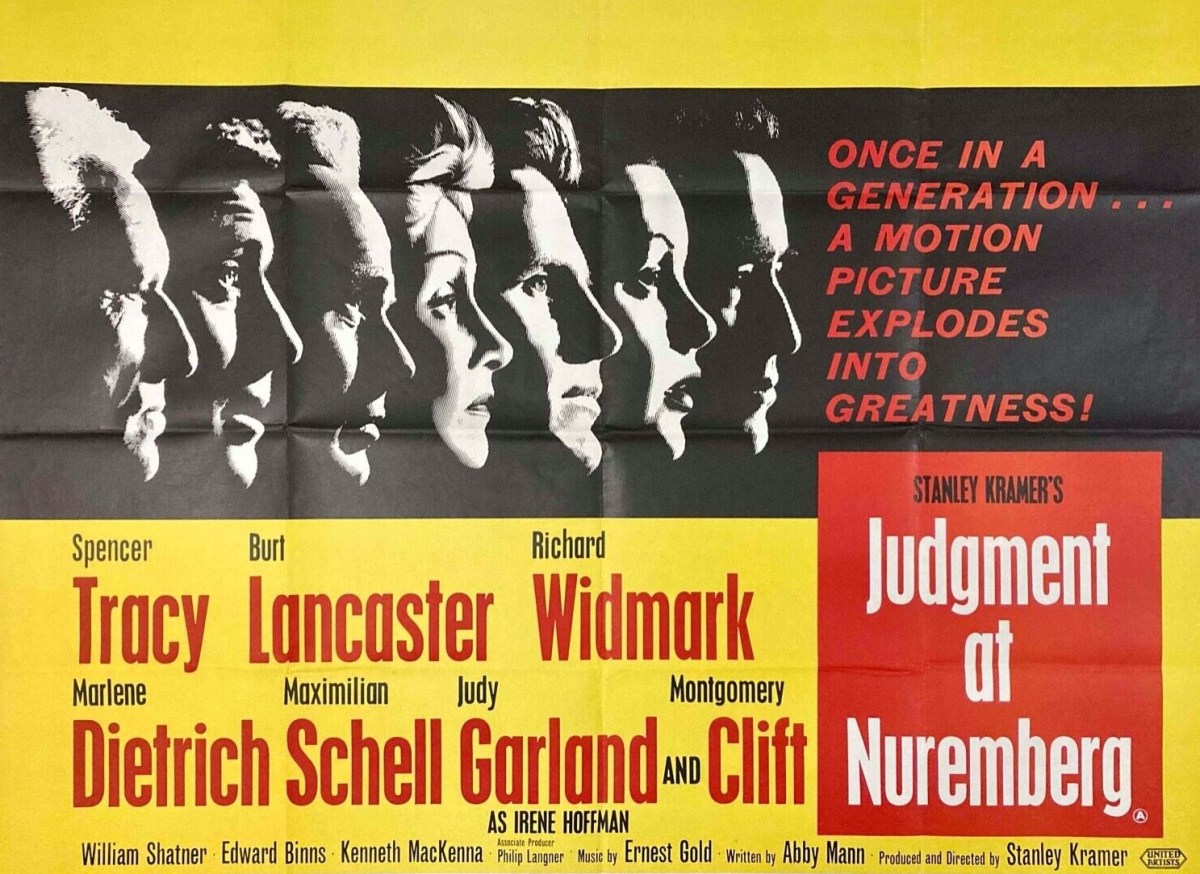
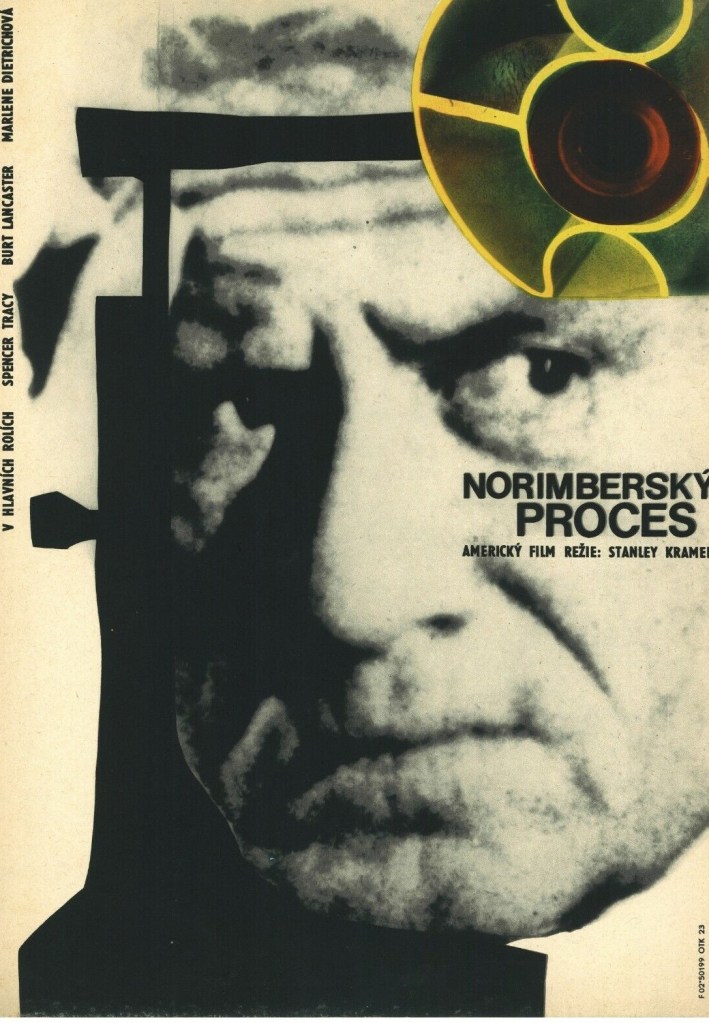
Stanley Kramer never caught a decent academic/critical break. Subject matter worthy, execution poor, was the overall consensus. But Judgement at Nuremberg, with its long tracking shots, sometimes turning 360 degrees around a character, should have changed all that. But the kind of critics who would have appreciated such bravura technique weren’t around at the time and even when Antonioni’s The Passenger (1975) appeared nobody thought to reference Kramer, believing this was a new cinematic invention by the esteemed Italian maestro.
So, Judgement at Nuremberg is remembered, if at all, for the subject matter and elevated by the performances rather than the director’s input. Most people misremember what the movie’s about. The main concern here isn’t the war criminal, the men personally involved in running the ghettos. Instead, it’s about those behind the scenes who could, theoretically, have prevented the camps flourishing, or at least challenged their opening.
Those on trial were freedom fighters of a different sort. As judges, the top tier of the legal system, their job was not just to uphold law and order and individual freedoms, but to take government to task for illegal action. It’s a basic tenet of the democratic world that governments cannot act in autocratic fashion but work within public accord.
Should the legal guardians find fault with government activity, their job is to take the ruling body to task – the European Court of Human Rights was set up with exactly that principal in mind, and various British and American law agencies have over time called a halt or questioned government proposals.
Some of the judges were clearly ill-fit for the task, lick-spittle jobsworths, desperate to hold onto rank and privilege, many sharing the same anti-semitic views as Hitler. But the Allied forces, being democratic, have to proceed along proper lines, taking potential criminals to court and allowing them legal defence.
So the main target is Dr Ernst Janning (Burt Lancaster), German’s pre-eminent legal force, a quiet, dignified man, who refuses to fawn or react to the charges. On the attack is prosecutor Col Tad Lawson (Richard Widmark). Acting for the defence is the wily, emotional, Hans Rolfe (Maximilian Schell) who is not above comparing the Holocaust to the Americans dropping the atom bomb on Hiroshima, indiscriminate terror brought on innocent civilians the result of both actions. He also brings to the court’s attention the distasteful theories that once held sway in high American legal circles as promulgated by Oliver Wendell Holmes, a Supreme Court judge, whose views on eugenics aimed at withholding procreation rights from the mentally handicapped.
As referee we have Dan Heywood (Spencer Tracy), the American chief judge, who didn’t want the job and was way down the pecking order of those best qualified. And he’s a bit of a detective on the side, trying to discover how much ordinary people – such as the flirtatious Mrs Bertholdt, widow of an executed German general, as well as the housekeeper and butler looking after him in some style – knew about the atrocities as they were taking place.
In the background is an Allied command not wishing to stir up any more controversy, conscious of the rising power of the Communist bloc, seeing West Germany as a bulwark against Stalin, concerned that forcing the country’s inhabitants to wallow in the past will turn their political minds towards the east rather than the west.
In due course, a variety of witnesses are called, testifying to ill-treatment under the German government including the backward Rudolph Pedersen (Montgomery Clift) and Irene Hoffman (Judy Garland).
What makes this so different is that innocence or guilt is not what’s under scrutiny, but reason. Why did such high-minded legal experts like Dr Janning give in to Hitler. And when? And do they recognise their role in providing Hitler with credence to continue with his massacre of the Jews?
Individual conscience and, conversely, collective guilt, might have been the driving force then but they are more than relevant today when actions in war come under even greater scrutiny and politicians are held to account. Perhaps, it’s ironic how little judgement was passed in the end on those convicted in these trials. Nobody was hanged, nobody received even a life sentence. In fact, by the time the movie was released, all were free men.
Stanely Kramer, the Scorsese or Nolan of his era regarding running time (it clocks in a just shy of three hours), does a superb job with his even-handed approach. While his technical skills were perhaps under-appreciated, he certainly knows how to command an audience’s attention and draws terrific performances from his actors.
Maximilian Schell, who won the Oscar, is perceived as the standout, but for me the highpoints were Burt Lancaster (The Swimmer, 1968) and Montgomery Clift (Freud, 1962). Abby Mann’s (The Detective, 1968) screenplay was an expanded version of his teleplay of two years before.
Has more than enough humanity to keep you riveted.
The one element that every movie requires – advance publicity – was denied Elmer Gantry. Shooting took place on a closed set with all visitors carefully screened. Only six actors were given access to a complete screenplay while a general synopsis was denied distributors and cinema owners.
Over 30 years after publication of the source novel by Sinclair Lewis, its contents were considered so volatile and contentious that, rather than be pre-judged by the industry on expectations of what the movie may contain, director Richard Brooks took to issuing baffling statements such as describing Elmer Gantry as “The All-American Boy.”
Even the 12-page A3 Pressbook/Campaign Book, the prime source of marketing contact between studio and theater owner, was niggardly in the extreme. Narrative detail was limited to “the story of a spellbinding evangelist” rather anything approaching a synopsis.
Stuck with how to woo an audience in advance, United Artists fell back on a teaser campaign comprising six separate ads. The sequence was as follows: “Elmer Gantry Is Coming!” / “Sinners! Elmer Gantry Is Coming!” / “Sinners! Elmer Gantry Is Coming! starring Burt Lancaster”/ “Sinners! Elmer Gantry Is Coming! Starring Jean Simmons” / “Sinners! Elmer Gantry Is Coming! starring Burt Lancaster and Jean Simmons”. The last advert was coupled with a quote from the New York Times with the final salvo the same ad repeated but with a different quote from the New York Post.
The New York campaign – in those days a movie might take a few months to spread out from initial opening locale to other cities allowing promotional ideas that worked in one area to be publicized – relied on the first two teasers. But they went out in saturation – in railroad stations, subways, buses and race tracks with additional displays on poles, stilts and drums.
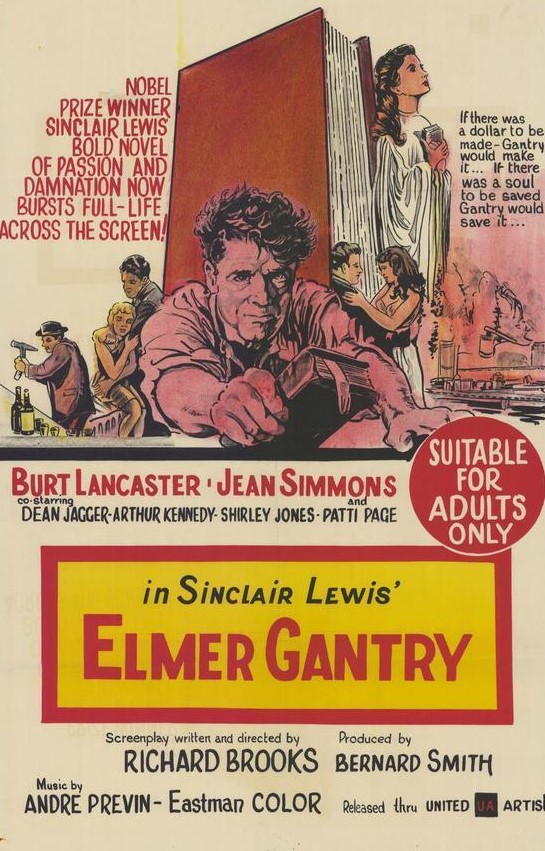
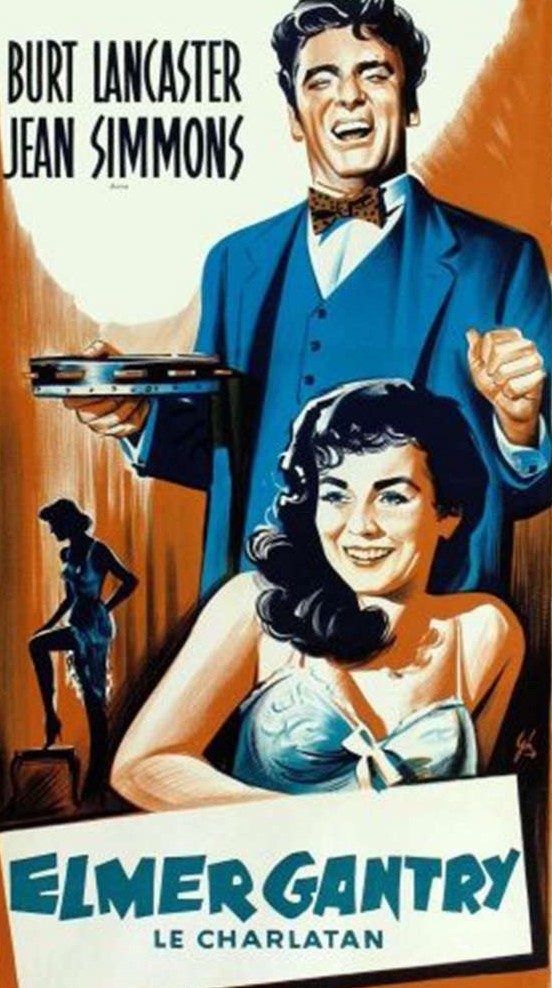
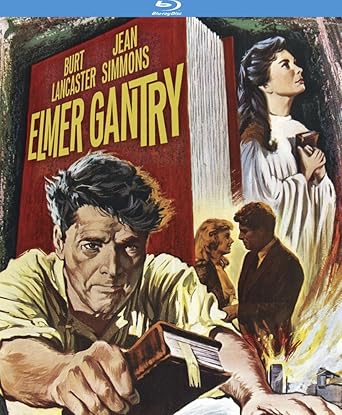
The major print advertising onslaught was led by two bold large-sized adverts intended to run facing each other on the same page. “Bless Him! Tens of thousands of believers shouted his praises!” was accompanied by the iconic illustration, Bible in hand, of Burt Lancaster. “Damn Him! Three women damned his soul” showed Lancaster grappling with Jean Simmons with Shirley Jones and Patti Paige in the background in more revealing clothing. But these two elements could also be fitted into the one ad, as shown above.
There were nearly a dozen full-size advertisements with a range of taglines. In all Lancaster is shown in the same pose with the Bible while Simmons is presented clutching a Bible and gazing heavenward. Shirley Jones appears in even skimpier outfits.
As was standard at the time, taglines could stand on their own or mix and match. Snippets for other ads were edited from this main ad: “Nobel Prize Winner Sinclair Lewis’ Bold Novel Of Passion And Damnation Bursts Full-Life Across The Screen! If there was a dollar to be made – Gantry would make it…If there was a soul to save -Gantry would save it…”
“Sinner! Elmer Gantry Wants You!” ran another ad backed up by “Are you ready, sinner? He wants you to know all about heaven…but not about his whiskey and his women!” Other adverts were fashioned from taglines like: “You’re all sinners…you’ll all burn in Hell! Tell ‘em Gantry…save ‘em from sin…lead ‘em to salvation…tell ‘em about everything…but not about your whiskey and your women!” Or included: “From the book that shook a nation with its sledgehammer theme…from a Nobel Prize-winning author…comes the raging story of a man who used the Holy Bible and broke every rule in it!”
Rarely have so many exclamation marks been employed in so short a space, but equally, rarely has a marketing team encapsulated so vividly a movie with a difficult subject matter, all tease and no substance.
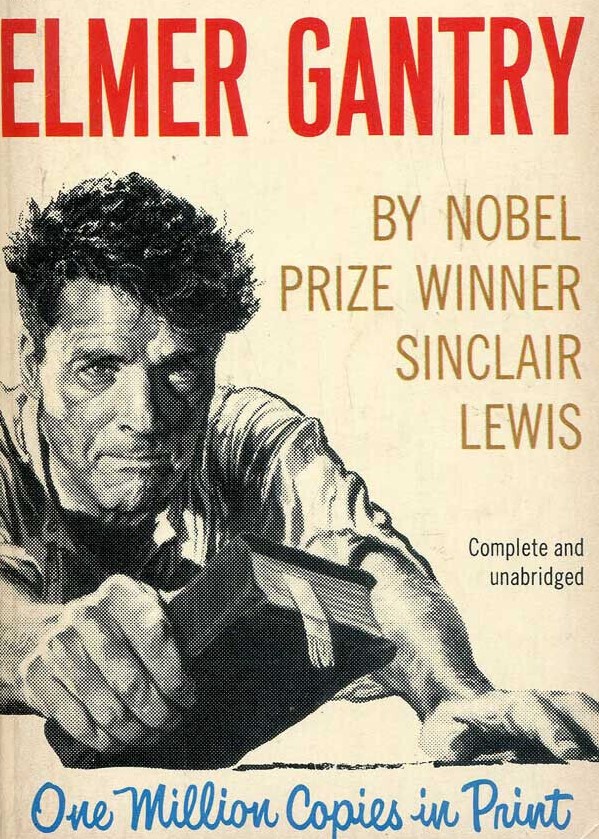
Out-with the usual marketing routes, the marketing team were able to take advantage of various ancillary promotional opportunities. Dell organized a massive paperback book tie-in in thousands of bookstores and newsstands, Burt Lancaster dominating the front cover with Simmons and Jones pictured on the back. Music retailers also played their part, United Artists Records launching the Andre Previn soundtrack album while Mercury released an album of revival tuness sung by Patti Paige, who made her movie debut in the film. With record sales exceeding 35 million, Paige’s host of fan clubs were a natural target for contact and if there was none in the local vicinity cinema managers were encouraged to start one by the simple device of setting up “a giant postcard in the lobby” and inviting fans to attach their signatures.
Department stores were called upon to run 1920s Fashion Shows.
Anniversaries, so important today, helped out. It was 30 years since Sinclair Lewis was awarded the Nobel Prize, the first American author so recognized, and 1960 was the 75th anniversary of his birth. But the promoters also played upon the book’s initial controversy, hoping to re-ignite the debate as a promotional tool.
With the bulk of the Pressbook given over to advertising and promotional ideas, barely little more than a single page was devoted to the stars, but even then there was little of the usual soft-focus puff pieces. The kind of journalistic nuggets that might help an editor fill a vacant space were limited. All we learned of Burt Lancaster, who had worked with Richard Brooks before on Brute Force (1947), was that – as if this was a mark of respect – he agreed to read the screenplay twice. Of Jean Simmons it was pointed out she had played an evangelist in Guys and Dolls (1955) but the Pressbook erroneously states that she played a nun in Black Narcissus (1947); in fact, she was a beggar girl. Arthur Kennedy is mentioned in relation to his Oscar nominations.
Shirley Jones was the most likely to attract column inches as a result of explaining how she made the transition from more demure roles in Oklahoma (1955) and April Love (1957). “It feels just fine – now,” she told the Pressbook interviewer. “At first, well, I really don’t wear much except what you see. A slip, these shoes with the green frills, and slinky black silk wrap-around that’s transparent.
“Usually, I walk into a movie set wearing my bustle and petticoats and some of the boys turn round as I go by and say, ‘Hiya, Shirl.’ But when I walked in dressed like this the fellows all just turned round and didn’t say anything. They never turned round like that before. Well, not really. It did take some getting used to after provoking the big brother reactions for so long.
“But I guess every girl dreams of being a conversation stopper some day. This is my chance. Of course, I am embarrassed sometimes…or maybe it’s inhibited.”
Brooks rewrote the script eight times before “he felt he had captured the essence” of Gantry. Most of the scenes were filmed on sound stages or adapted from an assortment of 1920s vintage streets from the backlots of other studios. The tabernacle was constructed out of an ice skating rink on a beach pier in Santa Monica.
Art director Edward Carerre spent $6,500 erecting and furnishing a genuine evangelist tent rented from Canvas Specialty. It was slightly trimmed to fit onto two combined sound stages on the Columbia lot. A total of 400 benches each measuring eight- or ten-feet were constructed by studio carpenters to provide seating for 1,000 – the tent accommodated another 2,000 standing. The stage required 500lb of imported sawdust and banners 30ft long were specially made to incorporate Biblical quotations. Where most movies required a maximum of 15-20 sets, Elmer Gantry boasted 62.
The climactic scene, conflagration in a tent, took five days to film. Soaking the set in kerosene would not supply the instant flash of flame the director demanded. So, instead, he turned to old film footage, including some frames from It Happened One Night (1934). “We’re burning film to make film,” quipped Brooks.
Burt Lancaster gives the performance of his life as the eponymous burnt-out salesman finding financial redemption in the salvation business in Richard Brooks’ riveting examination of the revivalist boom. While replete with hypocrisy, old-style religion brought succour to the rural poor, but the director takes such an even-handed approach to the subject matter, carefully nurturing a marvellous parade of characters, that you are totally sucked in.
Brooks made his name adapting famous novels but only here and In Cold Blood (1967) does he exhibit complete mastery of the material. In fact, he pulls out a cinematic plum in having the audience, who might initially have mocked the obvious manipulation of the poor, suddenly taking the side of the itinerant preachers when they come up against the more sophisticated religious operators in the big towns.
Elmer Gantry (Burt Lancaster) has some previous in the preaching business, but only for as long as it took for him to be chucked out of divinity school for seducing the principal’s daughter, so when by accident he comes upon a touring revivalist meeting he discovers his metier as a fast-talking brazen preacher. He doesn’t quite usurp the star of the show, Sister Sharon (Jean Simmons), and in fact their styles complement one another, he preaching hell and damnation, she the love of God.
Beneath the demure guise, Sharon is anything but a push-over. Not only does she see through him right away and consistently knock him back but she is quite the businessperson, though her methods of keeping civic officials in line often rely on blackmail. But then who are the hypocritical, allowing speakeasies and prostitution to run rampant, to attempt to rein in revivalists who need account to no one for how they spend their revenue?
Eventually, of course, Elmer’s ardent wooing wins over the virgin Sharon who easily forgives his dalliance with her doe-eyed follower Sister Rachel (Patti Paige). Burgeoning romance is scuppered by a chance encounter with prostitute Lulu (Shirley Jones), the principal’s daughter. That’s just the spark needed for anti-religious fervor to take over and the enterprise ends in disaster.
But what’s so good about a film that could as easily just relied on taking pot-shots at religion is that Brooks gives equal space to the good and bad in each character. Sure, Elmer’s confession of his sins might be construed as a seduction device, but that’s tempered by a genuine ruefulness and remorse over his previous actions. And while his grand-standing in front of an audience could be interpreted as merely an actor revelling in a role, you can see that religion has as easily taken over him and provided him with an identity that he finds rewarding. He might still be a salesman but he’s selling the hell out of the product.
Sharon’s uncanny hold over a congregation may be a true skill, and she’s definitely a believer, but that is borne out of fiction. She has reinvented herself, given herself a new name and identity, that furnished her with business opportunity in a male-dominated world, but love of God has come at the expense of love of man.
Perhaps what’s best about the picture’s construction is the array of supporting characters. Journalist Jim (Arthur Kennedy) might appear the pick, ingratiating himself with the touring company only to write a searing expose, but drawing the line, and incurring the wrath of his editor, at writing the kind of tawdry tale he believes is a fabrication. While still holding a torch for Elmer, Lulu has none of the cliché prostitute’s heart of gold. Initially rejected by Elmer, she goes along with a scheme to bring him down, only to change her mind and change it again, left only with remorse.
And Brooks manages to weave in a ton of detail, sometimes in dramatic fashion, such as the church elders in big city Zenith debating the value of backing the revivalists (the touring operation usually signs up hundreds of people to local parishes), and sometimes just as background, such as when Jim dictates his front-page lead in the newspaper office, whipping it off a page at a time to throw in front of the editor.
There’s also a little-commented-upon affinity between Shirley and Elmer. She, too, is coming to the end of the line. She is approaching burn-out. The endless travel, the responsibility for her payroll, financing accommodation, dealing with officials, seeing all the people she has returned to the fold being handed over to local churches, is taking its toll. And she wants the stability of her own church, where she can soothe her congregation on a weekly basis and live a more temperate life.
If ever a movie suited Burt Lancaster’s physicality, this is it. Allowed to channel his inner dominance, every gesture overpowers and by the same token makes him more potent when at his most abject. Lancaster (The Swimmer, 1968) was in a rich vein of form that would see him deliver a series of majestic performances throughout the decade. He deservedly won the Oscar.
Jean Simmons (Rough Night in Jericho, 1967) is, effectively, both a villain, duping everyone by her creation of Sister Sharon, and the epitome of the American Dream, a girl from shantytown who makes her way bigtime. Shirley Jones (Two Rode Together, 1961) is afforded more dramatic beats and hers is a sure-footed performance, leading you to believe she will react one way and then go another. Oddly, Arthur Kennedy (Joy in the Morning, 1965) missed out on adding to his five Oscar nominations for supporting actor.
Nothing in this movie has aged. If anything, this was way ahead of its time in daring to pick holes in organized religion (The Cardinal and The Shoes of the Fisherman were a good few years away and in TheNight of the Hunter a few years before Robert Mitchum only posed as a preacher).
Extraordinary movie by Richard Brooks at the top of his form.
The property had been bouncing around Hollywood for over decade. It had its origins in the true-life tale of the five Marlow brothers involving murder, revenge, and jailbreak, the story making national headlines when the case was heard at the U.S. Supreme Court in 1892. Based on the book The Fighting Marlows by Glenn Shirley,William H. Wright (Assignment in Brittany, 1943) shopped around a screenplay, jointly written with Talbot Jennings (Northwest Passage, 1940), that was purchased by Paramount in 1955.
Alan Ladd (Shane, 1953), who owed the studio a movie, was cast in the lead and the script went through rewrites by Frank Burt (The Man from Laramie, 1955) and Noel Langley (Knights of the Round Table, 1953) with shooting scheduled for 1956. John Sturges (The Magnificent Seven, 1960) was set to direct until Ladd quit, having bought his way out of his contract. Burt Lancaster (The Train, 1966) was brought in as his replacement.
When Lancaster dropped out, producer Hal Wallis took over the movie in 1959 and considered replacing him with James Stewart (Shenandoah, 1965) or Charlton Heston (The Hawaiians, 1970) with Dean Martin (Rio Bravo, 1959) as the second lead. But still the movie stalled for another five years before Wallis settled on John Wayne who signed on for $600,000 plus a one-third share of the profits and one-third ownership of the negative (a bounty that would continue to pay off through reissues and leasing to television). Henry Hathaway was paid a flat $200,000.
Wayne and Hathaway had history dating back to The Shepherd of the Hills (1941) based on the million-copy bestseller by Harold Bell Wright, and groundbreaking in its use of Technicolor, then in its infancy. They didn’t work again until desert treasure hunt Legend of the Lost (1957) which teamed Wayne with Sophia Loren. A few years later came North to Alaska (1960) followed by Circus World / The Magnificent Showman (1964).
Despite this long-term relationship, the most the director could offer about his star was that “Wayne is more particular about the pants he wears than anything in the world…unless he gets the thinnest kind of material it drives him crazy.”
When the script was finally knocked into shape, the Marlow siblings had been trimmed from five to four, and that family had been replaced by the Elders, a nod to western aficionados who would recognize the name Katie Elder (“Big Nose Kate”), occasional companion of Doc Holliday whose story Wallis had previously filmed as Gunfight at the O.K. Corral (1957). Even though Elder wasn’t dead enough – she lived till 1940 – to conform to this picture, it seemed an odd decision to choose that name unless resonance was expected.
But it was still far from a done deal because Wayne’s cancer threatened to scupper the picture. Start of shooting scheduled for October 20, 1964, was shuttered when the disease was diagnosed on September 13 following the completion of Otto Preminger WW2 epic In Harm’s Way (1965). Aware surgery might jeopardize the picture, Wayne suggested Wallis replace him with Kirk Douglas (Cast a Giant Shadow, 1966).
Hathaway rejected the notion, but while neither star nor producer had any idea whether the operation would be successful, and whether Wayne would be even fit enough to work, or – God forbid, that the actor might already have made his last picture – Wallis took an optimistic approach and announced the picture would be delayed for a month and “even a little later.” Hathaway’s optimism was based on the fact that he had survived colon cancer a decade before.
At least the surgeon moved fast, operating four days after diagnosis, and again five days later. As well as fighting the damage surgery and pain had done to his body, Wayne found himself slipping into depression, convinced the operation would render him unemployable. “I’ll never work again if they find out how sick I am. If they think an actor is sick, they won’t hire him,” he said, a legitimate observation given the cost of shutting down a picture should the actor be unable to play his role.
Wallis’s business partner Joseph Hazen shared Wayne’s pessimism and urged the producer to recast with either William Holder (The 7th Dawn, 1964) or Robert Mitchum (The Way West, 1967). Paramount, too, fretted about insurance, the studio couldn’t risk hiring an uninsurable actor. Wallis refused to abandon Wayne and the studio finally agreed to tough conditions from the insurance company. So, on January 6, 1965, the principals gathered in Durango to commence the 46-day shoot on a production budgeted at $3.19 million.
The high elevations – 8,500 ft in places – were not conducive to someone recovering from a lung cancer operation and Wayne found it difficult to breathe. It didn’t help that on the fourth day of shooting Wayne was expected to jump into icy water for the sequence where the brothers were ambushed by the villains. It didn’t help, either, that Wayne was too big to wear a rubber suit to stave off the cold like his fellow actors.
Wayne never complained that Hathaway “worked me like a damn dog.” He realized that it “was the best thing ever happened to me. It meant I got no chance to walk around looking for sympathy.” The star put on a brave front, publicly acknowledging his battle with cancer as a way of giving hope to others while privately terrified not so much of dying but of being helpless. “I just couldn’t see myself lying in bed…no damn good to anybody.”
“He had to be the macho man,” commented Earl Holliman (The Power, 1968), a late substitute for original star Tommy Kirk (Swiss Family Robinson, 1960) who was sacked after being caught smoking marijuana, “he had to have more drinks than the next guy.” And despite the severity of his condition, and although publicly pretending he had given up tobacco, he continued smoking cigars.
Recalled Dean Martin (Rough Night in Jericho, 1967), “He’s two loud-speaking guys in one.” George Kennedy (Cool Hand Luke, 1967) asserted, “If you put him in a group with other movie stars, the eye went to him and that is the ultimate marker of respect. He was John Wayne. He was very real. It didn’t matter if he wasn’t Olivier; Olivier wasn’t John Wayne.”
But there were outward signs of the effect the illness had upon him. He was less sure of himself on a horse, riding with a shorter rein out of fear a horse would get away from under him, trying to minimize the chances of falling or being bucked from the animal. And as the film wore on, an oxygen inhaler was set up beside him on set.
Dennis Hopper (Easy Rider, 1969) was wary of working again with Hathaway after a difficult experience with him on From Hell to Texas (1958) starring Don Murray and Diane Varsi where the actor suffered the indignity of endless takes. Hopper quit three times and for good measure the director put the word around and virtually grounded the actor’s career. Hopper only made one movie in six years. In the interim he had married Brooke Hayward, daughter of actress Margaret Sullavan whom Hathaway respected, and peace was brokered.
Although on his best behavior on the shoot, Hopper was no less impressed. “He was a primitive director, he rarely moved his camera, the movement came from the actors.”
“Westerns are art,” declared Wayne. “They’ve got simplicity and simplicity is art…There’s simplicity of conflict you can’t beat…Westerns are our folklore and folklore is international…In Europe they understand that better than we do over here. “
Whether it was public sympathy for an ailing star and his resolve to fight cancer, or audience delight that he was back in a western after a gap of a few years, The Sons of Katie Elder was a huge hit with $5 million in initial rentals (what studios were left with after cinemas had taken their share). It earned more later in reissues but that initial sum was enough for thirteenth spot in the annual box office rankings though beaten by both Shenandoah and Cat Ballou. Its foreign earning would probably match domestic, to make it one of Wayne’s biggest earners for the decade.
SOURCES: Scott Eyman, John Wayne: His Life and Legend (Simon and Schuster Paperbacks, 2014) p111, p387-396 ; Ronald L. Davis, Duke: The Life and Image of John Wayne (University of Oklahoma Press, 1998) p266; Hal Wallis Collection, Margaret Herrick Library; Hedda Hopper, “Ladd To Star in Film of Pioneers’ Reunion,” Chicago Daily Tribune, November 9, 1955, p16; Thomas M. Pryor, “Hecht-Lancaster Obtains 2 Novels,” New York Times, January 12, 1956, p22; Oscar Godbout, “TV Movies Extras Get Salary Rises,” New York Times, July 3, 1956, p17; John Wayne, “Me? I Feel Fine,” Los Angeles Times, January 18, 1965; James Bacon, “Wayne’s Biggest Bout vs. Killer Cancer,” Los Angeles Herald Examiner, March 14, 1965; Roderick Mann, “John Wayne – A Natural as The Shootist, Los Angeles Times, March 7, 1976.
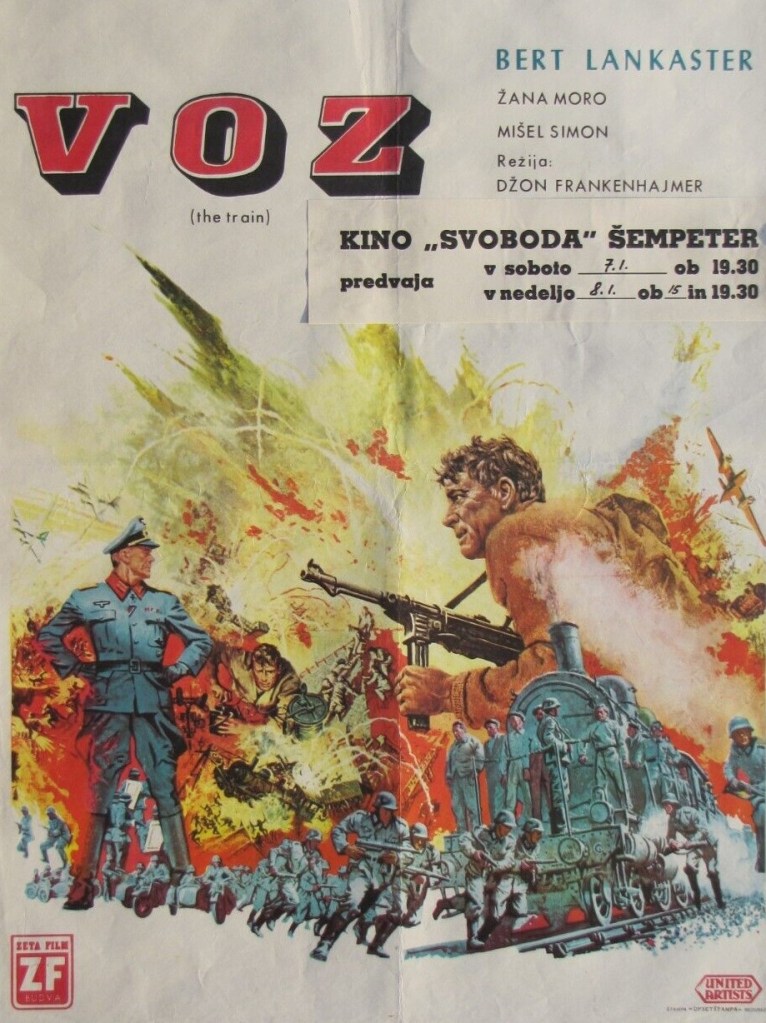
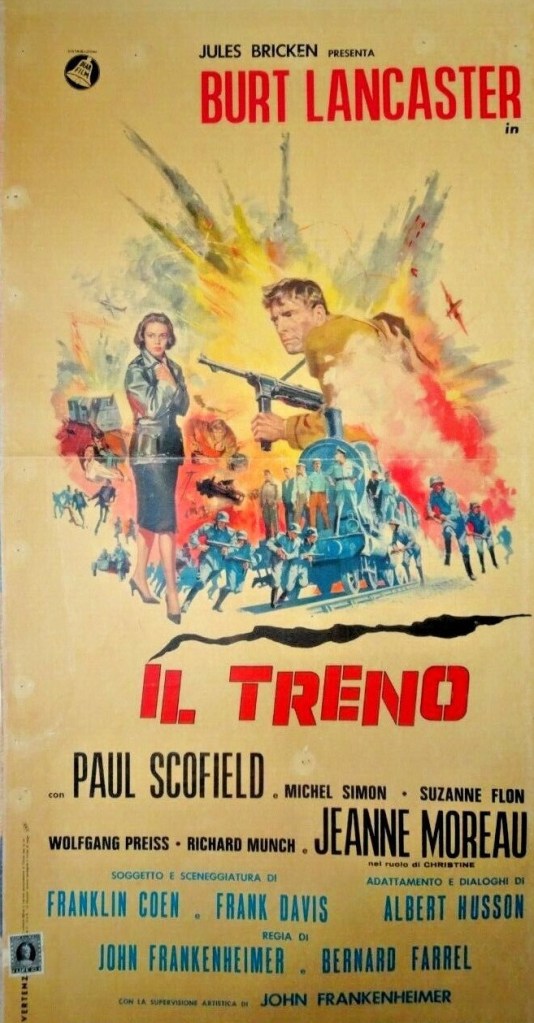
A juggernaut of problems was coming down the track – director sacked, over a year in production, script changing by the minute, way over budget, star Burt Lancaster, his public halo slipping after being caught escorting women who weren’t his wife, earning only 20 per cent of his normal $750,000 fee in order to pay off his massive debt to United Artists. And yet it set the template for “hi-tech shoot-em-ups” such as First Blood (1982) and Die Hard (1988), action pictures where a lone hero saved the day against overwhelming odds.
Lancaster’s hot critical run, Oscar winner for Elmer Gantry (1960), nominated for The Birdman of Alcatraz (1962), had turned sour with Luchino Visconti’s The Leopard (1963). Financially his career had hit an iceberg.
As part of the producing triumvirate of Hecht, Hill and Lancaster, responsible for pictures like Marty (1955), Trapeze (1956) and The Sweet Smell of Success (1957), he found himself in a financial hole, only bailed out when United Artists picked up the tab for the company’s accumulated debt, the actor paying it back with a four-movie deal for which he was remunerated to the measly tune of $150,000 each, a contract he described as “slavery.”
The Train was third on that agenda. It was a risk for United Artists, its first venture into the complex world of the European co-production, this time teaming with French outfit Les Films Ariane. At that point, Lancaster was still considered a creative powerhouse, if not the actual producer, then carrying out a great deal of that function.
Walter Bernstein (Fail Safe, 1964), who had worked with Lancaster on Kiss The Blood off My Hands (1948) and described the actor as “the gorilla on the bus,” was the only one of the original trio of screenwriters – the others being Franklin Coen and Frank Davis – not to receive a screen credit. It was based on a true story, a book Le front de l’art (1961) by Rose Valland. According to that narrative, Germans did try to transport by train a haul of Impressionist paintings. But it was bureaucracy and not the lone hero which prevented it reaching Germany.
But initially, the script had little traction, shelved by the studio until Arthur Penn (Mickey One, 1965) happened upon it. The director’s curiosity was piqued by what he perceived as the peculiar French trait of being willing to risk their lives for art. Penn targeted Lancaster as capable of generating “a certain kind of French sensitivity to the idea of art needing to be protected.” When Lancaster signed on, it was with the proviso Penn direct.
The movie went into production in August 1963, a 15-week schedule, and cooperation from the Louvre, French National Railways, French Army and with a contingent of 40 rail cars. Shots of Nazis in Paris were shot very early in the morning so as not to upset Parisians. The production was based in a small village close to Paris.
Turned out Lancaster and Penn were at odds from day one. Pestered to show “vulnerability” Lancaster decided to show the director “the grin.” Penn only lasted a day, technically two if you include that the following day was a holiday. By 11pm that night Penn was gone. John Frankenheimer who had directed Lancaster in three previous movies, The Young Savages (1961), The Birdman of Alcatraz and Seven Days in May (1964), was his replacement.
Bernstein quit. Lancaster told the writer, “Frankenheimer is a bit of a whore, but he’ll do what I want.”
Why Lancaster didn’t want to make Penn’s version – a quieter film about art (the train didn’t leave the station till about 90 minutes in) – was down to the commercial and critical failure of The Leopard. He needed a hit. And having gone down the arthouse Visconti route, the actor wanted to return to his action roots.
Lancaster showed where the power truly lay. As part of Frankenheimer’s deal, he received a Ferrari; Lancaster told him to keep UA at bay by complaining about the color. Frankenheimer did better than that. He negotiated a credit that read “John Frankenheimer’s The Train.” He evaded French laws that demanded a co-director on set and he received final cut, not to mention a bigger budget.
Production shut down while Lancaster and Frankenheimer hammered out a new script, one that called for, among other things, a 70-ton locomotive, a complete station, more boxcars, signal tower and switch tower as well as a ton of TNT and 2,000 gallons of gas to create the 140 separate explosions for a one-minute sequence that took four months to plan. One of the most striking shots, where the locomotive smashes free and provides a terrific close-up of the upended train wheels spinning, was achieved by accident. Once all the plans were agreed, production was delayed again because winter conditions meant the ground was too hard to safely detonate explosives. The budget doubled to $6.7 million.
Some goodwill was involved. The French welcomed the idea of UA destroying a marshalling yard because it saved them the cost of doing it.
Shooting restarted in Spring 1964. But the schedule was cut to seven weeks, though that include the strafing sequence. You may remember Lancaster had to lug around a wounded leg. That was a clever accommodation. The actor had incurred a knee injury so wouldn’t it be a good idea to find a reason for him to limp such as being wounded. Circumstances – other movies taking precedence after the long lay-off – resulted in the death of Michel Simon’s character.
Injury didn’t tend to hamper Lancaster’s physicality. He runs, jumps, climbs, falls downhill. Said Frankenheimer, “Burt Lancaster (aged 50 mind you) was the strongest man physically I’ve ever seen. He was one of the best stuntmen who ever lived.”
The ending was conceived late in the day. Originally, it was going to be a proper shoot-out. But the idea of Paul Schofield with a gun going up against Lancaster was deemed “ridiculous” so, in effect, the snob German “talked himself to death.”
Reviews were mixed and many found the film too long, one critic complaining, the train “pretends it’s going somewhere and…isn’t.” But somewhere along the way, Lancaster invented the modern action hero.
It didn’t do him much good. The film failed at the U.S. box office but (as Roy Stafford has reminded me) it was in Top 13 in the UK and top 5 in France so there’s a fair chance it at least broke even and may well have gone into profit. Lancaster, forced by UA into making The Hallelujah Trail (1965), another box office calamity, lost out on The Spy Who Came In from the Cold (1965) and Khartoum (1967)
SOURCES: Kate Buford, Burt Lancaster, An American Life, (Aurum paperback, 2008) p230, 234-240; John Frankenheimer, A Conversation with Charles Champlin (Riverwood Press, 1995); Charlton Heston, In the Arena (Simon and Schuster, 1995), p315; Tino Balio, United Artists, The Company That Changed the Film Industry, (University of Wisconsin Press, 1979) p279; Arthur Penn Interviews (University Press of Mississippi, 2008) p15, p45; Matt Zoller Seitz, “Those Hi-Tech Shoot-‘Em-Ups Got the Template from The Train,” New York Times, Apr 30, 1995; Lancaster interview, New York Post, Mar 22, 1965; Jean-Pierre Lenoir, “Stalling a Great Train Robbery,” New York Times, November 3, 1963.
Director John Frankenheimer (The Gypsy Moths, 1969) tackles the movie’s off-putting central issue straight on. At various points, characters argue whether it’s worth risking lives to save a bunch of paintings, even if they are by masters like Cezanne, Matisse and Manet and even if they do constitute the “pride of France.”
Had this been an ordinary heist, some master criminal conspiring to steal a trainload of paintings, the loot would not have been so contentious, as there was little chance of lives being lost. And in any case, thieves, in the act of stealing, do have to accept that they might fall prey to the cops or, as commonly, fellow members of the gang.
There was another point. Art, then and now, was commonly perceived as a high-class aspect of life, especially once it diverted away from easily understood portraits and still lifes into the specific styles of a Monet or Picasso. Working-class people had little interest in it and felt excluded from it.
So, from the French perspective, coming towards the end of World War Two, post-D-Day and Paris close to being liberated, upper-class German Col von Waldheim (Paul Schofield) decides to hijack the contents of a museum and take hundreds of masterpieces to Germany, ostensibly to fund the fightback against the invaders, but more likely just a final act of a conqueror who has enjoyed, rather than destroyed, the captured French capital.
At first, station master Labiche (Burt Lancaster), while complicit in minor sabotage, has no interest in becoming personally involved, especially with liberation so close and the threat of death lifting by the hour. Others take a much more patriotic stand over the paintings and endeavor in small ways to prevent the trainload’s departure and slow down its progress to Germany.
A whole battalion of German soldiers, including Von Waldheim, who has commandeered a train in the first place, and railway workers, are aboard. But not all are in agreement with their commander’s aims, his deputy Major Herren (Wolfgang Preiss) outspoken in his opposition to this waste of manpower and diversion of energy.
Von Waldheim blames Labiche for the minor sabotage and forces him to take personal control of the train. And it turns out Labiche is much more than a bureaucrat, and knows everything there is to know about driving a train and how the tracks operate. And eventually it becomes a game of cat-and-mouse between Labiche and Von Waldheim.
But before that occurs and the movie really takes off, there’s tons of stuff that come into the sub-genre of a sub-genre category, to the delight of a railway-spotter but the irritation of the general audience as we are treated to endless scenes of the train running through the country or stopping and starting and points being switched. All very fascinating in its own way, but tending to the tedious.
I’m a bit pernickety when it comes to the heist picture and I’m just wondering how the Resistance, in what appears to be very short notice (in real time the movie only lasts a few days) to arrange for railway stations and towns along the route to manage to make massive signs, some I would guess 30-40ft long, to convince Von Waldheim he is taking the route he expects rather than being diverted along a different track. And then to get word to the Allied forces not to bomb a train that had a whitewashed roof. Try explaining the contents to an Army that is trying to get on with winning the war and couldn’t be less concerned about what might be interpreted as misplaced pride.
You would imagine that if those actions could be so easily carried out that there might have been a proper Resistance troupe ready to assist in blowing up the engine, but safeguarding the coaches, along the way. As the toll of ordinary Resistance members mounts, it’s left to Labiche, decidedly not an art lover, to save the day.
And that’s when the film does take off. He’s the most enterprising of individuals, managing, despite being wounded, to single-handedly derail the train twice, even with soldiers hounding him over the hills and patrolling the track.
Burt Lancaster (The Gypsy Moths, 1969) is superb as the doubter who becomes committed to the cause. It’s easy to forget just what a range Lancaster has. There’s not every actor you would believe when he’s twisting wires in the complicated business of setting an explosion or hammering loose sections of track. To slip effortlessly from the nuance and privilege of Luchino Visconti’s The Leopard (1963) to the hard muscular graft of this is quite an achievement.
Paul Schofield (A Man for All Seasons, 1966) was far more virile than his later screen persona suggested. He was a classic example of why Hollywood raided Britain, especially for villains. Outside of the stage, he was virtually unknown, only two previous films in the 1950s, so he was a fresh face. He didn’t quite master the art of cinema, a bit prone to shouting and facial expressions verging on the combustible. But he proves an excellent and inventive adversary.
It’s another for the futility of war department and it’s ironic that it’s the mutinous Maj Herren rather than the French who decides lives are not worth losing over a bunch of paintings.
The action, when it finally emerges from the trainspotting, is excellent. But a bit of judicious pruning in the earlier stages would have worked wonders.
Unsung masterpiece. In the same year, director Jphn Frankenheimer went from the career nadir of The Extraordinary Seaman to an absolute gem. Beautifully paced, exquisitely observed, with five heart-wrenching performances of naked repression. For star Burt Lancaster a companion piece to The Swimmer (1968), for leading lady Deborah Kerr better work than even The Arrangement (1969), for supporting actor Gene Hackman (Downhill Racer, 1969) a wake-up call to Hollywood. Sparked by thrilling aerial sequences. And like Easy Rider (1969) interprets transience as freedom.
And in the most stunning piece of directorial bravura since Alfred Hitchcock despatched Janet Leigh halfway through Psycho (1960), here John Frankenheimer, four-fifths of the way through, leaves the others to pick up the pieces after the star’s apparent suicide.
A trio of sky divers – Mike (Burt Lancaster), Joe (Gene Hackman) and Malcolm (Scott Wilson) – on a barnstorming tour of small town USA board with Malcolm’s estranged Aunt Elizabeth (Deborah Kerr) and Uncle John (William Windom) in the small Kansas town where he was born and orphaned at age ten. John clearly resents the intrusion, Elizabeth finds it impossible to even hug her nephew, but a single glance between Mike and Elizabeth says it all. She is the bored housewife, he the conqueror.
But for all the subsequent revelations that would be melodramatic meat-and-drink to the likes of Elia Kazan’s The Arrangement, the entire tone is low-key. While fuelled on regret, this is not a movie that feasts on it.
And quite astonishingly, there is a whole pile of information dumps that serve to add tension to the tale. The stars of the show are all involved in the nitty-gritty, penning dates and times on posters, sewing their kit, the bombastic Joe acting as marketing guru and cheerleader. In a talk to women’s group, while purportedly explaining how a parachute works, Mike gives his audience a whiff of danger. For the whole enterprise depends on coming close to death. The longer a sky diver takes to open his parachute, hurtling to the ground at 200 mph, the more the crowd soaks it up.
The sky divers are long past the days of thrill-seeking, this is just a job, they are itinerants with nobody meaningful in their lives. Sky diving is “not only a way to live but also a way to die as few things are.”
Except when the performer, Mike is so reserved he might almost have disappeared into a void except silence seems to fill out his personality. He embarks on an affair with Elizabeth with scarcely a word spoken.
The screenplay has an amazing structure, each character exposed in novel fashion. The extremely realistic Mike finds himself in the deep waters of imagination. The overly-confident Joe speaks of his fears to the topless dancer (Sheree North) he has picked up but only when she’s safely asleep. He beats his chest in Church as he recites the “I am not worthy” section of the old Catholic Mass. Even the dancer gets a couple of great lines, confiding in a friend that Mike would have been her first choice to bed but Joe proved a decent substitute.
And there’s just a wonderful, initially mystifying, set of scenes, that could easily have been cut, but left in display the director’s utter mastery. A cranky conductor is rehearsing a marching band for, we learn later, the Fourth of July parade, picking, as is the way of cranky conductors, on some innocent in the band. Come The Fourth of July the marching band turns into main street – and finds it empty. The entire town, in a demonstration of ghoul-ness, has decamped to watch Malcolm attempt the stunt that cost Mike his life.
Returning home, Malcolm finds no homecoming despite his childless aunt desperate for a surrogate son. If she was any more buttoned-up she would explode. “I just wasn’t very observant,” she observes, explaining how her sister stole away her lover. And when that couple died in a car accident, John, who married Elizabeth on the rebound, forbade his wife to adopt Malcolm because he didn’t want to be daily faced with the son of her true love.
So many scenes are wordless observation. We focus on the dead eyes of John, pretending to be asleep, when his adulterous wife returns. Elizabeth watches her husband in a mirror. Virtually every shot of Elizabeth reveals the torment of a woman desperately clinging on to sanity. Every shot of Malcom reveals rejection.
Characters are viewed in long-shot, through doors, or from the sky, and then in bold extreme close-up, but not in a kind of experimental fusion of style, but through careful directorial consideration. You feel that every shot is just the correct shot for the moment.
For once, Frankenheimer has no conspiracy theory to peddle, but oddly enough this bears similarity to the car crash of The Extraordinary Seaman in that it is riddled with ghosts, of choices not taken, of regrets taken root.
And there is something quite remarkable in the character construction. Both Mike and Malcolm are melancholic, sapped of energy. Into this gap bursts Joe, a vibrant personality, the one gets every party going and always ends up with a bottle in one hand and a girl in the other. It’s quite a stunning performance from an, at this point in his career, a scene-stealer of some style.
In previous films Gene Hackman was always doing something, the hallmark chuckle still in embryo, but his performance often got in the way. Here, the screenplay by William Hanley – based on the novel by James Drought – effectively places him center stage, taking up the slack from the other pair and Hackman responds by proving how he could carry a picture if he was in fact the star.
Scott Wilson (In Cold Blood, 1967) takes the opposite approach, drawing us in with his soulful eyes and a demeanor calling out for affection. He dominates the final section as he, too, contemplates suicide, a pretty tall order given at this point he is in the sky and his eyes are masked by goggles.
When Deborah Kerr asks Burt Lancaster, “Why are we so contemptible to you?” it’s the question she’s asking of herself and that self-loathing guides her repressed performance, occasional bouts of adultery her only release, but unable, as with her early lover, to charge headfirst into happiness.
Lancaster’s role is central but not over-dominant in the way of The Swimmer. While seemingly the picture’s anchor, Frankenheimer is duping the audience in the manner of Hitchcock. Lancaster is not the unshakeable monolith he appears, but a fragile heart.
Critics, possibly still confounded by The Extraordinary Seaman and feeling Frankenheimer had shot his bolt, were pretty dismissive of this at the time. It doesn’t score highly on any of the current critical aggregate charts.
But I find that simply astonishing. If ever there was a movie demanding reappraisal, it’s this.
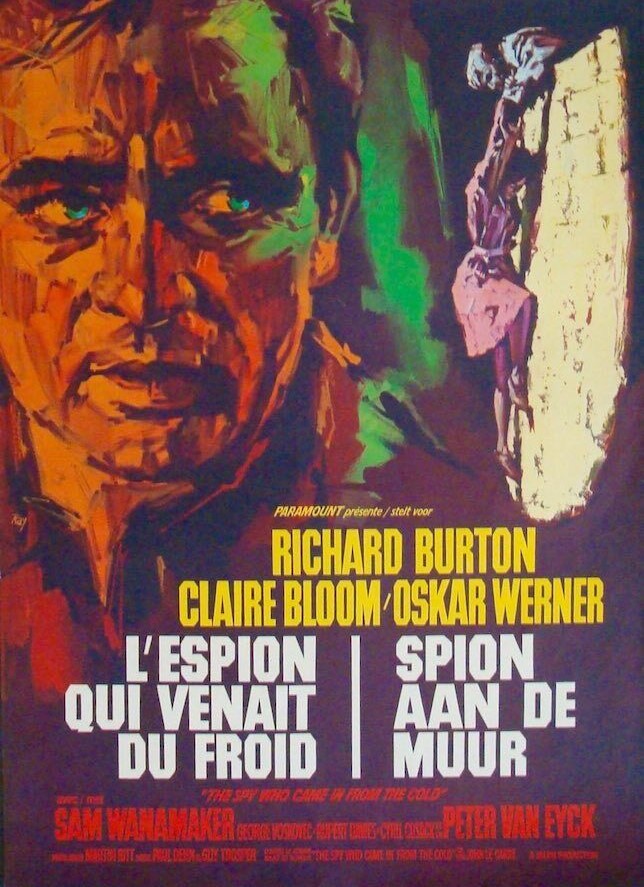
Shooting might have been less stressful and cheaper if director Martin Ritt had stuck to his initial schedule but when the shoot start-date was pushed back from late fall 1964 to January 1965 he lost original star Burt Lancaster (planning to play the original Englishman as a Canadian). At relatively short notice, Richard Burton stepped in, but for an eye-watering fee of $750,000, at that time the biggest salary paid in Hollywood. (Due to Ritt’s involvement there had been rumors Paul Newman would star.) And although Burton pushed for his wife Elizabeth Taylor for the small role of Nan, he was overruled on the issue of cost, and that audience expectations would be unfairly raised.
It didn’t matter, though, if Ritt refused to cast Elizabeth Taylor. He got her anyway, and her vast entourage, generally happy to remain out of the way but occasionally arriving on location in the middle of Dublin in her white Rolls-Royce sending fans into convulsions. There were two schools of thought as to which woman caused more disruption: the jealous wife exerting 24-hour surveillance on a husband with a wandering eye or one of his previous lovers, Claire Bloom, who was playing Nan. (The name changed from Liz in the book.)
“It was not a happy picture and the central reason fort that was: Claire Bloom,” averred Burton’s biographer Melvyn Bragg. “The real problem was not from Bloom but from Elizabeth Taylor’s jealousy,” claimed Sam Kastner. That Burton incurred Bloom’s wrath was not without doubt. But it wasn’t the first time. Prior to Taylor, but while he was married to Sybil, Burton and Bloom had been lovers.
Burton was “not prepared for Bloom and found it very difficult to handle.” The pair had met on a touring production of The Lady’s Not for Burning in the 1940s but their romance remained unconsummated. A few years later in the early 1950s the affair began in earnest and continued on and off for five years. When both were cast in Look Back in Anger (1959), Bloom expected them to pick up where they had left off. But that notion was dashed when Burton appeared, still married, on the arm of Susan Strasberg (Sisters, 1969).
The other elephant in the room was, of course, Burton’s alcohol intake. A very heavy drinker, verging on the alcoholic, his hand had begun to tremor until he received liquid sustenance. If Burton had an equally boisterous co-star as in Peter O’Toole in Becket (1964) or a very indulgent director as with John Huston in The Sandpiper (1965), his drinking would not attract comment. But “Martin Ritt did not approve of Burton’s heavy drinking and Burton resented that.”
Never mind Burton’s issues with ex-lover and wife, he was having difficulty delivering the performance Ritt demanded. The director wanted a stripped-down character, minus the oratory which had made the actor famous, the acting so flattened as to “make him anonymous.” Author John le Carre would have preferred James Mason or Trevor Howard for the “embattled” personas they presented, and which would have fit more into the director’s perception of the character. “For Burton this time there would be no strong sex, no oratory, no action, no charm.” The director wanted that Burton intensity, but coiled, not sprung. As the production wore on, director and star were barely speaking. “Ritt had come to despise Burton whom he saw as a spoiled and self-indulgent actor who had dissipated his talent.”
The initial screenwriter Guy Trosper made changes that seemed out of kilter with the book, for instance sending Leamas to psychiatric hospital rather than jail for punching the grocer. When he became ill he was replaced by Paul Dehn who did not veer so far from the book. Le Carre was brought in at the last minute at Burton’s insistence to do rewrites. But that merely added to the existing aggravation. While waiting for nightfall to shoot the escape sequence, Le Carre was obliged to keep the actor company, trying to consume most the available whisky so that Burton did not go on set drunk. While little of Le Carre’s rewrites found their way into the finished product, he did provide a new scene for Fiedler (Oskar Werner).
Ritt had a revolutionary picture in mind, not just filming in black-and-white to downplay the glamor of the espionage business as evidenced by James Bond, but to employ “a point of view that’s never been found before.” He was not a believer in the end justifying the means nor of depicting the enemy as rabid. “Most of the time,” he explained, “you have actors playing Communists as if they’d just switched over from playing Nazis in World War Two pictures…the Communists in this picture are people and one of them at least …is an honest, ethical man.”
While the decision to film in black-and-white was a creative decision, intended to give the film a realistic edge, he knew it would not necessarily go down so well with the end user, the exhibitor. “The needs of creative people and the needs of exhibitors are completely different. Exhibitors want pictures and creators want to express themselves and those two factors don’t always satisfy each other.” Although the movie was Oscar-nominated and critically well-received and did well in key city first-run, it was condemned by exhibitors in small towns, one of whom discouraged others from booking it and complained that the black-and-white aspect made the film impossible to view on old projectors.
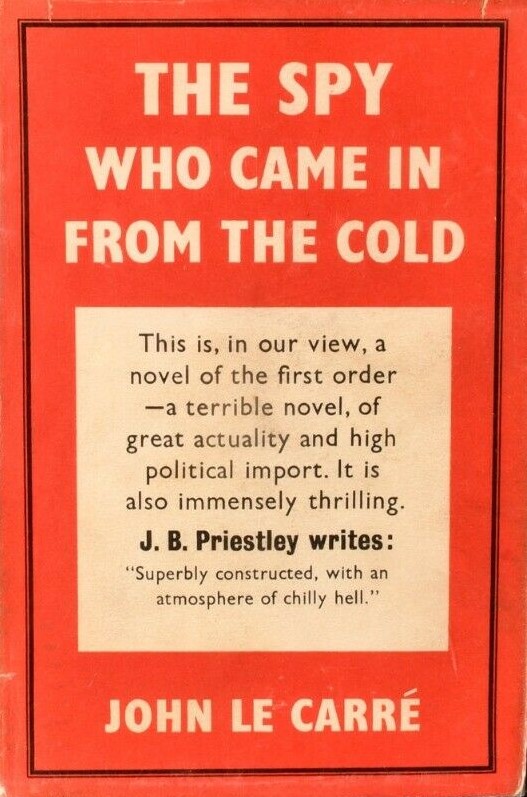
Author John le Carre was an unknown, two previous books published to no great sales. But The Spy Who Came in from the Cold proved a phenomenon. Debuting in the number spot in February 1964, the book spent 35 weeks topping the hardback bestseller chart. It ended up the hardback number one title in the U.S. during 1964, a quarter of a million copies sold, winner of the Edgar Award for Best Mystery, initial paperback order topping two million copies, five million books in print by the time the film appeared. So it seemed all the more astonishing that the movie rights had been snapped up for a mere $21,000 (with escalating clauses based on sales that took it up to $38,000). Martin Ritt claimed glory for that astute purchase, making a bid to a hard-up author when the book was in galley form. “When I bought it nobody else was running to buy it,” claimed Ritt. But it turned out the real star was Kay Selby, a Paramount story editor, who had dug it out of a pile of novels submitted. Le Carre did not make the same mistake again, movie rights for his next book The Looking GlassWar were sold for $400,000 and the paperback rights for the same
When the film had still been a relatively low-budget production, Paramount planned to film exteriors in London and interiors in Hollywood. But Ritt wanted “to capture the full brunt of the winter atmosphere for dramatic emphasis” and there was very little Hollywood could bring to the party to recreate an actual bleak British weather.
The bulk of the film was shot in Ireland at the defunct Ardmore studios in Bray – Ritt rented them from the Official Receiver, the first production there since November 1963 – and on location in Dublin, the historic Cornmarket standing in for Checkpoint Charlie while with the addition of breezeblock, barbed wire and an iron ladder, Dublin Square was transformed into the Berlin Wall, though some scenes set in East Berlin were shot in the London Docklands.
However, shooting kicked off in London, at Shepperton studios on January 9, 1965, before switching for two months to Ardmore, wrapping up there a week early, heading for location filming in Amsterdam (briefly) and 9-10 days in Garmisch (Germany) before returning to Shepperton in April. Ritt brought the picture in under budget.
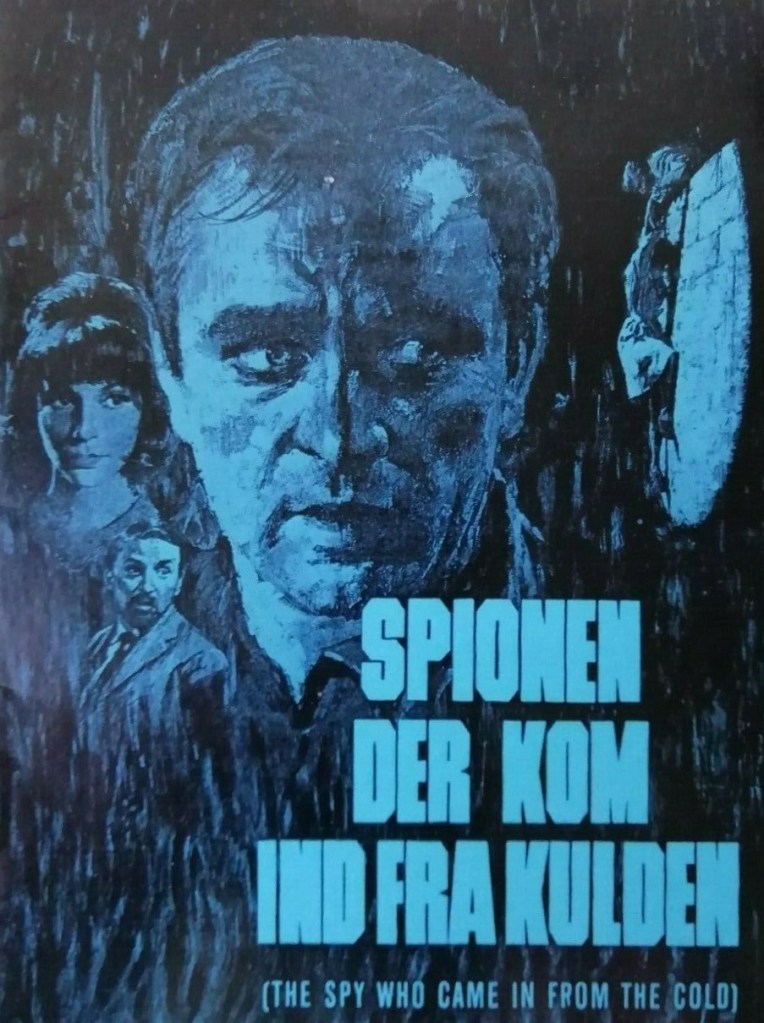
Paramount launched a teaser campaign in November 1965 New York – the idea stolen by United Artists for A Fistful of Dollars the following year – with a 1,000-strong two-sheet poster campaign in the city’s subway, promoting the film but missing out the opening date and the cinemas it would play, that information supplied closer to the launch which took place over the lucrative Xmas period in 1965, coincidentally just in time to qualify for Oscar consideration.
And also in time to face a spy box office tsunami called Thunderball and the roadshow epic Doctor Zhivago among the 20-plus movies launched for the festive season. In fact, the Bond films had triggered a resurgence of spy pictures. As the Ritt picture got underway, others on the starting grid include “The Matt Helm Project,” The Ipcress File, James Garner in Welcome Mr. Beddoes (A Man Could Get Killed) and Masquerade starring Cliff Robertson. In addition the potential line-up also included female spy Christy O’Hare, Aaron Rosenberg’s Smashmaster and Strangers on a Bridge; the first two were never made, the last one taking over half a century to hit the screen as Steven Spielberg’s Bridge of Spies.
Burton was Oscar-nominated, but in the year when Thunderball (1965), Torn Curtain (1966), The Silencers (1966) and Our Man Flint (1966) all featured in the top ten films of 1966, The Spy Who Came in from the Cold did not prove a counter-programming smash, sitting at 32nd in the annual chart with $3.1 million in rentals. Although the movie was critically well-received and did well in key city first-run, it was a bust in smaller towns. Don Stott of the Calvert Drive-In in Prince Frederick, Md, complained “it was one of the lousiest pictures I’ve ever had my displeasure to exhibit and lose my shirt on…the print was so dark…it was barely visible.” Added Arthur K. Dame of the Scenic Theater in Pittsfield, N.H., “it comfirms the fact that we are not going to do well with spy films.”
SOURCES: Adam Sisman, John Le Carre, The Biography (Bloomsbury, 2013) p258, 266, 273, 277-280; The Richard Burton Diaries (Yale University Press, 2012), p79-80; Melvyn Bragg, Rich: The Life of Richard Burton, (Hodder and Stoughton, 2012) p200-203; Sam Kashner, Furious Love (Harper Perennial, 2019) p120-131; “Burt Lancaster Plans More Pix Of His Own,” Variety, January 1, 1964, p27; “Bestseller at $20,000,” Variety, March 25, 1964, p15; “Broadway,” Box Office, April 20, 1964, pE5; “Director Martin Ritt: Big Dig Is Scripts You Can Sell to Producers,” Variety, May 13, 1964, p13; “Six for Paramount in Alien Locales,” Variety, July 15, 1964, p18’“Richard Burton Receives Role in Spy by Martin Ritt,” Box Office, August 24, 1964, pW1; “Voices in the Diplomatic Pouch,” Variety, December, 9, 1964, p7; “Ritt Starts Spy Who Came in from the Cold in London,” Box Office, January 18, 1965, pE5; “Spy Success Sires Speedy Sequel, Le Carre Learning Loot Lesson,” Variety, February 17, 1965, p3; “Martin Ritt May Wind Berlin Wall Episodes on Spy This Month,” Variety, February 24, 1965, p28; “Paperbacks Up their Covers and Advance $,” Variety, March 3, 1965, p1; “Burton Winds Irish Shooting Spy Film,” Variety, April 14, 1965, p20; Maxwell Sweeney, “Harassed Irish Studio Revives,” Variety, May 12, 1965, p54; “Kay Selby’s Coup,” Variety, August 11, 1965, p3; “Subway Posters First Step in Promoting The Spy,” Box Office, November 29, 1965, pA2; “Review,” Box Office, December 20, 1965, 1965, pA11; “Three Paramount Pix To Open in N.Y. Dec 23,” Box Office, December 20, 1965, pE16; “Martin Ritt Is Promoting His Spy for Paramount,” Box Office, December 20, 1965, pE12; “Espionage Shown in Its Dirty Clothes,” Variety, December 22, 1965, p4; “The Exhibitor Has His Say,” Box Office, June 13, 1966, pA4 and October 10, 1966, pB4; Big Rentals of 1966,” Variety, January 4, 1967, p8.
This isn’t my choice of the top films of the year, but yours, my loyal readers. This is a chart of the films viewed the most times over the full calendar year of January 2021 – December 2021.
The Secret Ways (1961). Richard Widmark in spy thriller set in Hungary during the Cold War and adapted from the Alistair MacLean novel. Senta Berger has a small role.
Ocean’s 11 (1960). Frank Sinatra, Dean Martin and the Rat Pack embark on an audacious Las Vegas robbery.
Pharoah(1966). Epic Polish picture about political shenanigans in ancient Egypt.
Age of Consent (1969). Helen Mirren stars as the nubile muse of jaded painter James Mason returning to his Australian roots.
The Venetian Affair (1966). Robert Vaughn hits his acting stride as a former CIA operative turned journalist investigating suicide bombings in Venice. Great supporting cast includes Elke Sommer and Boris Karloff.
The Golden Claws of the Cat Girl (1968). Cult French movie starring Daniele Gaubert as a sexy cat burglar.
Moment to Moment (1966). Jean Seberg is caught up in a Hitchcockian murder plot in the French Riviera. Also features Honor Blackman.
It’s Not All Rock’n’Roll (2020). Ageing rocker Dave Doughman aims to mix a career with being a father in this fascinating documentary.
4 for Texas (1963). Frank Sinatra and Dean Martin face off in a Robert Aldrich western featuring Ursula Andress and Anita Ekberg with Charles Bronson in a smaller part.
Once a Thief (1965). Trying to go straight ex-con Alain Delon is coerced into a robbery. Ann-Margret is a revelation as his wife. Jack Palance, Van Heflin and Jeff Corey add up to a great supporting cast.
Stiletto (1969). Alex Cord as a Mafia hitman wanting to retire is pursued by tough cop Patrick O’Neal. Britt Ekland heads a supporting cast which includes Roy Scheider, Barbara McNair and Joseph Wiseman.
Subterfuge(1968). C.I.A. operative Gene Barry is called to London to uncover a mole in M.I.5. Joan Collins provides the romance. Richard Todd, Tom Adams, Suzanna Leigh and Michael Rennie lend a touch of class.
The Swimmer (1968). Burt Lancaster delivers a superlative performance as a man whose life is falling apart.
The Rock (1996). Blistering thriller starring Sean Connery as an ex-inmate of Alcatraz helping Nicolas Cage infiltrate the island to prevent mad general Ed Harris destroying San Francisco. Michael Bay directs.
The Sicilian Clan (1969). Alain Delon joins forces with Jean Gabin to pull off an daring jewel heist with tenacious cop Lino Ventura on their trail. French thriller directed by Henri Verneuil.
The Naked Runner (1967). With his son held hostage, Frank Sinatra is forced to carry out an assassination in East Germany.
A House Is Not a Home (1965). Biopic of notorious madam Polly Adler (played by Shelley Winters) who rubbed shoulders with the cream of Prohibition gangsters.
Pressure Point (1962). Prison psychiatrist Sidney Poitier must help racist Nazi Bobby Darin.
Genghis Khan (1965). Omar Sharif plays the legendary warlord who unites warring Mongol tribes. Stellar cast includes Stephen Boyd, James Mason, Francoise Dorleac, Eli Wallach, Telly Savalas and Robert Morley.
A Twist of Sand (1968). Beleaguered smuggler Richard Johnson spars with Jeremy Kemp in thriller about hidden diamonds in Africa. Honor Blackman is along for the voyage.
Jason and the Argonauts (1963). Ray Harryhausen special effects dominate this legendary tale of the hunt for the Golden Fleece.
Dr Syn Alias the Scarecrow (1963). Disney movie that was turned into a mini-series in the U.S. starring Patrick McGoohan as the eponymous Robin Hood-type character who assists smugglers.
The Hitman’s Wife’s Bodyguard (2021). Ryan Reynolds and Samuel L. Jackson reunite for wild sequel also featuring Salma Hayek and Antonio Banderas.
Dark of the Sun / The Mercenaries (1968). Rod Taylor leads a private army into the war-torn Congo to rescue a cache of uncut diamonds. Jim Brown, Yvette Mimieux and Kenneth More co-star. Based on the Wilbur Smith bestseller.
The Guns of Navarone (1961). Classic war mission picture with an all-star cast of Gregory Peck, David Niven, Anthony Quinn, Stanley Baker, Irene Papas and Gia Scala. Adapted from the Alistair McLean bestseller.
Maroc 7 (1967). Gene Barry infiltrates a gang of jewel thieves in Morocco operating under the cover of a fashion shoot. Dazzling female cast includes Elsa Martinelli, Cyd Charisse, Tracy Reed and Alexandra Stewart.
The Satan Bug (1965). John Sturges adaptation of Alistair MacLean pandemic thriller stars George Maharis, Richard Basehart and Dana Andrews.
Five Golden Dragons (1967). Cult thriller with Robert Cummings as the playboy caught up in an international crime syndicate. Klaus Kinski and Christopher Lee head an exceptional supporting cast that also includes Margaret Lee, Brian Donlevy, George Raft, Dan Duryea and Maria Rohm.
Claudelle Inglish (1961). Diane McBain as the poor farmer’s daughter who wants to get rich quick.
Jessica (1962). Angie Dickinson plays a young widow who turns so many heads in a small Italian town that their wives seek revenge.
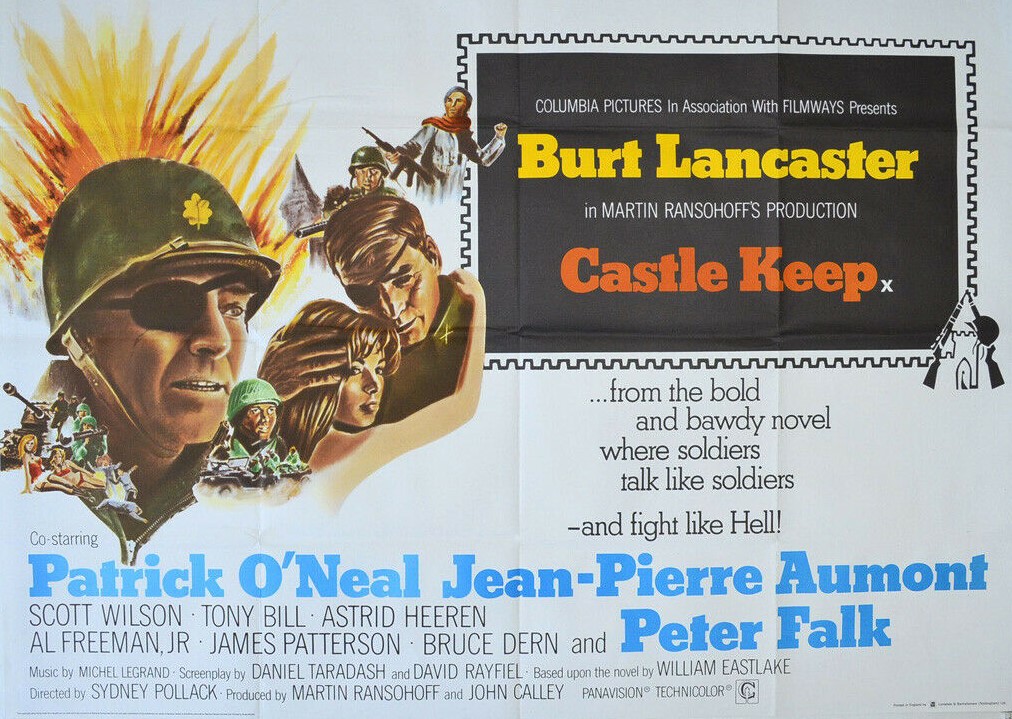
A bit more directorial bombast and this could have matched Apocalypse Now (1979) in the surrealist war stakes. Never mind the odd incidents surrounding a small unit of G.I.s taking over a magnificent Belgian castle towards the end of World War II prior to what turned out to be the Battle of the Bulge, this has on occasion such a dreamlike quality you wonder if it is all a figment of the imagination of one of the characters, wannabe writer Private Benjamin (Al Freeman Jr.). Throw in a stunning image, for the beleaguered soldiers at the start, of a horsewoman charging by in a yellow cloak, so out of place that it carries as much visual impact as the unicorn in Blade Runner (1982), and we are in definite cult territory.
One of the unusual elements is that, in this unexpected respite from battle, the soldiers are defined by character traits rather than dialogue or bravery as would be the norm. This ranges from baker Sergeant Rossi (Peter Falk) taking over the village boulangerie and bedding the baker’s wife (Olga Bisera), mechanic Corporal Clearboy (Scott Wilson) diving into a lake to rescue a Volkswagen he has adopted and the troops receiving a lecture on art history from Captain Beckman (Patrick O’Neal).
Commander Major Falconer (Burt Lancaster) is not only brilliant in the art of war, but calmly mentors Beckman through a firefight with an enemy airplane, teaches local sex workers how to make Molotov cocktails and, evoking ancient aristocratic tradition, enjoys conjugal relations with the conquered countess (Astrid Heeren), whose impotent husband (Jean-Pierre Aumont) encourages the relationship since the castle needs an heir.
There is wistful revelation, Beckman clearly hankering after his turn with the countess, a trainee minister who wishes he had the courage to join the boys in the brothel, the young soldiers there being treated as children rather than customers. And there are juvenile pranks – moustaches are painted on statues, wine bottles used for ten-pin bowling practice.
But the surreal moments keep mounting up. The Volkwagen, though riddled with bullets, refuses to sink in the lake, a hidden German reveals himself by playing the same tune on a flute as one of the enemy, the countess often appearing as an ethereal vision.
Through it all is rank realism. Falconer knows a German previously shared the countess’s bed. The count will do anything to safeguard his castle and maintain the family line, even to the extent of incest, since his wife is actually his niece. But above all, while his troops believe the war is at an end and enjoy the pleasures at hand, Major Falconer prepares for rearguard action by the Germans, filling the moat with gasoline, planning to pull up the drawbridge and control the high ground. The battle, when it comes, is vivid and brutal, the initial skirmish hand-to-hand in the village before the Germans advance to the castle.
Burt Lancaster (The Swimmer, 1968) is superb, far removed from his normal aggressive or athletic persona, slipping with pragmatic ease from the countess’s bed to battle stations. War films in the 1960s were full of great individual conflicts often won on a twist of ingenious strategy but seldom have we encountered a soldier like Falconer who knows every detail of war, from where and how the enemy will approach, to the details of the range of weaponry, and knows that shooting dead four soldiers from a German scouting mission still leaves one man unaccounted for.
Patrick O’Neal (Alvarez Kelly, 1966) also leaves behind his usual steely-eyed screen persona, here essaying a somewhat timid and thoughtful character. Peter Falk’s (Machine Gun McCain, 1969) baker is a beauty, a man who abandons war, if only temporarily, for a second “home,” baking bread, adopting a wife and child. In a rare major Hollywood outing French actor Jean-Pierre Aumont (Five Miles to Midnight, 1962) carries off a difficult role as a count willing to accept the humiliation of being cuckolded if it improves his chances of an heir. In one of only four screen appearances German actress Astrid Heeren (The Thomas Crown Affair, 1968) makes the transition from a woman going to bed with whoever offers the greatest chance of saving the beloved castle to one gently falling in love.
There is an excellent supporting cast. Bruce Dern (Support Your Local Sheriff, 1969) makes the most of a standout role as a conscientious objector. You will also find Scott Wilson (In Cold Blood, 1967), Al Freeman Jr. (The Detective, 1968), future director Tony Bill (Ice Station Zebra, 1968) and Michael Conrad (Sol Madrid / The Heroin Gang, 1968).
Two top-name writers converted William Eastlake’s novel into a screenplay – Oscar-winning Daniel Taradash (Hawaii, 1966) and newcomer David Rayfiel who would work with Lancaster again on Valdez Is Coming (1971) and with Pollack on Three Days of the Condor (1973) and Havana (1990)
Sydney Pollack (This Property Is Condemned, 1966), who had teamed up with Lancaster on western The Scalphunters, 1968), does a terrific job of marshalling the material, casting an hypnotic spell in pulling this tantalising picture together, giving characters space and producing some wonderful images, but more especially for having the courage to leave it all hanging between fantasy and reality.
Expressions like “we have been here before,” “once upon a time,” “the supernatural” and “a thousand years old” take solid root as the narrative develops and will likely keep spinning in your mind as you try to work out what it’s all about.













 The Magnificent 60s