Sink The Bismarck! (1960) ****

Hard to believe but outside of the Hollywood big-budget Bridge on the River Kwai (1957), this was the biggest British film at the U.S. box office in the previous decade. In fact, the British war films that did so well in the home territory, The Cruel Sea (1953) and Reach for the Sky (1956), sank like a stone when exported to in America while earnings for Ealing comedies,  limited to arthouses, hardly made a dent in the box office.

What makes this so appealing is the very lack of Britishness and the intrusion of a Yank, famed reporter Edward  R Morrow (playing himself), interrupting the action at various points to keep audiences up to speed. The fact that the sinking of the Bismarck, the biggest battleship ever built, was one of the few British actions at the start of the Second World War to be counted a success probably helped. Watching the Brits being lionized for defeat was not an attractive notion for global audiences.

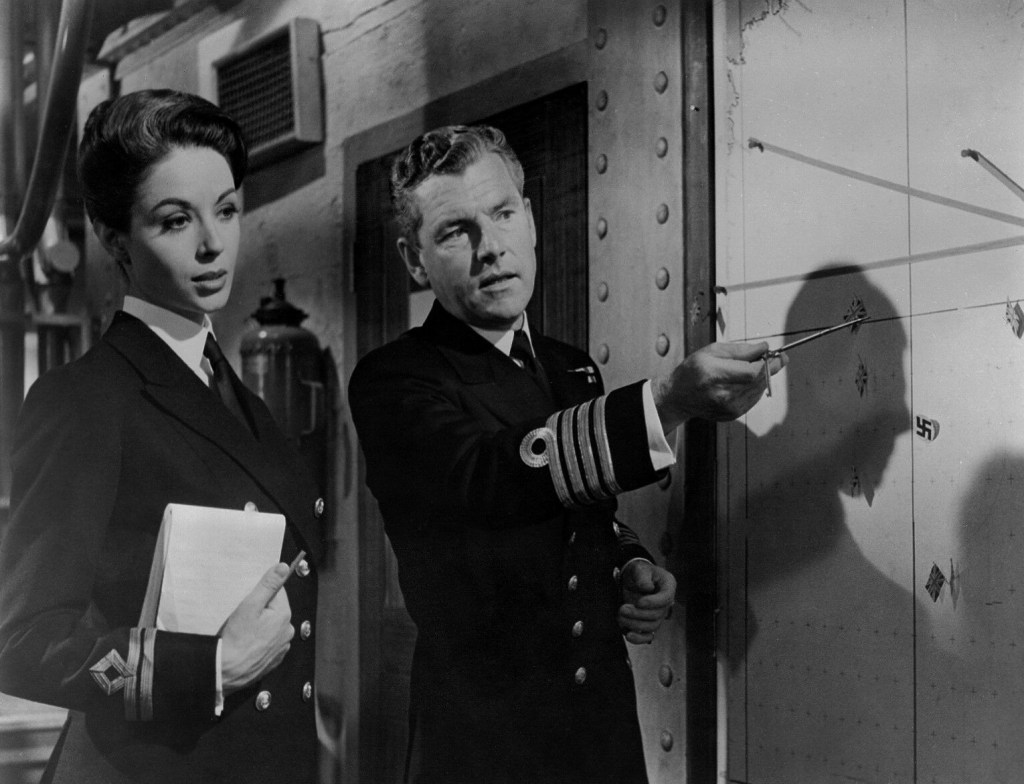
But in the main it is a thrilling docu-drama, very much a departure for the genre, with every nuance of potential consequence spelled out. Dialog and models being moved across maps announce the risks inherent in the British attack: the superiority of the newly-built German battleship, the multiple options the Germans had in 1941 to escape, the difficulties in pinpointing the German vessel in the fog-bound waters of the North Sea, and the devastation the battleship could inflict on the beleaguered convoys on which Britain depended to stay afloat. In addition, even when targeted the Germans could flee to occupied France or potentially summon U-boats or air support.

So in the manner or Operation Crossbow (1965) or Day of the Jackal (1973) the audience is primed for a minute-by-minute enterprise, the battleship deemed so dangerous that the Admiralty is willing to risk its own scarce supplies of battleships, destroyers, cruisers and aircraft carriers in a bid sink the enemy. It is so much a documentary that the beyond the thrill of the hunt there is little room left for drama and certainly little of the stirring kind that had become such a byword for the British version of the genre – and such a turn-off for foreign audiences who could hardly make out what the actors were saying never mind work out why such-and-such a mission they had never heard of was so important.

In any case emotion is forbidden in the subterranean claustrophobic Admiralty War Office where new operational commander Capt Shepherd (Kenneth More) holds sway. A martinet, “cold as a witch’s heart,” on arrival he rids staff of what he sees as the rank indiscipline of addressing colleagues by forename rather than surname, eating sandwiches at a desk to which the workforce have been chained for hours  and various minor offences against the strict code of a uniform.

It was inherent in this type of picture that the land-based unit suffer the casualties of war, husbands dead or missing in action, wives and children killed by German bombs. But the tightening of the stiff-upper-lip ensures that when such revelations become known, they appeared like emotional depth-charges on this otherwise staid ocean. And Capt Shepherd, through his choices, as would be true of many high-ranking officers, might be sending his own son to is death.

This is also one of the first instances in war pictures where the Germans are not treated as stock villains, but intelligent people, like Admiral Lutyens (Karel Stepanek) with his own vanity and a hunger for redemption, and Capt Lindemann (Carl Mohner), as valiant an opponent in the cat-and-mouse duel where outwitting the British enemy could wreak untold carnage and hasten – unusually from the German point-of-view rather than from the Allies – the end of the war.

A few months after launch the Bismarck is spotted leaving its home port, destination North Atlantic to feast on convoys travelling from America with invaluable supplies. There are four possible routes open to get round the top of Britain. To prevent the Germans reaching any of them British ships must be sacrificed, including HMS Hood – three survivors out of a crew of 1400.

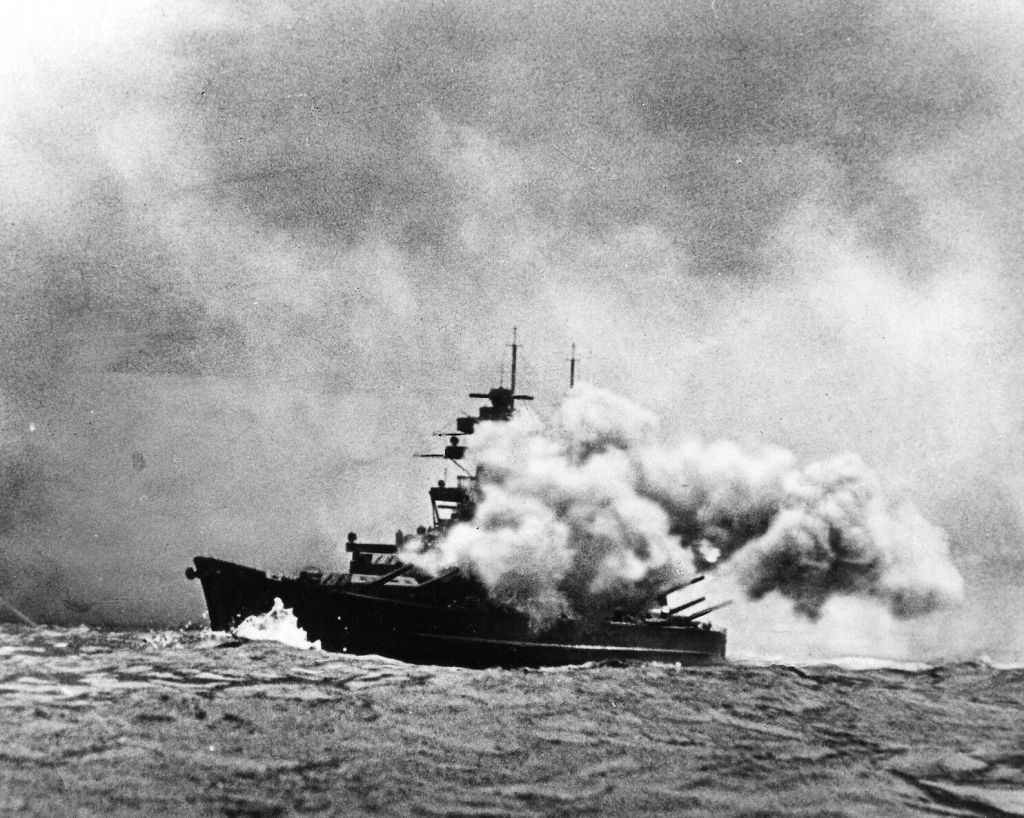
It’s David vs Goliath except David is a terrier capable of inflicting tiny wounds that drain the battleship of some of its power, loss of fuel and rudder problems limiting movement. It’s a different kind of war picture, as well as the big guns blasting at each other over huge distances, the British employ biplanes loaded with torpedoes, a weapon also used in some instances by its ships.

To keep audiences more heavily involved, there are snippets of dialog involving characters on board the various ships, some in distinctly un-stiff-upper-lip mode, and montages of the various vessels getting ready for action, as well as shots of devastation should a shell find its target.

But basically it’s  brilliantly-told tactic-heavy war picture that shows the shifting battleground, how the various ships are deployed, with no shortage of telling the audience how crucial success is and how crushing defeat. There’s no reliance on individual heroism, no snappy soldier defying authority, no hunch being played out, none of the usual cliches of the genre, instead, as with The Longest Day (1962) a clear explanation of what’s going on with superb battle scenes for the action-inclined.

It’s fair to say that even on the small screen, the models look a bit iffy, but this is more than compensated by other scenes on real warships, the use of newsreel footage, and fast cutting.  That action never takes place under a clear blue sky but always in murky waters also adds to the realism.

In a role that would have been custom-made for Kenneth More (The Comedy Man, 1964), king of the stiff-upper-lip, rather than simply spouting his lines, he adds considerable emotional depth. Dana Wynter (Something of Value, 1957) is excellent as his equally buttoned-up assistant.

There’s a full crew of supporting British character actors including Michael Hordern (Khartoum, 1966), Laurence Naismith (Jason and the Argonauts, 1963), Geoffrey Keen (Dr Syn, Alias The Scarecrow, 1963) and Maurice Denham (Some Girls Do, 1969) while the Czech-born Karel Stepanek (Operation Crossbow, 1965) and Carl Mohner (Assignment K, 1968) inject humanity into the Germans.

Lewis Gilbert (The 7th Dawn, 1964) does a brilliant job of bringing this all together, adding touches of emotion and humour to what could have been a too-dry concoction, drawing on a screenplay by Edmund H. North (HMS Defiant/Damn the Defiant, 1962) which was based on the book by C.S. Forester of Hornblower fame.

Behind the Scenes: “The Collector” (1965)

Director William Wyler was “saved,” to use the term preferred by his biographer Jan Herman, from what turned out to be the biggest picture of all time (up till then) The Sound of Music (1965) by a piece of door-stepping by two determined young producers who presented him with a pre-publication copy of John Fowles’ novel The Collector.

Wyler had been well down the pre-production route for The Sound of Music. It was he who hired Julie Andrews, having seen her performance on Broadway in My Fair Lady, and been granted access to the rushes of Mary Poppins (1964). While he was an odd choice to direct, being more of an opera buff and hard of hearing, he would later nurse Funny Girl (1967) to box office and critical acclaim.

While instinct told the German-born director that The Sound of Music “would be a success” he was troubled that it was set in Austria at a time just before World War Two when the country was mostly whole-heartedly welcoming the Nazis. “I can’t bear to make a picture about all those nice Nazis,” he said.

So when novice producers Jud Kinberg and John Kohn, television writers who had set up Blazer Films, brought him what would turn out to be a sensational bestseller, actor Terence Stamp already under contract and a deal in place with Columbia, turned up on Wyler’s doorstep with a completed screenplay they gave him a reason to pull out of The Sound of Music. He ignored the screenplay in favor of devouring the book.

“I couldn’t put the book down and I’m a man who can put down books very easily,” he said. While not so enamoured of the screenplay by Stanley Mann, he signed up, and although since the 1950s he had either officially or unofficially acted as producer on his own movies, he agreed to allow Kinberg and Kohn to do the job this time, as long as they did not interfere with direction and that he, of course, had final say.

Despite critical acclaim for Billy Budd (1962), a part he won ahead of the likes of Warren Beatty, Terence Stamp had not made a film since, and begun to doubt whether he was cut out for stardom. He wasn’t short of media attention – the various women he squired seemingly all the time made sure of that – but he was distinctly lacking in movie offers.

He took on the role of the deranged Freddie – even though he loathed the character – primarily because he had no other choice. “I hadn’t gotten any new work in roughly a year,” he explained. “I knew the camera loved me, so I had confidence in that. But I just thought this Freddie character was beyond me.” And once Wyler was signed, Stamp felt he would not come up to the director’s high standards. Told that Wyler had no objections to his casting, the still dubious actor asked to take part in the screen tests the director was holding for actresses hoping to win the role of Miranda, the female lead, partly to feel his way into the part and partly to give Wyler an opportunity to fire him if he wasn’t up to the mark.

Without the director being present, he tested with Sarah Miles, whom he had played opposite in Term of Trial (1962) and Samantha Eggar (Doctor in Distress, 1963). Once Wyler saw the footage, with Stamp clad in his own notion of the character’s clothing he expressed his confidence in the actor and told him, “I’m not going to make the book. I’m going to make a modern love story.”

Samantha Eggar was fired three weeks into rehearsals, undermined by just how good Stamp was, unable in her inexperience to cope with his “nasty attitude,” a deliberate decision by the actor, remaining in character during shooting, in part because they had attended drama school together where he had a crush on her and could not allow himself to feel inferior to her. Although his character worshipped her in one sense, his level of entitlement made him feel superior to her in another.

It turned out Stamp was following Wyler’s instructions. The director didn’t want Stamp and Eggar mixing off-set. The actor was to be as cold to her in real life as the character was in the film.

There had been enormous press coverage over Eggar being chosen, one of those Gone with the Wind-style star hunts of which Hollywood was so fond, so the press would leap at the news that she had departed the picture without shooting a scene. Wyler, in the meantime, pursued Natalie Wood (Splendor in the Grass, 1961), a far more accomplished actress and certainly not going to be dominated on screen, or in real life for that matter, by the likes of Stamp. Columbia production head honcho Mike Frankovich intervened on Eggar’s behalf, a script read-through was arranged, and Eggar was back in, on condition she agreed to an acting coach, Kathleen Freeman, of Wyler’s choosing.

But it wasn’t just the humiliation of working with a coach – although Marilyn Monroe famously employed a coach, she was scorned for relying on one – that Eggar had to put up with. Eggar wasn’t permitted to leave the set during the day, or eat with the rest of the cast, forcing her to remain in the daunting isolation of her character.  

“He wanted her in a constant state of terror and that’s really very difficult to act,” revealed  Stamp, who agreed to conspire with the director to drag out of her the performance of her life. It felt to Stamp that they were torturing the young actress even if that extended to no more on his part than giving her the cold shoulder.

Wyler went further. He wanted her to feel defenceless. During the rain sequence, she had a bucket of water thrown in her face so she was absolutely drenched. And while her travails were not much compared to what, for example, Kate Winslet endured on Titanic, it has been viewed as yet another example of a director bullying a young actress.

I’m not so sure about that, to be honest. The scene called for Eggar to be soaked to the skin and whatever way that occurred she would need to be absolutely drenched. Whether she believed a gentle shower of rain from a sprinkler would achieve the same effect is unknown and you might consider whether Wyler took the bucket approach because he believed her incapable of registering the required look of shock.

It transpired that Eggar hadn’t a clue, beyond checking his credits, who Wyler was. She hadn’t been allowed to visit the cinema until she was 18. And “had no knowledge…of the history of film.” Directors scarcely made the gossip pages and the flurry of biographies and critical appreciations were a few decades away. And minus VHS or DVD there was no way to easily lay your hands on a director’s back catalogue. “I was very ignorant,” she admitted, “of the position that he held as a Hollywood icon.” It’s entirely possible she never even saw Ben-Hur, for she has never mentioned doing so.    

During the love scene, she was kept nude while Stamp had his clothes on. “I kept wondering why I had to stand there with no clothes on when they were only shooting me from the waist up.” (And in keeping with the Production Code rules, no nudity was shown on screen). Eggar wondered if perhaps Wyler, who had a reputation as a ladies man and enjoying dalliances during shooting with some of his actresses, had taken a fancy to her. But he showed no signs of making any moves or even making the kind of remark that suggested he was in love with her, or ogling her body. It was just another device to keep her in character. (Thought it might have been better all round if she had been given some say in this approach.)  

On the other hand, Wyler clearly went out of his way to help her. He reversed his own decision to use her. To help her remain in character and develop her role, ridding her gradually of the confidence she exuded in her earlier scenes, Wyler shot the film in sequence, as unusual a method in Hollywood as the other techniques mentioned here. And when a photographer hid in the gantry to get a shot of Eggar in the nude, Wyler raced to her defence, ripping the camera from the intruder’s hand, destroying the film and throwing the man out.

A later decision in the editing room enhanced her performance without the actress having to express single emotion, speak an extra line or give another look. The script called for her character to remember her lover, using his image to see her through her ordeal. But Wyler completely cut out actor Kenneth More playing the lover, leaving in just one shot of the back of his head, so that instead of appearing to rely on that memory and those feelings to  combat the situation, she was presented instead as woman of great resilience. “It’s love keeping her alive,” Eggar would later say.

And there’s certainly no sense that Wyler was dissatisfied with her performance. However, like Stamp, she doubted her own skill. “At first I just felt I couldn’t do it. It took me five weeks to get on Wyler’s wavelength. When it’s over you realise you have done the best you could do. It’s very satisfying for an actress.”

Stamp saw a different side to Wyler. He recalls a director who didn’t even call “action.” He would “simply roll his hand” in order not to disturb an actor’s concentration. Unless, of course, an actor was not up to the mark: Maurice Dallimore, who played the nosy neighbor, felt the rough edge of the director’s tongue when he could not manage the necessary English accent.  

Originally, Wyler intended to shoot the film in black-and-white. But when the cinematographer did a black-and-white test of Eggar he also did a color one that captured the magnificence of her red hair and skin. Wyler had feared that color would act as a distraction and “could be phony, exaagerated.” Except for some establishing shots in Britain, the picture was shot in Hollywood. The scene with the bathwater running down the stairs was not in the book and of course Wyler took quite a different approach to the novelist. Even so, John Fowles appeared pleased with the result.

Stamp changed his views of Wyler. Initially, he told Roger Ebert, “I don’t go much for Wyler.” But, contacted by Jan Herman for the Wyler biography, he claimed Wyler and Fellini were the two best directors he had ever worked with. “It was one of the great experiences of my life. He was just wonderful in a way I’ve never come across before,” he told Brian Raven Ehrenpreis.

SOURCES: Jan Herman, William Wyler, A Talent for Trouble (Da Capo Press, 1997) p418-428; Roger Ebert,  “Interview with Terence Stamp,” New York Times, June 12, 1968; Brian Raven Ehrenpreis, “Get Your Sword!”, www.thequietus.com , August 25, 2018; “Collecting Life, An iIterview with Samantha Eggar, www.terrortrap.com ; Kathleen Carroll, “Redhead Mad for Pink,” New York Daily News, June 20, 1965.

The Collector (1965) *****

William Wyler’s paean to Incels strike such a contemporary note it’s hard to believe it was made over 60 years ago. An insightful study of male entitlement, female submission and    novice serial killer that showcased two emerging British stars, this is as much about the psychological make-up of the victim as the captor.

Following a lottery win (see Note), lonely bank clerk Freddie (Terence Stamp) kidnaps the woman of his dreams, flame-haired art student Miranda (Samantha Eggar) in the hope that once she gets to know him she will fall in love. He has found a large cellar beside the secluded mansion he bought with his winnings. But this is no dank dungeon with a prisoner chained to the walls, but a comfortable abode with lighting, heating, clothing, food, and art materials. However, it is locked.

In turn angry, puzzled and submissive, Miranda tries to work out what she needs to do to achieve her liberty without realising that no matter what she does she will never fulfil his dreams. Despite his shyness, it wouldn’t be hard in other circumstances to fall for a guy as good-looking as this, if only for an affair. She is sexually experienced, but has just been rejected by an older man (Kenneth More), and love on the rebound is hardly uncommon.  

Unfortunately, Freddie lives such a soulless, empty, existence, no interests beyond an obsession with butterflies, of which he has amassed a collection large enough to supply a complete museum, that the chances of finding common ground are remote and the circumstances of their meeting pretty much douse the potential for any spark.

At first, once she has expended her anger at her incarceration, she is grateful not to be murdered or raped – even pleads that if he is going to take her by force sexually not to drug her – and soon her mind turns to ways of escape, especially once he invites her into the big house, allows her to bathe, cooks her a meal and shows the world she could enjoy as his willing partner.

With every step, Freddie dares to dream more, that his insane idea will come to fruition, that a beautiful princess will love the lowly commoner. And as much as this focuses on male domination, it is also an examination of female independence, Miranda being in the foreground of that generation to espouse personal freedom, not viewing marriage as an ultimate destination, but seeking a fulfilling career with love almost a perk on the side.

Even without going to extent of kidnapping a woman, males of the period still expected a female to cater to their every whim, wife-beating hardly considered a crime, and, ironically, it would be a rare woman who would not enjoy the worship a more ordinary Freddie planned to bestow on his beloved.

It being set in the England of a particular period, Freddie blames the gulf between them on “class,” that where or to whom you are born creating an unattainable barrier between young men and young women, despite considerable evidence to the contrary. But, of course, to the thwarted, there is always someone to blame.

You will be very familiar with the cinematic tale of the imprisoned female attempting to escape by wiles and ingenuity, but even so, this will take you by surprise, in part because the idea of being forcibly detained was a rare event back then, so Miranda does not spend her time trying to chisel through loose cement using a stolen fork or other ideas along the same lines. That she has even managed to negotiate the length of her prison term makes her initial custody tolerable, especially as, in terms of material things, she wants for nothing.

Unfortunately, although Freddie is immune to normal feelings, he is alert to the slightest nuance, and would feel it an insult to his intelligence should she just play along and pretend to fall in love with as a means of engineering her escape. That the audience is probably more aware of this than Miranda makes the tension virtually unbearable.

This is a duel of the highest caliber between captor and detainee. At several moments it looks as if the tide will turn. A terrific scene with overflowing bath water fails to make a nosy neighbor suspicious. She even at one point manages to whack her assailant over the head with a shovel and attempt a genuine escape. You are left to wonder if making a sexual sacrifice, even taking the initiative with a virgin, will make the necessary difference. But one look into those implacable eyes would have told you exactly where you stood without having to wait until you were dragged by the hair across the lawn in a rainstorm.  

Audiences more familiar with the director through late-career roadshows like Ben-Hur (1959) and Funny Girl (1967) or the earlier rom-com Roman Holiday (1953) would be forgiven for forgetting how adept Wyler was at racking up the tension from his early thrillers or dealing with unattainable love (Wuthering Heights, 1939) or entitlement (Jezebel, 1938). He evokes such a claustrophobic atmosphere, ingrained with pure Englishness, and plays with ironies of character beauty – Freddie’s eyes and cheekbones, that should have attracted women by the score, instead lending him devilish menace while Miranda’s sensational looks that would have most men begging for just a minute of her company prove insufficient to enslave this particular creature.

That there is genuine sexual tension, not just whether he will end up raping her, but whether she might see his more attractive version of himself and come to give him what he wants without being repulsed, brings a surprising sexual tension. You wouldn’t say there was chemistry between the characters in the normal sense, but the situation is electrifying.

This was a career high for Terence Stamp (Term of Trial, 1962), minus many of the acting foibles and vocal tics that peppered his later work, and the same went for Samantha Eggar (Walk, Don’t Run, 1966). But the performances are of such a high quality, especially when you think she has breached his defences sufficiently, that at times it is an unbearable watch. John Kohn (Caprice, 1967) and Stanley Mann (The Naked Runner, 1967) based their screenplay on the bestselling – and highly praised – novel by John Fowles, author of later cult work The Magus.

This would have stood the test of time anyway as a pure thriller but since it digs into what has now become a counter-culture it carries even greater significance today.

NOTE: He didn’t win the lottery. That didn’t exist then. Instead he won on the “Football Pools,” but that concept – it began in 1923 –  is so hard to explain to non-British people that I took the easy way out. However, the “pools” was a gambling phenomenon of the times, the entry fee so low, at its peak played by 14 million people in the UK every week in the hope of winning a jackpot akin to lottery cash. In essence, you had to guess out of all the soccer games being played on a Saturday (all games in those days kicked off at 3pm on a Saturday) how many would end in draws.

Deadfall (1968) **

“The Big Reveal” comes too late to save this heist-cum-melodrama. It can’t make up its mind whether it wants to join the canon of superlative 1960s caper pictures – in which case it needed to make a greater effort on the cat burglary front – or whether it’s an odd addition to the menage a trois category, in which case it needed characters you could actually believe. Worst of all, it contains one of the great artistic follies, a robbery carried out in time with an  orchestra playing one of the great John Barry compositions, “Romance for a Guitar and Orchestra.”

The only problem, there’s no dramatic reason for this. Since the concert is miles away from the robbery, it’s not as if the music drowns out the shenanigans. Director Bryan Forbes (King Rat, 1965) shoots himself in the foot. It’s too clever a device by half, even if the music is intended as a counterpoint to the  robbery’s more dramatic themes or the silence which had become a trope.

Cat burglar Henry (Michael Caine) forms a business partnership with elderly safecracker Moreau (Eric Portman) and falls for his wife Fe (Giovanna Ralli). The husband-wife relationship is off to begin with, he preferring males, and the wife admitting she doesn’t always find men attractive, though quite what she is hinting at is never made clear. The target is millionaire Salinas (David Buck), whom Henry is investigating to the point of pretending to be an alcoholic so he can get to know Salinas in a sanatorium.

Any other movie would get straight to the point – draw up plans and get on with it. But here, for no real reason except delay, Moreau wants them to do a trial run,  a safecracking job on the mansion of the kind of couple who drive off in a posh car to attend a concert. The effort put into the planning isn’t really up to scratch, not when compared to the likes of Topkapi (1964) – to which every heist film of the era was measured – or Gambit (1966) or even the less well-known The Happy Thieves (1960) or Seven Thieves (1960).

Apart from some cat burglary skills the whole episode is perfunctory, guard dogs knocked out by drugs. The background music, the aforementioned John Barry opus, just about kills off any prospect of tension. It only sparks into life when Moreau admits the safe is beyond him and Henry has to prise it out of the wall and cart it to the waiting car.

The second heist would have been far more interesting had we known from the start that Salinas welcomes burglary attempts, seeing it as some kind of duel of wits with malfeasants.

In between the two robberies there is time enough – too much time in fact – for Henry and Fe to get it together, for Fe to run off and then return only to learn in The Big Reveal the kind of despicable man her husband is. The movie can’t even deal with the incestuous sub-plot and just lets it hang there. But by that stage you couldn’t care less. Fe isn’t the type of femme fatale to bother crossing the road for, the romance seems too prescribed and the downbeat ending makes no sense.

I’m only giving this any points at all really because it stars Michael Caine (Hurry Sundown, 1967) and features a lengthy slice of John Barry music. Caine has been in enough duds for sure, but this doesn’t have the ring of one of his doing-it-for-the-money numbers or a stab at the Hollywood big-budget scene. Caine is good enough and Eric Portman (The Bedford Incident, 1965) is an interesting study. But it just doesn’t gel, not just let down by Giovanna Ralli (The Caper of the Golden Bulls, 1967) but by the pretentious direction and dramatic miscalculation of Bryan Forbes.

Forbes’ wife Nanette Newman (The Wrong Box, 1966) makes a puzzling appearance in a small role with no dramatic credibility. Leonard Rossiter (Deadlier than the Male, 1967) provides another cameo. For many the high spot will be to see John Barry in the flesh, conducting the orchestra playing his composition.

Hide and Seek (1964) ***

Too many peculiarities for a small British B-picture that just about makes it over the line after “The Big Reveal.” You can start with the fact that, ostensibly, this was director Cy Endfield’s follow-up to his blockbusting Zulu (1964). In fact, it had been made long before, but sat on a shelf for a year, and only released to cash in on Zulu. And you can see why studio British Lion didn’t know what to do with it.

Diving down a 39 Steps thriller-sized rabbit hole, baffled professor saddled with adventurous female go on the run searching for answers to, wait for it, a crime which hasn’t actually been committed. There’s action on a train, some comedy as the worlds of academia and the sophisticated fast set collide, romance on a barge,  Cold War skullduggery,  too much chess, a bit of welcome role reversal, a cliff-top fight, and some dry wit that might have fitted better into a straightforward romantic comedy. And it ends with a twist of such audacity that it would either come as a relief to a bewildered audience or send them home frustrated at such a denouement.   

Rocket scientist David Garrett (Ian Carmichael) becomes embroiled in not even really a plot when he attempts to return a box, containing an inordinate amount of loot, to its owner,  chess grandmaster Dr Melnicker (George Pravda). Luckily, a clue in the form of a chess move takes him to a posh London house in fashionable Chelsea where he encounters the slinky Maggie (Janet Munro) and after hiding in a sandpit in a children’s playground to evade pursuers he ends up on a train with her heading north to a place called Flamboro.

But, wait, his pursuers are also on the train, so naturally the couple have to jump off, fall into a river and hitch a lift on a passing barge whose owner Wilkins (Hugh Griffith) proves most obliging. Indeed, Maggie is even more obliging, taking the lead in bedding the shy professor.  Things get interesting when Maggie, at a road sign, takes David in the completely opposite direction to Flamboro. That works for about ten seconds until a henchman Paul (Kieron Moore) captures them at gunpoint.

Rather than just shooting David dead he decides it would be cleaner to chuck him over a cliff. Luckily, David is a shade pluckier than you might expect. After winning this cliff-top tussle and shocked at having chucked a man over a cliff he is even more astonished to discover he is stranded, Maggie having made off in the car. Luckily, a passing policeman on a bicycle ensures David makes it safe to Flamboro, which turns out to be a huge mansion perched on a cliff.

My guess is by now you are so hooked by this story that you’ll want me to reveal The Big Reveal. Well, the whole thing turns out to be a trap. Melnicker, the pursuing thugs, Paul (who,  you’ll not be too astonished to learn, ain’t dead) and even Maggie have all been plotting to bring David here so that he can be kidnapped and handed over to a submarine arriving the following day. You see, David has been so outspoken (has he?) against his masters that everyone will put his disappearance down to defection. It’s all been a cleverly worked-out chess move as chief baddie Hubert (Curd Jurgens) takes pains to point out.

But our David isn’t exceptionally brainy for nothing and finds a way to outwit the bad guys with Maggie, by now repenting of her bad ways and fallen in love, along for the ride.

So what’s gone wrong? The casting, unfortunately, for one thing. Star Ian Carmichael (School for Scoundrels, 1960), better known for comedy, doesn’t quite make the switch to more straightforward thriller. And Curd Jurgens (Psyche ’59, 1964), whom you might expect to add some gloss, doesn’t appear till the end.

Worse, the film doesn’t find the right tone, too much comedic British observation, and not enough of the hero being in genuine jeopardy. Only a clueless professor would run from the thugs. If the big twist had occurred halfway through and the audience had time to wonder whose side Maggie was on and feel David was in in genuine danger it might have hit the bullseye because, oddly enough, the romance is believable in a Hot Enough for June (1964) kind of way, where innocent male is scooped up by a more worldly female way above his league.

But the role reversal is fun. She’s the one who goes to his rescue when he falls in the river, she’s the seductress, and gets to tell him he looks better “when he’s cross” (a line more typically with slight variations falling to the male) and delivers the movie’s one cracker: “Being a man you have no respect for a mink coat.” She would be an ideal candidate for femme fatale if only the director had let us in on the story quicker, but she’s certainly an astute lure.

Because I wasn’t expecting much, I have probably been a shade less critical than if I was viewing it as a follow-up to Zulu. In the end, it’s passable enough, especially if you are willing to see how clever it’s been.  

As I mentioned Ian Carmichael (Lucky Jim, 1957) is the weak link but former Disney protégé Janet Munro (Swiss Family Robinson, 1960), now blossomed in sexy fashion, steals the show and on this performance you might be surprised she  did not have a more illustrious career but she had a heart condition and died prematurely at the age of 38. Curd Jurgens was at the early stages of inventing his villainous persona. The other characters are merely pawns in the plot so end up as stock villains. Cy Endfield’s genuine follow-up to Zulu was worth seeing – Sands of the Kalahari (1965).

You can catch this on YouTube.

https://www.youtube.com/watch?v=w3zj_VcTdBM

Tunes of Glory (1960) ****

Fans of Succession will appreciate this power struggle in a Scottish army regiment set in 1948. In a reverse of The Godfather (1972) where the Corleones complain about needing a “wartime consigliore,” here the powers-that-be have decided this unnamed distinctly Highlander company requires a commanding officer with skills more appropriate to peace time.

Major Jock Sinclair (Alec Guinness) has been in charge of the battalion since the North Africa campaign in World War Two when the original commander was killed. But he has never been promoted to full Lt. Col. Naturally, having been in charge for six years, he feels the job should be his. At a time when the currency of command was wartime experience he’s less than pleased when he loses out to Col. Barrow (John Mills) who spent most of the war as a Japanese POW.

It doesn’t help that they are complete opposites. Sinclair is a tough, hard-drinking, attention-seeking Scotsman who enlisted as an ordinary soldier and rose through the ranks winning two medals for courage during the conflict. Barrow is Oxford-educated English upper-class, a lecturer at Sandhurst Military Academy, and recalls his war experience with terror rather than the braggadocio of Sinclair. Worse, he doesn’t drink.

It doesn’t take long for the pair to clash. Sinclair, who has ruled as much by preying on weakness as force of personality, is quick to start to look for flaws in his opponent’s make-up. Barrow feels discipline has been slipping and enforces tougher measures. That might make him unpopular but an army is built on discipline so soldiers can hardly complain.

But Barrow slips up by misreading the men. He chooses the worst of all issues to make a stand. For the first post-war official barracks party, Barrow insists the soldiers embark on traditional Highland dancing in regulation fashion rather than in their normal exuberant, not to say rowdy, manner. The soldiers are infuriated when Barrow insists they take lessons.

He has just lit the fuse. Naturally, nothing goes according to plan. Barrow is humiliated, Sinclair triumphant. But victory does not turn out the way Sinclair expected.

Somewhat cynical rebranding of the film in Italy as “Whisky and Glory,” possibly trying to cash in on the success of “Whisky Galore” and also misleading in suggesting actual conflict with the fighting in the background.

The main thrust of the narrative, as you might expect, is the stand-off between Sinclair and Barrow and the tensions felt all round, as would be the case in any business (Succession, now, of course the classic example) when a new boss takes control. While everyone might expect, and perhaps fear, change, in the military (as in the navy) there is always the danger, should the new broom try to sweep too clean, of mutiny.

This might not amount to a raising of arms. But there are other effective methods of mounting opposition – laxity, questioning or outright refusal to obey orders – or giving the new chief the cold shoulder. Here, in the background, are other simmering tensions. Not everyone is comfortable with Sinclair’s very laddish approach to command, the back-stabbing and double-dealing Major Charles Scott (Dennis Price) ready to pounce at any opportunity.

Sinclair is also having to deal with his daughter Morag (Susannah York) asserting her independence, having the temerity not just to take a boyfriend, Corporal Fraser (John Fraser), but one from the ranks rather than the officer class. And he feels the harsh tongue of his own paramour Mary (Kay Walsh).

Emotional isolation is rarely commented upon in matters of the armed forces and yet it is so much a driving force. If not adequately compensated by camaraderie, a man at the top can be very lonely indeed, and prone to the most vicious self-torment.

Director Ronald Neame (The Prime of Miss Jean Brodie, 1969) superbly invokes an army atmosphere away from the more usual battleground backdrop. The picture is anchored by brilliant performances all round and a roll-call of strong supporting characters. An unflinching look at power, especially leadership and the personal toll it takes. And it was astonishing that the movie could hit the target so well without relying on the usual round of sex, violence or that old stand-by the comic subordinate. It also probes the issues of what happens – in any industry – when the wrong person is put in charge. No less an authority than Alfred Hitchcock called it “one of the best films ever made.”

The sparring between Oscar-winning Alec Guinness (The Quiller Memorandum, 1966) and John Mills (The Family Way, 1966), who won the Best Actor Award at the Venice Film Festival for this role, is of the highest quality. Dennis Price (The Comedy Man, 1964) is the pick of the support while Susannah York (Sands of the Kalahari, 1965) makes an auspicious debut.

Few films could boast a better supporting cast: former British leading lady Kay Walsh (A Study in Terror, 1965), Gordon Jackson (The Ipcress File, 1965), Duncan Macrae (Best of Enemies, 1961), John Fraser (Tamahine, 1963), Gerard Harper (Adam Adamant Lives!, 1966-1967, TV series) and Peter McEnery (The Moon-Spinners, 1964).

James Kennaway (The Shoes of the Fisherman, 1968) wrote the screenplay based on his own novel.

On the Fiddle / Operation Snafu (1961) ***

Unassuming but undeniably charming British World War Two comedy denied U.S. release until four years later when a savvy distributor jumped on the James Bond bandwagon. Primarily of interest these days for the opportunity to see a pre-Bond Sean Connery (Dr No, 1962) in action its merit chiefly lies in ploughing the same furrow, though with a great deal less pomposity and self-consciousness, as the later The Americanization of Emily (1964), of the coward backing into heroism.

Horace Pope (Alfred Lynch) is a scam merchant who only dodges prison by enlisting. Assigned to the RAF he teams up with Pedlar Pascoe (Sean Connery) and they embark on a series of schemes designed to keep them as far away from the front line as possible. It’s hardly an equal partnership, Pope dreams up the fiddles while Pascoe just falls in with them. It’s not dumb and dumber but a collaboration that goes no further back in the annals of movies than brain and brawn.

Needless to say, the movie lacks the the damsels in bikinis which were a prerequisite of the Bond pictures. Sean Connery takes top billing Stateside where he was originally behind Lynch.

It’s certainly a cynical number, reflecting the boredom experienced by many of the Armed Forces backroom staff, the administrators whose inefficiency turns them into easy dupes, and the determination of soldiers to take advantage of every opportunity to bend the rules. It takes the unusual position of presenting the ordinary soldier as smart and every officer as a numbskull, an approach that would only have been possible 15 years after the war ended and in marked contrast to the determined heroism of other British war films – such intrepid stiff-upper-lip behavior a hallmark of the British version of the genre.

First stop is to run an operation issuing leave passes – for a price – and the sheer effrontery exhibited by Pope is a joy to behold. Next up is selling stolen meat on the black market.

While Pedlar is the wide-eyed camp follower, and more likely to forever sit on the sidelines, cheerful but shy, and only a few pratfalls away from being a bumbling idiot, they do make a good team. Being sent to France is more of a heaven-sent opportunity to increase their bankrolls than a hazardous wartime mission as Pope sells rations to the French. Eventually, of course, their various scams are rumbled and they are forced into battle.

The only thing better than one pre-Bond Connery picture is two.

The movie switches a bit more deftly into serious mode than the aforementioned The Americanization of Emily mostly because these are actual soldiers trained to be soldiers rather than an officer who landed a cushy number and whose main effort is to avoid combat. War is presented as horrific rather than comedy and it must have been the same experience for an ordinary soldier at the time, after months of inactivity suddenly thrust into the cauldron.

The picture moves at a brisk pace and is continually amusing if not particularly laugh-out-loud. You’ve probably seen most of the set-ups before but they are reinvented with an appealing freshness and briskness  As a bonus there’s reams of British character actors and comedians – plus token American Alan King (who would appear in Connery starrer The Anderson Tapes, 1971) – along the way. The term “snafu” in case you’re interested, has a similar meaning to the “fubar” of Saving Private Ryan (1998).

Alfred Lynch (The Hill, 1965) doesn’t milk the Cockney patter overmuch and he’s got a greater international screen appeal than the likes of the more English Sid James (Carry On films) or Norman Wisdom. Think a shiftier Sgt Bilko, if the Phil Silvers creation could be any more untrustworthy.

Connery’s performance is well worth a watch as a prelude to what was to come once his roles were tailor-made. He is an effortless scene-stealer, gifted in expressing emotion through his eyes, and although verbally Lynch dominates it’s difficult to take your eyes off Connery.

The roll-call of character actors includes Cecil Parker (A Study in Terror, 1965), Stanley Holloway (My Fair Lady, 1964), John Le Mesurier (The Moon-Spinners, 1964), Graham Stark (The Wrong Box, 1966) and Victor Maddern (The Lost Continent, 1968).

Cyril Frankel (The Trygon Factor, 1966) comfortably cobbles this together from a screenplay by Harold Buchman (The Lawyer, 1970, and who had ironically enough penned the picture Snafu in 1945) based on the novel Stop at a Winner by R.F. Delderfield.

When the box office supremacy of the Bond pictures was underscored by the reissue of the Dr No/From Russia with Love double bill in 1965, distributors, as had been their wont, racked the vaults for anything featuring Connery that could be re-sold to a willing public.    

While there is a readily available DVD, this turns up on a regular basis, in Britain at least, on television.

Night of the Blood Monster / The Bloody Judge (1969) ***

Handsomely mounted historical drama set in 17th century England on the brink of revolution  meets Son of Witchfinder General. An uprising headed by the Duke of Monmouth in the south-west threatens to overthrow King James II. Involved in the plot are Harry Selton (Hans Hass), son of suspected agitator Lord Wessex (Leo Genn), whose beloved Mary Gray (Maria Rohm) is in the sights of Judge Jeffreys (Christopher Lee) after he has condemned her sister Alicia (Margaret Lee) to be burned as a witch.

The minute witchcraft enters the equation the narrative thrust is constantly interrupted by scenes of nudity, blood and torture, mostly involving women, but actually the film does attempt to cover the rebellion and its notorious aftermath when hundreds of rebels were executed, the “Bloody Assizes” with “Bloody Judge” Jeffreys to the fore. Conflating witchcraft with a genuine historical episode does not work very well and unlike Witchfinder General (1968), the murder of innocent women is more of a sideshow, despite the brutality involved, and you get the impression the story has been hijacked to accommodate supposed witch Mary in the interests of adding titillation.

Even as the story of the rebellion unfolds, the threat to the crown spelled out, the origins of the revolt mostly made clear (Monmouth being the illegitimate son of Charles II, and nephew to James II) although the sectarianism behind the rebellion is ignored, the narrative keeps jumping back to the witch element. Jeffreys connects the parallel narratives, hunting down rebels and witches, while handling most of the exposition. Given the budget, there’s a surprisingly good battle sequence, cavalry charging cannon. Given his later reputation, Jeffreys also reflects on the meaning of justice.

And while there are some camp moments – Jeffreys playing the organ while attired in grand robes, dancing girls sticking pins in his effigy – the twists and turns (Mary captured and rescued, captured again)  are effective enough. Despite the copious nudity, there a couple of low-key love scenes and, oddly enough, a touching moment when Mary licks the blood from a dead prisoner. And for all the blood, that is effect rather than cause, nothing too gory.

But with the powerful all-mighty, and investigators able to plant evidence, and the innocent forced into immoral acts to save their loved ones, lawlessness is apparently next to godliness. But in reality the wicked did not get away with their crimes so various villains get their come-uppance.

Most peculiar sight is Christopher Lee in a love scene where he is not about to sink his incisors into a neck. Occasionally, the film bursts into German with English subtitles – as if various versions were pillaged to produce this copy – or has lines like “you turn me on.”

However, fans of Spanish cult director Jess Franco (The Girl from Rio) who expected something more along the lines of 99 Women (1969) and Venus in Furs (1969) may be disappointed that he spends so much time on the historical elements and less on the random T&A. You might not be surprised to learn of the involvement of ubiquitous producer Harry Alan Towers (Five Golden Dragons, 1967).

Heavens Above! (1963) ***

Surprisingly topical – food banks a key element – social satire. And a surprising box office smash – among the top 12 films of the year – in Britain, although the Boulting Brothers (I’m Alright Jack, 1959), often viewed as inheriting the Ealing mantle, had both commercial and critical form.  

In a case of mistaken identity, simplistic prison chaplain Rev Smallwood (Peter Sellers) is sent to rich parish Orbiston Parva, virtually endowed by the Delpard family, owners of the Tranquillax business nearby. Smallwood, an advocate of the meek inheriting the earth and making it his mission to ensure the rich can enter the kingdom of Heaven other than through a needle, convinces Lady Delpard (Isabel Jeans) to spread her wealth. This takes the form of the Good Neighbour Fellowship, whereby she sets up a food bank whose popularity soon endangers the town’s retailers and merchants, the public, naturally enough, preferring to do their shopping at the free church outlet than spend money on a butcher or baker (possibly candlestick makers escaped the impact).

Meanwhile, to show he is up to scratch in the poverty ranks, Smallwood invites into his palatial manse the Smith family who are being evicted from their plot of ground to make way for an expansion of the Tranquillax factory. Despite ruffling feathers in the ministry, Smallwood can’t be turfed out, since religious law dictates he effectively owns the manse. However, once shops have to close for lack of trade and factories, for lack of goods being sold, make thousands redundant, Smallwood’s do-gooding backfires.

While Harry Smith (Eric Sykes) is an archetypal welfare swindler (taking home £90 a week) and inclined to siphon off items from the food bank for his own entrepreneurial purposes as well as stealing lead from the church roof, the rest of his enormous brood, led by the redoubtable Rene (Irene Handl) are converted to the joys of Christianity, enough so much so that baptism and marriage (between the couple) beckon.

Most of the humour is gentle, the biggest laughs – Smallwood inadvertently eating dog biscuits, a dog peeing on his leg, choirboy reading a dirty book, the butler initiating a miraculous intervention – are straight out of the Charlie Chaplin joke book. And the timing for many lines appears out of kilter, as though the laughs were not intended.

British films around this time often received rave reviews from U.S. critics which ensured reasonable business at the arthouses while not striking a box office chord with the general public. there.

Apart from Smallwood, his assistant Matthew (Brock Peters) and the converted Lady Despard you are hard put to find any Chistians. As one character observes “not enough decent Christians to feed one lion.” And the townspeople are generally shown as scroungers of one kind of another with the Smiths typical sex-obsessed chip-guzzling working class. The business owners, bishops, aristocrats and assorted politicians are similarly pilloried for greed and inefficiency so you could say the Boultings are being fair straight down the line.

The best scene, and the one that makes the most out of a comic situation, is when the real Rev Smallwood (Ian Camrichael) turns up, is treated as an imposter and locked up for displaying psychotic tendencies. And there’s a clever, even more topical ending, involving space exploration, which equally cleverly mimics an earlier scene. Actually, there are two scenes that echo earlier activities, and both are intelligently used.

The satire retains some of its bite. There are even more rich people around now who hold onto their wealth and there are more poor people in clear need of help, assistance that would extend far beyond food banks, a relatively recent phenomenon. You can be sure selfish big business will be as self-interested.

Peter Sellers, complete with regional accent, in pre-Pink Panther mode shows dramatic skills that he would rarely be allowed to exhibit until much later in his career and although I think he should have been permitted more leeway in his lines he doesn’t deliver them as though he is milking a joke which means dramatic intent is not diluted. He is perfectly believable as the quietly-spoken forgiving vicar surrounded by more grasping colleagues who appear to have forgotten the basics of Christianity, his immediate boss, for example, on holiday in Monte Carlo.

British television comedian Eric Sykes (The Liquidator, 1965), barely recognisable after abandoning his trademark stance and voice, is the standout as the conniver-in-chief. Brock Peters (The Pawnbroker, 1964) is effective as the bin lorry driving protégé and Isabel Jeans (A Breath of Scandal, 1960) a delight as Smallwood’s slightly dotty benefactor – her look as she realizes he has scoffed the dog biscuits worth a couple of laughs. The others, good as they are, are called upon to play little more than stock characters: Cecil Parker (The Comedy Man, 1964), Ian Carmichael (The Amorous Mr Prawn, 1962) and Irene Handl (The Wrong Box, 1966). Look out for Roy Kinnear (Lock Up Your Daughters!, 1969), the first Doctor Who William Hartnell and the future Miss Marple Joan Hickson.

Ably directed by Roy and John Boulting who easily hit all their targets, the screenplay is by Frank Harvey (I’m Alright, Jack), John Boulting and critic Malcolm Muggeridge.  

A Matter of Innocence / Pretty Polly (1967) ***

Dramatically undernourished coming-of-age tale over-reliant on “authentic” travelogue and continuing the transformation of Hayley Mills from child to adult star, although that change had been clearly wrought by her previous outing in  The Family Way (1966) which had contained her first nude scene. While there’s definitely way more sex here it’s all off-screen.

In Singapore, family black sheep Robert (Trevor Howard) tries to stifle romance blossoming between his ugly duckling niece Polly (Hayley Mill) and local king of the fixers Amaz (Shashi Kapoor), to quote from list of the clichés the screenplay happily summons up. Polly is the bespectacled, dowdy, shy travelling companion to snippy aunt (Brenda de Banzie) – Robert’s sister not wife – who resides in a magnificent suite in Raffles Hotel, consigning her niece to a hovel of a room. When said aunt drops dead in the swimming pool, Polly, wasting no time on mourning, is free to turn butterfly, channeling her inner Brigitte Bardot with bouffant hairstyle and tight red dress.

The genial Amaz is on hand as a guide, in sexual matters as well as tourist, until huffing-and-puffing plantation manager Robert threatens to intervene and smarmy American Critch (Peter Bayliss) attempts to sweep her off her feet. And that’s about it, plot-wise. The meandering story provides insights into different aspects of local culture –  Whicker’s World was the only globe-trotting television series available at the time so all this would probably have entranced moviegoers rather than, as now, bored them to death.

Perhaps what’s most interesting is what’s left unsaid or never dwelt upon, of the posh English girl having sex with a native of Singapore. In previous movies – Bhowani Junction et al – miscegenation would have been the sole plot point with Brits up in arms at the suggestion of it. Here, the only objection to Amaz is that he’s a bit of a Casanova, practised seducer in the main of older women. While Amaz falls in love, Polly is considerably more objective, viewing their relationship in terms of rite-of-passage, rather an un-British approach, more in keeping with the attitudes those bold females exhibited in pictures like The Group (1966).

Polly is a pretty cool-headed kid, with a good head for booze, not staggering in gutters or throwing up after imbibing too much, alert to the intentions of Critch and more than capable of putting her uncle in his place. Despite her delight at enjoying sex Polly is more independent than you might imagine and the film’s actually a character study of a woman refusing to be defined – or trapped – by love and its obvious consequence marriage and viewing this new freedom as merely the starting point of her life.

For Hayley Mills fans, of course, her career divides sharply into Disney and post-Disney. Few child stars ever manage to take the first steps to an adult career never mind sustain one, but the actress made a good stab at throwing off her previous precocious screen persona by taking on challenging roles that perhaps upset her core followers. But the film would have benefitted from a better storyline and minus the distracting tourist elements been a lot tighter.   

The career of Trevor Howard, long-time second male lead, was on a bit of an upswing after sterling roles in Von Ryan’s Express (1965) and The Long Duel (1967) and although he remained the scowler supreme he brings more vulnerability to this role. Bollywood heartthrob Shashi Kapoor had come to prominence as far as the English-speaking countries were concerned through arthouse director James Ivory’s The Householder (1963) and Shakespeare-Wallah (1966) but this was his mainstream debut. He certainly has a screen presence and enjoys the best character arc, going from the cynicism of sex to the innocence of love. I’m sure the title is intended to refer to Polly but she is innocent, in screen shorthand terms, for about two seconds. Pretty Polly, the title of the short story on which the film is based, was not usable in certain countries because the name was the trademark of a popular brand of hosiery.

This was the final film of Brenda de Banzie (The Man Who Knew Too Much, 1956) and the second for British television stalwart Patricia Routledge (Keeping Up Appearances, 1990-1995), while for Chinese star Kalen Liu (Welcome to Hard Times, 1967) it was both her second and last picture.

This was perhaps an odd choice for director Guy Green (A Patch of Blue, 1965) but he was mired in the on-again off-again saga of proposed MGM roadshow epic Forty Days of Musa Dagh and compared to those travails this may have been welcome light relief. Keith Waterhouse and Willis Hall (Lock Up Your Daughters, 1969) developed the screenplay from Noel Coward’s short story.

Discover WordPress

A daily selection of the best content published on WordPress, collected for you by humans who love to read.

The Atavist Magazine

by Brian Hannan

WordPress.com News

The latest news on WordPress.com and the WordPress community.