The Running Man (1963) ****

Twisty Carol Reed thriller pivoting on emotional entanglement that keeps you guessing right up to the end. In revenge for losing his business after an insurance company failed to cough up for his crashed plane, entrepreneur Rex (Laurence Harvey) fakes his own death and flees to Malaga in Spain.

But when girlfriend Stella (Lee Remick) joins him she discovers he has assumed the identity of an Australian millionaire whose passport he has purloined and completed the transformation by changing his black hair to blond. Rex has a mind to repeat the experiment by killing off himself (under the new identity) and claiming the insurance. Stella, complicit in the original scam, not only balks at this idea but finds disconcerting his change of personality and clear attraction to the opposite sex.

Tensions mount when mild-mannered insurance investigator Stephen (Alan Bates) appears on the scene. Anyone watching the film now has to accept that in the days before social media every face was not instantly tracked and accept that Stephen is unaware of what Rex looks like.

The couple cannot run because they are awaiting a bank draft. Stephen immediately sets the tone for suspicion when he pronounces that their vehicle  “looks like a getaway car.”  Forced to follow “The Godfather” dictum of keeping your enemies closer, the pair befriend Stephen  with the intention of finding out what he knows and what are his intentions. Rex and Stella  have to pretend they have only just met, separate bedrooms et al, leaving the door open for Stephen to gently woo Stella, an action endorsed by Harvey. They are caught out in small lies. Rex’s Australian accent falters. Stephen keeps on making notations in a notebook. Rex  foils his pursuer’s attempts to photograph him.

The ensuing game of cat-and-mouse is complicated by Stephen’s romantic inclinations towards Stella. Is this as genuine as it appears? Or is he trying to get her on her own to admit complicity? Both Rex and Stella are, effectively, forced to adopt the new identities they have forged to dupe Stephen, with unforeseen results. There are red herrings aplenty, a race along mountainous roads, and some marvelous twists as the couple find the tale they have woven is turning too tight for comfort until murder appears the only solution.  

As with his international breakthrough The Third Man (1949), Carol Reed grounds the whole Hitchcockian enterprise in local culture – this being unspoiled Malaga prior to the tourist deluge – Spanish churches, a wedding, fiesta, the running of the bulls, with an occasional ironic twist – “gypsy” musicians watching ballroom dancing on television. Reed resists taking the material down a darker route – Hitchcock would undoubtedly have twisted the scenario in another direction until Stella came under threat from Rex – but instead allows it to play out as a menage a trois underwritten by menace.

The acting is sublime. Laurence Harvey (A Dandy in Aspic, 1968) wallows in his part, Remick (Days of Wine and Roses, 1962) quietly anxious scarcely coming to belief that she had played a part in the original crime, Alan Bates (The Fixer, 1969), his deceptively pleasant inquisitive demeanor the ideal foil to Harvey. Unusually, they all undergo change, Harvey uncovers a more ruthless side to his character, Remick responds to the gentler nature of Bates, while Bates shrugs off his schoolmasterly aspects to become an attractive companion.

A couple of footnotes – special mention to Maurice Binder for the opening credits and this was the final score of British composer William Alwyn (The Fallen Idol, 1948). John Mortimer (Bunny Lake Is Missing, 1965) wrote the screenplay based on the Shelley Smith novel.

Full throttle film noir.

https://amzn.to/45ZFynU

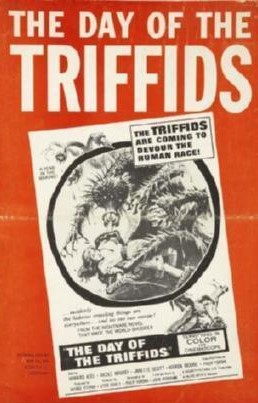
Day of the Triffids (1963) ****

Pandemic means panic and these are by far the best scenes in the adaptation of John Wyndham’s famed sci-fi novel. Virtually everyone in the world is struck blind by the fierce  brightness emitted from a bombardment of meteorites.

When passengers on a plane realize their pilot is blind, the panic is breathtaking. Ditto a train crashing into a station. While those with sight intact such as a busload of convicts can terrorize the blind, forcing them to submit to sexual overtures. On top of that are terrific scenes of deserted cities – very familiar to us all during the current pandemic – and of those unable to see trying to walk hands outstretched or attach themselves to anyone still blessed with sight.

One of the standouts is patient Bill (Howard Keel), saved from seeing the dazzling light display because his eyes were bandaged, walking through a deserted and trashed hospital. And perhaps Jurassic Park found useful the scene where the plants test an electrified fence.

And on top of that, of course, are the unstoppable monstrous man-eating plants whose growth has been triggered by the comets. Steven Spielberg over a decade later showed how to maintain tension by showing a terrifying predator in small doses and indicating its presence through musical cues and especially, when your monster ain’t quite up to scratch, keeping it hidden for as long as possible.

Interestingly, this film uses sound cues, specific noises attributable to the creatures, though the plants are shown too soon and too often but, in terms of special effects, not at all bad for their time and the low budget. And the sheer normality of the locations works very well – a caretaker having his sandwich, hard-boiled egg and flask of coffee the first victim. Some deft humor undercuts the terror. “Once you’ve tasted this coffee of mine,” remarks a character, ”you’ll know nothing worse can happen.”

Leading the fight against the monsters are sailor Bill (Howard Keel), ironically recovering from an eye operation, hotel proprietor Christine (Nicole Maurey) and in an isolated location alcoholic scientist Tom (Kieron Moore) and his wife Karen (Janette Scott).  Bill and Christine are initially intent on mere escape, but in the end have to fight.

A lean 93 minutes (the same as Gravity, 2013), tension is the key. That in itself is astonishing, given cinematographer Freddie Francis was called in at the last minute to puff out what would have been a too-short-to-release feature (under one hour at that point) directed by Steve Sekely (Kenner, 1968). Philip Yordan (El Cid, 1961) and Bernard Gordon (55 Days at Peking, 1963) knocked up the screenplay.

But once again a film like this shows how much more powerful is imagination. We can imagine being blind and walking in a vacuum with the vulnerability and helplessness that fear  entails. As the recent pandemic has shown, the unknown is terrifying and fear of the unknown even worse.

https://amzn.to/3FtsfBt

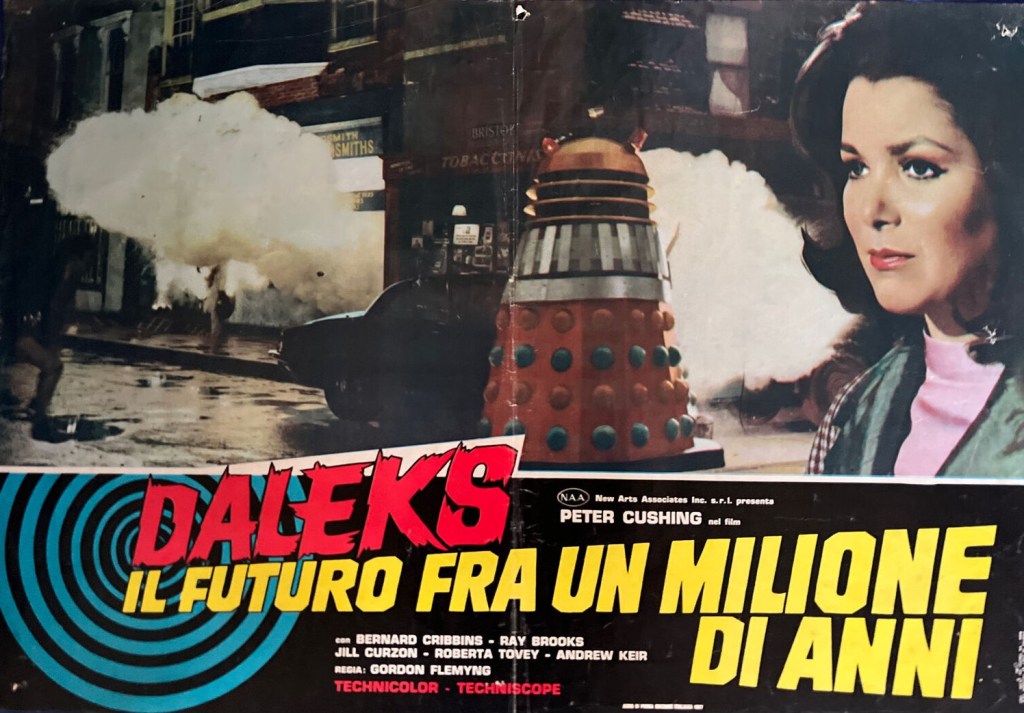
Daleks’ Invasion Earth 2150 A.D. (1966) ***

Sequels being all the rage – James Bond, Matt Helm, Derek Flint, The Pink Panther, The Magnificent Seven – in the 1960s it was no surprise that the success of Dr Who and the Daleks (20th top film at the British box office in 1965) suggested that a second go-round might be as profitable. As was standard, a recurring formula was the key.

In this case, Dr Who (Peter Cushing) and grand-daughter Susan (Roberta Tovey) repeated their previous roles though another grand-daughter Barbara (Jennie Linden) was replaced by a niece Louise (Jill Curzon) and hapless passenger Ian (comedian Roy Castle) was ousted in favour of  hapless London cop Tom (comedian Bernard Cribbins). But returning director Gordon Flemyng (The Split, 1968) upped the ante. Instead of waiting ages for the dreaded mechanical monsters with their electronic catchphrase (“Exterminate”) to appear, they turn up virtually in the first reel.

As if to emphasise the versatility of the Tardis, this time instead of space travel it’s time travel, Dr Who turning up in a blitzed London virtually two centuries ahead only to discover his nemesis rules the planet. It being set in a familiar locale, nobody is loaded down with information dumps, a tedious feature of the first picture, and it doesn’t take as long to get going, and our heroes, in various configurations, and while befriending the rebels – leader Wyler (Andrew Keir) and David (Ray Brooks) – endure a cycle of trap and escape while the good doctor tries to work out what brought the daleks to his home planet.

I’m giving this the benefit of the doubt and suggesting that the first appearance of the daleks is a homage to Dr No (1962) although one of the creatures emerging from the River Thames is hardly a patch in the sexy-entrance stakes as a bikini-clad Ursula Andress. Amidst all the mayhem, there are a couple of standout sequences, the best of which is a comedy skit involving Tom, disguised as a leather-clad member of the brainwashed automatons. This reminded me of Bob Hoskins in the first Super Mario Bros (1993 vintage) being trapped in an elevator with the Goombas. Tom is just too human to fit into this gang, constantly out of step with their actions.

Naturally, the Dr Who team are split up, allowing the action to move into two converging directions. The daleks plan to turn the planet into a giant spacecraft it can tow around, that storyline somehow involving a mining operation outside London while there’s some clever sci fi tomfoolery using the Earth’s magnetic poles to destroy the enemy.

Oops, I’ve given away the climax. Not that anybody cares that much, the main fun being the escaping formula – the daleks even use this as a plot twist, commending the intelligence of any human who can manage to escape – and watching the doctor outwit the enemy. Actually, the main fun is the dastardly daleks. Every time they appear you can imagine yourself back in a cinema crammed with thousands of kids yelling “Exteminate! Exterminate!”  

The plot keeps rolling along, no time to draw breath. And we’re not having to bother with any of the boring MCU claptrap intent on giving the super-villains a backstory or expiating their evil brains. The daleks represent alien domination, and they’re not here to give lectures on inhumanity or peace. In their determination to kill, they could almost be contemporary, given the number of serial killers and/or madmen clogging up cinema screens.

If not conspicuously inventive, Gordon Flemyng’s management of a large cast and a variety of action brought him to Hollywood attention. Given the storied career of Peter Cushing (The Skull, 1965) storied career, his performances as the doctor are generally overlooked, which is a pity, because he is certainly among the best to essay this character.  Carry On regular Bernard Cribbins livens up proceedings without needing to resort to slapstick in the Roy Castle mode. This must have seemed a bit of a come down for Ray Brooks after unexpected hit The Knack (1965) but he always seemed more at home on the small screen (although Flemyng hired him again for The Last Grenade, 1970).

The series ended here after the movie flopped on home territory. The original had bombed in the States, so the producers were heavily dependent on British box office. I guess just getting U.S. audiences aware there was such a thing in Britain as a “police box” would have been harder to grasp than the fact that it housed a time machine, and that the interplanetary craft was just there without a whole story about how it had come into being.

Made on a miserly budget by anybody’s standards, the sfx was never going to come up to scratch. But who cares.

“Exterminate! Exterminate!”

https://amzn.to/3FkXVJa

The Wrong Box (1966) ***

Somewhere between SBIG (So Bad It’s Good) and WAL (Worth a Look), The Wrong Box is a black comedy in the wrong directorial hands. Better known for thriller Seance on a Wet Afternoon (1964) and POW drama King Rat (1965) Bryan Forbes struggles to bring enough comedy into the proceedings or to wring sufficient laughs out of what he has.

Neither the wit nor the slapstick is sharp enough. But it does exhibit a certain charm. Essentially an inheritance story, it pivots on the notion that the two potential inheritors are on their last legs and putting one, Joseph Finsbury (Ralph Richardson), out of action will benefit dastardly nephews Morris Finsbury (Peter Cook) and John Finsbury (Dudley Moore) of the sole survivor Masterman Finsbury (John Mills).

It turns out Joseph Finsbury is not dead. That does not cue as much hilarity as it should., as the nephews plot to send him to his grave. Given the idea was dreamed by none other than Robert Louis Stevenson of Dr Jekyll and Mr Hyde fame, you can imagine it was written less with comedy in mind.

With so much dependent on set-pieces, it’s rather a hit-and-miss affair, with the conspirators’ failures not matching the humor of watching potential victims escape their proposed doom. Only occasionally does it sparkle.

Surprisingly, the film relies on affecting performances from the shy, retiring Michael Finsbury (Michael Caine), a gentle soul, who enjoys a very innocent romance with Julia Finsbury (Nanette Newman), a young woman terrified of being murdered, which condition provides ample opportunity for her to be rescued/consoled. who enjoy a very innocent romance.

Ralph Richardson steals the movie as a dotty pedant, weighted down with erudition and a knack, equally, for boring the pants off anyone within earshot and for escaping from the jaws of death including a massive train pile-up and several murderous attempts.

Michael Caine, in a follow-up to The Ipcress File (1965) and Alfie (1966) convincingly plays against type. John Mills (The Family Way, 1966) also plays against type as a villain rather than Hitherto, I had been rather sniffy about Nanette Newman (Deadfall, 1968),wife of the director, but here she is delightful.

Peter Cook (A Dandy in Aspic, 19680 and Dudley Moore, in his movie debut, let the show down by being so obviously the personalities from their comedy series Not Only…But Also (1964-1970), a partnership that works so well on television just frittered away here from what looks like characterization with nowhere else to go. But there is a nice cameo from Peter Sellers (The Millionairess, 1960) as an inebriated doctor.

Hard to say whether the blame lies with Larry Gelbart (The Thrill of It All, 1963) for his screenplay or Bryan Forbes for his direction.

Michael Caine got it spot-on when pointing out in his autobiography that it was a “gentle success in most places except Britain” precisely because to foreigners it represented an acceptably stereotypical view of a country full of eccentrics while to Brits it was all too stereotypical. So if you’re from America or other points global you might like it and if you are British you might not. On the other hand, the score by John Barry is one of his best with a wonderful theme tune.

Rise of the Footsoldier: Vengeance (2023) *** – Seen at the Cinema

If a train strike hadn’t forced me to drive to the Bradford Widescreen Weekend and threat of a storm ensured I set off early in the morning, leaving me an afternoon to kill, and if my hotel wasn’t slap bang next to a multiplex, I might not have been tempted. And I guess you could add to this list of possibilities that if cinemas had not been so strapped for product, it might have gone straight to streaming or DVD. So I’m happy to report that the British B-picture is alive and kicking.

Revenge is the order of the day, no surprise there in a crime flick, but here’s the twist: while ostensibly it’s just Tate (Craig Fairbrass) seeking vengeance for the death of a gangster buddy, in fact he’s also got a target on his back, three figures from his past intent on payback.

Previous entrant to the series.

So, the plot is complicated to say the least, but here’s the other twist: it’s the family element that stands out. Not “family” Mafia-style where omerta rules and only women are allowed to shed a tear. But family as in, tough as they are, these criminals have emotions. One particularly hard-boiled specimen bursts into tears in front of his cellmates on hearing of the death of a loved one. A budding gangster, boxer and drag artist (take your pick at which he shows the most talent) Billy the Kid (Ben Wilson) – who, father foolishly uses the same moniker for his stage act as his boxing – is terrified of coming out to trainer father Fergus (Stephen McCole), relying on his aunt Margo (Tara Fitzgerald) for a shoulder to cry on.

Mental and physical scars are on greater display than normal. Every time it looks like the violence quotient is about to up the ante, in sneaks a moment of humanity, a hood with a baby, the aforementioned reactions.

Set in the 1990s drugs scene, the movie has a Point Blank (1967) sensitivity (if that’s the word), Tate constantly confounded by what’s going on. No matter how many people he kills, the situation just gets murkier. To be honest, I’m not surprised, I was confused.

The low-budget dictates we stay pretty well removed from any period detail. The cars and the gentlemen’s club – the movie’s virtually an advert for the real-life Platinum Lace – and the fact that the bright lights of central London conceal a lot, is as far as we go. Hazy backgrounds and longshot keep the past out of sight.The attractions in the club are such that the punters are not diverted by the entrance of  bloodied gun-toting gangsters and the first gunshots pass them by.

Neat touches abound. The young girlfriend Charlotte (Emily Wyatt) of chief crook Hexell (Phil Davis) is in reality a safecracker and at the first opportunity heading off to foreign parts with a hefty haul. When Tate makes the mistake of driving into Fergus’s breaker’s yard he has not taken into account how easily his vehicle, shades of Mickey One (1965), can be scooped up and crushed to oblivion. Faulty information results in a heist being a bust. There’s some comedy with an out-of-date grenade and a machine gun firing blanks. In a more horrific echo of The Long Good Friday (1980) a miscreant is trapped in a car and burned alive.

But the best scene, amidst the carnage necessarily for a revenge picture, is a dying man accepting his son’s right to live his own life. And there is some honor among thieves, or at least an old pals act to fall back on.

There’s plenty violence for your buck. Knife, bullet, gas, grenade, fire, the permutations are endless and would need to be because so many people require to be dealt with. In individual combat, of course Tate wins the day, but given he is constantly outfoxed his fists and guns don’t always achieve their long-term purpose.

While Tate is not in the John Wick/Rambo league, he could certainly sit on a second tier that might encompass the movies of Dolph Lundgren, Steven Seagal, Jean-Claude Van Damme, though he’s not as athletic as the last two.

The marketeers were handed an unlikely bonus in the shape of a three-star review from  normally morally upright British newspaper The Guardian, and my guess it would be for the same reasons as I was impressed, the refusal to toe the DTV line and invest the picture with some humanity.

This series kicked off in 2007 and this is the sixth. The services of original star Ricci Hartnett were dispensed with after the second film. Fairbrass was top-billed for the next pair but ceded that to Vinnie Jones. The original was based on a true-life memoir but has gradually evolved into a more wide-ranging gangster series. Most have gone straight to streaming/DVD.

Good performances all round. Craig Fairbrass (Villain, 2020) should get a shot at something bigger. Directed with some elan on a tight budget by Nick Nevern (The Hooligan Factory, 2014) and the screenplay by producer Andrew Loveday (involved in two others in the series) and Jason Maza, also incidentally a producer, in his screen debut, has left an opening for a sequel.

The Frightened City (1961) ***

Sean Connery in an early role as a gangster is not the only reason for watching this brisk British thriller about a London protection racket. Primarily told from the point-of-view of the bad guys, this explores how a ruthless Mr Big builds up a criminal empire. Waldo (Herbert Lom), a bent accountant, brings together the six major gangs involved in extorting money from pubs and stores into a democratically-run syndicate.  He then moves on to demanding bigger sums from bigger enterprises such as construction businesses. However, when the gangsters fall out they go to war.  

This film is way ahead of the game in presenting gangsters as displaying any intelligence. Generally, they were depicted as brutes who ruled by force. But criminality at the top level demanded as much organization as in a legitimate business. Personalities had to be harnessed to work together rather than shoot each other on sight. Such skills had to exist in order for gangsters to operate on any scale. This picture examines how this was done.

The cops led by Det Insp Sayers (John Gregson) are almost a sub-plot and the story would have adequately run its course without their involvement. Sayers sails close to the wind in hoping to “tilt the scale of justice in our direction for a change.” Paddy (Sean Connery) doesn’t appear until about 20 minutes as a karate-expert cat-burglar turned enforcer. Paddy’s involvement with the syndicate ends when his code of honor is breached and he turns on his employers. His code is not so sacrosanct that it prevents him cheating on girlfriend Sadie (Olive McFarland). But he does display the virility to fill James Bond’s shoes.

There’s far more violence that would be expected in a British crime picture of the era. Night clubs, shops and pubs are wrecked and there’s plenty of fisticuffs and when the gangsters go head-to-head they upgrade to grenades. There’s a bit more plot than the running time can deal with so director (and producer and co-writer, along with Leigh Vance of Crossplot, 1969, fame) John Lemont occasionally resorts to cliché devices like newspaper headlines. Canadian Lemont – most famous for writing the first serial on ITV, Sixpenny Corner – was an auteur of the old-fashioned (and unheralded) kind, and previously writer-director of The Shakedown (1960). 

Top billing was a step up for Herbert Lom (Gambit, 1966) and he made the most of it, delivering a suave villain among the thugs. John Gregson (Night of the Generals, 1967) Table, 1959) was a solid British star and ideal cop material (he was later British television’s Gideon). Yvonne Romaine, as Connery’s new squeeze, a nightclub singer exploited by Lom more for her looks than her voice, was known to audiences after Curse of the Werewolf (1961). This was a sophomore outing for Scottish television actress Olive McFarland (So Evil So Young, 1961). Unusually, for a British picture at this time, the theme tune written by Norrie Paramour was covered by The Shadows and turned into a hit.

At this point in his career, Connery had already had two bites of the cherry without much success – romancing Lana Turner in Another Time, Another Place (1958) and Disney’s Darby O’Gill and the Little People (1959). He would make another three films before his breakthrough with Dr No (1962) but the Pressbook showed signs that he was headed for the heights.  Co-star Yvonne Romaine (and her distinctive body measurements) were accorded three separate stories in the Pressbook, compared to one each for Lom and Alfred Marks, at that point better known as a comedian. While no articles about Connery were featured, when it came to the advertising campaign Connery (and Romaine) outshone their co-stars.  

Producers were contractually bound in relation to the size of credits that appeared on any advertising. But there were no such regulations regarding the visuals of an advert. Although top-billed, Lom is not shown on any of the adverts. Given greatest prominence was Yvonne Romaine. There were thirteen different ads and she appeared in them all. Although Connery was third-billed and she was two rungs below in the credit stakes, he was the junior partner when it came to the artwork. While, Connery appeared in eleven in only one did he overshadow Romaine and in another they were visually-speaking accorded roughly the same status. But otherwise, she hogged the adverts.  

The Pressbook was small by American standards, consisting of six A3 pages, the bulk of which was given over to adverts. But what it lacked in pages it made up for in taglines – of which there were six main types.

The picture was not seen much in the United States, sent out in first run as the lower half of a double bill in only a handful of big cities, so there’s a fair chance it’s completely unknown except to Connery completists. It later appeared on the reissue circuit when Connery was a bigger name.

Worth a look as an example of the British crime movie trying to break out of the confines of the genre, and even more so as an early example of the Connery screen charisma.

Thank You All Very Much / A Touch of Love (1969) ***

The combination of Amicus and pregnancy might lead audiences to expect a monster baby of It’s Alive (1974) dimensions. Nor would you associate the studio, which made its name in horror pictures where women were either victims or sex objects, with feminism. But producer Milton Subotsky plays it straight, the only concession to the Margaret Drabble source novel is to change the title, from the obvious The Millstone to the more ironic Thank You All Very Much (in the U.S.) and A Touch of Love (in the U.K.).

It doesn’t go down the single mum kitchen sink route either, abandoned female struggling in poverty and desperate for a man. In fact, except in one instance, dependable men are in short supply. Though, it has to be said, female support isn’t much better.

Now there’s counter-programming. A “woman’s picture” supported
by low-budget actioner aimed at men.

Pregnant after a one-night stand with television personality George (Ian McKellen), post graduate student Rosamund (Sandy Dennis), after toying with home-made efforts at abortion, decides to have her baby. Luckily, she can afford it, living in a splendid apartment in what looks like South Kensington rather than a bedsit in a more squalid area of London. Her parents are more remote, tending towards the upper rather than the middle classes, the type who park their offspring in boarding school to minimize a child’s impact on their busy social lives.

Sandy Dennis (Up the Down Staircase, 1967) has quite a trick in her screen persona. She is generally initially presented as weak, whiny, vulnerable, trademark quavering voice helping this along, a potential victim until her inner steel exerts itself and you realize she is not the person you think she is. Almost an actorly version of the Christopher Nolan trope of letting you believe a character is one type of person until he/she turns out to be another.

There isn’t too much of the mother being tormented out of her skull by a baby screaming its head off – or as in Nolan’s latest opus Oppenheimer, a mother unable to cope handing the child over to someone else to look after – but she is very much alone, unable to reveal to the father his part in the pregnancy, despite having another one-night stand with him. So mostly it’s her coping with the system, suffering in silence in the traditional British manner endless bureaucracy, sitting in a long queue in a waiting room, and being beset by the very people you might expect to be more sympathetic.

Supporting feature given more prominence here.

But the nurses seem very much cut from the same pragmatic cloth as her parents. Prior to birth, one nurse informs her that it’s selfish not to give the child up for adoption. When the baby is convalescing in hospital after a heart operation, matron (Rachel Kempson), a graduate from the Nurse Ratchet school of health care, consistently refuses to let the mother see the baby as it’s apparently against hospital rules until in the best scene in the movie, and the one that achieves the Dennis trick, she literally screams the place down.

That nurses on a maternity ward full of little more than I would imagine at times screaming children are so disturbed by the prospect of an adult rebelling against the stiff upper lip conventions of British society says a great deal about the kind of uniformity and subservience expected of the public by those in charge of any large organization. None of the Angry Young Men of earlier in the decade would dream of such a simple solution to a problem.

Eventually, being allowed to sit by her child’s bedside until late into the night permits Rosamund to complete her thesis and win her PhD. She’s not quite as hard-nosed about George as she likes to imagine but since he’s not sufficiently taken with her child to allow it to disrupt a projected trip abroad, she realizes what had been plainly obvious to the audience that she is better off without men – or at least this particular, ineffective, individual – for the time being.

So most of the film is about Rosamund learning to enjoy her independence, able to achieve her goals without male assistance, and that’s generally done by action rather than dialogue or monologue, some heated debate or major crisis. Excepting the incident with Nurse Ratchet, it’s just about coping, and awareness that maternity need not cramp ambition.

Her arty friends (and parents for that matter) are all too keen on having a good time – the males mostly trying to bed her – to lend much support. Some like Lydia (Eleanor Bron) have a warped view of life.

In his movie debut Waris Hussein (The Possession of Joel Delaney, 1972) takes the striking narrative route of not allowing the picture to become tangled up with romantic complication, keeping it squarely focused on feminism, succeeding on your own terms, not reliant on men, embracing both motherhood and career. Margaret Drabble wrote the screenplay.

Sandy Dennis (Up the Down Staircase, 1967) delivers another telling performance, one of the few actresses permitted to be center stage in a non-romantic narrative, because this is the kind of role she can easily pull off. She manages a convincing British accent without falling prey to too much Britishness.

Minus the tell-tale diction that marked his later career, Ian McKellen (Alfred the Great, 1969) has an effective debut as the charming though selfish lover. Eleanor Bron (Two for the Road, 1967) is the pick of the supporting cast as the soft-hearted best friend who is too pragmatic by half. Others popping up include John Standing (Walk, Don’t Run, 1966), Margaret Tyzack (2001: A Space Odyssey, 1968), Maurice Denham (Midas Run, 1969) with Rachel Kempson (The Charge of the Light Brigade, 1968).

Unfussy direction matched with another brilliant turn by Sandy Dennis makes this a must-watch.

The Family Way (1966) ****

Nudity was not an option for previous child stars attempting to make the leap into adult roles. Shirley Temple in the 1930s and Margaret O’Brien in the 1940s were kids when they played kids and when they outgrew their cuteness audiences proved indifferent.

Being older when playing younger characters increased the chances of career survival. Silent movie superstar Mary Pickford was 22 when she first tackled child heroine Tess of the Storm Country (1914) and 30 for the remake and she made an absolute fortune from these kinds of roles. Judy Garland was 17 when The Wizard of Oz (1939) appeared and managed another 15 years at the top before drugs and drink took their toll, still worthy of supporting roles after A Star Is Born (1954) and even star billing in her last film I Could Go On Singing (1963). But she was fired from Valley of the Dolls (1967), ironically enough given the film’s subject matter, due to alcohol and drug dependency.

Hayley Mills was 14 when her first Disney picture Pollyanna (1960) was released and for the next five years at that studio never played anyone approaching her true age. She was protected from studio abuse because this was Disney and because her father was actor John Mills, who often appeared in her movies. When the Disney contract ended, Sky, West and Crooked (1966), her father’s directorial debut, attempted to refashion her screen persona with a more challenging role.

But The Family Way forced audiences to set aside all preconceptions. Not only did she show her naked derriere, but this was a film essentially about sex. No sex is actually shown because  newly-weds Jenny (Hayley Mills) and Arthur (Hywel Bennett) have problems consummating their marriage. You can thank the Carry On films for the snigger-snigger British mindset to sex. The promiscuous and often predatory characters of Darling (1965) and Alfie (1965) occupied a different world, almost a foreign country as far as the inhabitants of this solid working-class town were concerned.

They would have looked askance at such permissiveness. Here, at this particular point in history, both sexes were still expected to be virgins when they married. Sex in Darling and Alfie, for example, carries little emotional overtones. The Family Way is novel in treating sex as fundamental to happiness within marriage.

The subject of impotence would not be first on your list when you set out to make a warm-hearted drama. But here screenwriter Bill Naughton (Alfie) in adapting his play All in Good Time uses the theme to explore family values. But where recrimination – and subsequent confrontation – might be the first port of call for another writer, Naughton foregoes that obvious route to concentrate on the way impotence eats at a man’s self-worth. Two secrets drive the plot but the second is preserved right to the end, resulting in possibly the most moving finale you will ever watch.

In documenting working-class life it is superior to the earlier Saturday Night and Sunday Morning (1960). It is life without inbuilt bitterness. Families are still crammed into small houses, a visit to the housing department – to get a new council house or just be put on the waiting list – an invitation to humiliation, but there is full employment and enjoyment to be found in simple pleasures.

Family dynamics are expertly explored. Arthur, with a shelf load of books and penchant for classical music, is diametrically opposed to his down-to-earth but exceptionally obtuse father Ezra (John Mills), and there is a wonderful scene early on where Arthur seeing how badly his father takes defeat allows him to win an arm-wrestling competition.

Ezra is the standout, devoted to the memory of a long-departed childhood pal and struggling with his position as patriarch especially in the face of perennial sniping by wife Lucy (Marjorie Rhodes). Ezra is so expressive of longing and emotion, and it is he who has the heart-breaking final scene.

The older characters are fully rounded, bluff exteriors concealing fragile emotion. Hard-faced Lucy appears almost fey when she recalls a moment of love. Jenny’s burly father (John Comer) cannot cope with her departure from his household, especially as that leaves him at the mercy of his shrewish wife (stand-up comedienne Avril Angers).

Hywel Bennett begins a successful movie career with a difficult part, an introspective role calling for him to contain his emotions – not venting his spleen like the endlessly complaining Arthur Seaton of Saturday Night – until they erupt in a spectacular fist fight that does not go at all the way you would expect.

Barry Foster (Frenzy, 1972) has the showy part as the rough-edged  workmate and Murray Head (later part of the love triangle in Sunday, Bloody Sunday, 1971) also makes his debut in an equally showy role as Bennett’s brother who makes advances to his frustrated sister-in-law.

Even without the nudity, Hayley Mills, the denoted star, makes the transition to movie adulthood with ease. In part, all she had to do was drop the unnatural excitement that appeared essential to her Disney portfolio. Her delivery, her reading of a line, had always been good and she had clearly worked out she was going to be an actress not a sex symbol so there was no exaggerated use of her physicality.

Even the nudity worked in her favor, startled to be disturbed emerging from a bath, genuinely shy, not the mock-shy or reveling in her naked state that was de rigeur in Hollywood. She was also helped by being a light foil to the brooding, gloomy Bennett, her natural bright personality, while affected by their problem, still capable of enjoying harmless pleasures.  

This was a distinct change of pace for the fraternal producer-directing team John and Roy Boulting, stalwarts of British production since the 1940s with a host of well-regarded dramas and comedies, often with Peter Sellers, to their name.  Generally, they took turns about in the director’s chair – the former putting his name to thriller Brighton Rock (1948) and comedies Lucky Jim (1957)  and I’m Alright, Jack (1959), the latter claiming credit for drama Fame Is the Spur (1947), thriller Run for the Sun (1956) and comedy A French Mistress (1960). Occasionally, they shared the directing chore as with thriller Seven Days to Noon (1950), comedy Heavens Above (1963) and in this contemporary drama.

Their approach to The Family Way went against the grain of the gritty working-class dramas in the vein of Saturday Night and Sunday Morning and This Sporting Life (1962). Nobody here has a job they hate or comes home covered in grime. In fact, since the central thrust (pardon the pun) of the movie is about pleasure (sexual, that is), it is set against a background of enjoyment. Both principals have jobs in entertainment, Arthur an assistant projectionist in a cinema, Jenny working in a record store and also seen at a disco and a motocross event. Alcohol plays a role, of course, but not to the extent of over-indulgence, not drinking yourself to oblivion like Arthur Seaton, and its main purpose is to present the father as an amiable host.

What impact the burgeoning affair between Hayley Mills and Roy Boulting (33 years her senior) had on the production is anyone’s guess but possibly it helped steady the star’s nerves when it came to the nude scene. From today’s perspective the nudity appears gratuitous. And certainly back then it was shocking, ensuring an X-certificate (although the subject matter probably already guaranteed that).

Actually, it was social comment. While living in a decent-enough house, the family lacked one particular amenity – an indoor toilet. Washing took place at a communal sink or in the privacy of a bedroom with a bowl of water. A bath was a mobile unit, a zinc item dragged out of the scullery into the living room, filled with endless pots or kettles of hot water.

But for a young woman to take a bath demanded privacy. So when Jenny is interrupted in her ablutions, males and females in the audience had opposite reactions. It would not be unreasonable to suggest that males simply enjoyed the sight of the naked posterior. Women, on the other hand, would wince.

Aversion to nudity may have played a part but more likely women would feel deeply the humiliation at the lack of privacy in such a household, that someone could come upon you at your most vulnerable at any time. Sure, nothing went hidden in such houses, the sounds of any activity would carry through walls, but such a deep personal activity as exposure while taking a bath said far more about the brutal congestion of family life than jokes about hearing someone urinating into a container in the next room.

Paul McCartney contributed a very hummable melody as part of his debut movie score.

American audiences did not respond so well to Hayley Mills’ emergence as an adult actor and the movie failed to click at the box office there. But by that point it was already in profit, a runaway British hit (among the top twelve films of the year) and set the female star up for an adult career, pointed Hywel Bennett in the right direction and gave John Mills one of his most memorable turns.  

Very entertaining with terrific acting.

Behind the Scenes: “The Loss of Innocence / The Greengage Summer” (1961)

Director Lewis Gilbert’s career was at an impasse. He had made his name primarily in a string of typically British stiff upper lip World War Two pictures including Reach for the Sky (1956) and Sink the Bismarck! (1960). It will come as a surprise to many British people to learn that virtually no British movie, not even the WW2 films that were big hits domestically, made any impact at the U.S. box office, Sink the Bismarck! a rare exception.

Ferry to Hong Kong (1959) starring Orson Welles had flopped  and WW2 comedy Skywatch/ Light Up the Sky (1960) had died the death.

British director Victor Saville, who had made a name for himself in Hollywood with Greer Garson sequel The Miniver Story (1950) and Kim (1950) starring Errol Flynn, had turned producer, purchasing the rights to the bestseller by Rumer Godden (Black Narcissus, 1947).

Saville had entered into a partnership with veteran independent producer Edward Small (Solomon and Sheba, 1959) who had a deal with United Artists. The duo had three films on their slate, the others being movie version of The Mousetrap (delayed due to the length of a stage run that still prevents it being turned into a movie) and Legacy of a Spy (never made). Cary Grant was initially touted as the lead for Loss of  Innocence.

When that deal foundered, it shifted from UA to Columbia after the intervention of British producer John Woolf (The African Queen, 1951),  a relation of Saville, who had an ongoing relationship with Columbia. The script found its way to Kenneth More (Sink the Bismarck!) still a highly-rated draw at the British box office. He had to lose weight for the role. Later, Gilbert intimated he was not right for the part and would have preferred Dirk Bogarde.

More’s wife Mabel was friends with Gilbert’s wife Hylda  and it was at the former’s suggestion that Lewis was roped in. Gilbert was initially wary of working with Saville who, although highly respected as a director, had a reputation of being difficult to work with. A director turned producer was all too likely to have ideas about the direction rather than sticking to the production side. As it turned out, Savile “didn’t interfere at all.”

Hayley Mills (The Family Way, 1966) was first choice for the female lead. Her Disney contract was not exclusive and at 15 she might have been ideal casting. But such a role would almost certainly impact on her future with Disney.

Mrs Gilbert was instrumental in the casting of Susannah York (aged 21) having called her husband down the stairs to see the young actress in a television production of Arthur Miller’s The Crucible. As it happened, Saville was on the same page, also having witnessed that performance, calling the director the following day to suggest York. Coincidentally, the Gilberts had been invited to dinner with Sylvia Syms, female lead in Ferry to Hong Kong, only to find York was a guest. Auditioned for the role of Jos, the oldest of the four sisters stranded at a chateau in France after their mother is taken ill, York won the part.

“The hard part to cast,” according to Gilbert, was Hester, Jos’s younger sister, wise beyond her 14 years “who can see trouble where Jos couldn’t.” Contrary to received wisdom, the bulk of children who attended stage schools were working class. “Their parents needed the income. Middle-class parents, preferring their children to be properly educated, discouraged them from going to stage schools.”

In consequence, the bulk of the girls turning up for auditions spoke Cockney whereas the part called for a “nicely-spoken girl.” Just as Gilbert was about to give up on the process, he received a phone call from an agent, promising a new discovery. “Her name was Jane Asher…a pretty 14-year-old with long red hair.”

Other casting gambles didn’t work out so well. Seeking a young man to play a French gardener, Gilbert hit on the notion of hiring a real Frenchman, having found a young lad with curly hair who appeared just right for the part. The only problem was – he couldn’t speak English. But it didn’t seem so insurmountable since he was cast three months before shooting began. But when the cameras rolled “he was unintelligible.”

Gilbert surmised that “someone so chaotic as that curly-haired Frenchman would never amount to anything.” He was wrong. The man was Claude Berri, later the highly successful screenwriter and producer of Jean de Florette (1986).  

The movie’s original title –  The Greengage Summer – caused a massive problem. Naturally, it was expected that greengages (plums) would feature prominently in the background. But there were no greengages thanks to a blight that had ruined the harvest all across France. As a consequence, British greengages were used, removed from their sacks by the thousands and sewn onto trees by the art department.

Susannah York created another problem when, in her naivety, she decided that the most authentic way to play drunk was to be drunk. Gilbert tried to dissuade her, explaining that the scene would go on all day not just last five minutes and in order to play a drunk you needed your wits about you. York ignored the advice and a day’s filming was ruined. Filming, split between England and France, began in August 1960.

Although it received “extraordinarily good notices” in both Britain and America it failed to light a spark with audiences in either country. Gilbert’s retrospective assessment, citing previous movies like Billy Wilder’s  Love in the Afternoon (1957) with Gary Cooper and Audrey Hepburn and Sabrina (1954) with Bogart and Hepburn, was that “very few films where you get a young girl in love with an older man have ever been successful.”

SOURCES: Lewis Gilbert, All My Flashbacks (Reynolds and Hearn, 2010) p207-210; Kenneth More, More or Less, (Hodder and Stoughton, 1978);  Roy Fowler, “Interview with Lewis Gilbert,” British Entertainment History Project; Philip K. Scheuer, “Saville to Resume Producing Career; Godden Novel First of Three,” Los Angeles Times, November 3, 1958, pC13; Richard Nason, “Small and Saville Planning Dear Spy,” New York Times, October 7, 1957, p47; Stephen Vagg, “Movie Star Cold Streaks, Hayley Mills”, Filmink, March 19, 2022.

Loss of Innocence / The Greengage Summer (1961) ***

The alternative title assumed nobody in America knew what a greengage was – it’s a type of plum – but the new title was actually pretty apposite. Until then director Lewis Gilbert had been known mostly for Second World War pictures like Reach for the Sky (1954) and Carve Her Name with Pride (1955) so this was a considerable change of pace, and filmed on location in France.

Joss (Susannah York) takes center stage as a girl on the brink of womanhood who experiences powerful emotions for the first time – love and its perpetual bedfellow jealousy – as well as rite-of-passage experiences like getting hammered on champagne. She is the oldest of four siblings stranded in a French chateau when their mother takes ill.

Left to her own devices, she promptly falls for the suave and much older Eliot (Kenneth More) who has interceded on their behalf when the hotel owner is against putting up with a bunch of motherless children. Matters are complicated because Eliot is having an affair with chateau owner Zizi (Danielle Darrieux) and by Joss attracting the attention of Paul (David Saire), a hotel worker closer to her own age. In short time, the situation is brimming over with suppressed emotion.

Hester (Jane Asher), suddenly aware of the romantic havoc being wreaked by her older sister, is going through her own transformation, jealous that the unrequited love of Paul is not directed towards her, her emotions flying off the handle when she triggers a violent altercation with a local lad.

Despite the distributor’s best efforts – the tagline promises “A Summer of Evil” – by modern standards this is a gentle tale, but not without a harsh undercurrent. York is superb as she undergoes a transformation from uncertain schoolgirl to a woman realizing the power her beauty can exert. She flares from child to adult and back again in seconds.

The main U.S. poster and this one seem determined to add seediness to the tale.

Susannah York (They Shoot Horses, Don’t They, 1969) had won her big break after a sparkling performance in a small role in Tunes of Glory (1960) and she floats effortlessly between chalet school pranks and more serious misdemeanors including drunkenness.

Sometime child actor Jane Asher (still better known as Paul McCartney’s girlfriend or for her cakes rather than stunning turns like Deep End, 1970) also achieves a career breakthrough and you could argue that she edges out York in a role that calls for more balance.

Kenneth More (Sink the Bismarck!, 1960) was at his charming best in the kind of affable role he had generally moved away from, but his character has a darker side. More importantly, as an older adult infatuated with a young girl, he manages to steer well clear of any inherent  creepiness. There is no sense of him exploiting the situation, rather trying to guide the young woman in the art of love.

The dialogue is surprisingly good and Danielle Darrieux (better known as one of Darryl F. Zanuck’s girlfriends rather than for the likes of Romain Gary’s The Birds Go To Die in Peru, 1968) is convincing as an aging beauty willing to do anything to hold onto her man.  There is an interesting under-developed subplot too dangerous to explore at this point in the decade of the hotel manager Madame Corbet (Claude Nollier) clearly being in love with Zizi.

The young Elizabeth Dear (The Battle of the Villa Florita, 1965), making her debut, also enhances her career and British character actor Maurice Denham (Danger Route, 1967) has a small role. 

Lewis Gilbert’s subtle direction set his career on a new course that would ultimately deliver an Oscar nomination for Alfie (1966).  The Howard Koch (The Fox, 1967) screenplay draws heavily on the source novel by Rumer Godden, an expert in the suppressed complexities of female life, best displayed in Black Narcissus (1947) and The Battle of the Villa Florita

The scenery is a bonus as are the snatches of provincial French life. All in all, an engaging piece of work, with Susannah York delivering a star-is-born kind of turn.      

Discover WordPress

A daily selection of the best content published on WordPress, collected for you by humans who love to read.

The Atavist Magazine

by Brian Hannan

WordPress.com News

The latest news on WordPress.com and the WordPress community.