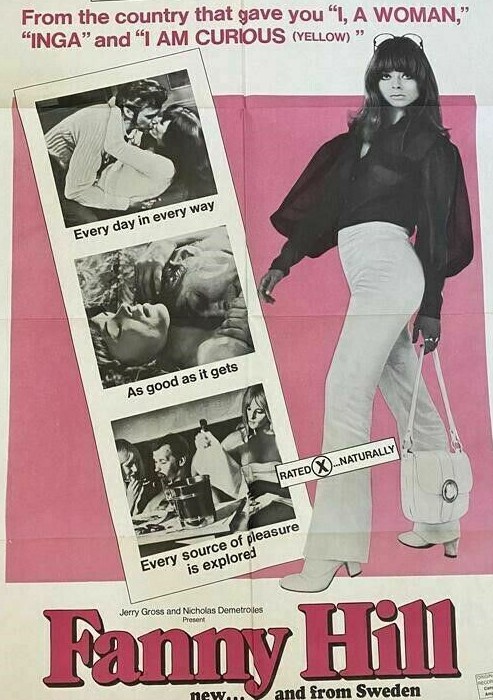
For three weeks at the end of November 1969 through to mid-December, the top films on the Variety weekly box office Top 50 chart were sexploitation films. The Swedish Fanny Hill (1968) was the first to hit the top and I Am Curious, Yellow, also from Sweden, took the top place for the next fortnight.
This was something of a slap of cold reality in the face of Hollywood which had assumed that by and large its product was sufficient to meet the needs of exhibitors nationwide. The slump in production due to the financial issues facing the top studios led the industry to expect that the traditional low-budget pictures that would make up the shortfall would come from the usual sources – westerns, crime, horror. Few would have bet on sexploitation taking up the slack.
The new Variety system of collating box office was in part to blame for the influx of sexploitation films being so transparent. Until the magazine instituted its weekly Top 50 grossing pictures in April 1969 and widened the net for gathering in those figures, box office was reported from just 200-300 first run houses in the major cities. This now expanded substantially to five times as many cinemas and included smaller houses in a greater number of cities as well as cinemas that belonged to a Showcase (wide release) circuit.
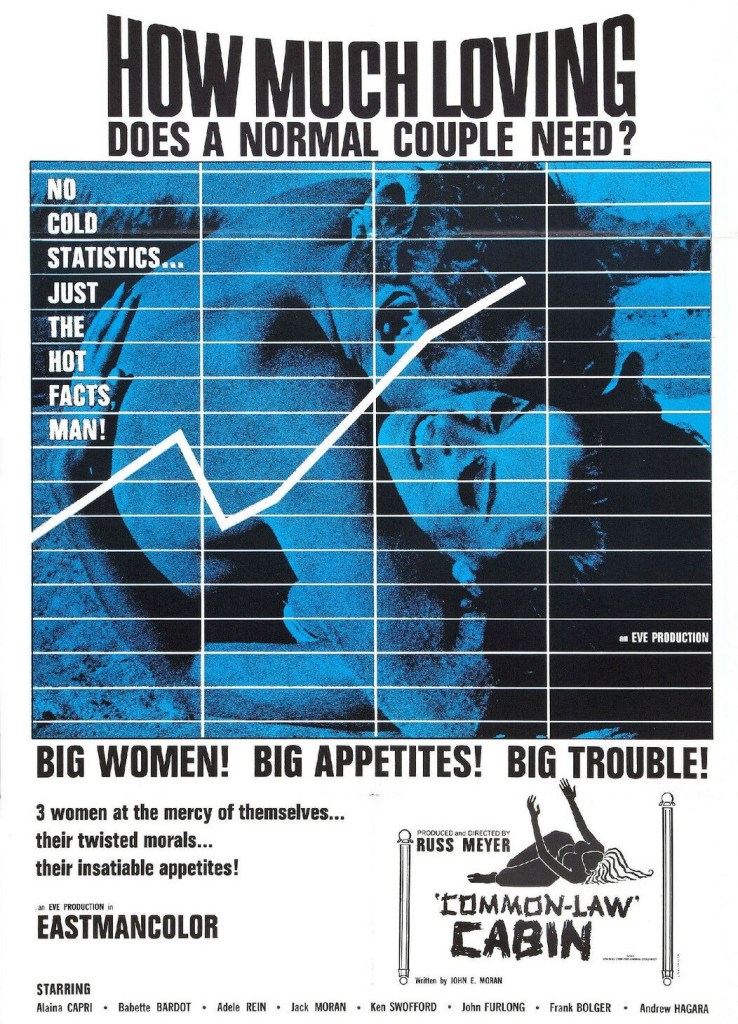
That resulted in a greater breadth of films being reported. Except on first run arthouses, where some art films with greater sexual content could be shown, it was rare for a sexploitation picture to feature in a big city first run. Russ Meyer was the acceptable face of sexploitation, especially since his films contained humor. Even so, eyebrows were raised when the exploits of Common Law Cabin (1967) made headlines in Variety (“Sexploitation pair: $22,000 at Fox”) at Detroit’s biggest cinema, the 5,100-seater Fox, a major first run venue. That film found slots in first run in Chicago at the Center and the Fine Arts in Portland. Another Meyer opus Finders Keepers found a berth at the Randolph in Philadelphia (“Russ Meyer’s Nude Pic Into Philly’s Classy First Run”). But that was the extent of its invasion of first run for that year. And that was pretty much how the industry expected things to stay, a rare sexploitation making a few headlines, but not much more.
So when Fanny Hill grossed $625,000 – equivalent to $4.7 million today – from 49 houses to hit the top spot it sent the industry reeling in shock. I Am Curious Yellow hit the top spot in successive weeks with $594,000 from 52 houses followed by $454,000 from 90. In some respects it should not have come as any great surprise. I Am Curious, Yellow had already had already featured several times in the weekly top ten, fifth with $213,000 from 16 houses, sixth with $137,000 from 14 and again with $$237,000 from 18.
Sexploitation distribution was handled in much the same way as any other picture. Probably it came closer to replicating an arthouse release, where prints, due to their cost, were in short supply and cinemas undertook to hold onto a movie for several weeks, if not months. But when a movie was clearly pulling in the crowds, the distributors switched to a more mainstream system, combining Showcase with first run. The big danger when films went wide was that grosses plummeted. But that was clearly not the case here. Yes, the earlier per-screen averages were higher but the later ones certainly did not fall off a cliff.
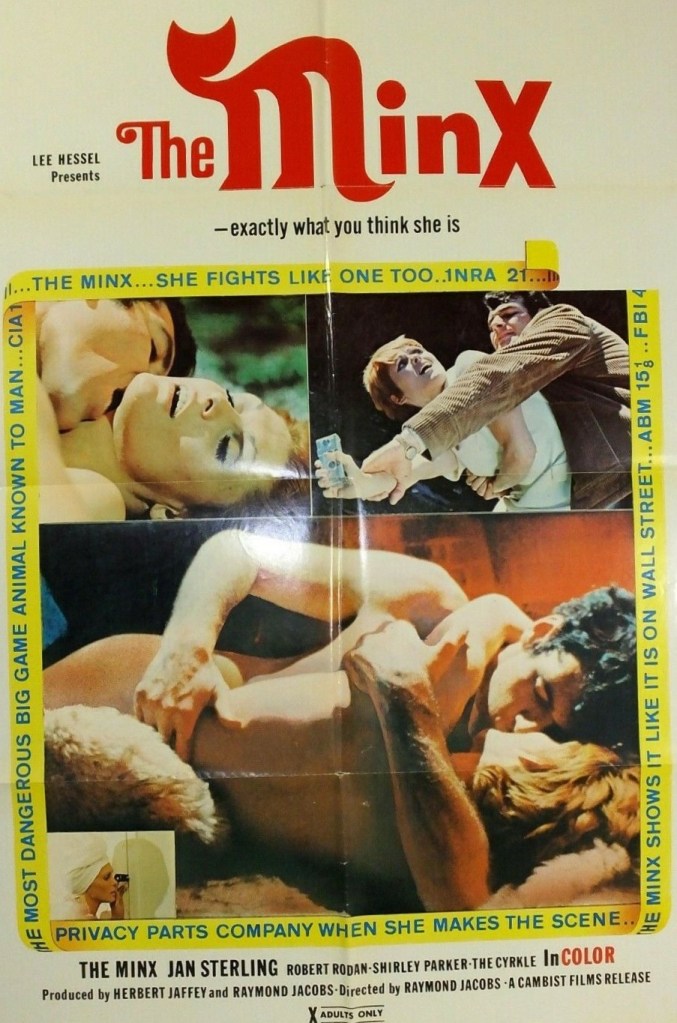
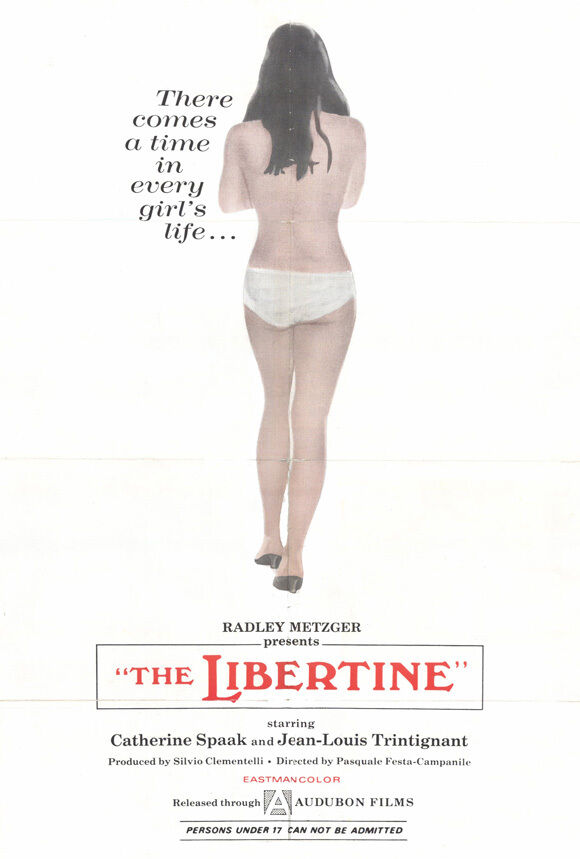
Outside of these two pictures, other sexploitationers had been making an impact on the weekly chart. The Libertine (1968) had placed 11th with $184,000 from 56, Naked Angels (1969) came 17th one week with $148,000 from 11 and lower down the chart The Minx (1969) had showed potential with $52,000 from three while Camille 2000 (1969) had earned $32,000 from two. Sexploitationers absorbed lessons learned from more mainstream distributors in how to use the Top 50 as a promotional tool. A movie that was not only taking in big bucks, but placed high in the chart and had a great per-screen average was inevitably going to attract attention.
Perhaps the oddest part of the sexploitation breakout was that so few had seen it coming. If so, they had not been reading the trade papers. This side of the business had grown so fast in a couple of years that those involved had formed their own association. It turned out a war had broken out between the suppliers of cheaply-made sexploitationers and those willing to increase their budgets in order to entice audiences with better production values.
But this was at the hard-core end of the business, the number of outlets tripling from 300 theaters three years before to 800 in 1969, and operating obviously outside the restrictions of the Production Code or the new censorship system. Initially, movies costing $8,000-$15,000 could have been put together in a weekend. Now up to 100 movies budgeted at at a maximum of $45,000 were being made every year with a potential profit of $125,000-$300,000 each. About half a dozen companies had annual million-dollar turnovers.
But this business had also filtered down to the more easily exhibited soft-core, which fitted into the “X” category under the new censorship rules. The 100 cheap soft-core efforts financed by individual theaters or small chains which filled a supporting spot on a double bill produced meagre returns so it made more sense to edit down a hard-core feature to suit a soft-core audience. The demand for hard-core, most prominently seen in Detroit, where hard-core pictures often outgrossed first run, was filtering down into soft-core, hence the growth in bookings for the likes of Fanny Hill and I Am Curious, Yellow.
The other reason for moving into the soft-core market was that the hard-core end was saturated resulting in lower rentals and consequently lower profits which inhibited production. Theaters struggling to cover overheads from the thin stream of movies emanating from the major studios or finding there was little juice left in blockbusters by the time they drifted down the exhibition food chain increasingly turned to soft porn.
SOURCES: “Sexploitation Filmmakers, Showmen Form Adult Motion Picture Ass’n,” Box Office, January 20, 1969, p8; “Over-Seated for Sex,” Variety, July 2, 1969, p1; “Sexpix of $25,000-$45,000 Negative Cost See Bright, Not Clouded, Future,” Variety, July 16, 1969, p17. Results for the “Top 50 Chart” in Variety were taken from the following issues in 1969: Jun 4, Jul 2, Jul 9, Jul 23, Sep 24, Oct 1, Oct 15, Nov 5, Nov 26, Dec 3, Dec 10, Dec 17, Dec 24.



 The Magnificent 60s