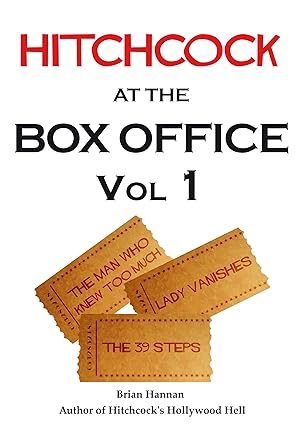
There’s a myth about Alfred Hitchcock that needs exploding. Every major biography – John Russell Taylor, Donald Spoto, Patrick McGilligan et al – repeats the same error. Namely, that as a result of the critical and commercial success in the U.S. of The Man Who Knew Too Much (1934), The 39 Steps (1935) and The Lady Vanishes (1938) that Hitchcock was received into the upper reaches of Hollywood in a blaze of glory.
However much that reads like a Hollywood fairy tale, the problem is that’s exactly what it is.
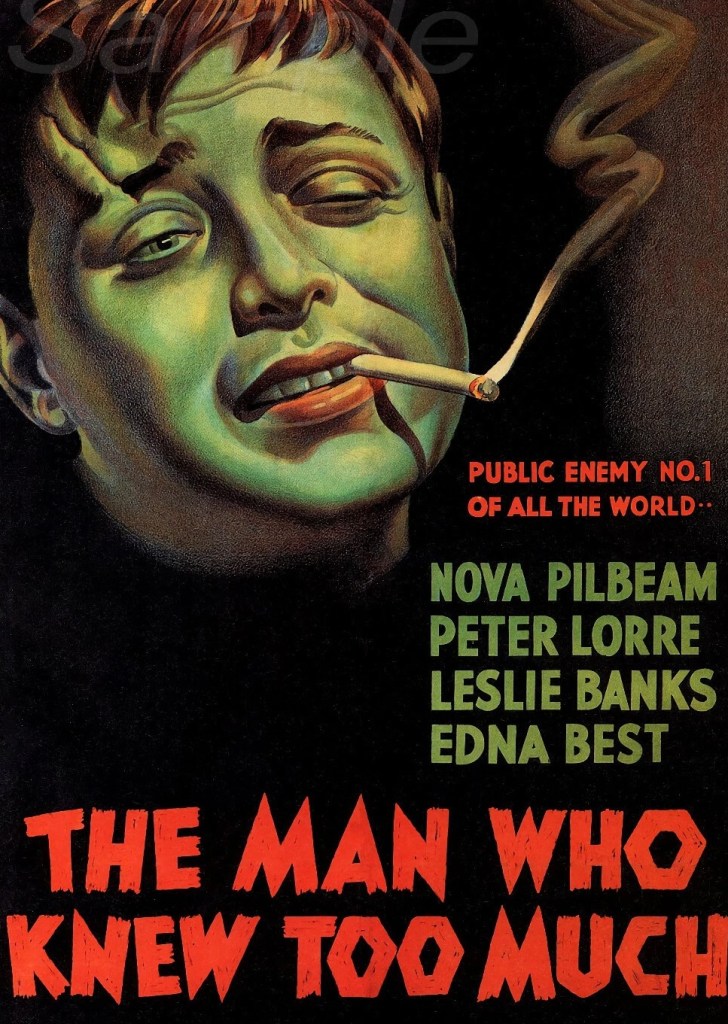
There was no great reason for me to write this book, except that in writing other books and in the process of doing research into the 1930s I would come across snippets of box office information that set my curiosity aflame. Not realizing I would end up writing the opposite, I thought it would be interesting to detail – just as the biographers proposed – Hitchcock’s earliest successes at the U.S. box office.
Hitchcock got a leg up in America because the company that made his films in the U.K, Gaumont British, was trying to plant a commercial stake in the U.S. and had established a distribution wing and rented out cinemas in major cities.
“The Man Who Knew Too Much,” wrote Patrick McGilligan in Alfred Hitchcock: A Life in Darkness And Light, “became the first Hitchcock film to score with critics – and audiences – in the United States.”
The box office aspect turned out not to be true.
The genre into which Hitchcock fitted – mystery/suspense/whodunit – had not, until recently, been a vibrant one. The most successful were series characters, Charlie Chan, Mr Moto, Bulldog Drummond, Perry Mason, Sherlock Holmes, all too predictable. “Mysteries have been hit and miss for the past few years,” remarked Variety in 1934, “and can hardly be considered a staple commodity.”
But there had been a sudden upsurge thanks to the popularity of detective fiction. Dashiell Hammett’s The Thin Man filmed in 1934 had been a sensation. But its success was down to an unusual ingredient – comedy. And the upshot of that was that all the other studios tried to follow suit. Variety reported: “Warner Brothers, Paramount, Radio (RKO) are instructing writers to whip up mystery stories with laughs as the main ingredient, the murder considered second.”
The Man Who Knew Too Much opened in New York in the week before Easter 1935 at the 2,200-seat Mayfair (ticket prices 35-65 cents) to good reviews. It ranked second to last at the box office for the week. But that was in a small cinema and the result was deemed good enough to run for another three weeks.
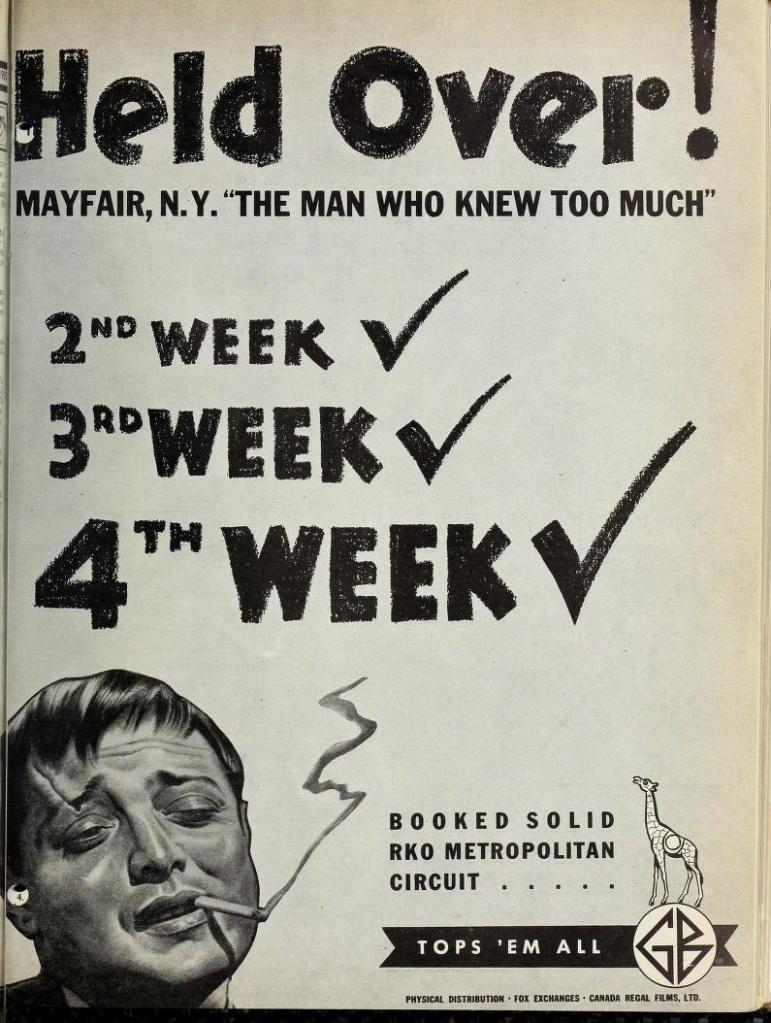
But it was in the same position – second to last – in Newark in New Jersey and Minneapolis. Montreal saw a slight improvement – third (instead of second) last.
However the tables were tuned in Philadelphia where it came top with $13,500 at the 3,600-seater Fox (40-65c), beating off James Cagney in G-Men ($11,500). It appeared on the upswing, placing second in Buffalo. But then was back to second bottom in Pittsburgh, Kansas City, and Washington.
It did not “score” with American audiences as biographer Patrick McGilligan has claimed. For the majority of its bookings, the movie had finished bottom or second bottom in the weekly rankings with precious few holdovers – the “legs” that, as now, were considered a key indicator of success.
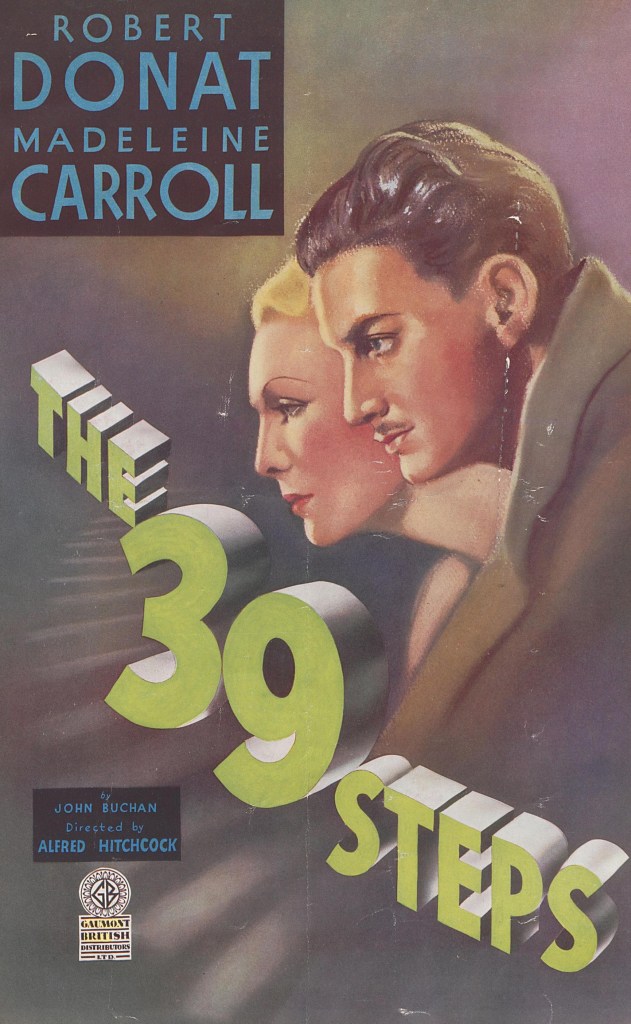
The 39 Steps was one of the biggest box office hits in Britain in 1935. In London’s West End it played, consecutively, at four cinemas, running for over 20 weeks. Once again U.S. reviews were excellent.
The 39 Steps opened on a relatively wide release during August 1935. In Boston it came third, but in Washington third bottom, and second bottom in both New Haven and Providence, and was last in Philadelphia. Worse was to come. In Cincinnati, it was yanked after just five days and lasted only three days in Los Angeles. In San Francisco expectations were so low it went out as the supporting feature to Laurel and Hardy’s Bonnie Scotland.
So, the last thing anyone expected was that it would crack New York. To everyone’s astonishment, The 39 Steps, helped along by a stage show, hit the box office jackpot with $43,000, on the way breaking the Saturday attendance record and ranked third for the week. A second week slipped only to £34,000, and might have remained longer except the cinema had a prior commitment.
It looked as if the tide had turned after taking the number one spot in Newark and Chicago and running four weeks in Minneapolis. It was runner-up in Brooklyn, Montreal and Buffalo. But in Seattle it was shunted onto the lower part of a double bill and in Indianpolis placed last. In Detroit it ran only five days and three days in Oklahoma City.
The 39 Steps had not taken the U.S. by storm nor was Hitchcock now seen as a top box office director. The 39 Steps had not hammered home the message to Hollywood that he had expected. The Hitchcock postman had now come twice – and not delivered.
The reason why biographers took this view of Hitchcock at this point in his career was that moving to America was seen as a triumph. Patrick McGilligan was not being ironic when he described Hitchcock as a “prize acquisition.”
Hitchcock signing a contract with David O. Selznick in summer 1938 was taken as a sign that his genius was at last being recognized. In fact, the opposite was true. He was signed by Selznick because no other studio wanted him. And Selznick took him on because he was cheap. All the best directors were tied down to contracts with major studios. Selznick relied on cheap loan-outs of directors from other studios.
Hitchcock simply lacked the track record at the box office that would encourage the other studios to risk offering him a contract. It was true that he had received offers from studios other than Selznick. RKO wanted him to go to America – but for a series film The Saint. He had been poised to sign for MGM in September 1937 and when that fell through was set to go with Twentieth Century Fox in June 1938.
But neither offer was to work in Hollywood.
MGM and Fox wanted him to remain in Britain. The one consistent element of these various negotiations was that the studios did not subscribe to Hitchcock’s evaluation of his own worth.
So, the question, was: could The Lady Vanishes (1938) redeem Hitchcock’s reputation at the box office and prove true the arguments made by the biographers that he entered Hollywood in triumph.
Sorry, but that would be deemed a spoiler so you’ll have to read the book to find out.
Hitchcock at the Box Office Vol 1 – The Man Who Knew Too Much, The 39 Steps and The Lady Vanishes by Brian Hannan is available on kindle and in print. Online edition $3.99 / £2.95. Print edition – available on Amazon and all good bookshops – is $10/£10.

