Rome Adventure / Lovers Must Learn (1962) ***

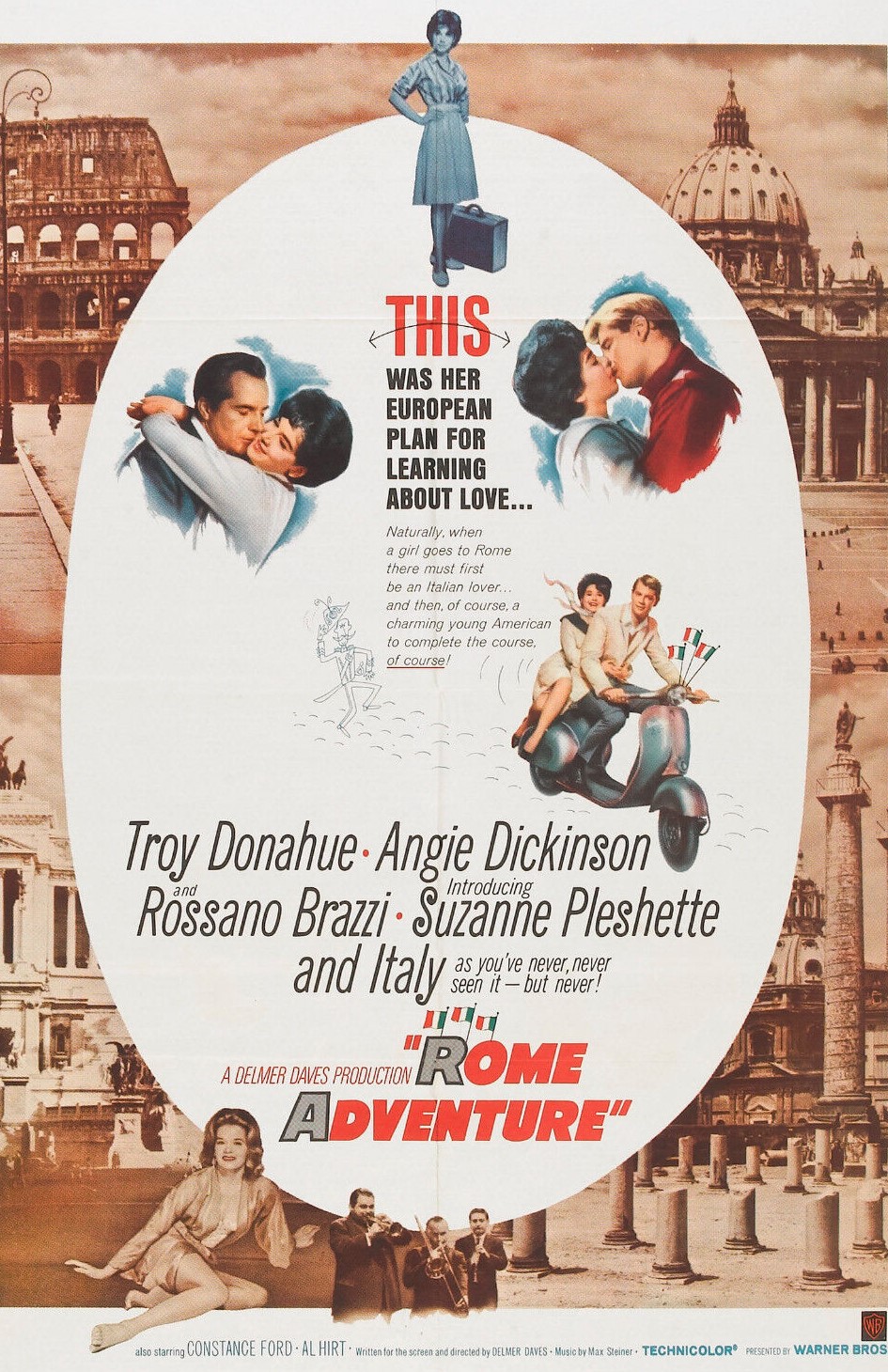
Angie Dickinson fans would be entitled to cry foul after the top-billed female star appears to be engaged in a bait-and-switch tactic. After a lengthy wait, when she finally does appear it’s only to high-tail it off to Switzerland leaving behind in Rome lover Troy Donohue. Her departure creates romantic opportunity, her return complication.

And is this the same Delmer Daves, you might ask, who made his name in a series of male-dominated westerns such as Broken Arrow (1950) and 3:10 to Yuma (1957)? Yes, it is, but once Daves had finished applying intense pressure to his male coterie, he did the same, in a different genre, to women.
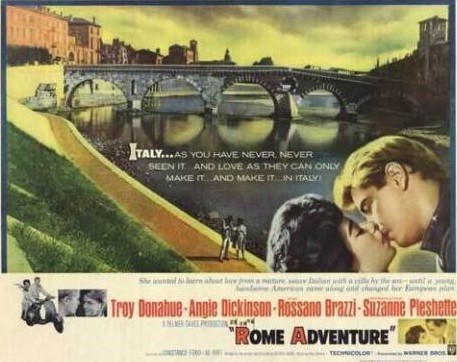
Young teacher Prudence (Suzanne Pleshette) exerts her independence by quitting her job after being hauled over the coals in Small Town U.S.A. for teaching her pupils a controversial novel. On the boat to Rome she encounters Italian lothario Roberto (Rossano Brazzi), who holds the lofty sexist opinion that only a man can turn a girl into a woman, and the nerdy Albert (Hampton Fincher), both of whom come a-courting, the youngster’s diffidence ruling him out of serious contention.

Roberto is friends with student Don (Troy Donohue) but the minute he is introduced to Prudence he has to rush off to try to persuade artist Lyda (Angie Dickinson) not to leave. Roberto turns gracefully aside after Prudence denies him sex (put more subtly than that of course) and she, finding employment in an American bookshop (speaking the language no deterrent there),  embarks on romance with Don, fluent in Italian, who teaches her how to drink strega, takes her to jazz clubs and acts as tour guide.

A good chunk of the picture, it has to be said, is a travelogue, and when neither Roberto nor Don are on hand to point out this or that monument or embark on a potted history, suddenly she discovers an interior monologue to do the job. And at one point it turns into If It’s Tuesday It Must Be Pisa as the couple take off on a longer trip, bouncing from one tourist city to another, the route only complicated by some slight comedy over whether they should share a bed.
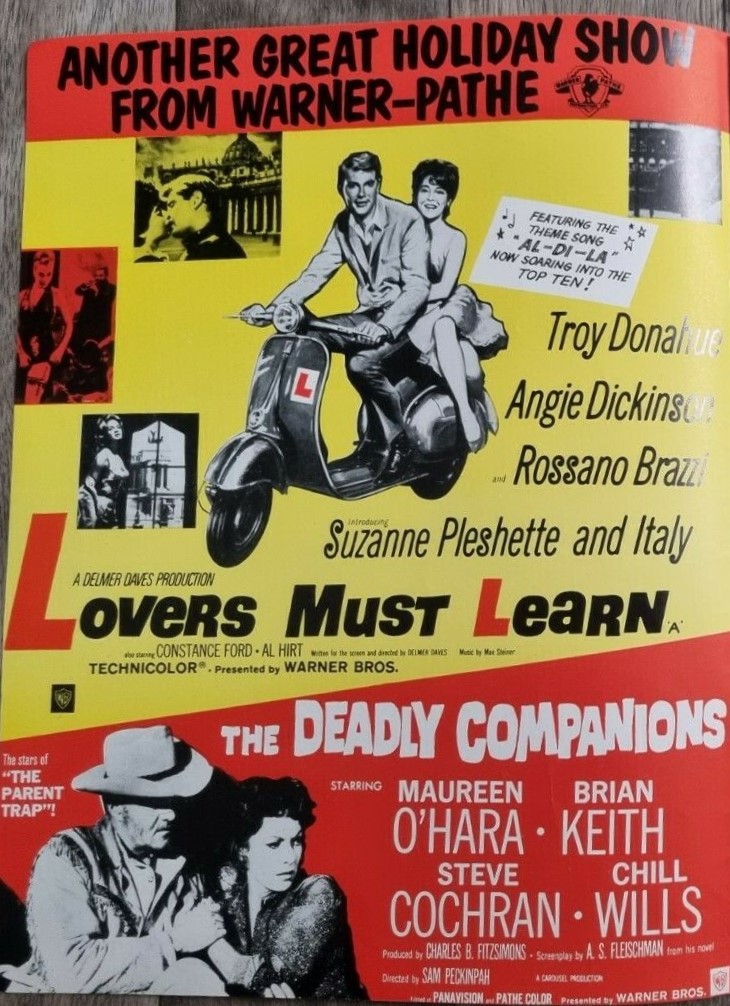
Re-titled in the U.K. and sent out with the most curious support.

Another decade and sex would most definitely be on the cards and the story would sink under an unplanned pregnancy or a fit of pique and scenes in a bedroom where they are separated by an open suitcase as one or other makes an effort to leave. But it’s the virginal aspects that makes this so sweet and for sure no director has managed to clear entire streets in usually heavily-congested tourist spots to deliver beautiful scenes in such scenic spots.

Actual drama might be light on the ground, but there’s no denying Delmer Daves knows how to apply pressure, this time on the woman, who can either treat romance as a  fleeting youthful episode or use it to launch big time into marriage and womanhood. Without a chaperone, unlike the hapless Albert, Prudence has only the example of her predatory employer who takes a male every season.

Just when the romance looks all set, back in Rome she catches Lyda and Don in a clinch and this sparks some good old verbal sparring between the two women as Lyda makes it very clear that Don is no virgin and that Prudence is out of her league.

You can guess how it will end. It’s as lightweight a confection as you will ever watch and yet it is worth watching because the director, close-up at the ready, scarcely gives Prudence a moment’s peace and if ever a director know how to gauge female intent and rely on eyes to express emotion it’s Daves.

Look beneath the façade of the travelogue and you find a woman trapped on the brink, that spark of independence misleading men into thinking she will surrender her virginity, and the woman not wanting to be another notch on a bedpost no matter if that fulfils the dual purpose of achieving womanhood. Daves’ name on the picture should be warning enough this isn’t quite your normal fluffy romance.

If you can ignore the sexism that dictates that a woman’s role is to “anchor” a man, turn his flightiness to one side and by some alchemy make him the best he can be, the narrative edges towards the independence of women, both Lyda and the bookshop owner pick and choose and sometimes abuse their men, and Prudence rejects romance on the rebound with Roberto.

But, of course, if that’s all you want, and you don’t want to hover near consequence, then writer-director Daves delivers a seamless concoction. If there’s an old-fashioned conceit to the whole thing, it’s perhaps because the source material, Lovers Must Learn, was written three decades before and preceded the likes of The Group in presenting a young woman as independent rather than merely yearning for marriage and motherhood.

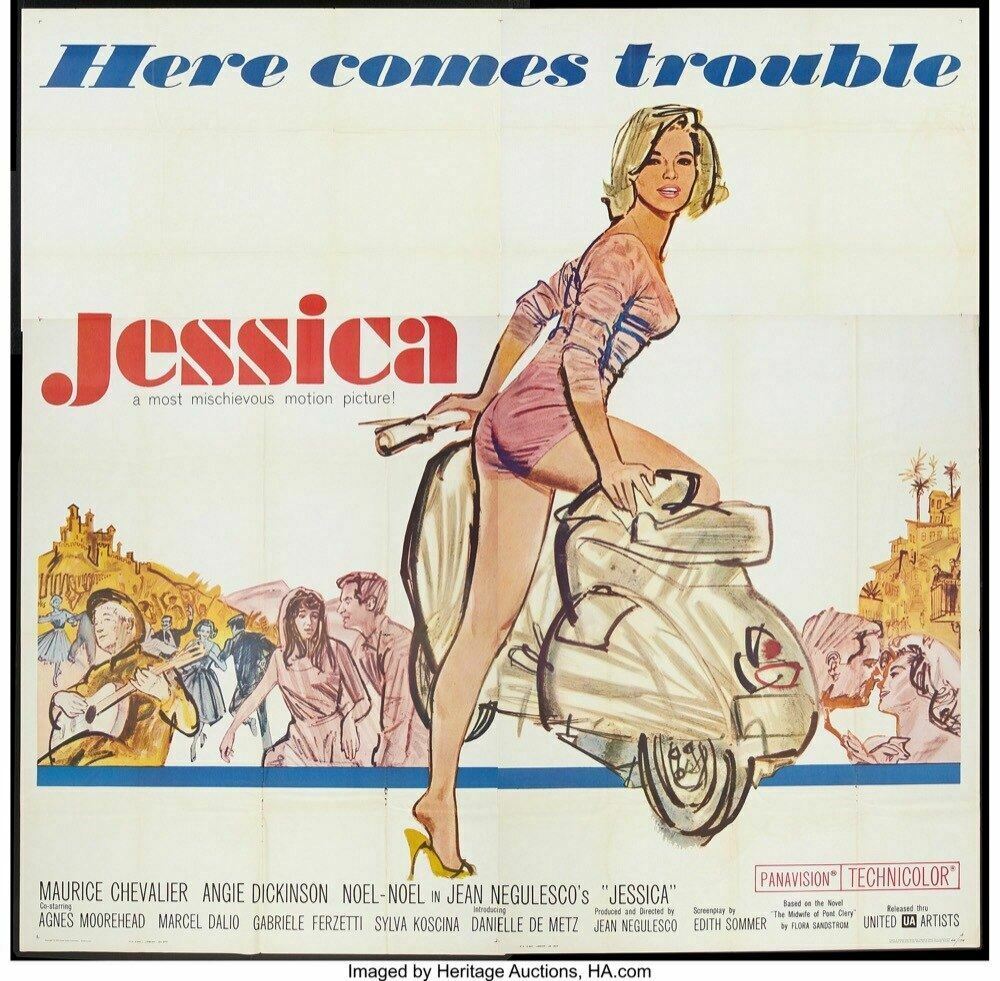
It seems odd for Angie Dickinson to be relegated to the supporting cast but possibly having already done her Vespa-riding number in Jessica (1962) she preferred a stab at a more mature role, though she had already gone down that route in The Sins of Rachel Cade (1962). Maybe she upset someone in the studio. Maybe her role was bigger but ended up on the cutting room floor when Daves realized the talent he had uncovered in Suzanne Pleshette (A Rage To Live, 1965).

Daves worked again with Rossano Brazzi on the director’s final picture The Battle of the Villa Florita (1965) and Pleshette had a short-lived marriage with Troy Donohue.  
All-Time Top 40

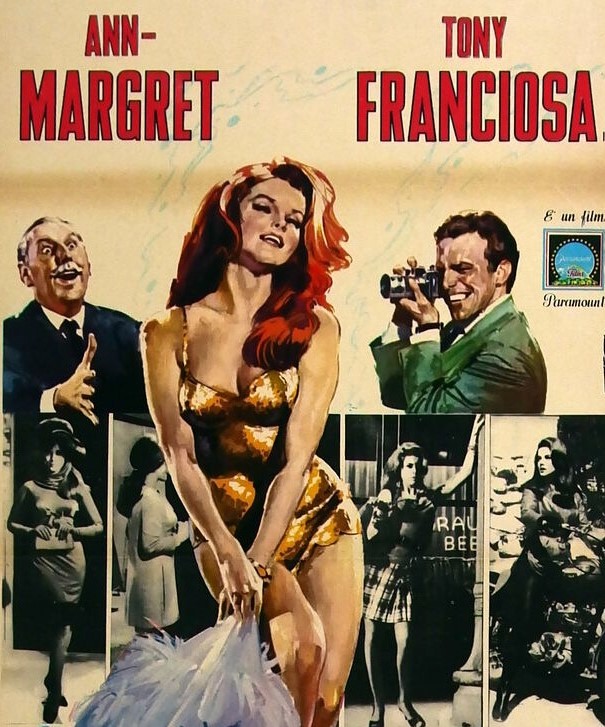
It’s Angie Dickinson vs Ann-Margret at the top of the All-Time Top 40. The two female stars take four of the top seven spots with Ann-Margret’s The Swinger replacing at the top long-time favorite The Secret Ways. These two have been duking it out over the past year, in which time the top spot has changed hands four times, with Jessica and Once Upon a Time in the West also taking a turn in the premier position. It’s also noticeable that women are top-billed in seven of the pictures in the Top Ten.

I started this Blog three years ago in June. Last year it was being read in 120 countries but that’s now gone up to 182 (out of the 193 recognized by the United Nations plus the Vatican state and the State of Palestine). Reviews have also increased and I’m now approaching 7,000 views a month, so thanks to you all.

I’ve been doing an Annual Top 40 since I started so this is the third iteration of that idea based on those reviews – out of the 900-plus posted so far – which have attracted the most attention over the three-year period. This isn’t my choice of the top films in the Blog, but yours, my loyal readers. The chart covers the films viewed the most times since the Blog began, from June 1, 2020 to July 31, 2023. (Yeah, it should have been May 31, but I’ve been remiss.)

  1. (7) The Swinger (1966). Ann-Margret struts her stuff as a magazine journalist trying to persuade Tony Franciosa she is as sexy as the characters she has written about.
  2. (-) Once Upon A Time in the West (1968). Rated the top western of all time, Sergio Leone’s operatic epic with Claudia Cardinale, Henry Fonda and Charles Bronson and the astonishing Ennio Morricone score.
  3. (2) Jessica (1962). Innocently gorgeous widow Angie Dickinson finds her looks turn so many male heads in a small Italian town that the female population seek revenge.
  4. (5) Fraulein Doktor (1969). Suzy Kendall in the best role of her career as a sexy German spy in World War One.
  5. (-) Stagecoach (1966). Ann-Margret, Alex Cord and Bing Crosby in decent remake of classic John Ford western.
  6. (1) The Secret Ways (1961).  Richard Widmark exudes menace in this adaptation of an early Alistair MacLean spy thriller set in Hungary during the Cold War. Senta Berger  has a small role.
  7. (-) The Sins of Rachel Cade (1961). Angie Dickinson as a missionary who falls in love with Peter Finch in war-torn Africa.
  8. (-) Gerry Anderson’s Fireball XL5. Colorized version of the famed sci fi television show.
  9. (11) Moment to Moment (1966). Hitchcockian-style thriller with Jean Seberg caught up in  murder plot in the French Riviera. Also features Honor Blackman.
  10. (3) Ocean’s 11 (1960). In the Rat Pack debut Frank Sinatra, Dean Martin, Sammy Davis Jr. et al plan an audacious Las Vegas robbery. 
  11. (17) Can Heironymous Merkin Ever Forget Mercy Humpe and Find True Happiness? (1969). Off-the-wall musical awash with nudity and Fellini-esque cavorting, directed by star Anthony Newley. Has to be seen to be believed. Joan Collins pops up. 
  12. (4) Pharoah(1966). Priests battle kings in Polish epic set in ancient Egypt. Fabulous to look at and thoughtful.
  13. (-) Sisters (1969). French drama bordering on the incestuous starring Nathalie Delon and Susan Strasberg.
  14. (-) Vendetta for the Saint (1969). Feature length version of the television show sees Roger Moore and Rosemary Dexter battling the Mafia in Sicily.
  15. (6) The Golden Claws of the Cat Girl (1968). Cult French movie starring Daniele Gaubert as a sexy cat burglar.
  16. (-) Baby Love (1969). Orphan Linda Hayden finds herself in a predatory middle-class London household.
  17. (-) Pendulum (1969). The under-rated George Peppard as a cop accused of murdering cheating wife Jean Seberg.
  18. (-) Lady in Cement (1969). Frank Sinatra reprises private eye Tony Rome as he tangles with Raquel Welch.
  19. (15) Subterfuge (1968). C.I.A. operative Gene Barry hunts an M.I.5 mole in London. Intrigue all round with Joan Collins supplying the romance and a scene-stealing Suzanna Leigh as a villain.
  20. (-) Plane (2023). Gerard Butler goes Die Hard as stranded pilot outwitting terrorists on a remote Pacific island.
  21. (18) Pressure Point (1962). Prison psychiatrist Sidney Poitier must help racist Nazi Bobby Darin.
  22. (31) Fade In (1968). Long-lost modern western with Burt Reynolds serenading low-level movie executive Barbara Loden whose company is actually filming Terence Stamp picture Blue.
  23. (16) A House Is Not a Home (1965). Biopic of notorious madam Polly Adler (played by Shelley Winters) who rubbed shoulders with the cream of Prohibition gangsters.
  24. (19) Deadlier than the Male (1967).  Richard Johnson as Bulldog Drummond is led a merry dance by spear-gun-toting Elke Sommer and Sylva Koscina in outlandish thriller.
  25. (-) The Girl on a Motorcycle (1968). Marianne Faithful dons – and slips out of – leathers in erotic drama with Alain Delon.
  26. (-) Some Girls Do (1969). Daliah Lavi and Beba Loncar get tough with Bulldog Drummond in sequel to Deadlier than the Male.
  27. (-) Beat Girl / Wild for Kicks (1960). London teenager heads for shady Soho. Starts out in milk bars, ends up in strip clubs.
  28. (-) Sodom and Gomorrah (1962). Robert Aldrich biblical epic sees Stewart Granger giving way to temptation in the infamous locale.
  29. (-) A Dandy in Aspic (1968). Director Anthony Mann died during shooting of spy picture so star Laurence Harvey took over. Mia Farrow co-stars.
  30. (-) The Brotherhood (1968). Martin Ritt’s Pre-Godfather take on the Mafia starring Kirk Douglas and Alex Cord as duelling brothers.
  31. (23) Once a Thief (1965). Ann-Margret (again)  is a revelation in crime drama with ex-con Alain Delon coerced into a robbery despite trying to go straight. Supporting cast boasts Jack Palance, Van Heflin and Jeff Corey. . 
  32. (-) Uptight (1968). Jules Dassin remake of John Ford classic The Informer set among black revolutionaries.
  33. (9)  A Place for Lovers (1969). Faye Dunaway andMarcello Mastroianni in doomed love affair directed by Vittorio De Sica.
  34. (-) The Misfits (1961). Stunning last hurrah for Marilyn Monroe and Clark Gable in John Huston tale of ageing cowboys.
  35. (-) Father Stu (2022). Biopic of boxer-turned-priest with Mark Wahlberg and Mel Gibson.
  36. (-) Blonde (2022). Andrew Dominik’s controversial take on the life of Marilyn Monroe with Ana de Armas.
  37. (12) 4 for Texas (1963). Frank Sinatra and Dean Martin face off in a Robert Aldrich western featuring Ursula Andress and Anita Ekberg with Charles Bronson in a smaller part.
  38. (-) Istanbul Express (1968). Gene Barry, John Saxon and Senta Berger involved in nefarious dealings on the other famous trans-European express.
  39. (33) P.J./New Face in Hell (1968). Private eye George Peppard is duped by shady millionaire Raymond Burr and mistress Gayle Hunnicutt in murder mystery.
  40. (10) The Venetian Affair (1966). Robert Vaughn hits his acting stride as a former C.I.A. operative turned journalist investigating suicide bombings in Venice. Great supporting cast includes Elke Sommer and Boris Karloff.

Dropping out of the Top 40

The surge of new entrants and other films attracting a vast new audience has meant some previous favorites tumble out of the Annual Top 40. (Previous year’s position shown in brackets).

(8) It’s Not All Rock’n’Roll (2020).  Ageing rocker Dave Doughman aims to mix a career with being a father in this fascinating documentary

(13) Age of Consent (1969). Helen Mirren stars as the nubile muse of jaded painter James Mason returning to his Australian roots.

(14) The Double Man (1967). Yul Brynner chases his doppelganger in the Swiss Alps with Britt Ekland adding a touch of glamour.

(20) Valley of Gwangi (1969). Special effects genius Ray Harryhausen the star here as James Franciscus and Gila Golen encounter prehistoric monsters in a forbidden valley.

(21) The Naked Runner (1967). With his son held hostage, Frank Sinatra is forced to carry out an assassination in east Germany.

(22) Orgy of the Dead (1965). Bearing the Ed Wood imprint, mad monster mash-up with the naked dead.

(24) The Sicilian Clan (1969). Stunning caper with thief Alain Delon and Mafia chief Jean Gabin teaming up for audacious jewel heist with cop Lino Ventura on their trail. French thriller directed by Henri Verneuil. Great score by Ennio Morricone.

(25) Dark of the Sun / The Mercenaries (1968). More diamonds at stake as Rod Taylor leads a gang of mercenaries into war-torn Congo.  Jim Brown, Yvette Mimieux and Kenneth More co-star. Based on the Wilbur Smith bestseller

(26) Stiletto (1969). Mafia hitman Alex Cord pursued by tough cop Patrick O’Neal. Britt Ekland as the treacherous girlfriend heads a supporting cast including Roy Scheider, Barbara McNair and Joseph Wiseman.

(27) Maroc 7 (1967). Yet more jewel skullduggery with Gene Barry infiltrating a gang of thieves in Morocco who use the cover of a fashion shoot. Top female cast comprises Elsa Martinelli, Cyd Charisse, Tracy Reed and Alexandra Stewart.

(28) The Rock (1996). Former inmate Sean Connery breaks into Alcatraz with Nicolas Cage to prevent mad general Ed Harris blowing up San Francisco. Michael Bay over-the-top thriller with blistering pace.

(29) The Swimmer (1968). Burt Lancaster’s life falls apart as he swims pool-by-pool across the county. Superlative performance. 

(30) Hour of the Gun (1967). James Garner as a ruthless Wyatt Earp and Jason Robards as Doc Holliday in John Sturges’ realistic re-telling of events after the Gunfight at the O.K. Corral.

(32) Dr Syn Alias the Scarecrow (1963). The British movie version of Disney American television mini-series sees Patrick McGoohan as a Robin Hood-type character assisting local smugglers.

(34) Sol Madrid/The Heroin Gang (1968). In his second top-billed role David MacCallum drags hooker Stella Stevens to Mexico to capture drugs kingpin Telly Savalas.

(35) A Twist of Sand (1968). Diamonds again. Smugglers Richard Johnson and Jeremy Kemp hunt long-lost jewels in Africa. Honor Blackman is along for the voyage.

(36) Genghis Khan (1965). Omar Sharif plays the legendary warlord who unites warring Mongol tribes. Stellar cast includes Stephen Boyd, James Mason, Francoise Dorleac, Eli Wallach, Telly Savalas and Robert Morley.

(37) Interlude (1968).Bittersweet romance between famed conductor Oskar Wener and young reporter Barbara Ferris.

(38) Woman of Straw (1964). Sean Connery tangles with Gina Lollobrigida in tangled tale of the killing of wealthy uncle Ralph Richardson.

(39) Bedtime Story (1964). Marlon Brando and David Niven are rival seducers on the Riviera targeting wealthy women.

Behind the Scenes: “Man’s Favorite Sport” (1963)

Should have been, as you might have guessed, Cary Grant (Charade, 1963) in the lead. Should have featured, which you won’t have guessed, Ursula Andress (She, 1965). Should have run, which you’d be amazed to learn, for 145 minutes, almost as long as your standard epic. Should have appeared, like Hatari! (1962), under the Paramount banner.

In fact, the most likely studio destination was Columbia. Hawks’s agent Charles Feldman had  spent 16 months trying to thrash out a very good deal for his client. Feldman, who owned the rights to Casino Royale, was also keen on Hawks directing a James Bond picture. That got as far as discussing Cary Grant as the handsome spy and Hawks’ enlisting the aid of his favorite screenwriter Leigh Brackett (Hatari!).

But instead of moving studios, Hawks decided to stay put, sitting on a three-picture deal worth a hefty $200,000 plus a 50 per cent profit share. First item on the new agenda could have been reuniting Rio Bravo (1959) alumni John Wayne and Dean Martin for The Yukon Trail. But that was before Hawks expressed interest in a romantic short story, The Girl Who Almost Got Away, published in Cosmopolitan magazine, and an ideal fit for Cary Grant.

But Grant, something of the entrepreneur himself, would only sign up if Hawks in turn agreed to direct one of the actor’s pet projects, The Great Sebastian. But the director didn’t like the idea of being a gun for hire and Grant’s attention meanwhile had wandered in the direction of Charade. Rock Hudson, borrowed from Universal, was seen as an ideal replacement. For the female lead Hawks initially enthused about Joanna Moore (Walk on the Wild Side, 1962) until he chanced upon Paula Prentiss (Where the Boys Are, 1960), an MGM contract player.

Paramount balked at a relative unknown. Hawks balked at anyone balking at his choice and switched the project to Universal. While toying with Casino Royale, Hawks had a sneak preview of Dr No (1962) and espied a natural for the second female lead in Ursula Andress. But her management team reckoned the Bond movie would open bigger doors. Instead, Hawks plumped for Austrian blonde Maria Perschy (The Password Is Courage, 1962). Charlene Holt (If A Man Answers, 1962) made such an impression on Hawks that she not only won the part of Rock Hudson’s fiancée but the role of regular girlfriend to the director and parts in his next two pictures.

Leigh Brackett  was brought in to pep up the original script by John Fenton Murray (It’s Only Money, 1962) and Steve McNeil (Red Line 7000, 1965). Unusually, she was rewriting on the hoof, earning $1,000 a week to refashion the lines scene by scene as production unfolded. Everything except the opening scene set in San Francisco was shot on the Universal backlot. Even then, neither Hudson nor Prentiss was transported to San Francisco, their close-ups while driving cars filmed at the studio and inserted as process shots. Hawks didn’t leave the studio either, entrusting that initial footage to associate producer Paul Helmick and cinematographer Russell Harlan.

Like Otto Preminger, Hawks liked a lot of takes. Paula Prentiss didn’t, in part because she felt he was trying to mold her into a screwball comedy heroine of the past, and in part because every take not printed impinged on her confidence. Although Hawks lacked the reputation as a bully of the Otto Preminger variety, nonetheless the inexperienced Prentiss found herself in tears more than once. Cary Grant dropped by one time for a friendly chat. He was made welcome. Angie Dickinson, expecting a similar welcome, received a curt put-down, Hawks making it clear he preferred as a brunette.

While the credit sequence by photographer Don Ornitz was deemed sexist since it comprised 33 models in sports or beach gear, it was actually the opposite because the women were proving how superlative they could be at sports generally considered the preserve of men. But there was no doubt the reaction Hawks expected when he spent $20,000 on black scuba outfits for Prentiss and Perschy, using molds made from their bodies to achieve the skin-tight effect. Hawks was notoriously slow, the picture taking three and a half months.

The initial version of the film attracted at a sneak preview the most positive responses the studio had ever received. The only problem was – it ran 145 minutes, considered an impossible length for a light romantic comedy. Although the next version was shorter, the audience response was decidedly worse. Even so, Universal insisted on further cuts until the movie came in at the two-hour-mark.

Not everyone went along with the official Hawks version of events. Others remembered the response to the various cuts not being so different. The film wasn’t released until six months later and there is no evidence that Hawks fought hard to retain his edit. Although he would later complain that the movie was “sabotaged,” that may have been his automatic default position once the movie proved a relative commercial failure, with only $2.35 million in U.S. rentals

Leigh Brackett had more right to feel disgruntled. She was denied a credit by the Writers Guild of America who contended her work was a polish rather than an original contribution.

I have to say I’m out of step with some of the critical opinion. Molly Haskell reckoned the film was actually some kind of Adam and Eve deal with Hudson “a virgin who has written a how-to book on sex while harbouring a deep fastidious horror of it.” The Haskin critique allows that fish are phallic symbols, therefore giving sexual credence to the scene about learning to handle a fish.

It might just be more straightforward to say that, of course, this isn’t as good as Bringing Up Baby but then, nothing ever was, and just enjoy what Hawks did manage to conjure up with very likeable leads.

SOURCES: Todd McCarthy, Howard Hawks, The Grey Fox of Hollywood (Grove Press, 1997), p595-603; Joseph McBride (editor), Focus on Howard Hawks (Englewood Cliffs); Molly Haskell, “Howard Hawks: Masculine Feminine,” Film Comment, March-April 1974.  

The Art of Love (1965) ****

Priceless. Effortless comedy from the same director, Norman Jewison, as Send Me No Flowers (1964) but minus the box office powerhouses of Doris Day and Rock Hudson and perhaps it’s their absence that makes this work so much better. Or perhaps you get more comedic leeway in Paris. Although the scripts were written by different people, I sense a directorial insistence that the supporting characters are believable, not just there to oil the plot.

The story here is fraud, penniless artist Paul (Dick Van Dyke) faking his own death to give his paintings the necessary burst of publicity to make them hot items. Except he doesn’t fake his death. He dives into the Seine to save a drowning girl Nikki (Elke Sommer) and his buddy Casey (James Garner), a wannabe writer for whom Paul is a meal ticket, and who you would have to say was instrumental in suggesting such a scam, assumes he has committed suicide.

Paul goes along with the scheme for as long as it takes art dealer Zorgus (Roger C. Carmel) to make a killing (no pun intended) from his paintings. Nikki ends up a housemaid at a risqué nightclub (though it being Paris what other kind is there) run by Madame Coco (Ethel Merman) where, coincidentally, heavily disguised, Paul hides out. Meanwhile, in the final piece of the complication jigsaw, Paul’s fiancée Laurie (Angie Dickinson), turns up. A bit like the lecherous friend in Send Me no Flowers, Casey knows how to make the most of the opportunity to give a potential widow a shoulder to cry on. “How can you make a play for this girl?” he asks his reflection, but she’s too gorgeous for qualms.

You can pretty much guess where it will go from here.

It works so well because none of the principals is permitted to milk their roles (though Van Dyke can’t resist making a meal out of a sneeze) and the supporting cast drive it along with selfish action. Dick Van Dyke (Divorce American Style, 1967) has none of his usual zaniness or limbs that refuse to obey orders. James Garner, though in part cloning his character from The Americanization of Emily (1964), plays it as drama. Elke Sommer (The Venetian Affair, 1966) is the best I’ve seen her, no longer the pouting sexpot but a girl-next-door from the suburbs fallen on hard times. Angie Dickinson (Jessica, 1962), further down the billing than I’d expect, has to play it for drama, almost the foil for Casey’s seductive tendencies.

There are some superb running gags. Paul is furious to find a red-headed woman in the bed of flat-mate Casey. But, sight gag number one, it belongs to a mannequin. The wig, sight gag number two, is used to disguise Paul. Casey gets ride of the mannequin by stuffing it into a furnace only it doesn’t fit so he has to saw off its legs and is discovered from above by a waiter, sight gag number three, who naturally thinks he is sawing a woman in half. (I always think the beauty of a good comedy is that you can see the gag coming and you still laugh.) That gag has even more miles to run.

The supporting cast, as I said, are all given just delicious lines. Paul and Nikki, soaking wet, are saved by a passing barge. Paul hangs out her clothes to dry. When the naked woman in the wheelhouse calls for her clothes, the barge skipper, enjoying the prurient scene, implores,  “Don’t give her her clothes back.” And when, after a row, that allows her to leave the barge, the skipper whines, “I told you not to give her her clothes back.”

. “I don’t want you to think I came for the rent you owe,” says Casey’s landlord. “What did you come for,” asks Casey. “The rent you owe, but I didn’t want you to think it.” The landlord’s wife comforts the grieving Casey (at this point he thinks Paul is actually dead) with some chicken soup. Casey admits the suicide was his idea. The woman snatches back her soup.

Having put Nikki on a bus, Paul, handing over few coins, asks the driver to keep an eye on her. Comes the reply, “I would whether you pay me or not.”

Sure, Ethel Merman (There’s No Business Like Show Business, 1954) gets to sing. Audiences expected that. But that’s understandable. What a voice. When you wonder why Ann-Margret wasn’t given more opportunity to sing in proper musicals, this is the answer. She lacks the voice of an Ethel Merman, Julie Andrews or Barbra Streisand.

The sly screenplay was concocted by Richard Alan Simmons (Della, 1965), William Sackheim (First Blood, 1982) and Carl Reiner, who had written for both Dick Van Dyke (his eponymous television show) and James Garner (The Thrill of It All, 1963).

The stars play proper roles, not just one-note characters driven by plot. Doesn’t take much to work out where it’s going all right but that doesn’t lessen the enjoyment of the journey.

I always wondered why, after making his name in comedy, Norman Jewison was selected for more serious works like The Cincinnati Kid (1965) or In the Heat of the Night (1967), but when you see the care he takes with each character, far more than standard directors in the fun genre, how he carefully builds the narrative, you do tend to agree he’s wasted in comedy.

A pure delight.

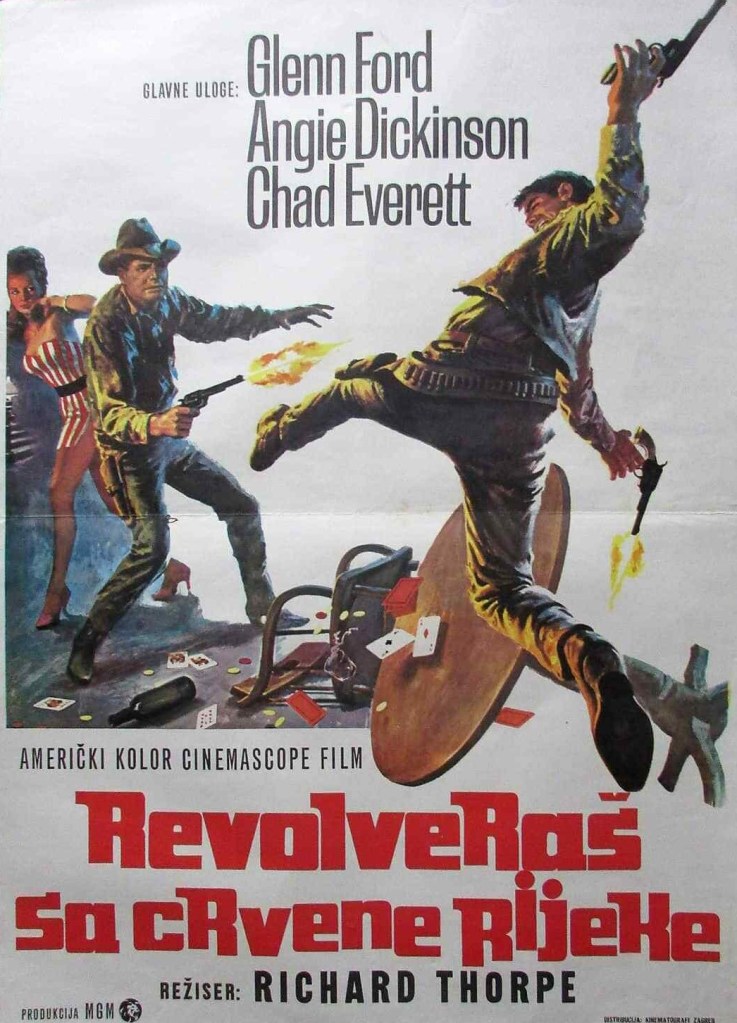
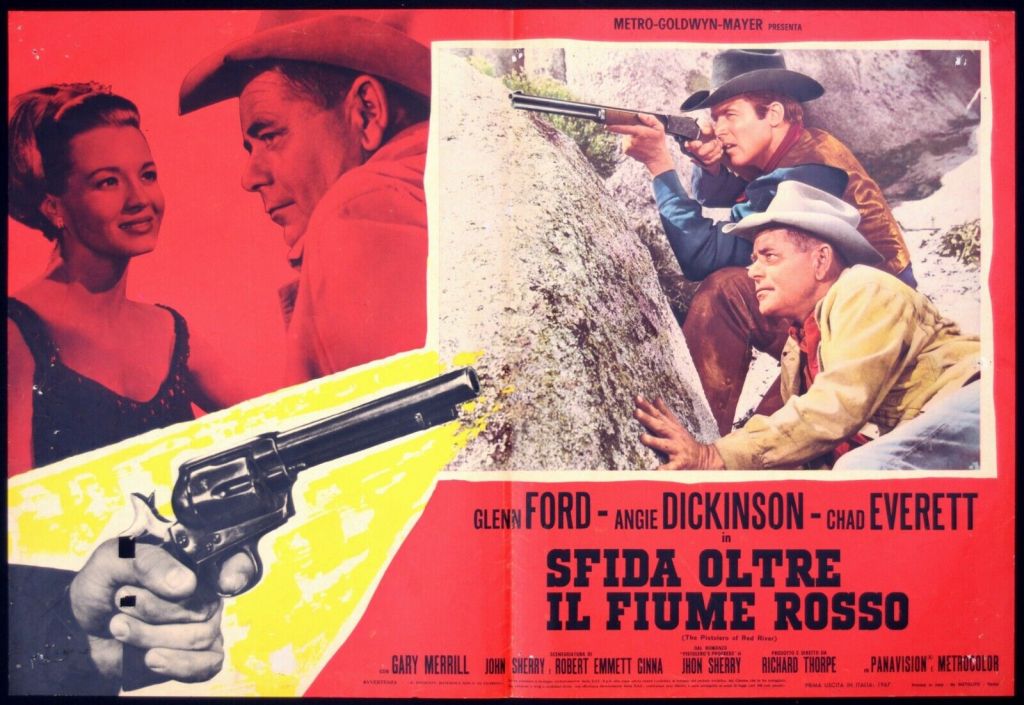
The Pistolero of Red River / The Last Challenge (1967) ****

A little gem. Mature, thoughtful, cleverly structured. Plays with expectations. Another assured performance from Glenn Ford (Rage, 1966) with Angie Dickinson (Jessica, 1962) permitted a character of considerably more complexity than normal.

Quite an unusual set-up. Marshal Blaine (Glenn Ford) is an ex-convict, his paramour Lisa (Angie Dickinson) is the local madam. Both are pretty much accepted in this small western town. Some hypocrisy comes Lisa’s way – her money acceptable to a storekeeper who out of earshot refers to her as white trash – but generally the townspeople are happy with an ex-gunslinger as lawman.

But he’s not your standard lawman. He’s very easy-going, not spending all is time upholding the law or out hunting varmints, and she’s not your typical madam either, mothers her employees, keeps unwanted men at a distance, and has made enough money for a fine rig and fancy clothes.

Blaine is sensible but ruthless, taking tough action to prevent a young kid getting into trouble with a dangerous gunman, but having no compunction about shooting the gunslinger. He’s not out for an easy life, but my he does enjoy it, though on a slack day finds fishing more fun than rolling in the hay with Lisa. She knows she has made a good catch, her friend still getting knocked about by her husband, and although Blaine doesn’t seem the marrying kind she has notions of having a baby.

But out fishing Blaine frees a villain Ernest (Jack Elam) who has upset the local Indians. Since they shared a cell way back, Ernest sees Blaine as an easy touch and when told where to go on that score fingers to blackmail Lisa. Meanwhile, this turns out to be an eventful fishing trip. Blaine buddies up with a stranger, Lot (Chad Everett), they fish, cook and drink whisky together until the newcomer reveals he’s on a mission to kill the lawman and take his title of fastest gunman in the southwest.

So you can see where this is headed. Except it doesn’t take that route. Because Lisa, worried that the youngster might well be faster on the draw, hires Ernest to kill him. And when that backfires, it’s only a matter of time before Blaine finds out and you wonder what that’s going to do to their relationship.

There’s some standard stuff, a poker cheat for example, but there’s a lot more going on. Blaine’s young deputy, mostly left to do the chores, tries to throw his weight around with the gunman only to end up with egg on his face. There’s an Native American in jail who we never see and a subplot involving his colleagues that looks like it’s headed in the direction of standard western confrontation until that notion is cleverly nipped away from under the audience’s feet.

Given credence by the worried Lisa is the idea that Blaine is coming to the end of the trail and it’s a testament to the direction that the tension lasts as long as it does. The promotional material gives out that the youngster is a tearaway threatening to shoot up the town, but that’s far from the truth, Blaine trying to talk him out of such rashness while at the same time seeing the boy as a reflection of his younger self.

There’s some brilliant dialog. “Of all the people ain’t worth saving,” Blaine tells Ernest, “you’re the first that comes to mind.” At their first meeting, Lot asks Blaine, “Where’s your tin star?” Retorts Blaine, “You better never see it on me.” As they part, Lot says, “We’ll be meeting again.” Replies Blaine, without aggression, “If that’s the way you want it.”

But there’s quite a lot that’s missed out. There’s no scene of Lisa hiring Ernest, just that he ambushes Lot. The jailed Native American is, as I mentioned, off-camera. There’s none of the usual massive build-up towards a showdown. And even as the shootout approaches, Lisa still doesn’t trust in Blaine’s skill and plans to shoot Lot herself.

That betrayal comes as a helluva shock. When has any lawman’s moll lacked such faith? As for Lot, gunslinging is all that he lives for, the measure of himself, and there’s a purity about him as he rejects countless offers of whisky and women even as he knows he’s making a terrible bed to lie in.

This was very much ahead of its time, especially in thwarting audience expectation not just in the representation of character but in the narrative. It proved a fine last hurrah for veteran Hollywood director Richard Thorpe (The Truth about Spring, 1965). Robert Emmett Gina (Before Winter Comes, 1968) wrote the screenplay based on the John Sherry novel.

As it happened, I watched this back-to-back with Rage so ended with an even better appreciation of Glenn Ford’s talent but was also very taken with Angie Dickinson for the way her character twisted and turned as she attempted to create the outcome she desired. Definitely worth a watch.

Year End Round-Up 2022: Top 30 Films Chosen By You

As is by now traditional (well, it’s the second full year) this isn’t my choice of the top films of the year, but yours, my loyal readers. This is a chart of the films viewed the most times over full calendar year of January 2022 – December 2022.

  1. Jessica (1962). Angie Dickinson plays a young widow who turns so many heads in a small Italian town that their wives seek revenge. The film had debuted at No 30 in the previous year’s chart so showed remarkable staying power.
  2. Once Upon a Time in the West (1969). Sergio Leone’s masterpiece now acclaimed as the greatest western ever made. Top class cast – Claudia Cardinale, Charles Bronson, Henry Fonda and Jason Robards – and one of the greatest scores ever written courtesy of Ennio Morricone.
  3. The Swinger (1966). Ann-Margret sparkles as author reinventing herself by writing a sex novel.
  4. Fraulein Doktor (1969). Suzy Kendall as German spy outwitting the British during World War One.
  5. Can Heironymus Merkin Ever Forget Mercy Humpe and Find True Happiness? (1969). Fellini-esque musical with abundant nudity as writer-director-star Anthony Newley tries to unravel the meaning of life.
  6. Father Stu (2022). Under-rated biopic with Mark Wahlberg as unlikely priest.
  7. Blonde (2022). Andrew Dominik’s controversial reimagining of the life of Marilyn Monroe with Ana de Armas
  8. For a Few Dollars More (1965).Sergio Leone re-teams with Clint Eastwood in the second in the spaghetti western trilogy with Lee Van Cleef as a rival bounty hunter.
  9. A Place for Lovers (1968). Faye Dunaway and Marcello Mastroianni in Vittorio De Sica doomed romance.
  10. Fade In (1968). Burt Reynolds disowned this romance filmed against the backdrop of making the Terence Stamp western Blue but it’s better than he thinks.
  11. The Secret Ways (1961). Richard Widmark in spy thriller set in Hungary during the Cold War and adapted from the Alistair MacLean novel. Senta Berger has a small role. Top film for 2021, so demonstrating the ongoing popularity of films based on the author’s works.
  12. The Sisters (1969). Complicated menage a trois that borders on the semi-incestuous starring Nathalie Delon and Susan Strasberg.
  13. Pharoah (1966). Epic Polish picture about political shenanigans in ancient Egypt. Another film with legs – it was No 3 in the 2021 annual chart.
  14. Water Gate Bridge / Battle at Lake Changjin II (2022). Another epic, non-stop action from the Chinese point-of-view in a sequel to one of the most famous battles of the Korean War.
  15. Harlow (1965). Carroll Baker as the blonde bombshell who rocketed to fame in 1930s Hollywood.
  16. Baby Love (1969). Morality tale as orphaned Linda Hayden tries to fit into an upper-class London household.
  17. Moment to Moment (1966). Hitchockian thriller set in the South of France with adulterous Jean Seberg suspected of killing her lover.
  18. Secret Ceremony (1968). Elizabeth Taylor, Mia Farrow and Robert Mitchum in atmospheric Joseph Losey drama.
  19. Lady in Cement (1969). Gangster’s moll Raquel Welch steals the show in Frank Sinatra’s second outing as private eye Tony Rome.
  20. Subterfuge (1968). Suzanna Leigh steals the show as a sadistic henchwoman trying to prevent Gene Barry uncovering a mole in M.I.5.
  21. P.J. / New Face in Hell (1967). George Peppard taken to the cleaners as down-on-his luck private eye.
  22. The Golden Claws of the Cat Girl (1968). Cult French movie  starring Daniele Gaubert as a sexy cat burglar. This was No 6 last year.
  23. The Gray Man (2022). Spectacular Netflix misfire with Ryan Gosling and Chris Evans as rival assassins and Ana de Armas adding some spice.
  24. The Brotherhood (1968). Martin Ritt Mafia drama sees siblings Kirk Douglas and Alex Cord falling out.   
  25. Some Girls Do (1969). Richard Johnson returns as Bulldog Drummond battling archvillains Daliah Lavi and Beba Loncar.  
  26. Pressure Point (1962). Prison psychiatrist Sidney Poitier treats racist patient Bobby Darin. Very unusual imagery.
  27. The Double Man (1967). C.I.A. operative Yul Brynner battles Russian espionage in Switzerland with Britt Ekland providing the glamor.
  28. Operation Mincemeat (2022). Re-telling of “The Man Who Never Was” World War Two plot that duped Hitler over Sicilian invasion plans.
  29. Orgy for the Dead (1965). Bizarre cult horror tale where most of the female characters appear to be auditioning for a nudie film.
  30. Texas Across the River (1966).  Alain Delon acts against type in Dean Martin comedy western.

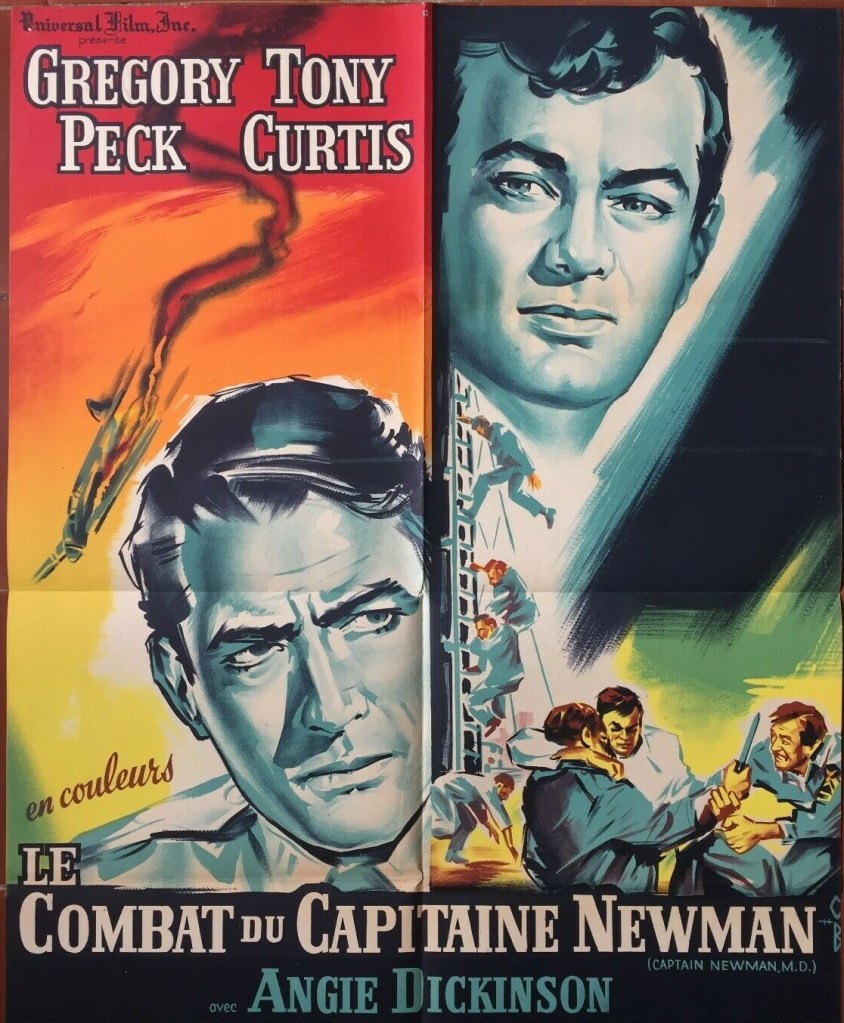
Captain Newman M.D. (1963) ****

Somewhat lost in the rush to acclaim star Gregory Peck for his Oscar-winning To Kill a Mockingbird (1962), this bold attempt to tackle mental illness among the armed forces deserves reassessment.

Set towards the end of World War Two, psychiatrist Captain Newman (Gregory Peck) heads up a unit addressing the previously ignored mental health issues of U.S. airmen. One of the first to identify post- traumatic stress disorder, Newman employs a whole raft of unusual techniques such as allowing his clients to tend sheep. And he’s not above using romantic sleight-of-hand to woo Lt. Corum (Angie Dickinson), a nurse in a non-psychiatric department, to join his team. Orderly Corporal Leibowitz (Tony Curtis), more of a con artist than a medical professional, is the other key member of the team.

As you might expect, Newman has to battle superiors to allow him to even attempt to cure any of the men under his care since in standard armed forces opinion they are really just cowards trying to duck out of their duty. Given there’s no prescribed treatment for his clientele, Newman basically improvises on a case-by-case basis to get to the heart of what caused mental collapse.

While the movie motors along nicely on the interplay between these three characters – the potential for real romance between Newman and Corum and Newman’s acceptance of Leibowitz’s alternative, more down-to-earth and decidedly un-medical approach – it focuses on three critical cases. Col Bliss (Eddie Albert) suffers from split personality, Capt Winston (Robert Duvall) is catatonic and Corporal Tompkins (Bobby Darin) too bubbly by far.

In dealing with each, Newman adopts a different persona, occasionally entering into the make-believe world of his clients to expose how much of a fiction they are. Stern with some, he is gentle with others and when he appears to go over the score explains he is not shouting at a person but at his symptoms.   

And while at time it feels like a mental equivalent of episodes of a hospital soap, the underlying drive, the knowledge that men are hiding from the horrors of war or endure guilt over action they may have taken or are unable to face the consequence of orders they carried out takes this into a different level. Almost all suffer from the standard conviction that they must be cowards. Newman’s task is to make all face up to their fears.

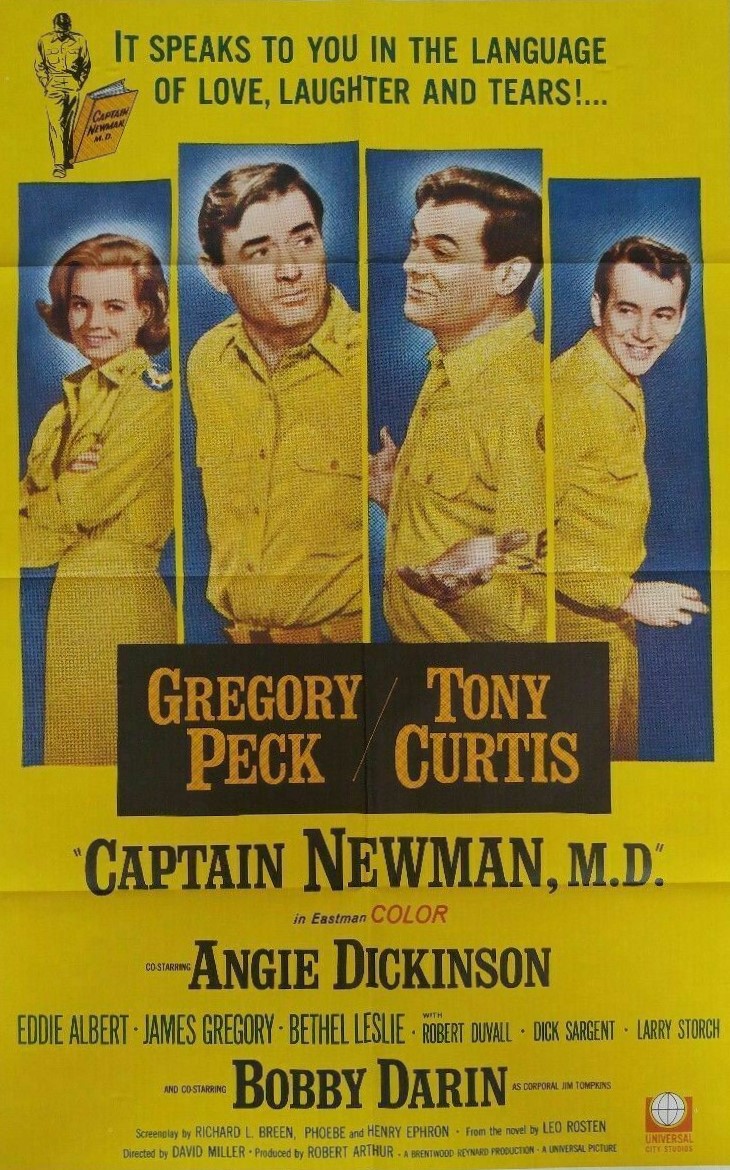
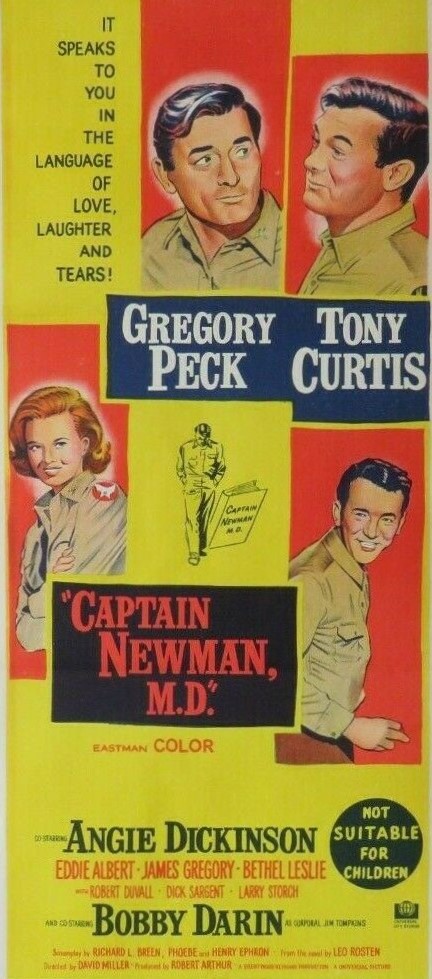
Presumably to overcome fears of audience resistance to the downbeat subject matter, the U.S. poster plain misled the public – “love, laughter and tears” were not much in evidence.

And it’s Corum’s self-appointed job to get under Newman’s skin and in so doing get to the heart of the terrible irony of his role. If he fails and men are discharged without being cured they will be returned to their units while mentally unstable and make decisions that could endanger thousands of men. If he succeeds, he sends men back to face potential death.

Luckily, it’s far from dour. Instead of taking the audience down a medical jargon rabbit-hole, the movie sensibly concentrates of character and humanity. It is filled with brilliant dialogue and whenever Newman appears overwhelmed up pops Leibowitz like the self-appointed class clown to bring events to a cheerier conclusion. Up till the end – a Xmas show by inmates and the arrival of a bunch of Italian POWs – the movie steers well clear of sentimentality and delivers a lucid exploration of the effects of war on the human psyche.

Gregory Peck (Mirage, 1965) is outstanding, not just from the way he adapts his character to suit the situation, but because quite a lot of his role is just to react to what is being said. Most stars would run a mile from being on the receiving end of chunks of dialog and insist on altering the script to make them appear more dynamic. Unlike Atticus Finch who is convinced he can find a solution, Newman knows his detection skills are very basic.

Tony Curtis (The Boston Strangler, 1968) might appear as if inhabiting a custom-made role suited to his natural effervescence and charm, but this is a deeper character than initially  seems the case and rather than ride along and enjoy himself he has spells of challenging Newman’s authority. It’s a more subdued role for Angie Dickinson (Jessica, 1962), too, but she also brings a level of seriousness to the part and is integral to the picture’s success.

Bobby Darin (Pressure Point, 1962) was Oscar-nominated but I found his acting over-the-top. Eddie Albert (Green Acres television series 1965-1971) and Robert Duvall (To Kill a Mockingbird), in particular, were more assured. Look out for James Gregory (The Secret War of Harry Frigg, 1968) and former child star Jane Withers.

David Miller (Hammerhead, 1968) strikes the correct tone, leavening the seriousness with humor, but not avoiding the deeper issues. In their final screenplay assignment Henry and Phoebe Ephron (Carousel, 1956), parents of Nora Ephron (When Harry Met Sally, 1989), teamed with Richard L. Breen (A Man Could Get Killed, 1966) for an intelligent screenplay based on the bestseller by Leo Rosten.

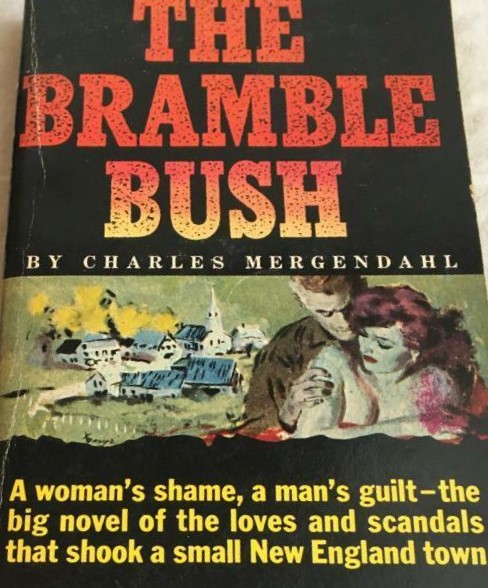
Book into Film: “The Bramble Bush” (1960)

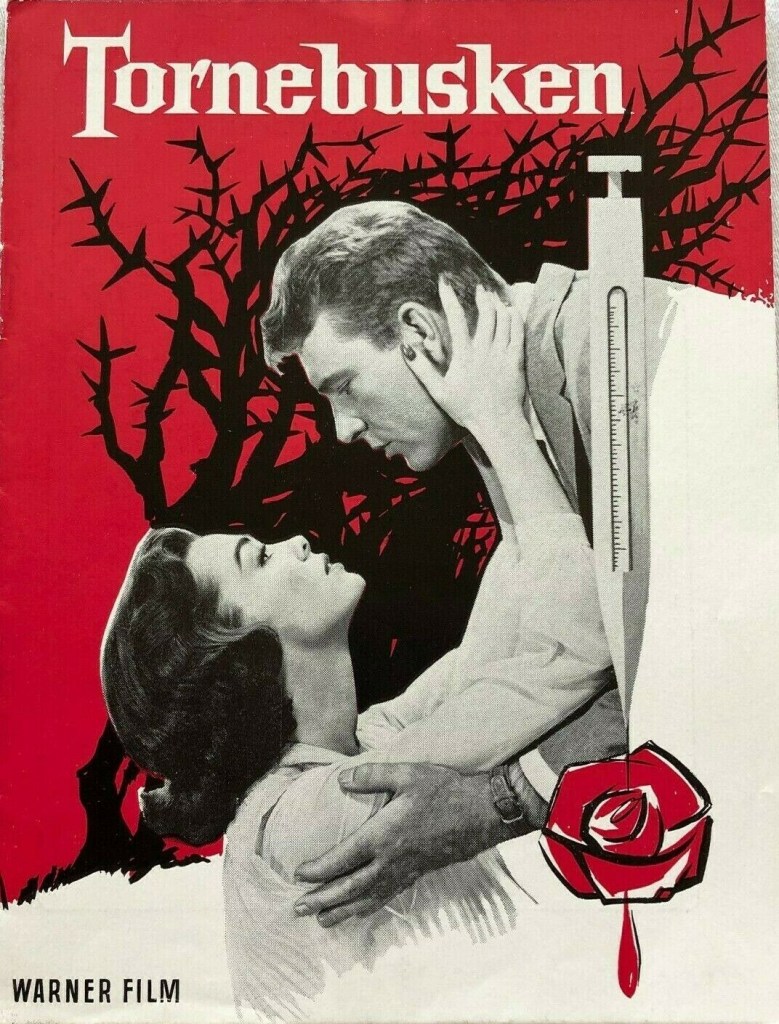
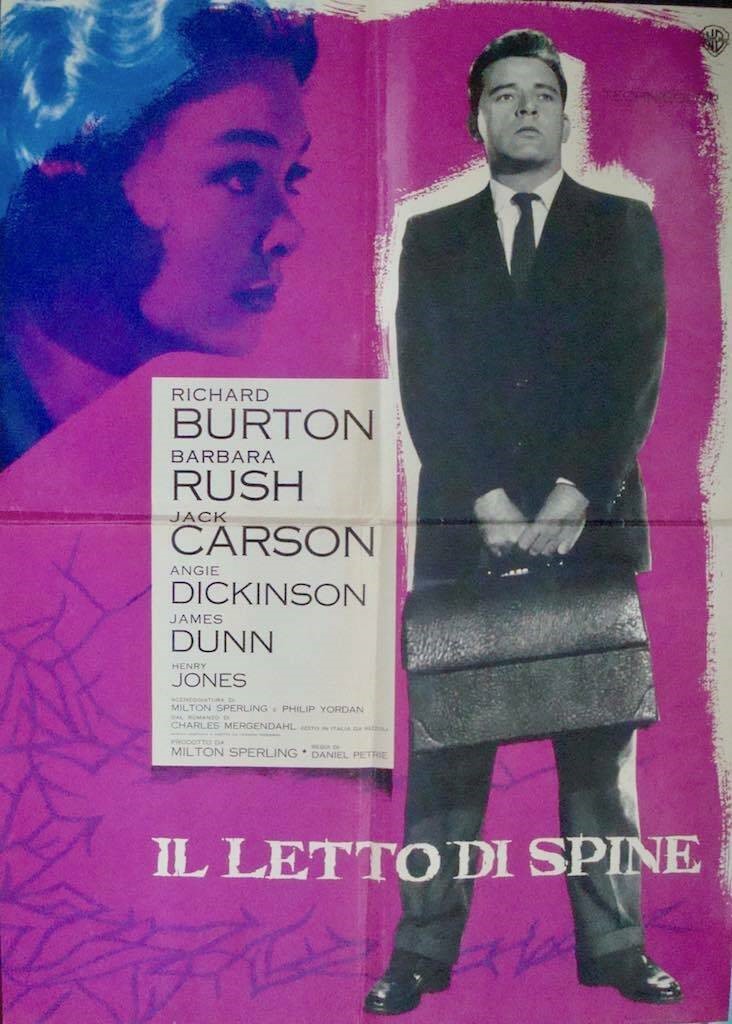
Few novels have been as abruptly shorn as Charles Mergendahl’s massive bestseller – seven million copies sold – The Bramble Bush. The last quarter of the original story was just dumped. For screenwriters seeking to heighten every emotion this was a very strange decision for it is in the last section that the book delivers huge dramatic punch.

The film – SPOILER ALERT – ends with Guy (played in the film by Richard Burton) judged not guilty of the murder of dying best friend Larry. Guy’s one-night stand with Larry’s wife Margaret (Barbara Rush) has made her pregnant but now widowed she leaves him on the grounds that he will be unable to live with what he has done. It’s a sad enough ending but it’s nothing compared to the book.

The trial section takes place three-quarters of the way through the novel. In the film, it is placed much closer to the end so there are only five minutes or so to tidy up in a rather ho-hum manner, nothing highly dramatic, no floods of tears, just Margaret leaving him behind.  

Following the trial in the book, however, Margaret’s departure is much more sudden. There is no goodbye. She just vanishes. While judged innocent of murder, Guy has lost his license to practice so in the absence of professional commitments is free to spend months hunting for her. And find her he does.

The dramatic point you would have thought would be simply whether she can ever accept as a lover the man who has injected her husband with a fatal dose of morphine regardless of whether this was done with the best of intentions and could be construed as a mercy killing. But the author isn’t finished with these characters yet. Yes, they are reconciled and in fact get married.

But it’s too late. Margaret has tuberculosis – a considerably more dangerous condition in those days than now, and in some cases as untreatable as the incurable Hodgkin’s Disease that afflicted her husband. That puts both her life and that of her unborn child in danger. Guy faces another dilemma, just as he did with her husband. If he has to choose, whose life would he want to save.

The baby is born, and both survive. But only for the time being. Margaret’s TB has not abated. Since Guy’s license has by now been restored, they return to the town. But he’s in for a shock. The town is outraged. The public which had stoutly defended him and the jury which had set him free now turn against both, aware through the arrival of the child that they must have had an affair while the husband was still alive, which therefore clouds the issue of exactly why Guy committed euthanasia.

But before Guy can decide to move elsewhere and nurse his sickly wife and care for his newborn child – called Larry after the dead husband – Margaret dies.

That turns the book into a three-handkerchief tragedy that the film never was. Except for running time, you wonder why the screenwriters elected to miss all this out. Maybe the movie would have run over the two-hour mark, perhaps two hours fifteen minutes, but that would hardly make it so undesirable to exhibitors nor so offensive to the public given the ending was so much more dramatic.

Even then, the author isn’t finished. He provides an ironic ending The rejected Fran – dumped also by this point by Bert, Guy’s lawyer– determines that she will look after the child, allowing Guy to recover from his ordeal. And there is the hope – although she would not press her love for Guy on him – that in due course he will come to appreciate her and reciprocate her love.

Quite a different ending indeed from that foisted on moviegoers. Hard to say whether readers were disappointed, but when a novel is such a huge success it is generally because the public likes the story the author has devised. So to rob them of that seems extremely odd.

The novel had raced to the screen. The book was published in September 1958 and the film opened in February 1960, barely seventeen months later. When the gap between novel and movie is so short, it generates feverish public anticipation. And it seems almost perverse to deny the waiting audience the movie they expected.

Naturally, in the transition from book to screen there are other eliminations – and additions. And there is also the usual welter of changes made for no particular reason, for example the town of East Dereham becomes East Norton in the film.

Certainly, the aim of a movie being to heighten drama and combine disparate elements into a more cohesive whole, you can see why in the film it raises the stakes for the lawyer Bert Mosley (Jack Carson) to already be campaigning for district attorney rather than, as in the novel, only dreaming about it. Although both his parents are dead, Guy came from far more prosperous stock in the film than the book, the hospital named after his father in the film but not the novel.

Some of the changes must have seemed to create more drama, but I’m not so sure. What difference did it make whether it was Guy or the dying Larry (Tom Drake) to be the one returning home? In the film it’s Guy, in the book Larry. In the book Guy is kind to the town drunk Stew (James Dunn) but it’s the opposite in the book, hostile and physical abusive to him from the outset. In the book we learn why – Stew was Guy’s mother’s lover and their affair triggered the suicide of his father – from an internal monologue, but in the film this plays out in more dramatic fashion when Margaret confronts Guy about what she sees as his unfair treatment of the older man.

There’s an elimination that’s so shocking you can’t understand why it was left out by the screenwriters. In the book we discover that Stew is in fact Guy’s father, a fact ignored in the film. And in the last section of the book when Guy is tracking down Margaret in different towns he takes Stew’s surname as his own. And one core element of the film – Larry pushing Guy and Margaret together – is the screenwriters’ invention. (Perhaps audiences would view Guy in a lesser light if he simply took advantage of his friend’s illness to sleep with his wife). And to tie things up more neatly, it’s Guy in the film who prescribes sedatives for Margaret whereas in the book that’s not part of his role.

On the other hand Larry’s father Sam is hostile to Guy for reasons that are kept from us in the film – but in the book we find out it’s because Sam blames Guy’s father (also a doctor) for his wife dying in childbirth, an incident that caused him to lapse into the insanity mentioned in the trial scene in the film.

You can see why some elements of the book are not included. The creepy newspaperman Welk (Henry Jones) who blackmails Fran (Angie Dickinson) into posing nude for him later dupes his assistant into doing the same. Bert falls for a tough Boston reporter Sylvia for whom he quits town and dumps Fran.  On discovering she is pregnant by Guy, Margaret’s initial reaction is to seek an abortion. And there’s a section where hospital chief Dr Kelsey and Fran discuss the various ethical ways doctors have of letting exceptionally ill babies die.  The judge suggests to the jury that Guy could be acquitted due to temporary insanity. And there is a bunch of peripheral characters whose main purpose is to highlight the jealousies inherent in small-towns.

But there are two character turnarounds the screenwriters choose to ignore. The first is that the drink-sodden Stew becomes a recovering alcoholic after discovering he is a grandfather. The second is more touching. After Fran was rejected early on by Guy and later dumped by Bert she had resigned herself to a life of “doing terribly immoral things.” But the book ends with, as mentioned above, her taking a huge emotional leap by giving herself the task of nursing both motherless child and widowed father.

It’s always fascinating to see how screenwriters tee up a book for the big screen treatment, deciding what to leave in and what to take out, occasionally (as in Mirage, for example) using little more than the title and the original idea and jettisoning the rest. Of course, limitations may be imposed on the screenwriters of which we are unaware, star demands or budget impositions and other factors. Here, I felt that screenwriters Milton Sperling (also the producer) and Philip Yordan did not get the best out of the book.

The Bramble Bush (1960) ***

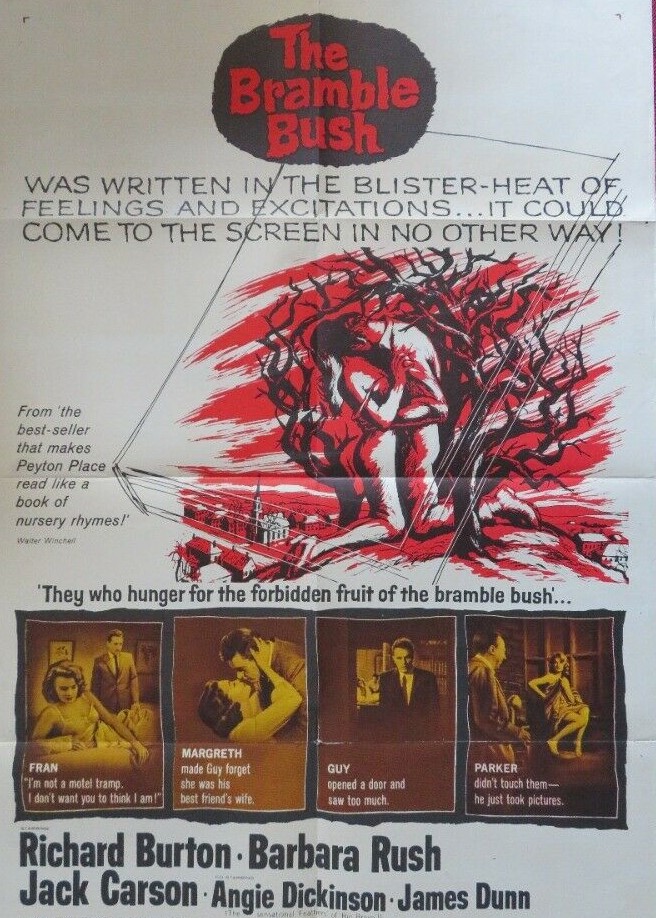
The secrecy business was working overtime in small-town America according to the Peyton Place template. And that wouldn’t be so bad here except returning big city doctor Guy (Richard Burton) has a few of his own in the locker but more importantly the unfolding of so many secrets detracts from the time available for the main dramatic premise which is an absolute corker.

We might as well account straight-off with the secret Guy drags around behind him like a two-ton weight thus explaining his general surliness, tight-lipped demeanor and occasional flashes of temper. As a twelve-year-old he told his father he had caught his mother in bed lover with Stew (James Dunn) which prompted his dad to chuck himself off a cliff.

The other big secret, dealt with fairly promptly, is that local nurse Fran (Angie Dickinson), who held a torch for Guy, now makes do with district attorney Bert (Jack Carson), that clandestine affair coming to light not so much in flagrante but in full beam when the illicit couple require treatment following a fire in a hotel bedroom.

The unravelling of both secrets impacts on Guy’s emotional state. The fire leads to Fran admitting her feelings to Guy, happy to have him use her for sex if love is not possible, “I love you so much I have no shame,” she proclaims, to no avail, but the hotel business also makes her fall prey to blackmail by local newshound Parker (Henry Jones), a budding amateur photographer of the unsavoury kind. Recounting his personal tragedy results in a Guy having a one-night stand with the married wannabe artist Margaret McFie (Barbara Rush).

But here’s the brilliant twist. Margaret’s husband Larry (Tom Drake) wants her to end up with Guy – but after his death. Larry, Guy’s best friend from childhood, is dying, the doctor scuttling back to a town that harbours too many bad memories in order to act as his personal physician. Larry’s never going to recover, he has the incurable illness Hodgkin’s Disease. His dying wish is that Guy marry Margaret.

Margaret is revolted by the idea, “I don’t want to be beautiful for anyone but Larry,” but unable to cope with his with illness is living on a cocktail of drink and drugs. And although Guy, who distrusts any woman, is similarly ill-inclined, Margaret becomes dependent on his medical ability, treating both husband and wife. Larry turns out to have another crazy idea – he wants Guy to kill him, medically speaking of course, some extra, illegal, doses of morphine would do the trick.

This incredible bucket list provides Guy with a huge dilemma, never mind what to do with Fran throwing herself at him and having to put up with the hypocritical Bert, and Stew, now the town drunk, begging for forgiveness, and Larry’s father Sam (Carl Benton Reid), who, for reasons unspecified, hates the doctor.  

There’s more twists to come, just in case you thought you had everything worked out. But you can see the problem over-complication creates. The euthanasia-please-have-sex-with-my-beautiful wife combination would have set the movie up nicely from the get-go. Guy wouldn’t need to have a deep secret to find himself in very deep waters. How he would react to either or both outcomes, how Margaret would equally react to the possibility of ending her husband’s suffering in a quick and painless manner, would be more than enough to provide the dynamic the picture required. The movie then pivots on Guy being charged with murder.

It’s certainly interesting enough but Guy is too buttoned-down to incur sympathy and his revelation, devastating though it is, doesn’t suddenly make him an instantly more attractive screen character. In fact, it’s Fran who elicits the greater sympathy, the woman bedding someone who views her only  as a sex object, yet willing to become a sex object for someone she does love if that’s all she can have. Eventually, the two key issues are put in the spotlight, which certainly puts a spark in the picture. But the poster promises a passion that just doesn’t exist.

Richard Burton (The Spy Who Came in from the Cold, 1965) plays this character in a lower register than his screen persona, the sonorous voice toned down, and although the look of someone who doesn’t want to be back rings true the performance lacks variety and there are only occasional glimpses of the fiery actor. Barbara Rush (Robin and the 7 Hoods, 1964) has her own legitimate reasons for being dispassionate and the vibrant character her husband married never really gets an airing. Angie Dickinson (Jessica, 1962) comes across as a more human character with, in emotional terms, a greater flaw, and a more tragic figure, even though there is nothing life-or-death about her circumstances. Two veterans are showcased: Jack Carson (Mildred Pierce, 1945) and James Dunn (Bad Girl, 1931).

Television director Daniel Petrie (A Raisin in the Sun, 1961) was making his movie debut. The screenwriting team of Milton Sperling and Philip Yordan (Battle of the Bulge, 1965) drew on the bestselling novel by Charles Mergendahl.

Hard to find DVD so Ebay is the best source.

All-Time Top 40

I started this Blog two years ago this month and to my astonished delight it is now read in over 120 countries. I am now well past over 500 reviews. So I thought you might be interested to know which of these reviews has attracted the most attention. This isn’t my choice of the top films in the Blog, but yours, my loyal readers. The chart covers the films viewed the most times since the Blog began, from June 1, 2020 to May 31, 2022.

  1. The Secret Ways (1961). Richard Widmark exudes menace in this adaptation of an early Alistair MacLean spy thriller set in Hungary during the Cold War. Senta Berger  has a small role.
  2. Jessica (1962). Innocently gorgeous widow Angie Dickinson finds her looks turn so many male heads in a small Italian town that the female population seeks revenge.
  3. Ocean’s 11 (1960). The Rat Pack makes its debut – Frank Sinatra, Dean Martin, Sammy Davis Jr. et al plan an audacious Las Vegas robbery. 
  4. Pharoah (1966). Priests battle kings in Polish epic set in ancient Egypt. Fabulous to look at and thoughtful.
  5. Fraulein Doktor (1969). Suzy Kendall in the best role of her career as a sexy German spy in World War One.
  6. The Golden Claws of the Cat Girl (1968). Cult French movie starring Daniele Gaubert as a sexy cat burglar.
  7. The Swinger (1966). Ann-Margret struts her stuff as a magazine journalist trying to persuade Tony Franciosca she is as sexy as the character she has written about.
  8. It’s Not All Rock’n’Roll (2020).  Ageing rocker Dave Doughman aims to mix a career with being a father in this fascinating documentary
  9. A Place for Lovers (1969). Faye Dunaway and Marcello Mastroianni in doomed love affair directed by Vittorio De Sica.
  10. The Venetian Affair (1966). Robert Vaughn hits his acting stride as a former CIA operative turned journalist investigating suicide bombings in Venice. Great supporting cast includes Elke Sommer and Boris Karloff.
  11. Moment to Moment (1966). Hitchcockian-style thriller with Jean Seberg caught up in  murder plot in the French Riviera. Also features Honor Blackman.
  12. 4 for Texas (1963). Frank Sinatra and Dean Martin face off in a Robert Aldrich western featuring Ursula Andress and Anita Ekberg with Charles Bronson in a smaller part.
  13. Age of Consent (1969). Helen Mirren stars as the nubile muse of jaded painter James Mason returning to his Australian roots.
  14. The Double Man (1967). Yul Brynner chases his doppelganger in the Swiss Alps with Britt Ekland adding a touch of glamour.
  15.  Subterfuge (1968). C.I.A. operative Gene Barry hunts an M.I.5 mole in London. Intrigue all round with Joan Collins supplying the romance and a scene-stealing Suzanna Leigh as a villain.
  16. A House Is Not a Home (1965). Biopic of notorious madam Polly Adler (played by Shelley Winters) who rubbed shoulders with the cream of Prohibition gangsters.
  17. Can Heironymous Merkin Ever Forget Mercy Humpe and Find True Happiness? (1969). Off-the-wall musical directed by star Anthony Newley that has to be seen to be believed. Joan Collins pops up. 
  18. Pressure Point (1962). Prison psychiatrist Sidney Poitier must help racist Nazi Bobby Darin.
  19. Deadlier than the Male (1967). Richard Johnson as Bulldog Drummond is led a merry dance by spear-gun-toting Elke Sommer and Sylva Koscina in outlandish thriller.
  20. Valley of Gwangi (1969). Special effects genius Ray Harryhausen the star here as James Franciscus and Gila Golen encounter prehistoric monsters in a forbidden valley.
  21. The Naked Runner (1967). With his son held hostage, Frank Sinatra is forced to carry out an assassination in East Germany.
  22. Orgy of the Dead (1965). Bearing the Ed Wood imprint, mad monster mash-up with the naked dead.
  23. Once a Thief (1965). Ann-Margret is a revelation in crime drama with ex-con Alain Delon coerced into a robbery despite trying to go straight. Supporting cast boasts Jack Palance, Van Heflin and Jeff Corey. 
  24. The Sicilian Clan (1969). Stunning caper with thief Alain Delon and Mafia chief Jean Gabin teaming up for audacious jewel heist with cop Lino Ventura on their trail. French thriller directed by Henri Verneuil. Great score by Ennio Morricone.
  25. Dark of the Sun / The Mercenaries (1968). More diamonds at stake as Rod Taylor leads a gang of mercenaries into war-torn Congo.  Jim Brown, Yvette Mimieux and Kenneth More co-star. Based on the Wilbur Smith bestseller
  26. Stiletto (1969). Mafia hitman Alex Cord pursued by tough cop Patrick O’Neal. Britt Ekland as the treacherous girlfriend heads a supporting cast including Roy Scheider, Barbara McNair and Joseph Wiseman.
  27. Maroc 7 (1967). Yet more jewel skullduggery with Gene Barry infiltrating a gang of thieves in Morocco who use the cover of a fashion shoot. Top female cast comprises Elsa Martinelli, Cyd Charisse, Tracy Reed and Alexandra Stewart.
  28. The Rock (1996). Former inmate Sean Connery breaks into Alcatraz with Nicolas Cage to prevent mad general Ed Harris blowing up San Francisco. Michael Bay over-the-top thriller with blistering pace.
  29. The Swimmer (1968). Burt Lancaster’s life falls apart as he swims pool-by-pool across the county. Superlative performance. 
  30. Hour of the Gun (1967). James Garner as a ruthless Wyatt Earp and Jason Robards as Doc Holliday in John Sturges’ realistic re-telling of events after the Gunfight at the O.K. Corral.
  31. Fade In (1968). Long-lost modern western with Burt Reynolds serenading low-level movie executive Barbara Loden whose company is actually filming Terence Stamp picture Blue.
  32. Dr Syn Alias the Scarecrow (1963). The British movie version of Disney American television mini-series sees Patrick McGoohan as a Robin Hood-type character assisting local smugglers.
  33. P.J./New Face in Hell (1968). Private eye George Peppard is duped by shady millionaire Raymond Burr and mistress Gayle Hunnicutt in murder mystery.
  34. Sol Madrid/The Heroin Gang (1968). In his second top-billed role David MacCallum drags hooker Stella Stevens to Mexico to capture drugs kingpin Telly Savalas.
  35. A Twist of Sand (1968). Diamonds again. Smugglers Richard Johnson and Jeremy Kemp hunt long-lost jewels in Africa. Honor Blackman is along for the voyage.
  36. Genghis Khan (1965). Omar Sharif plays the legendary warlord who unites warring Mongol tribes. Stellar cast includes Stephen Boyd, James Mason, Francoise Dorleac, Eli Wallach, Telly Savalas and Robert Morley.
  37. Interlude (1968). Bittersweet romance between famed conductor Oskar Wener and young reporter Barbara Ferris.
  38. Woman of Straw (1964). Sean Connery tangles with Gina Lollobrigida in lurid tale of murder and inheritance.
  39. Bedtime Story (1964). Marlon Brando and David Niven are rival seducers on the Riviera targeting wealthy women.
  40. Sisters (1969). Intrigue, adultery and incest haunt Nathalie Delon and Susan Strasberg as they try to recapture the innocence of the past.
Discover WordPress

A daily selection of the best content published on WordPress, collected for you by humans who love to read.

The Atavist Magazine

by Brian Hannan

WordPress.com News

The latest news on WordPress.com and the WordPress community.