Books by Brian Hannan – “Coming Back to a Theater Near You, A History of the Hollywood Reissue 1914-2014”

Two subjects dominate Covid-ridden Hollywood – the abject lack of new releases and the role of old films in keeping the movie pipeline flowing. 

Films like Inception (2010), Hocus Pocus (1993), Jurassic Park (1993), The Nightmare Before Xmas (1993) and Star Wars Episode V – The Empire Strikes Back (1980) among a host of others have come to the rescue of beleaguered exhibitors.

But this is not the first time that old films saved Hollywood. Reissues have been doing this trick for over a century. I wrote a 480-page book about it called Coming Back to a Theater Near You: A History of the Hollywood Reissue 1914-2014 (McFarland 2016) and since the subject was ripe for discussion I was invited to become the sole guest on a hour-long podcast by Pete Turner of Oxford Brookes University.

The average price paid by television for movies by 1966 was $350,000-$400,000 so the $2million ponied up by ABC Television for two showings set by far a new high mark. the film made more again from television when put on the auction block again. ABC made a profit of $1 million when Ford paid $3 million to be the sole sponsor. the network and the sponsor were suitably reward when the television screening netted a record 60 million viewers.

The golden age of the reissue came in the 1960s – the true starting point being 1964 – and therefore is very relevant to this blog.

But re-releases had been part of the Hollywood landscape since 1914 and for the same reason as now – a shortage of product. At that time exhibitors scrambled to show again older films from the two dominant stars of the era – Mary Pickford and Chaplin. For the next half-century, whenever production slumped, cinema owners turned to old films. But re-releases were a battleground between studios and exhibitors. Studios complained that each rental of an old film took away revenue that should be accruing to a new picture. Even so, there was no avoiding the need to use older films to fill out programs during years of production crisis such as the arrival of sound and especially the late 1940s and early 1950s.

But by the early 1960s with television eager to devour whatever old films were available, it seemed that the days of older movies generating any decent revenue were over. Ironically enough, it was television that hastened in a new attitude to reissues. The amount of money television was willing to pay for films depended on their box office on initial release. This issue became tricky when attempting to assess the demand for films that had been big in their day like Oscar-winner Bridge on the River Kwai (1957). Television argued that interest in seeing the film on television would not be high and that should be reflected in the price it was willing to pay. Columbia begged to differ.

To prove its point, in 1964 Columbia reissued the film. It became after Gone with the Wind the second-biggest reissue of all time, generating $2.19 million in rentals (what the studio receives once exhibitors have taken their cut) which placed the film in 32nd spit in the annual box office rankings -ahead of such star-laden vehicles are The Fall of the Roman Empire with Sophia Loren and Alec Guinness, Circus World with John Wayne and Frank Sinatra and Dean Martin in Robin and the Seven Hoods. But the icing on the cake was the sum now offered by the networks – a record $2 million. That set a precedent for blockbusters like The Ten Commandments (1956) and The Longest Day (1962) to press the reissue button later in the decade prior to a television sale.

The success of Goldfinger (1964) had exhibitors crying out for repeat showings of the first two bonds. demand was such that United Artists were able to demand 60% of the box office – an extraordinary amount for a reissue. Only Mary Poppins, the Sound of Music, Goldfinger and My Fair Lady beat the combo at that year’s box office.

But the 1960s reissue bonanza was just beginning. In 1965 the double bill of Dr No (1962)/From Russia with Love (1963) ranked fifth in that’s year’s annual box office rankings. From then on the release of every new James Bond picture was marked by a reissue double bill. The same held true of the Pink Panthers, the Matt Helm series and the Clint Eastwood westerns. The Oscars also provided a new reissue bonus. After Sidney Poitier won the Oscar for Lilies of the Field (1963), that poorly performing picture went out again with the Oscar-nominated Hud (1963). Columbia repeated the successful format by doubling up Oscar-bait Cat Ballou (1965) and Ship of Fools (1965) both starring Lee Marvin.

Horror specialist American International surprisingly snapped up the reissue rights. It was originally shown with subtitles as a way of the censors trying to prevent cinemagoers more intent on the lascivious than artistic merit attending. It was dubbed into English for the reissue to make it more easily accessible and also to make it more attractive to television.

It was soon open season on reissues – Lili (1953) starring Leslie Caron, Bayou (1957) now renamed Poor White Trash, the dubbed version of La Dolce Vita (1960) and the serial compendium An Evening with Batman and Robin were among the disparate successes jumping on the re-release bandwagon. Originally a flop Bonnie and Clyde (1967) only became a success when it was reissued in 1968. Disney, which had brought back its animated features on a regular basis, now turned to its live-action portfolio, cleaning up with re-runs of Swiss Family Robinson (1960) and In Search of the Castaways (1962).

Alfred Hitchcock became reissue royalty with highly profitable re-releases of Psycho (1960) and North by Northwest (1959) and double bills Marnie (1964)/The Birds (1963) and Vertigo (1958)/To Catch a Thief (1955). After box office powerhouse Who’s Afraid of Virginia Woolf (1960), two previous Elizabeth Taylor plums Butterfield 8 (1960)/Cat on a Hot Tin Roof (1958) hit reissue box office gold. There were also unsung heroes like One Million Years B.C (1966) with Raquel Welch and Steve McQueen-Faye Dunaway romantic thriller The Thomas Crown Affair (1968). Despite being readily available on television, Humphrey Bogart and Greta Garbo oldies played in a repertory system in arthouses while MGM launched its “Perpetual Product Plan” which saw a season of older favorites like Nelson Eddy-Jeanette MacDonald musicals playing once a week for six-to-eight-weeks.

But the decade’s biggest re-run accolades were reserved for the 70mm version of Gone with the Wind (1939). Already seen earlier in the decade in 1961 where it notched up $6million in rentals, the revamped version played in roadshow for over a year before hitting the general release trail and in total generated the phenomenal $35 million in rentals.

As my book shows, the reissue story did not end there. It simply opened the floodgates. The launch of the Director’s Cut and the restoration of lost classics like Metropolis (1927) and Abel Gance’s Napoleon (1927) took the reissue business down a different commercial route while 3D and Imax would not have shown such commercial potential except for the reissues in those formats of films like The Wizard of Oz (1939)and Titanic (1997) not forgetting the current trend for sing-a-long revivals and films shown with an accompanying live orchestra.

Here’s the link to the podcast: https://anchor.fm/pete-turner9/episodes/The-HOMER-Network-podcast-episode-2-emmrcp
In the News – August 1960

CLEOPATRA VERSION ONE

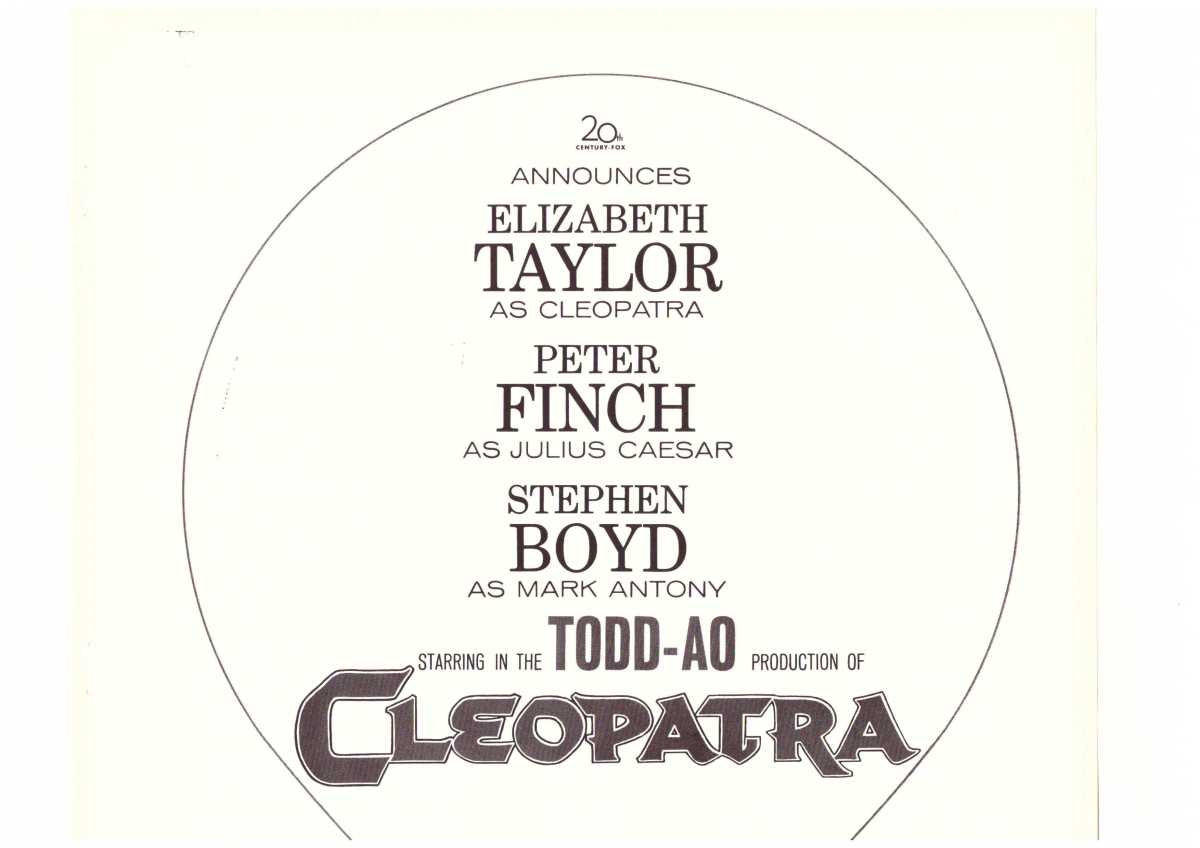
Producer Walter Wanger headed for Britain to oversee the start of production for Twentieth Century Fox’s Cleopatra. Before the movie was bogged down in illness and budget scandals, Elizabeth Taylor’s co-stars in this initial version were Stephen Boyd, fresh from Ben-Hur, and Peter Finch.  Wanger was mulling over taking the production to Egypt where he also intended to film the adaptation of Lawrence Durrell’s Justine. Rouben Mamoulian was the director of Cleopatra. Durrell had written the screenplay for this version. Fox was promising the movie would be on screens in June 1961. Joseph L. Mankiewicz, at this point down as writer of Justine, would later end up in charge of Cleopatra version two with Richard Burton and Rex Harrison replacing Boyd and Finch.

HITCHCOCK FESTIVAL

Although Alfred Hitchcock Festivals would become one of the major reissue talking points of the 1980s and while Rebecca (1940) had been successfully revived in the 1950s, the director’s first major commercial – as opposed to arthouse – retrospective was in the planning stage courtesy of David O. Selznick. He had in mind a rotating double bill based around three features to which he owned the rights – Spellbound (1945) with Ingrid Bergman and Gregory Peck, Notorious (1946) with Bergman and Cary Grant and The Paradine Case (1947) with Peck and Ann Todd. The project would be marketed as an “Alfred Hitchcock Festival.” Interest in the director was at all-time high after the double whammy of the previous year’s North by Northwest and current box office sensation Psycho. The fact that all three movies had already been shown on television was not seen as a deterrent. Selznick aimed to use as a promotional tool that moviegoers could see the pictures without irritating commercial breaks and on a much larger screen than television would afford.

IN THE PIPELINE

Montezuma was scheduled as Kirk Douglas’s follow-up to Spartacus with a budget in excess of the $12 million spent on the slave revolt epic. John Huston would pen the script and director. Douglas would play Cortez with Marlon Brando being wooed for the title role… Darryl F. Zanuck was setting up The Day Christ Died based on the Jim bishop bestseller in competition to George Stevens’ planned The Greatest Story Ever Told… Steve McQueen was planning to make The Captain under his own production company with Henry Fonda and Ernest Borgnine playing major parts… In fact, only The Day Christ Died ever saw light of day and  then only as a television film in 1980.  

IN OTHER NEWS

Critic Bosley Crowther declared war on subtitles, an unusual move for a writer long considered a purist where foreign movies were concerned…Pope John XXIII ordered a permanent projection room with air conditioning to be installed in the Vatican on the third floor of the Apostolic Palace because he liked movies more than his predecessor…La Dolce Vita was the top grossing film of the 1959-1960 Italian season with $1.125 million, well ahead of the closest runner-up Some Like it Hot with $725,000…Universal ordered a record fifty 70mm prints for SpartacusCharlton Heston was announced as El Cid for the forthcoming Samuel Bronston production…John Wayne held a sneak preview of The Alamo at the 900-seat Aladdin theater in Denver on August 5 with Can-Can kicked off the screen for the night…U.S. movie receipts were up for the first time in five years with the week of July 30 1960  the best since August 4 1956…In Britain, Hercules broke records in 36 of the 39 cinemas in its initial playoff.

SOURCES: “Wanger to Britain as Cleopatra and Justine Both May Shoot in Egypt,” Variety, Aug 3, 1960, p3; “Selznick Plotting Hitchcock Festival,” Variety, Aug 10, 1960, 7; “Kirk Douglas Outlines Plans for Mexican Biopic on Montezuma’s Life,” Variety, Aug 3, 1960, 4; “Zanuck Signs Gallico to Write The Day Christ Died,” Variety, Aug 10, 1960, 10; “Reisner-McQueen- Elkins Co-produce Captain,” Variety, Aug 17, 1960, 4; “Crowther’s Subtitles Must Go Stirs Trades, Uh-Huh but on the Other hand,” Variety, Aug 17, 1960, 4; “Vatican Getting Its Own Projection Room,” Variety, Aug 13, 1960, 13; “Italo Film in sharp Upbeat at ’59-’60 B.O.,” Variety, Aug 24, 1960, 11; “UI’s Big 70M Print Order for Spartacus,” Variety, Aug 24, 1960, 13; advertisement, El Cid, Variety, Aug 3, 1960, 16; “Wayne Sneaks Alamo,” Variety, Aug 10, 1960, 5; “Pictures $82,831,000 Take for Week Jul 30 Best Since Aug 4 1956,” Variety, Aug 10, 1960, 3; “Hercules Sets 36 New House Records out of 39 Spots in England,” Variety, Aug 10, 1960, 10.

The “Psycho” Revolution

It wasn’t just that Alfred Hitchcock broke all the rules in Psycho, turning horror on its head with the shower scene, introducing themes like mother-fixation and cross-dressing and delivering the first bona fide serial killer to American audiences.

He also took on the exhibition business by insisting that nobody was allowed into theaters after the film had started.

This went completely against the way films were normally shown. Patrons were accustomed to entering a movie theater whenever they liked, be it beginning, middle or end and then staying on till they came to the section they had seen before. Hitchcock was effectively calling an end to this practice.

Exhibitors were so used to customers going to the movies as a matter of course, as a regular habit, that few cinemas outside of arthouses and those in city centers even bothered to list start times. Although tacitly endorsed by exhibitors, this system was a menace to business since there was no way of knowing how many people were likely to vacate their seats at any given time and the fact that they did so intermittently interrupted the viewing of those still watching the picture.

Exhibitors were already investigating new methods of keeping their customers, including setting up their own production companies and buying up old films to present as reissues to make up for the shortage of new movies.

The Psycho “see it from the beginning” gimmick was initially viewed as exactly that – a gimmick. But when customers obliged without any particular fuss, standing patiently in line in the lobby or outside while one show vacated, this seemed to many indicative of a change in audience perspective. Many exhibitors wanted to take advantage of the potential to change moviegoing habits.  

“A new concept in motion picture promotion – building appreciation of the merchandise by customers – is being undertaken by segments of the industry,” said Hy Hollinger in Variety. “The idea involves a revolutionary change in the presentation of films in theaters with the industry engaging in a vast educational campaign to indoctrinate the public.”

“The public must be taught to accept starting times,” became a mantra. A more orderly approach would lead to greater appreciation of the films being screened. For once, America wanted to follow the Europe. A system of fixed schedules operated in Europe.

There were already “significant signs that the public prefer to see pictures from the beginning.” Exhibitors had registered more telephone calls asking about start times and more tickets were being sold just prior to the film beginning.

The Psycho sensation had kicked off another experiment. The film was being shown in New York nabes concurrent with its ninth week in first run at the DeMille and Baronet theaters in Manhattan. Usually, films were clear of first run commitments before launching on the circuits.   

And there were yet other changes afoot. Two circuits in New York – Loews and Century – had shifted back the start time of the main feature from 10pm by an hour or more, in the case of Century to a fixed 8.40pm which allowed moviegoers to get home in time for the eleven o’clock news. New York also led the way in combining first run in big Broadway houses with a concurrent booking in an eastside arthouse – Sons and Lovers (the only genuine arthouse offering), Psycho and Portrait in Black among those benefitting from the practice.

In addition, Psycho was considered responsible for another psychological phenomenon. It was asserted by Paramount publicists that the long lines of people standing outside the theater waiting to see the film “plants in people who had no desire to see the picture the seeds of desire to do so.”

Eroding the double bill mentality was also seen as a way of setting a more rigid approach of start times. The double bill was already under pressure because the number of movies being made was much lower than a decade before. Some theaters had taken to augmenting a single bill with a 30-minute short rather than a full feature.

Arthouse audiences had already accepted that the price of their ticket entitled them to only one movie, not two. Single bills allowed a theater more showings during the day, thus increasing potential receipts. When Psycho went into the circuits it was as a single bill with five or six showings scheduled.  

The roadshow was still in its infancy, Ben-Hur and a handful of other films leading the way, although spectacles like Spartacus, Exodus and The Alamo were on the horizon. Roadshows were presented as separate performances so no waste of seating capacity.

Roadshows and a film like Psycho had something else in common that augured well for a future where “grind” was eliminated. People accepted separate performances for roadshow or an uncommonly attractive feature like Psycho because they wanted specifically to see those particular pictures, not because they routinely went to the movies with little regard for what was actually being shown.

In just 38 weeks in a limited number of theaters presenting the picture in a limited number of showings at a set start time, Ben-Hur had already taking $7 million at the box office.  At Loew’s State in New York it had rolled up $1.2 million, in Los Angeles crossed the million-dollar mark and close to that figure in Boston, Chicago, Philadelphia and San Francisco. Psycho was on the way to being one of the biggest grossers of the year.

With Hollywood still battling the encroaching threat of television, and television beginning to snare the first tranche of 1950s movies, it appeared that exhibitors had found a way of guaranteeing survival. But whether these new ideas would be sustained was another story.

SOURCES: Hy Hallinger, “1960 Reasoning: Teach Appreciation, Prepare Public for Single Feature European-Style Fixed Schedules,” Variety, Aug 3, 1960, p3; Brian Hannan, In Theaters Everywhere, A History of the Hollywood Wide Release 1913-2017 (McFarland, 2019), 117-134; “May Shift Main Feature Hour,” Variety, Aug 10, 1960, 13; “Gotham Playoff Revolution,” Variety, Aug 10, 1960, 13; “Re Broadway & Eastside Day-Dating,” Variety, Aug 10, 1960, 13; “Is a Queue Itself Best Form of Sell?,” Variety, Aug 10, 1960, 13.  

The Glass Bottom Boat (1966) ***

I’ve never gone out of my way to watch a Doris Day picture with the exception of musical Calamity Jane (1953) when it became a camp classic as well as Hitchcock’s The Man Who Knew Too Much (1956) and films where she happened to be co-starring with Cary Grant.

So I came to The Glass Bottom Boat with low expectations, especially as this was towards the end of her two-decade career and co-star Rod Taylor was a different level of star to Grant and Rock Hudson. By now, she had dropped the musical and dramatic string to her bow and concentrated on churning out romantic comedies and also been supplanted by Julie Andrews as Hollywood’s favourite cute star.

But on the evidence here I can certainly see her attraction. This is entertaining enough. And she sings – the theme song, one other and a riff on one of her most famous tunes “Que Sera Sera.” Unless there’s a symbolism I’ve missed, the title is misleading since the boat only appears in the opening section to perform the obligatory meet-cute with Taylor as a fishermen hooking Day’s mermaid costume.

The plot is on the preposterous side, Day suspected as a spy infiltrating Taylor’s aerospace research operation. It’s partly a James Bond spoof – when her dog is called Vladimir you can see where the movie is headed – with all sorts of crazy gadgets. But mostly the plot serves to illustrate Day’s substantial gifts as a comedienne. For an actress at the top of her game, she is never worried about looking foolish.

And that’s part of her appeal. She may look sophisticated even when, as here, playing an ordinary public relations girl, but turns clumsy and uncoordinated at the first scent of comedic opportunity. There’s some decent slapstick and pratfalls and some pretty good visual gags especially the one involving a soda water siphon. A chase scene is particularly inventive and there’s a runaway boat that pays dividends. But there are a couple of effective dramatic moments too, emotional beats, when the romance untangles.

She’s in safe hands, director Frank Tashlin responsible for Son of Paleface (1952) and The Girl Can’t Help It (1956). I also felt Taylor was both under-rated and under-used, never given much to do onscreen except stick out a chiseled jaw and turn on the charm. Although he had been Day’s sparring partner in her previous picture Do Not Disturb (1965) he’s not in the Cary Grant-Rock Hudson league.

It’s also worth remembering that the actress had her own production company, Arwin, which put together over a dozen of her pictures, including this one, so she would be playing to her strengths rather than those of her co-star. On the bonus side, watch out for a blink-and-you-miss-it cameo by Robert Vaughn (The Man from Uncle), a featured role by Dom DeLuise as a bumbling spy and, in a bit part as a neighbour, silent screen comedienne Mabel Normand.    

  https://www.amazon.co.uk/Glass-Bottom-Boat-Doris-Day/dp/B089Q38254/ref=sr_1_2?crid=33N53Z2O4WYJB&dchild=1&keywords=the+glass+bottom+boat+dvd&qid=1595511843&s=dvd&sprefix=the+glass+bottom%2Caps%2C146&sr=1-2

Easy Rider (1969) *****

You could be forgiven for thinking that the movie’s main influences were the early Cinerama pictures that focused on extensive tracking shots of scenery (in this case, the open road) and unusual customs (ditto, alternative lifestyles, dope-taking etc) and Mike Nichol’s use of contemporary pop music in The Graduate (1967). But it also drew on the assumption, as did Hitchcock in Vertigo (1958) and Kubrick with 2001: A Space Odyssey a decade later, that a camera doing nothing can be hypnotic.

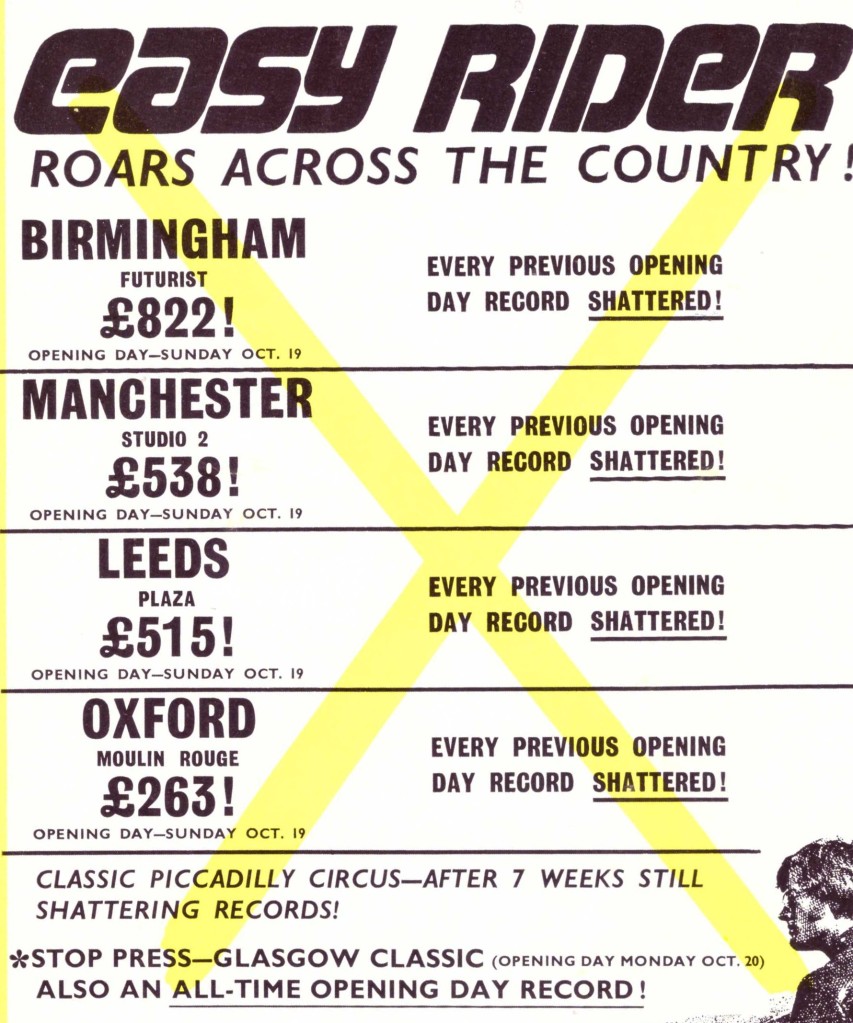
Selling a picture to the public and selling it to cinemas were two separate marketing skills. The easiest way to guarantee bookings for any film was to promote the box office figures through the trade press – as here in the British “Kine Weekly.” Columbia had cleverly booked the movie into one of the smallest cinemas in London’s West End where it was almost certainly guaranteed to break the box office record. But even the studio must have been taken aback by the way Easy Rider pulverized the previous record.

Message pictures were the remit of older directors like Stanley Kramer and Martin Ritt and films that had something to say about the human condition generally emanated from Europe and not low-budget efforts coming out of Hollywood. Easy Rider has a European sensibility, an almost random collection of unconnected episodes with no narrative connection to the main story, itself incredibly slight, of two mild-mannered dudes heading to New Orleans to see the Mardi Gras.

Road trips were not particularly unusual in American cinema but the form of previous locomotion was horse-related – westerns. The journey has been a central theme to movies. This is an 80-minute picture masquerading as a 95-minute one, a good fifteen minutes of screen time taken up with endless shots of Peter Fonda and Dennis Hopper on bikes passing through the landscape, with a contemporary soundtrack as comment.

Unusually, it’s also a hymn to ancient values, heads bowed in prayer at meals as different as you could get, the Mexican family and the commune, a marching band playing “When the Saints Go Marching In” and the recitation of prayers in the cemetery.

Success in London was no guarantee that a movie would perform as well all over the country. Columbia continued to book it into smaller venues in the hope it would repeat the London experience of breaking box office records. When it did the studio took out another advert in Kine Weekly to let exhibitors know.

What marks the film out stylistically, perhaps enforced by the lean financing, is the sparing way it is told. The most dramatic scenes – the three murders – are filmed in shockingly simple fashion. There are often long pans along groups of characters. While innovative, the flash-cut flash-forward editing adds little to what is otherwise a very reflective film. Inspired use is made of natural sound, the muffled thumping of oil derricks at the cemetery, the soundtrack to one death is just the battering of unseen clubs by unseen assailants.

The dialogue could have been written by Tarantino, none of the confrontation or angst that drives most films, but odd musings that bring characters to life. At the beginning of the trip, Hopper and Fonda are welcomed wherever they travel, but towards the end resented, treated as though a pair of itinerant aliens. They entrance young girls but are vilified by authority, jailed for no reason except the threat to traditional values they apparently represent.

Elements not discussed at the time of release make this more rounded than you would imagine. The excitable Hopper, a nerd in hippie costume, is driven by the American dream of making money. The more reflective Fonda senses something is not only missing from his life but has been lost forever. He has the rare stillness of a top actor, face reflecting unspoken inner turmoil.

It remains an extraordinary film, a series of accumulated incidentals holding up a mirror to an America nobody wanted to acknowledge and the brutal climax no less powerful now.   

Of course, the Easy Rider soundtrack itself summons up memories of the era and it is worth listening to just by itself and you might even want to go all the way and listen to it in the original vinyl.

Below is a link for the DVD.

   https://www.amazon.co.uk/Easy-Rider-DVD-Peter-Fonda/dp/B00LTK2Z44/ref=sr_1_1?crid=YSG6SCL8QQF9&dchild=1&keywords=easy+rider+dvd&qid=1596660339&s=dvd&sprefix=easy+rider%2Caps%2C153&sr=1-1

Discover WordPress

A daily selection of the best content published on WordPress, collected for you by humans who love to read.

The Atavist Magazine

by Brian Hannan

WordPress.com News

The latest news on WordPress.com and the WordPress community.