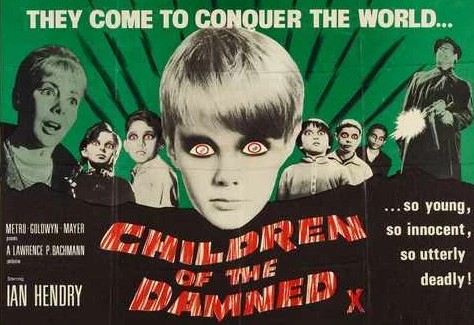
Children of the Damned (1964) ***

I wasn’t aware that celebrated sci fi author John Wyndham had written a sequel to his iconic novel The Midwich Cuckoos, filmed as Village of the Damned (1960). And it turned out he didn’t (he did make an attempt but abandoned it after a few chapters).  So he had nothing to do with the sequel. But the original had proved such a hit MGM couldn’t resist going for second helpings.

And there was nothing the writer could do about it, it being standard procedure that when you sold your novel to Hollywood the studio retained all the rights and could commission a remake, sequel, turn it into a television series, without consulting you.
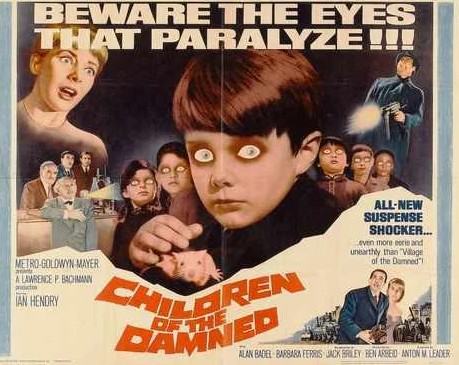
The only drawback for a potential sequel was that main adult character Professor Zellaby (George Sander) and all the kids had died in the original, though the final image of eyes flying out of the burning house might have suggested the children had actually survived. And, as we know these days, just when your main character dies it doesn’t prevent him miraculously returning to life should box office dictate.

So screenwriter John Briley (Oscar-winner for Gandhi, 1982) was handed the sequel. And what we get is a lot of atmosphere, a chunk of running around in empty London streets (the result not of mass evacuation but filming in early morning when roads are clear), a very slinky turn from Alan Badel (Bitter Harvest, 1963) showing what he can do when hero not villain, and a twist on the previous problem – how to vanquish the kids – which is whether to  weaponize them. Mostly, we are reminded of how better telekinesis was dealt with in the original picture and how poorly this compares to the likes of Brian De Palma’s later Carrie (1976) and even his The Fury (1978).
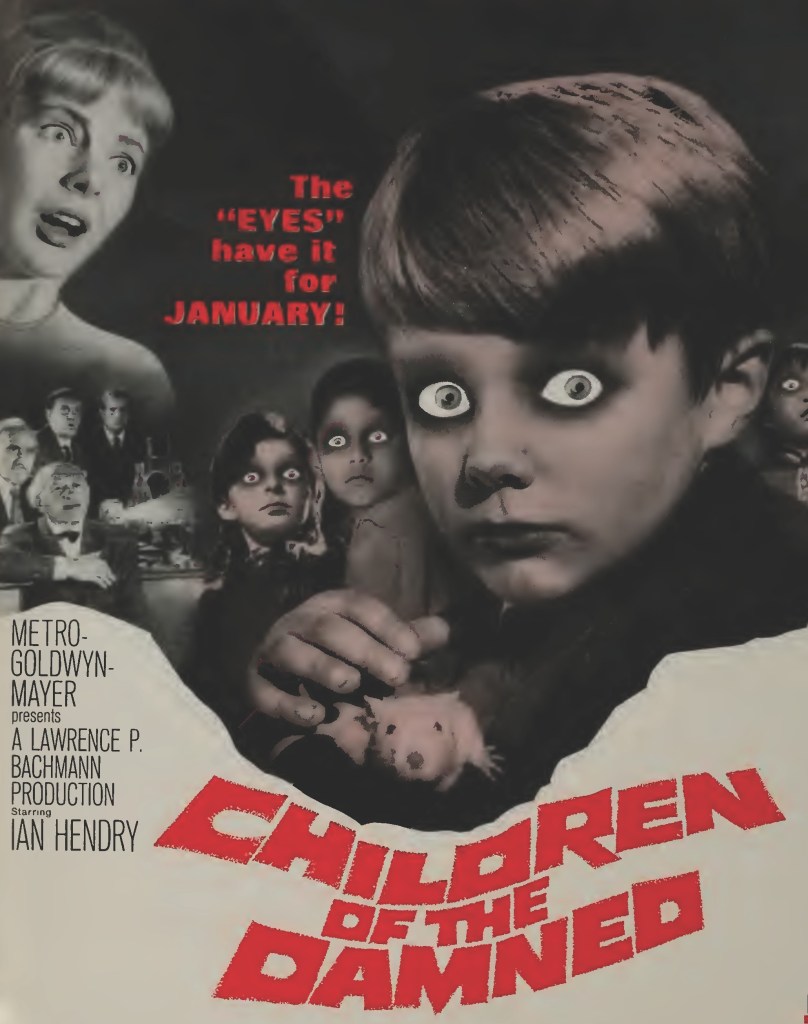
Apart from the title, there’s barely a nod to the previous incarnation, except that discerning the children’s paternity proves impossible. An United Nations project has tracked down six kids with incredible intellects. Like Professor Zellaby, British psychologist Dr Tom Llewellyn (Ian Hendry) and geneticist Dr David Neville (Alan Badel) want to study the kids while the more shadowy figure of Colin Webster (Alfred Burke) appears to have more sinister purpose in mind.

In any case none of the three achieve their goals because the kids escape and take refuge in an abandoned church, defending themselves against the authorities and the military by their brain controlling abilities and by the devising of a sonic weapon. Immediately under their thumb is the aunt, Susan (Barbara Ferris), of the young boy Paul (Clive Powell) who initially excited the interest of the British scientists.

Opinion varies as to whether the children are a genetic freak of nature, aliens or an advanced human race. The authorities can’t decide whether they are a threat or a wonder and decide to eliminate them, then change their mind, while the children decide to fight back then change their minds. The ending is quite a surprise.

Although the kids still have the fearful eyes, they are generally a lot less effective a scare than when the small gang of them stood side by side in the previous picture and stared at adults until they did the childrens’ bidding or killed themselves. There’s way too much discussion among adults. In the previous picture, those kinds of conversations had more emotional impact, since it was the villagers who were left distraught. Here, you couldn’t care less about the adults.

Interestingly enough, the standout isn’t any of the kids at all, but Alan Badel, who comes over as the libidinous sort, but very charming, and views any woman as fair game, but it’s fascinating to see how his usual screen persona here makes him a hero whereas in most other films exhibiting much the same characteristics he comes across as shifty, mean or downright villainous.

Ian Hendry (The Hill, 1965) was a rising British star but isn’t given much to get his teeth into. Barbara Ferris (Interlude, 1968) has a vital role.

Directed by television veteran Anton M. Leader (The Cockeyed Cowboys of Calico County, 1970) who makes his screen debut.

Not a patch on the original.

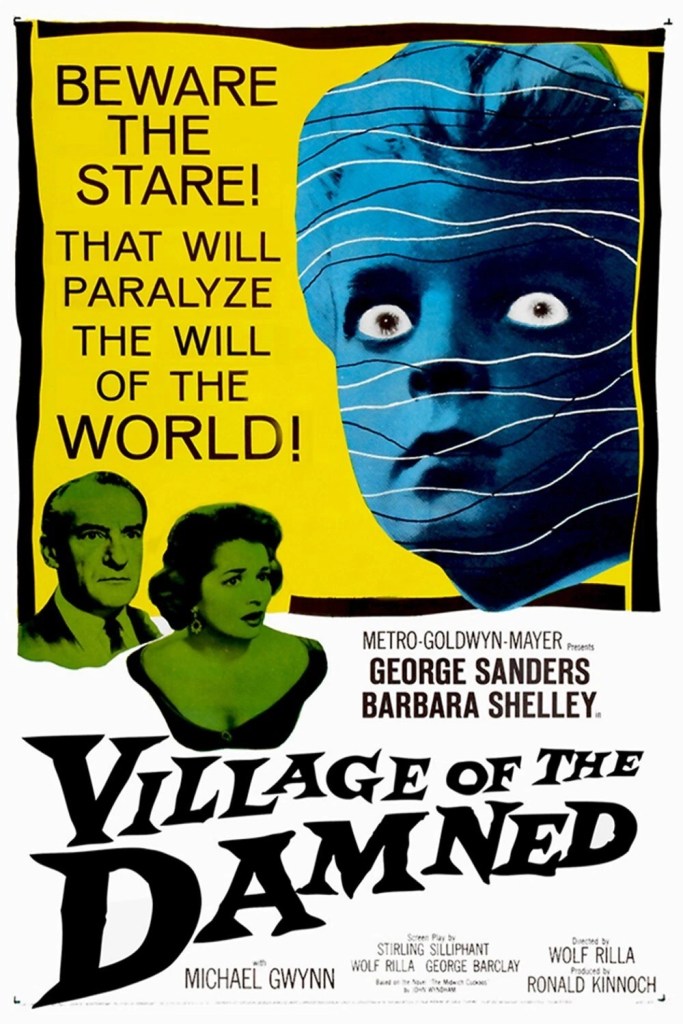
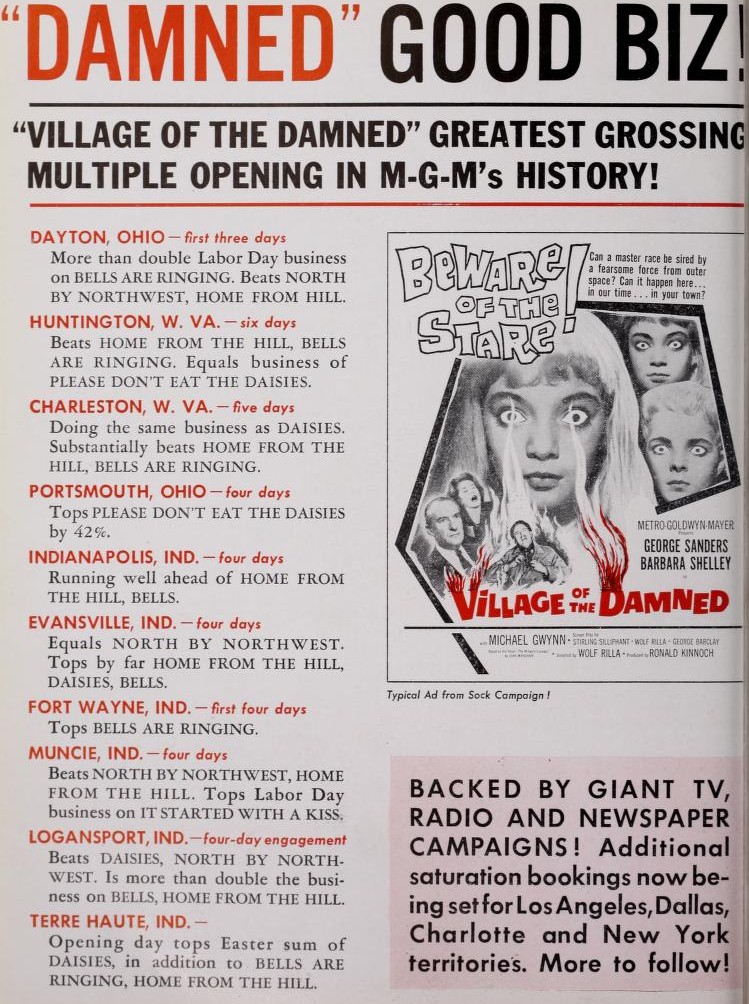
Village of the Damned (1960) ****

Superb chiller that, unusually, takes time to develop several strands over a longer time frame than is normal for a genre where the immediate takes preference. Opens a new dimension of terror, too, with the brain control sub-genre that would spill over into brainwashing. You could also, if you were of a mind, point to the genuine growing social power of the young as emphasized later in the decade with movies about hippies. It might not be too much of a stretch to point to the “Youthquake” at the end of the 1960s when pandering to a youthful audience nearly destroyed Hollywood.  

Terrific opening sequence of everyone in the small village of Midwich dropping to the ground, the immobilized driver of a bus crashing off the road, the driver of a tractor hitting a tree, taps left running, telephone calls cut off, all manner of accidents ensue. You think everyone’s dead, as do the military, called in to investigate. They cordon off the area, employ canaries and then humans to discover how far the danger spreads. But when a soldier who is dragged out unconscious from the forbidden zone wakes up, they soon realize the population is merely unconscious.

Childless couple Professor Gordon Zellaby (George Sanders) and younger wife Anthea (Barbara Shelley) are among those affected, apparently suffering no side effects for having been knocked out for around four hours. A couple of months later Anthea is delighted to report she’s pregnant. She’s not alone. But for many of the villagers what would be a cause for celebration causes untold grief. One husband returns home after a year away to find his wife is pregnant. In the days when pre-marital sex was frowned-upon, virgins, similarly affected, are shamed.

The pregnancies don’t run to the normal period either, and fully-grown children are born within a few months. What’s more, they all look as if they have inherited the same genes. Their blonde hair and striking eyes suggest they share the same father. Soon it transpires they can not only read minds but control them, causing at least two people to commit suicide.

Turns out this is a global problem, several other communities afflicted with the same condition, the Russians so concerned at the prospect that they bomb one village to oblivion, other cultures simply murdering the children.  Here, being English, where fair play still rules regardless of potential threat, the children are taken under the wing of Professor Zellaby, though the military, having sealed off the area, wait in the wings, itching to wipe out the troublemakers.

Quickly, it becomes a duel for power, the children will do anything to protect their species, Professor Zellaby at first wanting just to study the kids and understand them but soon recognizing the threat.

In between bouts of action, most of which is discreetly handled, none of the deliberately shocking scenes that might have emanated from an exploitationer, the authorities have plenty of time to ponder their existence. A leap in genetic mutation, or extraterrestrial origins, are among the options considered.

Eventually the villagers react like terrified Transylvanians confronting Dracula and attempt to set fire to the building where the children are housed but reckon without the brain control that can be exerted. In the end Professor Zellaby comes up with a self-destructive solution.

This is formidable stuff, all the more so, because in the days when most monsters grew fangs or claws or developed huge bodies and were otherwise physically frightening, the worst these kids get up to is to have a striking glow in their eyes, a startling contrast to their blonde hair, calm demeanor and neat uniform clothing.

Tremendously well done and it helps to have cast mainstream actors like George Sanders (Warning Shot, 1967) and Barbara Shelley (only later did she become a Scream Queen) and others who don’t carry the tinge of the horror genre.

Very well paced by German director Wolf Rilla (The World Ten Times Over, 1963) who resists the temptation to overplay his hand, achieving much more by leaving it to your imagination. Stirling Silliphant (The Slender Thread, 1965), George Barclay (Devil Doll, 1964) and the director adapted the groundbreaking novel The Midwich Cuckoos by John Wyndham. Horror maestro John Carpenter remade this in 1995, which only wnent to show how more successful the restraint of the original was.

Top notch.

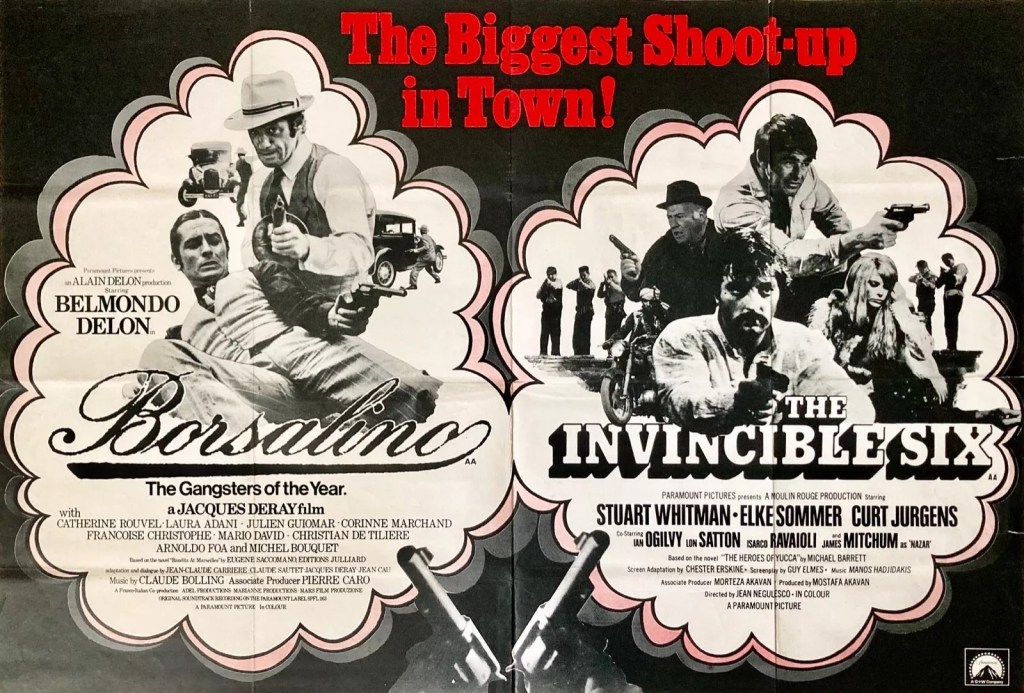
Borsalino (1970) ****

You wonder how much the unexpected success of this French gangster picture encouraged Paramount to invest in The Godfather (1972). The studio had gone down the Mafia route with The Brotherhood (1968) but to a significantly muted response. But where that film was heavy on family and drama, Borsalino went wild with charismatic performances and, as important, machine-gun-driven violence. And you couldn’t ignore the success the previous year of the French The Sicilian Clan (1969).

While Borsalino doesn’t go into the weighty issues and family sensibility that elevated The Godfather in the eyes of critics, its starting point owed more to Butch Cassidy and the Sundance Kid (1969) with two likeable hoods, even, initially at least, sparring over the same girl. The family element here concentrates on fraternity, brothers in crime, rather than the father-son dynamic that drove The Godfather. And it’s just so much goddam fun.  

Francois (Jean-Paul Belmondo) and Roch (Alain Delon) are petty crooks in Marseilles in the early 1930s working their way up to the top, initially just with scams like presenting a longshoreman who can’t speak a word of German as a German regional boxing champion, hijacking the favorite in a horse race, setting up a slot-machine business, disrupting the city’s fish market, until graduating to more serious crime and challenging Marello (Arnoldo Foa) and Poli (Andre Bollet), kingpins of the area’s organized crime. They set fire to an abattoir, establish their own fiefdoms, running legitimate businesses like casinos. But the higher they climb the closer they come to a devastating irony which cannot be ignored. Once they’ve eliminated everyone else, their only competition is with each other, and both realize that, inevitably, one will begin to want to become the undisputed top gangster.

Roch is the more thoughtful of the pair, the one looking ahead, sensing opportunity, the strategist, Francois more likely to indulge his playboy instincts, but both enjoy the high life, mixing with celebrities, politicians and archbishops. There’s plenty collateral damage. Try to steal a bigwig’s girlfriend away and you are virtually condemning her to death.   

Unexpectedly, for the genre, it’s huge fun, in part helped along by the genial earworm of a score by Claude Bolling, as evocative of the period as Scott Joplin’s rags were to The Sting (1973).  We don’t have to suffer any sanctimonious prig on the sidelines offering commentary or the gangsters making out that they’re better than they are because they don’t indulge in certain types of crime. But the biggest contributory factor is the teaming of Alain Delon (Once a Thief, 1965) and Jean-Paul Belmondo (Is Paris Burning?, 1966), the two biggest French male stars of the decade, the former enjoying substantially more success overseas than the latter.

Remember that Robert Redford was a not star when he made Butch Cassidy and the Sundance Kid so the pairing of two huge marquee names was not a regular feature anywhere in the world. It was Alain Delon, in his capacity as producer, who snared his rival, ceding top billing to achieve it.

This was the second of nine movies that Delon made with director Jacques Deray and could not have been more different from their previous outing La Piscine/The Swimming Pool (1969), a claustrophobic psychological thriller. Deray had history with Belmondo, too, Crime on a Summer Morning (1965). The characters were a great fit for their screen personas. And the photography, with some sepia tint, is distinctive.

Written by Jean-Claude Carriere (Viva Maria!, 1965), Claude Sautet (Nelly and Monsieur Arnaud, 1995), Jean Cau (Jeff, 1969) and the director, based on the book Bandits a Marseille by Eugene Saccomano.

Buddy movie breakout. Highly enjoyable.

The Innocents (1961) ***

One description of this film’s prequel The Nightcomers (1972) was that, even with the overt sex and violence, it was an arthouse picture masquerading as a horror movie. And obviously absent the sex and violence that’s how I feel about this one. I’m of the old-fashioned school when it comes to horror – once in a while I expect to jump. The biggest problem here is that fear is telegraphed in the face of governess Miss Giddens (Deborah Kerr). Instead of the audience being allowed to register terror, all the tension is sapped away by one look of her terrified face.

Atmospheric? Yes! Scary? No.

Certainly, the set-up is likely to spark the darkest imaginations. Orphans Miles (Martin Stephens) and Flora (Pamela Franklin) are abandoned by their uncle (Michael Redgrave) who wants to spent his time enjoying himself in faraway London without having to bother about the care of the minors. The governesses he installs are given carte blanche to deal with any situation that arises – as long as they don’t concern him with it. And he’s so disinterested in the children’s welfare that he hires a completely inexperienced governess in Miss Giddens despite the fact that the previous occupant of the post, Miss Jessel, had died in mysterious circumstances and a little digging would have revealed that she lived a hellish life under the thumb of valet Quint.

The kids appear somewhat telepathetic or telekinetic – Flora knows Miles is coming home before Miss Giddens does, Miles knows when the governess is standing outside his door. They’re maybe a too bit self-indulgent – Flora enjoys watching a spider munch on a butterfly and isn’t above finding out if her pet tortoise can swim, while Miles has Miss Giddens in a neck stranglehold.

But it’s unlikely the children are summoning ghosts – Quint appears to Miss Giddens at the top of a tower and again peering in through a window, Miss Jessel turns up, too, and I lost count of the number of disembodied voices. The ghosts it turns out have taken possession of the children in order to continue their relationship.

And while this is all very clever it does not chill you to the bone. The children are not as cute as they need to be to make this work. You get the impression, given half the chance, they would happily turn into little savages and experiment with all manner of cruelty. And that would occur whether there was the likes of Quint around to lead them astray because the adults in their lives are so selfish and set the wrong kinds of standards. But with the focus perennially on the trembling Miss Giddens, there’s little chance of getting inside the heads of the children.

Since jump scares are not in director Jack Clayton’s cinematic vocabulary, the best scenes are not visual, but verbal, housekeeper Mrs Grose (Meg Jenkins) filling the governess in on the unequal relationship between Quint and Miss Jessel, Flora imagining rooms getting bigger in the darkness (effectively more dark), Miles seeing a hand at the bottom of the lake.

There’s certainly an elegiac tone and the camera clearly sets out to destabilise the audience but that’s just so obvious it seems more an arthouse ploy than a horror schematic.

This was start of Deborah Kerr (Prudence and the Pill,1968) playing psychologically distorted characters. Over the previous decade she had revelled in a screen persona that saw her playing the female lead (sometimes the top-billed star) opposite the biggest male marquee names of the era – Burt Lancaster (twice), Cary Grant (twice), Yul Brynner (twice), Gregory Peck, William Holden, Robert Mitchum (three times), David Niven (twice), Gary Cooper. Now she turned fragile and that screen persona, introduced here, would see her through the next decade.

So she’s both very good and very bad here. Her character facially registers her inner thoughts but those too often get in the way of the audience. I found the kids more limited in their roles, not through acting inexperience, but through narrative restriction.

Jack Clayton (Dark of the Sun, 1968) directs from a screenplay by Truman Capote (In Cold Blood, 1967) and William Archibald (I Confess, 1953) from the celebrated Henry James story.

A bit too artificial for my taste. Probably heresy to admit it but I preferred the prequel.

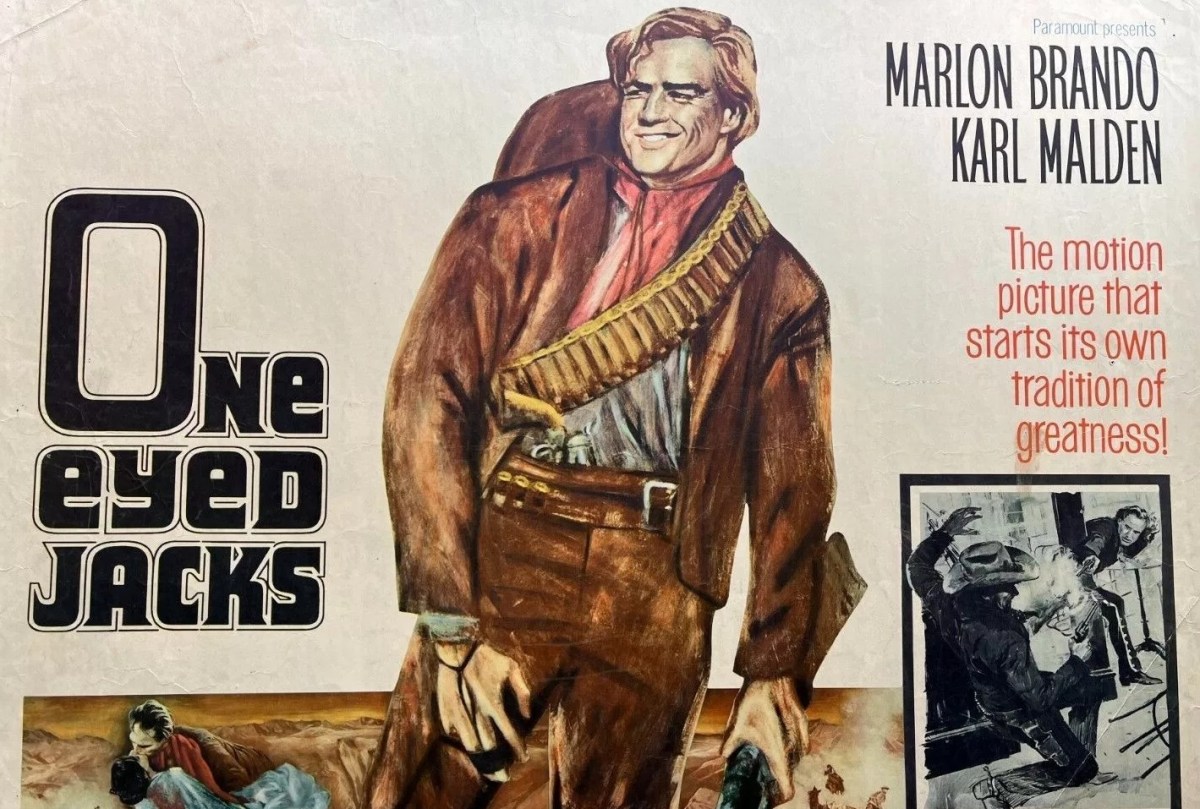
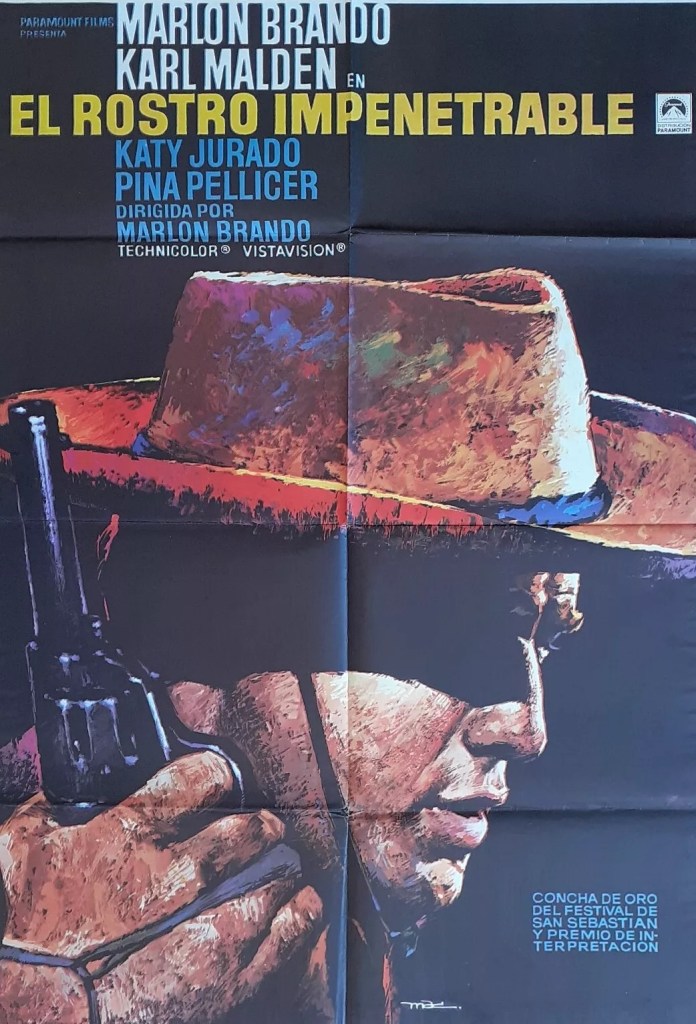
One-Eyed Jacks (1961) ****

Sets the tone for the later Sergio Leone, Sam Peckinpah and Clint Eastwood westerns in which the bad guys are the good guys and we find ourselves rooting for bounty hunters, gunslingers and bank robbers. Except this is more of a drama than a western. Shooting is kept to a minimum and instead it’s a character-driven drama about outlaws. Ostensibly, it’s a simple revenge tale and also totes around that later cliché of the honor code and principles that The Wild Bunch (1969) in particular put so much faith in.

But, in reality, it’s an in-depth look at two fascinating characters, both very human, both sly, self-indulgent, constantly attempting to reinvent themselves, cheat their way to a better life or to get what they want. There’s no sense of redemption, just obsession.

Rio (Marlon Brando) and Ben (Karl Malden) are bank robbers, the former a notorious gunslinger to boot and also partial to stealing pieces of jewellery to assist his practiced seduction routine whereby he claims a ring or necklace was a family heirloom, and he’s a good reader of the reluctant female because that tends to open the bedroom doors. Pursued after pulling off a job in Mexico, down to one exhausted horse and trapped by a posse, Ben is sent to get fresh horses but instead of coming back heads off with the loot. The captured Rio does a five-year prison stretch before escaping and seeking revenge.

Ben, meanwhile, has gone straight. He’s picked up a peach of a job as a lawman, a marshal no less, in Monterey on the California coast, where he’s made no secret of his past so he’s not prey to blackmail. He thinks Rio believes his story that he did all he could to return to aid his friend. We know different.

Rio has alighted on this town by pure accident, hooking up with a band of thieves led by Bob (Ben Johnson) who are set on robbing the bank here. Their plans are put in disarray when Ben takes revenge on Rio seducing his stepdaughter Louisa (Pina Pellicer) by subjecting him to a savage whipping and breaking his gun hand. It takes ages for the hand to heal and for Rio to even manage to whip out the gun let alone fire it with any speed or accuracy. He fesses up to Louisa that he’s not a secret Government agent, his usual cover story, but a bank robber and that the heirloom he gave her did not belong to his mother.

Bob gets fed up waiting, tries to pull off the bank job with one other accomplice, but the robbery goes wrong and a girl is killed. Ben pins the blame on Rio, arrests him and prepares to hang him. Louisa, who has initially rejected Rio after his confession and aware of his revenge plan, helps him escape.

The final shoot-out isn’t built up with the intensity of High Noon (1962) or Once Upon a Time in the West (1968) but with a resigned inevitability. Rio could have skipped out with Louisa and made a new life in Oregon. That would, in some senses, be revenge enough, stealing away the stepdaughter, one of the two main planks of Ben’s newfound respectability.

Don’t come here looking for honesty or upstanding individuals. Respectability is feigned – even Ben’s wife Maria (Katy Jurado) had a child out of wedlock. Everyone lies, even Maria – to protect Louisa from the stepdad’s wrath at losing her virginity.

In other words, a totally human cast of characters, shuffling the truth like it was a deck of cards. You wouldn’t trust any of them an inch. It doesn’t take much for cruelty to creep through the cracks, the cruel whipping, deputy Dedrick (Slim Pickens) handing out a beating to Rio in retaliation for being rejected by Louisa, Bob taking great delight in shooting dead an unarmed accomplice.  

Ben isn’t alone about lying about the impossibility of coming to Rio’s aid, Bob does it too. Wife and stepdaughter lie to Ben. Ben lies to Rio. Rio lies to Louisa. Where this fits into one of Dante’s circles of Hell is anyone’s guess.

Cinematically, there’s only really one standout scene, when Ben calls out of hiding all the men who are going to surround Rio. But there are bold visuals. I thought I was watching a dud DVD because the image was so washed out for the opening sequences then I realized it was just the glare of the white desert sand and deliberate. And the backdrop of crashing waves suggests a different sensibility.

You can see the impact of Brando’s direction – he was making his directing debut – more with the leeway he allows actors to carry out little bits of business that only another actor would appreciate. A shoeless Ben dances over the hot sands, when he picks up the coins he has dropped he remains on the ground longer sifting through the sand in case he has missed one, Rio reacts to Dederick sweeping ash in his direction.

This is Marlon Brando (The Nightcomers, 1971) still in his pomp.

Written by Calder Willingham (The Graduate, 1967) and Guy Trosper (The Spy Who Came in from the Cold, 1965) from the book by Charles Neider.

An exemplary work from a novice director.

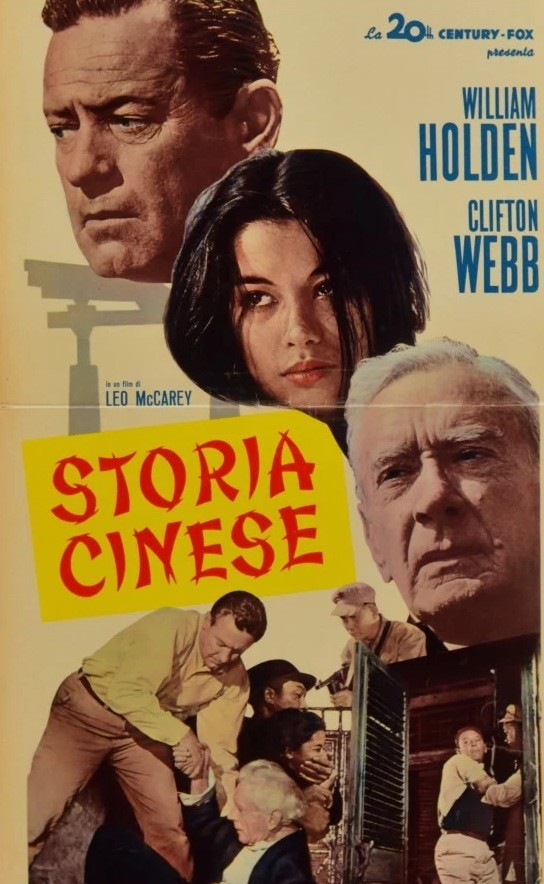
Satan Never Sleeps (1962) **

Of all the misguided sentimental anti-Communist drivel, this is a very poor swansong for triple Oscar-winning director Leo McCarey (Going My Way, 1944). A tone that’s awkward enough all the way through goes straight through the wringer when we are asked to accept without question the actions of a rapist. Such genocidal rape as the conqueror visits on the conquered would sit less comfortably with a contemporary audience.

Most of the problem is the set-up. Apart from those pesky Communists invading a Christian Mission, in other circumstances this would have settled into a verbal sparring match between about-to-retire old priest Fr Bovard (Clifton Webb minus trademark moustache), full of tetchy quips, and his younger replacement Fr O’Banion (William Holden) trying to shake off the unwelcome advances of even younger native Siu Lan (France Nuyen). There would be a servant or maybe a more high-flown doctor whom O’Banion could push Siu Lan onto.

There’s laffs  aplenty if you’re easily satisfied with the likes of a servant (Burt Kwouk in an early role) who believes thieving is compatible with Christianity, O’Banion’s woeful attempts at cooking and his inability to shoo away the ardent Siu Lan, and the priests risking breaking a golden rule of their religion to enjoy a glass of wine before the clock strikes midnight.

The arrival of the Communists is not initially too tiresome, Bovard doing his best headmaster impression keeps them in line, Communist leader Chung Ren (Robert Lee), an ex-Christian, sweet on Siu Lan. Things get tricky when Chung Ren’s attempts to forcefully claim the woman are deterred by O’Banion who is tested several times on the old Christian principle of turning the other cheek before resorting to unchristian violence.

Chung Ren then rapes Siu Lan anyway. But when she stabs him in the back and the rapist is forced to ask O’Banion to go to another mission to fetch the necessary penicillin to prevent infection spreading, the older priest is inclined to ignore the request and let him die. O’Banion thinks he has struck a deal to free the old priest in exchange for fetching the medicine, but Chung Ren reneges on the agreement and the priests are tortured and stand trial.

Meanwhile, Chung Ren has a change of heart, or so it seems, after Siu Lan gives birth to his son. But, actually, this might be more to do with the fact that he has been demoted for not being a good Communist, inclined to enjoy the finer things in life rather than share them out with his comrades. And it’s only when he’s told he’s going to be sent away to some kind of Chinese Gulag that his principles make an appearance and he helps the two priests and Siu Lan and her baby to escape.

I could see maybe Siu Lan being forced into marriage by Chung Ren in the Communist state while he was in a position of importance; she would have no choice in the matter. But for her to show the same acceptance in a democracy outside China smacks of the worst kind of wishful thinking. Sure, the Christian God is all-forgiving and, technically, all Chung Ren would have to do was confess the sin of rape and equally technically he would receive absolution and therefore in the Church’s eyes be free to marry.

But O’Banion overheard the rape. He’s a witness. That’s no use in the Communist society, but in a democracy you would have thought he would have been seeking prosecution. As he was a witness and this was not something protected by the sanctuary of the confession, he would not just be perfectly within his rights but would have to seek out rule of law.

I have never heard of a rapist and the woman he raped living happily ever after and I doubt if it would ever have been considered conceivable even in the early 1960s.

That aside, William Holden (The Devil’s Brigade, 1968) and Clifford Webb, in his last picture, are good value as the squabbling priests, less so when they venture into dubious morality. France Nuyen (A Girl Named Tamiko, 1962) doesn’t get a fair shake, required to be the cliché happy grinning native and then provided with no opportunity to state her case against her rapist before she’s pushed, for the sake of a fairy tale ending, into marriage.

Written by the director and Claude Binyon (North to Alaska, 1960) from the bestseller by Pearl S. Buck.

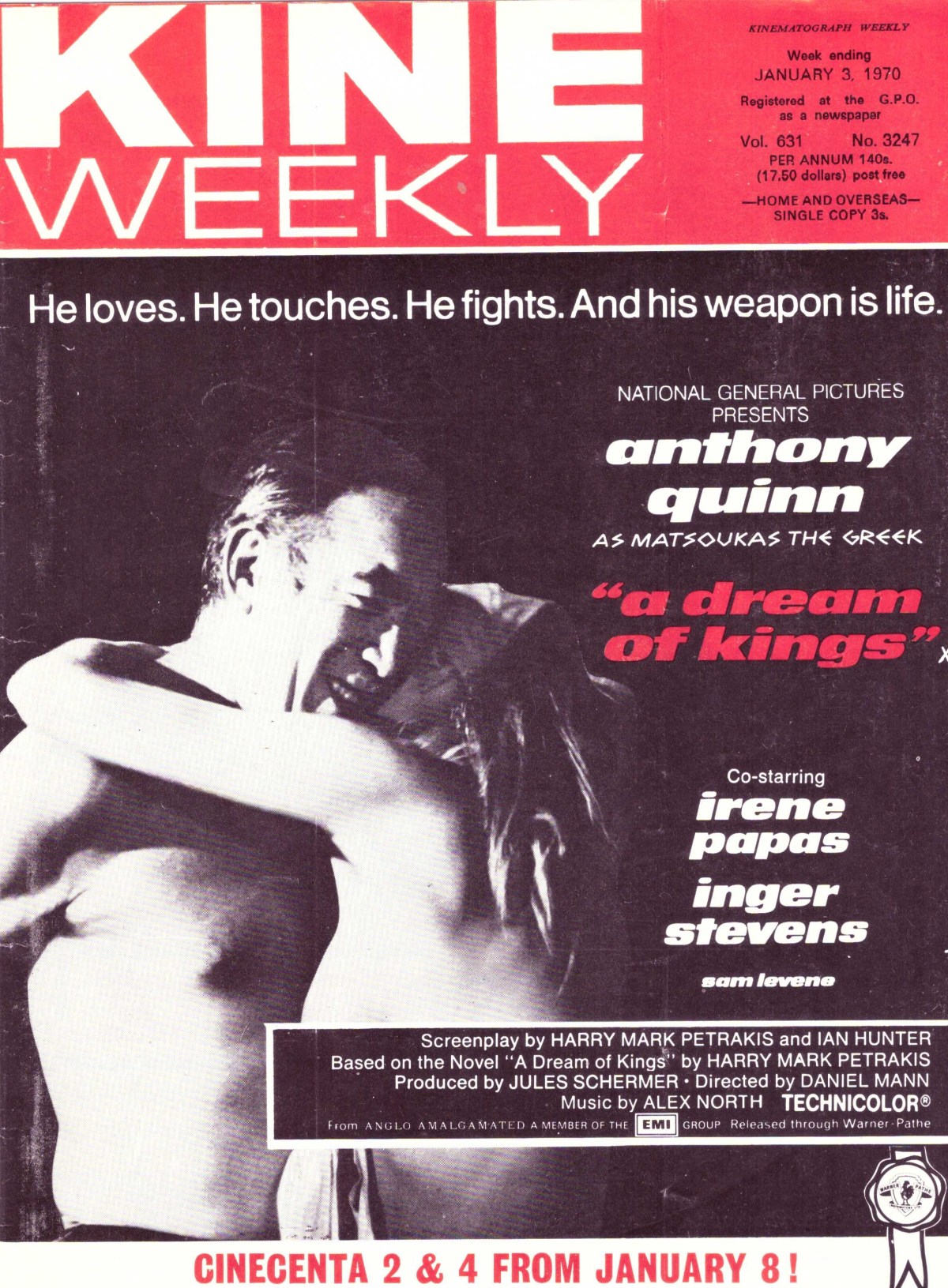
A Dream of Kings (1969) *****

Sometimes great movies just disappear. Even if they pick up some critical traction on initial release, as here, they flop at the box office. And they are not revived because the production company goes bust or the rights are complicated. Or, more likely, they don’t fit into audience expectation. All three stars here completely play against type, outliers in career portfolios. We have become so accustomed to the attraction of stars according to their screen personas that unless they are known to completely change their screen characters with every outing anything that’s different to the norm becomes unacceptable.

Director Daniel Mann (Ada, 1961) was best known for producing Oscar-winning or Oscar-nominated performances from female stars. He was immensely skilled at making audiences sympathize with the most flawed women. Here, he does the same for Anthony Quinn, in a performance that should have had Oscar voters lining up but was dismissed for all the wrong reasons. Theoretically, one of the film’s problems is the dialog. We are so used to a script full of cut-and-thrust or witty putdowns that we fail to recognize a screenplay, that in much the same way as a stage play – but without that form’s inherent artificiality – lets characters live and breathe, explore depths that are just not possible except in fleeting moments in the normal construction of a movie.

Most scenes here begin one way and then move in all sorts of directions, sometimes ending up back where they started, but most often going somewhere unexpected, not in the sense of a sudden twist, but in digging deeper into relationships and understanding that marriages are built on shifting sands, and not all of them perilous. There’s a lot of dialog and when you get a lot of long speeches it can make the actors look as though they’re hamming it up when in fact what they’re doing is opening up the character.

We shouldn’t like Matsoukas (Anthony Quinn) at all. He’s a gambler, a womanizer, drinks, comes home at sunrise, has nothing you’d call a real job.

And yet.

In his company you enter a world of possibility. By sheer force of personality he lifts gloom, even when it’s his actions that have caused it. He can convince the most downtrodden weaklings that they have something of worth.

When nobody has anything good to say about old drunk Cicero (Sam Levene), Matsoukas tells him he has a poker dealer’s graceful hands and provides solace just by befriending him. He convinces a 72-year-old man that the loss of his libido is not down to the old guy’s age but because in four years of marriage he has lost interest in his 31-year-old wife because she’s the one who has aged, physically less appealing, and then he teaches the desperate soul the gentle art of seduction, how to win a woman’s heart by putting her on a pedestal, treating her like a goddess, kissing her softly on eyes and ears rather than pawing her in frantic passion.

Just what Matsoukas’s job is – on the door it says “counsellor” which would suggest something  legal  – but in fact he’s a male version of an old wife and provides solutions to odd problems, a mother worried that her teenage son masturbates, for example.

He is the sort of guy who can wring triumph from disaster. He has just lost a bundle of dough at poker but the way he tells it you’d think he’d won. Instead, he appreciates the drama of it all, the way it makes a great tale even if he’s the loser. Naturally, wife Caliope (Irene Papas) doesn’t see it his way. She’s on her knees with trying to feed her three children from the scraps that fall from his gambling. Though when he wins big, they live like kings.

Although he still has a lusty sex life with Calope, and can mostly coax her round, he has fallen for widowed baker Anna (Inger Stevens), attracted to her in part to alleviate her grief, pull her out of the darkness.

And he cannot face up to the potential loss of his young son who has three months to live and has it fixed in his own mind that the boy will be cured if Matsoukas can expose him to the sunshine and the ancient gods of his Greek homeland, though he lacks the $700 required for the air fare.

Each sequence is long, carefully calibrated, giving time for the exploration of a wealth of emotions. Outside of the three main narratives are two other stand-out scenes. In his sermon a priest rails against the evils of life insurance that makes people welcome death yet argues, ironically, that death is a great joy and should not be feared. And there’s a party where Matsoukas on the dance floor is a magnet for every woman in the room.

This is an Anthony Quinn (The Shoes of the Fisherman, 1968) devoid of all trademark abrasiveness, the loud voice gone, trying to gouge every ounce of joy from a forbidding world. He has a very tender relationship with his dying son, inventing a game with fake telephones to deal with the boy’s fears, and is very playful with his two daughters. He is constantly wooing his wife, in part to ease the pain he causes her, but mostly because he wants them to get the most out of life.

This is a different Irene Papas (The Brotherhood, 1968) too, not the fiery woman or dutiful wife of her screen persona. Whatever anger she feels is subsumed by sorrow and she is always willing to let her husband fire up her heart as in the old days. Actresses don’t get such complex roles these days.

And all the pent-up fragility of Inger Stevens (Five Card Stud, 1968) is suddenly let loose as she twists her entire screen persona of tough woman in a man’s world – usually a western – on its head. Her scenes with Quinn are breathtaking. Unfortunately, this was her final film – she committed suicide shortly after. But she could not have found a better swansong, one that extended her range.

As he always does, Daniel Mann doesn’t take his main character’s side, but while extracting sympathy for character predicament and perspective, still lets the audience make up his mind. This could easily have gone all maudlin, the child miraculously recovering, the flight to Greece to find a rare cure, all Matsoukas’s delusion revealed as nothing more than true faith, but it’s more hard-edged than that. At the end Matsoukas has his exterior carapace ripped apart, beaten up, ostracized for committing the worst crime of a gambler – cheating – in dire straits.

And yet.

Written by Ian McLellan Hunter (Roman Holiday, 1953) from the bestseller by Harry Mark Petrakis.

I just adored this.

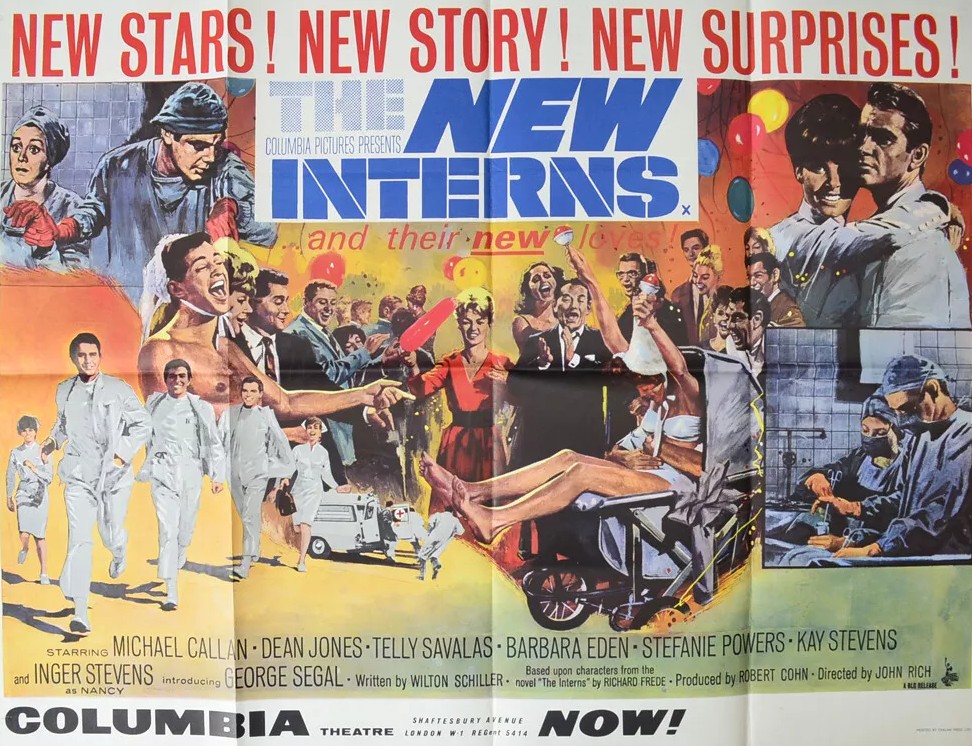
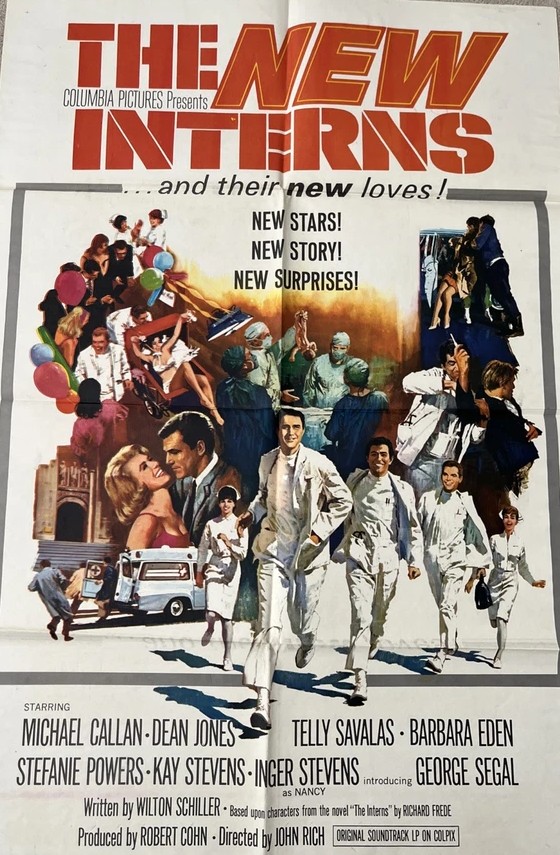
The New Interns (1964) ***

Columbia had turned this series into a glorified New Talent Contest. It didn’t spend much cash buffing up the sequel in terms of narrative or characters, so it’s mostly enjoyable to see just how well the studio was at spotting talent. In that regard this outing was as profitable as the original. This marked the debut of George Segal (The Quiller Memorandum, 1966) who quickly became a major marquee name. Also brought into the mainstream was Inger Stevens (Five Card Stud, 1968). Receiving a welcome career boost was rising star Dean Jones, though Disney (The Love Bug, 1967) rather than Columbia took better advantage of his skills, and in the comedic rather than the dramatic vein.
Various stars reprised their roles including top-billed Michael Callan (You Must Be Joking, 1965), signed up to a long-term deal. But most of the others in this category made their names through television. Telly Savalas (The Assassination Bureau, 1969) was the cop Kojak (1973-1978); Stefanie Powers (Warning Shot, 1967) flourished as The Girl from U.N.C.L.E. (1966-1967) and in Hart to Hart (1979-1984); and Barbara Eden went quickly into I Dream of Jeannie (1965-1970).

The upshot is that, depending on your taste, you might end up talent spotting yourself, shrieking with glee at spotting an old favorite, or perhaps so many of them, in what was, effectively, an all-star (of the minor kind) cast and paying less attention to the various storylines.

Most of the narrative energy revolves around various characters coming together in romantic entanglement – Dr Alec Considine (Michael Callan), while more inclined to play the field, ends up with Nurse Laura Rogers (Barbara Eden); despite initially being at odds Dr Tony Pirelli (George Segal) and social worker Nancy Terman (Inger Stevens) hook up; and various other romances are short-lived.

Outside of this, newlyweds Dr Lew Worship (Dean Jones) and wife Gloria (Stefanie Powers) discover he is sterile. The more powerful sequence relates to Nancy being sexually assaulted by juvenile delinquents who grew up in the same tough neighbourhood as Tony. As you might expect, the thugs end up in hospital and cause a fracas in which Alec is injured.

Tony has all the best lines. Invited to chance his arm with the nurses, he snaps that he didn’t come to the hospital to “learn to kiss.” Pushed out of the way by resident Dr Riccio (Telly Savalas) he retorts that he didn’t come to deliver messages. And so on, the most driven of the new intake, and the most surly, his initial encounter with Nancy has him upbraiding her for crying in front of a patient.

Decent soap opera as soap operas go, but without the more challenging aspects of the original. In an era when the series movie was beginning to take shape – primarily in the espionage arena – you can see why Columbia thought this might run and run and eventually the studio had another go at the concept, but this time as a television series.

Directed by John Rich (Boeing, Boeing, 1965) and written by big screen debutant Wilton Schiller from the bestseller by Richard Frede.

George Segal and Inger Stevens are the standouts.

I Thank a Fool (1962) ***

One of those bonkers pictures whose nuttiness is initially irritating but ends up being thoroughly enjoyable once you give in to the barmy plot and overheated melodrama. Murder, suicide, madness, illicit sex, blackmail – and that’s just the start of this farrago of nonsense. And set in Liverpool before The Beatles made it famous.

Christine (Susan Hayward), a doctor, is jailed when she kills her married seriously ill lover in a mercy killing. She’s not convicted of the murder but of the lesser crime of medical malpractice, but after serving an 18-month sentence finds she is unemployable, even in more lowly professions where her prison stretch counts against her.

When she is hired by the attorney Stephen (Peter Finch) who prosecuted her to look after his mentally ill wife Liane (Diane Cilento), the audience will already smell a rat given that Christine has changed her name and therefore the lawyer must have made considerable effort to track her down. His argument is that since she is no longer a qualified practitioner, she cannot advocate to have his wife committed to a mental institute, as a proper doctor would be required to, since Liane is clearly a danger to herself and other people. Your immediate suspicion is that Christine has been hired to take the rap once Liane is bumped off.

And it doesn’t take long for Christine to work out that not everything adds up. Liane is given enough rope to hang herself, access to a car to cause an accident, access to a horse which could easily bolt or fall.

Liane has been told her Irish father died in an accident where she was driving, the incident that triggered her madness. But when we discover the father, Captain Ferris (Cyril Cusack), is very much alive that’s the cue for a slew of unlikely events. When Liane finds her father, he’s not in the least a candidate for canonization, but an alcoholic. That triggers further mental trauma. And another accident, self-inflicted. After Christine administers pills, the young woman is found dead.

Bit of a stretch to compare it to the movies
mentioned in this poster.

Naturally, an inquest brings up Christine’s past and suspicion falls on her. And that would be par for the course, and it would be up to the condemned woman to find a way to prove her innocence. But that takes us into even murkier depths.

There’s bad blood between Capt Ferris and Stephen and the inference that this was only resolved by the father offering his underage daughter to the lawyer to be followed by the unscrupulous father blackmailing Stephen. Then it turns out there’s no case to answer and that Christine is innocent because, blow me down, Liane committed suicide.

But what should have been a straightforward, if unlikely, murder plot comes unstuck because it can’t make up its mind what it wants to be. Too many ingredients are thrown into the pot and the result is a mess.

Even the queen of melodrama Susan Hayward (Stolen Hours, 1963) can’t rescue this. And the pairing with Peter Finch (Accident, 1966) doesn’t produce the necessary sparks. Despite a variable Irish accent, Diane Cilento (Hombre, 1967) comes off best as the wayward deluded young woman.

Robert Stevens (In the Cool of the Day, 1963) directs from a screenplay by Oscar-nominated  Karl Tunberg (The 7th Dawn, 1964) adapting the bestseller by Audrey Erskine-Lindop.

Had every opportunity to be a star attraction in the So Bad It’s Good sub-genre but fails miserably. Still, if you enter into the swing of things, remarkably tolerable.

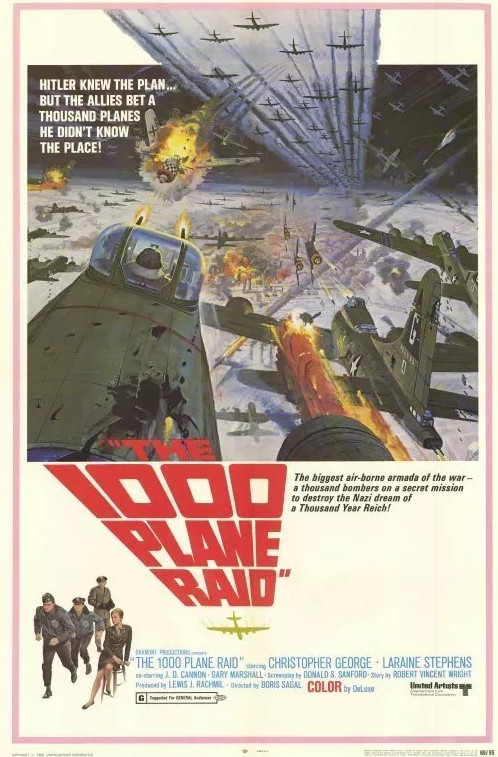
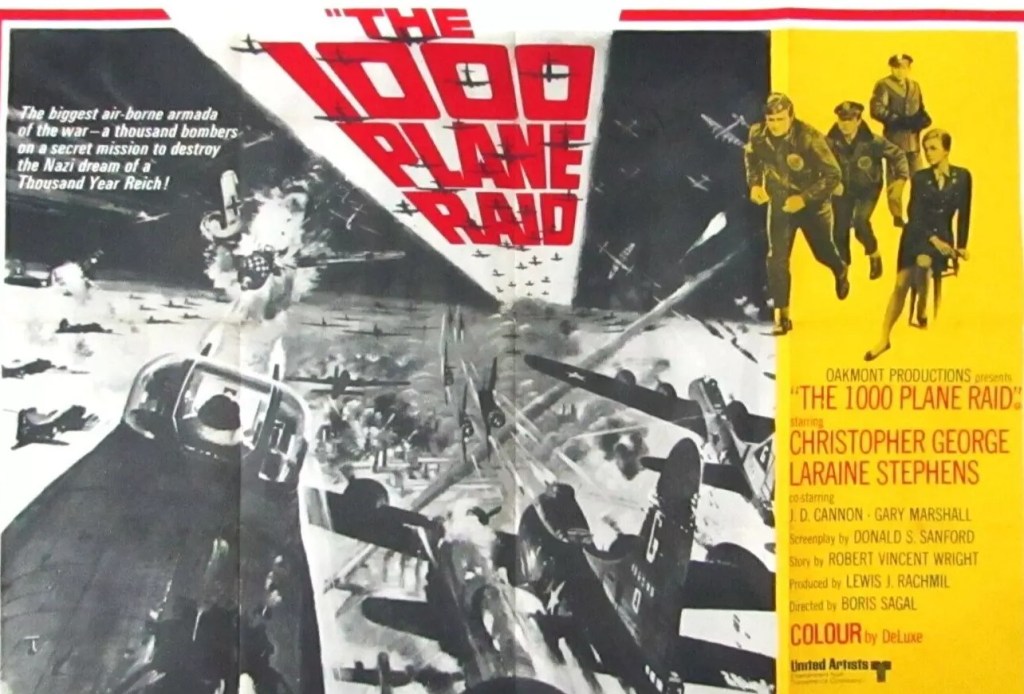
The Thousand Plane Raid (1969) ***

Let’s be honest. Like 633 Squadron (1964) and perhaps even, despite its all-star cast, Battle of Britain (1969), many in the audience will only be there for the hardware, the chance to see the flying battle buses that took the Allies to victory in World War Two. There’s not going to be much of a story anyway – rivalry between commanders, tension on the ground, a romance beginning or breaking apart, a stash of info dumps. That can hardly compare to the grace of the big birds in the air, usually a mixture of stock footage and new work with refurbished old planes.

This one has even re-purposed – perhaps stolen would be a better word – a mission from earlier in the war which was planned and carried out by the RAF so that it could be planned and in part carried out by the Yanks. Still, it was the Yanks putting up the money so I guess they can change history whenever they like.

U.S. Air Force Col Brandon (Christopher George), leading an American bomber group stationed in England, has worked out that while night-time missions result in fewer casualties they are increasingly failing to get the job done, only one on five bombs hitting the designated target. He reckons a gigantic air attack in daylight is the only way to succeed. His boss General Palmer (J.D. Cannon) grants him the chance to pitch his idea to the assembled RAF high command. Despite the risks, they agree and then need to come up with about million gallons of fuel and about a million-and-half tons of bombs, and requisition 30 airfields for the bombers and the same number for the fighter support.

Various elements make life tougher for Brandon. The mission chosen is much further afield than he originally imagined, the deadline is brought forward, his crew is unprepared and needs toughened up, plus his romance with WAC Lt Gabby Ames (Laraine Stephens) has hit a sticky patch and he’s having to deal with a cocky RAF fighter pilot Wing Commander Howard (Gary Marshal) who’s been seconded to the operation. To annoy Brandon further Howard befriends disgraced American pilot Lt Archer (Ben Murphy) who’s been accused of cowardice.

Before we can get to the big event, Brandon also undergoes a crisis of confidence and it’s as much as he can do to pull himself together in time. The screenwriter has arranged for the three main characters to end up in the one plane, allowing Archer to prove himself in battle and Howard to manage some heroics.

The sight of a huge array of WW2 planes in the air without the help of CGI still takes the breath away. Even though the final action pales in comparison with 633 Squadron or Battle of Britain it’s visually powerful enough to see us through.

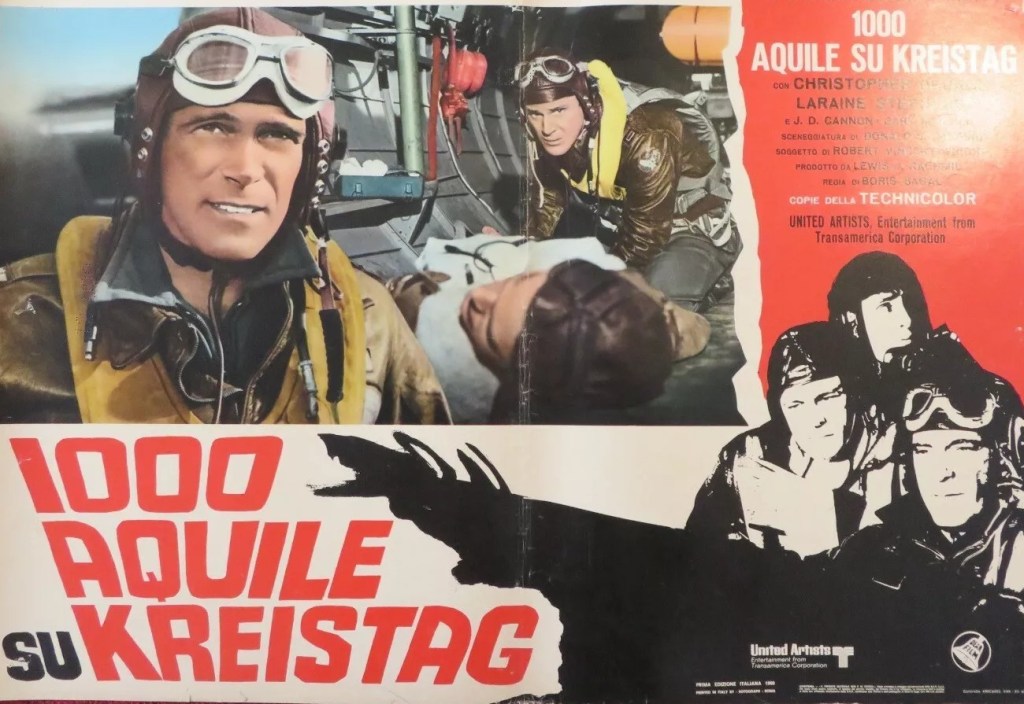
By the end of the 1960s, B-pictures cost a lot more, but that didn’t necessarily result in better performances. Christopher George (El Dorado, 1966), signed up to a five-picture deal by United Artists, isn’t the breakout star. In fact there isn’t one, neither Laraine Stephens (40 Guns to Apache Pass, 1967) nor Gary Marshal (Camelot, 1967), in his second and final movie, making much of an impression. However, the picture was more notable for members of the supporting cast including J.D. Cannon (Krakatoa: East of Java, 1968), Ben Murphy (Alias Smith and Jones TV series, 1971-193), Bo Hopkins (The Wild Bunch, 1969), future director Henry Jaglom (A Safe Place, 1971) and Tim McIntyre (The Sterile Cuckoo, 1969).

One who certainly made the step up was director Boris Sagal (Made in Paris, 1966); in a couple of years he would be helming cult number The Omega Man (1971). Written by Donald S. Sanford (Midway, 1976).

Discover WordPress

A daily selection of the best content published on WordPress, collected for you by humans who love to read.

The Atavist Magazine

by Brian Hannan

WordPress.com News

The latest news on WordPress.com and the WordPress community.