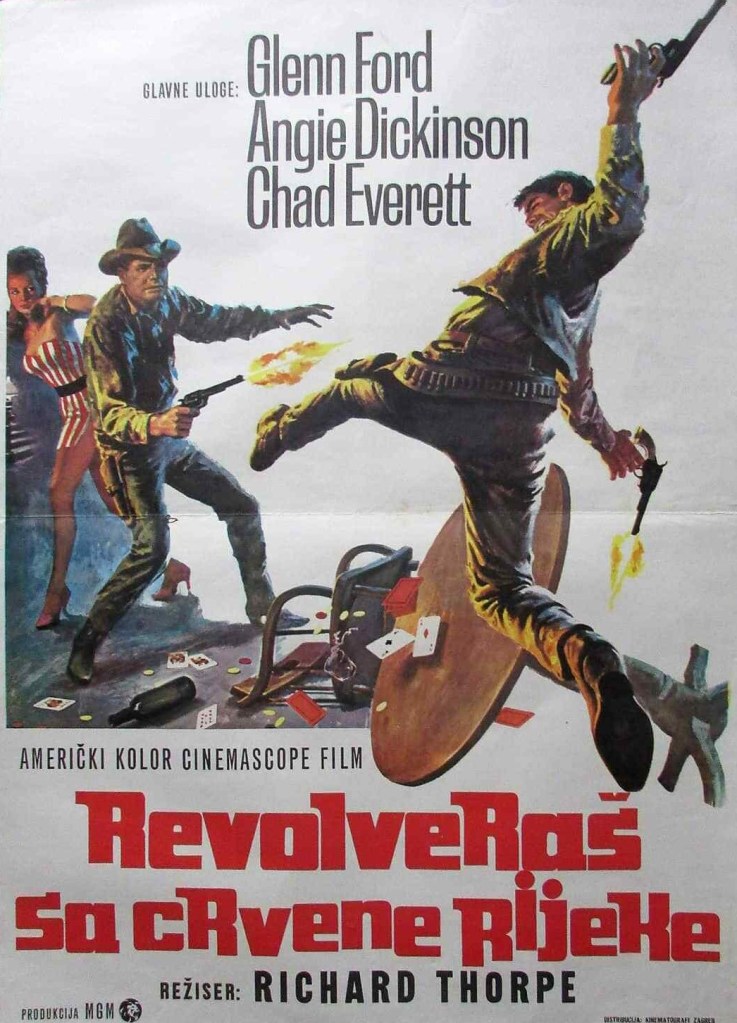
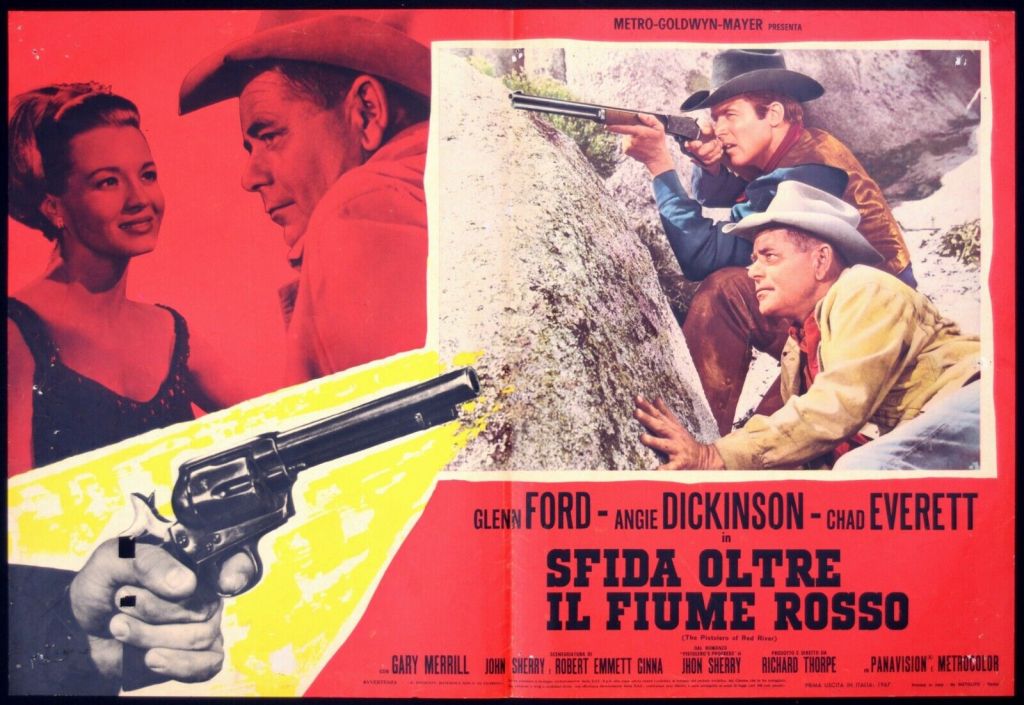
A little gem. Mature, thoughtful, cleverly structured. Plays with expectations. Another assured performance from Glenn Ford (Rage, 1966) with Angie Dickinson (Jessica, 1962) permitted a character of considerably more complexity than normal.
Quite an unusual set-up. Marshal Blaine (Glenn Ford) is an ex-convict, his paramour Lisa (Angie Dickinson) is the local madam. Both are pretty much accepted in this small western town. Some hypocrisy comes Lisa’s way – her money acceptable to a storekeeper who out of earshot refers to her as white trash – but generally the townspeople are happy with an ex-gunslinger as lawman.
But he’s not your standard lawman. He’s very easy-going, not spending all is time upholding the law or out hunting varmints, and she’s not your typical madam either, mothers her employees, keeps unwanted men at a distance, and has made enough money for a fine rig and fancy clothes.
Blaine is sensible but ruthless, taking tough action to prevent a young kid getting into trouble with a dangerous gunman, but having no compunction about shooting the gunslinger. He’s not out for an easy life, but my he does enjoy it, though on a slack day finds fishing more fun than rolling in the hay with Lisa. She knows she has made a good catch, her friend still getting knocked about by her husband, and although Blaine doesn’t seem the marrying kind she has notions of having a baby.
But out fishing Blaine frees a villain Ernest (Jack Elam) who has upset the local Indians. Since they shared a cell way back, Ernest sees Blaine as an easy touch and when told where to go on that score fingers to blackmail Lisa. Meanwhile, this turns out to be an eventful fishing trip. Blaine buddies up with a stranger, Lot (Chad Everett), they fish, cook and drink whisky together until the newcomer reveals he’s on a mission to kill the lawman and take his title of fastest gunman in the southwest.
So you can see where this is headed. Except it doesn’t take that route. Because Lisa, worried that the youngster might well be faster on the draw, hires Ernest to kill him. And when that backfires, it’s only a matter of time before Blaine finds out and you wonder what that’s going to do to their relationship.
There’s some standard stuff, a poker cheat for example, but there’s a lot more going on. Blaine’s young deputy, mostly left to do the chores, tries to throw his weight around with the gunman only to end up with egg on his face. There’s an Native American in jail who we never see and a subplot involving his colleagues that looks like it’s headed in the direction of standard western confrontation until that notion is cleverly nipped away from under the audience’s feet.
Given credence by the worried Lisa is the idea that Blaine is coming to the end of the trail and it’s a testament to the direction that the tension lasts as long as it does. The promotional material gives out that the youngster is a tearaway threatening to shoot up the town, but that’s far from the truth, Blaine trying to talk him out of such rashness while at the same time seeing the boy as a reflection of his younger self.
There’s some brilliant dialog. “Of all the people ain’t worth saving,” Blaine tells Ernest, “you’re the first that comes to mind.” At their first meeting, Lot asks Blaine, “Where’s your tin star?” Retorts Blaine, “You better never see it on me.” As they part, Lot says, “We’ll be meeting again.” Replies Blaine, without aggression, “If that’s the way you want it.”
But there’s quite a lot that’s missed out. There’s no scene of Lisa hiring Ernest, just that he ambushes Lot. The jailed Native American is, as I mentioned, off-camera. There’s none of the usual massive build-up towards a showdown. And even as the shootout approaches, Lisa still doesn’t trust in Blaine’s skill and plans to shoot Lot herself.
That betrayal comes as a helluva shock. When has any lawman’s moll lacked such faith? As for Lot, gunslinging is all that he lives for, the measure of himself, and there’s a purity about him as he rejects countless offers of whisky and women even as he knows he’s making a terrible bed to lie in.
This was very much ahead of its time, especially in thwarting audience expectation not just in the representation of character but in the narrative. It proved a fine last hurrah for veteran Hollywood director Richard Thorpe (The Truth about Spring, 1965). Robert Emmett Gina (Before Winter Comes, 1968) wrote the screenplay based on the John Sherry novel.
As it happened, I watched this back-to-back with Rage so ended with an even better appreciation of Glenn Ford’s talent but was also very taken with Angie Dickinson for the way her character twisted and turned as she attempted to create the outcome she desired. Definitely worth a watch.
There was enough controversy surrounding the launch of this picture without even invoking the behavior of director Sam Peckinpah. For a start its production heralded a revolution in exhibition. Cinema owners were intent on breaking the industry’s one sacrosanct law.
Since 1948 and the Paramount Decree which forced studios to shed their cinemas, it had been forbidden for a studio to operate as an exibitor and vice-versa. But the financial tsumani that hit the business at the end of the 1950s resulted in a shortfall of new releases and left exhibitors scratching around for product.
Taking the view that the situation was so dire that studios could not resolve it and imagining that the government would not look unkindly on the idea, exhibitors set up a company called Motion Pictures Investment Inc. Initially, the outfit was not so confrontational. The plan was simply to repackage old movies and send them out as reissues. There was no law against that since the exhibitors were not acting as production companies.
It was ambitious scheme, calling in 1958 for $25 million to be raised to fund a whole stream of old movies, sending them into reissue achieving the double aim of filling release gaps and preventing them from falling into the maw of television – Twentieth Century Fox in the process of selling 50 pictures dating from 1950-1955 to television for $10 million.
The Actors’ Strike of 1960 halved production, making a dire situation intolerable. MPI bought the rights to Gary Cooper western Friendly Persuasion (1957) and put together a hefty marketing campaign to get that picture back on the market. Recognising that studios were likely to prevent their gems from being reissued when they could be sold so easily to television, MPI bit the bullet and moved into production. Pathe-America was the vehicle, “a production-distribution-exhibition project predicated on the theory that exhibitors can sense better than anybody what the pubic want on the screens.”
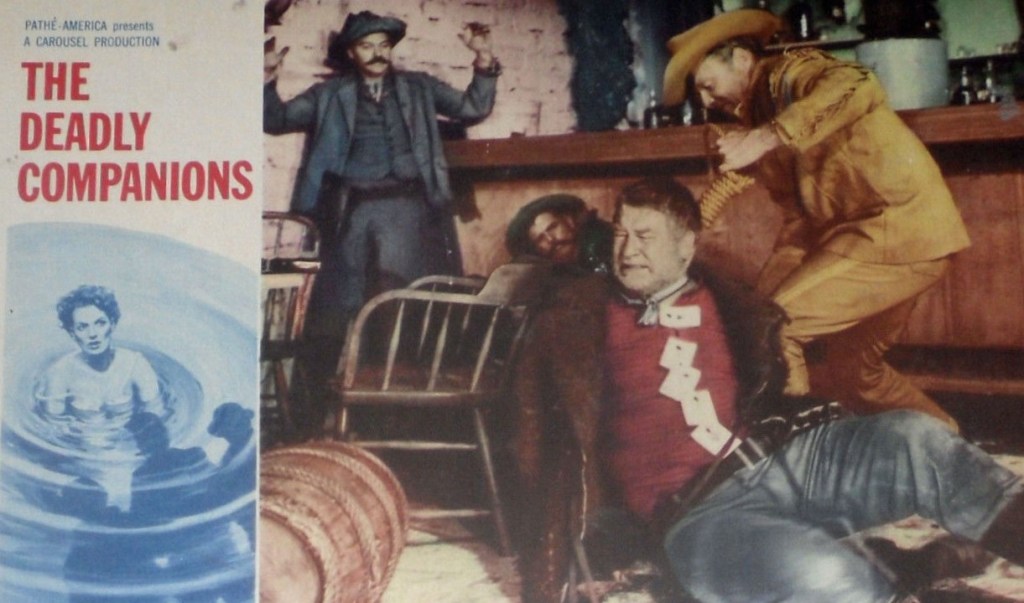
First film on the agenda – The Deadly Companions.
The driving force behind that picture was a female star intent on a bit of revolution of her own – Maureen O’Hara. The flame-haired actress – a star for over two decades, as comfortable in westerns like Rio Grande (1950) as dramas (The Quiet Man, 1952) and swashbucklers (The Spanish Main, 1945) had decided her career was in need of a rejig. Demand for her services was slowing down – only four movies in the second half of the 1950s compared to 14 in the first half.
In reality, her career was sinking fast and it felt like panic to imagine she could reconfigure herself at this late stage as a singer, signing a contract for an album first with RCA Victor in 1958 and then CBS in 1960 and starring in the Broadway musical Christine in 1960, a flop despite her “good singing voice and assured stage presence.”
But a bigger measure of her fall was that she ended up in television, spurred on initially by her brother, Charles B. Fitzsimons, who thought he could help better manage her career. Initially an actor, he had segued into production via independent producer Edward L. Alperson but without particular distinction.
They set up Tarafilm in 1958 with the aim of co-producing a series Women In the Case with CBS, profits to be evenly split. But that never surfaced and instead she was an actress for hire and at modest fees at that for, even for bigger stars, the small screen did not pay fees comparable with the movies. For the first time in her career a year passed without a single movie. In 1960 only television beckoned – Open Window, The Scarlet Pimpernel, Mrs Miniver and the DuPont Show of the Month. And there was something plaintive when O’Hara, who had espoused the freelance approach to her career, advised young stars to take a studio contracts if offered.
But Fitzsimons was feverishly working behind the scenes, trying to raise money for their Carousel movie production shingle, even going so far as applying to the U.S. Government’s Small Business Loan scheme. Without exhibitors determined to break the law, it’s doubtful they would have sourced the funding for The Deadly Companions. MPI put up nearly half the $390,000 budget for The Deadly Companions after Fitzsimons had commissioned a screenplay from novelist A.S. Fleischman.
Brian Keith was available because the television series The Westerner (1960) that had made him temporarily a star was cancelled after not even lasting a season. He came cheap – a steal even for a low-budget picture – at $30,000. Sam Peckinpah, who had originated The Westerner, was primarily a television writer and director thirsting for an opportunity to make his mark on the big screen. So, also out of work after The Westerner was canned, he came cheap too, earning half Keith’s salary.
Peckinpah later complained about script problems, but that was par for the course with the director; if a movie failed it was someone else’s fault. O’Hara, who had worked with the best including Hitchcock and Ford, and like most top stars knew a fair bit about how and where to point a camera, later complained that Peckinpah was out of his depth. But that, too, was par for the course. Her autobiography Tis Herself was almost a litany of complaints.
The problem for O’Hara was more financial. While Peckinpah was guaranteed payment, she was not. As producer, she would be working for a fraction of her normal fee of $150,000, expecting to make that back – and more – when the movie went into profit. There was no reason to assume it would not make a decent sum, low-budget westerns having a habit of making money.
The movie was filmed on location in Arizona. The picture’s Gila City, where the bank robbery took place, was based on the Tucson of a hundred years before. Seeking authenticity, the set was constructed following artist drawings culled from the early 1860s. Props were also authentic – the doctor’s chair was from the period, the surgical instruments remnants from the era and even the apothecary jars had come from an early pharmacist shop.
Extras were genuine cowboys or Native Americans. Apaches and Papagos were hired as Native Americans. At a casting call at the Ramada Inn, producer Fitzsimons found the genuine cowboy article in the in the lobby “their Stetsons stained by sweat and faded by the sun and most of them wore working jeans and multi-colored shirts that had been washed but not ironed…leathery-faced men…speaking in low voices of how bum the cattle business was from all this drought and how fine it was a man could pick up a few dollars riding with the movie company.” Even the cactus was authentic, the director favoring scenes which featured the giant Sauaro species.
The cave for one scene was also genuine, not a stage set, the result of an earthquake fault, 50-foot high and 40-foot across at the opening, spiralling hundreds of feet into the mountain. The roof, made up of boulders, was particularly precarious as any rumble could send it tumbling to the ground. Only essential crew were permitted for the scene which saw O’Hara firing a shotgun at an Apache. Fearing the sound of detonation might affect the roof, flash powder was used instead of cartridges.
Stunts involved included overturning a stagecoach and falling 35-feet. Stuntman Chuck Hayward nearly died during rehearsal when the horse bolted and the stagecoach struck a tree. He was married to Ellen Hayward, daughter of Joan Blondell and Dick Powell.
Perhaps the most immediately unusual aspect of the movie was the score. Among instruments used by composer Marlin Skiles were a toy trumpet, xylophone, vibraphone, kettle drum and cracked belt.
To help promote the picture the screenplay was novelized and went on to sell half a million copies, though it went out under the title Yellowleg and was not noticeably a movie tie-in.
The movie received good reviews. Box Office, which might be expected to back any exhibitor initiative, deemed it a “well above average western” with “superb performances” and “exacting direction.” Variety, which sided more with studios than exhibitors, nonetheless was mostly positive, except for “lapses and weaknesses” finding it “fairly engrossing” with O’Hara’s performance “one of her best for some time.”
As you might expect, exhibitors, too, got behind the picture. There was double “Gala World Premiere” in Tucson and Phoenix, on June 6 for the former the following night for the latter, attended by the stars. Surprisingly, given it was a target for saturation (i.e. multiple release region-by-region) and a low-budget number, it was shown in some major houses, in Detroit the 5,000-seater Fox, in Pittsburgh the 3,700-seater Stanley, a 3,600-seater in St Louis, in Buffalo the 3,000-eater Lafayette, in Cleveland the 2,739-seater Palace and in Seattle the 2,200-seater Music Hall. But bookings were scattered between June and September 1961.
But giving a movie a helping hand would not necessarily translate into decent box office. Takings were poor – the best result a “good” $15,000 in Detroit. Cleveland produced a “fair” $9,000, St Louis a “fair” $10,000, Pittsburgh a “drab” $8,500, Buffalo a “thin” $5,000 and there was but $2,500 in Seattle. No major first run theaters signed up in Los Angeles or Kansas City, in each location going out in small multiple release, edging a “dim” $8,5000 from three cinemas in the former and a “moderate” $15,000 from three in Kansas City. Nor did first run line up to host it in New York and by the time it reached Portland it was playing on the lower half of a double bill.
In an attempt to recover some of its $60,000 loss, MPI changed the title in 1962 to Trigger Happy, altered the poster to focus on action rather than sex, and programmed it in a double bill with its second production The Checkered Flag. That proved a failure and MPI was wound up.
Buoyed by the unexpected success of The Parent Trap (1961), O’Hara’s career recovered and she was paired with James Stewart in Mr Hobbs Takes a Vacation (1962) and reunited with John Wayne for McLintock (1963). Brian Keith never became a major star but still had a very decent career toplining smaller-budgeted films and in supporting roles. Charles B. Fitzsimons made a success of production, though mainly in television. We all know what happened to Sam Peckinpah.
SOURCES: Brian Hannan, Coming Back to a Theater Near You, A History of Hollywood Reissues 1914-2014 (McFarland, 2016) p117-120; Pressbook, The Deadly Companions; “Maureen O’Hara As Disker,” Variety, May 7, 1958, p59; “Maureen O’Hara Bagged for Series,” Variety, August 27, 1958, p27; “Christine Gives Columbia 3 On Showtime Shelf,” Variety, March 23, 1960, p45; Review, Christine, Variety, May 4, 1960, p56; “Longplay Shorts,” Variety, September 28, 1960, p58; “Family Classics,” Variety, November 2, 1960, p27; “MP Investment Trust Puts Coin into Pathe America Release,” Variety, January 25, 1961, p5; “Pathe America’s First Star: Maureen O’Hara,” Variety, November 9, 1960, p4; “Pathe Companions into Saturation Playoff,” Variety, June 7, 1961, p5; Review, Variety, June 10, 1961, p10; Review, Box Office, Jun 12, 1961, pA11; “Gala World Premiere for Deadly Companions,” Box Office, June 12, 1961, p10; “Don’t Do As I Do,” Variety, August 2, 1961, p4; “Fitzsimons Switches Pitch,” Variety, August 29, 1962, p16; “Motion Pic Investors Draws Criticism for Faltering Achievement,” Variety, December 12, 1962, p3; “Missouri-Made Feature in Second Round,” Variety, June 5, 1963, p18. Box office results: “Picture Grosses,” Variety – June 14 and 28, July 19, August 16 and 23, September 6, 13 and 20.
Bank robbers ride into town. They pass kids playing a vicious game. There’s something unusual on a roof. Innocents are killed in the resulting shootout.
Remind you of anything?
Sam Peckinpah’s debut is best viewed as an early dummy run for The Wild Bunch (1969) but the title could refer to any of his westerns since there is always malevolence afoot among any of his marauders, be they soldiers, lawmen or outlaws.
By the simple device of waiting a year until “The Parent Trap” had charmed audiences everywhere, UK exhibitors were able to launch “The Deadly Companions” on the back of it, as if O’Hara and Keith were re-teaming for the western rather than the other way round. “The Deadly Companions” wasn’t released in Britain until summer 1962, a year after its launch Stateside, and on the lower half of a double bill.
He’s done no favors by a genuine oddity of a script which has to shoehorn in various odd characters around a basic premise of escorting a woman across Indian Territory. And, it has to be said, more than occasionally the film doesn’t make much sense.
Strangers Yellowleg (Brian Keith), better known as The Man With The Hat since he refuses to take it off in case he reveals his scalped head, gunslinger Billy (Steve Cochran) and Turk (Chill Wills), former Confederate deserter, team up to rob a bank after the first two save card cheat Turk from an impromptu hanging.
But they discover they’re not the first to come up with robbing the new bank and in the shootout with the other robbers Yellowleg inadvertently kills the son of single mum and dance hall hostess Kit (Maureen O’Hara). She decides she doesn’t want to bury the boy in a town where she is openly despised but plans to put him to rest beside the grave of her husband in an abandoned village in Apache country.
Pricked by conscience Yellowleg offers assistance. But Billy goes along with the idea because, and there’s no getting round this, he wants to rape her. Turk goes where Billy goes. At first she resists all offers of assistance and manages to fend off the amorous Billy but of course she’s not able to fix broken wagon wheels or catch a runaway horse. Eventually, it’s just her and Yellowleg, though the other two turn up at the end, Billy not having given up on the notion of bedding her.
The Native Americans they encounter, as in The Pistolero of Red River/ The Last Challenge (1967) are mostly drunk and no threat. In fact, civilization is deadlier, Kit even cold-shouldered at church, and with travelling companions like Billy danger is a constant. Kit might have done better not to get herself wet so often, since that involves either a) being nude behind a wagon to dry off or b) splashing around in full view.
Surprisingly, the hat provides a couple of tender moments. But mostly it’s kept on because Turk is the guy who scalped Yellowleg. There’s an odd presumption that, although his facial features can’t have changed, that only removing it will alert Turk to his true identity. Yellowleg wants to scalp Turk in revenge. He’s only just found him after five years looking. So when he occasionally abandons Kit in dangerous Apache territory it’s to make sure his quarry hasn’t gone far.
There are some nice touches here, although the tendency towards gorgeous sunsets seems out of place. The person on the roof is, for unexplained reasons, Kit’s son playing a harmonica. The town has odd priorities. It may have a new bank but the local saloon has to double as the church, various paintings of nudes on the walls covered up for the occasion, the preacher (Strother Martin) happily challenging our trio to remove their hats in the presence of God. Yellowleg has “something wrong with his shooting arm,” a bullet embedded close to his collarbone that having found his prey he doesn’t have time for the convalescence required after an operation. Authenticity impinges – a rig carrying a coffin and two people is a lot more cumbersome than a single horse dragging a sled, body wrapped in cloth.
Maureen O’Hara (The Rare Breed, 1966) in tempestuous mode is the star attraction here. She’s independent, sassy, tender in turn, and able, for the most part, to defend herself against Billy. It seems a tad inconceivable that she would fall for her son’s killer much as, for purely practical reasons, she might accept his protection.
Brian Keith’s character doesn’t quite come off since it takes too long for his quest to be spelled out. Neither do he and O’Hara gell as they would in their next teaming, The Parent Trap (1961) .
Steve Cochran (Mozambique, 1964) is mostly in scene-stealing mode and it would have helped his character if it had been spelled out whether Kit was a mere dance hall hostess or one who gave out extras for a price. Chill Wills (The Alamo, 1960) also seems to be on a different planet when it comes to acting. But it does seem a shame all the boys put so much effort into trying to steal scenes when Maureen O’Hara without doing very much sneaks away with the entire picture. A.S. Fleischman (The Adventures of Bullwhip Griffin, 1967) wrote the screenplay based on his own novel, O’Hara’s brother produced, and, you might as well know, it’s the actress who sings the theme song.
You can count on Glenn Ford to bring his A-game to a B-picture. While never reaching the top tier of stardom he had been a box office stalwart in the 1950s until gradually losing his marquee touch in the early 1960s.
This is an odd one, with some nods at Wages of Fear (1953) and any picture that involved a trek or featured a hooker with a heart of gold. The story was certainly unusual – rabies. And the idea of a resulting pandemic will resonate more now than it did then. But it takes quite a long time for the key storyline to emerge, which is just as well because it allows Glenn Ford (Experiment in Terror, 1962) time to turn in one of his best characterisations.
Generally, Ford was Mr Dependable, very capable of holding his own and meting out punishment to anyone who crossed the line. So, this is as far from typecasting as you can get.
Dr Reuben (Glenn Ford) is a washed-up alcoholic working in a flyblown mining pitstop in Mexico, riddled with guilt at the death of wife and child. So when a posse of prostitutes turns up, he’s last in the queue, possibly his disinterest the attraction for Perla (Stella Stevens). By the time he realises he’s contracted rabies, he’s up against the clock, 48 hours to reach a town with an antidote, but still a baby to deliver, a jeep that has to cross a rickety bridge and then runs out of gas, so that, once linked up again with Perla and helped by Pancho, he has to cross mountain and desert to reach safety.
Logic isn’t in much evidence here. Despite knowing he has contracted the disease, he still delivers a baby and then spends most of the final 36 hours in the company of Perla and Pancho (David Reynoso), not to mention that the Mexican has abandoned his wife, who has just given birth in a shack, in order to accompany the doctor, or that the doc finds his way onto a bus loaded up with kids (presumably they are immune).
Not to mention that with a jeep running out of gas surely the last thing you’d want is to weight it down with passengers. And with a budget that’s not going to cater for a proper runaway bus that sequence falls back on the old speeded-up film. And if you’re going down the line of a rickety bridge, do it once, don’t repeat it.
But then you wouldn’t have anyone on hand to deliver philosophic lines, or to start to fall in love (wih Perla, you understand, not Pancho).
Take away the illogicality and there is still quite enough that works. The driver of the hooker truck unceremoniously jacks up his load to dump them in the town. A woman is tied to a table in preparation for giving birth. A suspected rabies victim is dragged through the streets by rope. The hunt for gas leads them to drain oil lamps. There’s a very self-aware Perla, more than enough common sense for both of them. She knows exactly what she has become and that’s something for which there ain’t no cure. But there are a couple of beautifully-wrought scenes that would allow Reuben and Perla to express their true feelings if either was capable of letting go, and you won’t see more expressive fingers.
They struggled to sell this one. The old “woman scorned” line is out of place as is a town eaten up with rage and Glenn Ford does little pistol-packing. But Stella Stevens does look pretty in pink.
And the clock running down also means that the symptoms are building up. Reuben’s senses are heightened. Light is too bright, sounds deafening, and if the doctor is already too ill he won’t be able to drink from a waterfall.
Every now and then director Gilberto Gazcon – who hadn’t made a picture in four years since La Risa de la Ciudad (1962) and wouldn’t make another for three years – chucks in a cinematic morsel, the camera whizzing around or racing back, to show Reuben’s state of mind. But, honestly, he needn’t have bothered.
You hire Glenn Ford and you get everything through his eyes, maybe a sly tensing of his features or a gesture from time to time, but this is one actor – mostly under-rated – who is just rock solid when it comes to displaying character. So when he’s not trying to save himself, dashing from one scheme to the next, he’s flat out trying to stop himself going mad, and only pausing for a bit of reflection as Perla tries to inject some meaning into his life.
Stella Stevens (Sol Madrid, 1968) ain’t that gold-hearted she’s going to let men treat her like dirt, she hands out a couple of good thumpings, but in her world you’re not going to come across any men who aren’t pure predatory, and it’s a shock for her to meet someone who thinks a woman can’t be bought. This is a rounded character – tough but vulnerable, and surprisingly tender should the opportunity arise.
Definitely a mixed-bag and a bit more work on the screenplay would not have gone amiss but top-drawer performance from Glenn Ford.
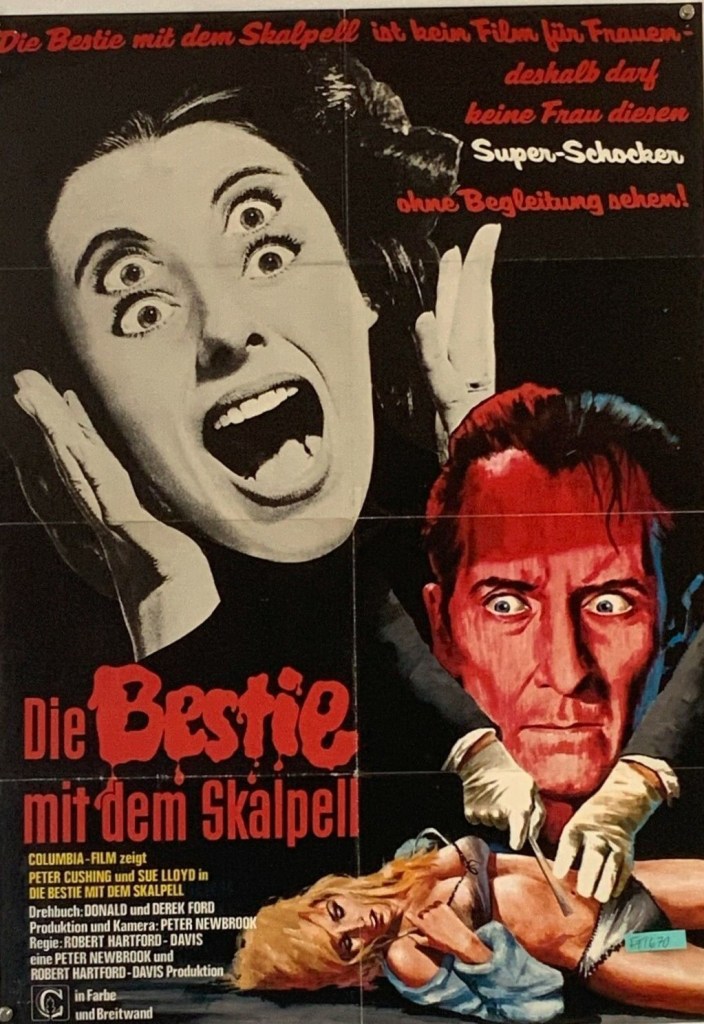
Admit it, you always wanted to discover what went on behind Peter Cushing’s chilly British reserve. The man who appeared to be constantly tormenting that nice Dracula or donning a deerstalker to outwit countless villains or battling otherworldly creatures like the Daleks or just a dependable character who in the unconventional Sixties knew right from wrong.
Of course, our Peter had occasionally come unstuck, the duped bank manager in Cash on Demand (1961) but even as Baron Frankenstein he never revealed a demonic side even as he created monsters who had a tendency to run wild, always civil to the last, stiff upper lip never quavering.
So it’s something of a surprise to see him cast in the first place as the older man lusting after a younger woman. Sir John Rowan (Peter Cushing) is a highly esteemed surgeon who has fallen for model-cum-flighty-piece Lynn (Sue Lloyd) and although he sticks out like a sore thumb at a typical Swinging Sixties party full of gyrating lithe young women he is happy to put up with it for the sake of his girlfriend.
But Lynn has a strong independent streak, she’s not the submissive lass who might have been content to swoon at the feet of such a highly intelligent man, and objects to his attempts at control and can’t resist the chance to show her allure to all and sundry by giving in to the temptation to pose for louche photographer Mike (Anthony Booth), and, as it happens, the assembled throng.
Sir John isn’t going to stand for such brazenness, starting a fight with Mike that ends in a dreadful accident, destroying half Lynn’s face. Naturally, plastic surgery being the coming thing and Sir John capable of turning his hand to anything he’s able to fix up her face good and proper.
Except it’s a temporary measure, something to do with the pituitary gland, and it turns Sir John into a serial killer. There’s no mystery to it, no detective scouting around trying to put together clues, the question soon becomes can Sir John keep it up and what psychological damage is inflicted on Lynn as she comes to the realization that the beauty she had taken for granted, setting aside the predations of age which are still some way off, could vanish in an instant leaving her shrieking in a mirror.
Things get out of hand when they head for the country and fresh victims and find themselves trapped in a home invasion by a gang as gormless and vindictive as the pair from The Penthouse. It doesn’t end the way you’d expect because there’s a twist in the tail that you might accept as par for the course in the unconventional cinematic Sixties or you might just put the producers down for wanting to have their cake and eat it.
Still, it’s good while it lasts. Cushing certainly reveals a different side to his screen persona, and I can’t remember ever seeing him truly in love or indulging in a passionate screen kiss, and certainly to see his murderous side emerge is quite a treat, no scientific excuse to mask his behavior.
And it’s equally good to see Sue Lloyd (The Ipcress File, 1965) in another of those roles where she displayed considerable independence. As an added bonus future Hammer Queen Kate O’Mara (The Horror of Frankenstein, 1970), here cleavage well hidden, turns up as Lynn’s sister. You might also spot Vanessa Howard (Some Girls Do, 1969) and Marianne Morris (Vampyres, 1974). Anthony Booth (Girl with a Pistol, 1968) was trying to shake off the shackles of BBC comedy Till Death Us Do Part
Robert Hartford-Davis (The Black Torment, 1964) does pretty well unsheathing the beast within the context of a vulnerable older man. Derek Ford wrote the screenplay with his brother Donald before he decided the sex film was his way to British film legend. The version released abroad contains more gore and sex than when the British censor had its wicked way.
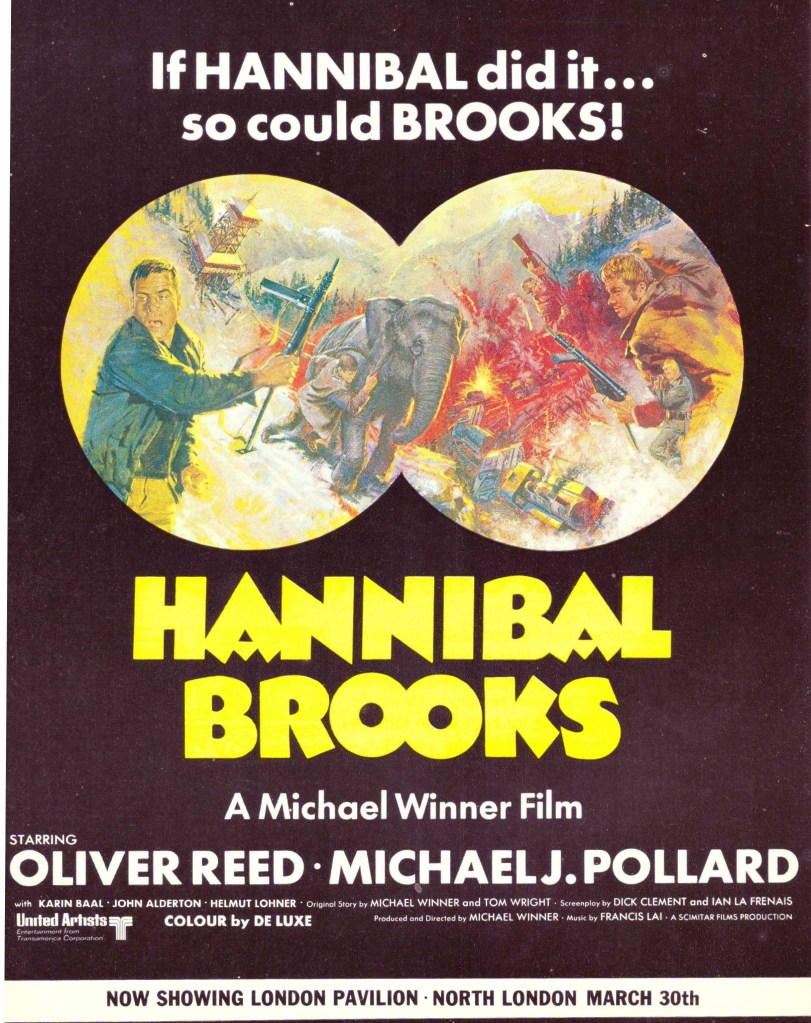
Gruff British star Oliver Reed shows his tender side in this entertaining offbeat POW escape picture. With local German men called up for war, Berlin Zoo relies on local prisoners-of-war to help look after the animals. Stephen Brooks (Oliver Reed) is detailed to look after an elephant (considerably more discreet in his toilette than those employed on Babylon). When Berlin is bombed, Brooks takes the elephant to Innsbruck in Austria.
His nickname is a bit of a misnomer. You would think he was going to emulate his famous predecessor and take the elephant over the Alps and into Italy, which would be possibly a safe destination because at this stage of the war the Americans have invaded and are marching north. But, instead, sadly, he only plans to make it as far as neutral Switzerland, where he would be equally safe.
Naturally he is pursued – and captured, and pursued and captured. But there always seems to be a convenient pile of logs that, a la Swiss Family Robinson, can be weaponised. And should you need any obstacle pulled down, well, an elephant comes in pretty handy on that score too.
Ineffectual American escapee Packy (Michael J. Pollard) turns up from time to time, usually in some piece of action that goes wrong, once to interrupt a romantic dalliance with Brooks’ occasional companion Anna (Maria Brockefhoff). And this being the Tyrol, it seems a shame not to halt proceedings every once in a while to take in a marching band or a traditional wedding or fair and for every damsel to have her cleavage on display.
Heading up the pursuit is Colonel von Haller (Wolfgang Preiss) although you might imagine he had more important things on his mind at this stage of the war than chase an elephant. Various troopers are so easily duped by Brooks they might have gone under the collective expression of “dolts.”
Where the elephant has to take the long way – he could as easily have been called “Slowly” – the Germans can travel by road, rail and cable car. It’s pretty episodic stuff, enlivened here and there by explosions and gunfights and the like and the question of whose side Anna is really on.
In some respects it’s a buddy picture. When the buddy is the elephant it works pretty well. Brooks is surprisingly tender and caring. But when Packy enters the equation and it’s the old question of three into two won’t go it becomes a bit lopsided. You get the impression it’s one of these picture that, to accommodate the budget, required an American star and Michael J. Pollard, with his already-established schtick, was nearest to hand.
It’s just as well Reed has toned down his scene-stealing growls and sideways glances because nobody can steal a scene like Pollard. If the elephant was ever in the slightest genuine danger, then you might have had a better picture, but nobody in those days was going to slaughter such a magnificent beast just to give a movie a harder edge.
Elephant is surplus to requirements in this action-based poster.
So the harder edge never comes, and it skips along uneasily between gentle comedy and action, with a potential screen partnership of unlikely personalities never quite gelling. If director Michael Winner had stuck with Reed and the elephant it would probably have worked much better. Or if the escapees had to blow up some vital factory or carry out another mission deep inside enemy territory it might have carried more narrative thrust.
It’s like two separate pictures, Reed and the elephant and Pollard and his bunch of generally hapless escapees. Harmless enough stuff and interesting mostly for seeing Oliver Reed upending his usual screen persona.
At this point in his career, Michael Winner (You Must Be Joking, 1965) was better known for comedy so perhaps this was his passport to suggesting to Hollywood he could handle action. Certainly, it suggested he could merit a bigger budget, for his next movie was The Games (1970) before stepping into the more comfortable territory of Lawman (1971).
I’d suggest this was equally a stepping stone for Reed (The Assassination Bureau, 1969). This film is largely ignored in assessments of the changes to his acting style that he made to accommodate the critically-acclaimed Women in Love (1969). And you can certainly draw a development line between the Michael J. Pollard of Bonnie and Clyde (1967) and his character in Little Fauss and Big Halsy (1970) where he successfully buddied up with Robert Redford. Dick Clement (The Jokers, 1967) devised the screenplay from a story by the director and Tom Wright, on whose own story of being a POW zookeeper this is based.
Most movies perceived as stepping stones are made of stronger material, and although this is more lightweight, it’s entertaining enough and certainly helped director and both stars switch career tracks.
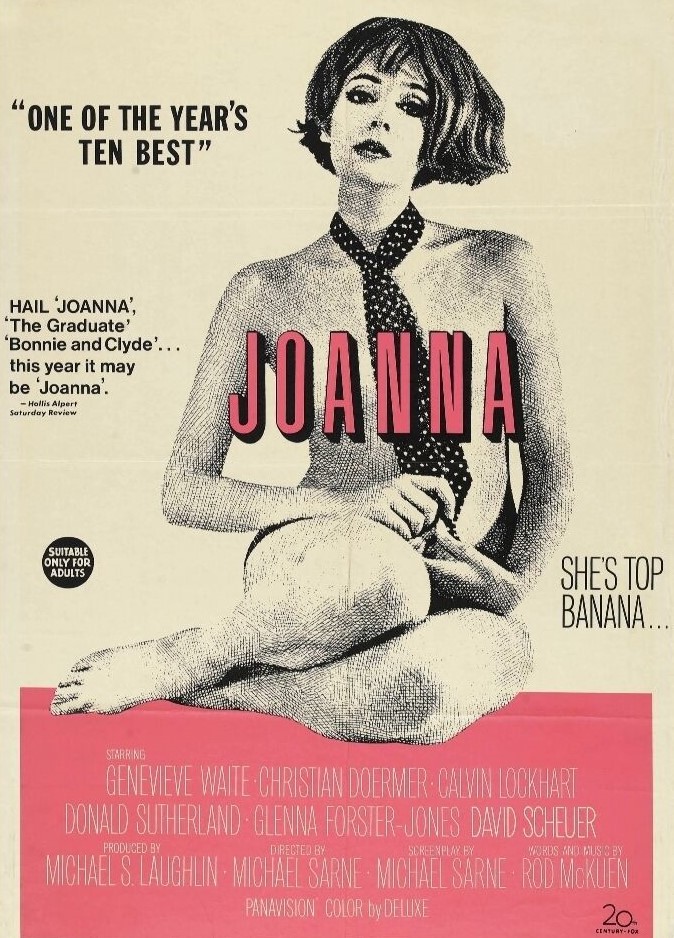
Mike Sarne (Myra Breckenridge, 1970) was one of those talents who ran away with himself, artistic notions indulged by the industry, until he was exposed as having little to say. Joanna is pretty empty of everything except style. And that wouldn’t be so bad if it was consistently stylish or showed a genuine flair for the visual image beyond a woman bathing in a lily pond or chasing an ambulance through a park.
And, of course, it’s never a good idea to park your inexperienced girlfriend upfront and center of your debut feature. Genevieve Waite, a model in the Twiggy fashion, had a thin, whiny baby voice, and lacked the skill to suggest any depth to the titular heroine.
The film stands up today as a shrine to misogyny, for the way in which, in the name of emancipation, women were exploited by men. Sexual freedom, bouncing along from one man to another, is the theme. “All women gained from emancipation is the privilege of being laid,” points out one (male) character. Freedom is expressed as lack of commitment. It’s kind of odd to hear young trendy men going on about commitment and expressing reservations about a flighty lifestyle, but it’s just as if the male authority figure had simply skipped a generation and was determined to keep women in their place.
Joanna, arriving from the countryside laden down with pots of home-made jam, flits through the Swinging London scene, exploring her artistic side through attending an art studio, occasionally working as a model, but more likely living off men, who are as likely to be married, and even then with another woman on the side.
She flits between artist Hendrik (Christian Dormer), nightclub owner Gordon (Calvin Lockhart) and wealthy dying toff Lord Peter Sanderson (Donald Sutherland) with a yacht in Morocco who surrounds himself with talented people because he lacks any talent himself. We don’t learn much about Joanna except her father, whom she fantasizes about cutting his throat, is a powerful enough magistrate that he can intervene when coppers are causing her boyfriend grief.
The other theme explored is racism. Gordon, a Sierra Leone native but a tax-paying British resident for eight years, is subjected to some racial abuse and later given a beating. That’s given more prominence than the miscegenation that would the following year (in 100 Rifles) attract so much controversy.
Lacking a strong narrative – mostly it’s people sitting around talking or getting into bed with each other – the film mostly hangs on a series of fantasies. Any time a new character appears, Joanna has the habit of spiriting them into a fantasy. Gordon’s sister is transformed into a maid in an English country house, Gordon becomes a Regency hero, the minute someone says sex can get you anything you desired even an elephant, lo and behold there’s Joanna sitting atop an elephant.
There’s a self-consciousness that this film can’t quite shake, the idea that somehow Sarne is holding a pillar up to society when in reality it is more a reflection of his own fantasies. The best scene comes at the end when the entire cast sings the theme song along a railway platform. The song, with no sense of irony, rhymes “top banana” with “Joanna.” And, of course, would you believe, this was all a film, director and cameras appearing at the end.
Whimsy is piled upon whimsy and that’s not enough to sustain the film. Waite offers very little except bounce, Donald Sutherland (The Split, 1968) – now coming up on 200 screen and television roles – is sorely miscast. Calvin Lockhart (The High Commissioner, 1968) brings more to the table, a polished performance that avoids the temptation to go too American. Sarne wrote the screenplay.
It’s not as bad as most films that get two stars from me but for the life of me I can’t see how it honestly earns three stars. You can sample it for free – or watch it all the way through – on Youtube.
Box office fans, excited no doubt at how Avatar: The Way of Water (2022), is charging up the all-time charts, might be surprised to discover that the concept of “worldwide” box office figures didn’t exist in the 1960s. Although foreign markets had proved important to Hollywood since the 1940s, there was no accepted way of measuring their impact.
Box office results in certain countries – Italy, France, Brazil, Australia etc – were reported only on an occasional basis and were never considered front page news. Global box office figures were more likely to appear courtesy of one of the profit participants. Star William Holden’s share of Bridge on the River Kwai (1957) and producer Sam Spiegel’s earnings on Doctor Zhivago (1965), for example, were widely reported. Or a studio might want to defray rising investor discontent by pointing how well a Stateside flop such as The Magnificent Seven (1960) had performed overseas.
But these were one-offs and it was impossible to get a handle on the worldwide results for an entire year of Hollywood output. The kind of global box office reporting we take for granted did not appear until the 1990s and often even then, for many pictures, it was only as a year-end figure.
However, during my digging into hordes of records for my book The Making of “The Magnificent Seven” I came upon a tranche of reports on foreign box office figures relating to United Artists for the years 1965 to 1969. And they make for fascinating reading, not least to discover which Stateside hits did poorly abroad and, conversely, what flops in the domestic market made up for it in foreign countries.
Volume of production at UA more than doubled over the period, from 17 pictures in 1965 to 38 in 1969, but the average budget came down from $3.68 million per movie to $2.14 million.
You won’t be surprised to learn that James Bond pretty much reigned supreme, taking three of the top four spots. But you might be taken aback to discover just how profitable this series was – over $100 million in rentals (the studio share of box office once cinemas have taken their cut) for three movies mentioned here – more than four times what they cost to make, and that would not take into account the colossal revenues accruing from merchandising.
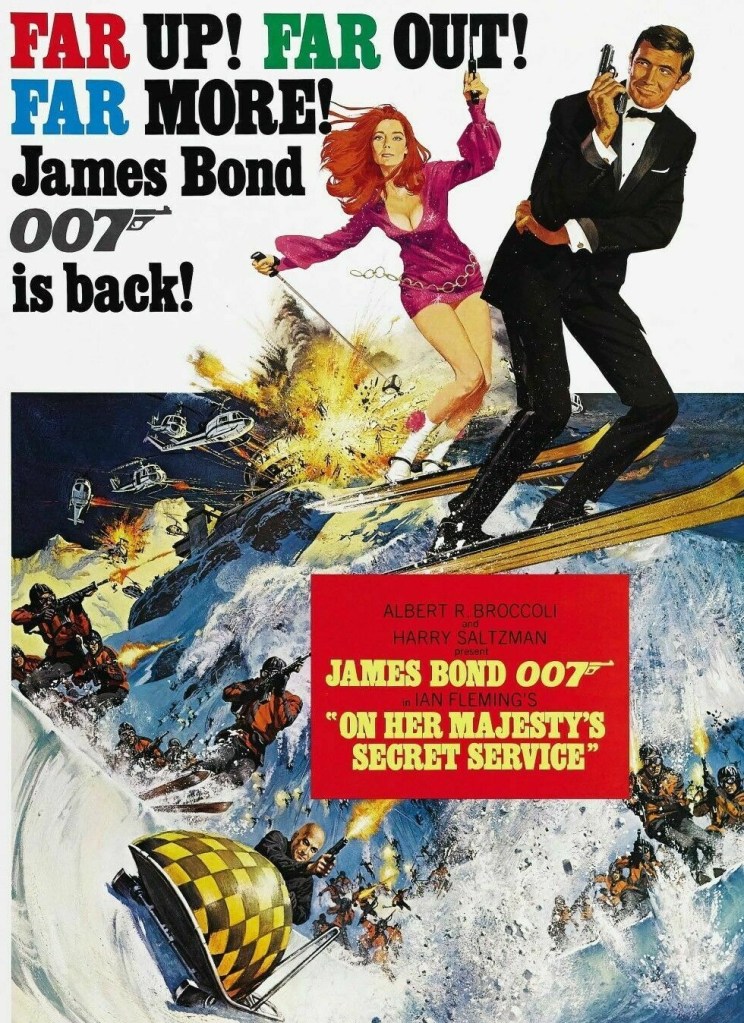
The 1965-1969 worldwide winner by some margin was Thunderball (1965), clocking up $48 million in worldwide rentals. In second place was You Only Live Twice (1967) on $36 million. but the prospect of a cosy one-two-three was nipped in the bud by Oscar-winning Midnight Cowboy (1969) on $26 million with On her Majesty’s Secret Service (1969,) hampered by losing the services of Sean Connery, settling for fourth after pulling in $23 million.
Fifth spot went to big-budget roadshow Hawaii (1966) starring Julie Andrews and Max von Sydow which sank $18.8 million worldwide followed by Norman Jewison’s low-budget crime story In the Heat of the Night (1967) on $16 million helped by Sidney Poitier at a box office peak and Rod Steiger, courtesy of an Oscar, at a career one. Placing seventh was big-budget all-star British World War Two epic The Battle of Britain (1969) which soared, largely on foreign grosses, to $15.5 million. Next, on $14.8 million, came roadshow musical Chitty Chitty Bang Bang (1968) starring Dick Van Dyke.
Biggest surprise of the year was the performance of family melding comedy Yours, Mine and Ours (1968) with out-of-favor stars Lucille Ball and Henry Fonda which closed in on $13 million. Rounding out the Top Ten was George Stevens’ Biblical roadshow The Greatest Story Ever Told (1965). However, its global figures of $12.1 million were a disappointment given its budget topped $21.2 million.
Just behind, on $12 million worldwide, setting another comedic hot pace, was Clive Donner’s What’s New Pussycat (1965). Despite having no roadshow credentials it boasted an all-star cast consisting of Peter O’Toole, Peter Sellers, Woody Allen, Ursula Andress, Romy Scheider and Paula Prentiss. Comedy also accounted for twelfth – the unfancied, though timely, Norman Jewison effort The Russians Are Coming, The Russians Are Coming (1966) starring Alan Arkin and Eva Marie Saint which coasted in with $11.8 million.
Thirteenth was Steve McQueen-Faye Dunaway romantic thriller The Thomas Crown Affair (1968) directed with considerable elan also by Norman Jewison. That flew in with $11.25 million, a cool million ahead of the second picture, Help!, by British pop sensation The Beatles.
Fifteenth place went to the final picture in the Sergio Leone trilogy The Good, the Bad and the Ugly (1968) starring Clint Eastwood which crested $10.2 million. John Frankenheimer’s World War Two thriller The Train (1965) with Burt Lancaster trying to outfox Paul Schofield tracked $9.75 million. But, as if to emphasize Clint Eastwood’s growing box office power, his first American western Hang ‘Em High came next on $9 million worldwide.
Second World War mission picture The Devil’s Brigade (1968) starring William Holden and Cliff Robertson in a Dirty Dozen-style knock-off paraded $8.6 million for eighteenth position. Comedy filled out the final two places in the Top 20. Jack Lemmon scored a suprise hit in Richard Quine’s How To Murder Your Wife (1965). Co-starring Virna Lisi and Englishman Terry-Thomas it romped away with $8.4 million. Although The Graduate (1967) had been a massive global success, United Artists only held the rights to certain territories but that was enough to pull in $7.7 million worldwide.
There wasn’t actually an informal Top 20 reported by United Artists over this five-year period. I’ve concocted it out of the reports below.
SOURCE: “United Artists Corporation and Subsidiaries Motion Picture Negative Costs for Pictures Released in the Year Ended 1965;” “United Artists Corporation and Subsidiaries Motion Picture Negative Costs for Pictures Released in the Year Ended 1966;” “United Artists Corporation and Subsidiaries Motion Picture Negative Costs for Pictures Released in the Year Ended 1967;” “United Artists Corporation and Subsidiaries Motion Picture Negative Costs for Pictures Released in the Year Ended 1968;” “United Artists Corporation and Subsidiaries Motion Picture Negative Costs for Pictures Released in the Year Ended 1969,” United Artists Files, Wisconsin Center for Film and Theater Research, University of Wisconsin.
There was one in every town: a woman, rich (Sanctuary, 1961) or poor (Claudelle Inglish, 1961) or in between (Butterfield 8, 1960), with a predilection for sex. There were several men in every town, queuing up to take advantage. The woman was inevitably a shameful creature, the men the envy of their peers. You don’t have to look further than Frank Sinatra’s tom-catting in Come Blow Your Horn (1963) or Omar Sharif as the romantic star of the decade with two women in tow in Doctor Zhivago (1965) for an idea of the double standards in play. Welcome to hypocritical Hollywood.
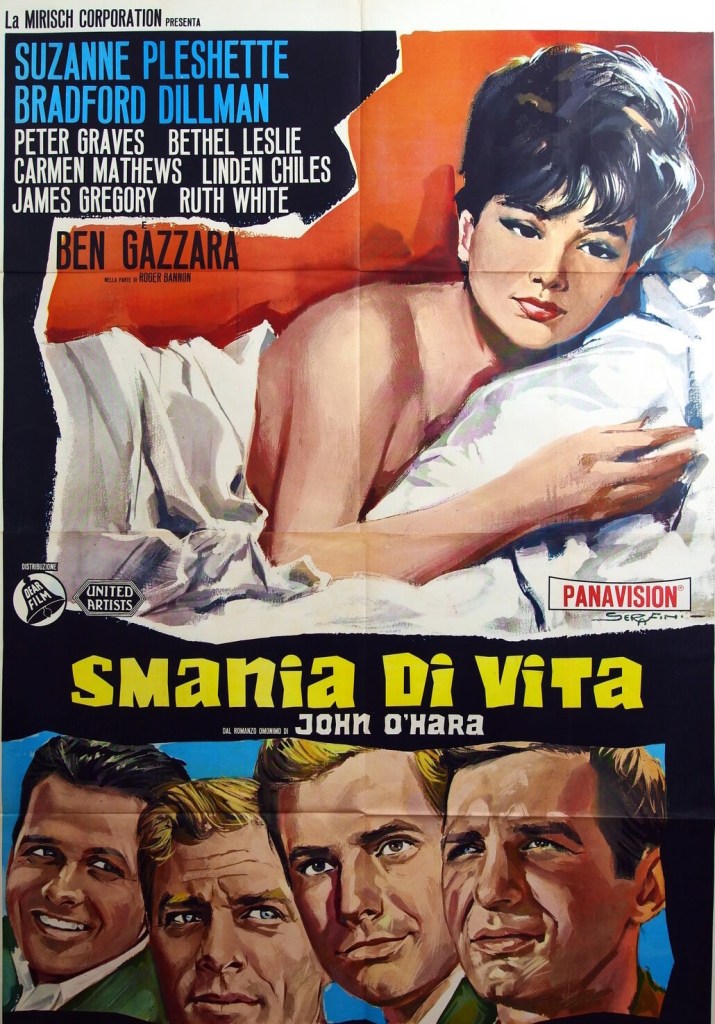
Grace (Suzanne Pleshette), father dead and stuck with a domineering mother, finds escape and fulfilment in sex, and just to give hypocrisy a final tug discovers that while boyfriends are keen to help her explore such physical needs, they take the hump when they discover they might not be the first – or the only. Parents, naturally, are appalled, and discovery of Grace’s antics – and she’s not particularly particular, a passing waiter will do – leads her mother to collapse.
Having confessed to potential husband Sidney (Bradford Dillman) that he will not be marrying a virgin and almost bursting with gratitude that he is willing to overlook her behavior, Grace becomes a farmer’s wife and then a happy mother, until construction owner Roger (Ben Gazzara) comes on strong. She might well have been able to have her cake and eat it but Roger, having fallen in love, reacts badly to being dumped and it’s only a matter of time before her world implodes.
Made a couple of years later, when the independent woman was being exalted, this would have been a different kettle of fish. Here, the boot on the other foot, the woman who picks and chooses her lovers seemed a step too far for that generation.
Before the big trouble begins, the movie does explore, though somewhat discreetly, the almost taboo notion that a woman might just enjoy sex for the sake of it. Sure, Grace likes being wanted and likes being held, but if she was around today, nobody would bat an eyelid if she just came out and expressed her preference.
Less discreetly, the subject of consensual sex comes up, but not as a question of debate, more as a matter of fact, that when Grace says no she actually means yes. There’s a very uncomfortable moment at the beginning when in a Straw Dogs-scene, though nothing like as violent, Grace appears to welcome a rape. Whether this is as bad as it sounds, or is just Hollywood hiding the blush that a woman would not seek out sex but could only discover its pleasures when forced upon her, is hard to say.
Nor is Grace a walking sex machine. She knows enough about men that she only has to put out feelers and any susceptible male will take the bait. And given the restrained times, she’s got no female pal with whom she can discuss her unseemly desires.
Of course, if this was a man, nobody would be batting an eyelid. Sure, once caught, he’d come up with all sorts of excuses, denials, begging for forgiveness, but an audience would give him a free pass. It’s only because this is a woman that it causes ructions. The movie just about gets close to what does make Grace happy and why she needs the thrill of extra marital sex but by that point the melodrama has taken over and there’s little time left for discussion, what with Roger intent on revenge and another lovelorn wife, mistakenly imagining her husband has fallen victim to Grace’s charms, also on the warpath.
Small town constraints play their part, too. Washing your dirty linen in public the worst of all offences. Author John O’Hara, on whose bestseller this is based – and whose other works Butterfield 8, Ten North Frederick (1958) and From the Terrace (1960) explored similar worlds – knows only too well that while wealth brings freedom and privilege it comes with chains attached.
And there’s some interesting role reversal, an illicit lover falling in love with a married person normally a starting point for a movie to explore happiness and its opposite rather than being the one act Grace will not tolerate in a lover, she wants strings-free sex, not anything with encumbrance. While Grace would like to act like a man, and has the wealth to shield herself from the worst of the fall-out, as a mother she is extremely vulnerable, and in this particular era could risk losing her child if seen as maternally unfit.
While lacking the sexual combustibility of Elizabeth Taylor or Lana Turner or other Hollywood heartbreakers, Suzanne Pleshette (Nevada Smith, 1966) gives a decent enough performance especially when it comes to her straightforward attitude to sex, aware she might be causing upheaval, but finding it impossible to ignore desire, or imagine a life in which that does not play an impulsive part.
Bradford Dillman (Sanctuary) has less room for character maneuver and is mostly called upon to suck it up. He comes into his own in the movie’s latter stages when bewilderment at betrayal and public humiliation clashes with continued love for his wife. Ben Gazzara (The Bridge at Remagen, 1969), trademark leer and smug face kept in check, has a showier role especially when the violent aspects of his character explode.
Director Walter Grauman, while better known for war picture 633 Squadron (1963), had just come off another picture dealing with female trauma (Lady in a Cage, 1964) and does quite a decent job here, the camera intensely focusing on the leading actress and then as the tragic outcome unfolds drawing away from her. There’s one great piece of composition. He had used tree branches and the countryside to frame Grace and Sidney at the height of their love. And he does the same again when Grace is abandoned.
Asks some difficult questions without quite getting to grip with the real subject of female sexuality. There was a sense that Hollywood was just on the cusp of accepting the independence of women, but didn’t want to go the whole hog just yet, because, apart from anything else, where would it leave the guys?
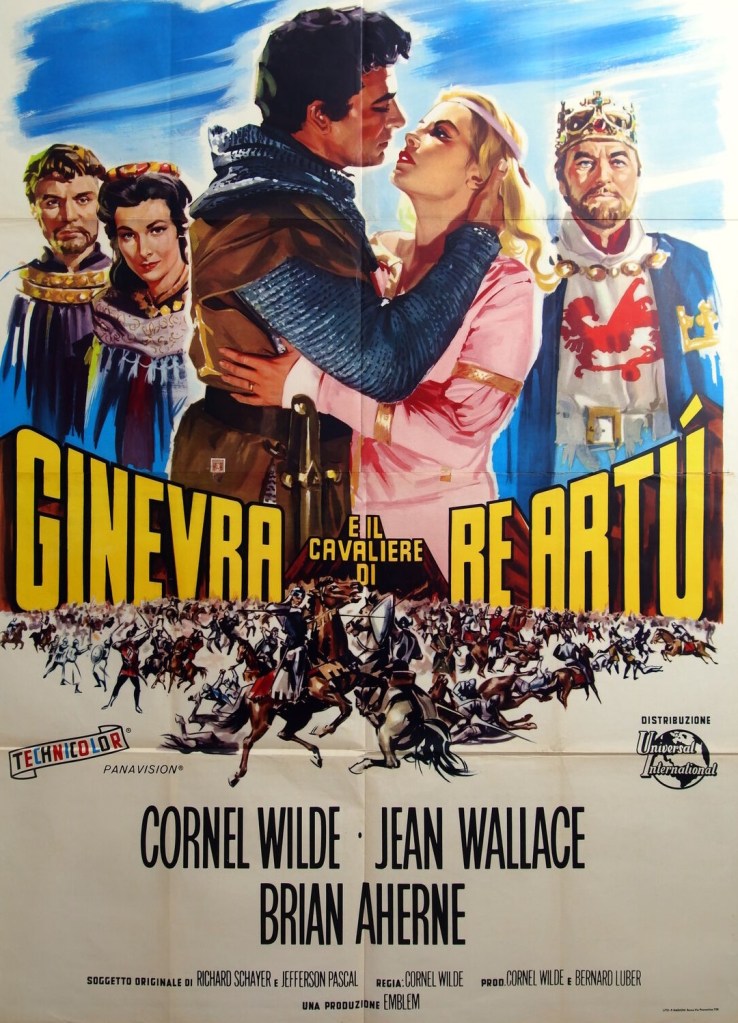
The legend is knotty. On the one hand it’s the most chivalric period in history. Excalibur, The Holy Grail, the feudal-tyranny-busting power-sharing democracy of The Round Table, and before Harry Potter came into view the most celebrated wizard of all time in the shape of Merlin. On the other hand, love was a pawn. Women were traded to cement relationships between rival kingdoms. And humans were all too fallible.
For a start, you had a king, Arthur, who couldn’t keep it in his pants and had already sired a bastard son Mordred who had his own ideas about inheritance. Then you had the king’s champion, Lancelot, who had a similar problem, except in his case he couldn’t keep his hands off the king’s new wife, Guinevere.
To pull off this love story, and keep the audience onside, you needed actors of a high caliber otherwise it sinks to a tawdry tale of adultery and betrayal. Unfortunately, there’s no Robert Taylor-Elizabeth Taylor (Knights of the Round Table, 1951) to hand and the combination of Cornel Wilde and his wife Jean Wallace doesn’t have the same ring or impact.
So, wisely, Cornel Wilde who doubles – make that quadruples – as director, co-writer and co-producer as well as star, concentrates on action, far more than in other swashbucklers of the decade such as Pirates of Tortuga (1961) and King’s Pirate (1967). Wilde has genre credentials, outside of Errol Flynn and Tyrone Power, with At Sword’s Point (1952) to his credit.
And you can’t help taking a liking to a swashbuckler which begins with a joke about soap, and then carries the same riff through to the obligatory bathing scene, where the act of physical washing, rather than merely splashing about in the nude for audience titillation purposes, sparks the relationship between the doomed couple.
This version of the story begins with the French king reneging on the deal to marry his daughter to King Arthur and demanding the matter be settled in the traditional manner, one-to-one combat. Lancelot is elected the English champion. By the time he returns home, complication lies in his wake. It’s not long before suspicions are aroused, Guinevere unable to keep emotions in check when she imagines Lancelot wounded in battle. Indiscretion gets the better of them and when Lancelot is discovered leaving her bedchamber, it’s all lovelorn systems go. Condemned to death for adultery, she needs rescued from a burning pyre.
Guilt ruins exile. Lancelot is now a reluctant rebel. And sex is off the agenda. Matters are only settled in the most drastic fashion, one that ensures an ending to rival Casablanca (1942). Action compensates for acting – Wilde runs the gamut of emotions from grimace to grin while Wallace over-acts – with a number of well-managed battle scenes.
The pick is Lancelot leading an army against raping pillaging Vikings. Apparently impregnable behind a lake that prevents attack on three sides, the Vikings don’t expect the English to block off their escape by setting the forest on fire, forcing them to charge through the water to Lancelot’s waiting troops. Another pitched battle is equally well-handled with thundering horses, each side trading volleys of arrows, and a clever flanking movement.
Although a relative novice behind the camera, Wilde is not afraid to experiment. Tracking cameras are extensively used as is limited point-of-view (opponent viewed through a vizor) although he does resort on occasion to older tricks like speeding up film so foot soldiers resemble Olympic sprinters.
And there is a sprinkling of other jokes and observations. A courtier mangles a visitor’s name in Court Jester fashion. Church bells ring because someone is battering the hell out of the iron casing. A rhymer is on hand to mock. A trumpeter is killed before he can sound the retreat. An old crone chomping on an apple settles in to watch a burning at the stake.
Obviously, in my search for a 1960s swashbuckler, I take the blame for bringing this to your attention. While lacking the charisma of Doug McClure and Jill St John in King’s Pirate and the acting not rising much above the levels of Pirates of Tortuga, this outshines both in the action department.













 The Magnificent 60s