From Noon Till Three (1976) *****

Charles Bronson in a feelgood movie? Charles Bronson the romantic comedy lead? Charles Bronson’s character impotent? The hell you say!

Certainly, Bronson’s boldest role, and if the original concept had played out the way audiences might have expected, the star’s career might have taken the kind of pivot afforded Arnold Schwarzenegger when he took on Twins (1988).  But a third act which probably baffled audiences half a century ago plays straight into the hands of the contemporary filmgoer and spins such a twist – almost a horror version of “print the legend” – that nobody has ever invented a better one.

This isn’t just Bronson as you’ve never seen him before but it’s also Jill Ireland in the role of her life, proving not just that she can act but putting on a brilliant performance.

So, this isn’t like any Charles Bronson character you’ve ever seen, light years away from the monosyllabic justified or unjustified killers he had hitherto portrayed for most of the decade. He’s not even the leader of the gang of outlaws and has a decidedly cowardly streak. And this isn’t Jill Ireland, his wife, either, in some punched-up supporting role. Here she essays her inner Katharine Hepburn or prissy Maggie Smith and engages in the kind of male-female verbal duel that hasn’t been seen since The African Queen (1952).  

When his horse pulls up lame Graham Dorsey (Charles Bronson) decides not to accompany his four outlaw buddies on a bank robbing expedition and despite the prospect of “borrowing” a horse from rich widow Amanda Starbuck (Jill Ireland) he goes along with her pretense that no such beast exists because he’s had a presentiment that the heist will go awry. The gang agree to pick him up on their return at a tension-sodden three o’clock – hence the title, a mild play on High Noon (1952).

Amanda is more than capable of dealing with his kind despite him spinning her a tale of having lost a similar mansion to her grand three-storey affair after the Civil War and being widowed for seven years and so depressed at his impotency he’s contemplating suicide.

In the way of opposites attracting, one thing leads to another and soon they are waltzing, dressed up to the nines, in her elaborate rooms and taking a dip au natural in a lake. When word comes back that the robbers have been caught and are all set to hang, much against his natural inclination not to jeopardize his newfound love, he agrees, at her behest, to go save them. Although he intends doing nothing of the sort and simply lying low, he is pursued by a posse and only evades capture by swapping clothes with a dentist he captures.

And then the tale deftly switches. The posse kills the real dentist. Seeing only his blood-drenched clothes at a distance, Amanda believes it’s Graham. Meanwhile, he’s locked up after being convicted of the dentist’s crimes. She’s so enthralled by the unlikely romance that she writes a book about it that turns into the kind of publishing phenomenon that triggers tours of Graham’s grave and the house where it all happened.

When Graham is released, you expect the sting in the tale will be that she’ll have gone off and married someone else. But she hasn’t. Except she doesn’t recognize him. Because in the writing she transformed him into a much taller more handsome figure and her imagination can’t deal with reality. Any time he reminds her of an intimate moment, she cries out “it’s in the book.” Finally, somewhat rudely, he does convince her but then, afraid of letting down the millions of fans captivated by the legend, rather than reviving their romance, she kills herself so the story cannot be challenged.

Worse, nobody believes Graham and he is accused of being a fraud and ends up in a lunatic asylum. Charles Bronson the madman, you didn’t see that coming I bet.

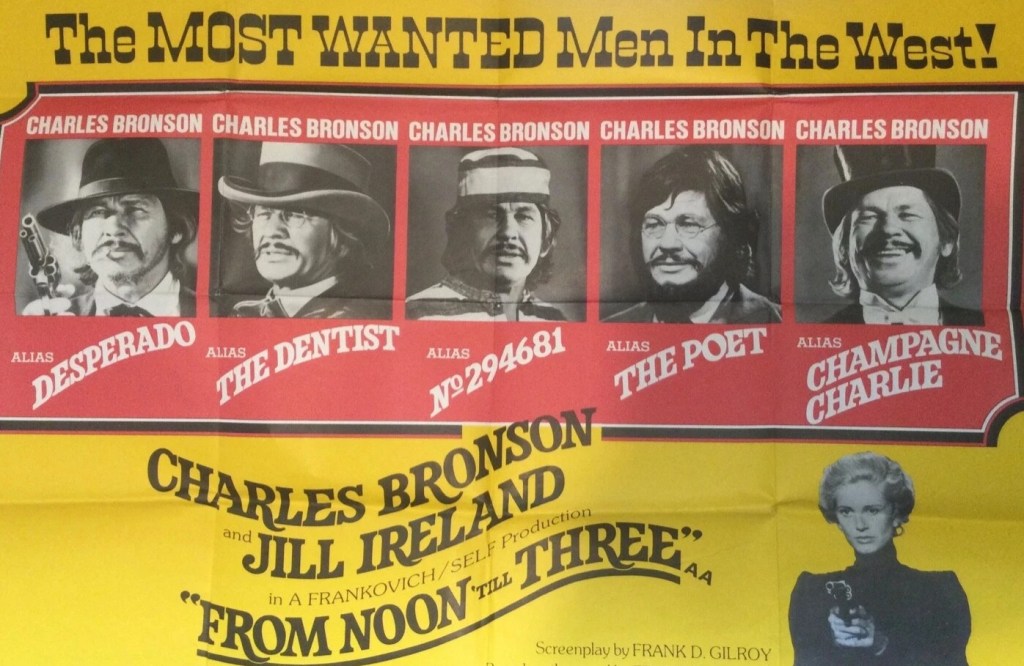
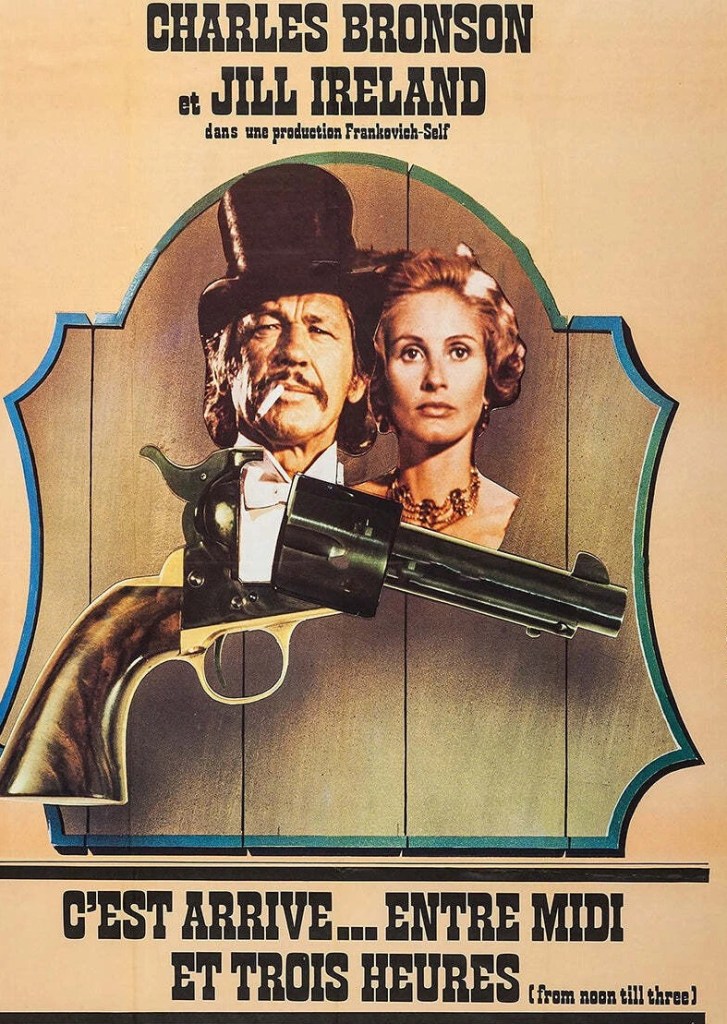
As you can tell from the posters, United Artists had no idea how to sell it and it lacked the single immediately visually-appealing gag of Twins, so it was a rare flop at this point in Bronson’s career. But a third act that was viewed as somewhat deranged satire has, in the half century since, now come into its own when questions about identity and point of view and “your own truth” and “recollections may vary” and imposter narrative and reality reinvention and fake news are endemic. In this case “print the legend” comes to haunt Graham.

But what was a flop in 1976 deserves reassessment and should be welcomed by a contemporary audience more able to deal with the sudden shift in tone. It might also put to rest the notions that neither Charles Bronson (Once Upon a Time in the West, 1969) nor Jill Ireland (Rider on the Rain, 1970) could act. This is a wonderfully spirited double act and had the movie been remotely successful might have set them up as a latter-day Tracy-Hepburn. I should note in passing a wonderful tune, “The Trouble With Hello Is Goodbye,” lyrics by Alan and Marilyn Bergman and music by Elmer Bernstein. Had the movie not been so quickly dismissed, that had all the making of a torch song.

Writer-director Frank D. Gilroy (Desperate Characters, 1971) has produced some scintillating dialog as well as bringing out the best in the couple. As clever on the spoofery front as Blazing Saddles (1974) and Support Your Local Sheriff (1969) but with a harder satirical edge.

I chuckled all the way through. It was a delight to see Bronson and Ireland playing such refreshing characters and the rom-com element worked out really well. So two bangs for your buck – a reinvented Bronson in the kind of role you never thought he could manage, and the kind of satire that hits home today.

Put aside all thoughts about what Charles Bronson and for that matter Jill Ireland can do or should do and sit back and enjoy this unexpected gem.

You can catch it on Amazon Prime.

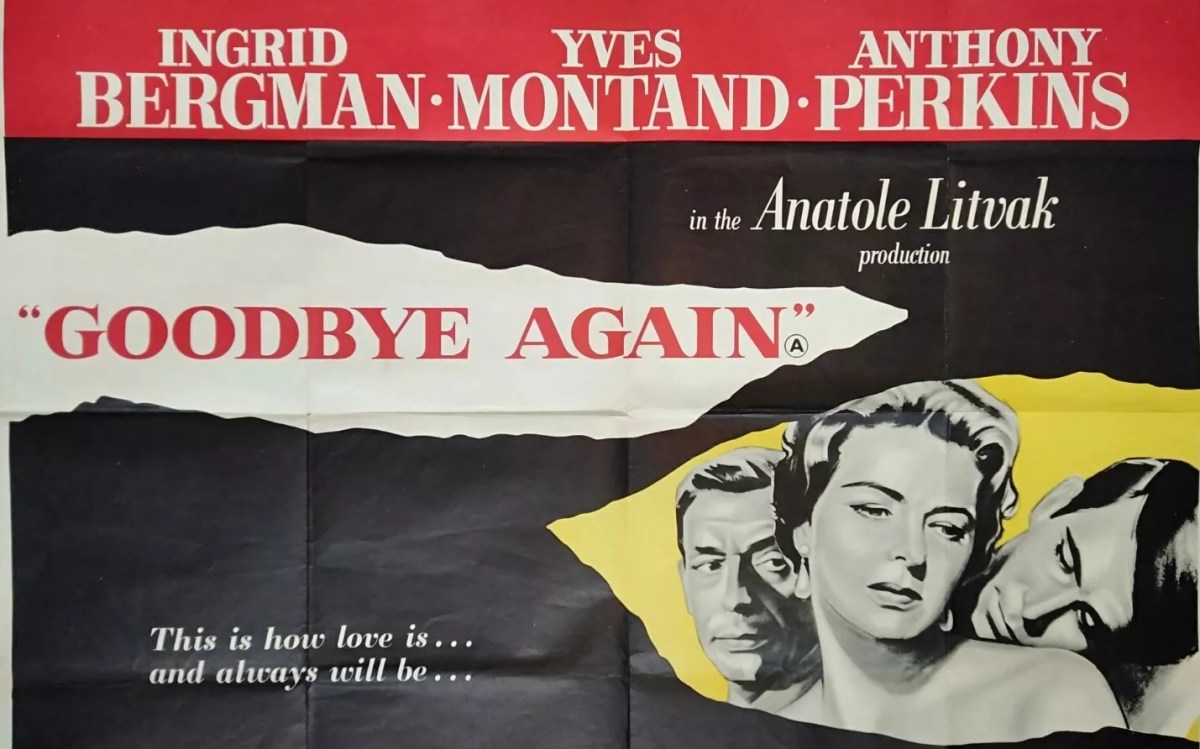
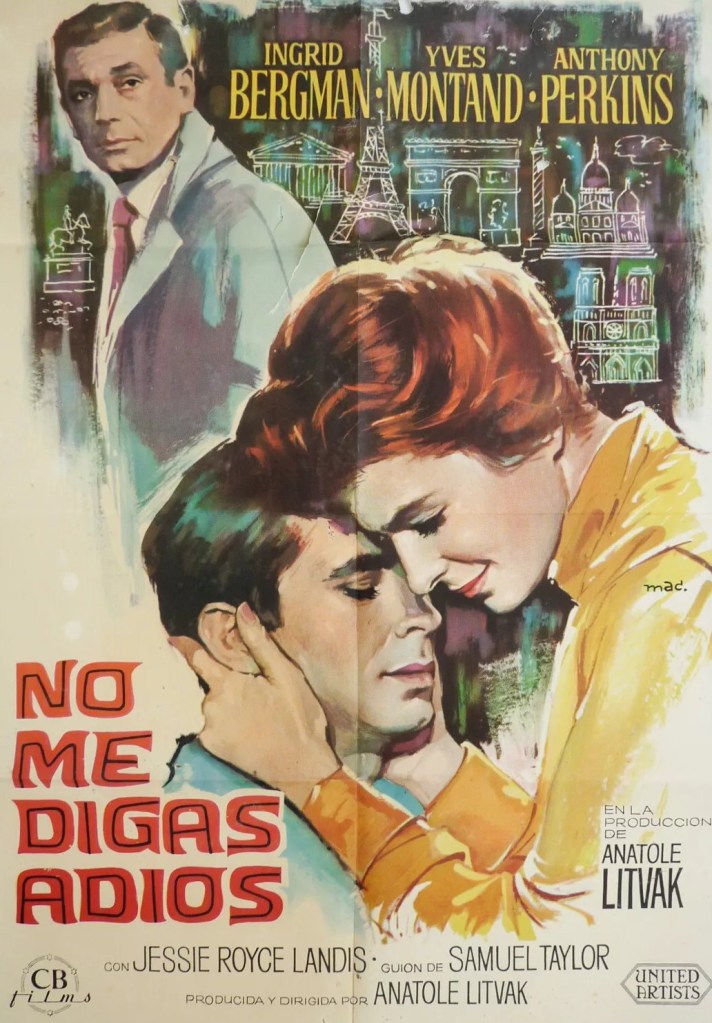
Goodbye Again / Aimez-vous Brahms (1961) ***

Something of a feminist icon with middle-aged single woman choosing her lovers. I should warn you that there’s a May-December trope, which was very common at this period, as older female stars, engaging on romance with younger males, catch up with the unchallenged notion that any ageing male star should be accorded a younger female partner regardless of the age difference.

Paula (Ingrid Bergman), a lady of independent means, is tiring of philandering lover Roger (Yves Montand). After five years, he still can’t keep his hands off any young girl – known as “Maisies” – who come within reach. Paula is pursued by a younger man Philip (Anthony Perkins) and eventually succumbs to his ardent wooing. They differ on whether their relationship has much of a future, she the more pragmatic of the two, as, I would guess, are the audience.

While he’s refreshing and energetic, the spoiled rich boy exhibits childish tendencies. There’s a clash between the independent woman and the older macho misogynist male who expects his lover to be at his beck and call, even when his disappearances are the result of assignations with other lovers.

A middle-aged woman was as much on the hook to an unfaithful lover as a married woman. While she doesn’t want to be married, she wants to enjoy the same sense of trust that marriage might bring. However, she’s not destroyed, as a married woman of the period might have been, by her partner’s infidelity. And precisely because they are not bound by legal obligation, she is perfectly within her rights to choose another lover.

Still, there is an intense melancholy that she cannot make Roger settle down with just the one woman – her – and that if their affair is to continue it must be on his unacceptable terms. Yet she is terrified of being alone and except for the appearance of Philip and her independence there is the sense that she might subdue tragic instinct and settle for the crumbs from Roger’s table.  

Glorified soap opera, no doubt, but it survives on the playing of Ingrid Bergman (The Visit, 1964) who shares with Deborah Kerr the ability to show conflict and sadness in her eyes. She brings so much depth to her character you are apt to forget you are watching a soap opera. That she remains attracted to Roger beyond the realms of logic compounds her tragedy.

Anthony Perkins (Pretty Poison, 1968) is very charming, ridding himself in the main of the jumpiness that appeared to fit his screen persona. While Perkins and Bergman make an unlikely screen couple, they are a believable one.

Yves Montand (Let’s Make Love, 1961) doesn’t have to drift much outside his screen persona of male fantasy figure, the one who has all the dames at his feet.

This is one of those very well-made Hollywood movies, full of gloss, trimmed with an edginess that soon takes center stage. Made in the 1940s it would be a classic weepie. The ending will take you by surprise.

Directed by Oscar-nominated Anatole Litvak (The Night of the Generals, 1967) in determined old-fashioned style from a screenplay by Samuel A. Taylor (Topaz, 1969) based on the Francoise Sagan bestseller.

An old-fashioned treat.

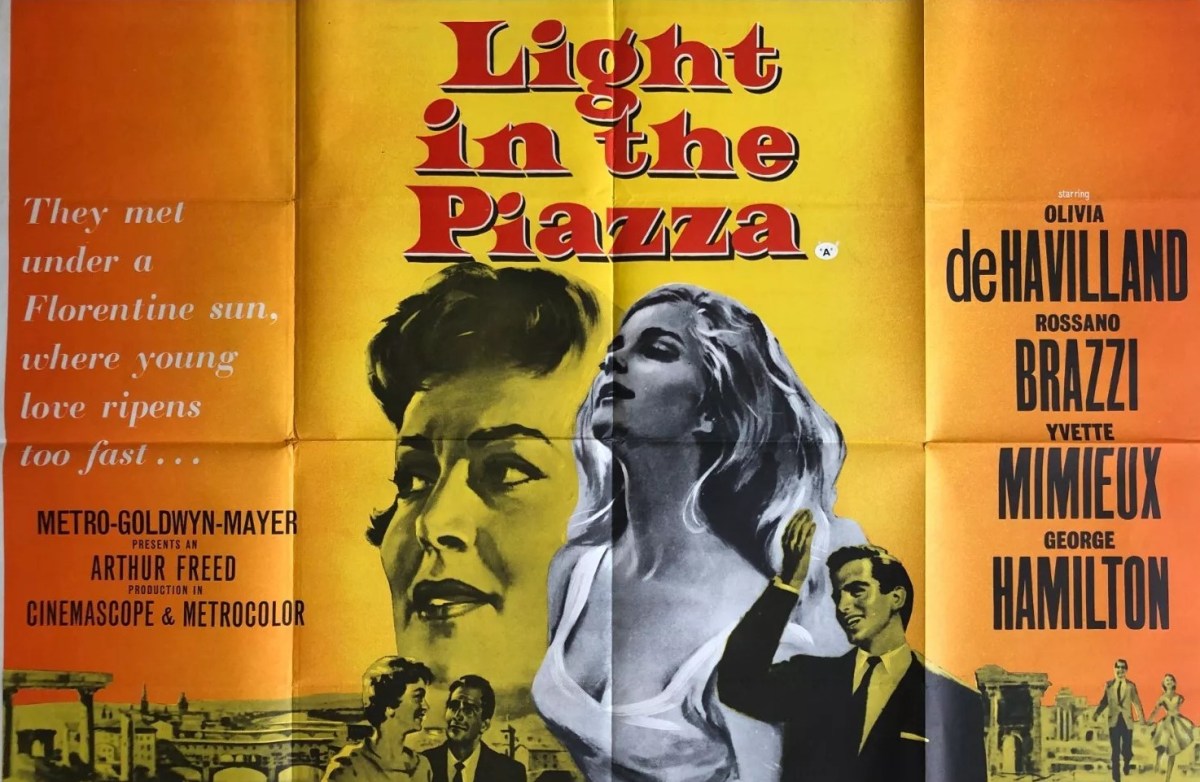
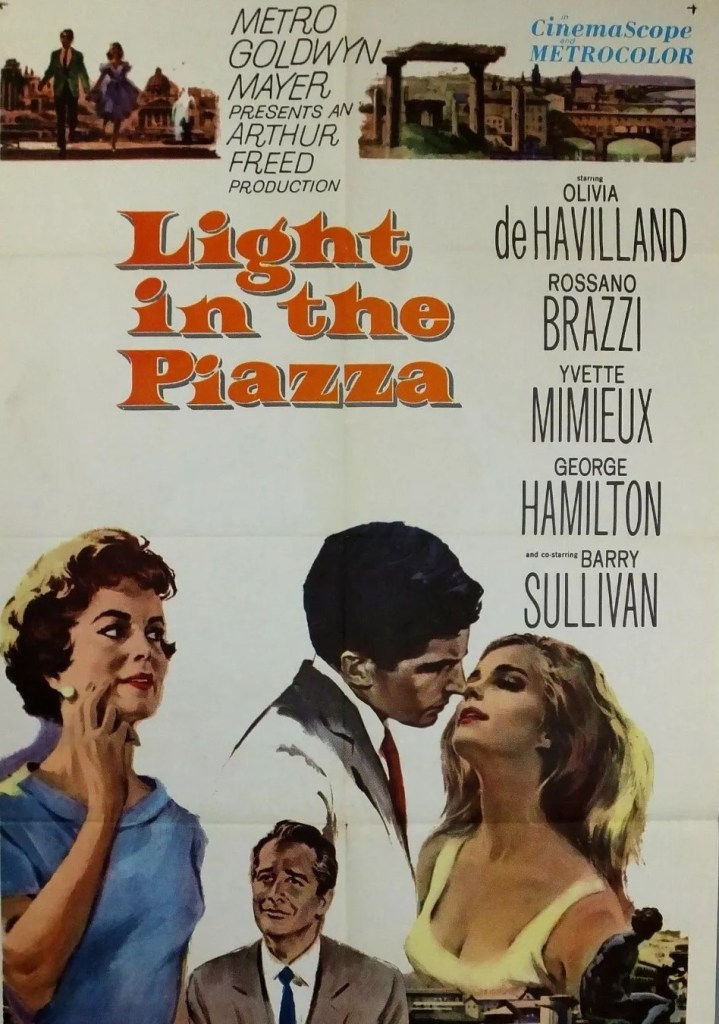
Light in the Piazza (1962) ****

Will resonate more strongly today. Never intended as a light-hearted confection, despite the obvious premise of young love catching fire in Italy, this was a bold picture in its day and a more subtle examination of the wider impact of mental illness than those later movies set in institutions such as Lilith (1962) or Shock Treatment (1964). Bold, too, of Olivia de Havilland to take on a role that is so transparently maternal. Instead of her middle-aged character succumbing to romantic opportunity as the billing might suggest, to a holiday affair with a rich handsome Italian, she is first and foremost a mother.

Initially, standard romance meet-cute as young Italian Fabrizio (an unlikely George Hamilton) catches the runaway hat of young blonde Clara (Yvette Mimieux) in a piazza in Florence. His ardent pursuit is thwarted at every turn by Clara’s mother Meg (Olivia de Havilland). At first this appears to be for the most obvious of reasons. Who wants their naïve daughter to be swept away by a passionate Italian with heartbreak and possibly worse consequence (what mother does not immediately conjure up pregnancy?) to come.

Sure, Clara seems flighty and a tad over-exuberant and perhaps prone to tantrums but then back in the day this was possibly just an expression of entitlement by rich indulged young women. Turns out there’s a more worrying cause of her sometimes-infantile behavior. She was kicked in the head by a pony and has the mental age of a child of ten. If she is not protected, she might end up as prey to any charming young man.

Clara needs tucked up in bed with a stuffed toy, and her mother to check the room for ghosts and read her a bedtime story before she can go to sleep. Even when Fabrizio’s credentials check out – his father Signor Naccarelli (Rossano Brazzi) vouches for his good intentions, but, in the way of the passionate Italians, would not want to stand in the path of true love.

Clara’s father Noel (Barry Sullivan) is the one who spells out the reality. That pony didn’t just kick his daughter in the head it “kicked the life out of” his marriage. His wife lives in a dreamland, hoping for a miracle, and if that is not forthcoming quite happy to live with a daughter who never grows up. He wants to send her to “a school,” convincing himself it’s “more like a country club.”

Meg fights her own feelings that she knows better than her daughter and that love will not provide the cure, at the same time as batting away the affections of the elder Naccarelli. When she finally gives in to her daughter’s desire, wedding plans fall apart at the last minute when Naccarelli Snr discovers that his 20-year-old son is marrying not, as he imagined, a woman of roughly the same age or slightly younger, but actually someone six years older. Eventually, the wedding goes ahead. Meg convinces herself she did the right thing in permitting the marriage to go ahead.

But this is one of those happy ever afters that don’t quite wash and you might find yourself wondering exactly how it played out when the husband discovered exactly what kind of wife she had. Her instability isn’t genetic so no danger of a subsequent child encountering the same issue. And having to care for someone other than herself might well bring out the same level of maternity as her mother shows, but equally clearly Fabrizio is unaware of exactly what he’s taking on. How will he feel when asked to read her a bedtime story or scour the cupboards for imaginary monsters.

The movie didn’t do well enough to warrant a sequel – audiences expecting romantic confection were disappointed – and just hope Clara didn’t turn into the kind of inmate seen in Lilith and Shock Treatment.

Still, takes a very realistic approach to the problems of someone with such problems maturing into adulthood.

The Oscar-garlanded Olivia de Havilland  (two times winner, three times nominee), in her first picture in three years, clearly didn’t want to see out her maturity in those May-December roles that others of her age fell prey to. She is excellent here, no attempt to dress herself up as a sex bomb, and refreshing to see her approach. Yvette Mimieux (Diamond Head, 1962) is excellent as the confused youngster. George Hamilton  (The Power, 1968) lets the side down with his speaka-da-Italian Italian but Rossano Brazzi (The Battle of the Villa Fiorita, 1965), who is Italian, has no trouble with the lingo or with being a smooth seducer.

Director Guy Green (Diamond Head, 1962) adds in some unusual Florentine tourist color, but doesn’t shirk the difficult storyline. Julius J. Epstein (Casablanca, 1942) wrote the script.

Worth a look

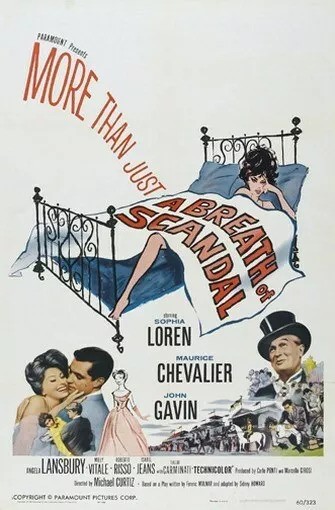
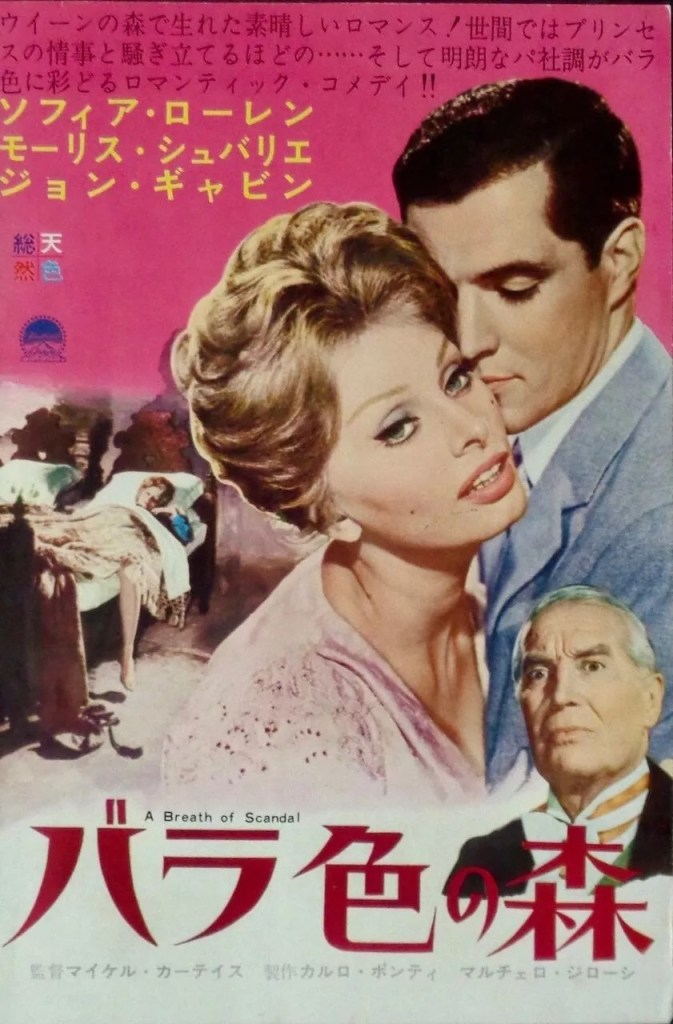
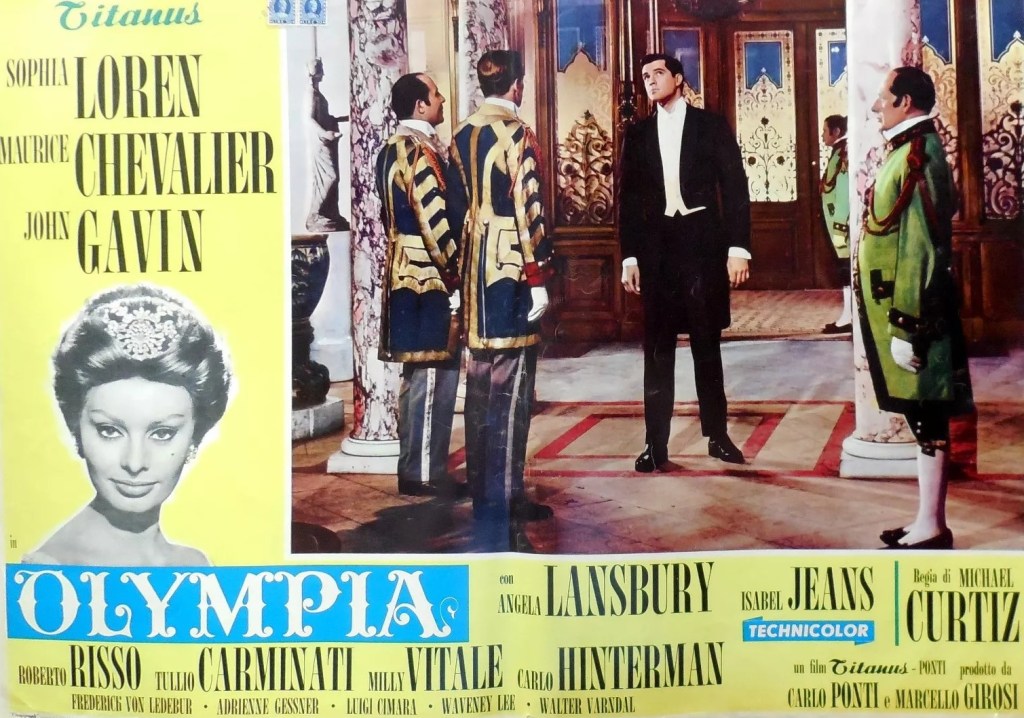
A Breath of Scandal / Olympia (1960) ***

Sophia Loren in playful mood. Not every serious actress could whip up a confection as light as this. She was in the middle of a romance period embracing both comedy and drama that began with Houseboat (1958) and rattled through to The Millionairess (1960) before embarking on a half-decade of more serious stuff starting with her Oscar-winning performance in Two Women (1960).

Easy to dismiss her here as all pout and bosom, but there’s a distinct egalitarianism on show, especially given it’s set in early stuffy 20th century Vienna, where protocol reigns, making life difficult for a lass who wishes an active sex life outside the constrictions of marriage.

There’s not much to the story, in fact it’s as flimsy as heck, but the kind of picture that a top star can swan her way through and charm the audience with her.

When we meet Olympia (Sophia Loren) she’s been exiled to the countryside for one scandal too many and to ease her boredom takes potshots at anyone visiting her quaint castle. Out horse-riding, she tangles with a motor car driven by Yank businessman Charlie Foster (John Gavin) and engineers that they spend the night in a nearby hunting lodge, leading him to believe she’s an ordinary peasant girl and not a princess.

Summoned back to Vienna by her father Prince Philip (Maurice Chevalier) and mother Princess Eugenie (Isabel Jeans) because they’ve found a prospective suitor in Prince Ruprecht (Carlo Hintermann), she encounters Charlie again because he’s trying to sell her father on some business deal.

On the sidelines causing trouble is (Angela Lansbury) who threatens to dish the dirt on Olympia and Charlie and cause a great scandal. And, really, that’s all there is to it except, as had become somewhat de rigeur in his pictures, Maurice Chevalier chips in with a song.

But the settings are glorious and costume design takes the top prize. While everyone else has a whale of a time, John Gavin (Midnight Lace, 1960) looks lost, wooden and out of his depth, unable to respond to the mischievous sparkle of La Loren. This could easily have been devised to show Loren at her marquee best, the belle of the ball, but with a cunning mind, quick repartee, and surprisingly feminist in her approach.

It was one of those Hollywood-Italian co-productions that were starting to take off with little regard for national gridlines. Though set in Austria, the female lead was Italian, male lead American, Maurice Chevalier (Jessica, 1962) as French as they come, Isabel Jeans (The Magic Christian, 1969) is English and director Michael Curtiz (The Commancheros, 1961) Hungarian.

It’s hardly demanding and since Gavin doesn’t step up to the plate lacks the necessary sizzle but all that means is Loren can steal the spotlight. Walter Bernstein (The Magnificent Seven, 1960) and Ring Lardner Jr (The Cincinnati Kid, 1965) turned the Frederic Molnar play into a screenplay.

Easy to criticize if you’re wanting something more demanding, but otherwise effortlessly enjoyable.

Perfect Saturday afternoon matinee material.

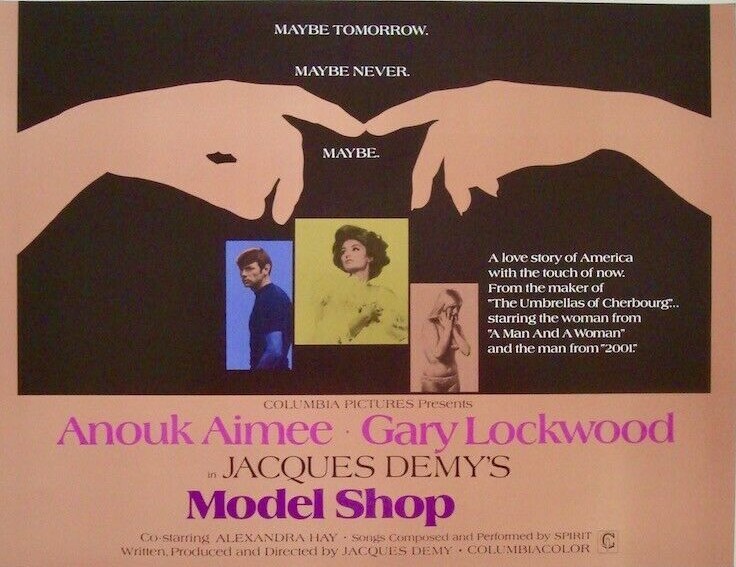
Model Shop (1969) ***

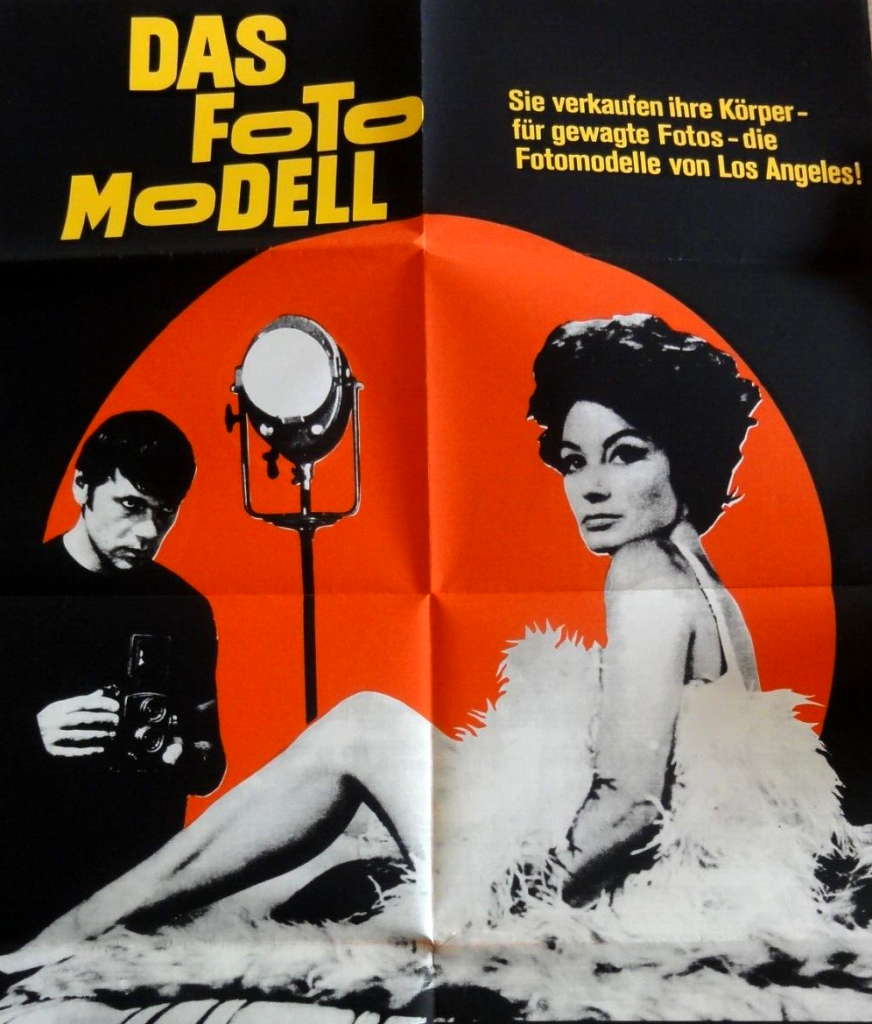
Surprising number of similarities to The Appointment (1969), including the aura of seediness, but lacking that film’s inherent tension or style. Lola (Anouk Aimee) is another model pursued by a another man who catches a glimpse of her in the street as in the Lumet affair. But it turns out a “model shop” is a tacky dive where men pay to take photographs of semi-naked women rather than anything to do with haute couture.

Lola is as depressed as Carla in The Appointment and for the same reason, abandoned by her boyfriend, who has gone off to gamble in Las Vegas. But new lover George (Gary Lockwood) is the antithesis of the successful Omar Sharif. You are inclined to give him a free pass because he’s got the draft hanging over him.

If he was disaffected, that could explain it. But he’s just bone idle, sponging off everyone in sight, musician friends and more ambitious girlfriend Gloria (Alexandra Hay), an actual model, though more in the commercial line than high fashion, but bringing in enough to pay his bills.

You might feel sorry for him that “the man” is trying to repossess his car until you see it’s an MG coupe that an unemployed guy could not afford and that when he does get enough cash to pay the outstanding payment he comes up with another excuse rather than parting with the money. He studied architecture but hasn’t the gumption to make his way in the adult world whereas Gloria accepts she might have to sit in a bathtub naked for a potential client if she wants to get on.

He won’t marry Gloria or give her a child so she’s full of empty threats to leave him but doesn’t carry that out until she discovers photos of Lola that he’s left lying around. There’s not much going on. It’s certainly a downmarket world. George and Gloria lived in a rundown suburb of Los Angeles with a pumpjack drilling for oil outside their front door.

A good chunk of time is spent on the road, not “out along the highway looking for adventure” as in Easy Rider (1969) and not in the great outdoors, but mindless drifting, or tailing Lola, around L.A.. There’s some kind of deadline on their romance – she’s headed home to France, his call-up is immediately imminent so unless there’s some expose of the seedier side of the city going on there’s not much else, just two people who lost their way finding brief solace in each other.

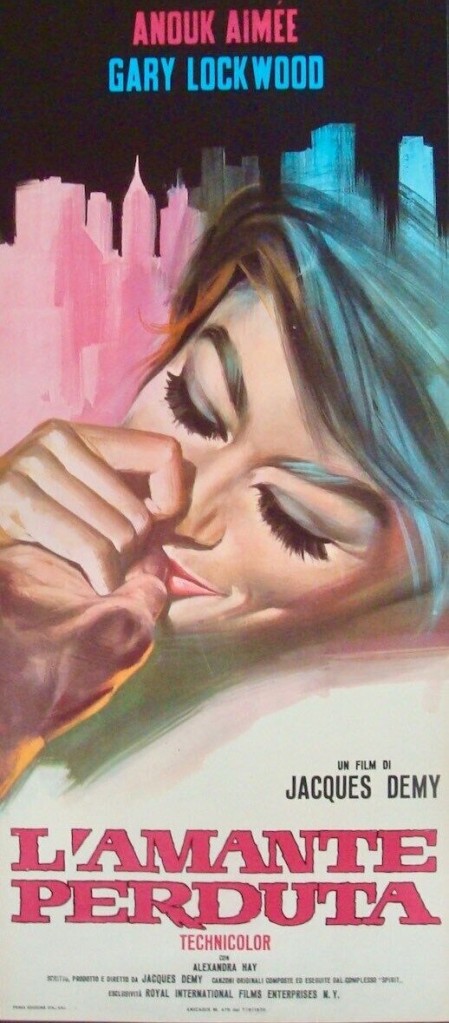
Anyone attracted by Anouk Aimee’s top billing is going to be disappointed, not in her performance, which reveals a markedly vulnerable gal beneath the glam (though she does dress haute couture). But Gary Lockwood (They Came to Rob Las Vegas, 1968) is front and central; she doesn’t turn up until about a third of the way through and only has a handful of scenes thereafter. So it’s that kind of slice-of-life movie, what the British used to term a “kitchen sink” picture, and takes place over a short time-span.

Gary Lockwood is excellent but he’s not asked to do very much, and you kind of get the impression he’s just being his charming self. Aimee seems to have cornered the market in playing “degrading” women, accused of being a sex worker in The Appointment and loaned out to high-class friends of her husband in Justine (1969). In some senses, bringing out the  character behind the tawdry image appears her forte. Alexandra Hay (Skidoo, 1968) is equally good, the grit behind the glam, not just a pretty face.

But just nothing happens. The background – the draft, potential Vietnam peace talks, the occasional joint – is scarcely a visceral snapshot of America at the time. European director looks at America and doesn’t much like what he sees, but less obviously a commentary on society along the lines of Antonioni’s Zabriskie Point the following year or even the home-grown Medium Cool (1969).

And lacking the style of Demy’s previous outing, the exuberant musical The Young Girls of Rochefort (1967) and you keep on expecting – hoping – the characters are going to burst into song. Oddly enough, it suffers from an unexpected culture clash. Relocate the same characters and the same story to Paris, speaking French with subtitles, and it would have worked better no matter how slight the story because it would automatically be infected by Gallic charm and even the poorer streets there would be interesting.

Carole Eastman (Five Easy Pieces, 1970) a.k.a. Adrien Joyce contributed to Demy’s screenplay. Members of rock band Spirit appear in the film and provide several tracks but there was no soundtrack album to take advantage of their involvement.

You might be interested to know that Harrison Ford was at one time up to play the lead. Hay was a starlet under contract to Columbia who financed the film. Equally oddly, it was not sufficiently arthouse to appeal to the cognoscenti and it was little surprise that the studio eventually chose to promote the seedier aspects in the marketing.

Flareup (1969) ***

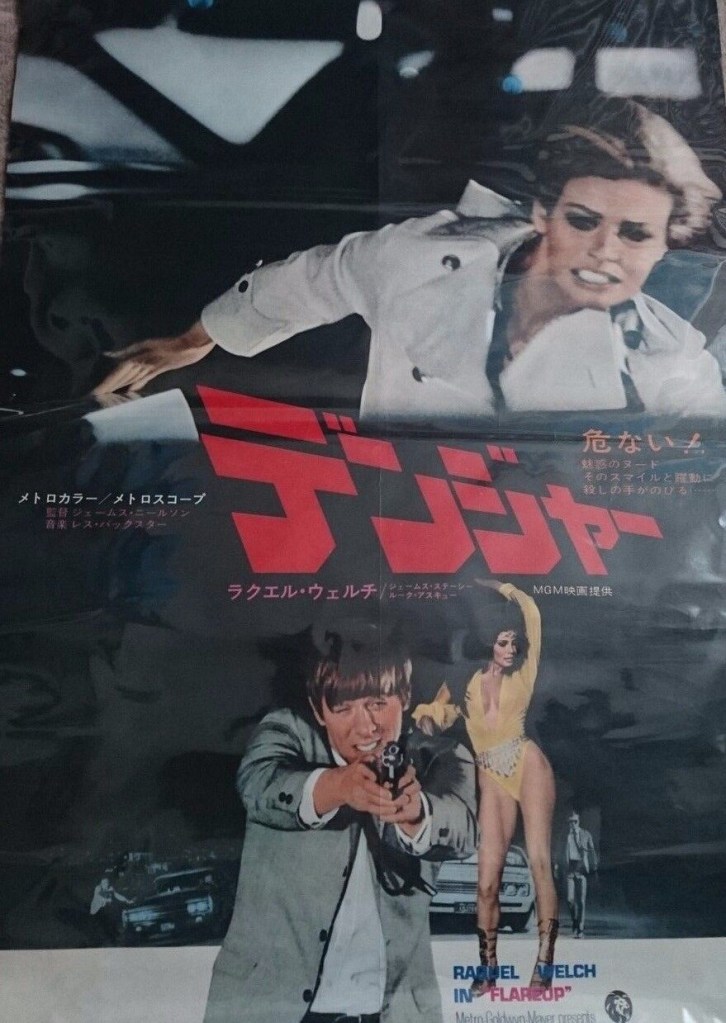
I thought I’d be taking one for the team in tracking down this much-maligned Raquel Welch number. Instead, I was pleasantly surprised. Oh, the movie’s nothing to write home about, desultory home invasion thriller that fails to come close to Kitten with a Whip (1964), Wait until Dark (1967) or The Penthouse (1967). But La Welch is something of a revelation.

Forget the Las Vegas go-go dancer come-on, this is more of a gentle romance. While attractive, Welch dispenses with the bra-busting outfits and overt sexiness, settling for a girl-next-door persona. In fact, you could have dumped the entire murder plot and had a more interesting picture, along the lines of Fade In (1969) where the normal hot-to-trot Burt Reynolds plays a gentler character.

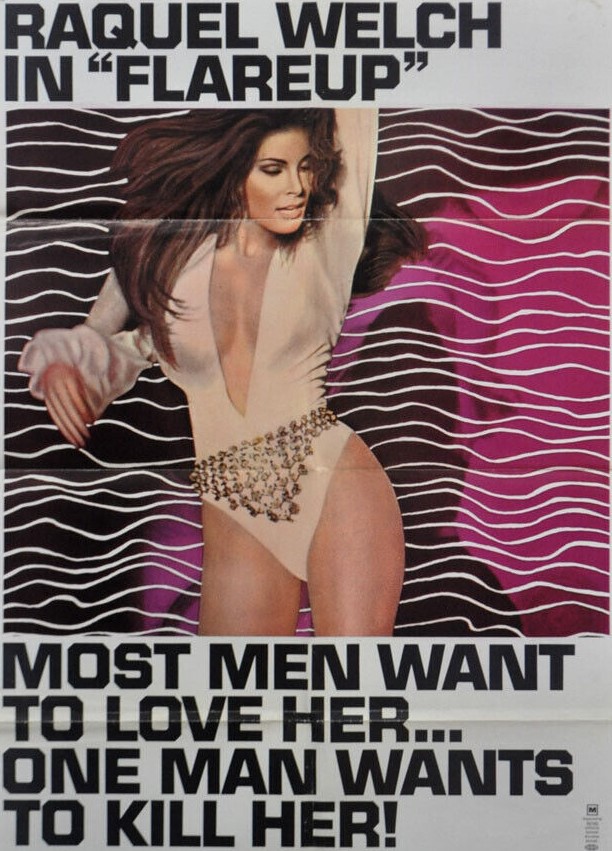
Artistic license taken to an extreme. Raquel Welch is a brunette not a redhead.

Since, (spoiler alert) in her sole dance number Welch keeps her attributes well-hidden, the producers felt obliged to stick in some topless dancers (quite how Welch is permitted to keep her clothes on in a topless go-go bar is never explained) which gives the picture a sleazy feel that runs counter to the tone of the romance.

So, Michele (Raquel Welch) is on the run from nutjob killer Alan (Luke Askew) who has bumped off his ex- Nikki (Sandra Giles) and her friend Iris (Pat Delaney). But why Michele is in the killer’s sights is never satisfactorily explained, except that she purportedly turned Nikki against him. Michele swaps Las Vegas for Los Angeles, finding work in another go-go bar and romance with Joe (James Stacy) whose interest in bull-fighting might have scared her off. But that’s tempered by his enthusiasm for flying model airplanes (an important plot point it transpires).

Cops are on the killer’s trail but not before he bumps off a guy who gave him a lift. Michele’s not hard to find, a drug addict employee of the Las Vegas operation points him in the right direction. There’s some desultory car chase footage and for no reason at all a chase on foot through an old zoo (presumably a genuine old zoo).

I had half-expected there might have been a lion or snake left behind to ramp up the thrill-quotient, but no such luck. What we do get, however, is a rarity in the chase department – exhaustion. Most people being chased on foot manage to drum up an insane amount of energy. Michele, on the other hand, is on the point of collapse.

But she’s not dumb. She might be rootless, not the questing soul of Easy Rider, but driven away by parental issues and, in gaining independence not keen on surrendering it to any passing male. And come the climax, she’s got a nasty weapon up her sleeve.

Essentially, she’s a sweet gal. Not the kind of character you’d expect La Welch to be playing, and perhaps that’s what attracted her to the script. It gives the actress the opportunity to escape from her sexy persona, and, while the tale is hardly weighty, the chance to prove she can do more than hide behind her particulars. Innocence isn’t something you’d associate with Raquel Welch, but here she exudes more of that than earthiness or sex appeal.

James Stacy (star of Welch’s debut picture A Swingin’ Summer, 1965) is a likeable boyfriend, not the kind trying to hustle her into bed. Luke Askew (The Devil’s Brigade, 1968) doesn’t do much except play mean.

James Neilson (The Moon-Spinners, 1964), while not able to jazz up a rancid plot, allows, as he did with Hayley Mills (an odd comparison indeed), Welch the chance to grow up on screen, defusing her sexuality but allowing her space to create a character so far removed from anything previously seen. But the tempo sags with over-reliance on dancing sequences, the Las Vegas backdrop and too much chasing that goes nowhere. Mark Rodgers (Let’s Kill Uncle, 1966) dreamt this up.

One perhaps for completionists. Lack of sexy scenes might be off-putting but, equally, you might want to see what Welch can do when playing against type.

https://amzn.to/3s0UpRi

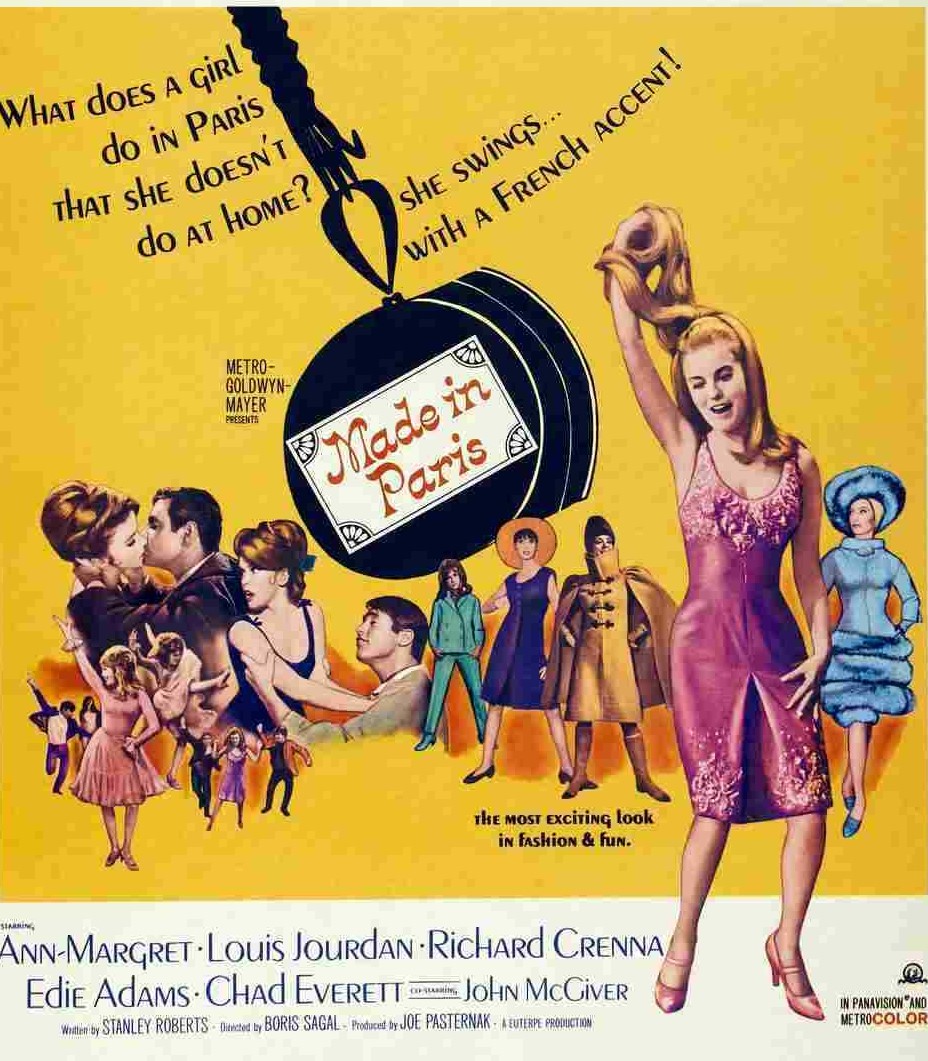
Made in Paris (1966) ***

She sings, she dances, she shakes her booty. What else would you expect from Ann-Margret in light comedic mode (i.e. The Swinger, 1966) rather than serious drama (i.e. Stagecoach, 1966). While appearing as free-and-easy as in The Swinger, she’s actually a dedicated virgin, as was par for the course before the Swinging Sixties kicked in. But the way she lets it all hang out, you’d be forgiven (if you were a predatory male) for guessing the opposite.

Maggie (Ann-Margret) is a career girl, assistant fashion buyer in a New York store, having come up the hard way, small-town-girl then model then salesperson. When the Paris buyer Irene (Edie Adams) quits her job to get married, Maggie is shipped out as her replacement, not as a reward for all her hard work but as punishment because she refuses to sleep with the boss’s cocky son Ted (Chad Everett). The idea is she’ll be so out of her depth, she’ll return humiliated and only too happy to jump into bed.

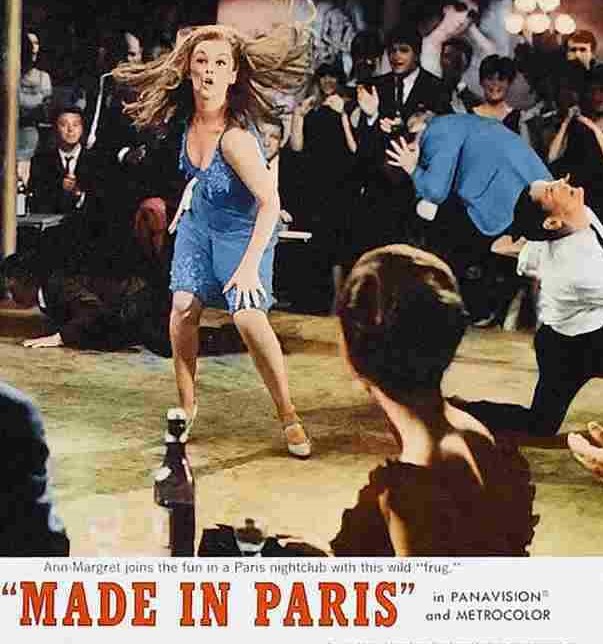
What do poster designes have against certain colors?
In the movie Ann-Margret dances in blue. In the poster, the dress turns red.

Turns out Irene quit so fast she didn’t have time to tell her Parisian boyfriend and fashion designer Marc (Louis Jourdan) so on Maggie’s first night in the company’s luxurious apartment he turns up. Naturally, he expects a bit of the old-fashioned quid pro quo, je ne sais quoi, whatever they call sex when they are being coy about it, and when she refuses to play ball he cables New York to demand her dismissal. Even when the New York boss (John McGiver) relents, she is banned from Marc’s fashion shows, meaning she can’t buy clothes she is forbidden to view.

Enter Ted’s buddy Herb (Richard Crenna), from the same lothario mold. Just to even things up or add further complication, Ted realizes he is actually in love with a girl who said no after a thousand boring girls who said yes. Trying to win her way back into Marc’s good books, with Herb as her guide she tracks the designer through the night clubs, eventually putting on the kind of sexy wild impromptu dance exhibition that the more staid Maggie could only have achieved if she’d taken lessons from Ann-Margret.

That does the trick and they share an impromptu number (“Paris Lullaby”) on the banks of the Seine although Marc still insists she shed her inhibitions before marriage if she wants to be considered a true Parisienne. The arrival of Mark and then Irene, abandoning her husband on their honeymoon when called in to retrieve the situation, adds fuel to the fire and then it’s one mishap after another, especially when Maggie discovers the pleasures of absinthe and ends up in Herb’s bed (yep, she has a hell of a time wondering not just how she got there but if, Heavens to Murgatroyd as Snagglepuss would say, she committed the terrible deed).

Unbelievably, and just as well perhaps from the narrative perspective, Herb isn’t a love rival. Maggie isn’t his type, its transpires. Shoot that man on sight – doesn’t fancy Ann-Margret?  Lock him up!

You won’t be surprised to learn that it all sorts itself out in the end but you might be a bit taken aback how quickly a dedicated career girl throws away her career once a marriage proposal comes her way.

You might have expected from the title that Maggie would be a model, the best excuse you could find for the actress to cavort in a series of skimpy costumes, as she does in the pre-credit sequence, an exquisite dialogue-free montage with a clever pay-off  that makes you think this is going to be much more stylish – excluding the fashion show of course – than it is.

Ann-Margret has such a dazzling screen persona she makes light work of even the lightest of confections. She does all that her most fervent fans would want but it’s not her fault she’s been cast in a Doris Day comedy that ensures she can only properly express her character by acts of exhibition. Louis Jourdan (Can-Can, 1960) keeps creepy entitlement at bay with lashings of Gallic charm. Despite his character’s playboy tag, Chad Everett (The Impossible Years, 1968) is the squarest of squares.

Richard Crenna (The Midas Run, 1969) spins his normal hard-ass screen persona into something a bit more sympathetic. Edie Adams (The Honey Pot, 1967) and John McGiver (Fitzwilly/Fitzwilly Strikes Back, 1967) add a bit of dash in support.

You’d never guess the director was Boris Sagal of The Omega Man (1971) fame. Stanley Roberts (Come September, 1961) wrote the screenplay.

Ann-Margret at her zingiest. What more could you ask?

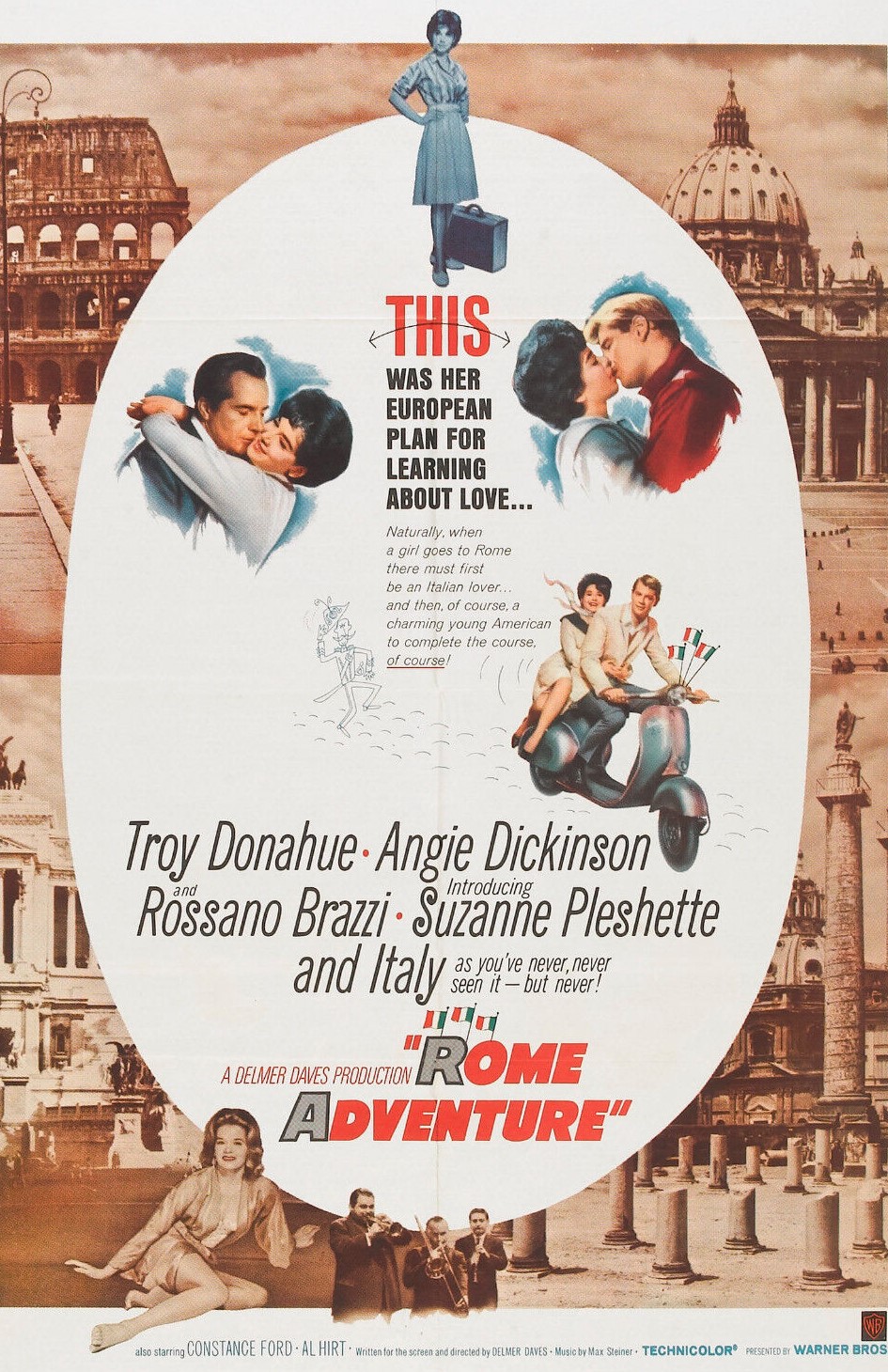
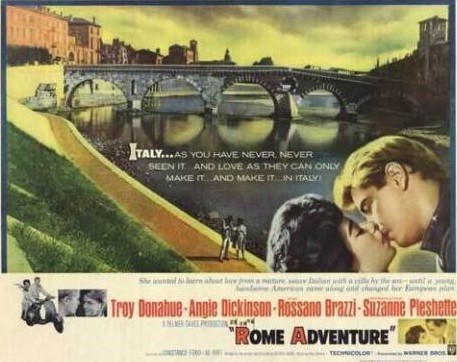
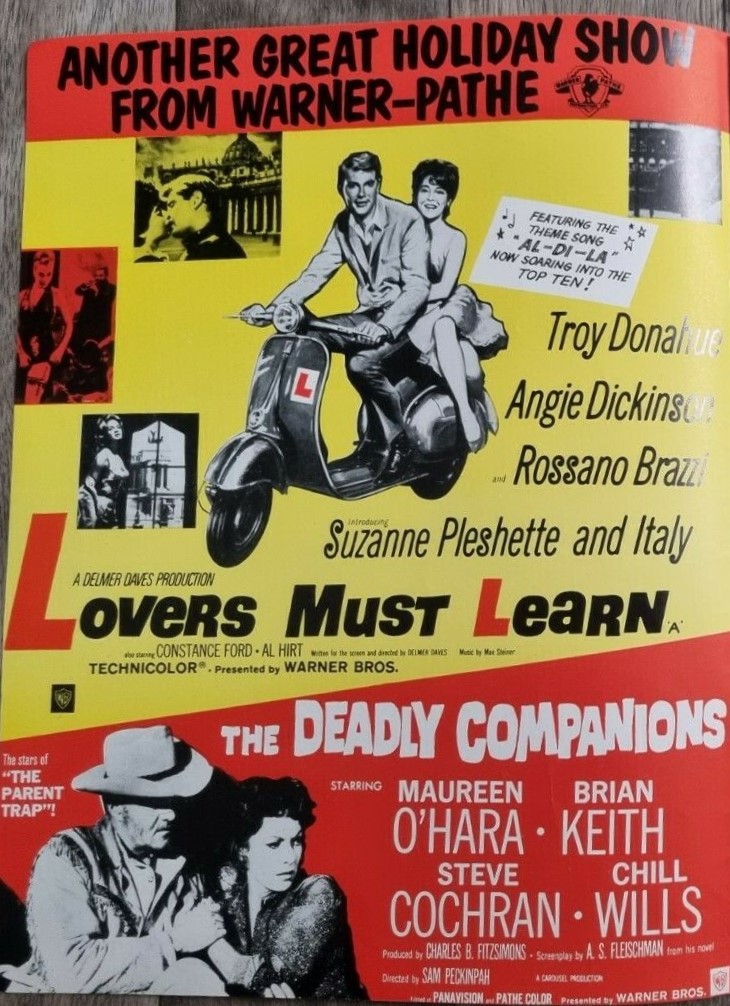
Rome Adventure / Lovers Must Learn (1962) ***

Angie Dickinson fans would be entitled to cry foul after the top-billed female star appears to be engaged in a bait-and-switch tactic. After a lengthy wait, when she finally does appear it’s only to high-tail it off to Switzerland leaving behind in Rome lover Troy Donohue. Her departure creates romantic opportunity, her return complication.

And is this the same Delmer Daves, you might ask, who made his name in a series of male-dominated westerns such as Broken Arrow (1950) and 3:10 to Yuma (1957)? Yes, it is, but once Daves had finished applying intense pressure to his male coterie, he did the same, in a different genre, to women.

Young teacher Prudence (Suzanne Pleshette) exerts her independence by quitting her job after being hauled over the coals in Small Town U.S.A. for teaching her pupils a controversial novel. On the boat to Rome she encounters Italian lothario Roberto (Rossano Brazzi), who holds the lofty sexist opinion that only a man can turn a girl into a woman, and the nerdy Albert (Hampton Fincher), both of whom come a-courting, the youngster’s diffidence ruling him out of serious contention.

Roberto is friends with student Don (Troy Donohue) but the minute he is introduced to Prudence he has to rush off to try to persuade artist Lyda (Angie Dickinson) not to leave. Roberto turns gracefully aside after Prudence denies him sex (put more subtly than that of course) and she, finding employment in an American bookshop (speaking the language no deterrent there),  embarks on romance with Don, fluent in Italian, who teaches her how to drink strega, takes her to jazz clubs and acts as tour guide.

A good chunk of the picture, it has to be said, is a travelogue, and when neither Roberto nor Don are on hand to point out this or that monument or embark on a potted history, suddenly she discovers an interior monologue to do the job. And at one point it turns into If It’s Tuesday It Must Be Pisa as the couple take off on a longer trip, bouncing from one tourist city to another, the route only complicated by some slight comedy over whether they should share a bed.

Re-titled in the U.K. and sent out with the most curious support.

Another decade and sex would most definitely be on the cards and the story would sink under an unplanned pregnancy or a fit of pique and scenes in a bedroom where they are separated by an open suitcase as one or other makes an effort to leave. But it’s the virginal aspects that makes this so sweet and for sure no director has managed to clear entire streets in usually heavily-congested tourist spots to deliver beautiful scenes in such scenic spots.

Actual drama might be light on the ground, but there’s no denying Delmer Daves knows how to apply pressure, this time on the woman, who can either treat romance as a  fleeting youthful episode or use it to launch big time into marriage and womanhood. Without a chaperone, unlike the hapless Albert, Prudence has only the example of her predatory employer who takes a male every season.

Just when the romance looks all set, back in Rome she catches Lyda and Don in a clinch and this sparks some good old verbal sparring between the two women as Lyda makes it very clear that Don is no virgin and that Prudence is out of her league.

You can guess how it will end. It’s as lightweight a confection as you will ever watch and yet it is worth watching because the director, close-up at the ready, scarcely gives Prudence a moment’s peace and if ever a director know how to gauge female intent and rely on eyes to express emotion it’s Daves.

Look beneath the façade of the travelogue and you find a woman trapped on the brink, that spark of independence misleading men into thinking she will surrender her virginity, and the woman not wanting to be another notch on a bedpost no matter if that fulfils the dual purpose of achieving womanhood. Daves’ name on the picture should be warning enough this isn’t quite your normal fluffy romance.

If you can ignore the sexism that dictates that a woman’s role is to “anchor” a man, turn his flightiness to one side and by some alchemy make him the best he can be, the narrative edges towards the independence of women, both Lyda and the bookshop owner pick and choose and sometimes abuse their men, and Prudence rejects romance on the rebound with Roberto.

But, of course, if that’s all you want, and you don’t want to hover near consequence, then writer-director Daves delivers a seamless concoction. If there’s an old-fashioned conceit to the whole thing, it’s perhaps because the source material, Lovers Must Learn, was written three decades before and preceded the likes of The Group in presenting a young woman as independent rather than merely yearning for marriage and motherhood.

It seems odd for Angie Dickinson to be relegated to the supporting cast but possibly having already done her Vespa-riding number in Jessica (1962) she preferred a stab at a more mature role, though she had already gone down that route in The Sins of Rachel Cade (1962). Maybe she upset someone in the studio. Maybe her role was bigger but ended up on the cutting room floor when Daves realized the talent he had uncovered in Suzanne Pleshette (A Rage To Live, 1965).

Daves worked again with Rossano Brazzi on the director’s final picture The Battle of the Villa Florita (1965) and Pleshette had a short-lived marriage with Troy Donohue.  

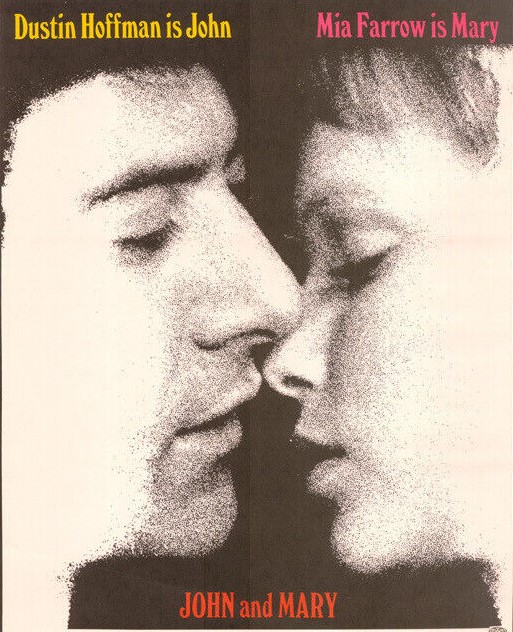
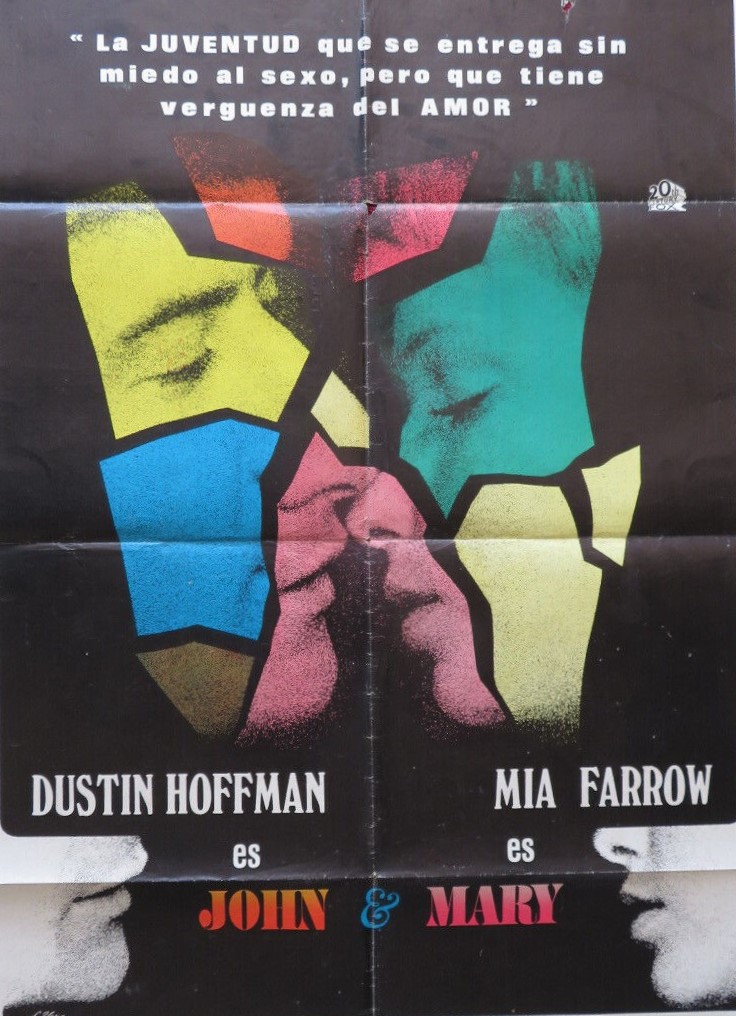
John and Mary (1969) ****

Woefully underrated. Remove the weight of expectation and you’re left with a bittersweet romance. This just wasn’t what critics anticipated from stars Dustin Hoffman, coming off the back of Midnight Cowboy (1969), and Mia Farrow, previous film the coruscating Rosemary’s Baby (1968), and certainly it seemed there was resentment at the audacity of British director Peter Yates attempting to switch from his action roots, best shown in Bullitt (1968). Worse, that Yates was trying to introduce a New Wave vibe.

In the end-up it’s sweet, but getting there is a prickly affair and it’s precisely this unique approach that creates its appeal. Where the standard set-up comprises meet-cute, break-up, back together, for the most part this looks as if actual romance, as opposed to sex, will never get off the ground, the pair smothered by doubt expressed in internal monologue.

Whereas, in The Fixer (1969), for example, hearing a character speak of their feelings outside of dialogue almost torpedoes the picture, here it works a treat, because it’s dealt with as if it was dialogue of the unspoken variety. Past experience that forces both characters to make suppositions about the other’s intent creates a very amusing and essentially true barrier to progress.

Back in the day, at the dawn of the singles generation, the idea of two young people hooking up for one-night stands filled the moral majority with shock, not just that widespread use of the Pill in avoiding pregnancy invoked promiscuity, but that random encounters immediately ended up in the bedroom rather than the becoming the start of a wooing (and discovery) process. These days, of course, Tinder and other such social media inventions, create umpteen opportunities for attraction to translate into instant sex.

But it doesn’t reduce the type of anxieties that are so well addressed here.

You can start with the basic morning-after notion of “how do I get rid of her?” all the way through to assuming such easy attitudes to sex on either side would destroy an ongoing relationship, and along the way dipping into such minefields as how to get to know another person, does he/she even like me or would they fall into bed with the first person to ask them, are they even as attractive in the cold light of day than when perceptions are muddied by alcohol and excitement, and, of course, the ultimate, was performance up to scratch.

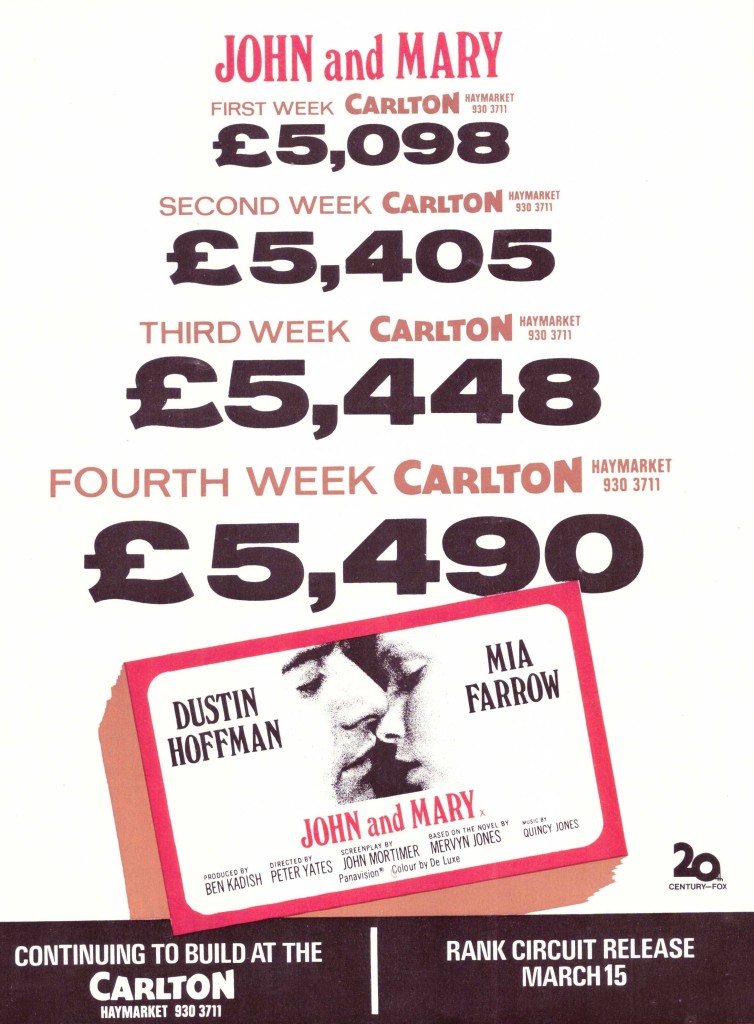
The Carlton was one of the smaller London West End cinemas and often used for prestigious openings to create the hold-overs that would build audience awareness and, such as here with box office increasing week-on-week, encourage cinema bookings.

This takes the unusual route of being peppered with flashback while the pair engage in spikier dialogue than you would find in the standard Hepburn-Tracy Hudson-Day romcom. And often what they say is the opposite of what they feel. Setting off in several directions at once – back a year or so, taking in the activity of the previous night and ploughing through the current day – could be off-putting but I found it worked a treat.

Anal retentive domesticated furniture designer John (Dustin Hoffman) hooks up in a singles bar with untidy politically-motivated sometime-actress Mary (Mia Farrow). His first reaction on waking up is to explore the apartment (rather large for New York), wonder when his wife will return, and think of all the deceptions he could pull. His first reaction borders on pure fear: she’s already planning to move in.

That neither has a genuine idea of the other person’s feeling provides the movie’s dynamic and the entire movie consists of them adjusting their expectations against a very contemporary backdrop of protests, politics, cinema verite and sex. Though primarily non-sexist and quite gender-equal, she isn’t looking to become a kept woman, for example, it does touch upon the notion that an easily-available woman is not far short of a whore, whereas, naturally, a promiscuous male is entitled to a free pass.

Her last relationship was with a married man (Michael Tolan), but she dropped him once he started talking about divorcing his wife. For John, girlfriend Ruth (Sunny Griffin) dramatically upped the stakes, arriving at his apartment with luggage, items of furniture and a rampant dog, enforcing on John responsibilities he did not want. Unusually, for the era, he is not politically involved and can cook, both of which attributes/skills we discover are the result of a mother so committed to politics that she neglected her children, never stocked her fridge and left her children to fend for themselves.

Each could press the nuclear button at any time. They’re attractive singles so more sex is just round the corner, going their separate ways the easier option, building a relationship far more difficult.

Dustin Hoffman shakes off a lot of the tics that were already showing and would inhibit later performances in a character far removed in sexual confidence from The Graduate (1967), but in some ways still touchingly naïve, and delivers a very believable performance. That it doesn’t fall into the usual Tracy-Hepburn battle of the sexes with witty put-downs owes much to the highly-nuanced performance of Mia Farrow who isn’t, as you might expect, in the least fragile and expresses her independence and challenges his views in a non-aggressive fashion.

Completely ignored by the Oscars, technically it won plaudits from Bafta, bracketed with Midnight Cowboy for Dustin Hoffman picking up the Best Actor Award, and with Rosemary’s Baby and Secret Ceremony for Mia Farrow in  being nominated for Best Actress – such arcane rules later changed.

In small parts look out for Cleavon Little (Blazing Saddles, 1974), Tyne Daly (Cagney and Lacey TV series 1981-1988), Don Siegel’s son Kristoffer Tabori (Journey through Rosebud, 1972) and Olympia Dukakis (Moonstruck, 1987). John Mortimer (Bunny Lake Is Missing, 1965) wrote the screenplay from the Mervyn Jones bestseller.

Cinematically and narratively refreshing, manages to be entertaining and thoughtful at the same time.

Interlude (1966) ****

Kevin Billington’s debut benefitted from a brief fad for classical music soundtracks, Elvira Madigan kicking off the fashion the year before, 2001: A Space Odyssey, which opened at the same time as Interlude, trumping everything in sight. And as luck would have it, this was not the only movie about an orchestra conductor, Counterpoint with Charlton Heston released in America a couple of months before this one opened in Britain.

What makes the movie so enjoyable is that overlaying the sumptuous love story is the angst of a mistress. It’s sweetly set in wonderful British locations, riverside inns, olde worlde hotels, trendy restaurants, a few flashes of swinging London, luxurious mansions. The solid backdrop for something as fragile as romance.

There could not be two more opposites to attract, the rich Oskar Werner (Jules and Jim, 1962) in full-on arrogant mode, all dark glasses and leather gloves with enough petulance to sink a barge, and journalist Barbara Ferris (off screens since the lamentable Catch Us If You Can three years before) who lives in a bedsit with a goldfish called Rover. He drives a Rolls-Royce convertible, she a Mini. 

There are some very good touches. We first see the characters in mirrors. He plays a “concerto for wine glass and index finger.” There is the very serious British business of whether milk goes in first to a cup of tea.

The screenplay by Lee Langley and Irish playwright Hugh Leonard is sharp and often witty.  “I want to marry you,” says Ferris, before conceding, “I just don’t want to be your wife.” There is clear realization of the nature of his personality in her remark, “Instead of being what you want, I’ll be what you’ve got.”

Even when emotion is expressed there is a feeling that a lot is still suppressed. Ferris goes from high excitement to high dudgeon and carries within the seed of fear, a character who spends as much time in terror as in love. This is exacerbated when she spots of Werner’s wife, stoically played by Virginia Maskell, at the hairdressers and “all of the sudden” the wife who has existed in her imagination “has a face.”

John Cleese and Donald Sutherland have decent cameos, the former in a bit of an in-joke as a PR man wanting to get into comedy (“satire – that’s my field”), the latter as the womanizing brother of Werner’s wife.

Oddly enough, the music – Beethoven, Tchaikovsky, Mozart, Dvorak, Brahms and Rachmaninov – acts in the same manner as Easy Rider the following year, as extensive interludes to the developing drama. Perhaps it is where Dennis Hopper got the idea.

It is very rounded for a romance, the acting excellent and the undernote of despair well-wrought.

Discover WordPress

A daily selection of the best content published on WordPress, collected for you by humans who love to read.

The Atavist Magazine

by Brian Hannan

WordPress.com News

The latest news on WordPress.com and the WordPress community.