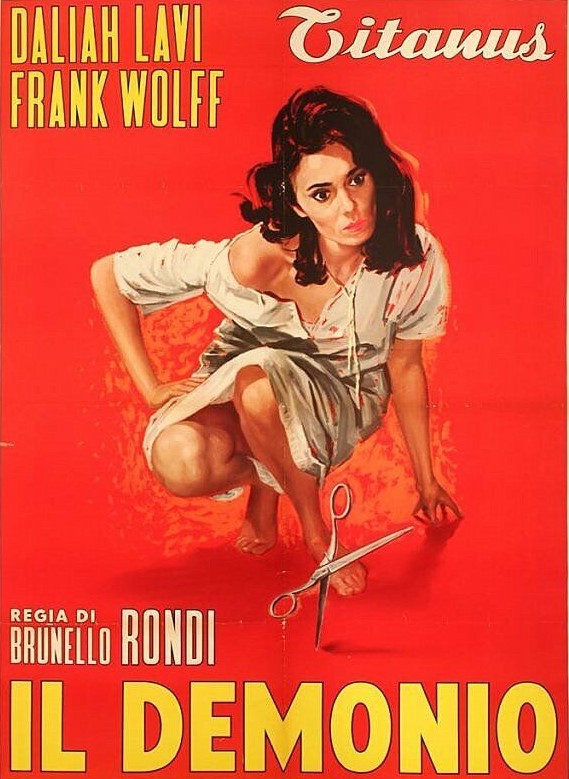
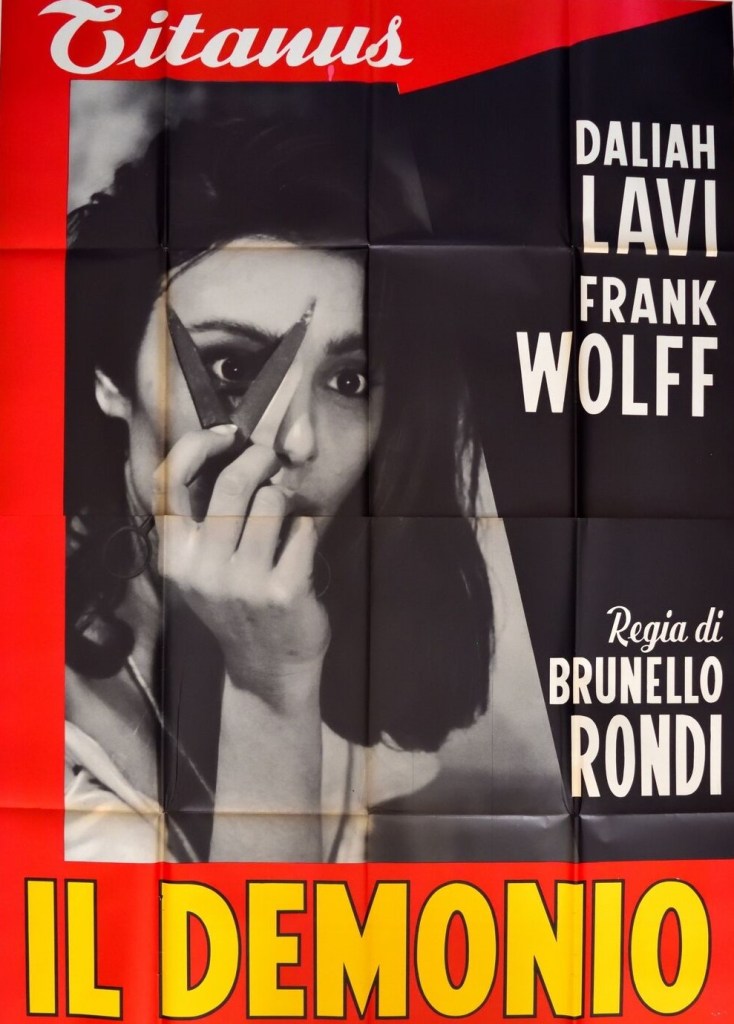
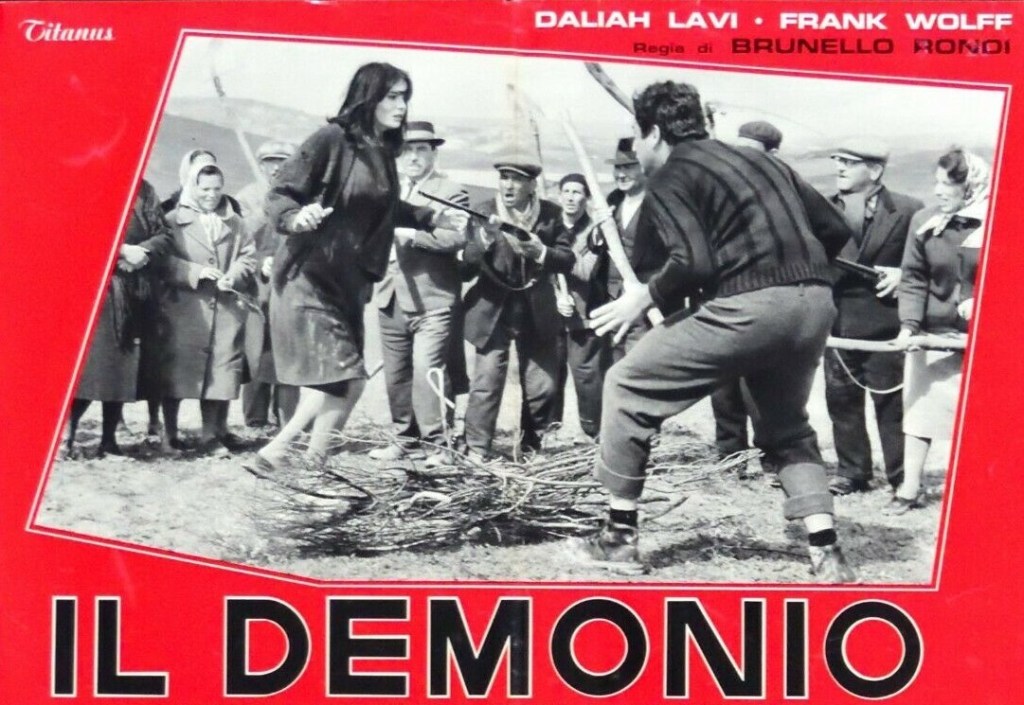
The Demon / Il Demonio (1963) *****

I was riveted. This is one of the most extraordinary films I have ever seen. Highly under-rated and largely dismissed for not conforming to audience expectation that horror pictures should involve full moons, castles, darkness, fog, costumes, nubile cleavage-exposing female victims, graveyards, a male leading character, shocks to make a viewer gasp, and the current trend for full-on gore.

So if that’s what you’re looking for, give this a miss. Even arthouse critics, spoiled by striking pictures by the Italian triumvirate of Fellini, Visconti and Antonioni, were equally scornful. For the most part the action takes place in broad daylight, rather than the twilight and darkness beloved of Hollywood (and British) horror.

It is set in an impoverished town in the Italian mountains, where farming is so primitive the soil is tilled with horse and plough and water is collected in buckets from the river.

One of the most striking aspects of the picture is that it creates its own unique universe. The townspeople are both highly religious and deeply superstitious, every traditional Catholic ceremony matched by old-fashioned ritual. Even some of the formal traditions seem steeped in ancient belief, sinners marching up a steep hill with people being scourged or carrying a heavy rock, in a convent the tree of a suicide covered in barbed wire.

Less conformist notions include a wedding night rite involving shoving a scythe under the bed to cut short Death’s legs with the bedspread covered in grapes to soak up evil and discord arranged in the form of a cross to act as bait for bad thoughts and poison them before they can cause the couple harm. When the people run through the town brandishing torches it is not, as would be genre tradition, to set fire to a castle but to vanquish evil from the air.

It is filmed in austere black-and-white. In the Hollywood Golden Era of black-and-white movies, lighting and make-up transformed heroines, rich costumes enhanced background. Here, if the heroine is wearing make-up it’s not obvious and the only clothes worth mentioning are a priest’s robes or a plain wedding dress. Otherwise the most arresting feature is the stark brightness against which the black-dressed figure of the heroine Puri (Daliah Lavi) scuttles about.

And although there are no jump-out-of-your-seat shocks, there are moments that will linger on in your mind, not least the heroine enduring a vicious extended beating from her father, an exorcism that turns into rape and the sight, Exorcist-fans take note, of a spider-walk, the young woman’s torso thrust up high on elongated arms and legs. Virtually the entire success of the picture relies on atmosphere and in places it is exquisitely subtle, the audience only realizes she has been raped, for example, by the look on her face.

The picture opens with a dialogue-free scene of stunning audacity, foreshadowing the idea from the start that image is everything. Puri pierces her chest with a needle, cuts off a chunk of her hair to mop up the blood, throws the hair into the oven and rams the crisp remains into a loaf of bread. Not to be consumed as you might imagine, but as a tool of transport.

Shortly after, having failed to seduce Antonio (Frank Wolff), she tricks him into drinking wine infused with the ashes of her bloodied hair, bewitching him, so she believes, to abandon his betrothed. In an echo of a Catholic sacrament she shouts, “You have drunk my blood and now you will love me, whether you want to or not.” 

The next morning when collecting water at the river she has a conversation with a boy Salvatore only to discover he has just died, his death blamed on her because his last words were a request for water, which she is judged to have denied him. She is beaten by women. She is feared by everyone in the village, her family tainted with the same brush, wooden crosses nailed to their door. She is not a ghostly figure, flitting in and out of the townspeople’s lives, an apparition tending towards the invisible, but fully formed, highly visible in her black dress and anguished expression, doomed by often vengeful action and forceful word.

Much of the film involves Puri being beaten or chased or captured, at one point trussed up like a hog. Attempts to exorcise her, whether by pagan or Catholic means, focus on getting the demon to speak his name. The ritual performed by heathen priest Giuseppe involves blowing on a mirror before taking on sexual aspects which culminate in rape. The Catholic version in a church in front of her family is primarily, as it would be in The Exorcist, a duel between the priest and whatever possesses her.

Movie producers who took one look at the beauty of Palestinian-born Daliah Lavi (Blazing Sand, 1960) and thought she would be put to better use in bigger-budgeted pictures made in color that took full advantage of her face and figure and that stuck her in a series of hardly momentous movies such as The Silencers (1966) and Some Girls Do (1969) should be ashamed of themselves for ignoring her astonishing acting ability.

And much as I have enjoyed such films, I doubt if I could watch them again without thinking what a waste of a glorious talent. This is without doubt a tour de force, as she alternatively resists possession and adores the being who has taken hold of her mind. She dominates the screen.

The rest of the mostly male cast is dimmed in comparison, as if overawed by the power of her personality. Future spaghetti western veteran Frank Wolff (Once Upon a Time in the West, 1969) comes off best. Director Brunello Rondi (Run, Psycho, Run, 1968) is better known as a screenwriter for Federico Fellini. He made few films, none matching this in scope or imagination, perhaps as a result of the picture not receiving the praise it deserved. Even now it does not have a single critical review on Rotten Tomatoes.

One other point: you may have noticed that in general the proclivities of male horror characters are never in need of psychological explanation. Nobody considers that the Wolfman must have suffered from childhood trauma or that a vampire drinks blood because he was a rejected suitor. Strangely enough, as would be the case in The Exorcist and other instances of female possession, psychiatry is usually the first port of call and here all reviews I have read implicitly see Puri’s actions as based on sexual inhibition and rejection by Antonio. 

You would need to chase up a secondhand copy to find this, I’m afraid.

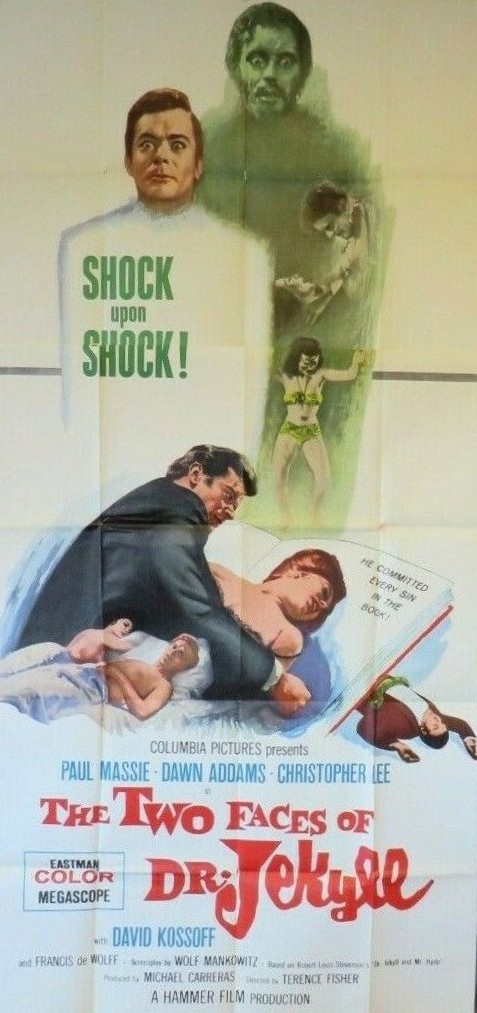
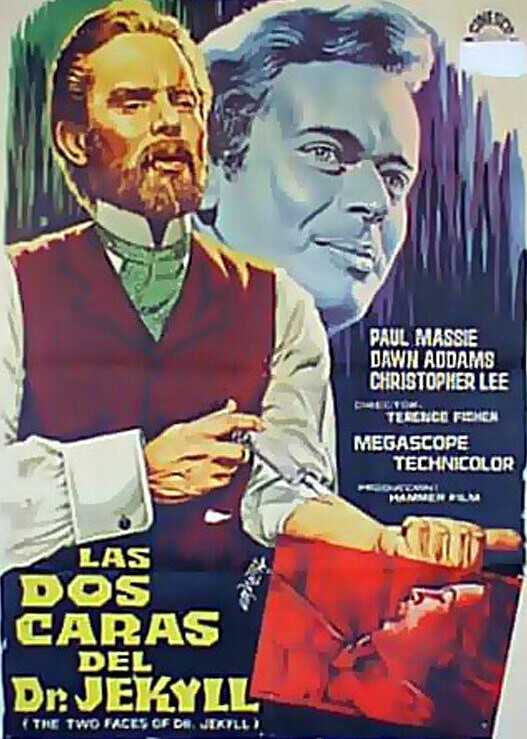
The Two Faces of Dr Jekyll / Jekyll’s Inferno / House of Fright (1960) ****

One of the most shocking films of its day with its unusual focus on sex and violence, this takes the famed Robert Louis Stevenson tale down a different direction in that Dr Jekyll enjoys the base animal instincts he has unleashed with his experiments rather than expressing remorse or guilt. Evil has never been more demonstrably enjoyed.

Dr Jekyll (Paul Massie) is a shy cuckolded scientist when he takes the magic elixir that diverts his dull personality towards a more dynamic, if ultimately perverted, destination. From being fearful of life, he begins to sample its more exotic pleasures under the guidance of louche best friend Paul (Christopher Lee) who is carrying on an affair with the good doctor’s wife Kitty (Dawn Addams).

Not only does the reincarnation of Jekyll as the lusty Hyde consort with prostitutes and manage to snare exotic dancer Maria (Norma Marla), a beautiful woman who would normally be way out of his league,  he develops a fetish for violence, almost beating to death a hooligan (Oliver Reed) in a dodgy club, only prevented from committing his first murder by the intervention of his friend.

Sure, there’s some philosophising about the nature of good and evil and whether violence is inborn or nurtured and there are moments when guilt rears its ugly head, but these are pretty fleeting to be honest, and most of the time he can hardly wait for another draught of his poison in order to shake off his insipid persona and revel in the new creation.

But magic will only take you so far. Believing he is now irresistible to women he fancies his chances with Paul’s amour, who is of course none other than his wife, but she will have none of it, finding him a poor alternative to the charming Paul. In one of the most controversial scenes of the day, and perhaps only ironically acceptable at the time, Hyde proceeds to rape the resisting Kitty. This skirts so close to the edge of taste, not just the worst type of domestic abuse (though husband assaulting wife would be no less unusual in Victorian times than it is now), but almost the neanderthal man taking what he wants, that it makes for uncomfortable viewing, especially as it is presented as a come-uppance for the adulterous hoity-toity Kitty.

Perhaps more interesting is that having won over the cold Maria, a trophy lover on a par with the higher-born Kitty, that’s not enough for Hyde.

Also, for the time, is an extremely risqué scene involving Maria and her snake, especially when having completed the usual survey of her curves, the reptile ends up down her throat. That the Victorians were masters of the art of hypocrisy comes as little surprise, but the extent of it takes the viewer aback.  

There’s another twist. When it becomes apparent that his crimes are about to catch up with him the cunning Jekyll attempts to blame Hyde.   

Sumptuously mounted by Terence Fisher (Dracula, Prince of Darkness, 1966) and with nary an attractive character in sight – none of the innocent victims of the vampire sagas, for example – to leaven the sight of such unmitigated wickedness, the director offers an unique vision of how easy human beings will degenerate given the chance. At the outset Paul appears the most obvious villain, leeching on his friend to pay his gambling debts, while at the same time making hay with his wife. But initial audience sympathy for a wife, presented as a beautiful woman who for the sake of security has made a bad marriage and who needs an outlet for passion, soon dissipates as her true character is revealed.

The refusal to temper the ongoing degeneracy with one good character is a bold choice. Budgetary restrictions eliminated the usual transformation scene but that was probably for the best, since Hyde merges as though from a chrysalis into a stronger personality rather than undergoing some body-wracking physical change. It’s almost as if the director is determined to show how easy, given opportunity, a good but essentially weak man will embrace the dark side.

Accusations that Fisher has failed to bring sufficient suspense to the film I find unfair. Certainly, there’s not the tension of the will-he-be-found-out vein, but since the story is so well-known that appears a redundant course sensibly avoided. The director replaces that with ongoing friction between Jekyll and his friend on the one hand and his wife on the other, both of whom are unaware that the man they know as Jekyll is aware of just what a fool has been made of his alter-ego.

The emphasis instead falls on how and when the cuckold will take his revenge. And although the rape scene is unwelcome, there’s a certain ironic sadness for Jekyll to discover that his new persona is no more attractive to his wife than his old one.

Paul Massie (Call Me Genius, 1961) is of course far removed from an actor like Spencer Tracy (Dr Jekyll and Mr Hyde, 1941) and he relies overmuch on rolling the eyes but even so this is a decent performance. Christopher Lee (Dracula, Prince of Darkness) is the revelation, creating a very believable insidiously charming man who never quite approaches outright villainy. Dawn Addams is excellent as the spoiled entitled wife.

One of the unusual aspects of the picture is that where Hammer had been and would remain a breeding ground for new stars – Christopher Lee a most obvious example – everyone else featured here came to, in cinematic terms only I assure you, an untimely end.

This turned out to be Paul Massie’s only starring role – he only made another three films during the entire decade – and was soon relegated to television. Dawn Addams only managed another nine and, apart from House of Sin/The Liars (1961), spy flick Where the Bullets Fly (1966) might be counted the peak.

David Kossof only made another four, and none beyond 1964. And this was the final film in an extremely brief two-picture career for Norma Marla. Only the uncredited Oliver Reed (Women in Love, 1969) and of course Christopher Lee (Dracula, Prince of Darkness, 1966) went on to bigger and better things.

As did Terence Fisher who helmed most of the best Hammer pictures of the decade. Wolf Mankowitz (The Day the Earth Caught Fire, 1961) wrote the script.

Generally dismissed at the time, this has for good reasons acquired a substantial following and is well worth a look.

Burn, Witch, Burn / Night of the Eagle (1962) ****

That rare event, a piece of cinematic alchemy. None of the principals had any particular form yet it all comes together quite splendidly.

Director Sidney Hayers was a journeyman, for every Circus of Horrors (1960) or Southern Star (1969) there was Cliff Richard vehicle  Finders Keepers (1966) or Three Hats for Lisa (1965) starring pop star Joe Brown. Apart from The Innocents (1961), Peter Wyngarde did not make another movie for nearly two decades and fame eluded him until he grew one of television’s most iconic moustaches for Department S (1969).

Janet Blair was attempting to revive a moribund career that had stopped dead with The Fuller Brush Man (1948). Ditto Margaret Johnston, nothing since Touch and Go (1955).

More prominent names were attached to the script: Richard Matheson had made B-movie waves with The Fall of the House of Usher (1960) and The Pit and the Pendulum (1961) and Charles Beaumont for The Premature Burial (1962). But the script itself, an adaptation of Fritz Lieber Jr.’s novel Conjure, Wife, was not in itself extraordinary.

Instead, it’s a prime example of what a director can bring to material. It begins with credits on one side of the screen and a wide-open eye on the other. Scenes brim with suspense yet often we have no idea what’s going on and with only music to guide us are sucked into a devilish plot. Most of the time Hayers concentrates on eyes, reaction, rather than lengthy scenes of dialog.

The fact that Hollywood ignored the depth of Wyngarde’s performance seems beyond belief. And you might be interested to know it was one of the earliest feminist pictures, the wife in control, acting as protector for the husband.

Norman Taylor (Peter Wyngarde) is a handsome successful college professor in the running for promotion. While he locks horns with lazy pupil Fred (Bill Mitchell), he charms others to the point of infatuation, witness Margaret (Judith Stott). But after a bridge party at their home his wife Tansy (Janet Blair) becomes obsessed with finding something. Upstairs, by accident Norman comes across a dead spider that she claims is a good luck charm from a holiday in Jamaica.

Eventually, while he’s asleep, she finds what she’s looking for, hidden in a lampshade and burns it. Later, a suspicious Norman uncovers all sorts of strange objects. All three scenes of the characters looking are filled with suspense and masterpieces if you like of how to use a camera and hook an audience, no explanation given, just a background of increasingly ominous music.

Confronted, Tansy admits she is a witch, that decision triggered by an incident in which her husband nearly died. Her spells, she claims, have brought him not just good luck, but protected him from bad sorcery, his success not just down to his charm. He insists on burning all her material, including, to her horror, a locket with his picture. And no time is spent, a la The Devil Rides Out (1968), in explaining the intricacies of the occult.

From then on his life turns sour. He is nearly run over by a van. Fred makes a complaint against him and then comes after him with a gun, Margaret claims he raped her. Gradually, Norman, an atheist where the Devil is concerned, believing that neurosis causes the wrong kind of faith, comes to realise he is a victim.

They are both up against someone more powerful. Some of the events have a supernatural tinge – doors that swing open in a storm, Tansy praying to “let me die in his place” – but others appear severe accentuations of the normal, a loudspeaker blaring out his voice from a tape recording over the college grounds, an eagle that hunts him down, big enough (in one astonishing scene) to break through a door, and with a 9ft wing span appearing enormous in a corridor.

The curse plays out to a fabulous end, a tremendous finale, full of human drama, emotions ripped apart, confrontation, Norman’s failed schemes to save his wife.

To say I was mesmerised was an under-statement. Just a brilliantly-done little picture with cracking direction and excellent acting all round.

Not only is the picture ripe for reassessment you would have thought it was well worth a remake.

Barbarian (2022) **** – Seen at the Cinema

Slow-burn thriller geared more towards suspense than horror, turning on their heads most of the usual tropes and coming away with a fresh look at the genre.

Tess (Georgina Campbell), in Detroit for an interview as a movie researcher, turns up at  a rental only to find it already occupied by Keith (Bill Skarsgard). Cue various negotiations as she tries to find out if he’s for real and then work out a viable sharing concept – she gets the bedroom – and to some extent whether he is some skank hiding behind a handsome and charming veneer just lying in wait for a victim. This picture takes its time getting anywhere but not knowing just where it’s going only adds to the suspense. Eventually, they get to know each other enough for good vibes to kick in and there’s a moment where it could have gone all the way to sex.

Next morning she departs for her interview but not without noticing she is in one hell of an odd neighborhood. On her return, Keith is nowhere to be seen although his clothes are still there. When she investigates, down in the cellar finds a rope in a wall that reveals a tunnel and she hears him shouting. Having seen way too many horror movies she does the sensible thing  and leaves – nope, she does the next sensible thing and makes sure she can actually see where she’s going. And all this time of course you’re thinking – aha! This is what he wanted all along, he was a charming skank hiding behind a veneer, but still you don’t know where this picture is going because the director is damn good at suspense.

And once she does find out what’s going on we jump to another character, breezy actor AJ (Justin Long) belting along the highway belting out songs only to be given the bad news he is being accused of rape. Upshot is he turns up at the rental in Detroit because he’s the owner and now needs to sell it pronto so he’s absolutely delighted to discover it’s goes not just into a cellar but an extended basement that goes on and on because he’s measuring the shit out of it, just ignoring the stained mattress, camcorder and bloody handprint because, heck, the extra space could mean his property is worth a whole lot more which is ideal because he’s in for some hefty legal fees what with confessing to another dude that his accuser did in fact need some “convincing” before they had sex.

You don’t worry too much about AJ following in the footsteps of Tess because he’s mean, not in the John Wick fashion, but in the sneaky way that sneaky people have of never getting caught out. And he’s got a gun.

Naturally, there’s something a good bit meaner down there and there’s a hint that’s the reason the neighborhood is so rundown.

I’m not going to go into that aspect of the movie which in some respects is well done and in other respects not. And there’s a couple of character-driven twists that you won’t see coming and a great scene when police refuse to believe that a female running loose complaining of monsters is more likely to be a drug addict with monsters in her head rather than a genuine victim.

All in all one of the best horror films in a long while and precisely because it bends the rules without losing the shock value we come to expect from the genre. Prey for the Devil (2022) which I saw on the same day goes in more for the standard horror elements with considerably less effect and The Banshees of Inisherin, which I saw in between this pair, could have equally well been described as a horror picture, and although the bulk of the damage is self-inflicted seeing a fellow walking round with all his fingers sheared off but still with one complete hand left so he can chuck the digits at a door has all the trappings of horror.

Stick with Barbarian, a horror debut worth applauding from writer-director Zach Creggan (Miss March, 2009). He’s got the sense to let suspense build up by letting audiences do all the work, their expectation far more effective than his misdirection, and he allows his cast time to let their characters take root. Georgina Campbell (Wildcat, 2021) is an impressive lead and because the director doesn’t spend all his time putting her in situations where she can do nothing but scream she gets the chance to act. Bill Skarsgard (It, 2017) and Justin Long (House of Darkness, 2022) complete an interesting trio of performances. How rare to go to a horror picture and come away raving about the acting.

War-Gods of the Deep / City Under the Sea (1965) ***

Hollywood careers rarely end in a blaze of cinematic glory. Sudden death ensured Clark Gable and Marilyn Monroe (The Misfits, 1961) and Spencer Tracy (Guess Who’s Coming to Dinner, 1967) went out with a bang but more likely a  career is just going to tail off and end with this kind of whimper. Director Jacques Tourneur, in any case, was long past a heyday that saw him set the horror genre agog with Cat People (1942), I Walked with a Zombie (1943) and The Leopard Man (1943).

If that wasn’t enough to solidify his credentials he dipped into another genre, the nascent film noir, and helmed gems like Experiment Perilous (1944) with Hedy Lamarr and Out of the Past (1947) with Robert Mitchum. Thereafter came swashbucklers The Flame and the Arrow (1950) headlining Burt Lancaster and Anne of the Indies (1951) plus crime drama Appointment in Honduras (1953) with the ever-dependable Glenn Ford and Joel McCrea western Wichita (1955). Then, miraculously, it was back to horror with Night of the Demon (1957) and the late flurry of The Comedy of Terrors (1963).

You can tell where I’m going with all this. War-Gods of the Deep has nothing on any of these pictures. The backstory is much more interesting than the actual film.

Basically, this is one of those pictures where an unlikely pair, American Ben Harris (Tab Harris) and eccentric Brit Harold Tufnell-Jones (David Tomlinson) get themselves into an unlikely situation and have to get themselves out of it.

Set in the smugglers’ paradise of the British Cornish coast around the turn of the last century, on a hotel on top of a cliff, the duo need to track down another American, Jill (Susan Hart), who has disappeared down a plughole, sorry mini-whirlpool. This leads to a legendary underwater city where smugglers led by Sir Hugh (Vincent Price) have found the secret of eternal life, a paradise now endangered by tremors from a nearby volcano.

The Italians didn’t fancy the two titles on offer so came up with their own
by purloining the Jules Verne classic.

He sent his enslaved Gill-Men to kidnap Jill in the erroneous belief that she is his dead wife. Bored out of their minds with listening to Sir Hugh prattling on endlessly about how the underwater city came into being and how important he is to the whole affair and what imminent dangers the inhabitants now face, and of course faced with their own imminent demise as sacrificial victims, the pair decide to scoot, having found a willing accomplice.

There’s a chase and whatever, and some undersea adventure, but there’s not much to it.

However, what you do get when you add someone like Tourneur – and to that extent Vincent Price and his ominous tones – to this listless mix is atmosphere. Tourneur can inject eeriness almost just by switching on a camera, despite a very stage-bound picture, and he knows how to add a music score that tremendously aids his enterprise. The opening section by the shore and in the hotel adds the necessary element of mystery to make the whole idea float.

There clearly wasn’t enough of a budget for the Gill-Men to appear as anything but peripheral figures which actually might have helped since, the state of special effects in that time might have made them laughable rather than distantly disturbing.

The best you can say is that Tourneur made the best of a bad job. Vincent Price (Diary of a Madman, 1963) only has to turn up to inject an element of danger. Tab Hunter (Ride the Wild Surf, 1963) and Susan Hart (Dr Goldfoot and the Bikini Machine, 1965) needn’t have bothered turning up for all they bring to the party. And David Tomlinson (Bedknobs and Broomsticks, 1971)  brings far too much, saddled with a pet comic chicken for no apparent reason except to extract a few laughs.

AIP, having made its name in the horror department by raiding the portfolio of Edgar Allan Poe, turned up this source material deep in that vault. But the only connection to Poe is the original idea –  which was not that original, other poets having plumbed those depths prior –  and that appears only in occasional desultory recitations of the poem. But, as a marketing tool, hey, Edgar Allan Poe, that’ll scare their socks off!

So, you are warned, but also you can’t help but warm to this final movie by one of the Hollywood greats as he tries to put a sheen on something that in other hands would have sunk like a stone.

Night of the Living Dead (1968) ****

Ground-breaking thriller in the apocalyptic vein that appeared destined for oblivion after being judged too over-the-top by the AIP/Hammer criteria suitable only for the denizens of late-night horror quintuple bills. I say “thriller” because even by today’s slaughter-fest standards when the heroes/heroines generally escape, it was unheard-of for the entire cast to die, especially considering the post-ironic ending which made a sharp political point.

Brother and sister Johnny (Russell Streiner) and Barbara (Judith O’Dea), having driven 200 miles to visit their father’s grave, are ambushed in a cemetery by a zombie. Johnny is chalked up as victim number one. Barbara escapes to what appears to be an abandoned house, attacked by more zombies, where in a by-now near-catatonic state she is eventually joined by the more action-oriented Ben (Duane Jones) who boards up door and windows and fires at the ghouls with a rifle.

The days when the Edinburgh Film Festival could put its imprimatur on breakthrough movies is long gone.

Hiding in the cellar are the Coopers, Harry (Karl Hardman) wife Helen (Marilyn Eastman) and daughter Karen (Kyra Schon), ill from being bitten by the monsters after their car was overturned, and Tom (Keith Wayne) and girlfriend Judy (Judith Ridley). In the ensuing panic and continued onslaught, the numbers of zombies growing by the minute, Harry determined they would be better off hiding in the cellar and at one point locks Ben out of the house.

Radio and television broadcasts reveal a mass outbreak of people rising from the dead and feasting on the living, the result it appears of radiation in space, caused by man-made accident. The zombies can be killed off by a bullet or blow to the head or being burned. A gas pump being nearby, Ben, Tom and Judy drive there but while Ben lays down a carpet of fire to deter the marauders Tom accidentally spills gas over the truck which catches fire. Ben escapes but the couple are incinerated, turned into a tasty barbecue for the invaders.

While the relentless siege continues, Karen dies and is reanimated. And so, as you don’t expect, there is no escape, the survivors fighting zombies outside and the living dead inside.

The final image, a photographic montage, takes the movie in another direction, down the Civil Rights route, as the corpse of the only African American is hoisted up on meat hooks.

Until George A. Romero (Dawn of the Dead, 1978) took this idea and ran with it, the indie-scene was populated by cheaply-made movies of no discernible artistic credit aimed at the bottom end of the distribution market or by artistically-minded directors who hoped their talents might be acclaimed and lead to a fat Hollywood contract.  

Although there was no shortage of shockers, most had laughable special effects, little in the way of narrative, and certainly no earth-shattering concept like nobody gets out of here alive.

A budget of just over $100,000 ensured there was little room for grandiose special effects but nonetheless the scenes of relentless zombies striding forward, the single creature at the outset joined by a mass, was cinematic genius. Nor were these fragile ethereal beings, but strong enough to physically kill and turn over cars. On top of that was the revelation that death did not sate their hunger, and they weren’t vampirically-inclined either, the tastes lying in the cannibalistic. If you were able to die quickly enough to be reanimated you might escape being turned into a meal.

Taboo-busting came easily. Never mind flesh-eating zombies, and graphic violence, what about matricide? And perhaps a nod towards the power of relentless pressure, the armies of the night here could easily translate to the armies of protesters taking to the streets in broad daylight to march against injustice and Vietnam, whose continued opposition to government would drive change.

No doubt the decision to film in black-and-white was budget-driven, but that turned out to be a boon, no need to invest in gallons of what might pass as red blood, or create bloody corpses, just focus on the relentless threat.

It helped, too, that the characters under siege were very human, Barbara going out of her head with fear, isolationist Harry willing to kill the others to defend his notion of hiding out in the cellar, hoping to escape unscathed.

This was the ultimate word-of-mouth picture, critically dismissed not to say reviled on initial release, but gradually picking up an audience until it became a must-see movie. Romero’s horror approach became widely imitated, though his influence took years to permeate down. Co-writer John A. Russo later became a director, helming Santa Claws (1996).

Diary of a Madman (1963) ***

Contemporary perspectives occasionally raise a film in the estimation. Here, our knowledge of the psychology behind serial killers sheds quite a different light. The idea that a killer can blame outside forces over which he has no control was one of the original tenets when the ordinary mind could not take in that some folks just enjoyed the act of murder so much they were inclined to do it over and over again.

Where I come there there’s a saying – “a big boy did it and ran away” – a device used by small boys in big trouble. And that’s pretty much the idea here. The innocent can be taken over by an evil entity, rather than admitting to surrendering to their most heinous desires.

A prisoner condemned to death in 19th century France confides in magistrate Simon Cordier (Vincent Price) that his murdeorus acts were the result of direction by the mysterious and, unhelpfully, invisible “Horla.” Naturally, Cordier dismisses the notion until, in self-defence, he kills the prisoner. Disturbed by his action, he seeks counsel and is advised by a psychiatrist (an “alienist” as such a person was known at the time) to spend more time on his hobby, sculpting.

Although Cordier appears to be a model citizen, there lurks in his past a suicidal wife who killed their child, and the notion that somehow he was responsible. Into his world comes woman-on-the-make Odette (Nancy Kovack) who earns more money as an artist’s model than her husband Paul (Chris Warley) does for his paintings. Unaware  that she is already committed, Simon proposes marriage. It doesn’t take long for him to suspect she is not what she seems and he does away with her only for Paul to become the main suspect and be condemned to death.

Cordier, discovering by accident that the Horla, is frightened of fire, lures the entity into his deserted house (servants sent away) and plans to destroy the entity but in the process the fire melts the door handles and Cordier can’t escape, dying in the process.

Price and Kovack.

A modern reading of course would set it up a different way, putting greater emphasis on the past, trying to uncover what drove Cordier’s wife to suicide. That he gives in to overwhelming urges might well be followed by periods of guilt until he realises that the only way out is his own suicide.

But the 1960s moviegoer – possibly still recovering from the murderous goings-on at the Bates Hotel, and grateful that it was fiction, and The Boston Strangler only just getting into his stride – was not quite ready to put any faith in a landscape filled with predators and victims, so it would make more sense for outside forces, voices or the like, to be controlling the ordinary person.

An eerie glowing light comes over the eyes of Cordier (and the earlier convict) any time the urge to kill dominates. But if you were going to set this up as a picture of innocence driven to dark deed you would not populate it with Vincent Price (Witchfinder General, 1968), who had form for dastardly deeds. Nor is Price quite able to pull it off, those sepulchral tones always seeming to indicate something lurking, and he’s hardly in the debonair category so at the very least he belongs to the caste of entitled rich taking advantage of a poor woman to press his case for marriage.

Nancy Kovack (Jason and the Argonauts, 1963) is more convincing as the manipulative object of his desire. I half-expected her to turn into a murderer in order to rid herself of her the husband getting in the way of her chance at a new, wealthier, life. Chris Warfield (Dangerous Charter, 1962) is the talentless dupe, whichever way you cut it, and you have to admire his wife for sticking with him for so long.

Given that director Reginald Le Borg’s career dated back to the 1940s and he had been lumbered with the Joe Palooka series and any number of B-movies, it was perhaps surprising that horror, although still strictly on B-movie budgets, became a forte – The Black Sheep (1956) and Voodoo Island (1957). While this one was clearly filmed on a studio backlot, he does a good job of bringing a bit of lushness to the proceedings.

Perhaps the most interesting element is that the idea originated in the mind of famed French short story writer Guy de Maupassant – you might be surprised to learned that nearly 300 movies and television adaptations have been made from his works, a dozen alone in 1963 including Mario Bava’s Black Sabbath. Worth comparing with Maniac out in the same year where the idea of the mad killer is exploited for a different end.

Very old-school, but with passable sfx.

Quatermass and the Pit / Five Million Miles to Earth (1967) ****

Five million dollars.  That’s roughly the budgetary difference between Hammer’s Quatermass and the Pit and Twentieth Century Fox’s Fantastic Voyage. Although the protagonists in the latter face the unexpected, the movie is (as would be 2001: A Space Odyssey, 1968) an exercise in awe, in controlled exploration of wonder, whereas Quatermass, lacking the money for special effects, concentrates more on story and human impact. The government funds the experiment in Fantastic Voyage while Professor Quatermass (Andrew Keir) finds nothing but obstruction from his superiors.

Quatermass and the Pit is a masterpiece of stealthy exposition. Virtually every minute brings another development, gradually building tension, stoking fear. The principals – Dr Roney (James Donald), Barbara Judd (Barbara Shelley) and the professor – are cleverly kept apart during the early stages. A human skull discovered on a building site for a London Underground station is followed by a skeleton. Palaeontologist Roney determines it is five million years old, older than any previous find.

A metallic object is found nearby. First guess is an unexploded bomb from the Second World War. But it’s not ticking. And a magnet won’t stick to it. Col Breen (Julian Glover) is called in along with hostile rocket expert Quatermass. They have been locking horns from the outset.

There’s a whole bunch of apparent red herrings, mostly of the demonic variety. The location, historically associated with weird occurrences, is a nickname for the Devil. A pentagram is detected. Touching the object can give you frostbite. Col Breen argues it’s a leftover German propaganda machine from World War Two. A hideous dwarf and other spectral images are sighted. Telekinesis is involved. And tremendous vibrations.

Some people, such as Barbara, have a more receptive brain and can play memories millions of years old that reveal the alien truth. But this is an alien race with genocidal tendencies and able to unleash psychic energy.

The genre requires the scientists to discover an improbable solution which of course they do. Given the miserly budget, the special effects are not remotely in the Fantastic Voyage league. But that hardly matters. The movie coasts home on ideas, marrying sci-fi, the demonic, dormant and institutionalized evil, the militarization of the Moon and the ancient infiltration of Earth by Martians, no mean achievement, and a vivid narrative.

Director Roy Ward Baker (aka Roy Baker) provides many fine cinematic moments as he chisels away at the story, finding clever methods of revealing as much of the aliens as the budget will permit, focusing on very grounded characters, concentrating on conflict, and human emotions, mainlining fear rather than awe, building to an excellent climactic battle between man and monster.

Barbara Shelley (The Gorgon, 1964) is the pick of the stars, in part because she is at such a remove from her normal Hammer scream-queen persona, but more importantly because she brings such screen dynamism to the role. It’s refreshing to see her step up, as she carries a significant element of the story. Oddlyenough, although she has as good a movie portfolio as Andrew Keir and is certainly superior to James Donald, the denoted star, in that department, she is only billed third.

While Andrew Keir (The Viking Queen, 1967), warm-hearted for an intellectual, and James Donald (The Great Escape, 1963), trying to keep a cool head in the middle of inclination to panic, are good, they don’t bring anything we haven’t seen before. Julian Glover (Alfred the Great, 1969) is never anything but imperious and/or irascible, so ideal casting here.

The innovative electronic music was down to Tristram Cary and the unsettling credit sequence deserves some recognition. Nigel Kneale, who originally explored similar ideas for the character on television, came up with the screenplay.

The Invitation (2022) ***- Seen at the Cinema

Two words – “Whitby” and “Carfax” – hint at what’s coming but luckily have no resonance for impoverished New York ceramics artist Evie (Nathalie Emmanuel) who takes up an invitation to visit long-lost relatives in an English mansion of significant splendour. Immediately taken by her host, lord of the manor Walt (Thomas Docherty), who comes across like a Regency buck, she finds herself a surprising guest of honour for a forthcoming wedding.

Head butler Mr Fields (Sean Pertwee) and the statuesque Viktoria  (Stephanie Cornelissen), another guest, are snippy but the others, a smorgasbord of three influential European families, make her welcome. A nightmare and a few things unexplained drive her into the arms of the sympathetic Walt and before she knows it, she has agreed, in jest, to marry him. “The Big Reveal” – a subject of the last two posts – is well-paced giving Evie time to react to her unexpected circumstances. Like Hide and Seek (1964) she has been led into a trap of her own making, millennial entitlement coupled with the chance to mix with the rich and famous enough to do the trick.

She, it transpires, is the bride of a very particular individual and despite her efforts to escape it will be a very red wedding.

If there had been no mention of Whitby and Carfax – and I don’t remember anything in the trailer – I would have been completely unprepared for what followed, at least in the vampiric context, for the other goings-on did not tilt the viewer in that direction. The romance was refreshingly modern, with various reversals, including Evie standing up for menials who had fallen foul of the butler, and for herself against belittlement by Viktoria.

The ice-house, a mainstay of such buildings prior to refrigeration, also turns out to be fit for purpose and in another twist Walt favours the harem approach to marriage.

Considerably less savage than your modern horror picture, and definitely a shade more romantic, I can see why it would go down poorly with the modern horror cognoscenti but I felt it was very well directed, much more in the classic tradition of pacing, character development and twist. And it has an excellent ending that I suspect might kick-start a sequel.

Nathalie Emmanuel – best known from a stint in Game of Thrones and F9: The Fast Saga (2021) – will surely be elevated to stardom after her first leading role. A big-screen natural, she carries the picture effortlessly, and even though effectively playing the innocent abroad, there are few moments where the character is out of her depth, tribute to her innate acting skills. This could have gone wrong in so many ways, but her performance evokes natural sympathy while at the same time you would not make the mistake of pitying her.

A bright future also awaits Thomas Doherty (High Strung Free Dance, 2018) who carries off his role with style and except until necessary does not hint at the real character underneath the charm. Sean Pertwee (The Reckoning, 2020) shows he can glower with the best of them but Stephanie Corneliussen, in her movie debut,  makes an excellent queen bitch and her whimpering sidekick Alana Boden (Uncharted, 2022) proves anyone can turn nasty given the right amount of prodding.

Big shout out to Scottish actress Carol Ann Crawford – better known as the dialect coach for Outlander – as the maid who sets Evie right. I do believe I was at university with her.

Director Jessica M. Thompson (The Light of the Moon, 2017) does an excellent job of keeping a tight rein on proceedings and even when all hell is about to break loose ensures that the ensuing havoc is carried out with some style. Blair Butler (Polaroid, 2019) knocked out the screenplay.

My only gripe is that Emmanuel and Doherty make such a fine couple – with the kind of screen charisma that is in short supply these days – it was a shame that the story had to take a turn into horror rather than continue (forgive the pun) in the romantic vein.

Orphan First Kill (2022) *** – Seen at the Cinema

Evil meets its match” would have been a good tagline for this neat B-picture, a slow burn that starts off as horror before swerving into a more straightforward thriller. A prequel to surprise hit Orphan (2009) and a perverse take on the origin theme so beloved of the MCU/DC movies, this begins in Estonia where Leena (Isabelle Fuhrman) is an inmate at a psychiatric institute.

At first it looks like the tale is heading in the direction of Leena’s relationship with new art therapist Anna (Gwendolyn Collins). But that is quickly stymied when Leena, having orchestrated an escape through her manipulative and seductive powers, knocks off Anna as well, pausing only long enough to harness the woman’s computer to find a lookalike missing girl, the American Esther Albright, she could pretend to be. The wealthy Albrights, mum Tricia (Julia Stiles), devastated artist husband Allen (Rossif Sutherland) and spoiled brat son Gunnar (Matthew Finlan) live in a huge mansion in Connecticut.

And at first again, we go down another rabbit hole, this time the question of whether Esther can maintain her disguise, coming up shy at times in the old memory department. A psychiatrist is initially a bit suspicious and there’s a cop, Inspector Donnan (Hiro Kanagawa) lingering in the background. But Esther bonds with Allen over their shared interest in painting and the husband believes he has unearthed a new shining talent.

We also go down a rat-hole, so to speak, when Esther befriends a rat (an unlikely inhabitant in such a deluxe property, but there you go) whose only purpose you guess right away is to die, poisoned in one way or another. You imagine the poisoner is going to be Esther just wanting to maintain her killing skills.

Not so. The poor old rat is killed by mistake by Tricia who is, it turns out, trying to rid herself of this imposter, a lass she knows only too well cannot be her missing daughter for one very unsavoury reason which I won’t divulge but certainly took me by surprise.

So then the film switches onto a completely different tack, and one that is far more satisfying than just a deranged maniac, as in most horror pictures, going round slaughtering everyone in sight.  Donnan has re-entered the frame by this point, continuing his investigations to the point of sneakily snatching Esther’s fingerprints so he can try and do a match.

So now it’s game on and Esther is out- numbered, up against a pretty dangerous mother-and-son combo, with only the dim husband as ally. And no matter what clever stunts Esther dreams up to rid herself of this infernal duo and live happily ever after with the doting father, the equally tough Julia is quietly setting her own snares.

We were already expecting trouble the moment we set eyes on Esther, who, with her baby-faced features and size, that was a given, if ever there was a monster-in-disguise it was her. But beautiful socialite Tricia is a different story and so if there’s a “secret” this time round it’s to do with Tricia’s family, the pair involved maintaining an ongoing masquerade with the unwitting father.

Esther’s survival depends not so much on killing her way out of here but on winning over the father sufficiently should that, inevitably, if her plans work out, bereft of wife and son he will turn to her for consolation.

Isabelle Fuhrman (Orphan) is even better than she was before. Then she was a young actress playing a young maniac. Now she’s over a decade older and having to act more than a decade younger and that certainly takes some doing. But Julia Stiles (Hustlers, 2019) is the revelation, the cold-as-ice beauty, barely holding her family together after the previous tragedy, on the one hand welcoming Esther because it revitalizes her almost-dormant husband, on the other needing to exert considerable control otherwise their carefully constructed lives are going to explode. Although the surname is not new to me, the actor is, and Rossif Sutherland (The Middle Man, 2021) gives a touching performance as the grieving, brooding father finding himself, especially good in his scenes in his studio with Esther. In only his second picture Mathew Finlan (My Fake Boyfriend, 2022) isn’t given much scope as a spoilt brat son nor is Hiro Kanagawa, best known for the Star Trek: Discovery TV series.

Director William Brent Bell (The Boy, 2016) does a decent job, especially given he has to stradde the twin genres or horror and thriller with a nod in the direction of film noir. The scenes between Esther and Julia, where they realise they are adversaries, are especially well done. There are enough twists to keep the plot spiralling along and clever use of doubles to make you believe Fuhrman is a little girl.

Far from a great picture, but enough to be getting along with in the absence of a blockbuster. The hardier of the moviegoer species, people like me who pop along to their local cinema every week regardless and find something to watch, will be less picky about this kind of fare than those who get in for nothing or are sent a streamer due to their status as critics. Exhibitors have complained for over a century now that the best movies are never spread out over the year, but clustered into various time zones. Their livelihood, after all, depends on a constant string of winners. It’s a different story for cinemagoers. We just want to sit in the dark and see a film and as long as it’s reasonable enough we’re not going to complain.

In what should have been an indifferent week for moviegoing – given I had already seen Bullet Train, Nope, Top Gun: Maverick etc – I managed quite a nice triple bill on my weekly outing. This was the sandwich between the charmingly tolerable Fishermen’s Friends: One for All and documentary Girls Can’t Surf.    

Discover WordPress

A daily selection of the best content published on WordPress, collected for you by humans who love to read.

The Atavist Magazine

by Brian Hannan

WordPress.com News

The latest news on WordPress.com and the WordPress community.