The Chase (1966) *****

Arthur Penn’s movie came with a lot of baggage. Notwithstanding that he was in need of redemption – he was fired from The Train (1964) and Mickey One (1965) had flopped – he virtually disowned The Chase a week before it opened, denouncing Hollywood in the media, complaining that films were being made by committee. Producer Sam Spiegel was desperate to prove he could make big pictures without David Lean, who had decamped to Carlo Ponti and MGM for Doctor Zhivago (1965) and the knives were out, as always by this point, for Marlon Brando.

So it’s quite astonishing that the finished picture carries such visceral power. It’s a rich, meaty movie, part drama, part thriller, part social comment. Thematically it covers racism, power, adultery, civic apathy, injustice and integrity. At the same time it’s action-driven and the acting from a stunning cast is uniformly excellent. Theoretically, covering so much ground, it should be all over the place.

But three elements keep it grounded. The first is Lillian Hellman’s screenplay. Only using the bare bones of the source material (Horton Foote’s novel and play), she creates a fabulous intermeshed canvas wherein every character no matter how small has an integral part to play. As Coppola would do later with The Godfather she employs the device of large gatherings (two parties, in fact, one for the rich and one for the lower classes) to expose frailties. The second is Brando, in a thoughtful performance, as an ex-farmer who despises the people he represents and battles to maintain bis integrity. And third is Penn’s classical direction. Regardless of the interference he detected, nobody told him where to point the camera. It is noticeable that characters are often centered on the screen, rather than the more arty off-center compositions gaining in popularity. This creates an onscreen equality.
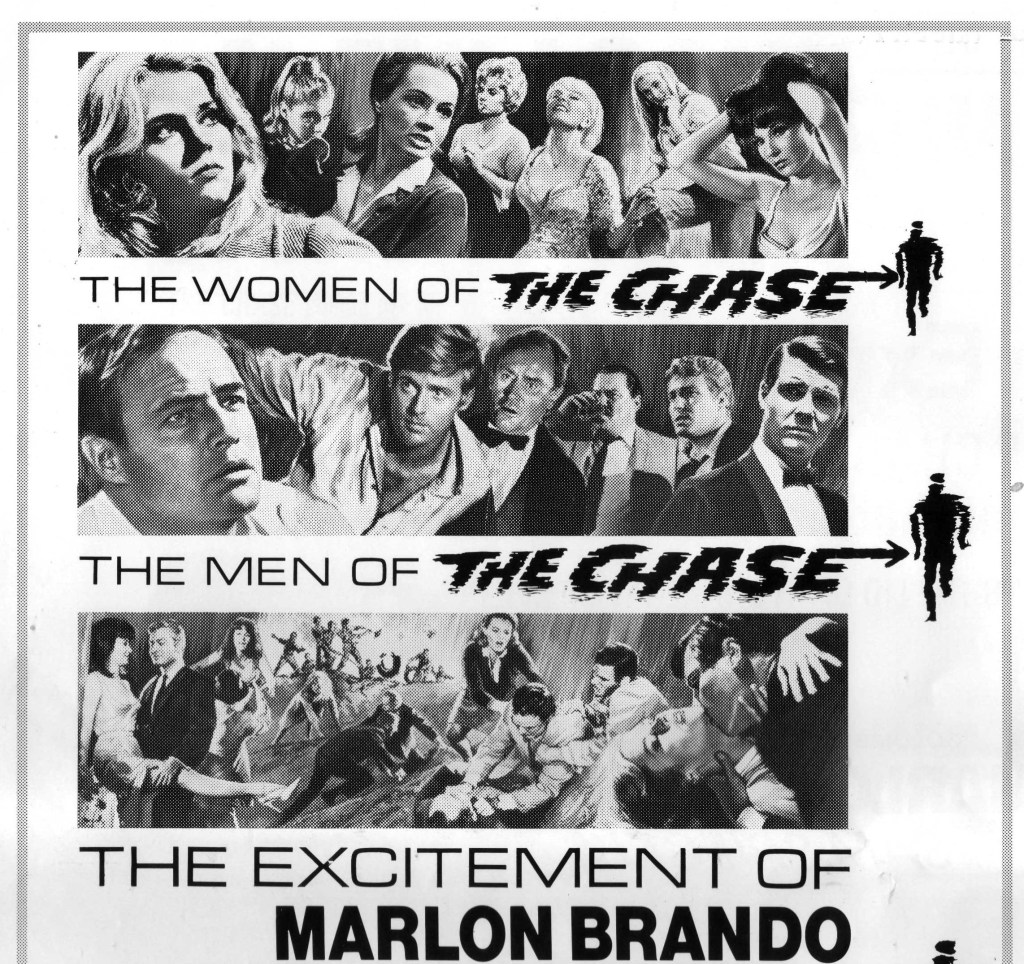
Basically, the narrative revolves around a small Texan town’s reaction to the return of escaped prisoner Robert Redford, now wanted for a murder he did not commit, which both brings the past to light and exposes existing tensions within the community. That Redford takes a good while to return allows those tensions to gently simmer. By the time he does the town is at fever pitch.

Redford’s wife Jane Fonda fears her affair with millionaire’s son James Fox will be discovered.  Timid banker Robert Duvall fears Redford discovering that he was initially imprisoned for a crime Duvall committed. Duvall’s sexy wife Janice Rule taunts him with her adultery. Redford’s mother Miriam Hopkins fears further humiliation.

Adding further bile to the proceedings are Bruce Cabot as Fonda’s venomous stepfather, real estate manager and gossip-monger Henry Hull who preys on adversity, and Rule’s lover Richard Bradford who drums up racial hatred against Redford’s friend African-American Joel Flueller.

The incorruptible Brando is faced with keeping the lid on a number of potential explosions.

Hellman’s script and Penn’s empathetic direction prevent it from falling to a swamp of melodrama. All of Miriam Hopkins’ maternal despair is captured in one shot of her sitting on a stool. Millionaire E.G. Marshall is building a local college so “young men do not have to leave here like my son.” The poor Fonda and rich Fox are genuinely in love but she holds it against him that he married someone else (of his own class) first while she waited “all those bad years.” When Brando imprisons Flueller for his own protection, he lets him find his own way to the cell and trusts him to lock himself up.

And there is an ample wit. A drunk confronts Brando with “the taxpayers of this town pay your salary to protect this place.” Brando’s response: “If anything happens to you, we’ll give you a refund.”

And I’ve not even mentioned Redford. While relegated to dipping in and out of the story to keep tension high, this is a memorable turn. Martha Hyer is estimable an alcoholic wife while Angie Dickinson extends her acting credentials with an untypical role as a domesticated wife.

John Barry’s score, dismissed by the Variety critic as having “no particular theme that lingers in the ear,” is in fact it is a triumphant piece of work, with a central melody that is in turn jarring and romantic.   

But it is Penn who brings home the bacon, bringing together a disparate tale in fine style, drawn tight to a stunning conclusion, and proving he had a mastery of both style and material that would stand him in good stead for his next picture Bonnie and Clyde.

I was lucky enough to catch this for free on Talking Pictures. It might come round again on this free channel. If not, or if you can’t wait, it’s well worth investing in a DVD. 

Cool Hand Luke (1967) *****

Lucas Jackson (Paul Newman) has none of the truculence of the ordinary rebel, consequence not part of his vocabulary, “it seemed a good idea at the time” his unfailing mantra. Outside of Butch Cassidy, a more amiable criminal you would struggle to find. He defies authority with a smirk, indiscriminate in opposing the system, whether devised by guards or prisoners and they are indiscriminate in return, swiftly punishing anyone who steps out of line.

First-time director Stuart Rosenberg’s meditation on martyrdom remains an iconic curiosity and one of a handful of great performances that showcase Paul Newman’s immense acting skills. It is about ten minutes too long, unremitting sequences of lorries travelling to and from work detail, in the morning or at night, and the work itself, way too repetitive, suggests a director who did not quite trust his audience to get it.

In a prison movie, the main narrative is always escape, but Luke is as much trying to escape from himself as his circumstances. There is a self-pitying aspect in him blaming God for making him the way he is. But beyond these gripes it remains an astonishing and involving work. This is a world reduced to a single common denominator – brutality. For a man who loathes rules, this is hell.

While no other character apart from Dragline (George Kennedy in an Oscar-winning role) and the Warden (Strother Martin in one of his best mean roles) is given much to do, nonetheless the rest of the cast do not merge into the background, facial expressions and tiny actions revealing character.  

There are a number of terrific scenes – Newman refusing to give in when beaten to a pulp in a boxing match, the egg-eating contest, the digging-the-hole method of destroying a man’s spirit, the guard bewailing the death of his dog. But the movie also examines the universal need for hero worship, Dragline’s bewilderment when Luke eventually fails to live up to expectation is affecting.

Two other aspects stand out. With every prisoner in the same uniform and the countryside bleak and undistinguished, Conrad Hall’s cinematography is miraculous while Lalo Schifrin’s score, with the wonderfully evocative simple theme, is continuously inventive. As definitive an examination of the outsider as the later Easy Rider.

Easy Rider (1969) *****

You could be forgiven for thinking that the movie’s main influences were the early Cinerama pictures that focused on extensive tracking shots of scenery (in this case, the open road) and unusual customs (ditto, alternative lifestyles, dope-taking etc) and Mike Nichol’s use of contemporary pop music in The Graduate (1967). But it also drew on the assumption, as did Hitchcock in Vertigo (1958) and Kubrick with 2001: A Space Odyssey a decade later, that a camera doing nothing can be hypnotic.

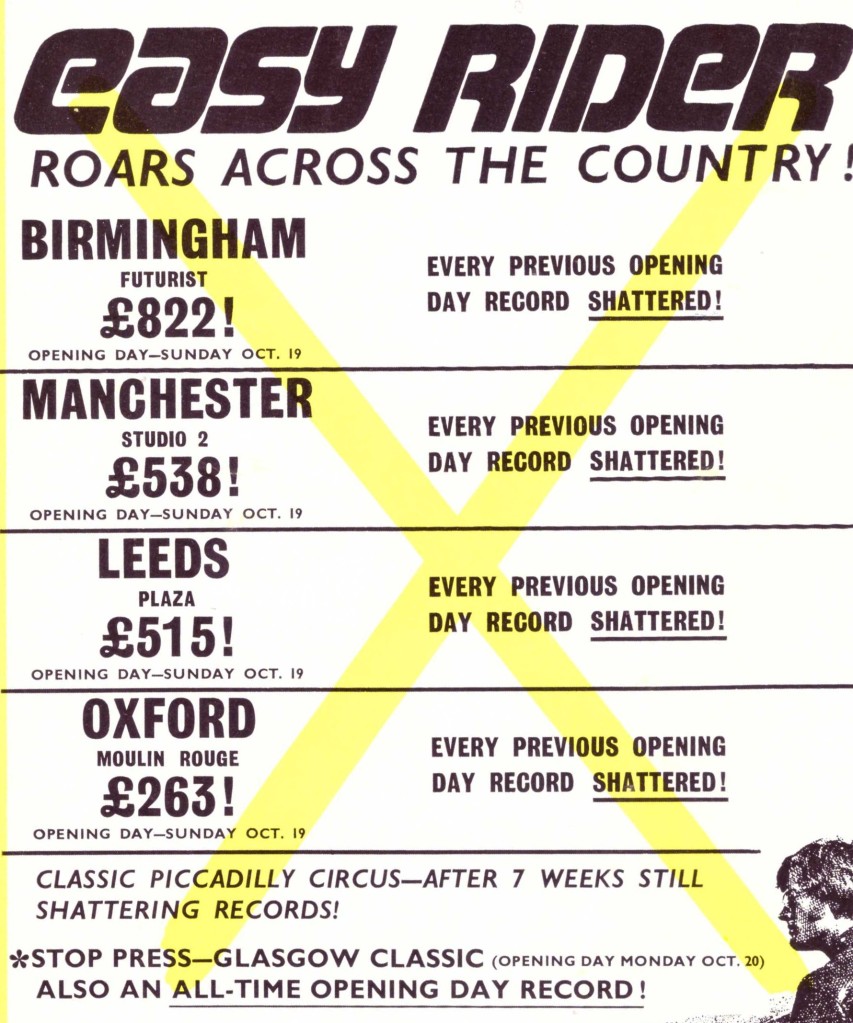
Selling a picture to the public and selling it to cinemas were two separate marketing skills. The easiest way to guarantee bookings for any film was to promote the box office figures through the trade press – as here in the British “Kine Weekly.” Columbia had cleverly booked the movie into one of the smallest cinemas in London’s West End where it was almost certainly guaranteed to break the box office record. But even the studio must have been taken aback by the way Easy Rider pulverized the previous record.

Message pictures were the remit of older directors like Stanley Kramer and Martin Ritt and films that had something to say about the human condition generally emanated from Europe and not low-budget efforts coming out of Hollywood. Easy Rider has a European sensibility, an almost random collection of unconnected episodes with no narrative connection to the main story, itself incredibly slight, of two mild-mannered dudes heading to New Orleans to see the Mardi Gras.

Road trips were not particularly unusual in American cinema but the form of previous locomotion was horse-related – westerns. The journey has been a central theme to movies. This is an 80-minute picture masquerading as a 95-minute one, a good fifteen minutes of screen time taken up with endless shots of Peter Fonda and Dennis Hopper on bikes passing through the landscape, with a contemporary soundtrack as comment.

Unusually, it’s also a hymn to ancient values, heads bowed in prayer at meals as different as you could get, the Mexican family and the commune, a marching band playing “When the Saints Go Marching In” and the recitation of prayers in the cemetery.

Success in London was no guarantee that a movie would perform as well all over the country. Columbia continued to book it into smaller venues in the hope it would repeat the London experience of breaking box office records. When it did the studio took out another advert in Kine Weekly to let exhibitors know.

What marks the film out stylistically, perhaps enforced by the lean financing, is the sparing way it is told. The most dramatic scenes – the three murders – are filmed in shockingly simple fashion. There are often long pans along groups of characters. While innovative, the flash-cut flash-forward editing adds little to what is otherwise a very reflective film. Inspired use is made of natural sound, the muffled thumping of oil derricks at the cemetery, the soundtrack to one death is just the battering of unseen clubs by unseen assailants.

The dialogue could have been written by Tarantino, none of the confrontation or angst that drives most films, but odd musings that bring characters to life. At the beginning of the trip, Hopper and Fonda are welcomed wherever they travel, but towards the end resented, treated as though a pair of itinerant aliens. They entrance young girls but are vilified by authority, jailed for no reason except the threat to traditional values they apparently represent.

Elements not discussed at the time of release make this more rounded than you would imagine. The excitable Hopper, a nerd in hippie costume, is driven by the American dream of making money. The more reflective Fonda senses something is not only missing from his life but has been lost forever. He has the rare stillness of a top actor, face reflecting unspoken inner turmoil.

It remains an extraordinary film, a series of accumulated incidentals holding up a mirror to an America nobody wanted to acknowledge and the brutal climax no less powerful now.   

Of course, the Easy Rider soundtrack itself summons up memories of the era and it is worth listening to just by itself and you might even want to go all the way and listen to it in the original vinyl.

Below is a link for the DVD.

   https://www.amazon.co.uk/Easy-Rider-DVD-Peter-Fonda/dp/B00LTK2Z44/ref=sr_1_1?crid=YSG6SCL8QQF9&dchild=1&keywords=easy+rider+dvd&qid=1596660339&s=dvd&sprefix=easy+rider%2Caps%2C153&sr=1-1

Discover WordPress

A daily selection of the best content published on WordPress, collected for you by humans who love to read.

The Atavist Magazine

by Brian Hannan

WordPress.com News

The latest news on WordPress.com and the WordPress community.