The Chase (1966) *****

Arthur Penn’s movie came with a lot of baggage. Notwithstanding that he was in need of redemption – he was fired from The Train (1964) and Mickey One (1965) had flopped – he virtually disowned The Chase a week before it opened, denouncing Hollywood in the media, complaining that films were being made by committee. Producer Sam Spiegel was desperate to prove he could make big pictures without David Lean, who had decamped to Carlo Ponti and MGM for Doctor Zhivago (1965) and the knives were out, as always by this point, for Marlon Brando.

So it’s quite astonishing that the finished picture carries such visceral power. It’s a rich, meaty movie, part drama, part thriller, part social comment. Thematically it covers racism, power, adultery, civic apathy, injustice and integrity. At the same time it’s action-driven and the acting from a stunning cast is uniformly excellent. Theoretically, covering so much ground, it should be all over the place.

But three elements keep it grounded. The first is Lillian Hellman’s screenplay. Only using the bare bones of the source material (Horton Foote’s novel and play), she creates a fabulous intermeshed canvas wherein every character no matter how small has an integral part to play. As Coppola would do later with The Godfather she employs the device of large gatherings (two parties, in fact, one for the rich and one for the lower classes) to expose frailties. The second is Brando, in a thoughtful performance, as an ex-farmer who despises the people he represents and battles to maintain bis integrity. And third is Penn’s classical direction. Regardless of the interference he detected, nobody told him where to point the camera. It is noticeable that characters are often centered on the screen, rather than the more arty off-center compositions gaining in popularity. This creates an onscreen equality.
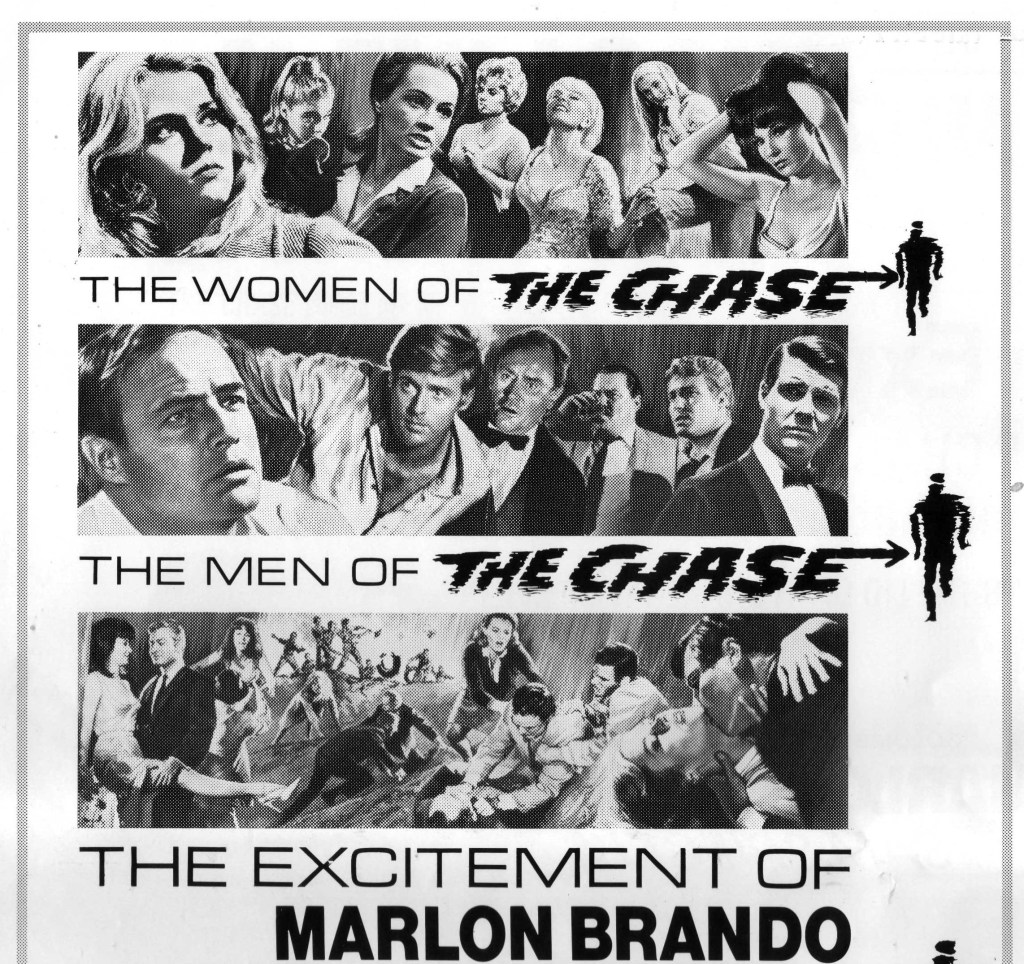
Basically, the narrative revolves around a small Texan town’s reaction to the return of escaped prisoner Robert Redford, now wanted for a murder he did not commit, which both brings the past to light and exposes existing tensions within the community. That Redford takes a good while to return allows those tensions to gently simmer. By the time he does the town is at fever pitch.

Redford’s wife Jane Fonda fears her affair with millionaire’s son James Fox will be discovered.  Timid banker Robert Duvall fears Redford discovering that he was initially imprisoned for a crime Duvall committed. Duvall’s sexy wife Janice Rule taunts him with her adultery. Redford’s mother Miriam Hopkins fears further humiliation.

Adding further bile to the proceedings are Bruce Cabot as Fonda’s venomous stepfather, real estate manager and gossip-monger Henry Hull who preys on adversity, and Rule’s lover Richard Bradford who drums up racial hatred against Redford’s friend African-American Joel Flueller.

The incorruptible Brando is faced with keeping the lid on a number of potential explosions.

Hellman’s script and Penn’s empathetic direction prevent it from falling to a swamp of melodrama. All of Miriam Hopkins’ maternal despair is captured in one shot of her sitting on a stool. Millionaire E.G. Marshall is building a local college so “young men do not have to leave here like my son.” The poor Fonda and rich Fox are genuinely in love but she holds it against him that he married someone else (of his own class) first while she waited “all those bad years.” When Brando imprisons Flueller for his own protection, he lets him find his own way to the cell and trusts him to lock himself up.

And there is an ample wit. A drunk confronts Brando with “the taxpayers of this town pay your salary to protect this place.” Brando’s response: “If anything happens to you, we’ll give you a refund.”

And I’ve not even mentioned Redford. While relegated to dipping in and out of the story to keep tension high, this is a memorable turn. Martha Hyer is estimable an alcoholic wife while Angie Dickinson extends her acting credentials with an untypical role as a domesticated wife.

John Barry’s score, dismissed by the Variety critic as having “no particular theme that lingers in the ear,” is in fact it is a triumphant piece of work, with a central melody that is in turn jarring and romantic.   

But it is Penn who brings home the bacon, bringing together a disparate tale in fine style, drawn tight to a stunning conclusion, and proving he had a mastery of both style and material that would stand him in good stead for his next picture Bonnie and Clyde.

I was lucky enough to catch this for free on Talking Pictures. It might come round again on this free channel. If not, or if you can’t wait, it’s well worth investing in a DVD. 
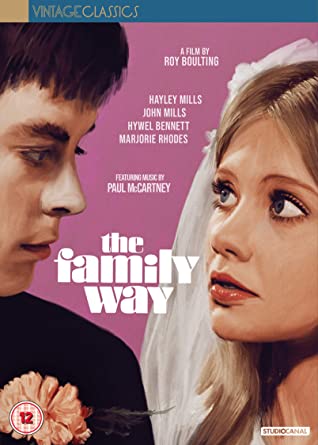
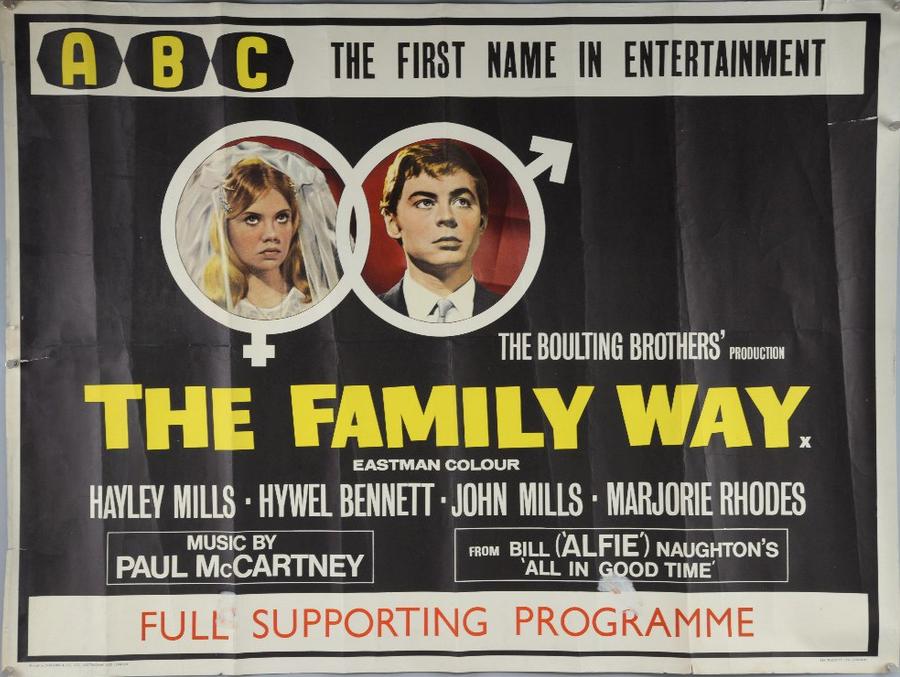
The Family Way (1966) ****

Nudity was not an option for previous child stars attempting to make the leap into adult roles. Shirley Temple in the 1930s and Margaret O’Brien in the 1940s were kids when they played kids and when they outgrew their cuteness audiences were indifferent.

Being older when playing younger characters increased the chances of career survival. Silent movie superstar Mary Pickford was 22 when she first tackled child heroine Tess of the Storm Country (1914) and 30 for the remake and she made an absolute fortune from these kinds of roles. Judy Garland was 17 when The Wizard of Oz (1939) appeared and managed another 15 years at the top before drugs and drink took their toll, still worthy of supporting roles after A Star Is Born (1954) and even star billing in her last film I Could Go On Singing (1963). But she was fired from Valley of the Dolls (1967), ironically enough given the film’s subject matter, due to alcohol and drug dependency.

Hayley Mills was 14 when her first Disney picture Pollyanna (1960) was released and for the next five years at that studio never played anyone approaching her true age. She was protected from studio abuse because this was Disney and because her father was actor John Mills, who often appeared in her movies. When the Disney contract ended, Sky, West and Crooked (1966), her father’s directorial debut, attempted to refashion her screen persona with a more challenging role.

But The Family Way forced audiences to set aside all preconceptions. Not only did she show her naked derriere, but this was a film essentially about sex. No sex is actually shown because  newly-weds Mills and Hywel Bennett have not consummated their marriage. You can thank the Carry On films for the snigger-snigger British mindset to sex. The promiscuous and often predatory characters of Darling (1965) and Alfie (1965) occupied a different world, almost a foreign country as far as the inhabitants of this solid working-class town were concerned. They would have looked askance at such permissiveness. Here, at this particular point in history, both sexes were still expected to be virgins when they married. Sex in Darling (1965) and Alfie (1966), for example, carries little emotional overtones. The Family Way is novel in treating sex as fundamental to happiness within marriage.

The subject of impotence would not be first on your list when you set out to make a warm-hearted drama. But here screenwriter Bill Naughton (Alfie) in adapting his play All in Good Time uses the theme to explore family values. But where recrimination – and subsequent confrontation – might be the first port of call for another writer, Naughton foregoes that obvious route to concentrate on the way impotence eats at a man’s self-worth. Two secrets drive the plot but the second is preserved right to the end, resulting in possibly the most moving finale you will ever watch.

The happy couple before life gets in the way.

In documenting working-class life it is superior to the earlier Saturday Night and Sunday Morning (1960). It is life without inbuilt bitterness. Families are still crammed into small houses, a visit to the housing department an invitation to humiliation, but there is full employment and enjoyment to be found in simple pleasures.

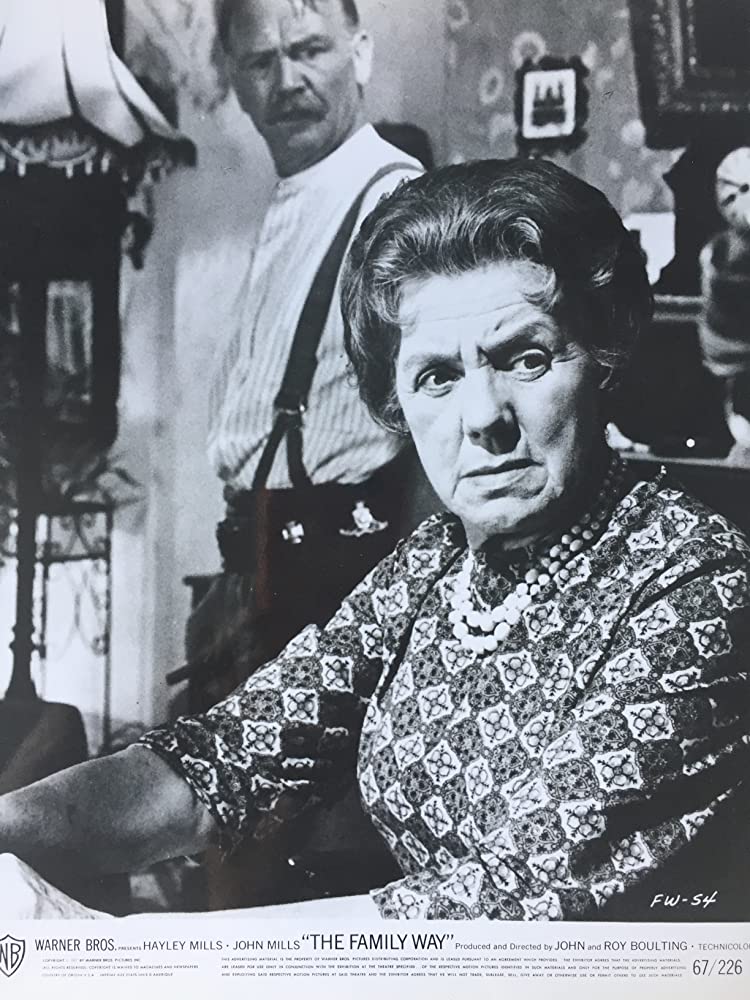
Family dynamics are expertly explored. Bennett, with a shelf load of books and penchant for classical music, is diametrically opposed to his down-to-earth but exceptionally obtuse father John Mills, and there is a wonderful scene early on where Bennett seeing how badly his father takes defeat allows him to win an arm-wrestling competition. Mills is the standout, devoted to the memory of a long-departed childhood pal and struggling with his position as patriarch especially in the face of perennial sniping by wife Marjorie Rhodes. Mills is wonderful doing nothing, a face so expressive of longing and emotion, and it is he who has the heart-breaking final scene. The older characters are fully rounded, bluff exteriors concealing fragile emotion. Hard-faced Rhodes appears almost fey when she recalls a moment of love. Hayley Mill’s burly father (John Comer) cannot cope with her departure from his household, especially as that leaves him at the mercy of his shrewish wife (stand-up comedienne Avril Angers).

Hywel Bennett begins a successful movie career with a difficult part, an introspective role calling for him to contain his emotions – not venting his spleen like the endlessly complaining Arthur Seaton of Saturday Night – until they erupt in a spectacular fist fight that does not go at all the way you would expect.

John Mills (the star’s real-life father) and Marjorie Rhodes as the parents of Hywel Bennett.

Barry Foster (later television’s Van de Valk) has the showy part as the rough-edged  workmate and Murray Head (later part of the love triangle in Sunday, Bloody Sunday, 1971) also makes his debut in an equally showy role as Bennett’s brother who makes advances to his frustrated sister-in-law.

Even without the nudity, Hayley Mills, the denoted star, makes the transition to movie adulthood with ease. In part, all she had to do was drop the unnatural excitement that appeared essential to her Disney portfolio. Her delivery, her reading of a line, had always been good and she had clearly worked out she was going to be an actress not a sex symbol so there was no exaggerated use of her physicality.

Even the nudity worked in her favour, startled to be disturbed emerging from a bath, genuinely shy, not the mock-shy or revelling in her naked state that was de rigeur in Hollywood. She was also helped by being a light foil to the brooding, gloomy Bennett, her natural bright personality, while affected by their problem, still capable of enjoying harmless pleasures. .

This was a distinct change of pace for the fraternal producer-directing team John and Roy Boulting, stalwarts of British production since the 1940s with a host of well-regarded dramas and comedies, often with Peter Sellers, to their name.  Generally, they took turns about in the director’s chair – the former putting his name to thriller Brighton Rock (1948) and comedies Lucky Jim (1957)  and I’m Alright, Jack (1959), the latter claiming credit for drama Fame Is the Spur (1947), thriller Run for the Sun (1956) and comedy A French Mistress (1960). Occasionally, they shared the directing chore as with thriller Seven Days to Noon (1950), comedy Heavens Above (1963) and in this contemporary drama.

Their approach to The Family Way went against the grain of the gritty working-class dramas in the vein of Saturday Night and Sunday Morning and This Sporting Life (1962). Nobody here has a job they hate or comes home covered in grime. In fact, since the central thrust (pardon the pun) of the movie is about pleasure (sexual, that is), it is set against a background of enjoyment. Both principals have jobs in entertainment, Bennett an assistant projectionist in a cinema, Hayley Mills working in a record store and also seen at a disco and a motocross event. Alcohol plays a role, of course, but not to the extent of over-indulgence, not drinking yourself to oblivion like Arthur Seaton, and its main purpose is to present the father as an amiable host.

What impact the burgeoning affair between Hayley Mills and Roy Boulting (33 years her senior) had on the production is anyone’s guess but possibly it helped steady the star’s nerves when it came to the nude scene. From today’s perspective, the nudity appears gratuitous. And certainly back then it was shocking, ensuring an X-certificate (although the subject matter probably already guaranteed that).

Actually, it was social comment. While living in a decent-enough house, the family lacked one particular amenity – an indoor toilet. Washing took place at a communal sink or in the privacy of a bedroom with a bowl of water. A bath was a mobile unit, a zinc item dragged out of the scullery into the living room, filled with endless pots or kettles of hot water. But for a young woman to take a bath demanded privacy. So when Hayley Mills is interrupted in her ablutions, males and females in the audience had opposite reactions. It would not be unreasonable to suggest that males simply enjoyed the sight of the naked posterior. Women, on the other hand, would wince. Aversion to nudity may have played a part but more likely women would feel deeply the humiliation at the lack of privacy in such a household, that someone could come upon you at your most vulnerable at any time. Sure, nothing went hidden in such houses, the sounds of any activity would carry through walls, but such a deep personal activity as exposure while taking a bath said far more about the brutal congestion of family life than jokes about hearing someone urinating into a container in the next room.

Paul McCartney contributed a very hummable melody as part of his debut movie score.

American audiences did not respond so well to Hayley Mills’ emergence as an adult actor and the movie failed to click at the box office there. But by that point it was already in profit, a runaway British hit (among the top twelve films of the year) and set the female star up for an adult career, pointed Hywel Bennett in the right direction and gave John Mills one of his most memorable turns.  And very entertaining and enjoyable with terrific acting.

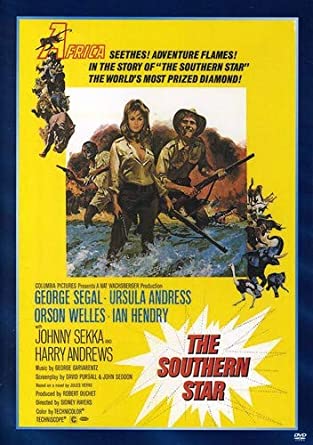
The Southern Star (1969) ***

There’s a surprisingly good movie here once you strip out the cliché jungle stuff and the racist elements. The diamond of the title is actually a MacGuffin, just enough to get you started on two parallel tales of revenge.

George Segal is a mining engineer-cum-adventurer and Ursula Andress, daughter of mine owner Harry Andrews, as far from the traditional jungle heroine (except in one regard) as you could get. She saves him from crocodiles, rescues him from jail and quicksand, swims across a hippo-infested river and is a better shot than him (or anybody for that matter) with a rifle. This is female empowerment with a vengeance.

Suspected of stealing the diamond, he is hunted by ranger Ian Hendry, Segal’s love rival, who intends to win Ms Andress back using the simple expedient of killing the thief. Lying in wait is all-purpose rogue Orson Welles who seeks revenge on Hendry. The second unit had a whale of time filming anything that moved –  lions, leopards, zebras, giraffes, buffaloes, monkeys, antelopes, the aforementioned hippos and crocodiles and what looked like a cobra – and at one point everything does move in coordinated fashion if you can call a stampede coordinated.

But the main focus is an Ursula Andress who constantly confounds Segal’s sexist expectations. Docility is her disguise. Anytime she appears to be doing what she’s told you can be sure she’s planning the opposite. While Segal does have his own specific set of jungle skills, he often looks a fool. But they do make a good screen partnership and their dialogue is lively.

Hollywood spent millions of dollars trying to create screen chemistry between various stars and although it seemed to work very well in the industry’s golden age with Clark Gable and any number of MGM female stars, Bogart/Bacall and Tracy/Hepburn and I guess you could chuck John Wayne-Maureen O’Hara into that particular mix, the formula seemed to have gone awry by the 1960s discounting the Doris Day/Rock Hudson combo, big budget romances like El Cid (1961) and Doctor Zhivago (1965) and an occasional home run with whomever Cary Grant was romancing on screen. So it was usually hit-or-miss whether any sparks flew between the stars.

Andress had certainly been a European femme fatale par excellence as seen in Dr No (1962) and The Blue Max (1966), but it was certainly not a given that she would more than hold her own for an entire picture. Segal was nobody’s idea of a romantic leading man although the notion had been given a tryout in The Girl Who Couldn’t Say No (1968) with Virna Lisi. But here the whole enterprise works in an It Happened One Night vein with the supposedly superior male recognizing that perhaps his companion was more than a match.

Harry Andrews and Orson Welles both try to steal the picture, with polar opposite characterizations, Andrews loud and menacing, Welles soft and menacing. You can tell Scottish director Sidney Hayers (The Trap, 1966) was an editor because he cuts for impact and mostly does an efficient job of sticking to the story. Supposedly, Orson Welles directed his own scenes, but that might be to make sure he got to hog the camera. He has enough choice lines and bits of business to keep him happy and gives his venomous character a camp edge.

The casual, incipient, racism is harder to ignore. It is both verbal and physical with Johnny Sekka, Segal’s buddy, who actually has the diamond, bearing the brunt and being brutally whipped.

Despite my reservations, this is well constructed and keeps one step ahead of audience expectation with plenty twists to subvert those, although the music by Johnny Dankworth gets in the way, offering musical cues opposite to what is required.

As it is a jungle picture there is the obligatory heroine’s bathing scene – and to balance the books on that score Segal does whip off his shirt at one point. Except for the clichés, it would have gone higher in my estimation for by and large it is well done and Andress is once again (see The Blue Max) a revelation.   

Genghis Khan (1965) ****

Hollywood was never reined in by the strictures of history, much preferring fiction to fact for dramatic effect, and that’s largely the case here, although the titular hero’s real life remains shrouded in myth.

If you do catch this surprisingly good feature, make sure it’s not one of the many pan-and-scan atrocities on the market. I watched this in the proper Panavision ratio which meant it occupied only one-third of my television screen, but in that format it’s terrific. It’s a bit of an anomaly for a decade that churned out high-class historical epics like El Cid (1961) because this clocks in about a hour short of other films in the genre and there’s no star actor or director to speak of and no Yakima Canutt to handle the second unit action scenes.

Omar Sharif’s marquee value at this point was so low that if you check out any of the original posters you’ll note that his name hardly rates a mention and he also comes at the very end of the opening screen credits. Although this is post-Lawrence of Arabia (1962), it’s pre-Doctor Zhivago (1965), suggesting nobody had a clue how to market his talents.

Director Henry Levin was a journeyman, fifty films under his belt, best known for not a great deal except for, following this, the second and third in the Matt Helm spy series. Given this film was critically ignored on release and since, and a flop to boot, it definitely falls into the “Worth a Look” category. Although there are few stand-out scenes of the artistic variety such as pepper Lawrence of Arabia or El Cid, this is still well put together and Levin shows an aptitude for the widescreen.

The narrative breaks down into three parts – the first section describing Sharif’s enslavement by nemesis Stephen Boyd (the picture’s star according to poster and screen credits) before banding together rival tribes in revolt, the second part a long trek to China, and the third encompassing a final battle and hand-to-hand combat with Boyd. For a two-hour picture it has tremendous sweep, not just the scenery and the battle scenes, but political intrigue, romance, a rape scene and even clever comedy. Sharif is excellent as a leader who believes his glory is predestined, but who has very modern ideas about the role of women.

The best section, oddly enough, is set in China where Sharif engages in a duel of wits with Robert Morley’s distinctively contradictory emperor, but that’s not to detract from the film’s other qualities, the action brilliantly handled, especially the chaos of battle, the romance touching, and the dialogue intelligent and often epigrammatic. Unlike James Mason who makes a calamitous attempt at a Chinese accent, Morley, costume apart, looks as if he has just walked out of an English country house, but his plummy tones belie a very believable character. Telly Savalas and Woody Strode have decent parts as Sharif’s sidekicks, the former unexpectedly bearing the brunt of the film’s comedy. French actress Francoise Dorleac is effective as Sharif’s wife.

Hitchcock stole one of his most famous ideas from Genghis Khan. About the only scene in Torn Curtain (1966) to receive universal praise was a killing carried out to a soundtrack of nothing more than the grunts of assailant and victim. But, here, where the score by Yugoslavian composer Dusan Radic was extensively employed, the rape scene is silent and just as stunning. If the only prints widely available are of the pan-and-scan variety I’m not surprised the film has been for so long overlooked, but if you can get hold of one in the preferred format you will be in for a surprise.      

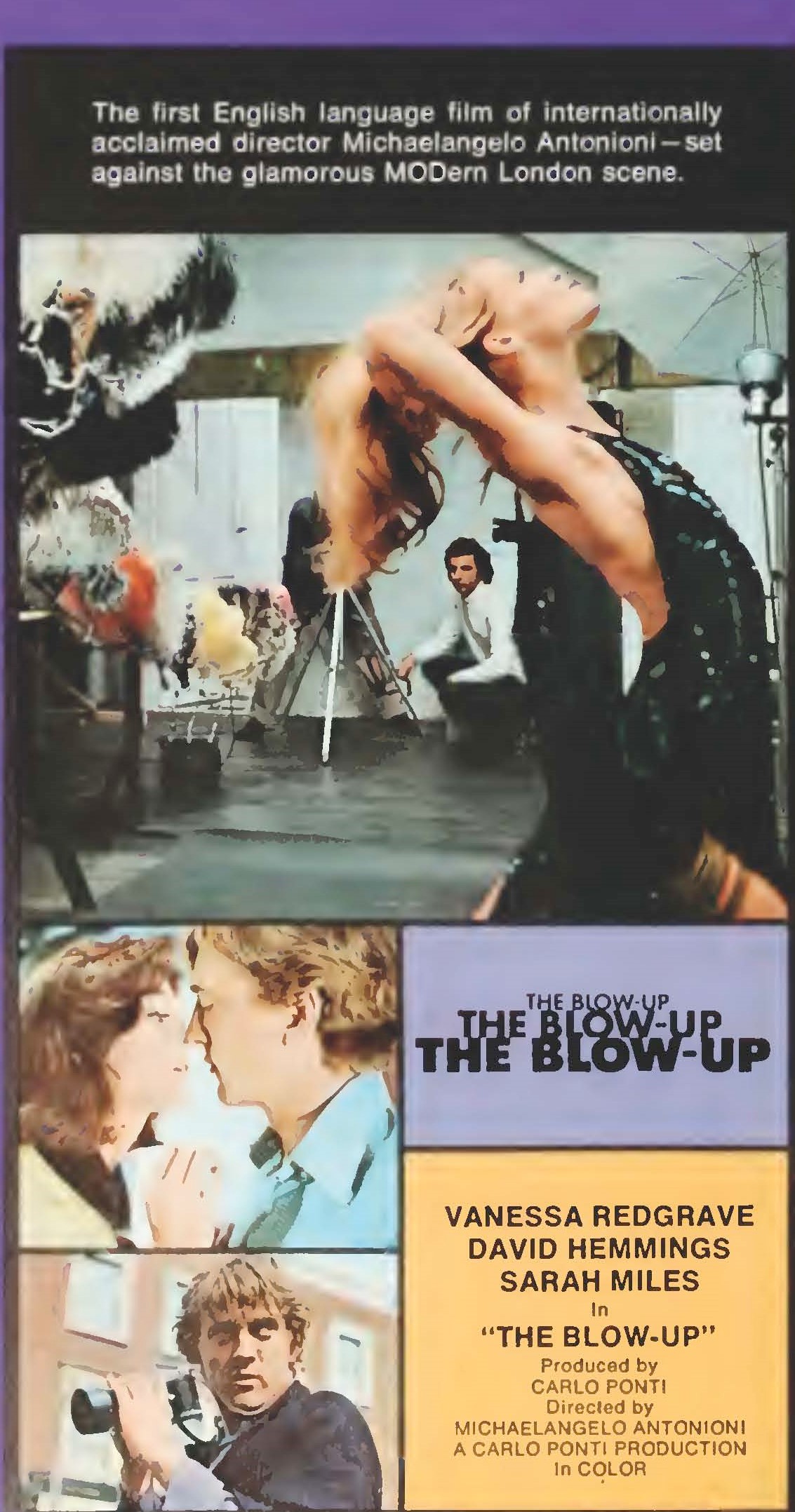
Blow-Up (1966)***

Movies can break all sorts of rules but they can’t cheat.

A film has to stick to an internal logic. For example, it can’t portray a photographer so obsessed with his calling that he even takes a camera with him to an antique shop and starts shooting off roll and after roll capturing the area’s rundown streets but then the one time he really could do with a camera – to prove there is a corpse at his feet – he is somewhat remiss. Especially when the movie turns on that plot point.

Setting aside what’s a somewhat contrived snapshot of “Swinging London” there’s a lot to admire here. The absence of music for one thing. Most of the movie runs without musical accompaniment, a bold move since so often we rely on the soundtrack to provide guidance for a scene or an overlay for the entire film. Here, Antonioni makes us falls back on our own interpretation.

David Hemmings, all mop-top and intense stare, is a high-flying high-living fashion photographer in the David Bailey mold (casual sex with wannabe models a perk) who turns investigator on being confronted in a park by Vanessa Redgrave after taking snaps she wants back. Tension is sustained by her sudden appearance at his studio, willing to pay with her body for the return of the photos, and then by Hemmings’ careful, photo-by-photo blow-up-by-blow-up analysis that slowly comes closer to the truth.

Everything in his world is judged through a lens, as if he can capture elusive truths, and he has aspirations to being more than a mere fashion adjunct, having spent time taking portraits of down-and-outs. He judges Redgrave as he would a model, she has a good stance and sitting posture. Even by the standards of the permissive society, he is a bit of sexual predator, taking advantage of two giggly model wannabes.

But the photography scenes are well done and Antonioni captures the intimacy between model and photographer that create the best images. If you can get past the cheat and the deliberate obtuseness this creates – and the tsunami of artistic interpretations it inspired about the director’s intent – then it remains intriguing.

This isn’t Hemmings’ greatest work – Fragment of Fear is much better – but it certainly provided him with a marketable movie persona. Redgrave is excellent as the nervy woman willing to do what is required and the movie might have worked better had she had been allocated more screen time and their duel had continued through other scenes. But then that would have been Hitchcock and not Antonioni.   I’d have given it a higher score except for the cheat.

Cool Hand Luke (1967) *****

Lucas Jackson (Paul Newman) has none of the truculence of the ordinary rebel, consequence not part of his vocabulary, “it seemed a good idea at the time” his unfailing mantra. Outside of Butch Cassidy, a more amiable criminal you would struggle to find. He defies authority with a smirk, indiscriminate in opposing the system, whether devised by guards or prisoners and they are indiscriminate in return, swiftly punishing anyone who steps out of line.

First-time director Stuart Rosenberg’s meditation on martyrdom remains an iconic curiosity and one of a handful of great performances that showcase Paul Newman’s immense acting skills. It is about ten minutes too long, unremitting sequences of lorries travelling to and from work detail, in the morning or at night, and the work itself, way too repetitive, suggests a director who did not quite trust his audience to get it.

In a prison movie, the main narrative is always escape, but Luke is as much trying to escape from himself as his circumstances. There is a self-pitying aspect in him blaming God for making him the way he is. But beyond these gripes it remains an astonishing and involving work. This is a world reduced to a single common denominator – brutality. For a man who loathes rules, this is hell.

While no other character apart from Dragline (George Kennedy in an Oscar-winning role) and the Warden (Strother Martin in one of his best mean roles) is given much to do, nonetheless the rest of the cast do not merge into the background, facial expressions and tiny actions revealing character.  

There are a number of terrific scenes – Newman refusing to give in when beaten to a pulp in a boxing match, the egg-eating contest, the digging-the-hole method of destroying a man’s spirit, the guard bewailing the death of his dog. But the movie also examines the universal need for hero worship, Dragline’s bewilderment when Luke eventually fails to live up to expectation is affecting.

Two other aspects stand out. With every prisoner in the same uniform and the countryside bleak and undistinguished, Conrad Hall’s cinematography is miraculous while Lalo Schifrin’s score, with the wonderfully evocative simple theme, is continuously inventive. As definitive an examination of the outsider as the later Easy Rider.

Easy Rider (1969) *****

You could be forgiven for thinking that the movie’s main influences were the early Cinerama pictures that focused on extensive tracking shots of scenery (in this case, the open road) and unusual customs (ditto, alternative lifestyles, dope-taking etc) and Mike Nichol’s use of contemporary pop music in The Graduate (1967). But it also drew on the assumption, as did Hitchcock in Vertigo (1958) and Kubrick with 2001: A Space Odyssey a decade later, that a camera doing nothing can be hypnotic.

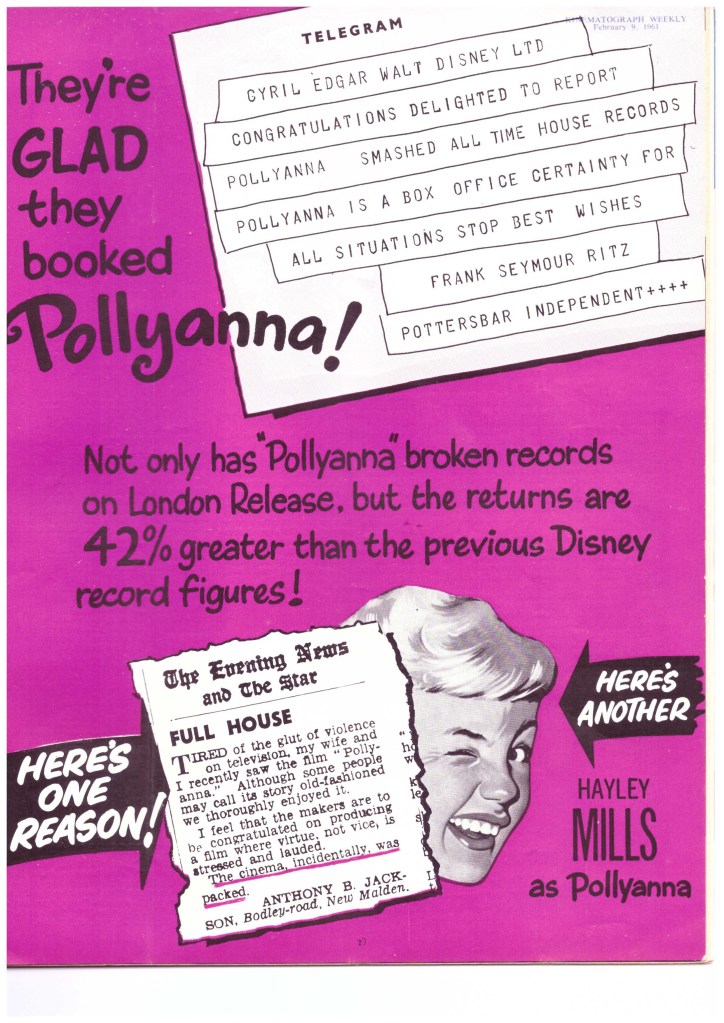
Selling a picture to the public and selling it to cinemas were two separate marketing skills. The easiest way to guarantee bookings for any film was to promote the box office figures through the trade press – as here in the British “Kine Weekly.” Columbia had cleverly booked the movie into one of the smallest cinemas in London’s West End where it was almost certainly guaranteed to break the box office record. But even the studio must have been taken aback by the way Easy Rider pulverized the previous record.

Message pictures were the remit of older directors like Stanley Kramer and Martin Ritt and films that had something to say about the human condition generally emanated from Europe and not low-budget efforts coming out of Hollywood. Easy Rider has a European sensibility, an almost random collection of unconnected episodes with no narrative connection to the main story, itself incredibly slight, of two mild-mannered dudes heading to New Orleans to see the Mardi Gras.

Road trips were not particularly unusual in American cinema but the form of previous locomotion was horse-related – westerns. The journey has been a central theme to movies. This is an 80-minute picture masquerading as a 95-minute one, a good fifteen minutes of screen time taken up with endless shots of Peter Fonda and Dennis Hopper on bikes passing through the landscape, with a contemporary soundtrack as comment.

Unusually, it’s also a hymn to ancient values, heads bowed in prayer at meals as different as you could get, the Mexican family and the commune, a marching band playing “When the Saints Go Marching In” and the recitation of prayers in the cemetery.

Success in London was no guarantee that a movie would perform as well all over the country. Columbia continued to book it into smaller venues in the hope it would repeat the London experience of breaking box office records. When it did the studio took out another advert in Kine Weekly to let exhibitors know.

What marks the film out stylistically, perhaps enforced by the lean financing, is the sparing way it is told. The most dramatic scenes – the three murders – are filmed in shockingly simple fashion. There are often long pans along groups of characters. While innovative, the flash-cut flash-forward editing adds little to what is otherwise a very reflective film. Inspired use is made of natural sound, the muffled thumping of oil derricks at the cemetery, the soundtrack to one death is just the battering of unseen clubs by unseen assailants.

The dialogue could have been written by Tarantino, none of the confrontation or angst that drives most films, but odd musings that bring characters to life. At the beginning of the trip, Hopper and Fonda are welcomed wherever they travel, but towards the end resented, treated as though a pair of itinerant aliens. They entrance young girls but are vilified by authority, jailed for no reason except the threat to traditional values they apparently represent.

Elements not discussed at the time of release make this more rounded than you would imagine. The excitable Hopper, a nerd in hippie costume, is driven by the American dream of making money. The more reflective Fonda senses something is not only missing from his life but has been lost forever. He has the rare stillness of a top actor, face reflecting unspoken inner turmoil.

It remains an extraordinary film, a series of accumulated incidentals holding up a mirror to an America nobody wanted to acknowledge and the brutal climax no less powerful now.   

Of course, the Easy Rider soundtrack itself summons up memories of the era and it is worth listening to just by itself and you might even want to go all the way and listen to it in the original vinyl.

Below is a link for the DVD.

   https://www.amazon.co.uk/Easy-Rider-DVD-Peter-Fonda/dp/B00LTK2Z44/ref=sr_1_1?crid=YSG6SCL8QQF9&dchild=1&keywords=easy+rider+dvd&qid=1596660339&s=dvd&sprefix=easy+rider%2Caps%2C153&sr=1-1

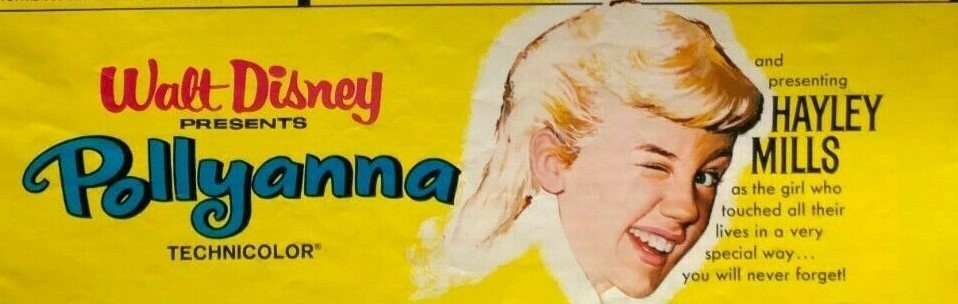
Pollyanna (1960) ***

This Walt Disney version discarded much of Eleanor H. Porter’s original best seller not to mention a great deal of the tear-jerking section that played to superstar Mary Pickford’s strengths in the silent 1920 adaptation. Pickford was in her late 20s at the time and a movie mogul to boot (having launched United Artists) so had a depth of emotion Hayley Mills (aged 13 during filming) could not hope to match.

The screenplay is a good lesson in how to retain the essential element of a story – a positive-thinking orphan alleviates the gloom in an embittered town – while providing more for adult audiences. Disney assembled an awesome cast with three Oscar-winners – Jane Wyman (Best Actress, Johnny Belinda, 1948),  Karl Malden (Best Supporting Actor, A Streetcar Named Desire, 1952) and Donald Crisp (Best Supporting Actor, How Green Was My Valley, 1942) – plus four-time nominee Agnes Moorehead and Adolph Menjou.

Despite no Oscar recognition Nancy Olsen had been leading lady to the likes of Bing Crosby, John Wayne and William Holden. In effect, parents would be very familiar with the stellar supporting cast. Unusually for a kid’s picture, Wyman, Malden and Crisp each are given a reflective moment to prove they are doing more than taking an easy salary cheque. 

At least in Hollywood terms (Mills made her debut the year before in the British Tiger Bay, 1959) Pollyanna falls into the a-star-is-born category. The actress acquits herself well, with her expressive face, while hearing the emotion she packs into the word “gorgeous” is word admission alone. With a healthy subplot about a town in thrall to matriarch Wyman, the weight of the movie does not fall on Mills’ shoulders alone and fire-and-brimstone preacher Malden and faded spinster Wyman are particularly good; Malden especially allocated more screen time than would be normal in a movie aimed at kids.

I have never read the book nor (to my shame) seen the Pickford version, so I came to the movie with low expectations, anticipating a lazy, maudlin effort. So I was quite surprised to discover how much I enjoyed it and was shocked by the final piece of action which turned the movie on its head. Sure, it relies on the feelgood factor but there is some decent stuff here – Pollyanna’s determination to find goodness in every event and every person takes her into some strange avenues – the rainbow playing on the walls, the “good parts” of the Bible – that these days makes for an entertaining matinee.  

Fall of the Roman Empire (1964) ****

There could not be a more contemporary picture. As an examination of the problems of assimilating different cultures it is hard to beat. As an assessment of the difficulties of the transition of power it is faultless.

In Gladiator Ridley Scott, taking a few liberties with the known facts, re-imagined the circumstances discussed here of the death of Emperor Marcus Aurelius and the ascension to power of his son Commodus. Along the way, Scott stole a few of Anthony Mann’s visual ideas, snow falling on the battlefield, for example, and at the end the phalanx of guards, shields up, blocking in Commodus and the dethroned military chieftain (Stephen Boyd here, Russell Crowe in Gladiator) for their gladiatorial climax.

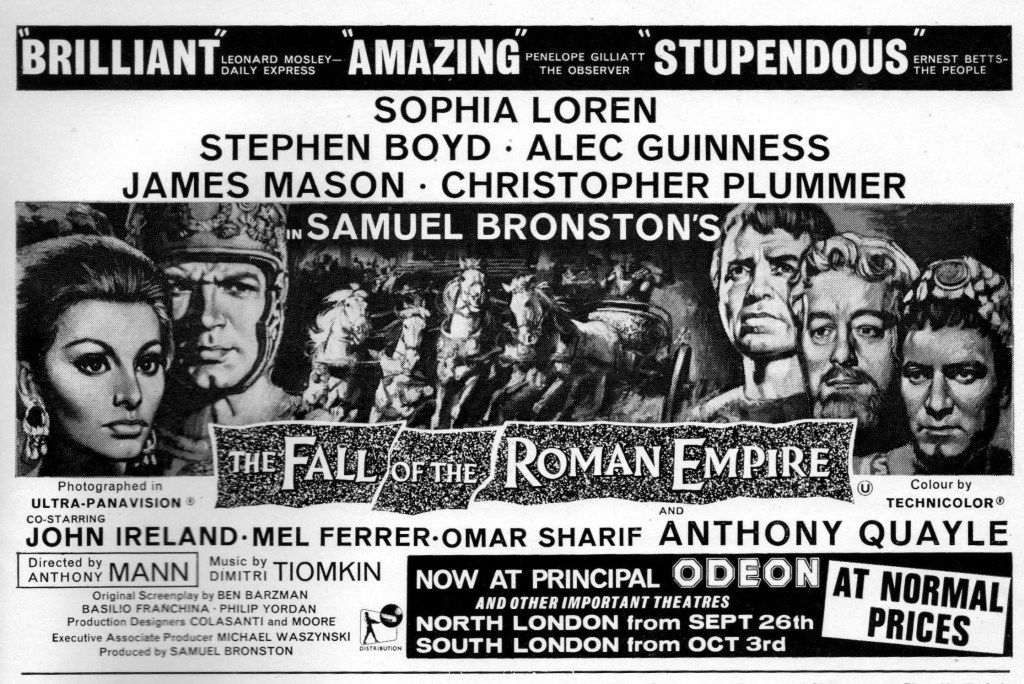
British advertisement for the film about to go on general release after a spell in the more expensive West End. The “normal prices” slogan was very commonly found on movies as they headed towards the more normal kind of cinema. in addition, by the time it was rest go into wider release the critics had delivered their verdicts and these could be tagged onto any advertising.

The title does not refer to an invasion of Rome by vast armies of barbarians but the internal corruption which signals the end of the empire. Audiences, taught Latin and Roman history as a matter of course at school around the time the film was released, would be more familiar with the subject matter, but hardly prepared for the spectacle.

Every extra in the known world must have been employed for several scenes, cities bursting with inhabitants, armies sprawling over vast tracts of land. One standout is the extraordinary chariot clash between the two protagonists, not in the confines of an amphitheatre a la Ben Hur, but on wild terrain, along narrow cliff roads, wheels tipping over the edge, down ravines and forest. The other is the soundless gladiatorial fight, not a whisper of music until there is a victor.

And there should be mention of the torture of James Mason, very well done. There is political intrigue, quite a clever way of poisoning an enemy, and plenty argument over the issue of accommodating different cultures, traditional punishment versus the novel notion of extending the hand of friendship and granting automatic citizenship.

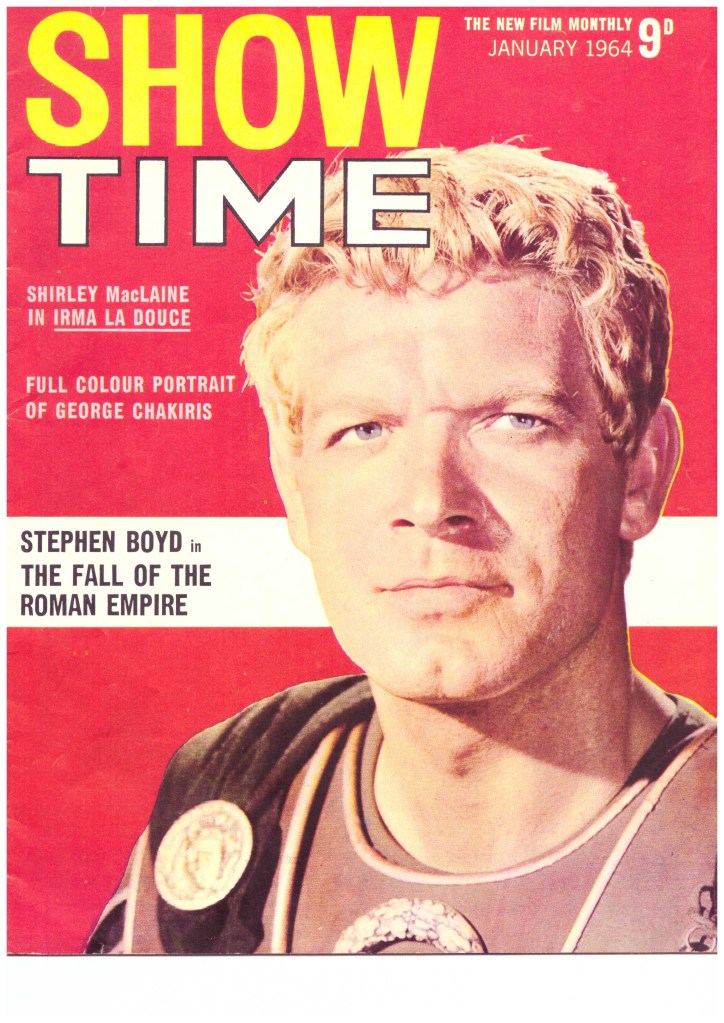
The relatively short-lived “Show Time” fan magazine was launched in Britain as Odeon’s answer to the highly successful “ABC Film Review.” Both magazines were only sold inside cinemas but it was common for cinemagoers to purchase copies without necessarily going into to see a picture. This magazine ceased publication by the end of the decade. This was the launch issue in Janaury 1964.

Loyalty is also tested – is treason a form of loyalty? And how much does loyalty depend solely on payment? Proof is given of how integrating cultures can work, an idea that seems alien to Romans accustomed to beating subjects into submission. In some respects the drama takes second place to the discussion.

Christopher Plummer is the deranged Commodus who embraces and disdains in turn his friend Livius (Stephen Boyd). Sophia Loren, as Commodus’ sister (no incestuous suggestions here), is in love with Boyd and though married off to Armenian king Omar Sharif she manages to spend little time with her husband.

If approached as a political film rather than a traditional epic it has a lot to offer. If you want just battles and thwarted romance then a lot less. The mixture of both strikes a good balance. While there are arguments that it is too long, it could actually do with another twenty minutes or so to iron out narrative inconsistencies.  

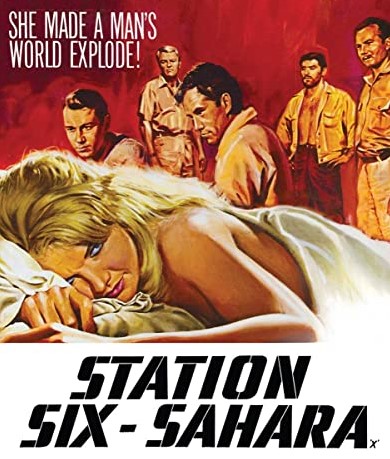
Station Six Sahara (1963) ***

David Lean spent months in Jordan capturing his vision of the desert for Lawrence of Arabia. Seth Holt was granted no such luxury, a few weeks at Shepperton Studios in England to make this British-German co-production.  

It is a surprisingly tight and effective drama made on a low budget excepting whatever fee induced Hollywood star Carroll Baker to join. Five men trapped on an oil pipeline maintenance unit drive each other to distraction. Loud Scot Ian Bannen constantly needles stiff upper-class Denholm Elliott while overbearing German boss Peter Van Eyck cheats at poker. The arrival of steely-eyed German Hansjorg Felmy alters the status quo as he refuses in his own quiet way to knuckle down to authority.

There is a wonderful psychological battle going on between Bannen and Elliott. Extremely envious of the number of letters Elliott receives, Bannen offers a month’s pay for just one. When the offer is accepted, Elliott cannot stop fretting about what he might have given away and what secrets it revealed about himself.

The arrival of Carroll Baker upsets the equilibrium further as the men attempt to win her affections. While apparently promiscuous, she is steelier than the lot of them, and tensions climb high when she begins to spread around her favors. Interestingly, she does no wooing but waits for men to come to her.

Given the budget restraints, or possibly because of them, it is surprisingly well directed. Two scenes stand out in directorial terms. In one featuring Bannen and Elliott, the Scot is only partly visible behind a piece of furniture but his dialogue continues even when out of sight. In the other, one of Baker’s suitors finds her door locked and as she is about to reply a hand appears (not in aggressive fashion) to cover her mouth, indicating she already has chosen her bedmate. Naturally, this can only lead to a grim end.

The cast of male unknowns are uniformly good but Baker steals the show as you would expect. Given the times, there was no nudity, but the overt sexuality certainly skirted the bounds of what passed as decency and Baker is alluring however little or much she wears. But her sexuality takes second place to her individuality. Her independence will not be surrendered to a man. Despite the budget restrictions it stands up very well.  

Discover WordPress

A daily selection of the best content published on WordPress, collected for you by humans who love to read.

The Atavist Magazine

by Brian Hannan

WordPress.com News

The latest news on WordPress.com and the WordPress community.