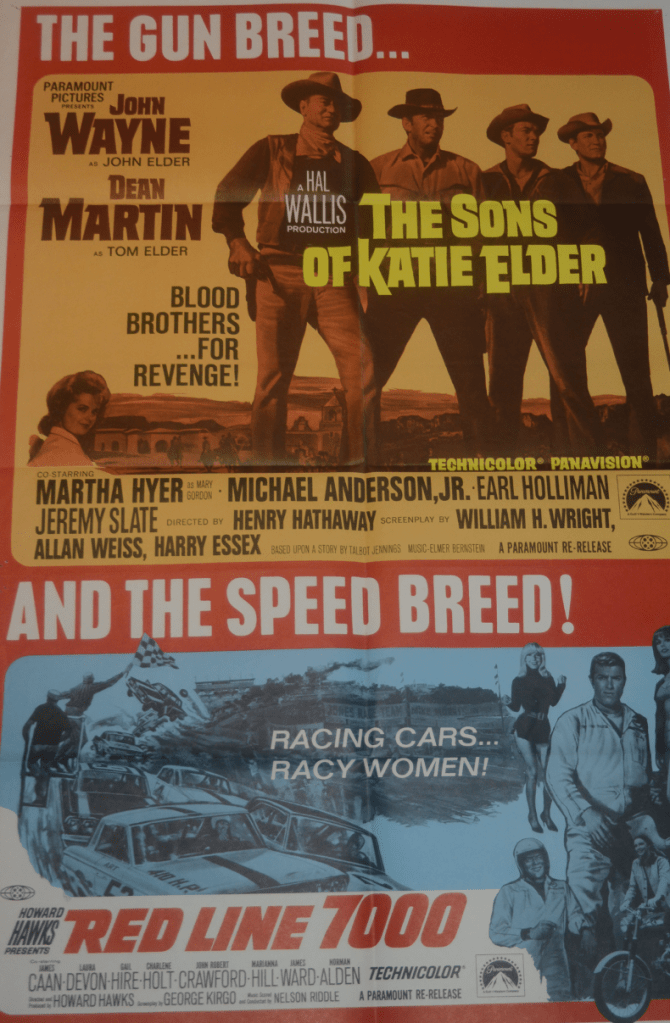
Quentin Tarantino is probably alone in preferring this movie mishap to John Frankenheimer’s Grand Prix (1966) – or I have somehow missed a “cult” picture. There was no doubt director Howard Hawks could handle speed. Check out the action in Hatari! (1962) as jeeps battle across tougher terrain than NASCAR racing circuits. But for some reason, he thought he would get away with interspersing footage of races and spectacular crashes with shots of actors behind the wheel. Any time something exciting is about to happen we’re alerted by the commentator saying “oh oh” or “wait a minute” or “hold it.” There’s none of the feverish excitement or authenticity of Grand Prix.
Hawks hired a no-name cast in a bid a) to become a star-maker, b) to prove he did require the marquee wattage of the likes of John Wayne and c) to show he could make a movie cheaply. He failed on all three counts. He probably didn’t think he was taking any kind of gamble at all, as a man approaching 70, in trying to depict the lives of people around 50 years younger. James Caan, in his sophomore outing, comes out best, but that’s not saying much since he has very little to do except growl and look broody. Marianna Hill (El Condor, 1970) is also believable.
While the racing footage has dated in a way that Grand Prix has not, the main problem is just a jumble of characters getting lost in a jumble of stories. No sooner has one character been introduced than we are onto another. There’s none of the cohesive story-telling that marked out The Big Sleep (1946) or Rio Bravo (1959) and, frankly, none of the characters are particularly interesting. And what possessed him to stick in a song sung by a character (Holly, played by Gail Hire) who cannot sing – she talks the lyrics – with a backing group made up of waitresses, I can’t begin to guess.
The most fun to be had is spotting in bit parts people famous for other reasons. Carol Connors, for example, who co-wrote the lyrics to “Gone Fly Now” (Rocky, 1976) appears as a waitress. As does Cissy Wellman, daughter of veteran director William Wellman. Comedian Jerry Lewis has a cameo. It says much for Hawk’s star-spotting abilities that of two female leads, Laura Devon only made five pictures and Gail Hire just two.
Henry Hathaway and Howard Hawks…Together!
Of the main supporting males, this was the beginning and end of John Robert Crawford’s movie career while Skip Hire made a bigger splash as a producer of television series The Dukes of Hazzard. Co-written by the director, George Kirgo (Spinout, 1966) and Steve McNeil (Man’s Favorite Sport, 1964)..
However, the French had a word for it – “genius.” Despite being dismissed as a rare misstep by the bulk of critics worldwide, Cahiers du Cinema decided it was one of the year’s Top Ten pictures. So what do I know?
I’m not sure I can take eight episodes of this especially in this trendy audience-alienating black-and-white version. Going all monochrome is like a bit like a novelist never deigning to describe the weather or what clothes their characters are wearing and I don’t go for the argument that the B/W is to prevent audiences being distracted by glorious Italian scenery when that’s the exact reason Dickie Greenleaf (Johnny Flynn), spoiled son of shipping mogul, went there.
I don’t know what time of year the tale was set because even the Italian seaside, warm enough presumably for Greenleaf and girlfriend Marge (Dakota Fanning) to go for a swim (Ripley remaining on the beach because his parents drowned, maybe), just looks gloomy. Anyone who can render Italy gloomy needs their head examined.
This isn’t Schindler’s List (1993) – which director Steve Zaillian wrote – that used B/W to sensible artistic effect or even Belfast (2021) where it was employed to depict the grimness of life.
I’m not even convinced by Ripley (Andrew Scott). Sure, the grifter was much more charming and personable, if occasionally awkward, as portrayed by Matt Damon (The Talented Mr Ripley, 1999) or John Malkovich (Ripley’s Game, 2002). This Ripley is just glum. Sure, his little cons don’t always work, but he can’t be as doom-struck as this.
Anyway, the story (eventually) starts when Greenleaf’s father pays Ripley, whom he believes to be a university chum of his son, to bring the errant boy, wasting his time on painting, writing and general idling, back from Italy, presumably to take on the role of inheriting the family business instead of living off his trust fund.
Like Sydney Sweeney’s character in Immaculate (2024) it hasn’t occurred to him that not everyone in Italy can speak English and so is thwarted trying to find directions to his prey’s pad. There’s a seemingly endless scene of Ripley climbing endless flights of stairs (how unfit can he be, Denzel Washington in The Equalizer 3 at least had a decent excuse) and this Ripley seems incapable of worming his way in (at least in Episode One) to his prey’s affections.
Yes, there are a couple of interesting scenes, Ripley changing seats on the subway because he sees a man staring at him on a different train. But most of the directorial art is devoted to snippets of images that have no relevance to the story or even the mood. There’s quite a barmy opening scene, too, of Ripley bumping a corpse down a flight of stairs in a tenement, not, to minimize noise, wrapping it up in a carpet or hoisting it on his shoulders. But that is clearly a denouement and it could be an awfully dull time away.
Except for the interviewee being an obliging idiot, this could as easily have turned into an own goal by a BBC desperately trumpeting its values to an indifferent nation that has been wooed away by the streamers. When the top dog is indulged by having her own top dog, a whippet, sitting at her feet everywhere she goes in BBC HQ and the supposed news bosses believe a scoop is snatching someone else’s scoop you’re on a very sticky wicket indeed.
And it’s worth bearing in mind that this show only came about because the person who set up the interview Sam McAlister (Billie Piper) had a severe case of schadenfreude and believing she hadn’t been sufficiently well rewarded wrote a book about the episode and nabs a writing credit here.
There’s not really a sympathetic character in the whole feature, unless you count the 450 journalists being shown the door because the Government won’t let the BBC raise the licence fee to cover its running costs and the BBC refuses to lower the fees it pays its top presenters (who only stay out of the goodness of their hearts because of course they would get richer pickings on commercial channels) to achieve the same end.
The only person who comes close is the sad-eyed Royal PR guru Amanda Thirsk (Keeley Hawes), heart roasted by looking after spoiled man-child Prince Andrew (Rufus Sewell in an ill-fitting face mask) – inclined to throw a tantrum should some housekeeper fail to arrange his battalion of teddy bears in the correct order – and clearly desperate to believe the prince could not possibly be at fault. However, the idea that you would let such a dope loose on Newsnight, facing one of the world’s toughest interviewers in whippet-lover Emily Maitlis (Gillian Anderson), shows remarkably poor judgement, especially when the prince just can’t see what all the fuss was about when he was doing the right thing by standing by his old pal, a convicted paedophile.
Anyone expecting proper investigative journalism or a thrilling narrative up to standards of All the Presidents Men (1976) or Spotlight (2015) – where the journalists actually do the hard work of the digging rather than just regurgitating a story that’s already out there, albeit with a bit more gloss, and the luxury of a one-hour time slot – would be looking in the wrong place.
Wouldn’t it be nice if we had discovered just a little bit more about Bernstein and Woodward’s personal lives, whether they owned dogs or had girlfriends or maybe a sick mother, just to fluff out the story a bit, but luckily Alan J. Pakula had more to worry about than what clothes his Woodward and Bernstein had to wear when confronting their subjects.
The BBC high-ups, when not toddling off to sit in boxes at the opera, come across as up their own backsides. Sam is shown to be an outsider, who, unfortunately, dresses like she’s going clubbing, which gets everyone’s back up, but, red card here, seems surprisingly ignorant of the juicier details of the story she’s investigating.
Netflix has been on a roll with The Crown so presumably thought any story with a royal connection would be equally a ratings winner, not realizing that you still need interesting characters to snaffle the viewers and no number of angst-ridden people is going to cut it.
I can’t vouch for the truth of the impersonations of real characters, but while Gillian Anderson seems to catch the essence of Emily Maitlis, Rufus Sewell’s intonations are very much the actor’s own while the face mask seems to wobble from time to time. Billie Piper got the thumbs-up from Sam. I doubt if Amanda Thirsk would care for her worst PR moment to be dramatized but Keeley Hawes at least lends her gravitas.
Suicide by television is the best way to describe the prince, locked into a self-serving version of himself as charming war hero best suited to modelling Army uniforms glittering with medals. However, it struck me at the time and I was reminded of this omission here, that none of the investigative journalists have sought to investigate the small matter of the Pizza Express alibi. I would have thought it would be relatively easy to establish if Andrew was there on the night in question. Directed by Philip Martin.
This only goes to prove that not only can you lead a horse to water but without much encouragement you can get it to drown itself.
The original interview is better value than this. But we should perhaps thank Netflix for allowing its rival a moment in the sun.
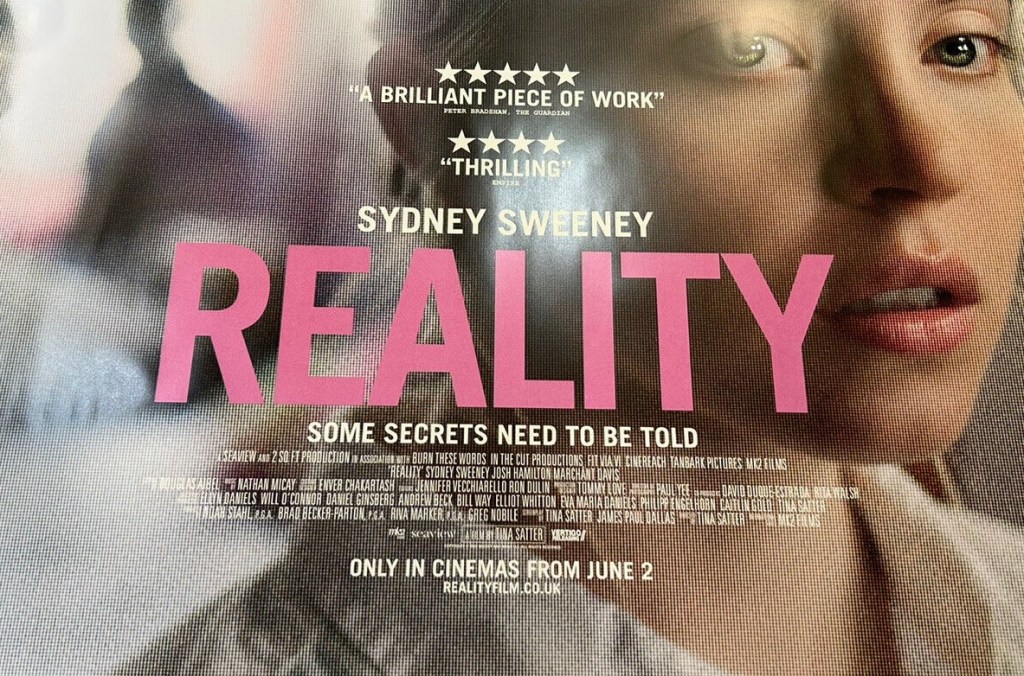
This never gained much traction on initial release but now Sydney Sweeney is a name to watch, worth checking it out.
When F.B.I. agents turn up at your door with a search warrant, surely your first instinct is to ask what the hell is going on? When that doesn’t transpire, an audience’s gut feeling is that you are hiding something. Or, this being America, it’s going to be a miscarriage of justice. Whether it is that in the end would depend on your political point of view.
Keeping politics out of it for the moment this is a riveting piece of what used to be called cinema verité and now probably is labelled docu-drama. The title would be ironic except that this main character had the kind of parents who named her Reality (Sydney Sweeney).
Initially, it’s just two rather amiable non-threatening FBI officers, Agent Garrick (Josh Hamilton) and Agent Taylor (Marchant Davis), who turn up in 2017 at the aforesaid door. They are advance warning, if you like, for soon there’s a posse of agents tumbling out of the cliché black vehicles. There’s certainly no sense of menace though Reality is kept clear of touching her mobile phone and kept outside and possibly thinking from the continued amiable chat with Garrick that it’s all going to be a misunderstanding. But then, as luck would have it, she’s got a room in her house that could stand in for a jail cell any day of the week, no furniture, bleak, and a snail plodding along the window ledge. And it’s in this room that the interrogation takes place.
What’s superb I guess is that the dialog all comes from F.B.I. transcripts so instead of the waterboarding or good-guy-bad-guy routine or just beating up a suspect that we’ve been fed as the truth by umpteen Hollywood movies the actual interrogation is so low-key you think this has got to be a case of mistaken identity. Or that someone out of malice has pointed the finger at an innocent party.
Reality is a linguist – speaks fluent Farsi (an Iranian language) – with high-level clearance working for the National Security Agency. Oh, and she teaches yoga, competes in weightlifting competitions and if I got this right owns three guns including an automatic rifle.
So, the questioning is pretty much along the lines of the F.B.I. just wanting to clear up a few things. Did she, for example, by accident ever take out of the building something classified that should never have left the office? Sure enough, way back, by accident she had done so. But it soon becomes clear, if ironic, that someone engaged effectively in espionage is just as open to being spied upon as the country’s adversaries.
But as the tension mounts, the tone never changes. It’s Reality who looks more and more under pressure. From standing stock still and meeting their eyes, her attention is diverted by the antics of the snail and she starts moving around and eventually slides to the floor. Occasionally, Taylor will take a turn asking questions and both are equally adept at expressing surprise, especially convincing given it’s soon evident they know her every move.
These guys could be classic courtroom lawyers, because they make no wild assertions, just gently lead her on to admitting what they know is true. They make a point of telling her they don’t think she’s a big badass spy, and that she’s just someone who made a mistake, maybe in the heat of the moment, what with so much going in the U.S. Presidential Elections of 2016.
And you’d be amazed at how the guilty party commits herself on the slightest of details, a piece of paper folded over, for example. Turns out Reality has been a whistle-blower and getting her to admit makes the consequences easier, especially when all her answers have been recorded, for the prosecution.
It’s quite obvious where debut director Tina Satter’s political views lie but that doesn’t get in the way of a stunning piece of cinema. She’s had the sense to keep it short – it barely passes the 80-minute mark – and to limit editorial outrage to the end.
As it stands, setting aside the political element, it’s an engrossing watch. Sydney Sweeney is superb as the guilty party while Garrick and Taylor are equally good at tying her up in knots. Sweeney cuts her dramatic teeth on this one, and is more impressive than in Immaculate, so counting this in with Anyone but You, studios should be throwing at her some decent dramatic as well as comedic vehicles. She doesn’t necessarily need a Glen Powell at her side,
One to watch, regardless of which end of the political divide you favor. This is the kind of movie that a Sidney Lumet – it reminded me both of the dryness of The Offence (1973) and the courtroom spectacle of The Verdict (1982) – or a John Frankenheimer would have pumped out in their prime or the fly-on-the-wall documentaries of Frederick Wiseman (Basic Training, 1971).
I thought I’d taken a stab at finding out what happened to Mimsy Farmer after More (1969) and by chance stumbled upon Rita Hayworth (The Happy Thieves, 1961), also persona non grata in mainstream Hollywood.
Pivots on the tricky trope of mistaken identity. Or, rather, someone who insists on believing that a stranger turning up is actually a long-lost son / lover / whatever. Jodie Foster was the too trusting wife in Sommersby (1993), for example, but it’s hard to pull this off once suspicions are aroused. Unless, of course, the potential dupe is determined to believe because it fills an emotional hole, thus providing sufficient narrative undercurrent.
Double bill of creepiness.
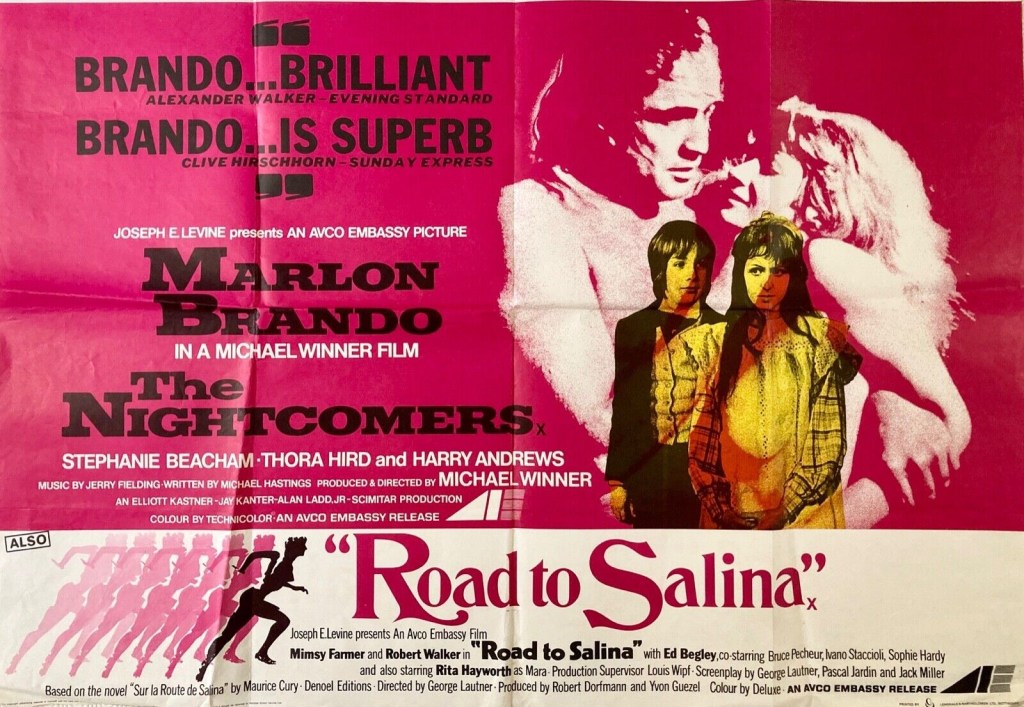
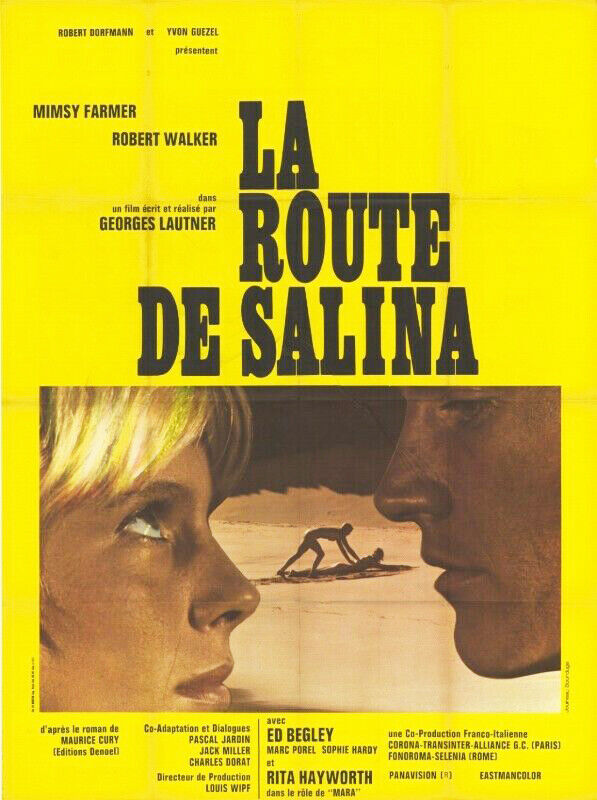
That’s the case here, when drifter Jona (Robert Walker Jr) turns up at the roadside service station run by Mara (Rita Hayworth) his resemblance to her dead son Rocky (Marc Porel) is so uncanny she believes it is the child returned. Just to be clear, Rocky died in mysterious circumstances, corpse never found, so there’s some foundation to her belief beyond maternal madness. Seizing the opportunity for a warm bed and some decent grub and the chance to be spoiled, Jona plays along – especially after Rita’s neighbour Warren (Ed Begley) supports her delusion – and soon he’s invited into another bed, that of Rocky’s sister Billie (Mimsy Farmer). The savvy daughter has her own reasons for going along with it. Then we’re into flashbacks within the flashback as the mystery unfolds and we dip in and out of incidents around the gas station and the somewhat unusual relationship between brother and sister.
As with most slow-burn dramas, you wouldn’t really call it a thriller, it depends on atmosphere, but in the same way as, for example, Don’t Look Now (1973), there’s definitely something insidious here and noir-ish if you don’t mind a story played out away from that genre’s physical darkness. It digs deep into the worst emotion of all, loneliness, and how the hankering after relationship, and an inability to steer clear of the psychosexual, anything to stop you from being alone, can bring torment and tragedy. Dangling fantasy in front of a woman incapable of dealing with reality is a dangerous temptation.
While some of the elements verge on the bizarre, and the narrative threatens to tip into confusion, the viewer is nonetheless kept on pretty much an even keel by the direction, which doesn’t play hard and loose with the facts, but just takes its own slow way heading towards resolution.
The main younger characters aren’t anything we’ve not seen before and the impetuous immoral Billie could easily be a cousin to Estelle in More (1969) while Jona is just every dopehead drifter with an eye on the main chance, except he turns patsy under the femme fatale wiles of Estelle. Rita Hayworth (The Money Trap, 1965), by now a Hollywood back number, brings a healthy dose of reality, and it’s worth the admission just to watch the former sex symbol fry eggs and dance around with the equally middle-aged and frumpy Ed Begley (Hang ‘Em High, 1968) while tacitly acknowledging the bolder elements of the counter culture.
Robert Walker Jr (The Happening, 1967) doesn’t bring much to the party but Mimsy Farmer sizzles. The movie trips easily through the decades, contemporary 1970s buzz undercut by old-fashioned 1940s sensibilities.
French director George Lautner’s stylish concoction – this begins with a downpour, character trapped in torrential rain, an unusual image for the times, and unwinds in flashback – forces you to suspend disbelief long enough to guide the endeavour to a satisfactory conclusion.
Under-rated, this should appeal beyond the Farmer and Hayworth fan clubs.
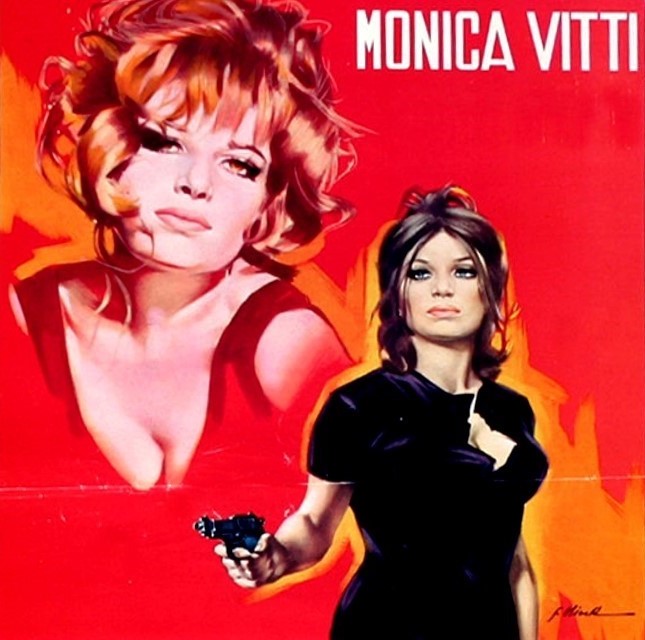
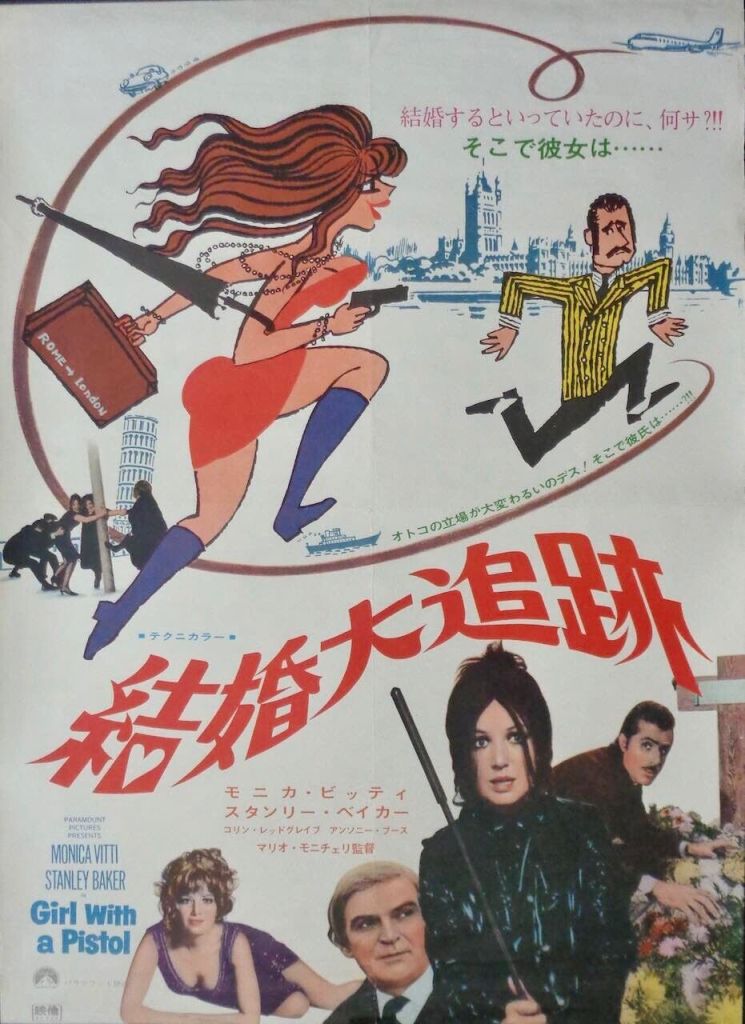
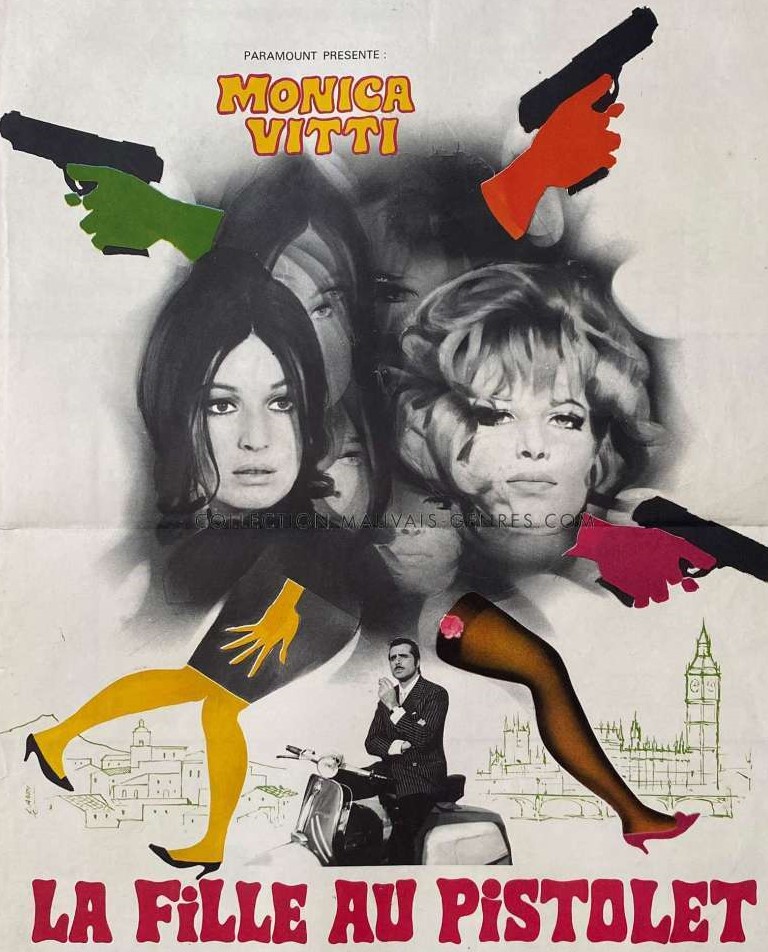
Off-beat Oscar-nominated comedy-drama that is both a marvelous piece of whimsy and a slice of social realism set in the kind of Britain the tourist boards forget, all drizzle and grime. It zips from Edinburgh to Sheffield to Bath to London to Brighton to Jersey as if the characters had been dumped from an If It’s Tuesday It Must Be Belgium sketch. If your idea of Italy was Fellini’s glorious decadence or Hollywood romance amid historic ruins and fabulous beaches, then the upbringing of Assunta (Monica Vitti) is the repressive opposite.
All women in her small town wear black. Men are not allowed to dance with women and must make do with each other. A man like Vincenzo (Carlo Giuffre) desiring sex must kidnap a woman, in this case Assunta, to which she will consent as long as he marries her. When instead he runs off to Scotland, she is dishonored and must kill him, armed with the titular pistol.
Pursuit first takes her to Edinburgh and a job as a maid, has a hilarious encounter with a Scottish drunk, and various other cross-cultural misinterpretations – in a bar she cools herself down with an ice-cube then puts it back in the bucket. Then it’s off to Sheffield where she falls in with car mechanic Anthony Booth (television’s Till Death Do Us Part) because he is wearing Italian shoes.
She can’t imagine he can watch sport for two hours. “You’re a man, I’m a woman, nobody in the house and you look at the television.” Although tormented by images of being attacked back home by a screaming mob of black-robed women, she begins to shed her inhibitions, wearing trendier clothes, although an umbrella is essential in rain-drenched Britain and given the Italian preference for shooting exteriors.
In between sightings of Vincenzo there are episodes with a suicidal gay man (Corin Redgrave) and a doctor (Stanley Baker). She becomes a nurse, then a part-time model, sings Italian songs in an Italian restaurant, drives a white mini, wears a red curly wig and more extravagant fashions. It turns out she can’t shoot straight. Gradually, the mad chorus of home gives way to feminist self-assertion as she becomes less dependent on men and a world run by chauvinists. It’s a startling mixture of laugh-out-loud humor and social observation. And while the narrative that at times verges on the bizarre, Assunta’s actions all appear logical given her frame of mind.
Vitti was Italian director Michelangelo Antonioni’s muse (and companion) through L’Avventura (1960), La Notte (1961) and L’Eclisse (1962) to Red Desert (1964). She had a brief fling with the more commercial, though still somewhat arty, movie world in Joseph Losey’s Modesty Blaise (1966) and the nothing-artistic-about-it comedy On the Way to the Crusades (aka The Chastity Belt, 1968) with Tony Curtis. Director Mario Monicello had two Oscar nominations for writing but was best-known for Big Deal on Madonna Street (1958) and Casanova ’70 (1965). Girl with a Pistol was nominated in the Best Foreign Language film category at the Oscars.
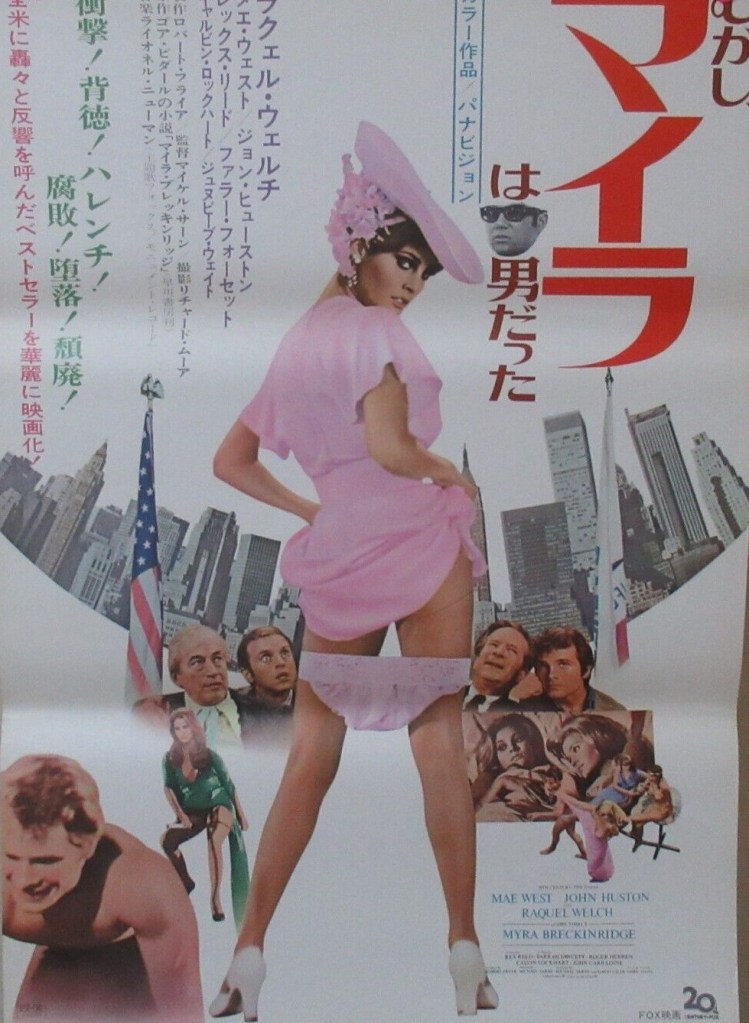
Proof that time can be kind to even the unholiest of unholy messes. Previously only appreciated/mocked for its camp values, the thin story this has to tell suddenly carries contemporary weight. Not so much the transgender elements but now revealed as the first picture to bring the MeToo agenda to light.
While it’s still terrible, with a tendency towards the really really obvious and, when that doesn’t work, bombard the audience with a That’s Entertainment smorgasbord of sexual innuendo. In fairness, even in those more feminist-awakening times, you probably still had to batter the viewer over the head to get them to accept any of the points being made.
Candy-striped oufit pure invention of the poster designer.
The first, while theoretically in a theoretical twist tranposed to the female, was the sexual predator, closely followed by the notion that every woman wanted “it”, regardless of them expressing otherwise. Even the dumbest cinemagoer could not have failed to see that putting an exclusively male casting couch at the disposal of Hollywood agent Leticia (Mae West) was actually a clever way of showing just how the movie business at its worst worked, though in reverse, the females queuing up (apparently) for the kind of sexual transaction that could give them a shot at stardom.
That it’s Myra (Raquel Welch) herself who spends most of the movie degrading men (anal rape anyone?), and women indiscriminately (I’m surprised the posters didn’t scream “Raquel Goes Lesbian”), it’s again just a play on what went on in the virtually exclusive male enclave of Hollywood. Just as pointedly it points the finger at the way Hollywood has destroyed the American Dream, snaring thousands of hopefuls who spend fortunes, whittle away their lives and prostitute themselves (and still do) in the vain hope that taking acting lessons for an eternity will somehow provide them with a talent they weren’t born with.
The narrative – what narrative? – concerns Myron (Rex Reed) having a sex-change operation to become the aforesaid Myra and then claiming an inheritance, on exceptionally spurious grounds, from her kinky uncle Buck (John Huston). And trying to part hunk wannabe Rusty (Roger Herren) from his wannabe girlfriend (Farrah Fawcett, the Major came later). You might argue that the continuous loitering presence of Myron is a distraction but occasionally it’s welcome as the movie runs out of punchbags.
And in case you didn’t get the message in what passes for dialog, Myra takes to just delivering straightforward lectures on the male-dominant Hollywood that posited the notion that women were there for the taking if you were just male enough to take them and that any women who showed the slightest ounce of onscreen intelligence and the ability to swat away predatory males was just a predatory male in disguise.
Nobody comes out of this with any dignity and though it destroyed the career of director Michael Sarne (Joanna, 1969) and Roger Herren, John Huston (The Cardinal, 1963) was inclined to self-indulgence on-screen if not restrained by a strong director, while Farrah Fawcett and, in a bit part, Tom Selleck survived to become television legends. The less said about wooden Rex Reed the better.
Quite where this left Raquel Welch is anyone’s guess. While she held the narrative together in convincing fashion, as an actress she wasn’t provided with enough material beyond the sensational to convince as a dramatic actress of anything more than middling caliber. Yet, it was an incredibly brave career decision. The contemporary likes of Joanne Woodward, Jane Fonda, Maggie Smith et al would have balked at the thinness of the material, and would have run a mile from expressing themselves in such sexual terms, despite probably recognizing what the movie was attempting to achieve.
It needed someone larger than life to play the part and, possibly with higher expectations than seemed plausible, the bold Raquel stepped up to plate. Perhaps the element that appeared most to her was that she took revenge on Rusty because (shock, horror) he didn’t fancy her at a time when she was presented as the most fanciable woman on the planet.
So discretion left at the door, blunderbuss in full operational mode, but even now it’s that approach that is wakening the industry up to the sexual misbehavior of many of its to male personnel. What was once top of the so-bad-it’s-good tree is now revealed as not too bad after all, if you swap the phantasmagoria for the stinking reality underneath.
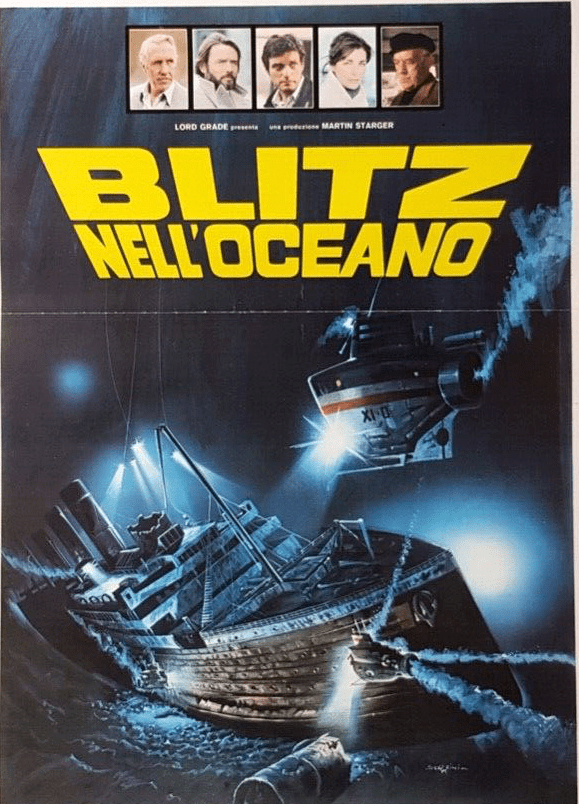
Another tricky one because, of course, I’m supposed to mock this colossal box office flop. Not least because, as later events proved, you couldn’t lift the Titanic off the seabed in one piece since it had actually broken in two. And there’s the dumb maguffin to end all dumb maguffins that kicks it all off in the first place, but you did need some excuse for the exercise. And, in fairness, in theory at least, it’s more cinematic to show the ship going down, and having lovelorn lovers to lament, than to see it coming up with no passengers to root for.
That said, the actual hunt for the lost vessel and the raising is stupendous stuff, even on the small screen, and with a director with greater visual flair than Jerry Jameson (Airport ’77, 1977) it could have been even better. But there can’t be a more iconic climactic shot than the Titanic steaming into New York, missing its scheduled arrival by a mere six decades.
Question is, does the technical stuff, the underwater photography, the raising, the impeccable model-work, make up for the lack of smarts elsewhere? Heck, who cares? No one is interested in whatever storyline the makers come up – and, let’s face it, not even DiCaprio and Winslet, good though they are, were the driving force for the James Cameron version – all they are interested is the recreation of the mythical ship, probably the only one everyone in the world can name. So get the nautical elements right and you’re pretty much there.
Critics, and crucially audiences, back in the day didn’t think so. But I disagree. I couldn’t begin to tell you much about the hare-brained narrative – some item so crucial to the present-day (1980, that is) ongoing Cold War between the U.S. and the U.S.S.R – and I couldn’t care less. Nor would you find many takers for a love triangle involved explorer Dirk Pitt (Richard Jordan), journalist Dana (Anne Archer) and all-purpose politico Gene (David Selby). And although an occasional acting heavyweight like Jason Robards (as an Admiral) and Alec Guinness (as a Titanic survivor) hoves into view, it’s the character actors like J.D. Cannon and M. Emmet Walsh who have more to do.
But that’s not much either, because anyone involved in the underwater stuff is required only to show two emotions, shock and awe, and to be honest they do a good job because really all we need are witnesses to the amazing. The picture tickles along for a bit while the principals argue about the right way to go about their task and where, specifically, to concentrate the search, and then about the actual mechnics of the raising, that aspect suddenly given the kind of self-imposed deadlines that seemed de facto for disaster pictures (they are always running out of time) because some guys are now trapped in the ship.
But just as James Cameron awed audiences with his reimagining of the interior of the mighty ship, it’s no less imposing here in its impoverished state, stripped of its glory, nothing but the naked façade of the still-amazing below decks. And when it finally does surface carries magical visual splendor.
In truth, I found I was tuning out of the human goings-on, waiting with bated breath for the next sighting – or the first – of the ship. And we’re spared the endless wittering-on about how the ship sank and who was responsible and you could argue the narrative trigger in Titanic (1997) of the old lady’s brooch is every bit as dumb as the rare mineral secretly stashed on board here.
Jerry Jameson’s cinematic career was sunk by the poor box office and he didn’t receive another movie credit for over a decade. But he does a decent enough job here in the absence of a genuine all-star cast and those sequences depicting the hunt and the triumph work very well indeed. None of the acting is awful, but the stars have been hired for obvious reasons – being inexpensive might have been the starting point – and neither Jason Robards (Hour of the Gun, 1967) nor Alec Guinness (The Quiller Memorandum, 1966) attempts anything you’ve not seen before. While Richard Jordan (Logan’s Run, 1976) is too freshfaced for his character, Anne Archer (Fatal Attraction, 1987) suggests vivacity on legs.
Screenplay credited to Adam Kennedy (The Domino Principle, 1977) and Eric Hughes (Against All Odds, 1984) in reality went through a hatful of different hands. Based on the Clive Cussler bestseller.
Don’t believe the critics – and possibly not even me – on this one but I found it a surprisingly good watch.
I hate it when a mystery movie so blatantly cheats. Sure, we expect some sleight of hand, some vital piece of evidence retained, for the purposes of maintaining high tension, till the very end. Or a twist, a la Jagged Edge (1985), when a murderer, having got off scot-free, is revealed as the killer after all.
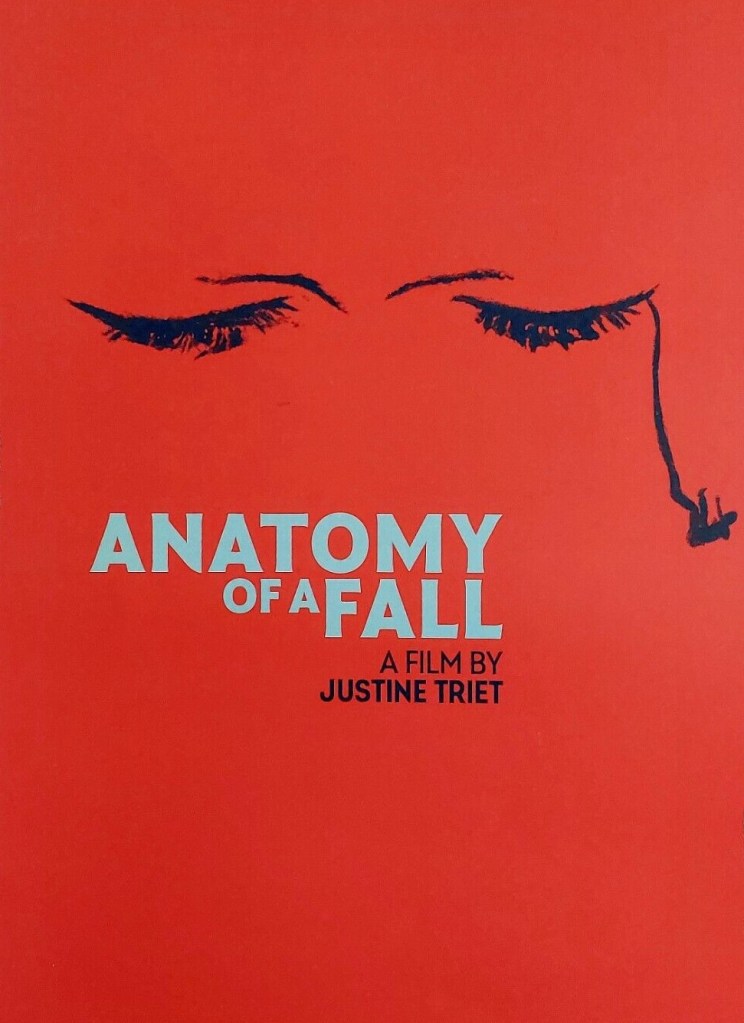
And while the central performances of accused, bisexual respected author and mother Sandra (Sandra Hueller), and accuser, smug unnamed prosecutor (Antoine Reinartz), are excellent and the exposition of the psychology of a marriage is well done, still the omission of the kind of critical forensic evidence that a modern audience would require works against the end result. Because otherwise, it plays like a 1940s courtroom drama, where the emphasis is solely on character rather than the weight of evidence.
So, here’s my complaint. The dead man has fallen from a window. Did he jump or was he pushed? Using forensics, the prosecution maintains he was hit by a heavy blow and some of the blood spatters down below were consistent with him losing blood when he was falling rather than when he hit the ground.
So we spend a great deal of time on examining how the body might fall and accounting for the blood, all of which appears to go against the accused, who is revealed as a not-so-nice person, possibly a sexual predator, possibly controlling, certainly a cheat – taking lovers while married and a heinous spot of plagiarism from her unpublished wannabe writer husband.
Only at the very end, when the half-blind child enters the loft space from which the father fell, do we realize that it would be impossible for this to be murder unless there was more evidence pointing to that eventuality. If the movie – prosecution and defence equally guilty of overlooking the obvious – had spent a couple of minutes on the loft space both would have come to the conclusion not so much that murder could be counted out but that there would be clear evidence of it.
The window is pretty small and an odd shape. But there was no evidence of a struggle, no scratches on the wood or glass, no tiny shred of material, and for the questionable spatters to end up where they did, the victim had to fall out backwards. So that means he needs to be pushed from the front and make no effort to save himself. The more obvious means of disposing of him – being thumped on the head from the back – was not consistent with the way he fell. And in any case, the space available for the wife to hit him with some heavy object would have meant leaving some evidence of that.
So, while it was certainly overlong, and could do with losing a good 15-30 minutes, I was happy to go along with the tale, held together as it was by the superlative performances and the usual courtoom duelling, though taking the last-minute evidence presented by the young boy as conclusive proof the father committed suicide seemed a step too far.
As a dissection of a marriage, of expectations of roles, and especially of the propensity for a failure to blame everyone else for their failings, it gets top marks. But it wears out its arthouse credentials by ignoring the forensic obvious.
I can’t also be the only one really annoyed that this Oscar-nominated performance basically skipped cinematic release. As far as I can work out, it was shown for one week in an arthouse in my neck of the woods way back last year and despite the Oscar nomination didn’t resurface except for a money-grab one-day showing two days (i.e. last night) before the Oscar ceremony. Like Maestro, it’s taken the streaming dollar and run, rather than allowed cinematic word-of-mouth to do what cinematic word-of-mouth is meant to do and build a groundswell of positive opinion prior to the awards.
So, yes, watch it for the psychology and the Oscar-worthy performance but don’t expect a contemporary approach to the mystery.
Tricky little number that pivots on a tricky plot point and is almost sunk by the kind of moralizing voice-over that was attached to Riot on Sunset Strip (1967) but actually bears serious reassessment. Quite a brilliant two-minute opening sequence with a tracking camera. I’m a big fan of directorial technical skill so bear with me.
We open with a man dangling from a balcony whose cries for help go unheard at the party inside. We shift inside and with no dialogue the camera begins tracking to the right. A man moves down to kiss a girl and from behind the one being kissed a hand relieves him of his wine glass and the camera slides inches further over to a dark-haired girl in the act of removing a bowler hat from a man and placing it on her head and as she leans back into the sofa that allows a blonde to come to the fore whose cigarette is removed from her mouth to light the cigarillo of an unshaven character who grabs a bottle of wine and in glugging it down moves over to the window and observing the dangling man and pours the rest of the bottle on his head.
“Help him up,” calls out another woman. This request is ignored, but the unshaven character shouts for someone else to help. The man is rescued. With a cynical stare, the unshaven man asks of the woman who has intervened, “Anything else?” She retorts, “Drop dead.” He climbs onto the balcony, falls over, and when the partygoers rush over in horror we cut to the street below where he is swinging from a lamppost.
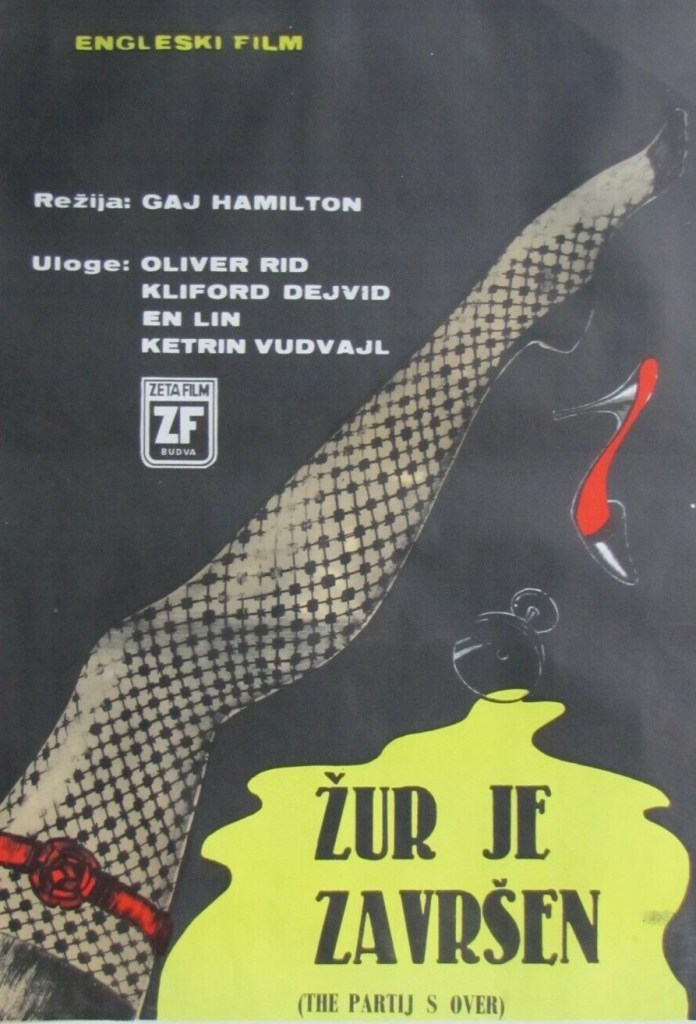
Easy enough to get away on the poster with what otherwise contractual credit billing forbids. Guy Hamilton could take his name off the credits but that wasn’t so easily enforced abroad.
Over the following credits comes the moralizing. “This film is the story of young people who become, for want of a better word, beatniks. It’s not an attack on beatniks…but shows the loneliness and unhappiness and eventually the tragedy that comes from a life lived without love for anyone or anything.” In other words – an attack on beatniks.
Actually, it’s far more about depression, though that’s scarcely acknowledged, not so much people trying to find themselves as not knowing where to look and in consequence spending a lifetime running away. You might only figure that out in retrospect but it gives the picture some punch. And they’re not overtly rebelling against society or authority as in The Damned (1962) or Riot on Sunset Strip (1967) beyond daubing a drunken face with a CND symbol.
These are less beatniks than, from their classy outfits, society debs slumming it. Yes, they don’t seem to do much else but party, although a number have artistic pretensions, sculpting and painting, for example, but mostly they seem able to lounge around without a care in the world, not like the motley secretaries living in bedsitters in The Pleasure Girls (1964).
The party characters quickly evolve into Moise (Oliver Reed), the unshaven character, who lusts in vain after sultry soul-eyed American Melina (Louise Sorel), the girl who gave him a ticking off, even though he has an adoring singer girlfriend, the blonde Libby (Ann Lynn), who he can, as he demonstrates rather misogynistically, summon with with a snap of his fingers. Bowler-hat is mysterious painter wannabe Nina (Katherine Woodville). The rescuer is sculptor and drummer Geronimo (Mike Platt).
Similarly, Guy Hamiltoncouldn’t prevent the marketing team sticking a sly reference to him – director of “Goldfinger” – elsewhere on the marketing material.
Melina has a wimp of a fiance, Phil (Jonathan Burn), and the story kicks into gear with the arrival of her American fiance Carson (Clifford David), a high-flying businessman, though owing rapid promotion to the fact she is the boss’s daughter. Since marriage is immiment, he is perturbed at being unable to contact his fiance.
But when he does try to find her, he is given the run-around. Nina tells him Melina is recovering from a terrible operation, someone else sends an easily-duped Yank to Buck House (Buckingham Palace), he finds her suitases packed in her room, that element backed up by the notion that she has given away clothes and jewellery (Nina wears her bracelet) and she has either skipped off to Paris or might be lying on a building site half-naked after being dumped there, dead drunk, as a prank by the gang.
So far, so black comedy. And you could believe all of it because Melina is “afraid of everything,” dreads having a daughter who might grow up to be “pawed by a thick hand” and otherwise seems to drift like a melancholy ghost. Phil, having failed his medical exams, commits suicide and like An American Dream/See You in Hell, Darling (1966) Carson is cast in the role of the person who could have saved him from diving from a roof.
Eventually, we do learn more about the other characters. Nina, who in the absence of Melina, takes up with Carson, is a provincial girl, who had an ill-advised marriage to please her parents. Libby is desperately in love with the womanizing Moise, who does a nice line in imitation and cutting remarks. When Melina’s father (Eddie Albert) turns up, the pace quickens.
And in a quite brilliant directorial coup, we realize that, ever since Carson’s arrival, the movie has been operating in flashback. There’s a better reason Melina is missing. She’s dead. She wasn’t drunk, she had toppled from a high staircase at a party and snapped her neck. But since everyone else is totally smashed, they assume she’s just out of it. Only Moise knows the truth, since she’d been trying to get away from him too fast. And since he makes no effort to prevent the prank going ahead, there would be some serious trouble should the police get involved.
Of course, the corpse turns up. Carson, reckoning he’s dodged a bullet, isn’t too torn up and he has a nice girl from the country, Nina, to hold his hand. Moise shows some remorse, but not enough.
Yes, a kind of morality tale but hardly enough to warrant the moralizing cautionary voice-over. Instead, it’s more prescient, Melina the forerunner of the kind of heroine who would find life just too tough and either end up in an institution or go on to ruin her own and everyone else’s life. As a study of depression it’s hard to beat. The spoiled brat who has everything only to realize it’s not enough. Guilt, too, if you count in Phil’s horror at kissing his dead girlfriend.
The credit sequence, which has been ripped off countless times, shows the motley post-party crew slinking across an iconic London bridge at dawn. And there are some wonderful scenes with a viciously playful Oliver Reed. In one he gives a Pythonesque take on the misunderstood waif – “my bathwater was never the right temperature, the servants always burned the toast.”
Oliver Reed (The Assassination Bureau, 1969) should have taken all the acting plaudits but in fact the women, with more emotion to openly play with, steal it. Katherine Woodville (The Wild and the Willing, 1962) takes it by a nose from Louise Sorel, in her movie debut, and Ann Lynn (Baby Love, 1969).
Just superbly directed by Guy Hamilton (A Touch of Larceny, 1960), who mixes atmosphere, emotion and mystery, in just the right quantities, a difficult trick at the best of times. And who has the cojones to pull a fast one. It could as easily have been, upfront, a murder mystery. Instead, it’s much more. Screenplay is by Marc Behm (Charade, 1963).
It was made in 1963, when it would have been far more pertinent, but, thanks to the British censor, held back for two years. The censor was exercised by the scene where Phil kisses Melina, thinking she is dead drunk, only to realize some time later that she is actually dead, and the real reason he threw himself off the roof. In those days, nobody had come up with a solution to the knotty problem of a director who wanted their name removed from the credits. Several years later, Hollywood adopted an all-purpose pseudonym to cover that eventuality. But here, if you watch the credits, you’ll see that there is, to all intents and purposes, no director.










 The Magnificent 60s