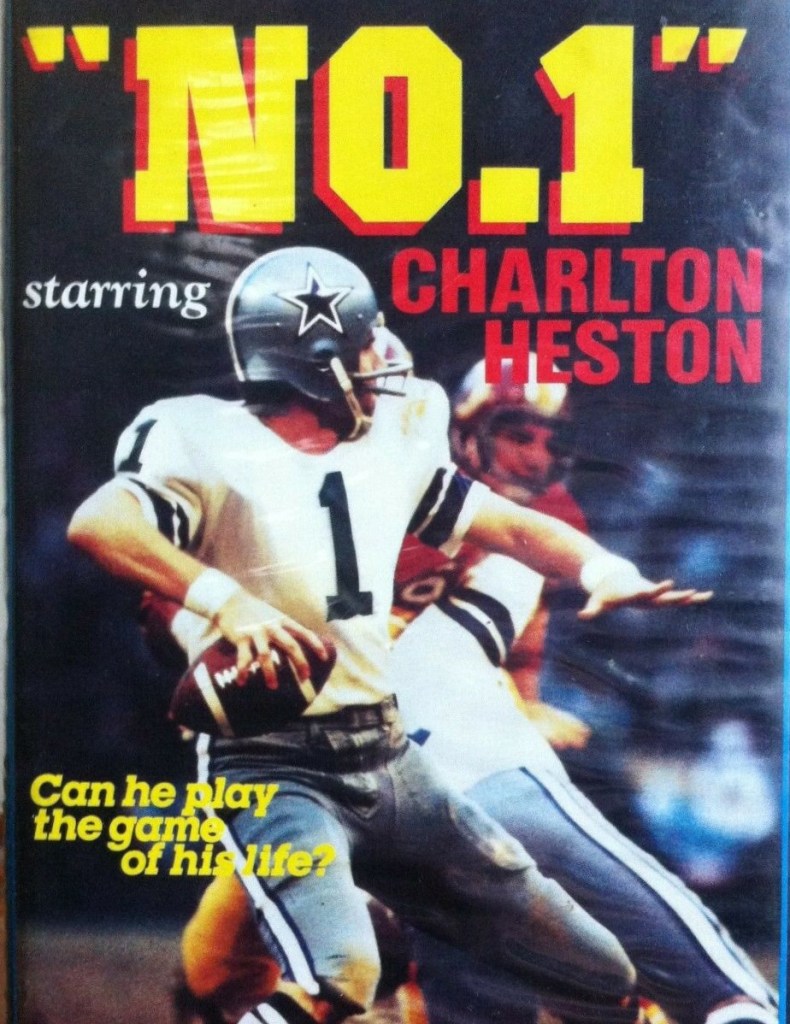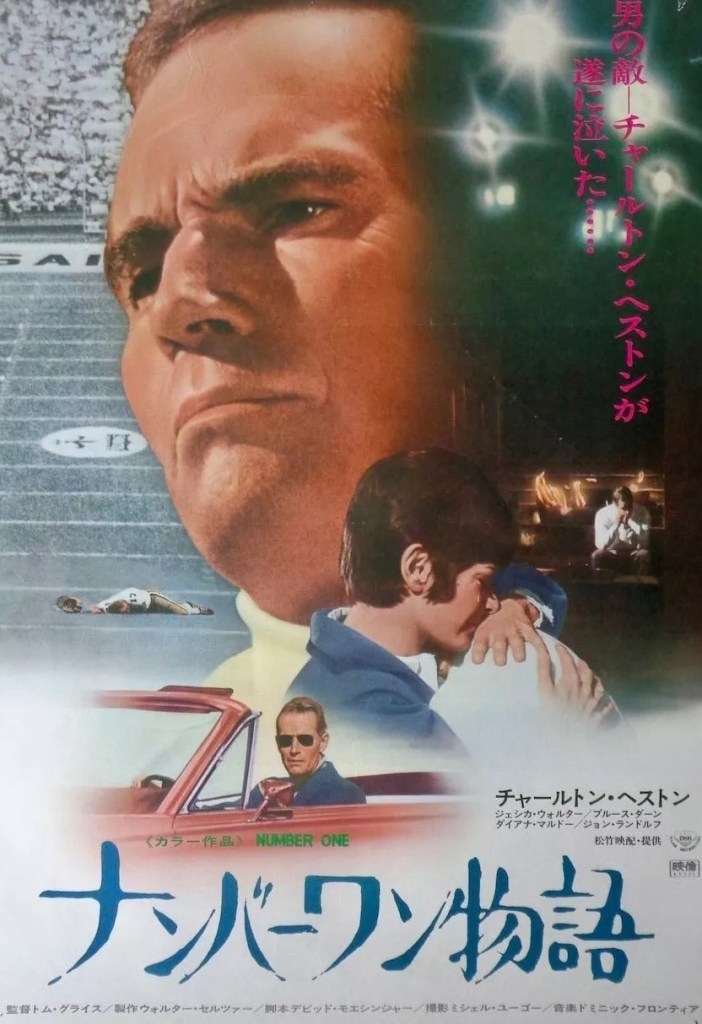
Number One / Pro (1969) ****

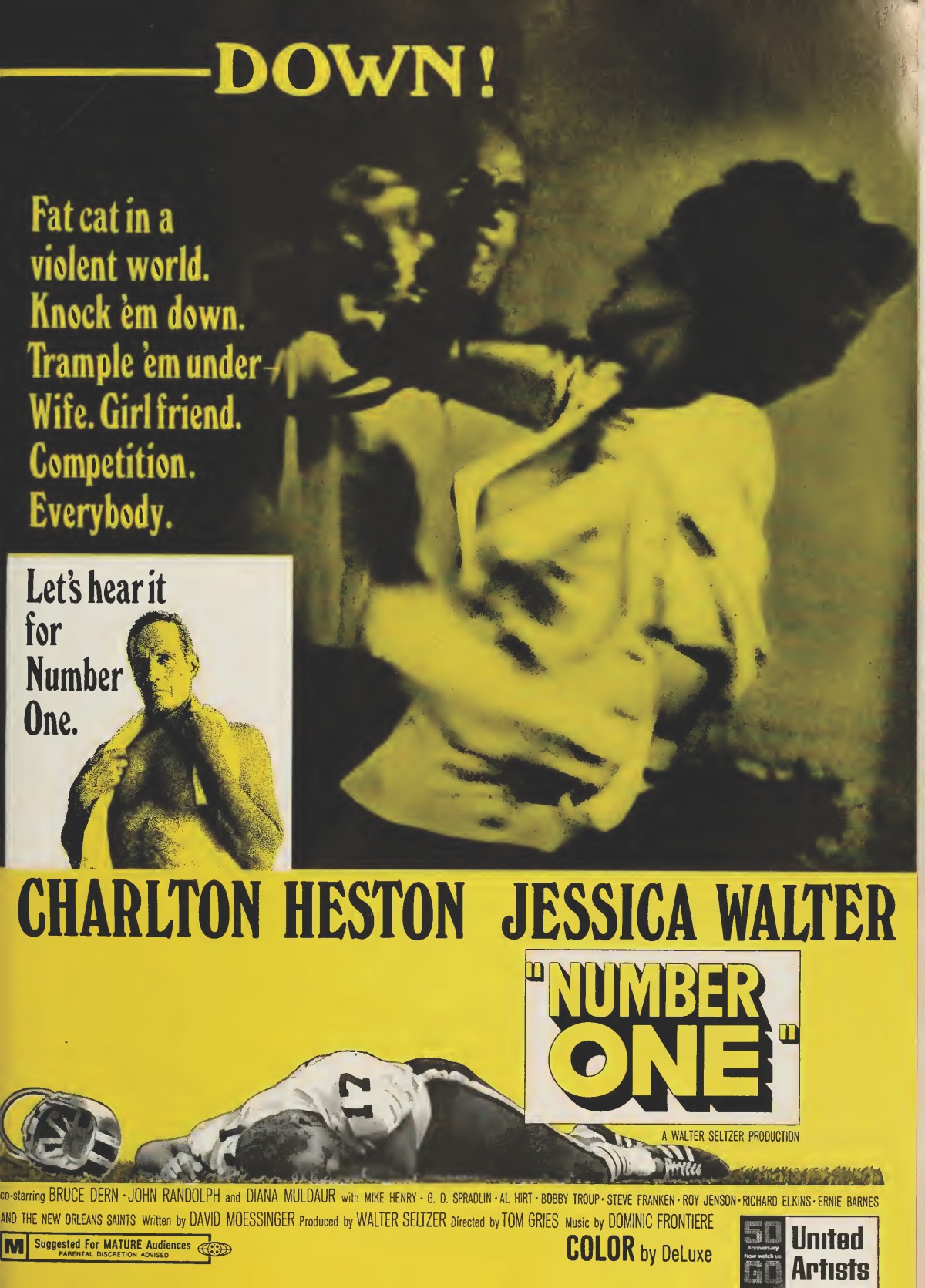
Quite possibly Charlton Heston’s best performance – as an ageing pro footballer refusing to bow down to the inevitable. Ron Catland (Heston) has much in common with Ned Merrill (Burt Lancaster) in The Swimmer (1968) as characters who believe they have been let down by the American Dream. And like that picture, plot is in short supply, it’s mostly a character study with sideswipes at the realities and inanities of American football.

An injury puts star quarterback Catland’s career in doubt. The media write him off, a younger quarterback Kelly (Richard Elkins) is waiting in line, while former colleague Ritchie Fowler (Bruce Dern) offers him a job in his car leasing business, or he could opt for a second career in computers, but Catland wants the only life he has ever known to go on forever.

There’s nothing inherently likeable about Catland. In fact, he’s downright mean most of the time, in part because of the falsity of his profession, management buttering you up when it’s contract time, then on your back once you have re-signed. He’s got a hero’s arrogance, has ignored from the outset the coach’s instructions, at odds with independent fashion-designer wife Julie (Jessica Walter), no children to shore up their marriage. Hardly surprising he drifts into another affair, “an occupational hazard” his wife calls it, this time with the fey Ann (Diana Muldaur) who owns a tennis shop.

You are probably familiar with the kind of football picture which climaxes with a last-minute touchdown or the more realistic movies like North Dallas Forty (1979) or the superlative Any Given Sunday (1999) where nonetheless the focus is on winning and characters are ramped up for dramatic effect. Or you might imagine Hollywood had been routinely churning out football movies like Knute Rockne All-American (1940) and Jim Thorpe All American (1951) for decades. But strangely enough the movie industry had not focused on this particular sport for well over a decade until the NFL documentary They Call It Pro Football (1967) and comedy Paper Lion (1968).

Number One sets out to set the record straight on the reality of being a football hero. And it’s by far the most realistic of the species. For every good-looking gal wanting to pass him a note on a napkin in a restaurant there are plenty fans turning on him for refusing to sign an autograph. For every sports reporter writing a puff piece, there are others tearing him to pieces in print.

The documentary-style approach by director Tom Gries (100 Rifles, 1969) serves the film well. This is a different kind of football team to the later fictional depictions. It’s a lonely life for a start. The players are rivals, not comrades.  There’s little camaraderie. The dressing room is like a morgue. No practical jokes and tomfoolery. No over-the-top team talk by the coach and thank goodness no padre who pretends to walk every aching mile in their shoes. Any exhortation is almost a plea. Injury is mostly ignored. Legs are constantly strapped up. And when your career is over you might be reduced to bumming a loan from a current star. The politics are brutal.

New Orleans Saints cooperated with the production so the game scenes come across well though not obviously with the razzamatazz of Any Given Sunday and Heston has the physique for a sportsman. Primarily a television writer, David Moessinger (The Caper of the Golden Bulls, 1967) only crafted two films in the 1960s and this, the second and last, was an unusual effort, as the character twists and turns trying on the one hand to escape the cage of his career and on the other determined to squeeze the last drop out of his golden imprisonment.

Catlan still sees himself (at the age of 40, no less) as the best quarterback in the business and simmers with anger that his body is letting him down and that he has nothing in place to fill the gap that abandoning the game will create. Underneath the volatility is a hole of pain. There’s no sense either that he has enjoyed his time at the top, just that it has always one way or another been a struggle.

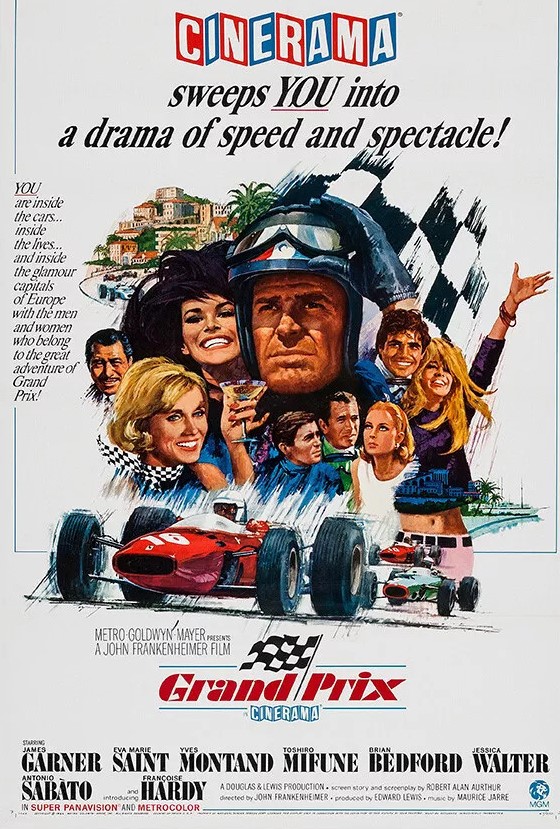
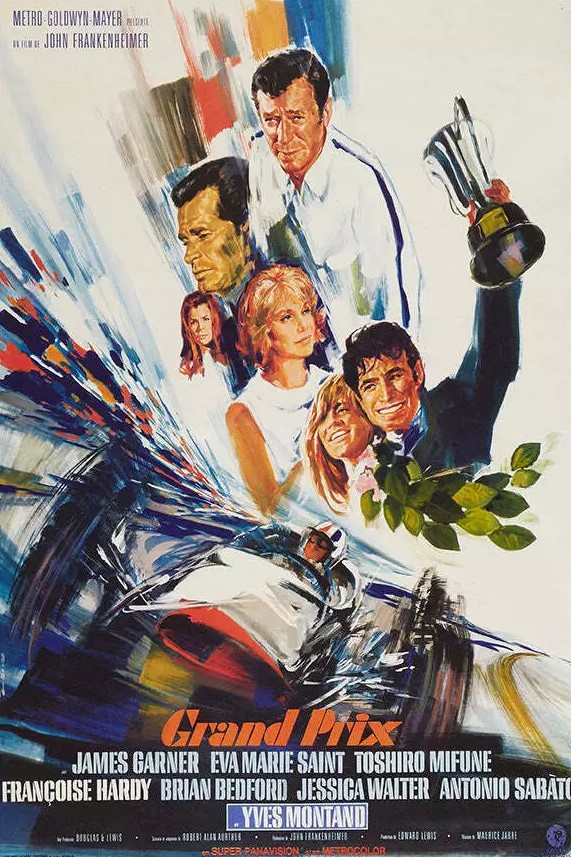
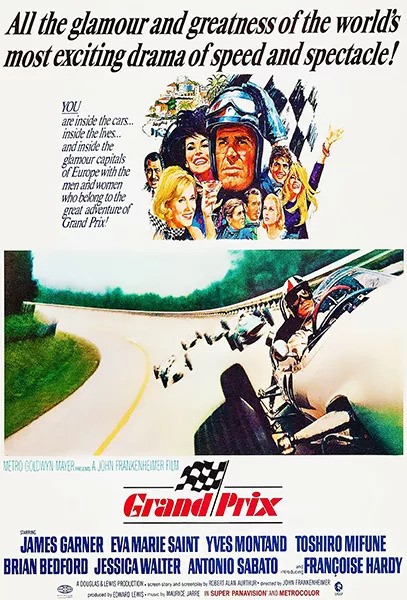
Although the movie was marketed with Heston as an aggressive individual, in fact it calls for a far wider range of emotions from Heston, and for this part he delivers in spades. Jessica Walter (Grand Prix, 1966)  gives as good as she gets, Bruce Dern (Hang ‘Em High, 1968) as the fast-talking salesman and Diana Muldaur (The Swimmer, 1968) are excellent. But this is Heston’s film. It’s more of a reflective piece, none of the dramatic highs and lows of other football pictures.

Rob Peace (2024) *** – Seen at the Cinema

Breaking Bad Goes to Yale. Or Good Guy Does Bad In Order To Do Good. Can’t say the current title is any more inviting than those – I guess this character isn’t at all known outside the U.S. where a book was written about him (it’s “based” on a true story, we are told) – but at least gives more of an idea of the level of complication we’re dealing with. The film lacks the sharp ironic intelligence required to make such a complex tale work and direction is so shapeless, diffuse, at times that it’s hard to keep going. And it falls prey to the Martin Scorsese trope of the voice-over telling us more about what’s going on in a character’s mind than his interplay with other characters. Yet, this is an interesting story and you wish it had been better told.

On the one hand any time the eponymous character gets into a financial snit he just falls back on drug dealing. On the other, though you could argue his father is a victim of blatant racism, Rob (Jay Will) never plays this particular card. We are constantly told he has a special gift for bringing people together, but the only evidence of that is when weed is on the table and in his entrepreneurial dealings which revolve around making a fortune from refurbishing empty homes in the neighborhood.

Blame the structure for the fact it appears to bounce around all over the place. A few neatly-placed flashbacks would have solved the problem, focused on present, rather than taking us on a near 20-year stretch mapping out an entire life. Rob, mathematical whizzkid, growing up in a tough locale, gets sent to private school for black kids run by a white priest, courtesy of single mom (Mary J. Blige) working three jobs, and manages to get some sort of scholarship to Yale where he’s got the kind of brain apparently capable of the radical thinking scientific breakthroughs require. Unfortunately, the only breakthrough he makes is of the Breaking Bad kind, setting up a lab on the premises, selling a better class of dope to his classmates.  

When his dope-dealing father Skeet (Chiwetel Ejiofor, who also directs) is jailed for murder, Rob – who, by the way, has changed his name so no one will make the connection with the jailbird – takes up his case, through a loophole gaining his father a few weeks of freedom. Then he turns to dope-dealing to fund a lawyer to argue his father’s case and also to fund the experimental drugs required to keep his old man alive when he succumbs to brain cancer.

Put front and center those two elements would have been enough for  a very sharp drama, especially as Rob begins to doubt his father’s innocence after discovering he was physically abusive to his mother. The best scene in the movie, spoiled by some over-acting by Ejiofor, is when the dying father realizes his son has these doubts.

There’s an awful grey area at the heart of the movie. You’d have thought someone of Rob’s intelligence could have dug up the court records and presented  more evidence pointing towards his father’s innocence and that he’s been the victim of a fit-up and it kind of skates over the supposed racist element here but common sense tells you it’s not going to be a white guy that’s infiltrated somehow this black enclave and shot dead two black women.

Towards the end of the picture one of his buddies points out that it’s not the duty of the son to look after the wayward father, and that aspect, the almost saintly aspect, isn’t dealt with much either.

A lot of scenes could be cut. One sequence of him playing water polo would be enough, one of him mooching around smoking dope, one of carving the turkey etc. Nobody appears honest enough. His mom doesn’t tell him her husband was a violent man or ask why the son is wasting his life, risking his future, for the man who after all abandoned him. And just exactly why is never gone in to. Rob himself doesn’t question his own ethics, returning to the life he is presumably trying to escape in order to fund the lawyer and the doctors suggests a lack of self-awareness. There’s none of the chutzpah that made American Gangster (2007) so riveting. You can see a life being thrown away through self-justified crime. He goes back to the drug-dealing when his real estate company goes bust during the sub-prime mortgage scandal, incurs the wrath of the full-time drug-dealers who fear he’s invading their turf and kill him.

I’m not sure how you deal with ambiguity in a movie but one way is not to ignore it.  

On a poor day for moviegoing, on a double double bill, this was the second best picture I saw all day, way behind a return to the sumptuous Count of Monte Cristo, but way ahead of the buffoonish mess of Beetlejuice Beetlejuice and the nonsense of Afraid.

Could sure do with a remake so an interesting tale could be more sharply told.

Dear Heart (1964) ****

Big difference between the manufactured maudlin of a weepie and middle-aged characters so ill-at-ease and discomfited that they are painful to watch, circumstances not redeemed by comedy. Audiences and critics didn’t take too kindly to this because the two stars were way out of their comfort zones. Glenn Ford (Rage, 1966) dropped his take-charge quiet-tough-guy persona, and didn’t even play that for laughs, and Geraldine Page (The Sweet Bird of Youth, 1962) rid herself of the tragic face that sacrificed itself on the altar of Oscar (at this point she was three-eights into her Oscar nominations haul).

The whole unremittingly sad enterprise would have been made for today’s generations, more acceptable of the sour ending and the clunkiness of romance that fails to gell.

Harry (Glenn Ford), a greetings card salesman who falls back on his own profession in his chat-up lines, thinks he has achieved his goal of settling down with widow Phyllis (Angela Lansbury) and becoming father to her young son, enjoying domesticity, extended family round for dinner, playing baseball and larking about with the boy. Evie (Geraldine Page) is too much and not enough, too big in her personality, not enough of whatever it takes to make her a long-term proposition for the opposite sex. They meet at a convention, hers, she’s a postmaster, he’s just staying at the same hotel.

She’s at least the more self-aware, wants more than the one-night stand of convention life, reluctant to take her place among the singletons, can’t work out why if she’s the life and soul of the party that at party’s end she’s still sitting on the shelf. But she also wants recognition – of some kind – makes fictitious calls to hotel reception so that a bellboy will troop round the lobby calling out her name. She brings her own lightbulbs, to replace the low-wattage ones in a bedroom, forever trying to adjust the world o her own vision, teasing bedroom curtains out in a different fashion, mild invention that keeps her sane regardless of how insane some actions are, charging ahead to open every door in the expectation that she shouldn’t count on male gallantry (this is the 1960s after all).

Harry’s the guy who does open doors for women, but cursed with loneliness, caught in embarrassing gaffes, chatting up the dumb kiosk blonde who’s a good bit more savvy. Most of the comedy hurts. He’s late to meet his boss because he stopped off for a martini at the apartment of an occasional lover and when he trips out too many excuses is told, tartly, that while one excuse is acceptable, three or four (train late, weather, can’t get a taxi, taxi stuck in traffic etc) is the sign of a liar. He does the whole unnecessary explanation routine when booking a hotel room for a tryst with the blonde whom he pretends is his wife not noticing the receptionist’s cynical eyebrows, and brought down to earth when said blonde breezes in and calls out a greeting to the receptionist.

Evie works out how to get a table in a packed restaurant, passing onto Harry the clever trick of saying you are waiting for a date and then apologising when they don’t turn up. When he tries this out, the waitress upends him with, “Why not join this lady (Evie), she can’t imagine either what happened to her date.”

There’s nothing cute about either of them so no chance of a meet-cute. She’s continually awkward, independent, and he doesn’t know how to spell out his troubles or work out why he’s walking into an unsuitable marriage. The only room this movie has for comedy is the sudden appearance in Harry’s life of a bearded teenager who usurps his bedroom (girlfriend constantly in the bath). This lad is Phyllis’s grown-up son Patrick (Michael Anderson Jr.) yet Harry’s been led to believe, or thinks he has, that the boy would be much younger, judging by the treasured photo given him by his fiancée. On the one side is a slab of situation comedy, on the other an out-of-his-depth Harry not knowing if he’s been duped and realizing how little he knows of genuine fatherhood. He’s awkwardness grown ten feet tall.

It’s not as if Harry and Evie actually conduct a romance, there’s some kind of attraction that neither can fully recognize, every time it sparks up as likely to wilt, and he’s prone to letting her down, sudden arrangement with son taking precedence over pre-arranged dinner with her, except, she’s mollified because he left her a note at the desk, and she doesn’t get those unless she manufactures them herself  and then in her ungainly way lets everyone know someone has tried to contact her, as if that’s a sign of importance, or explanation for her feeling of being so let-down.

Phyllis turns out not to be the smalltown housewife of whom Harry dreams. She’s had enough of being a housewife. She wants what she sees as the high life, living out of hotels, “From now on I just want to pick up the telephone” and order food, cocktails, laundry, newspapers, whatever. Just what different paths they are on is detailed in a killer of a line. When he complains – it would be an accusatory tone if he could muster up the courage – about why she gave him this particular photo of the boy, as a kid not a man, comes the rejoinder, “Because that’s the best picture of me that’s ever been taken.”

You’d be lucky to find romance in this sullen snarky version of New York, filled with  uncivil, unhelpful staff, bursting with indifference, nary a touch of sympathy for any customer, whether they are seeking a room in a city jam-packed with conventions or just a cup of coffee.

If you believe in the tagged-on happy ending, you’ll believe in anything. This pair are so discordant, so jarring, that they are probably the most realistic couple to ever grace the screen. Ignored as their performances are, they are probably the best of their careers, in part because neither is central to the bigger story that a high-end drama or western or thriller might entail., in part because they go out on an acting limb, light years away from their established screen persona. They are just so darned realistic your heart bleeds because you just know they are doomed into making relationship mistakes, most likely with each other, and will remain among the jittery unfulfilled, wondering how everyone else manages it.

Director Delbert Mann’s been here before – Oscar-winner for Marty (1955), drawing an Oscar-winning performance from David Niven in Separate Tables (1958) and James Garner’s best performance in Buddwing (1966) – and makes acceptable viewing out of what in the hands of a Harold Pinter would be an impossible watch. But even so, it comes close. Tad Mosel (Up the Down Staircase, 1967) wrote the screenplay.

Had this been an an arthouse picture, it would be drenched in awards.

Fabulous performances, heartfelt situation.   

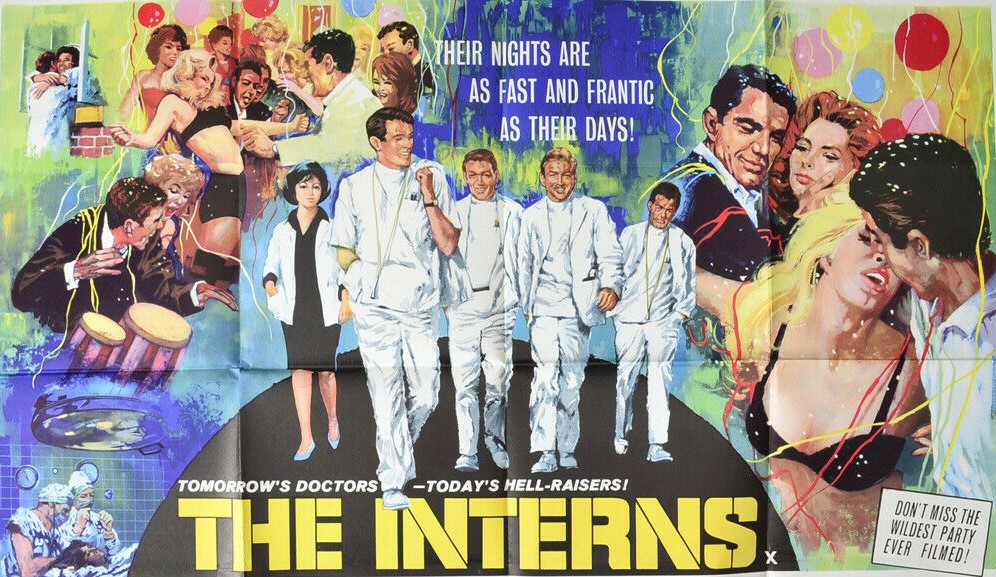
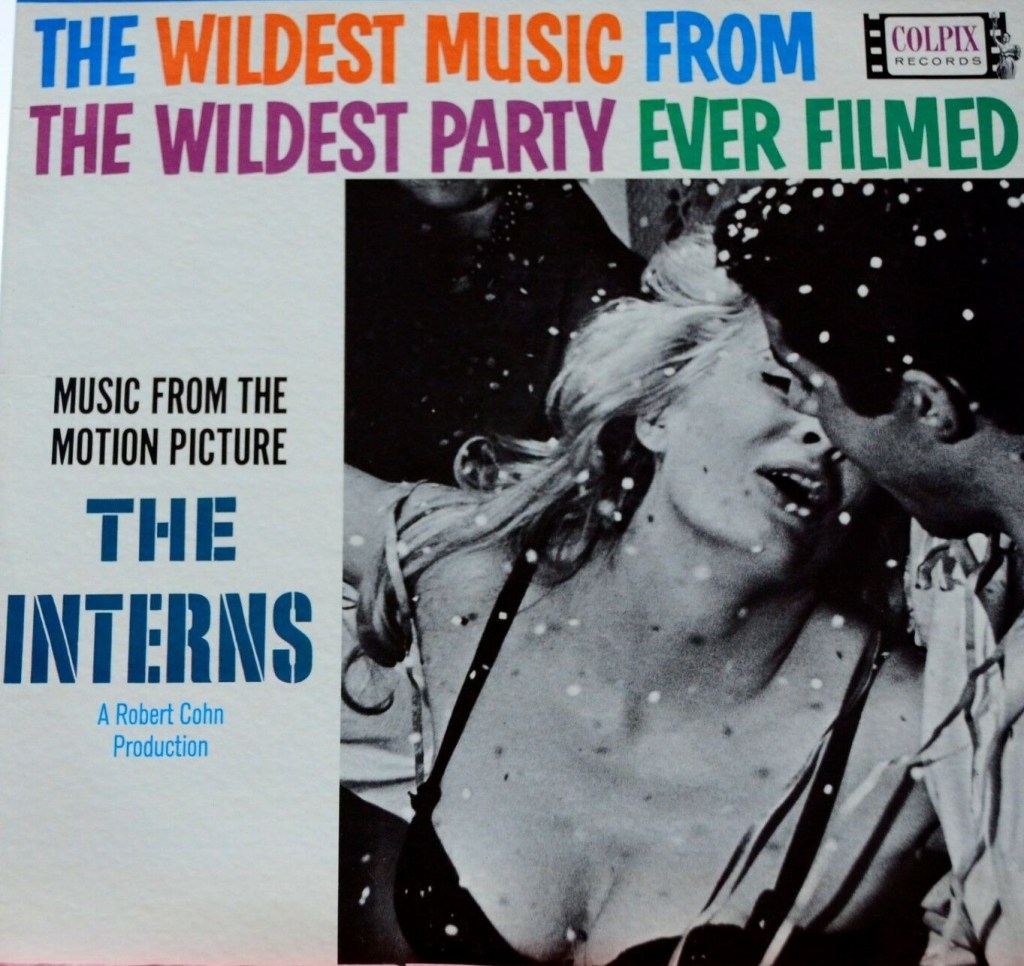
The Interns (1962) ***

Patients are a nuisance to be tolerated on the route to wealth in this superior soap opera that sees young doctors wrestling with ambition and ethics. Although also concluding that impending lofty status will snare them an attractive bride, they find women less biddable than expected, romance proving the trickiest of all procedures.

The main cast of four men and one woman are played by a roster of hotly-tipped newcomers, including future Oscars winners and nominees and the elusive Haya Harareet (The Secret Partner, 1961). Director David Swift, accustomed to handling multiple characters in the likes of Pollyanna (1961), keeps the pot boiling and although some storylines lead to obvious conclusions the screenwriters bring sufficient imagination to the various strands.

The story unfolds over the one year the doctors spend in a general hospital, where the patients are liable to be drunk and obstreperous, before taking up residencies elsewhere. As you might expect, the main characters divide into the good and the arrogant. Heading the latter are Alec Considine (Michael Callan) who cheats on girlfriend Mildred (Anne Helm) with older nurse Vicky (Katharine Baird) in order to gain through her connections a residency at a highly prestigious hospital.

Matching him in the cocky stakes is John Paul Otis (Cliff Robertson), charming to old ladies but willing to risk his career to bed movie actress Lisa (Suzy Parker). The good guys are Lew Worship (James MacArthur) who is seduced into the supposed backwaters of obstetrics and Sid Lackland (Nick Adams), an all-round good egg who falls for a patient Loara (Ellen Davalos).

The most interesting of the young doctors, however, is single mother Madolyn Bruckner  (Haya Harareet) who takes on surgeon Dominic Riccio (Telly Savalas) at every turn. Riccio spends his time berating his charges and, in particular, has a downer on female doctors. At every encounter, despite his vicious tongue, she refuses to back down.

But it is the patients, in particular Arnold Auer (Peter Brocco) and Loara, who blow a hole in the myth of hospitals. In the best scene in the film, Auer, suffering from a degenerative illness that will turn him into a vegetable, takes over from the doctor in giving his own awful diagnosis. His pleas for clemency from his ordeal, in essence assisted suicide, create an ethical dilemma for the young doctors who did not realize that modern medicine could prolong rather than curtail patient suffering.

Auer’s anguished wife Emma (Angela Clarke) flits in and out of the picture as she buttonholes any doctor willing to listen to a new cure she has discovered. While the more hard-hearted doctors can inure themselves to his agony, a savage turn of events finds them all caught up in a situation that could jeopardize their future careers.

Although Loara has an incurable disease and has more or less given up, Lackland’s effervescent good humor and determination that surgery can resolve all health issues brings her hope and if you were in her condition possibly the last thing you would want would be a cheerleading doctor on your side, but in this instance it brings succor and in the doctor’s case forces him to rethink his priorities.

Probably the last thing the doctors – and the audience – expected was to come up against such stubborn, free-thinking women. While Bruckner appears to fly the flag for female independence, she has solid support from Lisa who spends most of the picture rejecting Otis’s advances on the grounds that even when he becomes rich he will be too poor for her liking. Eventually, Vicky forces Considine to choose. Shy nurse Gloria (Stefanie Powers) shocks Worship by putting global travel ahead of marriage. But she’s not as shocking as the bespectacled inhibited Olga (Carroll Harrison) who loses her inhibitions in style at a wild party.

Theoretically, a film about young doctors having a romp, in reality a thoughtful and thought-provoking picture, tackling issues that would have been taboo at the time and removing the submissive tag that daunted most movie female characters in the movies.

Those who succeeded in later winning Oscar favor were Cliff Robertson, Best Actor for Charly (1968), and Nick Adams and Telly Savalas, both nominated for Best Supporting Actor, the former in Twilight of Honor (1963) and the latter in The Birdman of Alcatraz (1962).

Robertson was the pick of the bunch, a star in his own right graduating from 633 Squadron (1964) and Masquerade (1965) to J.W. Coop (1971) which he also directed. But largely, the stars did not fulfil initial promise. The peak of Michael Callan’s movie career was reprising his role in The New Interns (1964), star in British director Michael Winner’s You Must Be Joking! (1965) and second male lead in Cat Ballou (1965). James MacArthur had a steady movie career before an epic run in television series Hawaii Five-O (1968-1979). Nick Adams switched between film and television before his premature death in 1968.  Haya Harareet made only one more film, The Last Charge (1962). In a bit part here, this is the same Brian G. Hutton who went on to greater things as a director, most notably Where Eagles Dare. (1968).

Although primarily in television, the less-heralded stars enjoyed greater ongoing success. Mainly a strong supporting actor, Telly Savalas had only one stab at a starring role (Land Raiders, 1970) before achieving worldwide fame as Kojak (1973-1978).  Stefanie Powers was television’s The Girl from U.N.C.L.E. (1966-1967) and later Hart to Hart (1979-1984). Buddy Ebsen (who plays the older Dr Sidney Wohl) went straight into a nine-year run of The Beverley Hillbillies

Directed with considerable care and awareness of relevant issues by David Swift (Pollyanna, 1961) who co-wrote the screenplay with Water Newman (The Magnificent Seven, 1960) from the novel by Richard Frede. It spawned sequel The New Interns and a TV series. Some reports have The Interns as the biggest of the year for Columbia, but that would only be correct if you were only able to exclude the massive box office for Lawrence of Arabia.

Still a soap, but an interesting one.

Mademoiselle (1966) ****

Arthouse noir? Cross between an Ingmar Bergman movie, except that the protagonist acts on her repression, and a Claude Chabrol with a character harboring festering desire. Certainly a bold choice for star Jeanne Moreau, excepting Brigitte Bardot France’s biggest female star, to play someone so malignant with scarcely a redeeming feature. Bold, too, in the setting, not the picturesque French village peppered with bright boulangeries and patisseries and with restaurant gatherings knocking back the wine. This is the reality of country life, ruled by religion and officialdom, little sign of ooh-la-la, and distinctly xenophobic – the minute anything goes wrong, blame the foreigner, in this case an itinerant Italian woodcutter.

It’s a distinctly arthouse notion to let the audience know straight off who the villain is while the villagers themselves are left in the dark about who caused two recent fires, their suspicions landing on Manou (Ettori Manni), the forester who arrives once a year so not quite an unknown entity, and too keen on seducing the local women.

We don’t know who the arsonist is, yet, either, but we might get a good idea from the opening sequence where some annual religious pageant, involving blessing fish caught in the river, is disrupted after a woman in high heels and black lace gloves opens a dyke, allowing a torrent of water to flood a farmyard, nearly drowning the animals, only the priest and a few boys left to continue the parade once the adults have raced back to the farm to save the livestock.

The woman is careful to wipe her high heels clear of grass as she places them in a wardrobe on a high shelf that contains other high-heeled shoes. We soon learn she is not just the schoolteacher but also volunteers her typing skills to the police, therefore keeping fully abreast of any investigation, and that she is held in such high esteem in the village that she goes by the name of Mademoiselle (Jeanne Moreau). While she defends Manou against accusations thrown around by the police, she victimises Manou’s son Bruno (Keith Skinner), ridiculing his clothing, making him stand in the corner or against a tree in the playground.

Turns out she’s the fire-raiser and in a small farming village there’s no shortage of houses with adjacent barns stacked full of straw that it only takes a match and a spill of flaming paper to set aflame. Foreigner Manou doesn’t act like an outsider, but dives in to help, at one point needing to leap to safety himself from a burning building. He doesn’t give his son much leeway either, ridiculing him and belting him across the face.

Only the camera catches Mademoiselle’s brooding intensity, the villagers intent on seeing only the upstanding part of her nature, judging her by the job that in an impoverished ill-educated area elevates her to a position of some standing in local society. Nobody dares come a-wooing. Maybe there’s a local squire somewhere around who might fit the bill. And certainly, she won’t lower herself like certain of the younger village females to make the first move.

As the fires grow more common, greater suspicion falls on Manou whom she secretly desires. Contrary to expectation, given the real power she wields in the classroom, and the secret power she wields over the community, her sexual hankerings run in the opposite direction. She wants to be debased, kissing the shoes of Manou when at last she makes her feelings known, howling like a dog, submitting to his domination which includes being spat upon and her clothes torn. You get the impression this might just be her playing out a fantasy except when she returns to the village with her clothes ripped and the women presume she has been raped she points the finger at Manou.

There’s no climax. We don’t see Manou being chased by a baying mob or being arrested as the film ends with her being driven away in a taxi, presumably to move onto the next village where she can continue her life of crime.

So, very much a character study. It’s hard to know when it’s set, but then raw village life hardly changes from one century to the next. Director Tony Richardson (The Loved One, 1965) makes no attempt to evoke sympathy for her. A few decades on when audiences took a liking to serial killers played by terrific actors (Silence of the Lambs, 1991, for example), moviegoers would have been more rapt by her exploits, almost willing her on, but this decade followed a different morality, filmgoers expecting villains of either gender to be punished.

Those sullen sulky features that Moreau previously used as part of her undeniable sexuality now seem turned-in, as defining of incipient evil as deformity was back in the early days of Hollywood.

Sensational performance by Jeanne Moreau (Viva Maria!, 1965) and also by Ettore Manni (The Battle of the Villa Florita, 1965) who proves far more sadistic than your run-of-the-mill seducer with attitudes to women that wouldn’t be out of place in the later giallo genre.

You might feel short-changed that there’s no resolution and that, in a sense, just like Bitter Harvest (1963), the director has skipped the third act and that there’s no real detection of her crimes, no cat-and-mouse between sleuth and villain. But it’s all the better for leaving out those elements. Written by Jean Genet (The Balcony, 1963).  

Brooding and pitiless.  

The Reckoning (1969) ****

Fans of Succession will love the boardroom battles and fans of Get Carter the gritty violence. Michael Marler (Nicol Williamson) is a thug whichever way you cut it. He’s a business hard-ass, at his nicest he’s obnoxious, at this worst brutal. He drives like a demon. Even in love, he’s fueled by hate, sex with wife Rosemary (Ann Bell) infernal. And all of this made acceptable, according to the left-wing tenets that underwrite the film, because he is a working-class man battling upper-class hypocrisy, never mind that his upper-class wife was hardly foisted upon him, nor that he was forced to live in luxury.

Unexpectedly, the film also explores other themes which have contemporary significance. Computers play a pivotal role and so does honor killing. The picture’s original title – A Matter of Honor – was ironic given that in the upper-class worlds in which he moved, courtesy of his job and marriage, he is considered to have little in the way of chivalry. But in the working-class world he has escaped he must avenge his father’s death in this manner.   

The sudden death of his father sends him back to Liverpool where he discovers the old man was killed in a pub brawl. But the local doctor and police, disinterested in complicating what must be a regular occurrence, view his death as accidental. So Marler takes it upon himself to uncover the culprits and wreak revenge, any kind of revenge on any kind of culprit, regardless of the fact that from the outset it is clear they will hardly be gangsters.  While contemplating violence, he strikes up a sexual relationship with the married Joyce (Rachel Roberts).

The story jumps between the back-stabbing corporate world to a scarcely less violent working class environment. The combination of charm and brute energy holds a certain appeal for Rosemary (Ann Bell) and helps keep him in the good books of his boss. He is otherwise a bully, targeting the weak spots of anyone who stands in his way on his climb to the top, and while heading up the sales division of a company in trouble blaming everyone else for his own failings. And while scorning his wife’s upper-class friends is quite happy to enjoy the benefits of her lifestyle, the flashy car might be the result of his endeavors but not the huge posh house. Marler stitches up another associate with the assistance of another lover, secretary Hilda (Zena Walker), and his long-suffering wife finally takes umbrage at his venomous manner.

Marler hides his hypocrisy behind the façade of a left-wing class-struggle. John McGrath’s screenplay clearly intends Marler’s working-class background to provide him with a get-out-of-jail-free card as well as to launch an attack on an upper classes seen as namby-pamby except when it comes to putting the poor in their place. The anti-class polemic has somewhat eroded over time but in its place can be found an accurate portrayal of social history.  For  ordinary people, alcohol, the drug du jour, plays a massive part.  The endless terraces, houses without a single car parked outside, the vast pub which hosts wrestling matches and is a tinder spark away from erupting in a brawl, a culture where the first graspings at sex are likely to take place up a close or in a car, are in stark contrast to the high-life Marler enjoys in London.

He has no desire to go back home, hasn’t visited in five years, escaping there deemed a sign of success, and mostly returns metaphorically to draw on memories with which to scourge the upper-class and excuse his own behaviour. 

Nicol Williamson (Inadmissable Evidence, 1968) delivers a tour de force, his screen presence never so vibrant, exhibiting the same raw appeal as Caine in Get Carter. At this point in is career, with a critically-acclaimed Hamlet on stage, he was perceived as the natural successor to Laurence Olivier and Columbia held up the release of The Reckoning to allow the Tony Richardson film of the stage production, in which he starred, to pick up critical momentum. Oddly enough Rachel Roberts had not capitalized on her Oscar-nominated role in This Sporting Life (1963) and this was only her second movie in seven years. Initially coming across as brassy, she soon softens into a surprisingly wistful character. Both Ann Bell and Zena Walker bring greater dimension to their characters rather than as adoring doormats. You can catch Paul Rogers (Three Into Two Won’t Go, 1969) and Tom Kempinski in supporting roles.

Director Jack Gold, who had worked with both Williamson and McGrath on his movie debut The Bofors Gun (based on the writer’s play), does a great job of capturing a particular period of British social history as well as Williamson stomping around in his pomp. Written by john McGrath (The Bofors Gun, 1967) and, in his debut, Patrick Hall.

Terrific performance stands up well.

Hero’s Island (1962) ***

There’s a good reason you’ve never even heard of this famous lost film. A fabnulous cast – cult character actors (and occasionally stars) Warren Oates, Harry Dean Stanton, Rip Torn plus a top-billed James Mason – can’t prevent this relatively short film coming over as long drawn out. Proof, too, that cult television producers – in this case Leslie Stevens of The Outer Limits (1963-1965) and Stoney Burke (1962-1963) – shouldn’t always risk stepping into the director’s chair.  

But let’s stick for the time being to the good bits. It’s a historical Lord of the Flies, an almost primitive battle over territory, a small apparently uninhabited island off the coast of the Carolinas in the United States. There’s recognition of the British version of slavery, when, driven off their lands, or to escape dire poverty, people in the eighteenth century went willingly into indentured service in North America. After seven years, you could gain freedom – a contract torn up and rejoined at the indent the legal definition – and wives could equally be bought and if they were very lucky the husband might even agree to marry them in a church. You could buy children in similar fashion. There were other legal niceties, ownership could be challenged, since only a “full working family” could take command of land.

Freed from indenture, Thomas Mainwaring (Brendan Dillon), wife Devon (Kate Manx), two young sons and servant Wayte (Warren Oates) arrive on Bull Island, intending to live off the land, growing crops, fishing, building a house, and honoring God. But brothers – fishermen – Nicolas (Rip Torn), Dixey (Harry Dean Stanton) and Enoch (Robert Sampson) resent the intrusion, murder the husband and attempt to drive the others away, first invoking the law and then threatening violence.

The situation becomes more balanced when  Jacob (James Mason) washes up on the shore, tied hands and legs to a raft, though claiming to be the subject of a shipwreck. Gradually, he sides with the widow although he doesn’t take kindly to her giving orders, refusing to bear arms, and believing that faith in God will see them through. He’s so disenchanted that when pirates descend on the island, he stands back, refusing to help when the widow and then her children are kidnapped.

But eventually, thank goodness, he springs into action, revealing hmself handy with a cutlass, and a pirate, having sailed with Blackbeard, though his captaincy did not go so well, mutiny the true reason for ending up on a raft. Still, he wades into the pirates, retrieves the situation and the fisherman accept the widow’s rights to the island.

So, some interesting historical information, and a touch of swashbuckling. But that hardly makes up for the acres of time when nothing much occurs and the characters jaw about God, the law and life in general. A tinderbox of a set-up barely crawls along, scarcely catching fire.

And that’s despite the all-round good acting, Rip Torn (Sol Madrid, 1968), Harry Dean Stanton (Paris, Texas, 1984) and Warren Oates (The Wild Bunch, 1969) all at the beginning of their careers, their trademark acting styles not yet developed, so talent revealed as fresh, while James Mason (The Deadly Affair, 1967) acts very much against type. In her sophomore screen role, Kate Manx (Private Property, 1960), Leslie Stevens’ second wife (of five), only holds sway until Mason appears to blow her off the screen.

Writer-director Leslie Stevens (Private Property) has way too much to say but not the directorial skill to properly dramatize the material, which is crying out for greater tension, fiercer argument and more action.  

Now that I’ve brought this movie to your attention you may be wondering why, with this knock-out cast, you’ve never heard of it. And the reason is, as I’ve explained, it just doesn’t take off. More like a filmed play than a movie, the camera hardly ever moving. I’m not sure either why James Mason was tempted into becoming joint producer. He had just come off Tiara Tahiti (1962) and Stanley Kubrick’s Lolita (1962) so I would be guessing his career was in decent shape. Though sometimes it’s marquee power that pushes actors into the producing field. Whatever the plan, it backfired, the movie was a financial disaster and he wasn’t top-billed again for four years.

Worth a look for the cast but mostly just to see how even with the best cast a movie can miss the spot.

The Chapman Report (1962) ***

In the 1950s new talent was largely bloodied via small parts in big movies. In the 1960s, the easier route was to first build them up as television stars. This picture represents the nadir of that plan – female roles filled with established talent, males roles with actors who had made their names in television. And, boy, does it show, to the overall detriment of the picture.

Warner Bros even had the temerity to top-bill Efrem Zimbalist Jr (hauled in from 77 Sunset Strip, 1958-1964) over more famous actresses. Zimbalist Jr at least had some marquee value after starring in low-budget A Fever in the Blood (1961) and second male lead in the classier By Love Possessed (1961) and Ray Danton (The Alaskans, 1959-1960) had played the title role in B-picture The George Raft Story (1961), but Ty Hardin was unknown beyond Bronco (1958-1962) and Chad Everett drafted in from The Dakotas (1962-1963).

Little surprise, therefore, that director George Cukor (Justine, 1969) concentrated his efforts on the females in the cast. But it was curious to find Cukor taking on this sensationalist project based on the surveys of sexuality that had taken the country by storm. Had it been made by a less important studio than Warner Bros it would have been classed as exploitation.

The bestseller by Irving Wallace on which it was based was a take on the Kinsey Report a decade before and others of the species and, theoretically at least, opened up the dry material of the more scientific reports into how men and women behaved behind closed doors.

Amazing that this was passed by the Production Code since dialog and action are pretty ripe. Interviewed women are asked about “heavy petting” and how often they have sex and if they find the act gratifying. One interviewer crosses the line and has an affair; these days that would be viewed as taking advantage of a vulnerable woman. And there’s a gang rape.

Given the movie’s source Cukor takes the portmanteau approach, four women undergoing different experiences. The problem with this picture is that there’s little psychological exploration. Women are presented by their actions not by their thought patterns or by their treatment by their husband.

In what, in movie terms, is the standout section, Naomi (Claire Bloom), an alcoholic nymphomaniac, is so desperate for attention she throws herself at the delivery boy (Chad Everett), then at a married jazz musician (Corey Allen), with devastating effect, as he hands her over to his buddies, causing sufficient degradation that she commits suicide. Since we first come across her crying in bed, sure signs of depression, these days you would expect more exploration of her psychiatric state.

Similarly, the widowed Kathleen (Jane Fonda) has been tabbed frigid by her husband and nobody thinks to call into question his inadequacies as a sex partner rather than hers. Here it’s put down to daddy issues and growing up in a household heavy with morality.

Kathleen is taken aback by the researcher even asking her about sex, “physical love” the technical term, rather than a purer kind but her consternation at the questions being posed in very cold-hearted manner by an anonymous voice – researcher hidden behind a wall – does reveal how ill-equipped some people are to even talk about sex. Her story develops into some kind of happy ending, despite the fact that her interviewer Radford (Efrem Zimblist Jr) would be busted these days for taking advantage.

Teresa (Glynis Johns) is convinced by the interviewer’s tone that the simple normality of her own marriage must be abnormal and so, determined to fit in, embarks on a clumsy attempt to  seduce footballer Ed (Ty Hardin), coming to her senses when it comes to the clinch.

The interview also has a major impact on the adulteress Sarah (Shelley Winters). After confessing her affair to husband Frank (Harold J. Stone) she rushes off to lover, theater director Fred (Ray Danton), only to find, to her astonishment, that he’s a married man. Her husband accepts her back.

To keep you straight, the “good” women are dressed in white, the “bad” ones in black. The filming is distinctly odd. The man behind the wall is filmed with no ostentation, but the style completely changes when the director turns to the women who often end up in floods of tears.

Claire Bloom (Two into Three Won’t Go, 1969) and Jane Fonda (Barbarella, 1968) are the standouts because they have the most emotion to play around with. Oscar-nominated Glynis Johns (The Cabinet of Caligari, 1962) is the comic turn. Over-eager over-confident Oscar-winner Shelley Winters (A House Is Not a Home, 1964) gets her come-uppance. None of the men make any impact.

The book took some knocking into shape. Perhaps because, of the four names on the credits only one had signal screenwriting experience, Don Mankiewicz (I Want to Live, 1958). For the others, better known for different occupations in the business, this was their only screenwriting credit. Wyatt Cooper was an actor married to Gloria Vanderbilt, Gene Allen art director on many Cukor pictures and production designer on this, and Grant Stuart was a boom operator though not on this picture.

Best viewed through a time capsule.

Bitter Harvest (1963) ****

Anyone claiming to be gaslighted will have unwittingly invoked the memory of an English writer who died over 60 years ago. Alfred Hitchcock paid tribute to him in adapting his fiendish play, Rope (1948). Hangover Square (1945) starring Linda Darnell was another of his novels to hit the screen. In all there have been over 50 film and television adaptations of his works.

One of his most famous publications was a trilogy focusing on a London barman and a barmaid in love with him whom he casts aside. I had read it, as I had all of Patrick Hamilton’s novels, with enormous pleasure. The trilogy was published in 1935 under the title Twenty Thousand Streets under the Sky. So it was with some trepidation that I realized Bitter Harvest was based on the middle novel of the trilogy. The DVD had sat, unwatched, in my collection for a couple of years because I was put off by the title, the no-name cast and journeyman director, assuming some routine tale with a sad ending.

Now I’m kicking myself I ignored it for so long. It’s a little gem that packs a punch, climaxing with a stylistic twist, and held together by a virtuoso performance by Janet Munro, one-time Disney ingenue in pictures like Swiss Family Robinson (1960), as she twists the audience and her lover round her little finger. And all the way through, despite the self-imposed travails, she manages to evoke sympathy.

Virgin Jennie (Janet Munro) escapes humdrum life in Wales, running a small shop in a run-down village, looking after her ungrateful father, and about to be dumped as a full-time carer onto a pair of aunts, when she meets smooth salesman Andy (Terence Alexander). He gets her drunk on champagne, whisks her back to his flat where he rapes her. Shame prevents her going home. Friendly barman Bob (John Stride) takes pity on her when she reveals she’s pregnant and lets her sleep, untouched by him, in his bed. Naturally, the relationship progresses, though she makes no move to find a job. But she wants her “share” of the good things in life and a barman isn’t going to provide them.  

Bob soon realizes she isn’t quite the docile waif delighted to be looked after. “When have I taken orders from you?” she snaps. He’s shocked when she reveals that her pregnancy was a ploy, and taken aback when she rejects his marriage proposal. Instead, she’s out on the town with actor neighbor Charles (Colin Gordon) who takes her to a showbiz bash where she wangles an introduction to impresario Karl (Alan Badel). “I’ve got something they want and they can have it and they’ll pay for it,” shows Bob which way the wind is blowing.

The movie begins with a drunken smartly dressed Jennie, long red hair cut in a more fashionable bob, returning to her upper mews apartment. She’s so sozzled she drops her handbag on the steps, only stopping to retrieve her keys before kicking the bag down the staircase. Opening the door, she tosses the key into the street. Inside, she sets about destroying the chintzy apartment, pours whisky over a photo of man later revealed as Karl, smashes bottles, upends furniture, tosses dresses out the window, scrawls something in lipstick on the mirror.

Then we’re into flashback telling the story I’ve just outlined. When she sets herself up to become Karl’s mistress, you think there’s a third act to come. But the movie cuts instead to the mews apartment and the by now dead Jennie.

What distinguishes it is the set-up. Jennie appears initially as the victim until she exerts control, using Bob, and presumably intending to work her way up. Quite how her life came to end in suicide is never revealed. But director Peter Graham Scott (Subterfuge, 1968) has the foresight to realize he doesn’t have to go into the degradation and shame, just show consequence.

And it’s framed with excellent performances. Bob, determined to improve himself, buys a book a month. Barmaid Ella (Anne Cunningham), in love with him, has to endure a scene where he tells her all about Jenny. Bob’s landlady isn’t going to get on a moral high horse about him having a woman in his room when she can rook him for increased rent. You can tell, even if Jenny ignores the obvious, what kind of life she will have as Karl’s mistress when in their first moment of intimacy he slaps her face and rips her expensive dress to make a bandage.

There’s another scene just as shocking and if it was not edited out by the censor at the time it still came as a surprise to see fleeting glimpse of a naked breast, a good year before the U.S. Production permitted similar in The Pawnbroker.  

As I said, the transition of Janet Munro (Hide and Seek, 1964) from victim to predator is exceptionally well-done, her iron fist cleverly concealed for most of the film. And it’s admirable, too, that John Stride, whose career was mostly in television, doesn’t come across as a hapless suitor, though obviously he is gullible. Alan Badel (Arabesque, 1966) only has a couple of scenes but makes a huge impact. Barbara Ferris (Interlude, 1968) has a small part.

Highlight of Peter Graham Scott’s directorial career, well-paced, measured, drawing out good performances all round, especially in the boldness of the closure. Ted Willis (Flame in the Streets, 1961) does an excellent job of updating the novel, though one flaw is that while the early section is set in Wales there’s no sign of a Welsh accent.

Recommended.

It Ends With Us (2024) **** – Seen at the Cinema

Doubt if I’m the target audience for this little number. In truth, I snuck it in between the excellent Alien sequel and the execrable Trap in my weekly cinema outing. They don’t make them like this any more in part because the straightforward romantic drama was overtaken by the quirky rom-com at which the likes of Tom Hanks, Meg Ryan, Julia Roberts, and Hugh Grant excelled. In the Hollywood Golden Age, Clark Gable would hardly have fashioned a career had he not been teamed with a host of top female stars and Spencer Tracy and Katharine Hepburn couldn’t keep their hands off each other.

But come the 1960s the superstar as loner did away with that popular genre. Apart from The Thomas Crown Affair, Steve McQueen scarcely had a screen romance worth noting, nor did Paul Newman, Lee Marvin or Clint Eastwood and although Charles Bronson ensured wife Jill Ireland had a role in virtually all his movies, romance was rarely on his mind. But cast your mind back to The Way We Were (1973), the incredibly popular pairing of Barbra Streisand (billed first you might notice) and Robert Redford and you can see what, for one reason or another, Hollywood tossed away.

Domestic violence wasn’t on the menu back then and while it plays a part here, that’s not to detract from a solid romance with an excellent meet-cute, two hunks, some terrific dialog, and a sparkling supporting cast. This could be dismissed as upmarket Mills & Boon, especially given the three principals are, respectively, a florist, chef and neuro-surgeon, outside of a fireman just about the sexiest professions abounding in the world of fiction.

Florist Lily (Blake Lively) has to choose between commitment-phobic top doc Ryle (Julian Baldoni) and childhood sweetheart Atlas (Brandon Sklenar), now a successful chef. Her shop assistant Allysa (Jenny Slate) warns Lily about her lothario brother Ryle, but eventually he wears her down and they embark on a relationship that ends in marriage. But when Atlas pops up again, the perfect marriage begins to wear thin.

The return of Atlas brings back memories of her father who abused her mother and beat up Atlas after discovering him in Lily’s bed. The movie skips over Lily’s failure to stand up to her father and, although Atlas was hospitalized as a result of the encounter with her father, she allows her first proper boyfriend to drop out of her life. Luckily, he bears no grudges and sits on the sidelines offering tacit support should her marriage go sour. Unfortunately, she’s tucked his telephone number away in her mobile phone cover and on finding it the already simmering Ryle kicks off.

We open with a great scene with Lily, called upon to give the eulogy at the funeral of wealthy father (Kevin McKidd), walking out without finding anything good to say. There’s a clever visual, the piece of paper where supposedly she was to write down the five things she loves about the deceased, but all she’s written are the five numerals, and it’s as cleverly reprised later on.

The domestic violence is artfully done, so that, at first, we are inclined to believe that he strikes her on the face or throws her down the stairs by accident, partly from seeing the incidents from her confused point-of-view and partly a mind-set that doesn’t want to accept that her chosen mate may be the  spitting image of her father. The bite on the tattoo on her neck accompanying attempted rape is a different story. While Ryle doesn’t per se have justification for his innate violence, his inhibition is partly explained by guilt over a devastating incident in his childhood.

The title comes from the final scene. Presenting baby to father, Lily asks Ryle what advice he would he would give his daughter should she ever confess she had been smacked around or thrown down the stairs. He’s shamefaced enough to give the correct answer and she’s smart enough to give him the boot. “It” meaning violence from men, “ends with us,” she whispers to the baby.

And although that’s the big supposed big takeaway from the movie, in reality it doesn’t pivot on that element, instead it’s a very satisfactory almost classical love triangle of the kind they used to make, with plenty good lines and packed with interesting scenes.

Blake Lively, as she proved in The Rhythm Section (2022), is very capable of carrying a picture but here she’s swamped by support. Justin Boldoni (Con Man, 2018) is in double-hyphenate form – he directed it (Clouds, 2020, his previous) – stepping up to the plate not just as a prospective candidate to become Hollywood’s next big male sex symbol but making an impressive movie, slow-burn to allow characters to find their feet and for the actors not to rush at scenes or bite off lines. Jenny Slate (I Want You Back, 2022) is superb.  Christy Hall (Daddio, 2023) adapted the Colleen Hoover bestseller. 

Thoroughly satisfying involving drama.

Discover WordPress

A daily selection of the best content published on WordPress, collected for you by humans who love to read.

The Atavist Magazine

by Brian Hannan

WordPress.com News

The latest news on WordPress.com and the WordPress community.