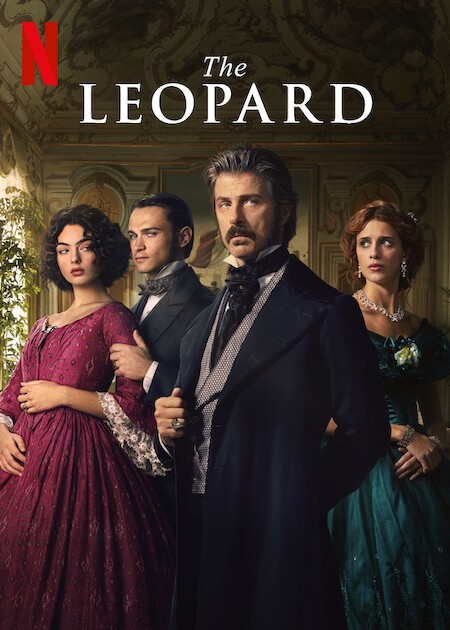
I should have guessed. The Netflix mini-series misses by a country mile. You could blame the casting – who could ever match Burt Lancaster (in the 1963 Luchino Visconti film) as the imperial Prince of Salina? That would be a fair point – it is television after all and that kind of gravitas coupled with regal authority is hard to find. But you should have been able to find someone to match Alain Delon in the second male role, Tancredi, but instead of any real finesse, this is played as soap opera. In fact you could say Downton Abbey Goes To Sicily might have made a better title.
The picturesque is no substitute for genuine understanding of cinematographic use of scenery. The Visconti version was a true epic but this, with double the running time, just stutters, the reimagining of the Lampedusa classic resulting in effect without notable cause.
Scenes are invented to establish character rather than that being shown through the actors. And while we might appreciate the Prince (Kim Rossi Stuart) putting his thieving farm manager in his place and in giving away a good chunk of his land to a corrupt Governor in order to save his wayward nephew Tancredi (Saul Nanni), these sequences look as if though they are dreamed up in soap opera fashion, turning on episodic impact rather than any inherent logic.
Sure, we learn more about the political background. Garibaldi wanted to unite Italy which until then had been a series of small kingdoms. Sicily was the last outpost of the old way and invasion was afoot, bolstered by rebellious islanders already causing ructions. In safeguarding Tancredi, the prince is nursing a viper in his bosom. Occasionally, the script makes a decent point, that in order to stay ahead of the game you need to embrace change.
But the rest is labored. Mostly directed by Tom Shankland with adaptation mostly by Richard Warlow. That Warlow is credited as “creator” rather than Giuseppe Tomasi de Lampedusa, author of the original novel, tells you all you need to know.
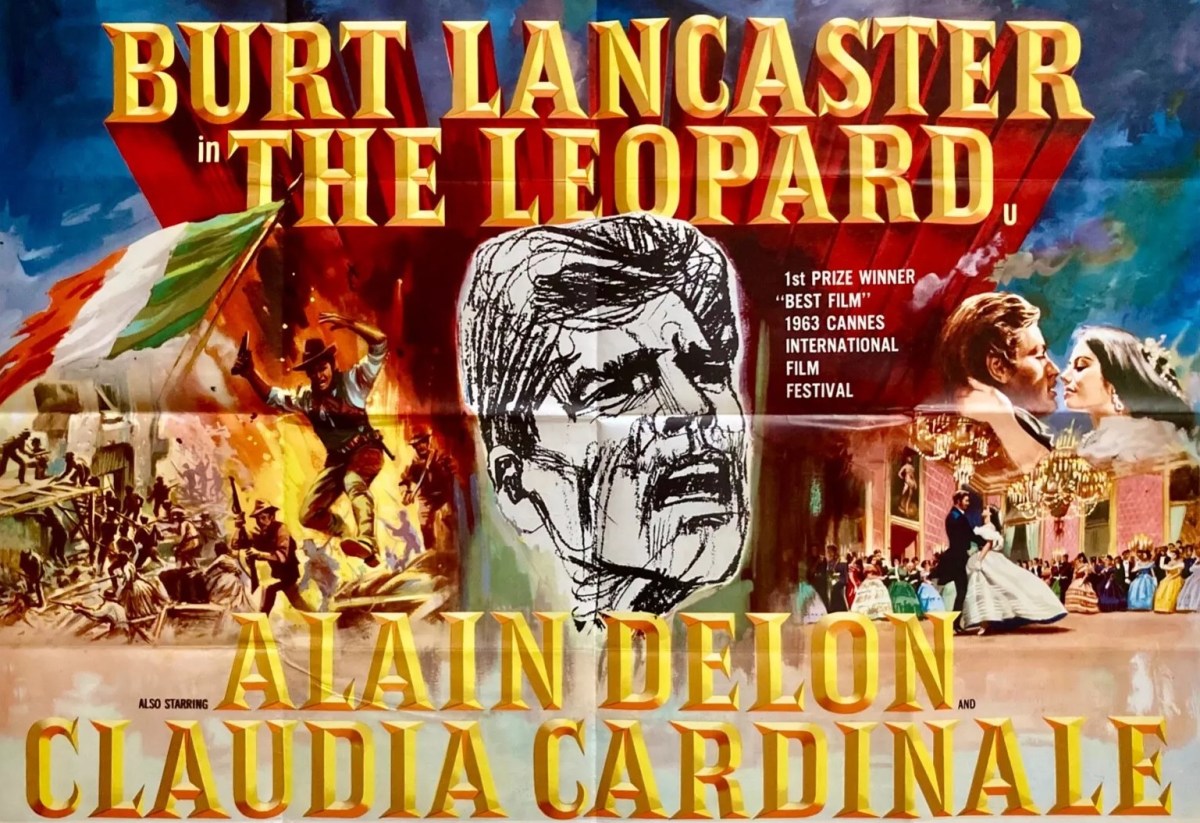
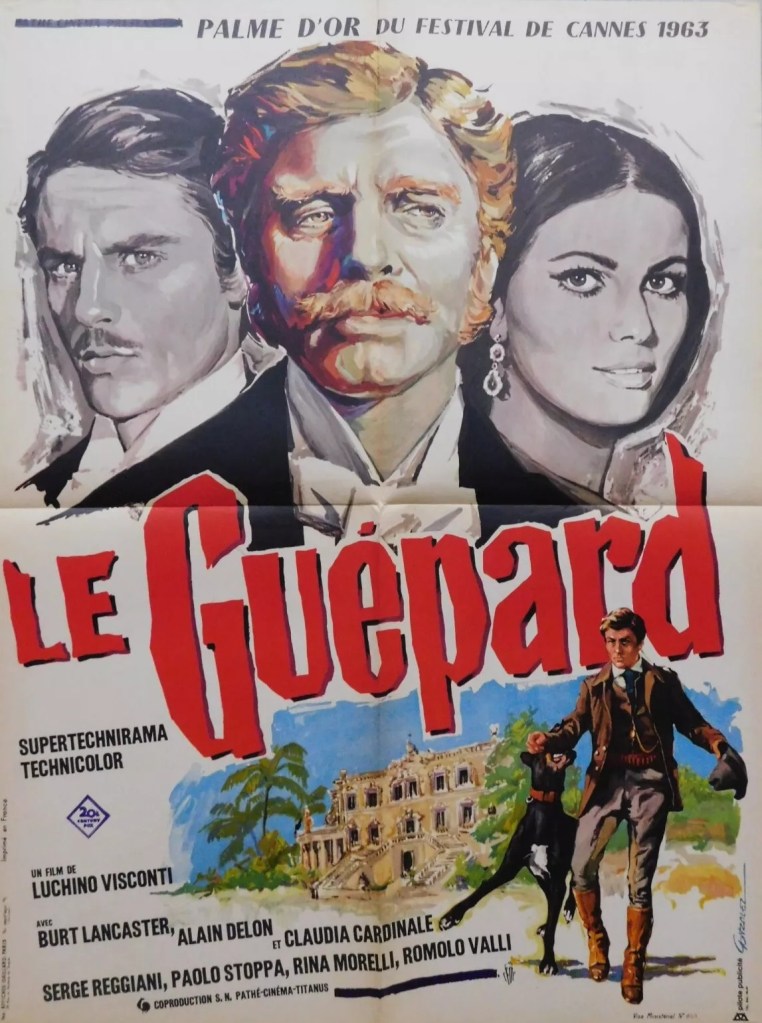
Masterpiece. No other word for the way director Luchino Visconti commands his material with fluid camera and three terrific performances (four, if you count the wily priest). An epic in the old-fashioned sense, combining intelligence, action and romance, though all three underlaid by national or domestic politics. And if you’re going to show crumbling authority you can’t get a better conduit than Burt Lancaster (check out The Swimmer, 1969, for another version of this), physical prowess still to the fore but something missing in the eyes. And all this on sumptuous widescreen.
Only a director of Visconti’s caliber can set the entire tone of the film through what doesn’t happen. We open with a religious service, not a full-scale Mass but recitations of the Rosary, for which the family is gathered in the massive villa of Prince Don Fabrizio Salina (Burt Lancaster). There is an almighty disturbance outside. But nobody dare leave or even react, children silently chided for being distracted, because all eyes are on the Prince and he has not batted an eyelid, worship more important than domestic matters.
Turns out there’s a dead soldier in the garden, indication of trouble brewing. Italy has been beset with trouble brewing from time immemorial so the Prince isn’t particularly perturbed, even if the worst comes to the worst an accommodation is always reached between the wannabes and the wealthy ruling elite.
There’s a fair bit of political sparring throughout but this is handled with such intelligence it’s involving rather than off-putting. Rebel Garibaldi is on the march, it’s the 1860s and revolution is on the way. But it’s not like the French Revolution with aristocrats executed in their thousands and when Garibaldi’s General (Guiliano Gemma) comes calling he addresses the Prince as “Excellency.”
The Prince is a bit of a hypocrite, not as devout as he’d like everyone to believe. He’s got a mistress stashed away for one thing and for another he blames his wife for the need to satisfy his urges elsewhere, complaining that she’s “the sinner” and that despite him fathering seven children with her he’s never seen her navel. Furthermore, the person he makes this argument to is the priest Fr Pirrone (Romolo Valli), who, knowing which side his bread is buttered on, doesn’t offer much of a challenge.
If you’re not going down the more perilous route of taking up arms, advancement in this society is still best achieved through marriage and the Prince’s ambitious nephew Don Tanacredi (Alain Delon), more politically astute, does this through marriage to Angelica (Claudia Cardinale), daughter of Don Calogeo Sedara (Paolo Stoppa).
Brutality and elegance sit side by side. You’re not going to forget the mob of women hunting down and hanging a Government police spy nor, equally, the astonishing ball that virtually concludes proceedings, showing that, whatever changes in society take place, those with money and privilege will still hold their own. But that’s only if they do a little bit of bending the knee to the new powers-that-be, something that Tancredi, by now a rebel hero wounded in battle, is more than happy to do, since that procures him even further advancement, but a step too far for the Prince, who at the end retreats into his study, as if this will provide sanctuary from the impending future.
Don’t expect battle on the scale of Lawrence of Arabia (1962), this action is a more scrappy affair, undisciplined red-shirted hordes sweeping through a town and eventually overwhelming cavalry and ranks of infantry.
But if you’re aiming to hold an audience for three hours, a decent script, romantic entanglement and camerawork isn’t enough. You need the actors to step up. Luckily, they do, in spades. Burt Lancaster is easily the pick, towering head and shoulders, and not just in physicality, above the rest, a man who sees his absolute authority draining away in front of his eyes. Alain Delon (Once a Thief, 1965) comes pretty close, though, not afraid to challenge his uncle’s beliefs nor point out his hypocrisy, and adept at picking his way through the new emerging society, his potential ascension to newfound power demonstrated by wearing a war wound bandage wrapped piratically around one eye, as though keeping a foot in both camps. Though American audiences never quite warmed to Delon, he was catnip for the arthouse brigade, courtesy of being anointed by Visconti and Antonioni in, respectively, Rocco and His Brothers (1960) and L’Eclisse (1962).
Far more than U.S. cinemagoers could imagine, Claudia Cardinale (The Professionals, 1966) also easily straddled commercial and arthouse – Rocco and His Brothers, Fellini’s 8½ (1963) – and on her luminous performance here you can see why. You might also spot future Italian stars Terence Hill (My Name Is Nobody, 1970) and Giuliano Gemma (Day of Anger, 1967). Adapted from the bestseller by Giuseppe Tomasi de Lampedusa by the director and his Rocco and his Brothers team of future director Pasquale Festa Campanile (The Libertine, 1968), Suso Cecchi D’Amico, Enrico Medioli and Massimo Franciosa.
I can’t quite get my head round the audacity of Netflix in attempting a mini-series remake. I’m assuming they’ve had the sense to buy up the rights to the Visconti to prevent anyone comparing the two.
One of the decade’s greatest cinematic achievements.
We’ve become pretty democratic this side of the Pond when it comes to individuals taking on giant corporations. Usually, the whistleblowing kudos goes to an attorney – Erin Brockovich (2000), Dark Waters (2019) or a journo (The Insider, 1999) or a left-wing activist (Silkwood, 1983). But after the success of Mr Bates vs. the Post Office (2024) the focus has come back to the common man.
Or the very ordinary woman, as here. Susan McIntyre (Jodie Whittaker) couldn’t be more down-to-earth as she (insert your own swear word) tells everyone. But she’s also very keen on booze and sex. But when she gives birth to a wee boy with a deformed hand, her partner skedaddles. She meets another woman Tracey Taylor (Aimee Lou Wood) whose child dies from complications after. Her partner sticks by her and they try again.
If the characters had been given the camera-eye view that the audience has – of lorries filled with bestial orange liquid driving through the town and dumping the waste not far outside it, you would have thought someone might take action sooner. But this is an industrial town, Corby, famous for the manufacture of steel – so the workers were used to the after-effects. We’re getting all this waste, and the dust clouds spread as well, because the steel plant has closed – putting 11,000 people out of work – and the factory is demolished to make way for some kind of barmy theme park.
An inoffensive council bureaucrat takes umbrage at the lack of safety on the demolition site. After his claims are dismissed by boss Roy Thomas (Brendan Coyle), he takes his evidence to councillor Sam Hagen (Robert Carlyle).
Given it’s Britain, you get plenty of politics, old-school Labour struggling to survive in the new harsh financial climate, the cosying up of cronies, the sneering at anyone with a degree, the eternal passing of the buck, and, more importantly, hiding the buck. Nothing to see here. Eventually a journalist Des Collins (Rory Kinnear) gets involved. But he really needn’t have bothered, for Susan McIntyre drives this case. Once she shakes off her self-pitying, her initial revulsion at the child, and gets rid of undesirable men, and has something worth fighting for she’s full on.
Jodie Whittaker (Dr Who to you and me) is a revelation. This is a part that requires an actress to give her all and still find a way for nuance. There’s no shortage of cussed young women determined to self-sabotage their dreams – look no further than Wild Rose (2018) and The Outrun (2024) – but this is in a different league altogether and long before Mr Bates got his act together Ms McIntyre was shooting with both barrels.
But it would be just another flag-waving exercise if so much wasn’t invested in the characters. Scenes of wives trying to beat the dust out of orange-sodden clothes, Susan playing games with her wee boy, kissing his antiseptic hands, her one-night-stand treating her with disrespect, the whistleblower twice rejecting bribes and tending his very ill father, even Roy seeing any issues as getting in the way of his dream of becoming council leader. You tend to think it’s just big business with all the upper-class camaraderie that that suggests that has an inbuilt exclusion zone for anyone attempting to tamper with the status quo, so it’s refreshing to know that the old boys network extends all the way through local left-wing politics.
Jack Thorne (National Treasure, 2016) put in the hard yards to stitch this all together so it wasn’t just another polemic but a character-driven drama. Minkie Siro (Pieces of Her, 2022) directs with occasional elan.
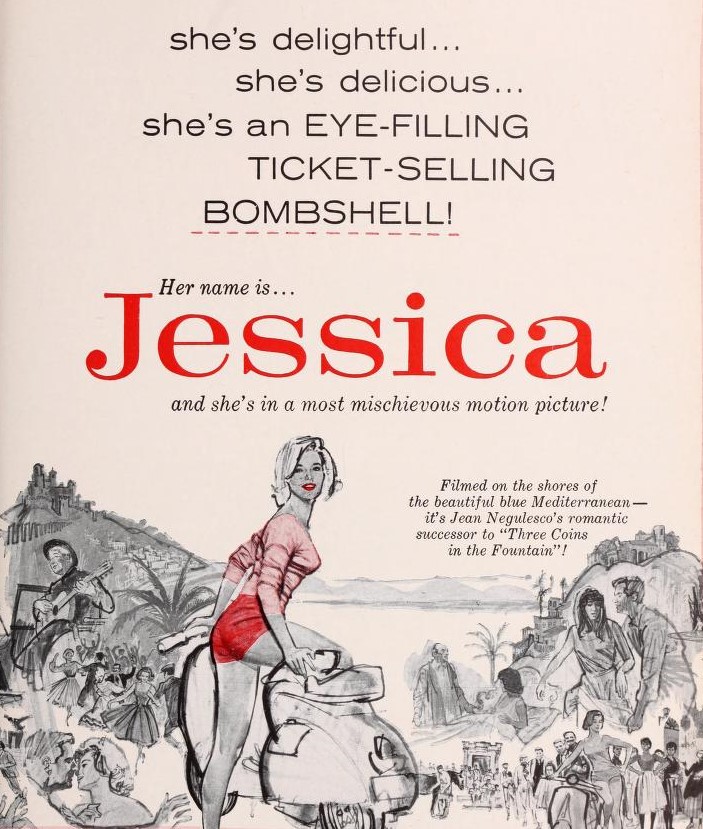
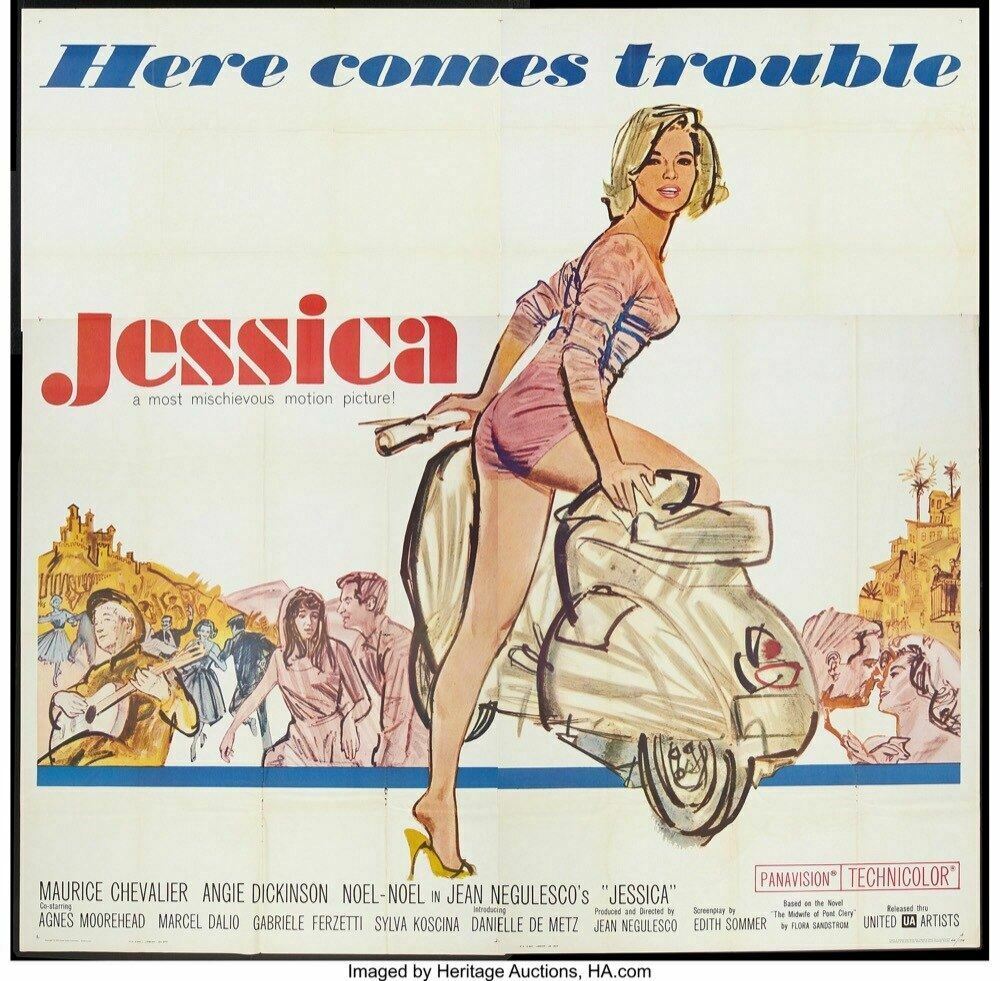
Roman Holiday (1953), Three Coins in a Fountain (1956) and Boy on a Dolphin (1956) had set a high bar for Hollywood romances set in Italy. Since Jean Negulesco had directed the last two, he was expected to sprinkle box office magic on this slight tale of young American midwife Jessica Brown Visconti (Angie Dickinson) adrift in a rustic village in Sicily.
She’s the kind of beauty who’s going to raise male temperatures except Jessica, having been widowed on her wedding day, is not romantically inclined. Unfortunately, that doesn’t stop the entire male population becoming so entranced that their wives become so enraged that led by Maria (Agnes Moorehead) they embark on a sex strike, assuming that without any pregnancies (contraception being frowned upon in a Catholic domain) to deal with Jessica will become redundant and go away. And that so annoys Jessica, who is doing a good job as a midwife, that she turns on the flirting to get back at her female tormentors. Luckily, there’s a reclusive landowner (Gabriele Ferzetti) who happens to be a widower, although romance takes a while to stir. There’s also a priest (Maurice Chevalier), in part acting as narrator, who turns to song every now and then.
So it’s a surprise that this unlikely concoction works at all. It’s charming in the obvious ways, the lush scenery, a traditional wedding, gentle comedy. But it’s a decade too late in taking an innocent view of sex. There’s no crudeness, of course; it doesn’t fall victim to the 1960s need to sexualize in an obvious manner. And not every husband is continuously ogling Jessica so Nunzia (Sylva Koscina) and young bride Nicolina (Danielle De Metz) are in the awkward situation of potentially betraying the sisterhood.
But in resolving the central issue the story develops too many subplots and introduces too many characters, often leaving Jessica rather redundant in terms of the plot, with not much to do, especially when her prospective suitor is absent for a long period going fishing.
Angie Dickinson is delightful as the Vespa-riding innocent turned mischievous. However, in some way though this seemed a backward step for Dickinson, a rising star in the Lana Turner/Elizabeth Taylor mold after being John Wayne’s squeeze in Rio Bravo (1959) and Frank Sinatra’s estranged wife in Ocean’s Eleven (1960) and after a meaty supporting role in A Fever in the Blood (1961) elevated to top billing in The Sins of Rachel Cade (1961). It seemed like Hollywood could not make up its mind whether it wanted her to be like Gidget or be given free rein to express her sexuality.
A charmer like Maurice Chevalier (A Breath of Scandal, 1960) was ideal for what was in effect a whimsical part. The singing probably met audience expectation. Perhaps like Sean Connery’s perennial Scottish accent, nobody ever asked Chevalier to drop his pronounced French accent even to play an Italian. But the picture is whimsical enough without him.
There’s a surprisingly strong supporting cast in four-time Oscar nominee Agnes Moorehead (Pollyanna, 1960), Gabriele Ferzetti (Once Upon a Time in the West, 1969) and French actor (and sometime writer-director) Noel-Noel. Yugoslavian Sylva Koscina (Deadlier Than the Male, 1967), Frenchwoman Kerima (Outcast of the Islands, 1951) and Danielle De Metz (The Scorpio Letters, 1967) all make a splash. Screenplay by Edith Sommer (This Property Is Condemned, 1966) from the bestseller by Flora Sandstrom.
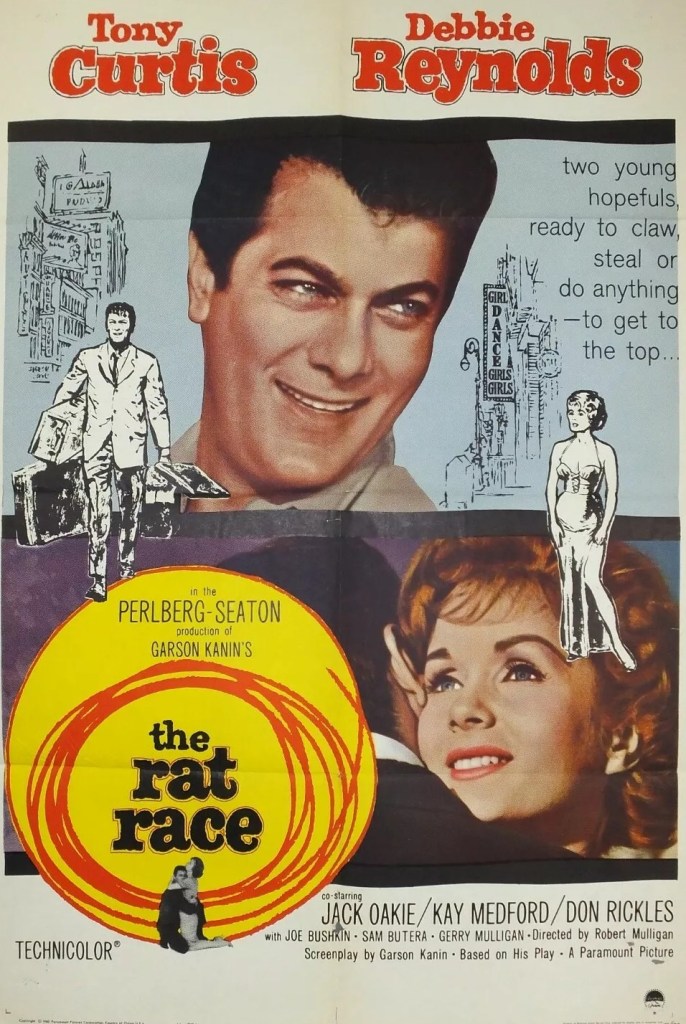
Surprisingly hard-edged tale with Debbie Reynolds giving the performance of her career and with a steely contemporary relevance. Snookers the audience into thinking it’s a standard romance, mismatched characters thrown together by circumstance, various rows and incidents to keep them apart before the expected happy ending. If screenwriter Garson Kanin had held his nerve, there wouldn’t be the get-out of a happy ending. As it is though, a formidable drama that doesn’t pull its punches.
From the title I expected a movie set in the world of big business, but instead we’re looking down on the lowest tiers of the entertainment business and, effectively, it’s a piece about the price paid for dreams. There are laffs, some good one-liners, but even these have a sourness to them.
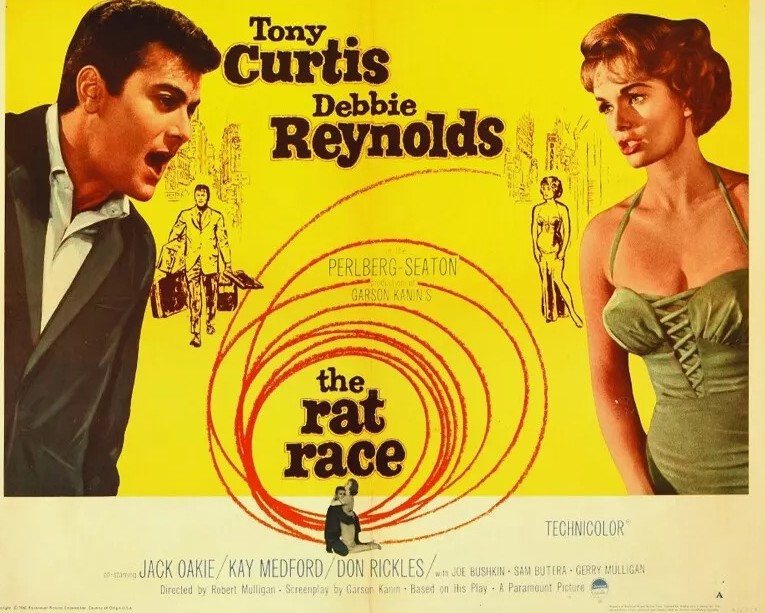
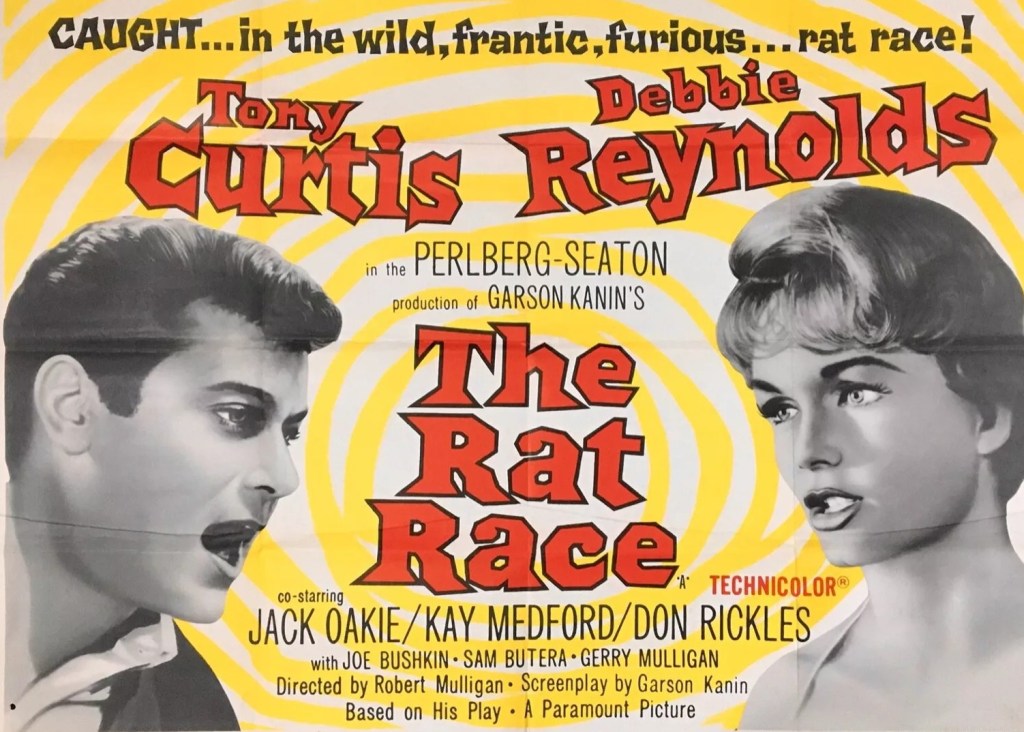
Pete (Tony Curtis) leaves Milwaukee for New York seeking fame and fortune as a saxophonist, not realizing he’s more likely to join the thousands of out-of-work musicians already resident, dreams dashed but determined to avoid the ignominy of going home with their tails between their legs, not just to face the mundane life that awaits but seared through with the guilt of failure. Through circumstance he ends up sharing an apartment with model-cum-dancer Peggy (Debbie Reynolds), who’s already given up on her dream once, but couldn’t stand more than a few minutes of the home she’d clearly been desperate to leave.
Peggy is clean out of modelling assignments and hasn’t made it to Broadway, either, not even to a chorus line. Instead, she earns not much of a living as a taxi dancer, more innocent than it would be now in the era of the lap-dancer but still seedy enough with roving male hands. She’s paid to dance with complete strangers, the kind of deadbeats unlikely to ever get on the dance floor with a beautiful woman in the normal course of events.
She’s about to lose her phone, but not above leading on the creepy repairman (Norman Fell) to believe he’s onto a promise should he give her a break. Only pride prevents her solving her financial problems – as well as not making her rent she owes cash to her sleazebag boss Nellie (Don Rickles) – by going down the sex worker route.
Pete thinks he’s got the smarts but in fact he’s afflicted with dumbness and gets ripped off for a mink coat made of cat fur and then loses a complete set of brand-new musical instruments to another scam. When he’s thrown the lifeline of a gig on a cruise ship, Peggy stumps up to buy him a new sax and the requisite tux. She’s paying for this with a promise to Nellie to enter the prostitution game, not quite spelled out as that but as close to the knuckle as you’re going to get in this era, the kind of soft-soap approach that worked for Butterfield 8 (1960).
When Peggy fails to deliver, Nellie humiliates her in the worst possible way. Beginning with her jewellery he strips her down to undergarments to show how much he owns her and just how good he is at playing hardball. It’s a gut-clenching scene. Sure, you know there’s not going to be any nudity, not in this period before the Production Code got flattened, but even so, it works extraordinarily well, especially as clearly Peggy doesn’t know just how far he will go and that he might not, in his quiet fury, be above turning her out into his club starkers.
Meanwhile, to ensure we get to the ending that audiences expected, Pete, on board the ship, has been ignoring any other romantic opportunities, and sending her a heartfelt letter a day, which she appears determined to ignore, knowing that the “rat race” isn’t the kind of world that accommodates long-term romance.
Suffice to say, when Pete manages to bail her out, that changes her mind, though the genuine Peggy would still have balked, knowing that, with their levels of talent, they were only going to become more wasted by lack of fulfilment.
So, yeah, happy ending, but you feel that’s been grafted on to allow audiences to take the rest of the tougher storyline. The MeToo campaign has exposed the pitfalls of the entertainment business, so what happens to Peggy wouldn’t come as a surprise to a contemporary audience.
By this point Debbie Reynolds (Goodbye Charlie, 1964) wasn’t known for drama, more for a spunky or sparky screen persona in a series of lightweight comedies or romances, this showed Hollywood what it was missing. Tony Curtis (Goodbye Charlie) had proven he could do comedy or drama and here he mostly plays it straight.
Director Robert Mulligan (The Stalking Moon, 1968) is probably responsible for maintaining the harder edge. This was originally a Broadway number, so I doubt if the sharpness would have worked so well in that medium. Garson Kanin (Where It’s At, 1969) and an uncredited John Michael Hayes (Nevada Smith, 1966) knocked out the screenplay based on the former’s play.
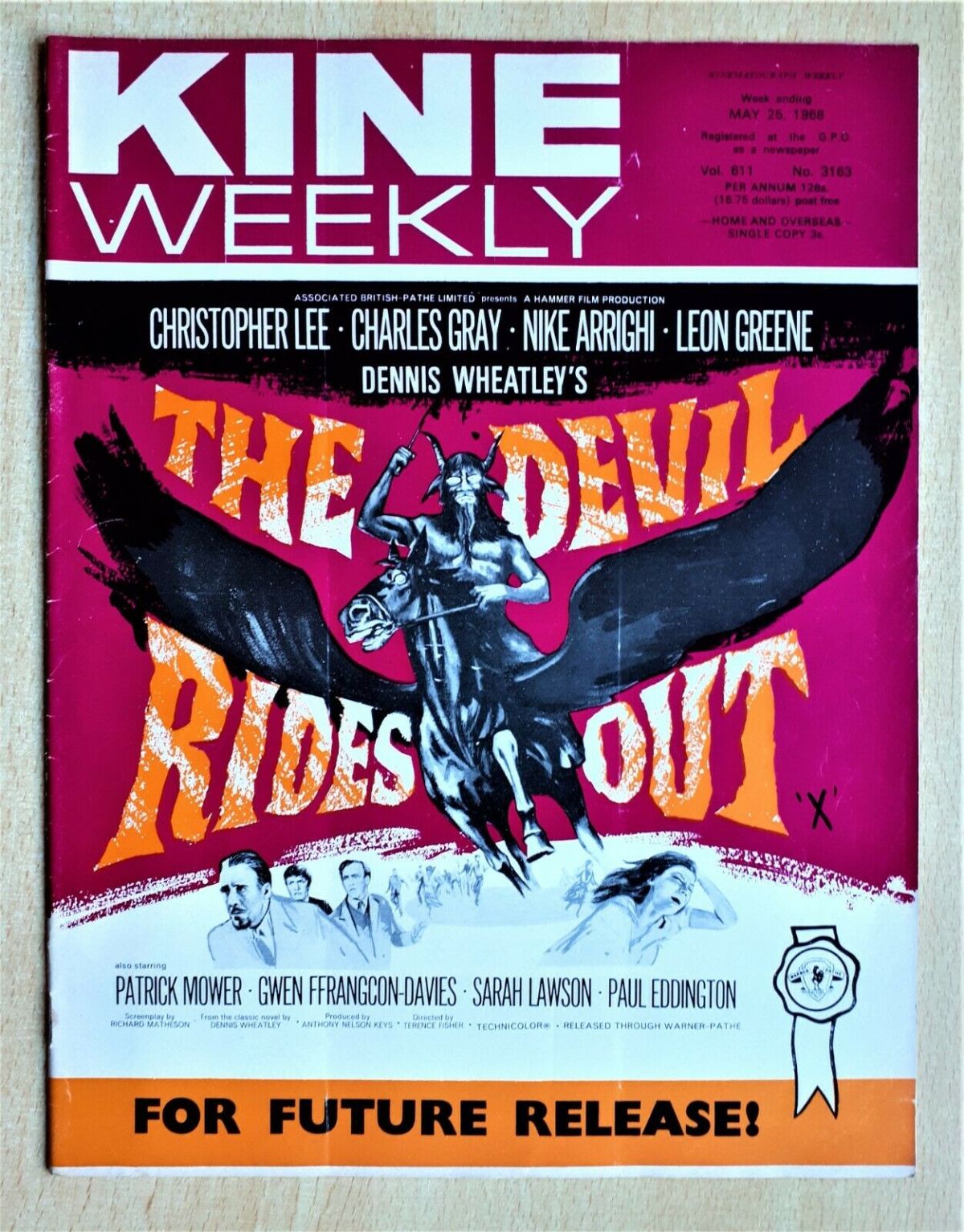
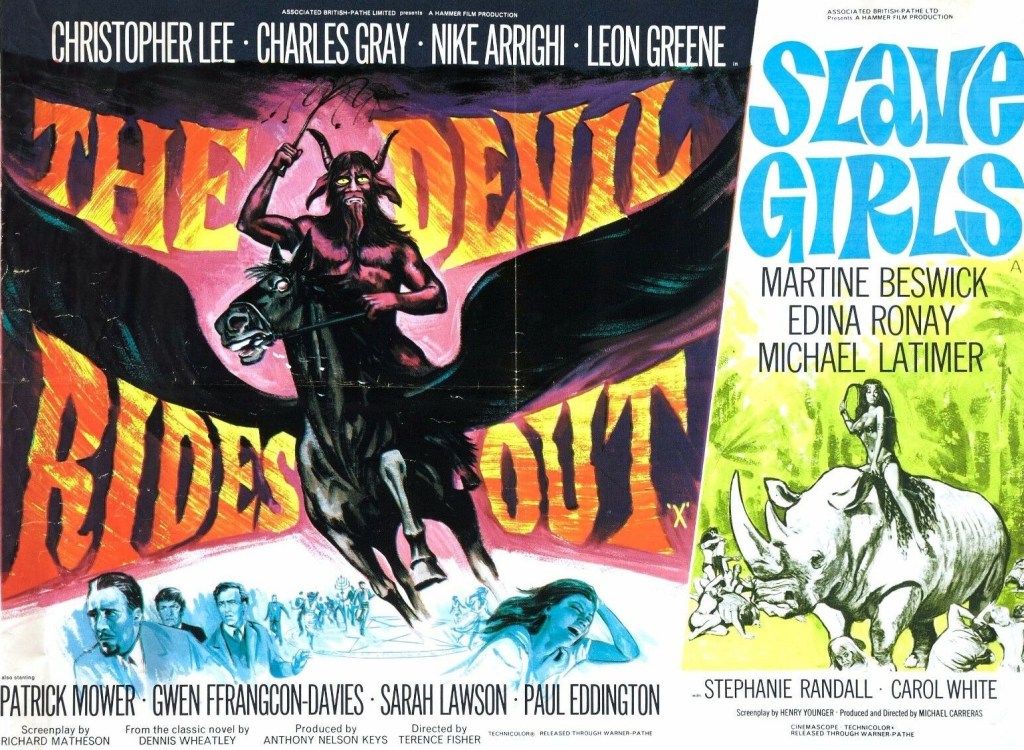
Strong contender for Hammer’s film of the decade, a tight adaptation of Dennis Wheatley’s black magic classic with some brilliant set pieces as Nicholas de Richleau (Christopher Lee) battles to prevent his friend Simon (Patrick Mower) falling into the hands of satanist Mocata (Charles Gray).
Initially constructed like a thriller with Simon rescued, then kidnapped, then rescued again, plus a car chase, it then turns into a siege as Richleau and friends, huddled inside a pentagram, attempt to withstand the forces of evil. Sensibly, the script eschews too much mumbo-jumbo – although modern audiences accustomed to arcane exposition through MCU should find no problem accommodating ideas like the Clavicle of Solomon, Talisman of Set and Ipsissimus – in favour of confrontation.
Unlike most demonic pictures, de Richleau has an array of mystical weaponry and a fund of knowledge to defend his charges so the storyline develops along more interesting lines than the usual notion of innocents drawn into a dark world. In some senses Mocata is a template for the Marvel super-villains with powers beyond human understanding and the same contempt for his victims. And surely this is where Marvel’s creative backroom alighted when it wanted to turn back time. Though with different aims, De Richleau and Mocata are cut from the same cloth, belonging to a world where rites and incantations hold sway.
While special effects play their part from giant menacing tarantulas and the Angel of Death, the most effective scenes rely on a lot less – Simon strangled by a crucifix, Mocata hypnotizing a woman, a bound girl struggling against possession. Had the film been made a few years later, when Hammer with The Vampire Lovers (1970) and Lust for a Vampire (1971) increased the nudity quotient, and after The Exorcist (1973) had led the way in big bucks special effects, the black mass sequence would have been considerably improved.
The main flaw is the need to stick with the author’s quartet of “modern musketeers” which means the story stretches too far in the wrong directions often at the cost of minimizing the input of de Richleau. In the Wheatley original, the four men are all intrepid, but in the film only two – de Richleau and American aviator Rex van Ryn (Leon Greene) – share those characteristics. At critical points in the narrative, de Richleau just disappears, off to complete his studies into black magic. Where The Exorcist, for example, found in scholarship a cinematic correlative, this does not try.
Christopher Lee (She, 1965), pomp reined in, is outstanding as de Richleau, exuding wisdom while fearful of the consequences of dabbling in black magic, both commanding and chilling. Charles Gray (Masquerade, 1965) is in his element, the calm eloquent charming menace he brings to the role providing him with a template for future villains. The three other “musketeers” are less effective, Patrick Mower in his movie debut does not quite deliver while Leon Greene (A Challenge for Robin Hood, 1967) and Paul Eddington (BBC television’s Yes, Minister 1980-1984) are miscast. Nike Arrighi, also making her debut as love interest Tanith, is an unusual Hammer damsel-in-distress.
Hammer stalwart Terence Fisher (The Gorgon, 1964) creates a finely-nuanced production, incorporating the grand guignol and the psychological. Screenwriter Richard Matheson (The Raven, 1963) retains the Wheatley essence while keeping the plot moving. A few years later nudity was no longer be an issue and Hollywood injected big bucks in horror special effects, so with those constraints in mind the studio did a devilish good job.
BOOK INTO FILM
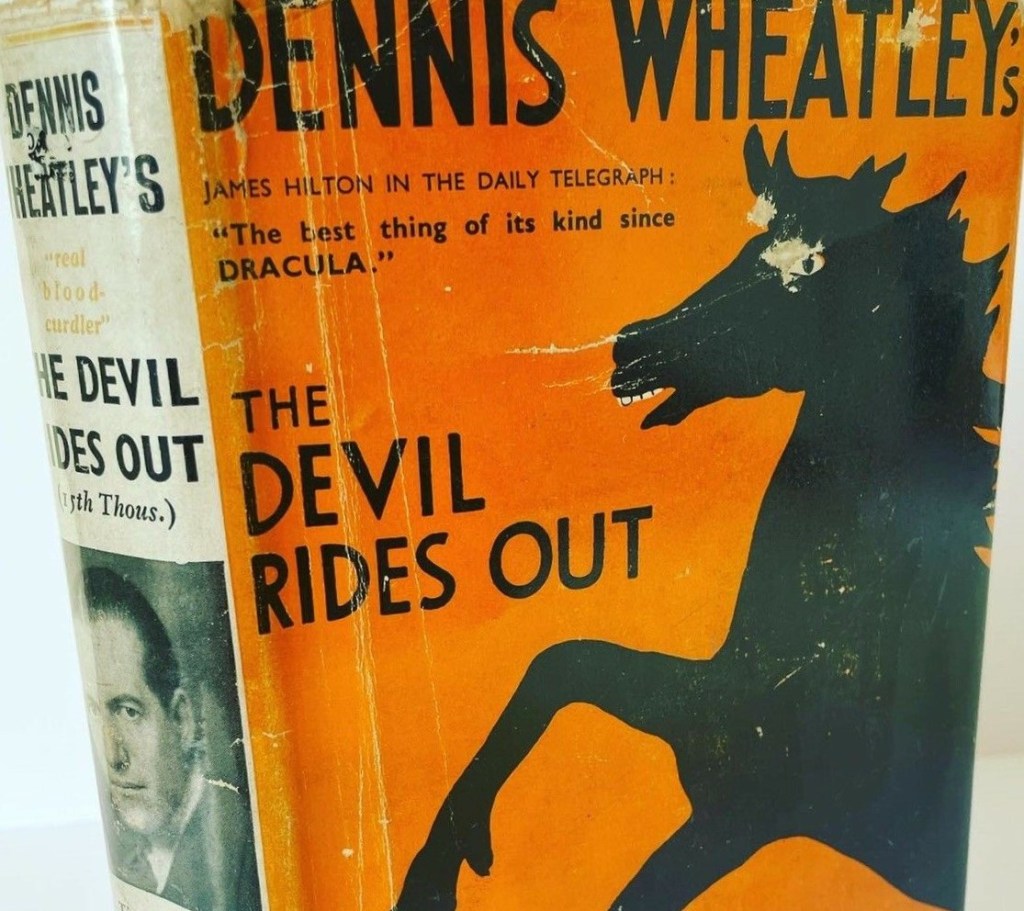
Dennis Wheatley was a prolific bestseller producing three or four titles a year, famous for a historical series set around Napoleonic times, another at the start of the Second World War and a third featuring the “four modern musketeers” that spanned a couple of decades. In addition, he had gained notoriety for books about black magic, which often involved series characters, as well as sundry tales like The Lost Continent. Although largely out of fashion these days, Wheatley set the tone for brisk thrillers, stories that took place over a short period of time and in which the heroes tumbled from one peril to another. In other words, he created the template for thriller writers like Alistair MacLean and Lee Child.
The Devil Rides Out, his fourth novel, published in 1934, featured the “musketeers” involved in his phenomenally successful debut The Forbidden Territory (1933), and introduced readers to his interest in the occult. Although of differing temperaments and backgrounds his quartet – the Russian-born Duke De Richleau (Christopher Lee in the film), American aviator Rex Van Ryn (Leon Greene) and wealthy Englishmen Richard Eaton (Paul Eddington) and Simon Aron (Patrick Mower) – are intrepid. And while screenwriter Richard Matheson stuck pretty much to the core of the Wheatley story, the film was hampered by the actors. The laid-back Paul Eddington hardly connects with the Wheatley characterization and Patrick Mower is too young for Aron.
As with the book, the story moves swiftly. Worried that Aron is dabbling in the black arts, De Richleau and Van Ryn go haring down to his country house where they meet black magic high priest Mocata (Charles Gray) and discover tools for satanic worship. And soon they are embroiled in a duel of wits against Mocata, climaxing in creating a pentagram as a means of warding off evil.
In order not to lose the audience by blinding them with mumbo-jumbo the script takes only the bare bones of the tale, bringing in the occult only when pivotal to the story, and that’s something of a shame. A modern audience, which has grown up on enormously complicated worlds such as those created for Game of Thrones and the MCU, would probably have welcomed a deeper insight into the occult. While out-and-out thrillers, Wheatley’s novels also contained copious historical information that he was able to dole out even when his heroes were in harm’s way. The Devil Rides Out is not a massive tome so it’s a measure of the author’s skill that he manages to include not just a condensed history of the occult but its inner workings. Every time in the film De Richleau goes off to the British Library for some vital information, his departure generally leaves a hole, since what he returns with does not always seem important enough to justify his absence.
But then the screenwriter was under far more pressure than a novelist. In some respects, this book like few others demonstrated the difference between writing for the screen and writing for a reader. With just 95 minutes at his disposal, Matheson had no time to spare while Wheatley had all the time in the world. Wheatley could happily leave the reader dangling with a hero in peril while dispatching De Richleau on a fact-finding mission, the action held up until his return. It’s interesting that Matheson chose to follow Wheatley’s characterization of De Richleau, who didn’t know everything but knew where to look. Matheson could easily have chosen to make De Richleau all-knowing and thus able to spout a ton of information without ever going off-screen.
But here’s where the book scores over the film. The reader would happily grant Wheatley his apparent self-indulgence because in the book what he imparted on his return, given the leeway to do so, was so fascinating. There are lengthy sections in the book which are history lessons where De Richleau gives readers the inside track on the satanic. In the opening section, once De Richleau and Van Ryn have rescued Aron, the author devotes a full seven pages to a brief introduction to the occult that leaves the reader more likely to want more of that than to find out how the story will evolve. He has hit on a magic formula that few authors ever approach. To have your background every bit as interesting as the main story is incredibly rare and it allowed Wheatley the opportunity to break off from the narrative to tell the reader more about the occult, which in turn, raised the stakes for the characters involved.
Dennis Wheatley
Effectively, there was too much material for a screenwriter to inflict upon an audience ignorant of the occult. Some decisions were clearly made to limit the need for lengthy exposition. But these often work against the film. For example, Mocata wants the Talisman of Set because it bestows unlimited power with which he can start a world war, but in order to accomplish that he needs to find people with the correct astrological births, namely Simon and Tanith. But this element is eliminated from the story, making Mocata’s motivation merely revenge. Matheson also removed much of the historical and political background, replaced the swastika as a religious symbol with the more acceptable Christian cross, and deleted references to Marie’s Russian background. Her daughter Fleur becomes Peggy. Matheson also treats some of the esoteric light-heartedly on the assumption that seriousness might be too off-putting.
Overall, the adaptation works, you can hardly argue with the movie’s stature as a Hammer classic, but the more you delve into the book the more you wish there had been a way for much of the material to find its way onscreen and to inform the picture in much the same way as the depth of history and character backstory added to Game of Thrones.
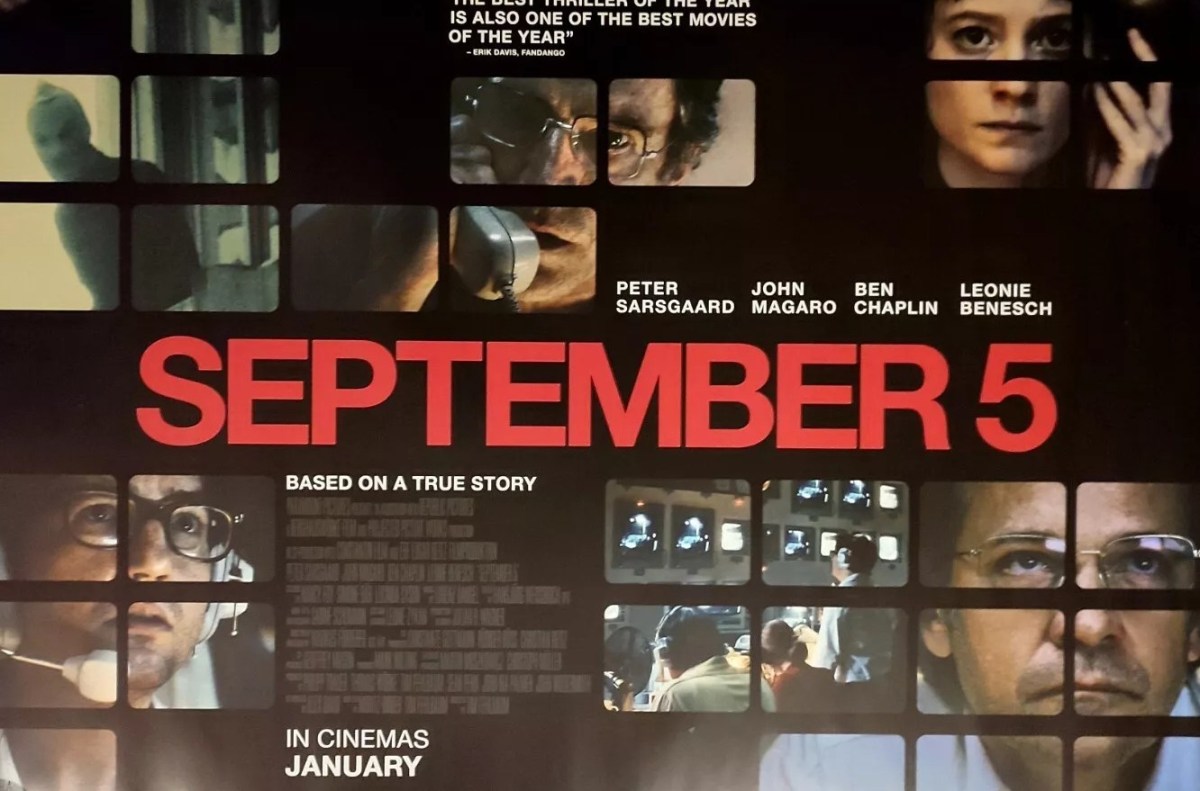
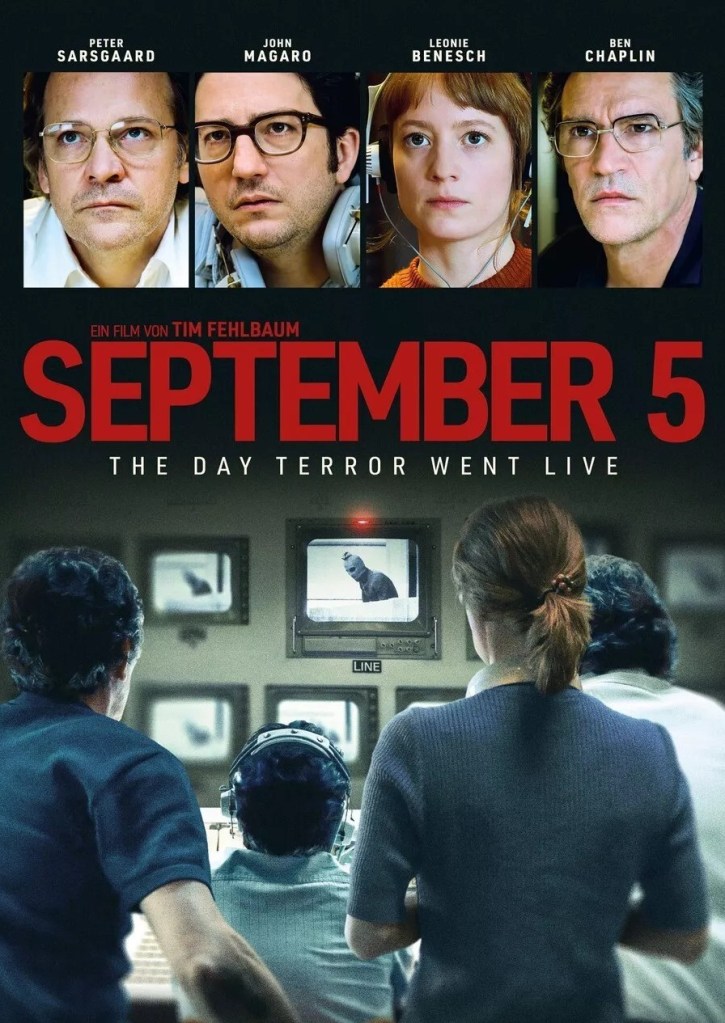
Watched this with growing revulsion. The final, triumphal, image says it all. The coverage of the terrorist attack on Israeli athletes at the Munich Olympic games in 1972 attracted a world record global audience of 900 million. Hooray! At least some good came out of it. How could anyone find celebration in such an atrocity? And ask a cinema audience to share in the tribulations of a television crew seeking the gold medal of the media games – the scoop.
No notion that in broadcasting the event – if it can be so termed – live that it opened the door to any other terrorist organization seeking a bigger global audience for its nefarious activities. You could blame the audience for watching. The networks after all are only pandering to public demand. They are not censors.
You’d hardly believe it but some of the characters here were all for broadcasting a live execution should the terrorists be so kind as to shoot someone within reach of the cameras. And, yeah, the terrorists knew there were cameras, because they could see the whole thing unfolding on the televisions in the rooms where they held their hostages. Which was very helpful, because it alerted them to the armed German police crawling over the rooftops.
In theory this falls into the subgenre of media backroom shenanigans, think Broadcast News (1987), or acclaimed tales of journalistic expose, king of that particular castle still being All the President’s Men (1976) though Spotlight (2015) might run it close, the ones where the reporters take a heroic stab at the establishment.
Here, though, the media is the establishment. This focuses on ABC, one of the three big U.S. networks, and it’s the tale more than anything of glory hunters, the sports division of the network stumbling upon the unfolding events and resisting every demand to hand it over to the more politically-aware and humanity-sensitive news department, boss Roone Arledge (Peter Sarsgaard) determined to win his place in the sun.
He’s the kind of manager who’s so arrogant that it’s not occurred to him to have around him anyone who speaks German – surely the Germans will oblige and all speak English – only to find that he relies to the extent of putting her life in danger on freelance German translator Marianne (Leonie Benesch). Given the crassness of the production, you won’t be surprised to learn that members of the team blame her for what her parents did or didn’t do during the Second World War.
What Roone is especially good at is departmental politics, so he finagles CBS out of their satellite slot so he can win coveted airing time and even when he has to accede to demands that he share the footage with other networks comes up with the proprietorial scam to stick an ABC decal on the corner of the screen, a device that is still used today as you will be aware.
In any other circumstance I’m sure I would delight in having revealed to me all the tricks of the trade, how the reporters hack into police radio, how they cut and edit footage to maximum effect, and, under extreme pressure, still think lightning fast on their feet, one cameraman cleverly disguised as an athlete to evade the security surrounding the hostage situation and sneak secret footage back..
The Germans come off as incompetent, initial security effort called into question, their handling of the shootout deplored, scant regard given to the fact that, as one of the conditions of peace, German soldiers are forbidden to appear on German territory. Steven Spielberg managed to cover the situation more even-handedly in Munich (2005) in which, thankfully, the media were non-combatants.
“We were waiting for something to happen so we could take a picture of it,” laments Marianne at the end, perhaps not realizing that this is the same instinct that currently bedevils social media, the stacking up of views for being there. All the way through the journalists are in self-congratulatory mode, convinced they are making history, not stopping to think it might be of the worst possible kind.
The only reason for making this movie from the standpoint of the reporters is to glorify them. The athletes held hostage and eventually killed are mere pawns in the larger media game.
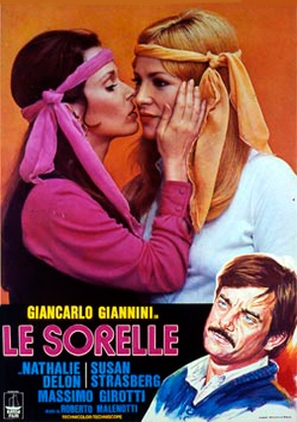
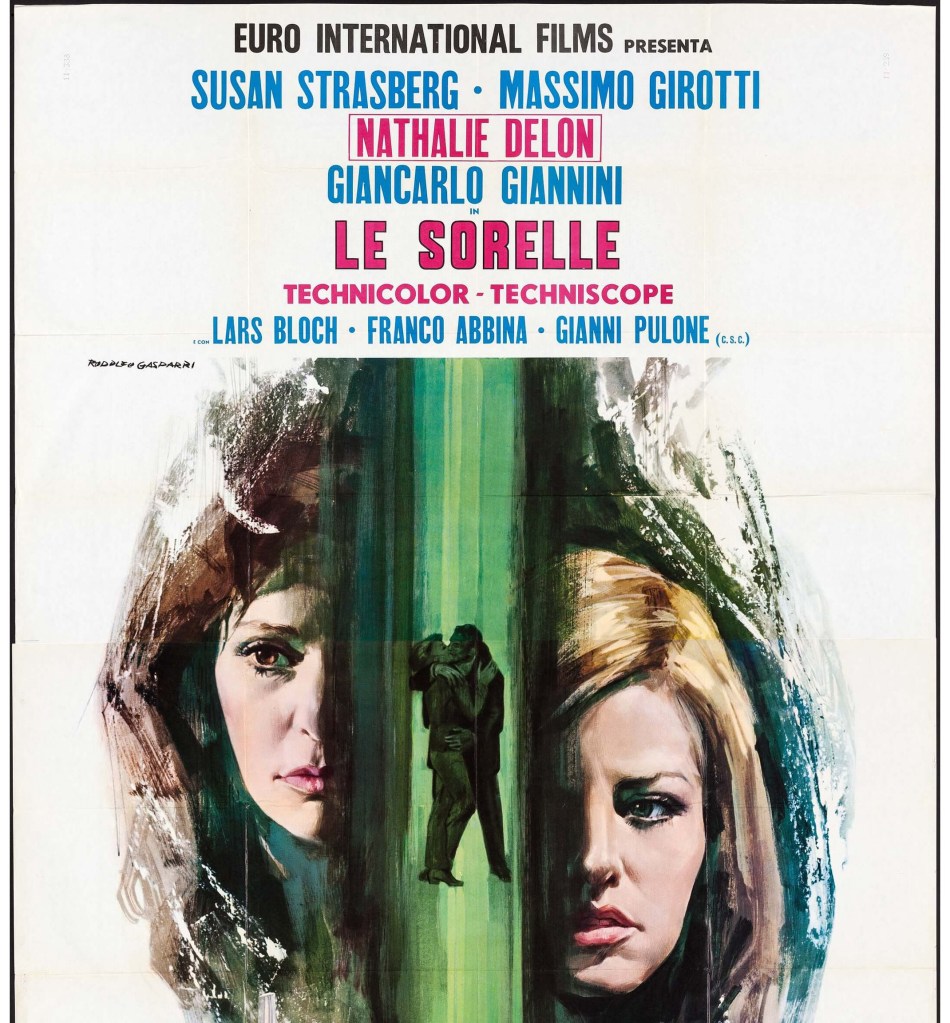
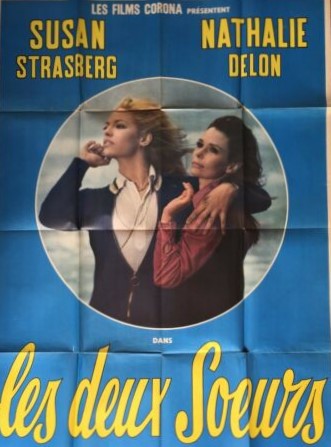
Erotically-charged, symbolically-heavy French drama of siblings trying to re-establish the intense relationship they enjoyed as teenagers. After a nervous breakdown and on the point of divorce, blonde translator Diana (Nathalie Delon) seeks respite at the home of younger sister Martha (Susan Strasberg), a brunette happily married to the wealthy and indulgent Alex (Massimo Girotti).
Initially, the more worldly Diana, the more flamboyant dresser, appears the superior but it soon transpires she is the more fragile. The apparently timid Martha allows her husband to control her life to the point of buying all her clothes and confesses to feeling as if she is on “a perpetual cruise.” While on the surface, it seems as if she has given up too much, in reality she disapproves of disorder and seeks perfection. She comes across as needing protection, and believes the woman’s role is to sacrifice, but in fact has managed to arrange her life to her own satisfaction.
Their competitive streaks emerge in different ways, Diana in obvious fashion, seeking to beat her sister while out horse-riding, Martha in more subtle and sensual manner, flaunting her sexual relations with her husband, almost offering her sister to her husband, and having a lover (Lars Bloch) on the side. There is a sense of each attempting to impose their world view on the other. Diana gives her sister a make-over, a new look which Alex adores, Martha hates it. There’s a sense of a chess game, with two or more players, with the males subservient. pawns.
Sensuality is never far away. Diana nuzzles her sister’s neck to smell her perfume. Alex is photographed, encouraged by Martha, in almost intimate mode with Alex. Dario (Giancarlo Giannini) is brought in to tempt Diana. And a scene where the girls experiment with colorful scarves suggests libertarianism.
But it is clear that both sisters live empty lives devoid of true love and equally obvious as the picture progresses that both have arrived at the conclusion that they were at their happiest when together. There are subtle hints of incest, comforting each other in bed, the sensuality electric and the film begins to examine whether this taboo can be crossed and, if so, will it provide the necessary escape?
Despite Martha’s apparent subjugation, there is more than an inkling of feminism, the girls are involved in a complicated game in which the males are pawns, either rejected or made to look fools. While not fulfilled, Martha has turned as much as possible to her own advantage and Diana seems perfectly capable of taking what she wants.
Alex provides the symbolism. He cultivates rare plants that need to hide from the sun, in a greenhouse, lengthy exposure to whose atmosphere would be fatal to humans. He endlessly photographs them because they won’t last long. And in similar fashion provides a haven for the apparently vulnerable Martha.
Nathalie Delon (When Eight Bells Toll, 1970), married at this point to Alain Delon, shows a subtlety of expression that is rare for someone appearing in just her third film, and effects a gradual character transition throughout. Susan Strasberg, daughter of famed acting coach, Lee Strasberg, inventor of the Method Style of Acting, was one of the boldest actors of her generation, appearing in drug pictures The Trip (1967) and Psych Out (1968). She delivers an excellent portrait of a woman who manages to keep her true personality hidden, and for whom sexuality has few barriers.
This is the puppy-fat version of Giancarlo Giannini (Swept Away, 1974), barely recognizable as the future arthouse superstar whose physical appearance relied on gaunt, angst-riddles features. Massimo Girotti (Theorem, 1968) is good as the man who thinks he has everything, not realizing how little he has.
Although this was an accomplished directorial debut from Roberto Malenotti, he only made one more movie. Perhaps he made enough from directing the famous Coke commercial I’d Like To Teach The World To Sing (1971).
Always intriguing, revelations continually undercutting what we think we know of the characters, but delivered in subtle European tones rather than employing Hollywood shock, each of the four main people involved changing considerably due to their interaction with the others. While certainly skirting close to the borders of what was permissible at the end of the 1960s, it does so without exploiting the actresses.
Dreary miscalculation. Ever since Tennessee Williams hit a home run with Cat on a Hot Tin Roof (1958), studios, directors and stars had clamored for his works, so much so that Hollywood had greenlit seven adaptations in five years. While box office was one consideration, the playwright was catnip to the Oscar, racking up 17 nominations with a hefty number in the Best Actress category.
However you dressed it up, his work contained a substantial number of portraits of sadness and malevolence and often teetered on the murky, so making them work at all depended not just on the acting and direction, but the initial story. Rather than being based on a play, this was sourced from his first novel, a bestseller.
But the tale never shifts out of first gear and it’s difficult to summon up sympathy never mind interest in any of the characters. The middle-aged romance had proved a cumbersome fix for studios, and since May-December numbers featuring ageing male and younger female had proved popular, Cary Grant set up with an endless supply of woman nearly half his age, it seemed only fair to give middle-aged actresses the opportunity to romance younger men.
Usually, however, this followed a more straightforward path, involving genuine feelings on both sides. But Hollywood was also digging into another cesspit, the female sex worker, somewhat dressed up in Butterfield 8 (1960) and Go Naked in the World (1961), treated more straightforwardly in Never on Sunday (1960) and Girl of the Night. So it only seemed fair to introduce the gigolo.
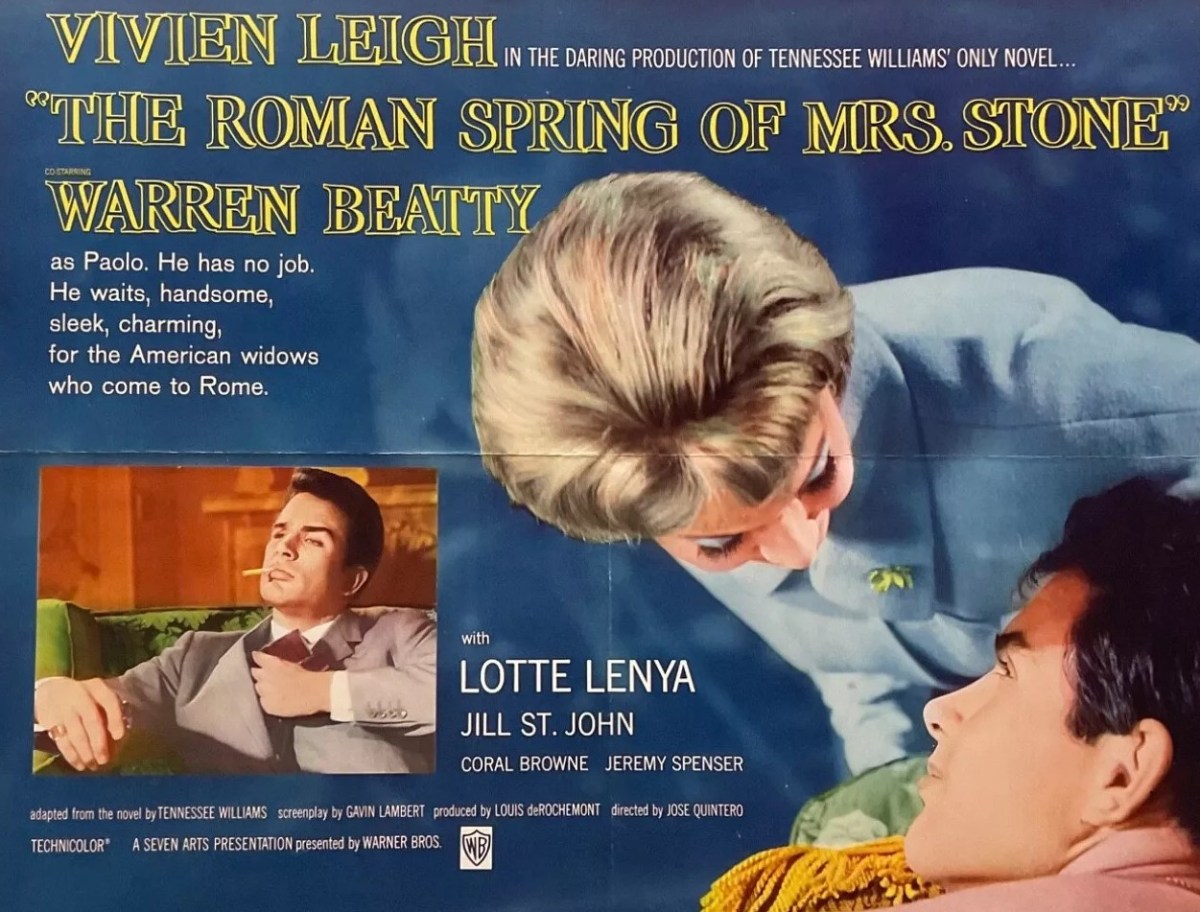
Stage actress Karen Stone (Vivien Leigh) heads for Rome with her wealthy husband to recover from the failure of her latest play, a Shakespearian outing. When her husband dies on the plane, Karen decides to hang on in the Italian capital, which, after a year, brings her into the orbit of gigolo Paulo (Warren Beatty) and his unscrupulous mentor/manager Contessa Magda (Lotte Lenya). While Karen isn’t entirely a dupe and quickly sees through Paulo, nonetheless a year of loneliness has taken its toll.
Plus she understands the attraction of the older lover, her husband being a good two decades older and willing to subsidize her theatrical and cinematic ambitions. Despite not falling for Paulo’s more obvious con tricks, Karen finds herself enmeshed in a one-sided romance, ignoring the warnings of friend Meg (Coral Brown) on the dangers of becoming the talk of the town with her lover clearly more attracted to rising movie star Barbara (Jill St John). Paulo quickly dumps the Contessa, leaving her free to pour bile into Karen’s ear.
Inevitably, the younger lover tires of the older, but generally such pairings work well enough because initially at least there is attraction on both sides. But when it’s as lop-sided as this no amount of long drawn-out close-ups of the disenchanted provide sufficient compensation for a story that overstays its welcome.
While there are hints of the decadence of La Dolce Vita (1960) that Fellini explored, here it’s more of a surface examination until the surprising ending, where you would think Karen is doing little more than willingly opening the door to a potential serial killer.
The only redeeming element, which might reverberate more easily today, is of the woman demonstrating her independence by being the one to choose, and to some extent discard, the man. While not for most of the movie a sexual predator, she may well have turned into one at the end.
Oscar-winner Vivien Leigh, in her first movie in six years, essays her role well but is compromised by portraying a character that fails to elicit sympathy. Warren Beatty (Promise Her Anything, 1966) avoids the trap of thickening his Italian accent and going wild with the gestures which lends his character more of a thoughtful personality but there’s not much here to write home about. Lotte Lenya (From Russia with Love, 1963) steals the show and was rewarded with an Oscar nomination. Jill St John (Tender Is the Night, 1962) plays the ingénue like an ingénue.
Unless you’re a student of theater I doubt if you’ll have come across Panamian director Jose Quintero. This was his only movie and he was more famous for staging some of Williams’ plays and for resurrecting Eugene O’Neill on Broadway. His inexperience shows in lingering on faces at the expense of creating drama. Gavin Lambert (Inside Daisy Clover, 1965) adapted the novel.
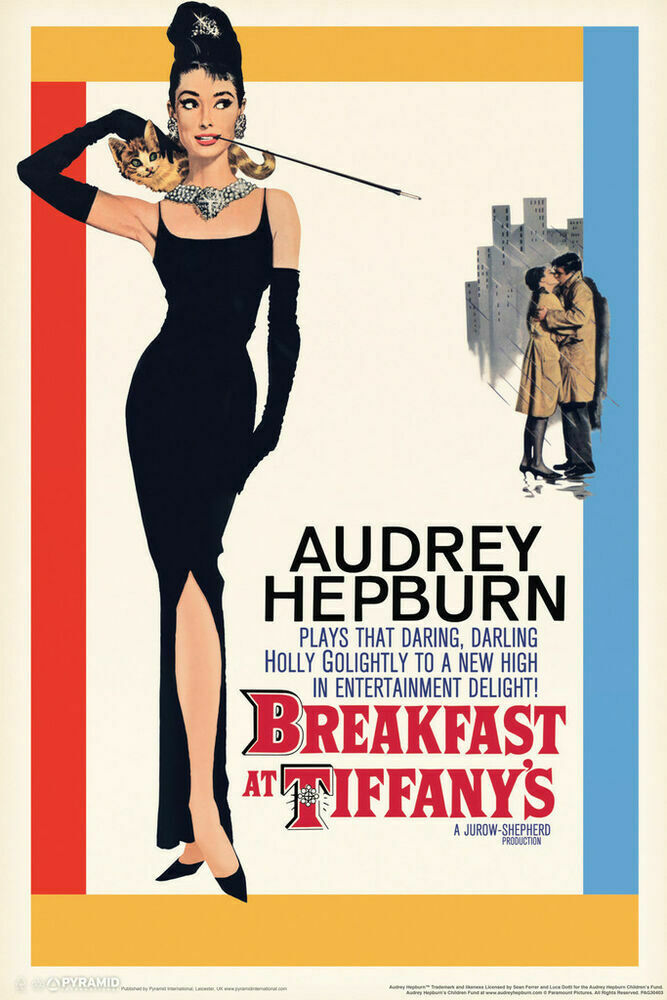
Reassessment sixty years on – and on the big screen, too – presents a darker picture bursting to get out of the confines of Hollywood gloss. Holly Golightly (Audrey Hepburn) is one of the most iconic characters ever to hit the screen. Her little black dress, hats, English drawl and elongated cigarette often get in the way of accepting the character within, the former hillbilly wild child who refuses to be owned or caged, her demand for independence constrained by her desire to marry into wealth for the supposed freedom that will bring, demands which clearly place a strain on her mental health.
Although only hinted at then, and more obvious now, she is willing to sell her body in a bid to save her soul. Paul Varjak (George Peppard), a gigolo, being kept, in some style I should add, with a walk-in wardrobe full of suits, by the nameless wealthy married woman Emily (Patricia Neal), is her male equivalent, a published writer whose promise does not pay the bills. The constructs both have created to hide from the realities of life are soon exposed.
There is much to adore here, not least Golightly’s ravishing outfits, her kookiness and endearing haplessness faced with an ordinary chore such as cooking, and a central section, where the couple try to buy something at Tiffanys on a budget of $10, introduce Holly to New York public library and boost items from a dime store, which fits neatly into the rom-com tradition.
Golightly’s income, which she can scarcely manage given her extravagant fashion expense, depends on a weekly $100 for delivering coded messages to gangster Sally in Sing Sing prison, and taking $50 for powder room expenses from every male who takes her out to dinner, not to mention the various sundries for which her wide range of companions will foot the bill.
Her sophisticated veneer fails to convince those whom she most needs to convince. Agent O.J. Berman (Martin Balsam) recognizes her as a phoney while potential marriage targets like Rusty Trawler (Stanley Adams) and Jose (Jose da Silva Pereira) either look elsewhere or see danger in association.
The appearance of her former husband Doc (Buddy Ebsen) casts light on a grim past, married at fourteen, expected to look after an existing family and her brother, and underscores the legend of her transformation. But the “mean reds” from which she suffers seem like ongoing depression, as life stubbornly refuses to conform to her dreams. Her inability to adopt to normality is dressed up as an early form of feminism, independence at its core, at a time when the vast bulk of women were dependent on men for financial and emotional security. Her strategy to gain such independence is of course dependent on duping independent unsuitable men into funding her lifestyle.
Of course, you could not get away with a film that concentrated on the coarser elements of her existence and few moviegoers would queue up for such a cinematic experience so it is a tribute to the skill of director Blake Edwards (Operation Petticoat, 1959), at that time primarily known for comedy, to find a way into the Truman Capote bestseller, adapted for the screen by George Axelrod (The Seven Year Itch, 1955), that does not compromise the material just to impose a Hollywood gloss. In other hands, the darker aspects of her relationships might have been completely extinguished in the pursuit of a fabulous character who wears fabulous clothes.
Audrey Hepburn (Two for the Road, 1967) is sensational in the role, truly captivating, endearing and fragile in equal measure, an extrovert suffering from self-doubt, but with manipulation a specialty, her inspired quirks lighting up the screen as much as the Givenchy little black dress. It’s her pivotal role of the decade, her characters thereafter splitting into the two sides of her Golightly persona, kooks with a bent for fashion, or conflicted women dealing with inner turmoil.
It’s a shame to say that, in making his movie debut, George Peppard probably pulled off his best performance, before he succumbed to the surliness that often appeared core to his acting. And there were some fine cameos. Buddy Ebsen revived his career and went on to become a television icon in The Beverley Hillbillies. The same held true for Patricia Neal in her first film in four years, paving the way for an Oscar-winning turn in Hud (1963). Martin Balsam (Psycho, 1960) produced another memorable character while John McGiver (Midnight Cowboy, 1969) possibly stole the supporting cast show with his turn as the Tiffany’s salesman.
On the downside, however, was the racist slant. Never mind that Mickey Rooney was a terrible choice to play a Japanese neighbor, his performance was an insult to the Japanese, the worst kind of stereotype.
The other plus of course was the theme song, “Moon River,” by Henry Mancini and Johnny mercer, which has become a classic, and in the film representing the wistful yearning elements of her character.








 The Magnificent 60s