Warning Shot (1967) ****

So underrated it doesn’t even feature on Wikipedia’s chart of 1960s crime pictures, this tight little gem, with an early reflection on police brutality, a dream cast, violence in slow motion  (prior to The Wild Bunch, 1969, mind you) and a stunning score from Jerry Goldsmith, is definitely in need of resurrection. Astonishing to realize that cop pictures had fallen so out of fashion, that this was the first Hollywood cop film of the decade – outside of a drama like The Chase (1966) – the entire previous output focusing on gangsters with a rare private eye (Harper, 1966) thrown in. With none of the vicious snarl of Madigan (1968) or the brutality of Coogan’s Bluff (1968), this was more in keeping with the later In the Heat of the Night (1967) in terms of the mental and physical barrage endured by the cop.

In thick fog on a stakeout for a serial killer at an apartment block Sgt Tom Valens (David Janssen) kills a potential suspect, wealthy Dr Ruston. Valens claims the suspect was reaching for his gun. Only problem – nobody can find the gun. Up on a potential manslaughter charge, Valens is pressured by boss (Ed Begley), lawyer (Walter Pidgeon) and wife (Joan Collins) to take the rap and plead guilty.  The public and media rage about police brutality. Putting Valens’ testimony in doubt is a recent shooting incident, which left Valens with a stomach wound, and which may have clouded his judgement.

Although suspended, Valens has no alternative but to investigate, interviewing elderly patient Alice (Lillian Gish) whom the doctor was visiting, patient’s neighbour playboy pilot Walt (George Grizzard), doctor’s assistant Liz (Stefanie Powers), doctor’s wife   Doris (Eleanor Parker) and doctor’s stockbroker (George Sanders) without nothing to show for his efforts but a savage beating, filmed in slow motion, inflicted by the doctor’s son and pals, and a further attempt on his life. He gets into more trouble for attempting to smear the doctor as an abortionist (a crime at the time).

The missing gun remains elusive though the direction at times suggests its existence is fiction. The detection is superb, red herrings aplenty, as Valens, the odds against him cheating conviction lengthening by the day, a trial deadline to beat, everyone turning against him, openly castigated as the killer cop, struggles to uncover the truth. And it’s clear he questions reality himself. He has none of the brittle snap of the standard cop and it’s almost as if he expects to be found guilty, that he has stepped over the line.

Along the way is some brilliant dialogue – the seductive drunk wife, “mourning with martinis” suggesting they “rub two losers together” and complaining she has to “lead him by the hand like every other man.”  Cinematography and music combine for a brilliant mournful scene of worn-down cop struggling home with a couple of pints of milk. The after-effects of the stomach injury present him as physically wounded, neither the tough physical specimen of later cop pictures not the grizzled veteran of previous ones.

David Janssen (King of the Roaring 20s, 1960) had not made a picture in four years, his time consumed by the ultra-successful television show The Fugitive, but his quiet, brooding, internalized style and soft spoken manner is ideal for the tormented cop. This also Joan Collins (Esther and the King, 1960) first Hollywood outing in half a decade.

Pick of the supporting cast is former Hollywood top star Eleanor Parker (Detective Story, 1951) more recently exposed to the wider public as the Baroness in The Sound of Music (1965) whose slinky demeanor almost turns the cop’s head. Loading the cast with such sterling actors means that even the bit parts come fully loaded.

In the veteran department are aforementioned famed silent star Lillian Gish (The Birth of a Nation, 1915), Brit  George Sanders (The Falcon series in the 1940s), Walter Pidgeon (Mrs Miniver, 1942) also in his first film in four years, Ed Begley in only his second picture since Sweet Bird of Youth (1962) and Keenan Wynn (Stagecoach, 1966). Noted up-and-coming players include Stefanie Powers (also Stagecoach), Sam Wanamaker (The Spy Who Came in from the Cold, 1965), George Grizzard (Advise and Consent, 1962) and  Carroll O’Connor (A Fever in the Blood, 1961). American television star Steve Allen (College Confidential, 1960) plays a hypocritical pundit.

A sophomore movie for noted television director Buzz Kulik (Villa Rides, 1968), this is easily his best picture, concentrating on character with a great eye for mood. Screenwriter Mann Rubin (Brainstorm, 1965) adapted the Whit Masterson novel 711  – Officer Needs Help. The score is one of the best from Jerry Goldsmith (Seconds, 1966).

Has this emanated from France it would have been covered in critical glory, from the overall unfussy direction, from the presentation of the main character and so many memorable performances and from, to bring it up once again, the awesome music.

Worth catching on Amazon Prime.

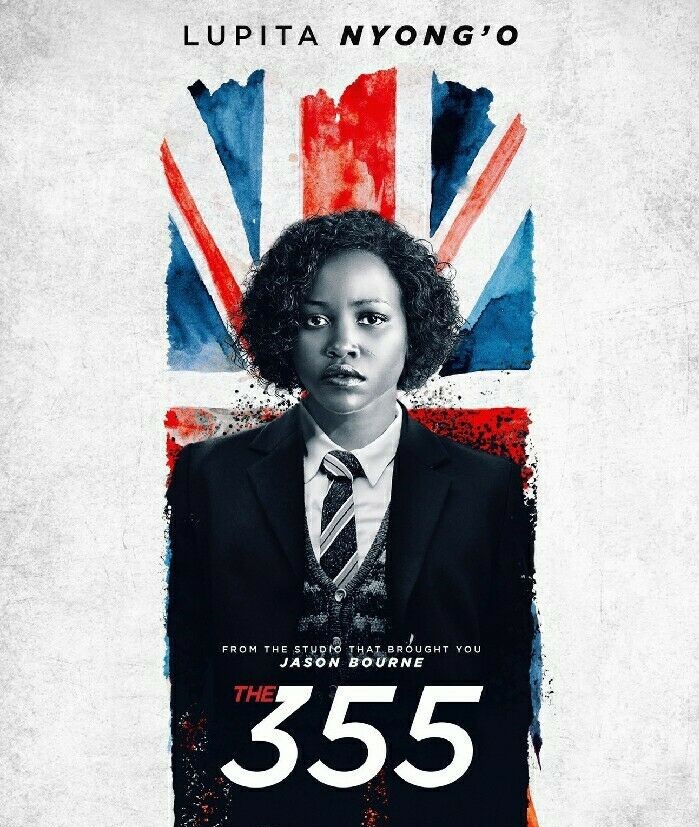
The 355 (2022) *** – Seen at the Cinema

Serviceable actioner but proof that if you don’t have a star big enough to front  a shoot-‘em-up then sticking in another three – or four – actresses of equal, middling, or up-and-coming, status won’t do the trick, not if the characters lack the originality of a Bourne or Bryan Mills (Taken, 2008). There’s plenty of bang for your buck, but the story hangs on the old trope of an electronic device that can blackout the world.

I am not sure why Jessica Chastain has never become a bigger box office star. She certainly has the kudos – two Oscar nominationss – and is not shy of taking on difficult subjects (Miss Sloane, 2016) and she’s certainly enjoyed the occasionally leg-up from a series (The Huntsman: Winter’s War, 2015; It Chapter Two, 2019) to boost her box office credentials. But her last venture into the action arena (Ava, 2020) was a box office flop, though possibly you could put the blame on the pandemic. By my count she has been the top-billed star (excluding her X-Men appearance) in her last eight pictures and none have been a hit.

Her presence in the credits would encourage me to stump up my money at the box office but apparently I am in the minority. I could say the same about Penelope Cruz (Parallel Mothers, 2021), the second biggest star here, and while she certainly retains top-billed status in her native Spain, otherwise she is occasionally a female lead but more likely a supporting player.

If I had been putting my money on anyone to take the action box office by storm it would be Diane Kruger who has the meanest stare this side of Lee Van Cleef. But she’s gone down this route to no commercial response before in The Operative (2019) and The Infiltrator (2016), neither fulfilling the promise she showed in Liam Neeson crackerjack Unknown (2011). Bingbing Fan, (Cell Phone 2, 2019) another X-Men alumni, has only recently achieved box office success, but in limited markets. Mexican Oscar-winner Lupita Nyong’o – here billed fourth and sporting a British accent – may well have the biggest fan base of the lot having clocked up appearances in three Star Wars pictures, taken top billing in Us (209) and third billing in Black Panther (2018).

But back to our story. On the run from the C.I.A. Mace (Jessica Chastain) teams up with Marie (Diane Kruger), a loner working for the German secret service, and Khadjiah (Lupito Nyong-o), a digital wizard formerly of the British secret service. Bing, who turns up later, represents the Chinese good guys. Graciela (Penelope Cruz) is the rank outsider, a therapist just caught up in the shenanigans. The action rattles through Paris en route to Marrakesh before a final stop in Shanghai. As you might expect, traitors lurk in various corners.

There are plenty shootouts and opportunities for the team to show off their hand-to-hand skills, but the action is slowed down by soap opera, having to spell out all the backstories of the principals, only one of whom, Marie, has anything worth listening to. Far be it for me to complain about too much emotion, but it took us over a dozen movies to learn anything significant about James Bond’s past, Bourne had no idea who he was, and at the other end of the scale Bryan Mills was so emotionally driven from the outset it formed the film’s core. Here, emotional quandary pops up when convenient. A bit of mystery would have helped more and cut a good 15 minutes off an overlong playing time.

As to the title, that is the only thing that is kept hidden to the end and when the revelation is made you realize it won’t mean a damn thing to the vast majority of the audience. As an origin story, I doubt the current box office receipts are sufficient to spawn future episodes. Which is a shame because having dumped all the emotional baggage in this picture, the characters could have focused more straightforwardly on action and story in the next.

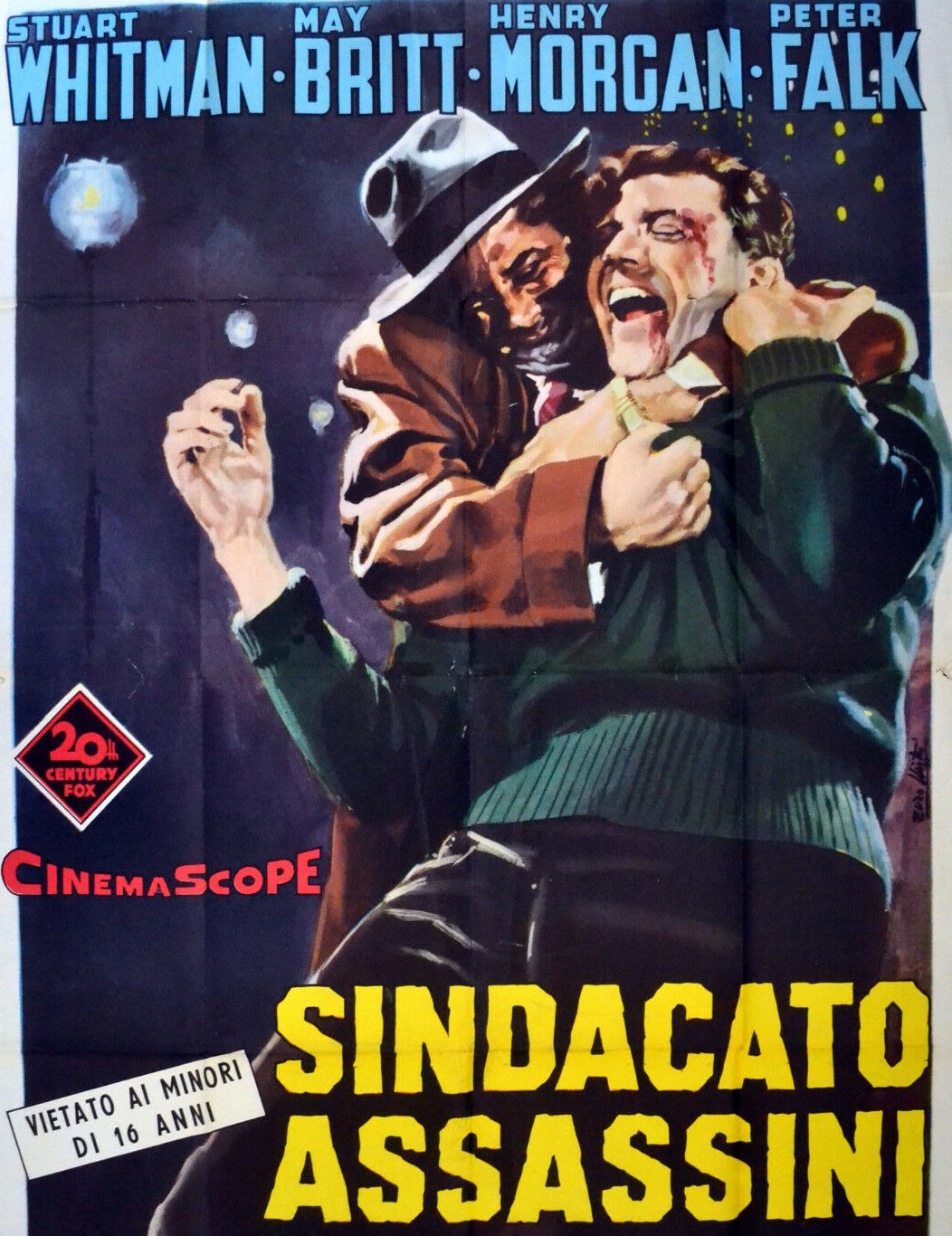
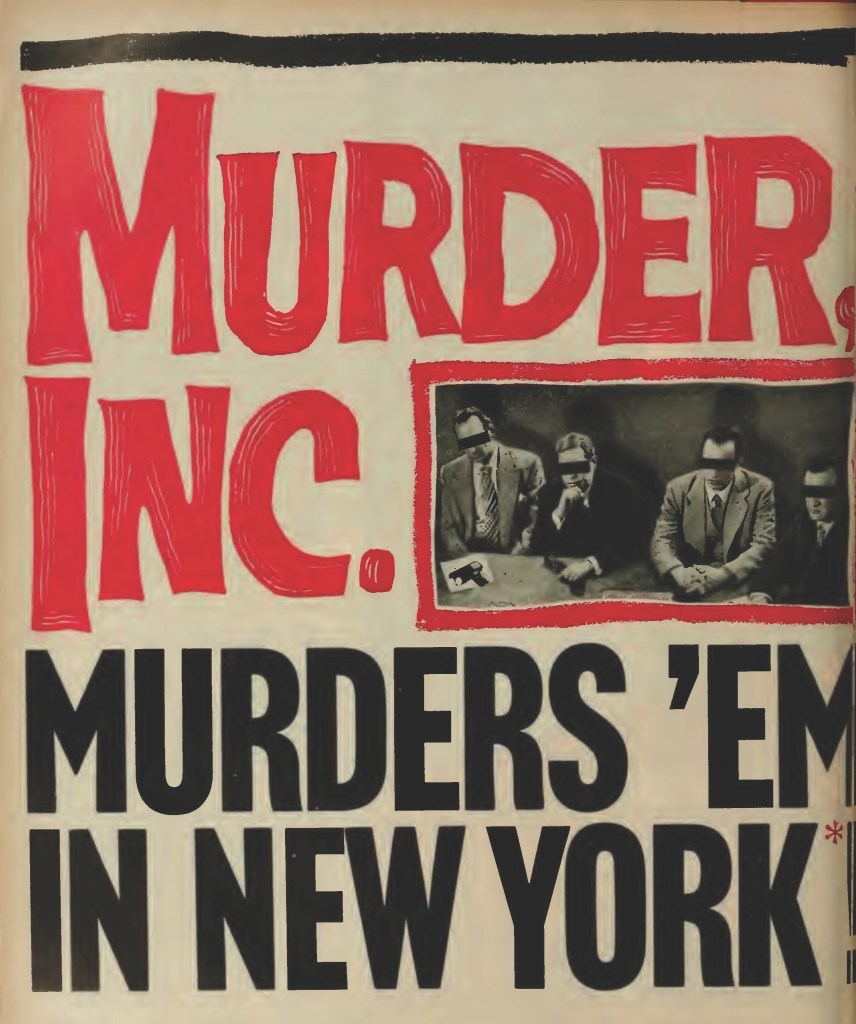
Murder, Inc. (1960) ***

A gangster trend hit the mean streets of Hollywood at the start of the 1960s. But in the absence of big box office hitters like James Cagney, Humphrey Bogart and Edward G. Robinson, these were all B films with unknowns or low-ranked stars in the leading roles. Whereas Little Caesar (1931), Public Enemy (1931), The Roaring Twenties (1939) and White Heat (1949) were fictionalized accounts of hoodlums, the gun-toting movie spree kicked off by Machine Gun Kelly (1958) and Al Capone (1959) was based on the real-life gangsters who had terrorized America’s big cities in the 1920s and 1930s.

By the end of 1960, moviegoers had been served up an informal history of the country’s best-known mobsters from Ma Barker’s Killer Band (1960) and Pretty Boy Floyd (1960) to The Rise and Fall of Legs Diamond (1960) and Murder Inc (1960). The infamy of the criminals was so comparatively recent that moviemakers assumed audiences had a wider knowledge of their exploits and the context of their crimes.

Murder Inc tells how underworld kingpin Lepke Buchalter – Tony Curtis played him in the more straightforward biopic Lepke (1975) – set up a system of killing dissenters in the ranks for the entire American Cosa Nostra (aka The Syndicate) in a way that prevented those ordering the murders being connected to those committing them, the same kind of protective cell operation used by terrorists. He created a separate organisation of hitmen.

This quasi-documentary, with occasional voice-over narrative, focuses on three characters – the quiet-spoken Lepke (David J. Stewart), hitman Abe Reles (Peter Falk) and singer Joey Collins (Stuart Whitman) who becomes involved to pay off a gambling debt. Later on, the focus switches to Brooklyn assistant district attorney Burton Turkus (Henry Morgan), against a backdrop of massive police corruption, investigating the murder epidemic this deadly enterprise has created. The films jumps around too much to be totally engrossing but it is certainly an interesting watch.

The two main villains could not be more different, Lepke representing the new school, a businessman, ordering killings but never participating, and for such a tough character tormented by a delicate stomach. Reles is old school, relishing opportunities to murder, and raping Collins’ honest wife Eadie (May Britt) in part because she treats him as scum. It’s hard to muster much sympathy for Joey especially as his wife takes the brunt of the violence.

In an Oscar-nominated performance Peter Falk (Castle Keep, 1969) steals the show as the chilling, venomous killer, the kind of nonentity who rises to prominence only through his penchant for homicide. Swedish star May Britt (The Blue Angel, 1959) isn’t far behind with a portrayal of a strong woman saddled with a weak husband. As the milk-drinking hood, David J. Stewart (The Young Savages, 1961) was as scary in his pitilessness as his more overtly violent underling.

Stuart Whitman (The Commancheros, 1961) is almost acting against type for he was later known for rugged roles. Henry Morgan (It Happened to Jane, 1959) gave his portrayal of Turkus similar characteristics to Lepke, appearing as a quiet individual, concerned with details,  except that he was incorruptible.

You might spot some interesting names in the cast. Simon Oakland (Bullitt, 1968) is an honest cop, Vincent Gardenia (Mad Dog Coll, 1961) is a lawyer, comedian Morey Amsterdam (The Dick Van Dyke Show, 1961-1964) plays a hotel manager, Sylvia Miles (Oscar-nominated for Midnight Cowboy, 1969) has a bit part and singer Sarah Vaughan is a singer.

For some reason, this movie starred a number of actors in leading roles who made few screen appearances. This was the only movie of the decade for May Britt, David J. Stewart made only three movies during the same period, and Henry Morgan only made three pictures in his entire career, this being the last.

The movie boasted two directors. Stuart Rosenberg (Cool Hand Luke, 1967) was replaced  by Burt Balaban (Mad Dog Coll, 1961) when the threat of strike action by actors and writers in 1960 forced the 18-day shoot to be cut by 10 days so it’s hard to say who was responsible for which scenes, although the film does boast some unusual aerial shots.

You can catch this on Amazon Prime.

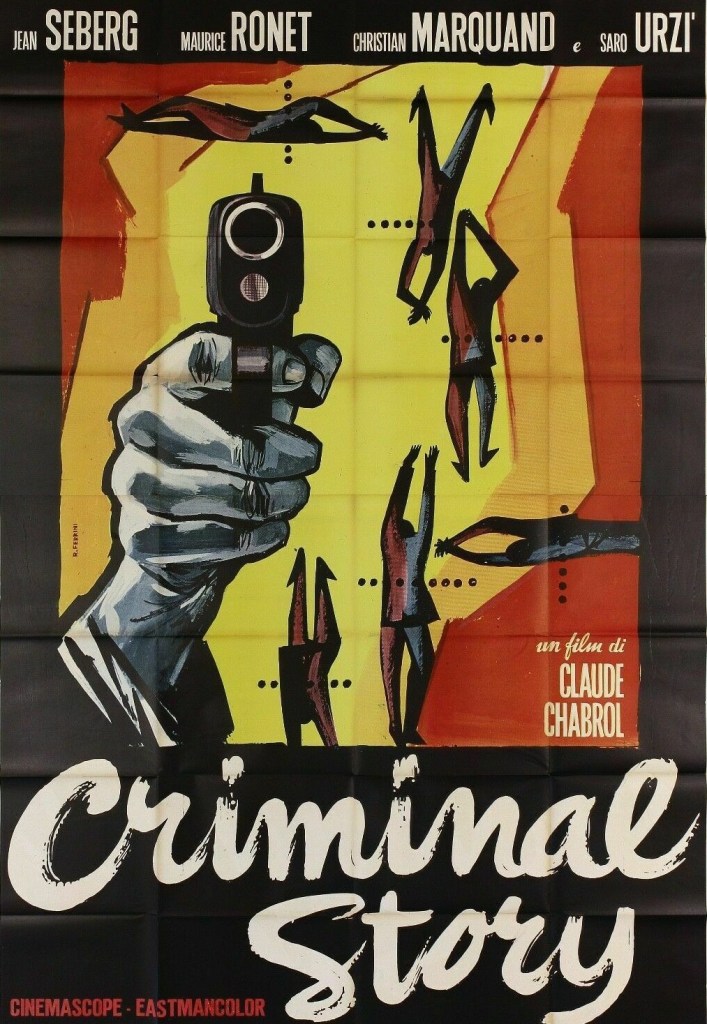
The Road to Corinth (1967) ***

Top-class cast and occasional stylish direction get in the way of a thriller that can’t make up its mind whether it is in reality just a spoof. On the one hand we have a killer in a white suit complete with straw boater and a secret service boss who sells Turkish Delight, on the other hand a story not so much from James Bond but from Bond imitators.

Agent Robert Ford (Christian Marquand) is on the trail of black boxes that prevent missiles launching. When wife Shanny (Jean Seberg) is framed for his murder she determines to uncover the real killer, aided by Dex (Maurice Ronet), and find the maker of the boxes.

But that’s an over-simplification of an over-complicated plot so it’s best to concentrate on the highlights. For example, when customs officials stop a magician they find white rabbits and doves in his vehicle and, despite severe interrogation, he can, magically, release himself from his bonds enough to swallow a concealed cyanide pill. Instead of the usual cute children that proliferate in these kind of films, there’s a really annoying one. Shanny, imprisoned, has to make dolls. Greek Orthodox priests play a significant role.

Throw in kinky secret service boss Sharps (Michel Bouquet) who relishes being slapped for his inappropriate overtures to Shanny, a porn film starring Madame Phiphi, the heroine dangled from a crane and later lashed down to a dumper, and a villain willing to give up his villainy for the love of a good woman.

But mostly it’s a picture in a rush. There are chases galore and nods to Hitchcock and lush Greek scenery.

It would be easy to assume that in eye-catching outfits Jean Seberg (Moment to Moment, 1966) is mostly there to provide eye candy but she does manage to outwit her pursuers from time to time although she seems equally to have a knack for being caught. Maurice Ronet (Lost Command, 1966), Christian Marquand (The Corrupt Ones, 1967) and especially Michel Bouquet (La Femme Infidele, 1969) bring an air of quality to the proceedings.  

Apart from the occasional stunning image, this is not the Claude Chabrol (Les Biches, 1968) that lovers of his thrillers would expect.

There’s a print of this on Youtube. Amazon Prime has this for certain regions. Otherwise it will be Ebay.

Ice Station Zebra (1969) ****

John Sturges’ Alistair Maclean Cold War thriller, released within months of the more action-oriented Where Eagles Dare, twists and turns as Americans in a nuclear submarine and the Soviet Union race to the Arctic to retrieve a fallen space capsule containing a deadly secret. Thoroughly enjoyable hokum filmed in Cinerama 70mm with an earworm of a booming theme from Michel Legrand and mostly outstanding special effects.

Nuke sub Commander Ferraday (Rock Hudson), despatched from Scotland, and believing he is only on a last-gasp mission to the save scientists at a stricken weather station, is somewhat surprised to be forced to carry as passengers arrogant British secret service agent David Jones (Patrick McGoohan) and Russian defector Boris Vaslov (Ernest Borgnine), the former refusing to divulge the reasons for being on board. From the outset the vessel is afflicted by sabotage and the cruel ice. Tensions mount further as they reach the Ice Station Zebra weather station. Since so much depends on mystery in a MacLean thriller, any other revelations would amount to significant plot spoilers.

So while there’s more than enough going on among the various characters and a plot that shifts like a teutonic plate, it’s the submarine section that proves the most riveting, the dives exhilarating. The underwater photography is superb in part thanks to an invention by second unit cameraman John M. Stephens which could film for the first time a continuous dive. Whether the sub is submerging, surfacing, puncturing the ice or in danger of being crushed to smithereens, it’s the nuke that takes centre stage, a significant achievement in the days before CGI.

Not all the effects are quite so top-notch, there’s some dodgy back projection, and the Arctic rocks look fake, but in general, especially with streamlined control panels, jargon spat out at pace, and sub interiors that appear realistic, the result of two years research, it’s a more than solid job, delivering the core of a Saturday night action picture.

The absence of a giant Cinerama screen does not detract from the movie – though if you get the chance to see it in 70mm, as I once did, jump at it – because the Super Panavision cameras capture in enormous detail the bow spray, the massive icebergs, the gleaming intricacy of the controls, and even the sea parting under the weight of the sub creates astonishing visuals. And there’s something inherently dramatic in the commander slapping down the periscope.

Rock Hudson (Tobruk, 1967) is back to straightforward leading man duty after his departure into paranoia in Seconds (1966) and he is burdened with both a chunk of exposition and having to develop a stiff upper lip in response to the secret agent’s reluctance to take him into his confidence. He comes more into his own in the action sequences. The tight-lipped brusque provocative McGoohan (Dr Syn, 1963) clearly has a ball as mischief-maker-in-chief, keeping everyone else on tenterhooks. Ernest Borgnine (The Wild Bunch, 1969) invests his character with wide-eyed charm at the same time as the audience doubts his credentials. Jim Brown (The Split, 1968) has little more than an extended cameo as the Marines’ chief and in smaller roles you can also spot future Oscar-winning producer Tony Bill (Castle Keep, 1969) and veteran Lloyd  Nolan (The Double Man, 1967).

This was the second MacLean adaptation for John Sturges (The Satan Bug, 1965) and he keeps a tighter grip on proceedings, a $10 million budget ensuring he could make the movie he envisaged, part-thriller, part-high adventure with well-orchestrated slugs of action.

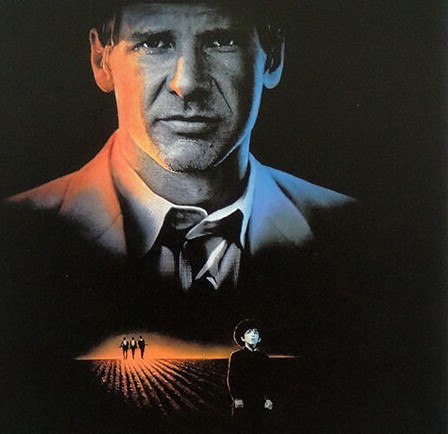
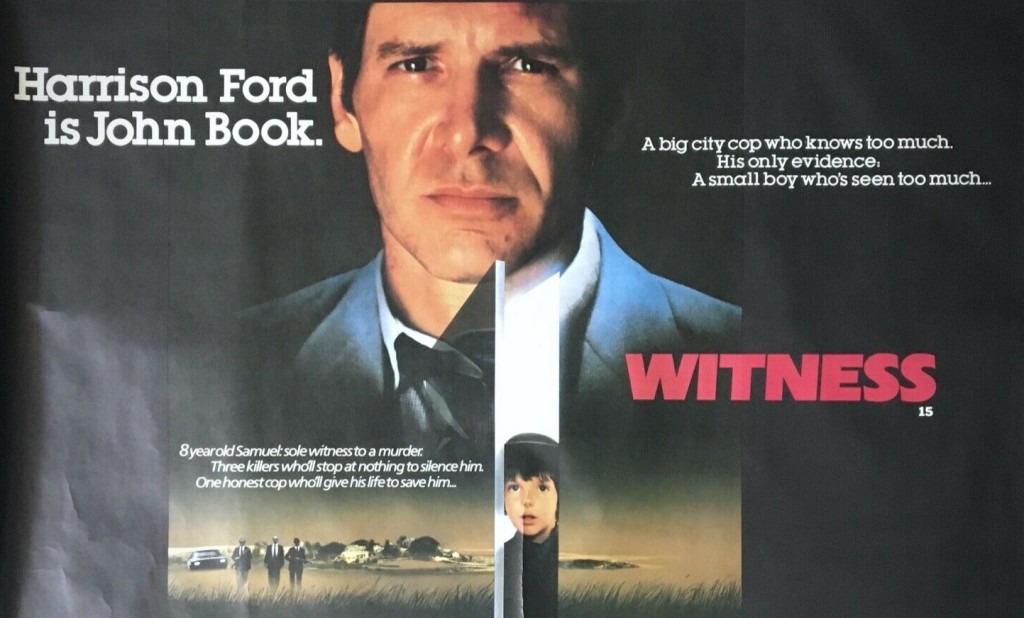
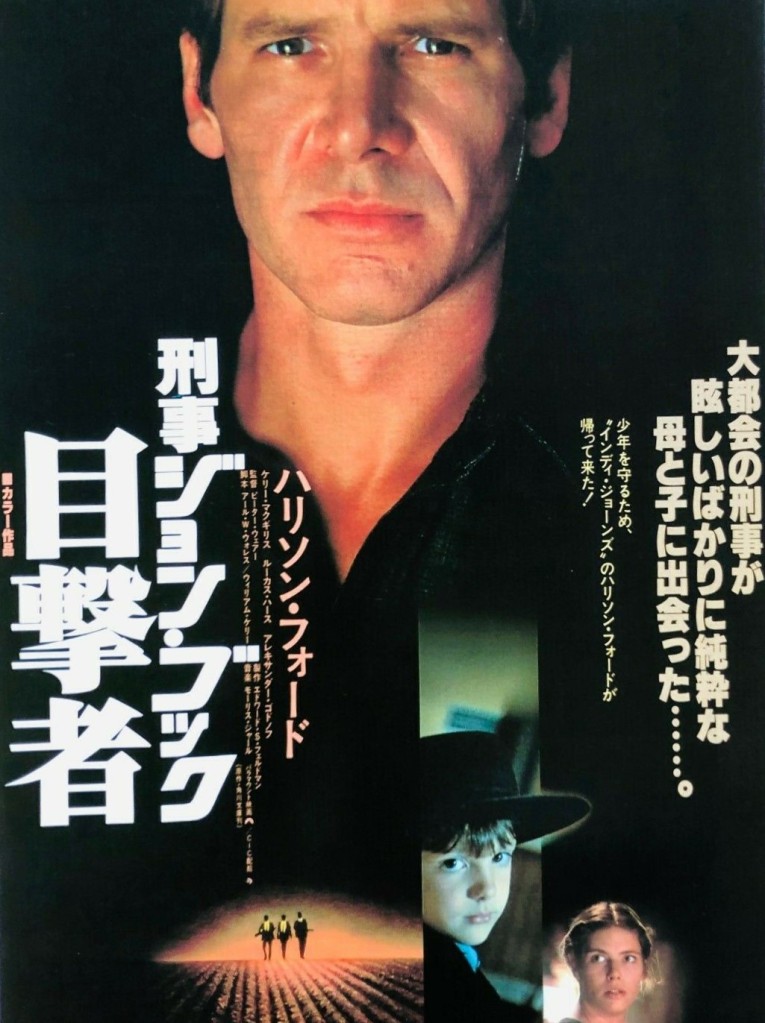
Witness (1985) *****

The Casablanca of the crime thriller, a stone cold classic in which impossible love takes precedence over unusual situation. In the Bogart-Bergman picture it is expatriates in war-torn North Africa, here a cop protecting an innocent boy hides out among the Amish. Like The Rock, this is so good the director makes the audience wait for a first sighting of the star while exploring the other main characters and the unique backdrop, in this case the customs and dress code of a religious cult that shuns the modern.

Adding to the paranoia rampant in American cinema in the 1970s/1980s is a further element – the hunted man or, in this case, boy. There’s no mystery in this thriller, 20 minutes in we know the culprit, involved in a criminal conspiracy so powerful it cannot be fought. And unlike the bulk of cop movies it’s not set in a city but in the country.

Just-widowed Rachel Lapp (Kelly McGillis) and eight-year-old son Jacob (Lukas Haas) set out by train to Philadelphia where the boy witnesses a brutal murder. Questioned by  Detective John Book (Harrison Ford), we discover by accident the killer is cop Lt McFee (Danny Glover). Reaching out to trusted mentor Police Chief Paul Schaeffer (Josef Sommer) only to discover he is implicated, Book flees back to Amish country, where a gunshot wound prolongs his stay.  

Distrusted as an uncouth “English,” liable to violence the Amish abhor, Book, with a range of carpentry skills, soon finds himself at home. Drawn to Rachel, passions simmer, but in this collision of cultures she cannot leave and he cannot stay. Without the cop background this would be a beautifully rendered love story, but the daily danger of the hidden being located  heightens already tense emotions.

The examination of the Amish lifestyle is faultless. Transport is horse and cart, though sometimes that is with almost balletic assurance, there is no electricity, the community works together but threatens exclusion for disobeying strict rules. In compliance, Book dons the typical Amish outfit of plain black jacket and straw hat, buttons forbidden. And it is only when he breaks out of such strictures that his charges are threatened.

While the violence is powerful and when the time comes Book has a ruse or two up his sleeve, the most memorable scenes are as far removed from the crime thriller genre as  possible. First is when Rachel enjoys a tentative forbidden dance with Book. Then there is the love scene where he watches her wash her naked torso, desire written over each face. Finally is building the barn where in quiet but obvious ways Rachel reveals her growing feelings for Book while with hammer and saw he helps put together the structure to the soaring strains of Maurice Jarre’s most magnificent composition.

Director Peter Weir (Dead Poets Society, 1989) excels in observation, a scene between Rachel and wooing farmer (Alexander Gudonov) takes place in silence, women whispering declaim attitudes to Rachel, her father Eli (Jan Rubes) waking Book before dawn, and several scenes of meals. Since restraint is the watchword, Weir draws exceptional performances from both principles, Harrison Ford (Blade Runner, 1982) receiving his only Oscar nomination, McGillis (Top Gun, 1986) nominated for a Bafta, likewise her only recognition at this rarified strata. Josef Sommer (Silkwood, 1983) is good as the ruthless but tormented corrupt cop, and both ballet dancer Alexander Gudonov and Viggo Mortensen (Green Book, 2018) make Hollywood debuts. Lukas Haas is as wide-eyed as they come.

Although nominated for eight Oscars, including Best Picture, Director and Music, it only picked up two, for editing and for an outstanding screenplay by William Kelley and Earl W. Wallace, both known almost exclusively as television writers.

An authentic, heartbreaking, multi-layered, adult picture like this is very hard to come by.

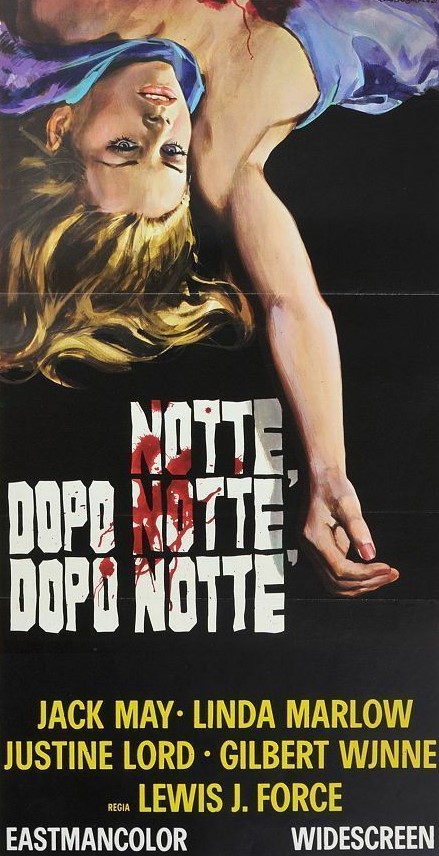
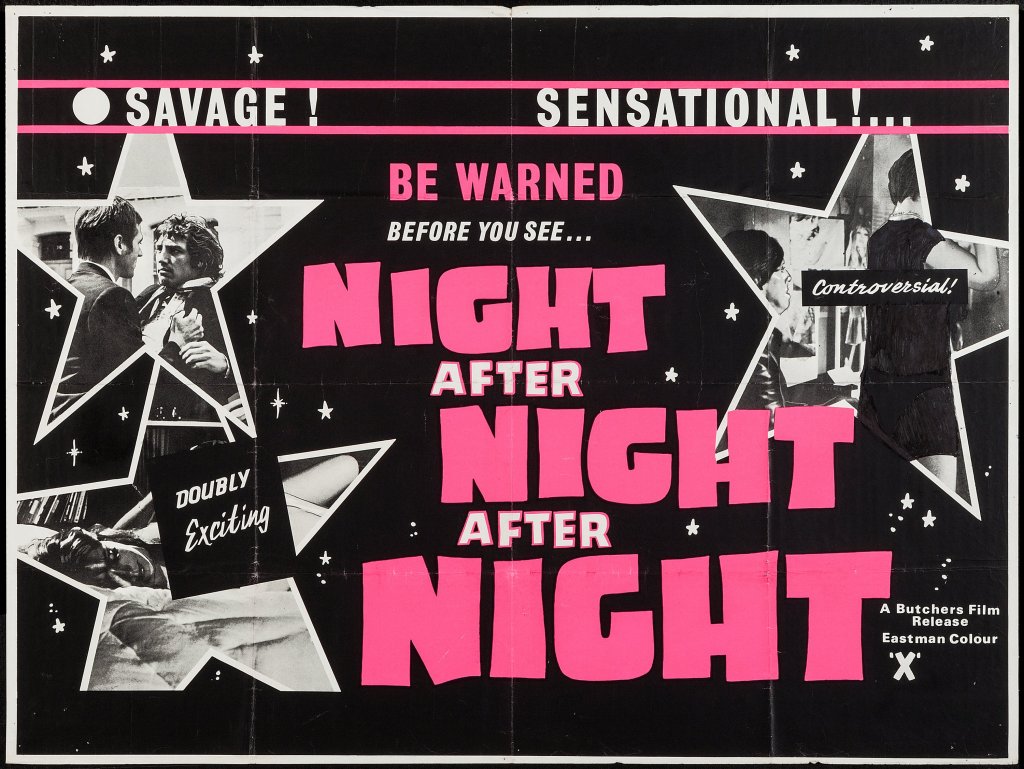
Night, After Night, After Night (1969) ***

British giallo sets tough London cop Bill Rowan (Gilbert Wynne) hunting a Jack-the-Ripper type serial killer who has slaughtered his wife (Linda Marlowe). Chief suspect is leering cocky jack-the-lad Pete (Donald Sumpter) of the wham-bam-thank-you-ma’am school of seduction. In an era when pornography and “perversion” were beginning to shake off the shackles of comformity and strippers, prostitutes, voyeurs and transvestites condemned as evils to be stamped out, this skirts the boundaries between sexploitation and heavy moralising.

Chief among those embarking on a moral crusade is hypocritical puritan Judge Lomax (Jack May) who spurns his attractive wife (Justine Lord) while indulging in cross-dressing. Needless to say, his clerk, ostensibly another upholder of the moral fabric, is a porn addict. As the body count grows, Pete manages to needle Rowan sufficiently for the cop to consider any nefarious means to put him behind bars.

Knives flash in the dark, the killer wears black leather, victims writhe on the ground as they are slashed to pieces, and coupled with the unusually high nudity quotient it is surprising that this picture passed the British censor. The movie never drags and there is enough incidental sleaze to keep the viewer interested. As a historical document, it details the point at which the country hovered between reined-in respectability and full-on sexual freedom.

Operating here under the pseudonym Lewis J. Force, Canadian director Lindsay Shonteff (The Million Eyes of Sumuru, 1967) conjures up a darker vision of a London so often presented in glorious tourist tones with nastiness seeping into every corner of society. Veteran Jack Lord (A Twist of Sand, 1968) captures well the double life of a decent man undone by what is perceived to be indecency and his later scenes are quite moving. Donald Sumpter (The Black Panther, 1977) is excellent as the taunting petty criminal while Gilbert Wynne makes a decent debut as a leading man. In small roles are Justine Lord (Deadlier than the Male, 1967) and Linda Marlowe (Big Zapper,1973 – directed by Shonteff).

Jack the Ripper was such an ingrained element of British culture that any movie featuring a similar villain gave audiences the creeps. British television cops were beginning to move out of the shadow of Dixon of Dock Green and into the new age of The Sweeney and while giallo did not catch on  among home-grown filmmakers there was considerably more focus on hardened criminals such as Get Carter (1971) and Villain (1971).

While the British B-film was moving increasingly towards sex comedy, this fits more succinctly into the Pete Walker sex’n’violence pictures of the 1970s which have attracted retrospective critical interest and for all its flaws, which can mostly be attributed to a low-budget, this is surprisingly impressive in places.

King of the Roaring 20s (1961) ***

Occasionally stylish B-picture purporting to tell the story of American Prohibition-era gangster Arnold Rothstein. It’s more of drama with various nefarious figures trying to outwit each other rather than a shoot ‘em up in the style of Al Capone (1959). David Janssen (Hell to Eternity, 1960) is ideal casting as the thoughtful, cold, calculating and possibly gambling genius Rothstein, the opposite of an intemperate crook like Capone.

The story is told essentially in two parts, Rothstein’s rise to power in partnership with childhood pal Johnny Burke (Mickey Rooney), initially running dice games in the street and  pulling the odd con before graduating to fly-by-night horse racing operations. When the opportunity arises to move into mainstream illegal gambling, he dumps Burke. Corrupt cop Phil Butler (Dan O’Herlihy) is a constant thorn in his side and showgirl fiancée Carolyn Green (Dianne Foster) views marriage as risky – “he’s the gambler but I’m the one that’s going to be doing the gambling.”

For whatever reason, the movie dodges what was believed to be Rothstein’s biggest coup, the fixing of the baseball World Series, but one long section is devoted to how he wins $850,000 (equivalent to $13 million today) on his horse Sidereal at odds of 30 to 1 at the New York Aqueduct track on July 4, 1921, through insider information and strategic betting. Inevitably, his gambling puts the kibosh on his marriage but by far the most interesting part of the picture is the chicanery as he shakes off one partner, battles another, and without compunction sets up Burke as patsy to settle his score with Butler.

In some respects Rothstein is a template for Vito Corleone (The Godfather, 1972) in terms of his business brain and ability to out-think and out-fox opponents and certainly his facial expressions and innate coldness bear comparison with what Al Pacino brought to his characterization of Michael Corleone. Except that he didn’t trust banks, and carried around wads of cash (hence the title of the biography on which this is based – The Big Bankroll), it’s hard to get a sense of the wealth the gangster generated or, given the minimal violence,  the world of imminent peril he inhabited. 

Period detail is cursory, limited to dancing the Charleston and pouring champagne into teacups. A better idea of the flavor of the times is the wholesale corruption endemic in police departments, untrustworthy lawyers and hypocrisy run wild.  It’s not really Janssen’s fault that it’s hard to warm to such a cold-blooded character, although you could point to The Godfather and The Brotherhood (1968) for that matter as examples of hoods who do elicit audience empathy.

With occasional bravura moments involving long tracking shots and overhead shots, and a terrific image of champagne bubbles seen through a pair of binoculars, director Joseph M. Newman (This Island Earth, 1955) shows stylistic flourishes that eschew his B-movie roots. Given Janssen is called upon to show as little emotion as possible, he does very well. Dianne Foster (The Last Hurrah, 1958), though initially demure, provides the fireworks. Jack Carson (The Bramble Bush, 1960) as kingpin Tim O’Brien matches Janssen in the cool stakes and proves a worthy adversary. Oscar nominee Rooney overacts but another Oscar nominee Dan O’Herlihy (The Night Fighters, 1960) relishes his dirty cop role.

In a rare Hollywood outing British sexpot Diana Dors (Hammerhead, 1968) puts in an unexpected and brief appearance as Carolyn’s cynical flatmate. The tremendous supporting cast includes Keenan Wynn (Point Blank, 1967), Mickey Shaughnessey (North to Alaska, 1960), Regis Toomey (The Last Sunset, 1961), Oscar-winner Joseph Schildkraut (The Diary of Anne Frank, 1959) and veteran character actor William Demerest.

Jo Swerling (It’s a Wonderful Life, 1946) delivers a pointed screenplay focusing on gangster conflict with some excellent observation of the deterioration of the Rothstein marriage and the nervousness of the usually ice-cold Rothstein when confronted by his father. This is one of those pictures that you think deserves a Netflix series, a dozen or so episodes to explore the myriad characters involved and especially to examine Rothstein in forensic detail. The movie gives a hint of that potential and on a tight budget does it well.

Hard to find unless you fancy paying $90 for a DVD or $24 for a VHS video, but you will find copies on the secondhand market.

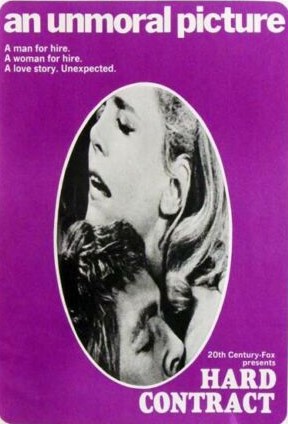
Hard Contract (1969) ***

A hitman movie that verges on the existential is always going to be intriguing. Stone cold killer John Cunningham (James Coburn) manages to keep the world at a distance until he runs into the vibrant Sheila (Lee Remick) in Spain. The film is a curiosity of an admittedly small genre dominated by such disparate offerings as The Killers (1946 and 1964), Yojimbo (1961), Le Samourai (1967) and Stiletto (1969). Here, although Cunningham does bump people off, you never see the violence. We’ve come to expect hitmen to be introspective, but there’s never been anyone as closed-off as Cunningham. No romance in his life, only hookers, no apparent depth, in fact we learn very little about him.

He only runs into Sheila because for a laugh she pretends to be a sex worker. In reality she’s a wealthy divorced socialite running with a fast set that include Adrianne (Lili Palmer) and ex-Nazi Alexi (Patrick Magee) whom she loves to taunt but whose contacts allow Cunningham to be effectively stalked. And as unsavory that might be from today’s perspective, it sheds light both on her power and whimsicality.

There’s an unusual background. Amid the extensive jet-setting in Torremolinos, Madrid and Tangiers, there are reality counterpoints, reflecting the issues of the decade – violent demonstrations with police using water cannon to control the crowds, the American elections and discussions about God, world hunger, the Holocaust, terrorism and population growth.

No doubt the script is wordy, but there’s hardly a word that doesn’t challenge convention. It’s steeped in amorality – a touchstone of the decade – good only occurs “when evil takes a rest” and the world is “immune to murder.” And you certainly get the impression that the rich can confront anything because, not having to live in the ordinary world, they can get away with it. Conversely, this is also one of those films where you wonder who did the wardrobe (Gladys de Segonzac, since you ask, who ran fashion house Schiaparelli in the 1950s) because not only does Sheila sport clothes that would have delighted Audrey Hepburn but Cunningham gets away with wearing a white jacket.

And if Korean vet Cunningham is enigmatic, the insomniac Sheila is cut from a similar cloth, and while a potential source for redemption is as likely to have sex with a casual pickup in a filthy alley. The story does not go quite the way you would expect – Cunningham’s growing dissatisfaction with his profession revealed when he can’t perform in a Brussels brothel. And his mindset allows him to consider mass murder as a solution to an emotional problem he cannot solve.

At core, of course, is whether once Cunningham’s emotional defenses are breached he can continue as a hitman, and  whether Sheila can accept his profession. The stakes rise when it transpires that (like Stiletto made the same year) retirement is not an option.

And for all the seriousness on show, there are some imaginative moments of hilarity – Cunningham’s idea of a love song is “To the Shores of Tripoli” and Adrianne proves determinedly indiscreet. In keeping with the paranoia cycle that was about to explode, you never find out why people are being murdered, or even who they are, far less the group which his boss Ramsay (Burgess Meredith) is fronting.

Far removed from the Derek Flint persona that had turned him into a star, James Coburn delved deeper into the amoral territory he had previously explored in Waterhole 3 (1967). Lee Remick (The Detective, 1968) is sheer madcap delight even when espousing her odd takes on philosophy. Lili Palmer (The Counterfeit Traitor, 1962), who by this point in her career was usually the wife or girlfriend, creates a very original character. Veteran Sterling Hayden had only made one film (Dr Strangelove, 1962) in a decade and is excellent as a contemplative retired hitman. Patrick Magee (The Skull) gives another of his tight-lipped performances. Karen Black (Easy Rider, 1969) has a small role as does Sabine Sun (The Sicilian Clan, 1969).

This marked both the debut and the demise of the directorial career of S. Lee Pogostin, best known at this point as the screenwriter of Pressure Point (1962) and Synanon (1965). In terms of argument over issues it stands comparison with Pressure Point but without that film’s intensity.

I remember being baffled by the picture when it came out and I was a teenager because the action I believed I had been promised never materialized but otherwise I could remember little about it so now it appears as an interesting antidote to the mindless action pictures.  

This is another freebie available on YouTube.

https://www.youtube.com/results?search_query=hard+contract+1969

Vendetta for The Saint (1969) ***

This big-screen version of small-screen hero is as pleasant a diversion as you can get. Nostalgia pretty much gives it a free pass and in any case the action, which punctuates the drama at regular intervals, was always going to be budget-restricted. Despite being in almost constant danger the insouciance of gentleman thief Simon Templar dictates that the pace is no more than languid.

As the title suggests, we’re in Mafia country, Templar (Roger Moore) drawn into a Cosa Nostra succession scenario as the result of a casual encounter with former bank clerk Houston (Fulton Mackay) later found dead. Houston has cast doubts on the real identity of  Mafia Don Destiamo (Ian Hendry) one of several contenders to become the next Mafia overlord. Templar sneaks into Destiamo’s world by pursuing his niece Gina (Rosemary Dexter). Although outwardly respectable, Destiamo a bit too fond of using his cigar as a weapon of disfigurement, threatening his blonde English moll Lily (Aimi McDonald) in this fashion.

Part of Templar’s attraction is that although he has a nefarious side he is happy to walk those mean streets and has a strict moral code. And he moves in such elevated circles that he has a nodding acquaintance with dying Mafia chieftain Don Pasquale (Finlay Currie) who has yet to pick his successor.

The other part of his attraction is that he’s played with such suaveness by Roger Moore. For a good chunk of the time someone is trying to knife him, shoot him, blow him up, capture him, jab him with a truth serum, and generally trying to stop him. In fending off such attacks, or out-smarting the villains, there’s rarely a hair out of place. It’s not so much devil-may-care as devil-is-wasting-his-time with such an imperturbable fellow.

Although the action is pretty straightforward, Templar is not above a clever ruse – jamming a bus in a gateway preventing his pursuers continuing the chase – nor an old one such as tying sheets together to climb out of a window. While Malta stands in for Italy, the locations still look authentic enough, ancient stone buildings, the occasional horse pulling a cart. When the action/drama eases up, there’s always pleasant scenery.

Following MGM’s success in stitching together into a movie two episodes of The Man From U.N.C/L.E. television series (an idea of course the studio had pinched from Walt Disney’s cinematic re-presentation of Davy Crockett episodes) it was no surprise that ATV, then under the control of future movie mogul Sir Lew Grade (Raise the Titanic, 1980), decided to adopt the same idea. Although The Saint had been showing on British television since 1962, by the end of its run in 1969 it had stepped up to bigger budgets, 35mm and color. Given each episode lasted around 50 minutes, it was relatively simple to devise a two-part program shown over consecutive weeks on ITV in Britain and then release it throughout the rest of the world as a feature film. The first such project was The Fiction Makers (1968) followed by Vendetta for the Saint.

Roger Moore’s movie career had been in limbo since Romulus and the Sabines (1961) and there’s no doubt that his performance as Simon Templar and later in another glossier British television series The Persuaders (1971-1972) made him a candidate for James Bond. While his interpretation of Templar, especially the wry delivery, does bear some similarities to his incarnation as 007, that only holds true as long as you set aside the year’s supply of Brylcreem dumped on his hair, the shoulder-padded shoulders and the fact that he had not yet perfected his trademark move, the raising of the single eyebrow.

While no match for the quips prevalent in James Bond, Canadian screenwriter Harry W. Junkin – best known for his television work, his only other movies being a similar melding of television episodes of The Persuaders – and John Kruse (Hell Drivers, 1957) – had some neat one-liners. Despite the obvious limitations, director Jim O’Connelly (Berserk, 1967) does a decent enough job.

But Moore carries the show. Ian Hendry (The Hill, 1965) makes a passable villain but not a passable Italian. In general, not surprisingly since most characters were played by British actors, the accents are all over the place though Moore, courtesy of squiring Luisa Mattioli (later his wife) managed to deliver his Italian lines in an acceptable accent. Otherwise the only one who comes close is Rosemary Dexter (The Shoes of the Fisherman, 1968) and that’s because she was Italian. Worth checking out in the supporting cast are Finlay Currie (Ben Hur, 1959) and Fulton Mackay (BBC series Porridge, 1974-1977).

You can find a lot wrong with this without looking very hard but if you switch off your over-critical faculties you will be pleasantly surprised.

Discover WordPress

A daily selection of the best content published on WordPress, collected for you by humans who love to read.

The Atavist Magazine

by Brian Hannan

WordPress.com News

The latest news on WordPress.com and the WordPress community.