The Mad Room (1969) ***

Tight little thriller lifted by excellent performances from Stella Stevens and Shelley Winters focusing on murders a dozen years apart. Mandy (Barbara Sammeth) and older brother George (Michael Burns), incarcerated in a mental institution after the murder of their parents, the twist being nobody can discover which child was responsible, are released into the custody of big sister Ellen (Stella Stevens), secretary to wealthy widow Mrs Armstrong (Shelley Winters) and betrothed to her son Sam (Skip Ward).

While concealing the children’s past, Ellen persuades Mrs Armstrong to offer them lodgings, that arrangement coming unstuck when the kids demand a room where they can go “to work things out.”  Armstrong is a bit barmy, engaged on building beside her home a museum to her husband, hence contractors and construction workers on site, and a horde of “ladies who lunch” involved in fundraising. She has also appropriated masseur Armand (Lou Kane), husband of alcoholic Mrs Racine (Beverly Garland), to fulfil her sexual needs.

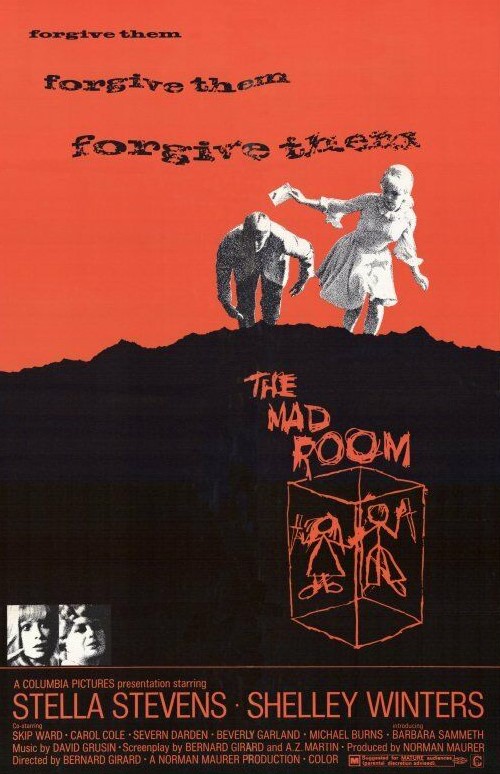
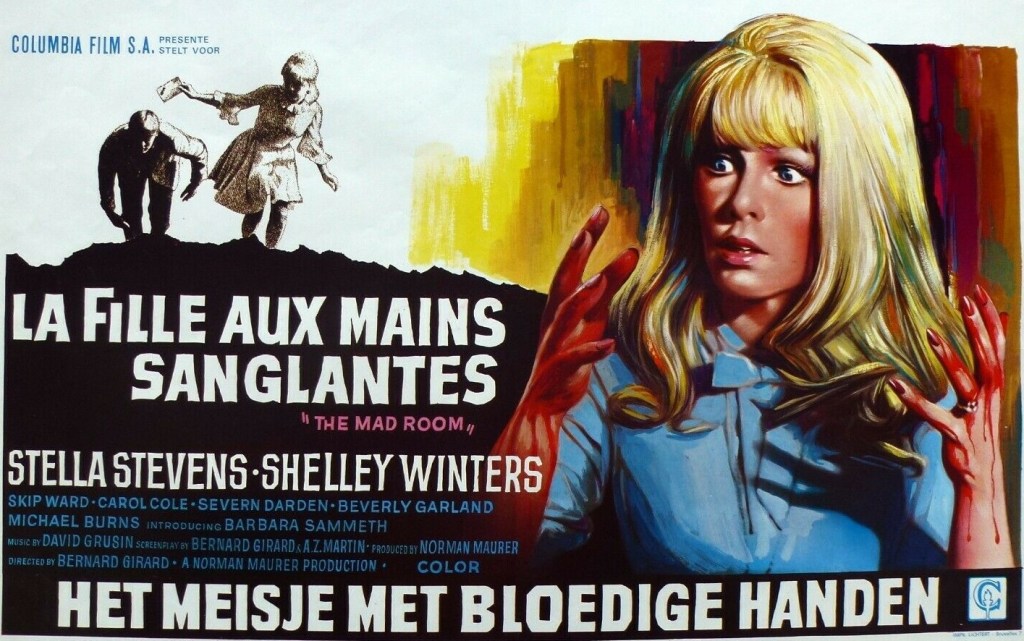
Don’t worry – the poster doesn’t give the game away.
The blood comes from Stella Stevens discovering the corpse.

When Mrs Armstrong threatens to chuck the kids out, she comes to a sticky end, and the question is raised again of whether Mandy or George are responsible. Mandy is the more highly-strung, stubborn and likely to challenge authority. George appears predatory, stalking the maid. Both are convinced the other is guilty.

Meanwhile, Ellen undertakes to remove the body and pretend Armstrong met her death by accident at a beauty spot, no mean feat given the palaver caused by the builders outside and the constant need for construction decisions and the unexpected arrival of a posse of ladies including the alcoholic Mrs Racine intent on raising merry hell.

It’s part whodunit, part nutcases-on-the-loose, part film noir, part slasher picture,  and part grand guignol. Hands are severed and blood is used to daub flowers on the walls. It’s tense enough even before Armstrong’s demise. She’s not only a loony, but untrustworthy, selfish, capricious and demanding, and it’s as much as Ellen can stand to constantly iron out all the loose ends in her employer’s life. But she sounds believable, an earnest do-gooder even while conspiring against what she sees as Ellen’s gold-digging.

Ellen, life thrown into turmoil after the death of her overbearing impoverished parents and only now building a new identity removed from the shadow of the children, faces the prospect of losing her ideal future. While it would have suited her for the children never to be released, she exhibits surprisingly a strong emotional attachment to her siblings, willing to both shelter and protect them, and conceal again their crimes.

Initial tension revolves around a chase, savage dogs, a shifty maid and Ellen dealing with the manipulative Mrs Armstrong, holding her own long enough until she is safely married, while further pressure builds with the necessity to cover up the murder, explain Mrs Armstrong’s absence, cope with the sudden influx of people and ascertain who has the murderous tendencies. There are some excellent scenes and twisty payoffs, and quite a bit of misdirection – the chase, rabid dogs, a childish song – and some inspired drama such as Mrs Racine letting rip, and Mrs Armstrong’s growing puzzlement.

Stella Stevens (Sol Madrid, 1968), normally eye candy or in a supporting role, is a revelation as Ellen, creating a grounded personality, with several changes of emotion and except for being a little pop-eyed on occasion carries off the part tremendously well and not falling prey to the temptation of grandstanding. Shelley Winters (A House Is Not a Home, 1964), who knows all about playing larger-than-life characters, tones it down here, even the obvious nuttiness reined in.

Michael Burns (That Cold Day in the Park, 1969) is the better of the two younger actors, while Barbara Sammeth’s (Foul Play, 1978) stiffness could be put down to inexperience – this was her debut. Otherwise former horror queen Beverly Garland (Stark Fear, 1962), one-time horr

Sumuru, Queen of Femina / The Girl from Rio / Mothers of America (1969) ***

Cult fans assemble. Sci fi crime thriller with for the time a fair sprinkling of nudity, and channelling psychedelic turns like Barbarella (1968) and Danger: Diabolik (1968) and one step up from the ultra-confident gals of Deadlier than the Male (1967) and Some Girls Do  (1969). It would have helped if there was a decent plot, and not just a barrage of double-crossing halfway in, but you can’t have everything and director Jess Franco seems to believe that the presence of a tribe of women decked out in red capes, white knee-length boots and not necessarily much in between, goes some way to compensate.

Crook Jeff Sutton (Richard Stapley) holes up in Rio with $10 million in stolen cash, unaware that his presence has already been noted by gang boss Masius (George Sanders) and local ultra-feminist Sununda (Shirley Eaton). After hooking up with manicurist Lesley (Maria Rohm), Sutton is set upon by Masius’ henchmen but escapes in a plane to Femina, “the capital city of the world of women,” a female fortress along the lines of the Bulldog Drummond pictures.

Turns out Sununda is partial to men with piles of cash, kidnapping and torturing them until they hand it over. So she can’t believe her luck when millionaire Jeff walks into her lair. Except Jeff is a bit of a fibber, having made up the story about the ten million, and instead landing at Femina in order to rescue Ulla (Marta Reves).

The plot only really kicks in when he escapes. Masius agrees to help Jeff in return for the pretend-thief helping him hijack Sununda’s vault of gold. In reality, Masius is using Jeff as bait, to tempt Sununda down from the clouds, and then turn him over in exchange for just half her gold. And so it’s back to Femina for all concerned.

There’s no real pretence at the kind of sci-fi that enthralled Barbarella audiences and none of the slick campness of Danger:Diabolik, and most of the ideas seem still-born and occasionally contradictory – in order to enslave men women must first be taught how to be irresistible to them – torture is accomplished either by whispering or kissing, and the ray-guns employed looked like cast-offs from the 1950s, but the regiment of women, with spies infiltrating everywhere, led by the ruthless Sununda, have the makings of a warrior nation.

The movie has far better luck with Masius, a splendidly-drawn character who doodles on restaurant tablecloths, enjoys reading Popeye comic books, and – a bit of drawback for a man in his profession – can’t stand the sight of blood. While his sidekicks are mostly incompetent, they do drive around in hearses that resemble pagodas or dress in unnecessary masks and while his girlfriends appear docile they are in fact spies. And there’s a spot of waterboarding in case you ever wondered where the American secret services got the idea.

The source material was from Sax Rohmer but Sununda lacks the inherent obvious evil of the author’s more successful Fu Manchu series, Shirley Eaton no match for Christopher Lee, the most recent Fu Manchu, nor Richard Shapley on a par with Fu Manchu nemesis Nayland Smith, regardless of whether played by Nigel Green (The Face of Fu Manchu, 1965),  Douglas Wilmer (The Brides of Fu Manchu, 1966) or Richard Greene (The Blood of Fu Manchu, 1968, and The Castle of Fu Manchu, 1969).

And anyone attracted to the picture by director Jess (Jesus) Franco is going to be disappointed by the lack of sleaziness he exhibited in pictures like Succubus (1968), 99 Women (1969) and  Marquis De Sade’s Justine (1969) and there’s not enough style, though abundant campness, to make up.  It’s hard to say quite why it did not have a harder edge, perhaps producer Harry Alan Towers, responsible for 99 Women, felt it should err in the softer direction of Fu Manchu than the overt sex-and-violence of the nascent women-in-prison genre.  

Franco and Towers (24 Hours to Kill, 1965, and Bang! Bang! You’re Dead!, 1966) had collaborated on The Blood of Fu Manchu and The Castle of Fu Manchu as well as Venus in Furs (1969) and Marquis De Sade’s Justine so presumably knew how far they could go and decided that here it was better to rein in Franco’s tendencies. Whether a tougher-edged approach would have made much of a difference given the indifferent playing – neither Shirley Eaton (The Scorpio Letters, 1967)  nor Richard Stapley (Two Guns and a Coward, 1968) bring much to the leading roles and George Sanders (Warning Shot, 1967) is not in it enough to save it. Maria Rohm, Franco’s wife, appeared in many of his films.  

Towers appeared on surer ground in the likes of 24 Hours to Kill (1965), Bang! Bang! You’re Dead! (1966) and Five Golden Dragons (1967) when he could draw on a more interesting cast, better stories and more colourful locations. This was a sequel to The Million Eyes of Sumuru (1967) again with Shirley Eaton and plum role for Klaus kinski.

Despite the film’s potential, the director and George Sanders it does not fit into the so-bad-it’s-good category nor has enough going for it to be labelled a true cult film. But I could be wrong in both those assumptions.

Lady in Cement (1969) ****

Frank Sinatra in cruise control reprises his Tony Rome (1967) private eye in a hugely enjoyable and vastly under-rated murder mystery with man mountain Dan Blocker of Bonanza fame and femme fatale Raquel Welch of pin-up fame. One of the actor’s greatest characterizations, albeit with little in it for the Oscar mob, this is one of the coolest gumshoes to hit the screen. Exhibiting none of the self-consciousness of latter-day Philip Marlowes or Sam Spades, Sinatra embellishes the character with more “business” than ever before, larding his dialogue with quips while he talks his way out of sticky situations and, as a big star, happy to be picked up by Blocker and dumped on a work surface. Can’t see Newman, Redford, McQueen, and Eastwood et al putting up with that kind of treatment.

Tony Rome is almost as much of a bum as he is a detective, betting on anything possible, wasting his time on fruitless quests for sunken treasure, lazing around in his yacht until in one of his deep sea forays comes across the naked titular damsel. Reporting the murder sees Rome co-opted by cop Lt. Santini (Richard Conte) to ID the woman. Sent to the apartment shared by Sandra Lomax and Maria Bareto in search for a potential client, Rome encounters Waldo (Dan Blocker) who hires him to find Lomax.

The British release paired an action picture with a sex comedy, the idea being to catch different types of audiences rather than putting two action films or two comedies together which would
later become the prevailing exhibition wisdom. Although the two films had in common a star in bikini.
Note that the double bill went on general release at the same time as the two pictures
were, separately, playing at London’s West End.

That takes Rome to Jilly’s go-go club where his conversation with dancer Maria (Lainie Kazan) is rudely interrupted by owner Danny Yale (Frank Raiter). Next stop is a swimming pool and who should emerge in a wet bikini than millionairess Kit Forrest (Raquel Welch) whose party Sandra attended. But a) she’s an alcoholic with memory issues and b) objects to snoopers so calls in neighbor and former hood Al Mungar (Martin Gabel) who sends Rome packing. When Maria is bumped off, Waldo is the prime suspect.

So we are enveloped in an interesting plot that soon involves blackmail and robbery and a suspect list that extends to Mungar and son Paul (Steve Peck) who has the hots for Kit, Yale and muscular boyfriend Seymour, and of course Waldo (whose reason for finding Sandra is revenge) and Kit. Despite the seeming light touch, inheritance is a theme, and the tale is character-driven, relationships complex, locales somewhat off-beat, a crap game in a mortuary, a nude painter’s studio, strip clubs, massage parlors and go-go dancing establishments abound, but with none of the moralizing that came with the territory. A racetrack is almost prosaic by comparison.

For most of the picture Santini and Rome have an antagonistic relationship until we find out, in a lovely scene, that Rome was the cop’s ex-partner, that the grumpy cop has a loving home life and that Rome is greeted with delight as “Uncle Tony” by Santini’s son. Rome is also very well acquainted with film noir and knows that a woman who appears too good to be true is in fact too good to be true so he’s sensible enough to steer clear of seduction (the bane of any film noir character’s life) unless he’s just pretending in order to glean information.

Raquel Welch is more sedate in this poster.

It’s a classic detective story, one lead following another, naturally a few contretemps along the way, some deception, and the laid-back Rome proves not as relaxed as you might expect, possessing a handy right hook and a neat uppercut. Interesting subsidiary characters include Al’s neglected wife, a bumptious beach attendant and a whining nude model.

Director Gordon Douglas – who handled Sinatra in Robin and the Seven Hoods (1964), Tony Rome and The Detective (1968) – brings out the best in the actor, keeps the action zipping along despite multiple complications and prefers a quip to a momentous speech.

Sinatra is just so at ease he oozes screen charisma. His shamus is no slick unraveller of truth, but a steady digger, accumulating information. You might think any tentative relationship with Kit stretches the age angle a tad but bear in mind at this stage Sinatra was married to Mia Farrow, 30 years his junior. Raquel Welch (The Biggest Bundle of Them All, 1968) is surprisingly good as a vulnerable mixed-up wealthy alcoholic and, except in her opening scene, manages to steer clear of a bikini for most of the picture.

Richard Conte (Hotel, 1966) is as dependable as ever but Martin Gabel (Divorce American Style, 1967) steals the supporting show as an apoplectic racketeer trying to go straight. You might like to know Lainie Kazan (Dayton’s Devils, 1968) is still working, The Amityville Murders (2018) and Tango Shalom (2021) among her recent output. It’s a shame Dan Blocker did not live long enough (he died in 1972) to build on his idiosyncratic performance.

The lively screenplay was written by Marvin H. Albert (A Twist of Sand, 1968) and Jack Guss (Daniel Boone: Frontier Trail Rider, 1966) based on Albert’s novel. Mention, too, for the jaunty theme tune by Hugo Montenegro (The Undefeated, 1969). You’ll find yourself humming it for days on end, it pops up often enough.

Into the catchphrase hall of fame must go Blocker’s exhortation “Stay loose” just before he unleashes mayhem. And while we’re about it, what is it about the quality of actor or status of a star that permits hoodlum Al’s peeved “I tried to go clean and you dragged me down” to be ignored while a couple of decades later a similar line from The Godfather Part III (1990) uttered by Al Pacino is hailed as a classic. You know the one I mean: “Just when I thought I was out, they pulled me back in.” Steven Spielberg is another who should have watched this picture for tips on how to deal with marauding sharks – Rome’s solution: kick them on the snout. By the way did Blocker fall out with imdb? Despite third billing, he’s not listed at all in the main credits and when you scroll down to the extended credits, he’s at the very bottom. Jeez!


Blood and Black Lace (1964) ****

Director Mario Bava channels his inner Douglas Sirk in a rich color palette for this early version of giallo. About as surprisingly rich is the camerawork, which, for a low-budget picture is exceptionally accomplished, tracking, drifting, bobbing between characters. This early in the 1960s, nudity was not so prevalent but setting a movie in a fashion house – ensuring the beauty quotient is remarkably high – provided sufficient opportunity for ladies to be seen (within a work context naturally) in a certain amount of undress and you can be sure the killer leaves them half-naked. And it’s not the usual giallo sex maniac at work either but, despite the volume of murders, a killer driven by a desire to conceal shame.

Blackmail, theft, abortion, cocaine addiction, pregnancy, impotence and illicit affairs are among the secrets the protagonists wish to keep hidden, all risking exposure by a diary kept by the first victim Isabella (Francesco Ungaro). So rather than a whodunit, it’s a whydunit. The killer is particularly creepy, face concealed behind white gauze like an Egyptian mummy. As the Italian title explains, six women are intended for the chop, so that kind of rules out a great deal of tension as you spend your time counting. Are we nearly there yet? And as we run out of obvious potential victims, who the heck is there left to kill? Of course, by that time, we are into twist territory and that element is certainly neatly done.

The main candidates for the murderer are: Franco (Dante DiPaolo), Riccardo (Franco Ressel), Cesare (Luciano Piggozi). Massimo (Cameron Mitchell)  and Marco (Massimo Righi). These are the official ones, rounded up by Inspector Silvestri (Thomas Reiner). But that still leaves housekeeper Clarice (Harriet Medin) in her black leather coat. And a fashion house being a festering wound of jealousy, sex, status and privilege you wouldn’t discount any of the models either nor an owner Cristiana (Eva Bartok) who is such a slave-driver she denies her seamstresses time to mourn.

Emotions would be running high in this establishment never mind with a killer on the loose. Relationships are so fraught that even when this is the worst possible time to be alone in a house, certain of the models refuse to offer sanctuary to others and one, Tao-Li (Claude Dantes), just plans to head for the hills (Paris, in other words) and abandon the others. Add to that a high degree of stupidity. When Greta (Lea Lander) discovers the disfigured corpse of Nicole (Arianna Gorini) in the trunk of her car, rather than calling the police, she drags the body into the house and hides it under the stairs while her butler is about to serve tea. Except it’s not out of folly, it’s because Greta, like all the women here, wishes to protect a male, passion reigning supreme to the extent that the thought of losing a lover even if he is a murderer is too much to bear.

The inspector’s task would be made easy if the killer had a distinctive modus operandi. Death occurs through strangulation, suffocation, drowning (though with cut wrists to make it look like suicide), falling from a great height and Nicole’s face thrust into a stove. If victims take a long time to die, it’s not from the killer’s sadism but his/her incompetence. Virtually none are speedily dispatched, murder not as easy as you might imagine, an idea that Hitchcock purloined in Torn Curtain (1966)

For most of the time the way the camera moves you would wouldn’t think you were watching a film about a serial killer (in those days as rare in reality as in fiction) but a dense emotional tale as spun by the likes of Luchino Visconti (The Leopard, 1963) amidst a backdrop of wealth and beauty. Setting aside the murders, there is a feast of intrigue, and a rich seam of characters, though the central theme seems to be (not surprising for the era) that money and beauty are not as fulfilling as love, something that women will commit various crimes (though stopping short of murder) to achieve.   

I would imagine it was just such intricate camerawork that put audiences off the picture on initial release, a big flop in Italy and, if screened anywhere else (as in Britain) the lower part of a double bill. Not quite as intense as Bava’s previous The Whip and the Body (1963) nor so stylistically driven as Danger : Diabolik (1968) and some way short of horror masterpieces like Black Sabbath (1963), this is still an interesting watch, something of a template for future giallo and from a pure directorial perspective glorious to watch.

The number of characters featured and the time spent on the various deaths limit the opportunities for any one star to dominate but Hungarian Eva Bartok (Operation Amsterdam, 1960) leads the line on the female side while American transplant Cameron Mitchell (Minnesota Clay, 1964) and Dante DiPaulo (Sweet Charity, 1969) vie for male acting honors. The screenplay was a joint effort by Marcello Fondato, Giuseppe Barilla and Bava.

YouTube has this for free though be warned it comes with ads and for the sumptuous photography alone you may want in any case to splash out.

Experiment in Terror / The Grip of Fear (1962) ****

For a modern audience any film that contains mention of “Twin Peaks” and “Tarantino” either shows amazing prescience and/or an indication of what is to come. This classy thriller does not disappoint. Part police procedural, part portrait of a killer, part clever heist and part women in peril, it has you wondering why director Blake Edwards did not stick to the genre. Set in San Francisco in an era when the F.B.I. was generally considered a good thing rather than the paranoia-inducing entity it would become a decade later.

Bank teller Kelly Sherwood (Lee Remick)  is terrorized by an unknown assailant into helping him carry out a audacious $100,000 heist. F.B.I. agent Ripley (Glenn Ford), aware of the prospective theft, is drawn into the diabolical web as is Sherwood’s younger sister Toby (Stefanie Powers). The only clue to the thief is his asthmatic voice. Levels of forensic detection set a new bar with the F.B.I. employing telephone, personal and even aerial surveillance, commandeering of television cameras to scan a crowd, and analyzing a telephone conversation to identify the criminal.

Released in Britain as “The Grip of Fear,” exhibitors tried to pull a fast one on the public by using as the support “Operation Mad Ball,” a Jack Lemmon number from 1957, in a bid to convince moviegoers that this program would repeat the successful pairing of Remick and Lemmon in “Days of Wine and Roses.”

There are red herrings aplenty. Tension is racked up so adroitly that any character entering the frame automatically arouses suspicion. Edwards takes a leaf out of the Hitchcock suspense book by finding constant ways to remind Kelly – and the audience – just what is at stake, Ripley promising her a “reign of terror” and not, as you might expect, lying to her about the threat she faces.

As Ripley digs further into the robber’s past, he uncovers not only a catalogue of crime including rape and three murders, but also an unusual personality. Yes, as you might expect, a control freak, but also a guy capable of affection and of lavishing thousands of dollars on those worse off than himself. And, of course, he is exceptionally good at planning crime, outwitting the F.B.I., and picking the kind of vulnerable victim susceptible to intimidation. Every time, the F.B.I. thinks it is closing in, he remains one step ahead. Eventually, the F.B.I. has amassed so many clues, including his identity, a photograph and previous lovers, that you think it’s impossible for him to escape – until he does.

Kelly is so on edge, in following instructions, that she picks up the wrong man in a bar, the police so antsy they mistake a drunk for the assailant. Drenched in atmosphere and rich in subsidiary characters, there’s scarcely a dull moment, from a mannequin repairer (Nancy Ashton) with a roomful of dangling inert bodies, a karate class with (ironically) a woman well able to defend herself, to a small boy desperate to see a G-man’s weapon, an informant (Ned Glass) with a penchant (as did director Edwards) for silent comedies, and a bank manager who promises Kelly a promotion even if she has to steal the money.

On top of this there are some genuine creepy moments that up-end our expectations. What Ripley doesn’t tell Kelly is that she’s also bait and clearly has little concern that she might end up collateral damage – anticipating at the very least she will have a nervous breakdown when it’s over, if, in fact, she survives – in his bid to snare the criminal. A terrified  kidnapped Toby strips down to underwear in front a man we know is a rapist. And the movie touches on the woman-who-loves-a-killer motif, a theme very much in the contemporary vein.

Blake Edwards (Breakfast at Tiffany’s, 1961) delivers a directorial tour de force. The criminal is hidden for most the picture, drip-fed to the audience in glimpses, his mouth here, his back there, other times in disguise. Edwards establishes the F.B.I. as such a “very efficient organization” using the most up-to-date methods and involving a vast number of staff plus police that it seems impossible to fail – until it does. And there is an absolutely brilliant six-minute sequence at the outset, milking the best of film noir lighting, when the criminal surprises Kelly in her garage and spells out in detail her vulnerability and the basics of his plan. By keeping the criminal in the shade, and what little available light there is covering her face, Edwards makes the most of Lee Remick’s eyes – every bit as iconic as Audrey Hepburn’s outfits in Breakfast at Tiffany’s – and her acting skill.

Remick (Sanctuary, 1961) is superb, trapped by emotion as much as terror, placing her trust in an F.B.I. that lets her down time and again. This is an edgier role for Glenn Ford (Fate Is the Hunter, 1964) as he steps up from the trustworthy guy-next-door to reveal a more ruthless streak. Stefanie Powers (The Warning Shot, 1967) does well in a small role and there is sterling support from Ross Martin (The Ceremony, 1963), Patricia Huston (Synanon, 1965) and Clifton James (Live and Let Die, 1973). Gordon and Mildred Gordon wrote the screenplay based on their novel Operation Terror.

“Twin Peaks” in case you are wondering is the district in which Kelly lives. There’s a sign towards the end for Tarantino’s World-Famous Cocktails.

Marathon Man (1976) ****

Over-complicated occasionally thoughtful thriller studded with contemporary nods to ecology and keeping fit pits history student Babe (Dustin Hoffman) against war criminal Szell (Laurence Olivier) in latter-day version of a hunt of Nazi ‘gold.’ Although obsessed with clearing the name of his dead father from charges trumped up during the Communist witch hunt, Babe is not the nerd of The Graduate, his persistence resulting in a romantic tryst with out-of-his-league Swiss blonde Elsa (Marthe Keller). The existence of a secretive government agency tilts this towards the paranoia thriller mini-genre.

It takes a while for all the pieces of the jigsaw to fall into place as we try to absorb the importance of a freak accident in New York that kills a German whose diamonds end up in the hands of Babe’s brother Doc (Roy Scheider), a rich businessman who appears to double up as a courier of some kind. Delivering the jewellery to connection LeClerc (Jacques Marin) in Paris, Babe’s suspicions that something is awry are confirmed when he realizes a bomb planted in the street was intended for him, later finds LeClerc dead and is attacked in his hotel room.

Didn’t take long for the British newspapers to cotton on to the punning possibilities of the title.

Meanwhile, the mysterious Szell emerges from his South American hideout and heads for New York. Doc blows up Babe’s romance by revealing his girlfriend is lying about her origins. Doc then keeps an appointment with Szell who proceeds to knife him although he manages to survive long enough to die in Babe’s apartment, shadowy government agent Janeway (William Devane) among others convinced Doc told Babe something important before he died.

That notion paints Babe as the target especially as Szell is of the same opinion. Soon Babe, literally on the run, is enmeshed in lethal game of double-cross but not before he makes the acquaintance of Szell who puts his dentistry skills to work in a still wince-inducing torture scene. It takes another fair while to work out not just who is who, but who Babe can trust, and what’s going on, the true nature of his brother’s employment and what exactly is the role of the government “special division that does what the F.B.I. and C.I.A. can’t handle.”  

By the time it becomes a straightforward thriller, the tension has ratcheted up to eleven and Babe is fighting for his life not just against a killing machine but a sadistic one at that. It’s not just the hint of the government black ops lurking in the background that gives this picture an extra dimension, but it presents an eerie prediction of contemporary concerns with its  acknowledgement of ecological activists, the interest in running that was just a sneered-at fad at the time, and a world that could at any time be disrupted by strike action.

There are some terrific set pieces and bold directorial choices, one murderous assault mostly seen from the point of view of an elderly invalid across the street who can scarcely see what is going on for curtains in the way. Trapped in the bathroom Babe can only watch as assailants prise the door off, especially terrifying as the bath has been previously signalled as Babe’s refuge, slumped in the water with a cloth masking his face. There’s a clever meet-cute and any number of incidentals in the passers-by caught on camera.

Dustin Hoffman (wearing the baseball cap in case you couldn’t guess) with director John Schlesinger on set. Hoffman’s ‘method’ acting riled Laurence Olivier, who, exasperated at yet another delay as the younger actor sought his motivation for a scene, beseeched him to ‘just act.’

This was as slick an A-list picture as Hollywood could muster in the 1970s with Dustin Hoffman on an Oscar- (three nominations so far) and commercial-streak – Papillon (1973) and All the President’s Men (1976) solidifying his box office marquee. Laurence Olivier (Sleuth, 1972) cemented his position as the world’s best actor heading a top-notch cast that included Roy Scheider (The French Connection, 1971) and the teeth-baring William Devane (Rolling Thunder, 1977),  directed by British Oscar-winner John Schlesinger (Midnight Cowboy, 1969) and written by the legendary William Goldman (Butch Cassidy and the Sundance Kid, 1969) from his own bestselling novel. Marthe Keller was at the start of a Hollywood roll with Black Sunday (1977), Bobby Deerfield (1977) and Billy Wilder’s Fedora (1978) to come.

Echoing Alan J. Pakula in The Parallax View (1974), Schlesinger lets many tense scenes roll minus music and the score, when it does appear, is by the king of the eerie score, Michael Small (The Parallax View).  Pick of the images, though, is the football bouncing from nowhere into a scene that triggers Doc’s panic. It’s not a paranoia thriller in quite the same vein as The Parallax View or Three Days of the Condor, but the existence of a secret government agency willing for its own reasons to do a deal with the most horrific people strikes another contemporary note.

Lansky (2021) ****

Murder Inc. gangster Meyer Lansky has featured in over a dozen Hollywood movies and television series from Lee Strasberg in The Godfather (1972) to Ben Kingsley in Bugsy (1991) and Dustin Hoffman in The Lost City (2015) so you could be asking why do we need another one? And it’s a good question because this part docu-drama, while recounting the well-known aspects of the mobster’s career, also examines less obvious areas as well as bringing the story up-to-date in a duel of wits between Lansky (Harvey Keitel) and the F.B.I. still chasing him for $300 million it presumes he has hidden away.  

The movie is framed by journalist David Stone (Sam Worthington) interviewing Lansky about his life. This turns out to be far more interesting than previously portrayed. Sure, there’s plenty of executions, but Lansky was also the most financially acute of gangsters, taking the business legitimate in the fashion of Michael Corleone in The Godfather, realising that rather than killing businessmen who could not pay their debts it was more sensible to take over their businesses and improve them, and in order to keep everything above board when contracted to oversee all the casinos in Cuba refusing to rig machines in the house’s favour.

Lansky in his heyday.

He’s also got a crippled son whose illness he perceives as a mathematical equation and is convinced he can beat the odds. In the course of his interviews, Stone falls for a honey trap and is blackmailed/bribed by the F.B.I.  So tension is raised by the government agency hovering in the background, the mystery of the missing millions, and Stone’s fears that Lansky will find out he is being betrayed.

Biopics succeed or failed based on what aspects of the subjects life they choose to cover. All the big names are here – Al Capone (Robert Walker Branchaud), Lucky Luciano (Shane McRae), Salvatore Maranzano (Jay Giannone), Bugsy Siegel (David Cole) – but we also delve into territory almost foreign to the gangster genre with Lansky’s patriotism leading him to root out Nazi spies and sympathizers during world War Two, in return for which he secures the release from prison of Lucky Luciano. His return to Israel is scuppered by U.S.-Israel relations. And, no matter his courtesy and manners, he’s also a scumbag of the first order, committing wife Anne (AnnaSophia Robb) to a psychiatric hospital because she has the audacity to blame him for his crimes.

Adding some depth is the “currency” of traded favours, that the U.S. government had little compunction in utilising his services at a time when it was trying to crack down on organised crime. Even the ageing Lansky is clever enough to outwit his pursuers.

But, of course, movie length works against the film. It would have been better as a limited series, exploring the man’s entire career. Even so, it certainly provides new insight into the mind of a gangster who was a businessman, in the correct term of the word, first and foremost. In another world, he might have been acclaimed as the man who pioneered a  gambling industry now worth $250 billion annually to the U.S. economy.

Just another elderly citizen.

Harvey Keitel (The Irishman, 2019) shows no sign of calling time on a career over half a century old and his bemused take on the gangster is solid work. Sam Worthington (Fractured, 2019) is excellent as the compromised journalist trying to keep family and finances together. Look out for David Cade (Into the Ashes, 2019) as Lansky’s lifelong buddy, Minka Kelly (She’s in Portland, 2020) as the deceitful girlfriend and AnnaSophia Robb (Words on Bathroom Walls, 2020) as the showgirl who realises marriage is not all it’s cracked up to be.

This was something of a personal project for writer-director Eytan Rockaway (The Abandoned, 2015) since his father was the journalist in the film. Rockaway’s approach is an interesting twist on the gangster film and he elicits strong performances all round. The final scene you won’t see coming.

The Parallax View (1974) ****

The shocking ending ensures the need to re-evaluate everything you have seen. The middle film in Alan J. Pakula’s paranoia trilogy – after Klute (1971) with All the President’s Men (1976) to come – is a dark (in more ways than one) reflection in essence on the John F. Kennedy assassination. The superbly stylish, on occasion over-stylised, cinematography carries an undercurrent of fear.  

Ambitious reporter Joe (Warren Beatty) investigates the notion that too many witnesses, including ex-girlfriend Lee (Paula Prentiss), to a senatorial assassination have been dying. Joe’s boss Bill (Hume Cronyn), while turning up acceptable reasons for each death, reluctantly backs him. Other witnesses such as Tucker (William Daniels) have run for cover. But, as Joe soon discovers, nobody can hide forever.  

Joe’s initial foray leads him to a small-time small-town Sheriff Wicker (Kelly Thorsden) with an unexpectedly large bank balance and murderous intent. Finding a link to a mysterious company the Parallax Corporation, Joe takes a written psychometric test to become a potential recruit for a company that is seeking, apparently, to find the hidden talents of under-achievers. After preventing one attempt on the life of another senator (Charles Carroll), Joe realises Parallax will stop at nothing.

Effectively, it’s a straightforward private eye number, Joe moving from character to character, building up a case. But the way Pakula frames the film, peppered with unusual scenes, turns it into an exercise in tension. One of Joe’s contacts works in a lab that is trying to train chimpanzees to play video ping-pong. Another scene takes place, disconcertedly, on a miniature train. At times we can hear every word delivered, even with the camera far away from the speakers, other times we hear nothing. Ominous music appears sparingly. Every step Joe takes in solving the mystery pushes him further into a corporate heart of darkness.

Beatty in the bar he’s about to wreck after ordering a drink of milk.

Joe believes Parallax are recruiting assassins but in point of fact their aim is considerably more devious. And here I don’t see how I can avoid a SPOILER ALERT. Parallax already have their assassins on board. What they are looking for are dupes, a patsy to take the blame once the killing has been done.

So when you look back from the ending what you find is that the cocky reporter is in fact exactly the kind of under-achiever the Parallax web attracts. There’s no proof of Joe’s editorial pedigree. Bill can point to any number of stories where Joe got hold of the wrong end of the stick. And the audience can see for themselves that he’s not exactly a super-brain. Sure, he can easily, with the help of a psychiatrist, pass the psychometric test, but how is he going to fare when he is linked up to some kind of machine that measures his response to visual imagery?

And you have to wonder what kind of idiot gets on a plane he suspects has a bomb on board  instead of staying off the aircraft and making a phone call. Or how he managed, after surviving an explosion at sea, to swim several miles to shore and land on a beach without drawing attention to himself so that he can masquerade as a dead man.

There’s also a curious section where Joe triggers a fist fight that ends in a John Ford-style saloon-wrecking. After killing the suspicious sheriff and hijacking his car, Joe then, in true French Connection style, sparks a car chase, managing to evade his pursuers by (natch) jumping onto the back of a passing truck.

But for all these flaws, there is something hypnotic about the picture. A camera that moves with snail-like precision from extreme long shot to medium shot or close-up, a reining in of flamboyance in favor of discipline, and shadow given its biggest outing since the film noir golden era. Pakula was trying to make an obvious point about the shady authorities that exercise behind-the-scenes power. The government is either powerless or complicit, various hearings into assassinations discovering zilch. Paranoia is no less prevalent now, of course, but what makes the biggest impact is journalistic entitlement, the reporter who can change things because he is willing to go down those dark streets like an avenging angel, not realizing he is always going to one step behind.

Warren Beatty (Kaleidoscope, 1966) has lost all the acting tics, the mumbling and stuttering he used to inflict on a weaker director, and instead delivers a great performance. Which is just as well because it’s a one-man show. Paula Prentiss (Man’s Favorite Sport, 1964) barely appears before she’s bumped off. William Daniels (Two for the Road, 1967) eschews his normal harassed husband for a well-judged turn.     

David Giler (Aliens, 1986) and Lorenzo Semple Jr. (Three Days of the Condor, 1975) fashioned the screenplay form the novel by Loren Singer. Also worth a mention is the eerie score by Michael Small (Klute, 1971) who for a time was the go-to composer for paranoia pictures.

Eye of the Cat (1969) ***

If I hadn’t watched The Woman Who Wouldn’t Die (1965) I wouldn’t have been so well up on the intrigue of the modern film noir so I guessed where this was going pretty quickly but that did not detract from the enjoyment of watching it reach its stylish denouement. A perfect antidote to the cute cats as personified by Disney in The Three Lives of Thomasina (1963) and That Darn Cat! (1965). 

Realizing that wealthy client Danny (Eleanor Parker), suffering from emphysema, might only need a nudge or two to hasten her death, hairdresser Kassia (Gayle Hunnicutt) enrolls the sick woman’s wayward nephew Wylie (Michael Sarrazin) in a plot to kill her off and inherit her money. There are two obstacles, possibly three.  Danny has a houseful of cats, close to a hundred at the last count, and Wylie, after a childhood feline encounter, is terrified of the four-legged creatures. Upset at his previous behavior, Wylie has been cut out of the old lady’s will and needs reinstated pronto. The last element is that Wylie has a younger brother, Luke (Tim Henry) who acts as Danny’s gofer, who may take exception to the scheme.

Needless to say, the otherwise imperious Danny is so delighted at the return of the prodigal nephew that she demands her lawyer Bendetto (Linden Chiles) amend the will immediately. She sleeps in an oxygen tent and simply switching off her supply will be enough. But, of course, it would be foolhardy to murder her before the will is signed, sealed and delivered. Unfortunately, Wylie is a high-spirited selfish young man and comes close to offing her unintentionally.

While Wylie takes up residence in Danny’s vast house, Kassia is kept in the cellar and there is a suspicion that he will blackmail her into having sex with him since she sees their relationship as strictly business. Wylie has a whole string of abandoned girlfriends and seems to have capacity for preying on the most vulnerable if “Poor Dear” (Jennifer Leak), the nickname he assigns one is anything to go by.

Meanwhile, Wylie’s childhood fears return. He doesn’t need to see a cat, or even smell it, just sensing its presence is enough. His terrified reaction makes him want to abandon the scheme, despite the amount he might inherit. Desperate to prevent him from leaving, Danny agrees to get rid of her army of cats. Unfortunately, Luke is not as assiduous as he ought to be and a couple escape the round-up.

As the deadline for her demise nears, the tension is ratched up, seeds of suspicion sown among the conspirators, complications with the will and of course the cats hidden from Wylie’s view – but not ours. A fabulous scene with a runaway wheelchair nearly puts paid to the entire endeavor.

The under-rated Michael Sarrazin (In Search of Gregory, 1969), given a more complex character than before, switches through the gears of terror, charm and predation. Gayle Hunnicutt  (P.J./New Face in Hell, 1968) is a less obvious femme fatale, relying far more on brain than obvious physical attributes. And what a delight to see 1950s box office queen Eleanor Parker (Warning Shot, 1967) handling a much larger role than was normal at this point in her career. Tim Henry made his movie debut. You might also spot Laurence Naismith (Jason and the Argonauts, 1963) and one of Judy Garland’s husbands Mark Herron (Girl in Gold Boots, 1968).

From the atmospheric credit sequence featuring silhouettes of cats through a rash of twists and turns director David Lowell Rich (A Lovely Way to Die, 1968) guides this unusual thriller with considerable expertise, knowing just when to add another layer to the suspense, and drawing excellent performances from the two principals. The original screenplay is by a master of the macabre Joseph Stefano of Psycho (1960) fame. Unlike me, who had a head start, this chiller will keep you guessing.

Discover WordPress

A daily selection of the best content published on WordPress, collected for you by humans who love to read.

The Atavist Magazine

by Brian Hannan

WordPress.com News

The latest news on WordPress.com and the WordPress community.