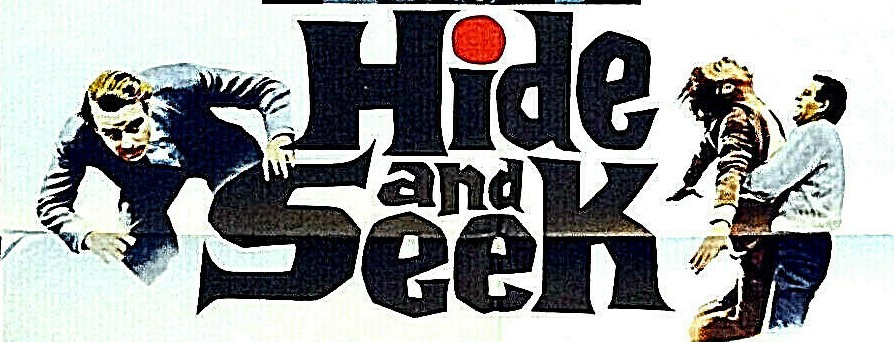
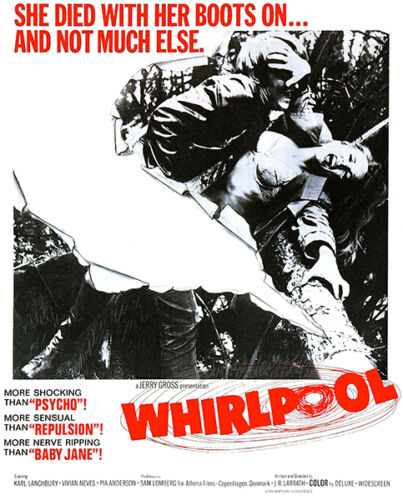
She Died With Her Boots On / Whirlpool / Perversion Flash (1969) ***

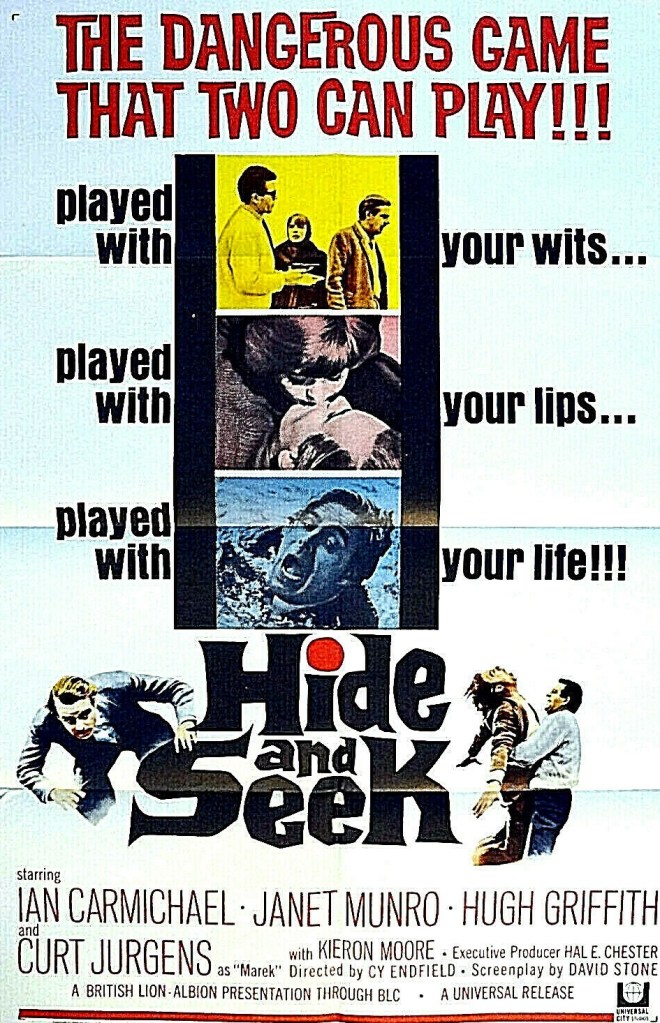
Sexual adventuress takes trip to the country with disastrous results. Best described as an early British venture in the giallo mold it lacks some of the style of that genre but is notable for the debut of Spanish cult director Jose Ramon Larraz (Vampyres, 1974). Perhaps as interesting is that it details a nascent killer warming to his task and climaxes in a nihilistic ending. Scoring so high on the sex/nudity quotient in the U.S., it was considered an out-and-out exploitationer.

Wealthy older woman Sarah (Pia Andersson) brings home model Tulia (Vivian Neves) for her protégé Theo (Karl Lanchbury), a budding photographer.  Sarah’s proclivities are apparent from the start, preferring young women though young men will also suffice, a switch in the normal power play of the era (and now for that matter) of rich old men chasing younger women.

Tulia is no innocent, lured or straying into the big dark house, and she’s game for anything, happily participating in a game of strip poker that ends in sex with Theo. However (and striking a contemporary note), he is unable to perform – for reasons that might be similar linked to young people today who suffer from the same condition due to over-exposure to porn – and in Theo’s case because he prefers watching.

Quite how far he is willing to go to achieve his kicks is shown in a scene where he drives Tulia to the woods where she is almost raped by his friend Tom so that Theo can photograph the act. Quite how far Tulia is willing to go is indicated by the fact that, while upset at this incident, she doesn’t run a mile and instead continues to enjoy games of seduction, this time with Sarah, with Theo at first limiting his participating to recording the action but later taking part in a menage a trois.

Meanwhile, a Scotland Yard Detective Inspector (Barry Craine) interrogates businessman Mr. Field (Edwin Brown), sugar daddy to missing Irishwoman Rhonda (Johanna Heger), and Field takes it upon himself to pay Theo a visit. Quite how he knows of Theo’s involvement with Rhonda is unclear but he doesn’t accept the explanation that the girl has gone home and hangs around to do a bit of spying. Not such a good idea, because he pays the penalty.

Although it’s a pleasant detached cottage and far from an old dark house, Tulia takes it upon herself to take a look at Theo’s studio where she finds various items of female clothing and photos of an unsavoury nature. A flashback reveals the death of Rhonda, seduced by Tom, then, following the arrival of Theo and his trusty camera, raped by a tramp. But it’s not Theo who kills her. It’s Tom, and largely by accident.

So what’s being set up really is how far beyond his normal games Theo will go, with Tulia providing the test case.

A chunk of the tension comes from having no idea what’s going on beyond Sarah indulging Theo. She appears ignorant of the depth of his perversion. And with Tulia being so complicit initially in the sex it appears to be going down a different route to the slasher pictures like Scream and more in keeping with the giallo which had yet to get into its stride. Tulia is a modern girl for the times, certainly not sexually repressed, which was refreshing, and being a model comfortable with her body. But she would not have been expecting something like this.

Karl Lanchbury (What’s Good for the Goose, 1969) looked like he was perfecting the creepy persona that would carry him through a few more Larraz pictures. Vivian Neves was a model, famous two years later for featuring in the first nude advertisement in The Times, but also a glamour model with pictorials in Penthouse and The Sun, and known as “The Body” a quarter of a century before that title was appropriated by Elle Macpherson, and later set up her own modelling agency. Pia Andersson only made this one picture.

Given he was dealing with so much inexperience and was himself a debutant, Larraz does a pretty good job. He would go on to make another 25 films mostly in the exploitation vein.  

I came across this on YouTube while looking for the Otto Preminger film noir Whirlpool (1950). The version I saw is taken from a very ropey VHS with time codes but there’s a better print on the channel under the title of Perversion Flash.

Seven Thieves (1960) ****

You wouldn’t figure director Henry Hathaway for a caper movie. He seemed more at home with action, whether that be war (The Desert Fox, 1951), adventure (Legend of the Lost, 1957) or western (Nevada Smith, 1966) although he was a dab hand at film noir (Kiss of Death, 1947). And before the big-budget all-star Oceans 11 entered the equation in the same year as Seven Thieves – and stole much of its thunder – the heist movie ran mostly on B-movie steam such as Rififi (1955), The Killing (1956) and Big Deal on Madonna Street (1958).

And probably judged against other glossy efforts of the 1960s like Topkapi (1964) and Gambit (1967) Seven Thieves would appear on the surface to come up a bit short. No doubt accounting for it being so under-rated. But while this is in itself a neat little thriller the kick comes in the emotional entanglements and a succession of twists at the end that sends it in my book into a higher category.

And it’s so outrageously clever that the mystery of why French-based criminal mastermind Theo Wilkins  (Edward G. Robinson) would reach out across the Atlantic Ocean to recruit former jailbird Paul Mason (Rod Steiger) to spearhead the heist of a cool four million dollars from a Monte Carlo casino is not resolved until the end, and in spectacular fashion.

Technically, there are actually only six thieves, the other is an inside man, Raymond (Alexander Scourby), who has fallen for the seductive charms of nightclub dancer Melanie (Joan Collins). Making up the rest of the septet are safe cracker Louis (Michael Dante) and muscle-cum-driver Hugo (Berry Kroeger) with Poncho (Eli Wallach) playing the key role of the pretend crippled, arrogant, irascible millionaire – and contrary to the claims of one poster he is the decoy not Melanie.

Distrust of his team makes Theo bring in Paul, who ruthlessly knocks them into shape, putting into seamless action the plan devised by Theo. Simply put, Poncho is going to act as a distraction by having a heart attack at the gambling table while Paul and Louis climb out a window along a ledge to the casino director’s flat which provides, by means of an elevator, direct access to the underground vaults. Once they’ve stolen the cash, they clamber back along the ledge and hide in the flat where, by this time, Theo, playing the role of Poncho’s personal physician, has taken him. The money will be hidden in Poncho’s wheelchair and removed to a waiting ambulance.

But Paul is a rather suspicious character and wants to know what he’s letting himself in for so in turn works out the weaknesses of his team. Melanie hides behind a façade of high birth, Pancho is too reckless, “measuring danger only in terms of profit,” Hugo prone to unnecessary violence, while Louis has omitted to mention he is terrified of heights, the ledge on which the operation depends standing on a 100ft high cliff.   

In some posters, this was promoted as Al Capone (Steiger)
vs Little Caesar (Robinson).

The plan relies on Poncho actually appearing to be dead, so dead that the casino director (Sebastian Cabot) will not hesitate, at Theo’s insistence, to shift him out of sight of the rest of the gamblers into his flat. But Complication No 1 is that Poncho doesn’t want to be dead, even if it is a ruse, skeptical of Theo’s plan to convincingly knock him out by means of a carefully measured dose of cyanide. Complication No 2 is that a night club client recognizes Melanie and casts doubt on her credentials as a lady of quality. Complication No 3 is that English physician Dr Halsey (Alan Caillou) questions whether Poncho is as dead as he seems.

But such complications are nothing compared an extraordinary range of twists that raise tension sky-high at the movie’s denouement. I challenge you to guess what these three superbly-conceived twists would be, all of them one by one turning the project on its head, and it rapidly shifts from one direction to another, ending with an unbelievable – and yet so in keeping with the premise – climax.

Attention to character detail lifts this out of the rut, whether it be Theo’s penchant for collecting seashells, Paul resplendent in a white suit, Melanie resisting the blandishments of becoming a kept woman, Raymond trying to climb out the murky depths into which the lure of Melanie has taken him, and a series of subtle relationships, some developing through the robbery, others which began long before the heist working themselves out.

The heist itself is well done, tension kept constant mostly through the failings of the crew and the suspicions of the dupes. All in all an excellent picture.

This was a critical film in the careers of most of the cast. Edward G. Robinson (The Cincinnati Kid, 1965) was handed his first top-billed role in four years. It was a deliberate change of pace for Rod Steiger (The Pawnbroker, 1964). For Eli Wallach, best known at the time for stage work, it was the first of three films that year that would launch him into the higher ranks of top supporting stars; it was followed by The Magnificent Seven and The Misfits. After being leading lady to the likes of Gregory Peck and Richard Burton, this spelled the end of Twentieth Century Fox’s belief in Joan Collins’ star qualities while for Michael Dante (The Naked Kiss, 1964) it was a step up.

Wallach and Dante could be accused of over-acting but Robinson, Steiger and Collins all act against type with considerable effect. Hathaway does a superb job working from a script by Sydney Boehm (Rough Night in Jericho, 1967) based on the Max Catto bestseller.

Bullet Train (2022) **** – Seen at the Cinema

What a blast! What a gas! And what the heck’s wrong with critics? Complaining Hollywood lacks originality and turning their noses up at this helter skelter of a thriller that hits eleven from the outset, maintains a hectic pace, and boasts gut-busting laughs.

The plot’s as complicated as it is simple. A bunch of assassins on a train trying to steal a suitcase containing ten million dollars discover they are taking the ride for another reason. Finding out they have competition, not just on board, but on various train station platforms, lends to the complications as they – and the viewer – try to work out just what the hell is going on. While there’s some great dialogue, for most of these guys fists and guns are their easiest means of communication so cue some fabulous action sequences.

Twin English hitmen Tangerine (Aaron Taylor-Johnson) and Lemon (Brian Tyree Henry) are the original messenger boys, tasked with delivering the loot from Tokyo to Kyoto on the titular train along with the son of a notorious gangster. Lemon, not the brightest gun in the arsenal, has left the case on a communal luggage rack where first off it is snaffled by Ladybug (Brad Pitt), as ethereal an assassin as you could wish for, and one in denial, preferring a more spiritual outlet for his skills. But guys who are good at killing people are less efficient at holding onto suitcases.

And so the prize bounces from character to character, including Kimura (Andrew Koji), the Wolf (Bad Bunny), Hornet (Zazie Beetz) and Prince (Joey King). Did I mention there was a deadly snake aboard and that the ultimate gangster going by the moniker of The White Death (Michael Shannon) was lying in wait? No? I didn’t want to overcomplicate matters.

Every time the various assassins, who specialize in different murder techniques, think they are getting to the bottom of the mysterious goings-on the movie virtually jumps track to head down a different route, but it does so with such elan and verve that you can’t wait for the next wrong turn.

The characterisation is as good as anything dreamt up by Tarantino, the oddbeat characters dancing to their own odd beat, the squabbling Tangerine and Lemon almost steal the show from Ladybug who believes he is suffering from a run of bad luck. And like he’s caught up in the wrong movie, Ladybug confides his thoughts to his offscreen handler Maria (Sandra Bullock). Wistful schoolgirl Prince can talk her way out of any situation. But as I said, the others prefer to just beat up their rivals.

So stand by for some of the greatest action this side of Jason Bourne and John Wick. And some of the dumbest moves this side of Dumb and Dumber. You’d think the action/comedy fusion wouldn’t work at all but the way director David Leitch plays with our expectations the whole shebang works beautifully. Though I wouldn’t describe it as such, more like an action picture that happens to make you laugh.

Part of the reason the action is so terrific is Leitch is a former stuntman, who must dream fights in his sleep, because he’s certainly dreamt up some original mano a mano stuff here. But he’s also the uncredited co-director of John Wick (2104) and sole helmer of Deadpool 2 (2018) and Fast and Furious Presents: Hobbs and Shaw (2019) so he’s no stranger to mixing action and comedy. And he takes a fluid approach to narrative.

But the laidback Brad Pitt (Ad Astra, 2019), almost a Bill Murray throwback, is absolutely superb, an Oscar worthy performance, a character re-examining his life in the midst of an assassins convention, and trying not to blame anyone attempting to kill him. Brian Tyree Henry (Joker, 2019) is the pick of the supporting cast. It’s a step up for Aaron Taylor-Johnson (The King’s Man, 2021), who plays the most irascible gangster since Daniel Day-Lewis in Gangs of New York (2002). The outstanding supporting cast is mostly made up of up-and-comers  – Joey King (The Kissing Booth 2, 2020), Zazie Beetz (Lucy in the Sky, 2019), Andrew Koji (Snake Eyes, 2021) – plus Michael Shannon (Heart of Champions, 2021) and Sandra Bullock (The Lost City, 2022) and cameos from Channing Tatum (The Lost City) and

The only minor quibbles are overuse of references to British kids fave Thomas the Tank Engine which may not be such a global phenomenon as the director would like, leading I would guess to some audience bafflement in the U.S., as might occasional mention of London soccer team West Ham, both key to the lives of Tangerine and Lemon.

Leitch owes an almighty vote of thanks to screenwriter Zak Olkewicz (Fear Street, Part Two -1978, 2021) who not only pulls the whole package together but springs brilliant lines and situations though how much was lifted directly from the source book by Kotaro Isaka I couldn’t tell you.

Can’t wait for the sequel. Brad Pitt has created a brilliant screen character that deserves a second outing.

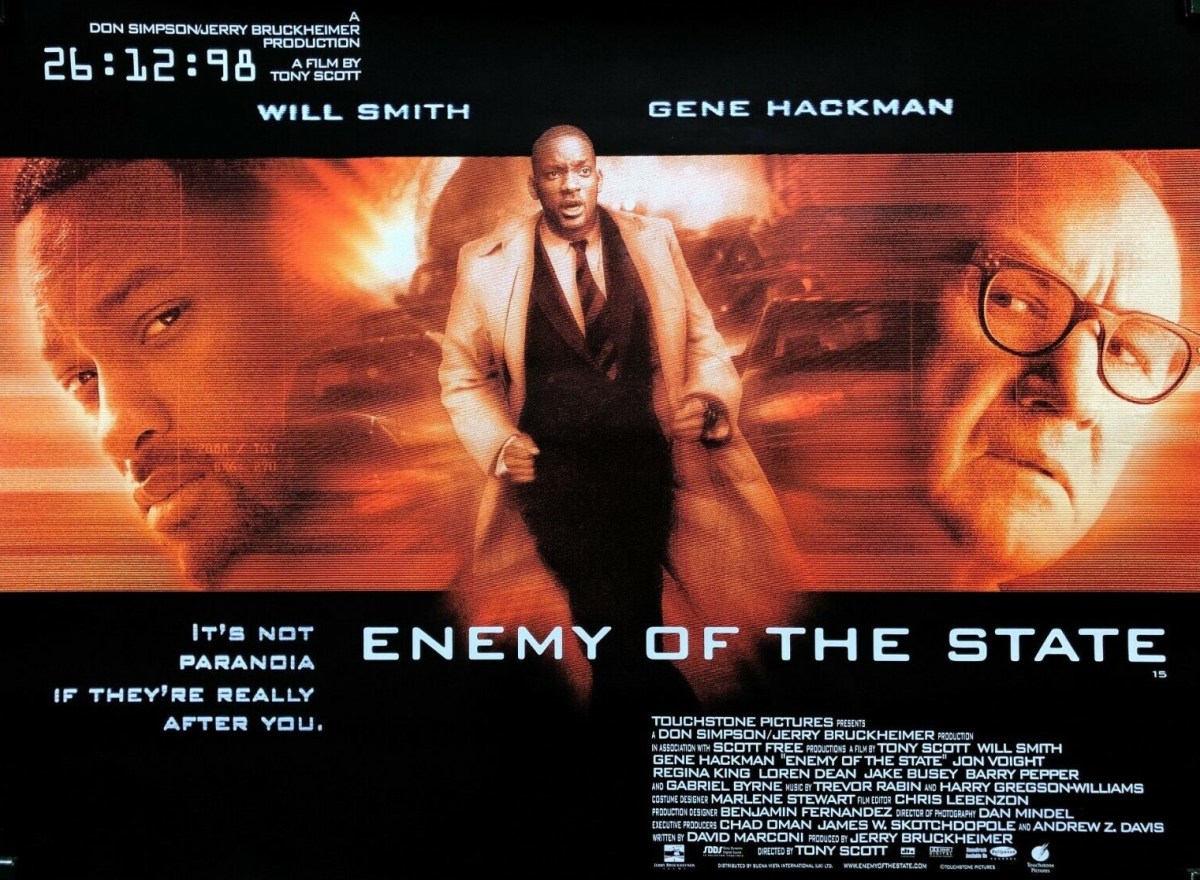
Enemy of the State (1998) ****

You are the star of the show so the last thing you want is to team up with a scene-stealer, but if you want to work with such an renowned talent, what can you do but let him steal.

It says a lot for Gene Hackman’s legendary status that, long past his box office peak in this fast-paced surprisingly contemporary paranoia thriller, his appearance late in the day turns up the heat on Will Smith at an early career pinnacle and at his charming best. You need someone as easy on the eye as Smith to lead the audience through a tortuous plot, centering on the collusion of big business and government to push through a commercially-motivated U.S. Government Act promoting greater surveillance, and someone as inherently gutsy as Hackman to carry the film over the line.

Ironically, the McGuffin is surveillance of the most benign kind, a camera trained on ducks at a river inadvertently picking up evidence of corrupt politician Reynolds (Jon Vogt) overseeing the murder of Representative Hammersley (Jason Robards) who stands in his way. The tape finds its way to an investigative reporter who, pursued by Hammersley’s goons, drops it into the shopping bag of labor lawyer Robert (Will Smith).

Unaware of the reasons why, Robert’s life unravels, Hammersley’s guys fabricating evidence that he has revived an affair with former lover Rachel (Lisa Bonet) and  is involved in Mafia money-laundering, resulting in wife  Carla (Regina King) throwing him out and being fired from his job. Bank accounts frozen (natch!), Robert turns to Rachel for help and she puts him in touch with her source Brill a.k.a Edward Lyle (Gene Hackman), an undercover communications expert who has been feeding Rachel information. When Rachel is eliminated, Lyle teams up with Robert and together they come up with a daring plan to incriminate Reynolds and absolve Robert.

Although brim-full of twists and turns, and a relentless government hit squad, the real joy of the picture is Tony Scott’s direction. Using his trademark speedy cuts, and scaring the life out of the audience regarding the depth of available surveillance, this is a thriller tour de force. The Top Gun (1986) director is at the top of his game, seamlessly shifting keys, racketing up the tension, the NSA’s encroachment on civil liberty so extensive it appears nobody can escape a web that is inexorably drawn tighter.

And it’s a fabulous double act, the innocent but slick Robert coupled with the world-weary but clever Lyle, the non-stop-talker versus the virtually silent. It’s the cat and mouse game where the mice turn out to hold the aces. Just brilliantly done and at such a speed. A plot that could easily become convoluted is superbly handled.

Will Smith (Independence Day, 1996) is given free rein and he’s good value for money, holding audience attention seamlessly, and until Gene Hackman (Crimson Tide, 1995) enters the frame he is running away with the picture. Their acting styles are completely different and you shouldn’t really be comparing them but when it comes to the crunch Hackman nails it every time and with hardly doing anything. Lisa Bonet (Angel Heart, 1987) makes a welcome return to the big-budget Hollywood scene. Jon Voigt (Midnight Cowboy, 1969) enjoys one of his better supporting roles.

The screenplay by David Marconi (The Dark Side of the Moon, 2015) is quite superb, not just with a whole series of riveting set-pieces and some terrific dialogue, but also with more humane touches, such as Robert’s encounter with his kids or his embarrassment shopping for lingerie in Victoria’s Secret.

And if there were not bonuses enough, there’s a virtual smorgasbord of talent in the supporting cast starting with 26-year-old Regina King (Boyz in the Hood, 1991) through Barry Pepper (Saving Private Ryan, 1998), Scott Caan (Ocean’s Eleven, 2001), Jake Busey (Starship Troopers, 1997), Jason Lee (Vanilla Sky, 2001) and Jamie Kennedy (Scream, 1996)  all the way to Gabriel Byrne (The Usual Suspects, 1995), Ian Hart (Backbeat, 1994) and Jack Black (School of Rock, 2003).

Stone cold classic not to be missed and worth another watch if you have viewed it already.

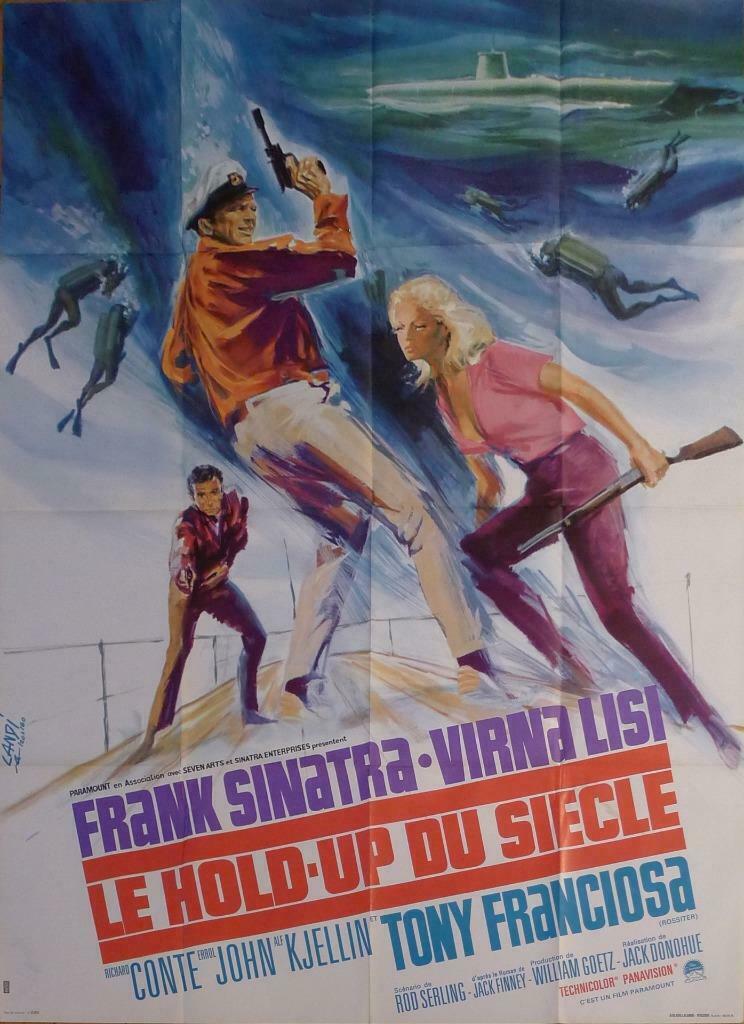
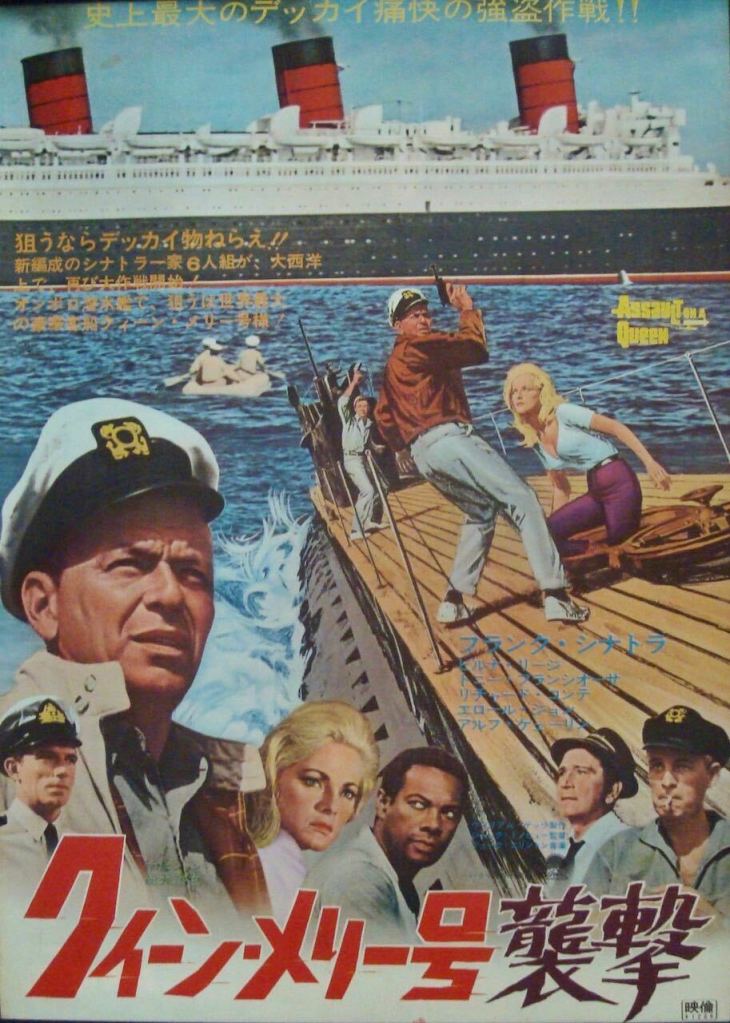
Assault on a Queen (1966) ***

I always wondered why this was a flop. I’m still baffled. Not only is it a perfectly serviceable caper picture, but it’s also high-concept before the term was invented, a World War Two submarine involved in holding up high-end ocean liner Queen Mary (yep, the real thing, thanks to cooperation from owners Cunard). 

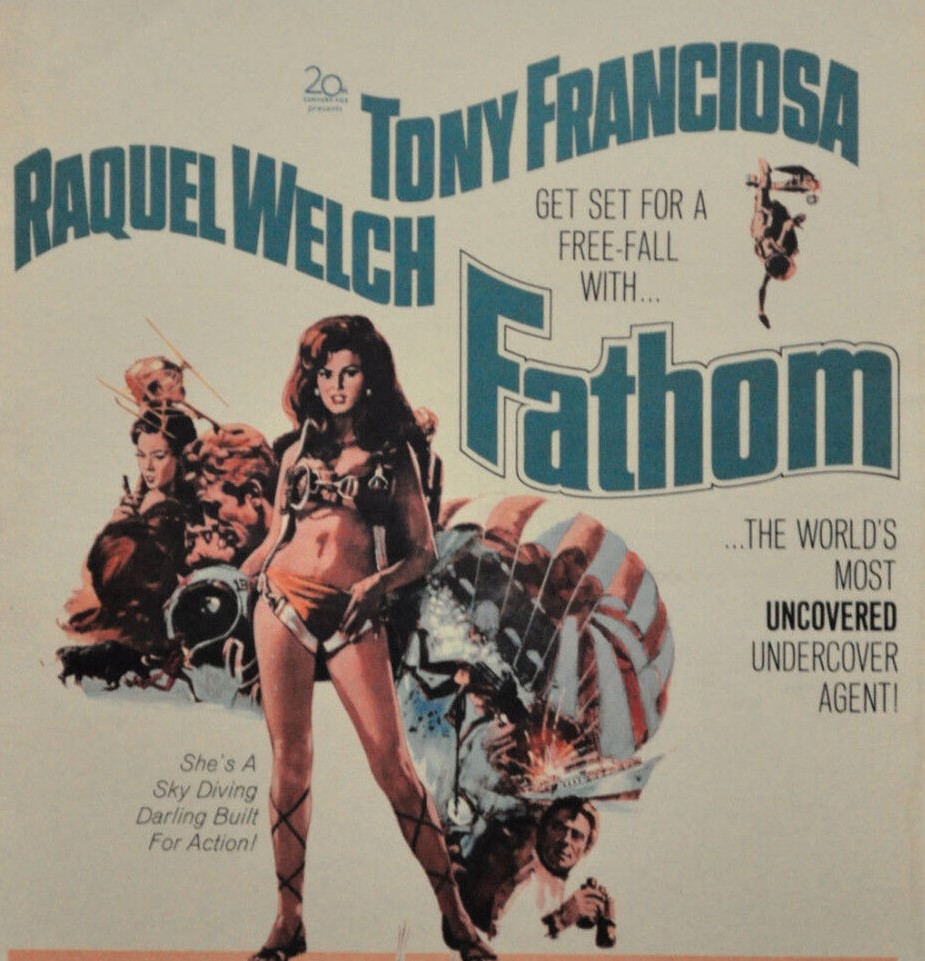
The dialogue’s crisp, the robbery well-planned, a good number of twists, plenty underwater thrills, hostility between crew members, and sexual tension kept high by the presence on board of the Italian Miss Big. Diver Mark Brittain (Frank Sinatra) is sucked into a treasure hunt in part because he needs the money and in part through the sexual magnetism of Rosa (Virna Lisi), the expedition backer, who already has suave Vic (Anthony Franciosca) on a string.

The plan evolves into piracy when Brittain discovers a World War Two German submarine on the seabed. As it happens, skippering the salvage vessel is former German U-boat captain Eric (Alf Kjellin). After Mark successfully raises  the sub, it’s game on, Vic’s qualms wilting under Rosa’s seductive gaze. The other team members are engineer Tony (Richard Conte) and wireless operator Linc (Errol John). The prize is a cool million in cash and gold bullion.

Catch No 1: the sub can’t stay submerged for more than an hour. Catch No 2: it’s not that seaworthy and could spring a leak at any time (“don’t just look for water, listen for it,” advises Eric). Catch No 3: in order to successfully board the Queen Mary looking for vital equipment, one of these very American Yanks has to pass himself off as a British sub captain on a secret mission.

Potential Catch No 4 has already been dealt with – if the Queen Mary officers rumble the ruse and call the thieves’ bluff the hijackers plan to put a dummy torpedo up the spout and fire it into the ship’s hull. Catch No 5: there’s so much pent-up hostility among the team the whole endeavor could be sunk. Mark and Vic are vying for Rosa’s favors and clever bombshell that she is she intends to keep it that way, stringing both along.

Racist Vic takes against Eric and also resents splitting the loot with late arrival Tony. Alf not only resents Mark, also a former sub officer, for ending up on the war’s winning side, but exhibits psychopathic tendencies and might just for the hell of it blow a passing tanker out of the water. Like any gang, each member brings something specific to the party. And without giving too much away, the  endgame turns into a battle of wits, especially when the unexpected occurs.

I’m a big fan of Sinatra’s acting style. He is so natural, his gestures don’t look like they’ve been rehearsed for hours in a mirror, you’ll never accuse him of Method acting, or picking parts with Oscars in mind, but somehow he still manages to inhabit his characters.

This is a fascinating role for Virna Lisi (How to Murder Your Wife, 1965), reminiscent of film noir in the way she handles men, but also years ahead of her time not just in combining  sexual and financial independence but of being the boss funding the heist and recruiting the team, and soon has the reluctant Mark playing ball with no sense that’s ultimately she’s going to fall at his feet.

Anthony Franciosca (Rio Conchos, 1964) is mostly a distraction, engaged in a private feud with James Coburn as to who has the brightest and biggest screen teeth. Richard Conte (Lady in Cement, 1969) and Alf Kjellin (Midas Run, 1969) are the physical and mental muscle, respectively, and Trinidadian Errol John (Man in the Middle, 1965) essays an interesting role. Jack Donohue (Marriage on the Rocks, 1965) keeps it all ticking along.

Rod Serling (Planet of the Apes, 1968) devised the screenplay from the novel by Jack Finney (Good Neighbor Sam, 1964). So why did critics and the public have such a downer on the picture? Critical attitudes to the star were easier to understand. Sinatra’s films were generally disliked, and knowledge of his one-take preference allowed critics to thumb their collective noses at his acting, assuming he put no effort into it.

Rumors of his underworld connections were beginning to emerge, he had just married Mia Farrow, less than half his age, and the Beatles and the British invasion had usurped his position in the pop rankings. The general feeling was he was on the way out so why not boot him while he was down. This was despite him receiving some of the best notices of his career for Von Ryan’s Express (1965).

Audiences might have been expecting another Rat Pack lark in the vein of Ocean’s 11 (1960) or felt the supporting cast lacked lustre, Lisi a little known commodity, this only her second Hollywood picture, Franciosca still the second banana, and Hardy Kruger would certainly have invested the German with more malevolence. Otherwise, it’s hard to see what there is to complain about. As I mentioned the dialogue was good, characters simmering, and the story satisfying enough.

Sure, a better director might have extracted more tension from the set pieces, lifted the pace, and added a booming score as with Ice Station Zebra (1968).

It might not be the best heist picture ever made, but it’s too good to be dismissed.

The Gray Man (2022) ** – Seen at the Cinema

I could have seen this for nothing on Netflix, but instead, hoping to do an action picture justice by seeing it on the  big screen, I shelled out my bucks for the privilege. Bourne Ripoff is as much as you need to know. Lazy writing with a bundle of the incongruities you can get away with within the MCU because as long as there’s the requisite action nobody bothers too much about logic.

Don’t be fooled into thinking this is John Wick gone wild. It’s many things gone wild, including a heap of overacting, and a pair of the biggest villainous klutzes you will ever come across. It’s vaguely redeemed by an explosions/ shootout/ tram chase in Vienna but that’s only enough to shift it up from one-star to two. And it’s a shame because Ryan Gosling (First Man, 2018) in his first movie for four years is a believable tough guy in the Bourne tradition and Ana de Armas delivers on the action chops she displayed in No Time to Die (2021).

A poster straight out of the Joseph E. Levine playbook. He used to dream up these kind of posters which characters were assigned titles that bore no resemblance to the part they played on screen.

It should be an action romp, but instead it’s a mess. A C.I.A. black ops unit – inventively called the gray department – is hiring convicted killers to knock off anyone they want. Six (Ryan Gosling) got jailed for an insane amount of time, would you believe (nope!) for, as a teenager, killing his dad who was domestically abusing both his sons (trying to drown Six, for example). Six’s latest mission is to kill a guy who turns out to be an assassin in the same line of work but who is blackmailing C.I.A. boss Carmichael (Rege-Jean Page).

There’s nothing cool about Carmichael, he throws coffee at windows when he’s cross, and that sets an awfully bad example because his underling Suzanne (Jessica Henwick) is also prone to getting very cross. But that’s nothing compared to complete nutjob Lloyd (Chris Evans) who enjoys a bit of torture and gives psychopaths a bad name, but if I got this right attended Harvard with Carmichael so that’s okay then. Lloyd is hired to kill Six because he knows too much. And Lloyd calls in other assassins.

Now we’ve had that template in Bourne so what’s going to make it different? I know, let’s ramp it up. Instead of individual assassins, who might display some kind of finesse, let’s have teams of rampaging assassins. You can’t really wreck Vienna with just an assassin or two, you need a whole army.

Danush (Avik San) is an unusual assassin in that he operates on his own, not needing a huge team, but he is also cursed by – remember he’s a ruthless assassin – being suddenly conscience-stricken.

Oh, I forgot to mention Fitzroy (Billy Bob Thornton), the guy who sprung Six from jail but is now retired. Luckily, he happens to have a young niece Claire (Julia Butters). And that comes in handy when Lloyd needs to bring him to heel – and can kidnap the girl. But wait, two years before, Six was assigned to protect Claire and saved her life twice.

Twice? Yep, once from assassination and once when he rushed her to hospital after something went wrong with her pacemaker. Yep, she has some terrible heart disease. But not enough apparently to prevent her being the world’s pacemaker poster girl. Guess what? She can race along the top of a castle and jump 100 feet off a castle wall into a moat.

After being blame-shamed by Carmichael, Six’s C.I.A. sidekick Dani (Ana de Armas) switches sides to help him and can be counted on to turn up to shoot darts at Lloyd and appear with a fast car in time to save Six from assassins on the aforesaid tram. But she’s one of the victims of the lazy writing. She has two clear chances to save the day by marksmanship and fails each time. The first excuse is just so dumb. Thrown a sharpshooting rifle by Six, she discovers this comes minus ammunition. “Never throw a loaded gun,” must be one of the stupidest lines ever written, a lame joke that clearly makes reference to No Time to Die. Armed with another sharpshooting device and with clear line of sight on Lloyd, for reasons that are never made clear she doesn’t shoot.

Did I mention that Six is the kind of tough guy who, armed with little more than a penknife, can saw through a water pipe because the directors want to do some kind of riff on Kingsman: The Secret Service (2014) or that this this is the thriller version of If It’s Tuesday It Must Be Belgium (1969) with a different country about every ten minutes. And if people aren’t losing digits, it’s fingernails.

Ryan Gosling and Ana de Armas come out of this well but Chris Evans (Avengers: Infinity War, 2018), with a Tom Selleck moustache, is just awful, a joke villain, the only surprise being he doesn’t twirl said moustache. It’s almost as if he’s doing his utmost to make people forget he was ever Captain Marvel, but this is to the utmost and beyond. Stick to Bridgerton would be my advice to Rege-Jean Page. Billy Bob Thornton (Bad Santa 2, 2016) plays one of his more restrained characters.

The Russo Brothers (Avengers: Infinity War) throw every trick in the book at the movie without starting from the obvious point – a decent script.

Coogan’s Bluff (1968) ***

Almost a curiosity in the Clint Eastwood canon from the later perspective, this modern western concerning a maverick Arizona cop pursuing a fugitive in New York could also be interpreted as a riposte to the violent avenger of the “Dollars” trilogy and Hang ‘Em High (1968). Like Rio Conchos (1964) there’s an action-packed start and finish and not much in between unless you count Coogan (Clint Eastwood) being beaten up, and like Firecreek, made in the same year but less of an audience attraction, a slow burn with little of the depth of the Vincent McEveety effort.

It fits more neatly into the “victim” niche of The Beguiled (1970) and Play Misty for Me (1971) with Eastwood, while attempting to present a macho image, set upon by predatory women. Here, although led into a trap by the girlfriend Linny (Tisha Sterling) of the wanted Ringerman (Don Stroud), the victim elements are mostly humorous, Coogan a fish-out-of-water taken advantage of by cab drivers and hoteliers and by a justice system that takes more note of due process than he is accustomed to. Otherwise, it’s pretty much a romance as Coogan, for whom persistence pays off, beds probation officer Julie (Susan Clark).

Coogan is a paid up member of the wham-bam-thank-you-ma’am fraternity, frolicking with an adulterous lover in Arizona, and displaying no qualms about getting it on with Linny. In the hands of Jack Lemmon this would be a comedy, so it’s a strange choice for Eastwood unless for experimental purposes, trying to set himself up more as Steve McQueen than John Wayne.

The picture opens with Coogan tracking down a Native American, and manacling him to a pole outside a house while he repairs inside for sex. Interrupted by a sheriff frustrated by his ways, he is despatched to New York where he manages, through a bluff, to have Ringerman removed from Bellevue mental hospital. On the way home, he is ambushed by Linny and some thugs, losing consciousness and his gun, neither going down well with the more bureaucratically-minded Lt. McElroy (Lee J Cobb) whose undercover stake-out plans he has also ruined.

Luckliy, Coogan has chanced upon probation officer Julie who can’t quite manage to deter his amorous advances and at an appropriate moment he sneaks a look at her files for his next lead. Not quite as sharp as he imagines, and clearly not much good at assimilating painful lessons, after a dalliance with Linny, he is astonished to be led into yet another trap. In the end, of course, he gets his man, courtesy of a motorbike chase. But there’s a curious ending. Not only does Julie, who he has betrayed with Linny, turn up to wave him off, but, as if he has now turned into a kinder, more humane specimen, he affords his prisoner a smoke, something he pointedly refused to do with the Native American.

It’s not dated particularly well and modern audiences will have trouble accepting domestic abuse and rape as comedic situations and eyebrows are scarcely going to be raised at the drug-addled Linny nor the club where naked women fly overhead on trapezes. The idea that intelligent women like Julie, weighed down with psych jargon and over-concern for offenders, just need a big hunk in their lives doesn’t fly either.

But if you accept the out-of-towner trope, and are happy to see Clint practising his squint and double take , you will find in between the action  and “victim” agenda, a quite tolerable romance. It was a bold choice for a star best known for killing people. Tough guy that he is, he is flummoxed by the big city and has a hell of a job getting his man. On the other hand Eastwood and Clark have excellent chemistry. This is embryo Eastwood, almost as if he is trying on a variety of screen persona to see what will fit. After Dirty Harry (1971) there was little truck with romance except for The Bridges of Madison County (1995) and In the Line of Fire (1993) so it’s interesting to see his moves, albeit that the best romantic work he did was in the director’s chair with Breezy (1973).

Susan Clark is superb, all the professional confidence of Tell Them Willie Boy Is Here (1969) but the romantic cynicism replaced by an appealing hesitancy. Lee J. Cobb (Exodus, 1960) has little to do except be grumpy, Don Stroud (Madigan, 1968) doesn’t feature prominently enough while Tisha Sterling (Journey to Shiloh, 1968) makes the bigger impact.

Don Siegel (Dirty Harry) would become an Eastwood long-time confederate, directing him in six movies, of which this was the first. He had just made a Hollywood comeback after six years in the feature film wilderness with Madigan (1968), a tougher cop picture. I would be inclined to lavish more critical plaudits on the idea of playing around with the tough guy persona, but I’m not sure that was the intention.

The Honey Pot (1967) ***

Shave 20-30 minutes from this and you would have had a taut thriller. You could start with the number of clever dicks who happen to notice that what’s going on bears a close resemblance to a play Volpone by Shakespeare contemporary Ben Johnson, even down to the anglicizing of the names of those fictional characters. And prune the number of detectives, three is two too many especially when there’s an actual genuine detective in the mix. And the shock ending is just…well…mince.

Otherwise, quite fun in a way. Wealthy Cecil Fox (Rex Harrison) hires sometime actor, sometime factotum, law graduate Marty McFly – oops William McFly – to help him pull off an elaborate joke, “people-baiting”, a modern version of “bear-beating” apparently. Fox pretends to be dying in order to bring three former lovers, all he presumes desperate to be named in his will, to his bedside in a grand palazzo in Venice. Upfront reason, some kind of revenge. Hidden reason, something darker obviously.

The trio are Texan Mrs Sheridan (Susan Hayward), movie star Merle (Edie Adams) and Princess Dominique (Capucine). Sheridan is accompanied by a nurse Sarah (Maggie Smith), the “voice of morality.” They all certainly seem to have a sense of humor. Two presenting Fox with gifts of clocks, the princess with an hour-glass filled with gold dust instead of sand, presumably with the notion that he can watch his life ticking away. Needless to say, this is like an reality TV show, Fox not having named an heir in his will, so they are all battling to be the heir, and as he points out, even the rich will succumb because there is no such thing as “enough money.”

Things do not go according to plan when Sheridan unexpectedly dies. Enter Inspector Rizzo (Adolfo Celi). Sarah suspects McFly because he used her as an alibi but disappeared for a time when she (for unexplained reasons) fell asleep in a posh restaurant (and nobody tried to wake her). Turning detective herself, she comes up with “proof positive.” Turns out the two remaining suspects had conspired to also give themselves an alibi, easily demolished by the kindly inspector. McFly, too, has been doing some digging.

But then comes another twist and everything you thought you knew flies out the window. Cue more investigation, more alibis and finally an Agatha Christie pay-off when the two amateur detectives and the real one confront everyone in the drawing room. By which time the twists are coming thick and fast.

Best thing about this is the playing. Although decidedly stagey, very little in the way of visual audacity, that works to the movie’s benefit, and not a bad choice to rely so heavily on the acting given the cast. With the exception of Edie Adams, Capucine and Celi, all were Oscar anointed. Two winners – Rex Harrison for My Fair Lady (1964) and Susan Hayward for I Want to Live (1958) – and between them another five nominations – and two future winners in Cliff Robertson for Charly (1968) and Maggie Smith for The Prime of Miss Jean Brodie (1969). The others were not out of their depth, Edie Adams (Made in Paris, 1966) clocking up Emmy nominations. Adolfo Celi (In Search of Gregory, 1969) a deuce of nominations from the Cannes Film Festival while even Capucine (The 7th Dawn, 1964) had been nominated for a Golden Globe.  

So director Joseph L. Mankiewicz (Cleopatra, 1964) makes the right decision to let his actors get on with. Rex Harrison is at his suave best, but with a malevolent undercurrent, and has most of the best – and zestiest – lines. Robertson, usually the hero, is sly and duplicitous. Susan Hayward was in her comfort zone, forthright and taking no prisoners, Capucine at her cold and haughty best. Smith and Celi were the revelations, the former losing the trademark drawl and the nurse’s mousiness as to some extent she exerts control, and Celi departing from the bombast and delivering a lower-keyed performance.

Doing double duty, Mankiewicz worked up the script from three sources: the original Volpone,  the play Mr Fox of Venice by Frederick Knott (Dial M for Murder) and a novel The Evil of the Day by Thomas Sterling. Next time the director went to the stage for inspiration he chose a better source for a mystery – Sleuth (1972).

Crossplot (1969) ***

Roger Moore – in his first movie in seven years – almost auditioning for James Bond with his lothario instinct, light touch for dialogue, a nice side-line in double takes, and enough action to show that even in his early 40s he was still nimble enough. Not in the Charade (1963) or Arabesque (1966) league and over-reliant on the Swinging Sixties and other “Tourist Britain” clichés and a plot that takes far too long to get going, it takes all the actor’s charm to make it watchable.

After one of his staff Warren (Dudley Sutton) switches the photo of a model in his portfolio, ad-man Gary (Roger Moore) finds himself on the trail of Marla (Claudia Lange), a sometime fugitive hiding out on a houseboat. Meet-cute is prompted when she pushes him into the Thames. On leaving he is knocked out and framed on a dope charge and once he manages to get her into the photographic studio Warren attempts to throw her off the roof, the would-be killer himself eliminated by his boss Ruddock (Francis Matthews) who in a marvelous piece of quick-thinking throws his gun to Gary who instinctively catches it, further implicating himself.

After going all round the houses (including a stately home), evading pursuit via an antique car race and a wedding, Gary finally gets to the bottom of why Marla is in such danger – she overheard a conversation between her aunt Joe (Martha Hyer) and Ruddock. Only problem is – she can’t remember it. And it takes even more time for Gary to figure it out, (not realizing, how could he,  that the clue is in the title, in fact two clues in a crossword puzzle). You can imagine how it goes from then.

This poster takes the easy route by trying to sell the picture on the back of “The Saint.”

On the plus side is mostly Roger Moore. “I come from a long line of hippopotamuses,” isn’t the sort of line you can deliver without some skill. But Moore’s performance lifts what is for the most part  a shaggy dog story, and he’s game enough to do all the running and fighting required, even the heavy lifting (of his eyebrows), to keep the story moving. It’s far from as funny as it thinks and not as funny as it needs to be, but there are still some good stabs at humour, a pistol held to Gary’s head discovered to be a toy gun, Gary turning the tables in a shower on Marla, telling the bride that her groom is a bigamist, and a running joke about the Marla being perennially hungry.  

The politics barely touches on the conspiracy aspects that Hollywood would have pounced upon and made a better fist of, although the idea that Britain could be undermined by civil strife was not far off the mark for the times. It needed some smarter thinking, though, for that element to work.

A much better attempt at selling a thriller with scenes from the film,
including the toy pistol pointed at Roger Moore’s head.

The rest of the cast are game enough. Claudie Lang (The Gatling Gun, 1968) is no Sophia Loren or Audrey Hepburn but nobody is pretending she is and she just about gets away with the dumb model approach. Martha Hyer (The Chase, 1966) delivers a glamorous villain and the suave Francis Matthews (Rasputin: The Mad Monk, 1966) her ideal match.

There’s quite a supporting cast: Veronica Carlsen (Dracula Has Risen from the Grave, 1968), Gabrielle Drake (Suburban Wives, 1972), Dave Prowse (Star Wars, 1977),  Bernard Lee (You Only Live Twice, 1967), Alexis Tanner (The Ernie Game, 1967), Ursula Howells (BBC’s The Forsyte Saga, 1967) and Dudley Sutton (Rotten to the Core, 1965).

If Alvin Rakoff (The Comedy Man, 1964) is in charge of the material he doesn’t have enough material to work with. He does enough to keep it on course but would have benefitted from a a tighter screenplay from Leigh Vance (The Frightened City, 1961). Both had done better in the past, but it is easy to be seduced by the romantic thriller format, almost a mini-genre in itself, assuming it is easier to pull off than it looks. The likes of Alfred Hitchcock (North by Northwest, 1959) and Stanley Donen (Charade) made it look easy but they had the advantage of big stars in Cary Grant and Audrey Hepburn who possessed the ability to make the lightest confection work.

The Mad Room (1969) ***

Tight little thriller lifted by excellent performances from Stella Stevens and Shelley Winters focusing on murders a dozen years apart. Mandy (Barbara Sammeth) and older brother George (Michael Burns), incarcerated in a mental institution after the murder of their parents, the twist being nobody can discover which child was responsible, are released into the custody of big sister Ellen (Stella Stevens), secretary to wealthy widow Mrs Armstrong (Shelley Winters) and betrothed to her son Sam (Skip Ward).

While concealing the children’s past, Ellen persuades Mrs Armstrong to offer them lodgings, that arrangement coming unstuck when the kids demand a room where they can go “to work things out.”  Armstrong is a bit barmy, engaged on building beside her home a museum to her husband, hence contractors and construction workers on site, and a horde of “ladies who lunch” involved in fundraising. She has also appropriated masseur Armand (Lou Kane), husband of alcoholic Mrs Racine (Beverly Garland), to fulfil her sexual needs.

Don’t worry – the poster doesn’t give the game away.
The blood comes from Stella Stevens discovering the corpse.

When Mrs Armstrong threatens to chuck the kids out, she comes to a sticky end, and the question is raised again of whether Mandy or George are responsible. Mandy is the more highly-strung, stubborn and likely to challenge authority. George appears predatory, stalking the maid. Both are convinced the other is guilty.

Meanwhile, Ellen undertakes to remove the body and pretend Armstrong met her death by accident at a beauty spot, no mean feat given the palaver caused by the builders outside and the constant need for construction decisions and the unexpected arrival of a posse of ladies including the alcoholic Mrs Racine intent on raising merry hell.

It’s part whodunit, part nutcases-on-the-loose, part film noir, part slasher picture,  and part grand guignol. Hands are severed and blood is used to daub flowers on the walls. It’s tense enough even before Armstrong’s demise. She’s not only a loony, but untrustworthy, selfish, capricious and demanding, and it’s as much as Ellen can stand to constantly iron out all the loose ends in her employer’s life. But she sounds believable, an earnest do-gooder even while conspiring against what she sees as Ellen’s gold-digging.

Ellen, life thrown into turmoil after the death of her overbearing impoverished parents and only now building a new identity removed from the shadow of the children, faces the prospect of losing her ideal future. While it would have suited her for the children never to be released, she exhibits surprisingly a strong emotional attachment to her siblings, willing to both shelter and protect them, and conceal again their crimes.

Initial tension revolves around a chase, savage dogs, a shifty maid and Ellen dealing with the manipulative Mrs Armstrong, holding her own long enough until she is safely married, while further pressure builds with the necessity to cover up the murder, explain Mrs Armstrong’s absence, cope with the sudden influx of people and ascertain who has the murderous tendencies. There are some excellent scenes and twisty payoffs, and quite a bit of misdirection – the chase, rabid dogs, a childish song – and some inspired drama such as Mrs Racine letting rip, and Mrs Armstrong’s growing puzzlement.

Stella Stevens (Sol Madrid, 1968), normally eye candy or in a supporting role, is a revelation as Ellen, creating a grounded personality, with several changes of emotion and except for being a little pop-eyed on occasion carries off the part tremendously well and not falling prey to the temptation of grandstanding. Shelley Winters (A House Is Not a Home, 1964), who knows all about playing larger-than-life characters, tones it down here, even the obvious nuttiness reined in.

Michael Burns (That Cold Day in the Park, 1969) is the better of the two younger actors, while Barbara Sammeth’s (Foul Play, 1978) stiffness could be put down to inexperience – this was her debut. Otherwise former horror queen Beverly Garland (Stark Fear, 1962), one-time horr

Discover WordPress

A daily selection of the best content published on WordPress, collected for you by humans who love to read.

The Atavist Magazine

by Brian Hannan

WordPress.com News

The latest news on WordPress.com and the WordPress community.