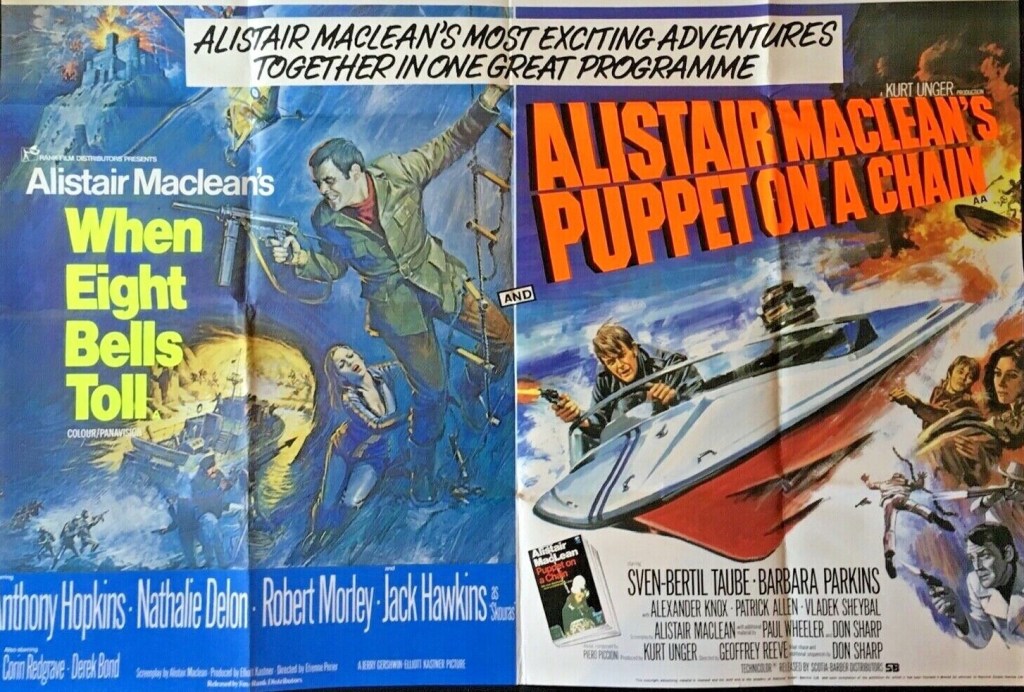
Puppet on a Chain (1970) ****

The spy genre was dying on its feet, even James Bond slipping into spoof territory, and it was left to Alistair MacLean to revive the genre with believable heroes and settings not just chosen for their scenic potential, fitting somewhere between the gritty policiers of Bullitt (1968) and The French Connection (1971) and with an emphasis on violence that Sam Peckinpah would be proud of.

Stylish bullet-ridden opening, crackerjack climax. In between depicting Amsterdam scenery and depravity side by side comes betrayal, duplicity, drugs, heinous deaths, plenty action, and as much as Bullitt (1968) reinvented the car chase this did the same for speedboats.

Tracking point of view follows an assassin into a house where he kills three people and removes something from the pendulums of clocks. U.S. narcotics agent Sherman (Sven Bertil-Taube) flies in to Amsterdam but before he can collect vital information from colleague Duclos he is murdered.

Top Dutch cops Col De Graaf (Alexander Knox) and Inspector Van Gelder (Patrick Allen) are helpless to stop the growing heroin traffic. Van Gelder, with addicted niece Trudi (Penny Casdagli), knows only too well the personal cost.The police force is riddled with leaks, the heroin gang out to stop Sherman from the get-go.

But Sherman has his own nasty medicine to deal out, and hands out beatings and death to those who get in his way. Helped by colleague Maggie (Barbara Parkins) and, inadvertently by Duclos’s girlfriend Astrid (Ania Lemay), the trail leads to the Morgenstern warehouse, which stocks all sizes of puppets, and a church run by shady pastor Meegeren (Vladek Sheybal) which has re-purposed Bibles.

Sherman has no sooner escaped one attempt on his life than he encounters another, so the action never lets up. Meanwhile, clues lead him to a boat in the harbor and he discovers how the heroin is being shipped. Maggie, on hand to offer romantic consolation, shares his tough assignment and questions his methods.

Although revivals were usually sold on the weight of a star, but by this point MacLean was a box office commodity and, let’s face it, neither Hopkins nor Bertil-Taube had much of a calling card.

The trail isn’t that hard to follow but the obstacles are considerable. Meegeren and pals take hanging to the extreme, strangling victim on steel chains, dangling them high as a warning to others. So, mostly, leavened, depending on your point of view, by titillating views of the Dutch capital and a sexy dance troupe that would put Bob Fosse to shame, its fist- and gun-fights all the way.

Except for his dalliance with Maggie, a romance that has to be kept under wraps, Sherman fits the tough Alistair MacLean template with a ruthless streak wide enough to have won plaudits from Where Eagles Dare team He gets a good dousing in the sea and is an unwilling candidate for a brainwashing technique that combines tradition with a personalized version of the sonic boom.

But the highlight without doubt is the high-speed speedboat chase through Amsterdam, beginning in the wider Zuider Zee before racing through the narrow twisty Dutch canals.

For the Dutch Tourist Board it was a game of two halves, organ music aplenty, cobbles and canals, and people dressed in traditional garb promoting the city as a desirable destination but the unsightly addicts and the sex trade as likely to put overseas visitors off (although for many that may well be the icing on the cake).

It was rare at this point, in a polished Hollywood-style picture, to dig so deeply into the seamy side of a city, but his one pulls no punches, nitty-gritty winning out over gloss, and where Easy Rider (1969) and others of that ilk opted to canonize drugs this favored grim consequence. 

It seems particularly difficult to get the casting right for an Alistair MacLean movie of the lone wolf variety – the all-star war pictures by contrast having no trouble attracting major players – and if you turned up your nose at Richard Widmark in The Secret Ways (1961), George Maharis in The Satan Bug (1965) and Barry Newman in Fear Is the Key (1972) you might quibble at Swede Sven Bertil-Taube (The Buttercup Chain, 1970). But he makes a fairly decent stab at the standard dour character.

Barbara Parkins (Valley of the Dolls, 1967), way out of her comfort zone, does well as the tough woman with a soft center. But, all told, you would say it benefits from largely casting unknowns as it prevents the audience arriving with preconceptions. In her only movie Penny Cadagli is the pick of the support, especially as her role in the movie is to play a role.

Although Geoffrey Reeve (Caravan to Vaccares, 1974) hogs the directing credit, the speedboat chase, other action scenes and the tightening up of the picture was the work of Don Sharp (Bang! Bang! You’re Dead, 1966). And Alistair MacLean didn’t, as he might have expected, receive sole screenwriting credit either, sharing it with Sharp and Paul Wheeler (Caravan to Vaccares, 1974).

Not only plenty of bang for your buck, but a riveting chase and one of the first sightings of heroin supply as the key driver of the narrative.

Underworld U.S.A. (1961) ***

Could be a companion piece for The Oscar (1966). Dumb punks with scarcely a redeemable feature. Treat women like garbage. Obsessed by an unachievable aim. In this case it’s revenge for the death of a no-good hoodlum father that provides an expose of the Mob. Sam Fuller opts for a documentary approach, rather than delving into the soap opera of The Oscar, and at times info dumps threaten to run away with the picture. While raw enough, lacks the emotional kick of The Naked Kiss (1964).

When habitual jailbird Tolly (Cliff Robertson) comes across one of his father’s murderers in gaol he tricks him into revealing the names of the three others – Gela (Paul Dubov), Gunther (Gerald Milton) and Smith (Allan Gruener) – who are now high-ranking gangsters. Having gained entrée to the hoodlum kingdom, he becomes an unlikely ally of top cop Driscoll (Larry Gates), devising a clever plan to suggest to Mob boss Connors (Robert Emhardt) that his lieutenants are so untrustworthy they should be rubbed out.

Along the way he enjoys a dalliance with a Mob runner Cuddles (Dolores Dorn) who draws the lines at handling drugs, and ruthlessly pulls her into his scheme. Motherless Tolly’s mother figure Sandy (Beatrice Kay) does her best to put him off his skulduggery.

When he’s not robbing or working on his scheme, he’s either seething or dashing Cuddles’s dreams of living together, not as his moll, put up in an apartment, but as an honest couple. He’s not remotely interested in doing the right thing or imagining himself as a public-spirited hero and would rather be executioner than laboriously bringing his targets in to face justice.

But the cops are equally ruthless, fully aware of the dangers facing informants, but so intent of catching the gangsters they do little to minimize the peril. Characters pop up in bit parts to make points about police corruption and when Fuller lurches away from Tolly to deliver lectures about the extent of the Mob’s tentacles it loses focus.

See what I was saying about stats. When did they ever sell a picture?

But all the statistics and operational details count for a lot less than venal assassin Gus (Richard Rust) cold-bloodedly running over a young girl to deliver a warning to others and Connors intending to turn schoolkids into drug addicts.

You can see why Fuller fell back on stats because there was hardly anything new to say about gangsters after a three-year crime biopic spree kicked off by Machine Gun Kelly (1958). Every major crime figure had been given the treatment – Al Capone (1959), Ma Barker’s Killer Brood (1960), Murder Inc. (1960), Pretty Boy Floyd (1960), The Rise and Fall of Legs Diamond (1960), King of the Roaring 20s: The Story of Arnold RothsteinMad Dog Coll (1961) and Dutch Schulz in Portrait of a Mobster (1961).

There wasn’t much new about Tolly except he believed his killings were sanctioned by a complicit police force and his own ideas about justice.

That said, Cliff Robertson (The Devil’s Brigade), before his twisted grin got the better of him, and he resorted to scene-stealing, is excellent as a driven dumb thug who lets anything worthwhile, namely the courageous Cuddles, slip through his figures. And Robert Emhardt has a ball running his empire from the poolside. But mostly, it’s tough guys talking tough, sometimes with the aid of a cigar.

You can’t not have seen most of this before. Sure, Fuller is a bit more stylish. The death of the father, all shadow, might be a homage to film noir. But, like all gangster films with the exception of Bonnie and Clyde (1967) and The Godfather (1972) and the Scorsese movies, it loses audience empathy because Fuller is unable to make likeable his unlikeable characters.

Someone Behind the Door (1971) ****

Dvorak would be turning in his grave at the audacity of using his New World Symphony (Ridley Scott used it with more subtlety for the Hovis advert a couple of years later) as the score for a Charles Bronson picture. But you could argue this really isn’t a Charles Bronson movie. He’s not the tough guy. He doesn’t come out all guns blazing. He doesn’t slap people around.

This is probably the biggest reversal of screen persona in Bronson’s career (if you exclude The Sandpiper, 1965, where he plays an artist, and you could probably chalk it off anyway because he wasn’t a star at that point). This is so far from the Bronson you guess it must be a cruel hoax.

Here, Bronson is the dupe, the patsy, the stooge.

Come again?

He’s not even dignified with a name, just “The Stranger.” In fact, this could be a remake of Rider on the Rain (1970) with Bronson playing the bad guy not the mysterious cop.

The Stranger, found standing in the road and no idea how he got there, ends up the patient of neurosurgeon and psychoanalyst Laurence (Anthony Perkins). The Stranger is suffering from amnesia so being the good guy he is, and always interested in another scalp for his casebook, Laurence takes him home – in Folkestone on the English south coast, next to Dover – and helps him begin the process of unravelling his identity.

Laurence is a bit cross, it has to be said, because he’s discovered his wife Frances (Jill Ireland) is having an affair with a French journalist Paul Damien. Laurence brings in his brother-in-law to break her alibi of always staying with him.

From a suitcase found on the nearby beach, whose clothes fit The Stranger, it’s conceivable this might be the very same Paul. But he could as easily be an escaped madman. Or he could be the chap who’s raped and murdered a blonde on the beach.

The Stranger, mightily confused, begins to suspect, especially when he finds a photo of a naked Jill in his pocket, he might indeed be Paul. And to even things up, he has reason to be jealous. If he is Frances’s lover, it could very well be Paul Damien to blame.

Naturally, Laurence has arranged for there to be gun handy. And gradually he twists the facts and works inventively to convince The Stranger that he should be very hot and bothered should, as appears likely, at any moment Frances and Paul walk through the door, allowing Laurence to take revenge and get off scot-free.

Whether The Stranger is ill or not, he is clearly easily led and pretty much accepts the situation Laurence presents. Any time he queries anything, Laurence has a ready answer.

So what you have really is two parallel tales of cat-and-mouse. On the one hand you have Laurence snaring The Stranger in a spider’s web of possibility and drawing a tighter noose around his wife and her lover (whoever that may be). But you also have, in his debut, clever-dick Hungarian director Nicolas Gessner (The Little Girl Who Lived Down the Lane, 1976) playing with audience expectation. At any moment, in the first parallel tale, you expect The Stranger will come to his senses, memory recovered, and putting an end to the nasty plan. Equally, at any moment, you expect the real Charles Bronson to stand up, take control and blast everyone to hell.

But neither of these possibilities occurs. The Stranger looks lost for the most part, diminished, outwitted, twisted around like an impotent puppet. Rather than concealing the difference in height between the principals ( that a big star is never smaller than anyone else seems set in the Hollywood Bible of Audience Deception), Bronson always appears to be cowering in front of Perkins.

Not falling back on his screen persona, in fact staying as far away from it as is possible (beyond showing off his torso from time to time to placate his female fans), Bronson delivers a more than believable performance as the little boy lost. This may not be an Oscar-winning elements performance, but in the Bronson portfolio this may well be his finest.

Sure, there a couple of implausible moments, but that’s par for the course in this kind of thriller.

And the coup de grace is that when, finally, Bronson does break loose of his shackles, it’s to act in a way no fan would like to see, when he commits a heinous act.

Bronson was far from the big Hollywood star at this point. While French audiences had certainly taken to him, that wasn’t reciprocated much elsewhere and despite being tossed into films like You Can’t Win ‘Em All (1970) opposite Tony Curtis and an international cast in eastern-western Red Sun (1971) he was still some way short of the top of the Hollywood tree. It would take another year before stardom was validated by the double whammy of The Valachi Papers (1972) and The Mechanic (1972) and another couple of years before Death Wish crowned him a superstar.

So it was an incredibly bold move to make such a shift away from creating a tough-guy screen persona. More so, to pull off such diffidence and weakness.

Interestingly, this isn’t the Anthony Perkins of Psycho (1960) either. He’s not the tic-ridden jumpy quavery-voiced individual that had appeared to be his screen persona.

Very much worth a look. Unless of course you don’t want to disturb your image of Bronson.

The Thomas Crown Affair (1968) *****

Employs Hitchcock’s trick of having you rooting for the bad guy. The caper picture remade. Steve McQueen (Nevada Smith, 1966) reinvented. Faye Dunaway (The Extraordinary Seaman, 1969) making the most stunning entrance this side of Ursula Andress in Dr No (1962). The technological dream of the split screen. Film noir filmed in bright sunshine with a femme fatale on the right side, only just, of the law.

Takes the insurance agent of Psycho (1960) and switches the gender. Nabs the Hitchcock crown (Notorious, 1942) for the longest screen kiss. Steals from Ingmar Bergman (The Seventh Seal, 1957) the title of best chess scene.

Female sleuth at a time when I don’t think the idea of a female detective crossed anyone’s minds in Hollywood. And one so sexy, stylish and uber-confident that she attracts not one sexist remark. Not dumb enough either like Lila in Psycho to walk into a trap.

And, incredibly, given wealth has been a movie trope since day one, luxuriates in a lifestyle – gliders, dune buggies, polo – never seen before. Not just a mesmerising song (“The Windmills of Your Mind”) but an absolutely outstanding score from Michel Legrand (Play Dirty, 1968). Almost works as a visual greatest hits collection, one memorable scene after another, a cat-and-mouse scenario, twists aplenty and smart, smart dialog.

Ignores back story and dark hidden secrets. Dispenses with the usual robbery cliches of planning the heist and the robbers irritating the hell out of each other. Theft here is carried out with mathematical precision, the crew members never meeting, mastermind Thomas Crown (Steve McQueen) hidden from view at initial interview behind a bank of blinding lights. But the investigation is clever, too, donkey work – tracking everyone who flew to Geneva (where the stolen cash is banked) – coupled with instinct, insurance agent Vicki (Faye Dunaway) choosing Crown as the most likely criminal from his photograph, and a piece of inspiration, offering a huge reward for anyone noticing their spouse had been in Boston on the day of the robbery and been behaving oddly.

Crown is a fabulous invention, savvy businessman, bursting with competitive instinct, unable to prevent himself crowing, his opening line – “you overpaid” – puncturing the triumph of businessmen who believed they bettered him in a deal. But he’s bored, riches and all the toys that brings including sexy girlfriend Gwen (Astrid Heeren) not enough, and he seeks to test himself against the law.

But he’s always testing himself, regardless of how high or how low the stakes. He’s the kind of guy who just bets for the thrill. The only reversal in the whole movie is a golf match where he employs the old sucker punch, double-or-quits routine, to be able to repeat an unexpectedly successful shot. When he loses spouts another brilliant line, “What else can we do on Sunday?”

But he’s up against as steely a competitor. Has any character ever delivered such an immortal line with such panache – “I’m immoral” – as Vicki who has no qualms about invading Crown’s house on a flimsy pretext or  kidnapping the son of one of the gang. “You won that round,” she tells Crown after bringing gang member Erwin (Jack Weston) in for questioning and stationing him in the same room as Crown, hoping to elicit recognition.

You’d hardly be surprised to discover she’s more than capable of using her body as a weapon, but you’d be hard put to work out who is seducing who. For both, part of the attraction must be danger, being up close (and very personal) with your rival. It wouldn’t take much to imagine this is a reversal, that Vicki is being hunted, that in the throes of romance she will give away too much. Or that the arrogant Crown believes he can have his cake and eat it. He doesn’t need the money, he can give it back, avoid arrest and sail off into the sunset with a woman his match in style and intellect.

If there’s one flaw in the spellbinding narrative, it’s here. We all know insurance exists outside the law. Retrieving money for clients is the sole aim, justice not on the agenda. No bank chief executive wants to suffer the embarrassment of being hauled into a courtroom to explain just how fallible their security systems are. Hand back the money, bury the publicity and all’s well. I’m not entirely sure why Vicki had to seek the approval of detective Eddy (Paul Burke), leading the police side of the investigation, when she could as easily have bypassed him and picked up her ten per cent of the money as reward and sailed off into the sunset.

Unless, of course, it’s not a flaw. And that for Vicki, as resolute a competitor as Crown, she requires official recognition of victory and to prove her superiority over the criminal by allowing him to be set free, giving her if you like the upper hand in the relationship.

Director Norman Jewison was on a box office roll after turning conspiracy upside down with The Russians Are Coming, The Russians Are Coming (1966), and exploring racism with In the Heat of the Night (1967). Where most critics prefer directors who reveal thematic consistency, Jewison seemed to be headed every which way – although in the cat-and-mouse stakes you could look at The Cincinnati Kid (1965) – with elan his ace in the hole.

And if you ever sat in a movie theater and thought you could do better than the drivel you were watching, then screenwriter Alan R. Trustman would be your patron saint. A lawyer by profession, he wrote The Thomas Crown Affair in a couple of weeks and, hardly surprising, given its audacity, it found its way to an agent. He went on to write Bullitt (1969), Lady Ice (1973) –  almost a remake of Thomas Crown – and The Next Man (1974) for Sean Connery.

The best fun crime movie since Hitchcock paired Cary Grant and Grace Kelly in To Catch a Thief (1955) and never bettered since.

Dazzling.

Psycho (1960) *****

Even though critically reviled at the time – “up to his clavicle in whimsicality” (Variety) /   “fairground sideshow” (Films and Filming) –  Hitchcock blasted wide open the doors to what would be deemed acceptable in modern American cinema. Made on a low budget in black-and-white following the sumptuous color of North by Northwest, it seemed a perverse choice. No studio wanted it. Hitchcock had to fund it himself, Paramount merely the distributor.

On paper, and based on a real-life case, it was certainly an unappealing prospect, leading actress murdered halfway through by a maniac with a predilection for dressing up as his mother. Using the crew from his television series, Hitchcock made it quickly for just over $800,000, a quarter of the cost of North by Northwest. An initial stab at the script from James Cavanaugh was discarded and working with Joseph Stefano (Black Orchid, 1959) the director shifted the focus of the Robert Bloch novel.

Instead of a fat, middle-aged, alcoholic, Norman Bates would become young and attractive like the character from French thriller Les Diaboliques (1959). The story itself changed from “Norman and the role Marion plays in his life…(to) the redemptive but ultimately tragic role Norman plays in her life.”  Although Hitchcock openly claimed he detested filming, having already worked out the entire shoot in his head, this was never entirely true. Some ideas just did not work. In Psycho, for example, the director had planned a helicopter shot tracking into Marion and Sam’s hotel room but “high winds kept jiggling the camera” and it was changed to three separate shots.

Also, by using two cameras, he allowed the opportunity to choose a different shot than originally imagined and, in a change from the shooting script, the post-shower focus changed from Sam to Lila, making her the focus of the film’s final section where she confronts the killer.

Nor is Marion Crane (Janet Leigh) a typical Hitchcock villain. She is not cut out for the work. Alone in his repertoire, she regrets her action, tortured by, not so much her conscience, as the thought of getting caught. Having stolen $40,000 she is so jittery she turns a harmless highway cop suspicious.

Once more, Hitchcock has us rooting for the bad guy or, in this case, the bad girl. In Vertigo (1958), the drive is silent, but here the silence is punctuated by imagining what people are saying about her, knowing pursuit is inevitable. By the time she reaches the Bates Motel, she is repentant, planning to return and face the music, “I stepped in a private trap back there and I’d like to go back and pull myself out of it.” 

Unfortunately, Norman Bates (Anthony Perkins) has other plans. In Rear Window (1954) the peeping tom is a good guy, here he’s anything but. Although Bates is presented as fighting his demons, he always gives in, while Crane never hears a voice urging her on, telling her she will get away with it. Crane has a working conscience, Bates a defunct one.

Bernard Herrmann’s strings-only score behind the jarring opening credits is only the first in a series of taboos broken. In the opening scene beefcake Loomis (John Gavin) is shirtless, nothing unusual there for a male star, but to show an actress three times in her underwear and more flesh glimpsed in the shower is novel.

Killing her off is, obviously, not the done thing either, that scene a colossal shock at the time. Effectively, she is the bait, the sexiest MacGuffin ever, leading us to the mystery of Bates.

There are many brilliant scenes: Crane’s car sinking in the swamp, the murder of private detective Arbogast (Martin Balsam), the shrieking music as the strings hit their topmost register, the discovery by Crane’s sister Lila (Vera Miles) of the corpse of Bates’ mother, the motel’s neon sign flickering in the dark, the spectral house behind the motel filled with strange voices and, of course, the enigmatic Bates, alternating eager smile with defensive reaction. There are a host of great lines: “The first customer of the day is always trouble,” says the salesman; “We’re quickest to doubt people who have a reputation of being honest,” says Arbogast; and the immortal, “A boy’s best friend is his mother.”

On release, the director engineered a publicity coup by insisting nobody be allowed into the cinema after the start. This was an illogical demand for what did it matter if a patron missed the opening 10 or 20 minutes? But it certainly got the public’s attention – for a different reason entirely. It was an assault on their basic rights as theatergoers.

In those days people went into a film 30 minutes, 50 minutes after the start and left when the film came full circle. When it opened, long queues outside the box office, the best kind of word-of-mouth, attracted interest, thus alerting people who might otherwise have simply passed by. Even drive-ins were forced to comply. Trade advertisements showed Hitchcock pointing to his watch, exhorting, “Surely you do not have your meat course after your dessert at dinner?” Exhibitors were promised a special manual, “The Care and Handling of Psycho.” As well as smashing box office records, it demolished another convention by showing in local New York theaters while still playing at major first run theaters in Manhattan. 

The film has enormous visceral power. The shower scene has, rightly, achieved legendary status, every frame dissected by scholars, some images, the curtain wrenched loose, the hand reaching out, the dead eye, the blood draining away, imprinted on the universal brain, and the music unforgettable. The acting from Anthony Perkins (Pretty Poison, 1968) and Janet Leigh (The Manchurian Candidate, 1962) is excellent, Leigh nominated for a Best Supporting Actress Oscar, Perkins not so lucky, ending up typecast. For collectors of trivia, Hitchcock’s daughter, Patricia, plays Crane’s office colleague.  And for academics, especially those with auteur on their minds, this was a good place to start.

Gambit (1966) ****

The heist movie – as epitomised by The Asphalt Jungle (1950), The Killing (1958) and Jules Dassin’s Rififi (1955) and Topkapi (1954) – had tended to be a relatively low-budget affair. Top-ranking stars steered clear because complicated plot often got in the way of character development  In the highly polished and entertaining Gambit British director Ronald Neame’s riff on the genre involved a narrative shift worthy of Christopher Nolan, Quentin Tarantino and, of course, Akira Kurosawa who had with Rashomon (1950) single-handedly invented the complex point-of-view.

Neame brought another couple of other aces out of the deck. First of all, there was the fun of watching over-confident thief Michael Caine’s apparently foolproof plans come unstuck. Secondly, in a romantic dynamic in the vein of It Happened One Night (1934) the less accomplished female (Shirley MacLaine) proves more accomplished than the male.

Gambit was also a clear demonstration of the power of the female star not just in the plot complications but from the fact that Caine owed his big Hollywood break to MacLaine, the actress having the power of veto over the male lead and, equally, the contractual right to choose her co-star.

The movie had gone through an interesting development phase. The original script by director Bryan Forbes (King Rat, 1965) had Cary Grant in the central (i.e MacLaine) role. Rewritten by Jack Davies (Those Magnificent Men in Their Flying Machines, 1965) and in his movie debut Alvin Sargent (The Stalking Moon, 1968) the main character underwent a gender shift.

After Psycho (1960) audiences had become used to being messed around. Stars could be killed off halfway through or not appear (Operation Crossbow a classic example) until well into the movie. Neame was not quite so bold but what audiences made of the usually garrulous MacLaine being rendered mute during the early part of the picture was anybody’s guess, perhaps the dumb show was a joke in itself.

But lack of dialogue did not prevent MacLaine from stealing the show and proving what an adept comedienne she was, a barrage of submissive looks enough to send an audience into hysterics.

In essence, Caine plays two characters. In the opening segment he is the brash, cocky  English gentleman-thief at the top of his game, bossing MacLaine around, gulling his mark (Herbert Lom) with an audacious plan to steal an expensive sculpture. In his version of events his plan goes off without a hitch. But when we switch to the MacLaine perspective, in which nothing goes according to plan, his cool demeanour is sorely tested and he turns into a frustrated idiot.

Watching the movie now, you can almost imagine that the MacLaine character, with a host of useless facts at her fingertips, was making fun of Caine’s well-known love of trivia, but that predated the actor’s acknowledgement of this aspect of his real-life character.

What makes the movie so much fun is that both parts of the film work and for the same reasons: believable characters; exciting heists and plenty of twists. The initial premise is that Caine recruits Hong Kong dancer MacLaine due to her startling resemblance to the late wife of Arab billionaire Herbert Lom as part of a ploy to relieve him of a priceless artefact.

While Lom is falling for MacLaine, Caine moves in for the kill with an ingenious heist. Mission accomplished he pays her off. But in the real version of the story, as seen through her eyes, Lom does not fall for the ridiculous scam, Caine’s plan fails to work until MacLaine comes to the rescue. Meanwhile, MacLaine has fallen for Caine, but does not want to be in love with a criminal. Although Caine initially resists his own emotions, he, too, takes the romantic plunge except that to win her he may have to lose what he prizes more.

As I mentioned it is awash with twists and the heists themselves are exceptionally well done but the screen chemistry between the two leads is terrific. Caine, who had otherwise been in control in his previous starring roles as the upper-class officer in Zulu (1963), spy Harry Palmer in The Ipcress File (1965) and the womanising Alfie (1966) – The Wrong Box (1966) was an ensemble item – was taking a chance in playing a character who would effectively play second fiddle to the star and in terms of the thief often appears out-of-control. MacLaine was more obviously in her safety zone. Hollywood spent a lot of time investing in screen partnerships, mostly failing, but this pairing certainly succeeded.

The Big Bounce (1969) ***

Femme fatale Nancy (Leigh Taylor-Young) makes a fair bid for the coveted Bunny Boiler of the Year Award. Had she chanced upon the right wrong guy who could channel her inherent viciousness she could have turned into Bonnie Parker. The only thing that holds her back from being a feminist icon, taking revenge for male betrayal, is her lack of independence.

Mistress to rich farmer Ray (James Daly), she teases the hell out of his head honcho Bob (Robert Webber), makes love in a graveyard, and fuels her amorality by going from breaking windows, attempted burglary and big-time heist to driving cars off the road and murder.

Temptation – Nancy-style.

Dupe is Vietnam vet Jack (Ryan O’Neal) who works as a hotel handyman and happily two-times her with single mother Joanne (Lee Grant).

Although easy with her charms, it’s sex that comes back to bite her when Ray explains that all this heady living comes at a price, pimping her out to a Senator he wants to impress. Whether that turns her against all men, including the dupe who she suspects of making out with Joanne, or whether she is plotting simple revenge against Ray isn’t made clear, but like the best femme fatales she has her eye on the loot that could bring her freedom and doesn’t much care what it costs to get it.

Nobody much cared for this picture, either, but I can’t see why. Sure, too much time is spent on Jack – he gets slung out of a job picking pickles for getting into a fight, and he lands on his feet with a friendly hotel owner Sam (Van Heflin) who buys him beers and even makes his breakfast, and pretty much could have the pick of any girl who walks into a bar. But that’s the usual narrative for film noir, pointing out, usually over and over, what an easy mark he is for a determined woman.

Unusual for the foreign title to be better than the original but this certainly captures the character better.

Nancy could have been less obvious, but she uses her perceived availability as a potent weapon – the scene where she holds her naked body just enough away from the panting Bob while probing him about his wife and children, is a classic – and she doesn’t make it easy for Jack either, although his reward is a drawn-out striptease. She’s the typical bored young woman looking for kicks, and like Pretty Poison (1968) you have to suspect that there’s considerable calculation behind what appear like spur-of-the-moment decisions, trying to work out just how far the dupe will go to retain her favors.

So while she races through the gears, Jack seems stuck on the starting grid, as his apparent good luck turns into confusion. And although he’s got the looks to attract women, he hasn’t the brains to understand them. He’s so dumb you just want Nancy to get away with it. If there’s a weak spot in the movie it’s that he just isn’t interesting enough to spend any screen time with. He boasts of having committed misdemeanours and he’s got a temper when roused but actually he’s your typical lost Sixties character looking for more stability in his life.

Unusually for a movie that’s drawn so much criticism, the supporting characters are quite appealing.  Sam is also a very worldly Justice of the Peace. Ray, far from being an easy conquest, is a hardass, the scene where he deadpans a line that it would take him, oh, a week to replace her if she fails to sleep with the Senator is priceless. There’s also some decent stuff about war, how Jack never even saw the enemy he was killing. And Joanne is a great study, another woman endlessly drawn to the wrong men, who can keep her dangling while never committing.

And beyond the scene where Nancy poses as a naked statue in a graveyard that is obviously unforgettable, there’s a marvellous scene where Jack wakes up in a strange house to the sound of tapping. When, finally, he opens his eyes, he sees a small girl tapping her cup at the breakfast table;  Joanne has a daughter she omitted to mention.

This was the first of Elmore Leonard’s crime novels to be adapted for the movies. But he wasn’t a Hollywood unknown. He supplied the source material for 3.10 to Yuma (1957) and Hombre (1967). And at this point he was keen on setting his stories in poorer areas, as well as pickle farming here,  the Kentucky backwoods are the setting for The Moonshine War (1970) and melon farming for Mr Majestyk (1974). There’s not a million miles between Mr Majestyk reaching for his gun when threatened and Nancy for one when betrayed, but somehow he’s in the right and she’s in the wrong.

And while you’re at it you might as well reflect on the complexities of Hollywood. Leigh Taylor-Young (I Love You, Alice B. Toklas, 1968) carries this picture and despite what the posters show was top-billed. But she didn’t get one more starring role. Two flops in a row – this and The Games (1970) – and Ryan O’Neal gets Love Story (1971) and he’s king of the hill.

Definitely worth a look.

Reality (2023) – Seen at the Cinema ****

When F.B.I. agents turn up at your door with a search warrant, surely your first instinct is to ask what the hell is going on? When that doesn’t transpire, an audience’s gut feeling is that you are hiding something. Or, this being America, it’s going to be a miscarriage of justice.

Whether it is that in the end would depend on your political point of view.

Keeping politics out of it for the moment this is a riveting piece of what used to be called cinema verite and now probably is labelled docu-drama. The title would be ironic except that this main character had the kind of parents who named her Reality (Sydney Sweeney).

Initially, it’s just two rather amiable non-threatening FBI officers, Agent Garrick (Josh Hamilton) and Agent Taylor (Marchant Davis), who turn up in 2017 at the aforesaid door. They are advance warning, if you like, for soon there’s a posse of agents tumbling out of the cliché black vehicles. There’s certainly no sense of menace though Reality is kept clear of touching her mobile phone and kept outside and possibly thinking from the continued amiable chat with Garrick that it’s all going to be a misunderstanding. But then, as luck would have it, she’s got a room in her house that could stand in for a jail cell any day of the week, no furniture, bleak, and a snail plodding along the window ledge. And it’s in this room that the interrogation takes place.

What’s superb I guess is that the dialog all comes from F.B.I. transcripts so instead of the waterboarding or good-guy-bad-guy routine or just beating up a suspect that we’ve been fed as the truth by umpteen Hollywood movies the actual interrogation is so low-key you think this has got to be a case of mistaken identity. Or that someone out of malice has pointed the finger at an innocent party.

Reality is a linguist – speaks fluent Farsi (an Iranian language) – with high-level clearance working for the National Security Agency. Oh, and she teaches yoga, competes in weightlifting competitions and if I got this right owns three guns including an automatic rifle.

So, the questioning is pretty much along the lines of the F.B.I. just wanting to clear up a few things. Did she, for example, by accident ever take out of the building something classified that should never have left the office?  Sure enough, way back, by accident she had done so. But it soon becomes clear, if ironic, that someone engaged effectively in espionage is just as open to being spied upon as the country’s adversaries.

But as the tension mounts, the tone never changes. It’s Reality who looks more and more under pressure. From standing stock still and meeting their eyes, her attention is diverted by the antics of the snail and she starts moving around and eventually slides to the floor. Occasionally, Taylor will take a turn asking questions and both are equally adept at expressing surprise, especially convincing given it’s soon evident they know her every move.

These guys could be classic courtroom lawyers, because they make no wild assertions, just gently lead her on to admitting what they know is true. They make a point of telling her they don’t think she’s a big badass spy, and that she’s just someone who made a mistake, maybe in the heat of the moment, what with so much going in the U.S. Presidential Elections of 2016.

And you’d be amazed at how the guilty party commits herself on the slightest of details, a piece of paper folded over, for example. Turns out Reality has been a whistle-blower and getting her to admit makes the consequences easier, especially when all her answers have been recorded, for the prosecution.

It’s quite obvious where debut director Tina Satter’s political views lie but that doesn’t get in the way of a stunning piece of cinema. She’s had the sense to keep it short – it barely passes the 80-minute mark – and to limit editorial outrage to the end.

As it stands, setting aside the political element, it’s an engrossing watch. Sydney Sweeney, a name I’m unfamiliar with, is superb as the guilty party while Garrick and Taylor are equally good at tying her up in knots.

One to watch, regardless of which end of the political divide you favor. This is the kind of movie that a Sidney Lumet – it reminded me both of the dryness of The Offence (1973) and the courtroom spectacle of The Verdict (1982) – or a John Frankenheimer would have pumped out in their prime or the fly-on-the-wall documentaries of Frederick Wiseman (Basic Training, 1971).

A must-see.

* They’re releasing this in the UK and possibly the rest of the world in the cinema, but in the U.S. it’s appearing as an HBO Original so I’m not sure if that means it’s gone straight to streaming or doing the indie rounds first.

Night of the Generals (1967) ****

Impressive vastly underrated whodunit that breaks all the rules. Take the length for a start – just stopping short of two-and-a-half hours. The investigation covers multiple time periods – 1942, 1944 and 1965. The killer outwits the detective. Most important of all, the murder is clearly a MacGuffin to examine politics among the German officer class.

A Polish woman who turns out to be a German agent is viciously stabbed to death in Warsaw in 1942 during a period of staunch resistance by the inhabitants. General Tanz (Peter O’Toole), sent in to quell a potential uprising, is one of three generals on the suspect list compiled by Major Grau (Omar Sharif), the others being the alcoholic General Khalenberge (Donald Pleasance) and the philandering General von Seidlitz-Gabler (Charles Gray).

But Grau is no ordinary detective or, put another way, this not an ordinary investigation.

Grau lacks any of the powers we associate with an investigator. Yes, we expect obstruction, perhaps collusion, as the murderer tries to avoid detection. But Grau might well have been a sergeant for the disdainful treatment and lack of cooperation he receives. And there’s a fair chance he’s going to be shot at as he prowls the streets, and resistance fighters in tenement exchange fire with the invaders. None of the generals can account for their whereabouts on the night in question.

While Tanz is benign to children, ordering a hungry bunch fed from his own supplies, he is ruthless with adults, willing to employ flamethrowers (Phase Two of his plan) to drive snipers out of buildings and if that fails move onto Phase Three which simply uses tanks to obliterate everything. Like some knight of old, Tanz stands upright in his jeep directing operations in full view of the enemy, almost taunting them to kill him.

The most powerful image in the film – the one used in the posters – has Tanz standing (on the right of the screen) upright in his jeep with the world on fire behind him. What’s edited out of the poster is that Grau occupies the left side of the screen, standing like a servant awaiting his master’s orders.

That Grau makes no progress at all is down to the power of his superiors. Since he commits the cardinal sin of getting in the way, he is just shuttled out of Warsaw, promoted to Colonel and given other duties in Paris. So the scene shifts to the Parisian capital in 1944 after D-Day. The same three generals are on duty in the French capital, not supervising, as you might expect, the defence of the city against the encroaching Allies, but planning an attempt on the Fuhrer’s life (Operation Valkyrie). This time it’s Tanz, returning from the Russian front where his regiment has been decimated, who is shuttled to one side, ordered to take two days leave so he doesn’t get in the way of the saboteurs.

At this point, the movie boldly switches perspective, in part to encompass the assassination subplot, in part to focus more closely on Army politics, in part to follow Tanz, not just an alcoholic but a poster boy for OCD, as he tries to enjoy some downtime. He is accompanied on his tourist trip through the city and jaunts to visit museums by his chauffer/butler Corporal Hartmann (Tom Courtenay) whose other duties include spying on the general on behalf of the plotters. Grau, meanwhile, recruits French Inspector Morand (Phillippe Noiret) to assist in his investigation, which is otherwise being obstructed on all sides.

I won’t reveal the shocking ending which shows just how clever the murderer is because that’s not actually the ending and the story shifts to 1965 when the generals have been rehabilitated after the war, the case still open because a third woman has been killed in the same fashion.

I may have seen this back in the day and certainly remember it vaguely from a pan-and-scan version edited for television, but I had generally avoided it because of the poor reviews. I wonder how many critics just found it in poor taste, to be spending big Hollywood bucks on a story that treated German generals as pretty well ordinary human beings, the war itself so much in the background you would think it non-existent. Plenty critics sniped at the performance of the principles, perhaps because Peter O’Toole (Becket, 1964) and Omar Sharif (Genghis Khan, 1965) played so much against type. The image I mentioned of O’Toole with the world ablaze is an ironic one, not charged with the glory of David Lean’s vision of the actor in Lawrence of Arabia (1962). Similarly, not once does director Anatole Litvak (Five Miles to Midnight, 1962) rely on Omar Sharif’s soulful brown eyes the way Lean did in Doctor Zhivago (1965), in fact there is no such shot here at all. Sharif looks weary and jaded, kept going in the face of obstruction by his own convictions about justice. O’Toole is so wound up he likes like he’s about to explode and at times certainly teeters off-balance.

Critics seemed so intent on dishing out barbs that they missed two excellent performances, Sharif , in particular, unable to call on his romantic side, delivering very fine work. Donald Pleasance (Soldier Blue, 1970), devoid of his usual physical tics, is also memorable. And there is so much to enjoy from the direction. Litvak, in particular, makes superb use of the tracking shot. Often a scene begins with a close-up, tracks back to reveals others, allows them to deliver their lines, then tracks back into the original character, usually the one with most to lose at this moment. He allows time to develop the other characters. Without ever appearing drunk in the way of Tanz, Khalenberg is always pouring or drinking a shot of alcohol. Seidlitz-Graber is inhibited by family politics as his wife (Coral Browne) attempts to ease their daughter Ulrike (Joanna Pettet) into high society.  

I must also mention the brilliant score and the pithy lines that shoot out from cynical mouths. “Making up one’s mind is one thing,” observes Seidlitz-Graber acidly, “speaking it is another.” On hearing of the assassination plot, Grau points out, “when things were going well, the generals enjoyed the war as much as Hitler.” Music came courtesy of Maurice Jarre (Doctor Zhivago) and the screenplay was a joint effort between Joseph Kessel (Army of Shadows, 1969) and Paul Dehn (The Spy Who Came in from the Cold, 1965) who hacked away at the H.H. Kirst novel, retaining only the opening.

Well worth watching.

Rider on the Rain (1970) ****

This is not the Charles Bronson you think you know, the mean, truculent, monosyllabic persona who turned into a box office powerhouse later in the decade. It took the French to recognize the leading man qualities Hollywood determinedly ignored. God forbid, he is actually pretty charming, although his methods for squeezing information out of a suspect are, well, suspect. And he turns up pretty late in the picture, just when you think the focus is going to be on the suspect, Mellie (Marlene Jobert) and it’s going to be one of those pictures where an innocent woman is suspected of a crime and the man has to clear her name.

Except Mellie isn’t innocent. She’s killed a rapist who broke into her house and then dumped his body over the cliff. And she isn’t, officially at least, a suspect, local cop Inspector Toussaint (Jean Gaven) more interested in getting a loan from her husband, pilot Tony (Gabriele Tinti), to pay off gambling debts. Needless to say, any time the cop does knock on her door, she jumps out of her skin.

And she would have got away with the murder, except for the arrival of Dobbs (Charles Bronson). He turns up at a wedding, ensures she gets to see a newspaper headline of the murder, insinuates his way into her life, not too difficult once her husband heads off on another flight. She runs a bowling alley with her mother Juliette (Annie Cordy) who scarcely has a maternal bone in her body.

Rather than helping the cops solve the case, Dobbs is more interested in the red bag the rapist was carrying. But when she hands over the bag, it doesn’t contain the $60,000 Dobbs wants.  We never see what Dobbs gets up to when he’s not with Mellie. But we hear it. His investigations may be carried out off screen but he’s tailing her – knows she bought a ton of newspapers – and tells her what he’s found out by speaking to cops and neighbors. Even though she’s replaced the cartridges in the shotgun she used to kill the rapist, he knows the gun has been fired. When she claims she was aiming at rats in the cellar, he points to the marks on the wall, too high for even the most acrobatic rat.

Mellie is trapped in a claustrophobic world, assailed by her own guilt and a jealous husband with too much unexplained loose cash (drug smuggling is the implication), turns against her best friend, boutique owner Nicole (Jill) who had an affair with her husband, and against her mother whom as a child she caught in bed with another man, causing her father to dump the mother.

They started to get tricky with double bills in the 1970s, trying to suggest
the films were equally attractive, ignoring the fact that if they had been
such hits they wouldn’t have been paired in the first place.

Most of the tension is self-inflicted but Dobbs has thing about nuts and soon is whizzing shells across rooms, some trick where they break on impact with a window, but the noise is like a shot, too close to the blast of the shotgun.

Every twist ratchets up the tension. And by concentrating on the suspect the police are ignoring and making Dobbs, by default, the chief investigator, and nobody to turn to, Mellie is turned inside out by his mere presence, never mind, when exasperated, he employs his own interrogation method, akin to waterboarding, except the liquid is alcohol, forced down her throat until her lungs are full to bursting.

The last act is a bit murky, as the locale shifts to Paris, involving a brothel owner and a set of gangsters who are even more intent on humiliating Mellie. With echoes of Charade (1963) and Moment to Moment (1966), it’s superbly directed by Rene Clement (Is Paris Burning? 1965), who doles out clues and twists like he’s playing a hand at cards.

In spite of the concentration on tension, he takes the time to build up his characters. A series of emotional flashbacks show the fault-lines in Mellie’s character, no matter that she initially appears confident with fashionable short hairstyle and white outfits bound to attract attention. Dobbs’ obsession with suddenly chucking nut shells around maintains the tension and his cavalier tone, especially his jocular use of a nickname, suggests an interesting personality behind the tough guy pose.

Like his script for The Sleeping Car Murder (1965), screenwriter Sebastian Japrisot is as concerned with ordinary life as with the thriller elements.

Charles Bronson (Farewell, Friend / Adieu L’Ami, 1968)  delivers the best performance of his entire career, tough guy with a charming underbelly, kind of Cary Grant with muscle. Marlene Jobert (Catch Me a Spy, 1971) is excellent as the victim turned suspect, and even Jill Ireland, for whom a part was always found in husband Charlie’s movies, shows a different side to her screen persona.

A riveting watch.

Discover WordPress

A daily selection of the best content published on WordPress, collected for you by humans who love to read.

The Atavist Magazine

by Brian Hannan

WordPress.com News

The latest news on WordPress.com and the WordPress community.