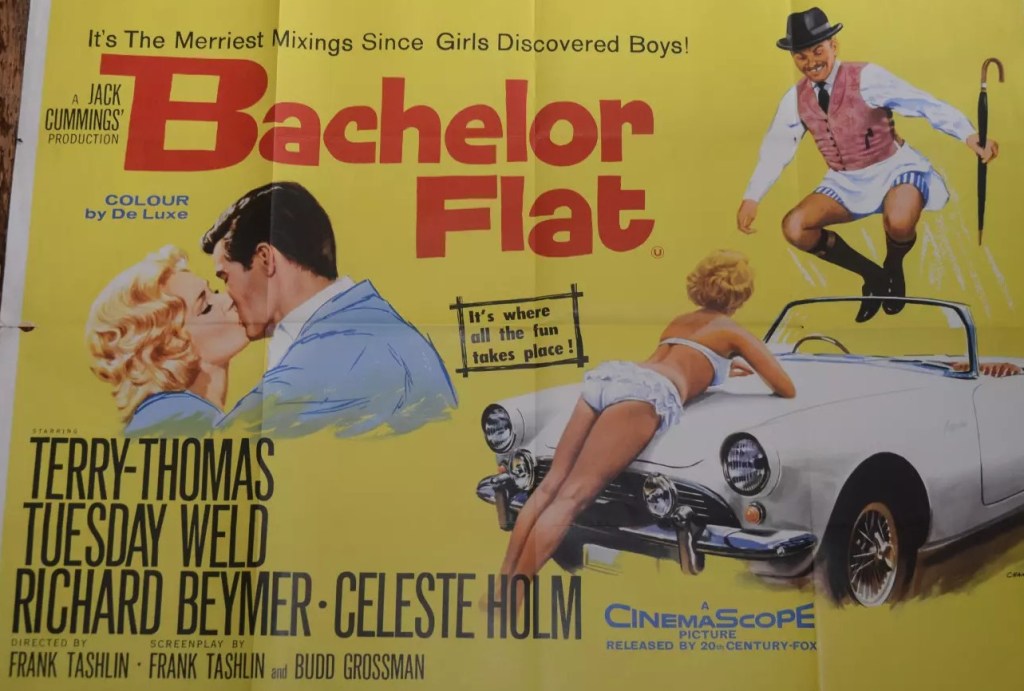
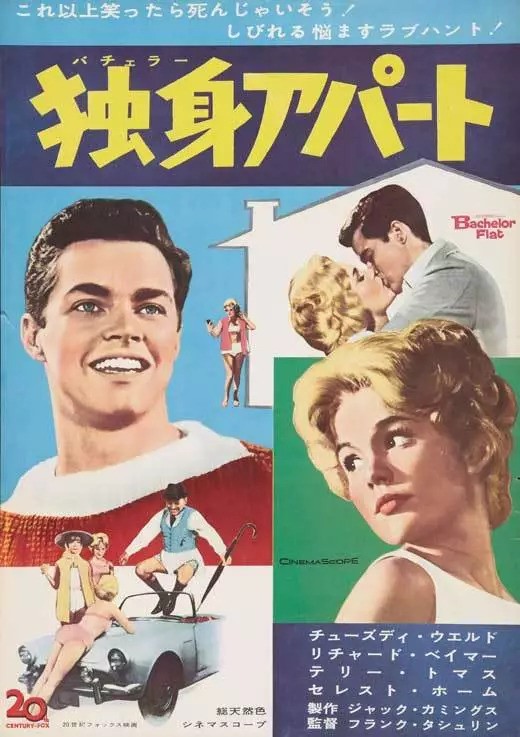
Bachelor Flat (1961) ****

Stereotypical Englishman reinvented. Where the suited-and-booted traditional British gent, umbrella at the ready, moustache awaiting twirling, bristling with pomposity, usually of military background and inclined towards the pedantic, was treated as a figure of fun, here in a marvelous conceit he is instead catnip to the ladies. You could imagine this was somewhat prophetic given the imminent arrival on Hollywood shores of such testosterone-charged figures as Sean Connery, Richard Harris et al.

All the elements that previously pointed to mickey-taking – impeccable manners, a sense of fair play anathema in the cut-throat American world, respect extended towards the opposite sex – are here presented as such ideals that the entire female population of a small town is swooning at the feet of its only known Englishman.

What’s more, director Frank Tashlin (The Glass Bottom Boat, 1966) doesn’t ask star Terry-Thomas (Arabella, 1967) to lampoon himself, as would often later be the case, where the actor was called upon to play an overstuffed romantic fantasist of the Bob Hope variety or presented as comedic villain or overacting butler. Instead, Terry-Thomas plays it straight, oozing astonishing charm that allows the slapstick and farcical ingredients to work a treat.

Sure, it’s mostly a dressed-up farce, people hidden in cupboards and under beds, doors slamming in faces, faces drenched in cake, and in a sharp swipe-left on gender equality, the man, rather than the woman, mostly seen in a state of undress.

Professor Patterson (Terry-Thomas) throws his adoring mostly adorable students into a tizzy when they discover he is engaged to actress Helen (Celeste Holm) currently residing in Paris. They met when the academic rented her beach house which is where Libby (Tuesday Weld) comes in. Astonished to discover a stranger in her mother’s house, Libby doesn’t let on she’s Helen’s daughter and instead pretends to have escape from juvenile detention. Helen has so far balked at telling her lover she has a 17-year-old daughter by a previous marriage.

Professor’s young neighbor, law student Mike (Richard Beymer), takes a shine to his unwelcome guest, but he’s mostly there to add complication to complication.

Usually, in these farces, it’s the guilty man trying to hide his various lovers from one another, hence stowing them away in cupboards and beds and whatever. But here the professor is a determined innocent who has to stoop to such shenanigans to pretect his integrity. But not only is he assailed by Libby but also by student Liz (Ann Del Guercio) who lets down his tyres so she can run him home and neighbor Gladys (Francesca Bellini) who makes eyes at Mike as a way of infiltrating Patterson’s defences. Added complications are a suspicious cop and a rival academic.

So when Patterson is not trying to keep the various female invaders from discovering one another, or the cop or Mike from finding them stashed away, he’s trying to fruitlessly explain how he has been snagged by the aforesaid predatory women. And of course when his fiancee returns there’s no queston she’ll catch him in some questionable act.

In some senses this is pretty formulaic stuff but it is brightened immeasurably by some choice lines (“I don’t take money from strangers unless I steal it” and “either you get a smaller bone or I get a bigger dog”), the occasional madcap situation (one of his suitors eating a slice of cream came while on a vibrating slimming machine and Mike discovering how Libby fed him a line), but mostly by the spirited playing of Terry-Thomas and Tuesday Weld. Apart from a small part in Tom Thumb (1958) this was the actor’s introduction to Hollywood and it says a lot for his talent that he’s entirely believable as the kind of charmer that women flock to.

Tuesday Weld (Pretty Poison, 1968) is more than glamor on legs and finesses her first top-billed role into surprising depths beyond the obvious enthusiastic ingenue, especially given her Ann-Margret-style shake-your-booty introduction, suggesting talent to burn. Richard Beymer (West Side Story, 1961), who was holding a real-life candle for Ms Weld, is little more than eye candy for the female gaze. And if none of this trio is sufficient to hold your attention, there’s a cute dog.

Frank Tashlin occasionally made films with more acerbic bite, but this isn’t one of them. It sticks to a magic formula that works mostly thanks to the two principles.

Raised up a good notch by the revelatory performance by Terry-Thomas, his drunk scenes are just superb and unusually played, and you probably can guess from this where Four Weddings and a Funeral (1994) got its rain-soaked proposal scene.

Tremendous fun.

Period of Adjustment (1962) ***

You want angst, frustration, tragedy, Tennessee Williams is your man. Comedy? Not so much. He had pretty much supplied Hollywood with an unending stream of hits. From The Glass Menagerie (1950), quadruple Oscar-winner A Streetcar Named Desire (1951), triple Oscar-winner The Rose Tattoo (1955) and four-time Oscar nominee Baby Doll (1956) to Cat on a Hot Tin Roof (1958) with six nominations, Suddenly, Last Summer (1959) three nominations, The Fugitive Kind (1960), Summer and Smoke (1961) four nominations, and Oscar-winner Sweet Bird of Youth (1962) his movies attracted the cream of Hollywood.  The likes of Marlon Brando (twice), Elizabeth Taylor (twice), Montgomery Clift, Vivien Leigh, Paul Newman (twice) and Katharine Hepburn stood in line for the honor of participating.

Tennessee Williams was, unusually for a writer, a marquee name. He promised sensation, sex, scintillation. Audiences in need of a few laffs didn’t look towards his work.

So what to make of his first comedy? He was the biggest name by far involved. And the marketeers made sure audiences were aware this was a comedy and not a searing drama. But absence of the kind of big-name star generally associated with the playwright’s adaptations might have made them leery. Director George Roy Hill making his debut. Anthony Franciosa in his first top-billed role, fourth movie for Jane Fonda, Jim Hutton downgraded to second male lead from being star of his previous picture, Lois Nettleton in her debut. But who knows? It might make stars of them all.

The story itself is slight. A couple with different expectations of each other coming to terms with marriage. There’s a racy element, too. New husband George (Jim Hutton) is suffering from stage fright, can’t deliver in the bedroom department on their honeymoon. Wife Isabel (Jane Fonda) is a bit too ditzy, far removed from the efficient nurse he fell, too fast, in love with. He’s got some odd ideas of his own, a hearse his notion of acceptable transportation.

Anyway, they end up in the home of his Korean War buddy Ralph (Anthony Franciosa) whose marriage to Dorothea (Lois Nettleton) is in tatters. It’s a soft soap version of Who’s Afraid of Virginia Woolf as the newly-weds get a glimpse of what can happen way down the line when marriage is out of control.

Luckily, it’s built as a comedy not as drama, so nothing gets that much out of control and if anything it’s heading in the direction of warm-hearted as the newly-weds find ways to patch up their differences while the warring couple discover exactly what’s gone wrong with their relationship, primarily that good old Ralph married his wife for her money.

But, mostly, instead of trying to fix their own marriages, the couples are more intent on offering advice to the other. The pal’s in-laws take the brunt of the blame. Dysfunctional family and potentially dysfunctioning family have to suck it up and change.

There’s some obvious comedy thrown in to lighten the load, this taking place at Christmas, a bunch of choristers, going door to door, get drunker with every stop-off. But the movie doesn’t quite go in the direction you expect. There’s no easy fix, though there is a fix, but each character goes through a definite change rather than just flipping a switch.

Though Jane Fonda (Barbarella, 1968) is the one who became a star, it took her quite a few acting iterations to achieve it, and this sees her going down the Marilyn Monroe route of  blatant sexiness so in a sense hers is the least interesting character because she’s so shallow to begin with. Anthony Franciosa (Fathom, 1967) is the pick, in part because he’s playing a more genuine character rather than the schemer or matinee idol that he essayed in so many later movies. Jim Hutton (The Hellfighters, 1968) is still in lightweight mode.

George Roy Hill (Butch Cassidy and the Sundance Kid, 1969) is occasionally stagey in his direction but manages to pull out the performances required to make this work. Isobel Lennart (Funny Girl, 1968) does the adaptation.

Not just for Tennessee Williams or Jane Fonda completists.

The Ballad of Josie (1967) ***

What was viewed as an oddity by the star’s legion of fans has turned out to have considerable contemporary appeal, situating Doris Day as an unlikely feminist icon. It was almost the opposite of her current template. She didn’t sing and the narrative was not driven by romantic mishap. It didn’t endear director Andrew V. McLaglen to his fans either after the tough-guy heroics of Shenandoah (1965). And you might also ask the question – was the feminism watered down by slapstick in order to make it more acceptable to the general audience.

One issue extremely relevant today is pretty much skated over. Josie (Doris Day) kills her drunken husband after setting about him with a pool cue. His death was largely misadventure, he fell down the stairs escaping her intended blow rather than as the result of it. What’s the world coming to, muse the men of the town, if a woman could get away with defending herself against a brute of a husband in such a fashion, given it’s accepted that a wife needs knocked about once in a while.

That she gets off seems less to do with understanding than narrative convenience. It turns her into a widow, and deprived of her son (removed by the threat of legal action by her father-in-law) that means she will come in handy for married men fancying an affair. Unable to find respectable work, she has one catastrophic shift as a waitress. In narrative terms this is intended to act as the ultimate humiliation but in terms of screen treatment it’s convenient excuse for slapstick.

For some reason best known to screenwriter Harold Swanton (Rascal, 1969), she appears best placed to influence the female townspeople on a delicate political point. Whether such influence is due to her getting away with bumping off her husband is never made clear. Turns out that women in Wyoming have the vote and in their battle for statehood the men believe that will count against them and want Josie to get them to agree to drop that right. (History tells us that the good folks didn’t enforce that and allowed women to keep the vote, so three cheers for Josie.)

Those two elements – wife-beating and voting – would make a darn good movie right there but they seem to just dip in and out of proceedings unless in some lame humorous instance. What does take center stage though is Josie’s battle for independence,  not wishing to “be taken care of” by some man. She argues that “you can’t kick under the rug that women are also people” and agin the notion that a woman is “a species of idiot kept in the back closet and spoon-fed three times a day.”

So she decides to become a cattle rancher. That inflames the ire in equal measure of suitor Jason (Peter Graves) and deadly enemy Arch (George Kennedy). And pretty much she is setting herself up for failure until she comes up with the notion of raising sheep rather than cows. The sheep vs. cows argument has been surprisingly well covered in the western – witness The Sheepman (1958), Heaven with a Gun (1969) and, in more recent times, 1923 (2022) – and here they decide the two animals are best kept apart by geographical divide. The sheep are really another narrative device, cue for more slapstick-style sequences, and as you know a sheepdog will tear the britches off anyone foolish enough to get in its way.

It’s somewhat astonishing that within this unwieldy set of confounding narratives that this works at all. And mostly that is down to Doris Day (With Six You Get Eggroll, 1968)  junking her previous persona of feisty female willing to be wooed by ardent or cunning male. While her anger often comes over as more like petulance and you would never mistake her for an Elizabeth Taylor or Maureen O’Hara as a woman not to cross, she does comes out of this with some credit. Peter Graves (Sergeant Ryker, 1968) and George Kennedy (The Pink Jungle, 1968) are merely adequate. Andrew V. McLaglen doesn’t show much gift for comedy apart from the most obvious but presumably he’s to be thanked for even venturing into such difficult territory.

Whether it was, as I said, a deliberate attempt to bring feminist issues to the fore, or to sneak them in under the guise of comedy, is a moot point. The star always claimed she was duped into the role, finding her husband Martin Melcher had signed her up for it without her knowing.

Rocket to the Moon / Those Fantastic Flying Fools (1967) ***

The Jules Verne express grinds to a halt in part because the promise of outer space adventure fails to materialize and in part because the treatment is comedic in the manner of  The Great Race (1965). A series of sketches with a shifting array of characters rarely works. Occasionally it hits the mark in a laugh out loud fashion but too often the jokes are labored  although as a tribute to a maze of inventive invention it’s a treat.

Unusually for such an all-star cast venture, we are, long before the titular action  and a race (of sorts) commences, treated to the greatest hits from the book of all-time failures. So we have electricity setting on fire the first country house, belonging to the Duke of Barset (Dennis Price), to be so illuminated; a new-fangled suspension bridge, courtesy of Sir Charles Dillworthy (Lionel Jeffries), that collapses when Queen Victoria cuts the ribbon; and a new type of explosive invented by German von Bulow (Gert Frobe) that proves a tad overpowering. Meanwhile, making possible the idea of sending a man to the moon is the arrival in Britain of the diminutive General Tom Thumb (Jimmy Clitheroe) accompanied by the bombastic and greedy Phineas T. Barnum (Burl Ives).

Combining the various scientific advances of propulsion and engineering have the flaw of not being able to bring a manned rocket back home. And sinister forces are at work, spies and fraudsters.

As with all these all-star comedies you spend half the time wondering how your favorite star is going to be worked into the equation and, having been squeezed into the narrative, justify their ongoing involvement. Daliah Lavi (Old Shatterhand, 1964), not particulary known for her comic gifts, is a case in point. On her wedding day she (as Madelaine) jilts French groom Henri (Edward de Souza) in favor of balloonist Gaylord (Troy Donohue) who has, literally, appeared on the horizon. Henri trying to down said balloon triggers an awful joke about a shotgun wedding.

To gain revenge, Henri funds the project on the basis of Gaylord being the moon pilot, and, in anticipation of the craft’s failure, that he will regain his bride. Madelaine, having been sidelined by all the developments, suddenly rushes back to center stage when she uncovers the devious plot and is shipped off to a home for wayward girls, run by the very wayward Angelica (Hermione Gingold). But that requires she escape and find her way back to her beloved, that aspect complicated because she loves both men (it transpires).

As the script is in the invidious position of having to place the participants into similar frying pans in order to effect similar rescues it’s as much a game of ping-pong as a movie. But there are some nice gags, a rocket attached to a helmet, the ruination of a teleprinter and the criminally-inclined Washington-Smythe (Terry-Thomas) who rooks billiard players with a magnet. And there’s a very contemporary financial element in that large wagers are placed on failure rather than success, the equivalent of betting on stocks going down rather than up  (short selling in the modern idiom)

The rocket is launched, with rather a different crew than originally anticipated following further skullduggery, and although it’s something of a cosmic joke that it only gets as far as Russia it’s rather a disappointing ending for fans of Verne who anticipated a more rigorous approach. Verne’s novel From the Earth to the Moon was surprisingly accurate in imagining how a projectile would achieve its aims. The novel had even more of a contemporary feel since it left the crew floating in space, a daringly artistically inconclusive climax, leaving the way open – again the contemporary flair – for sequel Around the Moon that explained their fate.

Oddly enough, Daliah Lavi, as the bride who can’t make up her mind, has one of the better parts, more fleshed out than most of the other flimsy characterizations. The likes of Troy Donohue, caught between heroism and doing nothing much at all, often looks flummoxed. Terry-Thomas (How To Murder Your Wife, 1965) in wily mode is the pick of the rest.

Director Don Sharp (The Brides of Fu Manchu, 1966) proves that comedy is not his metier. Screenplay by Dave Freeman (British TV sitcom writer making his movie debut) after Harry Alan Towers (Five Golden Dragons, 1967) altered the author’s original premise. While it could be skewered for taking such liberties with the august author, it is far better than you might expect, but not as good as it could, or should, be.

Unfrosted (2024) **

It’s an easy trap to fall into. You believe a much-loved actor couldn’t possibly lead you so astray. You are determined to give him every chance to proof your instincts wrong. You turn off at 15 minutes, then you feel you’ve done him an injustice, after all he is a major figure making his directorial debut, shouldn’t you cut him more slack? You switch off again at 35 minutes and are hit by the same guilty feelings. So you stick it out till the end and what do you get? One decent sequence with JFK of all people berating our nincompoops for asking for a favor when in one of his most famous speeches he had pointedly said, “Ask not.”

Indulgence gone mad. Or, just another day in the wacky world of Netflix. Honestly, who in their right mind would greenlight the directorial debut of a television comic who has never made a  movie, clearly doesn’t understand what makes a movie, and that a 90-minute picture needs a completely different approach to a 25-minute television episode, and as obviously couldn’t care less?

There’s enough to satirize in the world of business instead of some dumb satire about the creation of a cereal that defies convention. If it was such a massive success story why did it take so long so cross the Atlantic,  a couple of decades as far as I’m aware. But then, over here, we were still struggling just to work out why we needed to buy a toaster when you could just toast bread under a grill.

Clearly, the director-star Jerry Seinfeld, who’s always been enamored of his own material, was bored with being so wealthy that he decided he would inflict his latest joke on a disinterested public. I own up to having been a big fan of the Seinfeld schtick of a show about nothing and perhaps that’s where he’s gone wrong here. Because this is about something. At the very least rivalry between two cereal giants.

But these two apparently great companies are run by people who don’t notice that the cleaner sticking his mop in your face has a camera attached to it and the guy appearing at an inappropriate time in your business strategy meeting has (wait for it) a camera attached to his vacuum.

Sure, Seinfeld has rounded up a bunch of his pals and you can spot the likes of Amy Schumer, Melissa McCarthy, Christian Slater and Jon Hamm. It says a lot for their acting intelligence that they all thought this was a humdinger. I did like Hugh Grant playing Tony the Tiger since he’s grown a lot better at making a fool of himself.

The bizarre aspect of the whole enterprise is that there’s certainly a truth here. Any new product can have significant effect on other players in the market. Here, it was milk and sugar.  A breakfast item that does not require milk is going to damage sales of milk, forever associated with breakfast and as one of the characters so crassly puts it the first thing everyone ever drinks (birth is the clue in case you need that spelled out). Sugar is coyly referred to as the “white powder,” making a connection with that other well-known epidemic, and only in passing ruminating on the damage sugar has done to teeth, without making the obvious link between why milk, which is so good for you, is associated with sugar, which is so bad,

In the middle of it Seinfeld prances around like an inane cat, the same dry delivery that worked in in his series painfully not working here. Everyone else looks as though they are having such fun, like this is a pantomime and everyone can just, well jolly gee, over-act to their heart’s content.

This kind of picture is by now par for the course for Netflix. Hollywood had a name for this kind of movie. Vanity project. Usually, it was the price to pay for being contractually saddled with a star so big. Or, having been saddled with such a disaster, you could extract payment in the form of them making a film they had previously balked at. Sometimes, you end up doing both of you an enormous favor, The Sixth Sense, a colossal hit, the price Bruce Willis paid for his vanity project. Who says vanity doesn’t pay?

The galling part is that the fact that I’ve stuck through it will be notched up as a success by Netflix, added to the millions of other watched minutes by which the company determines a hit, rather than having some way of measuring how many switched off a sixth of the way through like I should have done.

I don’t even know why I’m giving it two stars.  In terms of laffs, it’s got as many as Orgy of the Dead, my all-time stinker.

Avoid.

The Great Race (1964) **** – Seen at the Cinema

And not just any old cinema, but the 87-year-old Fine Arts in Los Angeles, I guess the second oldest movie house still standing there, with admission a princely 50 cents and the whole place done out in a gaudy red. I was taking time out from a research mission to the Academy of Motion Pictures Arts and Sciences’ (the Oscar people) equally famous Margaret Herrick Library, where I was digging up stuff for my next book about the films of Alistair MacLean.

And where I discovered to my unimaginable delight they they had my books on their shelves. I’ll never win an Oscar and bestsellerdom will continue to evade me, but for a writer of books on movies, there can be no greater honor than to have your works on the shelves of Hollywood’s most important library. Since data protection will prevent me from discovering who has checked out my books, I can safely imagine that it was bound to be Harrison Ford, Greta Gerwig, Christopher Nolan and/or Steven Spielberg.

Anyway, enough of that self-congratulatory nonsense and on with the show. If you’ve any memory of this picture – jaunty jalopies battling it out at the start of the 20th century when suffragettes were raising hell – it’ll be for the slapstick. The upfront feminism most likely  passed you by. A savvier female you would be hard put to find, especially one that susses out exactly that when a male falls in with her views it’s just to get her into bed. So, from the contemporary perspective, this is a far harder-nosed picture than the fluffy narrative suggests.

Setting aside the famous pie-throwing homage to silent film pie-throwing (and every circus clown act since Doomsday) and a couple of sequences that outlive their welcome and the odd decision to find a plotline that can accommodate Jack Lemmon going down the (almost) identical twin route, this is pretty much sheer delight.

Characters could not be more black-and-white – in visual terms as well – than rival mechanical whizzes The Great Leslie (Tony Curtis) and Professor Fate (Jack Lemmon) except for the much more rounded (in character terms) interloper Maggie Dubois (Natalie Wood) as a reporter. Not content with being a legend in his own lunctime, the mad professor follows the Gore Vidal tack of being upset by any rival’s successes. However, he’s such an incompetent saboteur he doesn’t realize he’s merely the feed for a number of superb visual gags.

The Great Leslie, smile resounding with the Colgate audible zing, doesn’t have much to do except expound the principles of fair play and occasionally demonstrate his fencing skills when the plot turns sideways. Maggie is the ace inveigler, and when that doesn’t work resorts to handcuffs to ensure she will not be moved or someone else will be stuck fast. Standard bearer for female equality, she manages to put all the arguments without sounding dull, especially as, verbally, she is dealing with a keen dueller. And when she’s not switching sides, she’s rooting for the good guy.

The plot could have come out of a dishwasher but roughly equates to a round-the-world road race with most countries conveniently missed out, ending up in Paris with a stop-off somewhere in Germany. The deliberately cartoonish feel shouldn’t work at all, especially for a contemporary audience, but then we all laughed at Dumb and Dumber and plenty comedies with even less of a one-note touch. Thankfully, there was no such thing as deconstructed comedy in those days so everyone enters the spirit of the thing. And it’s quite refreshing to watch stuff being blown up and falling apart not for overblown thriller or comicbook reasons.  

I wasn’t taken with the overlong sequence in the saloon – extended singing and brawl (heck, what else are saloons for) – and wasn’t so hot on the legendary pie section either and certainly the notion that Professor Fate could be such a doppelganger for a dumb German prince that the powers behind the throne plan to substitute one for the other seems to belong in the furthest reaches of the Far Fetched Highway.

But there are so many gags and the characters, no matter how cartoonish at times, seem true to themselves, and with Maggie on hand to constantly upset the misogynistic applecart it seems a tad picky to be so picky. I was astonished that the audience I watched it with, primarily much younger than I, were so tickled.

Tony Curtis (The Boston Strangler, 1968) and Jack Lemmon (How to Murder Your Wife, 1965) repeat the magic of Some Like it Hot (1959) thanks to the strong directorial hand of Blake Edwards (The Pink Panther, 1963). Natalie Wood (Bob and Carol and Ted and Alice, 1969) shines. Rare comedy role from Peter Falk (Penelope, 1966). Excellent support from Keenan Wynn (Warning Shot, 1966). Edwards co-wrote the script with Arthur A. Ross (Brubaker, 1980).

Certainly more than stands the test of time.

Candy (1968) **

Ode to the male gaze. Once a cult vehicle, this will struggle to find favor these days what with its backward attitudes. Virtually impossible to excuse the rampant self-undulgence. The sexually exploited naïve Ewa Aulin in the title role didn’t even have the benefit of being turned into a star. The satire is executed with all the finesse of a blunderbuss. And while, theoretically, picking off a wild range of targets, if this movie has anything to say it’s to point out how easy it is for men to deify themselves at the slightest opportunity.

Not much of a narrative more a series of sketches slung together with the slightest connecting thread. Most its appeal lies in watching huge marquee names make fools of themselves. Or, if you’re that way inclined, seeing how much nudity will be imposed on the star, intimacy  rarely consensual, clothes usually whipped off her.  

Teenager Candy (Ewa Aulin) has father issues, daddy (Jack Austin) being a dumb angst-ridden teacher. Randy poet McPhisto (Richard Burton) drives a class of schoolgirls into a frenzy with his lusty reading, inveigles Candy into his chauffeur-driven car, ends up in her basement drunkenly humping a mannequin while Mexican gardener (Ringo Starr) with an accent as coruscating as that of Manuel from Fawlty Towers assaults her on pool table.  Scandalized father packs her off to his twin brother in New York, that notoriously safe haven for nymphettes, while on the way to the airport they are almost driven off the road by the gardener’s vengeful biker sisters (Florinda Balkan et al).

For no apparent reason she is hitching a lift on a military plane commanded by randy Brigadier Smight (Walter Matthau) who, on the grounds that he hasn’t had sex for six years, commands her to remove her clothes for the good of the nation. In the Big Apple, rock star surgeon Dr Krankheir (James Coburn), entering the operating theater to the same kind of waves of acclaim as McPhisto, finds an excuse to have her undress and submit to him, this just after she’s managed to avoid the attentions of her randy uncle. It should come as no surprise that Krankheit treats women as his personal property to the extent of branding them like cattle.

In due course, she encounters a gang of mobsters, an underground movie director and a hunchback (Charles Aznavour) who, in return for her showing pity for his condition, proceeds to rape her. She is arrested. Guess who wants to frisk her. Naturally, when she escapes she runs into a bunch of drag queens.   

Then she finds sanctuary in a semi-trailer truck, home to guru Grindl (Marlon Brando). He’d be convincing enough as a mystic except he, too, finds an excuse to rip her clothes off. There are more cops to contend with and another guru, facial features obscured by white clay. If they’re going to have sex then naturally it must be in a Hindu temple. Turns out the latest person to take advantage of her is her father but he’s been handed a get-out-of-jail-free card because by now he’s brain damaged.

This might all be a dream/nightmare. Candy might even be an alien. It’s dressed up in enough psychedelia to sink a battleship and its highly likely that any lass as gullible as Candy will find herself at the mercy of any man, so in that context it carries a powerful message. I’m sure many beautiful young girls will attest to the truth that men feel they have the right to paw anyone who comes their way without asking permission. And the other message is just as powerful – how many young actresses have been seduced by thoughts of fame to disport themselves in this fashion only to find that all the industry wants is their nudity not their acting talent.

You might say that the target is so obvious it hardly needs pointing out but the MeToo campaign will beg to differ and you would hope that Hollywood has wised up. It’s just a shame that the satire is so heavy-handed. The military and the medical profession are sorely in need to answering tough questions. Unfortunately, this picture doesn’t ask any. It’s like an endless casting couch.

Directed by Christian Marquand (Of Flesh and Blood, 1963) in, thankfully, his final picture, from a screenplay by Buck Henry (The Graduate, 1967) and Terry Southern (Dr Strangelove, 1962) based on the novel by Southern and Mason Hoffenberg. Nobody comes out of this well and it’s rammed full of cameos from the likes of Elsa Martinelli (The Belle Starr Story, 1968), John Huston (Myra Breckenridge, 1970), Anita Pallenberg (Performance, 1970), Marilu Tolo (Bluebeard, 1972) and boxer Sugar Ray Robinson.

Ewa Aulin (Start the Revolution Without Me, 1971) isn’t given much of chance, her character whimsical, pallid and submissive and she didn’t become a major marquee name.

A mess.

Strange Bedfellows (1963) ****

I had my first belly-laugh within seconds, a wonderful sight gag and was chortling all the way through this London-set battle-of-the-sexes comedy. Carter Harrison (Rock Hudson) is a high-flying businessman who needs to win back long-estranged wife Toni (Gina Lollobrigida) in order to gain promotion at a family-conscious oil company. Initially, Carter re-discovers the reasons he had first fallen in love with her but then, of course, only too bitterly, why they split. Hudson and La Lollo had previously teamed up for Come September (1963) and Hudson had spent most of the 1960s in romantic mishap with Doris Day so he could call on an extensive range of baffled and enraged expressions. Toni is an artist-cum-political-firebrand which sets up hilarious consequence. Richard Bramwell (Gig Young) is on hand to act as referee.

There’s some marvelous comic invention, a conversation between the two principals relayed through taxi controllers turns into a masterpiece of the misheard and misunderstood. Complications arise from Toni’s Lollobrigida’s fiancé Harry  (Edward Judd from First Men in the Moon, 1964), also an activist, but on the pompous side, and an Italian lothario. Taking advantage of the less than congenial London weather, there are jokes aplenty about umbrellas and in a nod to farce occasions for Carter to lose his trousers and share a bed with the fiancé. Smoldering sexual tension also kindles many laughs. By the time the film enters its stride it’s one comedic situation after another. It being England, naturally enough Lady Godiva is involved.

Hudson in suave mode trying to cope with the feisty Lollobrigida is an ideal comedy match. Costume designer Jean Louis has swathed the actress in a stunning array of outfits, some of which leave little to the imagination. When Doris Day got angry you tended to laugh, not quite believing this was anything more than a moderate hissy fit, but if you crossed Lollobrigida you were apt to get both barrels and it never looked like acting, she was a very convincing when she switched on the fury engine, plus, of course, whatever she threw added both to the comedy and her character’s conviction.   Both have terrific comic timing.

Writer-director Melvin Frank was something of a comedy specialist, a dab hand at suiting comedy to screen persona having previously set up Road to Hong Kong (1962) and Mr.  Blandings Builds a Dream House (1948). Terry-Thomas makes an appearance as a comic mortician and there are parts for English comedian Arthur Haynes and Dave King. Hudson and Lollobrigida exude screen charisma and while not in the class of Come September this delivers enough laughs to make you wonder why they don’t make them like that anymore.

Father Came Too! (1964) ***

The gentlest of British comedies – a fading subgenre after the infiltration of the genre by the unsubtle Carry On pictures – that on the face of it appears a sequel to the very successful The Fast Lady (1962), featuring the same cast with the exception of Julie Christie. And with both Stanley Baxter (on television) and Leslie Phillips subsequently outpointing James Robertson Justice in the stardom stakes, contemporary audiences tend to come at this from a mistaken perspective.

James Robertson Justice was at the time very much a British institution and if not the star you cast him at your peril as he was likely to steal the picture from better-remembered actors such as Dirk Bogarde in the Doctor series, Margaret Rutherford in Murder, She Said (1961), David Niven in Guns of Darkness (1962) and Omar Sharif in Mayerling (1969). He was a big burly man with a bushy beard and a loud hectoring style, more Brian Blessed (Flash Gordon, 1960) than Robert Morley (Oscar Wilde, 1960).  

Misleadingly, the posters suggest another motor-centered tale.

He wasn’t the star of The Fast Lady and if it hadn’t been for the presence of Julie Christie (In Search of Gregory, 1969) he would have stolen that movie too. But when he was the denoted star, as here, the picture is built around him, so it’s not, actually, the tale of a young couple buying a money pit of a house, but of the male version of the interfering mother-in-law who makes their life merry hell.

Just married Dexter (Stanley Baxter) and Juliet (Sally Smith) purchase what appears an idyllic cottage in the countryside only to discover it requires a great deal of work. Renowned actor Sir Beverly Grant (James Robertson Justice) resents losing his daughter to a man he distrusts and to her moving out of his very grand home (named Elsinore, though I wonder how many viewers got that connection).

His attempts to take over the re-building programme are rebuffed by his son-in-law who hires the kind of builders, led by Josh (Ronnie Corbett), who give builders a bad name, tearing more tiles off the roof than they replace, creating more work for themselves or proving incompetent wherever they go. There’s a subplot involving real estate agent Roddy (Leslie Phillips), a budding thespian, desperate for the actor’s seal of approval.

But mostly, it’s everything going wrong and the father getting in the way and making things worse. But the tale doesn’t revolve around the hapless hero but around the domineering father and audiences back in the day would have recognized this, revelling in the father’s performance rather than trying to get on the side of the son-in-law.

Mostly, too, the comedic trick is slapstick, foot in paint pots, falling through floors, ceilings and roofs, an invasion of cows (one with the inevitable bonnet), being drenched by as much water as you could get on a set, and Dexter wringing his hands as the calamities – and the budget – mount.

Usually, the young couple taking on the world scenario just results in them encountering trouble from neighbors or various representations of authority and generally the focus from the outset is on them. But, here, it’s the opposite, audiences of the time waiting, not so much to see what new disaster will befall the couple, but to enjoy the carnage the father visits upon them. And viewed from that perspective it becomes far more enjoyable.

He’s far removed from the interfering mother-in-law cliché because that element of any comedy was usually a subplot played by a character actor who rarely evoked any audience sympathy. But audiences came to a James Robertson Justice picture to enjoy the mayhem he caused. He had screen charisma in spades, and especially when the screenplay was tilted in his favor, was apt to totally dominate a movie. And this is him at his best.

Stanley Baxter was somewhat miscast as a whiny incompetent husband – or, rather, he was not given a part which best utilized his uncanny skill for impersonation as later shown in his eponymous hugely successful television show. Leslie Phillips plays against type, more of an ingratiating Uriah Heep type than the uber-confident lady killer. Sally Smith (Naked You Die, 1968) hasn’t a hope of emulating Julie Christie. A slew of television comics – apart from Barker you can spot Terry Scott, Hugh Lloyd, Fred Emney and Kenneth Cope – put in an appearance.

Director Peter Graham Scott (Subterfuge, 1968) lacks prequel director Ken Annakin’s madcap zest but keeps it going none the less. Jack Davies (North Sea Hijack, 1980) and Henry Blyth (The Fast Lady) are as inventive as the idea permits.

Good old-fashioned fun but requires to be viewed from the correct character perspective.

How Sweet It Is (1968) ***

You’d have thought by now leading men would be running shy of Debbie Reynolds, aware just how easily she would steal the picture out from under the top-billed star (witness Goodbye Charlie, 1964). But she had producers clamouring for the fizz she brought. Her comic skills, and willingness to entertain slapstick, were matched only by Doris Day. Especially helpful when she’s saddled with a convoluted plot that’s one-third generation gap comedy, one-third If It’s Tuesday It Must Be Belgium and one-third the kind of creative thinking that determines that somehow or other the female star must end up in a brothel. Throw in some flower power, split-screen, stills montage and slow-mo and you’ve covered all the bases.

In this hit-and-miss line-up, by far the most amusing element is that it’s the adults – photographer Grif (James Garner) and wife Jenny (Debbie Reynolds) – who are sex-obsessed, sneaking away at every opportunity for a bit of hanky-panky, trying to avoid the disapproving eyes of their virginal teenage son Davey (Donald Losby).

An odd example of creative license here. Poster designers had decided that red was the color no matter what. In the last section of the movie Debbie Reynolds parades in a blue – not red – bikini and the book on which it is based is called “The Girl in the Turqoise Bikini.” I’m not sure the color of the bikini is that much of a plot point unless it’s to hook readers of the original novel, but it’s mighty strange for the poster people just to change the color.

The narrative determines that Davey joins girlfriend Bootsie (Hilarie Thomson) and her lithe gal pals on a tour of Europe accompanied by Grif who has been commissioned to photograph the trip. Much to Grif’s horror, Jenny decides she’s going to follow them and hires out a swanky pad where the grown-up lovebirds can make a nest at some undetermined point.

The picture quickly loses interest in Grif and the girls, beyond an attractive tour guide making a pass at Grif and of course their bus getting stuck in the mud. Not only is the Jenny segment more intriguing – turns out she’s been conned by Gilbert Tilly (Terry-Thomas) into handing over a thousand bucks for a chalet he’s not entitled to hire out – because she gets romanced in high French style (champagne and flowers in case you’re bursting to know) by legal lothario Philippe (Maurice Ronet) and every now and then finds herself wearing little more than a bikini and sometimes nothing at all.

Takes a heck of a long time for the two stories to dovetail so that Grif can flounce off in a huff, punch the living daylights out of the Frenchman, and give the screenwriter the excuse to plonk Jenny down in a brothel (that part, I have to admit, is neatly done). There’s also some unusual class comedy at the chateau, Philippe initially being mistaken for a butler, then having to bunk down with his servant because (guess what) this mansion has only one main bedroom.

For no apparent reason there’s an odd section at the start. Instead of flying to Europe, they take the ship and for no apparent reason they’re stuck on C-deck with a lip-pursing purser (Paul Lynde) who insists males and females must sleep apart and share cabins with strangers. Slot into the miss department the opening with the old trope of the husband coming home to find his wife in bed with another man, except it’s Davey and the parental lovers are enjoying some afternoon delight, though quite how you can stretch that to Davey taking a carving knife up the stairs beats me.

James Garner is no more convincing a photographer than he was in The Pink Jungle (1968) and he hardly gives Debbie Reynolds a run for her money, as if he doesn’t know how to bring this character to life. Except for excelling at the risqué, and she a willing accomplice, he’s coming over like the straight man to her comedienne. Debbie Reynolds is superb, reactions honed to the bone, throwing herself into the part, undergoing whatever humiliation will snare a laugh.

Garner briefly resurrected his career with Support Your Local Sheriff (1969) before he hit the slide (see the previous Behind the Scenes article) and to my astonishment this signalled pretty much the end of Reynolds’ screen career, nothing for the next decades except What’s the Matter with Helen (1971) and a bit part (as herself) in The Bodyguard (1992). You can hardly blame her for screenwriters not coming up with the right material to take advantage of her supreme comedic gifts. Alexandra Hay (The Model Shop, 1969) is wasted, you might just as well have dabbed her role “the sexy blonde.”

Director Jerry Paris (Never a Dull Moment, 1968) throws everything he can at the screen without much success. Future director Garry Marshall (Pretty Woman, 1990) and producer Jerry Belson (Fun with Dick and Jane, 1977) in his movie debut formulated the screenplay from the bestseller by Muriel Resnik.

Far from the last comedy hurrah you would have wished for the actress, but all you’re going to get.  

Discover WordPress

A daily selection of the best content published on WordPress, collected for you by humans who love to read.

The Atavist Magazine

by Brian Hannan

WordPress.com News

The latest news on WordPress.com and the WordPress community.