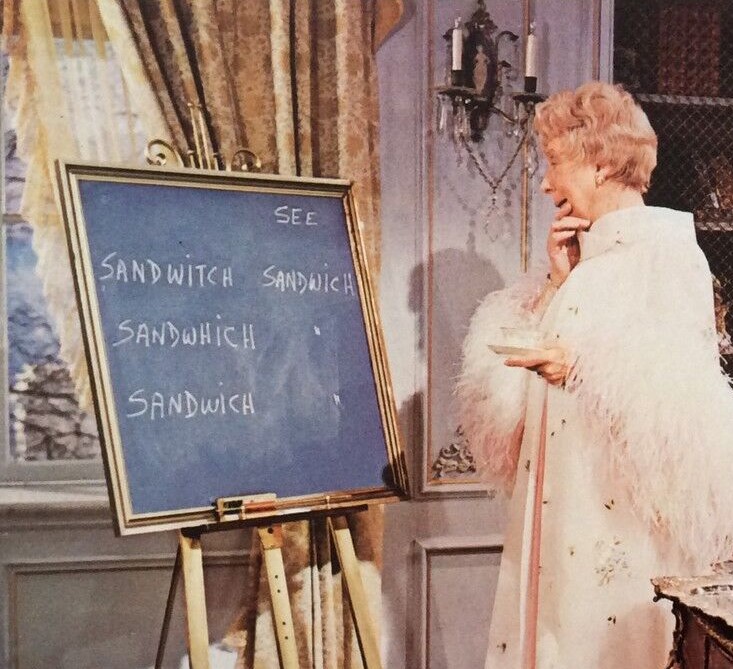
With Six You Get Eggroll (1968) ***

The blended family was so rare in the 1960s you could easily play it for comedy. In retrospect, though, this comes across as a more realistic approach at how game couples find their romance under threat from children hostile to the match. Doris Day’s swansong, she might have done better with a partner zippier on the uptake than Brian Keith, who for the most appears lumpen, and she shoulders most of the physical comedy burden, but it’s a decent end to an extraordinary career. There are shades of Absolutely Fabulous, children remonstrating with parents going off the rails.

Widow Abby is very much the independent woman, running a substantial lumberyard operation, too busy to consider romance and aware her options are limited to deadbeats. She can afford help for the domestic chores. Widower Jake (Brian Keith) faces endless frozen meals and could have as much sex on the side as he wants with married neighbor Cleo (Elaine Devry) whom he constantly rejects. She has three sons, one a teenager who works part-time in the business, he has one daughter, Stacey (Barbara Hershey) also a teenager.

Courtship gets off to a rocky start. Jake, invited to a dinner, is so bored he makes an excuse and leaves, caught out in his lie later that night. Most of the romance takes place in a drive-in hot dog operation since the children make it plain they oppose any union.

But, hey, since the story is also dragging, the couple decide to get married quick. That’s when the trouble starts. Neither house is big enough to accommodate the squad, irritation spills over into full-blown argument, and little can be done to placate the kids, who resent being forced into a situation over which they have no control and having to share a doting parent with a stranger.

Family planning was another big issue in the 1960s and this was an unintended offshoot, the couple making no provision in advance, beyond their own selfish needs, for how their marriage would emotionally affect their children. And although the happy ending doesn’t feel too forced, it does point up the problems of turning two rival families into one supportive team.

Back in the day. audiences probably laughed their heads off at the antics of the disapproving teenagers, but I think most people would approach those scenes with sorrow rather than humor, acknowledging the despair of ignored children facing up to dealing with what they regard as an intruder upsetting a settled family unit. The assumption that kids will make do while parents embark on a joyous ride seems only too unrealistic.

You can see some scenes coming a mile off. When Jake gets too close to a younger woman you guess right away that’s bound to be his daughter and the minute you spot a lorry loaded with chickens you are counting the moments before unexpected collision sets them free. But once the movie settles into the meat of the story it’s on pretty safe ground.

It’s at its best when Doris Day (Midnight Lace, 1960) is permitted space to indulge in physical comedy. The scene where she ends up with a yellow stripe on her attire is priceless and her driving of a camper van leaves much to be desired. Brian Keith (The Deadly Companions, 1961) only has to deal with temperamental cupboard doors. While he’s not in the class of her previous romantic companions like Clark Gable (Teacher’s Pet, 1958), Rock Hudson (Pillow Talk, 1959), Cary Grant (That Touch of Mink, 1962) or James Garner (Move Over, Darling, 1963) by this point in her career she was more than capable of carrying any movie.

Both teenagers were making  movie debts, Barbara Hershey (Last Summer, 1969) coming off best as the sullen female while John Findlater (Airport, 1970) is little more than her companion in creating chaos.

Director Howard Morris (Who’s Minding the Mint, 1967) puts on a decent show given the material. The script was written by Gwen Bagnit, whose last movie credit (western The Last Wagon, 1956) was a decade before, her husband television writer and sometime actor Paul Dubov, and Harvey Bullock (Who’s Minding the Mint).

It’s not quite the career finale Doris Day might have hoped for, but the box office was respectable especially as it faced severe competition from Yours, Mine and Ours (1968), which doubled down on family members, the year’s sleeper hit.

Harmless comedy, perhaps, but the passing of the years has given the movie unexpected emotional heft.

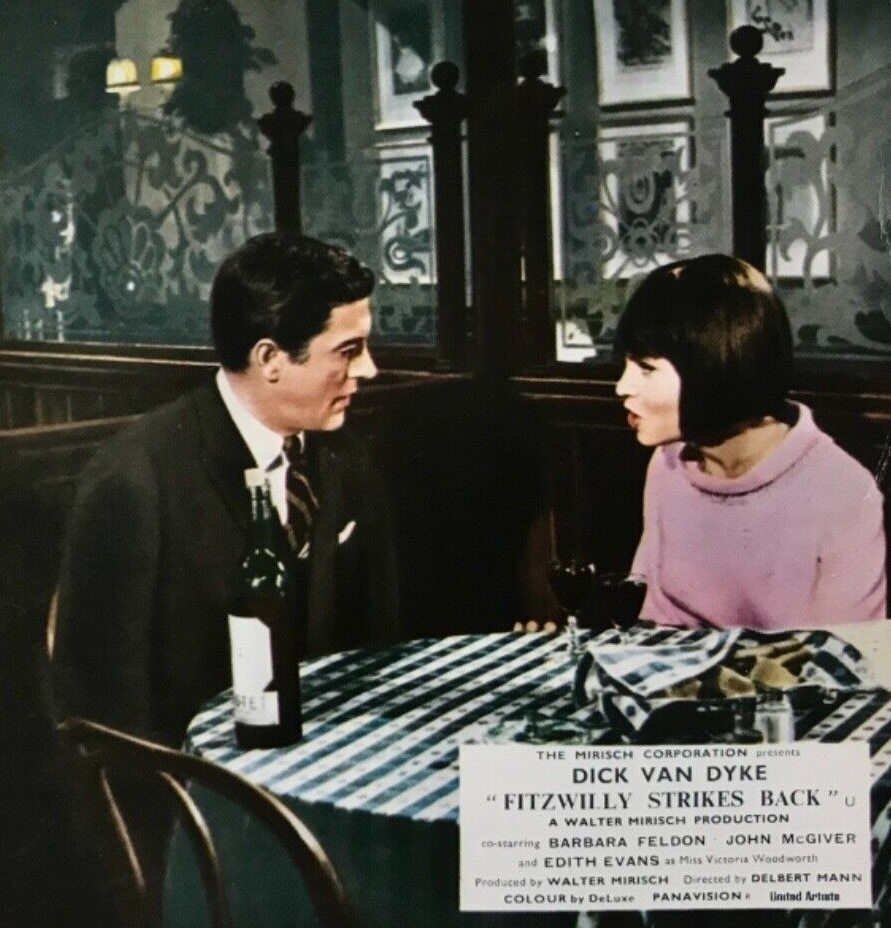
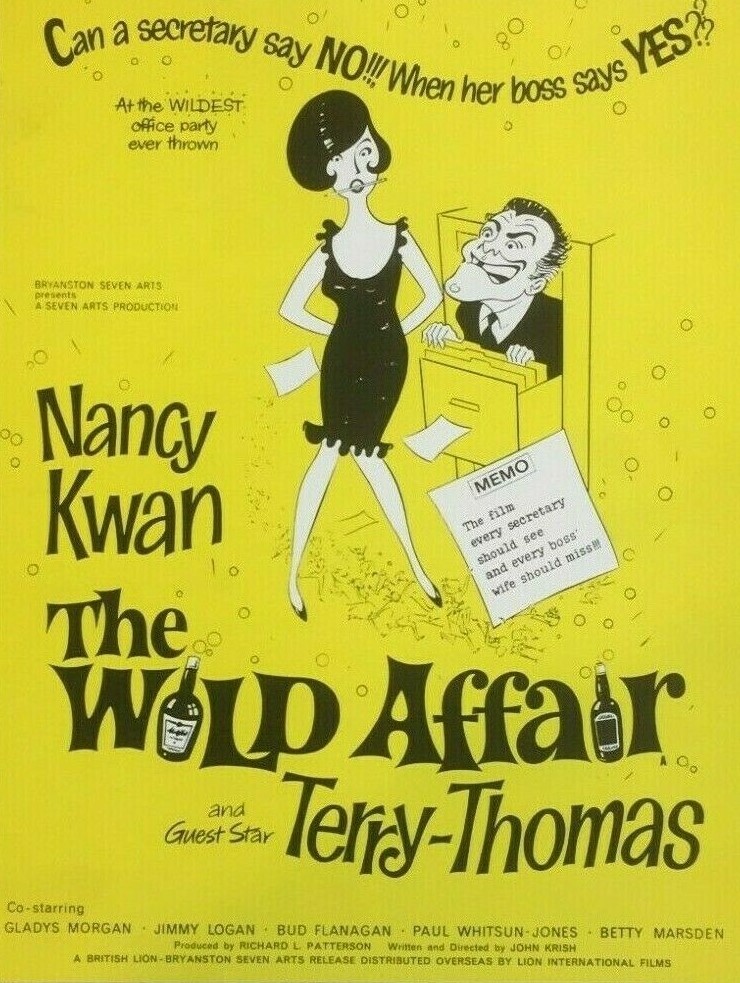
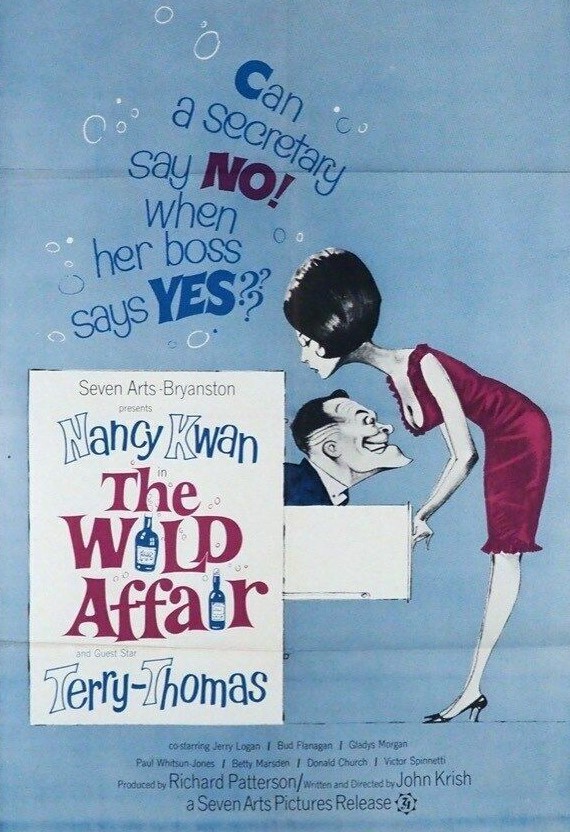
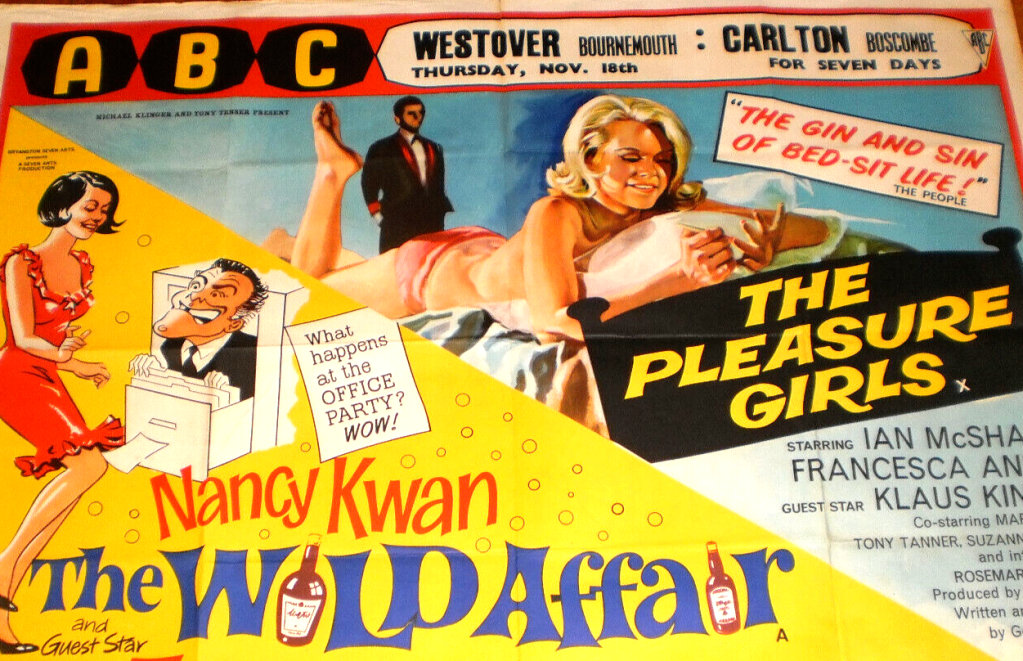
The Wild Affair (1965) ***

An unexpected gender equality twist as fiancée Marjory (Nancy Kwan) decides to embark on the equivalent of a stag party after seeing the state it left potential husband in. Although the full-scale Hen Party was a few decades away, Britain had given way to the Permissive Society, so, theoretically at least, a young lass on the brink of marriage could have a wild fling and with her last day at work coinciding with the office Xmas party she does her best.

Predatory men, of course, have a sixth sense regarding available women so there’s no shortage of suitors and she is egged-on by an alter-ego she calls Sandra who tut-tuts at her in the mirror when she fails to let herself go. Meanwhile, boyfriend Andy (Donald Churchill) has decided she will be bored silly at the party and plans to whisk her away for Xmas shopping.

The roster of potential lady-killers is headed by boss Godfrey (Terry-Thomas) forever maneuvring her into the confines of his office. Scottish salesman Craig (Jimmy Logan) wines and dines her in a private room. The company’s in-house designer Quentin (Victor Spinetti) tries to seduce by spouting poetry by D.H. Lawrence.

An office party being the kind of occasion where emotions run wild, tempers fray and home truths spill out, we discover Marjory is not the only one with romance in mind. An older secretary Mavis (Betty Marsden), lip perpetually a-quiver, more or less announces that Godfrey is the love of her life, ignoring, at least for the moment, that he has already embarked on an affair with model Monica (Joyce Blair).

Marjory switches from staid housewife-to-be (she has to quit her job on getting married, as was standard at that time) to exploring her inner Sandra, submitting to a make-over by Quentin that turns her into a vamp. With clothes by Mary Quant and a bob from Vidal Sassoon, she would have been quite the eye-catching catch had she remained still long enough for anyone to catch her. However, this being a comedy, and Marjory/Sandra an innocent among wolves much of the running time is spent getting her out of situations of her own making.

But although humor is to the fore, you get the sense this is a ground-breaking film desperate to break out into something more serious. Marjory challenges the notion that marriage ended careers, that women had to make do with sitting at home doing housework waiting for husband to return, in a life devoid of excitement or development.

If this is her idea of beginning married life, you certainly get the idea that her marriage will have a more feminist tinge than Andy might be expecting. The Sandra alter-ego, initially expressed as a flighty piece, soon develops into inner doubt, channeling a potential rebel. In some respects, this is standard stuff, middle-class girl sensing opportunity only to be taken advantage of and certainly this particular year appeared to be filled with characters on the cusp of change and/or consequence – Four in the Morning (1965), The Pleasure Girls (1965), The Hallelujah Trail (1965), Georgy Girl (1965), and you might even include Doctor Zhivago (1965). Female characters later in the decade would have fewer qualms.

So it has a time capsule feel, full of surreptitious suggestion. You get the impression that when Marjory quashes Sandra it’s only a temporary solution and that questions that remain unanswered will pop up at a later stage.

The ploy of the alter-ego in the mirror allows writer-director John Krish (Unearthly Stranger, 1963) to seed the comedy with more serious elements and ask questions that might be uppermost in the female mind. He throws in the occasional surreal moment such as the husband being trapped in a phone booth by a drunk (Frank Finlay) or an innovative way to stifle rising chaotic emotions. But some scenes could do with editing, namely the makeover scene which relies overmuch on reaction shots.

Nancy Kwan at last fulfils the potential shown in The World of Suzie Wong (1960), portraying a more complex character than the free-spirited Tamahine (1963). Terry-Thomas (Arabella, 1967) does too much mugging and his well of double-takes runs dry for this to be considered one of his better works. Joyce Blair (Be My Guest, 1965) makes the most of a man-eater role.

Silent American film superstar Bessie Love puts in an appearance and Scottish comedian Jimmy Logan is convincing in a dramatic part. Frank Finlay (A Study in Terror, 1965) is an inspired drunk and English comic Bud Flanagan has a bit part. Krish based the script on a  novel by William Samsom. If you want to learn more about “The Permissive Society,” check out a course run by the University of York, which dates it starting in 1957.

Strictly matinee material until you notice the undertones.

Nurse on Wheels (1963) ***

A rude interloper had come trampling over the more sedate world of the “Doctor” franchise, a gentle comedy now in its fifth iteration and even surviving a brief interlude minus original star Dirk Bogarde. Carry On Nurse (1959), the second in that series, had been a massive box office hit and a jolt to the cultural senses.

Who knew that the upright Brits would condescend to a film that depended on smutty jokes, leering male characters and inuendo? But it did open up the mini-genre of films about nurses where they could be presented as ordinary people rather than being heroic in some global famine-stricken or war-torn trouble spot. And make the nurse the top-billed character rather than a doctor’s sidekick whose main characteristic was to whimper at the star in the hope he might take a fancy to her.

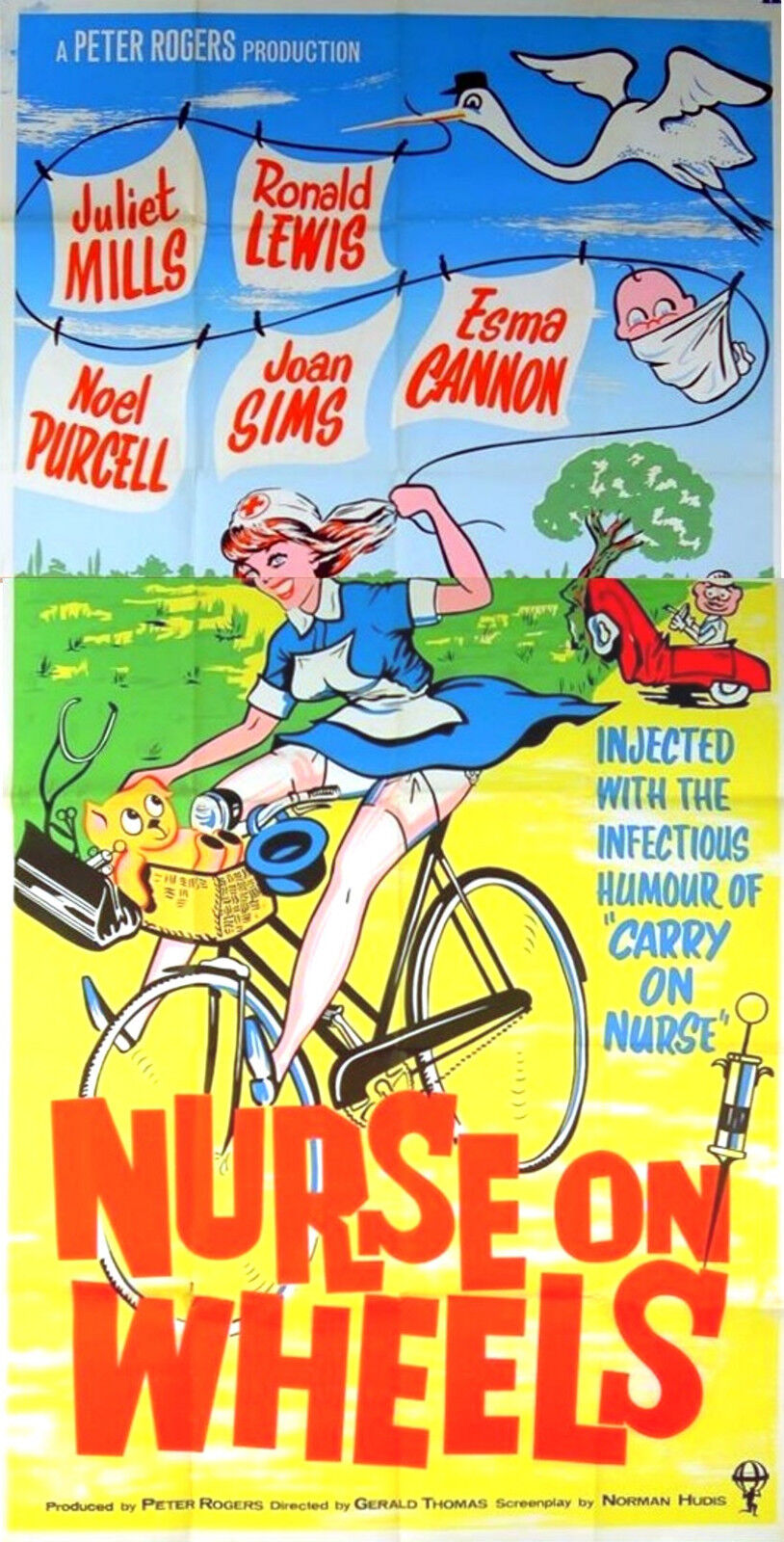
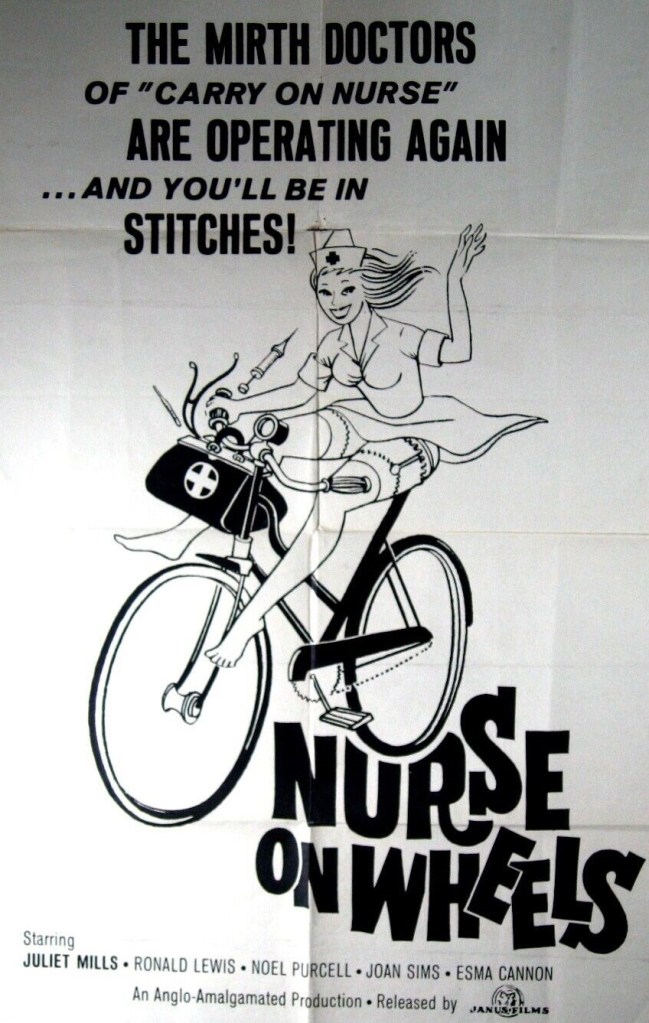
The marketing team clearly decided the slim Juliet Mills needed suspenders
and a bigger bosom to pull in the audiences.

But where the eponymous character in the Doctor series started out as hapless, lovelorn and bullied, here District Nurse Jones (Juliet Mills) has taken a leaf out of the robust book of Hattie Jacques, the bossy, no-nonsense, unperturbed Matron in Carry On Nurse. Not quite as over-the-top as that Matron, she more than holds her own, in perky fashion, in a patriarchal society, answering back a holier-than-thou vicar and dealing with a lecherous patient.

Nurse Jones has shifted from the city to the bland sleepy backwater village of Blandley in part to help her scatterbrain mother (Emma Cannon) cope better with, well, everything. Naturally, romance beckons, between Nurse Jones and local farmer Henry Edwards (Ronald Lewis), although any chance of love blossoming is imperilled by her lack of driving skills (106 lessons to pass her test).

Competent and confident and with a light riposte for every domineering male, it’s a shame that at the first sign of love she turns into a whimpering wreck. But there you go, confident women were acceptable in those days but everyone knew emotion would soon get the better of them. There’s not much in the way of plot, overcoming initial suspicions of patients coming to terms with a younger nurse, the various oddities of her charges, romantic rivalry between Nurse Jones and vicar’s daughter Deborah (Joan Sims).

But it is charming in an old-fashioned English way and certainly the camera adores Juliet Mills (Twice Round the Daffodils, 1962) though she’s neither given much drama to play with nor little opportunity, beyond the ripostes, to develop as a comedienne. Made in black-and-white on a leaky budget I had expected this to be a B-feature, propping up a double bill, but in fact it was given a circuit release on the ABC chain as the main (and sole) feature.

Will keep you entertained on a rainy Saturday afternoon, sufficient witty lines to raise a chuckle along with the batty mum’s battles with telephones, cupboards and rubber plungers. Not sure audiences wouldn’t have preferred smut and inuendo or the more polished presence of the Doctor cast.

But standing out as one of the few movies – comedies or dramas (and pre-dating the mid-60s cultural shift) – where a woman was in control of her own life not subservient or submissive to any passing male, feminism before that word took real root.

Supporting cast includes Joan Hickson (television’s Miss Marple), Carry On alumni Jim Dale and the aforementioned Joan Sims (who would have taken the lead role apparently had she not put on weight), Derek Guyler (Please Sir! television series) and Noel Purcell (Mutiny on the Bounty, 1962).

Director Gerald Thomas could churn out these light-hearted vehicles with his eyes closed and given he helmed the Carry On series shows remarkable restraint.

Shoot Loud…Louder, I Don’t Understand (1966) ***

The Raquel Welch picture nobody’s seen. Which is a shame because she demonstrates considerable comedic flair. And there’s a freshness and naturalness – almost a youthful gaucheness – about her that’s lacking in other movies where she was developing her more iconic acting style.

Tania (Raquel Welch) literally bumps into sculptor Alberto (Marcello Mastroianni) when his latest acquisition, an iron gate (locked naturally), blocks a footpath. Intrigued, she enters his Aladdin’s cave of artefacts and is frightened by his mad uncle who communicates via fireworks. With a start like that, you’re either headed for gentle romance between sensible young woman and less sensible artist, the usual on-off on-off scenario, or, this being quirky Italy and the director the even quirkier Eduardo Di Filippo (better known as a playwright – Saturday, Sunday, Monday) it’s going to follow a different route.

While Raquel Welch is for the most part costumed in alluring dresses she does not wear a bikini as in the poster at the top.

And so it does. Alberto thinks he has witnessed the murder of neighbor Amitrano (Paolo Ricci) – blood-soaked glove one clue – but when he confesses it might have been a delusion, something to which he is prone, he is arrested because the dead man was a gangster.  That sets a surreal tone – chairs raining from the sky, anyone?, a coffin full of potatoes, fortune tellers – and for some reason Alberto (who has received a bang on the head) begins to think Tania is also a figment of his imagination.

You can see where that idea came from, the delectable Tania in cleavage-resplendant form wearing dresses with clasps that appear unwilling to do their job. But on the other hand, he is handsome enough, with an artistic beard, and I doubt it would be the first time he had attracted a beautiful woman.

Tania is certainly a character, driving around in a sports car (with pink drapes) that appears to float rather than drive, containing another receptacle for a blood-soaked glove and with hot food in the glove compartment. In fact, she carries around a goodly supply of this local delicacy in case she might feel hungry in a police station or what have you.

Raquel Welch wasn’t girl of the year when this was made but by the time it was released in the USA in 1968 she had made a name for herself, in particular being named Star of the Year by one of the industry’s exhibiting organisations.

There’s certainly a bunch of dream-like sequences. After he finds a bloody knife and bloodied clothes Alberto gets punched on the head by a turbaned man, only to wake momentarily and fan his face with a fan, the kind of imagery Fellini could have dreamed up in his sleep. But this is set against a realistic backdrop, neighbors screaming at each other in the traditional Italian manner.  

So, what we are left with is a perfectly acceptable comedy where Alberto is accused of a crime he didn’t commit but the film might be too Italian for most tastes. This was made before La Welch achieved screen notoriety through the donning of a fur bikini and critics tended to look on Mastroianni (A Place for Lovers, 1968) as a serious actor rather than someone mixed up in this kind of gentle tomfoolery. I thought he was excellent in the role. But that was par for the course here, everyone dismissed.

De Filippo (Ghosts – Italian Style, 1967) didn’t have the kind of critical following ascribed to the likes Fellini and Antonioni so if this fitted into his normal style nobody was aware of it. But I’ve a feeling that this quirkiness was one of his hallmarks.

If you accept it on face value without looking to insert some kind of meaning then it makes perfect sense. As I mentioned, although her voice is dubbed, Raquel Welch (Bandolero, 1968) comes across very well, especially as, despite the enticing attire, she is not required to be all sexed-up or carry the dramatic weight of the tale, unlike the westerns where she is generally an object of lust and continually attempting to assert independence.

Having said that, this is particularly hard to track down, so you might not think it’s worth the bother. But, of course, if you are a Welch completist, nothing will be too much trouble. However, you’ll need to scour the second-hand markets to find a DVD.

Arabella (1967) ***

Under-rated comedy, set in 1928 Italy, had me chuckling all the way through. An episodic structure sees Arabella (Virna Lisi) duping an Italian hotel manager, British general and an Italian Duke (all played by Terry-Thomas) out of their cash in order to pay off the mounting tax debts of her grandmother Princess Ilaria (Margaret Rutherford) while trying to avoid the attentions of the mysterious Giorgio (James Fox).

Her scams are quite ingenious, beginning with arranging for a public urinal to be erected outside a five-star hotel and, pretending to be the lover of Benito Mussolini, convincing the manager that, for a price, she could arrange its removal. There’s nothing particularly original about faking a breakdown to attract the attention of  the general, a royal flunkey, but the blackmail trap she sets is elaborate.

But just as you think you know here this is going, it sprints off in another direction altogether, Arabella being the mark, and it’s one twist after another. She is rooked by Giorgio with whom she falls in love. The Duke, whom she sees as easy meat, instead uses her. Her grandmother’s ploy to burn down her mansion and claim the insurance money is foiled by a cat.  

All sorts of sly observations come into play. The hotel manager and his pals siphon off a large chunk of the cash they have taken from the safe to pay her off. The general, operating incognito, has his cover blown by a piece of music. The Duke turns the tables on his domineering wife and his son has an exceptionally clever ploy to keep mama sweet while enjoying his sexual independence. And it appears that every time Arabella gives in to entreaty, she is exploited. In other words, show weakness, give a loser an inch and they’ll take you for all you’ve got.

Terry-Thomas as a bumptious hotel manager with James Fox looking mysterious.

There’s no desperate reason for it to be set in the 1920s and, beyond the Charleston and costumes, it makes little attempt to evoke the era except perhaps to make the point that the world was not full of submissive women. And you might find inappropriate the trope about using a sexy woman to turn a gay man straight. It’s a sex comedy in the Italian style where just about anything goes and the act, rarely consummated, instead involves humiliation.

But Virna Lisi (How To Murder Your Wife, 1965) certainly commands the screen, carrying the show, fashionably stylish rather than overtly sexual, a born comedienne. Terry-Thomas (How To Murder Your Wife), while initially appearing under his trademark persona, completes a transition for the Duke, almost another twist if you like, audiences expecting a similar duffer to his previous parts. Lisi and Terry-Thomas clearly have rapport, almost a synergy, not the charisma of a screen couple, as in romantic pairing, but work very well with each other.

Margaret Rutherford (Murder Ahoy!, 1964) and James Fox (The Chase, 1966) let the side down with such insipid portrayals you wonder why they signed up.  It’s almost as if they couldn’t be bothered working on their characterisations. Cigar smoking and general ditziness is as far as Rutherford, in her final role, goes. Fox just looks fey and the one flaw in the narrative is why Arabella could look at him twice. As the Duke’s son, duping his mother, a pre-gaunt Giancarlo Giannini (The Sisters, 1969) is very entertaining.  

To enjoy this you have to suspend your ideas about comedy based on the British and Hollywood tradition. It aims for farce, no attempt to make larger comment on life.  

Mauro Bolognini (He and She, 1969) hangs this together in a decent enough fashion, confident enough of his material to lead the audience into a bait-and-switch. In his debut Giorgio Alorio (Burn!/Queimada, 1969) and Adriano Baracco (Danger: Diabolik, 1968) wrote the screenplay with British playwright Alan Hackney (Sword of Sherwood Forest, 1960) spicing up the English dialog. Ennio Morricone provided the score.

Skidoo (1968) *

Hubris can only get you so far. Unfortunately, it’s all downhill. Whatever possessed Otto Preminger (In Harms Way, 1965) to believe he could deliver a contemporary satirical comedy beats me. And it beat him, too.

Despite the comedic input of Jackie Gleason (The Hustler, 1962) and Groucho Marx there’s nary a single laugh, except, sadly, at the director’s expense as he attempts to shine a coruscating light on social mores and instead ends up fluffing his lines. The highlights (!!) are gangster Tony Banks (Jackie Gleason) having a bad trip, his daughter Darlene (Alexandra Hay) falling in with a bunch of hippies and having her body painted, his wife Flo (Carol Channing) trying to seduce another gangster Angie (Frankie Avalon) and some attempted gags at the expense of technology.

There’s even the old one of kids making out beside a parking meter and when busted complaining they are not getting their allotted time. And there’s an ongoing “joke” of Flo tussling with various men for control of the television set through rival remote controls.

The story, if you can call it that, has Tony infiltrating a prison in order to bump off inmate Packard (Mickey Rooney) who plays the stock market, complete with ticker tape, inside. Flo and Darlene, trying to find his whereabouts, end up at Angie’s hi-tech pad. Then all the hippies go back to the family house where Flo washes their hair.

You can imagine where hippies come into all this, making with the hip talk, and trying to set up an alternative world to the Establishment.

Carol Channing makes her feelings known by donning pirate garb.

In the style of It’s A Mad, Mad, Mad, Mad World (1963) the main attraction are the cameos, Peter Lawford (Ocean’s 11, 1960), John Philip Law (Hurry Sundown, 1967), Burgess Meredith (Rocky, 1976), George Raft (Five Golden Dragons, 1967), Mickey Rooney (24 Hours to Kill, 1965)  and Frankie Avalon (The Million Eyes of Sumuru, 1967). But they will all cringe at their participation.

Channing, only just Oscar-nominated for Thoroughly Modern Millie (1967) makes the worst career choice of her life, Alexandra Hay (Model Shop, 1969) not far behind, though with less marquee value to play around with.

Every acclaimed director has an off day, taking on a project through poor judgement or, more likely, financial necessity. But Preminger was still a Hollywood high-roller and this just looked like a dose of career suicide.

Come Blow Your Horn (1963) ***

Wonderful upbeat performance from Frank Sinatra lifts this out of a misogynistic pit where  women were either dumb, desperate to get married or passive-aggressive harridans. Bachelor playboy Alan (Frank Sinatra) has more women on a string than there is string. When younger brother Buddy (Tony Bill) moves in, Alan introduces him to the fun ways of the world, not expecting Buddy to be such an apt pupil.

Alan keeps main squeeze Connie (Barbara Rush) dangling while, pretending to have Hollywood connections, making hay with actress wannabe Peggy (Jill St John). He also keeps customer Mrs Eckman (Phyllis McGuire) sweet in transactional sex fashion and there’s no shortage of other women liable to appear out of the woodwork.

Meanwhile, his boss, apoplectic father Harry (Lee J. Cobb), goes around screaming at everyone, berating Alan for his lifestyle and moaning at harassed wife Sophie (Molly Picon). Most of the time it looks like it’s going to swerve into a more typical English farce with various women being hidden out of sight from various other woman or Harry or an equally apoplectic cuckolded husband (Dan Blocker).

But, with considerably more sophistication than that, the story takes the more interesting tack of character development. Alan, who might appear to be sitting pretty, woman at his beck and call, a glorious modern apartment, cocktails on tap, is brought up sharply by his brother’s delight at such a shallow life. Alan gets to play Hollywood honcho with Peggy while Connie delivers an ultimatum that threatens to bring Frank to his senses though, naturally, he believes it’s all hooey.

The fraternal business is well done, instead of the normal rivalry genuine affection and the older sibling offering guidance, though primarily in how to get drunk and get off with women rather than anything that might otherwise stand him in good stead. Though you might argue that being shown how to dress, and how converse with women, and organise a fun party might be as much education as a young gentleman in the Big Apple required.

The only thing better than one Frank Sinatra picture is two Frank Sinatras so to scoop up some extra cash these were paired for a speedy reissue.

Playwright Neil Simon, the toast of Broadway at this stage, exhibited such a keen sense of structure that the story never sagged. Any time that appeared a remote possibility, instead of a stranger coming in a la Raymond Chandler with a gun, it’s Harry stomping all over the place. There are some good catchphrases, genuinely funny moments, and some great lines, the best, I have to confess, from Peggy who bemoans the fact that she was stranded in a hotel room with Alan at a ski resort by all the snow outside. Redeeming factor: her homely kind of dumb serves narrative purpose, making the otherwise unbearably charming Alan come across as a heel.

This is quite a different Sinatra, like he’s channeling his record persona, none of the anguish, dramatic intensity or Rat Pack bonhomie he brought to other pictures. Often you hear of actors just playing the same character or a variation thereof, but this ain’t a Sinatra persona I’m familiar with and brings verve to the whole shebang.

Lee J. Cobb (Coogan’s Bluff, 1968) gives in to overacting. You can see how that loud style might work on the stage, but it’s less effective here. Jill St John (Tony Rome, 1967) is very good as the uncertain beauty, who could be incredibly seductive if only she could work out how, and not quite a victim either, and still managing vulnerability. Barbara Rush (Robin and the 7 Hoods, 1964) is wasted, though. Set up as a modern woman, she collapses at the first sniff of marriage, though framing her eyes in a mask of light in a taxi cab is about the only compositional mark of any note.

Quite what possessed director Bud Yorkin (Divorce American Style, 1967) to stick in the title song in the middle of the picture is anybody’s guess. Norman Lear (Divorce American Style) wrote the script but you can hardly go wrong with a Neil Simon template. 

End up: it’s mostly about family and people coming to terms with themselves and each other.

The Millionairess (1960) ***

The movies lost a brilliant comedienne when Sophia Loren was lured (by a million-dollar fee no less) into historical drama. Having previously demonstrated her flair for comedy in Houseboat (1958), turning Cary Grant’s life upside down, she repeated the formula here. Cultural appropriation by Peter Sellers is the main issue getting in the way of full appreciation, not just the actor essaying an Indian, but the fact that this is a very cliched  attempt.

The narrative runs along two parallel twists and coming from the politically-aware mind of George Bernard Shaw contains a streak of social commentary. Beautiful millionairess Epifania (Sophia Loren) can only marry a man able to demonstrate business acumen. Dr Kabir (Peter Sellers), who caters to an impoverished clientele, must marry a woman capable of existing in poverty, eking out an existence for 90 days on the daily equivalent of less than a couple of pounds sterling.  

At the foot of the poster note the advance warning of the initial stab at “Cleopatra” that was to star Feter Finch and Stephen Boyd rather than Richard Burton and Rex Harrison.

Epifania, presented in that generation as somewhat imperious but to today’s generation would be viewed as the epitome of the independent woman resisting the notion that she choose a mate based on someone else’s criteria, is not above a bit of jiggery-pokery to win the man of her dreams. Technically, all said lover has to do is turn £500 into £15,000 and since no detailed information needed accompany those transactions, Epifania feels justified in simply handing over the dosh to her lover to fulfil the requirements.

She falls into Dr Kabir’s orbit after attempting suicide by drowning following the discovery of her feckless lover Alistair’s (Gary Raymond) affair with Polly (Virginia Vernon). Kabir, mind on other more important matters, fails to rescue her. But when she ends up in the water again, this times as rescuer, he is more responsive especially when she manages a physical connection.

However, he is not going to be bribed into love, not even when she modernises his dilapidated surgery. Naturally, she is viewed as headstrong and controlling rather than a philanthropist and so they enter into the double bargain.

This splits the narrative, as Epifania returns to Italy to work in a sweatshop. And although she reveals not just newfound humanity, defending her exploited fellow workers, and demonstrates the business skills to reverse the factory’s declining productivity, this still isn’t enough for Kabir who, with no head for money and no inclination to go through any rigmarole to please Epifania, manages to insult her, thus triggering the normal romantic comedy breakup.

In the meantime, wily attorney Julius Sagamore (Alistair Sim) and opportunistic psychiatrist Dr Adrian Bland (Dennis Price) muddy the waters.

Mostly, the film gets by on old-fashioned charm – and while, as noted, Sellers’ performance is outmoded in his impersonation of an Indian he is quite believable as an honorable man unlikely to fall for the first beautiful woman to come his way.

Sophia Loren (Arabesque, 1966) carries the picture with her exquisite comedy timing and even when the posters emphasized her various states of undress there is much more to her ability, as audiences were already aware, than taking off her clothes. She is an absolute delight, both as the demanding haughty heiress and the spurned lover and in any other movie her romantic enterprise would be applauded and just as with Houseboat she drives the narrative, the object of her affection not quite putty in her hands, and with the bonus of a song, a duet this time (“Goodness Gracious Me”) rather than the two solos of the previous picture.

Peter Sellers (The Pink Panther, 1963) was still in search of his screen persona and to some extent is blown off the screen by Loren who seems much more comfortable with the material, extracting humor without needing to rely on funny voices. Sellers changed the character of the doctor in the original play from an Egyptian to an Indian for no particular reason and in fact the nationality of the doctor would have made little difference to the story, it was a character, disinterested in woman and contemptuous of wealth, that provided the narrative impetus. Oddly enough, although at the time the deceased George Bernard Shaw was considered one of the world’s greatest playwrights the 1936 play on which this is based had never been a big success, reception so lukewarm on its out-of-town opening that it did not reach the West End,  Broadway run delayed till 1949 and then only lasting 13 performances (i.e less than two weeks).  

Director Anthony Asquith had made a huge success out of the author’s Pygmalion (1938) (the source material for musical My Fair Lady) and specialised in bringing stage plays to the cinema – The Browning Version (1951) and The Importance of Being Earnest (1952) – so was acquainted with handling big stars and opening up plays for cinema audiences. He shows a sure grip on the action and allows Loren to build up a beguiling character so that audience sympathy for her dilemma never runs dry. Wolf Mankowitz (The Two Faces of Dr Jekyll, 1960) and the debuting Riccardo Arragno wrote the screenplay.

The material would have more suited the colder, sharper tongue of a Katharine Hepburn (who did at one time play the character on stage) but Loren’s portrayal avoids the temptation of adopting a more spinsterish approach.

Watch it for Loren and the clever Alistair Sim and try not to cringe at Peter Sellers.

Doctor in Distress (1963) ***

Bait-and-switch as the romantic complications of the grumpy Dr Spratt (James Robertson Justice) take precedence over the by-now pretty competent Dr Sparrow (Dirk Bogarde). Just about getting by on Bogarde’s charm in his fourth and final outing in a role that had made him a British box office star and possibly more notable as his final film as an out-and-out matinee idol before he shifted into the arthouse arena.

Dr Sparrow has come a hell of a long way since being a shy junior doctor, mercilessly bullied by Spratt and a love life that was filled with tangle. Here, he not only stands up to Spratt, but is something of a lothario, happily ditching new love Delia (Samantha Eggar), a model, albeit temporarily, in favor of French masseuse Sonia (Mylene Demongeot).

There is very little of the traditional rom-com-love-on-the-rocks in Bogarde’s relationship with Delia, who arrives as a patient with a sprained ankle at the hospital and is whisked home by Sparrow for a spot of practised seduction. Spratt, on the other hand, has fallen for physiotherapist Iris (Barbara Murray) and in trying to win her hand undergoes weight loss treatment at a health clinic, endures the indignity of wearing a corset, hires a private detective to get the lowdown on her, and finally, donning a disguise of dark glasses and hiding his bulky frame behind an umbrella, proceeds to attempt to discover who is his rival for her affections.

Sparrow is left to occasionally swat out of the way the interfering Spratt and alternatively offer him advice or a shoulder to cry on while trying to prevent Delia pursuing a movie career. So it’s just a series of situations, none of which are particularly funny, apart from the idea of Spratt getting his come-uppance.

It’s worth noting that for a British sex comedy, the females are in charge. Iris knocks back her various suitors, Delia refuses to let romance interfere with her career, jetting off to Rome over Sparrow’s objections, and the diminutive and muscular Sonia is more than a match for any man and just as predatory.

What’s most surprising is that a genial comedy like this can get away with so much permissiveness. This was opposite of the in-your-face snigger-snigger Carry On series so for Sparrow to be successfully spreading his wild oats seemed somewhat out of character. But you can see most of the jokes a mile off though probably in a packed cinema these would provoke more laughter than watching it at home on the small screen.

It’s probably worth it to see Leo McKern (Hot Enough for June, 1964) as a movie producer who envisages Sparrow as his new star and Frank Finlay as a corset salesman, a completely different role to his part in Robbery (1967). Fenella Fielding (Lock Up Your Daughters, 1969) has a cameo as a neurotic passenger on a train and Dennis Price (Tunes of Glory, 1960) as a sadistic health clinic manager while Donald Houston (A Study in Terror, 1965) has a larger part as another of Iris’s suitors.  

Dirk Bogarde (Justine, 1969) can essay this kind of character in his sleep but there is no doubting his screen charisma or charm. But I doubt if James Robertson Justice (Mayerling, 1968) varied his character much from picture to picture, perhaps louder and more bumptious here but unlikely to attract audience sympathy. Samantha Eggar (The Collector, 1965) doesn’t get enough to do and has her thunder stolen by the late arrival of Mylene Demongeot (Fantomas, 1964).

Director Ralph Thomas had made more than a half-a-dozen films with Bogarde including more dramatic ventures like Campbell’s Kingdom (1957) and The Wind Cannot Read (1958) and makes the most of this undemanding feature. You would have thought this was the end of the line for the series but with Leslie Phillips (Maroc 7, 1967) as Bogarde’s replacement it soldiered on for another couple of episodes.

Proof that a true star can always help a film rise above its material.

A Swingin’ Summer (1965)***

I admit it: spotting this on YouTube I couldn’t resist. After all, someone has to report on the first proper Raquel Welch picture. Plus, I had never seen a beach movie, such a staple of the decade. Plus, depending on your point of view, Raquel gets to sing.

But why waste any brainpower coming up with a new idea when you can recycle an old one – let’s put the show on in the barn. Or a version of it.

Raquel Welch – distinctive in any language.

When their summer plans are dashed, students Mickey (James Stacey) and Rick (William Wellman Jr.) decide to promote a series of beach concerts. That doesn’t sit too well with lifeguard Turk (Martin West) who takes an unwelcome shine to Mickey’s neglected girlfriend Cindy (Quinn O’Hara). Rick, meanwhile, is intrigued by nerdy Jeri (Raquel Welch) but a bit put off to discover she’s more interested in a meeting of minds than anything more obvious, and possibly by her independent, proto-feminist streak, in that she selected him for her “summer romance.”

Just in case you thought there wasn’t much else to do but wait till the wannabe promoters got their act together and people fell in and out of love, there’s a hefty amount of subplot: a fistfight, a robbery and a water-ski version of “chicken.” Plus if there was any chance of you getting bored, house band Gary and the Playboys and a variety of other acts, including as the climax The Righteous Brothers, hit the stage and, in the interests of gender equality, the platoon of good-looking women hanging around are matched by a squad of good-looking men. 

There’s even some effort at comedy, a few pratfalls, mostly thanks to the distractions of Jeri, and one gender-switch sight gag which seemed pretty daring for the times, and even a nod in the direction of health food fads. Perhaps, more surprisingly, are the solid characterisations, the principled Mickey who refuses to sponge off Cindy’s rich father. Discovering she bailed him out behind his back, securing the sum required for the project from her father, he accepts the money as a loan but renegotiates the interest rate.

Jeri is way ahead of her time, analysing the men she fancies and with the repartee to keep them in line. It’s pretty even-handed in the beach costume department, for every girl in a bikini or tight top there’s a bare-chested topless hunk, though it still manages to be overtly sexist, girls needing measured by an obliging male in order to enter a beauty contest.

Scottish actress Quinn O’Hara (The Ghost in the Invisible Bikini, 1966), a former beauty queen and girlfriend of pop star Fabian (Mr Hobbs Takes a Vacation, 1963), must have thought the prospect of becoming the breakout star pretty high, what with her reimagining of the Lana Turner/Jayne Mansfield tight top. Her only rival was the girl playing the nerd who hooked the male lead’s best friend. Ostensibly, the nerd was not much of a part, spouting psycho-babble most of the time.

A nerd is still a nerd, O’Hara must have assumed. Unless she’s Raquel Welch.

Welch handles the dialog very well, probably longer speeches than anyone else, but even with  her horn rim glasses and hair in a bun, and determined to measure potential partners by their brain cells, she stands out as an independent thinker long before she releases her secret weapon, a yellow bikini, and smart enough to work out that if that doesn’t set a man’s pulse racing to head for second base – jumping onto the stage to strut her stuff.

It’s a bit of a stretch to argue that an appearance in a low-budget beach movie ushered her into the Hollywood fast lane, but, hey, timing is everything, especially if you happened to catch the eye of a producer looking for someone to model a fur bikini.

None of the men made much of a splash in the movie business though James Stacy was the male lead opposite Welch in Flareup (1969). Supporting actor Allan Jones was the biggest name in the cast but well past his heyday as a Marx Bros stooge.

Some of the singers were better known than the actors. Topping the bill in that respect were The Righteous Brothers – hot after “You’ve Lost That Lovin’ Feeling and “Unchained Melody” – who sang “Justine” (no smash, reaching just No 85 in the U.S. singles chart). Gary Lewis and the Playboys also topped the charts in 1965 with “This Diamond Ring.” But The Rip Chords were coming to the end of their chart life. Raquel’s song “I’m Ready to Groove” did not set the house on fire, it’s fair to say.

Robert Sparr (More Dead Than Alive, 1969) was at the helm. Leigh Chapman (Dirty Mary Crazy Larry, 1974) and Reno Carrell (Winter a-Go-Go, 1965), also the producer,  collaborated on the screenplay.

A harmless curio – a neat 80 minutes long – and if you’re intent on watching a beach movie it might as well be this.

Discover WordPress

A daily selection of the best content published on WordPress, collected for you by humans who love to read.

The Atavist Magazine

by Brian Hannan

WordPress.com News

The latest news on WordPress.com and the WordPress community.