I am a published author of books about film - over a dozen to my name, the latest being "When Women Ruled Hollywood." As the title of the blog suggests, this is a site devoted to movies of the 1960s but since I go to the movies twice a week - an old-fashioned double-bill of my own choosing - I might occasionally slip in a review of a contemporary picture.
Information about how films performed outside the United States in the 1960s was incredibly difficult to obtain. Foreign or worldwide grosses were not reported in any consistent fashion – if at all – during that decade. Even the box office I’ve been able to report on previously, i.e. United Artists, just listed foreign as one all-encompassing entity, not breaking it down by country. So, when the opportunity does arise, it’s fascinating to observe how audiences in different countries react to what comes down the line.
Probably it will come as no surprise to discover that the top film of the 1960s in Australia was The Sound of Music. The musical brought in $4.4 million in rentals (the amount returned to studios once cinemas have taken their cut of the gross). It was the number one film, by a considerable margin, in the United States as well. Astonishingly, given the population differential (12.5 million Aussie inhabitants by 1970 vs 203 million in the US) the rentals were, proportionately, on a par, the movie hauling in $72 million in rentals on home territory.
Second place in Australia went to David Lean blockbuster DoctorZhivago (#3 in the U.S.) with $2.6 million followed by My Fair Lady (#7 Stateside) on $2 million, in both instances, pro rata, bettering their U.S. box office.
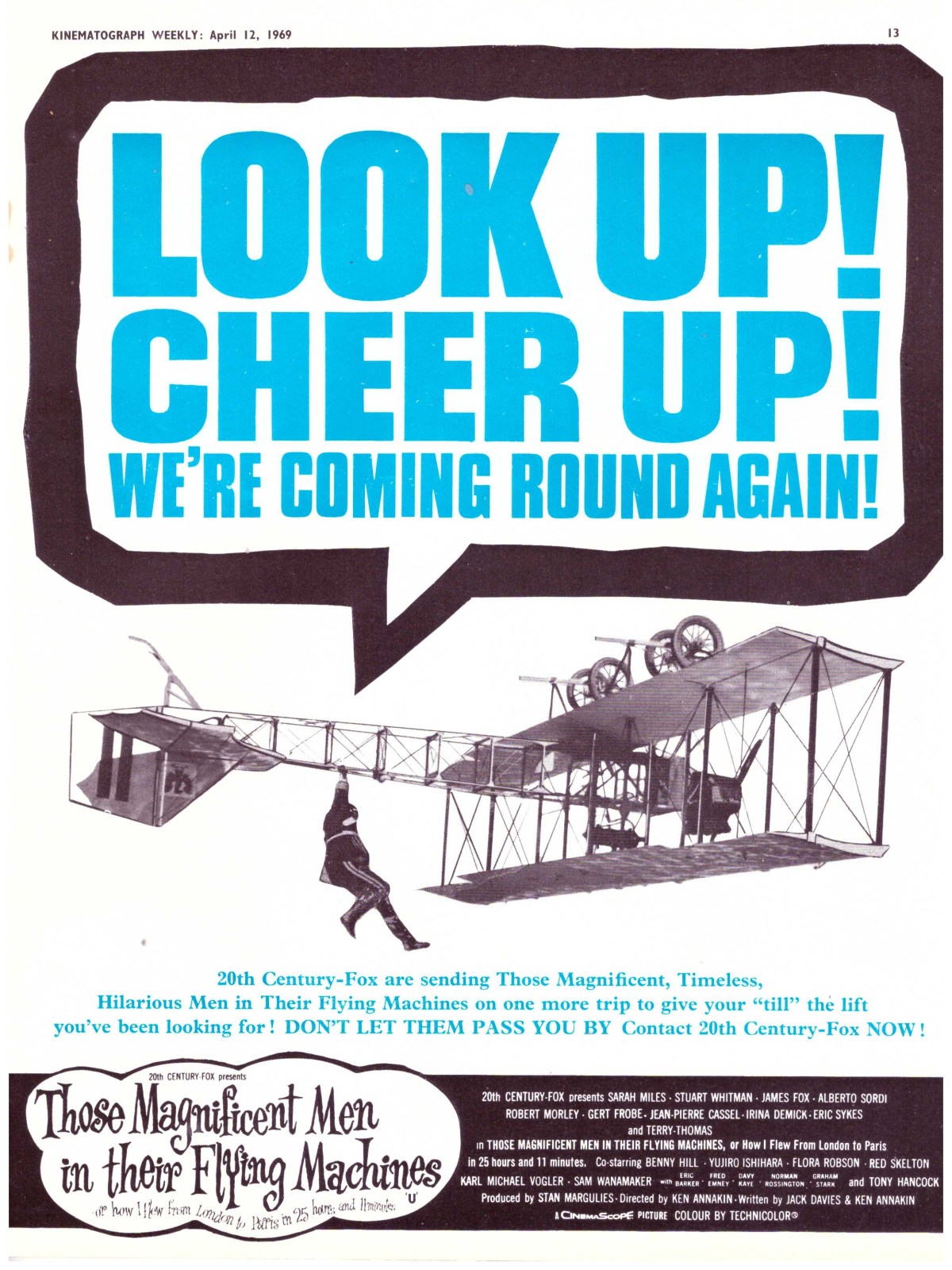
The biggest surprise of the decade was the performance of Those Magnificent Men in Their Flying Machines (#39 Stateside) which rocked up in fourth place with $1.7 million. You could probably say the same for the next picture on the list, Lee Marvin-Clint-Eastwood-Jean Seberg musical Paint Your Wagon, which struggled at the US box office. Australia rentals hooked $1.44 million.
Australians proved largely impervious to the flood of westerns that had struck pay dirt at the U.S box office. Big Stateside hitters like How the West Was Won (#12), True Grit (#47), Cat Ballou (#62), The Professionals (#69), The Alamo (#73) and Shenandoah (#77) don’t feature on this list. The exception was Butch Cassidy and the Sundance Kid (#28) which raced to $1.31 million and placed seventh Down Under.
Whether humor would travel was difficult to predict. As well as Those Magnificent Men, comedies ranking better in Australia than in the U.S. were: It’s A Mad, Mad, Mad, Mad World (#18 Stateside) which took sixth spot here on $1.3 million; Tom Jones (#23) 10th here with $1.06 million; The Great Race (#54) 16th here on $884,000; and Irma La Douce (#43) 20th here with $832,000.
But The Graduate, the second-best performing movie in the U.S., failed to emulate that success, coming in 12th here with $1.02 million. Likewise, comedies that were massive in the U.S. made less of an impact, neither The Odd Couple (#14 Stateside) nor The Love Bug (#22nd) making this list.
Aussies were as appreciative as U.S. audiences of Sidney Poitier’s breakthrough duo Guess Who’s Coming to Dinner (#10) whose $1.08 million secured ninth position here and To Sir, With Love (#19) which took 11th spot on $1.05 million.
There was comparatively less interest in the spy genre that swamped American cinemas during the decade. James Bond was not the bonanza it was Stateside. Thunderball, ranked 8th in the U.S., Goldfinger ranked 11th, and You Only Live Twice ranked 20th were, 21st , 22nd and 30th, respectively here, and not commanding, proportionately, anything like similar rentals.
With $1 million in the kitty, Oliver! outranked both West Side Story ($902,000) and Camelot ($833,000) whereas in the U.S. the situation had been reversed. Here, respectively, they snapped up 13th, 15th and 19th spots whereas in America it had gone 55th, 17th and 45th.
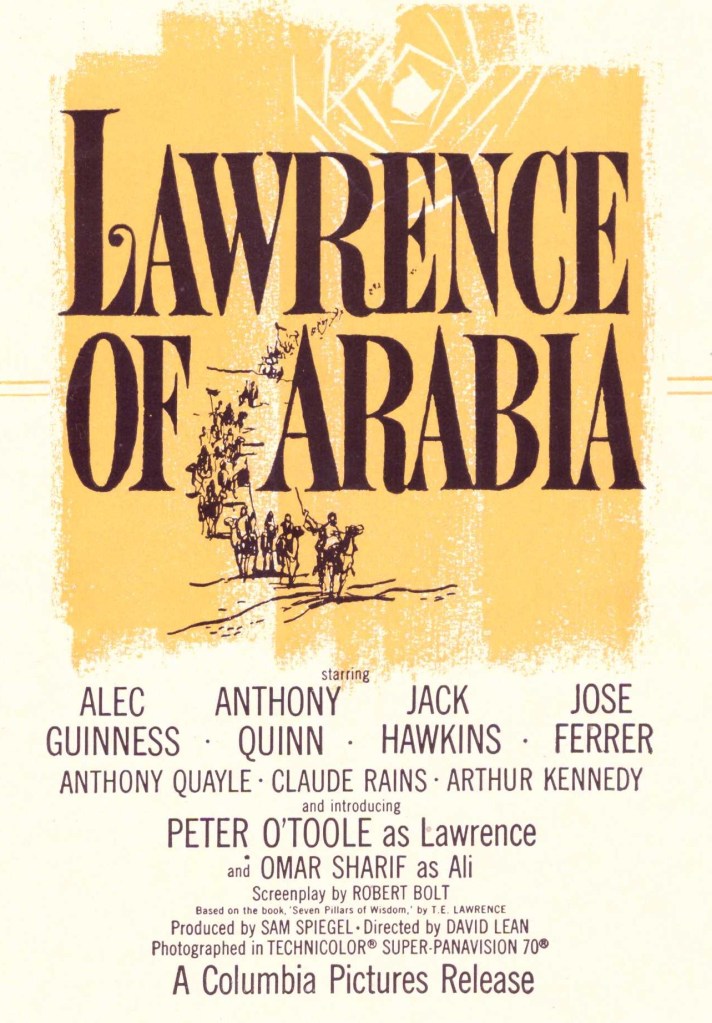
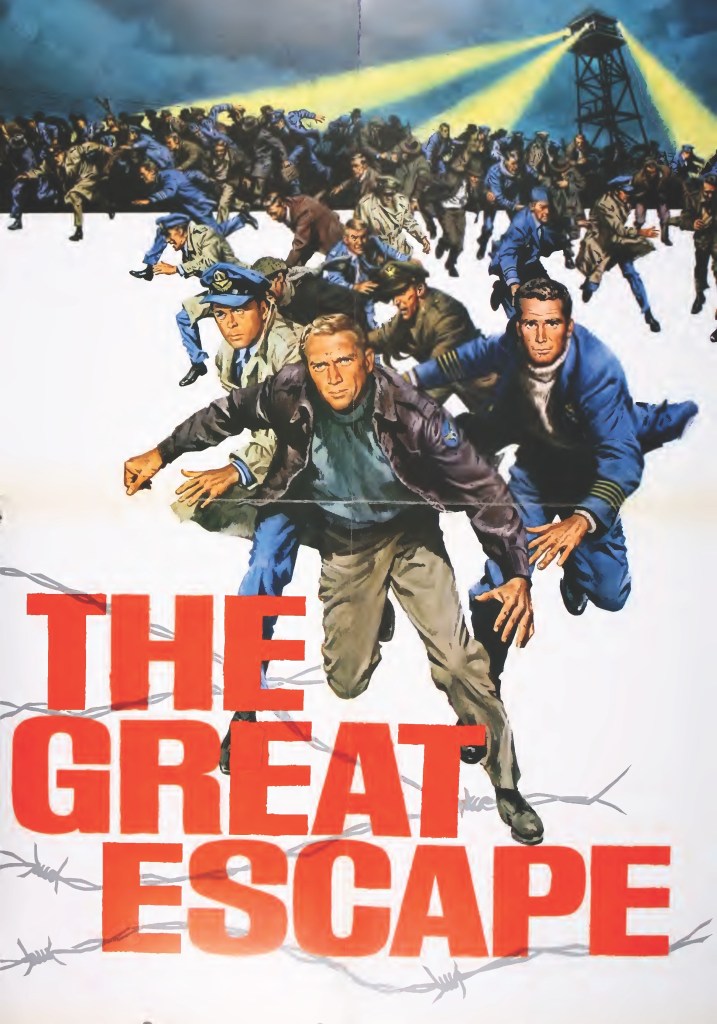
Three outliers which had not made the U.S. Top 100 performed far better in Australia: Battle of Britain with $776,000 tallied up 23rd spot, Born Free with $721,000 homed in on 26th spot and The Great Escape shot up $543,000 for 32nd. Some other movies in the American Top 100 did considerably better in Australia. Lawrence of Arabia (#28) tracked to 8th spot in Australia with $1.1 million. Chitty Chitty Bang Bang and Hatari!, joint 92nd in the U.S rankings, topped out at 29th and 33rd, respectively, in the Aussie version.
Controversy didn’t fly so well. Of pictures that fell into that category, the best results came from Midnight Cowboy. It was ranked 52nd in the U.S. rentals race but clocked up $846,000 in Australia to land 18th place. Conversely, The Dirty Dozen, 16th in the U.S., only managed 28th. But other movies laden with sex, drugs, profanity or violence proved to have less appeal. Bonnie and Clyde (#13 Stateside), Valley of the Dolls (#14), The Carpetbaggers (#26), Rosemary’s Baby (#28), Planet of the Apes (#28) and Who’s Afraid of Virginia Woolf (#37) failed to make the cut.
SOURCES: “All-Time Aussie Rental Champs,” Variety, May 5, 1982, p54; Brian Hannan, The Magnificent 60s, The 100 Most Popular Films of a Revolutionary Decade (McFarland, 2022).
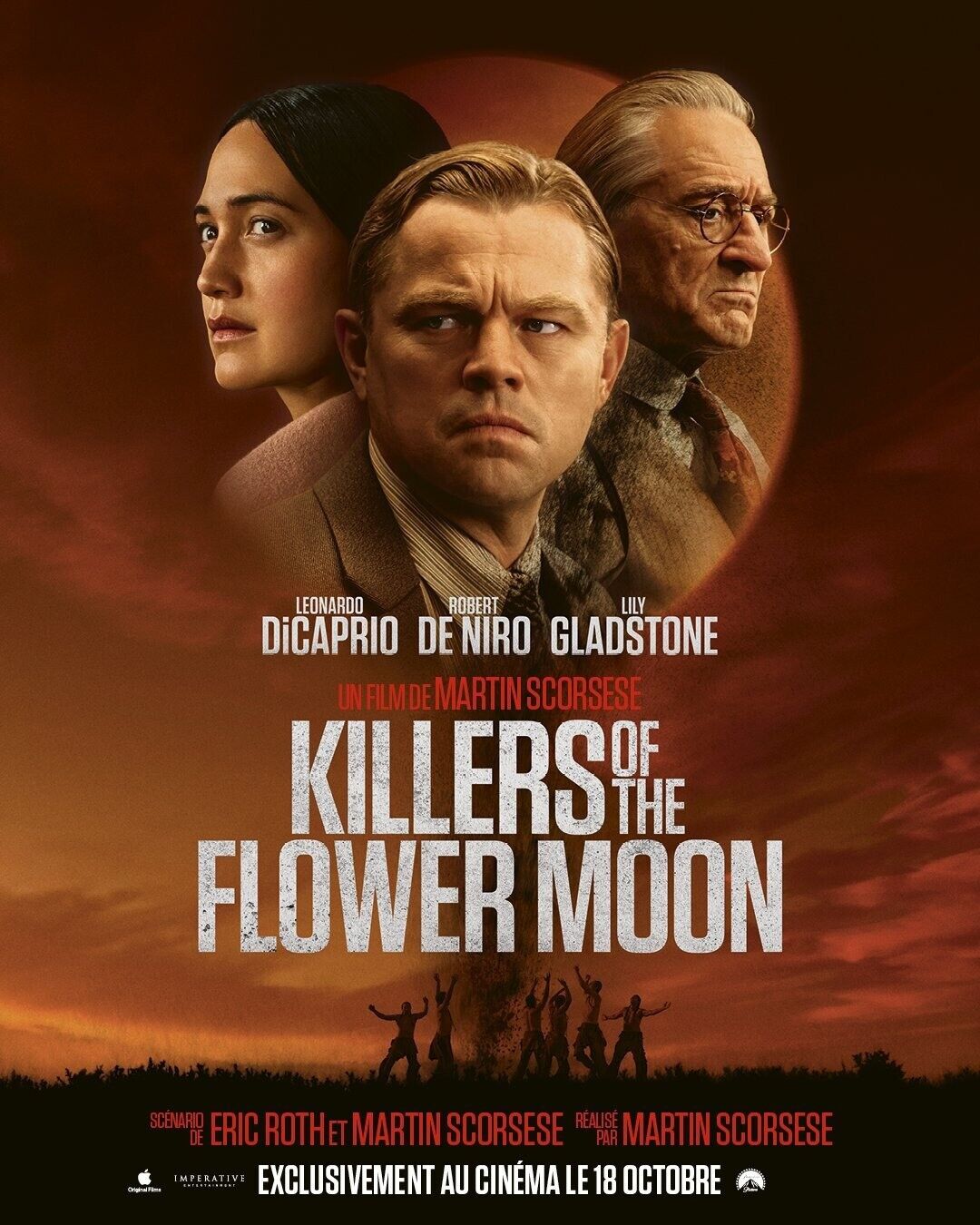
Let me stop you right there. This isn’t a review of this particular movie, you’re probably sick to death of those already, and it’s not some kind of Scorsese retrospective, but an expression of what it’s like to live through the transformation of one of the greatest directors Hollywood has ever produced. That zipping excitement when you first encounter a new Hollywood animal and when he charges down a different track or seems to lose control.
Catching up on a director’s life work via a carefully-curated retrospective hasn’t got an ounce of the flavor of living through it, from the days when film festival break-outs were not the carefully-orchestrated distribution and publicity machines they are now.
I first encountered Scorsese before a clever journalist had coined the rather derisory notion of a Brat Pack, when the director was just another new voice clamoring for attention in a world of considerably more cinematic noise than exists today, when MCU and streaming didn’t exist, and audiences could find massive variety every time they attended the cinema.
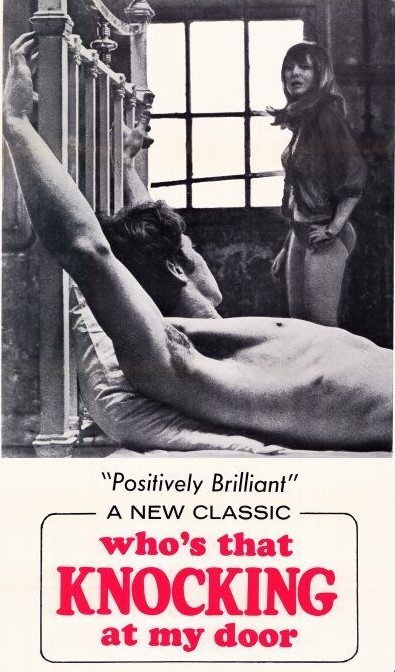
Who’s That Knocking at My Door slipped through the arthouse cracks in 1967 – the year of The Graduate, Guess Who’s Coming to Dinner, In the Heat of the Night, The Dirty Dozen and El Dorado. I didn’t see it then. I would be surprised if anyone did. Nobody was ready for that brash style with its insistent use of pop/rock music. I caught up with a few years later when the Scorsese we know now was still in embryo form.
Sure, Mean Streets (1973) gave strong indication of the gangster path towards which Scorsese was inclined, but it wasn’t so obvious then that he would make that genre his own, not when he interspersed that with a tale of Depression-era hobos, Boxcar Bertha (1972), and Alice Doesn’t Live Here (1974), a proto-feminist narrative whose stunning tracking opening set out his technical directorial credentials. And it was anybody’s guess which way he’d go from here.
And I doubt if anyone expected Taxi Driver (1976), the moody glimpse of the New York underbelly with a psychopath hero, and certainly after that exploded at the box office and had critics purring, nobody would guess his career would take a musical turn, New York, New York and The Last Waltz in consecutive years. You might consider Raging Bull (1980), prototypical Scorsese. But the truth is, he was never typical. He jumped from project to project in a manner that only appeared to make sense to himself.
Some choices were so atypical you wondered if there had been any through-thread – what possibly connected King of Comedy (1982) to The Age of Innocence (1993) and Hugo two decades later. Certainly, when he imbibed a deep spiritual draft, you could make a thematic connection between The Last Temptation of Christ (1988), Kundun (1997), and Silence (2016).
But by this point he had achieved Hollywood nirvana, the mixture of critical adulation that put him top of the hitlist of those studios with one eye on the Oscars and bouts of box office glory that kept the same studios sweet. If he ever felt the need to revive a fading career he could churn out the likes of apparently mainstream but dark-tinged Cape Fear (1991), The Aviator (2004), Shutter Island (2010) and The Wolf of Wall Street (2103). And at the back of your mind, as a fan, was the question of how long would it take him to return to the gangsters. If you had Goodfellas (1990) forever etched on your mind, Casino (1995), Gangs of New York (2002), The Departed (2006) and The Irishman (2019) seemed almost always within reach.
Of course, he can hardly be separated from Robert DeNiro, his go-to star, ten teamings in all including the current number. And for a DeNiro substitute, Scorsese didn’t go far wrong with Leonardo DiCaprio, six including the new one. Stars with an edgy side were attracted to Scorsese and vice-versa.
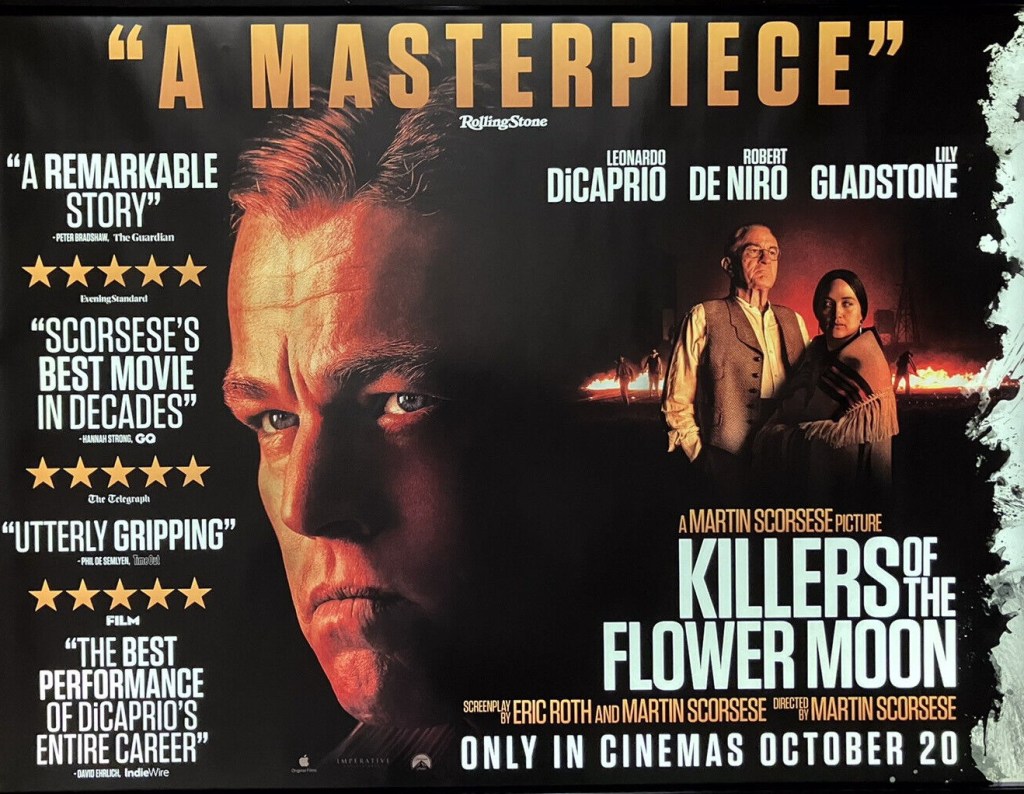
It’s perhaps no coincidence that DeNiro and DiCaprio play murderous relatives in Killer of the Flower Moon, but the performances both deliver are so subtle, so far removed from what Scorsese’s asked of them before, as to point them both in the direction of the Oscar.
You think you kind-of know what you’re going to get with Scorsese, but, more than any other director, he whips the ground out from under you. Killers of the Flower Moon is bereft of the Scorsese trademarks, voice-over, exuberant violence, thumping soundtrack.
So when you’ve been watching his movies for over half a century, you look on him as you might a favored son, delighted in his achievement. But you don’t want him to stop, you want him to keep going. There must be one more film in him. Like Ridley Scott, he’s more bankable than ever, especially if the streamers are looking for a short-cut to hooking up with the best talent available.
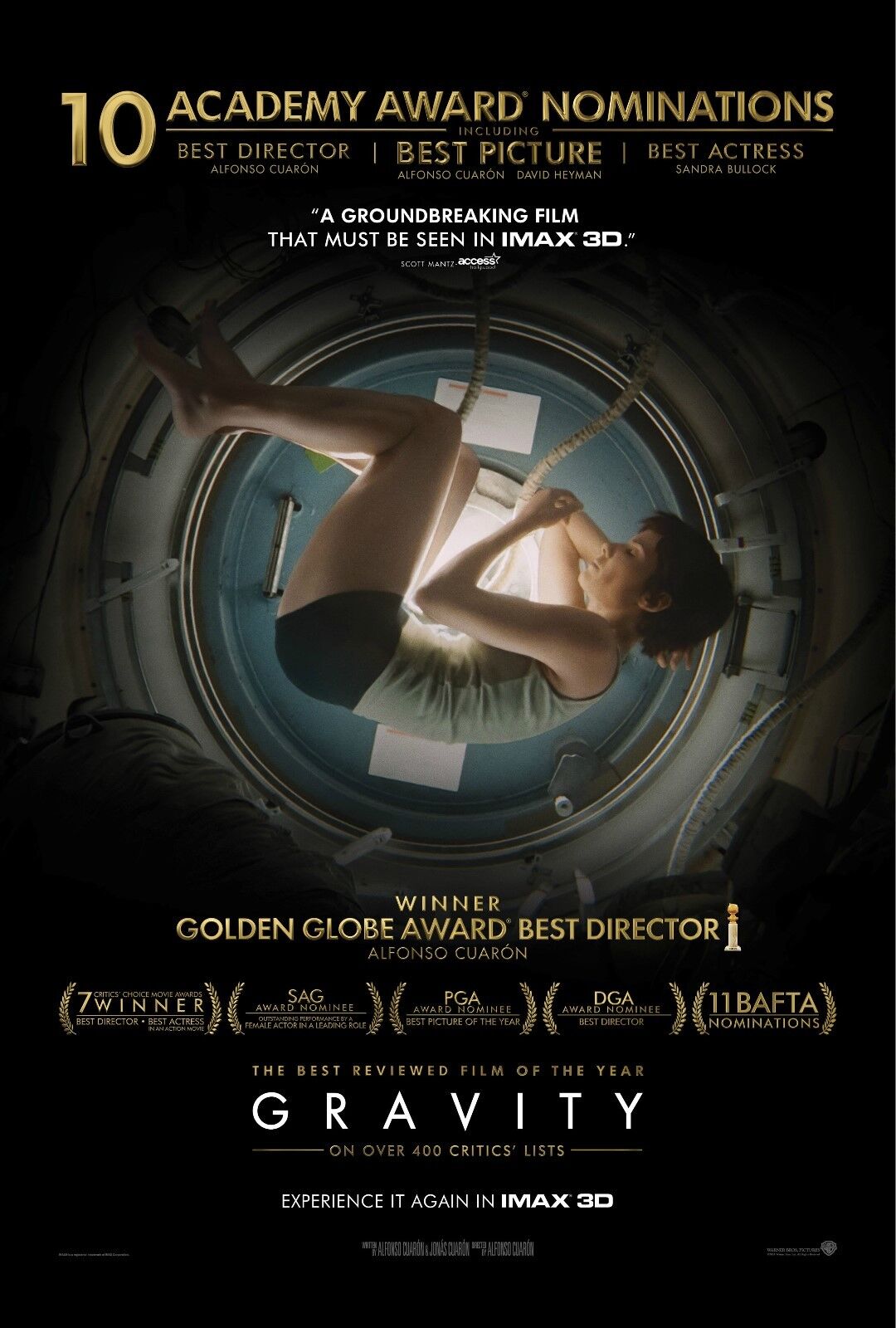
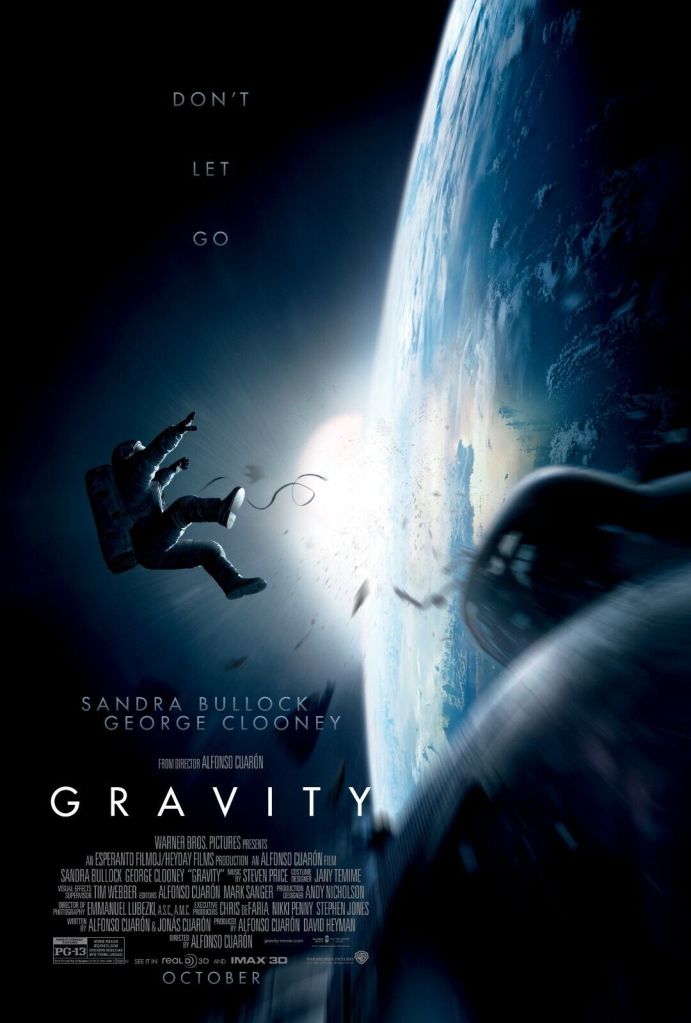
Superb piece of counter-programming saw this sleek sci-fi disaster picture pitted against the uber-lengthy Killers of the Flower Moon. Clocking in at under half the running time of the Scorsese feature (but with the bonus of 3D), almost B-movie style in a mean 93 minutes, it still stands as an awesome achievement by Oscar-winning director Alfonso Cuaron (Harry Potter and the Prisoner of Azkaban, 2004).
Stripping away the tedious back story that generally afflicts sci fi, and bold enough Psycho-style to dispense with a major box office figure halfway through, like John Wick it’s action from the get-go. No aliens here, just a couple of almost nerdy astronauts, sewn-up grieving mother Ryan (Sandra Bullock) and jabber mouth Matt (George Clooney), doing boring maintenance on a pretty mediocre-looking space vehicle, not the kind that’s going to blast off into deep space mapping unknown territories.
Russian space trouble causes a chain reaction that sends hundreds of miniature missiles in diabolic orbit around Earth, hitting the beleaguered Yanks time and again until their entire crew, and that of Russian and Chinese space units, is wiped out. Fits into the survival-in-space mini genre that accommodates Apollo 13 (1995) as easily as The Martian (2105) and the sub-sub-genre of women-surviving- in-space that Sigourney Weaver kicked off in Alien (1979).
So, you know from the off that you’re not going to get a woman bleating about the situation and unable to cope. It’s all about hanging on and using whatever skills got humanity into space in the first to get them back out. As usual, the answer is a pretty straightforward piece of reverse engineering.
But mostly this is sheer spectacle held together by one of the greatest actors of modern times in Sandra Bullock (The Lost City, 2022). When you need someone to emote for the most part from under a space suit, she’s the one. Takes the feet from under you though in the human twist. Why not just let nature take its course, instead of fighting for your life? Might have made a bigger psychological impact if Ryan had just let go, but that’s not, I would imagine, as big box office as the battle for individual survival, especially from someone who has zilch to live for.
I’ve no idea how they achieved the effects and don’t want to know, but a lot of it looks as if shot in-camera, with Ryan floating around in the spaceship. Quite how Cuaron, on triple-hyphenate duties here, writer-producer-director, captured her helplessly turning cartwheels across empty space is anybody’s guess.
If it had been the usual muscled-up candidates hurtling towards their doom, I doubt if audiences would have cared so much, but the everywoman aspects of Ryan nailed it. No point trying to explain the narrative of destruction, suffice to say that whatever deadly comes her way is just as mundane as whatever is helpful.
Pure raw cinematic ride with no let-up in the action. Not sure it will hold up so well on a small screen (though the Blu Ray should provide a hefty impact) so I’m grateful for Warner Brothers for bringing this back for a reissue one-night stand to celebrate its tenth anniversary. Not sure either that it found much of an appreciative audience though. There was just me and one other person in the cinema audience last night.
Your leading man is an alcoholic drug-addled star with substantially impaired sight. Your leading lady, in her first major role, decides she knows more about acting than the very experienced director. But in the world of victimhood, who gets the blame? Not of course Montgomery Clift (The Defector, 1964) or Susannah York (Sands of the Kalahari, 1965), but director John Huston (The Night of the Iguana, 1964).
Huston had been trying to put together a movie about the flawed god of psychiatry, Sigmund Freud, for 13 years. In 1949, with a screenplay by Charles Kaufman and backed by Twentieth Century Fox, it was going to be called Dr Freud. That version was still on the stocks a couple of years later. It wasn’t the first attempt to put the Viennese genius’s life on film, in 1940 Warner Brothers announced Edward G. Robinson in The Life of Freud with a script by Gary Endore.
Huston began serious work on the movie in 1956, but it was only greenlit two years later, after he signed a five-picture $20 million deal with new production unit Seven Arts, set up by Ray Stark and Eliot Hyman, future kingpins at Columbia and Warner Bros, respectively. It was to follow The Man Who Would Be King (not finally made until 1975), for which Huston was scouting locations in Afghanistan. At that point Freud was scheduled for 1959. Then it was Unforgiven (1960) and The Misfits (1961) that came first.
Mostly, the delay was caused by the screenplay. Huston had handed the task to celebrated French philosopher and playwright, who with what amounts to contempt for Hollywood, had written a 300-page script. His next attempt was 780-pages. Read that and weep, Christoper Nolan and Martin Scorsese, this was a 10-hour movie. When questioned, Sartre retorted “so make a 10-hour film.” Huston contemplated turning the script into two unrelated movies, perhaps in the vein of Young Tom Edison and Edison, the Man (both 1940).
Sartre spent two weeks at Huston’s home in Ireland, with Reinhardt on hand as well, trying to condense the material. But he spoke so rapidly that Huston confessed “I could barely follow even his basic thought processes….sometimes I’d leave the room in desperation, on the verge of exhaustion from trying to follow what he was saying.” Huston could not fault Sartre’s diligence. The playwright rose at 5am and would have 20-25 pages ready for discussion five hours later.
Sartre was paid $40,000 for his screenplay. Kaufman was brought back on board but his work didn’t gel with Huston’s vision. Wolfgang Reinhardt, whose name also appeared as producer, was more involved on the script. His relationship with Huston went back to Juarez (1939) on which they were co-writers and Dr Ehrlich’s MagicBullet (1940), for which Huston was credited with one-third of the script and Reinhardt was producer. But Reinhardt hadn’t received a screenplay credit since Juarez and his last Hollywood picture as a producer was Caught (1953). More recently, he had found work in Germany on The Trapp Family (1956). According to Huston, he was “misunderstood, distrusted and ill-used in Hollywood.”
Eliot Hyman questioned Reinhardt’s contribution. In addition to snagging $30,000-$35,000 and a 7.5 per cent profit share for his producer duties, Reinhardt was being paid $300 a week plus expenses for screenwriting, fees Hyman considered “out of line.”
Huston was determined that “Freud’s descent into the unconscious should be as terrifying as Dante’s descent into Hell.” Sartre was viewed as having not just objectivity but as someone who knew Freud’s work intimately. But clearly major work was required to trim the Sartre script. It took six months to reduce the material into a workable script. Naturally, Sartre objected to the reworking and wanted his name removed.
Eventually, with the project at an impasse, Huston turned to leading British psychiatrist Dr David Stafford-Clark to provide clarification. Clift, who as a patient had considerable experience of psychiatrists, insisted on joining their discussions, but “his presence served only to delay and confuse.” When asked to leave, he stood outside the door and cried, then “drank himself unconscious.”
That should have been warning enough. Having worked with an equally addled Montgomery Clift on The Misfits (1961), Huston might have thought twice about going back into the lion’s den. But, while not covered in box office glory, The Misfits was superlative, with all three principles turning in excellent performances. And in any case, Clift was the go-to actor for the tortured character.
Eva Marie Saint (The Stalking Moon, 1969) was first choice for the role of troubled teenager Cecily and after she turned it down Huston approached Marilyn Monroe whose psychiatrist advised against it. So, it went to 22-year-old English actress Susannah York, who had attracted Hollywood’s attention after two British films – Tunes of Glory (1960) and Loss of Innocence / The Greengage Summer. Unusually, this was not a romantic part, treatment of this patient critical to Freud’s analytical breakthrough. Karl Malden (Pollyanna, 1960) was offered the second male lead, but due to his unavailability it provided a comeback for Larry Parks (The Jolson Story, 1946) who hadn’t worked in Hollywood since 1954.
Huston recalled, “He had deteriorated to a shocking degree… I should have dropped Monty…but I didn’t. I thought that when we got on the set and he had lines he would be all right.”
Clift continually tried to rewrite the movie. He had got hold of previous copies of the script and produced his own indecipherable version and spoke the lines in an infantile manner. “Finally, I realized this was primarily a stall for time,” said Huston. “Monty was having difficulty memorizing the lines. I was surprized at this because he had done so well during The Misfits.” But those lines were simple compared to the long, complicated speeches of Freud.
“I’m sure Monty had almost no conception of what he said in the picture – yet he had the ability to make you believe what he did.” Eventually, his lines were written on boards, on the labels of bottles, door frames and other places on the set. Added Huston, “There was a mist between him and the rest of the world that you simply couldn’t penetrate.”
Huston also encountered problems with York. “Susannah was the personification of the uninformed arrogance of youth. Shortly, under Monty’s influence, she became convinced she was entitled to scientific opinions regarding a subject of which she was woefully ignorant.”
She and Monty would collaborate to rewrite their scenes. York refused to do a scene as originally written until a call to her agent changed her tune.
It took all Huston’s experience to hold onto his temper but a confrontation with Clift in his dressing-room resulted in a door slammed so hard it shattered a mirror. That was later conflated into Huston smashing furniture and tearing the couch apart. Huston was also blamed for Clift receiving rope burns during the climbing sequence. In fact, the shots were arranged so that after just holding on to the rope for the short period required, the actor could let go and land a few feet down on a pile of mattresses. Instead, he slid down the rope, holding on with his hands.
“My reputation for cruelty appears to stem directly from this one scene,” complained Huston, convinced the rope burns were Clift “for his own reasons beating himself up.”
Cinematographer Douglas Slocombe developed a technique of three-plane camerawork to help audiences distinguish between reality, dreams and memory. Scenes where characters recalled memories were shot through a small clear-glass plate mounted on the lens matte box. Dreams acquired an extreme black-and-white effect with chalky faces and other details standing out as luminous in tunnels of darkness. This was achieved through a combination of dramatic contrast in photography, stock and lab work.
The production spent five weeks at the Bavaria Studios in Munich before shifting to Vienna, which included 10 days of night shooting.
Universal underwrote the movie, and with To Kill a Mockingbird (1962) also on its roster, intended to celebrate its golden anniversary in fine style with “record rentals” from a raft of movies appealing to the public and the critics.
Freud’s daughter Anna and son Ernest didn’t take kindly to Hollywood’s interpretation of their father’s life and disassociated themselves from the movie and the Viennese hierarchy objected to the film’s louche elements.
Filming began in August 21, 1961, including three weeks on location in Vienna, and was due to wrap on December 5. That it took another two months to complete, (final shooting date was February 10, 1962) inflating the budget, was laid at the foot of Clift. Never mind the drink and drugs he was consuming in mighty proportions, he had cataract problems and could hardly see.
Universal sued Clift for $686,000 for not acknowledging his cataract problems prior to filming, an issue that prevented him memorizing his lines. Clift counter-sued for the remaining $150,000 owed from his $200,000 fee, claiming the problems had developed during filming. “I refuse to accede to the defendant’s demand that this condition…was responsible for delays to the picture.” Firemen’s Fund Insurance, whose policy covered the actor for a year from April 1, 1961, with the proviso the movie finished by December 5, 961, denied liability.
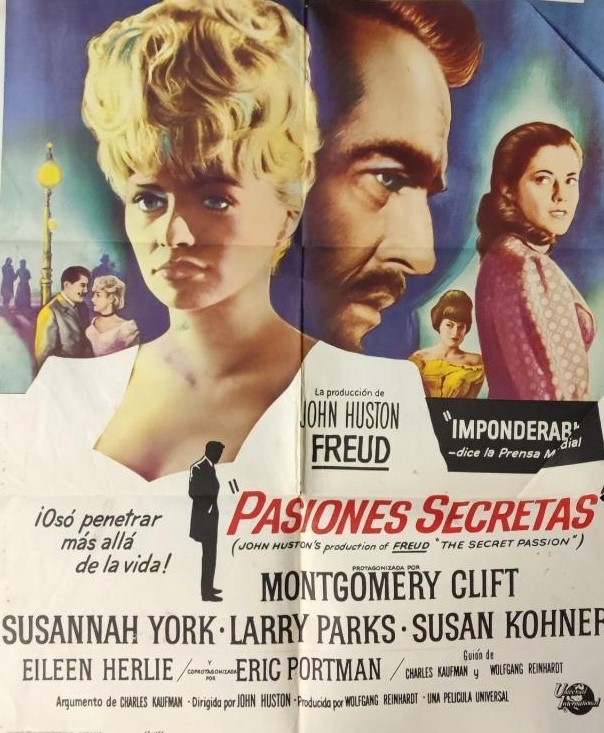
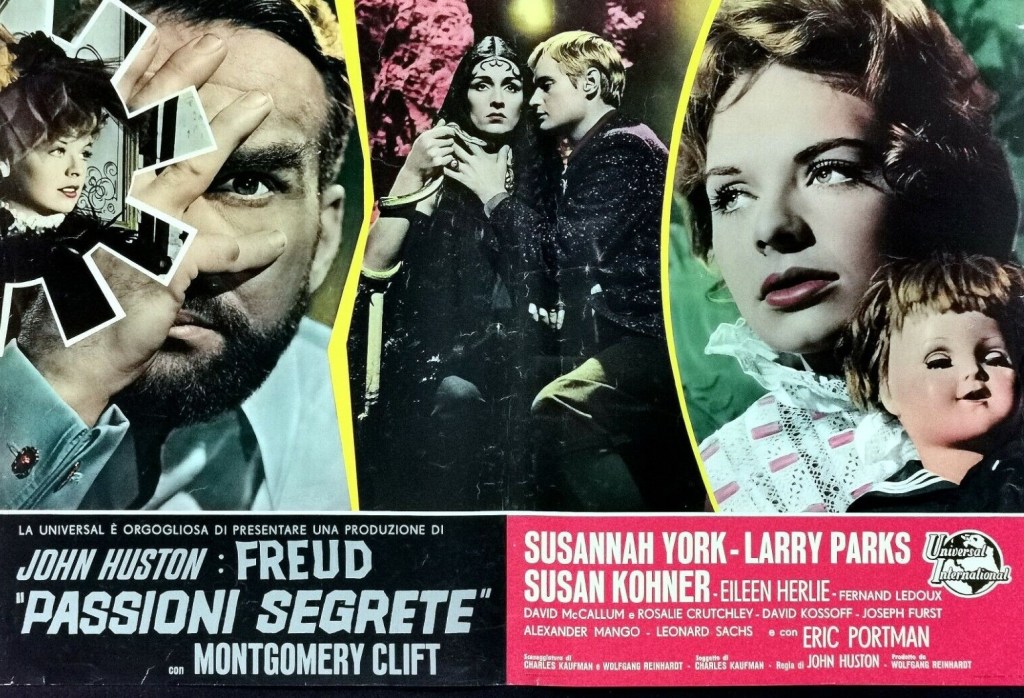
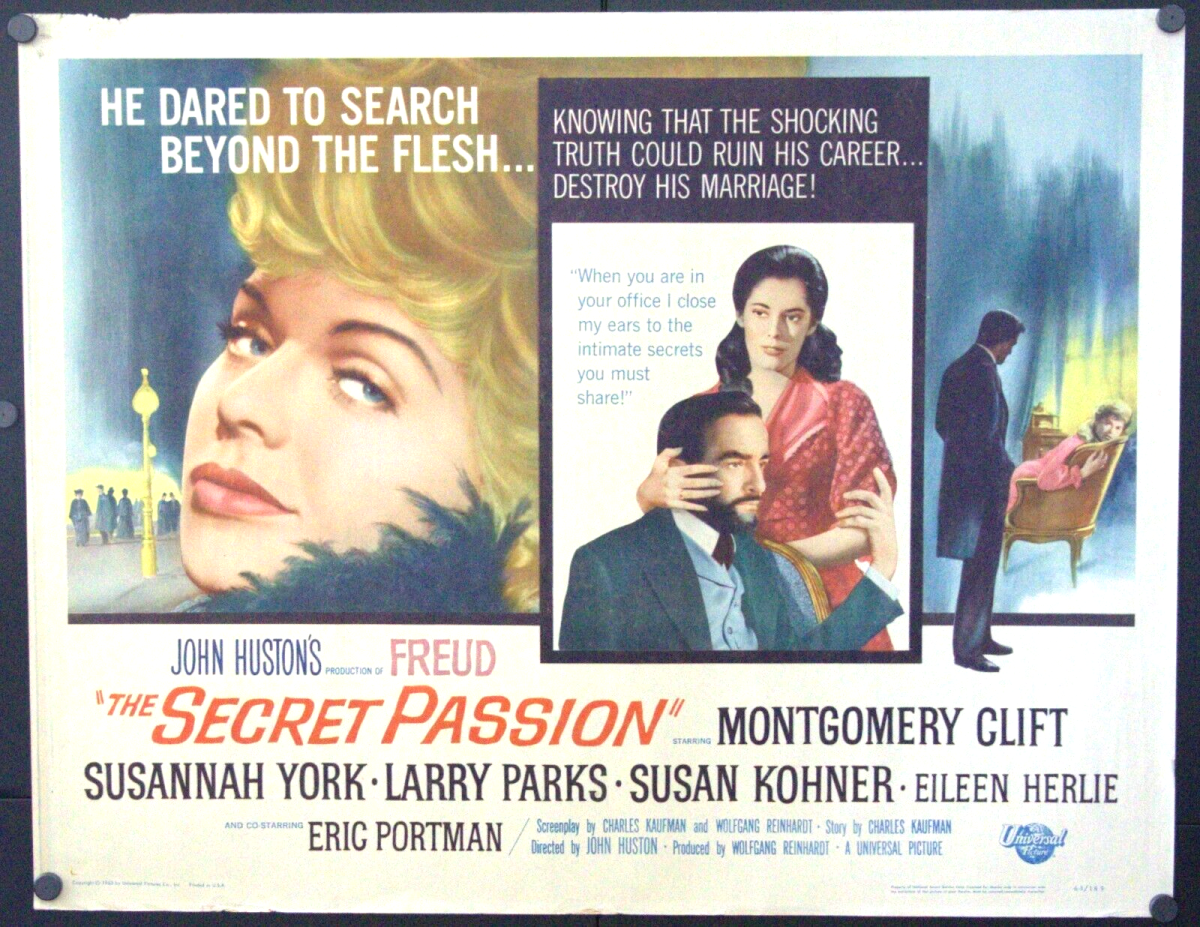
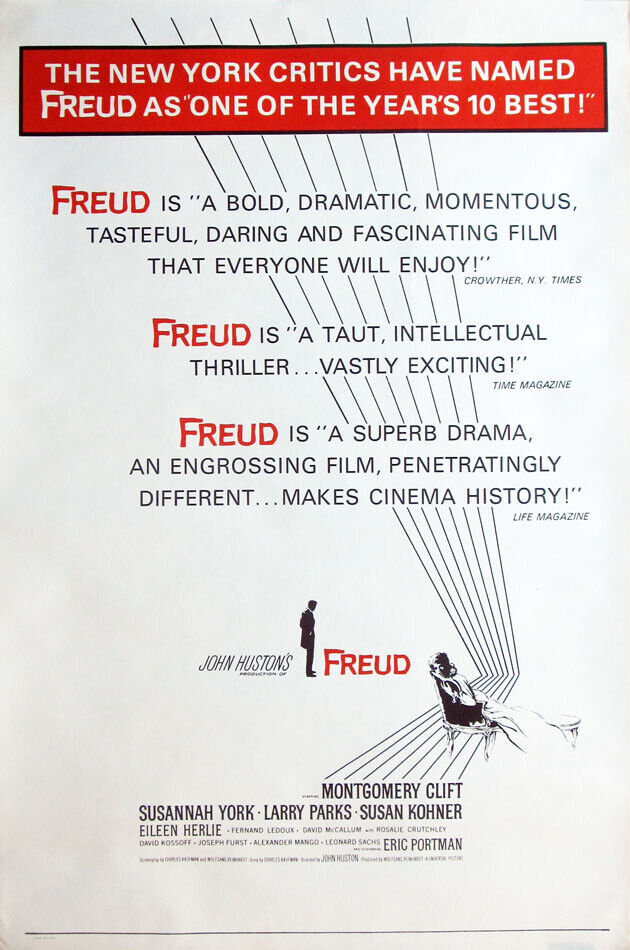
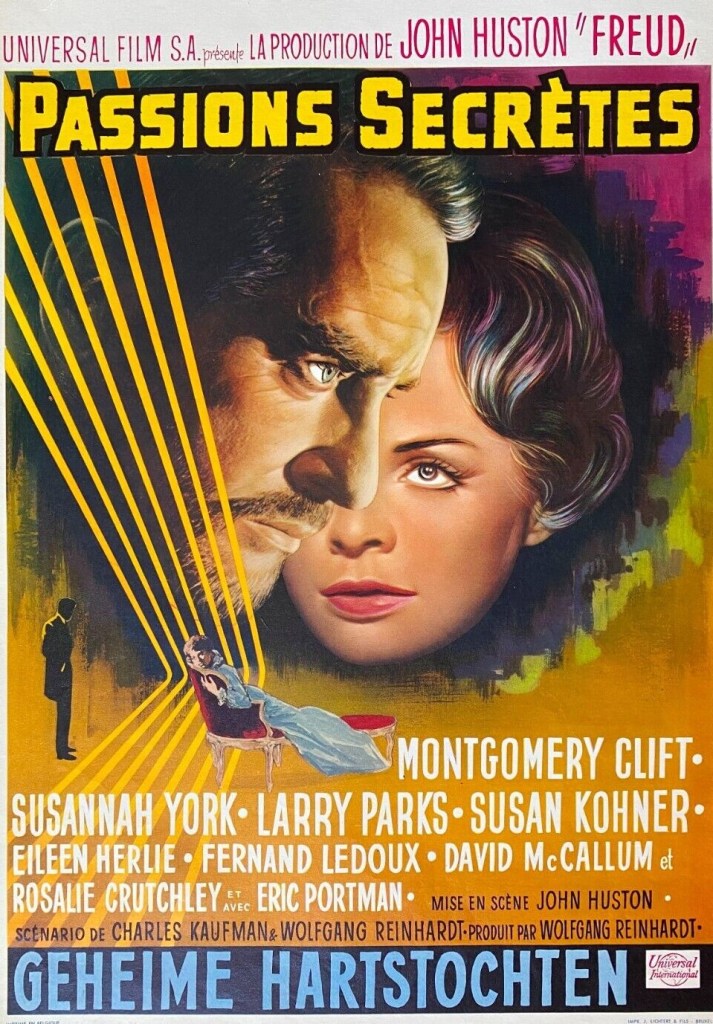
Universal was concerned that the title would mean little to the general public and pre-release toyed with changing the title to Freud: The Dark Passion but agreed, in the end, not to “tamper” with it. However, exhibitors disagreed. And once Minneapolis second-run and neighborhood cinema owners refused to book it under the existing title, it was changed to The Secret Passion, which at least got it through the door with bookers even if the public remained wary. On posters, The Secret Passion part of the title grew bigger and bigger until the Freud element almost disappeared. The film was cut after initial release but the DVD shows the full version.
Despite critical approval and a 12-week run in New York and some decent runs in smaller houses in the country’s bigger cities, it was a flop, not managing the $1 million in rentals required to earn a spot on Variety’s annual box office chart.
SOURCES: John Huston, An Open Book (Columbus books, 1988) p294-305; “Memo from Eliot Hyman,” July 15, 1959, United Artists Archive, University of Wisconsin, Box 7, Folder 7; “Endore for Freud,” Hollywood Reporter, February 24, 1940, p2; “Robinson As Freud,” Box Office, March 2, 1940, p2”; “Dr Freud Bio On Fox Docket,” Box Office, September 17, 1949, p19; “20th Lead with Five in Biopic Sweepstakes,” Variety, January 24, 1951, p5; “Freud Biopic 1st Hyman 7-Arter,” Variety, July 30, 1958, p3; “John Huston’s Next Spot – Afghanistan,” Variety, October 15, 1958, p19; “Huston Seeks Saint,” Hollywood Reporter, November 10, 1958, p2; “Universal Unchained,” Variety, August 19, 1959, p5; “Huston in on Freud Biography,” Variety, October 28, 1959, p11; “Sartre Script on Freud: 780 Pages,” Variety, June 29, p3; “Freud Rolls August 21,” Variety, July 26, 1961, p5; “Freud Moves Location,” Hollywood Reporter, October 12, 1961, p6; “Freud on Night Shift,” Hollywood Reporter, October 24, 1961, p3; “Freud Film Not To Liking of Kin,” Variety, November 1, 1961, p2; “Three-Plane Photography Developed for Freud,” Hollywood Reporter, December 19, 1961, p11; “Huston’s Freud Ends Photo Phase,” February 14, 1962, p4; “Universal Sues for $600,000,” Hollywood Reporter, April 30, 1962, p3 “Montgomery Clift’s Eye Trouble,” Variety, June 5, 1963, p5; “U’s Insurance Claim on Monty Clift,” Variety, June 27, 1962, p7; “It’s Plain Freud, U Won’t Tamper,” Variety, October 3, 1962, p3; “Never Heard of Freud,” Variety, October 9, 1963, p5; ’“Top Rental Films of 1963,” Variety, January 8, 1964, p37.
The Oppenheimer of its day. Instead of splitting the atom, seizing on inexplicable division within the brain. Rather than untapping raw energy concealed inside a previous passive element, delving into the raging unknown of the human psyche. While lacking Christopher Nolan’s cinematic bravura and his post-discovery crucifixion of the main character, nonetheless an intense, under-rated piece. Without doubt one of the few genuine examples of ideal casting – tortured actor playing tortured character.
In the main it’s a tale of three case studies: Oedipal complex exhibited by suicidal Carl (David McCallum), the paternal fixation of Cecily (Susannah York), and Freud’s own sexuality, his strong feelings for his mother. Along the way there’s a potted history of psychiatry. Freud eventually discards the traditional route of hypnotism for getting to grips with a character’s malfunctioning brain and invents the new technique of simply talking to the person. Bit by bit like a forensic analyst going deeper and deeper into character-forming events in early childhood that trigger shame, revulsion and guilt in emotional maturity.
In the case of Cecily, her inability to face the consequences of early circumstances – she was abused by a father she had convinced herself she adored – forces her either to reinvent key moments of her life (believing her father died in a hospital rather than a brothel) or to become afflicted by blindness, phantom pregnancy and paralysis.
It doesn’t shy away from the intimacy of the psychiatrist-patient relationship that can lead to a vulnerable client falling in love with her doctor or, conversely, the physician taking advantage. Freud often felt bound up with his patients’ dilemma, some potent imagery shows him physically unable to free himself from a client.
It unwinds like a detective story, almost a film noir where the investigator goes down the wrong path and finds clues buried within himself, becoming aware of how complicit the mind can become in concealing from the conscious part of the brain what the unconscious cannot deal with.
Theoretically, with mental health issues more to the fore these days, we are all familiar with the causes of emotional disturbance but, in fact, far from this being old hat, in the same way as Oppenheimer shed new light on a significant event with which we are all familiar, I found it quite fresh, especially as, in his intensity, Freud could have been blood brother to the renowned physicist.
As you might expect, Montgomery Clift (The Misfits, 1961) is quite superb. You might think there’s not much acting involved here, Clift just being himself. But compare this performance with The Misfits or the later The Defector (1964) and you can see both similarities and considerable differences. No actor was more adept at revealing soul through the eyes.
The less experienced Susannah York (They Shoot Horses, Don’t They, 1969) and David McCallum (Sol Madrid / The Heroin Gang, 1968) overplay their hand, depending too often on physical expression to show torment. Larry Parks (The Jolson Story, 1946), in his final movie, is more discreet as the shrink falling dangerously in love with his patient without stopping to examine what forces led her to harbor romantic inclination towards him.
As with Oppenheimer, information dumps are made credibly dramatic, and Freud’s lecture on infant emotion to a shocked audience is a stand-out.
John Huston (The Night of the Iguana, 1964) wisely uses the Viennese backdrop as window dressing rather than the camera over-indulging in scenery, although there is a hint of the Sherlock Holmes in scenes of illicit night life.
French philosopher and playwright Jean-Paul Sartre (The Condemned of Altona, 1962) worked on the screenplay along with Charles Kaufman (Bridge to the Sun, 1961) and Wolfgang Reinhardt (Hitler – The Last Ten Days, 1973).
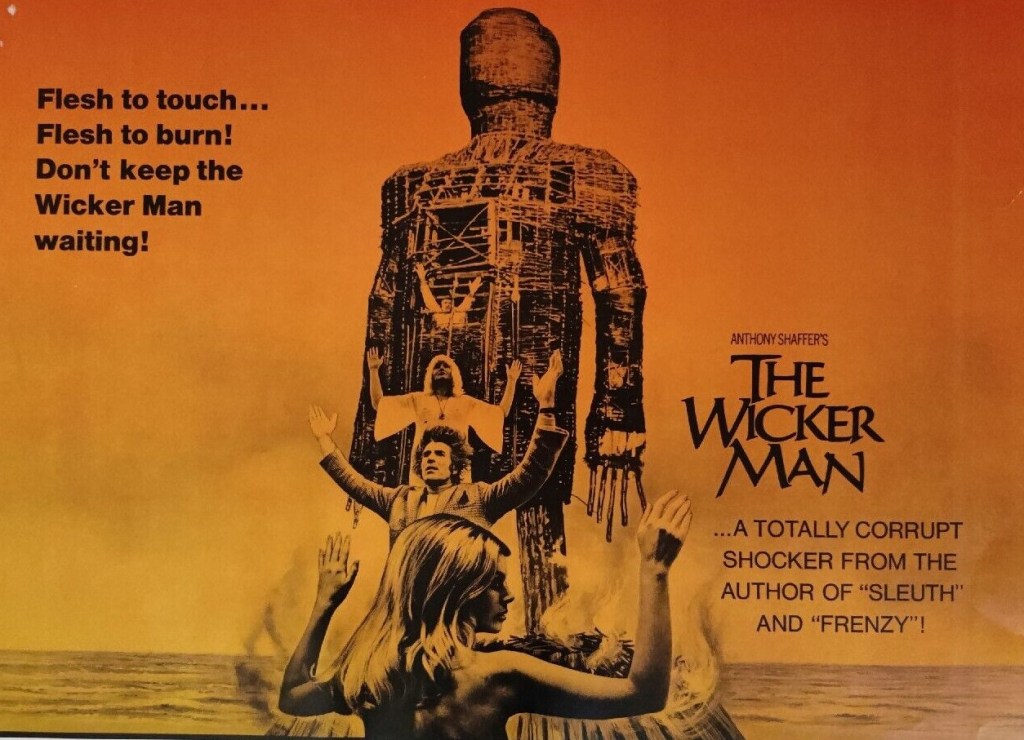
Cult films don’t come any bigger than The Wicker Man (1973). Regarded as a box office flop in Britain at the time of initial release, it struggled to gain any traction in the U.S., only managing a truncated release there towards the end of the decade. However, closer examination of the box office reveals a different story and suggests both that distributor British Lion was rather harsh in declaring it a box office disaster and that more careful handling on the delayed U.S. release could have produced better results.
In the U.K., it was denied a stand-alone release and went out as the second feature to the critically acclaimed and commercially successful Don’t Look Now (1973) directed with some style by Nicolas Roeg and starring Donald Sutherland and Julie Christie, and which has, assuredly, stood the test of time. Several weeks after Don’t Look Now launched as a solo feature on October 1973 at the prestigious Odeon Leicester Square in London’s West End it shifted in December to the less prestigious Metropole where it was coupled with The Wicker Man.
It’s my considered opinion that the reason the double bill managed such a long run – around five months – in the West End, moving between various cinemas, was, in substantial part, due to The Wicker Man. It had been released with virtually no fanfare and relied on word-of-mouth to attract an audience and I think it was the beginnings of that cult recognition that resulted in the double bill playing as long.
Given Don’t Look Now was a verified box office hit as a solo feature, it made little sense to couple it with an unfavored second feature since at this point the double bill was losing ground at cinemas. A single bill meant more performances, especially on the vital weekends, and therefore the potential for greater box office.
One of the elements that backed the notion that The Wicker Man was more important to the double bill than the distributors cared to acknowledge was that the fall-off week-by-week was minimal. The double bill played on in London’s West End long after it had completed a circuit run on the Odeon chain, suggesting that its attraction was perhaps due to the unexpected pulling power of The Wicker Man.
In its accounts, British Lion wrote off a $470,000 loss against The Wicker Man. But that seems like an accounting trick. The distributor had a choice in how it allocated the box office. A supporting feature could expect to receive little more than a flat fee as its share of the box office if it was deemed a B-feature. A genuine double bill – and bear in mind that horror maestro Christopher Lee was a box office attraction in Britain – would split the proceeds. That British Lion opted to treat it as a second feature, allowing it to maneuver the box office against the picture. Otherwise, given its low budget, it would certainly have turned a profit. The loss seems even more baffling when you take into account that it was sold to 17 countries.
In any case, since nobody else has tracked The Wicker Man’s actual performance in the UK and the U.S., I thought it might be interesting to do so.
UK (LONDON WEST END) BOX OFFICE 1973-1974
Don’t Look Now/The Wicker Man
Metropole (1,394 seats)
December 19 1973: – $5,300 (Variety deemed this “anaemic”)
December 26 1973: – $4,700
January 2 1974: – $4,900
January 9 1974: – $13,200
January 16 1974: – $9,700 (“very good”)
January 23 1974: – $8,700 (“fine”)
January 30 1974: – $7,700
Odeon Kensington (1,883 seats)
January 16 1974: – $16,800 (“boff”)
January 23 1974: – $13,700 (“robust”)
January 30 1974: – $10,900 (“fancy”)
February 6 1974: – $10,800
February 13 1974: – $9,300 (“stylish”)
February 20 1974: – $6,100
Odeon Haymarket (600 seats)
February 20 1974: – $6,000
February 27 1974: – $8,300
March 6 1974: – $7,700
March 13 1974: – $6,800
March 20 1974: – $7,400
March 27 1974: – $7,100
April 3 1974: – $6,900
April 10, 1974: – $5,700
Cincenta 3 (150 seats)
April 24 1974: – $2,600 (“nice”)
Cinecenta 2 (150 seats)
May 1 1974: – $2,700
It was pretty much unheard of in London’s West for a programme to move around five cinemas, and, with the exception of Cinecenta, running for so long at each venue with a low drop-off week-by-week (steeper falls would have seen runs more speedily terminated). And when it came to the U.S. release, half a decade later, as you can see, much to everyone’s surprise, The Wicker Man on its own delivered both some notable opening figures and lengthy runs.
US BOX OFFICE 1977-1981
The Wicker Man only
Although being rated “R” by the U.S. censor in April 1974 and being reviewed by Variety in May 15 1974, The Wicker Man failed to gain any release in the U.S. even though one-time partner Don’t Look Now was widely distributed. The Wicker Man received a promotional fillip after winning top prize at the Fantastic Festival in 1974 but it wasn’t enough to boost its Stateside distribution prospects. Both National General and New World had considered taking it on but ultimately passed. It ended up at Warner Brothers which stuck it in the vault after a disastrous test at drive-ins in Atlanta and San Diego.
Box Office magazine gave it a favourable review in 1978, calling it a “lost horror classic” and noting that director Robin Hardy had made “an impressive debut.” The version its reviewer saw was cut from the original 102 minutes to 87 minutes. But the version seen by The Hollywood Reporter in 1979 was the restored version and its reviewer reckoned that the “dark intagibles” of its mangled release made it ideal fodder for a “cult audience.” By now PR had kicked in and it received the accolade of a front-page story in The Hollywood Reporter, calling it “reborn” and making play of the problems encountered along the way.
But apart from the Minneapolis misadventure in 1977, it wasn’t until 1979 that it made any release headway. Most of the bookings were in arthouse cinemas. But what is noticeable is length of runs and comparatively small week-by-week drop-offs.
Minneapolis: World (461 seats)
October 5 1977: – $2,000 (“poor”)
San Francisco: Lumiere (300 seats)
January 24, 1979: – $19,000 “boffo”
January 31, 1979: – $15,500
February 7 1979: – $13,000
February 14 1979: – $11,000
February 21 1979: – $10,600
February 28 1979: – $7,000
March 7 1979: – $5,700
March 14 1979: – Not known
March 21 1979: – $5,900
Los Angeles: Los Feliz Westland 1 (763 seats)
March 21 1979: – $19,500
March 28 1979: – $13,500
April 4 1979: – $11,000 (“not bad”)
April 11 1979: – $9,500 (“tidy”)
April 18 1979: – $4,000
April 25 1979: – $4,000
May 2 1979: – $3,100
Los Angeles: showcase release in four other theaters
March 21 1979: – $26,000
March 28 1979: – $18,000 (“pretty”)
Seattle: Crest (700 seats)
April 4 1979: – $7,100
April 11 1979: – $6,700
April 18 1979: – $6,300
April 25 1979: – $4,700
May 2 1979: – $3,300
New York: Paramount (533 seats)
April 2 1980: – $21,000
April 9 1980: – $9,000 (transit strike ruined second and subsequent weeks)
April 16 1980: – $4,400
April 23 1980: – $4,000
Boston: Orson Welles II ( 200 seats)
April 23 1980: – $15,000 (“house record”)
April 30 1980: – $14,000 (“lusty”)
May 7 1980: – $8,800
May 14 1980: – $8,700
May 21 1980: – $7,600
May 28 1980: – $6,200
June 4 1980: – $4,200
June 11 1980: – $5,200
June 18 1980: – $3,200
June 25 1980: – $3,300
Washington: Cerberus II (150 seats)
December 3 1980: – $7,500
December 10 1980: – $5,500
Kansas City: Fine Arts (560 seats)
January 21 1981:– $3,200
Kansas City: Watts Mill (250 seats)
February 11 198l: – $2,500
Miami: showcase release in four cinemas
April 1 1981: – $3,700 (“remote”)
Cleveland:
April 1981: shown as part of the Cleveland International Film Festival
Pittsburgh: Arcade (775 seats)
May 20 1981: – $5,000 (“stout”)
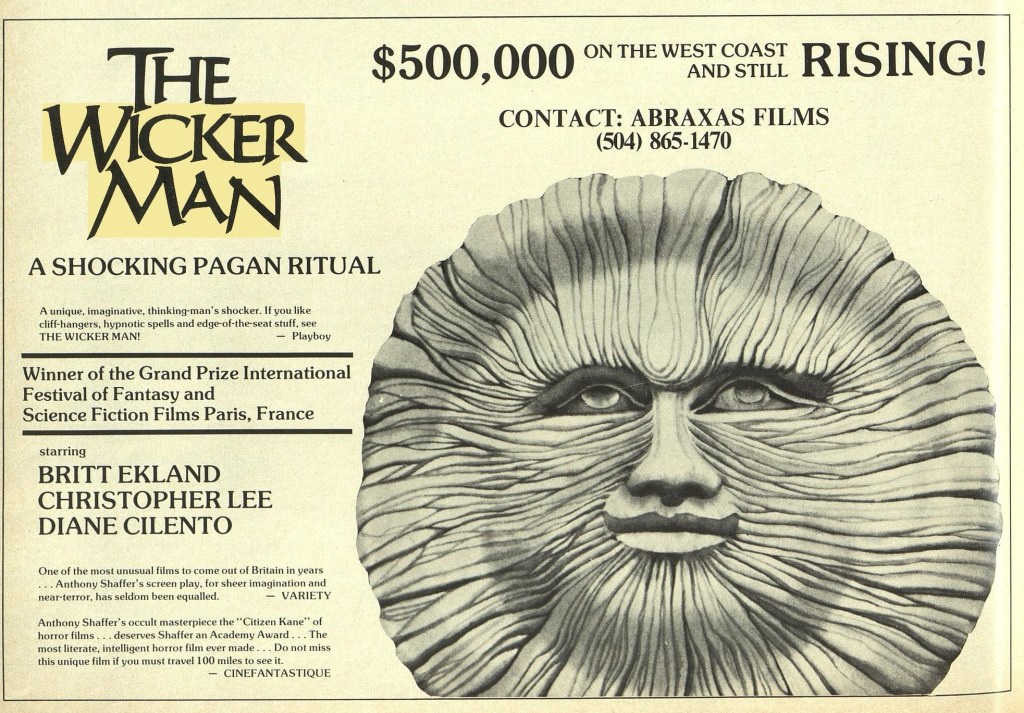
According to an advert in Box Office magazine placed by distributor Abraxas in October 1979, The Wicker Man had already grossed $500,000 on the U.S. west coast. counting it the 1980 and 1981 releases, more than likley it passed the $1 million gross. Whether any of these receipts found their way to British Lion is questionable, so the U.S. box office would have done little to remove the idea it was a flop, but, in fact, counting all the results together, it must have done enough overall to turn a healthy profit.
I should point out that the dates above refer simply to the dates when the box office was reported in “Variety” magazine and not to the actual date when the film was shown. Typically, “Variety” would report box office in the week after a film was shown but this could still be up to 14-17 days after. The actual week 1 / week 2 / week 3 stuff is completley accurate even if the dates might appear misleading.
NOTE/PLEA/WHATEVER: Collecting these figures took a huge amount of work so if you want to pass on this information to others, please acknowledge the source.
SOURCES: Variety, dates as shown; “Coming Releases,” Box Office, September 30, 1974, pA6; Review, Box Office, January 9, 1978, pA9; “Wicker Man Reborn Thanks to Persistent Young Distribs,” The Hollywood Reporter, February 15, 1979, p3; Review, The Hollywood Reporter, February 20, 1979, p3; Advert, Box Office, October 1979, 1979, p16; “Wicker Man Gets Proper Release After 6 Years,” The Hollywood Reporter, April 3, 1980, p1; “Strike Dents N.Y. Box Office,” Box Office, April 14, 1980, p7.
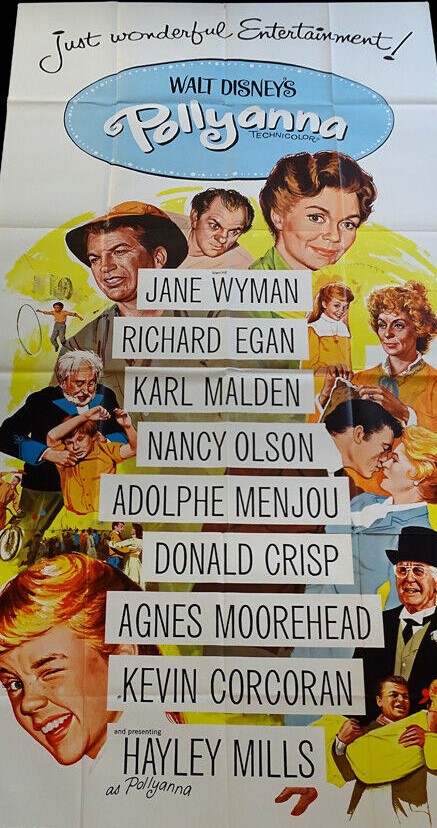
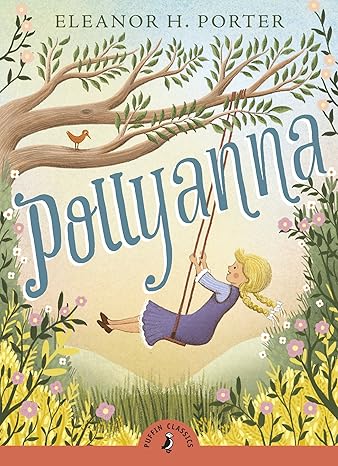
Walt Disney discarded much of Eleanor H. Porter’s original best seller not to mention a great deal of the tear-jerking section that played to superstar Mary Pickford’s strengths in the silent 1920 adaptation. Pickford was in her late 20s at the time and a movie mogul to boot (having launched United Artists) so had a depth of emotion Hayley Mills (aged 13 during filming) could not hope to match.
The screenplay, by David Swift (Love Is A Ball, 1963) is an object lesson in how to retain the essential element of a story – a positive-thinking orphan alleviates the gloom in an embittered town – while providing enough worthwhile for adult audiences. Disney assembled an awesome cast with three Oscar-winners – Jane Wyman (Best Actress, Johnny Belinda, 1948), Karl Malden (Best Supporting Actor, A Streetcar Named Desire, 1952) and Donald Crisp (Best Supporting Actor, How Green Was My Valley, 1942) – plus four-time nominee Agnes Moorehead and Adolph Menjou.
Despite no Oscar recognition Nancy Olsen had been leading lady to the likes of Bing Crosby (Mr Music, 1950), John Wayne (Big Jim McLain, 1952) and William Holden (Force of Arms, 1951). In effect, parents would be very familiar with the stellar supporting cast.
Orphan Pollyanna (Hayley Mills) – British accent explained by parents being missionaries – , majoring on optimism, tries to enliven a town torn apart by dissent and petty feuds and in thrall to her intimidating aunt and fading spinster Polly Harrington (Jane Wyman). While she tries to see the good in everyone, the rest of the population is forever pointing out the bad. The main source of contention is a derelict orphanage. The townspeople want it demolished and a new one erected. Polly Harrington wishes it preserved in its dilapidated state as a monument to her father who had built it. It’s the kind of attitude someone would take who was just plain determined to get their own way. Pollyanna tries to sway opinion against her aunt, resulting in no end of trouble.
Various sub-plots include stifled romance, Harrington has driven away boyfriend Dr Chilton (Richard Egan), fire-and-brimstone preacher Rev Ford (Karl Malden),another orphan Jimmy (Kevin Corcoran), the reclusive Mr Prendergast (Adolphe Menjou) coaxed back into communal life, and the mayor (Donald Crisp) trying to repair the rifts.
Unusually for a kid’s picture, Wyman, Malden and Crisp each are given a reflective moment to prove they are doing more than taking an easy salary cheque, bearing some of the weight of the narrative, Malden especially allocated more screen time than would be normal in a movie aimed at kids.
I have never read the book nor (to my shame) seen the Pickford version, so I came to the movie with low expectations, anticipating a lazy, maudlin effort. So I was quite surprised to discover how much I enjoyed it and was shocked by the final piece of action which turned the movie on its head. Sure, it relies on a feelgood drive but there is some decent stuff here – Pollyanna’s determination to find goodness in every event and every person takes her into some strange avenues, the rainbow playing on the walls, the “good parts” of the Bible – that these days makes for an entertaining matinee.
At least in Hollywood terms (Mills made her debut the year before in the British Tiger Bay, 1959) Pollyanna falls into the a-star-is-born category. The actress acquits herself well, with her expressive face, while hearing the emotion she packs into the word “gorgeous” is word admission alone. Being older than the usual child star, she was one of the few who made the transition into adult roles. Karl Malden is the pick of the supporting cast but he is given a good run for his money by Jane Wyman. Disney’s trick of peppering a children’s film with actors well-known to the adult audiences was one he would use again.
Swift, in dual capacity as director (and making his movie debut) played down the saccharine nature, making the main character less just automatically bouncing with happiness and more striving to make the best of difficult situations.
One of the joys of writing this blog has been the opportunity to reassess stars that I’ve had a tendency to under-rate. You’ll maybe forgive me for putting Doris Day in that category especially as I’ve had ample reasons now to take a different, Please Don’t Eat the Daisies (1960) just one of the many instances where the actress has confounded my expectations.
Until I started on the Blog I’d never gone out of my way to watch a Doris Day picture with the exception of musical Calamity Jane (1953) when it became a camp classic as well as Hitchcock’s The Man Who Knew Too Much (1956) and films where she happened to be co-starring with Cary Grant.
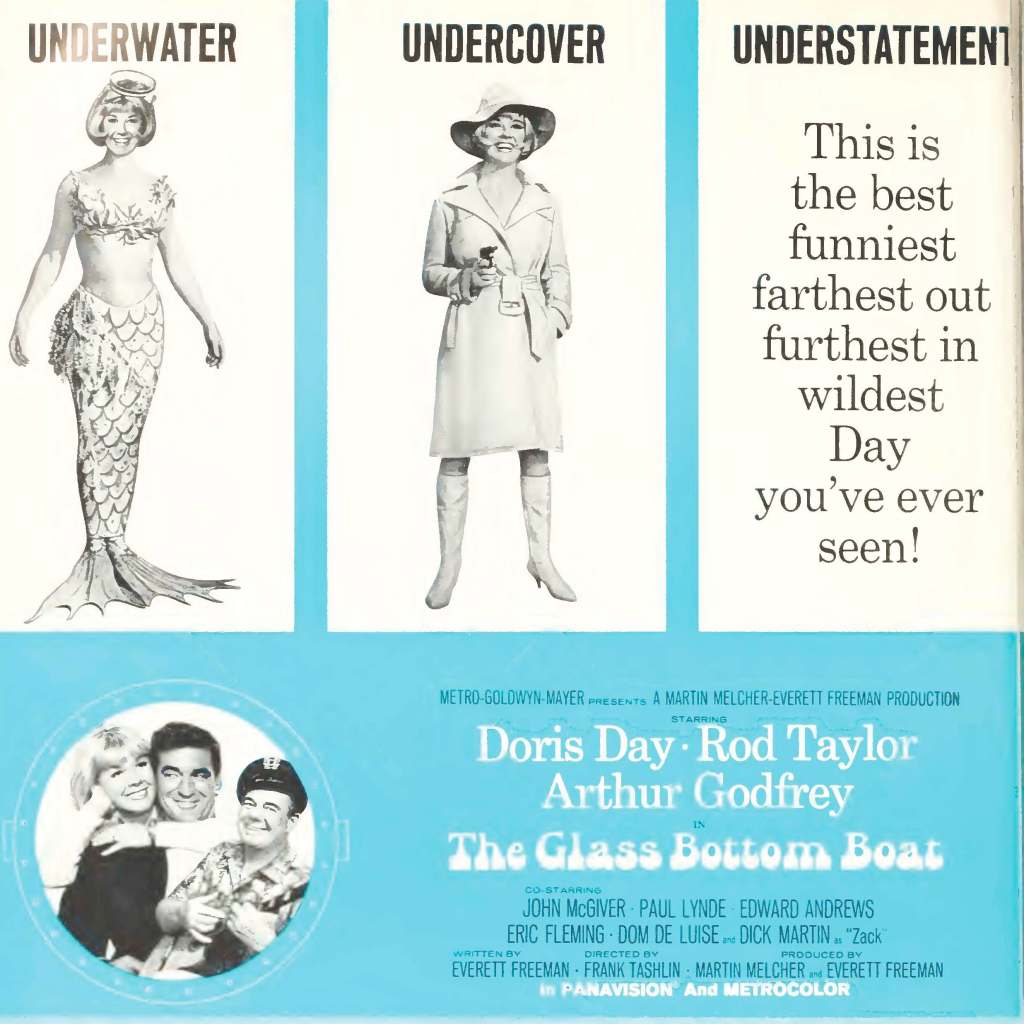
So I came to The Glass Bottom Boat with low expectations, especially as this was towards the end of her two-decades career and her co-star was Rod Taylor, a different level of star to Grant and Rock Hudson. By now, she had dropped the musical and dramatic string to her bow and concentrated on churning out romantic comedies and also been supplanted by Julie Andrews as Hollywood’s favorite cute star.
But it was in part on the evidence here that I changed my tune regarding Day. This is entertaining enough. And she sings – the theme song, one other and a riff on one of her most famous tunes “Que Sera Sera.” Unless there’s a symbolism I’ve missed, the title is misleading since the boat only appears in the opening section to perform the obligatory meet-cute with Taylor as a fishermen hooking Day’s mermaid costume.
The plot is on the preposterous side. The occasionally hapless Jennifer (Doris Day) is suspected as a spy after infiltrating Bruce Templeton’s (Rod Taylor) aerospace research operation. It’s partly a James Bond spoof – when her dog is called Vladimir you can see where the movie is headed – with all sorts of crazy gadgets. But mostly the plot serves to illustrate Day’s substantial gifts as a comedienne. For an actress at the top of her game, she is never worried about looking foolish.
And that’s part of her appeal. She may look sophisticated even when, as here, playing an ordinary public relations girl, but turns clumsy and uncoordinated at the first scent of comedic opportunity. There’s some decent slapstick and pratfalls and some pretty good visual gags especially the one involving a soda water siphon. A chase scene is particularly inventive and there’s a runaway boat that pays dividends. But there are a couple of effective dramatic moments too, emotional beats, when the romance untangles.
She’s in safe hands, director Frank Tashlin responsible for Son of Paleface (1952) and The Girl Can’t Help It (1956). I also felt Rod Taylor (Dark of the Sun, 1968) was both under-rated and under-used, never given much to do onscreen except stick out a chiseled jaw and turn on the charm. Although he had been Day’s sparring partner in her previous picture Do Not Disturb (1965) he’s not in the Cary Grant-Rock Hudson league.
It’s also worth remembering that the actress had her own production company, Arwin, which put together over a dozen of her pictures, including this one, so she would be playing to her strengths rather than those of her co-star. On the bonus side, watch out for a blink-and-you-miss-it cameo by Robert Vaughn (The Man from Uncle), and a featured role by Dom DeLuise as a bumbling spy.
Everett Freeman (The Maltese Bippy, 1969) wrote the screeplay.
Audrey Hepburn and Cary Grant (later a famous duo in Charade, 1963) were the first names associated with Bonjour Tristesse. The former was mooted soon after the movie rights were sold to French producer Ray Ventura. She remained in the frame after Otto Preminger took over in 1955, when the project was intended for MGM rather than Columbia, at which point Grant was being targeted.
But, unfortunately, this was not being proposed as a dream team. Vittorio De Sica was being lined up to play the father in the Hepburn version that was to be directed by Jean Negulesco.
(You can see why uncovering this information prompted me to have a second shot at a “Behind the Scenes” for this picture. When I did the original article, I didn’t have access to my usual online sources. But after a query from a reader over the success/failure of the movie, and with internet access restored, I began to check out its box office and, in so doing, found a treasure trove of new data.)
Even after Preminger dumped Hepburn – and Maggie MacNamara, star of The Moon Is Blue (1953) for that matter – as being too old, at this point Preminger was not looking in the direction of Jean Seberg either. Instead, he was going down a more traditional route to find an actress to play disturbed teenager Cecile. He embarked on a publicity-driven new star hunt. After in 1956 holding a “talent search for femme lead” in France, the director selected 17-year-old Gisele Franchomme for the role.
But she never made the grade either and was quickly jettisoned for Francoise Arnoul (French Cancan, 1955), aged 25 at the time, with another Frenchwoman, Michele Morgan (Lost Command, 1966), as the older woman who snares Cecile’s father, still to be played by Grant.
It’s hard to visualize now just what a hot number the source material was. The novel by Francoise Sagan had been a massive U.S. bestseller. By September 1955 it was in its ninth hardback printing, shifting 110,000 copies, and in 1956 became Dell’s top-selling paperback of the year. The movie rights had originally sold for just $3,000 to Ventura before Preminger ponied up $100,000 (or $150,000 depending on who you believe and in either case still the highest price ever paid for a French novel) and set the movie up at MGM.
So that studio was determined to strike while the novel was hot, taking advantage of the sensational sales figures achieved by Dell. Preminger had different plans. He had a double whammy in mind, planning to pre-empt the movie with a play written by S.N. Berhman (on loan-out from MGM who took first stab at the screenplay) initially scheduled to hit Broadway more than a year before the film appeared.
Preminger had worked the play-into-movie magic before, directing The Moon Is Blue on Broadway in 1951 two years prior to his controversial movie version. In the end Preminger concluded there was “insufficient time” to put a play into production before he was due to begin shooting.
Although it had originally gone along with the idea of the play to the extent of funding the stage production, MGM grew increasingly anxious about the delay in moving onto the picture-making part of the deal. Originally, it was planned as Preminger’s follow-up to The Man with the Golden Arm (1955) which would have seen it released either in later 1956 or early 1957.
The notion of turning the book into a play first probably caused the parting of the ways between MGM and Preminger, the studio unable to pin him down to a start date that would take advantage of phenomenal public interest. He was a hard guy to pin down, already commissioning Alec Coppel to write the screenplay of The Wheel, his proposed biopic of Gandhi, and he also had an ongoing deal with United Artists. So when MGM pulled out, the director turned to Columbia, planning Bonjour Tristesse as the first film in a multi-picture non-exclusive deal.
You could see why MGM were so anxious to get going. The studio was leading the way in a new trend, “the newest film cycle is controversy,” trumpeted Variety in a front-page splash in 1956, tagging Bonjour Tristesse “an unpleasant tale.”
But there was a better reason to act fast rather than just to be seen as with-it. Not only was the paperback market booming, its fastest-growing sector was the movie tie-in. While the 4,500 titles appearing annually accounted for sales of around 200 million copies, publishers also printed movie tie-ins for another 200 titles.
Movie tie-ins had turned into a publishing phenomenon. Sales of Dell movie tie-in paperbacks rocketed year on year, so much so that the rise in 1959 was 23 per cent over the previous year. Ironically, Preminger’s Anatomy of a Murder (1959) has been the publisher’s top title for that year. Peyton Place had taken the top spot in both 1957 and 1958 – 4.2 million copies in print – with Bonjour Tristesse its top seller in 1956.
Typically, a movie tie-in was, in effect, a follow-up to the initial paperback. Often the tie-in print run was much higher than the initial printing. The tie-in edition for Bridge on the River Kwai, for example, topped 750,000 copies, for Sayonara it was 900,000. Don’t Go Near the Water sold one million in a month. The average movie tie-in print run for Bantam was 200,000-350,000 copies; for Dell 250,000-300,000; for Signet 300,000; Popular Library 250,000-300,000; and Pocket 225,000-375,000.
Paperbacks accessed a new market. Apart from traditional bookshops, they were available in drugstores, newsstands, supermarkets, impulse buys when the reader was purchasing something else. But they provided for studios a powerful marketing tool. Dell advertised that its paperback “bestsellers were movie pre-sellers” and for good reason. Front covers adorned with stills from a forthcoming movie offered studios fresh promotional opportunity. When a big picture was due you could hardly walk down a street without your attention being called to a tie-in.
Paperback sales were also viewed as a providing a strong indication of box office potential. Based on its sales, it was predicted that Bonjour Tristesse would do as well as Old Yeller and Don’t Go Near the Water, which turned into, respectively, the 10th and 14th biggest films of the year. Columbia sales chief Rube Jackter was so confident of success for Bonjour Tristesse that he departed from convention, taking a groundbreaking approach, personally undertaking a nationwide tour to sell the project to his local sales teams. Perhaps he didn’t want to be beaten to the punch by A Certain Smile (1958), Sagan’s sophomore novel, rights selling for $150,000 and eight per cent of the gross.
Newcomer Jean Seberg was in the vanguard of a new talent hunt. Undaunted by his experience with Seberg in Saint Joan and the critical pummelling she had personally taken, Preminger defended his protégé. “I think she has talent. If I’m wrong, I’ll pay for it. I don’t say I’m infallible, but neither are the critics.”
Preminger backed new talent, taking a chance on Maggie MacNamara in The Moon Is Blue, Lee Remick in Anatomy of a Murder and, later, Tom Tryon in The Cardinal (1963) and Carol Lynley in Bunny Lake Is Missing (1965). In the late 1950s, Twentieth Century Fox was particularly active in developing younger – and cheaper – stars. But other studios such as Universal and Paramount (who had picked up Audrey Hepburn in a talent hunt in the earlier part of the decade) were also keen.
Lynley and Remick were among those being tipped for the top in 1959 in addition to Rod Taylor (Dark of the Sun, 1968), Jill St John (Tony Rome, 1967), Stuart Whitman (Rio Conchos, 1964), Troy Donohue (Rome Adventure, 1962), Bradford Dillman (The Bridge at Remagen, 1969), Sandra Dee (A Man Could Get Killed, 1966), John Gavin (Psycho, 1960) and Cliff Robertson (Masquerade, 1965).
Preminger’s cinematographer George Perinal (who had taken over Saint Joan, 1957, at short notice) hankered after using Technirama for the picture until the director pointed out “the difficulties of using such a large camera in the tiny interiors of the locations.” These included an art gallery in Montparnasse round the corner from Notre Dame where Preminger negotiated a one-day rental (and the purchase of a Picasso) from the Japanese owner. Following Saint Joan, Perinal was so taken with the experience of working with Preminger that he had turned down several other offers in order to keep himself free for a possible shot at Bonjour Tristesse.
“A large part of my job,” noted Perinal, “ is keeping out of the way once I had lit the set as Preminger wanted,” leaving the physical shooting to the cameraman. He had “great admiration for Preminger’s methods” since “unlike most directors he doesn’t protect himself by having one or two extra cameras covering the scene from different angle. He knows the angle he is after, and he gets it.” If the rushes proved the scene didn’t go as planned, he simply shot it all over again.
The scene in Maxim’s was filmed for a day and a night, extras being rehearsed in the morning. Most of the takes concentrated on chanteuse Juliette Greco. Francoise Sagan was tapped to write the lyrics for the movie’s theme song, but that didn;t work out instead it’s credited to Jacques Datin.
It’s worth remembering the ease with which top stars travelled. Deborah Kerr had booked passage on the Queen Mary sailing from New York to Cherbourg in the north of France for herself and two children, Melanie and Francesca, and after docking took a leisurely drive down to St Tropez.
As well as paperbacks offering marketing opportunities, the theme song to Bonjour Tristesse was also a promotional tool, Gogi Grant released it as a single, Les Baxter as an instrumental and Janet Blair sang it on British television top show Sunday Night at the London Palladium while the soundtrack album was a premier release for RCA Victor, which backed it up with an advertising campaign.
Released in February 1958 in the U.S., Bonjour Tristesse was one of 35 pictures distributed by Columbia over a six-month period. Thanks to the book sales and the cast, expectations were high. David Niven was riding a commercial (blockbuster Around the World in 80 Days, 1956, still in cinemas) and critical wave (Separate Tables, 1958, would earn him an Oscar). Deborah Kerr remained one of the industry’s most sought-after stars, her commercial and critical standing (three Oscar nominations 1956-1958 in a row) far higher than Niven’s. She had hit box office heights in The King and I (1956) and played opposite such top male stars as William Holden (The Proud and the Profane, 1956), Cary Grant (An Affair to Remember, 1957) and Robert Mitchum (Heaven Knows Mister Allison, 1957).
Robert Coyne of exhibitor alliance Compo rated it potentially one of the year’s “big pictures” along with The Young Lions and Peyton Place. But while enjoying some reasonable results in prestigious first run theaters in hi-hat locations, Bonjour Tristesse quickly fizzled out.
Although a dud in the United States – in terms of rentals it didn’t even clear $1 million – it enjoyed greater success elsewhere, ranking fifth in Japan, 20th in the annual Italian box office race, and in the Top 50 in France, “bang-up business” in journalistic parlance. But it was banned in Ireland. However, suggestions it was a box office smash elsewhere had to be taken with a pinch of salt. It only earned $195,000 in rentals in Japan. So, it is doubtful if it ever reached profitability on initial release.
There was some respite in the critical pummeling of Seberg. Hollywood Reporter, in a favorable review, tabbed her a “delicious little eyeful” noting her style was better suited to this than Saint Joan. And despite her experience of working with the director, the actress, one year later, was reported as “hoping Otto Preminger will come through with a commitment to her” not realising he was on the stage of ducking out of her contract, explaining that there wasn’t a suitable role for her in his next three planned pictures. So that contract, too, went the way of Columbia who tested her for a supporting role in The Beach Boys, a starring vehicle for Kim Novak to be helmed by Charles Vidor.
There was some reassessment of the title post-release. When Columbia sold a batch of 60 movies to television in 1964, Bonjour Tristesse was hailed in the trade advertising campaign as the main attraction, photos of the three stars adorning a full-page advert in Variety. It was reissued in Tokyo in 1981. It was featured in a 15-picture Columbia retrospective at the Museum of Modern Art in New York in 1985.
SOURCES: “Europe,” Hollywood Reporter, August 18, 1954, p7; “Otto Preminger Acquires Bonjour Tristesse Novel,” Hollywood Reporter, April 27, 1955, p2; “Tristesse Legit Version Being Financed by MGM,” Hollywood Reporter, May 31, 1955, p1; “Preminger Gets Behrman To Script Play and Film,” Hollywood Reporter, August 5, 1955, p3; Mike Connolly, “Rambling Reporter,” Hollywood Reporter, August 24, 1955, p2; “M-G Bankrolls Tristesse Legiter,” Variety, September 7, 1955, p3; “Literati,” Variety, September 7, 1955, p69; “Preminger Sets Coppel To Script Wheel,” Hollywood Reporter, January 12, 1956, p3; Stuart Schulberg, “Europe’s Unpampered Stars,” Variety, February 15, 1956, p7; “Chatter,” Variety, February 15, 1956, p74; “Paris,” Hollywood Reporter, May 22, 1956, p20; Mike Connolly, “Rambling Reporter,” Hollywood Reporter, June 8, 1956, p2; “Chatter,” Variety, June 13, 1956, p78; “Looky – We’re Controversial,” Variety, June 26, 1956, p5; “Bonjour Tristesse,” Variety, July 25, 1956, p4; “Chatter,” Variety, August 22, 1956, p62; ”Niven and Kerr Will Star in Tristesse,” Hollywood Reporter, February 21, 1957, p2; “Broadway Ballyhoo,” Hollywood Reporter, April 19, 1957, p10; “Insufficient Time for Tristesse Stage Version,” Variety, March 28, 1956, p2; “Cameraman on the Sidelines,” American Cinematographer, August 1957, p510; “The Note-Book,” Hollywood Reporter, August 5, 1957, p7; “Broadway Ballyhoo,” Hollywood Reporter, August 13, 1957, p4; “Broadway Ballyhoo,” Hollywood Reporter, August 20, 1957, p4; “Preminger,” Variety, October 16, 1957, p75; “Jackter Hits Sticks for Bonjour Release,” Variety, December 18, 1957, p3; “Foreign TV Follow-Up,” Variety, December 18, 1957, p38; Advert, “Dell Book Best-Sellers Are Movie Pre-Sellers,” Hollywood Reporter, January 8, 1958, p5; Review, Hollywood Reporter, January 15, 1958, p3; Advert, Variety, January 22, 1958, p56; RCA Victor advert, Variety, January 29, 1958, p56; Advert, Billboard, January 27, 1958, p49; “Columbia Feeds 35 by August,” Variety, February 5, 1958, p18; “A Film ‘Still’ Big Sell on Paperback,” Variety, March 5, 1958, p7; “Irish Want New Film Censoring,” Variety, June 11, 1958, p11; “Broadway Ballyhoo,” Hollywood Reporter, July 1, 1958, p4; “Sindlinger: And Rebuffed,” Variety, July 2, 1958, p5; “Paris First Runs,” Variety, July 16, 1958, p12; “New York Sound Track,” Variety, July 30, 1958, p21; “Columbia To Test Seberg for Beach Boys Role,“ Hollywood Reporter, August 15, 1958, p1; “Yank Films Still Dominate Italy,” Variety, December 3, 1958, p12; “Top Grossers* of 1958,” Variety, Jan 7, 1959, p48; “Kwai Tops in Japan,” Variety, March 18, 1959, p24; “Nine U.S. Pix,” Variety, May 13, 1959, p12; “Hollywood Takes To Tyros,” Variety, September 2, 1959, p3; “Paperback-Film Zowie Tandem,” Variety, February 3, 1960, p5; Advert, Variety, September 9, 1964, p39; “Bull Takes Charge,” Variety, May 25, 1981, p32; “MoMa Columbia Retro Set,” Variety, January 30, 1985, p4.
* NOTE: Just to confuse things, Variety headlined its annual rentals report as “Top Grossers of 1958” but in the small print clarified that these figures related to “domestic market rentals accruing to distributors (i.e. studios) a distinguished from total theater gross.”
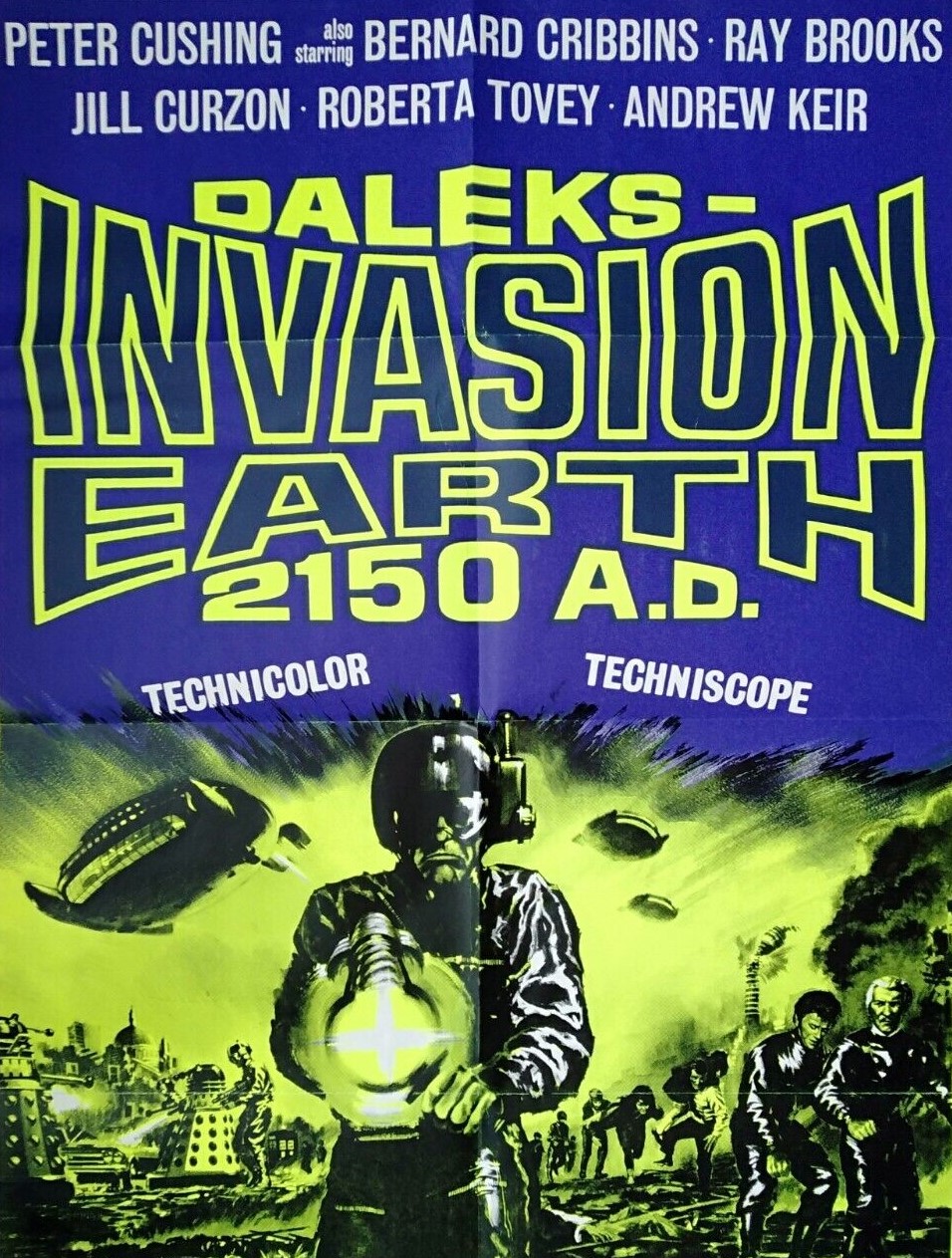
Sequels being all the rage – James Bond, Matt Helm, Derek Flint, The Pink Panther, The Magnificent Seven – in the 1960s it was no surprise that the success of Dr Who and the Daleks (20th top film at the British box office in 1965) suggested that a second go-round might be as profitable. As was standard, a recurring formula was the key.
In this case, Dr Who (Peter Cushing) and grand-daughter Susan (Roberta Tovey) repeated their previous roles though another grand-daughter Barbara (Jennie Linden) was replaced by a niece Louise (Jill Curzon) and hapless passenger Ian (comedian Roy Castle) was ousted in favour of hapless London cop Tom (comedian Bernard Cribbins). But returning director Gordon Flemyng (The Split, 1968) upped the ante. Instead of waiting ages for the dreaded mechanical monsters with their electronic catchphrase (“Exterminate”) to appear, they turn up virtually in the first reel.
As if to emphasise the versatility of the Tardis, this time instead of space travel it’s time travel, Dr Who turning up in a blitzed London virtually two centuries ahead only to discover his nemesis rules the planet. It being set in a familiar locale, nobody is loaded down with information dumps, a tedious feature of the first picture, and it doesn’t take as long to get going, and our heroes, in various configurations, and while befriending the rebels – leader Wyler (Andrew Keir) and David (Ray Brooks) – endure a cycle of trap and escape while the good doctor tries to work out what brought the daleks to his home planet.
I’m giving this the benefit of the doubt and suggesting that the first appearance of the daleks is a homage to Dr No (1962) although one of the creatures emerging from the River Thames is hardly a patch in the sexy-entrance stakes as a bikini-clad Ursula Andress. Amidst all the mayhem, there are a couple of standout sequences, the best of which is a comedy skit involving Tom, disguised as a leather-clad member of the brainwashed automatons. This reminded me of Bob Hoskins in the first Super Mario Bros (1993 vintage) being trapped in an elevator with the Goombas. Tom is just too human to fit into this gang, constantly out of step with their actions.
Naturally, the Dr Who team are split up, allowing the action to move into two converging directions. The daleks plan to turn the planet into a giant spacecraft it can tow around, that storyline somehow involving a mining operation outside London while there’s some clever sci fi tomfoolery using the Earth’s magnetic poles to destroy the enemy.
Oops, I’ve given away the climax. Not that anybody cares that much, the main fun being the escaping formula – the daleks even use this as a plot twist, commending the intelligence of any human who can manage to escape – and watching the doctor outwit the enemy. Actually, the main fun is the dastardly daleks. Every time they appear you can imagine yourself back in a cinema crammed with thousands of kids yelling “Exteminate! Exterminate!”
The plot keeps rolling along, no time to draw breath. And we’re not having to bother with any of the boring MCU claptrap intent on giving the super-villains a backstory or expiating their evil brains. The daleks represent alien domination, and they’re not here to give lectures on inhumanity or peace. In their determination to kill, they could almost be contemporary, given the number of serial killers and/or madmen clogging up cinema screens.
If not conspicuously inventive, Gordon Flemyng’s management of a large cast and a variety of action brought him to Hollywood attention. Given the storied career of Peter Cushing (TheSkull, 1965) storied career, his performances as the doctor are generally overlooked, which is a pity, because he is certainly among the best to essay this character. Carry On regular Bernard Cribbins livens up proceedings without needing to resort to slapstick in the Roy Castle mode. This must have seemed a bit of a come down for Ray Brooks after unexpected hit The Knack (1965) but he always seemed more at home on the small screen (although Flemyng hired him again for The Last Grenade, 1970).
The series ended here after the movie flopped on home territory. The original had bombed in the States, so the producers were heavily dependent on British box office. I guess just getting U.S. audiences aware there was such a thing in Britain as a “police box” would have been harder to grasp than the fact that it housed a time machine, and that the interplanetary craft was just there without a whole story about how it had come into being.
Made on a miserly budget by anybody’s standards, the sfx was never going to come up to scratch. But who cares.









 The Magnificent 60s