Twisted Nerve (1968) ***

Another rich kid with mental health issues though without Orson Welles to offer expiation. The cause of this character’s illness is undetermined but it’s easy enough to spot the trigger to violence. The lad’s father is dead and his mother’s new husband, a wealthy banker, wants him out of the way, or at least out of the house, or at least, given he’s twenty-one, out working rather than mooning about the house all day.

And this was certainly the year for the movies exploring split personality – if such shallow treatment could be deemed investigation – what with Tony Curtis and Rod Steiger in serial murderous form in, respectively, The Boston Strangler (1968) and No Way to Treat a Lady (1968). And for movie fans it was an unexpecteldy speedy reteaming for Hayley Mills and Hywel Bennett after the humungous success of The Family Way (1967) in which the actress shed her child-star persona in no uncertain manner and the British film industry was, apparently, suddenly blessed with a duo with marquee appeal.

A poster that gives the game away. And an apostrophe issue.

This takes the Rod Steiger route of charming killer rather than a Tony Curtis puzzled and horrified by the demands of his ulterior personality. Given the emphasis on mental illness these days, Twisted Nerve is the hardest of the trio to take, since it’s effectively a play on an old gimmmick, deviousness concealed inside appeal.

Martin (Hywel Bennett) faced with expulsion from his house by overbearing substitute father Henry (Frank Finlay) pretends to scoot off to France but instead inveigles himself into the boarding house run by Joan (Billie Whitelaw) after tricking her librarian daughter Susan (Hayley Mills) into extending a sympathetic hand to his alter ego, the childish Georgie, whose behavior falls only a little way short of sucking his thumb and clutching a teddy bear.

Joan’s initial cynicism gives way to maternal feelings when he clambers into her bed in the middle of the night after a supposed nightmare. (And not with sexual intent.)

Occasionally, Martin cannot control his true feelings, despite Susan rebuffing his romantic overtures. Father is the first victim, substitute mother Joan the second and it’s only a matter of time before Susan becomes a target either for his stifled sexuality or his inner venom.

This would probably work just as well minus the schizophrenic element. In fact, there’s too much of tipping the nod to the audience. Eventually, Susan’s suspicions are aroused but  director Roy Boulting (The Family Way) is no Alfred Hitchcock able to manipulate an audience. So, mainly, what we are left with is Hywel Bennett’s ability to pull off a double role rather than his victims’ susceptibility to his charms.

Hayley Mills’ character could do with fattening up, otherwise she’s just the dupe, bright, bubbly, self-confident and attractive though she is, although her mother, in passing, is given more depth, a lonely attractive widow prone to sleeping with her attractive guest Gerry (Barry Foster) and, unnerved to some extent by her daughter’s growing independence, wanting a son to mother.

It’s only un-formulaic in the sense that the director is playing with an audience who were not expecting anything like this as a story fit for their two newest adult stars so hats off especially to Bennett for considering a role that could as easily have typecast him for the rest of his career. As I said, setting aside the mental illness elements, Bennett is good fun, as he toys with both aspects of his character, adeptly dealing with those who would patronise him, and like Leopold and Lowe convinced he can get away with the perfect crime, whose planning and attention to detail is noteworthy.

As with the Chicago killers it’s only accident that gives him away, although the policeman here (Timothy West) is less dominant than his American counterpart.

Clearly filmmakers of the 1960s were beginning to grapple with mental illness but either lurching too far towards romance as a way of instigating tragedy as with Lilith (1964) or to the most violent aspects of the condition as with virtually anything else beginning with Psycho (1960).

Worth a look for Hywel Bennett’s chilling performance – template for Edward Norton’s turn in Primal Fear (1996) – and Hayley Mills fans won’t want to miss it. Strong performances by Billie Whitelaw (The Comedy Man, 1964), Barry Foster (Robbery, 1967) and Frank Finlay (The Shoes of the Fisherman, 1968) help enormously. There was quite an input into the screenplay. Along with Boulting, Leo Marks (Sebastian, 1968) doing the heavy lifting adapting work by Roger Marshall (Theatre of Death, 1967) and, in his only movie credit, Jeremy Scott. Great score by Bernard Herrmann.

Well done with misgivings.   

The Red Tent (1969) ***

If you’re unfamiliar with the abortive Italian airship expedition to the North Pole led by General Umberto Nobilo (Peter Finch) in 1928, you’ll find this an absorbing tale. If you are familiar then you will probably appreciate the film-makers’ attempts, via an unusual framing device, to carry out a post-mortem and to apportion blame for the disaster. If you know your history, you’ll also be aware both poles had been conquered, American Robert Peary first to the North Pole in 1909, Norwegian Roald Amundsen (Sean Connery) claiming South Pole bragging rights two years later.

So you’re also probably wondering what was the point nearly two decades later of the Nobilo operation? But the sled-led efforts of Peary and Amundsen were feats of endurance i.e. man vs.  nature. This was science vs. nature. The dirigible was the apex of aviation advancement and nations still battled for exploration glory. So to travel in some comfort and fly over the North Pole in a few days would be a demonstration of scientific supremacy. Conquest of one of the most inhospitable places on earth was almost a PR exercise. With no intention of landing it was also a glorified tourist trip.

However, the science was flawed. Nobody had counted on the build-up of ice. The airship crashed and since this was a joyride nobody was equipped to walk their way out. Just surviving would be difficult enough. Loss of radio transmission (science) indicated a problem so rescue airplanes were deployed. But without a location to pinpoint the survivors, searchers had about two million sq km to cover. Luckily, a brilliant scientific deduction by expedition member Finn Malmgreen (Eduard Martsevich) saves the day and a ham radio user (amateur science) picks up the location. Game on!

Except airplanes are too easily thwarted by blizzards, fog and the inhospitable. Home base, set up simply to welcome home a successful jaunt, is not capable of organizing a proper rescue. A Russian ice-breaker joins the rescue attempt. Taking greater risks is aviator Einar Lundborg (Hardy Kruger), fired up by the promise of sex with desperate nurse Valeria (Claudia Cardinale), who happens to be Malmgreen’s girlfriend, and a bounty from Nobilo’s insurers. The redoubtable Valeria does not have to sell her body to persuade the more highly-principled Amundsen to join the rescue effort.

So it’s gripping clock-ticking-down stuff, action shown in considerable detail, almost over-populated in one sense as director Mikhail Kalatozov (The Cranes Are Flying, 1957) covers multiple storylines, the various disjointed rescue efforts, the survivors weakening by the day, imperiled by marauding polar bears and the ice cracking up beneath their feet.

In the main it’s a true story, Valeria the only fictional element, inserted for genuine cinematic purpose, to give the audience someone to emotionally root for back on land and for her character to guide us in an almost contemporary touch through the ghoulish carnival onshore as thousands gather to witness first-hand news of disaster.

What’s obviously patently untrue is the framing device, given that it shows the still-living Nobilo summoning up the ghosts of others involved in the event for a post-mortem, in which his guilt drives him into the position of sacrificial lamb. Although on first encounter it appears a bizarre idea, that, too, soon achieves dramatic purpose. Clearly there was intense discussion at the time and in the immediate aftermath by those who survived the disaster and there must have been high-level talks behind closed doors that usually excluded the main characters of the kind that was played out in a host of historic pictures made during the decade. Lawrence of Arabia (1963) and Khartoum (1965) had many such set-pieces where reputations were shredded.

This approach permits opportunity for all the principals to come together for confrontational purposes in the one room. Not all of that discussion follows the expected path and there is an interesting argument between Nobilo and Amundsen about leadership. From an audience perspective, it is, of course, quite satisfying to see Sean Connery (The Hill, 1965) facing off against Peter Finch (The Sins of Rachel Cade, 1961) with Hardy Kruger and Claudia Cardinale (The Professionals, 1966) embroiled in the debate.

There is the bonus of fabulous cinematography of the majestic Arctic, the icy waste, and breaking up of ice floes and collapsing icebergs has never been captured in such widescreen glory. Further pluses are in the performances, especially Connery as an aged Amundsen, Finch as the glorious pioneer bewildered the sudden turn of events and Cardinale as a woman willing to go to any lengths to save her lover. Ennio Morricone provided the score.

However, you are best going into this aware that while Finch has a goodly amount of time onscreen, Connery and Cardinale (the ostensible stars judging by the credits) are not seen so frequently. That said, the movie works well as an account of the disaster. The version I saw was just a shade over two hours – cut by about 30 minutes from original release.

Streaming channel Sweet TV has the longer version but I couldn’t find a workable link.

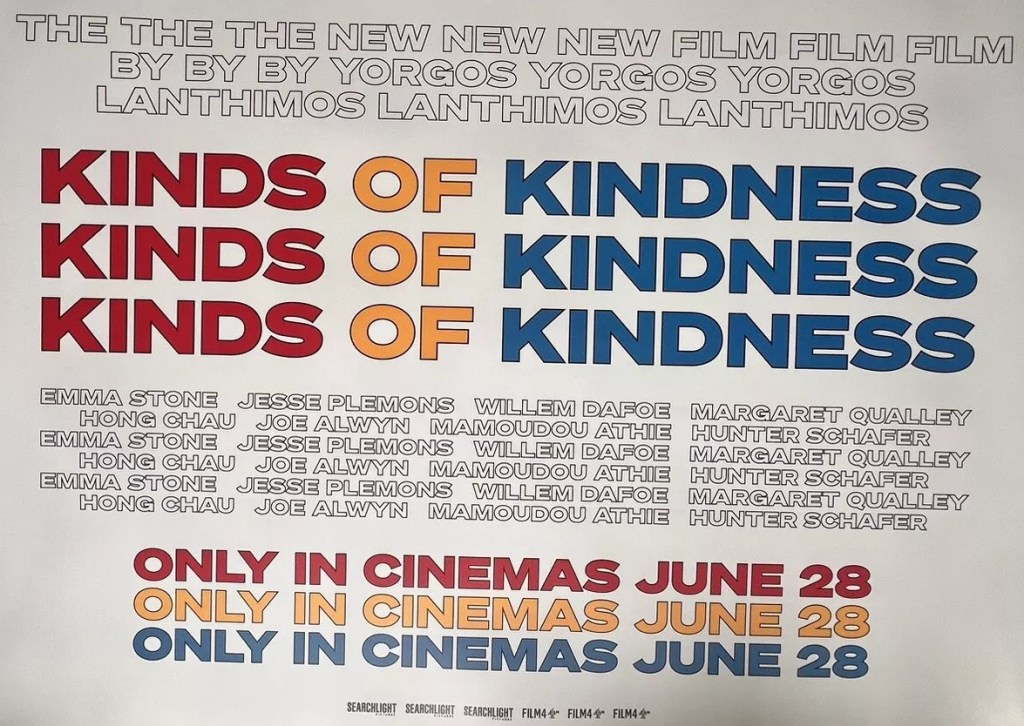
Kinds of Kindness (2024) *** – Seen at the Cinema

Wonder if director Yorgos Lanthimos (Poor Things, 2023) was tempted to go full tilt batshit arthouse boogie on this one and run it all as one big picture rather than setting it into neat episodes, the opposite of what Kevin Costner has done – and been lambasted for – in Horizon (2024). What a riot it would have been if critics had been set the jigaw of trying to work out what part the several main actors were playing at any given time. Am sure that would had had critics out of their seats at both ends of the appraisal syndrome.

As it is, the Dogma-esque notion of the the main actors each essaying three different roles doesn’t work. We all know they’re pretty good actors – Emma Stone (Poor Things) a two-time Oscar-winner. Willem Dafoe (Poor Things) a four-time nominee, Jesse Plemons (Civil War, 2024) nominated once – so they’re hardly needing to prove anything, least of all that they’re versatile. Would have been much better as an all-star (in arthouse terms) cast of nine actors and none of the episodic separation since the stories all take place in a similar disturbed Lantimos-esque world. In fact, you could have tucked the whole lot into Poor Things (2023) and not missed an artistic beat.

Sure, when you think of the episodes individually, it comes across as Twilight Zone-lite or Stephen King on an off day, with (except once) none of the satisfying resolution or alternately deliberating confusing endings. But when you run all the episodes together without any real differential it packs a lot more punch and the world is more fully delineated.

So you get a shipwreck survivor chopping a finger off to satisfy the mania of her husband and him preferring instead a whole leg though he’ll settle for a kidney. Same fella wants to check out old videos of his wife and they turn out to be wife-swapping ventures captured on film. A female jumps headlong into an empty swimming pool in order to facilitate some kind of superpower in her twin.

A cult revolves around determining contamination by licking skin. Their devotees derive mystical loyalty from drinking water into which their cult chief has dropped his tears. Sexuality is fluid, not just the wife-swapping, but bisexuality abounds, and within what might appear to be sexual freedom is a lot of coercive control. But if anybody’s going to get slapped around, it’s the men.

Did I mention the dogs controlling the planet? And a vet who’s too dumb to notice that the cut on a dog’s paw is far too clean to have come from an animal? And, in a riff from Sommersby (1993), the ill-fitting shoes that suggest an imposter. And that a husband is feeding his wife abortion pills?

This is all pretty much standard territory for Lanthimos. But where Poor Things took place is an all too unreal world, here everything would be legit – business, cops – except for the behavior of the characters.

So you wonder if, presented with the script, the main actors couldn’t decide which part they wanted and so Lanthimos just said, heck, play them all. And it’s true you’d have a hard time deciding which part each is best at although as a rule each actor is dominant in only two sections and less important in one. Personally, I’d go for Emma Stone as the shipwreck survivor going along with her husband’s madness in order to save their marriage. For Jesse Plemons I’d choose the businessman under complete control of his boss, down to the clothes he wears each, what he eats and at what time he makes love to his wife. For Willem Dafoe, I’d go for his creepy cult personality.

Just like Horizon, the length (164 minutes here) didn’t bother me. There was generally enough going on, what with all the twists, to keep interest high.  

This kind of has the feeling of one for Lanthimos rather than a more accessible one for a wider audience as instanced by The Favourite (2018) and Poor Things. The Academy might well respond to actors taking on more than one role though not quite in Alec Guinness/Peter Sellers fashion and if so the biggest nod should be in the direction of the under-rated Plemons.

Written by the director and regular collaborator Efthimis Fillipou (The Lobster, 2105).

Didn’t have me on the edge of mys eat, but I didn’t fall asleep either, and I certainly wasn’t fretting like some critics at the supposed waste of their valuable self-entitled time.

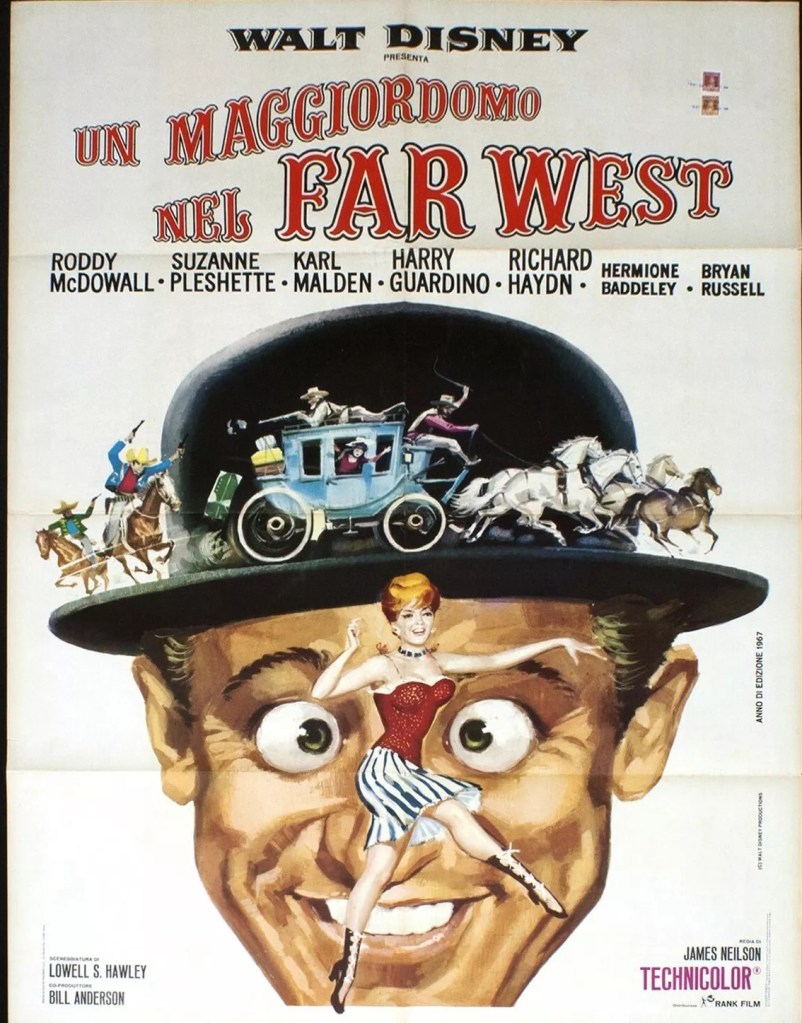
The Adventures of Bullwhip Griffin (1967) ***

All studios believed in their brand name. That the sight of the  MGM lion or the Twentieth Century Fox searchlight or the Paramount mountain represented a quality mark that would buffer expectation and reassure an audience they were not going to be rooked. That might have been the case decades before when the Warner Brothers logo might mean gangster pictures or socially aware movies or MGM, with more stars than there are in heaven, pictures with top-notch talent, or Universal determined to scare the pants of you with its horror catalog.

But that was no longer the case, most studios so desperate for survival that they would fork out for whatever trend seemed most likely to make money and the industry lurched from western to musical to adventure and back again whenever a big hit appeared. The only studio which still retained genuine marquee appeal was Disney. As studios dipped into more unsavory fare, according to the older generation, and the prospects of sending your children to the movies without having to check out the picture in advance diminished, a Disney film was a guarantee of fret-free entertainment.

Throughout the decade adults as much as kids swarmed to the Disney repertoire. In 1961 the studio scored a box office triple whammy when The Absent-Minded Professor, The Parent Trap and Swiss Family Robinson took three of the top four slots in the annual box office race. In the following years Bon Voyage (1962), Moon Pilot (1962), Son of Flubber (1963), In Search of the Castaways (1963), The Sword in the Stone (1964), The Misadventures of Merlin Jones and especially Mary Poppins (1964) kept the studio buoyant, not to mention the string of pictures starring Hayley Mills and a stack of animated classics it could reissue at the drop of a hat.  

Disney ruled the lightweight world, its films often driven by a simple plot device. And as the rest of the industry coveted sex and violence, exhibitors relied on Disney to bring in the kids (and adults) during holiday periods. It would end the decade on a whopping high with The Love Bug (1969).    

Here, the ploy is as old as the hills, a fish out of water, in this case an English butler. Disney had rung the changes on that particular sub-genre through the governess in Mary Poppins, steadfastly ignoring a trend towards more sinister servants as demonstrated by The Servant (1963) and The Nanny (1965). But Disney did have the ability to hook name actors for its child-friendly movies, here Roddy McDowall (Lord Love a Duck, 1966), Oscar-winner Karl Malden (Nevada Smith, 1966) and Suzanne Pleshette (A Rage to Live, 1965).   

If you are expecting whiplashing escapades of the Indiana Jones variety, you will be in for a disappointment. Eric Griffin (Roddy McDowall) is the aforementioned butler escorting a child Jack (Bryan Russell) on a treasure hunt through the gold fever American West. When his charge runs away, Griffin finds the boy stowing away on a ship. The ever-genteel Griffin has skills that see him through any situation, working as cook on the ship, setting up his stall as barber on the mainland, and occastionally employing a devastating right hook to knock seven bells out of giant bully Mountain Ox (Mike Mazurki).

The plot, such as it is, revolves around recovering a treasure map stolen by swindler Judge Higgins (Karl Malden) and eventually when the movie needs some zap the feisty Arabella Flagg (Suzanne Pleshette), Griffin’s bankrupt employer who as it happens fancies the bulter, turns up.

There’s enough action to keep the picture on a steady keel, a storm at sea, a stagecoach hold-up, prizefight and a climactic town-wrecking fire. There are, perhaps surprisingly, a few choice lines.

But there’s a misinterpretation at the center of the movie so it’s as well its made with kids in mind. The fish-out-of-water notion would play better if historically movies fielded idiot butlers rather than ones who tended to take command when things get tough, though it’s unliklely kids would be aware of previous entries in the sub-genre. So, theoretically, it’s a surprise when Griffin outfights the lummox and outwits the swindler.

If the kid isn’t cute enough there are compensations elsewhere, a decent support in Harry Guardino (The Pigeon That Took Rome, 1962) and Hermione Baddeley (Harlow, 1965). Roddy McDowall at least is in a movie that suits his screen persona and deceptively languid acting style while Suzanne Pleshette takes a feminist slant to the Wild West. Whether British comedian Tony Hancock – he was sacked during filming – would have added much to the proceedings is open to debate.

It’s worth remembering that, outside of Hayley Mills offerings, Disney comedies of this period revolved around adults coping with bizarre situation. This doesn’t quite have the gimmicks that drove Son of Flubber, The Ugly Dachshund (1966, also headlining Pleshette) and Lt Robin Crusoe U.S.N. (1966).

Adequately directed by James Neilson (Dr Syn Alias the Scarecrow, 1963) from a screenplay by Lowell S. Hawley (Swiss Family Robinson) drawn from the novel The Great Horn Spoon! by Sid Fleischmann.

I remember seeing this as a kid and feeling pretty content coming out of the cinema, so since it did what it says on the tin, I’m loathe from an adult perspective to take it to pieces.

A movie that says – lighten up!

Behind the Scenes: The All-Time Top 20

The “Behind the Scenes” articles have become increasingly popular in the Blog. As regular readers will  know I am fascinated about the problems incurred in making certain movies. Perhaps one of the more interesting aspects of this category is that every now and there is out of nowhere massive interest in the making of a particular movie and it shoots up the all-time tree. Most of the material has come from my own digging, and sources are always quoted at the end of each article, but occasionally I have turned to books written on the subject of the making of a specific film. 

As with the All-Time Top Movies section, the top 20 comprises the choices of my readers. Alistair MacLean still exerts an influence, which is reassuring because my next book is about the films made from his books.

While Waterloo remains firmly out in front there are some interesting new entries such as The Cincinnati Kid, The Appointment, Mackenna’s Gold, The Train, The Sons of Katie Elder and The Trouble with Angels while Man’s Favorite Sport has made a steady climb upwards.

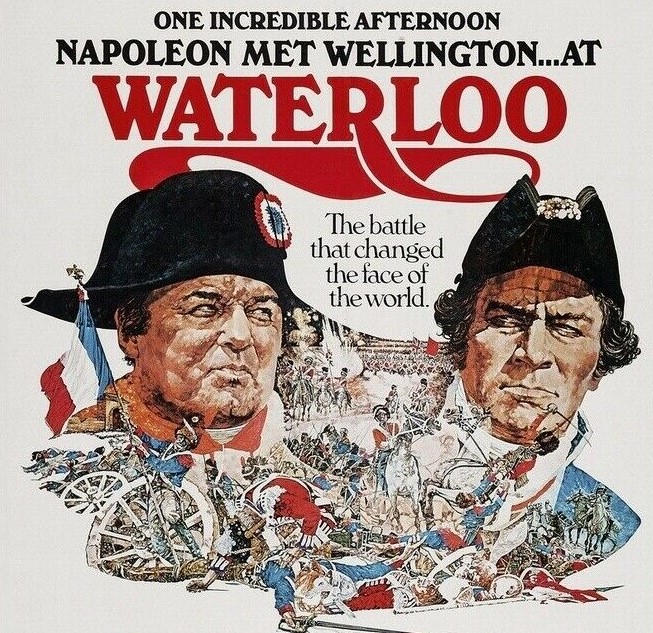
  1. (1) Waterloo (1970). No doubting the effect of Ridley Scott’s Napoleon in racketing up interest in this famous flop.
  2. (2) Ice Station Zebra (1968). A complete cast overhaul and ground-breaking  special effects are at the core of this filming of an Alistair MacLean tale.
  3. (3) In Harm’s Way (1965). Otto Preminger black-and-white epic about Pearl Harbor and after.
  4. (7) The Guns of Navarone (1961). Alistair MacLean again, setting up the template for the men-on-a-mission war picture with an all-star cast and enough production jeopardy to qualify for a movie of its own.
  5. (6) The Satan Bug (1965). The problems facing director John Sturges in adapting the Alistair MacLean pandemic classic for the big screen.
  6. (9) Man’s Favorite Sport (1964). Howard Hawks back in the gender wars with Rock Hudson and Paul Prentiss squaring off.
  7. (4) Battle of the Bulge (1965). There were going to be two versions, so the race was on to get this one to the public first.
  8. (5) Cast a Giant Shadow (1965). Producer Melville Shavelson wrote a book about his experiences and this and other material relating the arduous task of bringing the Kirk Douglas-starrer to the screen are told here.
  9. (10) The Girl on a Motorcycle (1968). Cult classic starring Marianne Faithful and Alain Delon had a rocky road to release, especially in the U.S. where the censor was not happy.
  10. (8) Sink the Bismarck! (1962). Documentary-style British WW2 classic with Kenneth More with the stiffest of stiff-upper-lips.
  11. (11). Tora! Tora! Tora! (1970). Richard Fleischer dispenses with the all-star cast in favor of even-handed verisimilitude.
  12. (New Entry) The Cincinnati Kid (1965). Once Sam Peckinpah was fired from the poker epic, Norman Jewison took over. Steve McQueen, Ann-Margret and Edward G. Robinson are top-billed.
  13. (New Entry) The Trouble with Angels (1966). Hayley Mills causes trouble at a convent school where Rosalind Russell tries to rein her in.
  14. (13). The Bridge at Remagen (1969). John Guillerman WW2 classic with George Segal and Robert Vaughn
  15. (17). The Collector (1963). William Wyler’s creepy adaptation of John Fowles’ creepy bestseller with Terence Stamp and Samatha Eggar.
  16. (New Entry) The Train (1964). Another director fired, this time Arthur Penn, with John Frankenheimer taking over in this cat-and-mouse WW2 struggle between Burt Lancaster and Paul Schofield.
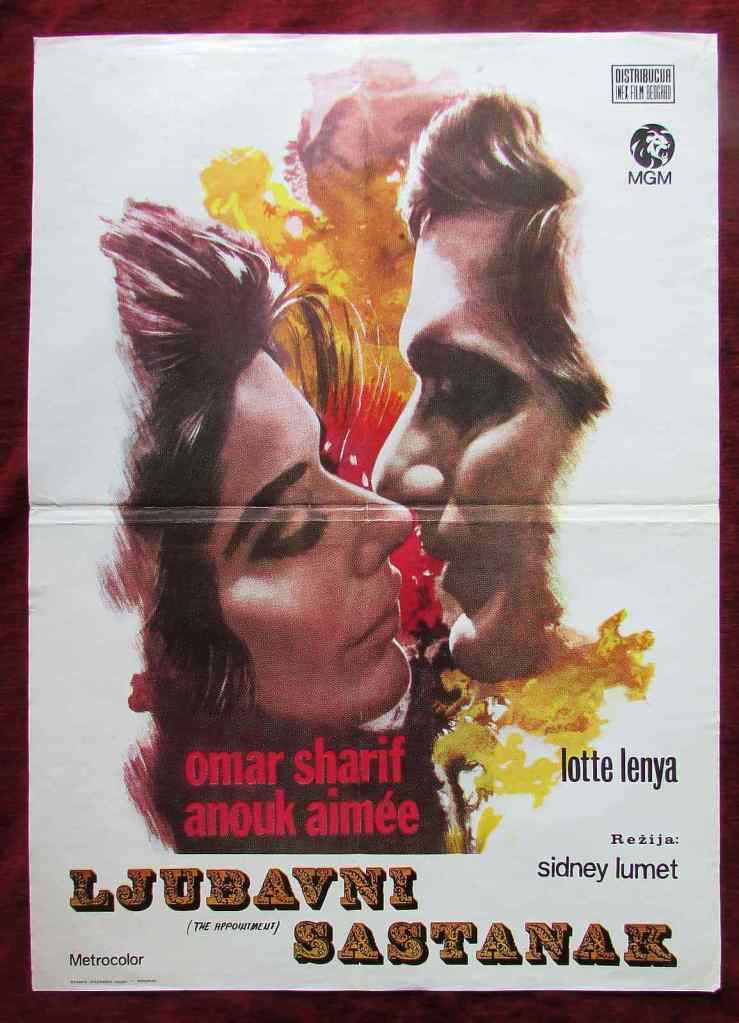
  17. (New Entry) The Appointment (1969). Sidney Lumet has his hands tied in Italian drama with Omar Sharif and Anouk Aimee.
  18. (20) The Way West (1967). Kirk Douglas and Robert Mitchum face off in pioneer western.
  19. (New entry) Mackenna’s Gold (1969). Producer Carl Foreman has his work cut out bringing home western Cinerama epic starring Gregory Peck and Omar Sharif.
  20. (New entry) The Sons of Katie Elder (1965). Long-gestating Henry Hathaway western with John Wayne and Dean Martin as brawling brothers.

The All-Time Top 40

Traditionally, this is an opportunity for me to blow the trumpet on behalf of my loyal and growing band of readers. But this time out I’m also taking the opportunity to blow my own trumpet or in the patois of my home city “bum ma load.” I began this blog in June 2020 and my monthly viewing figures scarcely topped a few hundred in the first year. Now I’m hitting 10,000 views a month. Being a self-effacing kind of guy, I thought the world should know.

Now, back to the main task in hand. It’s been a major aspect of the Blog to see which films are most favored by my readers.  As regular readers will know, I run this feature every six months.

It’s worth pointing out that for such a testosterone-driven decade the Top Ten is dominated by female stars with Ann-Marget and Angie Dickinson in the ascendancy.  Raquel Welch, Hayley Mills and Jean Seberg also make a splash. As well as top male figures like Frank Sinatra, John Wayne, Robert Mitchum and Dean Martin readers have been highly appreciative of underdogs like Alain Delon, Richard Johnson and Alex Cord.

Surprisingly high number of new entries include Young Cassidy, Fathom, The Appointment, Diamond Head, The Family Way and The Venetian Affair.

The figures in brackets represent the previous year’s position.

  1. (1) The Swinger (1966). Queen of the Blog Ann-Margret in bouncy sex comedy that manages a sprinkling of innocence. 
  2. (2) Stagecoach (1966). Double whammy from Ann-Margret in this more than acceptable remake of the John Ford western with the male lead taken by Alex Cord, another star in need of reassessment.  
  3. (4) Fraulein Doktor (1969). German spy Suzy Kendall out-foxes Kenneth More in this World War One adventure with surprisingly grisly battle scenes and a superb score from Ennio Morricone.
  4. (3) Jessica (1962). Angie Dickinson as a young widow incurring the wrath of wives in a small Italian town.
  5. (7) Once Upon a Time in the West (1969). For many, including myself,  the greatest western ever made. Sergio Leone fashions a masterpiece from a stunning cast of Claudia Cardinale, Henry Fonda and Charles Bronson and that fabulous Morricone score.
  6. (6) Fireball XL5. (1962) The height of a television cult. Famous British series from Gerry and Sylvia Anderson, now colorized. “My heart will be a fireball…”
  7. (5) The Sins of Rachel Cade. (1961) Angie Dickinson (again) as African missionary falling foul of the natives and commissioner Peter Finch. Roger Moore in an early role.
  8. (10) Vendetta for the Saint. (1968) More television cultism. Movie made by combining two episodes of the series featuring the immortal Simon Templar. Roger Moore tackles the Mafia.
  9. (12) The Sisters (1969). Complicated French love triangle featuring Nathalie Delon and Susan Strasberg.
  10. (11)  Baby Love (1969). Controversy was the initial selling point but now it’s morphed into a morality tale as orphaned Linda Hayden tries to fit into an upper-class London household.
  11. (13) Pharoah (1966). Sensational Polish epic set in Ancient Egypt centering on the battle between the country’s ruler and the religious hierarchy.
  12. (9) Moment to Moment (1966). Hitchcockian-style thriller set in the south of France with Jean Seberg caught out in illicit love affair. Co-starring Honor Blackman.
  13. (21) Go Naked in the World (1961). Steamy drama with Gina Lollobrigida discovering that her profession (the oldest) and true love (with rich Anthony Franciosa) don’t mix. Great turn from Ernest Borgnine as a doting father.
  14. (8) The Secret Ways (1961). The first of the Alistair MacLean adaptations to hit the big screen features Richard Widmark trapped in Hungary during the Cold War. Senta Berger has a small role.
  15. (36)  In Harm’s Way (1965). Otto Preminger’s Pearl Harbor epic sets John Wayne and Kirk Douglas at each other’s throats.
  16. (20) The Golden Claws of the Cat Girl (1968). Genuine French cult film with Daniele Gaubert as a sexy cat burglar.
  17. (14) Can Heironymus Merkin Ever Forget Mercy Humpe and Find True Happiness? (1969) Self-indulgence reaches new heights as singer Anthony Newley invokes his inner Fellini that somehow involves bedding lots of women. Then-current wife Joan Collins co-stars.
  18. (New Entry) Young Cassidy (1965). Rod Taylor and Julie Christie in Jack Cardiff’s Irish drama. He took over from an ill John Ford.
  19. (22) Pressure Point (1962). No escape for racist patient Bobby Darin when psychiatrist Sidney Poitier is around.
  20. (New Entry) The Appointment (1969). Complete change of pace for Omar Sharif in unusual Italian drama directed by Sidney Lumet. Anouk Aimee is the tantalizing female lead.  
  21. (New Entry) Fathom (1967) Raquel Welch swaps her skydiving kit for the more comfortable environs of a bikini in thriller. Anthony Franciosa co-stars.
  22. (22) Pendulum (1969). Cop George Peppard accused of murdering unfaithful wife Jean Seberg.
  23. (New Entry) The Family Way (1966). Hayley Mills grows up – and how – in marital drama with new British star Hywel Bennett.
  24. (New Entry) Diamond Head (1962). Ruthless hypocritical land baron Charlton Heston causes chaos in Hawaii. With Yvette Mimieux and George Chakiris.
  25. (26) A Dandy in Aspic (1968). Cold War thriller with Laurence Harvey as a double agent who wants out. Mia Farrow co-stars.  
  26. (New Entry) The Venetian Affair (1966). Robert Vaughn turns in a terrific performance as an ex-alcoholic spy dealing with former lover Elke Sommer in slippery Venice-set thriller.
  27. (21) The Best House in London (1969). That’s a euphemism for a brothel, let’s get that straight. David Hemmings tries to do right by the sex workers.
  28. (25) Lady in Cement (1969). Frank Sinatra reprises private eye Tony Rome with mobster’s moll Raquel Welch as his client.
  29. (31) The Girl on a Motorcycle / Naked under Leather (1968). Heavily-censored in the U.S., erotic drama with singer Marianne Faithfull as the titular fantasizing heroine. Alain Delon co-stars.
  30. (New Entry) Genghis Khan (1965). Omar Sharif as the all-conquering Mongol chieftain. Stephen Boyd, James Mason, Eli Wallach, Telly Savalas and Francoise Dorleac lend support.
  31. (New Entry) The Chalk Garden (1964). Hayley Mills again, being brought to heel by governess Deborah Kerr with a hidden secret.
  32. (New Entry) Plane (2023). Gerard Butler channels his inner Bruce Willis as he attempts to avoid dying hard on an island inhabited by rebels.  
  33. (23) Oceans 11.  Frank Sinatra heads the Rat Pack line-up, inspiring an industry of  remakes and with everyone starting with Tarantino ripping off one scene.
  34. (New Entry) Five Card Stud (1968). Surprising mix of feminism and noir in revenge western. Dean Martin, Robert Mitchum and Inger Stevens topline.
  35. (34) The Misfits (1960). Last hurrah for Clark Gable, fabulous turns from Montgomery Clift and Marilyn Monroe in John Huston tale of losers. 
  36. (28) Once a Thief (1965). Change of pace for Ann-Margret as working mother whose ex-jailbird husband Alain Delon is forced into another job.
  37. (27)  Deadlier than the Male (1967). Espionage with a sting in the tale as venomous female villains including Elke Sommer and Sylva Koscina target Bulldog Drummond
  38. (35) Rage (1966). Glenn Ford and Stella Stevens combat pandemic in Mexican town.
  39. (New Entry) Blonde (2022). Ana de Armas in stylized biopic of Marilyn Monroe
  40. (33) She Died with Her Boots On / Whirlpool (1969). Sleazy British film from cult Spanish director Jose Ramon Larraz sees kinky photographer Karl Lanchbury seduce real-life MTA Vivien Neves.  

Behind the Scenes: The Reissue Saves the Day (Again)

Apparently to everyone’s surprise the extended version of Lord of the Rings: Fellowship of the Ring (2001) broke into the box office top ten the weekend before last with The Two Towers (2002) not far behind. Already cinemas are gearing up for a swathe of 1999 reissues (25th anni don’t you know) including The Matrix and American Pie and IMAX is already setting aside screens for the 10th anniversary re-release of Interstellar (2014) later in the year.

With the demise of the DVD and the domination of the streamers, you would have thought there was no room anywhere for old movies returning to the big screen. But, historically, reissues always returned to save the day, most commonly when the industry was low on product. That was generally the most obvious reason and splurges of revivals occurred in the early 1920s, late 1930, post WW2 and the mid-1950s.

But there were other reasons. I could give you chapter and verse about the reissue since I wrote a book about it, but to save you ploughing through those 250,000 words, I’ll stick to the salient points. Mary Pickford and Charlie Chaplin kicked off the revival business. In the silent era there were few prints of any new picture, often less than 100, so theaters which couldn’t afford the price of the new offerings of the King and Queen of Hollywood just brought back their old ones.

For a time, in the 1920s and 1940s, studios just retitled pictures and brought back oldies as newbies until the law caught up with them. And in another dodgy piece of business, just before Hollywood sold a bunch of titles to television, they were inclined to throw them out for one last roll of the box office dice, infuriating exhibitors and moviegoers alike.

But the big boom in reissues was nothing to do with shortage and more the realization that, as we are more fully aware these days, punters will go back again and again to see a favorite. The James Bond bandwagon kicked off this particular spree but by the 1970s many films – Butch Cassidy and the Sundance Kid (1969), Billy Jack (1971) and Jeremiah Johnson (1972) – made more on revival than they did first time around. Studios began to build into a film’s release a reissue – they even invented a phrase for it “the wind-up saturation.”

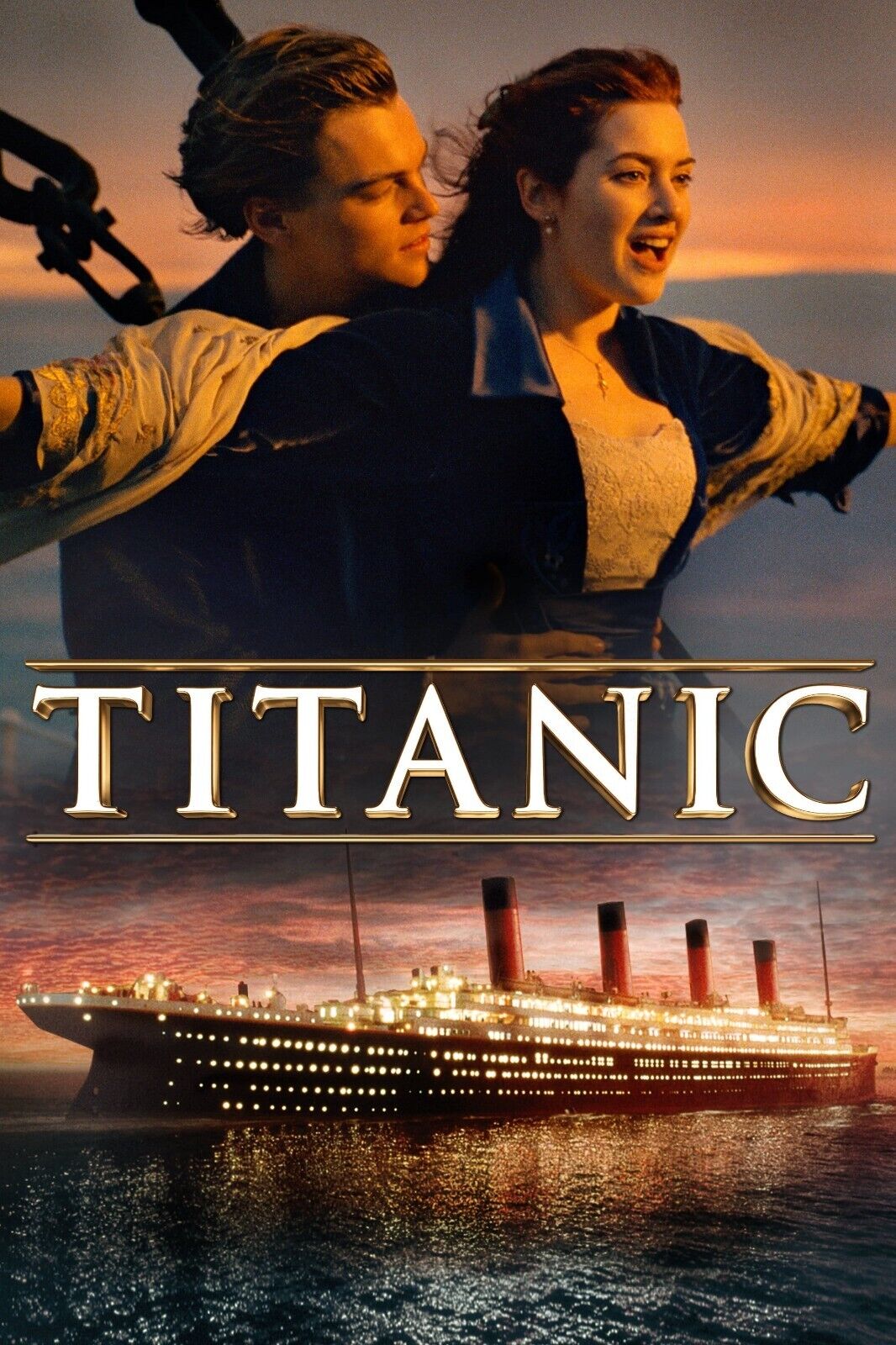
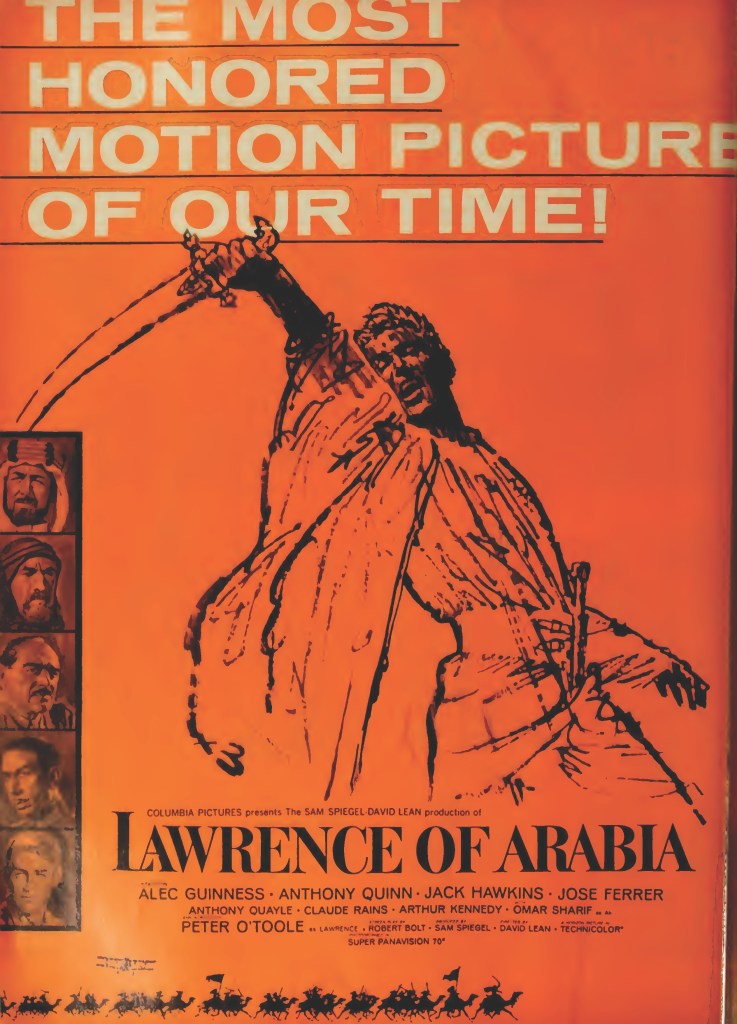
And when those particular wells began to run dry as ancillary – video, cable – took over, the art film rode to the rescue. Neglected masterpieces like Abel Gance’s Napoleon (1927) or Fritz Lang’s Metropolis (1927) were revamped while disgruntled auteurs of the caliber of David Lean found new audiences for different versions of Lawrence of Arabia (1962) and Ridley Scott took this notion to the extreme with endless iterations of Blade Runner (1982). Then Imax and 3D came into play and scooped up gazillions for further airings of Pixar or Disney classics or Titanic (1997). 

However, the reissue heyday looked dead and buried once movie lovers cottoned on that old movies were constantly were only being brought back for a one-day showing because they had gone through the 4K loop, but with DVDs able to add buckets of extras, commentaries and histories, that became the de facto location for revivals.

But then Covid struck and cinemas, bereft of product, looked once again to oldies. While nobody was partying like it was 1999, it was both astonishing and satisfying to studios that older movies could take up some of the product slack. While most of the movies taking a second bite were made this century and some coming back not long after initial release, there have been a good few surprises in the mix, not least that the anniversary marketing tag was not always in play.

Take the 2020 revivals for example. Topping the list was Mamma Mia (2008) with a whopping $84.6 million gross worldwide – plus $7.2 million for the 2018 sequel – followed by Harry Potter and the Sorcerer’s Stone  (2001) scooping up a wizard $31.5 million. Gravity (2013) with Sandra Bullock adrift in space notched up $24.8 million. You’d be taking something of a marketing gamble to reckon American election year could boost an old political movie but that was the case for The Post (2017), sterling cast of Meryl Streep and Tom Hanks aside unless Streep was surfing a Mamma Mia wave, which blocked out $13.9 million. Bohemian Rhapsody (2018) continued to clock up the bucks, with $7.1 million.

The traditional upswell for U.S. animated classics was long gone but Moana (2016) cleared another $21.7 million while The Lion King (1994) chomped through another $5.6 million in the wake of the remake.

Avatar (2009) was the big noise of 2021, lifting $57.9 million a year ahead of the long-awaited sequel. Harry Potter and the Sorcerer’s Stone kept going, an extra $15.5 million and, guess what, there was a welcome audience for Lord of the Rings: Fellowship of the Ring with $8.9 million.

And the original Avatar wasn’t done. In fact the following year – 2022 – it did even better, an awesome $76 million in the kitty.  Given that James Bond was the original source of so much reissue wealth it was fitting that 10th anniversary status was bestowed on Skyfall (2012), with the studio rewarded by a healthy $33 million. In true Martin Scorsese style, that is by not fitting with convention, The Wolf of Wall St (2013) celebrated its ninth anniversary and plundered $15 million.

James Cameron and Christopher Nolan in 2023 went head to head for the title of reissue king. Titanic – again – won with $70 million. Interstellar – another ninth anniversary celebrant – took home $44 million. The original Toy Story (1995) resurfaced with $27.5 million and in a 30th anniversary gesture The Nightmare Before Xmas (1993) romped off with $10.4 million.

And what of this year? Star Wars: Episode 1 – The Phantom Menace (1999) leads the pack with $19.4 million. As I mentioned 1999 is getting fair old fist-pump, some marketeers with little in the way of cinematic memory going so far as to claim it was cinema’s best-ever year. That kind of all-encompassing revival branding was rolled out for Columbia’s 100th Anniversary celebrations which saw a bundle of old pictures brought out under that aegis for a total $6 million gross. The second part of Dune brought further viewings for Dune (2021) and $3.9 million. Shrek 2 (2004) was 20th anni fare – a further $2.4 million.

Yet another revival of Alien (1979) – 45th anni if you’re interested – snapping up $2.3 million – ahead of the latest in the series was no surprise but a return for Hereditary (2018) was, this Toni Collette number reflecting its growing cult status with an extra $2.4 million.

The Lord of the Rings trilogy this year has already snagged a collective $7.8 million, Fellowship in front with $3.4 million, Two Towers on $2.4 million and Return of the King with $2.2 million.

So it looks like, at least for the time being, and as long as anniversaries provide marketing heft, the reissue will keep going,

Next up, as part of the Columbia reissue juggernaut, Lawrence of Arabia (1962). As it happens, there’s a Behind the Scenes on that one on the blog.

SOURCES:  Brian Hannan, Coming Back to a Theater Near You, A History of Hollywood Reissues 1914-2014 (McFarland, 2016); Box Office Mojo.

Something in the Water (2024) ** – Seen at the Cinema

Hilariously bad. Worth a look if you are short of contenders for the Razzies. However, I do reserve the right to accept that I am wrong and that as a male of the species it’s really my own fault if I can’t get to grips with a female version (director, writers, cast) of the shark sub-genre. If you’ll recall I was recently singing the praises of Under Paris, a highly inventive and improbable ecological take on the shark picture but solidly done in which the predators showed no mercy and the director hadn’t a sentimental bone in his body. I’ve also been keen on the various iterations of The Meg. So if anyone’s going to cut a shark movie a bit of slack it would be me. But I’m right out of slack.

For those of you who thought S Club 7 ditty “Reach” would if anything act as a shark repellent I’ve got some bad news for you, although I should add the rider that maybe the problem is that Ruth (Ellouise Shakespeare-Hart) is dancing as well as singing and in shallow water. But at least though the singer was first up on the shark menu if you watch closely you’ll see the correct way to do the actions for the tune. There is a right way, you know, and this picture is full of people who know the right way to do all sorts of insignificant stuff, like the etiquette of peeing in the ocean (quite different from a swimming pool), and what’s the difference between a yacht and a boat (a class thing, apparently) and the clincher – the correct use of the ellipsis.

So five gals are somewhere in the Pacific (I guess, could be Blackpool with fake palm trees for all I know) for a wedding and they have the bright idea to temporarily maroon former lovers Kayla (Natalie Mitson) and Meg (no irony intended, I’m sure) on a tiny desert island until they make up. They had split up after being beaten up by a gang of homophobic females. Well, Meg (Hiftu Quaseem) was beaten up, and now suffers from panic attacks. Kayla was unharmed but is guilty about that.

They only hired a small boat and once they have to race for help after the shark has taken little more than an amuse bouche out of Ruth’s leg, uber-bossy bride Lizzie (Lauren Lyle) takes charge, speeds the boat and runs it over a reef which is when they discover they only have one lifebelt and (gosh) there’s no mobile phone connection. Guess who can’t swim? Lizzie, so she gets the lifebelt. Turns out they would only have needed four anyway at this juncture because Ruth soon succumbs and in the only piece of sense that anybody exhibits they dump the body in the water, hoping that will be sufficient to satisfy the shark.

And with testosterone out of the equation and only one knife between them this isn’t the time for the hapless quartet to trade survival tales or work out clever ways to avoid being eaten. Or even cover their faces against the terrible sun with the shirts they all wear over their swimsuits. Mostly what they do is point the finger of blame and once they’ve done all that they execute a perfect reversal and each starts blaming herself for causing the situation. Kayla then decides to swim for help all the way back to their holiday beach because (I’m assuming) she’s got an unerring sense of direction or an inbuilt compass and isn’t just going to swim around in circles or miss a turn and hit Australia.

A shark fin pops up from time to time to remind us we’re not in a soap opera. Given we’re several generations away from Jaws (1975), it’s hardly surprising the characters have little in the way of shark know-how. The question isn’t really how did the women find themselves in this situation but how did anyone think it would work.

There’s not much experience on show. Movie novice Hiftu Quaseem carries the greatest emotional package in a movie that’s thin on backstory and character. Natalie Mitsom had two previous bit parts, Nicole Rieko Setsuko, one, Ellouise Shakespeare-Hart one significant movie role. Lauren Lyle, the most experienced, has the worst part of bridezilla. Directorial debut for former art director Hayley Easton Street has proved, even before release, enough of a calling card that she’s got another two movies lined up. Dialog sample – “we’re all in the same boat” / “she’s like a dog with a bone” – by movie debutante Cat Clarke gives an idea of what the actresses had to put up with.

Once I check out their CVs I feel a bit mean about being so tough on such an inexperienced bunch but I’m sure they’ll weather worse than me and, should success beckon, can write it off to experience.

On the plus side it’s only about 80 minutes long, the kind of credit that include the names of welders and audit clerks padding it out a few minutes longer.

There’s something in the water all right – a turkey.

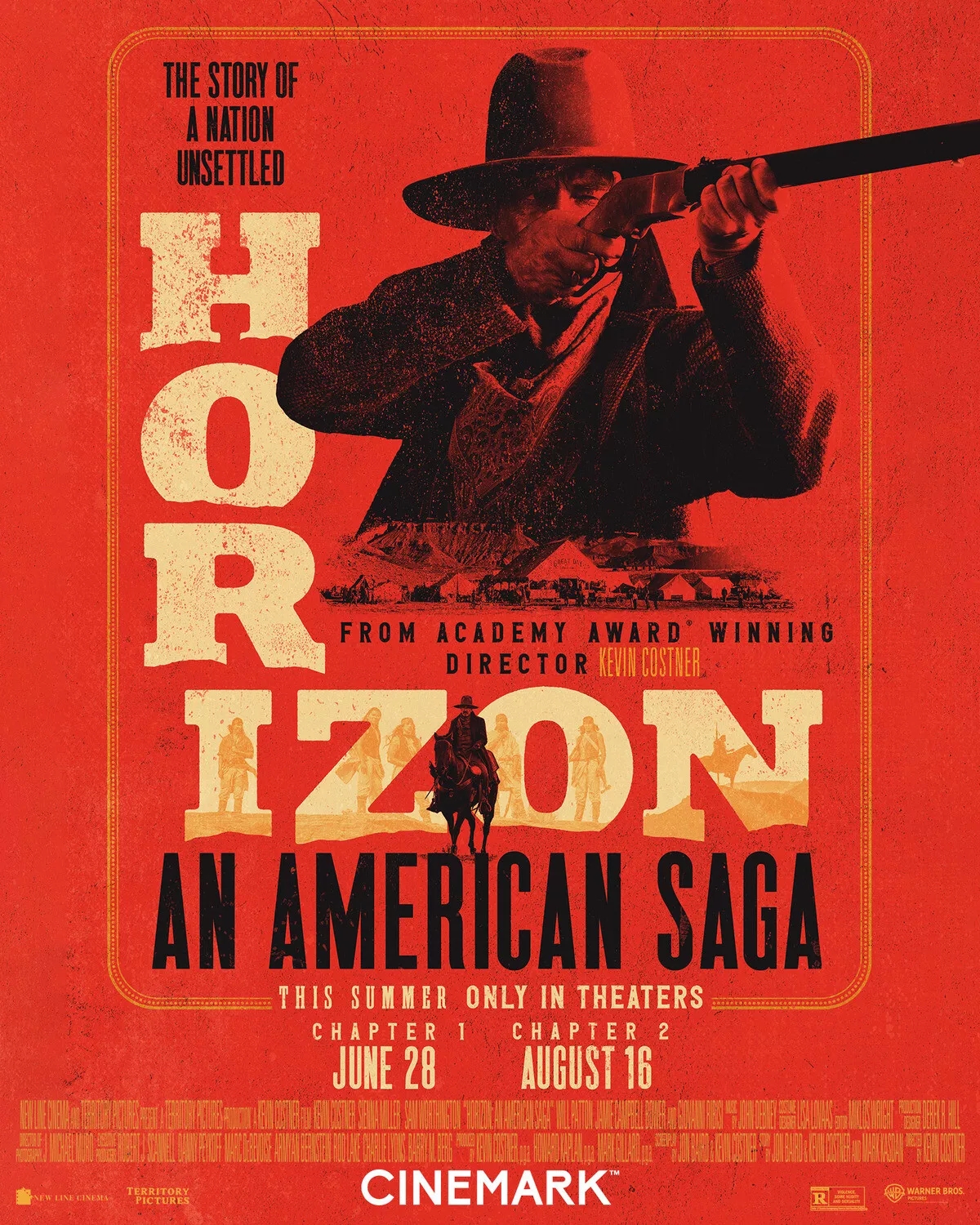
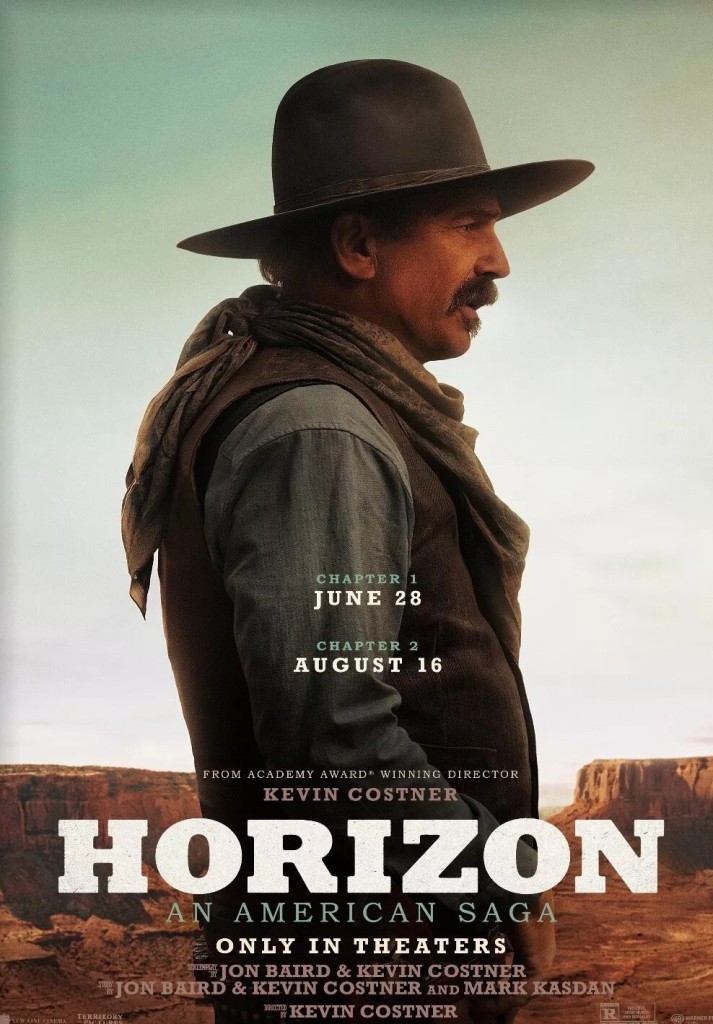
Horizon: An American Saga Chapter 1 (2024) **** – Seen at the Cinema

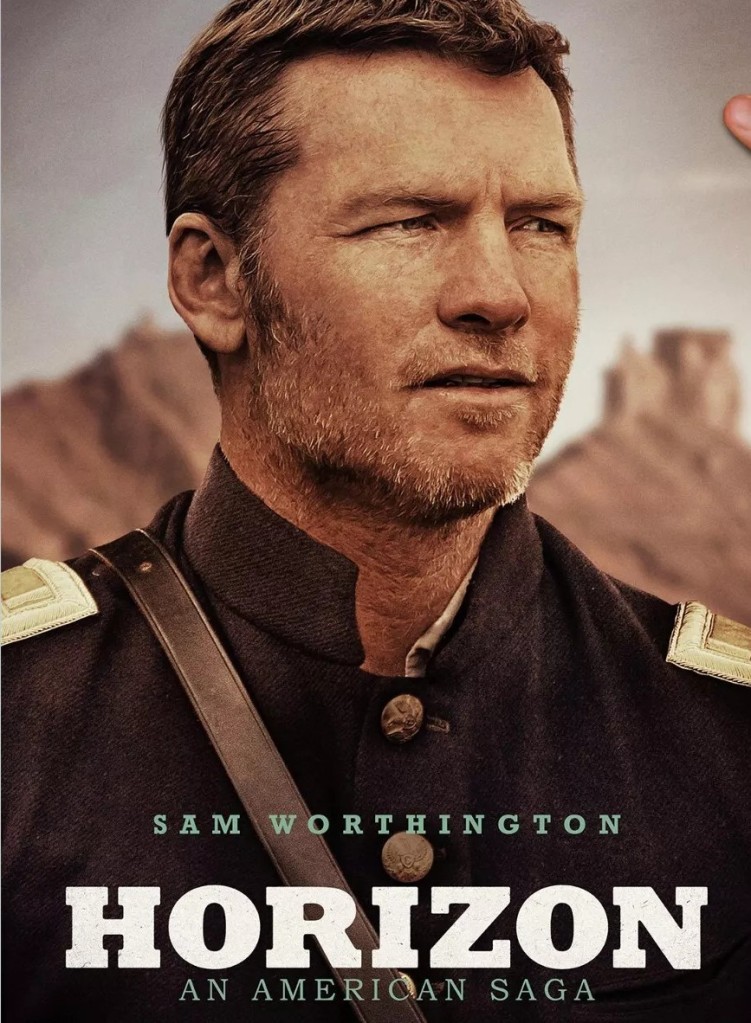
Unpacking Kevin Costner’s hefty portmanteau is a significant task since at times it veers into the unwieldy. But only once during the three-hour running time did I glance at my watch and that was over an hour in when I started to wonder when Costner in his capacity as star would appear. Anyone looking for anything heroic or iconic or in the vein of Dances with Wolves (1990) or even Wyatt Earp (1994) had better look elsewhere. This has more in common with the grimy westerns of the 1970s when heroes were hard to come by and the West was a cesspool of brutality. 

There’s a heck of an arthouse sensibility to this ensemble piece, characters and situations appear with little preamble and often little consequential explanation, and we switch geographically and psychologically at the drop of a hat. Theoretically, I should be waiting until Chapter 2 pops into view in a few weeks’ time before attempting summation because it’s clear that some sections are unresolved here, assuming the ending is more of a trailer for part two than a speeded-up finale.

At $100 million – and same again for Chapter 2 – this would have all the makings of an over-the-top vanity project, especially after Yellowstone was thrown out with the bathwater. In some senses it’s closer to a series of vignettes puncturing the myth of the West. The wagon train section, for example, focuses on an over-entitled English woman who breaks several golden rules and encounters a couple of peeping toms while the wagon master (Luke Wilson) finds out just how powerless he is in trying to enforce discipline.

Virtually all the women are schemers. Ellen (Jena Malone) attempts to murder her husband and flee with their child, takes up with another fella who’s trying to run some kind of gold strike scam but unfortunately runs into the sons of the man she tried to kill. Her child, meanwhile, is being cared for by sex worker Marigold (Abbey Lee) who gets her hooks into prospector Hayes (Costner) but only as long as she can dump him for another man and dump the child on another family. By comparison Frances (Sienna Miller) is saintly, having survived an Indian massacre, but she makes no bones about making a play for married cavalry lieutenant Trent (Sam Worthington).

And the older ones are just as savage. Mama Sykes sets her sons out for revenge and an elderly lady in the fort batters two soldiers for trying to steal a child-sized bed. The latter is another vignette, the old woman, mourning the loss of one child, being maneuvered by a clever sergeant (Michael Rooker) into semi-adopting another, and that lass, in the most touching (or sentimental if you like) vignette, sending soldiers into battle wearing flowers she has cut from a quilt.

There’s not much point being a child here if you can’t fire a weapon. Native American kids are only too ready to aim arrows at white men and one young massacre survivor buys a pair of Colts to effect his revenge.

The main thrust of the tale is the land rush of the 1860s, when settlers dashed from east to west in the hope of a better life and in the expectation that the Army would take care of any Native Americans who got in the way. Lt Trent does his best to dissuade settlers from picking land that’s too far away from a fort to defend. The Apache chief tries his best to dissuade his son Pionsenay (Owen Crow Shoe) from attacking the settlers, pointing out (somewhat improbably) that his tribe can find enough sustenance in the mountains.

From my own reading on the subject, namely The Earth Is Weeping by Peter Cozzens, this was true to life, the younger braves more likely to wage war, the older chiefs prescribing restraint and fearing consequence, and the rivalry between different tribes is cleverly dealt with, even though it’s hard to understand at the time the point of a lone Native American being hunted down and killed by a band of other Native Americans.

The titular “Horizon” is the name of a large swathe of land being sold back east to settlers as presumably a land of milk and honey, said settlers harnessing similar entrepreneurial spirit as the Pilgrims who crossed the Atlantic in search of same. Every now and then a character pops up to provided a potted history, Col Houghton (Danny Huston) one such, predicting the bloody end to the encroachment of land.

The biggest set piece is the massacre that interrupts another set piece, the kind beloved of John Ford and Michael Cimino, the local dance, that itself punctuated by other vignettes, the teenager too old to dance with his mother, another teenager playing with a loaded gun, until both teenagers are taught savage reality and this section ends with Frances hammering a shotgun through the earth to provide a source of air for her and her daughter trapped underground.

There’s a quirkiness here that would sit well with Robert Altman or the Coen Brothers or Yorgos Lanthimos. And the scene between Hayes and the younger Sykes gunslinger is pure Tarantino.

But there’s way too much hair. Authentic though it may be, the thickness of the beards makes  it virtually impossible at times to identify the actor underneath. But despite the running time it’s also been brutally edited, hard to work out how Hayes goes from being hunted by the Sykes Gang to working on the railroad.

So this is a warning as much as a straightforward review. Don’t go in expecting the usual. This isn’t an exploration of the West in the manner of How the West Was Won (1962) with big stars and a ton of set pieces and Cinerama to pump up the action and roadshow to make the whole enterprise seem somehow more worthy.

The women steal the acting honors, especially Sienna Miller (The Lost City of Z, 2016) and Jena Malone (The Neon Demon, 2016). Directed with some style by Costner from a screenplay by himself and Jon Baird in his debut.

Plenty to see here that’s worthy of praise if you set aside expectations.

The Secret Partner (1961) ****

Curious about what happened to Haya Harareet, Charlton Heston’s leading lady in Ben Hur (1959), filmed in 70mm glorious color, I happened across this neat twisty British thriller filmed in standard ratio and black-and-white. Turned out to be put together by the Basil Dearden/Michael Relph combo and starring Stewart Granger, one-time star of MGM extravaganzas like King Solomon’s Mines (1951) and clearly now atoning for failing to hit the box office mark often enough for Hollywood’s liking.

Driven by a brilliant plot, whose resolution I defy you to guess, and climaxing with three stunning twists, the first story-driven but the others landing a no less effective emotional and human punch. I should warn you right away that Harareet is not in the picture as much as you would expect given that she took second billing. That’s no surprise, really, since on her first entrance, as wife Nicole, she walks out on husband John Brent (Stewart Granger) citing his illicit romantic liaisons. 

Though driving a swanky car and living in a big house, Brent, a top-level shipping executive, is one harassed individual. What’s more he is being blackmailed by alcoholic dentist Ralph Beldon (Norman Bird).  When the shipping company’s safe is robbed of £130,000 (equivalent to £3 million today), suspicion falls on Brent, one of only two employees with both keys and the combination. Enter about-to-retire chain-smoking Detective Superintendent Hanbury (Bernard Lee, shortly to achieve global fame as “M” in the Bond series).

Constantly wreathed in a cloud of smoke, Hanbury’s investigation leads to various suspects – the other keyholder Charles Standish (Hugh Burden) whose job is at risk, interior designer Clive Lang (John Lee) who is over familiar with Nicole, and friend Alan Richford (Conrad Philips) who is secretly in love with Nicole. All have good reason to be responsible for the theft, not least Nicole because of Brent’s habit of talking in his sleep and in trying to memorize ever-changing safe combinations constantly running them through his head, conscious or unconscious.

To add to the complications, Brent has a mysterious past. In addition, a masked gunman pops up from time to time. So, although Brent remains the prime suspect, Hanbury, with an investigator’s vigilance and attention to detail that Hercule Poirot would be proud of, uncovers clues that point elsewhere. Pretty soon, Brent is on the run, first to France, where he is arrested, and then, after escaping custody, through the murky streets of Soho trying to locate a girl to whom he might have given the combination while asleep. He, too, discovers some unpleasant truths far closer to home.

Basil Dearden (Victim, 1961) does a brilliant job of setting up the mystery, a dab hand, too, at serving up multiple red herrings, as well as a spot of sleight of hand, not least when the music intrudes too loudly in old-fashioned manner as if to point the finger, and the audience’s attention, in a misleading direction. Sure, it’s a low-budget affair by Hollywood standards and indeed by Dearden/Relph standards (big-budget roadshow Khartoum, for example), and the black-and-white photography is for financial rather than artistic reasons, but it is superbly done and keeps you guessing to the end.

Stewart Granger (The Last Safari, 1967) is at his suave best. Harareet, all fur coat and steely resolve, gives a good performance. Bernard Lee is an excellent British copper, hoping to end his career on a high note, patiently probing suspects, and there is a good turn from Norman Bird as the dodgy dentist and a fleeting appearance by Willoughby Goddard as an equally dodgy hotel manager. Written by David Pursall and Jack Seddon who went on to churn out MGM’s Miss Marple thrillers.

Discover WordPress

A daily selection of the best content published on WordPress, collected for you by humans who love to read.

The Atavist Magazine

by Brian Hannan

WordPress.com News

The latest news on WordPress.com and the WordPress community.