I am a published author of books about film - over a dozen to my name, the latest being "When Women Ruled Hollywood." As the title of the blog suggests, this is a site devoted to movies of the 1960s but since I go to the movies twice a week - an old-fashioned double-bill of my own choosing - I might occasionally slip in a review of a contemporary picture.
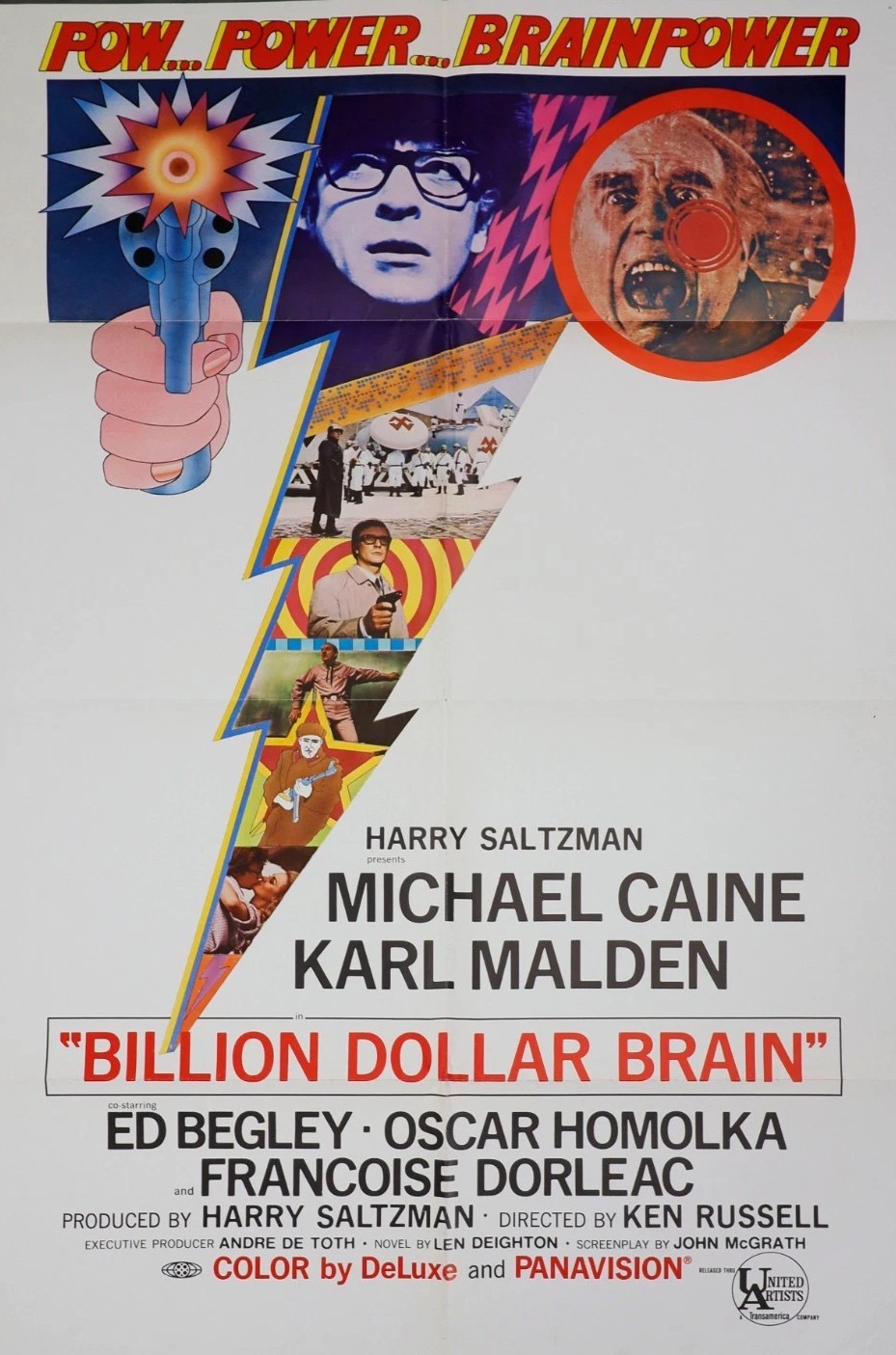
Could have been the greatest espionage movie of all time except for one thing – excess. Now director Ken Russell would soon make his reputation based on sexual excess – Women in Love (1969), The Devils (1971) etc – but here he takes self-indulgence in a different direction. The plot is labyrinthine to say the least, and Finland proves to be dullest of arctic locations, no submarine emerging from the ice to liven things up as in Ice Station Zebra (1968), just endless tundra.
Setting that aside, there are gems to be found. Author Len Deighton ploughed a different furrow to Ian Fleming (Goldfinger, 1964) and John le Carre (The Spy Who Came in from the Cold, 1965), none of the glitz of the former nor the earnestness of the latter. He was more likely to trip a narrative around human foibles. And so it is here.
For a start, our hero Harry Palmer (Michael Caine) is the MacGuffin and then is duped – three times. Firstly, he is the reason we end up in Finland in the first place, having responded to an anonymous message and the promise of easy money. Then, in the most foolish action ever to befall a spy, he falls in love with the mistress Anya (Francoise Dorleac) of old buddy Leo (Karl Malden). Finally, he is shafted by former employer Col Ross (Guy Doleman) and generally given the runaround by Russian Col Stok (Oscar Homolka), reprising his role from Funeral in Berlin (1966).
Unlike the previous Harry Palmer iterations, that began with the splendid The Ipcress File (1965), there’s a techie megalomaniac on the loose, General Midwinter (Ed Begley) – think Dr Strangelove on speed – who’s not so intent on world domination as flattening the Soviets, which more or less amounts to the same thing.
Midwinter provides the movie with considerable technological foresight, his billion-dollar computer prefiguring the way in which we have allowed technology to rule our lives, and, unlikely though it seems, perhaps provided the inspiration for the serried ranks of Stormtroopers from Star Wars (1977).
For the most part, lovelorn Palmer is led a merry dance and relies on a deus ex machina in the shape to Col Stok to put an end to Midwinter’s potential Russian uprising. A rebellion was always going to be a tad dicey because Leo has stolen all the money Midwinter provided for him to set up an army of Russian dissidents. Leo thought it made more sense for the cash to be put to better use, namely investing in high living and a glamorous mistress. There we go with the old human foible. But Palmer can match him there, not quite having the brains to realize that a beautiful woman who can play Leo so well could also play him.
There’s a marvelous pay-off where we discover that in the middle of the male-dominated espionage shenanigans, it’s Anya who turns out to be the clear winner. In a terrific scene she takes the case containing the secret McGuffin from Leo rushing to board her train then, with her hands on the valuable cargo, kicks him off the train. And once she has trapped a foolish British spy, who has let his emotions get the better of him, is apt to poison him.
There’s some distinct Britishness afoot. Complaints about salary and endless bureaucracy abound. And there’s a piece of pure Carry On when, in a sauna scene, the camera manages to put objects or bodies in the way of Anya’s nudity. One-upmanship doesn’t get any better than Col Ross smirking when he tricks Palmer into returning to work for him.
Smirking is in the ascendancy here. Palmer smirks at the folly of Leo in believing that the young beauty is after him for anything but his money and his access to potentially dangerous toxin. Anya doesn’t need to laugh behind the backs of the two men she has so easily duped when she can enjoy sweet revenge right to their faces.
Once you get to the end, you can more appreciate the content, although, like me, you probably wished the director could have got a move on, and thought he should have done a lot better in the climactic scene than toy trucks falling into Styrofoam blocks of ice.
The tale isn’t on a par with the previous two, Deighton being more at home with cunning adversaries rather than overblown megalomaniacs, but everyone, with the exception of Anya and Col Stok – i.e. the bad guys – are too easily taken in. Technically, Palmer wins the day, but that’s only to fulfil the requirement that the good guy must appear to win even if the good guy in this instance is smeared all over with impotence and folly.
The camera loves Michael Caine (Gambit, 1966) so there’s no problem there especially as by and large he’s wearing his cynical screen persona. Karl Malden (Nevada Smith, 1966) has a ball, especially as this must be the only time he gets the girl. Ed Begley (Sweet Bird of Youth, 1962) and Oscar Homolka over-act as they should, but Francois Dorleac (The Young Girls of Rochefort, 1967), in her final role, steals the picture from under all of them.
Directed by Ken Russell as if he kept his editor at bay and written by Scottish playwright John McGrath (The Bofors Gun, 1968) in his big screen debut.
So a very interesting twist on the spy picture but be warned before you go in that it takes quite a while to get there.
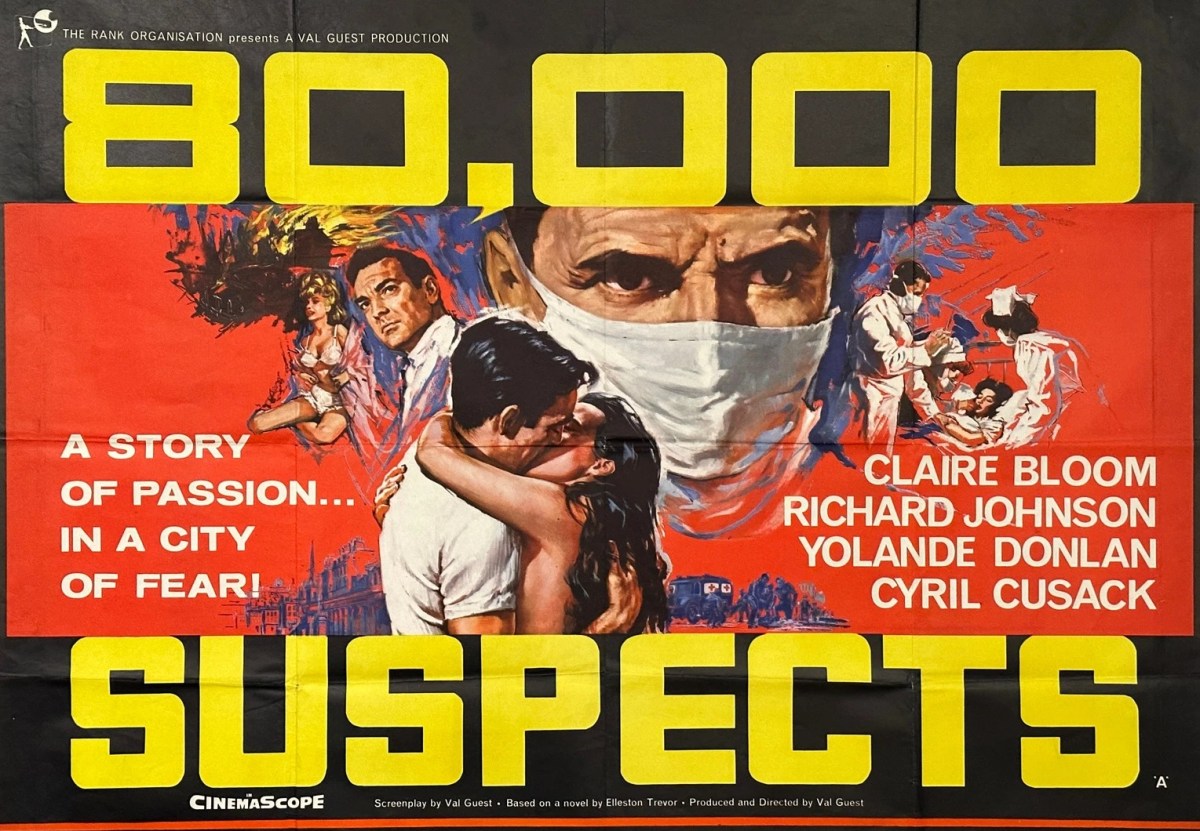
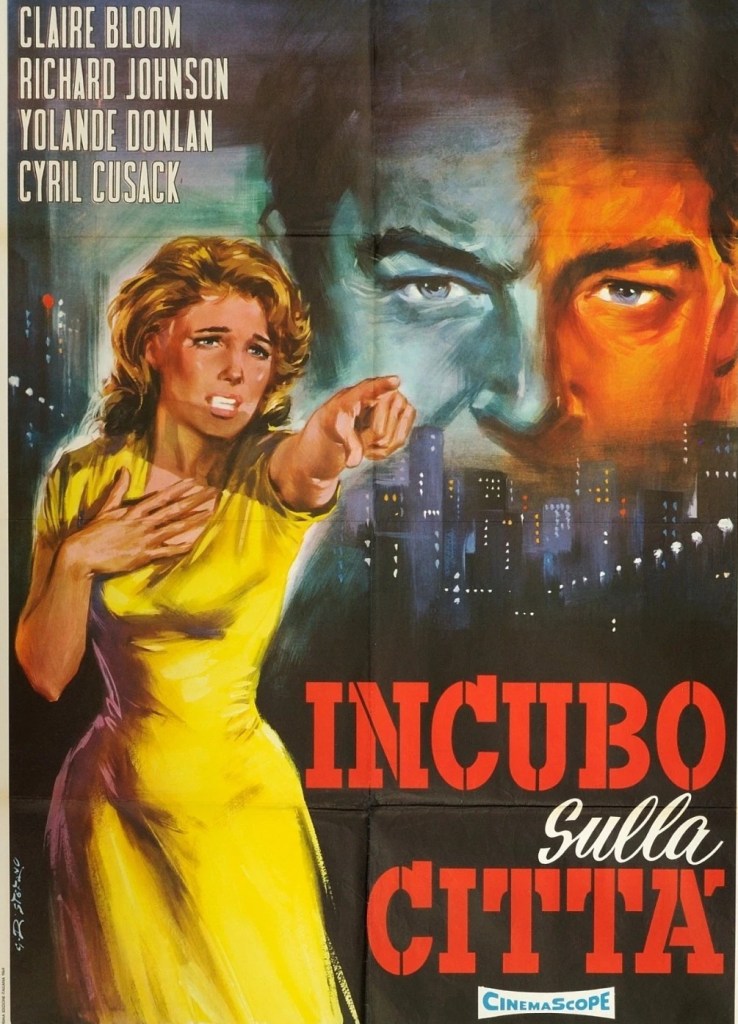
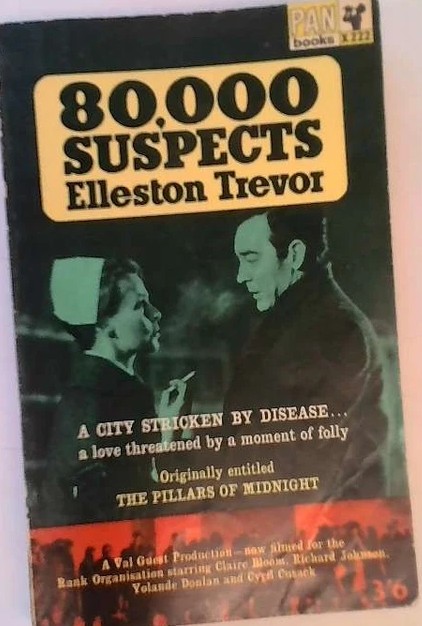
Eschews the X-cert terror of some of the end-of-the-world efforts of the period such as The Day the Earth Caught Fire (1961) and Day of the Triffids (1963) in favor of a more solid documentary-style approach and focusing on the tangled love lives of the main characters. There’s a distinctly British tone. People form long, orderly queues to receive an injection to combat a sudden epidemic of smallpox and police and any kind of hard-line enforcement plays a minor role. And the medical boffins in charge act more like detectives, tracking down potential infected individuals, engaging in door-to-door street-by-street hunts for those carrying the virus, maps are drawn, areas blocked off. There are deadlines and countdowns. Doctors are disinfected, clothes are incinerated and corpses cremated. So there’s enough tension to keep everyone on their toes.
But most of the emotional muscle is not by asking an audience to empathize or sympathize with those in danger or whose lives are suddenly cut short. But by concentrating on the impact of adultery on two couples. Dr Steven Monks (Richard Johnson), who identified the presence of smallpox in the large town of Bath with 80,000 people potentially at risk, is suspected by retired nurse wife Julie (Claire Bloom) of having an affair with glamorous Ruth (Yolande Donlan), wife to Monks’ stuffy colleague and friend Dr Clifford Preston (Michael Goodliffe).
The Monks are on the verge of going abroad on holiday when the smallpox disrupts their plans, although it’s Julie who appears the more principled and dutiful of the two, her husband being all set to head off and leave someone else to sort out the mess.
To make sure emotions are not sidelined by the scale of the epidemic, Dr Monks and wife are kept in the thick of it, the stakes rising dramatically when Ruth catches the disease. That triggers the most interesting – and original – sequence of the drama. When Steven thinks his wife is in danger of dying his feelings for her surge, but when she recovers, his ardor dampens down. He receives another kick in the teeth when he discovers that his lover Ruth has another fancy man.
So quite a lot of this is couples trying to work out their feelings, and it doesn’t follow the usual cliché, even though Julie is somewhat short-changed by the script in not being allowed to rage against her husband but passively accept his adultery. Dr Preston is more insightful, able to accept that his best friend has betrayed him, but sympathizing rather than condemning his wife because he knows that none of her adultery has brought her any happiness. It helps both of the Monks to have a wise padre (Cyril Cusack) available to listen to their troubles.
Though the epidemic is well drawn with plenty location work capturing the times, really the story is more about a pair of adventurous lovers, Steven and Ruth, landed with a pair of dullards in Ruth and Clifford, and making the necessary adjustments.
This was the first top-billed role of the career of British actress Claire Bloom (Three into Two Won’t Go, 1969) despite arriving on the scene in a blaze of leading lady glory. The Buccaneer (1958) opposite Yul Brynner and Look Back in Anger (1959) opposite Richard Burton should have been enough of a calling card, but she drifted to Germany and then television before another leading lady stint in The Wonderful World of the Brothers Grimm (1962) before tumbling down the credits for The Chapman Report (1962).
And except that she had outranked Richard Johnson in The Haunting (1963), you might wonder why she achieved top-billing here when Richard Johnson (Deadlier than the Male, 1967) has the bigger role. In theory, Bloom has the better role, she’s a victim of disease and has to cope with an unfaithful husband, but its Johnson who faces the bigger predicament in coming to terms with a love for Bloom that is at its peak only when he risks losing her.
High-spirited Yolande Donlan (Jigsaw, 1962) steals the early scenes. Decent support in Cyril Cusack (Day of the Jackal, 1973), Mervyn Johns (Day of the Triffids), Ray Barrett (The Reptile, 1966) and former big marquee attraction Kay Walsh (Oliver Twist, 1948).
Val Guest (The Day the Earth Caught Fire) has to duck and weave with this one to ensure the human drama isn’t buried by the impending disaster – and vice-versa. Written by Guest based on the novel by Elleston Trevor (The Flight of the Phoenix, 1965).
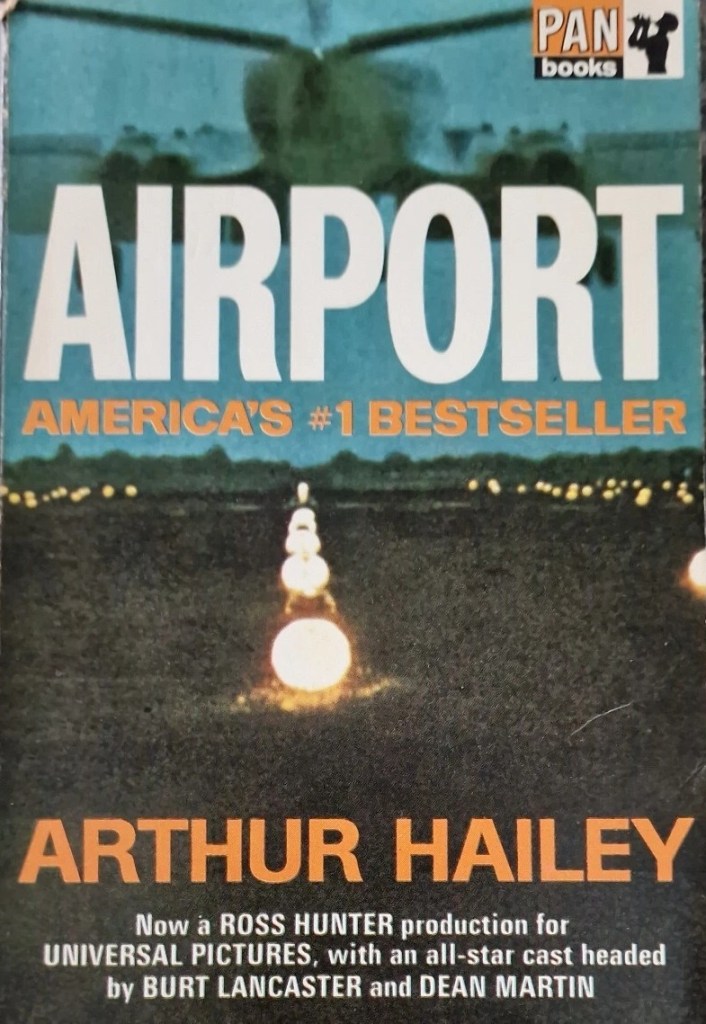
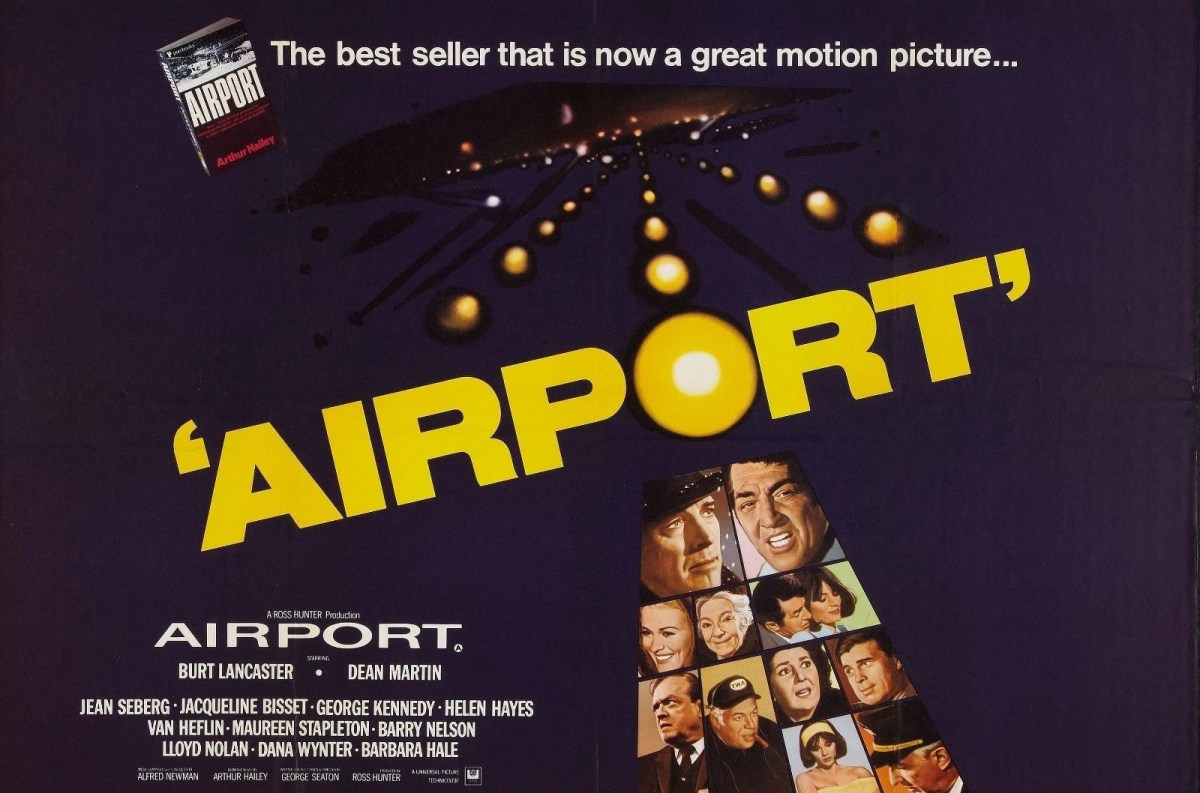
You might think director George Seaton wearing his screenwriter’s hat had his work cut out adapting Arthur Hailey’s 500-page tome for a lean two-hour picture. But Hailey’s book was anything but lean and the fat was easily trimmed away. The author had little idea of dramatic tension and there’s a clear example here that what plays in a novel won’t at all work on screen.
Had Seaton slavishly followed the Hailey template the tension-filled climax of the bomb exploding on the plane and the pilot having to land the stricken plane on an icebound runway would have been interrupted by numb-boring back-and-forth between airport executives and people complaining about planes flying overhead disrupting their lives and the author holding forth on the future of air travel.
A huge chunk of the book is politics one way or another and with the exception of a brief tussle between airport boss Burt Lancaster and his bosses that focuses, unlike the book, on Lancaster’s attempts to keep the runway open, Seaton chucks out all that stuff about townspeople, literally, on the march. Audiences won’t be much interested either in much of what Hailey, in investigative fashion, turns up about cargo loading and the problems facing shoe-shiners and skims over the question of why airports permit insurance agents to so freely operate in an airport, making a healthy living (from which the airport takes a cut) from selling fear to travelers.
It’s interesting, as always, to see what, apart from the obvious as I’ve outlined, a screenwriter doesn’t believe essential. So in the movie Dean Martin’s beef with Burt Lancaster is over the airport’s supposed inefficiency in keeping the runways clear in the face of a snowstorm. But in the book that’s the least of Martin’s concerns, since he’s taken umbrage at this dialing up of the fear factor by selling insurance policies to people about to board a plane.
When you see all those guys and all that heavy-duty equipment trying to clear a path for the airplane grounded in the snow, you think what the heck’s the problem, it’s only a big mound of snow. In the book, the real problem is explained. The plane isn’t stuck in the snow – it’s stuck in the mud underneath the snow, so actually the ground staff have to dig it out of a pretty big hole.
Hailey also takes a detour with the George Kennedy troubleshooter. Instead of getting a police escort to the airport he takes time out to sort out a traffic tangle, demonstrating, for the reader, his unique set of skills, which, sensibly, Seaton reckons will be amply shown when he is doing his job on the runway.
Fourth time unlucky – the series runs out of runway.
There’s a subplot that Seaton eliminates. As well as having a troublesome brother-in-law in Dean Martin, Burt Lancaster has a troublesome brother, so burned out by his job as an air traffic controller that he’s on the verge of committing suicide. But again, Seaton reckons there’s enough going on without over-egging the pudding.
Seaton really comes into his own on the emotional front, having a better notion than Hailey of how to heighten emotion. So there’s no mention that the apparently childless Dean Martin had a previous child from a previous affair – the baby was adopted (a policy airlines encouraged to get stewardesses back to the front line as soon as possible) so the question remains – does he want to be a father? Seaton also brings forward his idea about an abortion. In the book, Burt Lancaster and Jean Seberg have not consummated their affair, but Seaton makes it implicit in the film that they have. Also Hailey reveals from the start that Lancaster’s wife is already playing away from home but Seaton holds that knowledge back so there’s an emotional twist in the film.
What Seaton adds is just as demonstrative of the screenwriter’s skill. Not in the book: the nun, the priest, the bolshie passenger and the know-it-all teenager. These are Seaton inventions. Seaton also builds up Lancaster’s wife as coming from a wealthy family rather than being a failed actress. And he brings to the fore the women who are the casualties of male weakness, Dean Martin’s wife discovering his girlfriend is pregnant, the bomber’s wife realizing what he has done, Lancaster’s wife confronting him.
Although Hailey spends acres of print going on about the problems low-flying planes cause he doesn’t actually show their impact. Seaton cuts right to the chase, opening with a scene of plates and stuff crashing to the floor in a house as a plane flies overhead. And in scenes of the snowplows sending snow wafting through the air the director in Seaton turns what Hailey described as a “conga line” into a ballet
One other element – in the book the Burt Lancaster character has a limp. Movie heroes don’t limp.
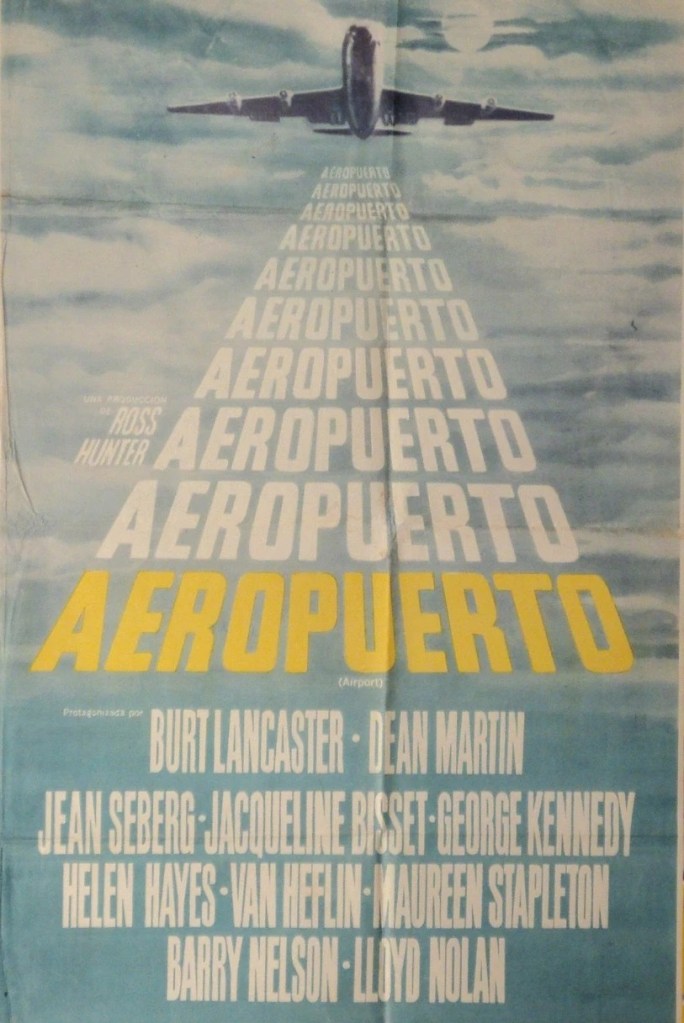
Ross Hunter had been a big wheel in the production business for the best part of two decades, shepherding home hits like Midnight Lace (1960), remakes of universal weepies like Back St (1961) and Madame X (1966), play adaptations such as The Chalk Garden (1964), the Tammy movie series and Julie Andrews musical Thoroughly Modern Millie (1967). He was as close to a sure thing as you could get. Even so, Airport, with a $10 million budget, was the biggest gamble of his career.
He paid $350,000 upfront plus another $100,000 in add-ons for the rights to the runaway Arthur Hailey bestseller. Initially, Hunter was targeting the roadshow audience, filming in 70mm, the first time Universal had employed Todd-AO.
Dean Martin, who had made Texas Across the River (1966) and Rough Night in Jericho (1968) for Universal, was first to sign up for his usual fee plus a percentage. Martin was at a career peak, carried along effortlessly at the box office by the Matt Helm quartet and targeted for westerns.
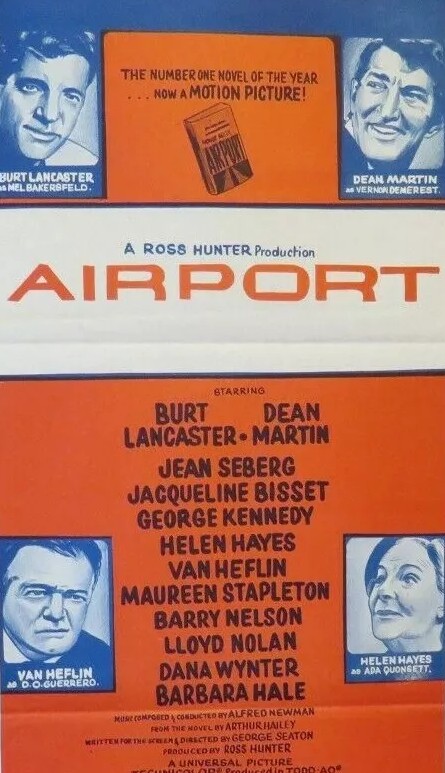
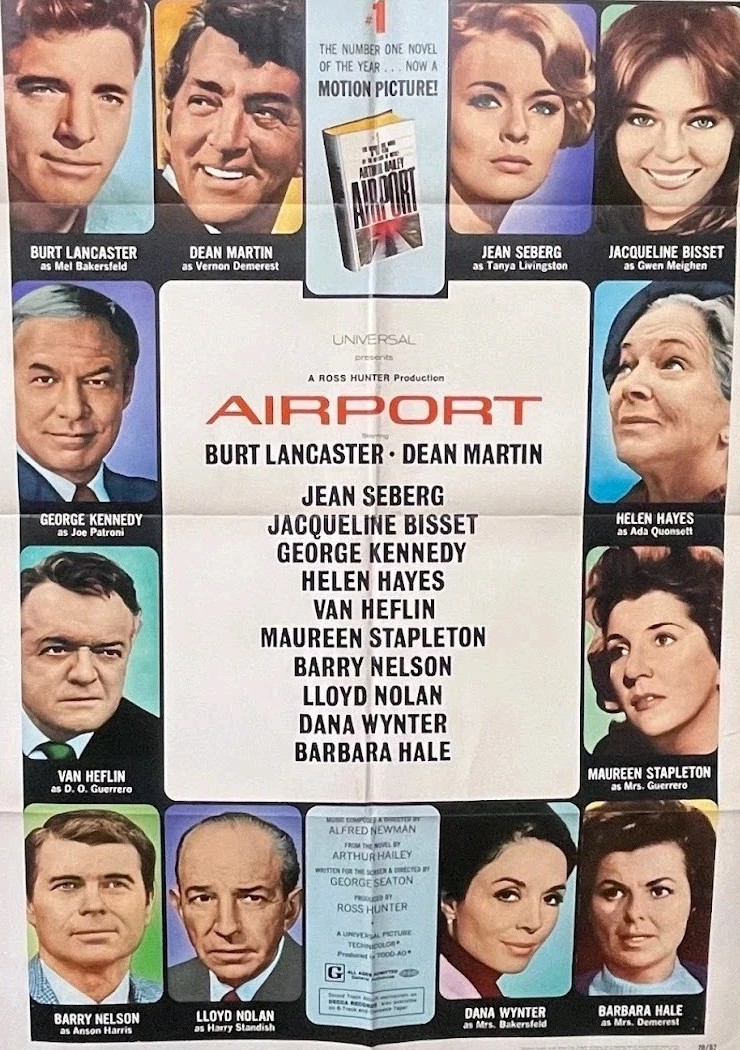
Hunter was pitching a movie with four major stars in Oscar-winner Burt Lancaster (Elmer Gantry, 1960), Dean Martin, Jean Seberg (Paint Your Wagon, 1969) and Oscar-winner George Kennedy (Guns of The Magnificent Seven, a1969) and another half-dozen names of varying marquee appeal that included British actress Jacqueline Bisset (Bullitt, 1968), and mature stars in Van Heflin (Once a Thief, 1965), Lloyd Nolan (The Double Man, 1967), Barry Nelson (The Borgia Stick, 1967), TV Perry Mason’s Barbara Hale and Oscar-winner Helen Hayes (Anastasia, 1956).
The picture came at a fortuitous time for Burt Lancaster. A trio of more challenging movies – The Swimmer (1968), Castle Keep (1969) and The Gypsy Moths (1969) – had flopped, so his marquee value was in question, especially at his going rate of £750,000 (plus a percentage). Doubts had set in with The Gypsy Moths, with MGM dithering over the opening date, switching it originally from summer to Xmas and then back again but happy to censor the picture to meet the approval of the Radio City Music Hall where it premiered.
And while he was still clearly in demand in 1968-1969, he had lost out the starring role in Patton (1970) with James Stewart in the Karl Malden role, which would have coupled commercial success with critical approbation. The shooting of Valdez Is Coming (1971) was postponed for a year. Originally it had been set for a January 1969 start date with Sydney Pollack directing. Face in the Dust, a Dino De Laurentiis production, never saw the light of day.
And although Lancaster later described Airport as “the biggest piece of junk ever made” (luckily he didn’t live to see Anora or Mercy), the disaster blockbuster put his career back on track. It was quite a change of pace for him, too. He wasn’t in every scene and at times he had to take whatever Dean Martin’s character threw at him. But what he brought to the picture was his natural electricity, the tension of never knowing what he was going to do. But Airport barely merits a page in Kate Buford’s biography.
Double Oscar-winner George Seaton was set the dual task of condensing Arthur Hailey’s 500-page novel into a lean two-hour movie which he would direct. In a directing career spanning a quarter of a century, Seaton was well-used to handling big stars of the caliber of William Holden (three pictures including The Counterfeit Traitor, 1962), Bing Crosby and Grace Kelly (The Country Girl, 1953) Kirk Douglas (The Hook, 1962), Montgomery Clift (The Big Lift, 1950) and Clark Gable and Doris Day (Teacher’s Pet, 1958),
Jean Seberg, under investigation by the FBI, had revived an ailing career with Paint Your Wagon (1969). Producer Ross Hunter initially preferred Angie Dickinson (Jessica, 1962) or Stella Stevens (Rage, 1966) for the role of Lancaster’s screen lover, but had to go along with Universal with whom Seberg had a two-picture “pay-or-play” deal (she got paid whether she made a picture or not). However, she was considered a marquee name in the international market, especially France where she had remained a cult figure after Breathless (1960).
Disconcerted by being considered unwanted, her natural nervousness increased until Hunter made a point of convincing her that he was “genuinely happy” at her involvement.
She wasn’t the only person to be considered second best. For the part of the elderly stowaway, six-time Oscar nominee Thelma Ritter (Boeing, Boeing, 1965) and Jean Arthur, who hadn’t appeared in a movie since Shane (1953), had been wooed before Hunter settled on Helen Hayes.
For Seberg, it was the biggest pay cheque of her career – $150,000 plus use of a studio car and $1,000 a week expenses for the 16-week schedule, but she lost out on a percentage. She was billed third. High-flying her career might be, but personally she was struggling, her marriage to Romain Gary in trouble and under pressure to help raise funding for the Black Panther movement. She was receiving calls in the middle of the night. “Many nights she’d be so frightened, she’d come and sleep on the couch at my home,” recalled Hunter, “there’s no doubt it was an extremely difficult period for her.”
Helen Hayes reminded Seberg of her grandmother, to whom the stowaway’s exploits would have appealed. As a teenager, Seberg had idolized Hayes. Dean Martin pushed for Petula Clark (Goodbye, Mr Chips, 1969) for the Jacqueline Bisset role and Stella Stevens (Rage, 1966), as well as being considered for the Seberg part, was also in the frame.
Virtually all the bit parts were played by Universal’s contract players. For Airport, the studio rounded up thirty-two of them. Patty Paulsen, who played stewardess Joan, was a genuine stewardess for American Airlines before she won the role on the strength of winning a beauty contest. It was veteran Van Heflin’s final picture, and also for composer Alfred Newman. George Kennedy would reprise his role through three other pictures in the series – though he turned down Airplane! (1980).
Location filming at Minneapolis-St Paul International Airport began in January minus director George Seaton who had come down with pneumonia. Henry Hathaway stepped in, at no cost, to cover. The producer had headed to Minnesota for the snow, but there was none around, and the production team had to import tons of fake stuff made out of whitened sawdust. Filming took place at night in plunging temperatures. Despite wearing face masks, cast and crew suffered and the freezing conditions slowed down the shoot.
Hunter hired a $7.5 million Boeing 707 for $18,000 a day. For studio work in Los Angeles Hunter brought in a damaged Boeing. Ironically, Dean Martin had a fear of flying and travelled to the location by railway. Ditto Maureen Stapleton.
Seberg’s outfits, including calfskin sable-lined coats designed by Edith Head, cost $2,000 apiece, though Seberg was less keen on the airport uniform. With Seberg’s hometown less than a five-hour drive away she was able to head home during breaks in filming.
John Findlater, who played a ticket checker in the film, remembered Seberg as “frail and lonely…very shy…she had a very hard time of it.” It took four days to film the scene where Helen Hayes explains the art of the stowaway and feels the brunt of the wrath of Burt Lancaster and Seberg. Delays always niggled Lancaster, for whom they smacked of unprofessionalism. To raise her spirits, Seaton improvised little comedy skits.
Seberg befriended Maureen Stapleton, playing the bomber’s wife. Seberg was “impressed” that Stapleton could cry on cue and the minute the scene was over be laughing.
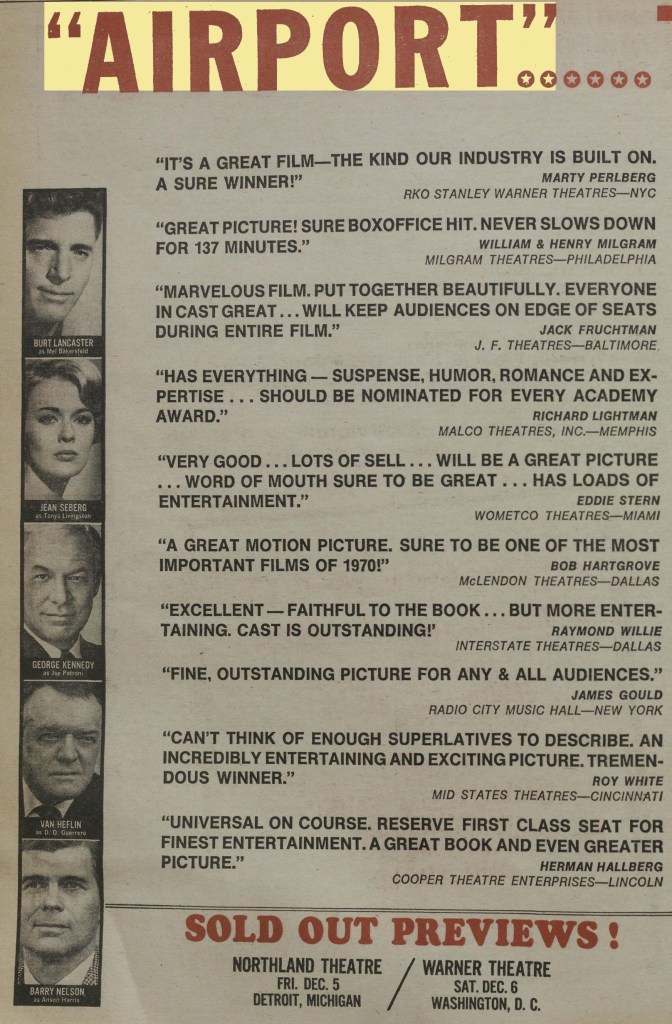
In the end Hunter gave up the idea of a prestigious roadshow run, settling instead for a premiere opening at the Radio City Music Hall and first run houses across the country. There had been no shortage of pre-publicity. Any time an airplane hijack hit the headlines or a snowstorm shut down airports or an airplane skidded off the runway, editors were happy to insert a mention of the picture.
And there was an abundance of airports and travel companies willing to sign up for cooperative promotions, helped along by the fact that Edith Head had designed the “Airport Look” launched not just with male and female fashions but a range of travel accessories. A beauty queen competition “International Air Girl” managed to hook a 45-minute television slot in Britain.
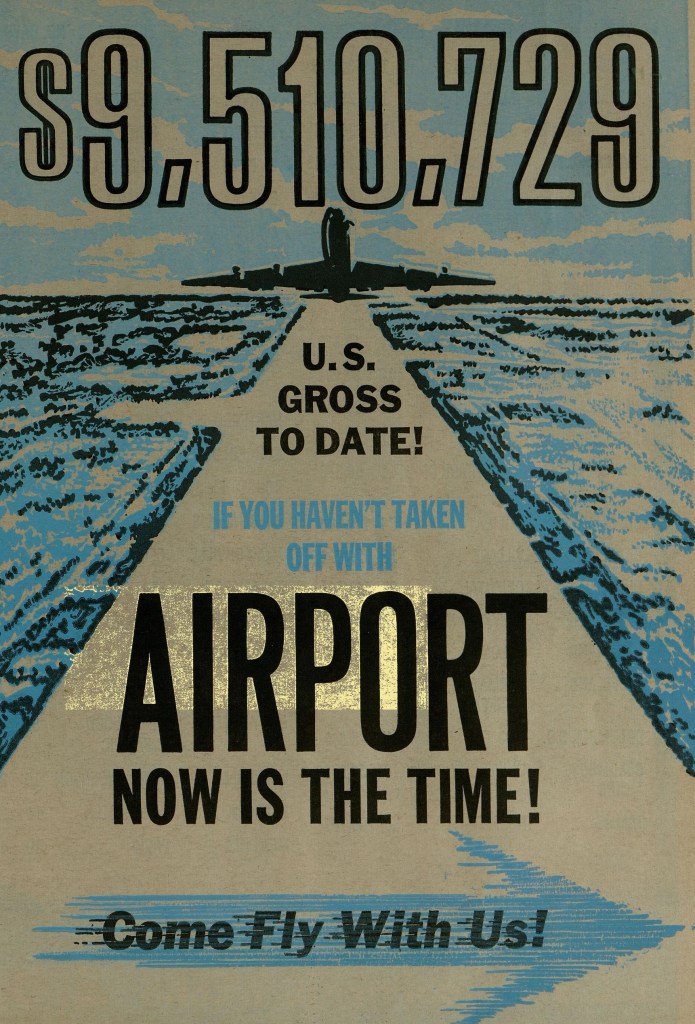
Opening at the Radio City Music Hall in New York, a couple of weeks in advance of the national roll-out, Airport plundered a record $235,000, topping that in its second week, and scooping up $1 million before the end of the month. It was gangbusters everywhere, opening in prestigious first run locations, with nary a showcase/multiple run in sight. “Wham” was the description beloved of the Variety box office headline writers, the word preceding its $80,000 opening week tally in Chicago, $28,000 in San Francisco, and $25,000 in Louisville. “Smash” was also brought into play for its $40,000 in Baltimore and $33,000 in Philadelphia. The subject matter allowed the sub-editors who wrote the headlines some license, so it was a “sonic” $40,000 in Boston and a “stratospheric” $45,000 in Detroit. And it had legs. Week-by-week fall-offs were slight. It was still taking in $25,000 in the 24th week in Detroit, for example.
By year’s end it was easily the top film of the year with $37 million in rentals, way ahead of Mash on $22 million and Patton $1 million further back. And it kept going, adding another $8 million the following year as it was dragged back into the major cities for multiple showings (seven in New York) in multiple engagements.
Business was not so robust abroad. Though Airport managed a six-week run at the Odeon Leicester Square, where it received a Royal Premiere on April 22, 1970, its opening week’s figures were down on both the final week of its predecessor at the London West End cinema, Anne of the Thousand Days, and its successor Cromwell and the film didn’t make the Annual British Top Ten. But in Australia it led the field, though its returns were one-third down on the previous year’s Paint You Wagon and Butch Cassidy and the Sundance Kid.
For its television premiere on ABC in 1973, the network demanded a record $140,000 per minute for advertising. Outside of Gone with the Wind, it earned the highest rating of any movie from 1961 to 1977.
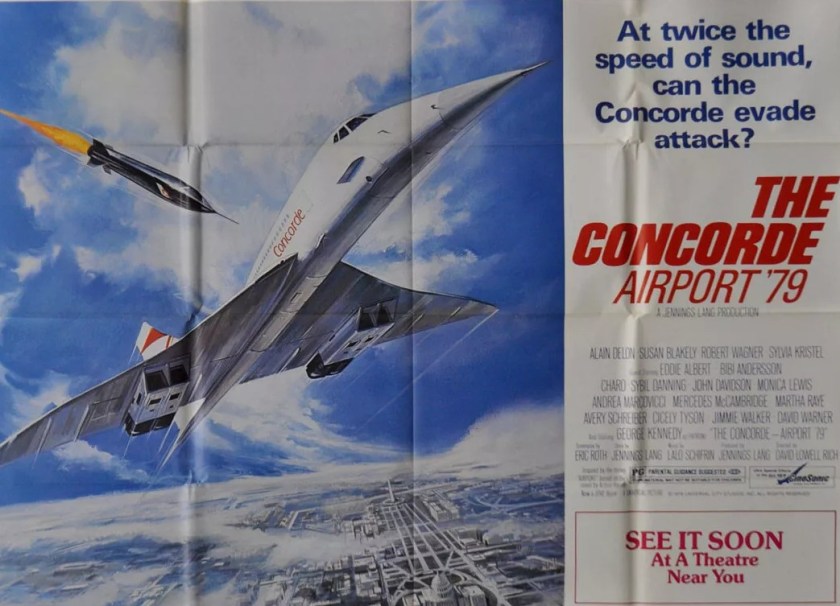
But it also set up an industry. Sequels were the name of the game. And though Airport ’75 (1974) headlining Charlton Heston and Airport ’77 (1977) starring Jack Lemmon were cut-price operations, they were huge successes at the box office, the former hauling in $25.8 million in rentals, the latter $16.2 million. A fourth venture, The Concorde…Airport ’79 (1979) with Alain Delon, flopped and put an end to the series.
SOURCES: Garry McGee, Jean Seberg, Breathless, 2018, p167-171; Kate Buford, Burt Lancaster, An American Life (Aurum Press, 2008) p264-265; “Cast Patton & Bradley,” Variety, September 20, 1967, p13; “Airport Film Deal,” Variety, May 29, 1968, p60; “Steiner at Goldwyn Plant,” Variety, July 24, 1968, p7; “Dean Martin First to Sign for U’s Airport,” Box Office, August 5, 1968, pK4; “Hollywood Happenings,” Box Office, January 6, 1969, pW2; “Airport Will Be U’s First Feature in Todd-AO,” Box Office, January 13, 1969, p12; “Seaton’s Temp Sub at U: H. Hathaway,” Variety, January 22, 1969, p7; “Airport Sequence Follows Real Event,” Box Office, January 27, 1969, pNC3; “17 Inches Snow Brings North East Business To Complete Standstill,” Box Office, February 17, 1969, pE1;“Ross Hunter’s Roadshow,” Box Office, April 28, 1969, pK2; “De Laurentiis Slates 3 Aussie Locationers,” Variety, September 24, 1969, p18; “Put Back Moths Scenes Cut Solely for Radio City,” Variety, October 22, 1969, p5; “Airport Smacks $1-Mil,” Variety, April 1, 1970, p4; “Airport Contest on TV,” Kine Weekly, April 18, 1970, p18; “Big Rental Films of 1970,” Variety, January 6, 1971, p11; “Encore Hits,” Variety, June 16, 1970, p5; “ABC Flying 140G Per Minute for Airport,” Variety, June 27, 1973, p14; “Hit Movies on TV Since ’61,” Variety, Sep 21, 1977, p70; “All-Time Film Rental Champs,” Variety, May 12, 1982, p5. U.S. weekly box office figures – Variety, March-April 1970; U.K. weekly box office figures, Kine Weekly, April-July 1970.
Thundering entertainment from an era when they made movies to appeal to audiences and not to placate the overweening ego of over-entitled directors. I first saw this in 1970 when it was selected as one of three films (the others being Cromwell and The Virgin and the Gypsy) to open the new Odeon triplex in Glasgow, and, thanks to my own in-built movie snobbery, haven’t seen it since. So this was a revelation.
Let’s start with the running time. Made now this would be an overblown 150 minutes (at least) stuffed full of extraneous scenes. But let’s start with the opening. The screen is dark. Yes, absolutely dark. What? Is this some kind of arthouse venture? And it remains dark for about 20 seconds though by now sound has been added, a general hubbub of commotion. Are you sure this isn’t arthouse? Had this been directed by Scorsese or Coppola (who, in fact, used a similar device to open The Godfather, 1972) critics would have picked it up.
John Frankenheimer for Grand Prix (1966) and Norman Jewison for The Thomas Crown Affair (1968) were praised for their use of the split screen, another aspect ignored here by critics. Yet split screen is not only impressively utilized, but, on occasion, it has a humorous quality, as the screen not only splits in two but accommodates other shapes in between or round about. Did anyone mention the use of the wipe? A cinematic technique scarcely employed in the mainstream since Seven Samurai (1954).
Several narrative plates regarding relationships spin in the air while the movie sharpens focus to concentrate on resolving three major incidents involving airplanes. The first is shifting a jet stuck in the snow during a huge snowstorm and blocking off one entire runway. The airport is already under pressure, what with the storm curtailing other flights and forcing others to dive for cover. Then we have a bomber, planning to wreck the plane mid-ocean to claim on the insurance, but when his plan goes awry and he blows out the toilet of the plane, the crew have to bring it down, safety jeopardized by the jet stuck on the ground.
You always know how disaster pictures are going to end, maybe the only guesswork concerns who will actually survive, and it’s an incredible credit to this movie that I felt the tension constantly rippling through me as we hit the various climactic episodes.
On the ground airport manager Mel (Burt Lancaster) is trying to shift the stuck aircraft while dealing with irate wife Cindy (Dana Wynter) and keeping on track his illicit relationship with PR manager Tanya (Jean Seberg). This is on top of a) wrangling with an airport executive who refuses to expand the airport to meet overwhelming demand and whose only reaction to impending crisis is to close the airport down, b) dealing with local citizens furious that plans are rattling their houses, and c) taking flak from brother-in-law and ace pilot Vernon (Dean Martin).
Up in the air Vernon has his work cut out coming to terms with the pregnancy of girlfriend Gwen (Jacqueline Bisset) – always having used his marriage as an excuse not to get emotionally involved with his string of girlfriends – and with a 70-year-old stowaway Ada (Helen Hayes) and bomber D.O. Guerrero (Van Heflin) and then bringing in the stricken plane.
We’re tossed a few red herrings on the passenger manifest. Spot a nun and a priest in a disaster picture and you’re generally in for cliché overload. Here, instead, they are used for humor, the nun taking a swig of whisky under pressure and the priest whacking a belligerent passenger. And the charming Ada is on land given very sympathetic treatment given the thousands of dollars she’s conned out of airlines over the years, but that’s only to set her up for some harsh treatment on board.
There’s an unexpected twist with the bomber. For a few minutes it looks like the crew are going to win the day but then calamity strikes. Meanwhile, on the ground troubleshooter Joe (George Kennedy), huge cigar constantly in place in the mouth, has taken charge of shifting the stuck plane and in the end has to take drastic action.
And in little telling snippets director George Seaton plays fair with the wives who lose out, Mrs Guerrero (Maureen Stapleton) and Mrs Demerest (Barbara Hale) while allowing Mrs Bakersfield to deliver a come-uppance to her errant husband – she’s been playing away too.
The decision to pack this full of more genuine stars than you ever got in a roadshow – mostly the cast list was padded out with newcomers or stars past their best (Lawrence of Arabia, 1962) – reversed this with genuine stars in supporting roles and newcomers in the leading roles) Both Oscar-winning Burt Lancaster (The Professionals, 1966) and Dean Martin after the Matt Helm series and a bunch of westerns were genuine top-notch marquee names. Jean Seberg had just hit a career box office high with Paint your Wagon (1969). After Bullitt (1968) Jacqueline Bisset’s star was on the rise. Oscar-winner George Kennedy (Cool Hand Luke, 1967) was top-billed in Guns of The Magnificent Seven (1969).
And there was a heck of a strong supporting cast: Van Heflin (Once a Thief, 1965), Dana Wynter (Sink the Bismarck!, 1960), Barbara Hale (Perry Mason series, 1957-1966). Oscar-winner Helen Hayes (she won in 1932) and Maureen Stapleton (Bye, Bye, Birdie, 1963) proved the pick, the former here winning a second Oscar, the latter nominated. Apart from Van Heflin, Seaton had gone for character actors rather than stars – Wynter hadn’t made a movie in a decade, for Stapleton it was seven years, for Hayes 14 years and Hale one film in over a decade.
You’d be laughed out of town these days if (outside of sci-fi) you tried to saddle a star with chunks of exposition or technical detail, but here the force of the screen personalities of Lancaster, Martin and Kennedy makes you hang on their every word.
They didn’t have prizes in those days for ensemble acting, but if they had this would surely be in contention, as director George Seaton, in his capacity as screenwriter, ensures that no one is left out and even if it’s only with a look we learn everything we need to know about a character’s emotional life.
Given this was – to use Christopher Nolan’s favorite phrase – “shot in camera” this is a terrific technical achievement in terms of the airplane action especially the stuck plane trying to hirple it way out of trouble.
Director George Seaton (36 Hours, 1964) took ill during production and exterior sequences were filmed by Henry Hathaway (True Grit, 1969). A mention, too, for the driving score by Alfred Newman, in his last screen assignment. It was nominated for 10 Oscars including Best Picture.
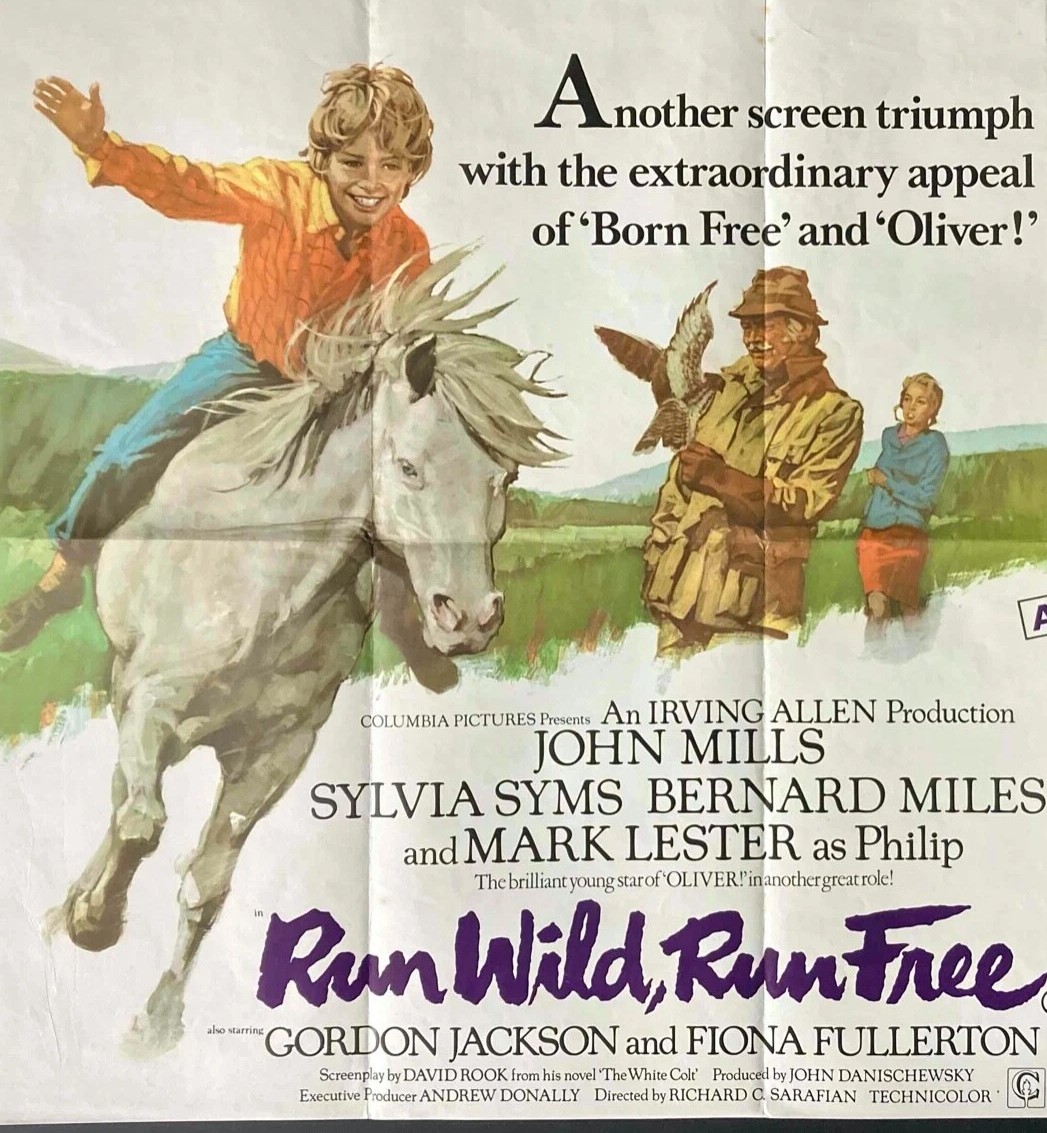
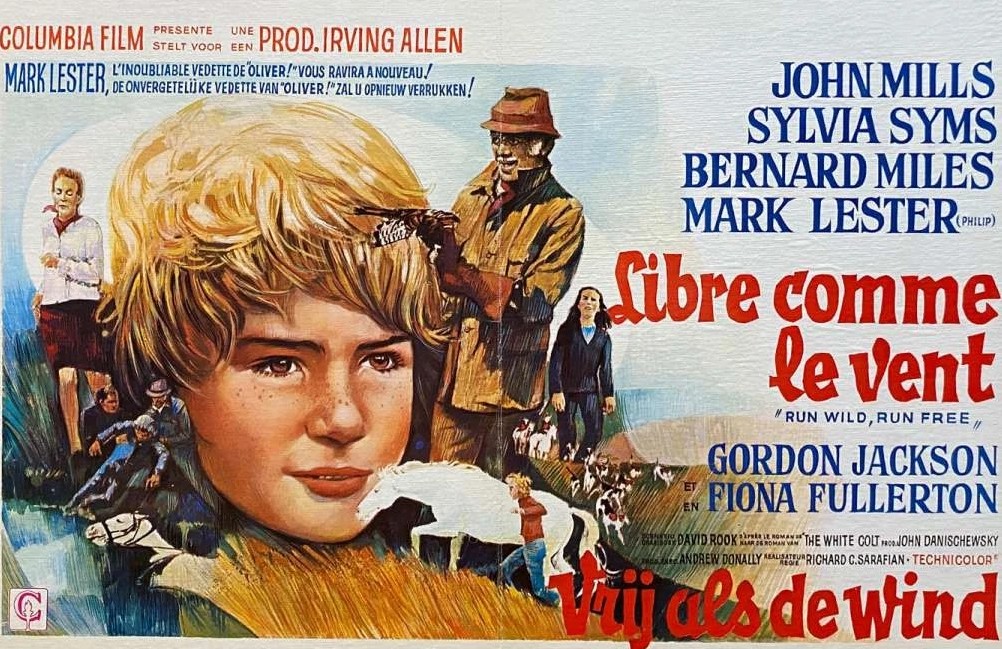
Surprisingly absorbing, precisely because of the distinct lack of the soppiness or mawkishness associated with the genre. Nature “red in tooth and claw” scarcely puts in an appearance and even then is a good bit less dangerous than a wanton child unable to understand or control his emotions. Parents are very well-drawn, too, in an era that scarcely ran to much comprehension about child psychology, a mother rejecting her son because she is convinced he has rejected her, a traditional father who lacks the skills to convey his love for his son. And you wouldn’t get away these days with an old fellow taking more than a passing interest in a small bewildered boy with the audience immediately conjuring up images of abuse.
The film also prefigures the Gaia movement. Both the old fellow and his young charge are given to lying prostate on the grass, the better to listen to the beating heart of the Earth. And you wouldn’t think of pinning this one on director Richard C. Sarafian, best known for his biker epic Vanishing Point (1971). Far less imagine how you’d get a whole stack of actors to spend a great deal of time wading through a swamp “in camera” rather than utilizing some form of CGI or to volunteer their fingers to be bitten by a predatory bird.
If you’re searching for the kind of twist that’s so common these days, look no further than the location. Those wild moors look fantastic in the sunshine, especially for compositions that outline characters against the sky, but they’re treacherous too, when the fog comes down and you’re trapped without a signpost home, and they’re not all hard grass or spurs or rock but conceal sections of perilous swamp.
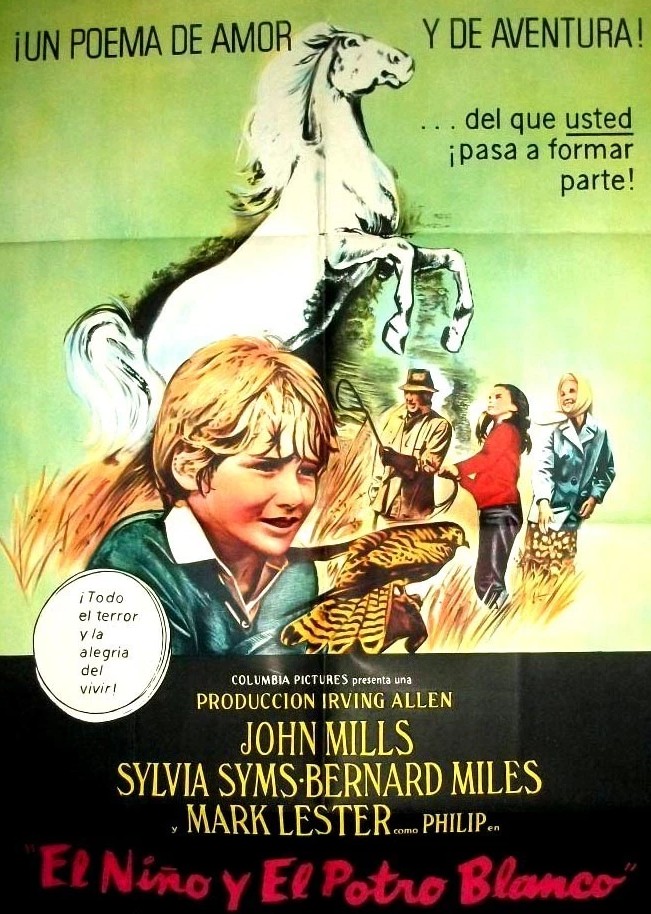
Living on the edge of the moors, small wonder Philip (Mark Lester) is attracted, even as a toddler, to the wilderness. That’s exacerbated when he’s afflicted by muteness after developing a stammer around the age of four. It’s assumed there’s a psychosomatic cause, but we’ve got no time and the parents no inclination to dwell upon that.
He develops an obsession with a wild white pony, one of a herd that runs free on the moors, and spends most of his time out trying to find it. Col Ransome (John Mills), nature lover and amateur ornithologist, befriends Philip, helping him to understand nature, and teaching him to ride – bareback – the pony. Ransome also shows him to manage a kestrel.
Scenes of characters working with horses or other animals are usually limited to bit of nose stroking or whispering to calm said animal down, but here we go into a lot more intricate detail of how to win the cooperation of a horse, the kind of lore that nobody’s got much time for these days. So if you want to ride a horse bareback first off you need to just lie on top across its back and stroke its sides. And for a predator, you have to be willing to accept the occasional peck on your fingers while, again, you evoke a stroking mechanism. You might also be surprised to learn that the easiest way to mend a broken wing is by the use of glue.
While Philip and the Colonel and a young girl Diana (Fiona Fullerton) are happily communing with nature, Mr Ransome (Gordon Jackson) and wife (Sylvia Syms) are scarcely able to work out their feelings at being abandoned by their child. The mother tends to get angry, the father, in a very touching scene, is left desolate after Philip ignores a present the father believes would have brought more solidity to their relationship, and in another effective scene it’s the Colonel who explains that it doesn’t take much for a child to understand how devoted an apparently distant father can be.
Any potential soppiness is killed off when Philip in a wild fit of obsession nearly kills the kestrel and in another sequence of disregard almost kills the horse. Occasionally, Philip speaks a few words to the old man but refuses to express himself in front of the parents. So it will come as little surprise that when the parents finally hear the son speak it’s at the quite gripping climax when all the adults have failed to rescue the white horse from a swamp.
And anyone expecting that cute kid from Oliver! (1968) would have their hopes dashed when Mark Lester displays all the natural truculence and wantonness of a child. He’s pretty good, I have to say, in being forced to confine his emotions to facial expression.
John Mills (Guns at Batasi, 1964) is excellent and Sylvia Syms (East of Sudan, 1964), shorn of glamor, and Gordon Jackson (The Ipcress File, 1965) as her emotionally inarticulate husband, both dump their screen personas in favor of highly believable characters. Fiona Fullerton makes her screen debut.
Richard C. Sarafian does a splendid job. Screenplay by David Rook based on his novel.
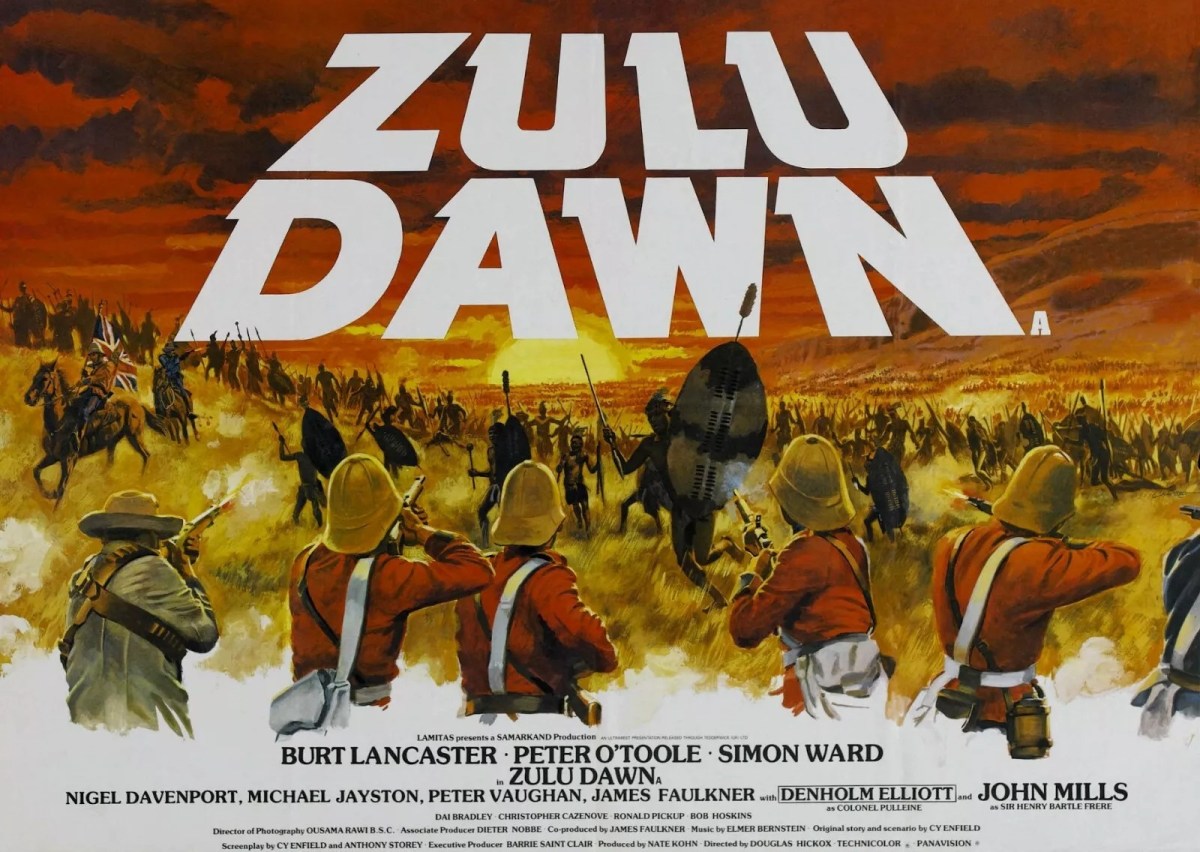
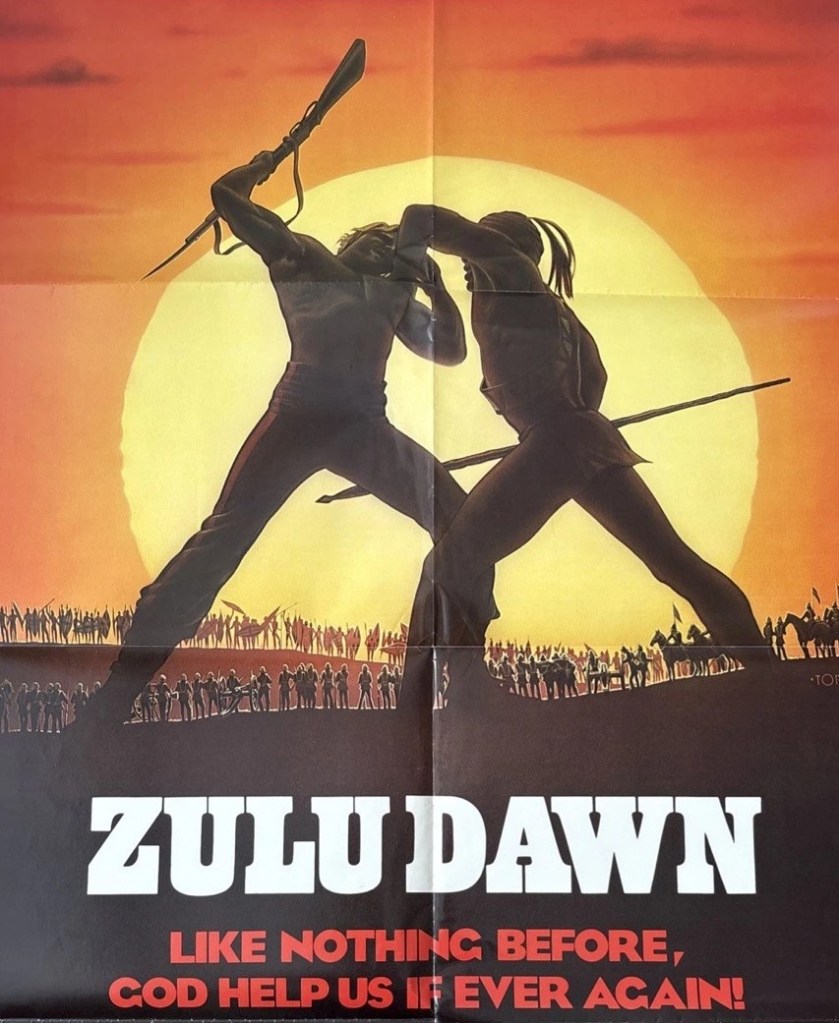
You’d wonder why anyone would want to make a film about this calamitous military disaster, the Battle of Isandlwana in 1879. Yet, such subjects have always attracted Hollywood, especially if some kind of triumph can be snatched from defeat – Dunkirk (1958 and 2017) – or some charismatic figure of the order of General Custer is involved – They Died With Their Boots On (1941), Custer of the West (1967). Or you can make something mythical such as The Charge of the Light Brigade (1936) and with the assistance of the screen presence of Errol Flynn tilt it towards glory or you can take the same subject (the 1968 version) and make merry with satire should you wish to poke fun at the British Empire.
The latter could easily have been the starting point for Zulu Dawn, a prequel to the majestic Zulu (1964). However, although the Brits were outthought, out-maneuvered and outnumbered, the errors made on the battlefield were generally not through hubris or commanders competing for glory. And you would have to assume that no matter what the British Army could do, in terms of size it was minute compared to the Zulus, and even armed with rifles and artillery was hardly going to withstand a sustained attack.
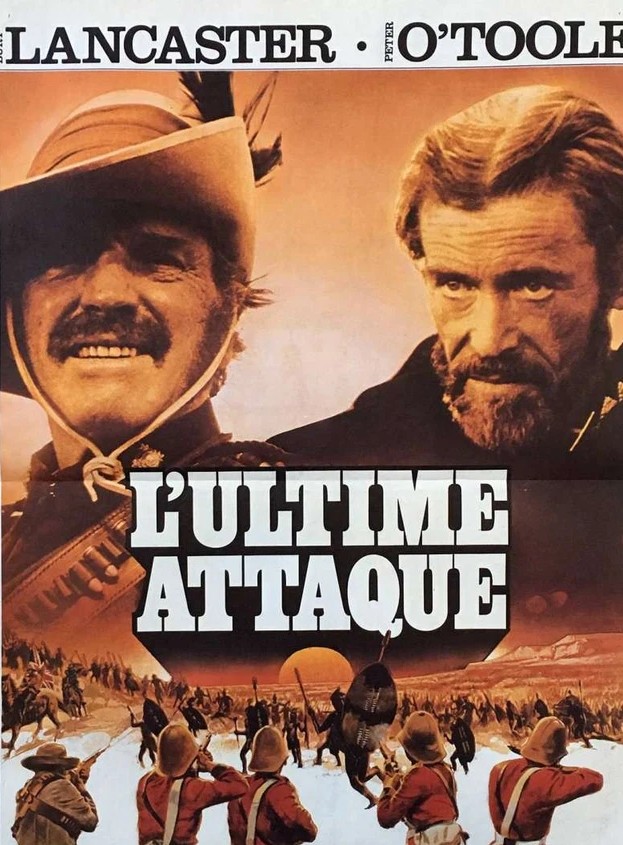
So it’s fairly solid stuff, buoyed up by decent performances, though Burt Lancaster playing an Irishman seems tacked on to increase marquee appeal. The final shot of the eyes of Peter O’Toole would easily stand in the annals of war pictures as one of the best testaments to the horror of defeat and impending humiliation.
There is certainly some unsavory business at the start as British commander Lord Chelmsford (Peter O’Toole) and diplomat Sir Henry Bartle Frere (John Mills) unwittingly poke the lion of Zulu King Cetawayo whose rising strength they perceive as a threat to the British colonies in the southern regions of Africa. Chelmsford makes the mistake of invading Zululand.
Hoping to pin down the enemy to the traditional pitched battle on territory that would give him an advantage, he finds he’s chasing ghosts. They can’t locate the Zulus until the enemy wants to be found. And in an echo of the later Lawrence of Arabia, Cetawayo does the impossible and leads his troops on what was considered an unlikely line of attack.
The British strategy of lining up troops in two lines and shooting alternately certainly reduces the oncoming force, but four times the amount of firepower would still have had trouble preventing the onslaught. Critically, in search of more favorable ground, Chelmsford splits his forces, but, again, even had the British been one unit, it would have made little difference.
I’m not sure how true is the portrayal of the officious quartermaster Bloomfield (Peter Vaughn) who, even in the heat of battle, demands soldiers form an orderly queue to receive a supply of bullets, and that may just be a potshot at overbearing bureaucracy.
The narrative flits from various characters, dashing cavalry types like Col Durnford (Burt Lancaster) and Lt Vereker (Simon Ward), commanders Chelmsford and Col Pulleine (Denholm Elliott), those representing different points of view such as Col Hamilton-Brown (Nigel Davenport) and Col Crealock (Michael Jayston), and lowly grunts in the form of Colour Sergeant Williams (Bob Hoskins) and Boy Pullen (Phil Daniels).
There’s certainly a sense of the higher-ups still enjoying the pleasures of life, wine served at dinner, plated service, but the lesser ranks still have largely an easy time of it, when they are not marching spending most of the time in idleness. It’s a very civil environment. Commands aren’t barked out. “I say, would you mind…” is the tone.
But it’s the marching that’s the killer. The heat’s not as bad as in Crimea and there’s no disease decimating the ranks but they still have to do a lot of walking on uneven terrain. There’s enough difference of opinion at all levels of the Army to keep tensions high.
And there’s more of a focus on the brutality of war – Lt Vereker laments the death of a Zulu child, you can easily be killed by your own troops and truth is viciously beaten out captives (who, as it happens, have been sent to become captives and mislead the Brits.) I was wondering if audiences had come to expect a scene with native girls dancing half-naked, as had occurred in the sequel, and the censor turned a blind eye to.
Peter O’Toole (The Lion in Winter, 1968) has the best role, especially when he counts the cost of defeat. Burt Lancaster (Valdez Is Coming, 1971) offers some star power but little else and the rest of the cast is virtually a roll-call of Who’s Who in British acting.
Luckily, the picture is more than even-handed and while not pillorying the Army and the Establishment in the manner of The Charge of the Light Brigade (1968) plays fair with the circumstances and exalts Zulu victory as much as British defeat.
Directed by Douglas Hickox (Les Bicyclettes de Belsize, 1968) with perhaps overmuch concentration on marching. Zulu director Cy Endfield had shot his bolt by this point and wasn’t invited back except in the capacity of screenwriter along with Anthony Storey making his movie debut.
Much better than I expected.
If you fancy checking out how it compares to Zulu (1964), you can check out my review on the Blog.
You can catch Zulu Dawn on the big screen beginning week of March 19 at a variety of cinemas including Odeon and Picturehouse in the UK and in other countries thanks to Munro Films. Here’s the link to the showings.
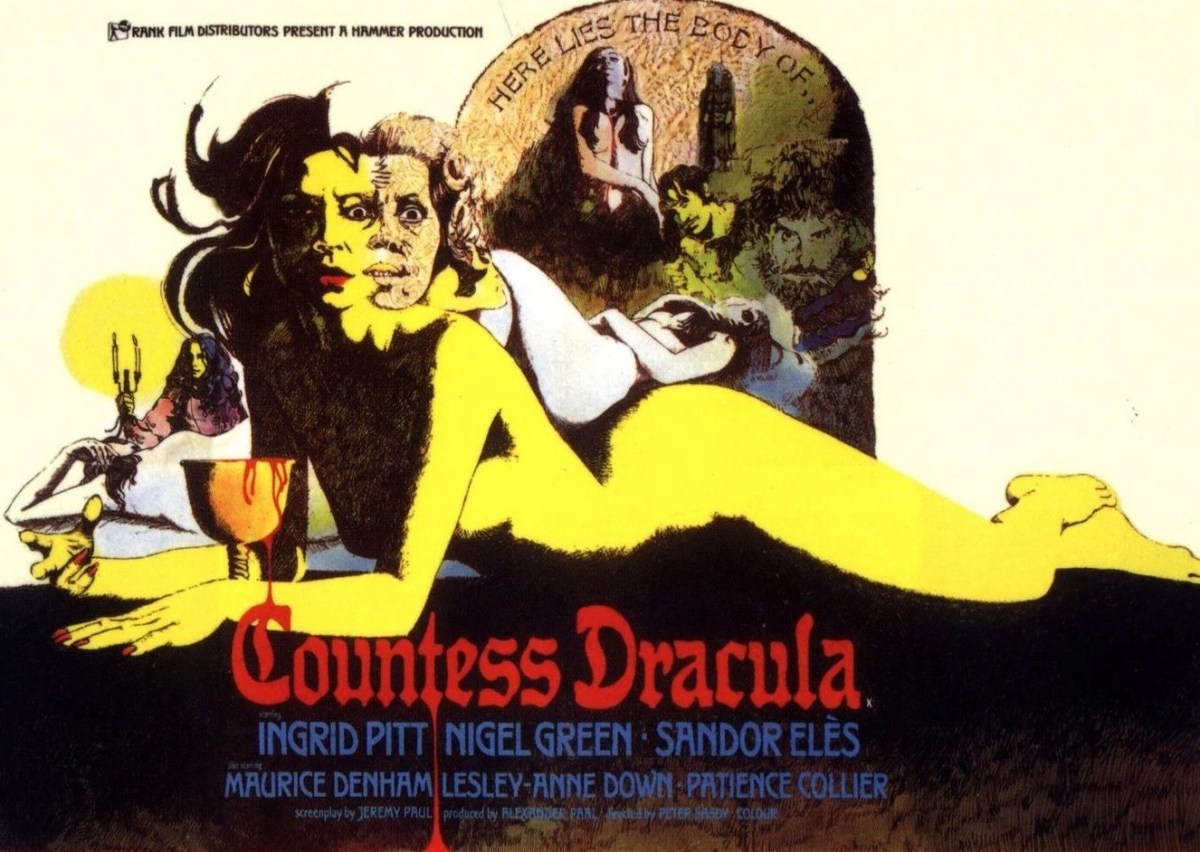
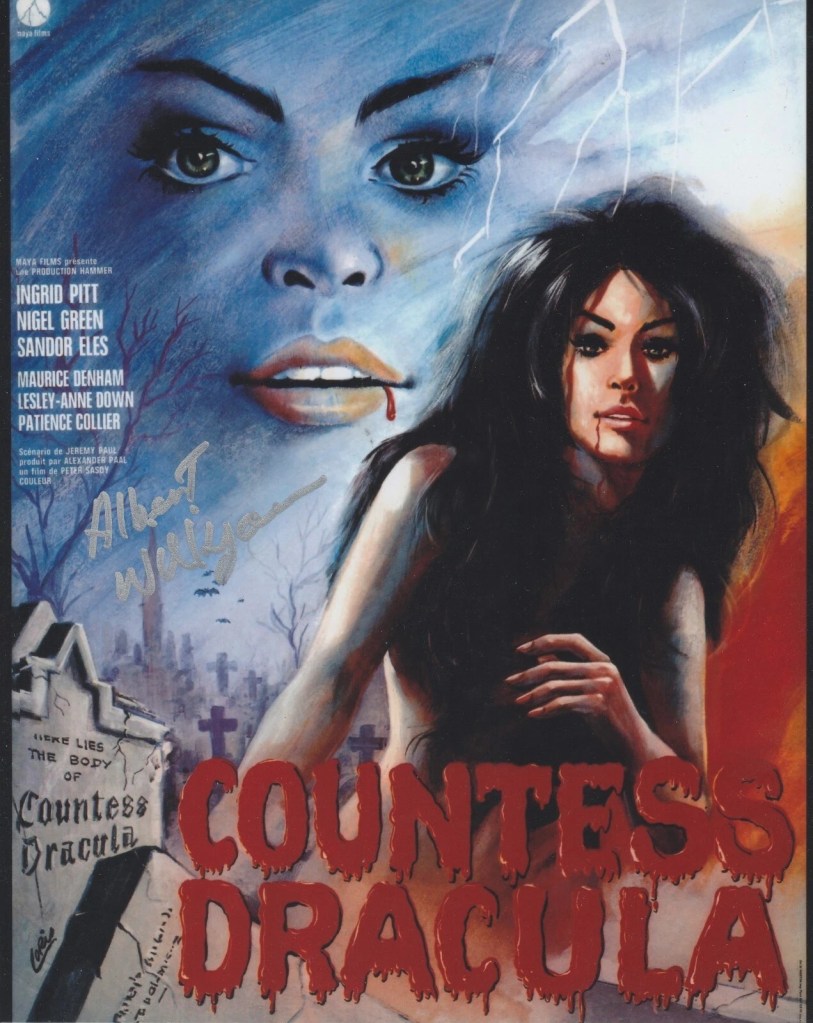
You wouldn’t go looking to British studio Hammer for a subtle treatise on the perils of ageing. Nor might you expect a predator to be so cruelly, and consistently, punished. Nor, for that matter, for a mirror to provide revelation given that in the traditional vampire movie one of the signs you have a bloodsucker in your midst is that a mirror does not show their reflection.
The title is something of a misnomer: while there’s bloodletting aplenty there’s zero actual bloodsucking. Hammer had taken a sideways shift into female empowerment and more obvious sexuality and gender twist with the introduction of the female vampire – beginning with The Vampire Lovers (1970), sequel Lust for a Vampire (1971) and, completing the trilogy, Twins of Evil (1972). For that matter it also pre-empted, in perverse fashion, the body swap genre of Freaky Friday (1976 etc.).
These days this would be termed the expansion of a “horrorverse” or a “Hammerverse” as the studio developed its IP since it had not abandoned the traditional Christopher Lee version, doubling down in 1970 with Taste the Blood of Dracula and The Scars of Dracula and following up with Dracula A.D. 1972 (1972).
While Countess Dracula doesn’t fall into the vampiric category, neither does it so obviously exploit the sexuality and rampant nudity of the female vampire trinity. But there are other shocks in store. Be prepared for emotional punch, not something normally associated with Hammer.
The ageing beauty had been a 1960s trope as Hollywood had come to terms with finding starring roles for 1940s/1950s stars past their box office best but names – Lana Turner and Vivien Leigh among others- with still some marquee lure. And this follows a similar trajectory, older woman falling in love with younger man.
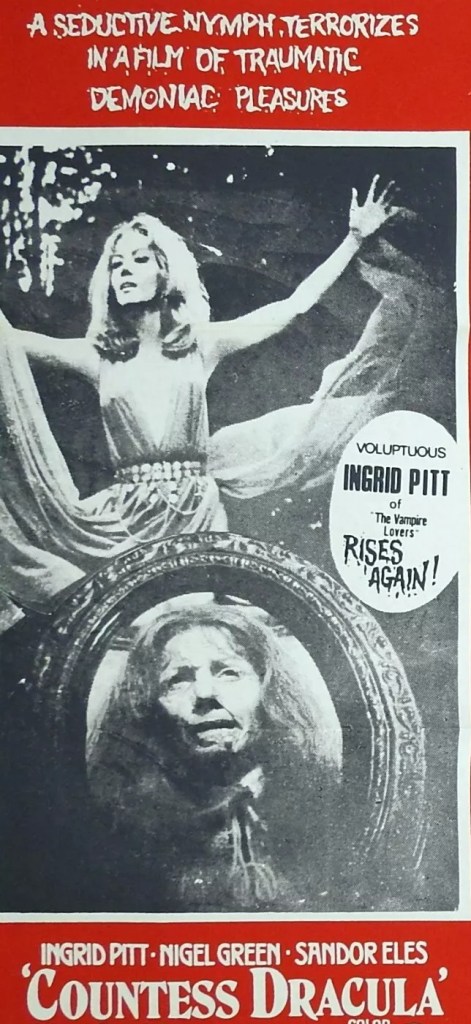
Set in Hungary in the seventeenth century, widowed Countess Elisabeth Bathory (Ingrid Pitt) discovers by accident that a touch of virgin blood rejuvenates her skin and tempts her into stealing the suitor Toth (Sandor Eles) of her 19-year-old daughter Ilona (Lesley-Anne Down). But that means kidnapping Ilona and keeping her imprisoned so Bathory can impersonate her, finding a ready supply of virgins to murder and exsanguinate, enlisting in her scheme lover Capt Dobi (Nigel Green) and maid Julie (Patience Collier).
The ruse appears to work well – at first. Believing Bathory is actually her daughter, Toth is easily seduced. But there’s a downside which is quickly apparent. What spell blood casts, it doesn’t last long. And there’s a sting in the tail. Having acted as a rejuvenating agent, when the virgin blood has run its course transformation goes the other way and turns her into an old crone.
So now, Bathory and her team enter serial killer territory, the disappearances and deaths arousing suspicion among the locals and historian Fabio (Maurice Denham), and her daughter threatening at any minute to escape her captor and turn up at the castle. And Bathory cannot give up the fantasy, not least because when the blood runs out, she’ll be unrecognizable as an old crone.
You can see where this is headed, so that’s not much of a surprise. What is astonishing is how well director Peter Sasdy (Taste the Blood of Dracula) handles the emotion. You might think the special effects do all the work that’s required, but that’s not the case. It’s Bathory’s eyes not her crumpled skin that make these scenes so powerful and in between, apart from the initial transformation, Bathory shifts uneasily between exultation that she is living the fantasy and terror that it will come to a sudden end.
Ingrid Pitt (The Vampire Lovers, 1970) has the role of her career, superbly playing a woman bewitched by her fantasy and the prospect of literally turning back the years. None of the ageing actresses that I previously mentioned manage to so well to portray that specific female agony of a beauty losing her looks. Sandor Eles (The Kremlin Letter, 1970) looks the part and Nigel Green (Fraulein Doktor, 1968), while shiftier than usual, also has to scale more emotional heights than normal, in not just having to countenance his lover going off with another man but helping her to do so. Lesley-Anne Down (The First Great Train Robbery, 1978) makes a splash.
More than ably directed by Sasdy, from a screenplay by Jeremy Paul in his debut based on the book by Valentine Penrose.
I’m not sure how well this went down with vampire aficionados and suspect there was audience disappointment, but there is more than enough depth to make up.
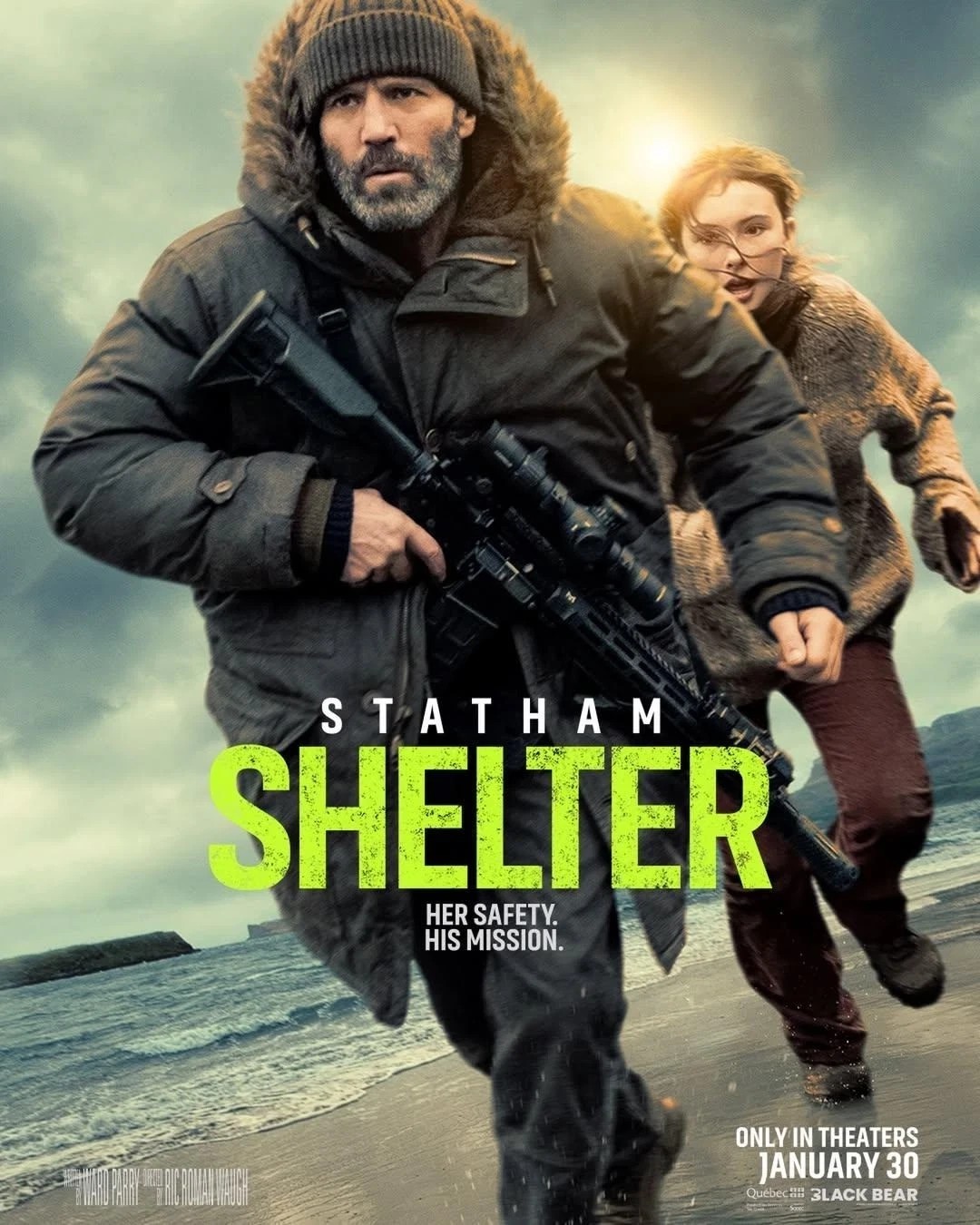
Even though it’s easily one of the worst in the Jason Statham canon, I feel duty bound to review this because a) it’s set in a remote Scottish location, the Outer Hebrides, famed for the likes of Whisky Galore (1949) and its sequel and b) because I’ve been a paid-up member (possibly one of the few) of The Stath Fan Club. So I was half-expecting to see the imprimatur of Creative Scotland on the credits, but when I checked it out, realized I’d been sold a dummy and that for “tax reasons” it had been filmed in Ireland with an occasional sign slotted in to suggest it was set in Stornoway.
But I’m afraid our Jason has fallen victim to the Dwayne Johnson affliction, whereby the successful action hero believes he has to show he can “act.” In this case, Jason is saddled with a young girl which means, by virtue of Sergei Eisenstein’s dictat, every time he glowers the hostility is softened because the camera cuts to the girl.
The reasons this falls down is not so much that very little makes sense in the first place (even though that’s a very low bar anyway) but that the director loses faith in the original idea and having set up the notion of former Government gun for hire recluse Mason (Jason Statham) battling through the wilderness of the land and seas around the Sottish Western Isles to safeguard his unwelcome charge, the orphan Jesse (Bodhi Rae Breathnach), that’s suddenly abandoned and we are relocated to London for a shoot-out in a nightclub.
The screenplay draws extensively on the Bourne films. Mason has been hiding out in a lighthouse on a remote island, quietly drinking himself to death, because principles got the better of him a decade past and he refused to kill an innocent man so when he is discovered alive when the records have been rigged to show he is dead, MI5 (or MI6) chief Manafort (Bill Nighy) wants him exterminated so, as in the Bourne series, some other assassin’s phone lights up and the hunt is on.
Logic is in complete absence. Mason’s been off the grid for a decade. Give him a few more years and he’d be dead from alcohol poisoning. And if you wanted to eliminate him, all you’d have to do is cut off his weekly supply of food and booze and wait for him to starve to death or sit in ambush till he leaves the island in his tiny boat.
Instead, some unknown person for no apparent reason has fitted (technology-wise) Mason up as a terrorist so MI5 (or MI6) go in all guns blazing only to discover he has an effective web of Rambo-style defences. He’s got a tech buddy (Daniel Mays) on Stornoway who can fix the tech problem but he’s dying of cancer so in no fit state to look after a, no matter how meek, teenager. So after more bloodshed, they’re off to London apparently secure in the knowledge that in the small matter of getting on and off the ferry required to take them to the mainland they can move unseen and that’s despite the fact that he’s been tracked using the tiniest available access points on all sorts of mobile phones and cameras on Stornoway.
Naturally, the only person who can get Jesse to safety in London is a drug trafficker and her freedom is complicated by the arrival of the same shady MI5 (or MI6) guys and genuine MI5 (or MI6) guys who couldn’t spot them traveling on any of the 400-odd miles it took to get them to the capital.
It’s not just Jason Statham going all gooey Dwayne Johnson that doesn’t make it work but the girl is a refugee from The Pony Club or National Velvet, a posh lassie who looks as though she’s had every inch of teenage-ness surgically removed and as if she’s never heard of Home Alone and hardly aware that you’ve got to show some spunk not mooch around complaining you’re going to be left alone while wanting (apparently) to be liked the murdering varmint accompanying you.
So with that relationship in screen terms dead in the water, the movie has to fall back on some garbled secret system called T.H.E.A. and an incredibly young incoming head of MI5 (or MI6) Roberta (Naomi Ackie) who looks young enough to be Jesse’s big sister (Ackie is only 35) whose job is to sort out the resultant mess.
I mentioned in a previous article how some careers were sustained by the overseas market rather than their box office returns in the U.S. and that’s been largely the case with Statham. Shelter stiffed on opening weekend in the U.S. taking just $5.5 million though it’s knocked up another $7.7 million worldwide.
Although Statham has had an unlikely hand up the Hollywood tree by being parachuted into the Fast and Furious franchise and being the leading man (or last man standing) for The Meg duo, his fortunes otherwise at the box office have been variable. The Beekeeper (2024) hit an unexpected $162 million worldwide ($66 million Stateside) and A Working Man (2025) delivered a tolerable $89 million worldwide ($37 million domestic) and even Wrath of Man, despite a poor $27 million in the U.S. crossed the $100 million mark when all other markets were taken into account.
Even so, I doubt if worldwide will redeem this one. I had thought after such a run of duds in January (and you can add Primate to the list) I could depend on Statham to redeem a poor month. Alas, no.
Directed by Ric Roman Waugh (Angel Has Fallen, 2019) from a screenplay by Ward Parry (The Shattering, 2015).
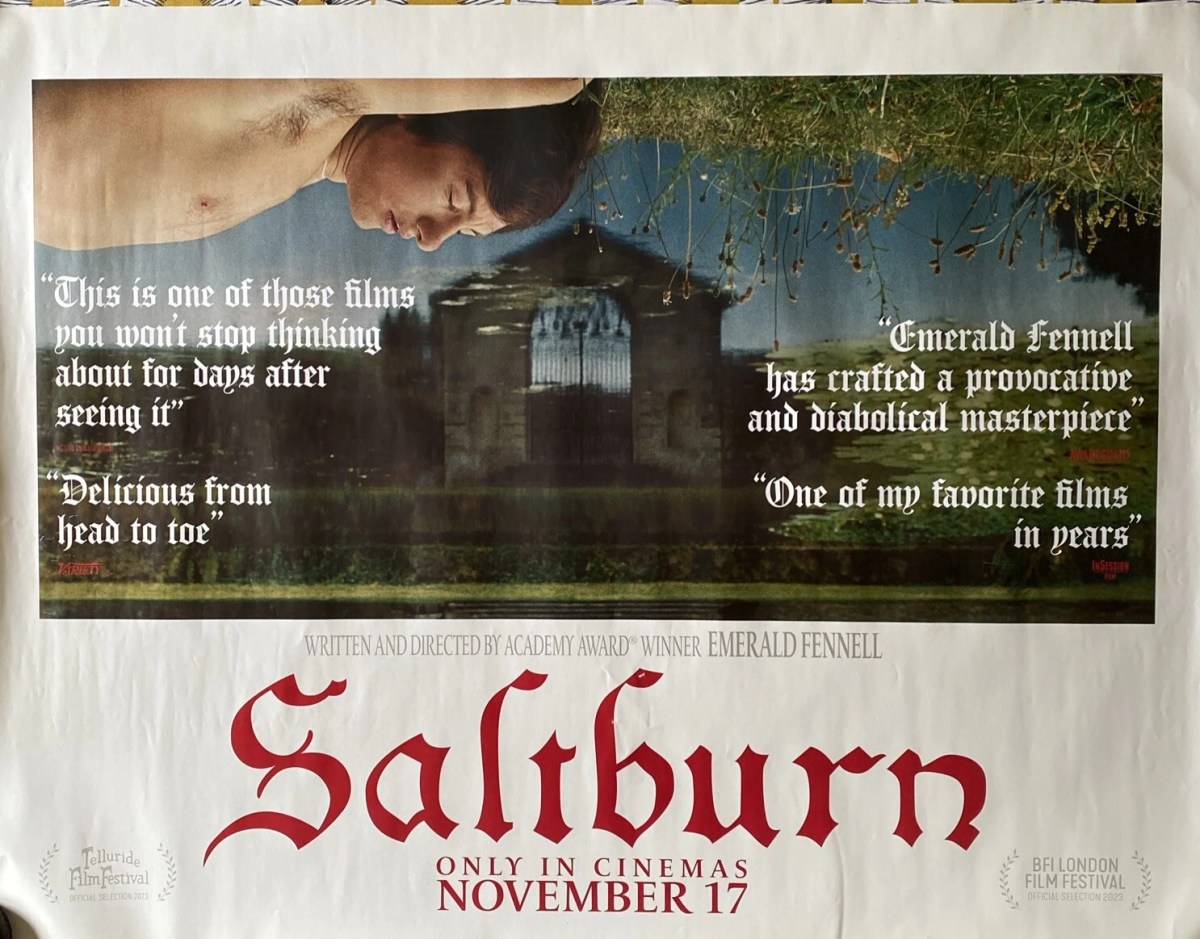
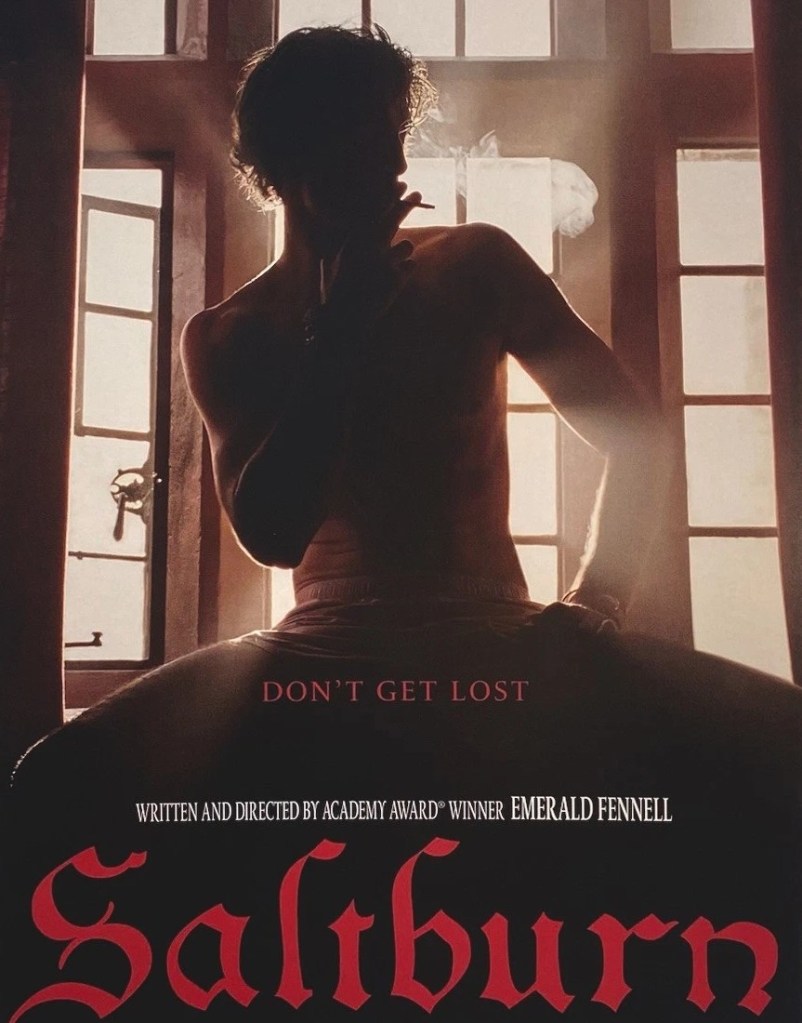
With the arrival of Emerald Fennell’s latest epic Wuthering Heights (or to give it it’s full title “Wuthering Heights” – yes, don’t ask me!) imminent I thought I’d go back to Saltburn and see if my second impression was any better than my first.
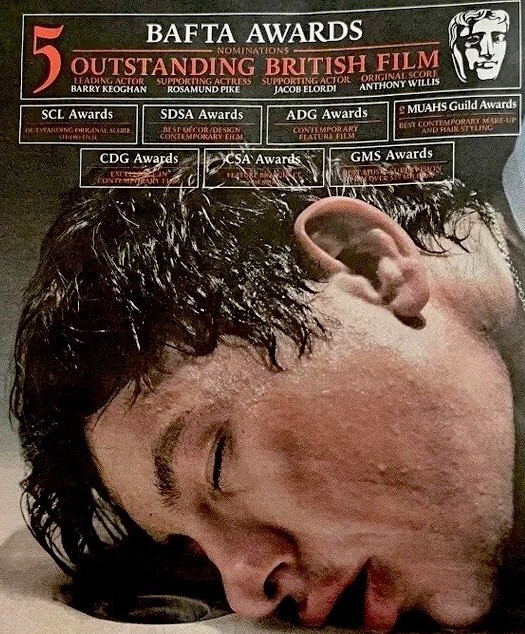
Alas, I was right first time. Another “visionary” director disappearing up their own backside, despite having a superb cast at their disposal including Oscar-nominated Jacob Elordi (Frankenstein, 2025, and now Wuthering Heights), Oscar-nominated Barry Keoghan (The Banshees of Inisherin, 2022) and Oscar-nominated Rosamund Pike (Now You See Me: Now You Don’t, 2025).
There wasn’t enough in a second viewing to convince me to spend a whole lot of my time revising my original review, so what follows is an expanded version of my first attempt.
Brideshead Revisited Meets Carry On Downton Abbey. Wouldn’t surprise me if that’s the way it was actually pitched, it’s just so uneven, veering through several different styles without ever finding a target. The shock elements are, unfortunately, just risible. Via the trailer this appeared to be a moody, atmospheric picture about entitlement, the downside, if you like, of Downton Abbey.
Instead, it’s just plain barmy, which might well have worked if its take on the bizarre had been consistent, but, really it’s a contender for the coveted So-Bad-It’s-Good Award with Rosamund Pike odds-on to nab the award for the best Maggie Smith impression. .
Oliver (Barry Keoghan) is supposedly a scholarship student at Oxford, coming from a sinkhole estate in Liverpool, parents drug dealers etc etc. Out of his depth, by chance he latches on to sex god Felix (Jacob Elordi) and is invited to spend the summer at the latter’s stately home complete with sneering butlers and demonic family, all graduates of the Over-Acting Academy.
Turns out we’ve not been watching Downton Abbey at all, but The Usual Suspects, Oliver not an innocent little bookworm after all but an extremely malevolent character who manages – in the absence (luckily) of post-mortem or any forensic examination– to bump off the entire family in order to inherit (don’t ask!) Saltburn in order to, in a bizarre nod to Risky Business, dance naked through it.
The only reason it gets any points at all is Jacob Elordi, who exhibits tremendous screen charisma, and because the barmy extremely self-centred and out-of-it Rosamund Pike does elicit a few laughs and maybe, courtesy of Richard E. Grant, has a haircut to enter some kind of Hall of Fame.
The shock elements are hilarious as though someone of school age has decided they are really going to shock mummy and daddy. So we’ve got Oliver licking up Felix’s leftover sperm in the bath, the various deaths and the stark naked (are you shocked now?) Risky Business homage.
Jacob Elordi has since come good. He was a believable Elvis in Priscilla (2023), excellent in On Swift Horses (2024) and superb as Frankenstein and possibly still in with a shout of becoming our next James Bond. Barry Keoghan hasn’t come good, at least in the commercial sense, second-billed in Bird (2024) and Bring Them Down (2024) and third-billed in Hurry Up, Tomorrow (2025). For all I know he may be content to plough the arthouse furrow but given his presence – and third-billed again – in the forthcoming big-budget Crime 101 that doesn’t seem to be the case, though it is true it sometimes takes a while for new faces to find a way to fit in.
It’s a shame really because spoofing Downton Abbey or Brideshead Revisited for that matter can be done with considerable ease as the recent Fackham Hall has proved.
 The Magnificent 60s