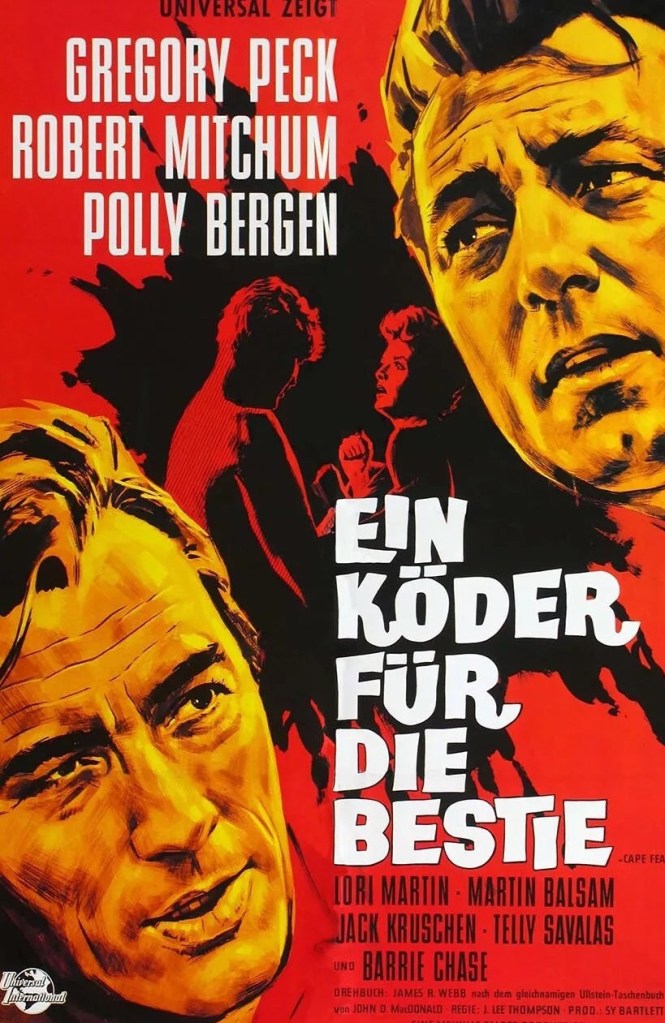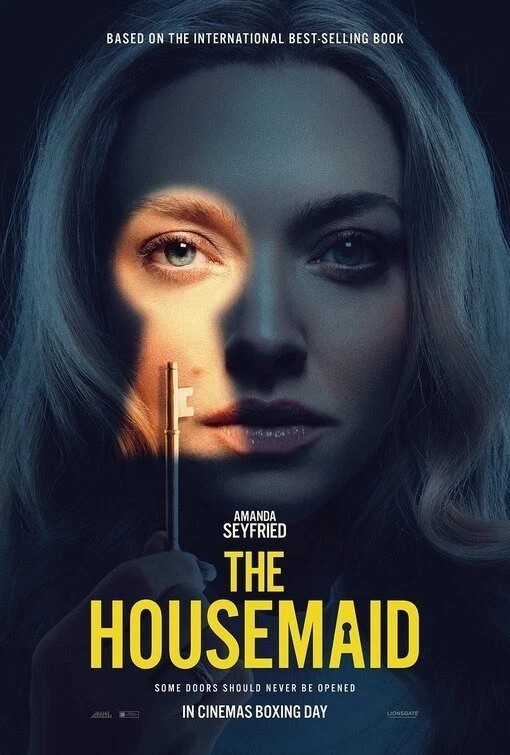
Behind the Scenes: Book into Film – “The Housemaid” (2025)

Now that Hollywood is waking up to the surprise hit of the season – worldwide gross now pushing $300 million – it’s equally surprising to discover just how much work went into converting a bestseller with a very enticing hook into a runaway success. The pitch is a stunner – abused wife grooms housemaid to take her place and, potentially, put her abusive husband in his place.

Screenwriter Rebecca Sonnenshine (The Keeping Hours, 2017) does a quite superb job of tailoring the bestseller by Freida McFadden. It would have seemed, on the face of it, with such a killer premise, you wouldn’t have to do much tampering. But you’d be wrong. What Sonnenshine removes and adds and touches up are a template for the art of screenwriting.
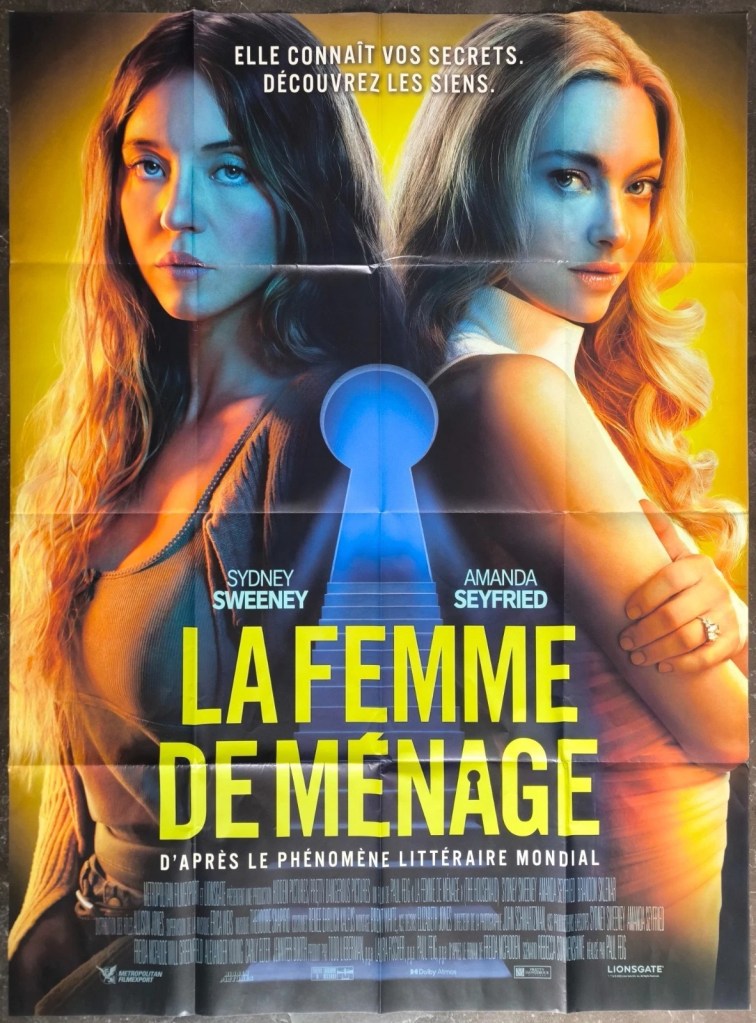
Major changes: the climax is completely changed and the role of handyman Enzo (Michele Morrone) considerably reduced, especially the icky section where our valiant housemaid Millie (Sydney Sweeney) looking for a no-strings-attached one-night-stand comes on to Enzo only to be rejected; and the screenwriter takes the “privilege” line that doesn’t appear until well into the book and brings it in much earlier, to add gentle menace.

Minor changes: just about everything.

The filling out begins at the start. In the book, there’s very little detail regarding the job interview and the grandeur of the house except that it’s grand. Here’s what Sonnenshine adds – the “W” on the gate, the display of enticing food that employer Nina (Amanda Seyfried) lays on for a prospective employee, the emphasis on the obnoxious child Cece (Indiana Elle) as a potential ballerina, the cops rousting Millie when she’s asleep in her car. Here’s what Sonnenshine immediately removes: the attic is smaller in the book, tiny, compressed, more ominous; an immediate warning from Enzo; and we don’t learn right away that Millie is a killer.

If you want to know the difference between taut narrative and drama, follow Sonnenshine. In the book, Millie meets husband Andrew (Brandon Sklenar) and child at the interview. In the film, it’s on her first day on the job when Cece introduces herself as the most obnoxious child, taking the new employee to task right away.

Other simple changes: in the book Millie starts work the next day, in the film she starts immediately following the job offer. In the book, Millie arrives overloaded with baggage that Nina doesn’t offer to help carry, in the film she brings very little and Nina does offer to help.

Major change: the heirloom plates. That’s pure Sonnenshine invention. They don’t appear in the book, and husband Andrew’s mother (Elizabeth Perkins) is scarcely in sight.
Sonnenshine also dumps Millie’s apparent first big mistake. In the book Millie makes Cece a peanut butter sandwich only for Nina to go ballistic because the child is apparently allergic. That’s too obvious a schematic and Sonnenshine opts for something better.

Right away, over the “dirty glass” issue, Sonnenshine brings in the first use of the “privilege” weapon long before as I said I was used in the book and never by the child. But she takes out the point about Millie’s glasses / contact lens. In the book this is a contentious issue – Nina accuses Millie of lying over wearing contact lens and glasses.

Also Nina gives her old clothes to Millie very early on whereas Sonnenshine dramatizes this so that it’s seen as an apology.

It’s Sonnenshine who adds drama to Millie’s visit to her probation officer and gives the probation officer the icky line asking Millie about her sex life. Nor, in the book, is Andrew mad keen on Stanley Kubrick’s Barry Lyndon (1975). That’s another Sonnenshine touch, to fill out Andrew’s character. “Hot saint” is another of Sonnenshine’s lines. In the book it’s Andrew who suggests going to the Broadway show, not Nina, so that’s a nice gesture rather than with Nina, another apology. I should also point out that in the book Nina is about 50lb heavier than in the film. The ballet isn’t so dominant, either, Cece in the book attending a range of classes.

In the book, Andrew and Millie don’t get separate rooms at the hotel. They are all over each other in the cab to the hotel. It’s Sonnenshine who adds the dramatic urgency and ratchets up the tension in that in the film Millie tries to avoid intimacy and it’s only when she thinks she’s been fired by mobile phone that she falls into Andrew’s arms.

The film’s killer twisty line of “did you learn to cook in prison?” is better than the book’s “what’s prison food like?” Sonnenshine’s other big switch is that in the book Millie’ in juvenile detention not a scholarship kid as a private school when she commits murder. In the book Nina’s discovery of the Playbill program for the Broadway play is more discreetly done. But Sonnenshine turns it more dramatic with Nina coming down the stairs holding the magazine.

Nina’s immediate revenge in the book is to have Millie suspected of shoplifting after an anonymous phone call to a supermarket. Again, in the film it’s ratcheted up, Millie arrest for stealing her boss’s car and handcuffed and more roundly humiliated that provides the grounds for Andrew to chuck his wife out. The book cuts Millie out of the confrontation between husband-and-wife which results in Nina leaving.

And the book has no equivalent to Nina howling in her car apparently in despair at being chucked out, nor, in a marvelous twist, once we discover what hell awaits Millie, to cutting back to that scene and Nina turn that wail into a whoop of delight at being free.

Nina having to compensate for not getting her roots done by pulling a hundred strands of her hair out twice is in the book. But since the book didn’t include anything to do with priceless heirloom crockery, Millie’s first punishment is, frankly, a lot less interesting. Millie has to balance a stack of heavy books on her stomach for hours at a time. Honestly, that’s nothing, and visually zero, compared to having to rip your stomach open with the sharp end of a broken piece of crockery, which must be one of the most horrific scenes committed to celluloid.

And it’s not a cake knife left in the attic deliberately by Nina that allows Millie to escape, it’s the remains of a pepper spray that had formed part of one of Nina’s punishments. Stabbing someone in the neck with a knife versus blinding them with a pepper spray – what’s the more visual? You don’t need me to tell you.

His punishment in the book is rather long-winded especially bearing in mind that there’s no heirloom plates and assorted crockery to up the ante. So first of all in the book, Millie tortures Andrew by making him bear the weight of the books for hours at a time. It’s only days later, in fact, that in the book Millie instructs Andrew to pull out a tooth. Bear in mind, too, there’s been no lead-up to this, not in the book, which is why the screenwriter places such emphasis on his teeth and smile.

Sonnenshine tosses away the book’s ending. And you can see why. It’s not remotely cinematic. Sure, Nina returns to help. But in the book little help is needed. By the time Nina returns several days later, Andrew has already starved to death, or dead by dehydration, technically. That would be more easily explained to the cops given the problems with the door and Andrew in the house alone except in the book Millie has had her fun and made him pull out four teeth.

So, Sonnenshine opts for another course of action. He’s not dead when Nina returns. She makes the mistake of thinking it’s Millie locked in the attic and inadvertently frees her husband and then after some coming and going Millie pushes him over the banister and down about 50ft to his death.

Sonnenshine adds a happier postscript, Nina giving Millie $100,000.

I read the book after I saw the film so I was amazed at the quality of the script, the changes, the omissions, the additions and especially the nuances, the rounding out of every character. I doubt if anyone voting for the Best Adapted Screenplay Oscar ever reads the source material and that will probably count against Rebecca Sonnenshine come next year’s awards when virtue-signaling will probably win the day once again.

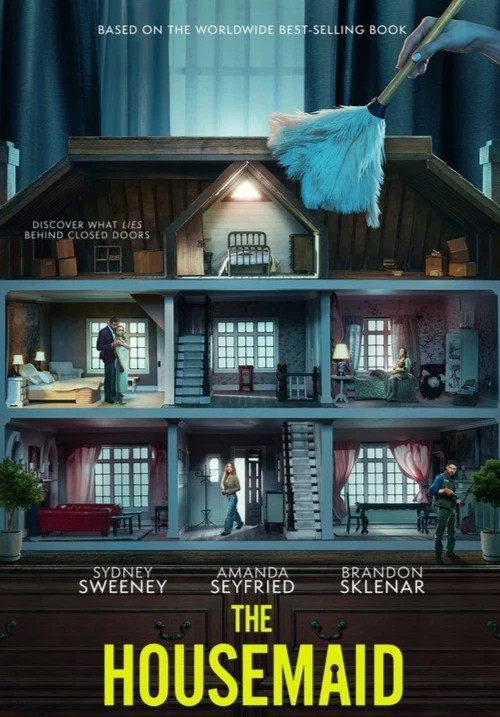
Other additions by the screenwriter: the toy troll, and therefore Cece stealing it from Nina’s bedroom, the creepy dolls house, and therefore Cece playing with it.

Much as I enjoyed the plot-heavy book, I enjoyed far more what the screenwriter made of it and I think Sonnenshine has played an enormous role in making the film such an appealing attraction.

The movie’s still going to be playing for weeks now, so if you get the chance check it out.
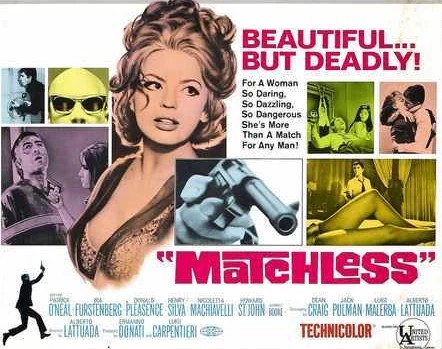
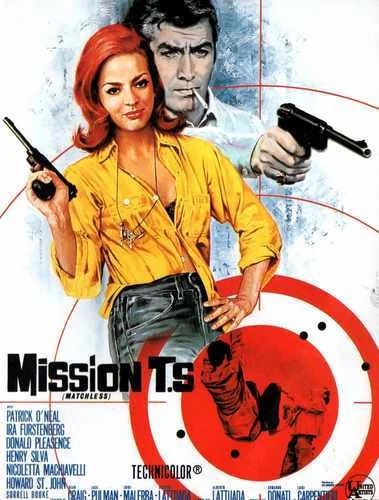
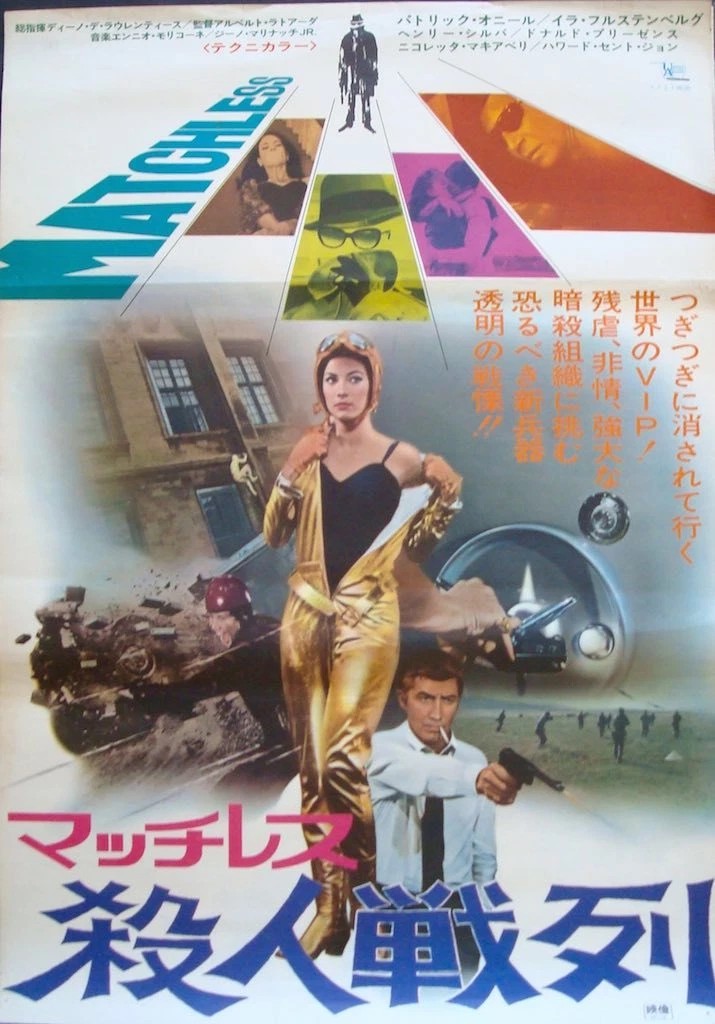
Matchless / Mission Top Secret / The Invisible Spy (1967) ***

Alberto Lattuada is the big attraction for me here, being the director of World War One spy drama Fraulein Doktor (1968) starring Suzy Kendall and which has become a standout, in terms of views, on the Blog. Conversely, you might be swayed by the undoubted physical attributes of Ira von Furstenberg (The Vatican Affair), a real-life princess to boot, or perhaps by the under-rated Patrick O’Neal (Stiletto, 1969) enjoying a rare foray as the top-billed star.

While the U.S. title is a tad opaque – our journalist hero Perry Liston (Patrick O’Neal) uses that by-line – the foreign title gives the game away. While imprisoned in China, Perry is handed a ring with magical powers by a Chinese prisoner in gratitude for helping him out. The ring permits a brief snatch of invisibility every ten hours, resulting in the screenwriters having to ration its appearance. As with any such charm, it provides opportunity for tension, humor and sexual frisson.

Another inmate Hank (Henry Silva) wants the ring for himself so spends a lot of the  movie chasing, catching and losing Perry. The U.S. Government reckons a touch of invisibilkity will come in handy when dealing with arch-villain Georges Andreanu (Donald Pleasance) who has the usual arch-villain’s penchant for world domination. If it’s not enough that people are hunting him for the magic ring, Perry has others on his trail once he steals Andreanu’s secret serum. (Sensibly, the screenwriters shy away from what actually the serum does in the way of helping the arch-villain along in his quest for world domination – all that detail never did much to enhance the Bond/Flint/Helm stories.)

And like any decent spy of the era, Perry has women throwing themselves at him, some just for the hell of it but others who use sex to their advantage.  O’Lan (Elisabeth Wu) falls into the first category, Tipsy (Nicolatta Machiavelli), a henchwoman of Andreanu, into the second, while artist Arabella (Ira von Furstenburg) has him guessing, Instead of a girl in every port, Perry has a girl in every country, China, Britain and Germany.

Perry isn’t a superhuman spy in the James Bond mold, and he’s not forced to keep it going with spoofery of the Derek Flint/Matt Helm variety, and he’s often at a disadvantage, caught naked, for example, when the invisibility spell wears off, and allowing Arabella to generally outwit him.

The central conceit works well in the context of the movie, helping and hindering Perry in equal measure. But there are also plenty other original touches: a car chase where the vehicles end up on top of a train, Hank watching a Man from Auntie series on television, tension racked up when villains come inadvertently close to the ring, hypnotism to fix boxing matches, torture by spinning, facial transformation, an amphibious car, a set-piece in a bank.

There’s more serious intent than you might expect, a satirical view of good guys and bad guys.  Americans and Chinese apply the same kind of torture to Perry and employ the same plastic surgery method to send spies in undercover. While Perry is at his most powerful – i.e when invisible – he is also at his weakest by being naked.

Patrick O’Neal and Donald Pleasance (who appeared as Blofeld the same year in You Only Live Twice) have a ball though Ira von Furstenberg steals every scene she’s in. Henry Silva has the opportunity to try out his comedy acting chops.

Not in the same vein as Fraulein Doktor but generally consistently holding the interest.

Behind the Scenes: The Overseas Box Office Breakout

For the first four decades of the Hollywood business, success in markets other than domestic was random. Many countries restricted the number of U.S. films that could be shown, others like Britain prevented American studios for a long time taking out of the country money earned at the box office.   There was always the chance it could be less profitable if a dominant foreign cinema chain or distributor demanded a larger slice of the box office. In addition, some genres that worked in America stiffed abroad – musicals and comedies found it hard to translate.

Except in extremely sporadic fashion, foreign box office was not reported in the trade media until the 1990s. So there was no such thing as worldwide grosses available on any real scale. These days for many films overseas receipts bring in more than domestic – Zootropolis a current example with around 70 per cent of takings coming from abroad – but that was virtually never the case until the arrival of the James Bond pictures, which acquired a genuine global brand, in the 1960s.

However, the United Artists archives held by the University of Wisconsin provide some  fascinating insights into the growing power of the foreign box office in the 1950s. Movies released into the foreign market would make a percentage of their domestic take. But that varied enormously. Even the star-studded Around the World in 80 Days (1956), the second-biggest blockbuster of the year Stateside, with a colossal $16 million in domestic  rentals took in less than a quarter of that abroad, just $3.9 million.

For some films, the percentage was better. Controversial William Holden drama The Moon Is Blue (1953) notched up $1.3 million abroad compared to $3.5 million at home. War picture Beachhead (1954) starring Tony Curtis bundled up $1 million overseas as against $1.4 million in domestic. The Barefoot Contessa (1954), boasting Humphrey Bogart and Ava Gardner, added $2.2 million in foreign coin to its domestic tally of $3.25 million.

Richard Burton as Alexander the Great proved the breakthrough, domestic’s $2.5 million matched by the exact same amount abroad. Robert Mitchum in Foreign Intrigue (1956) went one further, reversing the usual situation, foreign of $1.14 million ahead of domestic’s $1 million.

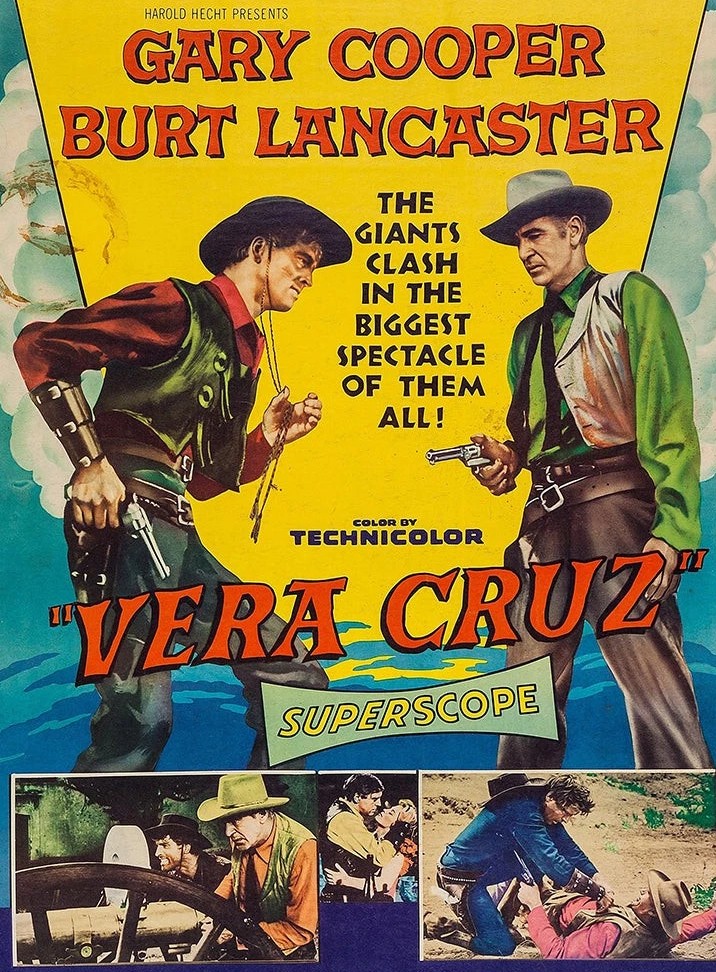
But the UA star with the biggest consistent pull overseas was Burt Lancaster. Robert Aldrich’s Apache (1954) knocked up $1.75 million abroad compared to $3.25 million at home. Vera Cruz, (1954) also directed by Aldrich and coupling Lancaster with Gary Cooper, hit a home run – the $3.94 million abroad being just short of the $4.5 million at home. The actor’s first venture into directing The Kentuckian (1955) kept up the pace with $1.97 million overseas versus $2.6 million at home.

While these were all action pictures, it was acrobatic drama Trapeze (1956), with Lancaster and Tony Curtis fighting over Italian sex symbol Gina Lollobrigida, that made Hollywood wake up. In the U.S, it came third on the annual box office charts with $7.5 million in rentals. If that took the industry by surprise that was nothing compared to foreign where the movie racked up $7.4 million.

Lancaster remained potent. Submarine war picture Run Silent, Run Deep (1958), co-starring Clark Gable, did virtually as well abroad as at home – $2.42 million overseas compared to $2.5 million at home.

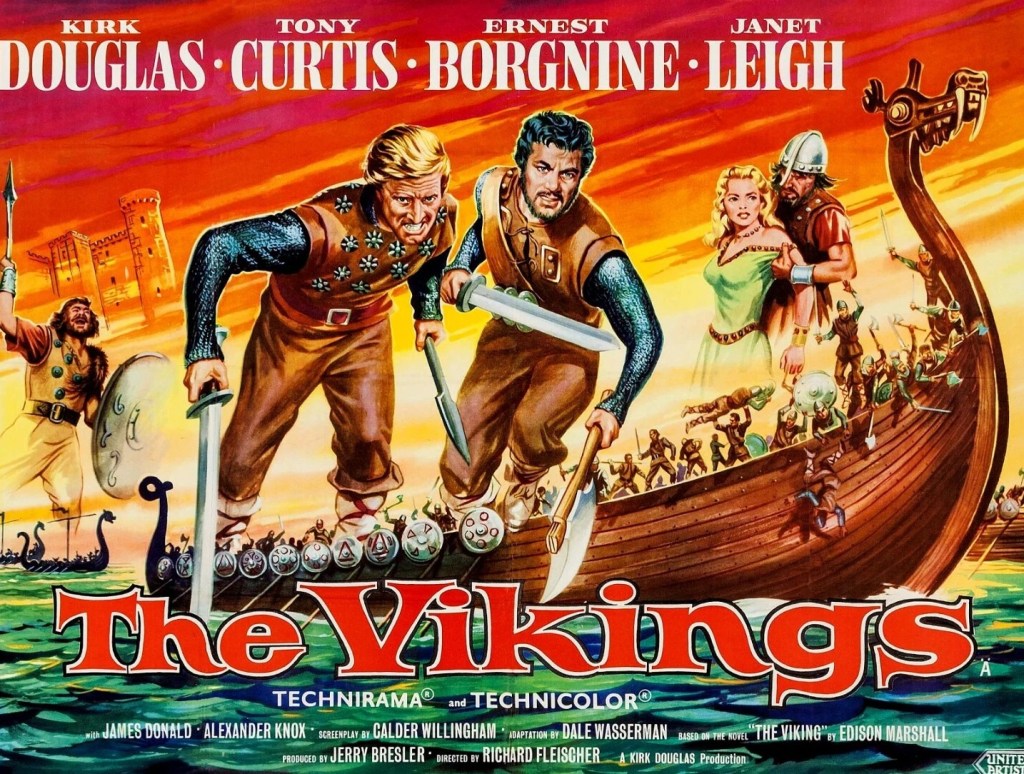
Perhaps learning from the experience of Trapeze, UA went for broke with historical actioner The Vikings (1958) starring Kirk Douglas and Tony Curtis. Domestic of $7 million, enough for fifth  place in the annual box office league, was beaten by an overseas count of $7.34 million.

For the first time it appeared that Hollywood could count on overseas to swell the box office in sizeable fashion, thus allowing studios to invest more, especially in historical movies with an action angle, thus opening the door for the spate of 1960s roadshows. Such results also cemented star salaries. If a Burt Lancaster picture could make the same again abroad as at home that put him in a new category of dependable stars and allowed studios to gamble on increasing his salary.

That Charlie Chaplin proved  a better draw overseas than in the U.S. was largely by default. The actor-producer-director had fallen foul of American politics with the result that his latest release Limelight (1952) flopped. Abroad it was a different story and Limelight hit a tremendous $5.1 million. With the U.S. reissue market also showing resistance to Chaplin oldies, it was left to overseas audiences to show what cinemas were missing as Modern Times (1936) racked up $2.1 million and The Gold Rush (1925) $1.25 million. For comparison the reissue of Red River (1948) pulled in just $19,000 overseas.

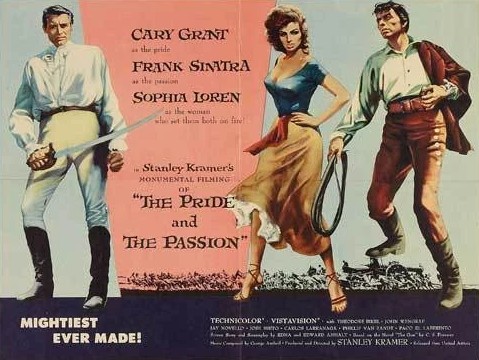
Other notable leaders in the overseas market included: Frank Sinatra, Cary Grant and Sophia Loren in The Pride and the Passion (1957) with $3.17 million ($5.9 million domestic); Billy Wilder’s Agatha Christie adaptation Witness for the Prosecution starring Tyrone Power and Marlene Dietrich on $2.81 million ($3.75 million domestic); and Love in the Afternoon (1957) with $2.7 million ($2 million domestic) starring Gary Cooper and Audrey Hepburn.

Also making a noise overseas were: Stanley Kramer medical drama Not As a Stranger (1955) toplining Olivia De Havilland, Frank Sinatra and Robert Mitchum  on a $2 million haul ($7.1 million domestic): Sinatra again in Otto Preminger’s study of addiction The Man with the Golden Arm (1953) on $1.87 million ($4.35 million domestic); Sinatra in war picture Kings Go Forth (1958) on $1.83 million ($2.8 million domestic) and Kirk Douglas as The Indian Fighter (1955) with $1.84 million ($2.45 million domestic).

Bob Hope went against the grain when his overseas tally for Paris Holiday (1958) at $1.8 million bested the $1.5 million of domestic while John Wayne and Sophia Loren’s foreign engagements for Legend of the Lot (1957) counted as a disappointment with just $1.66 million compared to $2.2million domestic.

Low-budget Oscar-winner Marty (1955), produced by Burt Lancaster’s company, was as big a surprise abroad as at home, sprinting to $1.43 million ($2 million domestic). Others worth noting included: Bandido! starring Robert Mitchum on $1.42 million overseas ($1.65 million domestic); David Lean’s romantic drama Summertime (1955) with Katharine Hepburn on $1.3 million ($2 million domestic); Anthony Mann’s Korean War venture Men in War (1957) on $1.26 million ($1.5 million domestic); and Clark Gable in The King and Four Queens (1956) hauling in $1.24 million ($2.5 million domestic).

Olivia De Havilland as The Ambassador’s Daughter (1956) tabbed $1.1 million overseas ($1.5 million domestic) and Gary Cooper in Mark Robson’s Return to Paradise (1953) tallied $1.1 million ($1.8 million domestic). Slow burners numbered Dale Robertson in Sitting Bull (1954) with $1.1 million ($1.5 million domestic) and Stanley Kubrick’s anti-war picture Paths of Glory (1957) with Kirk Douglas shooting up $1 million ($1.2 million domestic).

SOURCE: “Foreign Distribution Gross Estimates,” United Artists Archives, Box 1, Folder 8, University of Wisconsin. Note that in this case “gross” means “gross rentals” not “box office gross.”

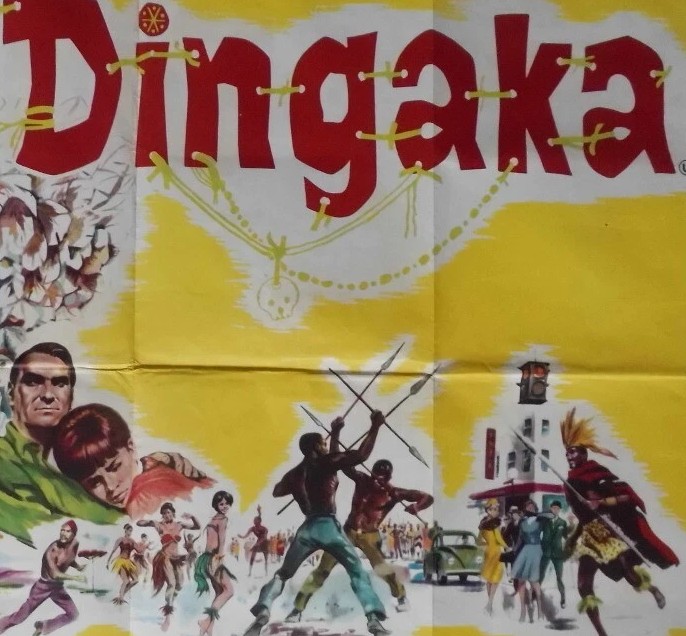
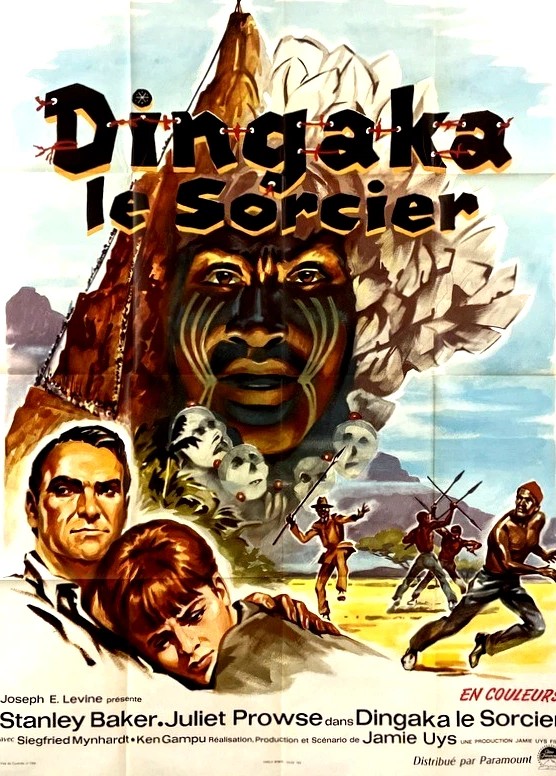
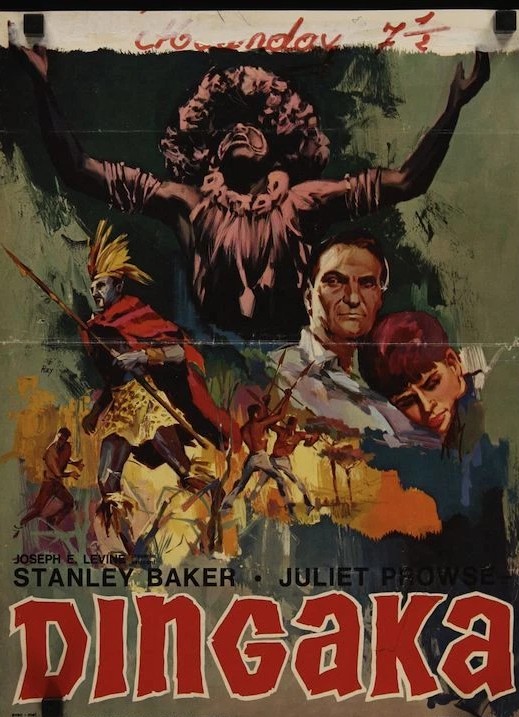
Dingaka (1964) ****

Whether you appreciate this will depend on whether you were attracted by the prospect of an early offering by South African writer-director Jamie Uys (The Gods Must Be Crazy, 1980) or by the star wattage of Stanley Baker (Sands of the Kalahari, 1965) or perhaps by the promise of the salacious. Hopefully, it was the first, because you would be disappointed on the other two counts, Baker not making an entrance until halfway through the picture and not much of an impact thereafter.

Surprisingly relevant due to its depiction of people in the thrall of a higher power – whether you take that in a religious or political context makes little difference – and in the cultural conflict between an indigenous tribe and the “civilized” white man. But there’s also a noir tone here, the fatalism that often prevents the “good criminal” in a noir picture from escaping the judicial consequence of an action that could be seen as moral.

And if you think you know your African music through interpretations by the likes of Neil Diamond and Paul Simon, then here’s a far better introduction. Song is a constant whether for ceremonial purpose, worship, entertainment and work or for making more bearable time spent in jail or hard labor.  

And though it’s not spelled out there’s a Biblical element, the old “eye for an eye,” done away with in modern civilization through courtrooms, juries and due process whereby the act of killing is carried out remotely by the state rather than the victim’ relatives.

An African tribesman Masaba (Paul Makgopa), furious at being dethroned after a six-year reign as the local fighting champion, seeks a cure for the loss of prowess from a witch doctor (John Sithebe). He is told to eat the heart of a small child. Soon after the daughter of Nkutu (Ken Gampu) is found dead. The distraught father beats the witch doctor until he points to Masaba. In revenge for Nkutu assaulting the witch doctor, revered as a local god,   Nkutu is cursed, resulting in the almost immediate death of his wife.

Nkutu pursues Masaba to the city and strangles him to death. He is taken aback to be arrested since, according to tribal law, he is well within his rights. Of course, that’s at odds with civilized law. When the judge learns of the murder of Nkutu’s daughter and advises that the state would take care of any killing in the way of punishment that had to be done, Nkutu is puzzled. “You must not hang him. He did not kill your child. I must kill him. It is the law.”

It turns out Masaba has survived, giving Nkutu, on meeting him in court, a second chance to kill him, which fails.

“Big hard cynical lawyer” Tom (Stanley Baker), grudgingly doing pro bono work, has his work cut out since Nkutu refuses to give him instruction, is defiantly unremorseful, and can’t provide any proof that Masaba murdered his daughter beyond that “his eyes told me that he killed her.”  

But since Nkutu only attempted murder then he gets off with a relatively light sentence, though it still involves back-breaking work. But at least it’s outside, providing the opportunity to escape and go home and kill Masaba properly. Meanwhile, Tom has chanted his tune and tries to help Nkutu by confronting the witch doctor.

Eventually, Nkutu learns the witch doctor was the murderer and despite fear of being eternally cursed challenges the witch doctor’s authority and kills him. And given this  takes place away from civilization it’s unlikely that anyone’s going to come asking questions.

Outside of the drama and the culture clash, the director keeps this perpetually interesting by adding in authentic aspects of local life. There’s a milk tree, a man cures hides by spinning them on a rock that dangles from a tree on a rope, access to the otherwise inaccessible witch doctor’s lair on a mountaintop is via a series of vertigo-inducing ladders, prison guards have spears not guns. The use of music adds atmosphere.

And the acting is good, and as a consequence of this Ken Gampu enjoyed a Hollywood career in such films as The Wild Geese (1974) and ended up with over 80 film credits. Stanley Baker’s character is well drawn, exchanging barbs with his wife (Juliet Prowse) his cynicism in part due to the couple’s fertility problems.

Now warned about the limitation of Baker’s involvement, if you are happy to examine the tale as presented – one of struggle against both malicious and just authority – you will be rewarded.

YouTube has a decent print and not one marred with advertisements.

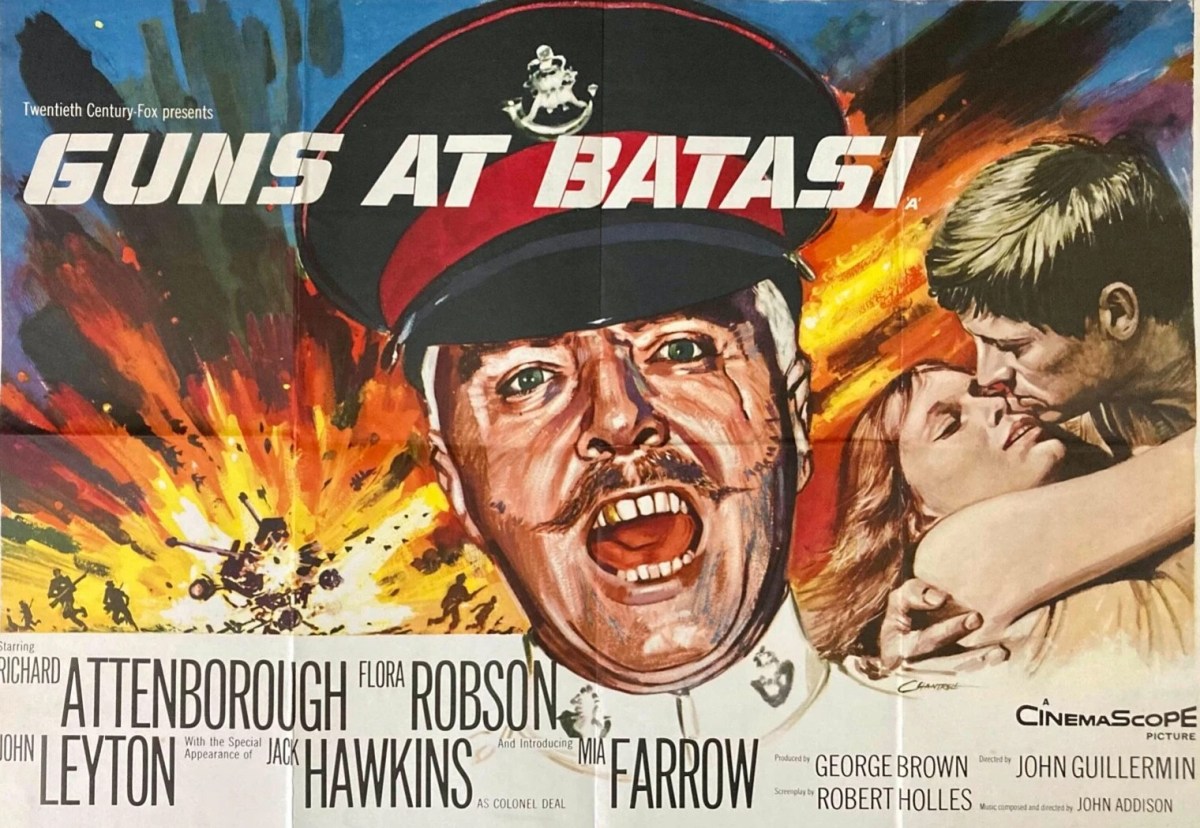
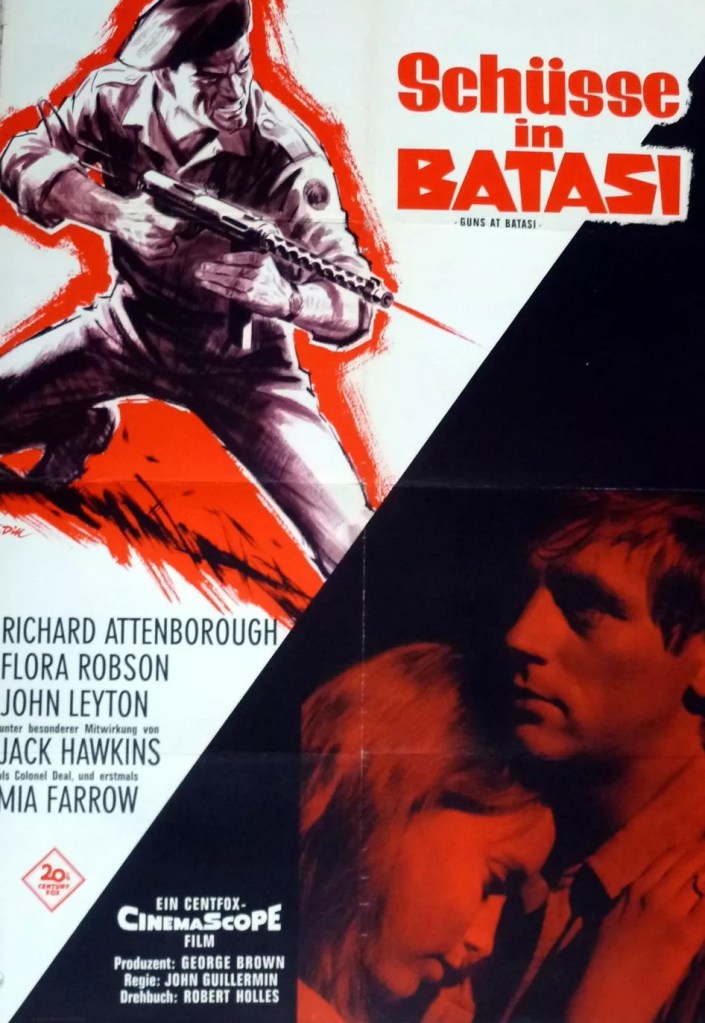
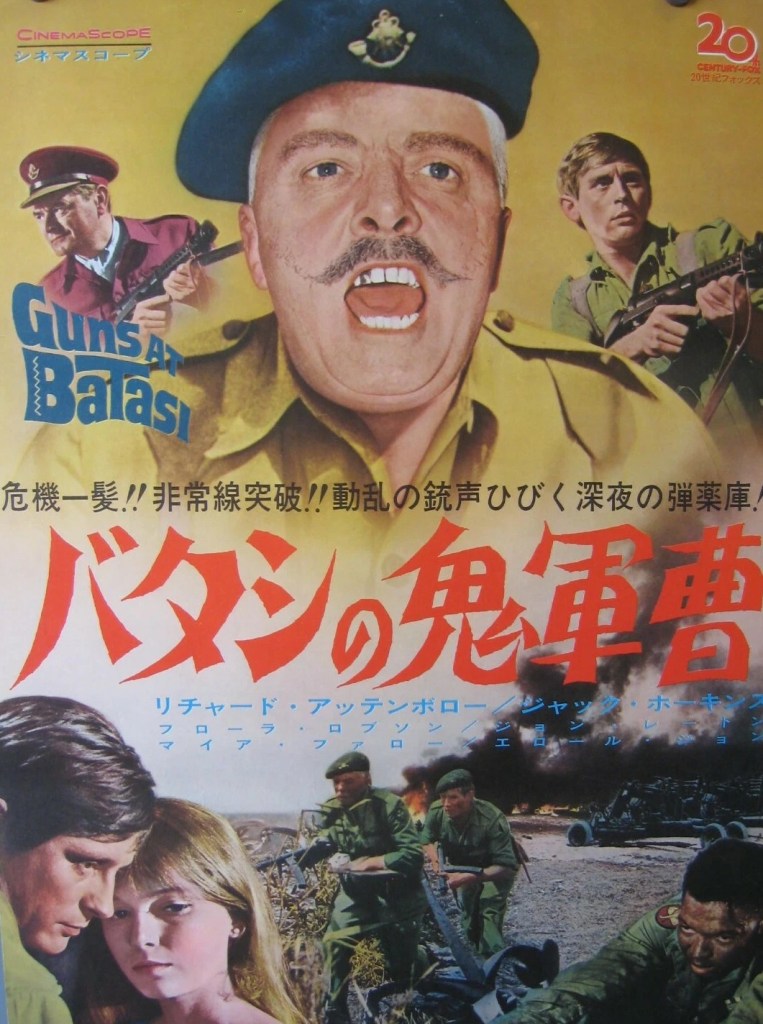
Guns at Batasi (1964) ****

In the same year as the Brits were turning whopping defeat into marginal victory in Zulu (1964) a more complex version of imperialism reflecting modern times (i.e. the 1960s) was being spelled out here and magnified by the performance of Richard Attenborough’s career. The British, as has been their wont, while no longer in complete control of this anonymous African country, have left behind a military operation in theory to support whoever is in power but in reality to safeguard their own commercial interests.

Every side of the coin is shown, from the old school soldiers to raw recruits scarcely able to work a rifle, to the pragmatic politicians and Africans with loyalties split between the mother country and the new regime. There’s a feisty British MP Miss Barker-Wise (Flora Robson) on the side of equality who is given a rude awakening on realpolitik and the well-spoken African, educated in Britain, exalting in throwing off decades of being patronized.

Just as the Africans are in revolt against the existing corrupt regime, so, in his own way, is Regimental Sergeant-Major Lauderdale (Richard Attenborough) who, secretly, refuses to obey the orders of his superior, Lt Boniface (John Errol). Most of the confrontation is distinctly old school, depending on the power of personality, in the best scene in the movie Lauderdale forcing his superior to accept the inferior’s authority. In another scene, the ambushed Col Deal (Jack Hawkins), with considerable British sang-froid, talks his way out of trouble.

The British are caught out by the sudden insurgency and almost certainly would not have become actively involved on the losing side had it not been for trying to save the life of wounded African Capt. Abraham (Earl Cameron) condemned by Boniface as a traitor. It should have been a Mexican stand-off until rebel ire was tamped down and a new kind of status quo – either the Brits tossed out or kept on supporting the new regime – was constituted. No need for violence or action, just keeping your nerve, a quality which Lauderdale has in spades.

Except that the sergeant-major has lied to the African commander, pretending Abraham is dead and not merely being hidden. When the Africans literally bring up the big guns, prepared to blast out the Brits, Lauderdale determines to spike the guns.

Except for the spit-and-polish, in military terms this is a very rusty British unit. You expect that Lauderdale will turn out to be all bluster. But he switches into commander instantly, holds (verbally) the enemy at bay, rallies the troops, leads by example and carries out a clever attack. But it’s a hollow victory. Politics works against him and he is humiliated at the end.

A good chunk of time is spent putting the British in their place.

Although the narrative appears to take time out to indulge the visiting MP and to tee up a piece of romance between raw recruit Pvt Wilkes (John Leyton) and  stranded tourist Karen (Mia Farrow), both tales are soon subsumed into the action, the soldier forced into action, the politician forced to confront how little her principles count and how ineffective her authority in a war zone. There is some decent humor, the snarkiness between the soldiers, and Wilkes romantic clumsiness.  

Richard Attenborough (Only When I Larf, 1968)  is easily the pick as he presents various elements of a complicated character, the dedicated career soldier at the mercy of an inexperienced superior, questioning just what he has devoted his life to, straining to hold up his stiff upper lip, the butt of jokes, boring all with tales of long vanished glory, eventually revealing that he is much more than bluster, taking effective command, but then paying the price as the political scapegoat.  Jack Hawkins (Zulu, 1964) has a smaller role than you’d expect from the billing and Flora Robson (7 Women, 1965) weighs in with another battleaxe. In her debut Mia Farrow (Secret Ceremony, 1968) demonstrates ample promise and Errol John (Man in the Middle, 1964) has a peach of a role.

Directed with some distinction by John Guillermin (The Bridge at Remagen, 1968), demonstrating a gift for both action and emotion, from a screenplay by Robert Holles based on his novel.

Although ignored by the Oscars, Attenborough won the Bafta Best Actor Award.

Thoroughly involving.

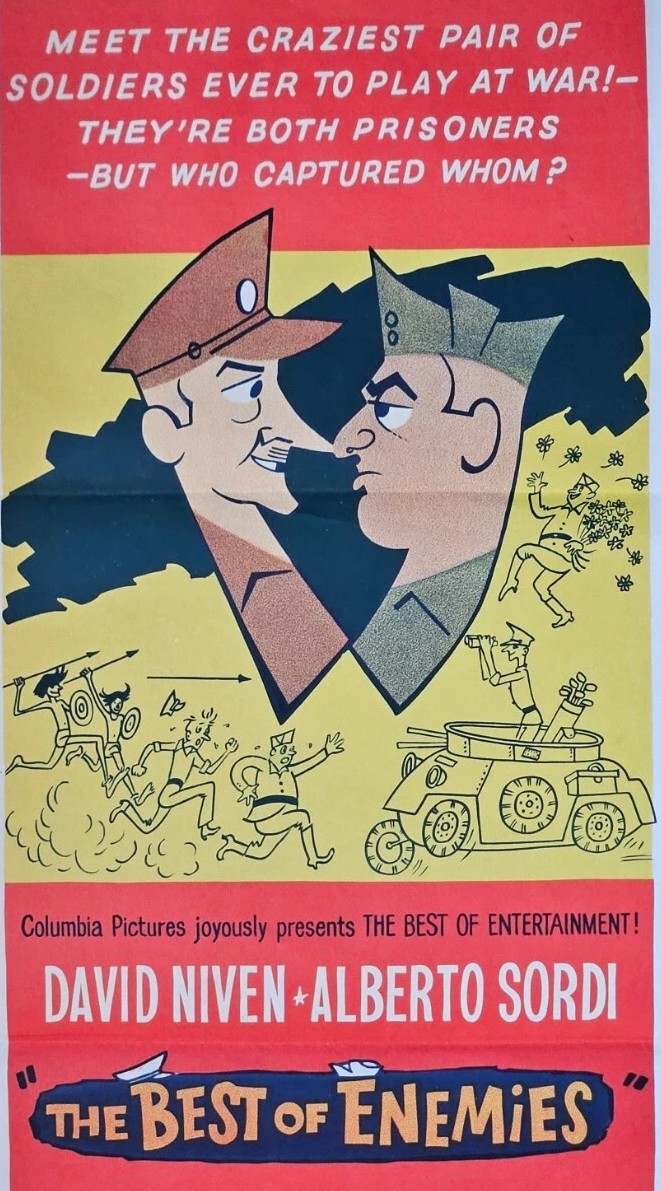
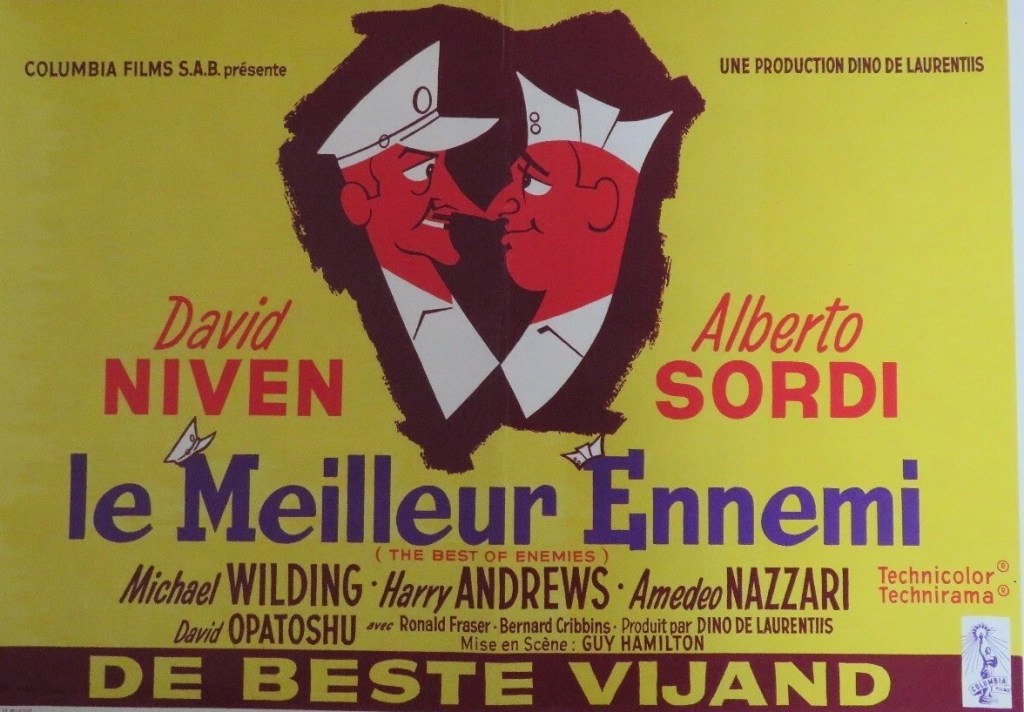
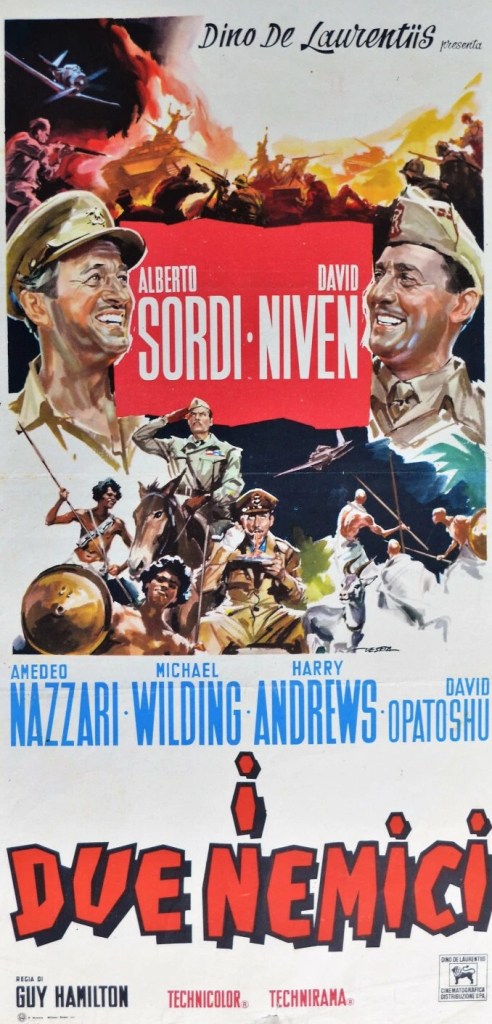
The Best of Enemies (1961) ***

When we talk about realistic war movies, we generally mean ones chock-full of brutality and violence. But there was another reality rarely touched upon, and that was guys to trying to get through the whole shooting match without getting killed. Not cowards, necessarily, but people unwilling to take stupid action in the guise of blind obedience.

This ends up being a highly unusual and hence highly original take on the war picture. Where, in another film, enemies might duel fiercely to the death, attempting to outwit each other at every turn, this delivers on a more emotional, thoughtful, and human, level.

You wouldn’t have thought, either, that the combination of two wildly different humor codes, the more overt Italian and the laid-back British, would work. So in subject matter and style, this takes a helluva risk. Much of the effect rides on exposing as misleading the standard tropes regarding the different countries – that the Italians are weak and that Brits, feelings numbed by stiff upper lip and upbringing, never complain.

Major Richardson (David Niven), reconnaissance plane shot down in Italian-held Abyssinia (Ethiopia) in 1941 in World War Two, is captured in the desert by a unit led by Captain Blasio (Alberto Sordi). Blasio doesn’t want the responsibility of prisoners and encourages Richardson to escape, hoping that the Brit, taking note of how weak the Italian unit was, would leave them alone.

The opposite is true. The Brits would like nothing better than to capture a weak section of the Italian Army. So Richardson, leading a stronger unit with tanks and stuff, confronts the Italian who is furious that the man he let go has somehow reneged on an unwritten code of honor and come back. Using a simple ruse, the Italians escape.

The Brits nearly catch up with them several times but incompetence gets in the way. Then Blasio gets annoyed with some of his natives and cuts them loose and in revenge they start a fire that drives both Brits and Italians together. Blasio is happy to surrender since that means the Brits, devoid of transport after the fire, have to holster Italian rifles and carry on a stretcher any Italian, such as Blasio himself, who falls ill.

The enemies unite to escape an interfering native tribe but then Blasio gets the hump at Richardson once again, returning the Italians to prisoner status once they are free. Hiding out in an abandoned village, the Italians are put to work building latrines – and according to the British class system different ones for officers and soldiers. A bid by Blasio to put Richardson in his place misfires. The two units bond again over a game of football and when the tribesmen return Richardson breaks the rules by handing back the Italians their rifles. Only thanks to British incompetence there’s no Italian ammo.

So then, weapon-less, and nobody apt to take sides, they stagger over the desert, directed by Richardson to safety. Richardson and Blasio bond over wives and family. But when they reach a proper road, Richardson reverts to the status quo and insists the prisoners form up at the rear. Except, he’s got it all wrong and they have ended up in the Italian-controlled zone. Blasio can’t contain his delight, mocking the Brits, but not taking them prisoner. Except he’s got it wrong, too, as the desert campaign is over and the Brits are victorious.

It doesn’t end well for either officer. Richardson is threatened with being put in the catering corps, Blasio a bedraggled prisoner. But it finishes on an uplifting moment, Richardson instructs his men to present arms to the prisoners, indicating their mutual respect.

So, as I said, nothing like your usual war movie. Both commanders are incompetent. Richardson despises Blasio for not “putting any effort” into his job. Blasio can’t understand why Richardson takes the job so seriously. Even if it marked him down as a coward, Blasio’s wife just wants him home safe. Incompetence rules, mistakes are legion, and pettiness guides the action of the officers. Movie makers of the period tended to concentrate on the heroism of war, but there must have been a ton of expeditions like this that went awry.

The script allows both David Niven (Bedtime Story, 1964) and Alberto Sordi (Anzio, 1968) considerable latitude, the Englishman afforded a wider range than usual, the Italian encouraged to tone down the over-acting, so each turns in a more measured performance. Sordi was nominated for a Golden Globe and the movie was nominated for two other Globes including Best Foreign Film.

The supporting cast includes Michael Wilding (The Sweet Ride, 1968), Harry Andrews (The Hill, 1965) and David Opatoshu (Guns of Darkness, 1962).

Directed by Guy Hamilton (Battle of Britain, 1969) from a screenplay by Jack Pulman (The Executioner, 1970).

More rewarding and emotionally satisfying than I expected.

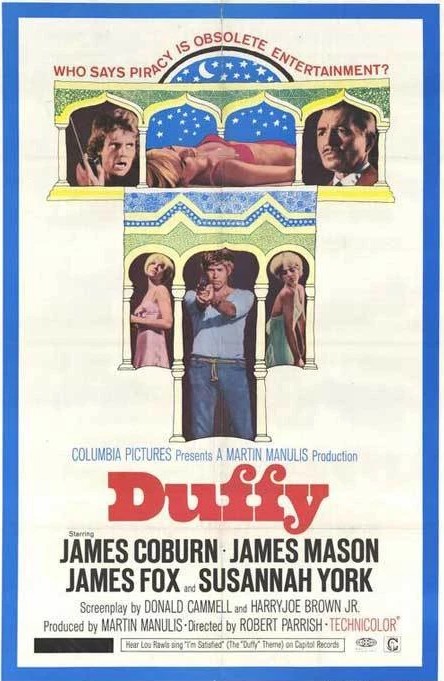
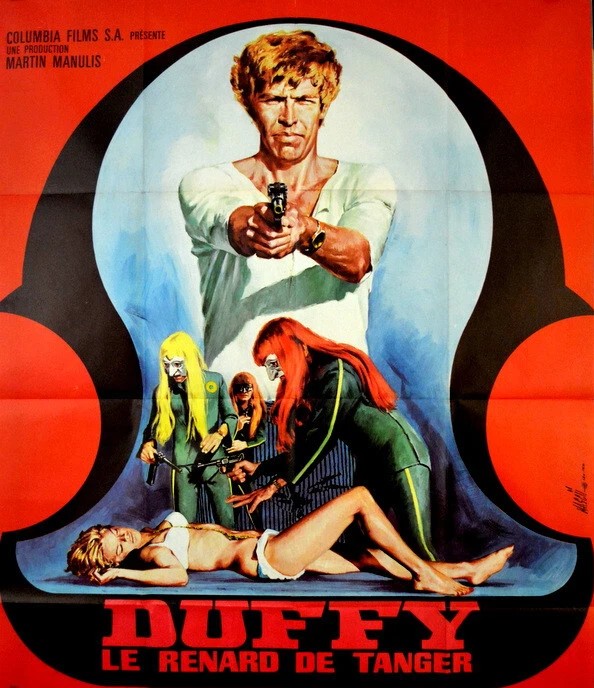
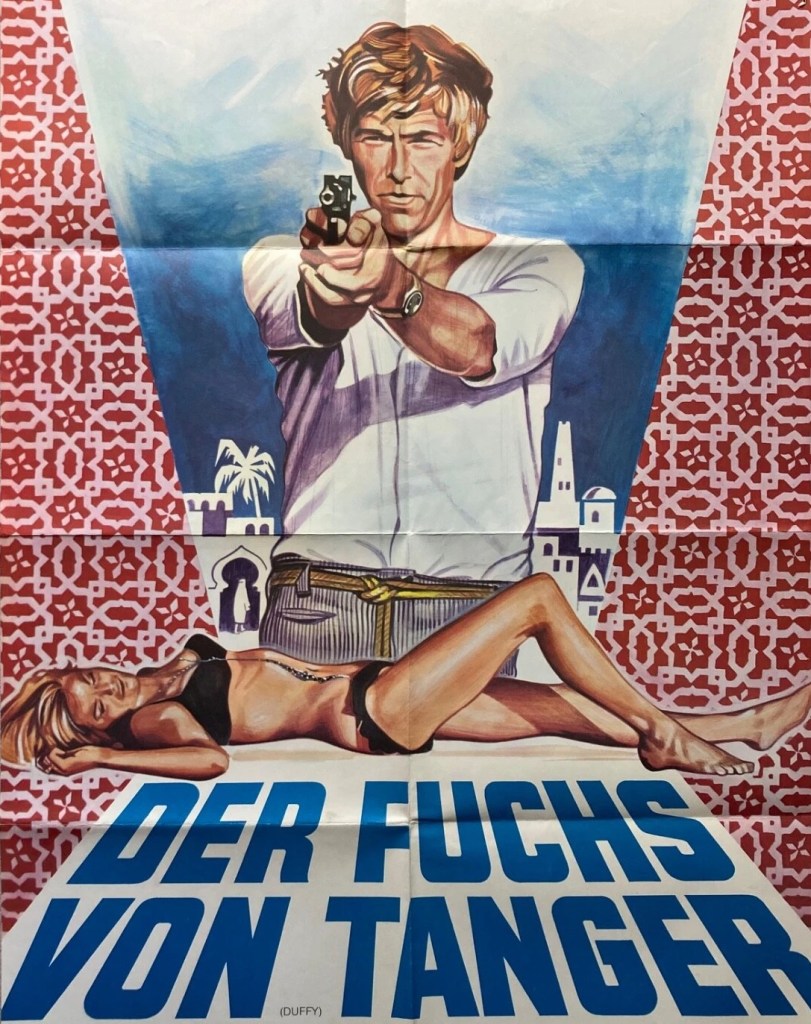
Duffy (1968) ***

Star James Coburn wasn’t keen on the title. Had it been made today it would have been a contender for the sobriquet of The Nepo Heist. I’m sure many heirs would quite like a large chunk of their inheritance put in their hands long before it was handed over after the death of the father/mother. Luckily, this isn’t about blatant greed. It’s presented as more of a game, a duo of half-brothers, same father/different mother, trying to put one over their arrogant father.

Millionaire businessman J.C. Calvert (James Mason) is as keen on keeping the kids in their place, constantly deriding as incompetent Antony (John Alderton)  – an accurate assessment it has to be said – and more than willing to challenge Stefane (James Fox) to any game of skill, even darts, especially if it involves money.

The sons set out to steal £1 million ($3 million) from a shipment of cash their father is transporting aboard the passenger ship Osiris to Naples. To that end they recruit hippy smuggler Duffy (James Coburn). Stefane’s girlfriend Segolene (Susannah York) might have been included as a makeweight except she takes a fancy to Duffy. Given that betrayal is a standard trope of any heist, you are kept wondering if she is, in fact, no matter how she protests her independence, a plant.

It takes quite a while for the plot to gather any steam what with dilly-dallying around Tangier and making considerable adjustments to a yacht. No time is spent either in the planning of the crime, the action just unfolds. The theft itself requires little of the unique set of skills that most thieves possess, nothing more than going on board the Osiris in disguise, both Stefane and Segolene decked out in religious garments, and putting on masks for their incursion into the room containing the safe. The only moment of real tension comes in having to extract the code to the safe.

The escape is better thought-out. The cash is chucked overboard in buoyant bags, connected to Duffy by means of a fisherman’s line which, when reaching the safety of their yacht, transformed for the time being into a fishing boat, Duffy reels in. A helicopter magically appears from the hold and they blow up the yacht before escaping, stashing the loot in 30ft of water in a cove near Tangier.

Assuming J.C. would be able to claim on his insurance then no great harm would be done to the family coffers, and the sons, as well as filling their pockets, would have the pleasure of making a fool of their old man. As you might expect, there’s double crossing still to come. And it’s a gem of a twist. Calvert has been in on the crime from the outset, thanks to the connivance of Segolene who turns out to be his girlfriend.

However, that scam is undone in another twist and it’s Duffy who comes out trumps, though far short of a millionaire.

Relies more than most crime pictures on the charm of the three main characters, with Antony there for nuisance value. However, the will-she-won’t-she games Segolene plays with Duffy and Stefane would have had more impact if Stefane had not been so nonchalant about their romance, and if she had not been so strident as regards her independence and unwillingness to become attached to any man.

That said, she turns out to be the cleverest of the lot, stringing along the two younger men while making a better play for the older one. But there’s something missing in the construction of the picture, so her triumph seems to come out of left field, almost a twist for the sake of it.

James Coburn (What Did You Do In The War, Daddy?, 1966) gives his screen persona an almighty about-turn, and although he appears useful with a pistol, he comes across more as a free-living hippy of the period, with a penchant for erotic pop art, though he has little regard for ecology, literally littering the planet, chucking wrappers and bottles everywhere.

James Fox (King Rat, 1965) has a whale of a time as an insouciant aristocrat, a character trait  he clearly inherits from James Mason (Age of Consent, 1969) as his father  while Susannah York (Sands of the Kalahari, 1965) swans around in cool attire all the more to make herself appear nothing more than a mild distraction rather than a criminal genius.

Leisurely directed by Robert Parrish (Journey to the Far Side of the Sun, 1969) from a screenplay by Donald Cammell (Performance, 1971) and Pierre de la Salle and Harry Joe Brown Jr.

Very slight.

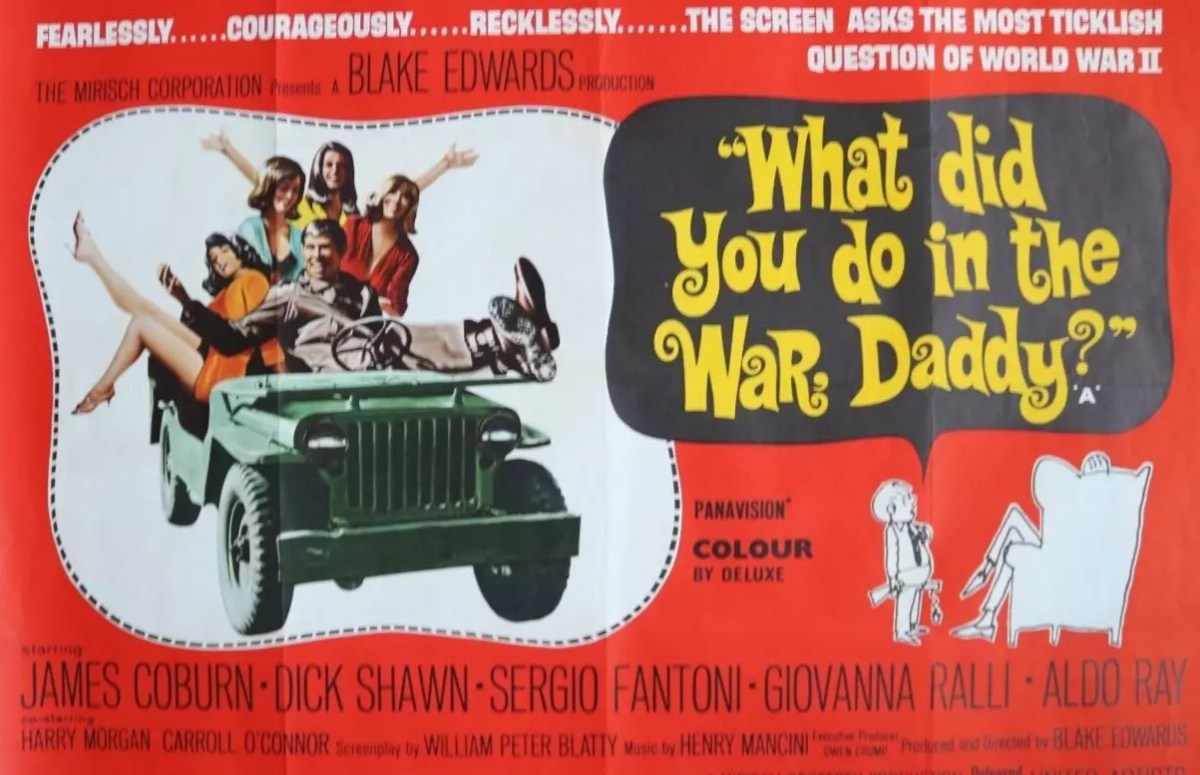
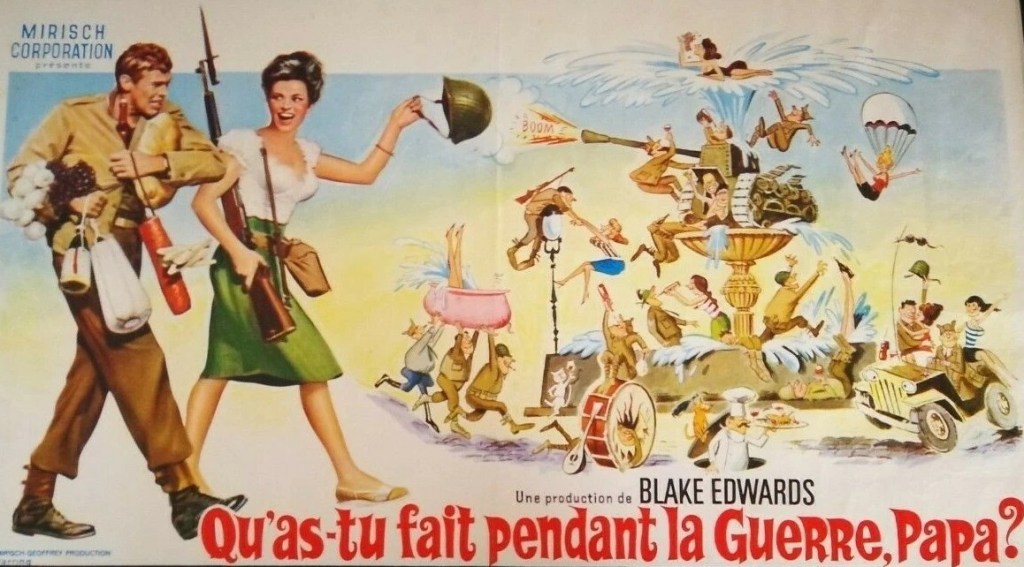
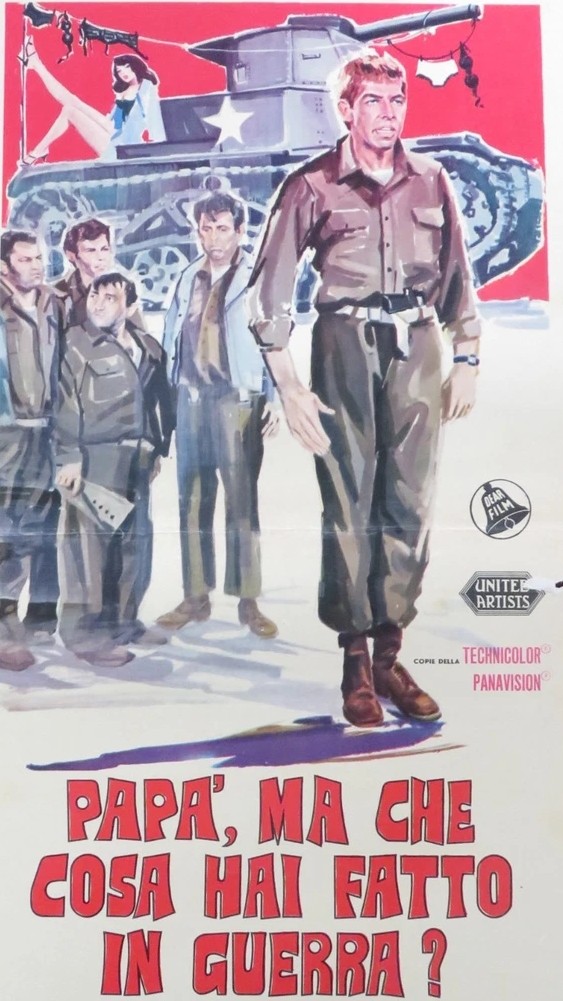
What Did You Do in the War, Daddy? (1966) **

How on earth did James Coburn get mixed up in this mess? I’m assuming that having suddenly been elevated from supporting actor to top billing as a result of Our Man Flint (1966) he took the first job that came along that reflected his ideas about salary. Director Blake Edwards was, to some extent, at something of a loose end. United Artists had passed on The Great Race (1965) and another project with the director had fallen by the wayside. Apparently, this movie was the result of a question asked by his son. During World War Two, Edwards had served in the U.S. Coastguard which meant he did not see active service though did suffer a back injury. Writer William Peter Blatty (A Shot in the Dark, 1964) was too young for World War Two and though he joined the US Air Force he didn’t see active service either, being employed in the psychological warfare division.

So this exercise wasn’t going to be based on personal experience. The mid-1960s wouldn’t exactly lend itself to poking fun at war, although Vietnam was fair game.

You might have thought Coburn, on reading the script, would have realized he’s not much in the movie for the first 20 minutes or so and then is at the mercy of a bundle of subplots.

During the invasion of Sicily in 1943, stickler for discipline Captain Cash (Dick Shawn) is handed command of a disorganized unit headed by Lt Christian (James Coburn) and instructed to take a strategic village from the Germans. Turns out the enemy is long gone and the resident Italian soldiers, commanded by Capt Oppo (Sergio Fantoni), are only too happy to surrender as long as they can continue to enjoy la dolce vita which in this case involves an annual wine festival. Most of the early part of the picture revolves around getting Cash to loosen up, and after imbibing copious amounts of liquor and being seduced by the mayor’s daughter Gina (Giovanni Ralli) he relents.

There are only two obstacles to the merry party. Oppo objects to his girlfriend Gina being used as a makeweight to make Cash see things the Italian way and Cash’s boss General Bolt (Carroll O’Connor) asks to see proof of their success. So, since not a shot has been fired and they can’t boast of a camp full of Italian POWs, they decide to invent the proof and start filming phoney footage.  Bolt reckons they need support and sends up reinforcements. Which is just as well because the Germans, either realizing what they’ve been missing or being nudged back into action, decide to reappear. And given the slovenly chaotic opposition it’s not hard for them to re-take control of the town which results in Cash hiding out in drag.

Theoretically, it’s a reasonable idea. There’s been no shortage of swindlers or con-men or black marketeers in war movies – think James Garner in The Great Escape (1963) and The Americanization of Emily (1964) – and various armies have been filled with shysters ranging from Sgt Bilko to the shifty recruits in British films up to all sorts of wheezes or doing their best to stay out of the line of fire.

But once the point has been made that it’s better to make love not war and drink as much wine as possible and become friends with the enemy, the point is made over and over again. There isn’t a single joke that isn’t belaboured and not many laffs to begin with. Going over-the-top is fine for slapstick like The Great Race but it doesn’t work here.

James Coburn has too little to do and Dick Shawn (A Very Special Favor, 1965) too much. Giovanni Ralli (Deadfall, 1968) and Sergio Fantoni (Hornet’s Nest, 1970 ) are wasted. Carroll O’Connor (Warning Shot, 1966) is the pick of a supporting cast that includes Aldo Ray (The Power, 1968) and Harry Morgan (The Mountain Road, 1960) but that’s only because he has a clever reversal of a role as a general who wants to be treated as an individual.

I should point out this has something of a cult following but I won’t be joining the fan club.

Must have seemed a good idea at the time.

The Wild Angels (1966) ***

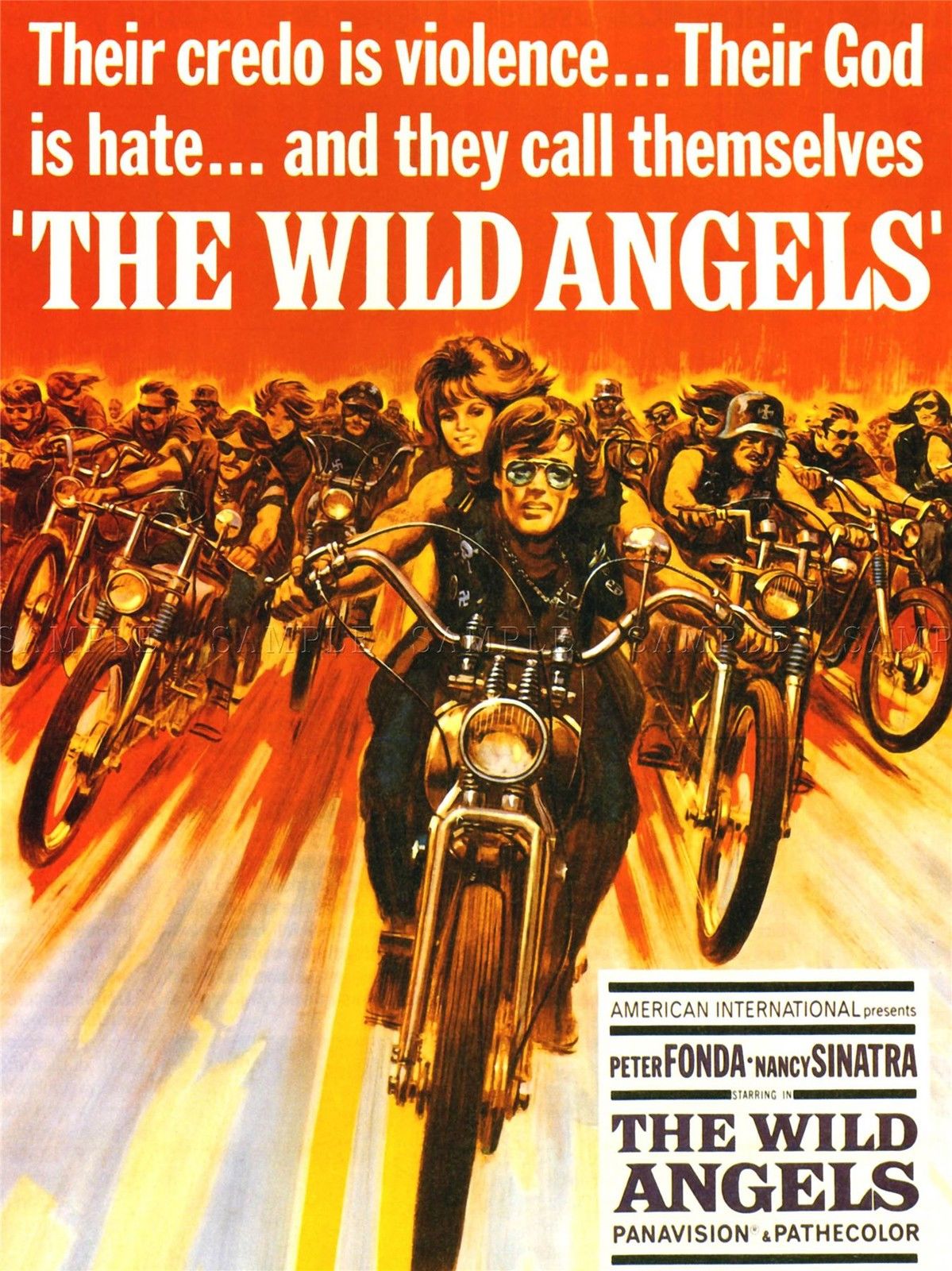
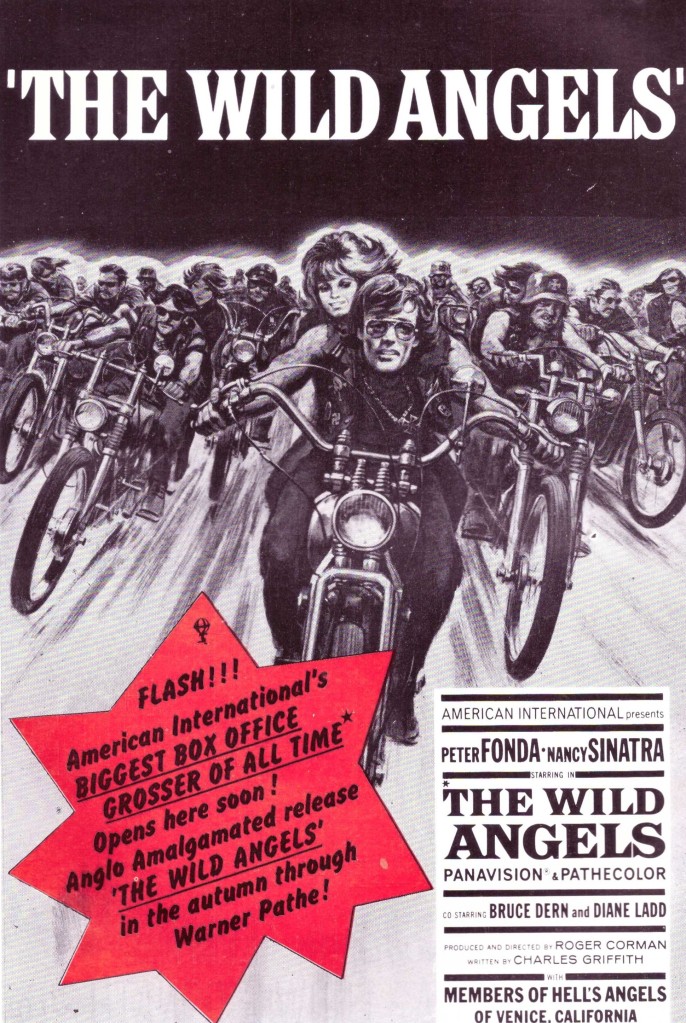
Riders stretched out across a sun-baked valley – you could be harking back to the heyday of the John Ford cavalry western instead of the biker picture, the first in the American International series, that sent shockwaves through society and laid the groundwork for the more philosophical Easy Rider (1969) a few years later. Long tracking shots are in abundance. You might wonder had director Roger Corman spent a bit more on the soundtrack, the bikers just worn beads instead of swastikas, and been the victims rather than the perpetrators of violence how this picture would have played out critics- and box office-wise.

The Wild Angels set up a template for biker pictures, one almost slavishly followed by Easy Rider, a good 15 per cent of the screen time allocated to shots of the Harley-Davidson riders and scenery, and a slim plot. Here Heavenly Blues (Peter Fonda), trying to recover a stolen bike, leads his gang into a small town where they beat up a bunch of Mexican mechanics, are pursued by the cops, hang out and indulge in booze, drugs and sex, and then decide to rescue the badly-injured Joe (Bruce Dern) from a police station. This insane act doesn’t go well and after Joe dies they hijack a preacher for a funeral service that ends in a running battle with outraged locals and the police.

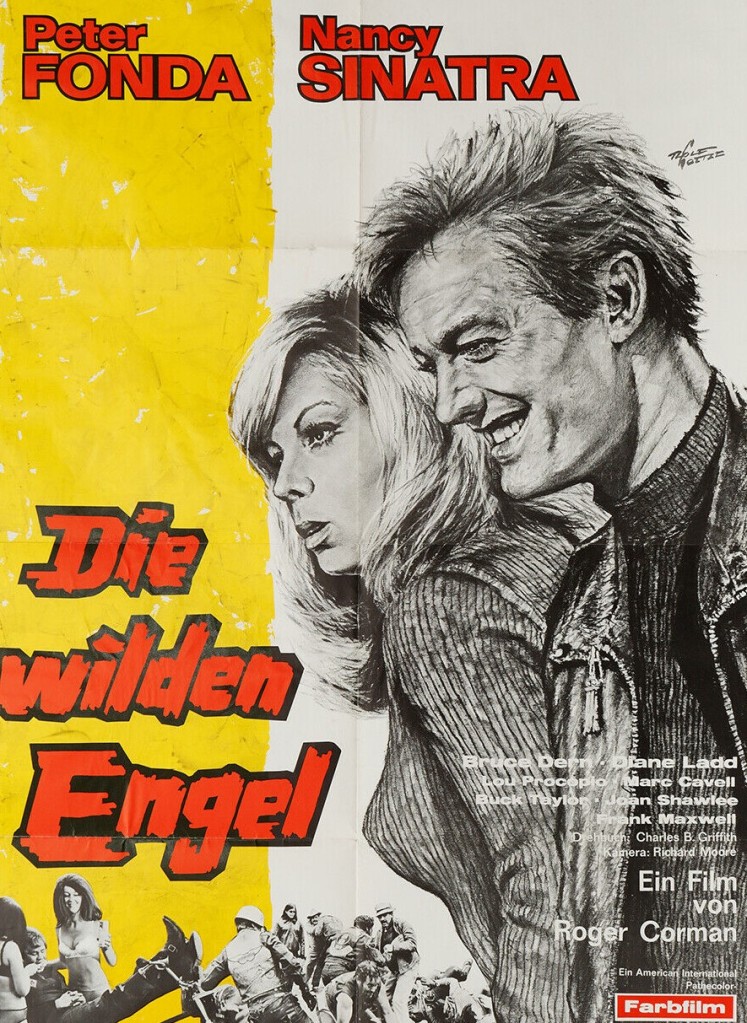
One of the weirdest posters of all time – at first sight it looks like Nancy Sinatra is holding the decapitated head of Peter Fonda in front of her.

There’s an odd subplot, given the lifestyle of freedom and independence, of Monkey (Nancy Sinatra) trying to get a romantic commitment out of Heavenly. Conversely, Heavenly, rejecting the traditional shackles of love, finds himself trapped by grief, eventually and quite rightly blaming himself for Joe’s death, and apparently turning his back on the Angels to mourn his buddy. The decline – or growing-up – of Heavenly provides a humane core to a movie that otherwise takes great pride in parading (and never questioning) excess, not just the alcohol and drugs, but rape of a nurse, gang-bang of Joe’s widow (Diane Ladd), violence, corpse abuse, and wanton destruction.

A ground-breaking film of the wrong, dangerous, kind according to censors worldwide and anyone representing traditional decency, but which appealed to a young audience desperate to find new heroes who stood against anything their parents stood for. In a decade that celebrated freedom, the bikers strangely enough represented repression, a world where women were commodities, passed from man to man, often taken without consent, and racism was prevalent.

Roger Corman (The Secret Invasion, 1964) was already moving away from the horror of his early oeuvre and directs here with some style, the story, though slim, kept moving along thanks to the obvious and latent tensions within the group. If he had set out to assault society’s sacred cows – the police, the church, funeral rites – as well as a loathing of everything Nazi, he certainly achieved those aims but still within the context of a group that epitomized some elements of the burgeoning counterculture.

In retrospect this appears an ideal fit for Peter Fonda, but that’s only if viewed through the prism of Easy Rider for, prior to this (see the “Hot Prospects” Blog) he was being groomed as a romantic leading man along the lines of The Young Lovers (1964). Bruce Dern (They Shoot Horses, Don’t They, 1969) was better suited, his screen persona possessing more of the essential edginess while Michael J. Pollard (Bonnie and Clyde, 1967) was the eternal outsider.

Rather surprising additions to the cast, either in full-out rebel mode as with Nancy Sinatra (The Ghost in the Invisible Bikini, 1966) or hoping appearance here would provide career stimulus as with movie virgins Diane Ladd (Chinatown, 1974) and Gayle Hunnicutt (P.J. / A New Face in Hell, 1968). Sinatra certainly received the bulk of the media attention, if only for the perceived outrage of papa Frank, but Hunnicutt easily stole the picture. Minus an attention-grabbing role, Hunnicutt, long hair in constant swirl, her vivid presence and especially her red top ensured she caught the camera’s attention.

Charles B. Griffiths (Creature from the Haunted Sea, 1961) is credited with a screenplay that was largely rewritten by an uncredited Peter Bogdanovich (The Last Picture Show, 1971).

Behind the Scenes: Selling “Quality Sleaze,” Gregory Peck and Robert Mitchum – Pressbook for “Cape Fear” (1962)

If you’re not Alfred Hitchcock with carte blanche to scare the pants off the audiences every which way but loose and you’re not launching a B-movie sexploitation drama, then you’ve got to take a more sensible path to selling a picture headlined by the world’s greatest hero Gregory Peck elevated to such a position by the extraordinary success of The Guns of Navarone (1961) which topped the annual box rankings in the USA.

So while your taglines can emphasize “shock and suspense” what you’re selling cinema managers is quality. So, in the Pressbook/Marketing Manual, Peck is portrayed as a “celluloid perfectionist” and “four-time Oscar nominee” so multi-talented he’s a triple hyphenate – writer, producer, actor. Such a perfectionist he’s known “to spend a week or more preparing for one small scene.”

He is a class act not some sleazy B-movie bum. “He not only completely absorbed all the dialog, its various nuances and shadings, but also probed the psychological and physiological motivations of the attorney he portrays,” notes the Pressbook.

And it’s not just Peck who’s to be praised. “Seldom has such an outstanding array of talent been so tellingly marshaled for such a dramatic thunderbolt.”

The messianic tone is evident throughout. Headlines claim “Bob Mitchum’s career reaches a new high,” Lori Martin has the “top role” of her career, Barrie Chase is “praised as top talent discovery” and “Telly Savalas termed top talent find by Peck.”

Polly Bergen “emerges as an actress of great sensitivity and insight.” Lori Singer, in her movie debut, “graphically attests to the polish she has achieved through her work as child lead in the video (television) series National Velvet.” Although Martin had another reason for turning up word perfect – so that she could get off early and go ice skating.

And the praise doesn’t stop there. “A whole new career should open for sultry Barrie Chase, one-time dancing partner of Fred Astaire.” She is “sensationally good as the casual pick-up ensnared by Mitchum.” The talent pickers had no doubt she was “destined to become one of the foremost dramatic talents of the industry. The very quality which made her such an outstanding dancer – her tireless attention to even the minutest detail – has helped turn her into a magnificent actress.” The marketeers were convinced her “masterpiece” performance would result in an Oscar nomination.

Peck had appointed himself the “tub-thumper” for Savalas after seeing him play Al Capone” in the television series The Witness (1960-1961) calling him “one of the finest new talents of the last 10 years.”

According to the Pressbook, director J. Lee Thompson “deliberately imparted…a distinctively British touch.” Claimed Thompson, “There emerges in the best of the British pictures a certain warmth and credibility which are looked upon as the English hallmark. Such an impression is achieved, it seems to me, through the simple technique of emphasizing character development.”

For journalistic snippets there’s not much beyond that Peck was so impressed with the location in Georgia that he purchased a plot of land on Sea Island to build a beach house. Plus that he’s turned into a noted photographer, now onto his seventh camera with a fast lens. Polly Bergen was creating a nightclub act. Robert Mitchum was thrown three times on his first film horse.

But it was unlikely that cinema managers would find a way of passing on to audiences the idea that this was a “quality sleaze” picture populated by proven and up-and-coming talent. The public had to make do with posters and taglines to get a feel for what was on offer. And in that respect the marketeers pulled few punches.

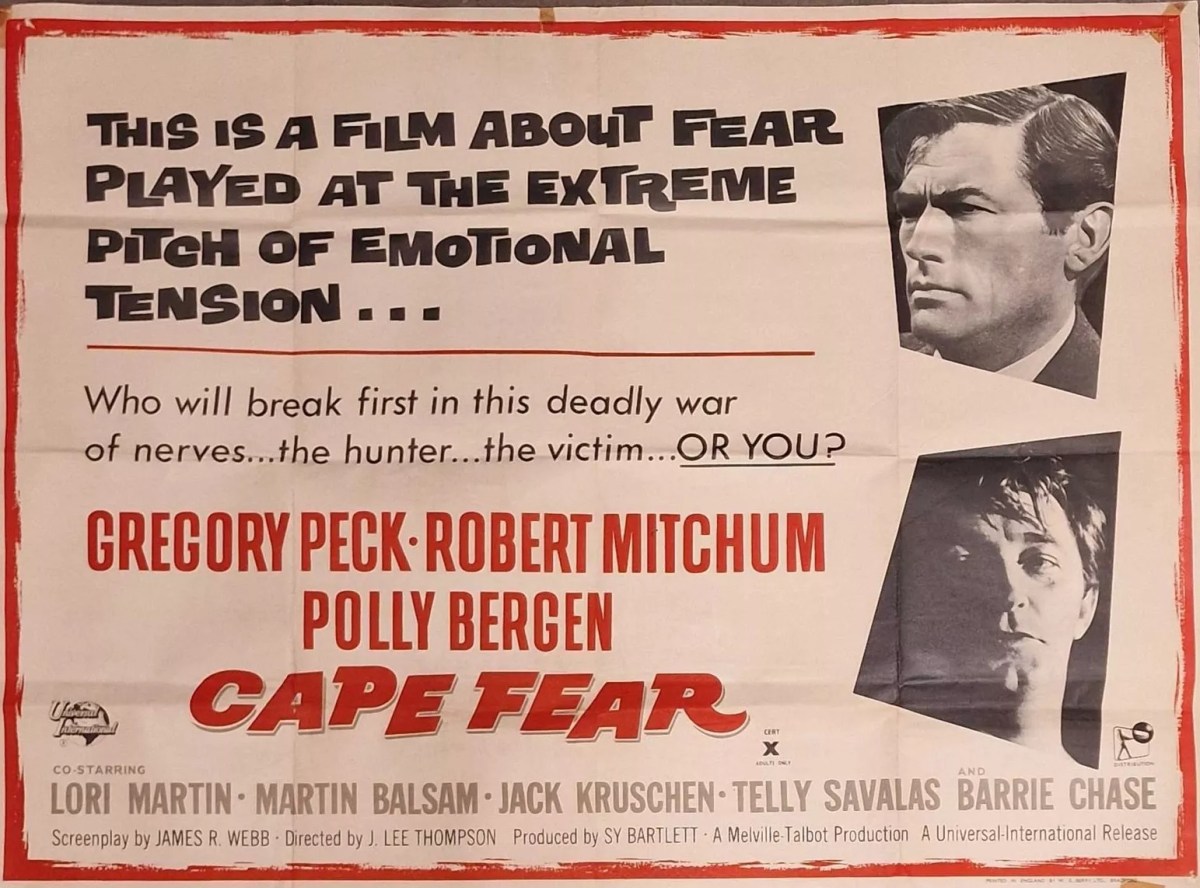
As usual, cinema managers were offered a plethora of choice when it came to the posters. Mostly, Peck and Mitchum were shown on opposite sides of the poster with in between an image intended to conjure up menace – the bare-chested Mitchum confronting Bergen, Bergen comforting her daughter, mother and daughter running, Mitchum tangling with the daughter.

Taglines spelled it out in a variety of ways: “A terrifying war of nerves unparalleled in suspense!” with a sub-tag of “A man savagely dedicated to committing a crime shocking beyond belief! A man desperately determined to end his ordeal of terror…even if it meant using the ultimate weapon – murder!”

Exclamation marks were in full flow. “Now, he had only one weapon left – murder…to prevent an even more shocking crime” was backed up by “the drama of an unrelenting war of nerves…and the helpless lives that were caught in its terrifying crossfire!”

Or try this – “The savagely suspenseful story of an unspeakable crime…and the man, the woman, the helpless people it touched with terror. From the moment they meet the tension is explosive. An electrifying war of nerves unrelenting in suspense!”

In case you didn’t get the message, here it is in more subtle form: “What happens to them in an adventure in the unusual!” That understatement is followed up with “So daring in theme…so frank in treatment…that it frightens while it fascinates and gives a terrifying new meaning in suspense!”

And there were variations of the above: “A terrifying war of nerves unparalleled in suspense! The Watched…who can only run so far before coming face-to-face with The Watcher…who waits for the moment when the woman and her daughter will be alone.”

And – “Now the nightmare was about to become a terrifying reality… the whispered threat a crime unspeakable. So daring in theme…so frank in treatment. What happens to them is an adventure in the unusual!”

Plus – “Their ordeal of terror triggers the screen’s most savage war of nerves! Unparalleled suspense…as one becomes a target for nightmare, the other becomes his target for execution.”

Unusually, there were a host of promotional items. As well as a motion picture paperback edition from Fawcett, “hot off the press” was the Prentice-Hall hardback The Polly Bergen Book of Beauty, Fashion and Charm, including stills from Cape Fear. Books were a major source for marketing, given there were over 100,000 outlets in specialist shops, drug stores, railway and bus terminals and carousels on newspaper stands.

Virtually any homely element of the movie was co-opted for promotional purposes. A scene taking place at a United Air Lines terminal counter provided opportunity for tie-ins with travel agents and ticket offices. Bowling “palaces” might be happy to display posters and promotional material given there’s a scene set in a bowling alley. Distributors of a Chris Craft boats, Chrysler station wagons, Larson speed boats and Scott outboard motors – which all appear in the movie – could be targeted.

Discover WordPress

A daily selection of the best content published on WordPress, collected for you by humans who love to read.

The Atavist Magazine

by Brian Hannan

WordPress.com News

The latest news on WordPress.com and the WordPress community.