The Rock (1996) *****

Amazingly, there was no 25th anniversary razzamatazz for this pulsating piledriver of an action movie, a stone cold classic. Instead of the standard breaking out of Alcatraz, a brilliant reversal sees a crack military team of U.S. Navy SEALS trying to break in to stop maniac martinet General Hummel (Ed Harris) devastating San Francisco with stolen missiles containing nerve gas. Notwithstanding his iconic turn as James Bond and Oscar acclaim for The Untouchables (1987), this is surely one of Sean Connery’s best, if not boldest, performance, the calm at the heart of the storm, exuding a riveting screen persona. No other star of his calibre would have allowed themselves to be seen at the start with such a lack of dignity, not just shackled but with dirty exceedingly long hair.

Not only is it a brilliant entrance but such is director Michael Bay’s mastery of his material that he makes audiences wait 25 minutes for it while he sets up the terror that awaits the city from a rain of terrifying gas, Hummel as a ruthless legendary officer with a point to prove and allows Nicolas Cage to break out of his initial geek. Backed by a classic battering ram of a score by Hans Zimmer and Nick Glennie-Smith and an outstanding battalion of supporting players, Bay never lets up the high-pitch tension, finding his stylistic way with slo-mo, helicopters swaying in the sky and brutal stand-offs.

Former British spy John Mason (Connery), the only man alive who has broken out of Alcatraz, is released from prison to lead the break-in, Hummel holding hostages as well as his weaponry. Never has a star done so much with so little, using a coin to discover his nemesis FBI director Womack (John Spencer) and with nothing more than a piece of string engineering his own escape from a San Francisco hotel that leads to a riveting car chase ending in wanton destruction and a touching scene reuniting Mason with a long-lost daughter (Clare Forlani). That such a cracking movie bothers with emotional hooks –  academic FBI chemical expert Stanley Goodspeed (Nicolas Cage) also has his girlfriend in harm’s way – shows the screenwriter’s skill in bringing greater character depth. Except for his daughter, Mason would have made another escape from Alcatraz at the first opportunity.

What appears a mission impossible becomes a mission impossible too far when Hummel’s men slaughter the military invasion leaving the unlikely duo of Mason and Goodspeed to save the city – and their own lives – when the equally ruthless rescue operation bosses determine it’s better to completely liquidate Alcatraz rather than risk the missiles being fired.

And without Cage as the mild-mannerd scientist stepping up to the action plate, this would be a different picture, over-dominated by Connery. Cage delivers a multi-layered performance, from the emphatic strum of a guitar string to his flickering fingers and the brilliant delivery of the humdrum line “in the name of Zeus’s butthole.” He shifts from fearful geek who has left his gun behind to determinedly hunting down Mason in a car chase and then finding a true action mojo on the rock.

Given this top-notch performance, it’s proof of Connery’s star power that he easily steals the picture. Suspicious, clever, ruthless, soft-hearted when it matters, he mentors Goodspeed, though not always gently, “losers always whine about their best, winners go home and f*** the prom queen.”

Odd as it might be to say about a Michael Bay picture, this is layered too. From the conflict between Mason and Womack, the nuanced performance by the essentially honorable Hummel, brilliant character development –  like Hilts in The Great Escape Mason the loner eventually persuaded to help the general cause –  the transition of Goodspeed from goofy oddball to savior, speedy edits, some cracking images, a script dipped in paranoia (references to Roswell, the Kennedy assassination, black ops and secret military slush funds)  and a stack of one-liners. All this delivered in passing as this high-speed train of an action blockbuster thunders along the line.

The whole enterprise is bolstered by a top-notch supporting cast led by the Mason-hating John Spencer (stepping up from a supporting role in L.A. Law, 1990-1996), David Morse (The Green Mile, 1999), eternal heavy William Forsythe (J. Edgar Hoover in The Man in the High Castle, 2018-2019) getting the chance to lighten his load, Michael Biehn (Aliens, 1986), John C. McGinley (Any Given Sunday, 1999) and Bokeem Woodbine (Queen and Slim, 2019). Two young actresses show tremendous promise – Clare Forlani capitalised on this break with Meet Joe Black (1998) but it proved less of a Hollywood calling card for Vanessa Marcil (Goodspeed’s fiancé), her best work coming in television (Las Vegas, 2003-2008).

It was also Michael Bay’s calling card to enter the high-octane world of big-budget blockbusters like Armageddon (1998). While his career had as many ups as downs, this is unquestionably his action masterpiece, a no-holds-barred non-stop adrenaline spike.

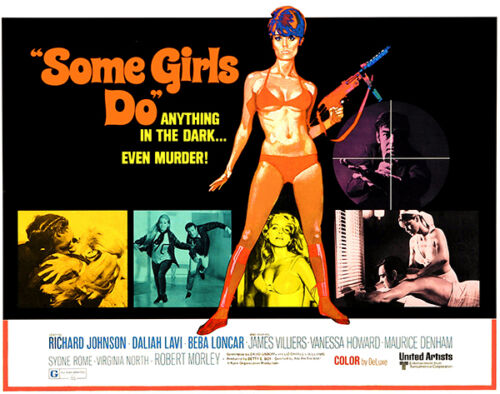
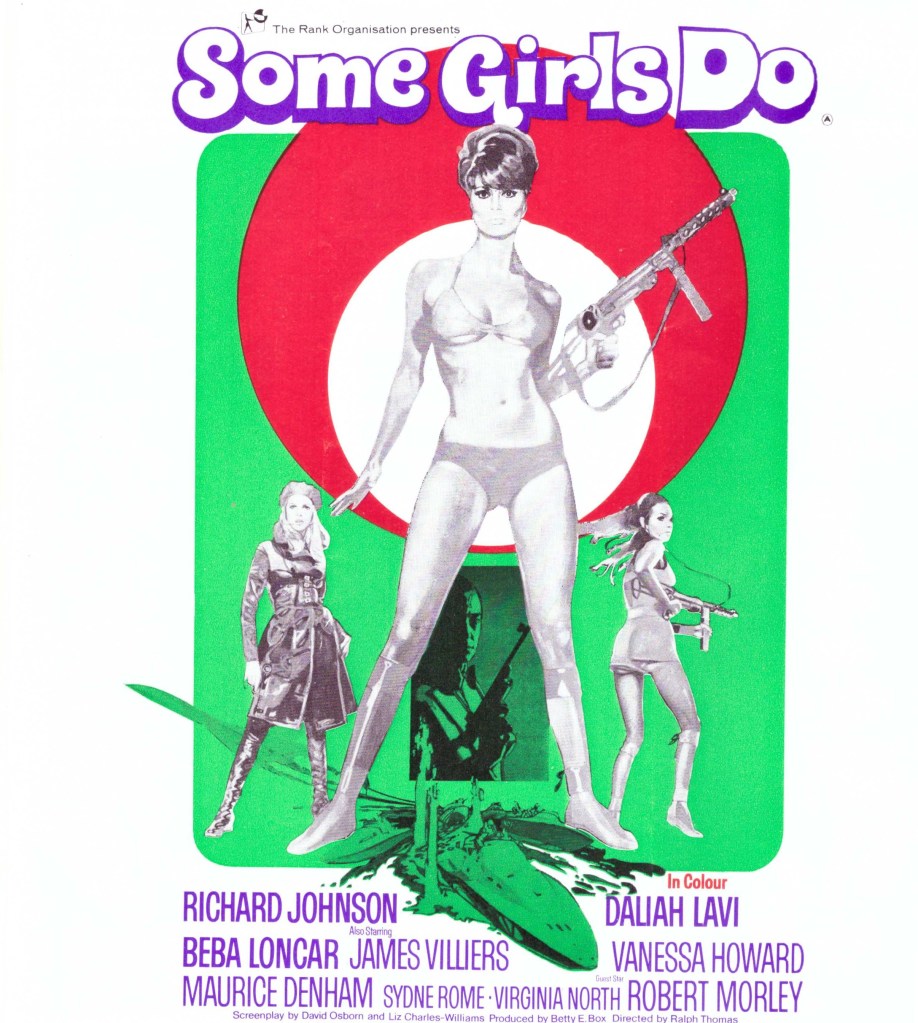
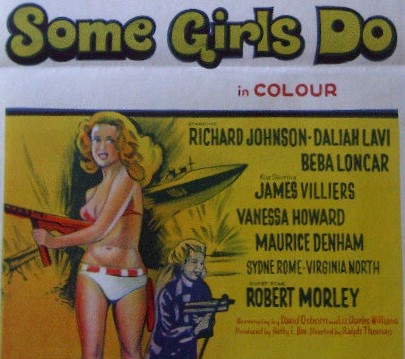
Deadlier than the Male (1967) ****

For a movie intended to set up a series character in the vein of James Bond, it was ironic that it was the women who stole the show, not just from their tendency to turn up in bikinis but for their outrageous villainy. Irma (Elke Sommer) and Penelope (Sylva Koscina) are the seductive assassins in the hire of Carl Petersen (Nigel Green) who has designs on an Arab oil empire. On her own Irma dispatches mogul Henry Keller (Dervis Ward) then the pair – emerging from the sea like a pair of latter-day Ursula Andresses – harpoon his colleague Wyngarde (John Stone).  

Soon Hugh Drummond (Richard Johnson), investigating the death of Stone, becomes a target  and that sets him off, with nephew Robert (Steve Carlson) in tow,  to the Mediterranean and the yacht of oil-rich King Fedra (Zia Mohyeddin) where, of course, the girls lie in wait.

Dispensing with the gadgets – except for one item employed by the villainesses – and gimmicks of Bond, but retaining the quips, this is a fun ride with a more down-to-earth leading man – like the early Bonds – smarter girls, a more old-fashioned mystery, hefty thug Chang (Milton Reid)  in the Oddjob mold, a castle doubling as the villain’s lair, a suave master criminal, some detective work, and a super scene involving giant robotic chess men.

The bickering between Irma and Penelope, not just a tad sadistic but a kleptomaniac especially as far as her partner is concerned, coupled with their overweening confidence, makes them much more human than any Bond Girl and the character traits explored have a pay-off at the climax. Equally interesting are the mind games, Drummond vs. Peterson but also Drummond vs. Irma. And that the female baddies see it as points on their scoreboard to seduce Drummond rather than the other way round.

Drummond is every bit as capable a seducer as Bond and equally ruthless, stripping one suspect naked. Petersen is also a clever character, faking his own death and running a very smooth operation, and certainly his recruitment techniques are second to none.

Some ideas were certainly ahead of their time, the chess men are the equivalent of a modern computer game while the human bomb has, unfortunately, entered the modern lexicon and there are enough female serial killers around to prevent anyone believing they are always (to use a sexist phrase) the gentle sex. However, in the middle 1960s, the concept that women would be partial to murder and torture not to mention repeatedly seducing males went so much against the grain of the male authority figures that the British censor slapped an X-certificate on the movie.

Shakespearian actor Richard Johnson was at one time an MGM contract player, but his only previous top-billed outing was the Italian-made The Witch (1966) but he certainly made a splash with this character, investing it with a great deal more gravitas than Derek Flint or Matt Helm. The Teutonic Elke Sommer (The Venetian Affair, 1966) is brilliant as one half of the assassin tag-team with a batch of one-liners for every occasion. Sylva Koscina (A Lovely Way To Die, 1968), nose always put out of joint, almost steals the show.  Nigel Green (Tobruk, 1967), while his usual sardonic self, has the playfulness of the rich and powerful.

Steve Carlsen, in his movie debut, doesn’t make much of an impact in a largely lame role. Zia Mohyeddin has a more interesting role as the oil kingpin wanting to help his people. As you can expect in a spy picture there are a host of beautiful women – Suzanna Leigh (The Lost Continent, 1968) a defector, Virginia North, also making her debut, Justine Lord (Night after Night after Night, 1969), and Didi Sydow in her only screen appearance.

The light comedy experience of director Ralph Thomas (Doctor in Distress, 1963) comes in very handy, as his sense of comic timing is excellent, but, perhaps learning from his previous brush with espionage in Hot Enough for June / Agent 8¾ (1964) brings a bigger punch to the action scenes. And it’s a bold ploy to start with an action sequence revolving around Irma and Penelope rather than our star man.

The screenplay was a team effort – Jimmy Sangster (The Devil-Ship Pirates, 1964), taking a break from Hammer duties, David D. Osborn (Maroc 7, 1967) and Liz Charles-Williams, making her screen debut  – all involved.  This was familiar territory for composer Malcolm Lockyer (Five Golden Men, 1967). British pop act The Walker Brothers had a hit with the theme tune.

This is more fun than camp, not a send-up of the genre like Derek Flint and Matt Helm, but a spy picture with a believable leading men and excellent villains. But the plot is more centered on filthy lucre rather than global control and there is a genuine understanding of how businesses work – takeovers, mergers, dirty dealings – though small wonder Petersen would like to be shot of pedantic boardroom nuisances like Bridgenorth (Leonard Rossiter) – wouldn’t we all?

Bulldog Drummond was an international crime-buster invented by “Sapper,” the pen-name of H.C. McNeile. Bulldog Drummond had been a Hollywood mainstay for over four decades, the twenty-plus pictures attracting stars like Ronald Colman (Bulldog Drummond, 1929, and Bulldog Drummond Strikes Back, 1934), Ray Milland (Bulldog Drummond Escapes, 1937), Walter Pidgeon (Calling Bulldog Drummond, 1951) and a young Ralph Richardson (The Return of Bulldog Drummond, 1934). But the notion, in the Swinging Sixties, of tagging any leading man by the moniker of ‘Bulldog’ did not seem like a good idea, so the character underwent wholesale reinvention, and his nickname is never mentioned. 

The title comes from a line in a poem by Rudyard Kipling, The Female of the Species. That was the original title of the film and also of a Sapper book.

The Sisters / Le Sorelle (1969) ****

Erotically-charged, symbolically-heavy French drama of siblings trying to re-establish the intense relationship they enjoyed as teenagers. After a nervous breakdown and on the point of divorce, blonde translator Diana (Nathalie Delon) seeks respite at the home of younger sister Martha (Susan Strasberg), a brunette happily married to the wealthy and indulgent Alex (Massimo Girotti).

Initially, the more worldly Diana, the more flamboyant dresser, appears the superior but it soon transpires she is the more fragile. The apparently timid Martha allows her husband to control her life to the point of buying all her clothes and confesses to feeling as if she is on “a perpetual cruise.” While on the surface, it seems as if she has given up too much, in reality she disapproves of disorder and seeks perfection. She comes across as needing protection, and believes the woman’s role is to sacrifice, but in fact has managed to arrange her life to her own satisfaction.

Their competitive streaks emerge in different ways, Diana in obvious fashion, seeking to beat her sister while out horse-riding, Martha in more subtle and sensual manner, flaunting her sexual relations with her husband, almost offering her sister to her husband, and having a lover (Lars Bloch) on the side. There is a sense of each attempting to impose their world view on the other. Diana gives her sister a make-over, a new look which Alex adores, Martha hates it. There’s a sense of a chess game, with two or more players, with the males subservient. pawns.

Sensuality is never far away. Diana nuzzles her sister’s neck to smell her perfume. Alex is photographed, encouraged by Martha, in almost intimate mode with Alex. Dario (Giancarlo Giannini) is brought in to tempt Diana. And a scene where the girls experiment with colorful scarves suggests libertarianism. 

But it is clear that both sisters live empty lives devoid of true love and equally obvious as the picture progresses that both have arrived at the conclusion that they were at their happiest when together. There are subtle hints of incest, comforting each other in bed, the sensuality electric and the film begins to examine whether this taboo can be crossed and, if so, will it provide the necessary escape?

Despite Martha’s apparent subjugation, there is more than an inkling of feminism, the girls are involved in a complicated game in which the males are pawns, either rejected or made to look fools. While not fulfilled, Martha has turned as much as possible to her own advantage and Diana seems perfectly capable of taking what she wants.

Alex provides the symbolism. He cultivates rare plants that need to hide from the sun, in a greenhouse, lengthy exposure to whose atmosphere would be fatal to humans. He endlessly photographs them because they won’t last long. And in similar fashion provides a haven for the apparently vulnerable Martha.

Nathalie Delon (When Eight Bells Toll, 1970), married at this point to Alain Delon, shows a subtlety of expression that is rare for someone appearing in just her third film, and effects a gradual character transition throughout. Susan Strasberg, daughter of famed acting coach, Lee Strasberg, inventor of the Method Style of Acting, was one of the boldest actors of her generation, appearing in drug pictures The Trip (1967) and Psych Out (1968). She delivers an excellent portrait of a woman who manages to keep her true personality hidden, and for whom sexuality has few barriers.

This is the puppy-fat version of Giancarlo Giannini (Swept Away, 1974), barely recognizable as the future arthouse superstar whose physical appearance relied on gaunt, angst-riddles features.  Massimo Girotti (Theorem, 1968) is good as the man who thinks he has everything, not realizing how little he has. 

Although this was an accomplished directorial debut from Roberto Malenotti, he only made one more movie. Perhaps he made enough from directing the famous Coke commercial I’d Like To Teach The World To Sing (1971).

Always intriguing, revelations continually undercutting what we think we know of the characters, but delivered in subtle European tones rather than employing Hollywood shock, each of the four main people involved changing considerably due to their interaction with the others. While certainly skirting close to the borders of what was permissible at the end of the 1960s, it does so without exploiting the actresses.

Intriguing.

Can-Can (1960) ***

A sterling cast does justice to some great Cole Porter songs in an entertaining musical typical of the period. Apart from appropriating some stock footage, nobody was going to bother to head out on location when a Hollywood-ized version of Paris could be recreated on the set. While the film is ahead of its time in several ways – Simone (Shirley Maclaine) owns the nightclub and the women in the title dance are meant to be minus their panties, hence attempts by authorities to shut it down – the plot features an old-fashioned love triangle.

While the chief magistrate (Maurice Chevalier) turns a blind eye to the lewd dance, his younger colleague Phillippe (Louis Jourdan) does not and ensures Simone is arrested. Complications arise when Philippe falls in love with Simone who already has a lover, the lawyer Francois (Frank Sinatra) who is averse to committing to marriage. The four stars are all very charming and there is gentle comedy and effortless acting as the romantic knots are tightened and then unpicked. Hypocrisy is tested and found wanting. The courtroom scenes are amusing and most of the story focus is on how Phillippe can get round his principles and legal obligations to successfully woo Simone.

But in reality, the audience is here for the music, and to hear classic Porter songs interpreted by Sinatra and Chevalier. While the songs are top-drawer, what captured my imagination most was the “Garden of Eden” ballet with a stunning design and superb dancing by Simone and Claudine (Juliet Prowse).  The “Apache Dance” also boasts some singular choreography but otherwise while the “Can-Can” itself is rousing and well-done this is for obvious reasons a censored version.

The Cole Porter contribution includes: “I Love Paris,” “C’Est Magnifique,” “It’s Allright With Me,” “Let’s Do It,” and “Just One of Those Things.”

Walter Lang was a safe pair of hands in this genre having helmed Call Me Madam (1953), There’s No Business Like Show Business (1954) and Oscar-nominated for The King and I (1956). The screenplay was a harder slog. The original Broadway musical was a romance between the judge and the nightclub owner. Adding the lawyer Francois to the mix necessitated major changes to the story. But Dorothy Kingsley also had form, having been responsible for the screenplays of  Kiss Me, Kate (1953), Seven Brides for Seven Brothers (1954) and Pal Joey (1957). Co-writer Charles Lederer, although involved in Kismet (1955), had a better grasp of comedy, as seen in Gentlemen Prefer Blondes (1953) and It Started with a Kiss (1960).

Although not universally admired by the critics, it won two Oscars – color costume design for  Irene Sharaff and best music for Nelson Riddle. It didn’t hit a home run at the box office either and the finger was pointed at Twentieth Century Fox for committing the mortal sin of inflating revenue figures on its initial launch.

While not one of the all-time great musicals and put in the shade when compared to West Side Story (1961) and The Sound of Music (1965), it’s an enjoyable confection.

The Brutalist (2025) *** – Seen at the Cinema

The third act of this heavily-favored Oscar contender is so demented I half-expected Mark Wahlberg from Flight Risk (2025) to come charging in through the woodwork. So, spoiler alert and all that jazz, I’m going to tell you what all the critics, determined to shove this into Oscar pole position, have kept hidden.

The dramatic climax, if that’s the right word, is a male rape. Our hero Laszlo (Adrien Brody),  by this point a bit addled what with his alcoholism and heroin addiction, on a trip to the marble quarries, while extremely addled, is raped by multi-millionaire patron Van Buren (Guy Pearce), previosuly inclined towards the philosophical and intellectual rather than showing any hint of apparent violent or for that matter homosexual tendencies.

This rape sets Laszlo off an inexplicable series of tirades against all and sundry which puzzles said all and sundry until his crippled wife  Erzsebet (Felicity Jones), until now in a wheelchair and equally inexplicably now on her feet, albeit with the help of a walking frame, turns up at a Van Buren dinner party to point the finger. At which point, understandably, the money is pulled from the architectural marvel being built, though not before we see, in another inexplicable sequence, its one genuine marvel, the way light from outside lights up a cross on the altar.

Just to round everything off, just when the movie is headed, what with said millionaire pulling the plug, for one of those sad endings when said architect is left high and dry and the building set to be an unfinished folly and Laszlo possibly heading for a mental institution or the breadline, genius unrecognized, we are presented with a coda, and with a swish of the directorial magic wand, it turns out that instead Laszlo went on to have a magnificent career, so much so a major exhibition is launched in his lifetime.

So, what was a pretty engrossing drama, with, for probably the first time on celluloid, an understanding of what goes on in the mind of a genius builder given the same credence as the evolution of an artist of the painting or music variety (witness the recent A Complete Unknown), turns, with several fell swoops, into an oddity, one which critics are desperately trying to salvage to position it, as I mentioned, as not only the Oscar favorite but as a contemporary version of Citizen Kane.

And you can forget all the hoo-hah about Vistavision.
In an ordinary theater this makes not the slightest difference.

These aren’t the only inconsistencies. Completely broke, living in a single room, at the end of the 1940s, after our Holocaust refugee has become an American immigrant, he manages to scrape enough money together to hire/buy a movie projector and hire/buy a porno flick. And I’m still getting my head round the building of a “community” endeavor, part-funded by the community, being constructed on a remote hill several miles away from the community it is meant to serve. Not to mention, Laszlo being able to afford a packet of smokes while queuing at a soup kitchen and while raging against the machine that a young child is left without even a slice of bread doesn’t go and buy a loaf of bread for the starving child instead of a packet of cigarettes for himself. And if you’ve ever met anyone who has a fabulous library, the last thing they want is the books hidden away, even from the dangerous sun, and even to allow an architectural genius an architectural flourish.

Certainly, director Brady Corbett (Vox Lux, 2018) wants to have his cake and eat it, so as well as Holocaust references, we are shown grinding American poverty before getting back on track to tell the story of artistic genius and the financial obstacles, considerably more in the building business than painting or writing a tune, it must overcome.

So why everyone is trying to position this as the Oscar fave is because despite these deficiencies, the first two-thirds of the picture present a very absorbing and ambitious drama. While you’re scarcely going to find a scene that genuinely sticks in the mind, if we are putting Corbet in the Scorsese, Nolan, Scott, Spielberg category, the overall effect is certainly effective and the look distinctive. And while the male rape is going to divide audiences, there is an unusual stack of sexuality elsewhere – his cousin Attila (Alessandro Nivolo) is overly affectionate even given the overly expressive male camaraderie of European countries and likes to sashay around in an apron. On landing in the U.S., one of Laszlo’s first acts is to hook up with a hooker, and there’s a distinct frisson of sexuality in the Attila household, while the crippled wife finds the sex act alleviates her pain.

What brings this alive and gives it substantial heft are the three male performances. Adrien Brody, proof that one Oscar win (for The Pianist) doesn’t open as many doors in Hollywood as you’d expect, is immense, given a wide panorama of feelings to play with, completely engaging and more important, believable, all the way through. But Guy Pearce has equally drifted in a tsunami of supporting roles or top-billing in small pictures and he is superb as the restrained businessman finding expression through closeness to art. And Alessandro Nivolo (Amsterdam, 2022), also somewhat in need of acting redemption, has a brilliant turn as the sinuous cousin.

I didn’t find this as bum-numbing (even while sitting in the worst seats in the world – at least a quarter of a century old by my count, yeah that old – in my local arthouse) as I expected – the first time I looked at my watch there was only 25 minutes left to go. It wasn’t the length that made me antsy but the drive into off-piste territory in the third act, as if Corbet had no idea how to finish the picture.

Despite my reservations, and there are, as you can see, many, this is worth seeing, though maybe you might want to skip out at the conveniently-placed intermission.

Companion (2025) **** – Seen at the Cinema

Body Heat meets I, Robot in a film noir high-concept sci fi female revenge thriller. Such a contagion of ideas should skid off the rails but it works a treat as debut director Drew Hancock offers a highly intelligent adult movie. And might have been ideal Valentine’s Day counter-programming fodder to the more lightweight Bridget Jones: No More Please except that Captain America: Brave New World has already snapped up the counter-programming slot. Hopefully, this will pull in a deservedly wide audience that it’s still around to cause the other franchise operations some grief.

In my eyes sci fi and horror have to follow an internal logic, in other words create a world that can’t be twisted to suit an inconvenient obstacle. This is filled with them, but the best is when our heroine Iris (Sophie Thatcher) has discovered she’s a robot programmed to fulfil the needs of her owner but gains control of herself and plays around with her personality only to discover that the electric car in which she is trying to escape won’t respond to her new voice.

This is just so brilliantly done that when you get one twist after another following in logical fashion you don’t recognize these as twists but rather logic played out to the ultimate degree.

Three couples meet for an idyllic weekend in the country in a fancy pad beside a lake, owned by dodgy Russian multi-millionaire Sergey (Rupert Friend) who has brought along docile trophy mistress Kat (Megan Suri). Joining them are robot owner Josh (Jack Quaid) and Iris and gay couple Eli (Harvey Guillen) and Patrick (Lukas Gage), who, also, it transpires, is a robot.

The robots are programmed with highly believable meet-cutes, one involving a fancy dress party, the other the clumsy up-tipping of a stack of oranges in a supermarket. The robots are programmed to a) have sex at the drop of a hat; b) love their owners; c) be unable to tell a lie  and d) follow the first rule of robotic development, as laid down by Isaac Asimov, of being unable to kill a human.

The last commandment ain’t quite so hard and fast and it turns out an owner, for nefarious purpose, can actually turn on the aggression control. As much as Sergey is probably, thanks to his wealth and perceived status as a thug, programmed to assume any woman is there for the taking, so a robot, aggressive instincts sharpened, can respond violently to attempted rape.

So, first of all, this looks like it’s going to be a tale of how do the other members of the holiday gang deal with Sergey’s murder and the more philosophical question of whether a robot can be held responsible for a crime or whether blame would lie with the owner for dickering around with the controls or for the inventor for allowing such a possibility.

You could have had a fair old time exploring any of these possibilities, and a fairly satisfying picture, given the detail of the programing and the examination of female dependency (Kat is as much under the thumb of Sergey as Iris of Josh) and male control and in low-key fashion the kind of guy who would otherwise most likely be an unwilling celibate. The movie poses another question that it doesn’t really go into, which is how our view of an otherwise unattractive male character changes when he has a beautiful woman on his arm, Hollywood the first to perpetuate such fictions.

Anyway, the story goes in a different direction. Turns out Josh is quite the sneaky conspirator. He has programmed Iris to take the rap for Sergey’s death while he and Kat make off with the $12 million the Russian keeps in his safe. But, like any heist picture, the theft is the easy part, the thieves inclined to fall out, and with a robot distraught at discovering she’s a robot and that her life is a fiction (and Josh’s to boot) then it’s only going to get murky.

But that’s without taking into account more logic. As the story develops, Patrick takes a programmed shine to Josh, acting as his protector, Josh discovers the makers of the robots have built in some safeguards, and Iris finds that the acquisition of greater intelligence (with little more than, ironically, a swipe right) more than makes up for losing the love ideals for which she is constructed and which constitutes the center of her understanding of her life’s purpose. Like M3GAN (2022), this is sitting up and begging for a sequel.

Top marks to Drew Hancock, who doubled up as writer, for exploring so many avenues and in contriving an interesting plot without cocking it up with easy solutions. Sophie Thatcher (Heretic, 2024) is the standout, but Jack Quaid (Oppenheimer, 2023), latest in the acting dynasty, essays well a difficult part, turning from clumsy charmer to needy controller. Lukas Gage (Smile 2, 2024), too, shifting up the gears from adorable to deadly.

Certainly, one of the most intelligent sci fi thrillers in a long time.

Flight Risk (2025) ** – Seen at the Cinema

At best, nifty piece of counter-programing, short on running time compared to the ballast-heavy bum-numbing three hours-plus of The Brutalist. At worst – where do we start? Maybe with the bald wig where you can see the join. Just part of the bombastic over-the-top zoppazaloola performance by Mark Wahlberg, deciding not to entertain a smidgeon of finesse or subtlety, not even of the John Malkovich (In the Line of Fire, 1993, Con Air, 1997) vintage, in his portrayal of a sadistic bisexual rapist murderer with a propensity for chopping off fingers and indulging in other anatomical atrocities.

The aim was, I guess, Narrow Margin on a Plane, though the confines of a cabin in a tiny plane leave little room for maneuver. And blow me down if the whole damn thing wasn’t shot over Alaska as the movie portends, but in Nevada, although I guess to the uninitiated one snow-capped peak looks very much like another. And blow me down number too, just when the tension (what tension?) should be ratcheting up to eleven, if we don’t take time out from chaining up the bad guy to allow our other more civilized bad guy to go all sentimental on us and want to do something good.

And that’s before we delve deep into a dumb back story about our cop being responsible for burning a prisoner to death after she went against all the rules of the profession and allow said female prisoner to take a shower, shackled to the bath to permit privacy, not expecting someone to lob a Molotov Cocktail into the bathroom. Your heart bleeds.

So, U.S. Marshal Madolyn (Michelle Dockery) in sore need of redemption after the prisoner-burning episode is escorting Winston (Topher Grace) from his hidey-hole near the Arctic Circle so he can appear as a witness in a Mafia trial, him being the mobsters’ accountant. Daryl (Mark Wahlberg) is their cocky pilot. Winston’s main job is to add laffs, by being just the kind of weak-minded entitled chap who took the easy route to riches rather than go to college and get a proper job. Madolyn has got other things on her mind beyond redemption and not liking the look of the cocky pilot.

She has sniffed out corruption in the department which might go as high as very high indeed, with a guy on the Mafia payroll, whom Winston, once he gets into his stride as a reformed criminal, is going to give up. All this by dint of her remote detection.

Or she could just be distracted by the rom-com elements of the plot. Did I mention there was romance? Our Madolyn is way too smart to fall for a dumbass like Winston and ain’t going to let a cocky hardhead like Daryl engage her in banter. But she’s a sucker for a sweet-talking off-stage fella who’s going to instruct her how to fly the plane once she’s incapacitated Daryl. He’s full of great information which I’ll bear in mind next time I’m on a plane coming in to land that’s run out of fuel. Guess what, it’s easier to land a plane if it’s run out of fuel. Phew, that’s a relief.

I’m generally all-in when it comes to hard-edged crime pictures with less-than-stellar casts as long as the action keeps coming and the plot makes some sense. This feels like they put out an all points bulletin for any idiotic plot handle they could find and when that didn’t work thought  the casting would save them. Let’s get one of those top-class English lasses from Downton Abbey and put her through the mill and let’s get a fairly stellar action star and let him go off-piste.

In fairness, Michelle Dockery, who had already mined a tough streak in Godless (2017), isn’t bad, discarding all the girly girl prettiness in favour of no make-up no-nonsense toughness and twisting around seven ways to sundown to accommodate all the twists in the plot, even softening enough to indulge the romantic dreams of her off-stage lothario.

There’s maybe a chance this will turn into so-bad-it’s-good gold and if so it will be down to a demented performance by Mark Wahlberg (Father Stu, 2022), one of the few top stars, either by desire or financial necessity, to take risks with his screen persona. The problem is that his part is really a glorified cameo, the picture not so much revolving around his horrid horror-porn imagination, as the redemption-cum-rom-com focus of Michelle Dockery, the latest in a series of eye-gouging unlikely action heroines.

Directed by double Oscar-winning Mel Gibson (Hacksaw Ridge, 2016), no slouch himself, as an actor, in putting in a demented performance. Directed, without, I guess, the slightest notion of irony. Script by Jared Rosenberg in his screen debut.

But as I said, beats The Brutalist hands-down when it comes to lean running time (just 87 minutes).

The Roman Spring of Mrs Stone (1961) **

Dreary miscalculation. Ever since Tennessee Williams hit a home run with Cat on a Hot Tin Roof (1958), studios, directors and stars had clamored for his works, so much so that Hollywood had greenlit seven adaptations in five years. While box office was one consideration, the playwright was catnip to the Oscar, racking up 17 nominations with a hefty number in the Best Actress category.

However you dressed it up, his work contained a substantial number of portraits of sadness and malevolence and often teetered on the murky, so making them work at all depended not just on the acting and direction, but the initial story. Rather than being based on a play, this was sourced from his first novel, a bestseller.

But the tale never shifts out of first gear and it’s difficult to summon up sympathy never mind interest in any of the characters. The middle-aged romance had proved a cumbersome fix for studios, and since May-December numbers featuring ageing male and younger female had proved popular, Cary Grant set up with an endless supply of woman nearly half his age, it seemed only fair to give middle-aged actresses the opportunity to romance younger men.

Usually, however, this followed a more straightforward path, involving genuine feelings on both sides. But Hollywood was also digging into another cesspit, the female sex worker, somewhat dressed up in Butterfield 8 (1960) and Go Naked in the World (1961), treated more straightforwardly in Never on Sunday (1960) and Girl of the Night. So it only seemed fair to introduce the gigolo.

Stage actress Karen Stone (Vivien Leigh) heads for Rome with her wealthy husband to recover from the failure of her latest play, a Shakespearian outing. When her husband dies on the plane, Karen decides to hang on in the Italian capital, which, after a year, brings her into the orbit of gigolo Paulo (Warren Beatty) and his unscrupulous mentor/manager Contessa Magda (Lotte Lenya). While Karen isn’t entirely a dupe and quickly sees through Paulo, nonetheless a year of loneliness has taken its toll.

Plus she understands the attraction of the older lover, her husband being a good two decades older and willing to subsidize her theatrical and cinematic ambitions. Despite not falling for Paulo’s more obvious con tricks, Karen finds herself enmeshed in a one-sided romance, ignoring the warnings of friend Meg (Coral Brown) on the dangers of becoming the talk of the town with her lover clearly more attracted to rising movie star Barbara (Jill St John). Paulo quickly dumps the Contessa, leaving her free to pour bile into Karen’s ear.

Inevitably, the younger lover tires of the older, but generally such pairings work well enough because initially at least there is attraction on both sides. But when it’s as lop-sided as this no amount of long drawn-out close-ups of the disenchanted provide sufficient compensation for a story that overstays its welcome.

While there are hints of the decadence of La Dolce Vita (1960) that Fellini explored, here it’s more of a surface examination until the surprising ending, where you would think Karen is doing little more than willingly opening the door to a potential serial killer.

The only redeeming element, which might reverberate more easily today, is of the woman demonstrating her independence by being the one to choose, and to some extent discard, the man. While not for most of the movie a sexual predator, she may well have turned into one at the end.

Oscar-winner Vivien Leigh, in her first movie in six years, essays her role well but is compromised by portraying a character that fails to elicit sympathy. Warren Beatty (Promise Her Anything, 1966) avoids the trap of thickening his Italian accent and going wild with the gestures which lends his character more of a thoughtful personality but there’s not much here to write home about. Lotte Lenya (From Russia with Love, 1963) steals the show and was rewarded with an Oscar nomination. Jill St John (Tender Is the Night, 1962) plays the ingénue like an ingénue.

Unless you’re a student of theater I doubt if you’ll have come across Panamian director Jose Quintero. This was his only movie and he was more famous for staging some of Williams’ plays and for resurrecting Eugene O’Neill on Broadway. His inexperience shows in lingering on faces at the expense of creating drama. Gavin Lambert (Inside Daisy Clover, 1965) adapted the novel.

Disappointment.

They Came from Beyond Space (1967) ***

If you’re familiar with the Amicus output from its portmanteau horror movies this excursion into sci fi might come as a surprise. On the other hand, should you be a fan of Dr Who you might well be acquainted with Amicus’s two excursions into this genre – Dr Who and the Daleks (1965) and Daleks’ Invasion Earth 2015 A.D. (1966). In fact, the outfit’s production at this point was evenly split between sci fi and horror and had They Came from Beyond Space and stablemate The Terrornauts (1967) done better the company might have persevered with the genre.

That these two were originally intended to go out as a double bill – they did in the U.S. but not in Britain – is somewhat surprising given they have similar themes of some kind of dying alien species using Earth for survival. And with a bigger budget, They Came from Beyond Space might have made a bigger dent into the box office, instead of heading beyond the realms of cult into oblivion.

There are some neat touches. Meteorites fall on Earth. Nothing odd in that, certainly not in the world of cinematic sci fi. What’s strange is how they land – in a perfect V-formation. What’s more their source is the Moon. You won’t be at all surprised to learn, however, that the aliens bear no resemblance to the amazonian-type women promoted in the poster.

Also peculiar, for the time, is that the scientists sent to investigate are led by a woman, Lee (Jennifer Jayne), her boss and lover Dr Temple (Robert Hutton) left behind because he has a silver plate in his head as the result of an automobile accident. The meteorites exert a strange power and soon Lee and her confederates are organizing some massive scientific project to send a mission to the Moon, funding procured from a million-pound loan from a hypnotized bank manager and the local community falling victim to a strange plague which renders them obedient.

Eventually, alarm raised by Lee commandeering so much expensive equipment, Dr Temple does go to investigate and is baffled by the construction of a military compound complete with armed guards and electrified fence housing a vast underground laboratory and a rocket ready for launch.

He manages to kidnap Lee, possessed by an alien force, and with buddy Farge (Zia Mohyeddin) comes up with a variation on the kind of common-cold weapon employed to defeat aliens – in this case the use of silver to block the alien rays, you always knew that silver plate in his head would have narrative purpose. Realizing her situation, Lee now pretends to be an alien and the trio sneak aboard a rocket and after a fantastically speedy journey land on the Moon where they are confronted by the Master of the Moon (Michael Gough).

Quite why female sacrifice was a common theme between this and The Terrornauts is anyone’s guess but soon enough the aliens have Lee staked out. And that silver plate has to be surgically removed from Dr Temple’s head so the aliens can get a good look at his brain.

Like The Terrornauts, there are no physical aliens, just some kind of energy source. And like E.T. some decades later they just want to go home. Farge leads the enslaved in revolt and normally that would trigger some violent finale but here, instead, there’s a curious – and welcoming – climax.

A kind of “why didn’t you say so, old chap” ending where the Earthlings agree to help the aliens return to their planet, no collateral damage necessary. This is probably the most unexpected thinking person’s twist that you could ever conceive – a variation on the idea of foes finding common cause. It certainly didn’t fit into the genre and my guess is most audiences were baffled at the outbreak of peace. It just didn’t go with the territory.

None of the acting is anything to write home about, but the picture is generally well done, the special effects more than passable given the budget, and enough in the narrative tank to keep you going.

Robert Hutton (The Vulture, 1966) was coming to the end of a B-picture career. Jennifer Jayne’s (The Liquidator, 1965) hardly really took off. Zia Mohyeddin (Deadlier Than the Male, 1967) had a decent run in supporting roles. Everyone is no more than adequate in roles that demand no depth.

Freddie Francis (The Skull, 1965) does his best with a script by producer Milton Subotsky (The Skull) adapting the novel by Joseph Millard.

Undemanding but holds the interest.

In the Line of Fire (1993) *****

Outside of the top-billed trio of Julia Roberts, Sandra Bullock and Meg Ryan, Rene Russo stole the limelight as the decade’s leading lady, bolstering the credentials of such supposedly superior marquee names as Dustin Hoffman (Outbreak, 1995), Mel Gibson ( Lethal Weapon 3, Ransom and Lethal Weapon 4, 1992, 1996 and 1998), John Travolta (Get Shorty, 1995), Kevin Costner (Tin Cup, 1996) and Pierce Brosnan (The Thomas Crown Affair, 1999) – an almost unprecedented, for a female star of the period, roster of hits.

Not only that, but she had also come to the game late, 35 at the time of her debut in Major League (1989) and therefore well into the most dangerous age for a female star in Hollywood, her 40s, by the time she came to work with some of the industry’s biggest names. By comparison Julia Roberts was 23 at the time Pretty Woman (1990) was released, Meg Ryan 28 when she captured hearts in When Harry Met Sally (1989) and Sandra Bullock 32 when she snazzed Sylvester Stallone in Demolition Man (1993).

It’s worth remembering that Eastwood, the previous decade washed away with insipid box office, was entering a late career halcyon period, his critical and commercial esteem boosted by the Oscar-winning Unforgiven (1992). Previous male superstars close to retirement age weren’t called upon to put in a sprint or two. Sure, John Wayne and James Stewart could land a good punch, but that was generally in a confined space and nobody was calling on their athletic skills. But, here, Eastwood set the tone for later pictures like Taken – and he was a decade older than Liam Neeson in that one.

Russo, an MTA, oozed class and maturity, never looked as if she was out of her depth or if she would come off second best to any of the macho males she was generally surrounded with.  This isn’t her greatest role – her duel with Brosnan takes that accolade – but comes pretty close.

As Lilly Raine, she nurses ageing Secret Service agent Frank Horrigan (Clint Eastwood) over the line. Frank isn’t just perennially out of puff, but catches bad colds and makes such a basic error that he’s chucked out of the presidential protection elite, though kept on by boss Sam (John Mahoney) in a bid to track down assassin Mitch Leary (John Malkovich).

This is nuts-and-bolts action, a lot of time spent in basic detection, following up insignificant leads, but it’s also a classic hunter vs. hunted duel, with for the most part the assassin getting the upper hand, running rings round the entire Secret Service with his disguises and ability to remain more than one step ahead. Instead of a car chase, there’s a rooftop chase.

Horrigan is the kind of imperturbable cop who doesn’t mind partner Al (Dylan McDermott) being suffocated half to death if it gives him an edge on a villain. He’s got a chequered past, maligned by the Warren Commission in the Kennedy assassination report, feeling his age, but when life gets too tough tinkers away at the piano.

He has spicy exchanges with Lilly, taking sexism to what was an acceptable limit back in the day (now of course he’d be in the same dinosaur category as James Bond), and in due course, in quite oblique narrative fashion, wooing Lilly. The sex scene is treated as comedy, the first items to hit the carpet in the undressing malarkey are not panties and bra, but handcuffs and pistols. Hot romance is put on the back burner, which is just as well because Horrigan has his hands full not just with Leary but with a variety of superiors what with his inability to bite his tongue.

Meanwhile, we follow Leary as he coldly disposes of two men and two women in separate instances who have inadvertently caught him out. And he’s not going to make it easy for Horrigan. This isn’t the one-plan-man of previous assassin pictures, he doesn’t just have a back-up, instead employing all sorts of strategies to mislead and misdirect. And he’s not your usual nutter either. Clearly, he’s a worthy opponent, matching the enterprise, initiative and imagination of the anonymous killer of Day of the Jackal (1973). And in those days, what with developments in technology, an assassin can assemble his own gun rather than handing the task, as in Day of the Jackal, to a denoted weapons expert.

The stunning key sequence, astonishing in character terms, is when Horrigan passes up the option of shooting the assassin stone dead in favor of saving his own life – resulting in the irony (as Leary points out) of good guy being saved by bad guy. And in avoiding such action Horrigan condemns his partner to death. There’s as good a scene where I could swear Horrigan’s chin wobbles as he wonders if he could have prevented Kennedy’s death.

Sure, this is a variation on the serial killer trope of someone tormenting a potential victim, but the connections Leary attempts to build with Horrigan aren’t as far short as the cop would like to believe.

Director Wolfgang Peterson (Outbreak) is due considerable praise especially for his pacing, fitting in a complex narrative in a shade over two hours, building tension in myriad ways, but not being afraid to take a laid-back approach with the camera, long, lingering shots establishing mood and occasionally character. The sequence where Horrigan waits, somewhat wistfully, for Lilly to look back from a considerable distance after they have enjoyed an ice-cream together on a national monument is in many ways one of the finest nods to incipient romance ever put on celluloid.

Terrific acting all round. Written by Jeff Maguire (Victory, 1981).

Superb stuff. Top notch.

Discover WordPress

A daily selection of the best content published on WordPress, collected for you by humans who love to read.

The Atavist Magazine

by Brian Hannan

WordPress.com News

The latest news on WordPress.com and the WordPress community.