I am a published author of books about film - over a dozen to my name, the latest being "When Women Ruled Hollywood." As the title of the blog suggests, this is a site devoted to movies of the 1960s but since I go to the movies twice a week - an old-fashioned double-bill of my own choosing - I might occasionally slip in a review of a contemporary picture.
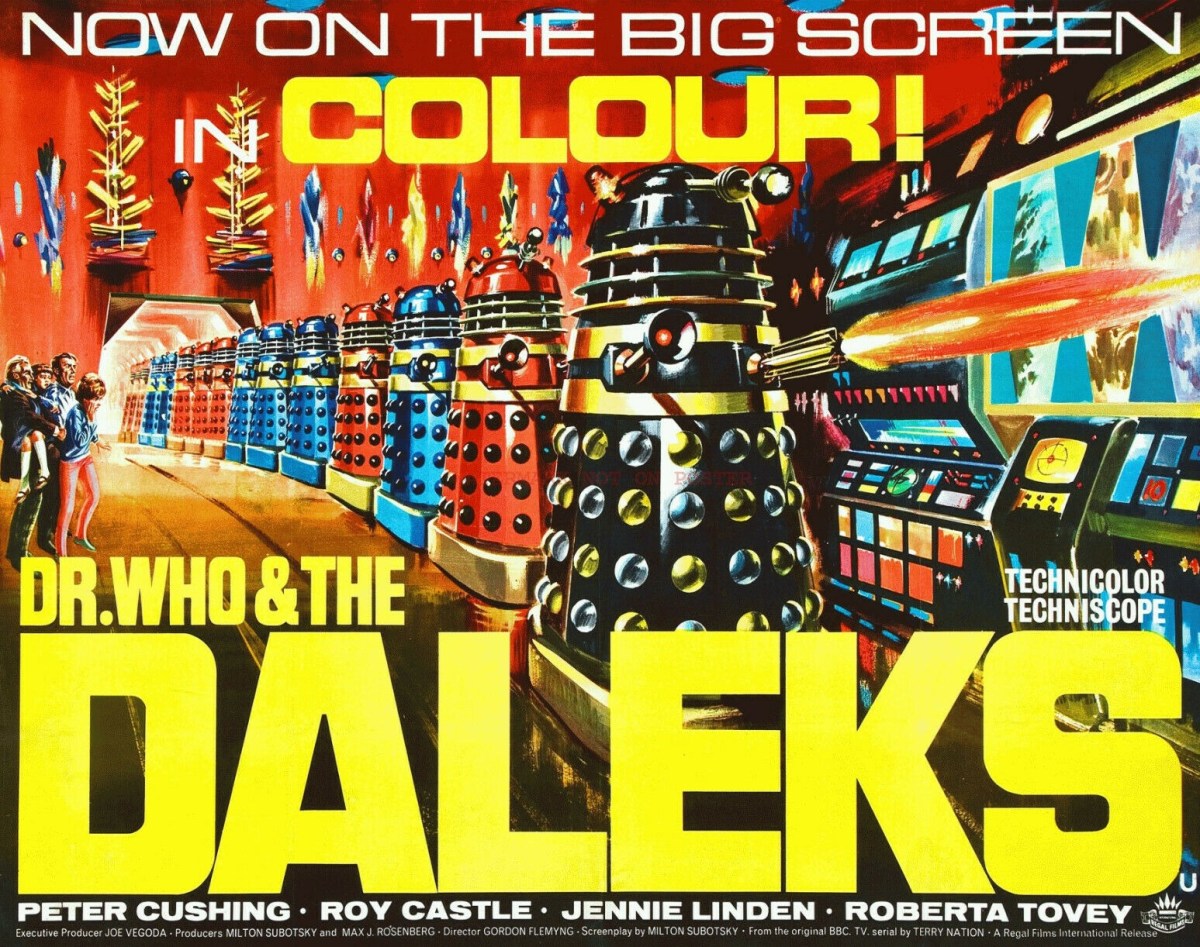
The maiden voyage of the time-travelling Tardis is triggered by some unexpected pratfall comedy. On board are the venerable doctor (Peter Cushing), his intrepid great-granddaughter Susan (Roberta Tovey) and a fearful pair, granddaughter Barbara (Jennie Linden) and accident-prone Ian (Roy Castle). They land on a petrified planet ruled by robotic Daleks with menacing electronic voices.
The malfunctioning Tardis forces them to investigate an abandoned city but they are quickly imprisoned, the steel robots determined to discover why the earthlings should be immune to the radiation that has consumed the planet after nuclear war. Meanwhile, the planet’s remaining inhabitants, the Thals, are planning an uprising.
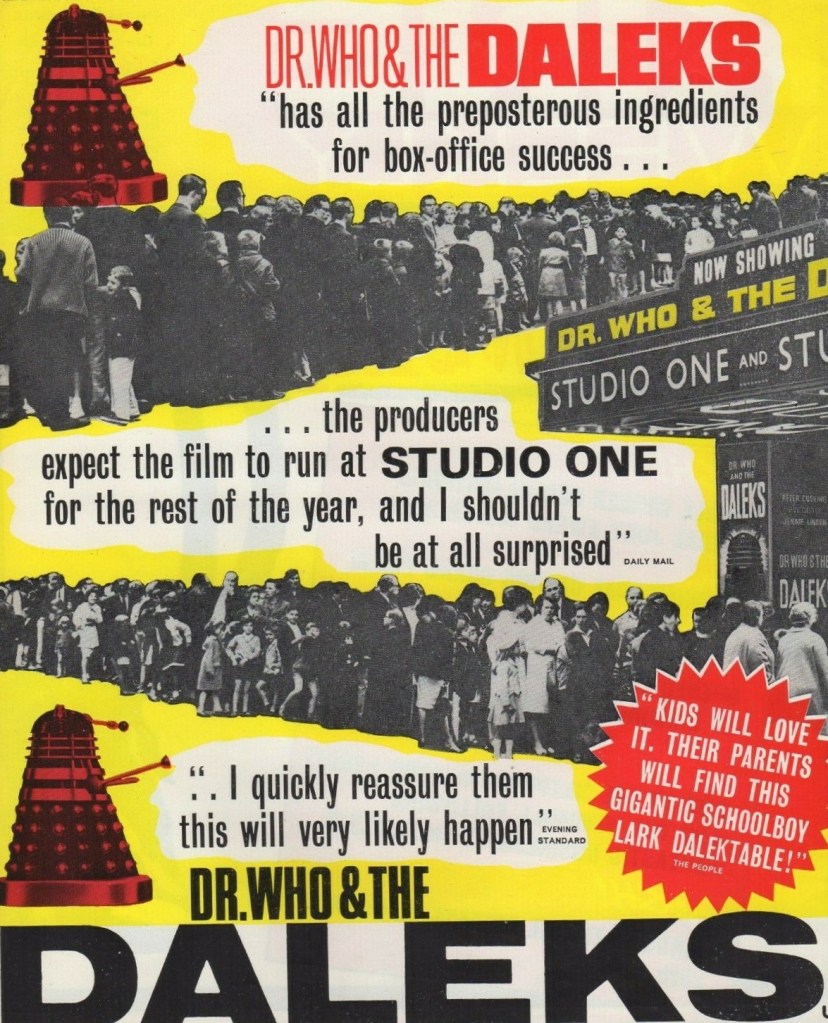
Studio One was one of the smallest cinemas in London’s West End and often used as the launch pad for Disney pictures.Limited capacity ensured that a hit film would run for months and the crowds queueing outside would attract the attention of other passersby.
Budget restrictions ensure that menace is limited, even as the characters endure a heap of traditional obstacles such as swamp and rocky outcrop. Adults who did not grow up in the 1960s when the BBC television series took Britain by storm and apt to come at this without the benefit of nostalgia will certainly look askance at the sets and costumes. And it doesn’t possess the so-bad-it’s-good quality of some 1950s sci-fi pictures. But since it was primarily made for children, then perhaps it’s better to watch it with a younger person and gauge their response – of course, that may be equally harsh from someone brought up on the modern version of the series or already immersed in superheroes.
On the plus side, it does move along at a clip. Roberta Tovey (A High Wind in Jamaica, 1965) charms rather than annoys as the plucky grand-daughter even if her grandfather has mutated from the sterner figure of the television series into an eccentric inventor. Peter Cushing (She, 1965) is only required to ground the production which he does adequately. The innate comic timing of Roy Castle, in his leading man debut, brings a light touch to proceedings as the bumbling boyfriend and generates some decent laughs. Jennie Linden (Women in Love, 1969) has little to do except look scared.
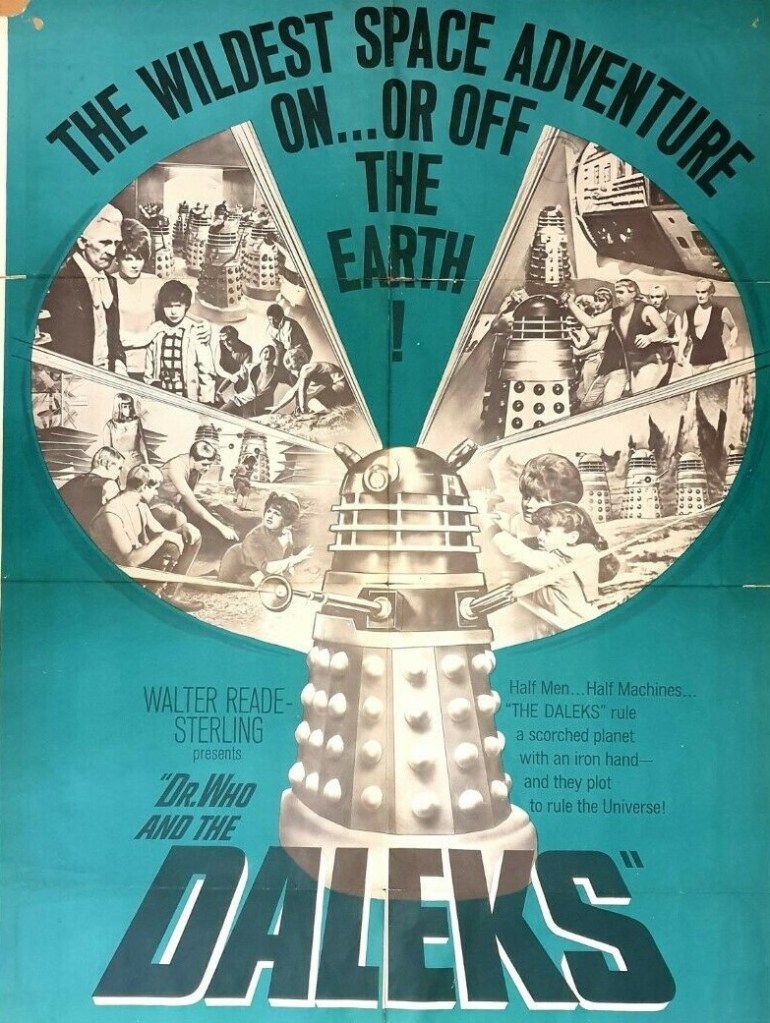
With no built-in audience, the U.S. distributors marketed it in typical fashion – “half men half-machine” – and possibly roped in a bigger adult audience unaware of its origins in children’s television.
Oddly enough, it was American Milton Subotsky who, in opportunistic fashion, brought the project to the big screen, although the BBC had a track record of providing product that might make such a leap, The Quatermass Experiment in the 1950s the leading example. He wrote the screenplay and acted as producer and had previously worked with Cushing on Dr Terror’s House of Horrors (1965) and was about to embark on horror masterpiece The Skull the same year. He has approached the material with some reverence and the fact that the budget allowed for hordes of daleks rather than being seen one or two at a time as on the television probably made some child’s day.
Scottish director Gordon Flemyng (The Split, 1968) would make the leap to Hollywood on the back of this picture and its sequel the following year and you can see what made studios have faith in his ability – he deals with multiple characters, works quickly on a low budget and delivers an attractive picture that was a box office hit.
I suspect that audiences will divide into those who watch the film with nostalgia-colored spectacles, those who think it only as good as a bad episode of Star Trek and those who adore any low-budget sci-fi movie.
Top-class cast and occasional stylish direction get in the way of a thriller that can’t make up its mind whether it is in reality just a spoof. On the one hand we have a killer in a white suit complete with straw boater and a secret service boss who sells Turkish Delight, on the other hand a story not so much from James Bond but from Bond imitators.
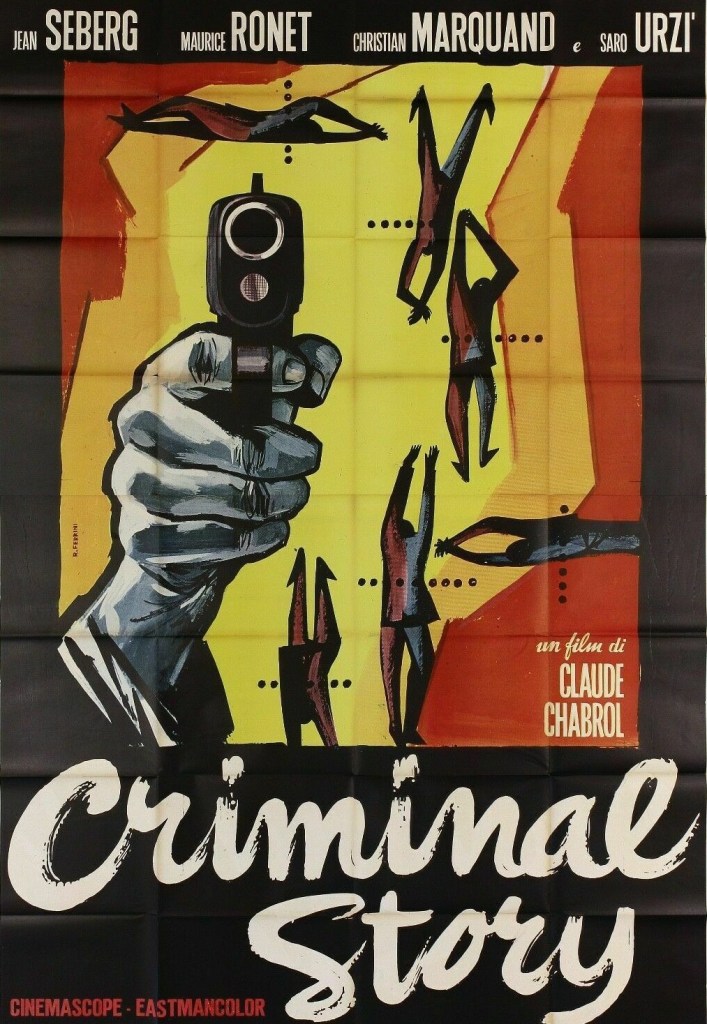
Agent Robert Ford (Christian Marquand) is on the trail of black boxes that prevent missiles launching. When wife Shanny (Jean Seberg) is framed for his murder she determines to uncover the real killer, aided by Dex (Maurice Ronet), and find the maker of the boxes.
But that’s an over-simplification of an over-complicated plot so it’s best to concentrate on the highlights. For example, when customs officials stop a magician they find white rabbits and doves in his vehicle and, despite severe interrogation, he can, magically, release himself from his bonds enough to swallow a concealed cyanide pill. Instead of the usual cute children that proliferate in these kind of films, there’s a really annoying one. Shanny, imprisoned, has to make dolls. Greek Orthodox priests play a significant role.
Throw in kinky secret service boss Sharps (Michel Bouquet) who relishes being slapped for his inappropriate overtures to Shanny, a porn film starring Madame Phiphi, the heroine dangled from a crane and later lashed down to a dumper, and a villain willing to give up his villainy for the love of a good woman.
But mostly it’s a picture in a rush. There are chases galore and nods to Hitchcock and lush Greek scenery.
It would be easy to assume that in eye-catching outfits Jean Seberg (Moment to Moment, 1966) is mostly there to provide eye candy but she does manage to outwit her pursuers from time to time although she seems equally to have a knack for being caught. Maurice Ronet (Lost Command, 1966), Christian Marquand (The Corrupt Ones, 1967) and especially Michel Bouquet (La Femme Infidele, 1969) bring an air of quality to the proceedings.
Apart from the occasional stunning image, this is not the Claude Chabrol (Les Biches, 1968) that lovers of his thrillers would expect.
There’s a print of this on Youtube. Amazon Prime has this for certain regions. Otherwise it will be Ebay.
Many liberties have been taken with the work of Alistair MacLean but there is little to match the arrogance of director John Sturges in deciding that the author’s original ending just wasn’t good enough. Setting aside the achievements of The Magnificent Seven (1960) and The Great Escape (1963), he was known for lapses of cinematic judgement, namely in switching completely the tone of The Satan Bug (1965) and assuming audiences shared his sense of humour with The Hallelujah Trail (1965).
According to Glenn Lovell, Sturges’ biographer, the director had “cringed” when presented with the Chayefsky screenplay, claiming the book had no “finish.” Closer, in Lovell’s words, to Agatha Christie than Ian Fleming. You have to ask if Sturges, or Lovell for that matter, had ever read Alistair MacLean’s astonishing tour de force of an ending.
The MacLean version climaxes in the submarine not on shore. And it takes to the ultimate the problems of confinement. You would have thought Sturges would have had little problem with the deadly incarceration of the MacLean climactic chapter given that had been a main element of The Great Escape, especially in the scenes with the claustrophobic Charles Bronson.
What Sturges passed up was what films like Das Boot (1981) later did so well – the sheer terror of being trapped underwater. MacLean’s book envisages the survivors of the fire at Ice Station Zebra rescued and returned to the submarine with the knowledge in the mind of David Jones (Patrick McGoohan in the film) that among them is a murderer, a Russian spy who caused the fire. The vessel is then subjected to further sabotage. A fire in the engine room causes the submarine to stop. That in turn causes the temperature to plummet, leaving the men in an “ice cold tomb.” Worse, they are running out of oxygen. Carbon monoxide is poisoning the atmosphere. In a short time a hundred will be dead. And to top it all, they have lost their bearings, the compasses don’t work, they are going round and round in a circle.
Can you imagine the possibilities? Absolute chaos. Not just thick acrid smoke everywhere, men strewn unconscious, the fire still burning, panic, terror. A submarine that was slowly becoming an underwater grave with still a killer on the loose.
Sturges could not imagine the possibilities. Perhaps he had not read the book either and Chayefsky had skipped through that part of the novel to get to the “trial,” the uncovering of the traitor that had been deemed too much like Agatha Christie. But The Guns of Navarone, one of the most successful movies of all time, had enjoyed a similar scene, when a surprise traitor was unmasked.
The ending Sturges slapped on the picture had its genesis in a couple of lines from the book where the British secret agent explained that Russian airplanes had come to the Arctic in the guise of helping the rescue but in reality looking for the film from the satellite. All the stuff about the new type of camera being stolen by the Russians and of film containing sensitive information about American missile sites needing to be recovered had come from the book. In the MacLean version, the traitor would dump the film out into the sea via the sub’s garbage chute but tagged with a floating device and a yellow marker so it could be picked up by a Russian vessel.
Instead, Sturges went for some kind of direct confrontation with the Russians, a shoot-out on the ice. It seemed a mighty odd decision, given the opportunities in 70mm Cinerama for a full-scale panic on board an immobilised submarine drifting to its doom.
In order to make his version work, Sturges had to draft in a squad of marines eventually led by Capt Anders (Jim Brown). The introduction of Russian defector Boris Vaslov (Ernest Borgnine) makes less sense, especially as, snooping around the submarine, he is obviously up to no good, but that might be for sound cinematic reasons since otherwise the traitor would only turn up once the movie reached Zebra and even then would need to come to the fore for some obvious reason.
Interestingly, the screenplay omits one element. Heading the Zebra Arctic operation is the older brother of the British secret agent, giving him a secondary reason for his mission, and the potential for emotional reaction on finding his sibling dead.
Sometimes screenwriters just seem to earn their keep by changing names for no apparent reason. So the book’s Commander Swanson becomes Ferraday (Rock Hudson) and British agent Dr Carpenter is renamed David Jones minus medical degree. All the initial sabotage comes from the fertile mind of the author and long before Tom Clancy, beginning with The Hunt for Red October, invented a brand-new publishing genre concentrating on military detail, MacLean reveals an extraordinary grasp of every detail of a nuclear submarine, the Arctic, the weather and what exactly might go wrong from a fire on board or should the vessel lose speed.
Neither would you recognise Rock Hudson in MacLean’s description of the submarine commander as “short, plump…(and) a pink cherubic face.” MacLean’s British agent is less arrogant and acerbic, keeps much more to himself, revealing his character at appropriate moments spaced through the book, than does the film’s David Jones. That Dr Carpenter, the narrator, knows massive amounts about everything means that he does not need to showboat like the filmic David Jones to prove he is in charge.
The book is a turbo-charged thrill ride. That the final piece of sabotage and its consequences last nearly 50 pages is proof of MacLean’s skill as a page-turner. Much as I enjoyed the film as it stands, it’s just a shame that Sturges did not follow the author into his astonishing climactic sequences.
After the publication of Ice Station Zebra in 1963, Alistair MacLean’s adoring public had to wait three years for its successor – When Eight Bells Toll. As he done before, the author just quit. But unlike the previous disappearing act, when he continued to produce books under the pseudonym of Ian Stuart, this time nothing came down the prolific pipeline. The goose had laid its last golden egg.
After a five-year tax exile in Switzerland, MacLean had returned to Britain in 1962, setting up home first in Farnham, Surrey, followed by a brief hiatus in Ireland before settling down in a Georgian mansion with a two-acre estate in Haslemere, Surrey.
Film tie-in paperback of what might have been Alistair MacLean’s final book.
But as he delivered the manuscript of Ice Station Zebra to publisher Ian Chapman of Collins, he dropped a bombshell. He had made more than enough money. He was fed up with the high-and-mighty attitude of his editors. He was depressed by the sales of Fear Is The Key, which had been a writing breakthrough for him. He had written his last book. Now he was going to become a hotelier and to that end had bought the famous Jamaica Inn plus Bank House at Worcester and the Bean Bridge Hotel in Somerset.
The 400-year-old inn, immortalized by the Daphne Du Maurier book and Alfred Hitchcock film, was a solid going concern, takings from accommodation and food augmented by income from three bars and a souvenir shop. MacLean was a hands-on manager and felt immediately more at home dealing with real people than sitting in a lonely room pounding out his fiction. He had come to the conclusion that writing novels was “not a moral way of earning money.”
In dreaming the dream, he was especially particular, having inspected over 100 hotels before plumping for Jamaica Inn. He had the idea that hotel-keeping was in his blood. His younger brother Gillespie was a hotelier and since he could not afford a hotel of his own Alistair had bought him one near Fort William. Gillespie, however, was less than enthusiastic about the notion of operating three hotels far apart, and doubted his brother’s skills. Alistair showed little aptitude for running a business. He failed to understand the importance of stock-taking and before he could get to grips with the basics had already invested in a beer-making operation.
In despair he turned to his older brother Ian who was a high-flyer at Shell. Sensibly, Ian did not give up the day job but trying to keep an eye on a failing enterprise proved impossible. Alistair lacked people-management skills and was a poor judge of character. It was no surprise the hotels failed to flourish.
That Alistair MacLean returned to writing at all was the result of a leap of faith by producer Elliot Kastner who had parlayed $1,000 for the rights to Ross MacDonald novel The Moving Target and another $5,000 for a screenplay by William Goldman into a $3.3 million private eye picture Harper (1966) starring Paul Newman, along the way netting a cool half a million bucks for himself. In Britain to make Kaleidoscope (1966) with Warren Beatty, Kastner opened a production office at Pinewood. Aware that MacLean had no books to sell, his entire portfolio already snapped up and since his retirement nothing in the locker, he went down another route. He suggested MacLean write an original screenplay, offering $100,000 plus a share of the profits and the book rights.
Apart from the money they brought in, MacLean had not been too happy with Hollywood’s treatment of his novels. Richard Widmark had substantially altered The Secret Ways (1961), Carl Foreman had not only added characters to the film version of The Guns of Navarone (1961) but appeared to have appropriated the entire work and applied a possessive pronoun to the main title credits as if he had dreamed up the whole thing instead of just, as producer, putting the package together. The Satan Bug (1965), too, had been considerably changed and judging from the number of screenwriters hired for Ice Station Zebra, which had not gone before the cameras at this point, it was more than likely the producers had moved away from the Chayefsky treatment which MacLean had approved.
At least at the start, Kastner seemed trustworthy and his enthusiasm was flattering. After convincing the author that he had an ear for cinematic dialogue, and that his plots were ideal, Kastner handed MacLean some sample screenplays. Although MacLean was interested he told the producer he was too busy to commit right away. Assuming this was a reference to the hotels, Kastner was surprised to learn that, unbeknownst to Ian Chapman, MacLean had already renounced his retirement and was working on When Eight Bells Toll. A deal for Where Eagles Dare was struck on January 15, 1967. Eight weeks later MacLean delivered the screenplay.
Four years after apparently giving up writing forever, he had stumbled into a new career. And it wasn’t just Kastner queuing up to buy his work. Since “you can sell a picture just on the basis of his name,” Alistair MacLean remained a major attraction for filmmakers. By 1969 all 14 of his novels (up to Puppet on a Chain) had been bought for the movies, Ransohoff picking up the rights the previous year to The Golden Rendezvous, published in 1962, lining up MacLean for screenwriting duties. Another seven original screenplays, with book deals pending, had also been purchased by producers including two sequels to When Eight Bells Toll, a pirate tale Swashbuckler and a western Deakin (renamed Breakheart Pass).
He never quit again.
SOURCES: Jack Webster, Alistair MacLean (Chapmans, London, 1992 paperback) p118-132; “New York Sound Track,” Variety, My 8, 1968, p30; “Film Slump No Problem for Alistair MacLean,” Variety, p35.
Director John Sturges was not flying quite as high as when he had greenlit The Satan Bug. Since then two films had flopped – big-budget 70mm western The Hallelujah Trail (1965) and Hour of the Gun (1967). Two others had been shelved – Steve McQueen motor racing epic Day of the Champion and The Yards of Essendorf. But his mastery of the action picture made him first choice for Ice Station Zebra.
Independent producer Martin Ransohoff (The Cincinnati Kid, 1965) had snapped up the rights in 1964, initially scheduling production to begin the following spring. He financed a screenplay by Paddy Chayefsky (The Americanization of Emily, 1964). Judging by later reports MacLean appeared happy with the screenwriter’s approach, especially after being so annoyed with the way Carl Foreman had appropriated The Guns of Navarone. Ransohoff put together a stellar cast – The Guns of Navarone (1961) alumni Gregory Peck and David Niven plus George Segal (The Quiller Memorandum, 1966). But each wanted to act against type. Peck, having played a submarine commander in On the Beach (1959), wished the role of an American secret agent, Niven to play his British equivalent with Segal left to pick up the role of skipper. Then Peck objected to the way his character was portrayed.
Sturges, paid a whopping $500,000 to direct, was unhappy with the Chayefsky script commissioned by the producer so he hired Harry Julian Fink (Major Dundee, 1965) and W.R. Burnett (The Great Escape, 1963). But he hated the results so much he suggested MGM drop the entire project. That was hardly what Ransohoff, after forking out $650,000 on screenplays and $1.7 million on special effects, needed to hear. As a last resort, Sturges turned to Douglas Heyes (Beau Geste, 1966) who beefed up the Alistair MacLean story, completely changing the ending, introducing the U.S. vs U.S.S.R. race to the Arctic, and a bunch of new characters including those played by Jim Brown and Ernest Borgnine, who had previously worked together on The Dirty Dozen (1967).
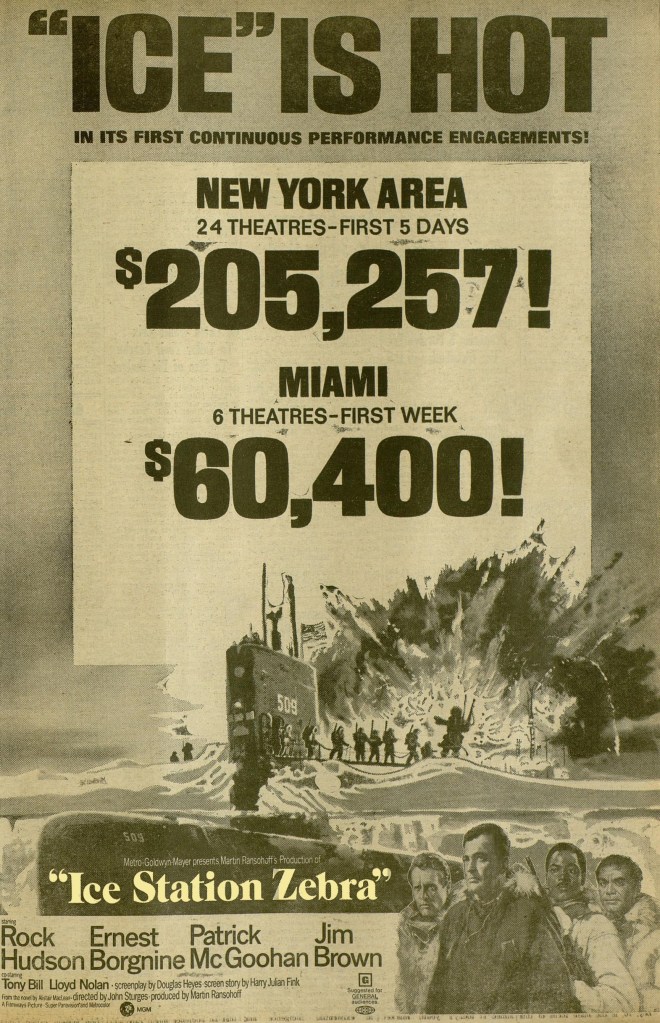
Six months after its roadshow engagement in New York, the picture went into general release in continuous performance.
After a string of flops, Hudson, celebrating his 20th year in the business, chased after the role of sub commander. Although it has been reported that Laurence Harvey briefly came into the frame for the part that went to Borgnine, I could find no record of that. Confusion may have arisen because in 1964 Harvey was prepping another MacLean picture, The Golden Rendezvous, which he planned to direct in the Bahamas. Having landed the major supporting role in Who’s Afraid of Virginia Woolf (1966), Segal was the casting coup before he, too, jumped ship.
British star Patrick McGoohan (Dr Syn, 1963) who had not made a movie in five years, was an unlikely candidate for the second lead. Sturges saw him as the next Steve McQueen. But his inclusion only came about because of the sharp increase in his popularity Stateside after fans had bombarded the networks to bring back the Danger Man (1964-1967) television series (renamed Secret Agent for American consumption) after it had initially underwhelmed. Increased public demand for the “old-fashioned hero with morals” became a feature of an advertising campaign. McGoohan received the accolade of a write-up in the New York Times. It seemed a cinch to have a denoted television secret agent star to play another spy in the film.
The all-male cast prompted the director to consider adding a hallucinogenic dream sequence involving women. Despite his penchant for action pictures, Sturges was a gadget nut and particularly interested in the space race, tracking by ham radio the launch of the Russian Sputnik 1, concerned that the Americans had been beaten. While moon landings remained some way off, the next battle for supremacy was nuclear submarines, of which Sturges was in awe.
Principal photography began in mid-June, 1967 and finished 19 weeks later. The $8 million budget topped out at $10 million. The non-nuclear U.S.S. Ronquil stood in for the book’s sub with U.S.S. Blackfin doubling in other shots. The vessel’s interiors dominated MGM’s soundstages with a 16ft superstructure as the centerpiece with hydraulics creating the tilting and rocking effects. Art director Addison Hehr’s commitment to authenticity saw his team buying real submarine effects from junk yards to fit out the interiors. The conning tower was almost as tall as a five-storey building and the submarine, built in sections, measured 600ft. The Polar landscape was created by draining the MGM tank, at the time the largest in Hollywood, of three million gallons of water and then mounted with snow and rocks and the burnt-out weather station.
While aerial shots of Greenland ice floes and fjords doubled for Siberia, to capture the wild ocean Sturges and cameraman John Stephens took a helicopter ride 30 miles out from the coast of Oahu where a 45-knot wind created “monumental” seas. A 10ft miniature in a tank permitted shots underwater and cameras attached to the Tronquil’s deck and conning tower achieved the unique sub’s-eye-view. The unconvincing Arctic landscape was shot on a sound stage.
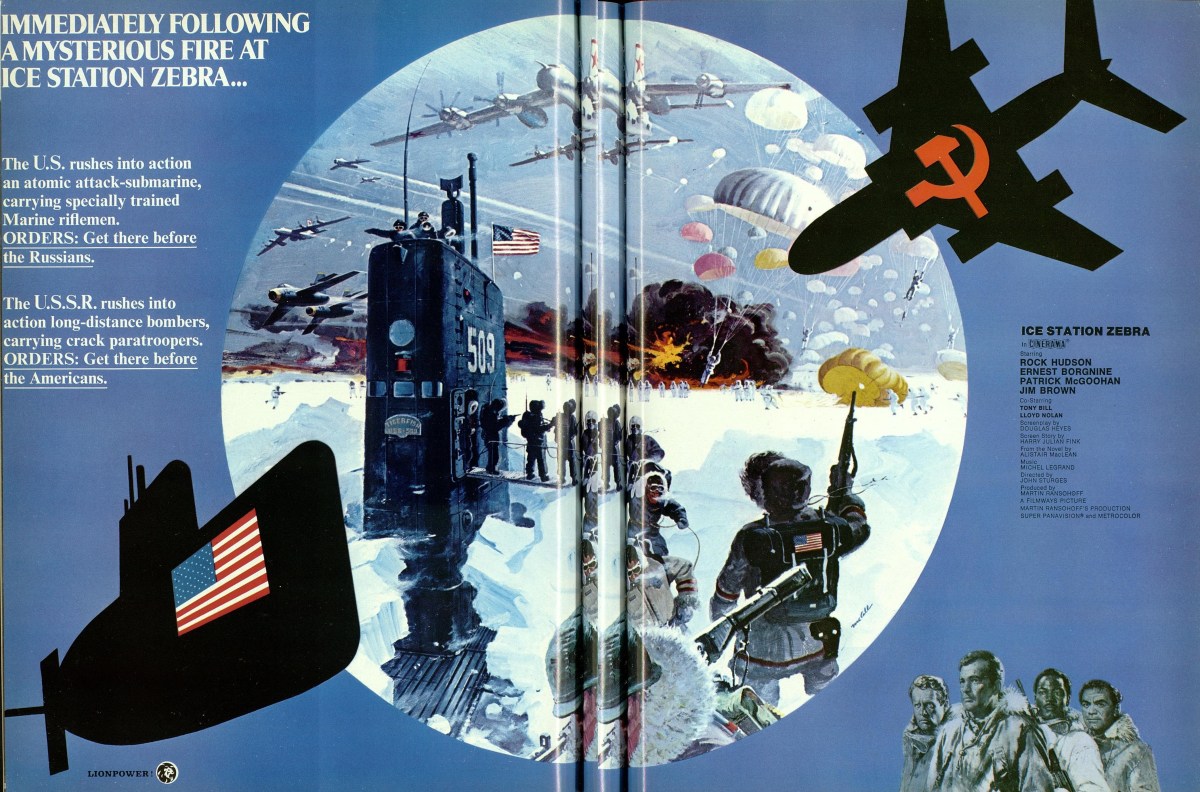
Early trade double-page advertisement (hence the lines in the middle).
Not only did screenwriter Douglas Heyes alter the original ending, but Sturges claimed improvisation was often the order of the day. “We made it up as we went along,” he said, “adding a whole bunch of gimmicks – the homing device, the capsule in the ice, the blowtorch…I don’t think it had any political significance. It just dealt with an existing phenomenon in an interesting way.” (Note: the homing device was in the original novel.)
A major hitch hit the planned roadshow opening in New York, essential to building up the brand. MGM proved reluctant to whisk 2001: A Space Odyssey out of the Pacific East Cinerama theater while the Stanley Kubrick opus was still doing so well. So it opened in the Big Apple on December 20, over two months after its world premiere at the Cinerama Dome in Los Angeles, where MGM had decked out the lobby with a submarine measuring 20ft long and 12 ft high. From the publicity point-of-view the delay was a drawback since New York critics – who attracted the biggest cinematic readership in the country – would not review the film until it had opened and should they take a positive slant their quotes would come too late for the national advertising campaign.
SOURCES: Glenn Lovell, Escape Artist, The Life and Films of John Sturges (The University of Wisconsin Press, 2008) p262-268; “Film in Focus, Ice Station Zebra,” Cinema Retro, Vol 17, Issue 51, 2021, p18-27; “Harvey Huddles with Maugham on Bondage,” Variety, May 15, 1963, p25; “New York Sound Track,” Variety, April 29, 1964, p18; “Ransohoff-Metro Prep Zebra Via Chayefsky,” Variety, January 20, 1965, p4; “Novelist, Producer Meet On Ice Station Zebra,” Box Office, April5, 1965, pNE2;“George Segal,” Variety, April 28, 1965, p17; Advertisement, Variety, April 20, 1966, p44-45; William Kirtz, “Out To Beat Bond,” New York Times, Jun 23, 1966, p109; “Ponti Seeks David Niven,” Variety, October 26, 1966, p3; “Cinerama Process for Metro’s Zebra,” Variety, May 17, 1967, p24; Advertisement, Variety, June 21, 1967, p8-9;“26 Probable Roadshows Due in Next Two Years,” Variety, January 17, 1968, p7; “Poor Ratings But Film Plums Going To Pat McGoohan,” Variety, July 3, 1968, p3.”Premiere Display Built for Ice Station Zebra,” Box Office, October 14, 1968, pW2; “Ice Station Zebra Frozen, No N.Y. Cinerama Booking,” Variety, October 23, 1968, p12; “Ice Station Zebra in World Premiere,” Box Office, Oct 28, 1968, pW1; “No Zebra Shootout in N.Y. , Gets 2001 Niche, Latter Grinds,” Variety, October 30, 1968, p3; “Filmways Stake in Ten Features for $55m,” Variety, November 20, 1968, p7.
John Sturges’ Alistair Maclean Cold War thriller, released within months of the more action-oriented Where Eagles Dare, twists and turns as Americans in a nuclear submarine and the Soviet Union race to the Arctic to retrieve a fallen space capsule containing a deadly secret. Thoroughly enjoyable hokum filmed in Cinerama 70mm with an earworm of a booming theme from Michel Legrand and mostly outstanding special effects.
Nuke sub Commander Ferraday (Rock Hudson), despatched from Scotland, and believing he is only on a last-gasp mission to the save scientists at a stricken weather station, is somewhat surprised to be forced to carry as passengers arrogant British secret service agent David Jones (Patrick McGoohan) and Russian defector Boris Vaslov (Ernest Borgnine), the former refusing to divulge the reasons for being on board. From the outset the vessel is afflicted by sabotage and the cruel ice. Tensions mount further as they reach the Ice Station Zebra weather station. Since so much depends on mystery in a MacLean thriller, any other revelations would amount to significant plot spoilers.
So while there’s more than enough going on among the various characters and a plot that shifts like a teutonic plate, it’s the submarine section that proves the most riveting, the dives exhilarating. The underwater photography is superb in part thanks to an invention by second unit cameraman John M. Stephens which could film for the first time a continuous dive. Whether the sub is submerging, surfacing, puncturing the ice or in danger of being crushed to smithereens, it’s the nuke that takes centre stage, a significant achievement in the days before CGI.
Not all the effects are quite so top-notch, there’s some dodgy back projection, and the Arctic rocks look fake, but in general, especially with streamlined control panels, jargon spat out at pace, and sub interiors that appear realistic, the result of two years research, it’s a more than solid job, delivering the core of a Saturday night action picture.
The absence of a giant Cinerama screen does not detract from the movie – though if you get the chance to see it in 70mm, as I once did, jump at it – because the Super Panavision cameras capture in enormous detail the bow spray, the massive icebergs, the gleaming intricacy of the controls, and even the sea parting under the weight of the sub creates astonishing visuals. And there’s something inherently dramatic in the commander slapping down the periscope.
Rock Hudson (Tobruk, 1967) is back to straightforward leading man duty after his departure into paranoia in Seconds (1966) and he is burdened with both a chunk of exposition and having to develop a stiff upper lip in response to the secret agent’s reluctance to take him into his confidence. He comes more into his own in the action sequences. The tight-lipped brusque provocative McGoohan (Dr Syn, 1963) clearly has a ball as mischief-maker-in-chief, keeping everyone else on tenterhooks. Ernest Borgnine (The Wild Bunch, 1969) invests his character with wide-eyed charm at the same time as the audience doubts his credentials. Jim Brown (The Split, 1968) has little more than an extended cameo as the Marines’ chief and in smaller roles you can also spot future Oscar-winning producer Tony Bill (Castle Keep, 1969) and veteran Lloyd Nolan (The Double Man, 1967).
This was the second MacLean adaptation for John Sturges (The Satan Bug, 1965) and he keeps a tighter grip on proceedings, a $10 million budget ensuring he could make the movie he envisaged, part-thriller, part-high adventure with well-orchestrated slugs of action.
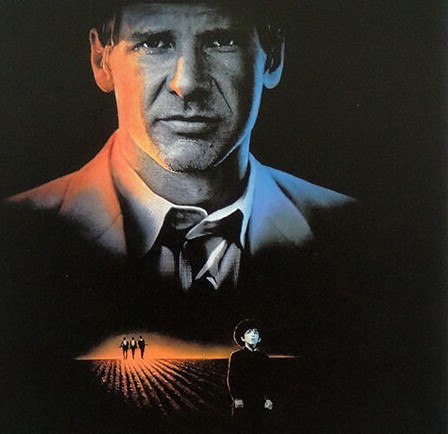
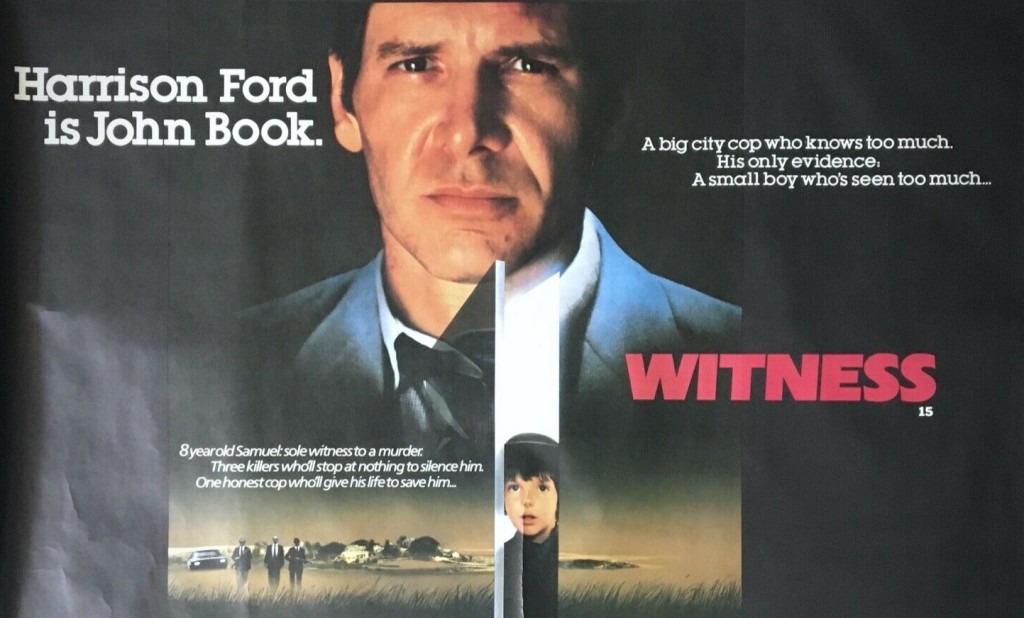
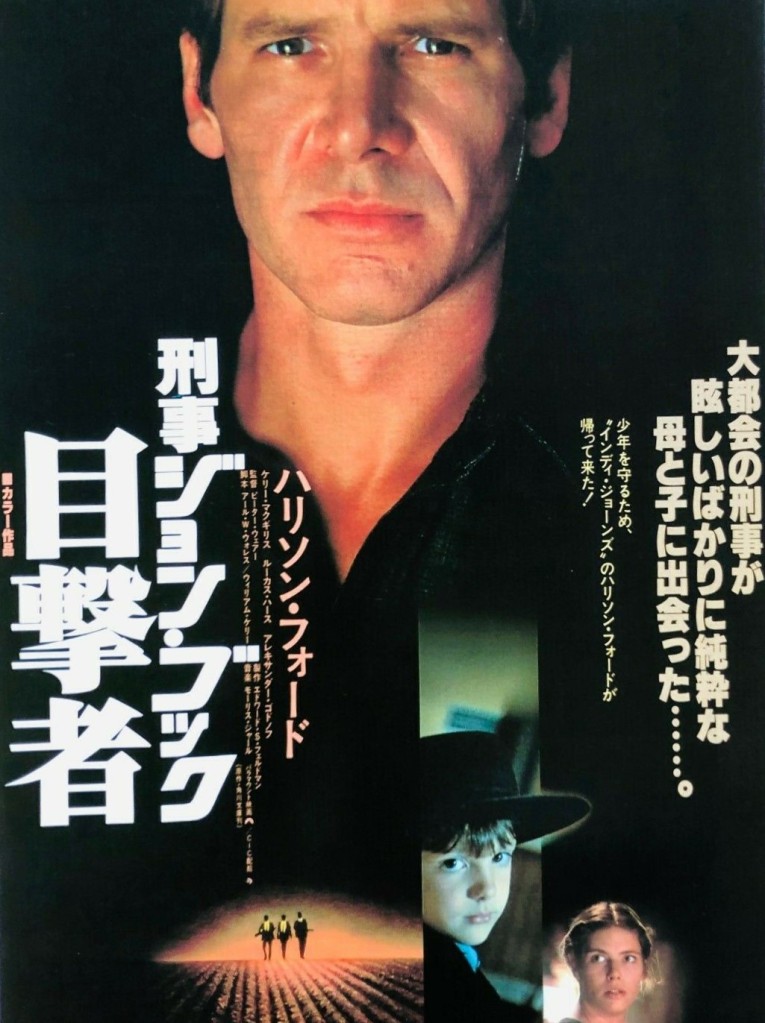
The Casablanca of the crime thriller, a stone cold classic in which impossible love takes precedence over unusual situation. In the Bogart-Bergman picture it is expatriates in war-torn North Africa, here a cop protecting an innocent boy hides out among the Amish. Like The Rock, this is so good the director makes the audience wait for a first sighting of the star while exploring the other main characters and the unique backdrop, in this case the customs and dress code of a religious cult that shuns the modern.
Adding to the paranoia rampant in American cinema in the 1970s/1980s is a further element – the hunted man or, in this case, boy. There’s no mystery in this thriller, 20 minutes in we know the culprit, involved in a criminal conspiracy so powerful it cannot be fought. And unlike the bulk of cop movies it’s not set in a city but in the country.
Just-widowed Rachel Lapp (Kelly McGillis) and eight-year-old son Jacob (Lukas Haas) set out by train to Philadelphia where the boy witnesses a brutal murder. Questioned by Detective John Book (Harrison Ford), we discover by accident the killer is cop Lt McFee (Danny Glover). Reaching out to trusted mentor Police Chief Paul Schaeffer (Josef Sommer) only to discover he is implicated, Book flees back to Amish country, where a gunshot wound prolongs his stay.
Distrusted as an uncouth “English,” liable to violence the Amish abhor, Book, with a range of carpentry skills, soon finds himself at home. Drawn to Rachel, passions simmer, but in this collision of cultures she cannot leave and he cannot stay. Without the cop background this would be a beautifully rendered love story, but the daily danger of the hidden being located heightens already tense emotions.
The examination of the Amish lifestyle is faultless. Transport is horse and cart, though sometimes that is with almost balletic assurance, there is no electricity, the community works together but threatens exclusion for disobeying strict rules. In compliance, Book dons the typical Amish outfit of plain black jacket and straw hat, buttons forbidden. And it is only when he breaks out of such strictures that his charges are threatened.
While the violence is powerful and when the time comes Book has a ruse or two up his sleeve, the most memorable scenes are as far removed from the crime thriller genre as possible. First is when Rachel enjoys a tentative forbidden dance with Book. Then there is the love scene where he watches her wash her naked torso, desire written over each face. Finally is building the barn where in quiet but obvious ways Rachel reveals her growing feelings for Book while with hammer and saw he helps put together the structure to the soaring strains of Maurice Jarre’s most magnificent composition.
Director Peter Weir (Dead Poets Society, 1989) excels in observation, a scene between Rachel and wooing farmer (Alexander Gudonov) takes place in silence, women whispering declaim attitudes to Rachel, her father Eli (Jan Rubes) waking Book before dawn, and several scenes of meals. Since restraint is the watchword, Weir draws exceptional performances from both principles, Harrison Ford (Blade Runner, 1982) receiving his only Oscar nomination, McGillis (Top Gun, 1986) nominated for a Bafta, likewise her only recognition at this rarified strata. Josef Sommer (Silkwood, 1983) is good as the ruthless but tormented corrupt cop, and both ballet dancer Alexander Gudonov and Viggo Mortensen (Green Book, 2018) make Hollywood debuts. Lukas Haas is as wide-eyed as they come.
Although nominated for eight Oscars, including Best Picture, Director and Music, it only picked up two, for editing and for an outstanding screenplay by William Kelley and Earl W. Wallace, both known almost exclusively as television writers.
An authentic, heartbreaking, multi-layered, adult picture like this is very hard to come by.
The cult of Ed Wood has a lot to answer for. A complete chapter is no doubt devoted to him in the history of the so-bad-it’s-good genre. His masterpiece, if you would call it that, was Plan 9 for Outer Space (1957) but more likely these days to attract attention for the cross-dressing Glen or Glenda (1953). Johnny Depp embellished the legend in the 1994 Tim Burton biopic.
Even so, little can prepare you for the likes of Orgy of the Dead, nowadays sold on Wood’s name, but to which he only contributed the screenplay based on his own novel. Not that, given his mesmeric incompetence, he would have done any better in front of the camera. It’s trash, but it’s a hoot, especially when The Mummy (Louis Ojena) and the The Wolfman (John Andrews) enter proceedings in costumes that would have been ridiculed on the domestic Halloween scene.
Bob (William Bates), a horror writer seeking inspiration, and girlfriend Shirley (Pat Barrington), drive out in the country. When their car crashes they end up in a cemetery and tied to stakes watch the dead, ruled by the Emperor (Criswell), come to life. Except the departed all look as they are auditioning for a job in a strip club. So what you get is one scene after another of nearly-naked girls gyrating for the camera. That’s pretty much it, until the sun comes up and the obvious occurs.
This marked the directorial debut of A.C. Stephens whose company Astra had started off with different intentions, buying up the rights to five films by French comedian Fernandel which would have been destined for arthouses. Criswell was a famed seer, appearing on countless television programs, who predicted the death of President Kennedy. Ed Wood – or Edward D. Wood Jr as he was known then – had made a television series Criswell Predicts (1953) and Criswell acted as narrator of Plan 9 from Outer Space.
Given the battles Hollywood had with introducing snippets of nudity in the 1960s I wondered how such blatant nudity got through the censor. Well, quite easily actually. Films with such high skin quotients simply did not apply for a rating. The Production Code was a self-funded censorship scheme operated by the studios. They submitted their films to this board and received an official rating. But if you did not submit your picture – foreign filmmakers also got round the censor by not applying – you didn’t get a rating and unless some officious local censor came after you then the pictures would play wherever cinemas would book them.
The case against wholesale nudity, such as the plethora of nudist camp movies that appeared in the 1950s, was torn apart by a ruling from the New York Court of Appeals in 1957 which declared, in relation to Garden of Eden (1954), that “nudity in itself” was not covered by “obscenity in law.” That opened the door for the likes of Russ Meyer and The Immoral Mr Teas (1959).
The drawback for moviemakers entering this new subgenre was the lack of movie houses willing to show such films. Arthouses that might take a racy Ingmar Bergman or Fellini drew the line at treating their patrons to such overt fare, although The Orgy at Lil’s Place (1963) set records at the 390-seat World arthouse in New York where it ran for 29 weeks taking an average $10,000 per week at a time when tickets cost around a dollar.
Tracking box office figures through Variety, I was surprised to discover that some major cinemas in major cities were happy to screen Orgy of the Dead. It played in Chicago at the 1,100-seat Monroe and pulled in a “merry” $6,000 in a double bill with Jungle Street Girls (1960) which, despite the title, was a B-picture crime drama starring David MacCallum and then-wife Jill Ireland.
Orgy of the Dead was far more popular in Boston where it played both the 1,909-seater Pilgrim and the 625-seat arthouse Symphony Two. In its first outing at the Pilgrim it collared $5,500, returning six months later supported by nudist feature Adam Lost His Apple (1965) to pull in another $5,000. It made more – $6,200 – on its third appearance there after another six months. Following that it ran for two weeks at the Symphony in a double bill with Russ Meyer’s Lorna (1964) for a grand total of just under $5,000.
SOURCES:Variety box office figures – December 14,1966, August 17 1966, February 1 1967, August 23 1967, October 4 1967, October 11 1967; “NY Art Sites Favor U.S. Pix,” Variety, May 12, 1965, p155; “Astra Gets Rights to Five Fernandel Films,” Variety, September 1, 1965, p16.
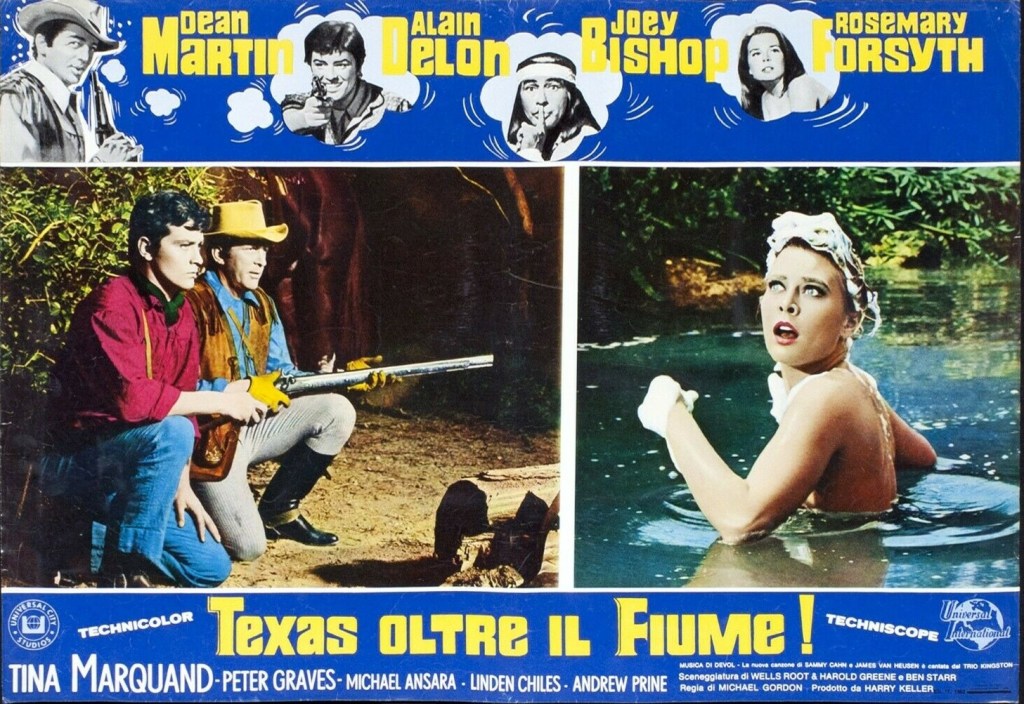
Excellent comedy western mixing dry wit and occasional slapstick to joyous effect. The wedding between Spanish duke Don Aldrea (Alain Delon) and Louisiana belle Phoebe (Rosemary Forsyth) is interrupted by her previous suitor Yancy (Stuart Cottle) who is killed in the resulting melee. Escaping to Texas, Don Aldrea’s marksmanship leads settler Sam (Dean Martin) to recruit him to help fight raiding Commanches. Romantic entanglement ensues when the Don rescues Native American Lonetta (Tina Marquand) and Sam has more than a passing interest in Phoebe.
It is so tightly structured that nothing occurs that doesn’t have a pay-off further down the line. Bursting with terrific lines – including a stinger of a final quip – and set pieces, it pokes fun at every western cliché from the gunfight, the cavalry in hot pursuit, and fearsome Native Americans to the snake bite and the naked bathing scene. Incompetence is the order of the day – cavalry captain Stimpson (Peter Graves) issues incomprehensible orders, chief’s son Yellow Knife (Linden Chiles) cannot obey any.
The Don, with his obsession with honor and his tendency to kiss men on the cheeks, is a comedy gift. Despite his terrific head of hair, he is stuck with the moniker “Baldy” and every time he is about to save the day he manages to ruin it. Sam is the kind of guy who thinks he is showing class by removing his spurs in bed while retaining his boots. His sidekick Kronk (Joey Bishop), a mickey-take on Tonto, mostly is just that, a guy who stands at the side doing nothing but delivering dry observations.
Lonetta is full of Native American lore and has enough sass to keep the Don in his place. “What is life with honor,” he cries to which she delivers the perfect riposte, “What is honor without life?” Phoebe is a hot ticket with not much in the way of loyalty.
Two sequences stand out – the slapping scene (whaat?) and a piece of exquisite comedy timing when Sam, Phoebe and the Don try an iron out a complicated situation.
Good as Dean Martin (Rough Night in Jericho, 1967) is the picture belongs to Alain Delon (Once a Thief, 1965) and I would argue it is possibly his best performance. Never has an actor so played against type or exploded his screen persona. Delon was known for moody, sullen roles, cameras fixated on his eyes. But here he is a delight, totally immersed in a role, not of an idiot, but a man of high ideals suddenly caught up in a country that is less impressed with ideals. If he had played the part with a knowing wink it would never have worked.
Martin exudes such screen charm you are almost convinced he’s not acting at all, but when you compare this to Rough Night in Jericho it’s easy to see why he was so under-rated. Joey Bishop (Ocean’s 11) is a prize turn, with some of the best quips. Rosemary Forsyth (Shenandoah, 1965) is surprisingly good, having made her bones in more dramatic roles, and Tina Marquand (Modesty Blaise, 1966) more than holds her own. Michael Ansara (Sol Madrid, 1968) played Cochise in the Broken Arrow (1956-1958) television series. Under all the Medicine Man get-up you might spot Richard Farnsworth. Peter Graves of Mission Impossible fame is the hapless cavalry leader.
Director Michael Gordon (Move Over, Darling, 1964) hits the mother lode, the story zipping along, every time it seems to be taking a side-step actually nudging the narrative forward. He draws splendid performances from the entire cast, knowing when to play it straight, when to lob in a piece of slapstick, and when to cut away for a humorous reaction, and especially keeping in check the self-indulgence which marred many Rat Pack pictures – two of the gang are here, Martin and Bishop. There’s even a sly nod to Sergio Leone spaghetti westerns when the electric guitar strikes up any time Native Americans appear. Frank De Vol (Cat Ballou, 1965) did the score.
If you’ve not already come across Cinema Retro magazine – now celebrating 18 years of publication – or its various Special Issues you are in for a treat. Spy Girls fell under its “Foto Files Special Edition” portfolio and includes over 200 illustrations of the actresses who dominated the wave of espionage pictures in the 1960s and to a lesser extent the 1970s.
As well as focusing on the leading female stars in every series film – James Bond, Derek Flint, Matt Helm, Bulldog Drummond, The Man from Uncle and Harry Palmer – the magazine also pay tribute to the wide variety of starlets who appeared in bit parts such as Zena Marshall (Dr No, 1962), Aliza Gur (From Russia with Love, 1963), Shirley Eaton and Margaret Nolan (Goldfinger, 1964) Molly Peters (Thunderball, 1965) and Gila Golan (Our Man Flint, 1966).
However, in the main the concentration is on the flood of European actresses who set Hollywood agog following multiple appearances in spy pictures. Beginning with original Swiss-born Bond girl Ursula Andress (Dr No and Casino Royale, 1967, the magazine features every actress who had a starring role in the mainstream spy films. Some, of course, seemed very comfortable in the genre with roles in several pictures.
Leading that particular parade were Italian Daniela Bianchi who, after her spy debut in From Russia with Love, was seen in Slalom (1965), Operation Gold (1966), Special Mission Lady Chaplin (1966), Requiem for a Secret Agent (1966) and Operation Kid Brother (1967). Matching her was Austrian Senta Berger, caught in The Secret Ways (1961), The Spy with My Face (1965), Our Man in Marrakesh (1966), The Quiller Memorandum (1966), The Ambushers (1967) and Istanbul Express (1968).
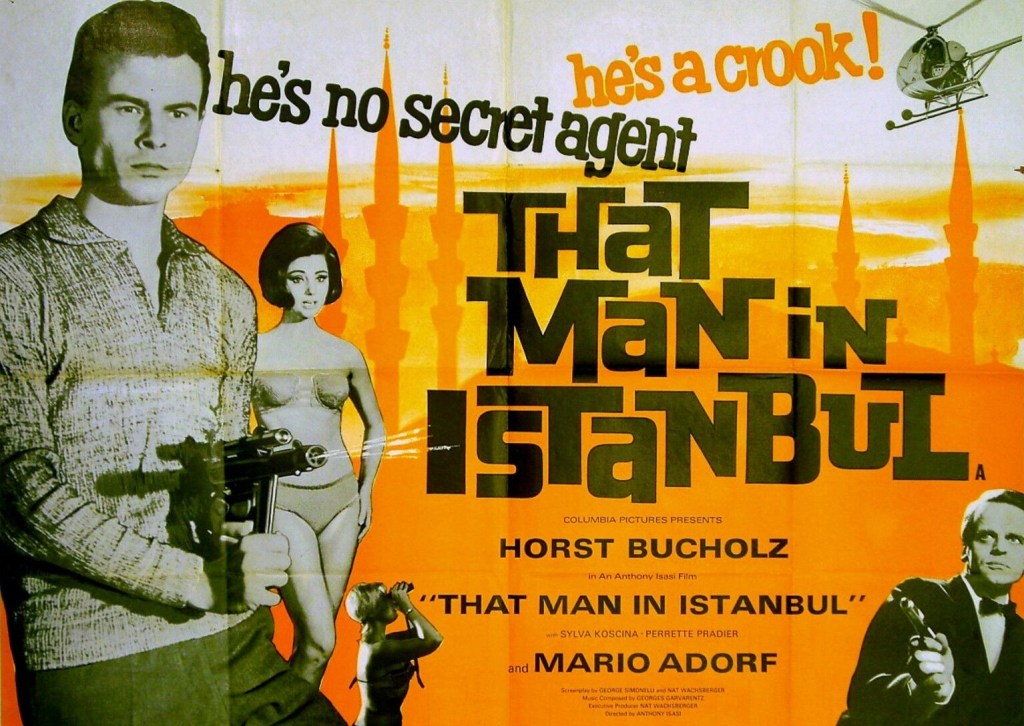
Not far behind came Israeli Daliah Lavi who lit up the screen in The Silencers (1966), The Spy with a Cold Nose (1966), Casino Royale (1967), Nobody Runs Forever (1968) and Some Girls Do (1969). German Elke Sommer was another regular, headlining The Venetian Affair (1967), The Corrupt Ones (1967), Deadlier than the Male (1967) and The Wrecking Crew (1968.) Also a regular in the genre was Yugoslavian Sylva Koscina with Hot Enough for June/Agent 8¾ (1964), That Man in Istanbul (1965), Agent X-77 Orders to Kill (1966) and Deadlier than the Male (1967)
Canadian Beverly Adams featured three times in the Matt Helm series, in The Silencers, Murderers Row (1966) and The Ambushers (1967). Czechoslovakian Barbara Bouchet turned up in Agent for H.A.R.M (1966), Casino Royale and Danger Route (1967) and Austrian Marisa Mell had top roles in Masquerade (1965), Secret Agent Super Dragon (1966) and Danger:Diabolik (1968). Another three-peater was Rome-born Luciana Paluzzi – To Trap a Spy (1964), Thunderball (1965) and The Venetian Affair (1967) – not forgetting Swede Camilla Sparv in Murderers Row (1966), Assignment K (1968) and Nobody Runs Forever (1968).
No study on the girls involved in espionage over these two decades would be complete without mention of Raquel Welch for Fathom (1967), Monica Vitti in Modesty Blaise (1966), Honor Blackman in Goldfinger and Britt Ekland in The Man with the Golden Gun (1974). The occasional American leavened the pot – Jill St John appearing in The Liquidator (1966) and Diamonds Are Forever (1971) and Lana Wood also in the latter.
The extensive illustrations include stills, and photographs of the stars relaxing on set or setting up a shot, as well as a veritable archive of posters from virtually every country in the world, often with substantially different artwork to the originals. In addition, articles on the main actresses are included as well as snippets of information on the lesser stars.
Priced at just £6.95 / $11.99 this might make a nice Xmas filler.










 The Magnificent 60s