I am a published author of books about film - over a dozen to my name, the latest being "When Women Ruled Hollywood." As the title of the blog suggests, this is a site devoted to movies of the 1960s but since I go to the movies twice a week - an old-fashioned double-bill of my own choosing - I might occasionally slip in a review of a contemporary picture.
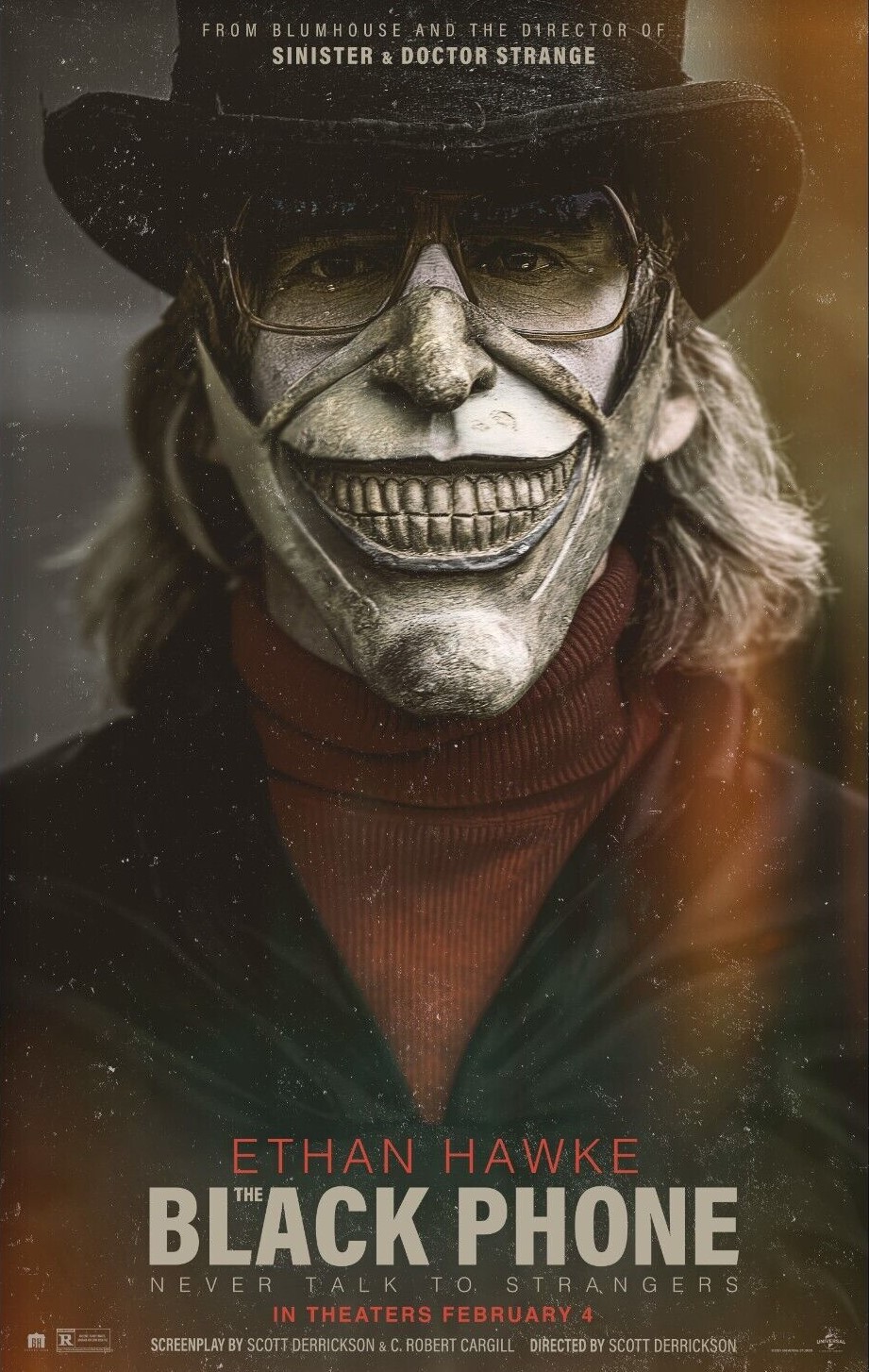
Most original horror film since Jordan Peele’s Get Out (2017) and sharing that film’s ability to throw the audience off guard by constantly twisting expectations and slowly taking its time to reach an incredible denouement. Be warned, though, it is about child abuse and some of the scenes come down to the knuckle. But it is also, surprisingly, a coming-of-age picture.
In 1978 in a Denver suburb, Finney (Mason Thames) and younger sister Gwen (Madeleine McGraw) live with widowed alcoholic father (Jeremy Davies), prone to beating his kids with a belt. Although bullied by classmates, Finney always picks himself up. Gwen has dreams which may be real – her mother committed suicide after similar visions.
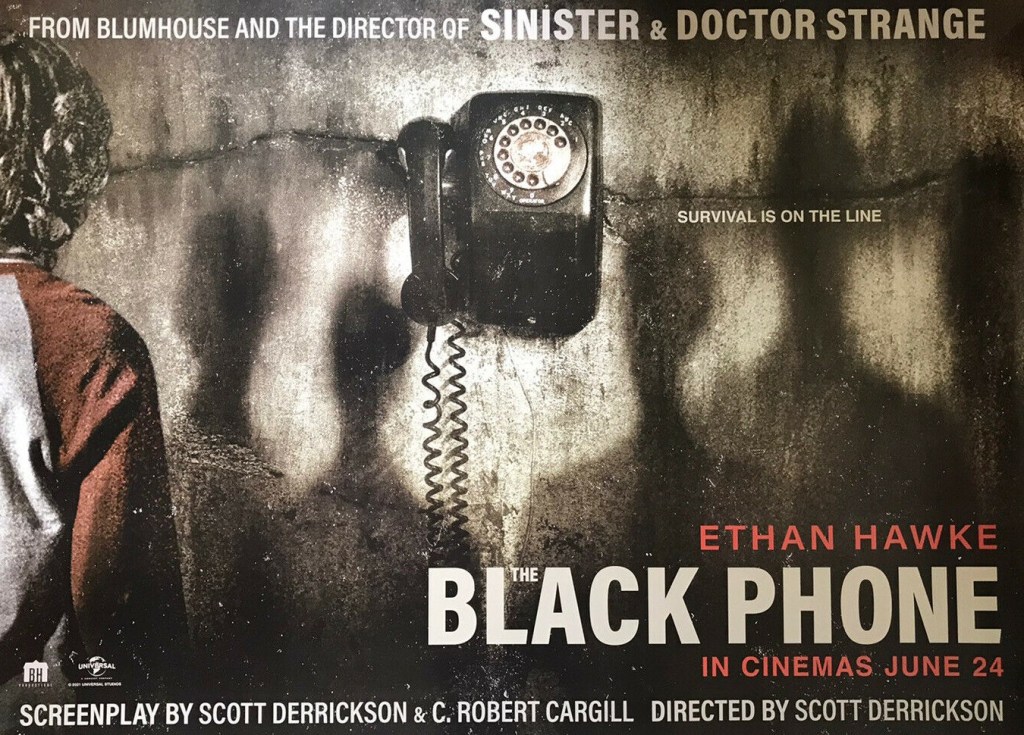
When Finney becomes the latest victim of masked serial child kidnapper The Grabber (Ethan Hawke) he finds himself trapped in a basement, empty except for a mattress and a phone that doesn’t work. The cops are baffled. Gwen attempts to reach her brother through dreams. When the phone mysteriously does ring it’s always one of the Grabber’s five previous victims offering practical escape advice. At the top of the stairs a half-naked masked Grabber sits in a chair gripping a leather belt waiting for his captive to become “naughty” so he can be punished.
I’m going to be in spoiler alert country if I tell you anymore but if you’ve seen the trailer be aware that’s far from the whole story. Part of what makes this so good is how realistic is the portrayal of the kids and the venal world they inhabit. They have no defence against the brutal father and in some respects expect adults to behave in horrific fashion. A boy who Finney helps with schoolwork acts as his protector but when he is kidnapped the bullies take revenge, handing out a bloody beating. Although brother and sister are close, there are few limits to their teasing. And Gwen has the lip of an adult in taking on a couple of unwary cops.
All the time you are left guessing. Is the Grabber behind the phone calls? Is it another of his elaborate games? Does he intend to offer escape, only to snatch it away? Can Gwen summon up spirits at will or will she flounder helplessly trying to save her brother. And if he disappears for ever, what prospect could be worse than living with her awful dad? Have the snippy cops got any leads at all? The father’s not out helping the hunt for his boy, so it possible he’s involved, especially since he wields a belt similar to the killer? Is Max, the visitor from out of state, possibly the killer, even though he appears to be a harmless cocaine-sniffing conspiracy nut?
And if five previous victims are gone, presumed dead, what chance has Finney, a vulnerable kid if ever? His protector was a very tough kid, one capable of beating a bully to a pulp, and if he can’t survive the kidnapping what chance does Finney have?
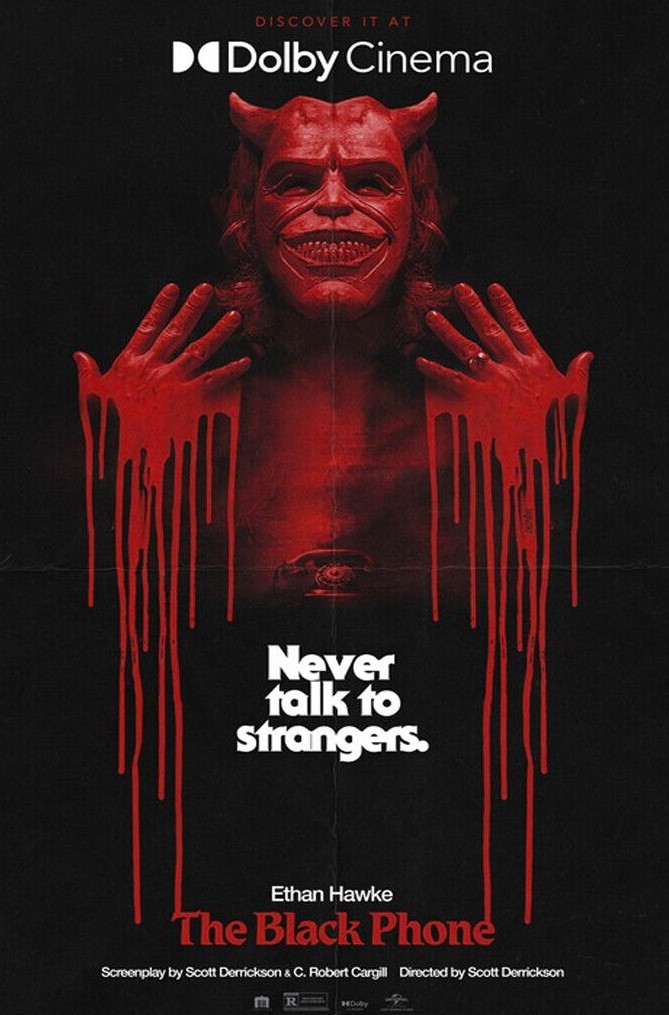
Over it all is the malevolent presence of the Grabber who wears two-piece masks (with devilish horns and long chin) that show different parts of his face but never the whole, who sometimes just sounds like a guy who has lost his way and means no real harm, if only he could sort out what’s gone wrong. His kidnapping ploy is to drop his shopping on the sidewalk and hope a nice kid is going to help, especially as he is a magician with a stack of black balloons, the kind of conjurer who might appeal to an edgy teenager who thinks The Texas Chainsaw Massacre the greatest film ever made.
Jump-out-of-your-seat shocks are few but this is a rare horror movie that has little reliance on such tricks. Tension is maintained with magnificent ease.
Mason Thames (Walker TV series 2021) and Madeleine McGraw (Secrets of Sulphur Springs, 2021-2022) are terrific as the kids, not putting a foot wrong as they move in the sometimes inexplicable adult world, but sharpening their teeth on vicious childhood. Sure the mask does a lot for Ethan Hawkes (The Northman, 2022) but his voice and his movements do the rest and this is a bold part to take on, way out of his comfort zone. Jeremy Davies (The House That Jack Built, 2018) is every bit as creepy.
While Scott Derrickson has dipped his foot into horror (The Exorcism of Emily Rose, 2005.) and for that matter the supernatural (Doctor Strange, 2016) before, he has never done so with such distinction, reining in the shocks in favour of escalating tension, never shifting focus away from the kids. He co-wrote the screenplay with Doctor Strange collaborator Robert Cargill based on the short story by Joe Hill (Horns, 2013).
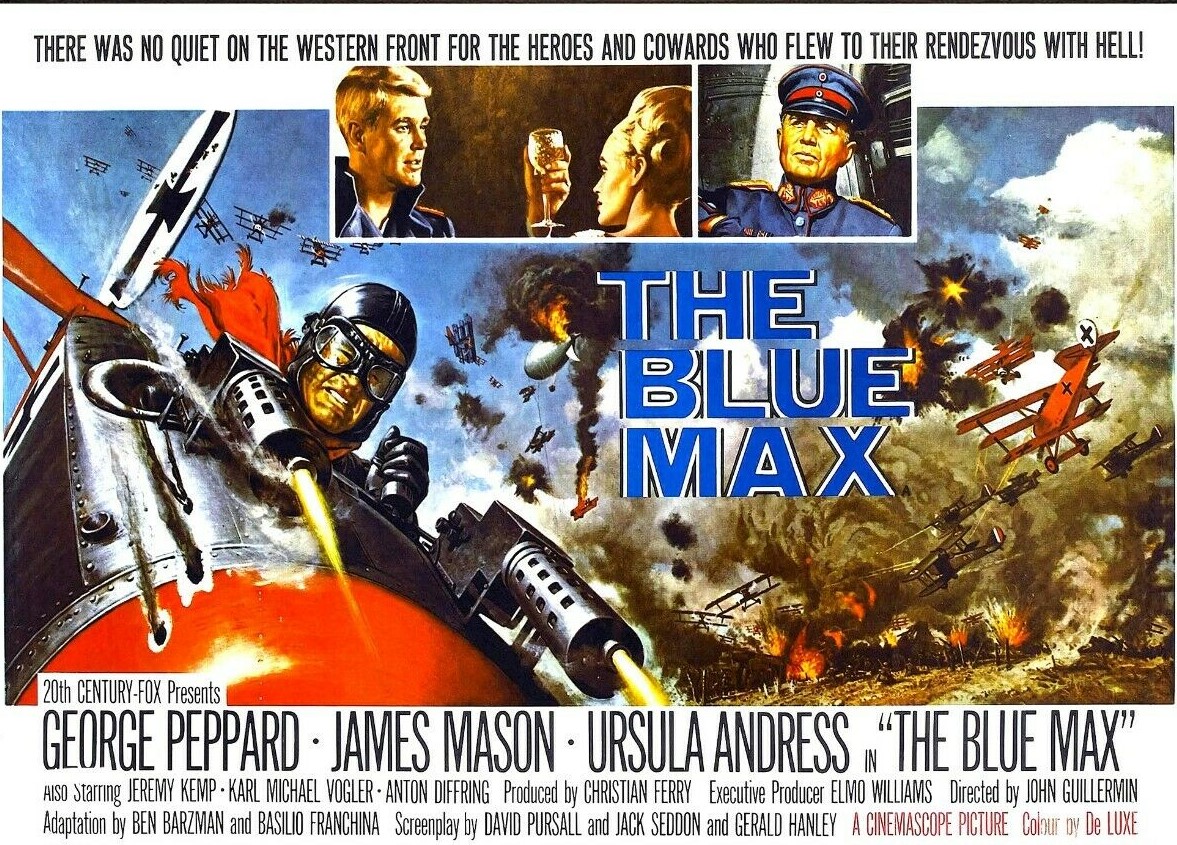
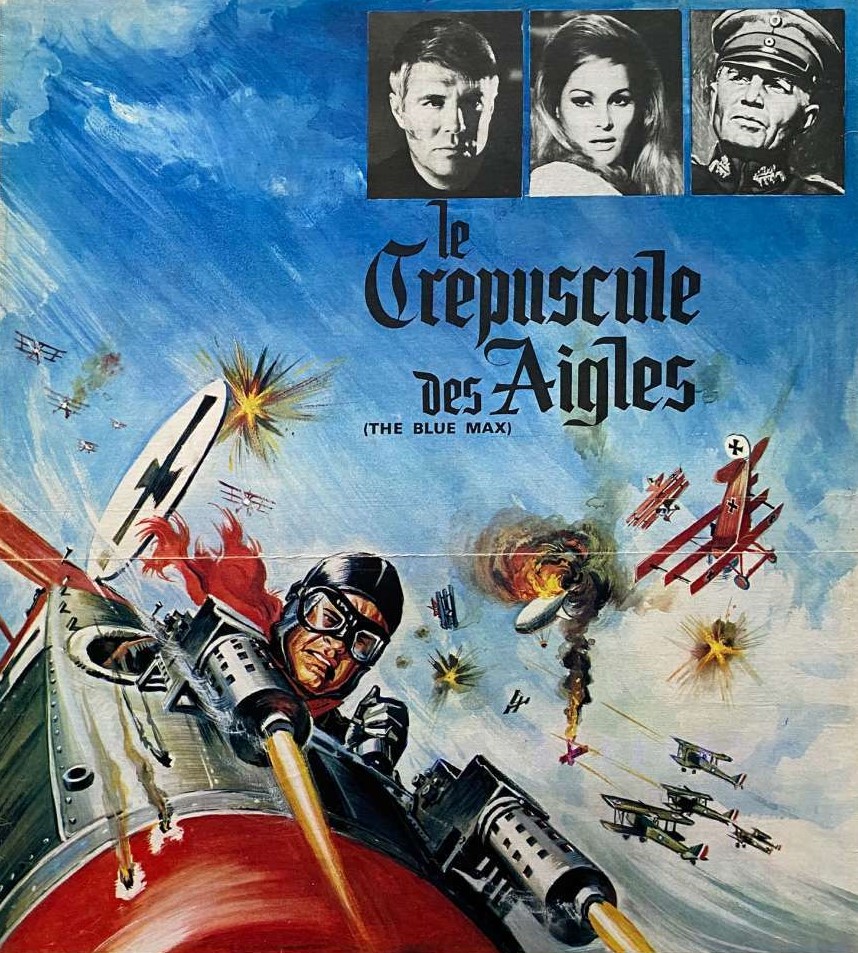
Watching The Bridge at Remagen sent me back with renewed admiration to John Guillermin’s take on World War One in The Blue Max. Again, a tale of two men battling for supremacy, although in this case they are both on the same side. Flying aces Lt Bruno Sachel (George Peppard) and Willi von Klugerman (Jeremy Kemp) could easily be accommodated within the highest echelons of the German fighter pilot division except that each wishes to be known as the country’s number one pilot and there is also a question of class and nepotism.
Quite how working-class Sachel Peppard makes the transition from grunt in the trenches to Germany’s elite flying corps is never made clear in this glorious aerial adventure. But he certainly brings with him an arsenal of attitude, clashing immediately with upper-class colleagues who retain fanciful notions of chivalry – harking back to the days of cavalry charges – in a conflict notorious for mass slaughter.
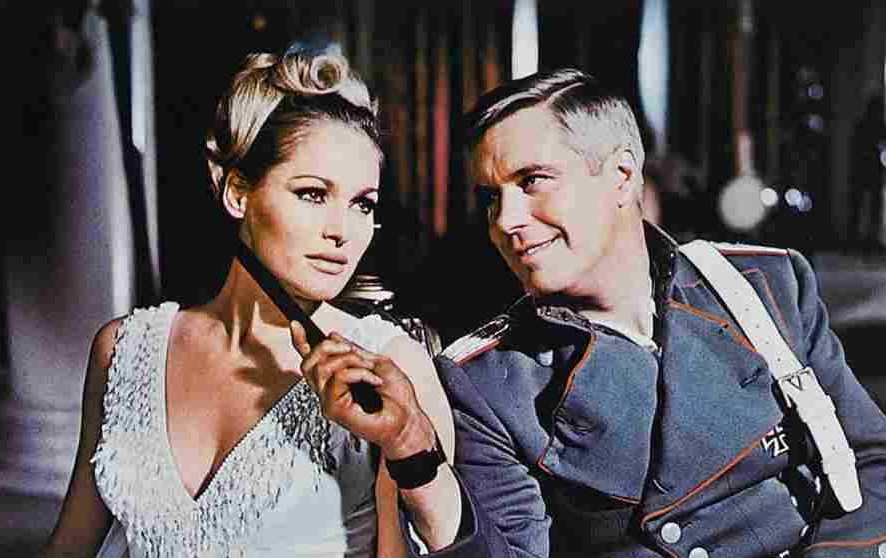
He climbs the society ladder on the back of a publicity campaign designed by General Count von Klugerman (James Mason) intent on creating a new public hero. On the way to ruthlessly gaining the medal of the title, awarded for downing twenty enemy aircraft, he beds Mason’s playful mistress Kaeti (Ursula Andress).
While the human element is skillfully drawn, the innate jealousy and petty rivalries that threaten to spoil the camaderie so essential to any war effort, it is the aerial element that captures the attention. The planes are both balletic and deadly. Because biplanes fly so much more slowly than World War Two fighters, the aerial scenes are far more intense than, say, The Battle of Britain (1969) and the dogfights, where you can see your opposite number’s face, just riveting. Recognition of the peril involved in taking to the sky in planes that seem to be held together with straw is on a par with Midway (2019) while the ability of the best pilots to dodge trouble in the sky has been more recently highlighted in top Gun: Maverick (2022).
I was astonishing to discover not only was this a flop – in part due to an attempt to sell it as a roadshow (blown up to 70mm for its New York premiere) – but critically disdained since it is an astonishing piece of work. Guillermin makes the shift from small British films to a full-blown Hollywood epic with ease. His camera tracks and pans and zooms to capture emotion and other times is perfectly still.
The best scene, packing an action and emotional wallop, will knock your socks off. Having eliminated any threat from an enemy plane, rather than shoot down the pilot, Peppard escorts it back to base, but just as he arrives the tail-gunner suddenly rouses himself and Peppard finishes the plane off over the home airfield, the awe his maneuver originally inspired turning to disgust.
The action sequences are brilliantly constructed, far better than, for example 1917 (2019) – which by contrast appears labored. One battle involving planes and ground troops is a masterpiece of cinematic orchestration, contrasting raw hand-to-hand combat between enemy soldiers with aerial skirmish. Guillermin takes a classical approach to widescreen with action often taking place in long shot with the compositional clarity of a John Ford western. Equally, he uses faces to express emotional response to imminent or ongoing action.
George Peppard (Pendulum, 1969) is both the best thing and the worst thing about the picture. He certainly hits the bull’s eye as a man whose chip on one shoulder is neatly balanced by arrogance on the other. But it is too much of a one-note performance and the stiff chin and blazing eyes are not tempered enough with other emotion, and he fails to portray the kind of complex character he would essay so brilliantly in P.J./New Face in Hell (1968) and House of Cards (1968) It would have been a five-star picture had he brought a bit more savvy to the screen, but otherwise it is at the top of the four-star brigade.
James Mason (Age of consent, 1969) is at his suave best, his aristocratic German somewhat redeems the actor after his appalling turn the same year as a Chinaman in Genghis Khan. Jeremy Kemp (A Twist of Sand, 1968) is surprisingly good as the equally ruthless but distinctly more humane superior officer. For once given the chance to act, Ursula Andress (The Southern Star, 1969) is more than mere eye candy, the kind of mistress with an eye more on the main chance than true love, although she does manage to swan around in one scene clad in only towels.
Look out for Derren Nesbit (The Naked Runner, 1967), Anton Diffring (Where Eagles Dare, 1968), Harry Towb (The Bliss of Mrs Blossom, 1968) and Karl Michael Vogler (The Dance of Death, 1967).
Guillemin’s technical skill is outstanding. In Bridge at Remagen it was the tracking camera and the blitz of war that captured the eye, here it is fabulous aerial photography. In the later picture, it was often hard to delineate individuals within the overall frame since the whole point of the film was the absolute messiness of war, but The Blue Max, dealing with one-on-one duels, presented a better opportunity to take advantage of cinematic elan. The screenplay, based on the bestseller by Jack Hunter, was courtesy of the team of David Pursall and Jack Seddon (The Southern Star) and Gerald Hanley (The Last Safari, 1967) after initial work by Ben Barzman and Basilio Franchina (both The Fall of the Roman Empire, 1964).
There had been a marked trend towards even-handedness in terms of presenting both sides during World War Two, as exemplified by Battle of the Bulge (1965), but this was the first to present the Germans in such heroic fashion.
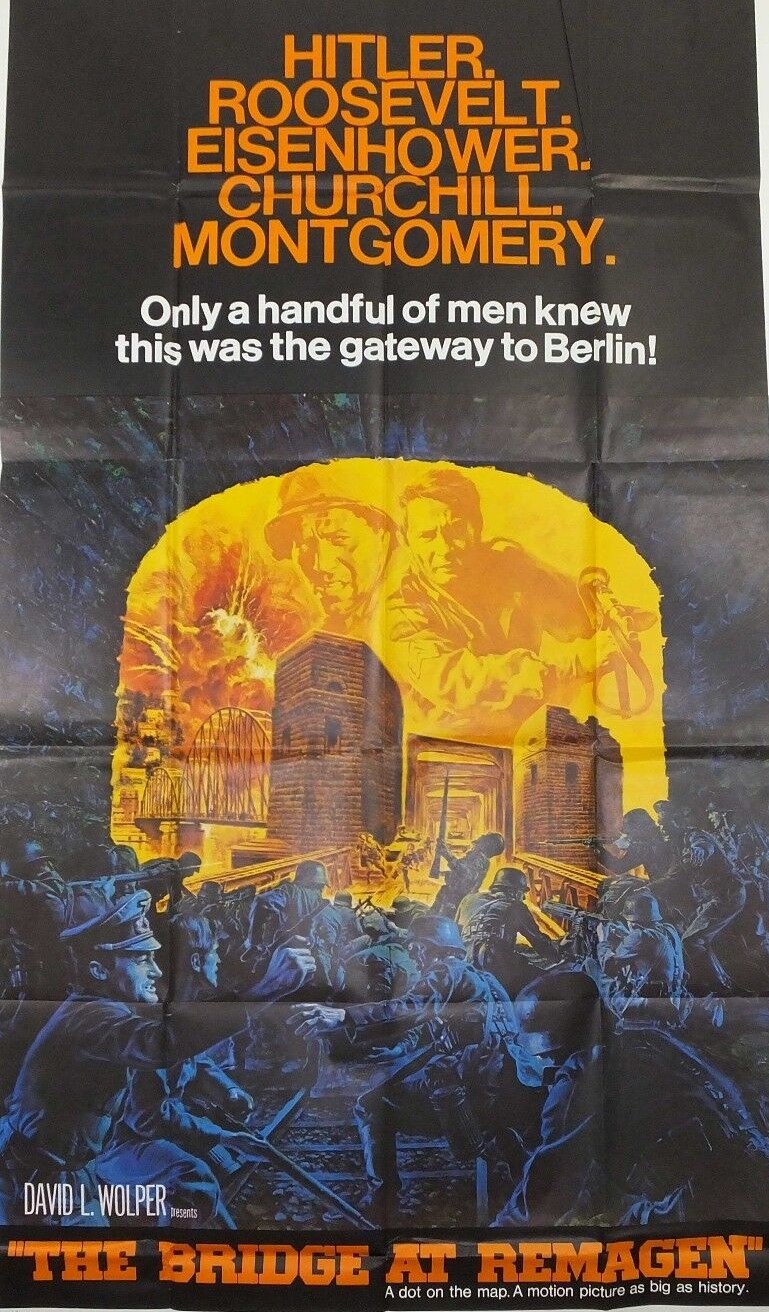
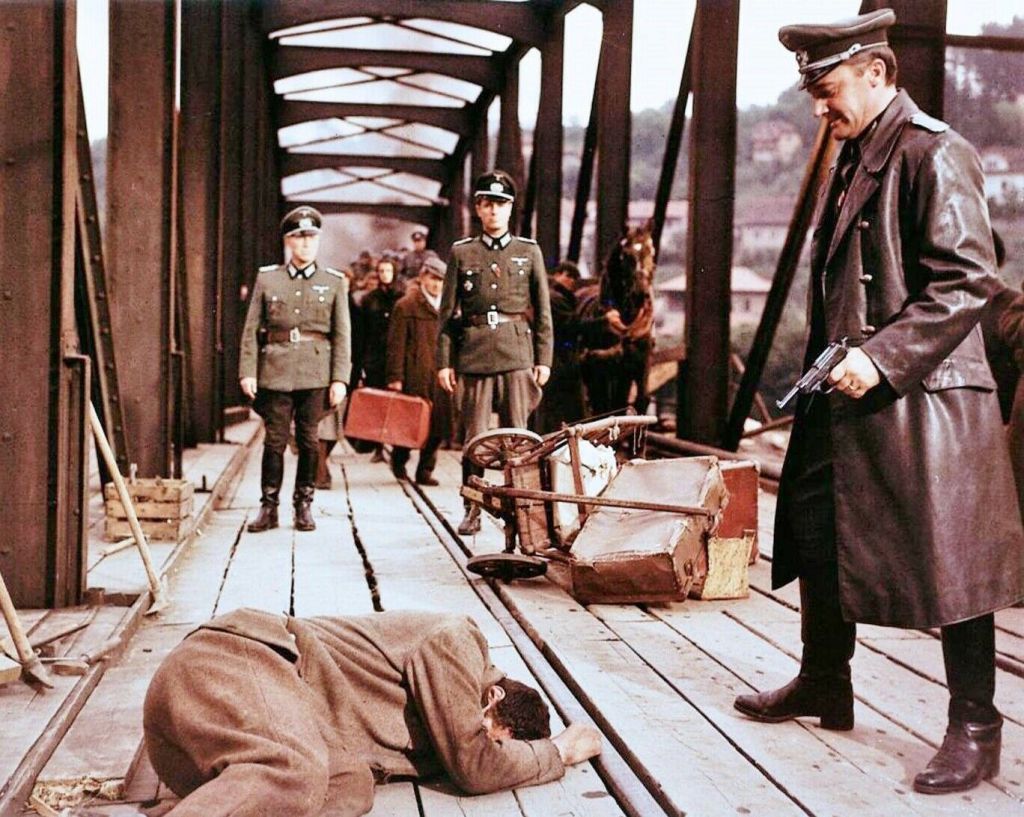
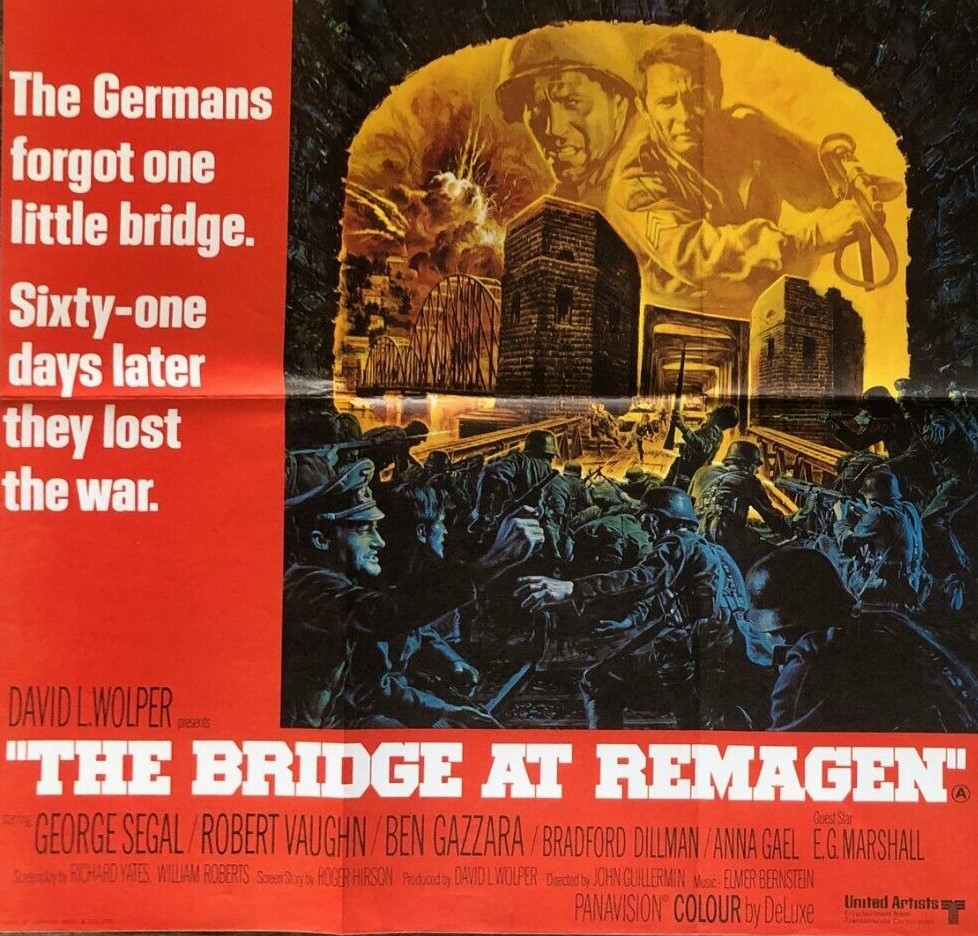
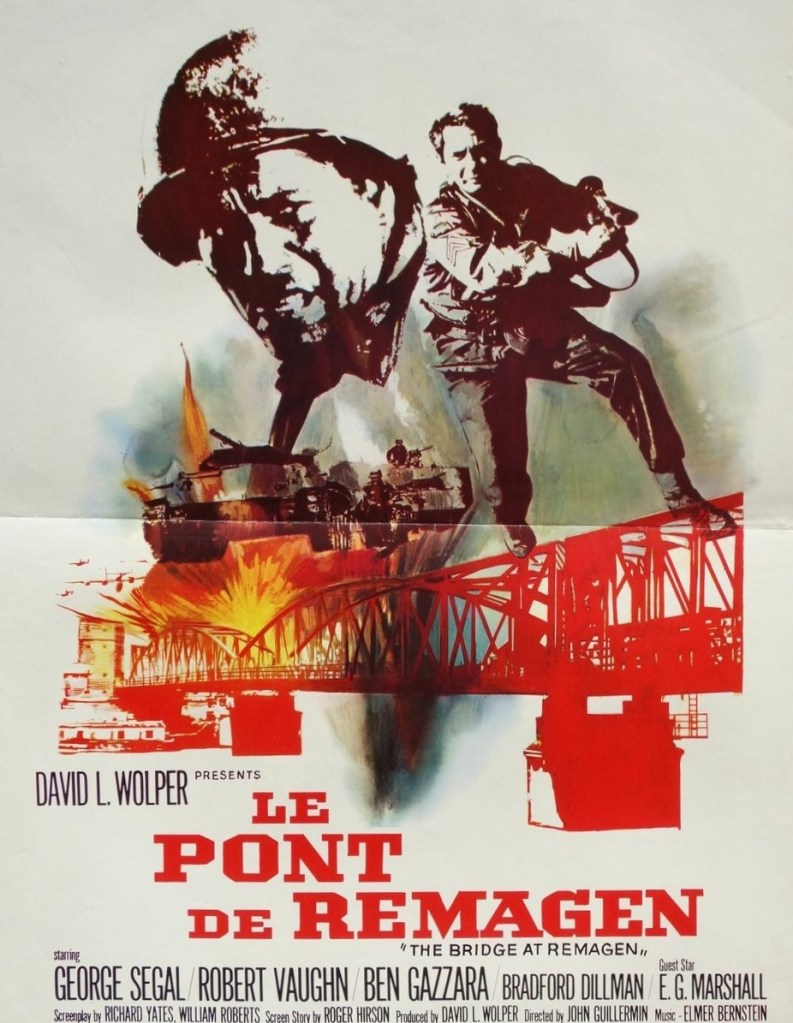
A million-and-a-half dollars potentially went down the drain when, thanks to the Russian invasion two months into production, producer David L. Wolper had to shift location shooting of World War Two picture The Bridge at Remagen from Czechoslovakia to Italy and Germany. Actors and crew woke up on August 21, 1968, to find their hotel surrounded by Russian tanks. Only quick action saw 80 personnel ferried in a taxi convoy through the only remaining open checkpoint to the airport, their departure coinciding with the arrival of the Russian paratroopers.
This had not been the first international incident for the movie, based on the destruction of the Ludendorff Bridge over the Rhine at Remagen in Germany. Previously, Wolper had been accused of being a C.I.A. spy and reports were circulating that armaments were being brought in to support Czech leader Dubcek while rumours flew of “busloads of American troops…arriving in Prague disguised as tourists and film technicians.” Matters were so bad that the Czech army placed under lock and key the film’s entire TNT and dynamite inventory amounting to over 6,000 sticks of the former and 800lb of the latter.
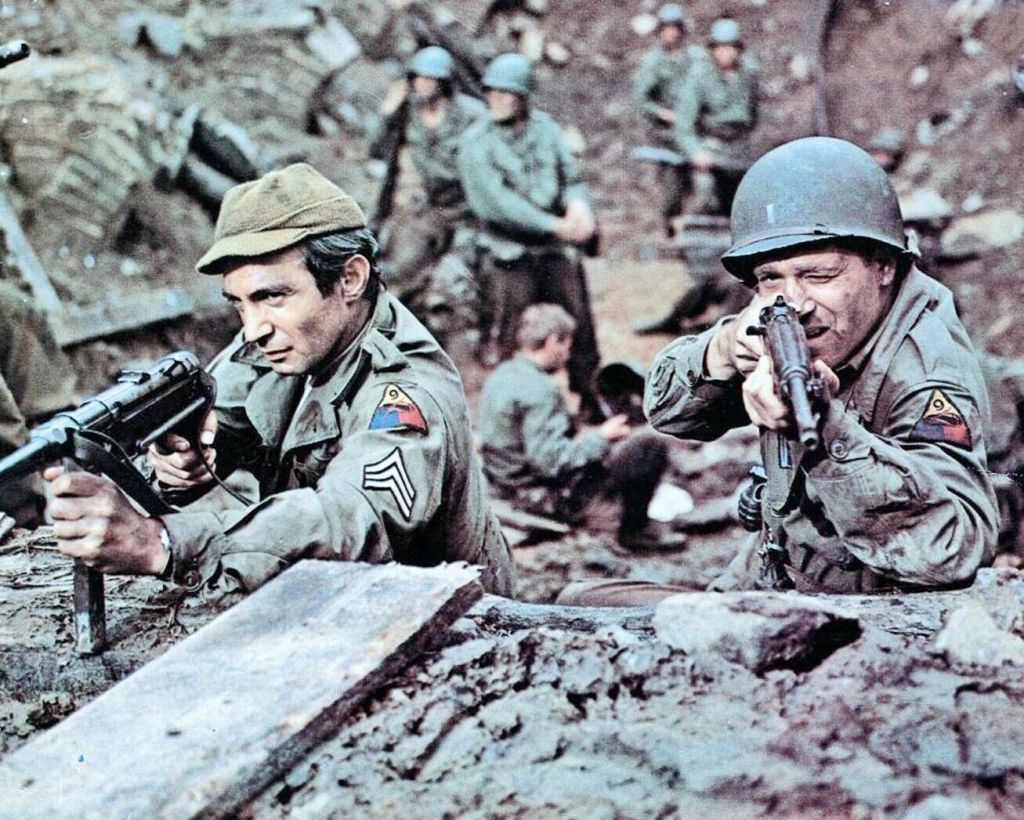
Ben Gazzara and George Segal open fire.
Small wonder the Russians were alarmed because the production had arrived with a massive cache of weaponry – an inventory over 1,000 pieces strong – including eight Sherman tanks and over 130 Browning and Thompson machine guns, MI rifles and carbines and Colt pistols as well as 300 dummy rifles. Luckily, most of the film’s battle scenes action had been completed when production was interrupted but that still meant a month of interiors and exteriors.
Wolper was something of a Johnny-come-lately to the Remagen scene. Budd Schulberg (On the Waterfront, 1954), who had fought at Remagen, and his brother Stuart were first into the frame, planning in 1958 to film for Warner Brothers Ken Hechler’s 1957 bestseller on the battle, as a follow-up to their first production, Wind Across the Everglades (1958). Stanley Kubrick was being lined up to direct. When WB bowed out the Schulberg Brothers moved it first to Columbia and then United Artists. When that gamble failed to come off, United Artists assigned Phil Karlson (The Secret Ways, 1961) as director but that also hit the buffers. Although Wolper started work developing a treatment in 1965 – Irvin Kershner in his mind as director – he had Ihe had to deal with another contender in Flaum and Grinberg Productions which in 1966 announced this as their debut production.
Wolper had come to movies on the back of documentaries. Using his Metromedia outfit as an umbrella, he had struck a six-picture deal with United Artists. The first movie had been the documentary Four Days in November (1964). But the next was intended to be a “plotted dramatic film based on fact with a big star cast” known at the time as The Remagen Bridge. From the outset this was seen as a “harsh recreation of actual slogging combat with some four letter words and not a glorification of war but underlining its hellishness.”
In the event, this was overtaken on the Wolper schedule by another war movie The Devil’s Brigade (1968). Further pictures planned were Europe U.S.A. (a.k.a. If It’s Tuesday It Must Be Belgium, 1968) and All the Conquerors (never made). Wolper had also in 1965 purchased the source material for The Green Beret, that proved to be a war movie too far and the project ended up with Warner Brothers and John Wayne.
After Roger Hirson delivered a story treatment for Wolper in 1965, the screenplay of The Bridge at Remagen went through the hands of Richard Yates, paid $25,000, the uncredited Ted Strauss (a Wolper executive with writing credits on documentaries) and Sam Watson who stiffened the treatment, with input from Wolper determined to “reinforce the image of Michaels (Segal) as one of the walking dead.”
While veteran William Roberts (The Magnificent Seven, 1960) finalized many of the film’s elements, Wolper also turned to Ray Rigby (Operation Crossbow, 1965) to “deepen the characters and create scenes with more punch” and Rod Serling (another $25,000). But Hirson could lay claim to setting up the movie’s dynamic. “This is the story of two men and a bridge,” he wrote. Initially, the American was called Earl Ammerman then Floyd Love before hitting on Michaels and finally Hartman, although that first name went from Curt to Vic to Phil. The German originally Hans Heller transitioned to Major Krueger, based on the real-life Hans Scheller.
Early drafts contained references to German secret weapons, a chaplain, a group of Polish sex workers and a brief glimpse of the woman (Anna Gael) at the end. Anthony Hopkins, then unknown, and Robert Vaughn were considered for the role of Major Krueger. Vaughn could read German and had an Oscar nomination and was a leading television star. George Segal faced no competition for his starring role, having already been in uniform for King Rat (1965). But Alex Cord (Stagecoach, 1966) declined a supporting role and Robert Blake (Tell Them Willie Boy Was Here, 1969) was considered
Filming on the original Rhine bridge was no longer possible given it had fallen ten days after the battle. Depending on which report you read, finding a replacement took around three years or 18 months or maybe just six months and involved a global search. One usable bridge was found in Washington State but with bare hillsides rather than town and mountain. John Frankenheimer on The Fixer (1968) had set a precedent for filming behind the Iron Curtain by using Budapest in Hungary to represent Russia.
Robert Vaughn about to open fire.
Not far from Prague in what was then known as Czechoslovakia the production unit alighted on the Davle road bridge, and struck a deal in October 1967. It was almost a perfect match for Ludendorff once towers had been added at either end, the bridge itself raised by 14ft and been augmented for authenticity by wooden and steel girders. To complete the transformation an 80ft tunnel was blasted out of the surrounding mountains. And a false church, another key scene, was built on a hill.
For $20,000 Wolper also bought a village called Most which the government had marked for demolition, allowing him to blow up designated buildings in a three-square block, providing the location for a key sequence in which the town was devastated by tank bombardment. (As I mentioned in my review, the collapse of these buildings looked incredibly real, and no wonder given they were not plaster-and-lathe imitations but genuine stone.)
Prague’s Barrandov Studios supplied 188 crew, up to 5,000 extras, interiors and transport. As part of the deal Czech labs would carry out the processing but not the synching or mixing. The decision to shoot in Czechoslovakia was primarily financial. Wolper reckoning shooting there could be done for $3.5 million, saving the production an estimated $2 million-$2.5 million if filmed in Hollywood. For the Czechs The Bridge at Remagen was a “test situation.” Should the country’s movie industry prove amenable to Hollywood it could result in an influx of hard currency and a stampede of U.S. productions. Already The Reckoning was heading for Bratislava.
Ironically, the success of a Communist-ruled country like Czechoslavakia in embracing Hollywood business lay in its acceptance of capitalism. It was ironic that what Wolper demanded of his Czech counterparts would have been impossible to achieve in a democratic country. “No western society could suspect traffic from a public thorough fare for three months to benefit a private enterprise.” Motorists were forced to use a temporary ferry and river traffic was held whenever required.
Englishman John Guillermin, a World War Two veteran, was hired on the basis of World War One picture The Blue Max (1966). That he had completed A New Face in Hell (1968) by the time shooting began was a bonus. Vaughn credited Guillemin with the film’s success. “I think he did a lot of research to make it more than just another war movie.”
George Segal concurred, “That was a movie constructed by John Guillermin and cinematographer Stanley Cortez. They shot a war and Guillermin made sense out of it – the angles were so dramatic….It was an epic… (P.J./A New Face in Hell) was a tough-as-nails movie at that time and I knew that’s what Remagen needed…Developing the war-weary character of Hartman was a little bit of me and a little bit of working it out with Guillermin…He brought so much texture to it that you fed off him and his attitudes and the way he conducted himself… Very focused, very concentrated, Guillermin was very economical in his shooting…He was a great influence on me in that film because I was the one who had to take charge and he demonstrated to me how to take charge.”
There was another side to Guillermin that almost caused him to be fired. “He was kind of a martinet,” explained Vaughn, “but I got along very well with him.” Added Segal, “I know sometimes he was implacable and I know that Wolper had problems with him.” That was putting it mildly. “The first day of shooting,” recalled Bo Hopkins, “John Guillermin hollered so loud his veins stuck out.” But when Guillermin attempted to bar Wolper from the set for a complicated battle scene, the producer promptly fired him. “When he realized I was serious,” Wolper recollected, “he apologized so I rescinded his firing. But I wasn’t kidding. Without that apology, he would have been gone. I had learned early that, as a producer, you have to be tough and you have to be tough right away.”
That it was truly a war out there can be judged from the armoury. The rolling stock came courtesy of the Austrian army by way of a sale from the U.S. in 1947. These included eight M-24 Chaffee tanks, three M-3 half-tracks, three M-8 armoured cars, eight 2½ ton trucks and six jeeps. The German actors and extras were armed with 250 Mauser rifles, 28 M-P machine guns, 14 P-38 pistols, 14 Lugers and eight Bren machine guns on top of four 88mm anti-aircraft guns, eight troop carriers and a dozen assorted armoured vehicles. In total the picture drummed up 150,000 rounds of ammunition, and in addition to the TNT and dynamite consignment mentioned above over three tons of smoke-producing powder.
The German and American stories were filmed separately, with little crossover between the two units. Remagen battle tank veteran Col Cecil E. Roberts, retired, oversaw the training of extras as U.S. and German soldiers. Hal Needham took charge of the stunts.
Part of the Czech Hollywood education was understanding the hospitality needs of the stars. Usually for a long shoot abroad, principals would be lodged in private houses, but here the 35 most important personnel were pup up in hotels. To the Czech way of thinking “deluxe hostelry was inappropriate” was actors who would be playing tough soldiers so the worst of the modern hotels, The International, was where many ended up.
The mollycoddled Hollywood contingent, wherever accommodated, found service uniformly slow, water supplies liable to vanish at short notice, no water at all one day, and drycleaning facilities that took two days. The normal contingent of wives had little confidence in the Czechs reaching the necessary standards. Janice Rule (Mrs Ben Gazzara) lasted three weeks before skipping off to Paris. Mrs Segal and her child remained in Switzerland for the duration. Although the three top stars dined each night Segal drank little on the grounds that “it interferes with my suffering.”
The stars were suddenly newsworthy when they became the first refugees from Czechoslovakia. Robert Vaughn and most of the world had expected a different outcome when Alexander Dubcek took over, a basic form of democracy heralded as the “Czech Spring.” Recalled the actor, “By the time we started filming (on June 6, 1968) it was a joyous time to be in Prague…the smiles (the public) wore and their exuberant anything-is-now-possible mood exemplified the socialism with a human face then making headlines the world over.” Ben Gazzara commented: “They were closing down the borders. If one of our people hadn’t called the U.S. Embassy we would have gone to the wrong border checkpoint, one already closed by the Russians.” Gazzara smuggled out a local waitress. The taxi convoy was met at the border by a fleet of buses organized by Wolper.
Stuck with an incomplete movie, and having to come to terms with the volume of equipment equipment left behind, Wolper took three weeks to reorganize. Most of the action sequences had been completed, but the vast arsenal borrowed from Austria would require substantial compensation if not returned. In addition, also lost were 40 reels of unprocessed colour negative worth $250,000 and crucial plates for rear projection work. In the end, the Russians were not willing to go to war with a Hollywood studio and returned 5,200 items of materiel, arms, costumes and film as well as 47 heavy-duty military vehicles straight to Vienna. .
Wolper found two locations to replicate the lost Dalve bridge – a crossing near Hamburg employed to represent the underside of the historic bridge for a key scene and at Castel Gandolfo close to Rome in Italy he built a half-scale replica. The addition of a small part of the bridge and a tunnel allowed the director to complete a number of vital sequences including when Hartman runs under enemy fire.
A second unit under the direction of William Kronick was permitted to return to Czechoslovakia to film 12,000 feet of “critical shots that couldn’t be duplicated.” These comprised long shots of the Germans trying to blow up the bridge and the eventual crossing of the bridge by 600 American soldiers – played by Czech Army personnel in the relevant uniform – and tanks and half-tracks. This was done, however, under the watchful eye of 500 armed Russian troops. Wolper had to pony up an extra $1 million for reconstructing sets originally used in Prague, for building the new bridge in Italy, for transport and for an extraq five weeks in salary.
“We defy anyone to identify what was shot near Prague and what was shot near Hamburg or outside Rome,” boasted Wolper (although in fact such mismatches provoked negative comment). He was especially proud of the scene of George Segal running across the bridge which was begun in Czechoslovakia nine weeks before it was completed at Castel Gandolfo on the reconstructed bridge. “You cannot tell the difference,” he said. Considering the unexpected interruption, he could be justifiably smug that the movie completed shooting in just 93 days.
Wolper had no illusions about the movie business and did not believe in the notion that any studio or producer possessed a magic touch, much though that was a line given out by any filmmaker enjoying a bout of success. “Audiences are very selective nowadays,” he said. “The moviegoer has an antenna that goes up if they like a film. If the antenna doesn’t go up nothing will drag him in.”
Wolper decide to launch the picture with an old-fashioned “local” world premiere. Ever since Cecil B. DeMille premiered The Buccaneer (1938) in New Orleans, this had turned into a major marketing device, with movies having first showings in a variety of small towns and cities all over America linked to a location shoot or birthplace of a star. The idea had long been out of fashion but since the original author was now a respected West Virginia Congressman, the movie premiered at the Keith-Albee cinema in Huntingdon, the mayor declaring a “Remagen Week” and tanks rolling through the streets as part of a publicity blitz.
By the time The Bridge at Remagen appeared, Wolper was a big-time indie producer, having splashed out $500,000 pre-publication on John Updike’s Couples to be directed by Joseph L. Mankiewicz (never made). Also on his agenda were: The Confessions of Nat Turner to star James Earl Jones with first Norman Jewison at the helm then Sidney Lumet, an original screenplay by Mort Fine (The Pawnbroker, 1964) called The Blessed McGill, The Great Cowboy Race from a screenplay by Abe Ginnes, Three Women (renamed I Love My Wife, 1970) and King, Queen Knave (1972) based on the Nabokov novel.
It’s axiomatic of the vagaries of Hollywood for even the most successful producers that two of these films never saw the light of day. Wolper stopped making movies after 1972, concentrating on television mini-series and documentaries for over two decades before returning to Hollywood in triumph with L.A. Confidential (1997).
SOURCES: Steven Jay Rubin, The Making of The Bridge at Remagen, Cinema Retro, Vol 12, Issue 33, pages 26-37 and Vol 12, Issue 34, pages 18-25; “Schulberg Next for WB Rhine Crossing Saga,” Variety, August 13, 1958, p7; “Schulberg Freres Will Roll Book by Congressman,” Variety, June 3, 1959, p7; “Rolling in Germany,” Variety, November 16, 1960, p5; “Phil Karlson Will Direct Mirisch Film in Europe,” Box Office, Jul 26, 1961, pW4; “Remagen Bridge As Plotted Film for UA,” Variety, March 3, 1965, p17; “Wolper Purchases Rights to GreenBeret,” Box Office, July 5, 1965, pW2”; “Flaum and Grinberg Form Production Firm,” Box Office, May 30, 1966, pW1; “Wolper Forms New Company To Produce Features, “ Box Office, February 27, 1967, p5; “Borrow Span, Blow Up Town,” Variety, November 8, 1967, p7; “UA Signs Wolper for Couples Release,” Box Office, February 26, 1968, p5; “Representative Hechler Is Adviser on Bridge at Remagen,” Box Office, April 22, 1968, p8; “Czechs Learn Fast What Yanks location Wants,” Variety, July 3, 1968, p31; “E Germans: Remagen a C.I.A. Front,” Variety, August 14, 1968, p14; “Czechs Want Western Production,” Variety, August 21, 1968, p16 – astonishingly this story ran on the day the Czechs ended any chance of Western movie investment when the Russians invaded the country; “Remagen Crew Safe, Will Finish at Hamburg Studio Site,” Variety, August 28, 1968, p3; “Remagen Weapons List,” Variety, August 14, 1968, p14; “Actors Cross Borders in Nick of Time,” Box Office, September 2, 1968, p12, “Wolper Retreat From Prague Costs Him Vast Arsenal for Remagen,” Variety, September 25, 1968, p32; “Remagen, 2nd Unit Shoots with USSR Troops Watching,” Variety, November 6, 1968, p2; “Despite Reds Czech Invasion, Wolper Winds His Remagen,” Variety, November 27, 1968, p28; Advertisement, Variety, January 15, 1969, p33; Advertisement. “Bridge at Remagen, The Incredible Log of the Motion Picture that Became An International Incident,” Variety, May 7, 1969, p132-133. “Audiences Still Puzzle for Producer David Wolper,” Box Office, July 14, 1969, pWC2; “Photograph,” Box Office, August 18, 1968, pB2.
Superior war film, somewhat underrated. Not just realistic battle scenes, but realistically weary soldiers and taking an even-handed approach to war in the manner of Battle of the Bulge (1965). The Americans want to destroy the bridge to trap 75,000 German soldiers on the wrong side of the Rhine, the German Major Krueger (Robert Vaughn) overrides his orders to also destroy the bridge and prevent the Allies with a direct route to Berlin. Instead with depleted forces – think Zulu (1963) – and hugely outnumbered he attempts to keep the bridge open so the cornered Germans can escape.
Unlike most war films there’s no time for comedy to lighten the spirits, it’s gruelling non-stop action. Even when the advance company, headed by grizzled Lt. Hartman (George Segal) find an abandoned village where the exhausted squad could rest up for a bit, they are ordered to keep going until they find more enemy to engage. Unlike the humane Krueger, the Allied high command are merciless, gung-ho Major Barnes (Bradford Dillman) and glory-hunter Brigadier Shinner (E.G. Marshall) drive their troops on, the latter not bothered how many of his men die in an attempt to blow up the bridge – “it’s a crap shoot” is the closest he gets to apology, claiming his actions will shorten the war.
When Allied attempts to blow the bridge fail and with the enemy so close Krueger has to proceed with detonating the explosives littering the bridge and that plan is also scuppered, it’s a battle to the death to secure the crossing. And the story itself is accentuated by nods to the grisly cost of war – on both sides. Heartless Sgt Gazzaro (Ben Gazzaro), whose freebooting Hartman despises, is brought up short when he kills a youth commandeered into action by Krueger in a bid to bolster his meagre outfit – barely 200 men when he expected a force of around 1600. Krueger is sickened to see a German firing squad executing deserters, but has little sympathy for an innkeeper who has lost a son to the fighting when four million Germans are already dead.
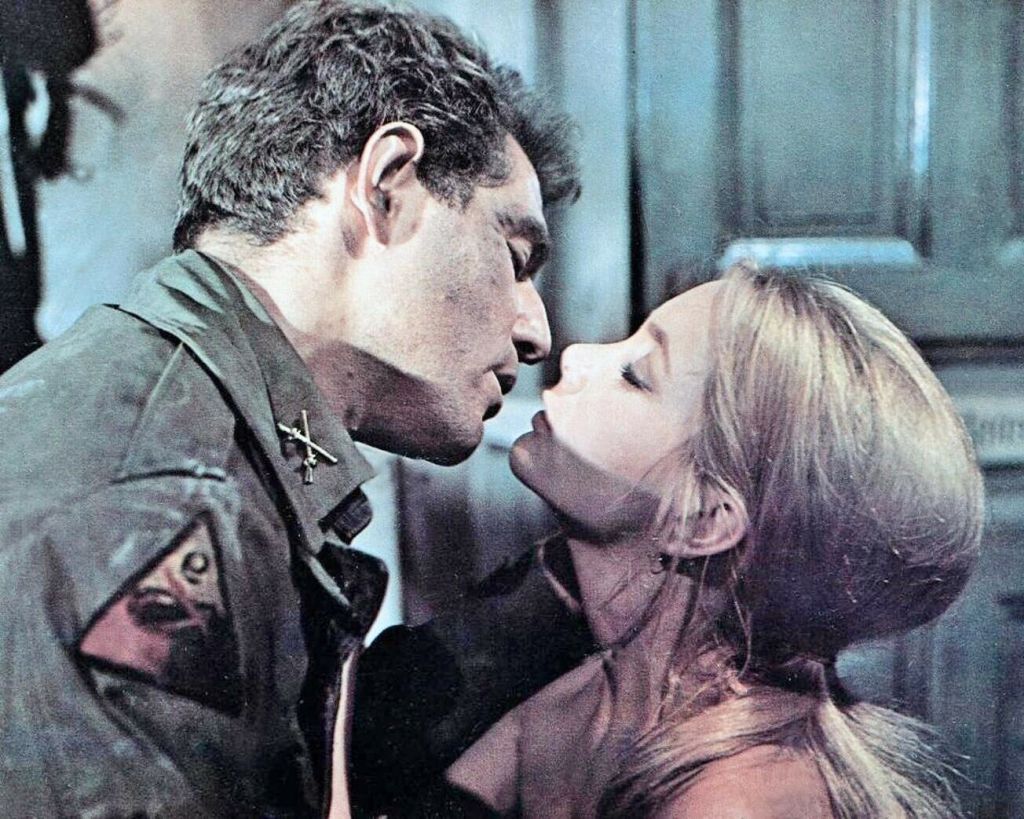
While reining in the worst excesses of Angelo, preventing him taking advantage of a captured woman (Anna Gael) and refusing himself to accept her offer of sex, Hartman does not rail (like Patton, 1970) against those of his men who succumb to pressure. Finding one soldier collapsed, he sympathizes, “sometimes it hits you like that,” and he refuses to put his men in unnecessary line of fire, prompting Barnes into almost killing him. Unlike Battle of the Bulge, however, there is no arrogant German commander (like Robert Shaw) nor complacent Americans.
The action is not only non-stop but hectic and the film begins brilliantly with tracking cameras scarcely able to keep up with American tanks barrelling along the road and aerial shots showing the destruction of another bridge over the Rhine. American tanks and German artillery exchange fire over the river. Buildings are blown out or majestically collapse (turns out these were real buildings, not mock-ups). Bridge stanchions fall in slow motion into the water. Refugees are collateral damage, the camera hardly registering a crying child or an abandoned doll.
As in the best war pictures, strategy and tactics are laid out for the audience, the American blunderbuss approach compares poorly to Krueger’s desperate attempts to utilise every advantage to the point of arming a barge in the river. Hartman and Krueger are well-matched in courage, the former thrown endlessly into action by cynical superiors, the latter, having discharged himself from hospital to fight on, landed with the task of rallying defeatist troops, and leading them into harm’s way in a manner that the American’s immediate superior, Barnes, point-blank refuses to do. Pride drives on the German, the war is almost lost, but surrender would be tantamount to humiliation. All Hartman has to fall back on is an inner core and the chain of command, soldiers obey orders.
Both George Segal (The Quiller Memorandum, 1966) and Robert Vaughn (The Venetian Affair, 1966) are well outside their acting comfort zone. Two stars whose hallmarks are cocky characters and suave charm turn into determined men who barely crack a smile. Segal has done cynical before but not to this degree and what catches the eye more is his sheer physical exhaustion. This is an early career highlight for Vaughn, rarely offered such juicy roles.
Although associated in the general audience mind for playing creepy, not to mention sleazy, characters, Ben Gazzara (Capone, 1975) had not made much impact on 1960s moviegoers, and beyond a handful of supporting roles best known to Americans for a starring role in television series Arrest and Trial (1963-1964). The general untrustworthy screen persona he would come to inhabit is given a good work-out here except for two scenes where his character takes unselfish action. Bradford Dillman, also best known for television (Court Martial, 1965-1966), portrays a largely one-dimension character lifted out of the ordinary in a couple of scenes.
E.G. Marshall (The Defenders, 1961-1965) and Peter Van Eyck (Station Six Sahara, 1963) are the opposing commanders. You can also spot Hans Christian Blech (Battle of the Bulge), Anna Gael (Therese and Isabelle, 1968), Sonja Zieman (The Secret Ways, 1961) and Bo Hopkins (The Wild Bunch, 1969).
John Guillermin (The Blue Max, 1966) directs with aplomb from a screenplay by William Roberts (The Devil’s Brigade, 1968) and novelist Richard Yates (Revolutionary Road, 2008) in his only work for the screen.
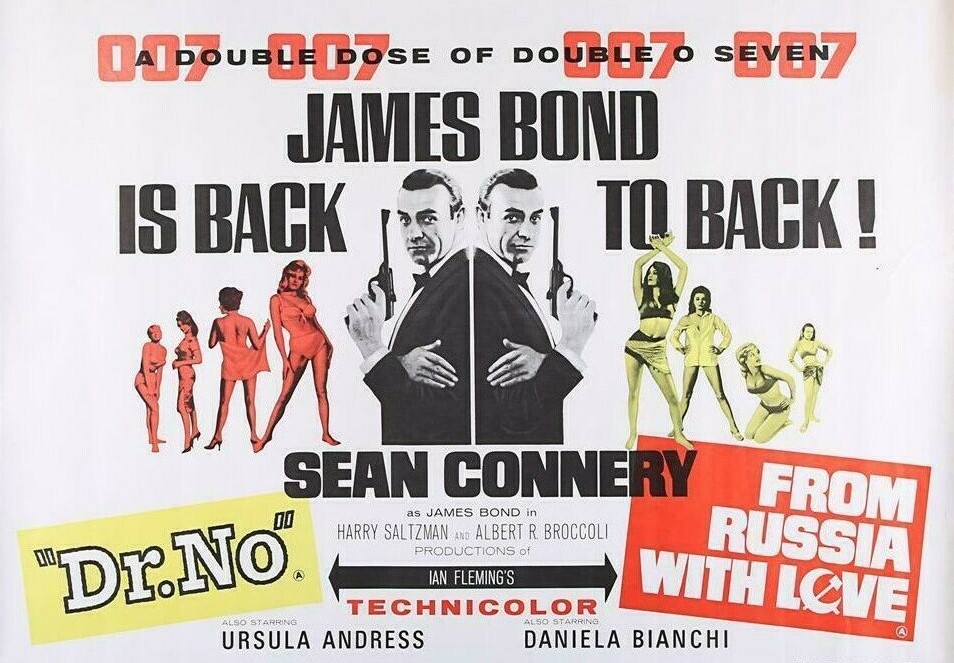
These days you need the impetus of an anniversary or the accompaniment of a live orchestra for an old movie to do the rounds on the big screen apart from perennials like It’s a Wonderful Life (1946) at Xmas and Casablanca (1942) on St Valentine’s Day. In attempting to turn a revival into an “event” these are mostly treated as one-screening-only affairs such as was the case with Dr No (1962) on the occasion of its 60th anniversary. While that milestone marked the birth of the Bond phenomenon, it ignored another landmark, one that played a significantly more important role in the 1960s than virtually any other picture – the rebirth of the reissue/revival.
For the first James Bond double bill Dr No/From Russia with Love which appeared in 1965 in the wake of Goldfinger (1964) created a new market for old pictures, triggered the “threeissue” bonanza, boosted the coffers of virtually every studio in Hollywood and saved many an exhibitor from the perennial product shortage.
Quite how momentous this particular double bill was can be seen from the fact that no reissue beyond Gone with the Wind (1939), irregularly revived, had ever featured in the annual top ten at the box office. Dr No/From Russia with Love was the first oldie ever to reach fifth on the annual rankings, beaten in the 1965 year-end chart only by Mary Poppins (1964), The Sound of Music (1965), Goldfinger (1964) and My Fair Lady (1964). It earned more than Peter Sellers-Peter O’Toole smash What’s New Pussycat (1965), James Stewart in Shenandoah (1965), Richard Burton and Elizabeth Taylor in The Sandpiper (1965), Cary Grant comedy Father Goose (1965), Frank Sinatra war picture Von Ryan’s Express (1965) and comedy western Cat Ballou (1965).
Reissues had come to rescue of beleaguered studios in a major fashion several times before, most recently in 1948 and 1952 but in the 1960s exhibitors were wary of giving old movies a big-screen berth for fear that this was a mere prelude to an appearance on television and being faced with angry moviegoers duped into paying for a film they could have seen a few months later for nothing. So except for the umpteenth revival of Gone with the Wind in 1961, and Bridge over the River Kwai (1957) re-released in the wake of Lawrence of Arabia (1962) in 1964, few reissues had been welcomed by the marketplace.
In fact, there was no solid reason to bring back either of the first two Bond pictures in the United States, if judged by their initial box office. The sensational figures achieved in Britain were not repeated across the Atlantic, Dr No bringing in just $2 million in rentals, From Russia with Love double that, but neither in the box office ballpark that might automatically justify a rerun. In fact, both pictures had already been re-booked in cinemas, and as double-bills, though not with each other, but engagements of From Russia with Love/The Definat Ones, Dr No/The Manchurian Candidate and Dr No/Toys in the Attic elicited such low response the experiments were quickly terminated.
Nor was the idea precipitated by Goldfinger hitting the mother lode on its U.K. launch. What made United Artists executives in Hollywood sit up were not Goldfinger’s whopping figures. In the same week, however, that Goldfinger opened in London’s West End at the Odeon Leicester Square, Dr No was re-booked into the Leicester Square Theatre across the street and From Russia with Love into the Pavilion just around the corner. Neither oldie impinged on the audience for the new Bond, instead attracting their own avid moviegoers, desperate for a second chance to see the films that kicked off the whole phenomenon. In due course, Dr No and From Russia with Love were shunted onto the Rank circuit where they played as a double bill to great success.
When the double bill was announced as a prospective program in the United States, exhibitors were beating down UA’s door, despite the stiff terms demanded, a 60 per cent share of the receipts. That was an extraordinarily high sum for a reissue, especially one that would allow exhibitors time for only one showing every evening rather than the two showings afforded a single bill.
Unlike Britain, UA was disinclined to run the risk of the two oldies cannibalising demand for Goldfinger. So the double bill was held back until April 1965, five months after Goldfinger had opened, long enough for that picture to have been milked in first run, and long enough also for it to act as an effective trailer for the new pairing.
The double roared out of the traps, collaring, in first-run single-cinema opening-week debuts, $57,000 in Chicago, $42,000 in Philadelphia, $40,000 in Dallas, and $36,000 in Cleveland. The Bond reissue bandwagon proved unstoppable. These were the kind of figures attained by box office home runs. Second weeks drops were relatively small. The double bill grossed $1.3 million (equivalent to $11.9 million today) from 103 cinemas in its first week. When it entered multiple run in New York, the only film that did better over the course of the whole year was Goldfinger. From 26 houses Dr No/From Russia with Love gobbled up $649,000 – an incredible per-theatre-average even at 1965 prices – and the second week was $264,000. Total gross over four weeks: £1.29 million. Demand was so high that in June UA ran out of prints – 400 were in circulation. The Los Angeles showcase (multiple run) produced $647,000 in three weeks from a maximum of 30 houses.
The double bill notched up $8 million in rentals, virtually solid profit, since costs had long since been covered and the movies sold themselves. As much as UA realized that each new Bond film was a potential goldmine, so they also quickly understood the rich seam available from bringing back the older movies.
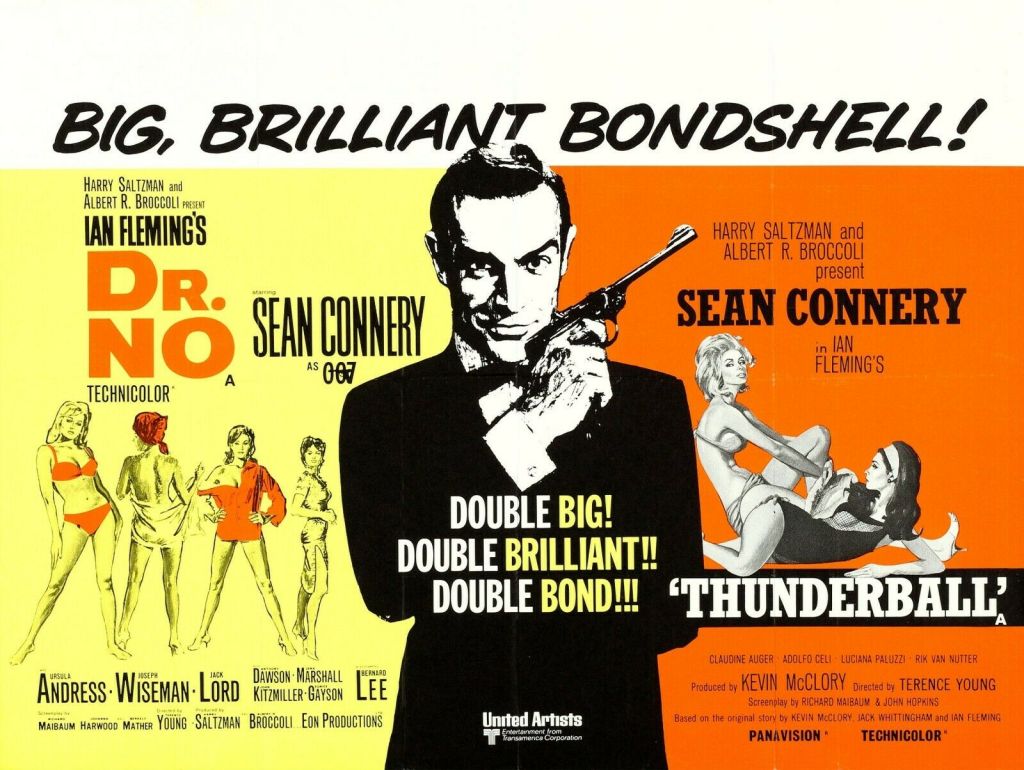
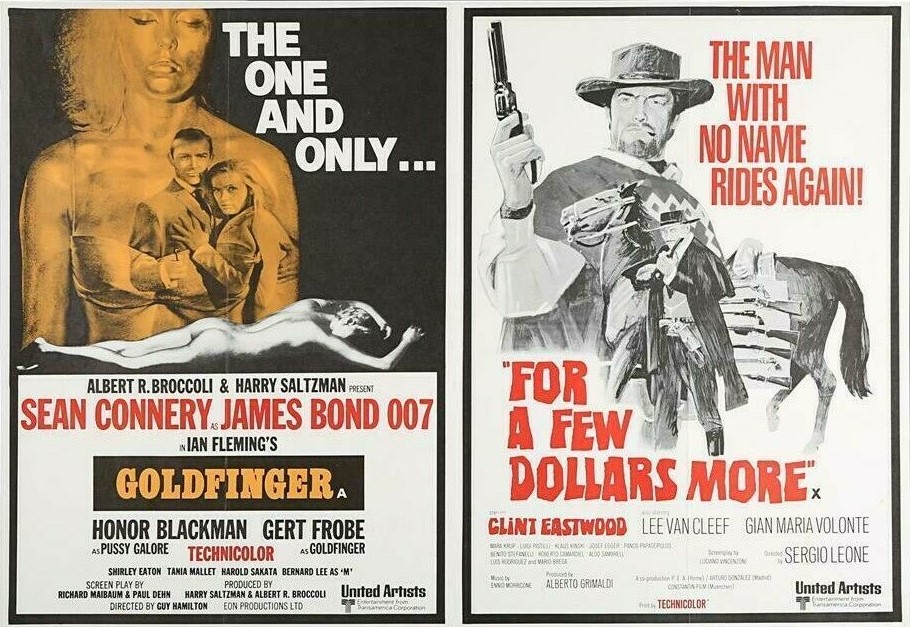
UA tested out the new idea the following year, this time with Goldfinger/Dr No. The result was $4.6 million in annual rentals, enough for seventeenth spot in the annual chart. Further pairings appeared – Thunderball (1965)/From Russia with Love and Goldfinger/Dr No in the wake of You Only Live Twice (1967). UA took the double bill reissue to its logical conclusion by dualing the “Dollar” features – A Fistful of Dollars/For a Few Dollars (both released in the U.S. in 1967) followed by Hang ‘Em High (1968)/The Good, the Bad and the Ugly (U.S release 1967). UA took the idea in a different direction by doubling up You Only Live Twice and The Good, the Bad and the Ugly. In fact, in 18 months between April 1968 and September 1969, UA sent its entire portfolio of Bond and ‘Dollar’ films back into the marketplace. The “threeissue” – a movie returning three times to cinemas in a short space of time – was born.
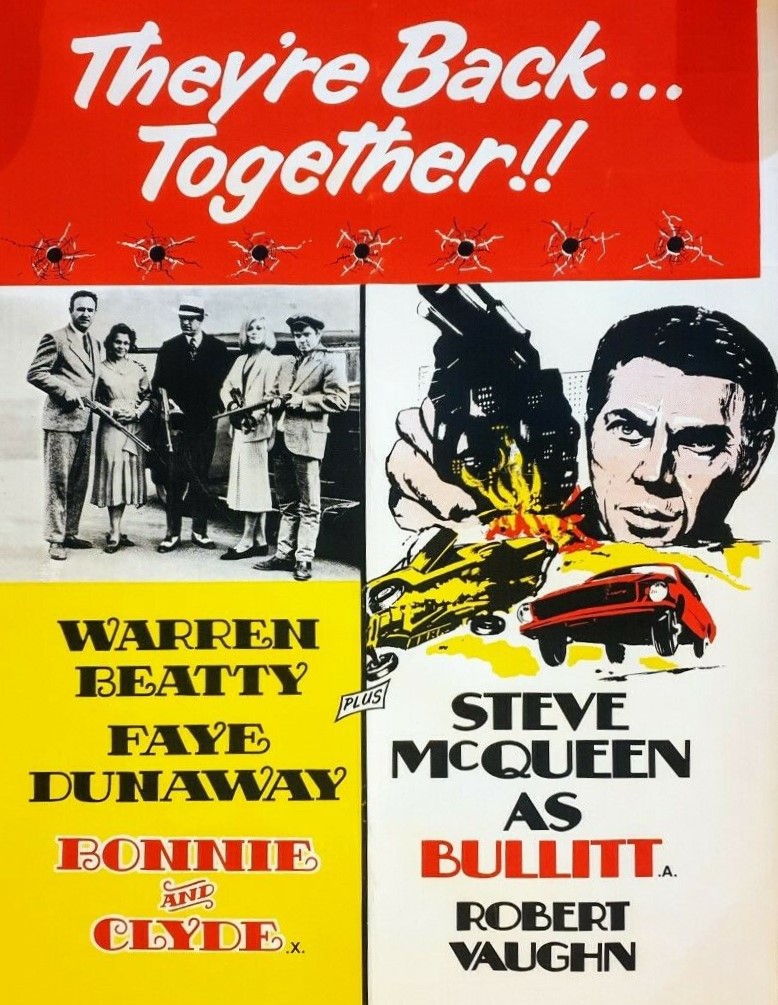
UA’s bounty created a new template for Hollywood, the opportunity to pair known winners not long after the originals had first been seen, rather than the traditional delay of seven-to-ten years. For some studios this was films with an Oscar link – Columbia’s Cat Ballou and Ship of Fools (1965) combo racked up $1.3 million in rentals, Warner Brothers with Cool Hand Luke (1967) and Wait until Dark (1967). For others the twinning was an attempt to prolong box office as with Bonnie and Clyde (1967)/Bullitt (1968) or arthouse breakouts like Belle de Jour (1967)/A Man and a Woman (1966).
In the 1970s when there was an even greater product famine the UA speedy reissue experiment was vital to studio finances. After initial release, Butch Cassidy and the Sundance Kid (1969) generated $24.8 million in rentals from two separate reissues. Brought back three times were Billy Jack (1971) with an extra $25.2 million, The Exorcist (1973) with a bonus of $21.4 million and Blazing Saddles (1974) with $26.4 million.
In other words around $100 million in extra revenues from just four pictures in the 1970s thanks to studios adopting the speedy reissue template initiated by United Artists for James Bond. At a rough estimate additional rentals (i.e. the money paid straight into studio coffers) from reissues in the 1960s and 1970s could easily have reached the half a billion mark.
SOURCE: Brian Hannan, Coming Back to a Theater Near You. A History of the Hollywood Reissue 1914-2014 (McFarland, 2016). Over 250,000 words devoted to the only history of the reissue.
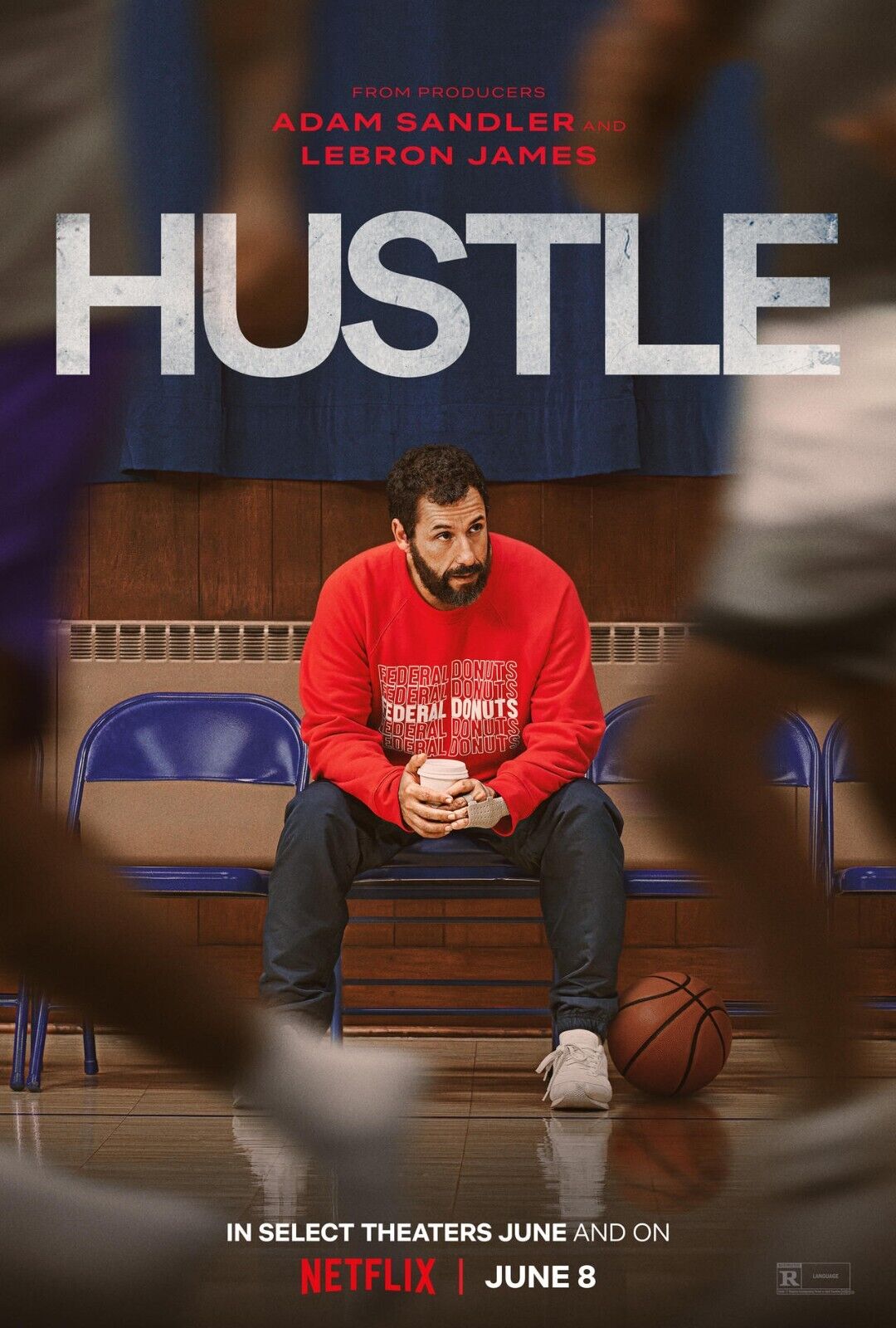
Never thought I’d be praising the acting of Adam Sandler – or lasting to the end of a Netflix movie (yep that includes The Irishman). Except that this effort which appeared to be very off-message for the sports genre suddenly veered back on course towards the finishing line I thought it had the makings of a genuine five-star movie, almost the prequel to all those Kevin Costner-type picture where the washed-up sports star/coach ends up working with a team from Nowheresville.
For a long time the movie’s tension derives from it looking as if the career of wannabe basketball star Bo Cruz (Juancho Hernangomez) is going south before it has even begun, partly from self-inflicted issues and partly from the shenanigans of the all-powerful, and in so doing exposes the rough and dirty underbelly of basketball.
Scout Stan Sugarman (Adam Sandler) achieves his lifetime ambition of being promoted by ageing owner Rex Merrick (Robert Duvall) to assistant coach of the Philadelphia 76ers. But Merrick’s sudden death sends Stanley back on the road where he discovers hustler Bo playing in an ordinary outdoor court. Having incurred the enmity of Vince (Ben Foster), Rex’s son and new team boss, and with Bo being denied a contract, Stan quits and tries to get Bo accepted into the national trials (known, for the uninitiated, as the Combine Draft).
But Bo, who has a conviction for assault, blows his chance, loses his potential breakthrough spot and except for Stan’s herculean efforts would be on a fast track back to Nowheresville. Which would have been an interesting picture in itself, there being far more losers in sport than winners, and always room in some lower league for a washed-up coach.
Sure, there’s the usual unusual training regime (this is the home of Rocky after all), and plenty one-to-one scrimmaging and amazing shots, but mostly it moves at a slower pace, a character study more than anything, as Stan learns to mentor his pupil and his pupil learns to cope with mental pressures. Opportunities to widen the picture’s scope – a potential romance with Stan’s daughter Alex (Jordan Hull) or crisis in the Sugarman home – are ignored in favour of a sharper character focus.
I’m no fan of basketball, never watched a game, couldn’t name a single player unless they starred in an animated feature, and yet I was fascinated by the way the game was played, the ins-and-outs of on-field play. Having watched it, I wouldn’t say I was any more educated, couldn’t even tell you how many people were in a team or even how long as game lasted, but for sure it kept my interest.
There’s contrasting use of social media – one that triggers the young man’s downfall, another that prompts his comeback. But in the main, especially if like me you are unfamiliar with the game, you are mostly gripped by the tension, the consequences of failure for Stan far greater than failure for Bo, and the eventuality that there is no way this can work out. And in that respect it’s not like Rocky or Any Given Sunday where the steps to success are more readily pinpointed.
Like Brad Pitt, Adam Sandler (Uncut Gems, 2109) is entering potentially the “last leg” of his career. He’s lost the annoying nasal whine and the manic comedic energy and transitioned the loser persona into a more recognisable human being. Denied the need to strive for laughs, his delivery is more conversational and realistic. Juancho Hernangomez, a basketball player, making his acting debut, sensibly restrains himself. Queen Latifah (The Tiger Rising, 2022) has also stepped away from comedy although she enjoys some good riffs with Sandler. Jordan Hull (The L Word: Generation Q, 2019-2020) also makes her movie debut. Ben Foster (Hell or High Water, 2016) plays the mean boss. SNL graduate Heidi Gardner is another stepping out of her comfort zone.
There are some anomalies, most notable being that Sandler seems a few inches short of being a former basketball player. Also, you would have to imagine that a young man who came from a tough background and hustled for a living was unlikely to be deterred by a few insults coming his way and equally unlikely to throw away so much food. And also, I never knew the basketball find actually came from Spain, the location work confusing to say the least, I thought he just spoke Spanish, hardly a rare language in America. And who is this guy called “Himself” who appeared to be played by over a dozen people?
Jeremiah Zagers (We The Animals, 2018) does an excellent job or reining in Sandler and the fact that the ending turns this into a warm-hearted drama does not lessen the fact that for most of the time it felt like anything but is testament to his skill.
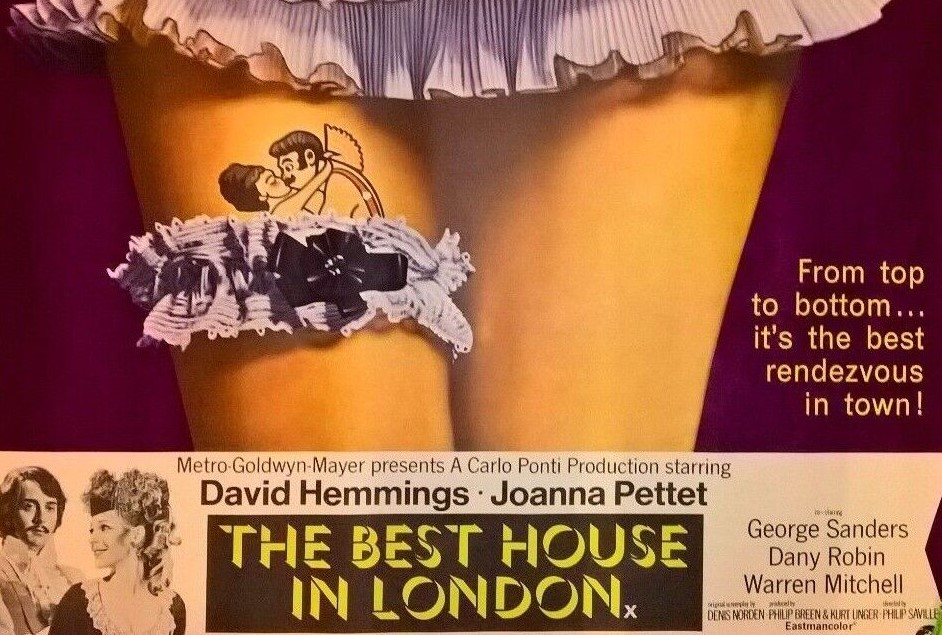
One of the worst – and certainly among the most repellent – films ever made. A hymn to misogyny under the guise of the not very difficult task of exposing Victorian hypocrisy, it labors under the bizarre thesis that all women want to be prostitutes. Screenwriter Denis Norden’s befuddled sense of history is awash with the same kind of contempt for audiences. Elizabeth Barrett (of Wimpole St fame) rubs shoulders with Lord Alfred Douglas (Oscar Wilde’s illicit lover) even though they lived half a century apart, the Chinese Opium Wars and The Indian Mutiny feature despite being separated by 15 years.
Sex workers had proved the basis for many good (and occasionally excellent) pictures in the 1960s ranging from Butterfield 8, Never on Sunday, Irma la Douce and Go Naked in the World at the start of the decade to Midnight Cowboy at its end, but these all featured well-rounded characters facing understandable dilemmas. But here the cynical and demeaning plot – more Carry On Up the Brothel than political satire – makes you wonder how this concept was perceived as either plausible or an acceptable subject for comedy
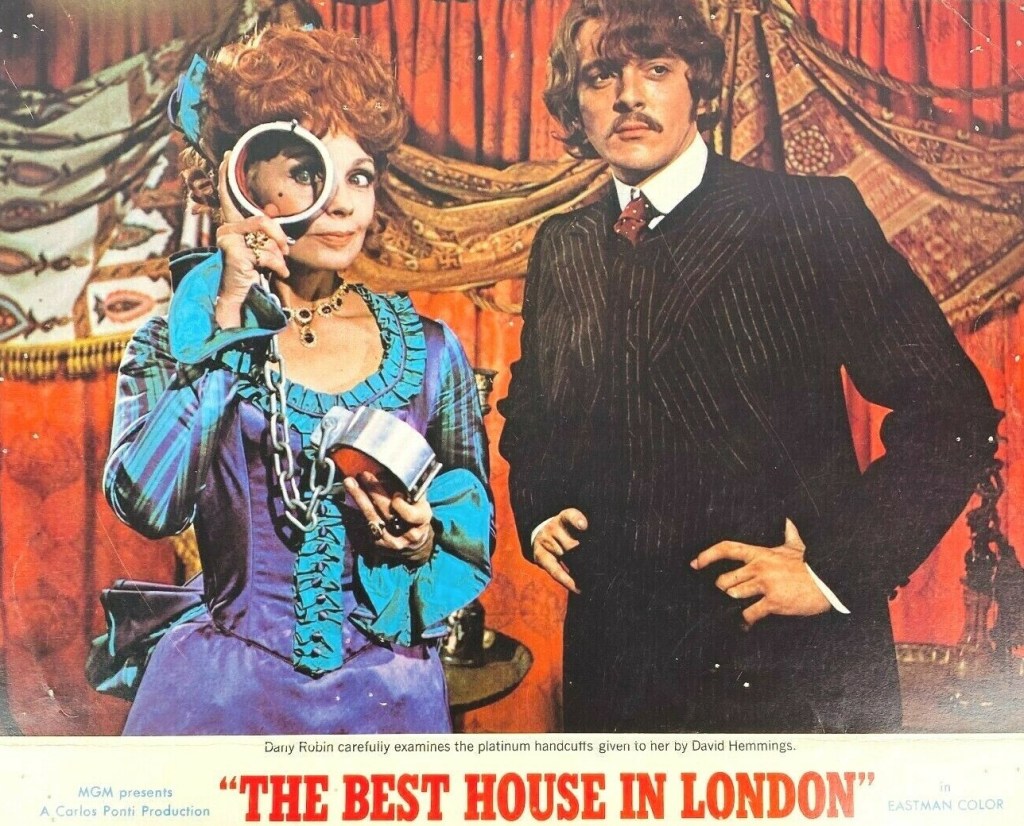
The monocle joke. Dany Robin sports the manacles her idiotic girls were supposed to wear rather the monocles they did wear.
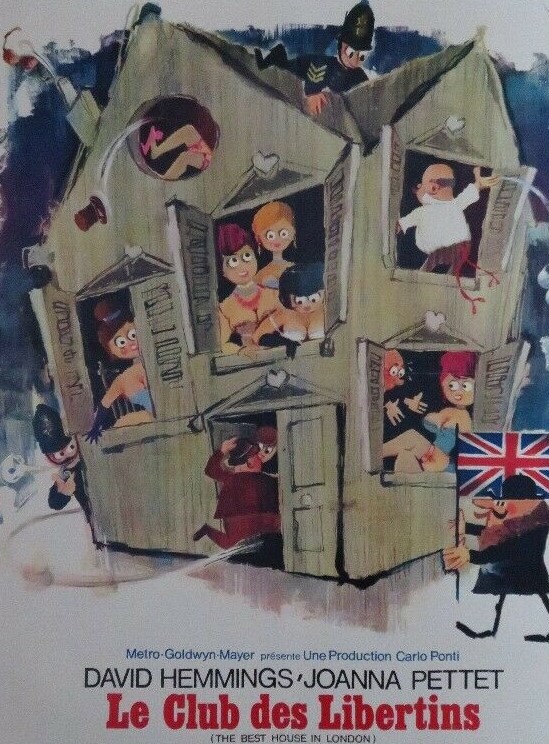
Feminist philanthropist Josephine Pacefoot (Joanna Pettet) – a character based on the real-life campaigner Josephine Butler – has set up the Social Purity League to rescue fallen women. Walter Leybourne (David Hemmings) is hired as a publicist to bring the issues raised to a wider audience. When Josephine inherits the fortune of Uncle Francis (George Sanders) the pair come up against the nefarious Benjamin Oakes (also played by Hemmings), her cousin and his half-brother, who has purloined his uncle’s mansion in Belgravia as the premises for London’s first brothel – The Libertine Club. This venture is backed by the Home Secretary (John Bird) as a way of getting streetwalkers away from upmarket shopping streets where their presence discourages wealthy females. Josephine also has to deal with a caricatured “evil” Chinaman (Wolfe Morris) through her uncle’s investment in opium. There’s also for no particular reason apoplectic airship inventor Count Pandolfo (Warren Mitchell).
All the women rescued from the oldest profession by Josephine are soon recruited by Oakes and a good chunk of the middle section of the movie involves various excuses to give the viewers intimate glimpses of what goes on in the brothel, involving an abundance of nudity. Oakes also aims to seduce Josephine while the shy Walter struggles to entice her into romance.
Excepting Josephine and Oakes’ mistress Babette (Dany Robin), the women are uniformly stupid. The story begins with Oakes’ duping a woman in a hot air balloon into removing her clothes on the grounds that it was the only way to reduce height enough to land. And it does not get any better. Women supposedly forced onto the streets after bad experiences with men turn out to be the seducers. Walter has the devil’s own job getting any of the girls to agree they had been raped. Walter, hoping to sell a story to The Times, is no less crass: “I can get five columns for a good rape.” Flora (Carol Friday), rescued much to her displeasure, is “gagging” for it. And there’s just an awful scene where a young girl sings about her “pussy” which even in the 1960s surely raised adverse comment.
The humor is largely of the sniggering variety. The brothel girls wear monocles instead of manacles, the only game on display in the Card Room is strip poker, and naturally there is a peeping tom, lawyer Sylvester (Willie Rushton).
As if to display his erudition, but without raising the laughter quotient, Norden chucks in literary cameos by the score – Charles Dickens (Arnold Diamond), Alfred Lord Tennyson (Hugh Burden), the aforementioned Elizabeth Barrett (Suzanne Hunt) and Lord Alfred Douglas (George Reynolds), Sherlock Holmes (Peter Jeffrey) and Dr Watson (Thorley Walters), plus explorer David Livingstone (Neil Arden) and department store entrepreneurs Fortnum (Arthur Howard) and Mason (Clement Freud).
That the movie actually gets one star is thanks to a number of excellent visual jokes: one scene of Uncle Francis defying the mutineers by raising the Union Jack cuts to the blood-splattered flag decorating his coffin; Sylvester frustrated at the keyhole but still hearing the moans of seducer-in-chief Oakes is followed by the sight of the wannabe lover struggling to get out of his bonds, having been attacked by Chinamen.
There’s not much difference, beyond hair color, between the characters essayed by David Hemmings (Alfred the Great, 1969). Both are one-dimensional, the pop-eyed virgin astonished by the goings-on at the brothel, the suave villain who might as well be twirling his moustache for all the depth he brings to the role. Thankfully, Joanna Pettet (Blue, 1968) is at least believable though even she could not act her way out of scenes where she was suspended by the Chinaman above a vat of boiling acid.
George Sanders (Sumuru, Queen of Femina aka The Girl from Rio, 1969) has a ball as the hypocrite-in-chief who knows how to monetize vice while Dany Robin (Topaz, 1969) brings some finesse to an otherwise one-dimensional part. But everyone else is a cipher which is a shame given the talent on show – John Bird (A Dandy in Aspic, 1968), John Cleese (A Fish Called Wanda, 1988), Warren Mitchell (The Assassination Bureau, 1969), Bill Fraser (Masquerade, 1965) and Maurice Denham (Some Girls Do, 1969). Among the girls, you might spot Veronica Carlsen (Dracula Has Risen from the Grave, 1968) , Margaret Nolan (Goldfinger, 1964) and Rose Alba (Thunderball, 1965).
Director Philip Saville (Oedipus the King, 1968) should have known better and certainly made amends later in his career with among other projects BBC series Boys from the Blackstuff (1982). But Denis Norden (Buona Sera, Mrs Campbell, 1968) never wrote a more misguided piece in all his life.
For sure, a film like this is not going to do down well in these times but I was surprised how vilified it was on release, critics like Roger Ebert insulted by its endless attacks on women, the public no less hostile and it died a death at the box office.
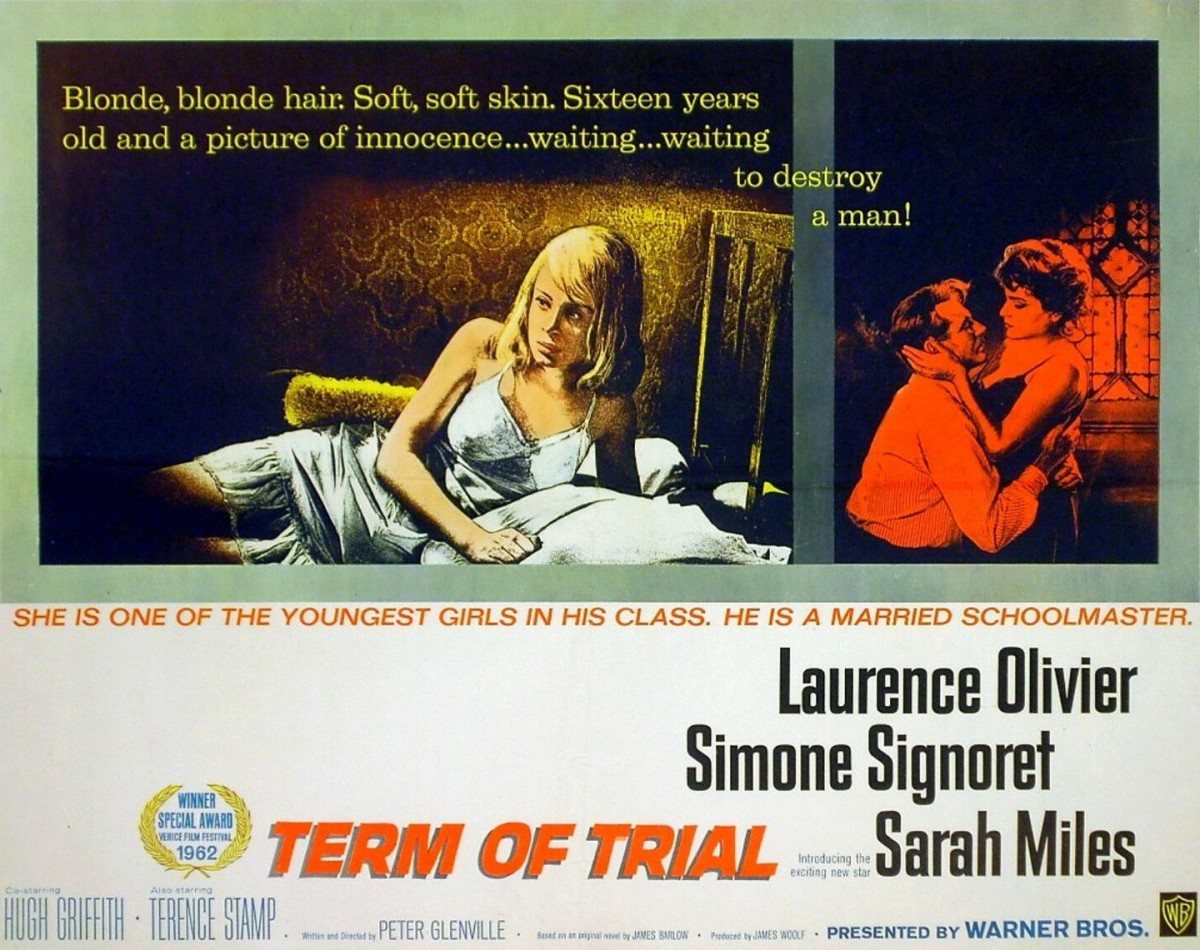
Notable for the debuts of Sarah Miles (Ryan’s Daughter, 1970) and Terence Stamp (The Collector, 1963) and an ending that even in those misogynistic times was wince-inducing. The halcyon era of dull English schoolteachers being celebrated (Goodbye, Mr Chips, 1939) or finding redemption or even just managing to overcome pupil hostility (The Browning Version, 1951) were long gone, replaced by a more realistic view of the casual warfare endemic in education establishments, not quite in The Blackboard Jungle (1956) vein but running it close, with bullying, sexual abuse and ridicule running riot.
Self-pitying Graham Weir (Laurence Olivier) has failed to achieve his ambitions in part due to alcoholism, in part to antipathy to his conscientious objection during World War Two. And although he has a sexy French wife Anna (Simone Signoret) in the days when any Frenchwoman was deemed a goddess, she is embittered that the future he promised has not materialized. Like To Sir, with Love (1967) his classroom is filled with no-hopers so that he responds to the meek and innocent wishing for educational betterment.
Weir’s only defence against endless indignity is a stiff upper lip and slugs of whisky. His lack of character contrasts with a young lad who takes revenge against constantly being chucked out of his house by his mother’s lover (Derren Nesbitt) by blowing up the man’s sports car.
Spanning the twin cultures of religion and the razor, one falling out of favor, the other holding violent sway, opportunity to rise above kitchen-sink England lies with the self-confident such as thug Mitchell (Terence Stamp) who smokes in class, gives the teachers lip, takes photographs of girls in their underwear in the toilets, physically threatens classmates and when his target is bigger gets older men to give him a good thumping.
A somewhat unlikely development is an end-of-term trip to Paris where the infatuated Shirley (Sarah Miles), who the good-hearted Weir has been giving free private tuition, ends up in the teacher’s bedroom and later accuses him of abuse. The impending court case and threat of imprisonment scupper Weir’s chances of promotion, make him consider suicide, and Anna to leave him.
The court scenes allow a number of famous character actors a moment of acting glory. Laurence Olivier (Bunny Lake Is Missing, 1965) must in part have been attracted to the role by a terrific court monologue. The movie is very downbeat in a country universally known never to enjoy an ounce of sunshine justifying the black-and-white movie rendition. If there is liveliness in the streets, cinemas, shops, it never translates into any of the main adult characters, all determined to uphold ancient values and endure constricted lives.
Exploiting audience expectation for verbal fireworks, the tension in Laurence Olivier’s finely judged performance comes from his untypical, unshowy delivery. You can almost hear him grinding his teeth. Simone Signoret (The Sleeping Car Murder, 1965) also acts against the grain, battening down her inherent sexuality, and her very presence speaks of lost hope, the fact that she was once attracted to Weir indicating he was once a very different prospect.
Sarah Miles excels as the wannabe seducer, that hesitant voice that would become her hallmark, struggling here to turn innocence into lure, expressing her adoration in heart-breaking simplicity, and yet aware that to catch Weir would require more than just the submission a guy like Mitchell requires. While hers is a stunning debut, I’m at a loss to see what marked out Terence Stamp’s typical surly teenager for speedier stardom.
Oscar-winner Hugh Griffiths (The Counterfeit Traitor, 1962) is the pick of the supporting roles. A remarkable scene-stealer, a shift of his head, a flicker of his eyelashes is all he needs while sitting in the background to attract the camera from another character in the foreground. Look out for Barbara Ferris (Interlude, 1968), Derren Nesbit (Where Eagles Dare, 1968), Allan Cuthbertson (The 7th Dawn, 1964), Roland Culver (Thunderball, 1965) and Thora Hird (television’s Last of the Summer Wine, 1986-2003).
Surprisingly un-stagey direction from Peter Glenville (Becket, 1964) who was far better known as a theater director in London and Broadway. Probably in those days if you were setting a movie outside sophisticated London you had to present a gloomy version of Britain so you can’t really blame him for that and Olivier was hardly a major box office attraction so a budget trimmed of color would be a requisite. Although the older characters display grim determination, the younger ones have not had the spirit knocked out of them in the Saturday Night and SundayMorning (1960) manner and the location shots reveal a buzzy atmosphere.
Glenville also wrote the screenplay based on the bestseller by James Barlow.
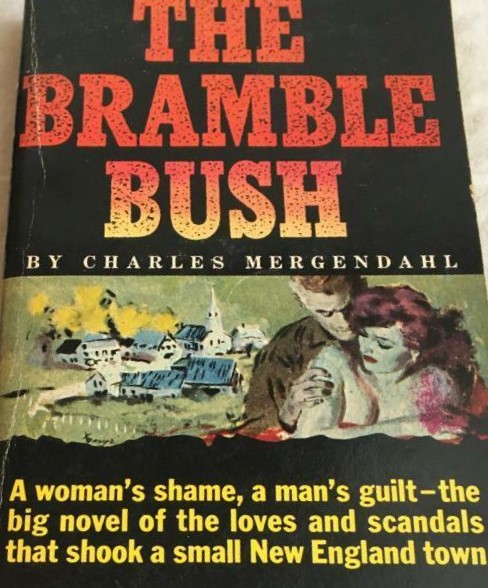
Few novels have been as abruptly shorn as Charles Mergendahl’s massive bestseller – seven million copies sold – The Bramble Bush. The last quarter of the original story was just dumped. For screenwriters seeking to heighten every emotion this was a very strange decision for it is in the last section that the book delivers huge dramatic punch.
The film – SPOILER ALERT – ends with Guy (played in the film by Richard Burton) judged not guilty of the murder of dying best friend Larry. Guy’s one-night stand with Larry’s wife Margaret (Barbara Rush) has made her pregnant but now widowed she leaves him on the grounds that he will be unable to live with what he has done. It’s a sad enough ending but it’s nothing compared to the book.
The trial section takes place three-quarters of the way through the novel. In the film, it is placed much closer to the end so there are only five minutes or so to tidy up in a rather ho-hum manner, nothing highly dramatic, no floods of tears, just Margaret leaving him behind.
Following the trial in the book, however, Margaret’s departure is much more sudden. There is no goodbye. She just vanishes. While judged innocent of murder, Guy has lost his license to practice so in the absence of professional commitments is free to spend months hunting for her. And find her he does.
The dramatic point you would have thought would be simply whether she can ever accept as a lover the man who has injected her husband with a fatal dose of morphine regardless of whether this was done with the best of intentions and could be construed as a mercy killing. But the author isn’t finished with these characters yet. Yes, they are reconciled and in fact get married.
But it’s too late. Margaret has tuberculosis – a considerably more dangerous condition in those days than now, and in some cases as untreatable as the incurable Hodgkin’s Disease that afflicted her husband. That puts both her life and that of her unborn child in danger. Guy faces another dilemma, just as he did with her husband. If he has to choose, whose life would he want to save.
The baby is born, and both survive. But only for the time being. Margaret’s TB has not abated. Since Guy’s license has by now been restored, they return to the town. But he’s in for a shock. The town is outraged. The public which had stoutly defended him and the jury which had set him free now turn against both, aware through the arrival of the child that they must have had an affair while the husband was still alive, which therefore clouds the issue of exactly why Guy committed euthanasia.
But before Guy can decide to move elsewhere and nurse his sickly wife and care for his newborn child – called Larry after the dead husband – Margaret dies.
That turns the book into a three-handkerchief tragedy that the film never was. Except for running time, you wonder why the screenwriters elected to miss all this out. Maybe the movie would have run over the two-hour mark, perhaps two hours fifteen minutes, but that would hardly make it so undesirable to exhibitors nor so offensive to the public given the ending was so much more dramatic.
Even then, the author isn’t finished. He provides an ironic ending The rejected Fran – dumped also by this point by Bert, Guy’s lawyer– determines that she will look after the child, allowing Guy to recover from his ordeal. And there is the hope – although she would not press her love for Guy on him – that in due course he will come to appreciate her and reciprocate her love.
Quite a different ending indeed from that foisted on moviegoers. Hard to say whether readers were disappointed, but when a novel is such a huge success it is generally because the public likes the story the author has devised. So to rob them of that seems extremely odd.
The novel had raced to the screen. The book was published in September 1958 and the film opened in February 1960, barely seventeen months later. When the gap between novel and movie is so short, it generates feverish public anticipation. And it seems almost perverse to deny the waiting audience the movie they expected.
Naturally, in the transition from book to screen there are other eliminations – and additions. And there is also the usual welter of changes made for no particular reason, for example the town of East Dereham becomes East Norton in the film.
Certainly, the aim of a movie being to heighten drama and combine disparate elements into a more cohesive whole, you can see why in the film it raises the stakes for the lawyer Bert Mosley (Jack Carson) to already be campaigning for district attorney rather than, as in the novel, only dreaming about it. Although both his parents are dead, Guy came from far more prosperous stock in the film than the book, the hospital named after his father in the film but not the novel.
Some of the changes must have seemed to create more drama, but I’m not so sure. What difference did it make whether it was Guy or the dying Larry (Tom Drake) to be the one returning home? In the film it’s Guy, in the book Larry. In the book Guy is kind to the town drunk Stew (James Dunn) but it’s the opposite in the book, hostile and physical abusive to him from the outset. In the book we learn why – Stew was Guy’s mother’s lover and their affair triggered the suicide of his father – from an internal monologue, but in the film this plays out in more dramatic fashion when Margaret confronts Guy about what she sees as his unfair treatment of the older man.
There’s an elimination that’s so shocking you can’t understand why it was left out by the screenwriters. In the book we discover that Stew is in fact Guy’s father, a fact ignored in the film. And in the last section of the book when Guy is tracking down Margaret in different towns he takes Stew’s surname as his own. And one core element of the film – Larry pushing Guy and Margaret together – is the screenwriters’ invention. (Perhaps audiences would view Guy in a lesser light if he simply took advantage of his friend’s illness to sleep with his wife). And to tie things up more neatly, it’s Guy in the film who prescribes sedatives for Margaret whereas in the book that’s not part of his role.
On the other hand Larry’s father Sam is hostile to Guy for reasons that are kept from us in the film – but in the book we find out it’s because Sam blames Guy’s father (also a doctor) for his wife dying in childbirth, an incident that caused him to lapse into the insanity mentioned in the trial scene in the film.
You can see why some elements of the book are not included. The creepy newspaperman Welk (Henry Jones) who blackmails Fran (Angie Dickinson) into posing nude for him later dupes his assistant into doing the same. Bert falls for a tough Boston reporter Sylvia for whom he quits town and dumps Fran. On discovering she is pregnant by Guy, Margaret’s initial reaction is to seek an abortion. And there’s a section where hospital chief Dr Kelsey and Fran discuss the various ethical ways doctors have of letting exceptionally ill babies die. The judge suggests to the jury that Guy could be acquitted due to temporary insanity. And there is a bunch of peripheral characters whose main purpose is to highlight the jealousies inherent in small-towns.
But there are two character turnarounds the screenwriters choose to ignore. The first is that the drink-sodden Stew becomes a recovering alcoholic after discovering he is a grandfather. The second is more touching. After Fran was rejected early on by Guy and later dumped by Bert she had resigned herself to a life of “doing terribly immoral things.” But the book ends with, as mentioned above, her taking a huge emotional leap by giving herself the task of nursing both motherless child and widowed father.
It’s always fascinating to see how screenwriters tee up a book for the big screen treatment, deciding what to leave in and what to take out, occasionally (as in Mirage, for example) using little more than the title and the original idea and jettisoning the rest. Of course, limitations may be imposed on the screenwriters of which we are unaware, star demands or budget impositions and other factors. Here, I felt that screenwriters Milton Sperling (also the producer) and Philip Yordan did not get the best out of the book.
The secrecy business was working overtime in small-town America according to the Peyton Place template. And that wouldn’t be so bad here except returning big city doctor Guy (Richard Burton) has a few of his own in the locker but more importantly the unfolding of so many secrets detracts from the time available for the main dramatic premise which is an absolute corker.
We might as well account straight-off with the secret Guy drags around behind him like a two-ton weight thus explaining his general surliness, tight-lipped demeanor and occasional flashes of temper. As a twelve-year-old he told his father he had caught his mother in bed lover with Stew (James Dunn) which prompted his dad to chuck himself off a cliff.
The other big secret, dealt with fairly promptly, is that local nurse Fran (Angie Dickinson), who held a torch for Guy, now makes do with district attorney Bert (Jack Carson), that clandestine affair coming to light not so much in flagrante but in full beam when the illicit couple require treatment following a fire in a hotel bedroom.
The unravelling of both secrets impacts on Guy’s emotional state. The fire leads to Fran admitting her feelings to Guy, happy to have him use her for sex if love is not possible, “I love you so much I have no shame,” she proclaims, to no avail, but the hotel business also makes her fall prey to blackmail by local newshound Parker (Henry Jones), a budding amateur photographer of the unsavoury kind. Recounting his personal tragedy results in a Guy having a one-night stand with the married wannabe artist Margaret McFie (Barbara Rush).
But here’s the brilliant twist. Margaret’s husband Larry (Tom Drake) wants her to end up with Guy – but after his death. Larry, Guy’s best friend from childhood, is dying, the doctor scuttling back to a town that harbours too many bad memories in order to act as his personal physician. Larry’s never going to recover, he has the incurable illness Hodgkin’s Disease. His dying wish is that Guy marry Margaret.
Margaret is revolted by the idea, “I don’t want to be beautiful for anyone but Larry,” but unable to cope with his with illness is living on a cocktail of drink and drugs. And although Guy, who distrusts any woman, is similarly ill-inclined, Margaret becomes dependent on his medical ability, treating both husband and wife. Larry turns out to have another crazy idea – he wants Guy to kill him, medically speaking of course, some extra, illegal, doses of morphine would do the trick.
This incredible bucket list provides Guy with a huge dilemma, never mind what to do with Fran throwing herself at him and having to put up with the hypocritical Bert, and Stew, now the town drunk, begging for forgiveness, and Larry’s father Sam (Carl Benton Reid), who, for reasons unspecified, hates the doctor.
There’s more twists to come, just in case you thought you had everything worked out. But you can see the problem over-complication creates. The euthanasia-please-have-sex-with-my-beautiful wife combination would have set the movie up nicely from the get-go. Guy wouldn’t need to have a deep secret to find himself in very deep waters. How he would react to either or both outcomes, how Margaret would equally react to the possibility of ending her husband’s suffering in a quick and painless manner, would be more than enough to provide the dynamic the picture required. The movie then pivots on Guy being charged with murder.
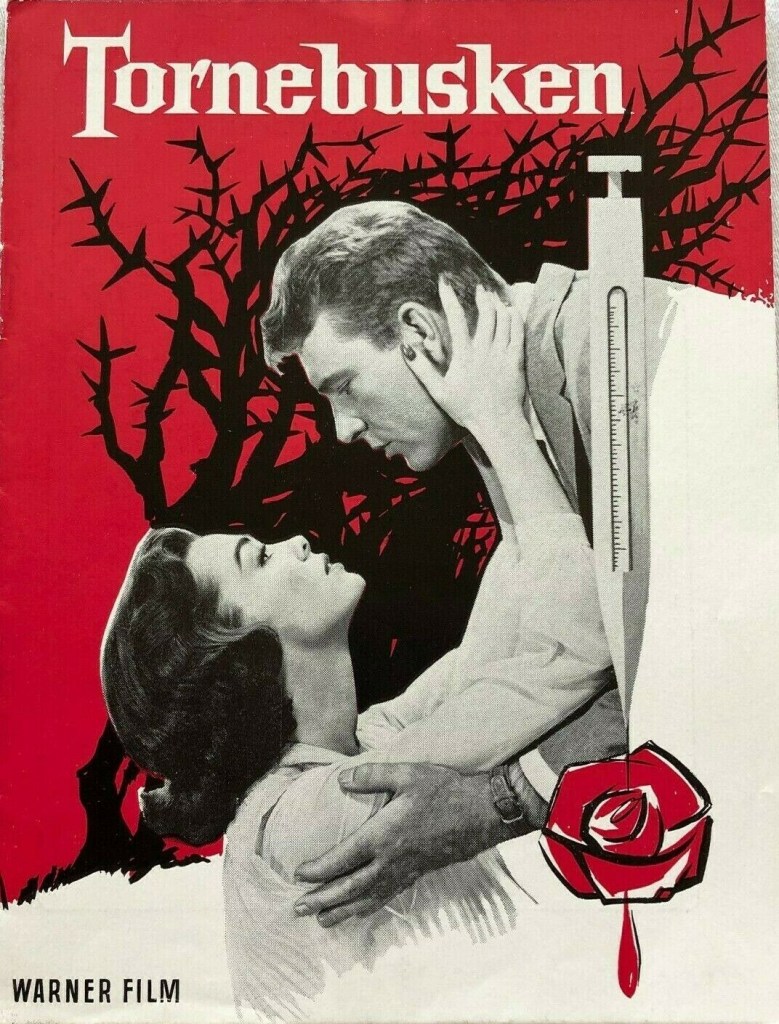
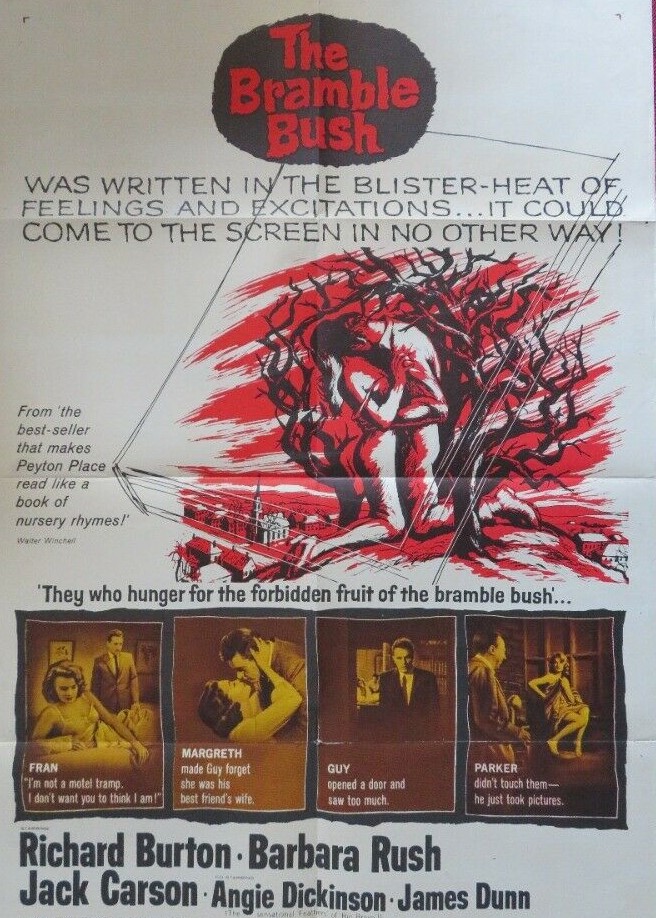
It’s certainly interesting enough but Guy is too buttoned-down to incur sympathy and his revelation, devastating though it is, doesn’t suddenly make him an instantly more attractive screen character. In fact, it’s Fran who elicits the greater sympathy, the woman bedding someone who views her only as a sex object, yet willing to become a sex object for someone she does love if that’s all she can have. Eventually, the two key issues are put in the spotlight, which certainly puts a spark in the picture. But the poster promises a passion that just doesn’t exist.
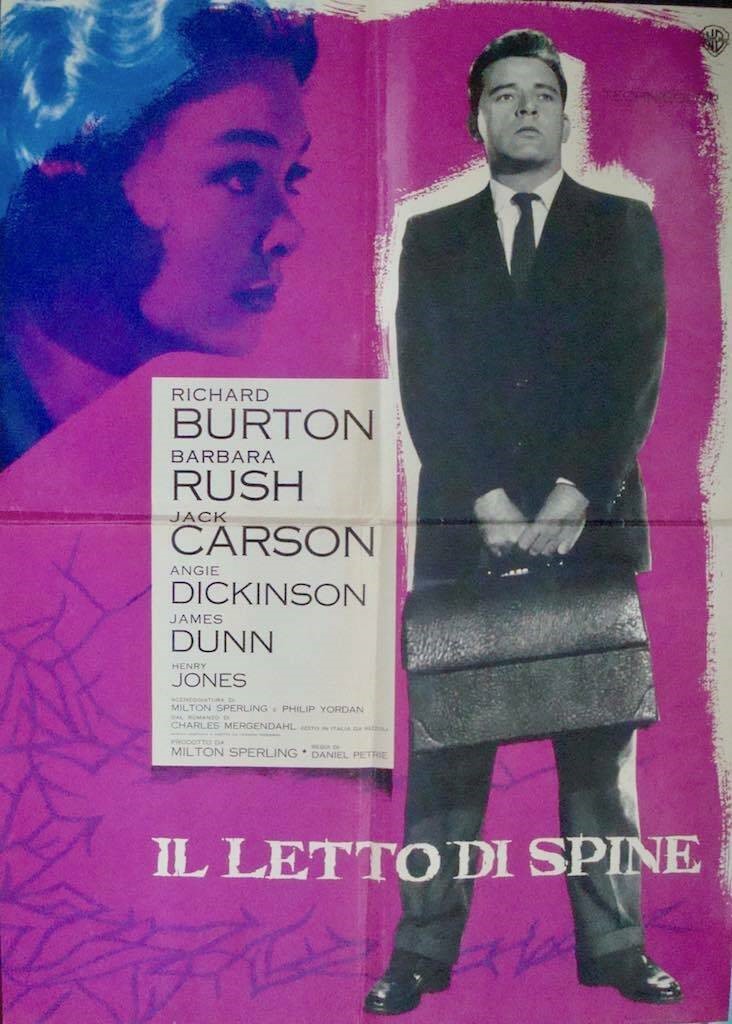
Richard Burton (The Spy Who Came in from the Cold, 1965) plays this character in a lower register than his screen persona, the sonorous voice toned down, and although the look of someone who doesn’t want to be back rings true the performance lacks variety and there are only occasional glimpses of the fiery actor. Barbara Rush (Robin and the 7 Hoods, 1964) has her own legitimate reasons for being dispassionate and the vibrant character her husband married never really gets an airing. Angie Dickinson (Jessica, 1962) comes across as a more human character with, in emotional terms, a greater flaw, and a more tragic figure, even though there is nothing life-or-death about her circumstances. Two veterans are showcased: Jack Carson (Mildred Pierce, 1945) and James Dunn (Bad Girl, 1931).
Television director Daniel Petrie (A Raisin in the Sun, 1961) was making his movie debut. The screenwriting team of Milton Sperling and Philip Yordan (Battle of the Bulge, 1965) drew on the bestselling novel by Charles Mergendahl.

 The Magnificent 60s