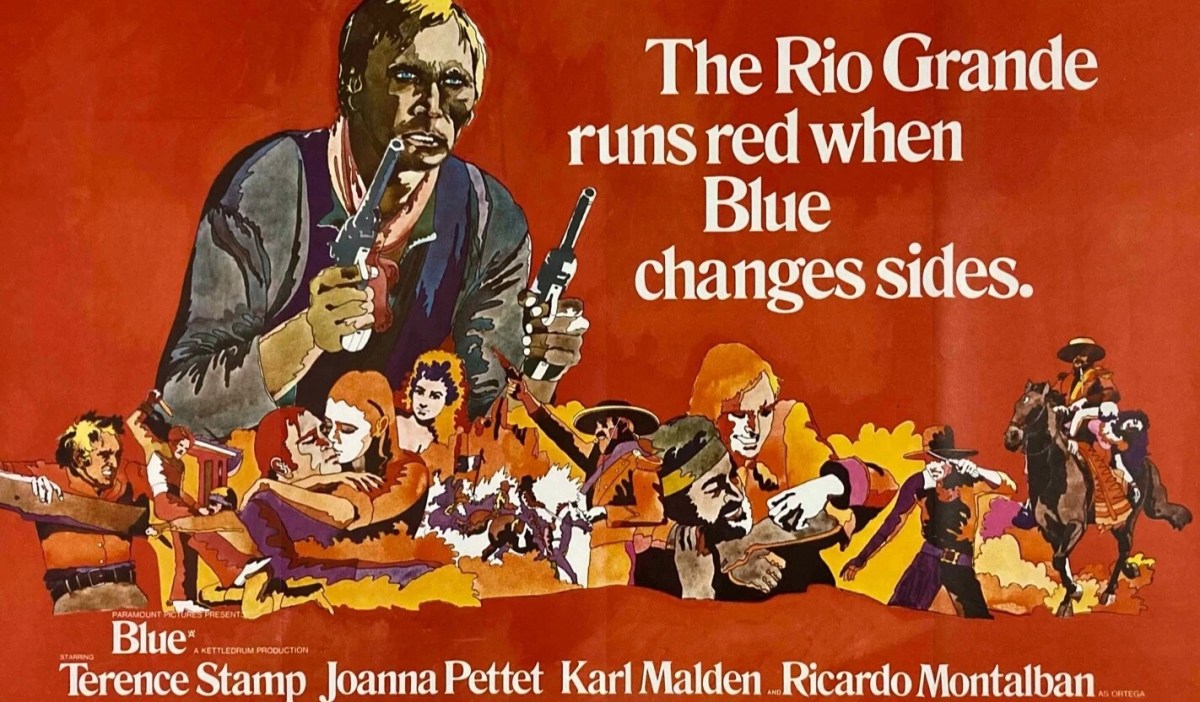
Easily the most underrated western of all time. Few people saw it on release and precious few since. If remembered at all, it’s for reasons of movie trivia. Robert Redford got into a legal fight with Paramount when he pulled out of the starring role. And it was what was being shot in the background of the Burt Reynolds movie Fade In (1968).
Decades before cultural appropriation was a major no-no, Americans didn’t take too kindly to Brits taking on top-billed roles in westerns. Audiences sniggered at Dirk Bogarde as a Mexican bandit in The Singer Not the Song (1960), John Mills proved an obstacle to audience acceptance of Chuka (1967) and Shalako (1969) starring Sean Connery, the world’s biggest box office draw at the time, would become a huge flop Stateside.
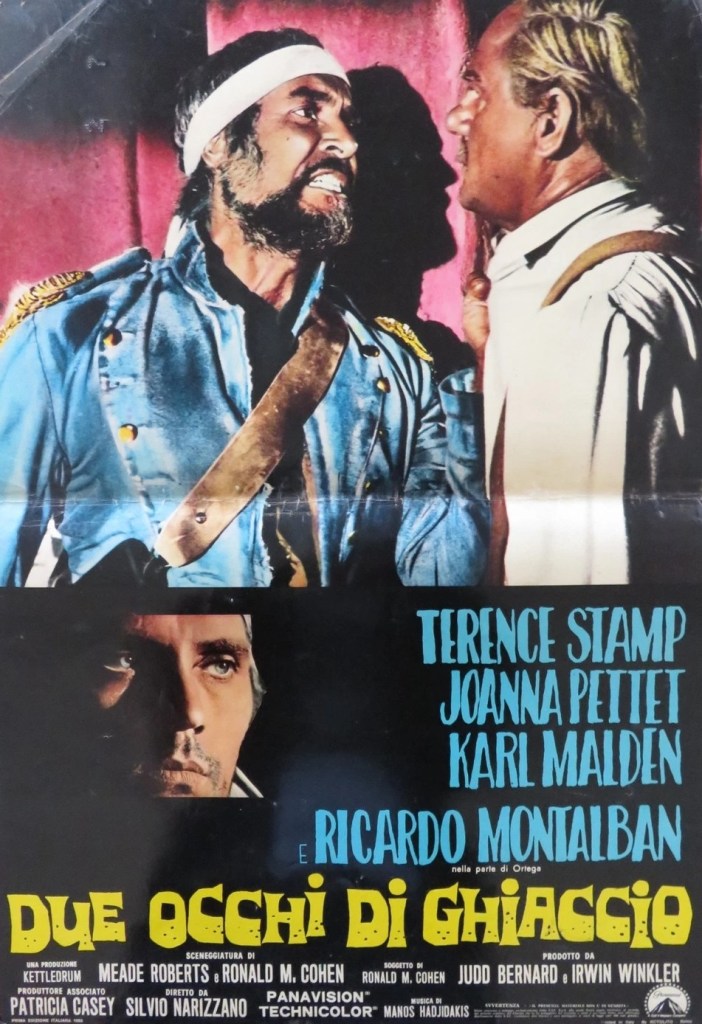
Yet there are some extraordinary moments here. Some, frankly, I’m astonished never rated a mention at the time nor since. The director’s use of natural sound is ground-breaking. For a start, there’s very little music, none of the triumphal brass that generally accompanies hordes of cowboys racing across plains. Often, here, all we get is hoofbeats. In terms of the aural Hitchcock would have applauded one scene, where a man is hunted through tall grass. All we hear is the crackling sound of the pursuers as they stalk him through the dried-out terrain.
Most times when in other films we see a bunch of cowboys charging along, it’s filmed from the front or the side. Reason being, shoot it from the back and you’ve got to deal with all the dust churned up by the hooves. Not so, here, bring on the dust. Let’s have something new.
There’s even a nod to The Searchers (1956), the famous doorway scenes, but here the main character is neither coming nor coming but cannot make up his mind whether to do either and so slouches against the doorframe.
The opening sequence is The Wild Bunch (1969) in reverse. It’s the good guys in the town, and the bandits who create the ambush and, minus Peckinpah’s obsession with bloodletting, treat their captives ever bit as brutally. Even here, there are two notable scenes. In the first, our hero Blue (Terence Stamp) has been sitting napping under his hat when a troop of Mexican soldiers arrive. Once they hunker down inside the saloon he throws a huge red scarf in the hair, signal to the watching bandits. Then, after the soldiers have been routed, and their leader is still trying to make a stand, Blue races up behind and whips away first his upraised gun, then his hat, then the man himself.
And these are not ordinary bandits. You might think they are given our post-action introduction to them shows them whoring, gambling and fighting. But actually they are revolutionaries and leader Ortega (Ricardo Montalban) has a strategic brain and realizes that they have to take the fight across the river to the Americans – on their most important day of the year, July 4th, Independence Day – and get them so riled up they do something about the inequities in Mexico.
And he has his work cut out to rein in his rebellious son and the concerns raised by his number two that the life, hiding out in the hills and sleeping in caves, is losing its appeal to his followers. So, intelligent bandits.
The Americans might not be particularly bothered by their neighbors, but still they’ve got a stuffed mannikin hanging from a noose with the word “Greasers” written upon its chest. The bandits break up the party, rob the Yanks, but for some reason leave the enemy with all their weapons, allowing the farmers to form an immediate posse and set off in pursuit.
Blue is shot but makes his way to a farmhouse where, luckily for him, he is tended by farmer’s daughter Joanne (Joanna Pettet) whom he previously saved from rape. It’s a bit of a tip-off that the fugitive goes by the name Azul (the Spanish word for “blue”) to the Mexicans given, I’m assuming, all Mexicans are brown-eyed. So he must be an outlander. And so he is, brought up by the Mexican bandits.
At first he appears to be of the Clint Eastwood persuasion, monosyllabic to the point of dumbness, but, eventually, in a quite brilliant scene, forced to utter a word before Joanna cuts his throat with a razor, an idea that found its way, as I recall, into Alan Parker’s Mississippi Burning (1988).
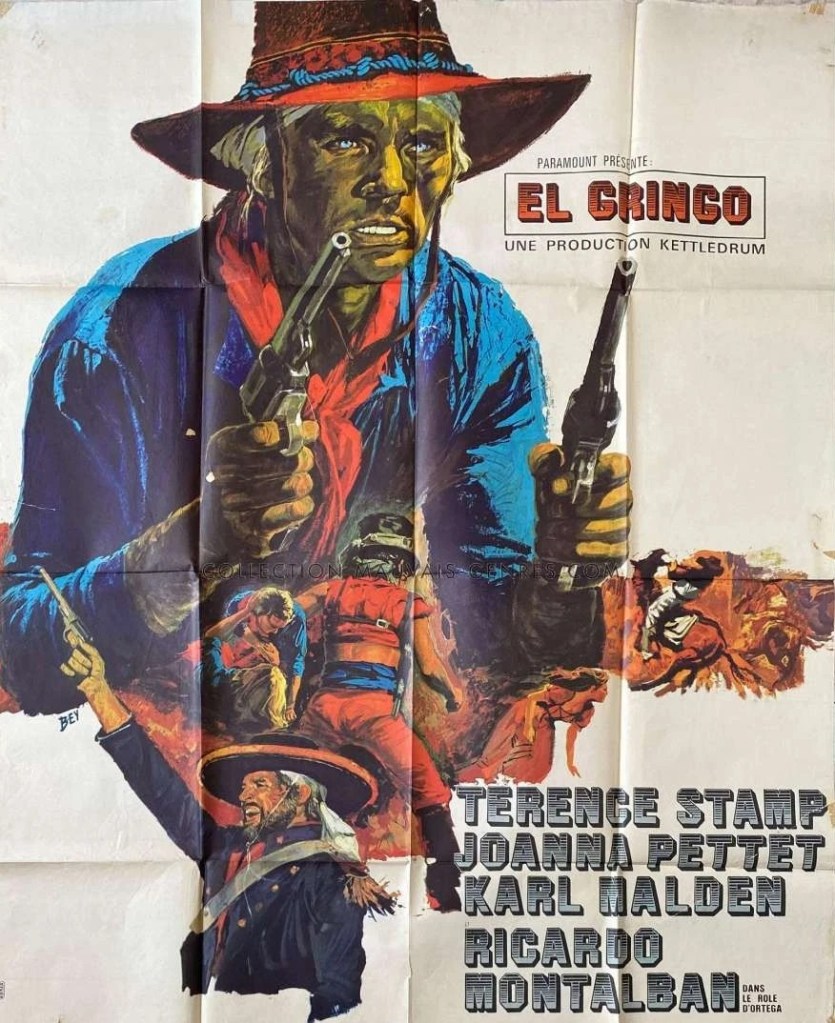
And if ever action carries more meaning than words, it’s in the scene where Joanne discovers Blue has apparently fled only to spy him ploughing the fields. As you might expect, whether an American male or female is brought up by Native Americans (Hombre, 1967) or as here Mexicans, they find it hard to be accepted. The issue is forced upon his new countrymen when the bandits return, and Blue has to choose a side.
Blue was an orphan thanks to racism against his American parents when they settled in Mexico. And he suffers, unfairly you would say given he was born in the U.S., from racism again when he crosses the border.
The sex scene is brilliantly handled, relying both on sight and sound. It’s Joanna who has to instigate it, instinctively knowing that he won’t make any move in case it is wrongly interpreted. The father, noting her bedroom is empty, begins to walk along the corridor to Blue’s room. Hearing his footsteps, Joanna turns out the light. Seeing the light go out, the father retreats – on tiptoe.
There’s also the best demonstration of pistol shooting this side of Butch Cassidy and the Sundance Kid the following year. And without taking anything away from the Robert Redford scene, it’s remarkably similar.
And Blue proves himself to be a brilliant tactician. He sets up a stunning ambush and the bandits are slaughtered from both sides of the river when they attempt to cross. His leadership, unusually, sets up emotional issues. When Joanne reacts against this new tough side of him, it’s her father that calms her. But that isn’t the peach. Blue confesses that he enjoys killing, it “pleasures” him.
I’m afraid to say the ending of Butch Cassidy also has remarkable similarities to this. There it’s the freeze frame that encapsulates the death of the heroes. Here, the camera draws back and back into the sky as Joanne holds her dead lover in the river.
Terence Stamp (The Collector, 1965) doesn’t quite have enough going on behind the eyes to become a top-class actor so sensibly director Silvio Narrazino (Georgy Girl, 1966) avoids going in too close on the baby blues and allows the actor freedom of movement to reveal his feelings, the slouching in the doorway one example, another being Blue’s slow realization that much of what he sees in the farmer’s house is familiar. Stamp acquits himself well in the action scenes.
But Joanna Pettet (The Best House in London, 1969) is the revelation. We’re quite used to spunky or feisty females in westerns. But I don’t think I’ve ever seen one who takes control with subtlety. Her father Doc Morton (Karl Malden) can’t get a word out of Blue no matter the threats uttered and violence threatened. But when Joanna takes up a cut-throat razor for the first time in her life and begins to trim his stubble, deliberately making a hash of it, that’s as novel a meet-cute as you’re going to find as well as one of the best definitions of female character that you’ll see in a western.
Written by Meade Roberts (The Stripper, 1963) and Ronald M. Cohen (The Good Guys and the Bad Guys, 1969).
One of the most stylish and innovative westerns you’ll ever see and you need to watch it with your ears attuned to sound.
A true find.

 The Magnificent 60s
A bit:
“Blue marked a re-teaming of producers Irwin Winkler and Judd Bernard after 1967’s Point Blank (see entry). Robert Redford was initially attached to star, as announced in a 25 Jan 1967 Var item, which listed Blue as one of twenty-eight feature films Paramount Pictures planned to release between 1967 and 1969. Rod Steiger was sought to co-star with Redford, according to the 20 Apr 1967 DV. However, the 12 Jun 1967 issue noted that Redford had left the project and would be replaced by British actor Terence Stamp. The 23 Apr 1968 DV review of the film later stated that legal action was taken following Redford’s departure, resulting in a rumored settlement.
Principal photography began in Moab, UT, on 5 Jul 1967, as noted in a 7 Jul 1967 DV production chart. While filming was underway, a second picture, titled Fade In, was shot concurrently. An article in the 30 Jul 1967 LAT explained that, on a location scout for Blue in Apr 1967, director Silvio Narizzano and associate producer Patricia Casey had met a Utah local named Pete Dole, a farmer “who impressed them with the complete harmony with which he lived in his environment.” Casey had imagined what might ensue if a worldly woman like herself had a love affair with Dole; thus, the story for Fade In was built around an unlikely romance between a visiting actress and local cowboy on the set of Blue. Jud Taylor was hired to direct Fade In, with Burt Reynolds and Barbara Loden co-starring. Silvio Narizzano and Judd Bernard, among others, were set to appear as themselves. The budget for Fade In was cited as $400,000 in the 30 Jul 1967 LAT, which indicated that Blue would cost far more. The 23 Apr 1968 DV later listed Blue’s initial budget as $3 million, but stated that the final cost exceeded $5 million. The dual production was said to mark the first time that two separate Hollywood pictures were shot in conjunction with one another. Judd Bernard, who produced both, was quoted in LAT as saying, “Both pictures are either going to be great or be disaster areas. There will be no middle ground for either one.” However, while Blue received a theatrical release as planned, Fade In was shelved by Paramount. It was ultimately shown on television, making its debut on 8 Nov 1973 on the CBS (Columbia Broadcasting System) network, as indicated by a 4 Nov 1973 NYT listing.
The world premiere of Blue was scheduled to take place on 23 Apr 1968 at the Utah Theatre in Salt Lake City, UT, according to the 12 Apr 1968 DV. The Mormon Tabernacle Choir was slated to perform at the event, which would celebrate the picture as the first-ever feature-length theatrical film to be shot entirely in Utah.
A news brief in the 25 Apr 1968 DV stated that Johnny Mandel was originally hired to compose the score but was later replaced by Manos Hadjidakis.
Blue marked the feature film acting debut of Peggy Lipton.”
LikeLike