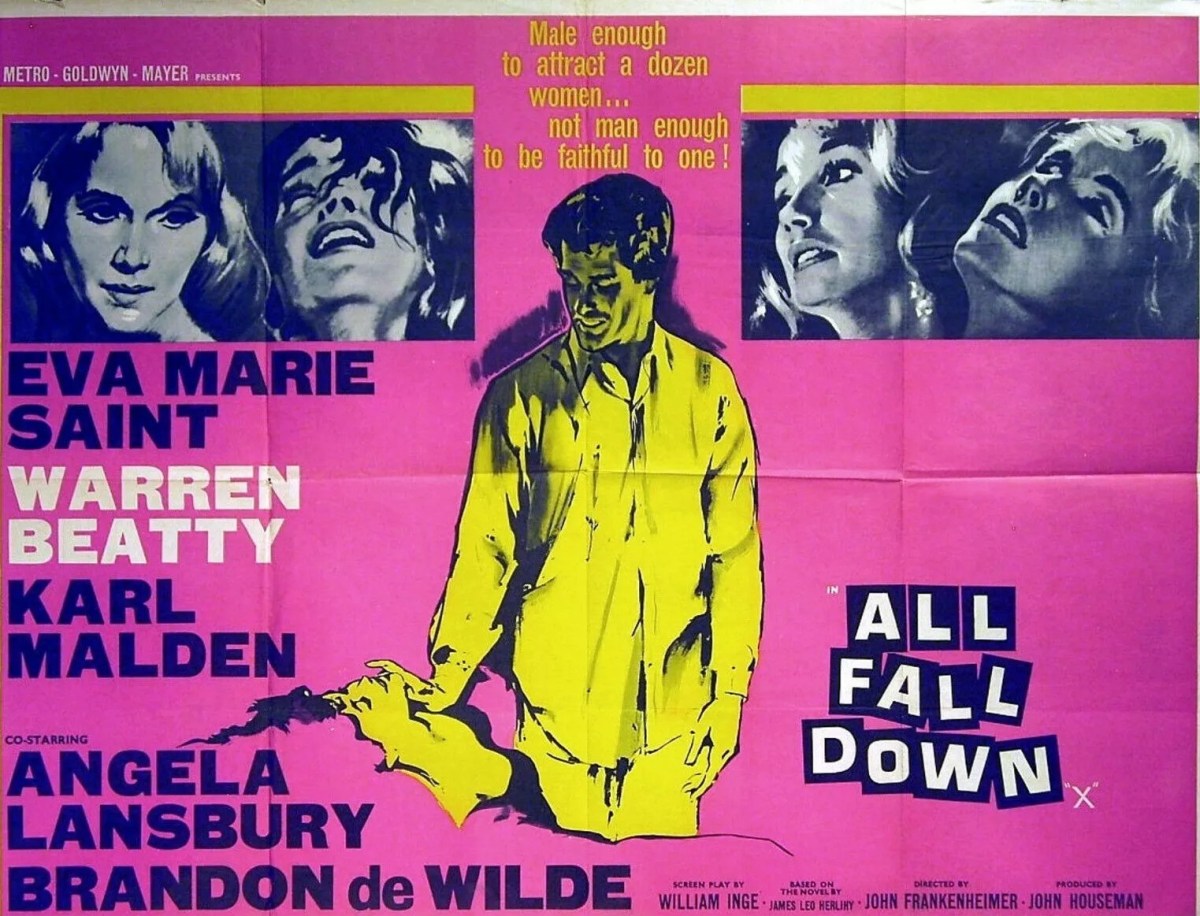
Both an easy sell and a tough sell for today’s audience. Easy because, this early in the decade, we’ve got a succession of independent sexually liberated women for whom handsome hunks like Berry-Berry (Warren Beatty) are collectibles. Tough because our ostensible hero is a serial abuser, beating up women.
The tale is somewhat complicated by the narrative which, rather than putting Berry-Berry and Echo (Eva Marie Saint) together early on, gets more involved in the travails of Berry-Berry‘s innocent young brother Clinton (Brandon De Wilde), leading us to believe this is going to be more of a coming-of-age saga than a more mature romance, especially when the young lad is besotted by the 31-year-old Echo who appears to foolishly encourage him though he’s not much past the age of consent.
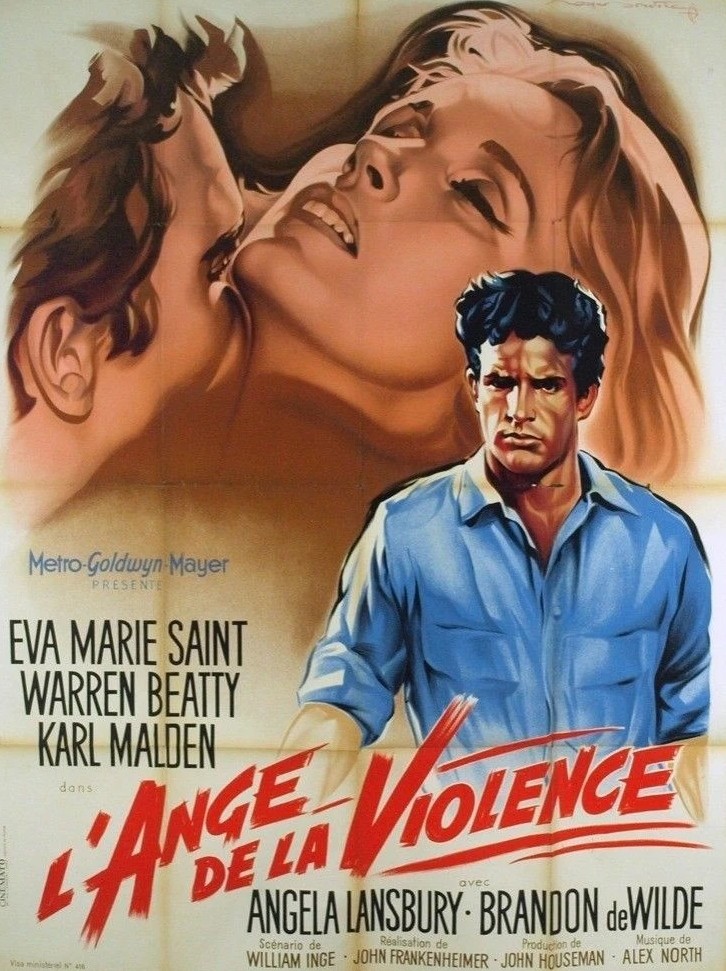
Or that it’s one of those stories when the adoring sibling realizes that big brother is not worthy of any adoration and far from looking as if he rules the world with his drinking and womanizing that he’s a pitifully small part of it.
Given the era, only a fraction of the sleazy world explored in the bestselling source novel by James Leo Herlihy (Midnight Cowboy, 1969) can find its way onto the screen. Still, in the first few scenes were are introduced to hookers, strippers and corrupt cops (who steal the cash Clinton planned to spend setting his brother up in the shrimp business).
Berry-Berry hasn’t a protective gene in his body, abandoning Clinton when a rich married woman beckons. It’s not just the unhappily married who alight on Berry-Berry but otherwise respectable schoolteachers. For a contemporary audience this might have been a more instructive avenue to go down, how such women, not all with money to burn, have the confidence to pick up men from a position of authority. Sure, Berry-Berry’s not one, ultimately, to remain at anyone’s beck-and-call but it’s interesting to see just who’s first to do the beckoning.
This is also the kind of picture that comes over more like a stage play and all the hidden secrets that entails – Echo’s previous boyfriend committed suicide. Clinton’s parents, however, let it all hang out, the father an alcoholic, the mother controlling.
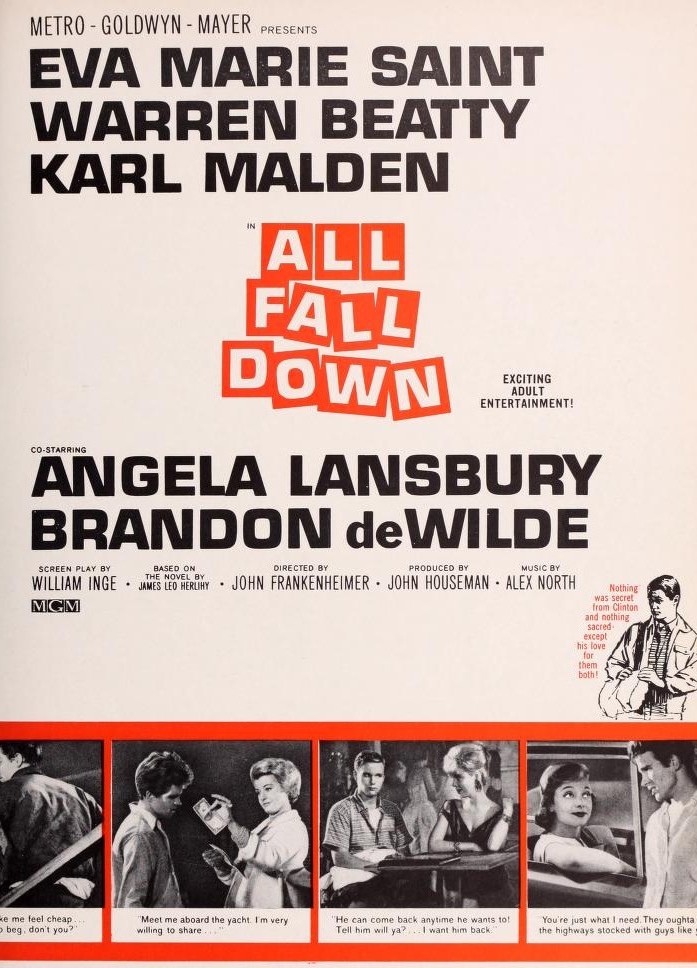
By the time Berry-Berry and Echo manage to get it together, you can tell which way this is heading and even if Echo hadn’t died in a car accident, it’s doubtful given Berry-Berry’s personality whether he could have handled commitment.
Warren Beatty (Kaleidoscope, 1966) comes over like a latter-day James Dean, all quiff and male arrogance and winning smile, but there’s not an ounce of depth to his characterization albeit that he wants to have it all and can’t deal with entanglement and treats women as punchbags when he wants out of a relationship.
Eva Marie Saint (36 Hours, 1964) is better value, expectation already beaten out of her after having put up with the depressed boyfriend all this time and willing to embark on an affair with Berry-Berry because she hopes that eventually he will come to love her. Her ideal lover, it has to be said, looks like being the sweet-natured Clinton. But Saint leans into her feyness too often.
Much better value are Karl Malden (Billion Dollar Brain, 1967) and Angela Lansbury (The Manchurian Candidate, 1962) as the bickering parents. Malden has never looked as unkempt and he retains a marvelous innocence, inviting three bums to the house in the spirit of Xmas.
Too much rests on the shoulders of Brandon De Wilde (In Harm’s Way, 1965) and, in truth, the narrative could have excised him and still arrived at its destination and it seems somewhat preposterous to have him so involved in the final scenes.
The structure emulates F. Scott Fitzgerald’s The Great Gatsby where much of what we see is through the prism of a secondary character who in the novel acts as narrator. They junked that aspect for any of the screen versions and they’d have been better off doing the same here.
John Frankenheimer (The Manchurian Candidate) directs from a William Inge (Splendor in the Grass, 1961) script.
A contemporary audience might find more interesting the parts that the film only covers in passing. “They ought to have highways stacked with guys like you,” is the come-on of one rather forward lady.


A few bits:
“The 14 Sep 1960 Var announced the second printing of James Leo Herlihy’s bestselling 1960 novel. Domestic motion picture rights were purchased by Metro-Goldwyn-Mayer (MGM) for $150,000. As stated in the 12 Sep 1960 LAT, producer John Houseman hired renowned playwright William Inge to adapt the novel for the screen. Eight months later, the 17 May 1961 DV reported that director John Frankenheimer was scouting locations in Key West, FL.
According to the 14 Apr 1961 LAT, Houseman was hoping to cast actress Carolyn Jones in the film. The 1 Jun 1961 DV noted that Robert Wagner was also under consideration. As stated in the 27 Jun 1961 DV, Frankenheimer planned two weeks of rehearsals prior to filming. A 28 Jul 1961 DV production chart announced the start of principal photography the previous day.
Both Frankenheimer and lead actor Warren Beatty denied rumors of their purportedly combative working relationship in the 11 Sep 1961 DV. Beatty admitted, however, that he preferred detailed instructions from a director, while Frankenheimer wanted actors to express their feelings. Frankenheimer revealed that a “dream sequence,” which featured Beatty as a werewolf, was inspired by the director’s own recent nightmare. Months later, actress Eva Marie Saint told the 1 Apr 1962 LAT that she insisted on being doused with cold water during a rainstorm sequence, enabling her to shiver and shudder in a convincing manner.
Other cast members included Rick Lancelot and Rita Somers (11 Aug 1961 DV); William Challee (14 Aug 1961 DV); Mabel and June Smaney (15 Aug 1961 DV); John Burnside (17 Aug 1961 DV); Harry Hines and Burt Mustin (22 Aug 1961 DV); and Alyce Allyn (14 Sep 1961 DV). The 7 Jul 1961 DV credited George Elder as prop man, and Amelia Wade as script supervisor.
The 21 Sep 1961 DV reported the conclusion of principal photography, and the company’s return to California from Key West the previous day. Frankenheimer explained his decision to film in black-and-white in the 6 Oct 1961 NYT, saying that color “generally ruins good drama” by converting it to “travelogues.” The 30 May 1962 Var estimated the final budget at $1.2 million. According to the 28 Dec 1961 DV, composer Alex North expected to complete the score in two recording sessions, one of which was scheduled for that day, the other for 15 Jan 1962.
The 30 Jan 1962 DV noted that Houseman and Frankenheimer attended a “sneak preview” in Pomona, CA. Another preview at the Paramount Theatre in Hollywood, CA, was reported in the 6 Feb 1962 DV, with Warren Beatty, Eva Marie Saint, and several young MGM executives in attendance.
All Fall Down opened 28 Mar 1962 in Chicago, IL. Openings followed in Los Angeles on 6 Apr 1962, and in New York City on 11 Apr 1962. The picture was also an entry at the 1962 Cannes Film Festival. Critics were generally disappointed, with several noting oversights and incongruities in the screenplay. Of particular note was Bosley Crowther, who complained in his 12 Apr 1962 NYT review “that everyone in the story is madly in love” with Beatty’s character, whom he described as a “cretin.”
LikeLiked by 1 person
Never knew anything about this so thanks for filing me in.
LikeLike