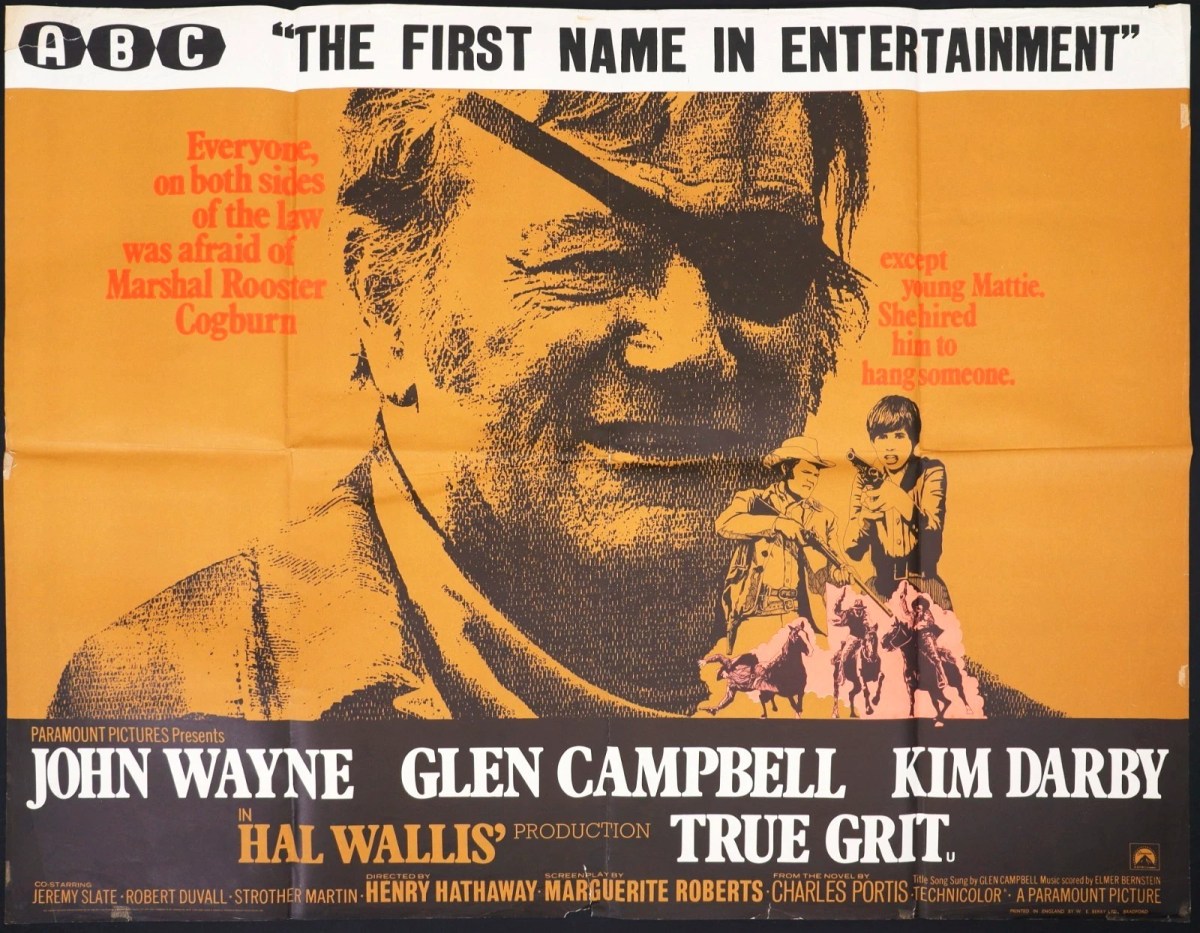
An old-style western with a modernized anti-hero in Rooster Cogburn (John Wayne), nearly as “rapaciously brutal” as the same year’s The Wild Bunch, a script with language that captured the period, a heroine Mattie Ross (Kim Darby) who falls into the robust Barbara Stanwyck/Maureen O’Hara mold, humor and action in equal measure, and an unfussy director (Henry Hathaway) who loved the panorama even more than John Ford.
Although still critically rated as not as good as The Wild Bunch, and still mostly disdained by academics, I would argue that it has been grossly under-rated and fully deserving of a re-evaluation. In the first place, despite direction very much in the old school, Hathaway exhibits many stylistic flourishes, not least the very long shot which has rarely been used to such effect. He also utilizes the shaky-camera point-of-view in a much more effective manner than Mackenna’s Gold (1969) to record Cogburn’s charge at the outlaws and there is even a zoom, to pick out the villain Tom Chaney.
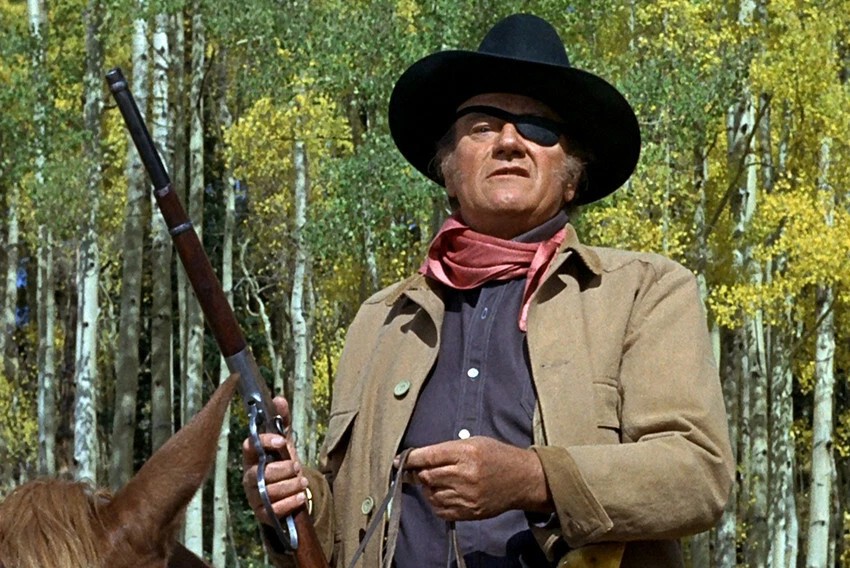
Also, you know exactly where you are in a Hathaway picture, not just in the narrative sense, but in terms of how people lived and where the towns and farms were in relation to each other (the Ross farm is 70 miles from Fort Smith, the hamlet of McAllister 60 miles from the villains’ hideout). He liked to show many aspects of a town, so we see where the courthouse is in relation to the jail and the stable by the simple expedient of having the characters walk past them. And the movie is littered with sound effects of the most ordinary kind (blacksmith’s hammer, train whistle, footsteps). The film is as much about progress as Once Upon a Time in the West and The Wild Bunch, the name of the town, Fort Smith, where much of the initial action takes place, indicates it was once a frontier town.
Rooster Cogburn feels crowded out by a new generation of lawyers challenging swift justice, and Mattie Ross, hunting the killers of her father, is well schooled in argument, winning many a confrontation with apparently more experienced and wily men by being more adept at negotiation and like a chess player always one move ahead. The aftermath of the Civil War lingers in the background, demonstrated by Mattie’s weapon and Cogburn’s antipathy to Texas Ranger LaBeef (Glen Campbell). But the story strikes an even balance, no matter how assured Mattie Ross comes across in civilization she almost comes apart in the wilds and without the protection of Cogburn would have met the kind of fate at the hands of men undergone by female characters in The Stalking Moon (1969), Mackenna’s Gold and The Wild Bunch.
It should be said here that the movie is full of audience direction, we are always told where Mattie will go next or where Cogburn is intending to go, with accompanying plausible reason, especially when later Cogburn calls off the hunt for the outlaws. There is no exploration of mystery, the characters are always upfront, and where characters express regret is it minus the self-pitying of The Wild Bunch. Nobody is defined by something they should have done instead, so, in that respect, the narrative is as clear as the overall direction.
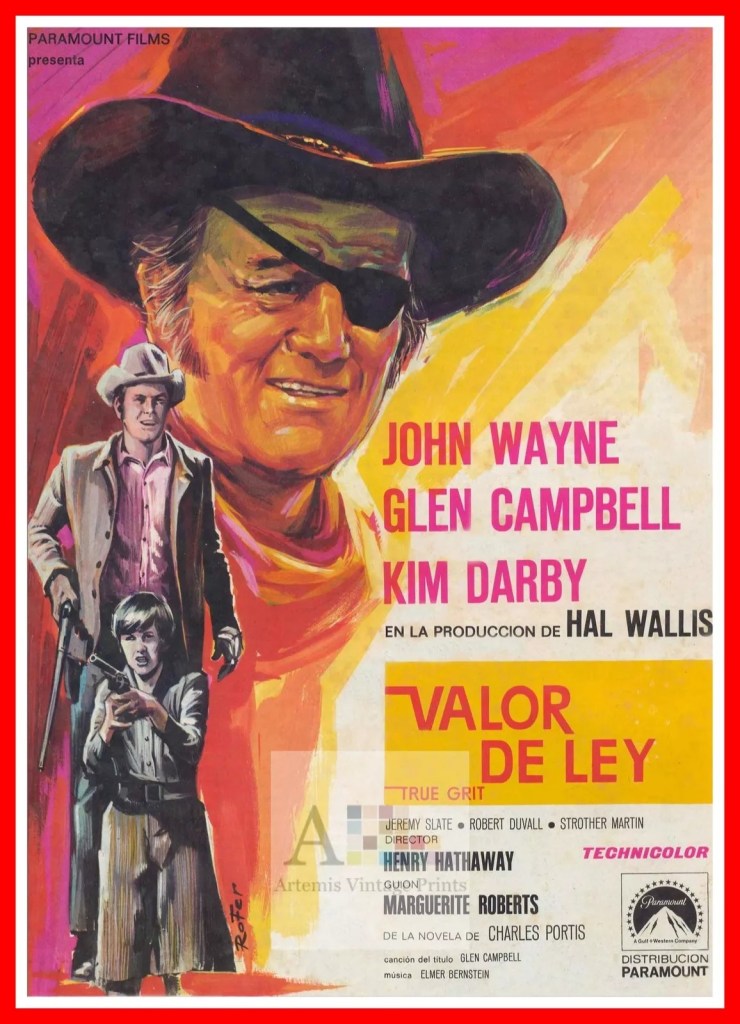
We hear Cogburn’s voice before we see him, as if the director is preparing us for a different John Wayne. This is the actor in a new timbre, the usual slow drawl replaced by a raucous bark. And it is a different Wayne, one eye covered in a black patch, giving him a piratical look. He hustles the prisoners out, kicking one straggler viciously in the butt. Wayne walks differently, too. Instead of the famous slow walk, Cogburn is a man in a hurry, pushing forward with purposeful stride, ignoring Mattie as she comes racing after him, slamming the basement door in her face.
LeBeef is another dreamer, “nobody yet” but aiming to “marry well”, in this case “a well-placed young lady in Waco” who would “look with favor” on him for bringing back Chaney who has also killed a senator. His charm fails to convince Mattie to join forces. She sees right through him: “I have no regard for you but I’m sure you have enough for yourself to go around.”
Then comes a four-minute Mattie tour de force as she confronts Col Stonehill (Strother Martin) and demands $300 in reparation for the loss of her father’s saddle and for selling him dodgy horses. She threatens him with the law in the shape of Daggett, her secret weapon, and she knows enough about legality to beat Stonehill at his own game. Even better, this is no meek woman. It is one thing to be able to score points off an old lawman like Cogburn, who would have been putty in the hands of any capable woman of the Stanwyck/O’Hara variety, but another to outwit a wily old horse-dealer like Stonehill (his title a hangover from the Civil War and one which ensures a measure of respect). Even better again, she knows she will win, so confident that she has already drawn up the papers to sign.
Now neither Cogburn nor LeBeef are witness to this demonstration of her capability, so they will, naturally, treat her as a young girl, “baby sister” in Cogburn’s dismissive term. But Hathaway is setting a trap for the audience. Having witnessed this display, we think she will be able to hold her own in the wilderness, mistaking her willfulness for sagacity, and so are on her side in her attempts to win over the two men, when, in fact, she will prove to be so out of her depth as to endanger herself and others.
The pursuit is dogged, and everyone at some point is found wanting. Cogburn smokes the villains out from their cabin and would kill the others without warning except LaBeef objects out of principle and Mattie wants Chaney alive.
At Mattie’s prompting, we hear Cogburn’s mostly unvarnished, but never maudlin, history, he lost his eye in the war, committed a robbery to fund the purchase of an eating place that had a billiard table, married a grass widow, until she left him for her first husband, taking their son, Horace, hiding his sorrow at the boy’s departure in a grumpy “he never liked me anyway” and berating him as “clumsy.” When she lies down to sleep, he gazes at her fondly for the first time, perhaps prompted by memory of his loss.
In the climactic shoot-out, in the most famous John Wayne image since his character’s introduction in Stagecoach (1969), first in long shot then from his point-of-view with a shaky camera, he grasps the reins in his teeth and fires two-handed. He kills two but Pepper shoots his horse from under him and Cogburn, in a sign of his age when otherwise traditionally cowboys leap free of a falling horse, is trapped on the ground under the weight of the animal, unable to reach his gun or to shift. The wounded Pepper advances. He towers over Cogburn until LaBeef, whose marksmanship had previously been in question, saves his life.
And that should pretty much have been the end of the picture, roll credits with Chaney being hung, but there is still nearly 15 minutes to go. Returning to collect Chaney, LaBeef is ambushed, cracked on the head by a rock. Mattie shoots Chaney but the recoil sends her into the snake pit. Cogburn arrives in time to kill the wanted man, also sending him into the pit. She has damaged her shoulder and cannot pull herself up on a rope so Cogburn has to descend. He shoots a rattlesnake but another bites her.
She still had enough presence of mind to demand he first collect her fallen gun and her father’s gold piece from Chaney’s corpse. As he hauls himself up, a dazed LaBeef, mounted on a horse, pulls on the tope to ease their ascent, but the effort is too much, and he keels over and dies.
Mattie strokes his head, the first sign of her changed feelings towards him. Alternatively, this could be guilt because it was her wrong-headedness that caused his death, but that seems unlikely, she is not one to covet regret. Cogburn slaps saliva on the wound (rather than, as we might expect from watching other westerns, sucking out the poison), puts her arm in a sling, and sticks her on Blackie, her horse, despite her protests about the little horse carrying such a weight. Cogburn is ruthless, riding the horse so hard it dies. Then he carries her and finally steals a buggy.
Where previously most of the journey had been rendered in long shot, now Hathaway reverts to medium shot and close up of the haggard Cogburn racing desperately to save the girl’s life. When we cut to Cogburn and Chen Lee instinctively we know she has been saved. The lawyer Daggett appears to pay Cogburn what he is owed plus $200 for saving her life, though, typically, she has prepared a receipt for him to sign.
Then she is home. It is winter. Snow lies on the ground. Cogburn explains there was no woman waiting for LaBeef, though the marshal has collected the reward. She shows him her father’s grave and wants Cogburn, the father she has adopted, to be buried in the same burial ground. She gives him her father’s gun and in a final triumphant moment the “fat old man” gloriously rides over a four-bar fence waving his hat in the air.
John Wayne received just reward with his Oscar, Glen Campbell (The Cool Ones, 1967) does better than we might expect from a singer. Kim Darby (Bus Riley’s Back in Town, 1965) was ignored by Oscar voters but she certainly holds her own. Terrific direction by Henry Hathaway (5 Card Stud, 1968) from a script by Marguerite Roberts (5 Card Stud) based on the bestseller by Charles Portis (Norwood, 1970).
Unmissable.

 The Magnificent 60s
Here you go:
“Producer Hal B. Wallis optioned screen rights to Charles Portis’s novel, True Grit, while it was still in galley form, as stated in the 10 May 1968 DV. Two months later, the 10 Jul 1968 DV noted that Wallis and his partner, Joseph H. Hazen, had paid $300,000 for the option and a percentage of the film’s gross, after beating out rival bidders James T. Aubrey and John Wayne’s Batjac Productions. Despite losing the bid, Wayne remained interested in playing the role of “Rooster Cogburn,” which he suspected was written with him in mind, even though Portis denied it, according to the 13 Apr 1969 LAT. The novel was scheduled to be published by Simon & Schuster on 10 Jun 1968, and prior to that, it was set to be serialized in SEP.
Marguerite Roberts, who had worked on Wallis’s previous Western, 5 Card Stud (1968, see entry), was hired to adapt the script, and Henry Hathway was brought on to direct for Paramount Pictures. The project marked a re-teaming of Wallis, Hathaway, and Wayne, who had worked together on The Sons of Katie Elder (1965 , see entry). Wayne’s salary was not specified in the 13 Apr 1969 LAT, although it stated his going rate “for the last several years” was $1 million plus gross profit participation. Co-star Glen Campbell’s salary was cited in the 11 Aug 1969 DV as $100,000.
Several actresses in their twenties were considered for the role of fourteen-year-old “Mattie Ross.” The 13 Jun 1968 DV noted that Wayne wanted twenty-eight-year-old Katharine Ross, with whom he had recently worked on Hellfighters (1968, see entry), to play the part, and she was enthusiastic about the project after reading Portis’s novel. Weeks later, the 1 Jul 1968 DV named Mia Farrow as the top contender, and stated that the fictional Mattie would now be portrayed as an eighteen-year-old. Genevieve Bujold claimed in the 29 Oct 1969 Var that she had been offered the role, but had refused it without reading the script because she was unwilling to work with Wayne. On 20 Aug 1968, DV announced the official casting of twenty-one-year-old Kim Darby, who was known, at the time, as a television actress.
Principal photography was set to begin on 5 Sep 1968. Location shooting took place in Ridgway and Montrose, CO, and Mammoth Lakes, CA, according to items in the 2 Oct 1968 DV and 19 May 1969 DV. Production then shifted to the Paramount Pictures studio lot in Hollywood, CA, where filming was underway as of mid-Dec 1968.
While the picture was still being shot, the 18 Dec 1968 Var reported that Paramount had already received several “reverse blind bid” offers from exhibitors, hoping to secure the film for showings at their theaters, presumably based on the popularity of John Wayne and the success of his recent pictures, El Dorado (1967, see entry) and The Sons of Katie Elder. The item noted that such bidding was not “quite within the jurisdiction of the Justice Dept. which slapped down studio-domination of distribution-exhibition some decades ago.”
The following actors were listed as cast members in the 13 Sep 1968 and 2 Nov 1968 issues of LAT: Guy Wilkerson, who was set to play a hangman; J. Delos Jewkes , cast in the role of a minister; Hank Worden, cast as an undertaker; Richard O’Brien; and Andy Davis, Jay Silverheels, and Clyde Howdy, set to play condemned men. In a 12 Apr 1969 item, LAT stated that musician Al De Lory had been enlisted to “arrange, conduct and produce Glen Campbell’s title song” for the film.
Promotions included sixty-six one-minute radio commercials, recorded by Wayne, Darby, and Campbell, and set to air in the Los Angeles, CA, area. The 26 Feb 1969 Var noted that the radio spots not only advertised the film, but the Signet paperback version of Portis’s novel, slated for release around the same time.
Prior to the premiere, scheduled for 12 Jun 1969 at the Cinema 150 Theatre in Charles Portis’s hometown of Little Rock, AK, a preview screening was set to take place on 9 May 1969 at the Golden Spike Centennial, a celebration of the 1869 joining of the Central Pacific and Union Pacific Railroads, in Salt Lake City, UT. The 30 Apr 1969 Var noted that the preview would occur at the 1,800-seat Capitol Theatre in Salt Lake.
True Grit was initially rated “M” (for mature audiences) by the Motion Picture Association of America (MPAA), as stated in the 28 May 1969 Var. However, prior to release, filmmakers edited “four-letter words” out of some scenes, and the picture was re-rated “G” (for general audiences). It opened on 13 Jun 1969 at Grauman’s Chinese Theatre in Los Angeles, and was met with largely positive reviews. It went on to become a commercial success, taking in $11.5 million in film rentals for the year 1969, as stated in a 7 Jan 1970 Var box-office chart.
“Rooster Cogburn” was ranked the thirty-ninth hero in AFI’s 2003 list, 100 Years…100 Heroes & Villains. The role won John Wayne his only Academy Award, for Best Actor, and a Golden Globe Award for Best Performance by an Actor in a Motion Picture – Drama. Elmer Bernstein and Don Black were nominated for an Academy Award for Best Music (Song—Original for the Picture) as well as a Golden Globe Award for Best Original Song – Motion Picture. Glen Campbell also received a Golden Globe nomination for New Star of the Year – Actor, the picture was named one of the top ten movies of 1969 by the National Board of Review.”
LikeLiked by 1 person
Thanks. I wrote extensivley about this in my book The Gunslingers of ’69 so I’ve got a Behind the Scenes running tomorrow.
LikeLike
Hi
Could you check something for me through your stack of ads and access to US newspaper websites. I’m looking for release info for a British film called The Mini Affair which starred singer Georgie Fame. I found mention of some screenings listed in the Spartanburg Herald Journal SC and Rome News Tribune (not sure where that is in the US). This was late 1968.
LikeLike
Brian, what an obscure curio of a movie if there ever was one. THE MINI-AFFAIR(filmed 1966-67, released 1967/68 in the UK?? released in the USA 1968), is it a lost movie or just filed away in a vault somewhere? Georgie Fame and his hit song “The Ballad of Bonnie and Clyde”(1967), which I hadn’t thought of in decades, but I remember hearing the song a lot back in 1968.
As far as I know, THE MINI-AFFAIR had its World Premiere in the USA on Wednesday May 22, 1968, in theaters, mostly drive-in theaters, simultaneously at different locations. According to THE DAILY SENTINEL newspaper In Rome, New York the movie had its world premiere at the Capitol and at the New Hartford Drive-In simultaneously. Both theaters were owned by Myron J. and Joseph S. Kallet who were prolific movie theater owners and operators in Central New York. The 2nd feature at the drive-in was GEORGY GIRL(filmed 1965-66, released 1966). THE TIMES RECORD of Troy, New York advertised the world premiere in both drive-in theaters the Saratoga and the Auto Vision with THE PRESIDENT’S ANALYST(1967) the 2nd feature at the Saratoga and GEORGY GIRL the 2nd feature at the Auto Vision. THE GLENS FALLS TIMES of Glens Falls, New York advertised the world premiere at the Glen Drive-in with GEORGY GIRL the 2nd feature. Also, THE BERKSHIRE EAGLE of Pittsfield, Massachusetts advertised the world premiere at the Berkshire Drive-In with the 2nd feature WATERHOLE #3(filmed 1966, released 1967).
The American Film Institute(AFI) site lists premiere information as Albany, New York, opening 22 May 1968. There are probably other cities that THE MINI-AFFAIR opened in.
Brian is this for an upcoming write-up?
LikeLiked by 1 person
I’m doing a favor for Martin Lewis who screened the picture as a cult reissue in LA some time back.
LikeLike
Many thanks for all this. I’ve yet to see the movie but it sounds cult all right.
LikeLike
Brian, THE MINI-AFFAIR is most surely a “Cult” movie, because you can’t view it anywhere. Martin Lewis had the movie at his Mod’s & Rockers Film festival in Los Angeles on July 7, 2002. I wonder if that was the last time it was shown anywhere. The movie was still playing in drive-in’s here in the USA in 1969, albeit on the grind circuit. This movie really intrigues me right down to the bone.
Is Martin Lewis working on bringing THE MINI-AFFAIR back? It would be a real 1960’s-time capsule. All those Bee Gees songs. The Bee Gees first movie score.
LikeLiked by 1 person
Yeah, he’s looking into that, most likely a DVD I think.
LikeLike
I found 8 ads from the Rome, NY Daliy Sentinel. How do I get these to you?
LikeLiked by 1 person
Can you email them to
bhkhannan@aol.com
LikeLike