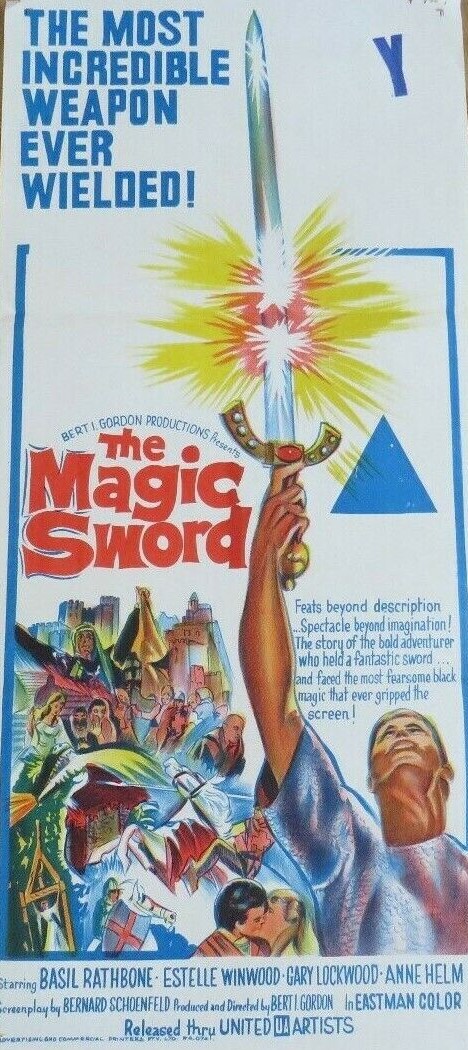
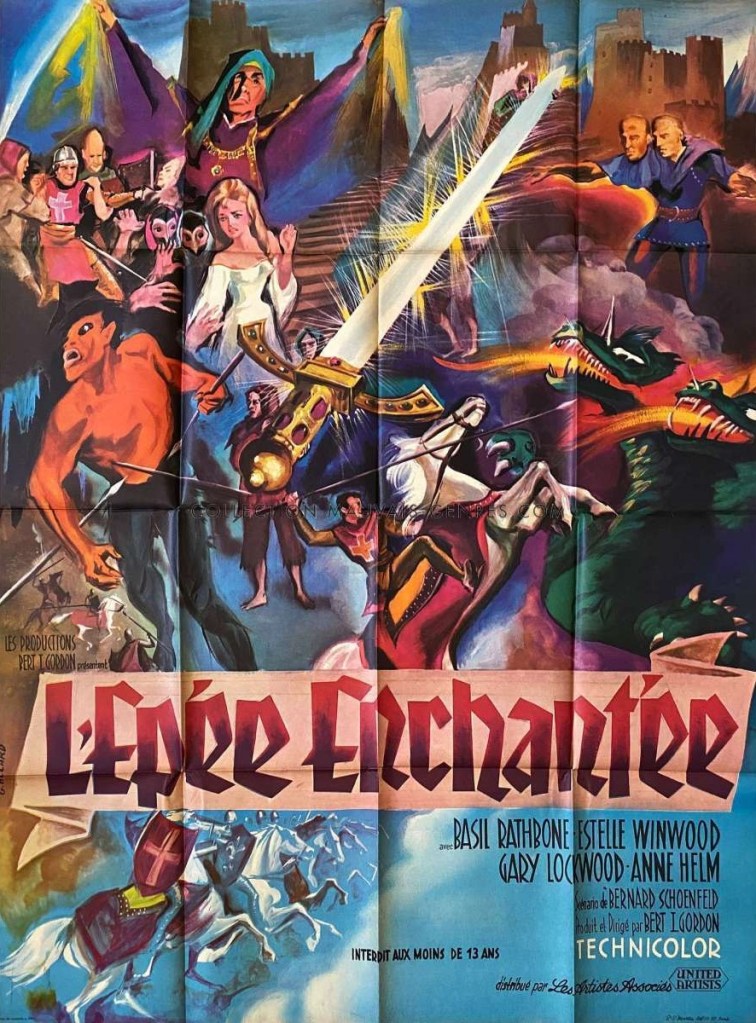
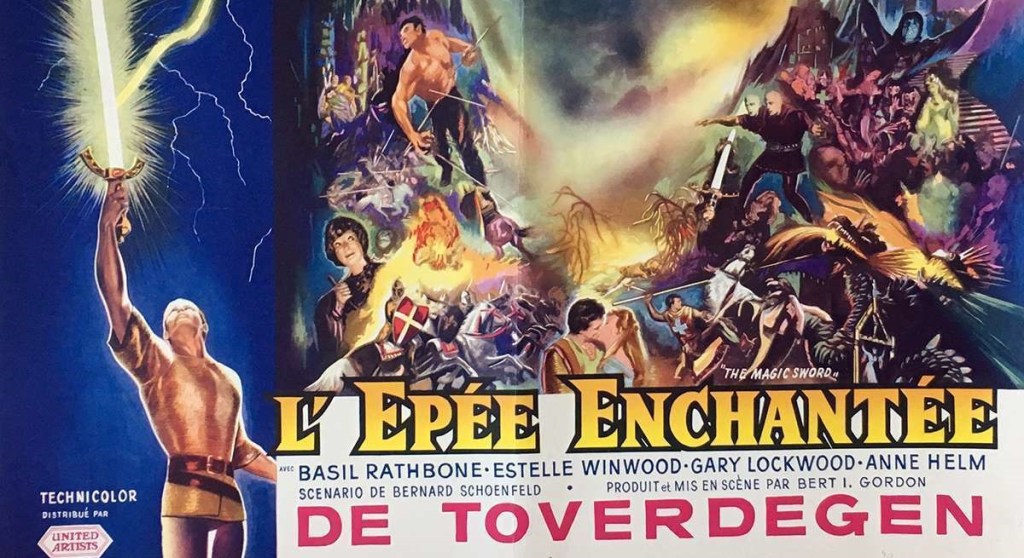
Where’s Ray Harryhausen when you need him? Not much wrong in this fun low-budget adventure that a few doses of Dynamation wouldn’t fix. While it means the monsters don’t cut it – man in mask with a dodgy perm playing an ogre, two-headed dragon whose flames appear superimposed – the rest of it is as up to scratch as you might expect from a genre that relies on exploiting old myths.
And we do get a look at Gary Lockwood (The Model Shop, 1969) in embryo and Basil Rathbone (The Comedy of Terrors, 1963) having a whale of a time as a villain who somehow (point plot not explained) has lost his magic ring. That means he’s going to strike a deal with loathsome knight Sir Branton (Liam Sullivan) – who happened across it (plot point unexplained) – to kidnap Princess Helene (Anne Helm). He’s somewhat hindered in explaining his plans because his voice is often drowned out by the thunder he can summon just by lifting his arms.
But it’s magic vs. magic as the pair come up against sorceress Sybil’s (Estelle Winwood) adopted son Sir George (Gary Lockwood) who’s stolen a set of enchanted artefacts including the titular sword, armor, a shield and the fastest horse in the world and heads off to rescue fair maiden from the castle of Lodac (Basil Rathbone) where the aforementioned dragon is on a steady diet of consuming a human being (or two, if twins or sisters are to hand) once a week.
Sybil, who seems to exist in some kind of darkroom, constantly lit by red, is a hoot, when not turning herself into a cat, unable to recall spells, not surprising since her memory has to span 300 years. Her coterie includes a chimp who does nothing (what’s the point of that, you might wonder, though perhaps magic is involved in just getting it to sit still) and a two-headed man, both faces speaking the same words at the same time.
There’s a tilt at a magnificent seven scenario as Sir George brings to life six sidekicks, a multi-cultural melange if ever, or a stab at attracting audiences from six different countries if you like. You need to be mob-handed at this game because the bunch, assisted or sabotaged by the accompanying Sir Branton, need to overcome The Seven Curses of Ladoc (the film’s alternative title in various parts), including the ogre and a malodorous swamp, and sure enough those dangers soon cut the motley band down to size.
Meanwhile, the imprisoned princess has watched the dragon eat, and is tormented by dwarves (though the caged elves turn out to be friendlier). There’s going to be two showdowns, not one, since Lodac has no intention of allowing Sir Branton the glory of rescuing said princess and therefore winning her hand in marriage. He is hell-bent on revenge, since the king’s father had burned his sister at the stake as a witch.
The meet-cute if you like is princess and potential rescuer facing each other across a dungeon while tethered by rope to stakes. Sybil does try to help but damned if she can remember the final words of her spell.
Gary Lockwood, in his first leading role, takes the whole thing seriously, and only made two more films before something in this role and It Happened at the World’s Fair (1963) and Firecreek (1967) tipped off Stanley Kubrick that here was a star in the making for 2001: A Space Odyssey (1968). So it does show that no part, however preposterous, is worth turning down.
Basil Rathbone would steal the show – as he should being top-billed – were it not for the fun-loving Estelle Winwood (Games, 1967) as the dotty aunt kind of sorceress. What Hollywood dictat I wonder determined that leading actresses often made their entrance swimming naked in a pool. Anne Helm (The Interns, 1962) doesn’t have much to do except look scared. You might spot Danielle De Metz (The Scorpio Letters, 1967).
With Sybil to dupe, all the curses to overcome and deal with the duplicitous Sir Branton, the pace never lets up. And it’s short (just 80 minutes) so no time for dawdling.
Director Bert I. Gordon (The Amazing Colossal Man, 1957) has been here before with the special effects that appear dodgy to the contemporary eye but were ground-breaking at the time when SFX did not command multi-million-dollar budgets. Screenplay by Gordon and Oscar-nominated Bernard C. Schoenfeld (13 West Street, 1962).
While Harryhausen tales were always redeemed by the special effects, this is perfectly acceptable late-night entertainment when the critical guard is down.
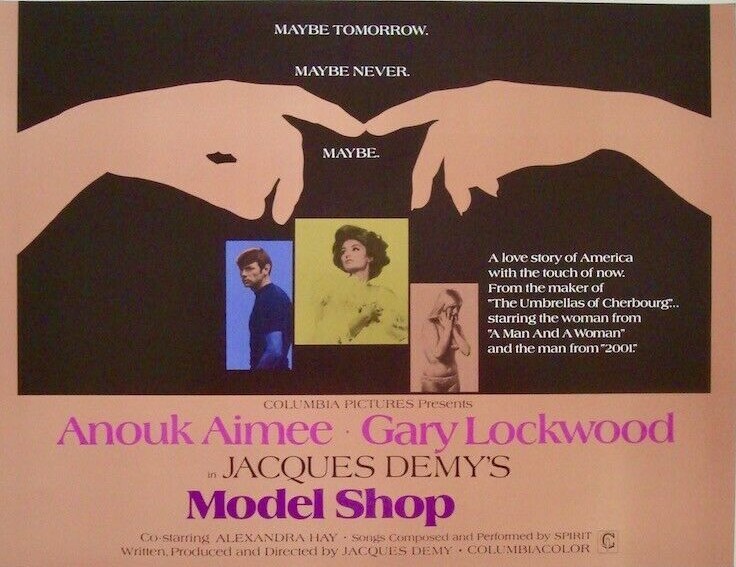
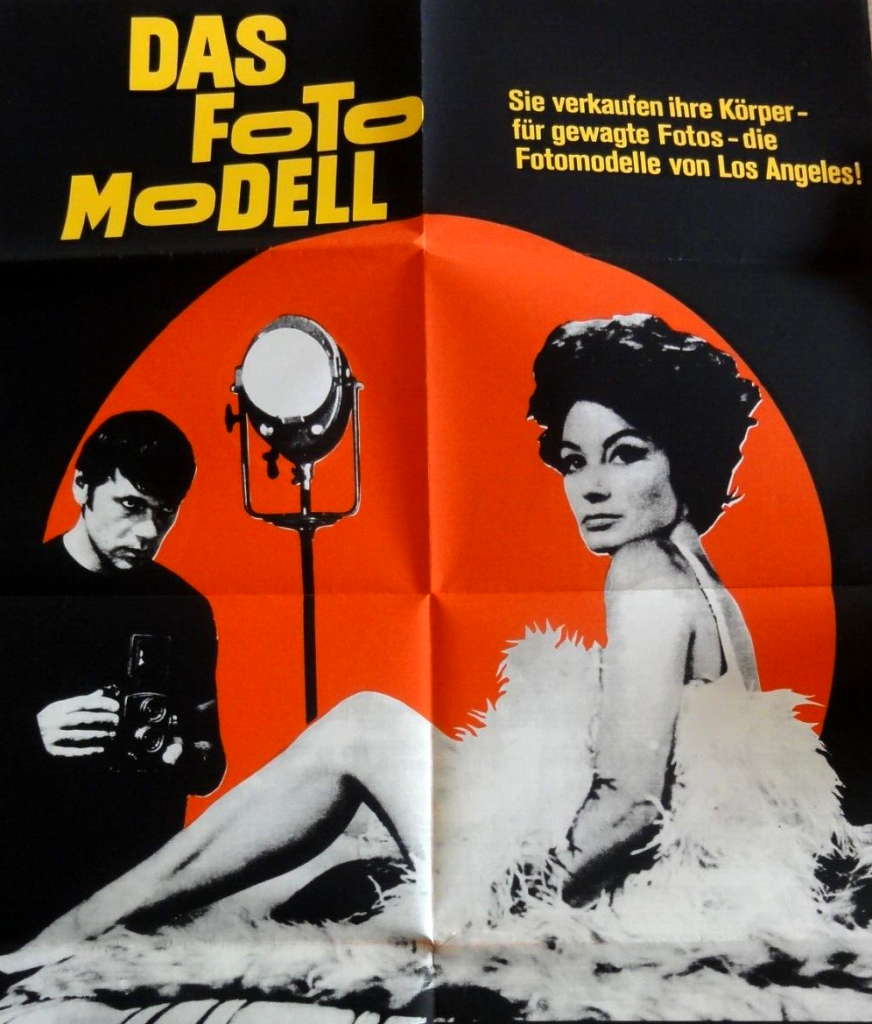
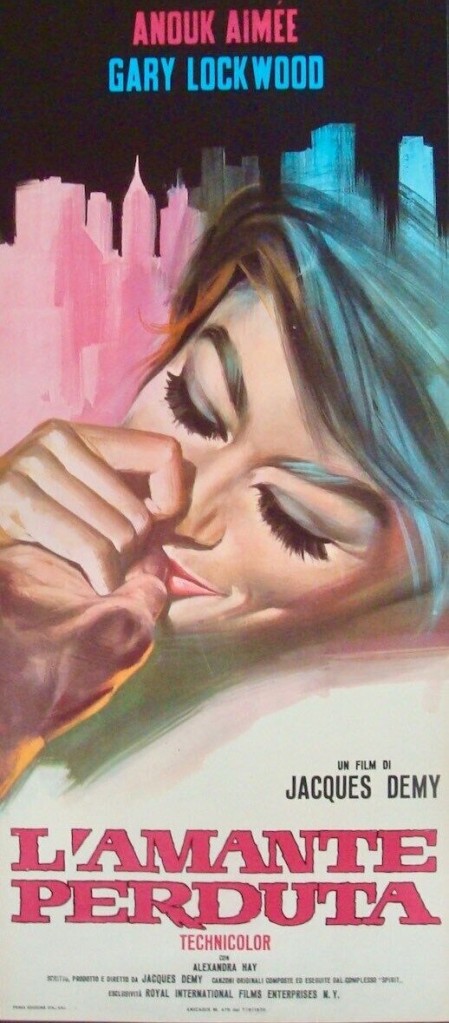
Surprising number of similarities to The Appointment (1969), including the aura of seediness, but lacking that film’s inherent tension or style. Lola (Anouk Aimee) is another model pursued by a another man who catches a glimpse of her in the street as in the Lumet affair. But it turns out a “model shop” is a tacky dive where men pay to take photographs of semi-naked women rather than anything to do with haute couture.
Lola is as depressed as Carla in The Appointment and for the same reason, abandoned by her boyfriend, who has gone off to gamble in Las Vegas. But new lover George (Gary Lockwood) is the antithesis of the successful Omar Sharif. You are inclined to give him a free pass because he’s got the draft hanging over him.
If he was disaffected, that could explain it. But he’s just bone idle, sponging off everyone in sight, musician friends and more ambitious girlfriend Gloria (Alexandra Hay), an actual model, though more in the commercial line than high fashion, but bringing in enough to pay his bills.
You might feel sorry for him that “the man” is trying to repossess his car until you see it’s an MG coupe that an unemployed guy could not afford and that when he does get enough cash to pay the outstanding payment he comes up with another excuse rather than parting with the money. He studied architecture but hasn’t the gumption to make his way in the adult world whereas Gloria accepts she might have to sit in a bathtub naked for a potential client if she wants to get on.
He won’t marry Gloria or give her a child so she’s full of empty threats to leave him but doesn’t carry that out until she discovers photos of Lola that he’s left lying around. There’s not much going on. It’s certainly a downmarket world. George and Gloria lived in a rundown suburb of Los Angeles with a pumpjack drilling for oil outside their front door.
A good chunk of time is spent on the road, not “out along the highway looking for adventure” as in Easy Rider (1969) and not in the great outdoors, but mindless drifting, or tailing Lola, around L.A.. There’s some kind of deadline on their romance – she’s headed home to France, his call-up is immediately imminent so unless there’s some expose of the seedier side of the city going on there’s not much else, just two people who lost their way finding brief solace in each other.
Anyone attracted by Anouk Aimee’s top billing is going to be disappointed, not in her performance, which reveals a markedly vulnerable gal beneath the glam (though she does dress haute couture). But Gary Lockwood (They Came to Rob Las Vegas, 1968) is front and central; she doesn’t turn up until about a third of the way through and only has a handful of scenes thereafter. So it’s that kind of slice-of-life movie, what the British used to term a “kitchen sink” picture, and takes place over a short time-span.
Gary Lockwood is excellent but he’s not asked to do very much, and you kind of get the impression he’s just being his charming self. Aimee seems to have cornered the market in playing “degrading” women, accused of being a sex worker in The Appointment and loaned out to high-class friends of her husband in Justine (1969). In some senses, bringing out the character behind the tawdry image appears her forte. Alexandra Hay (Skidoo, 1968) is equally good, the grit behind the glam, not just a pretty face.
But just nothing happens. The background – the draft, potential Vietnam peace talks, the occasional joint – is scarcely a visceral snapshot of America at the time. European director looks at America and doesn’t much like what he sees, but less obviously a commentary on society along the lines of Antonioni’s Zabriskie Point the following year or even the home-grown Medium Cool (1969).
And lacking the style of Demy’s previous outing, the exuberant musical The Young Girls of Rochefort (1967) and you keep on expecting – hoping – the characters are going to burst into song. Oddly enough, it suffers from an unexpected culture clash. Relocate the same characters and the same story to Paris, speaking French with subtitles, and it would have worked better no matter how slight the story because it would automatically be infected by Gallic charm and even the poorer streets there would be interesting.
Carole Eastman (Five Easy Pieces, 1970) a.k.a. Adrien Joyce contributed to Demy’s screenplay. Members of rock band Spirit appear in the film and provide several tracks but there was no soundtrack album to take advantage of their involvement.
You might be interested to know that Harrison Ford was at one time up to play the lead. Hay was a starlet under contract to Columbia who financed the film. Equally oddly, it was not sufficiently arthouse to appeal to the cognoscenti and it was little surprise that the studio eventually chose to promote the seedier aspects in the marketing.
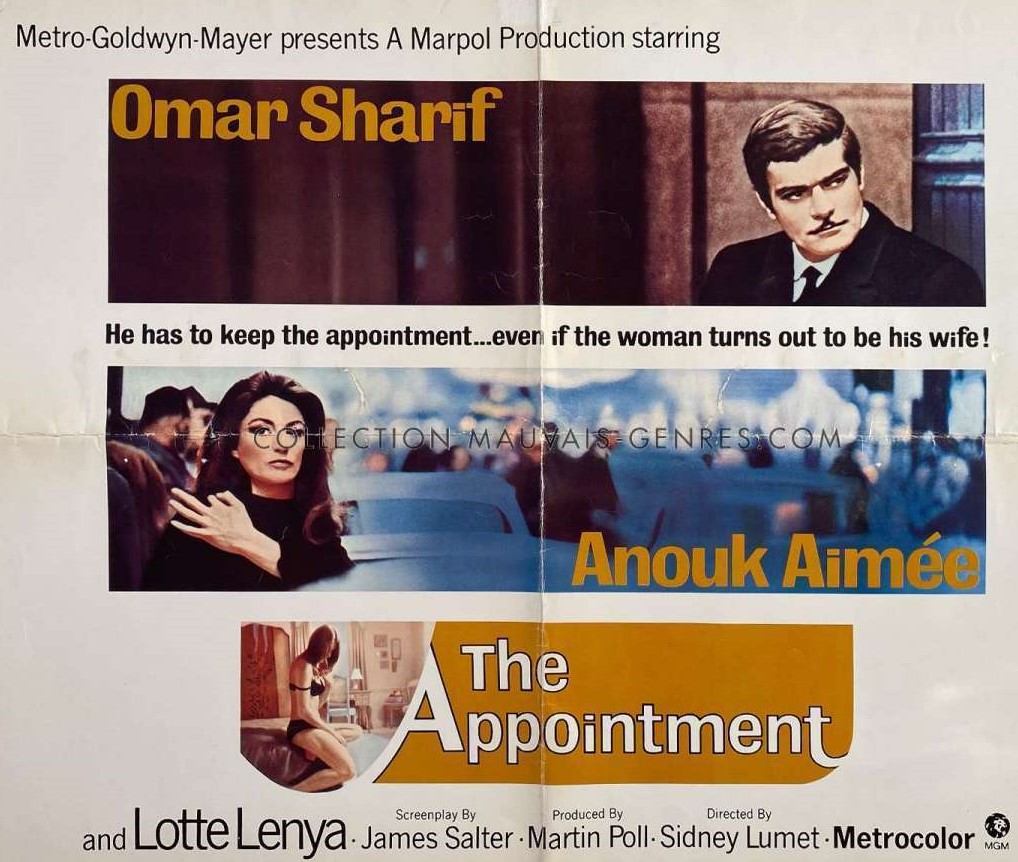
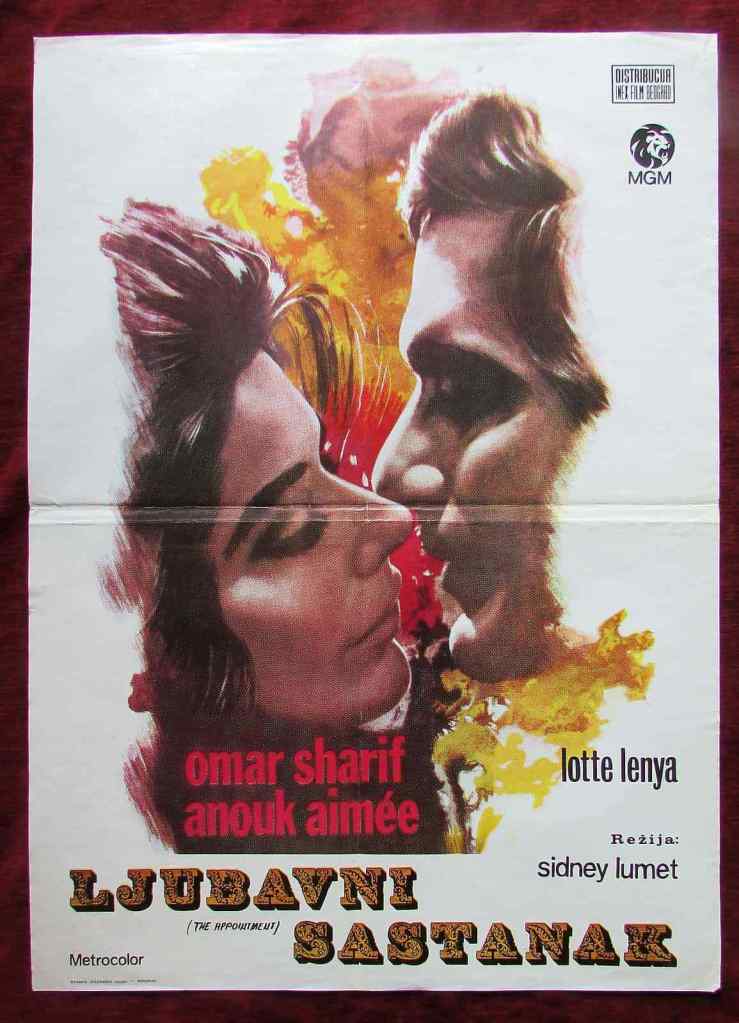
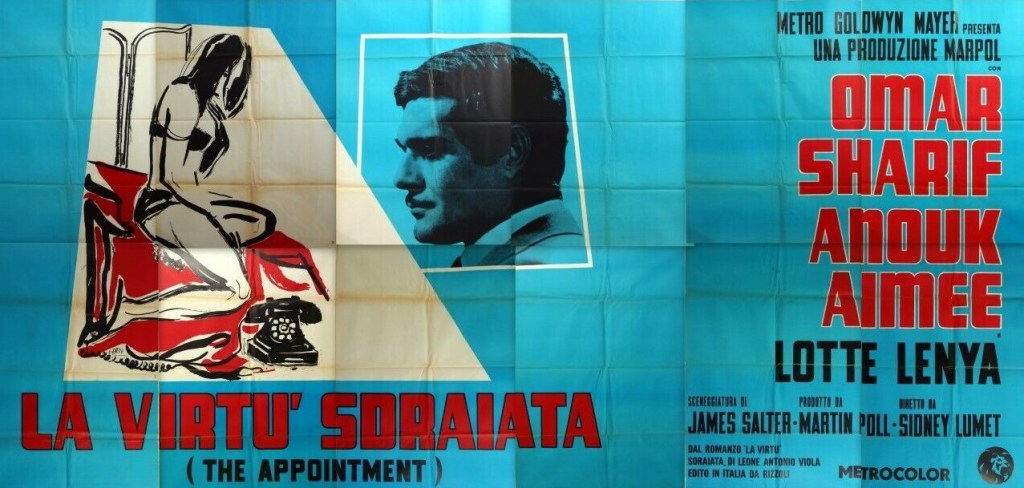
When the Cannes Film Festival in 1969 gave The Appointment the honor of being the first film invited to compete it looked like an exercise in kudos. Quite how that turned into a humiliation that would deny the Sidney Lumet picture a U.S. release was one of the oddest stories of the decade.
Lumet, it has to be said, was not exactly flying high. After the double whammy in 1964 of The Pawnbroker and Fail Safe, his career had stalled, The Group (1966) not delivering the expected box office, fired from Funny Girl (1967) and The Deadly Affair (1967), Bye Bye Braverman (1968) and The Seagull (1968) all misfires. So it probably seemed like the ideal career fillip to recharge his creative batteries in Italy, with a movie starring Omar Sharif and Anouk Aimee, both Oscar-nominated and still bathing in the warm afterglow of worldwide successes via Doctor Zhivago (1965) and A Man and a Woman (1966), respectively.
Aimee had made the list of female stars dominating the box office along with the likes of Barbra Streisand, Faye Dunaway, Jane Fonda, Catherine Deneuve, Julie Christie, Mia Farrow, Julie Andrews and Joanne Woodward. Although producer Martin Poll had a spotty record – just rom-com Love Is a Ball (1963) and thriller Sylvia (1965) on his dance card – that would change with his most ambitious project to date, The Lion in Winter (1968) pairing Peter O’Toole and Katharine Hepburn.
In truth, Lumet thought the original screenplay by the distinctively offbeat James Salter – undergoing a highly productive period, Three (1969) and Downhill Racer (1969) also on the launch ramp – “a silly story” but one that “could be salvaged with careful creation of mood, texture and dialog.” But he was virtually the only American on the project, Sharif Egyptian, Aimee French while the rest of the cast (excepting Austrian Lotte Lenya) and crew was Italian.
Shooting began at the end of February 1968. Martin Poll had been already working for seven months on the project ensuring it didn’t suffer from the production mishaps that had blighted another, bigger, MGM production, The Shoes of the Fisherman (1968). Interiors were shot at the Palatino studios (now fully soundproofed) in Rome, with a key sequence filmed at Lake Bolsena 100km to the north, and Poll had gained permission to shoot in key locations in the capital including Via Condotti leading to the Spanish Steps.
But the lake proved a trial. High in the mountains, located in a crater, it was prone to sudden squalls. First day of shooting coincided with “maverick” winds on the lake. The 40ft boat hired to transport the crew three kilometres across the lake to the tiny island was wrecked. A helicopter flew in two smaller replacements, and helped ferry passengers across, but only if they signed disclaimers absolving Poll of any redress should there be an accident.
Contract never fulfilled although it formed part of Avco embassy’s 20-page advert in Box Office magazine in November 1968.
Poll had also granted the director a week’s rehearsal time with the full cast, the movie was filmed with direct sound, rather than the traditional Italian post-production synching. And he had been hard at work on a fashion promotion campaign, highlighting the 40 haute couture designs that designer Ghelardi had created for one sequence.
A fashion show was being programmed as part of the world premiere in Rome on April 2, 1969, with the expectation that newspaper and television coverage would drive up global media interest. Poll had also set up 26 openings worldwide as the first wave of an ambitious release program to start a few days later to capitalize on the Easter break. It was all looking good – the movie had even come in under budget and a week ahead of schedule.
But the world premiere and the global release pattern were cancelled when, out of the blue, the movie was invited to compete at Cannes. The showing there would constitute the world premiere. The existing strategy was shelved in the hope that victory at the festival would provide a bigger marketing hook. Cannes had already suffered controversy that year after Carl Foreman quit the jury following censorship in France of his big-budget Cinerama roadshow western Mackenna’s Gold (1969), incidentally also starring Sharif.
Nothing went according to plan at Cannes. Festival audiences booed and whistled and waved white handkerchiefs in a sign of their disapproval. Variety called it a “flimsy love story” while condemning Sharif’s performance as “laughable.” What should have been a triumph turned into a disaster. MGM pushed back release a year until further work was done on the film.
But even as MGM was considering what to do to produce a version that might satisfy U.S. exhibitors, audiences in other parts of the world had decided there wasn’t much wrong with the version shown at Cannes. In fall 1969, the movie registered “sensational grosses.” In Japan rentals topped $1 million, in Manila there was an “unusually long run” and it broke records in Buenos Aires. Even so, Stateside executives were dismissive, “abroad, speed doesn’t mean that much,” they declared and set about changing the movie.
Under the terms of Lumet’s contract his right to final cut should have prevented any tampering with the picture. Unfortunately, he had gone along with the general consensus that the Michel Legrand score, minimalist though it was, required changing. But substituting John Barry music took the movie past its agreed completion date, thus negating Lumet’s contract and allowing MGM free rein.
At first, following a “disappointing” sneak preview in the U.S. in 1969, Lumet was involved in the editing but the studio found it easier to move forward if the original director was not looking over its shoulder. A new editor, Margaret Booth, was called in. She sliced 25 per cent out of the picture and added stock Italian footage to give the movie what MGM guessed would pass for “authenticity”, a more sun-kissed version of the country. MGM’s assessment was that the new version was “much better, much faster, playable.”
Lumet disagreed, “The MGM version now makes no sense. Characters appear and disappear, plot elements emerge and then are dropped. It’s ridiculous.” Being enraged was as close as the director came to affecting the outcome. It wasn’t the only box office disappointment facing MGM at the time. Much of the $20 million invested in four pictures – The Appointment, Goodbye Mr Chips (1969), Zabriskie Point (1970) and Captain Nemo and the Underwater City (1969) – was lost.
A “disappointing” test date in April 1970 in San Francisco confirmed what the studio feared. The movie was unreleasable. It might have been a different story if the two stars had unassailable box office track records. But Omar Sharif’s career had dipped. Mayerling (1968) though a success abroad barely hit the million-dollar mark in the U.S., while Mackenna’s Gold , Che! (1969), The Last Valley (1970) and The Horsemen (1971) were all expensive flops.
Anouk Aimee had done little better, pulling out of The Mandarins with James Coburn, Fox’s big-budget Justine (1969) a spectacular flop, Jacques Demy’s The Model Shop (1969) – “a really bad movie” according to Vincent Canby of the New York Times – also tanking and Columbia failing to find a release slot for One Night A Train (1968).
Lumet remained in a commercial wilderness. He was touted in a two-page advertisement as lining up two features for Avco Embassy, but they never appeared, nor did The Confessions of Nat Turner and We Bombed in New Haven, based on the Joseph Heller play, while Last of the Mobile Hot Shots (1970) with James Coburn flopped. He only managed an unexpected return to form with hit crime caper The Anderson Tapes (1971).
The 100 prints made by MGM – half in the original version, half the recut version – sat on the shelf as new studio management pondered whether the film was worth any further investment in the advertising and marketing required to shape a launch or even worth wasting any more time. In the end, it took the easier option, and without permitting any more cinematic screenings, sold it to CBS for its Late Movie slot – “the film buff graveyard” – which played host to such other lost pictures as The Picasso Summer starring Albert Finney and John Frankenheimer’s The Extraordinary Seaman (1969) with Faye Dunaway.
Beyond the abortive sneak preview and the test showing, the first anyone in America caught glimpse of The Appointment was on July 20, 1972 – three years after its Cannes disaster – on the small-screen on CBS.
SOURCES: “Roman Settings for Appointment,” Variety, February 28, 1968, p25; “Appointment Has Quick Dates with Squall,” Variety, March 20, 1968, p28; “Elated Poll Completes Appointment,” Variety, June 2, 1968, p22; Advertisement, Variety, November 13, 1968, p54-55; Shelagh Graham, “Film Industry in New Garbo Epoch as Femme Stars Dominate B.O,” Variety, January 8, 1969, p1; “Anouk of the Scram,” Variety, January 29, 1969, p26; “Holdbacks Explained,” Variety, February 26, 1969, p21; “Set Appointment Preem in Rome,” Variety, February 26, 1969, p38; “MGM Cancels Italo Appointment So As To Qualify at Cannes,” Variety, March 19, 1969, p5; “Appointment in Cannes,” Variety, April 16, 1969, p13; “Booing of Metro’s Appointment,” Variety, May 28, 1969, p28; Review, Variety, May 28, 1969, p34; “Re-edit Appointment After Cannes Booing,” Variety, July 9, 1969, p5; “Lumet Ponders Slave Revolt,” Variety, September 3, 1969, p6; “Capsized in Cannes,” Variety, September 19, 1969, p5; “Appointment Does Big Biz O’Seas,” Variety, October 8, 1969, p5; “MGM Delayed Appointment Pic,” Variety, January 20, 1970, p5; “MGM Write-Downs,” Variety, April 22, 1970, p5; “Cannes-Jeered Pic,” Variety, July 19, 1972, p7.
You can see why MGM dumped this. Just as easily as you can see its attraction for star Omar Sharif, his boldest-ever role, completely against type, burying the romantic hero in one fell swoop. It wasn’t just the arthouse pretensions – the absurdly long, by Hollywood standards, long shots held for an insanely long time and the greatest aerial shot, almost to the moon and back, ever devised – that made the studio cut and run faced with the impossibility of selling Omar Sharif as a creepy, repressed guy who drives his wife to suicide.
Luxuriant moustache trimmed to look like a ramrod British colonel, often bespectacled, unmarried middle-aged lawyer Federico (Omar Sharif) takes a fancy to the withdrawn Carla (Anouk Aimee), fiancée of legal buddy Renzo (Fausto Tozzi). She works as a model in a high-class fashion house.
So Federico is shocked to discover that Renzo has dumped her after discovering evidence, somewhat circumstantial it has to be said, that she moonlights as an equally high-class sex worker who takes occasional assignments from antiques dealer Emma (Lotte Lenya). Now that Carla is unencumbered in the marital stakes, Federico undertakes to discover whether the accusation is indeed correct. If not, then he reckons, she might well fall for him, if only on the rebound, after all he is very successful and, despite the geeky haircut and moustache, a handsome dude.
It’s left to your imagination whether Federico actually has sex with the young woman – who “could pass for 17” and arrives clutching schoolbooks – for whom he pays 100,000 lire (around $1,000) but my guess is he does, getting her to pretend he’s her Latin schoolmaster. So that’s the Omar Sharif romantic persona killed off right there and from then on it’s hard to muster any sympathy for the character, every bit as obsessive, say, as James Stewart in Vertigo (1958).
This has a Hitchcockian aura, an atmosphere of stealth and secrecy and chill. He ends up marrying her, turns into a control freak, refuses to let her go out to work, complains about her make-up, asks where she’s been. He gets it into his head that she’s back to her old tricks and rekindles the investigation. She becomes more withdrawn and eventually commits suicide. The ideal ending, the arthouse ending, would have left Federico forever puzzled, not knowing whether he had married a hooker or not, whether, for all his caution, he had been duped. But that’s not the way with what you would otherwise describe as a psychological thriller – calling it a big-budget arthouse picture from a major studio by a relatively unacclaimed (outside of The Pawnbroker, 1964) mainstream director would not be an option – so we get a twist at the end.
This isn’t your usual Italy either, it’s not set in a sun-drenched land with impeccable beaches and ladies wandering around with cleavage abounding. This is the Italy of traffic jams and rain and wind and huge brown waves battering the shore and buttoned-up women.
And audiences have rarely been presented with such a depressing insecure female character. You get the impression she wears fabulous clothes to hide, not glorify, her body. She might come across as playing with Federico, pretending to be asleep when he comes to bed during a romantic weekend on a remote island, the woman way out of his league who wants to keep him at a distance while she makes up her mind. But that interpretation would only be from Federico’s perspective. Otherwise, an attendant viewer would note that she doesn’t seem at all comfortable with life, and that abandoned by one lover without finding out why she can’t risk losing her heart to another.
Had this been made by Visconti or Antonioni (Blow-Up, 1966, went down a similar suspicious route) it might have been acceptable as a distribution vehicle for MGM (after all, they did pump millions into Zabriskie Point, 1970). The odd thing was, the arthouse mob didn’t like it either, showing disdain in the most publicly humiliating manner possible, audiences at Cannes booing it off the screen.
But once you accept the odd premise and equally fall in with the seedy character depicted by Omar Sharif, you begin to feel its power. The daring camerawork is exceptional, some of the scenes in extreme long shot contain as their essence elements of intimacy, and the world’s greatest aerial shot pulls away from the picture’s most romantic scene, as if giving indication of what is not well, rather than enveloping the characters with the usual background of nature at its most rapturous. And it’s pretty much silent, a John Barry theme dips in and out, but scarcely swells when it does, on a rare occasion, appear, so this plays out without much in the way of musical nods to the audience.
Outside of Lawrence of Arabia (1962), this is easily Omar Sharif’s greatest performance. His gamble in parlaying his box office marquee and universal romantic appeal (he appeared in Mayerling, the ultimate romantic tale, the same year) to take on this unappealing role showed a commitment to expanding his screen persona that went unrewarded. Anouk Aimee, anointed one of the screen’s biggest female romantic leads after the unexpected success of A Man and a Woman (1966), is also playing against type.
Sidney Lumet went through a distinctly lean period between The Pawnbroker and his 1970s output – The Anderson Tapes (1971), Serpico (1973), Dog Day Afternoon (1975) – and while The Pawnbroker presented an equally disaffected character he was crying out for your sympathy. You could almost view The Appointment as an exercise in style and the director trying to see, in terms of narrative and character, what he could get away with, and to become the director stars would trust when they wanted to shake up their screen persona – witness Sean Connery as a criminal and Al Pacino as a gay bank-robber.
Critics have avoided this like the plague – three reviews on imdb, only one on Rotten Tomatoes – so if that’s not a sign of being under-rated I don’t know what is.
It’s different for sure but that doesn’t make it any less worth seeing. And it would certainly fit in with the expectations of a contemporary audience.
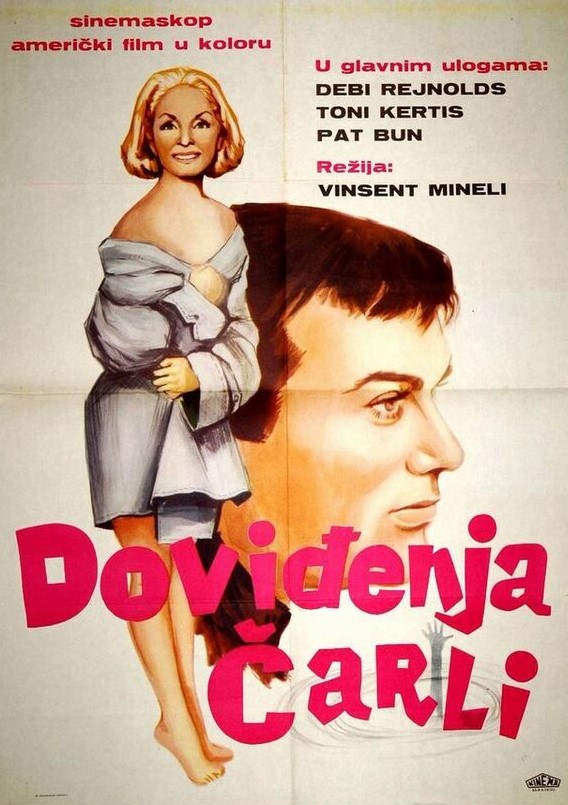
Gender switch comedies were a rarity in Hollywood at this point though of course Billy Wilder had scored big with Some Like it Hot (1959) and I’m guessing the possibility of Tony Curtis repeating his drag act was an audience lure for this one. Alas, that wasn’t to be. This goes the other way. Or several other ways. A woman playing a man who is a woman. That would be catnip these days were it a transgender thing, but it ain’t.
Confused? So sex predator Charlie (a male) drowns while escaping enraged husband Sir Leopold (Walter Matthau) only to reappear, re-born or reincarnated (as the producers decide after googling it, sorry, after they look it up in a book) as a naked woman walking along the highway, rescued by the wealthy Bruce (Pat Boone) and delivered to the nearest house, Charlie’s own pad, now occupied by old buddy George (Tony Curtis).
There’s some light comedy as George tries to safely manhandle the unknown woman, clad only in Bruce’s coat (necessitating his later return of course) and gradually the surroundings seem over-familiar to the woman and then, shazam, George works out from what she knows about him that actually she must have returned as a man, also called Charlie (Debbie Reynolds).
A cosmic joke, in other words. The man who preyed upon women returning as a woman. See how he likes it to be on the receiving end of misogyny. But, mostly, he/she lolls around with legs spread like a man, gulps down whisky and is a dab hand at cards. But that’s not where the humor lies, apparently, because the movie moves on quickly from the woman acting the man and into the man-woman discovering all the female tricks of the trade, visiting a beauty parlor and the hairdresser. Charlie discovers it’s not the same fun slapping a woman’s backside – what a revelation – if you’re a woman.
But, basically, the female Charlie decides to become a female version of the male Charlie, the predator, ripping off friends, chasing the big money, trying to seduce Bruce. So, mostly, it’s one odd plot device after another.
But the sizzle is Debbie Reynolds, not so much the man-woman stuff, but turning into a mean Bette Davis character before your eyes, all hard-edge and shifty moves. There’s sexual tension as well, George initially resisting the woman he knows is or was a man, before finding the attraction too much, and the same going for Bruce. There’s a fair whack of sexual confusion, as the newborn Charlie still finds herself ogling women.
In those far more innocent times, it doesn’t know what it wants to say and lacks the narrative to say it. Audiences had terrific fun with Jack Lemmon and Tony Curtis in Some Like it Hot, but that narrative ploy was bang on, and Lemmon enjoying dressing up as a woman and Curtis having to keep his male instincts at bay while ogling Marilyn Monroe was pure catnip.
Here, Curtis is mostly the foil for Debbie Reynolds and by the time it looks as though they might get it together she is way past behaving like a man and is most definitely a desirable woman so it’s kind of difficult to make this work romantically or humorously.
Perhaps the oddest element is that the signs were already there that it wouldn’t work that well. It started as a Broadway play written by George Axelrod (The Seven Year Itch, which was a Broadway smash) but it barely lasted a dozen weeks on stage. By that time, though, Twentieth Century Fox had splashed out $150,000 for the rights. Still, bigger sums have been buried in the annual accounts.
And I guess when Vincente Minelli (Two Weeks in Another Town, 1962) came on board with a pretty decent cast it seemed at least doable. Like many a lightweight comedy from the decade – Dear Brigitte (1965) for example – it’s keep afloat by a terrific performance by the principal star, in this case Debbie Reynolds (Divorce American Style, 1967). You might spot Ellen Burstyn (The Exorcist, 1973) in an early role.
Take away Debbie Reynolds and it would limp along.
Setting aside diversity and inclusion issues and the invasion of streamers, the integrity of the Oscars have been under attack for a good few decades. Most observers put this down to the influence of the Weinsteins who began to use the awards as a major plank of their marketing, often spending more on that element of publicity than anything else.
The submission rules are simple: a movie has to play for one week in Los Angeles before the end of the year. That accounts for the rush of prestige-related product in the Xmas period. Occasionally, an entry would be rejected because it was shown outside the strict geographical confines of the city. But mostly movies appeared in this fashion to test the waters.
Oscar upfront and central.
Even before the nominations were announced, critics and observers would be garlanding various pictures with high praise, anointing them certainties for recognition, which, in the era of social media, was often as good as, if not better than, actually gaining a nomination. And nowadays there’s even mileage if a favorite falls at the last hurdle, endless articles doing the rounds on movies that were “snubbed,” such manufactured outrage bringing extensive media coverage.
In Britain, where I grew up, I distinctly remember a flurry of distinguished movies being released in March/April, capitalizing on nominations and/or wins. In the U.S. the release pattern tended to be more fluid, studios holding back on wide release until nominations were in the bag.
The Weinsteins changed all that by aggressively targeting Oscar voters, helping build the Golden Globes as an indicative precursor to the bigger awards, and creating a marketing tsunami behind any of their movies that got a sniff of a nomination. Eyebrows were certainly raised at these tactics, but, Hollywood turned a blind eye mostly especially in years when box office gross could be achieved by appealing to the lowest common denominator and Oscar bait was viewed as an acceptable route for financially weaker studios or mini-majors.
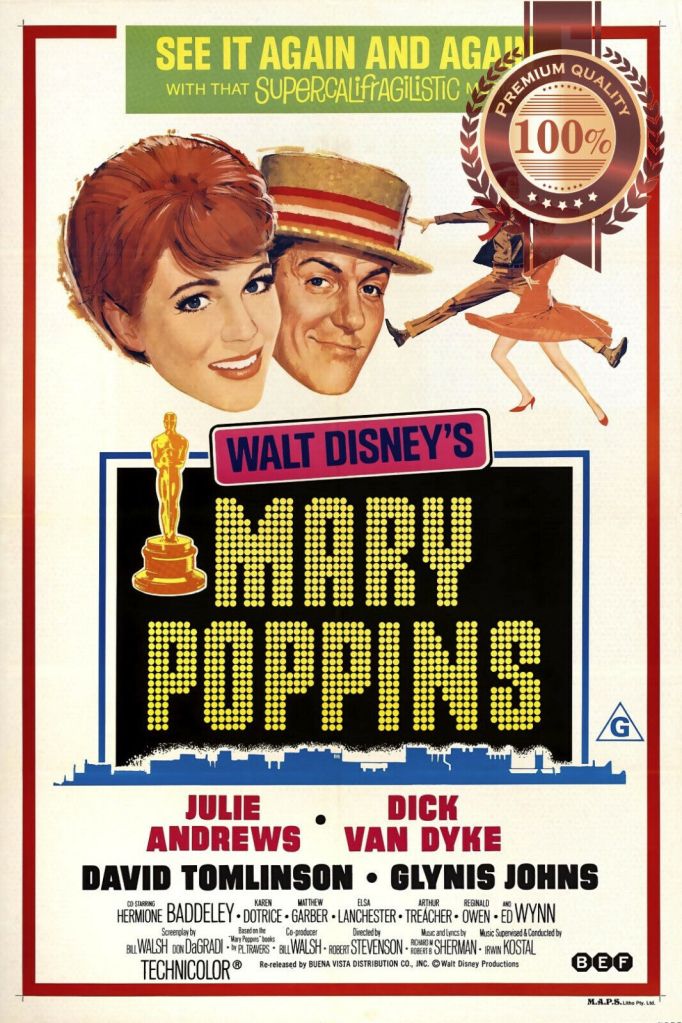
Although there had always been a few winners that appeared to come out of left field – Marty (1955), the classic example – and the industry displaying a penchant for awarding a best actor/actress award to a neophyte – step forward Yul Brynner (The King and I, 1956) and Julie Andrews (Mary Poppins, 1964) – or to a veteran deemed worthy (John Wayne for True Grit, 1969), it was generally accepted that awards were always genuine and reflected the mood of the time.
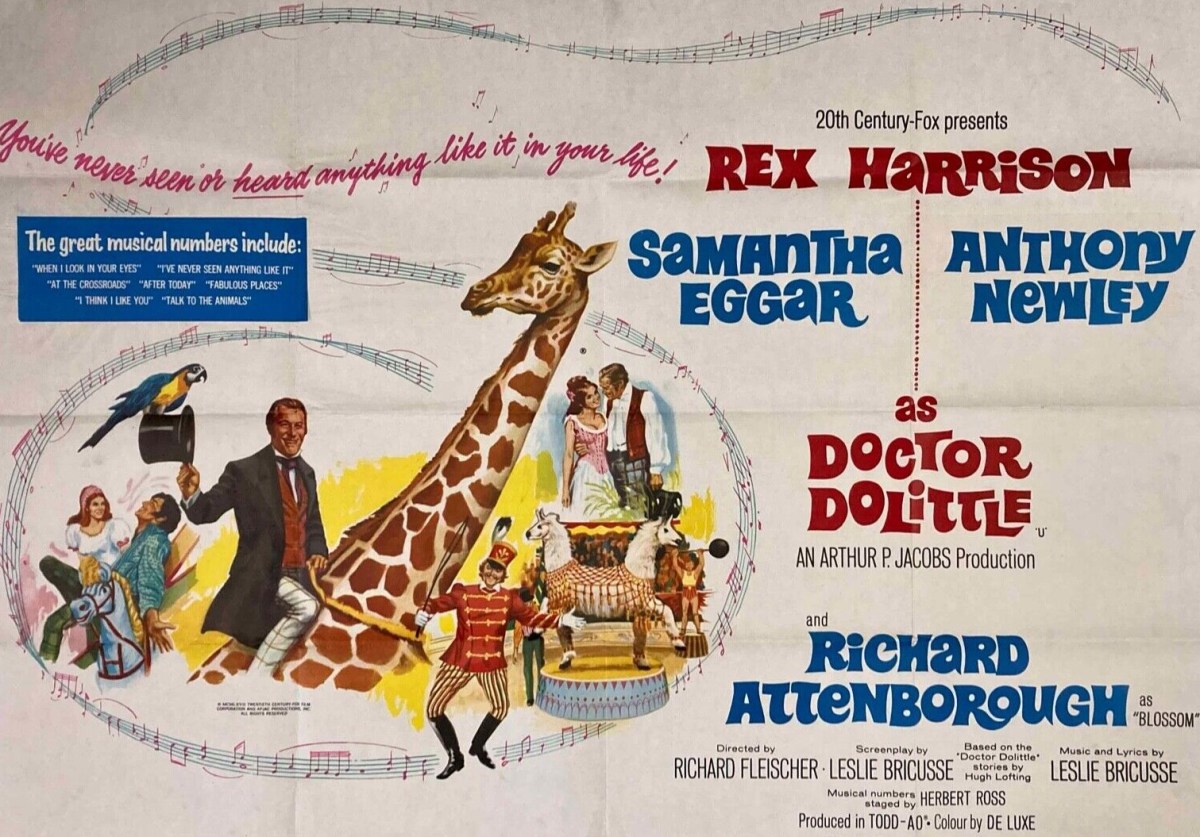
There was no hint of overt machination, of tweaking the system, until observers started questioning just how musical Doctor Dolittle managed to leapfrog into the Best Film category in 1967 ahead of more obvious candidates like Cool Hand Luke and In Cold Blood not to mention Wait until Dark, Point Blank or Accident. Or even better-reviewed and better-performing musicals such as Camelot and Thoroughly Modern Millie.
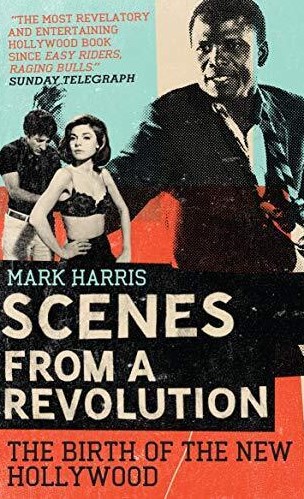
And it might well have remained just an anomaly until investigative journalist Mark Harris dug out the truth for his book Scenes from a Revolution (2008) which, on focusing in the other, more worthy candidates for Best Picture – Bonnie and Clyde, The Graduate, In the Heat of the Night and Guess Who’s Coming to Dinner – used that to frame his argument that Hollywood had finally come of age in terms of addressing racism, violence and sex and welcoming new talent.
Except that loading Doctor Dolittle into the equation blew a hole in his brilliant thesis, unless he was making a diversity pitch for talking animals. There had to be an explanation. It made no sense that Hollywood denizens who had voted for Bonnie and Clyde and The Graduate could be equally enamored of the musical. But, of course, that’s not the way nominations work. At this stage voters aren’t voting for all the pictures, they are voting for an individual favorite.
So, clearly, what had occurred was a major division. It could easily ascribed to a difference in taste. Those who voted for the other quartet clearly shared similar sensibilities. Those who opted for Doctor Dolittle were going against the grain. It was easily explainable as old-timers hitting out as much as older audiences did against a tide of sex and violence, rewarding a return to more innocent times. Or perhaps some kind of recognition that since the musical – The Sound of Music (1965), Mary Poppins – was deemed in some circles to have saved Hollywood then it was only fitting that a new musical should be honored in some fashion.
The truth was darker and left a bitter taste. Twentieth Century Fox, the studio which had put $31 million in production and marketing fees behind Doctor Dolittle and was heading into the same budget stratosphere for Star! (1968), wanted to use Oscar leverage to box office advantage, reviving a picture that was headed for the flop counter and reversing perceived critical disapproval.
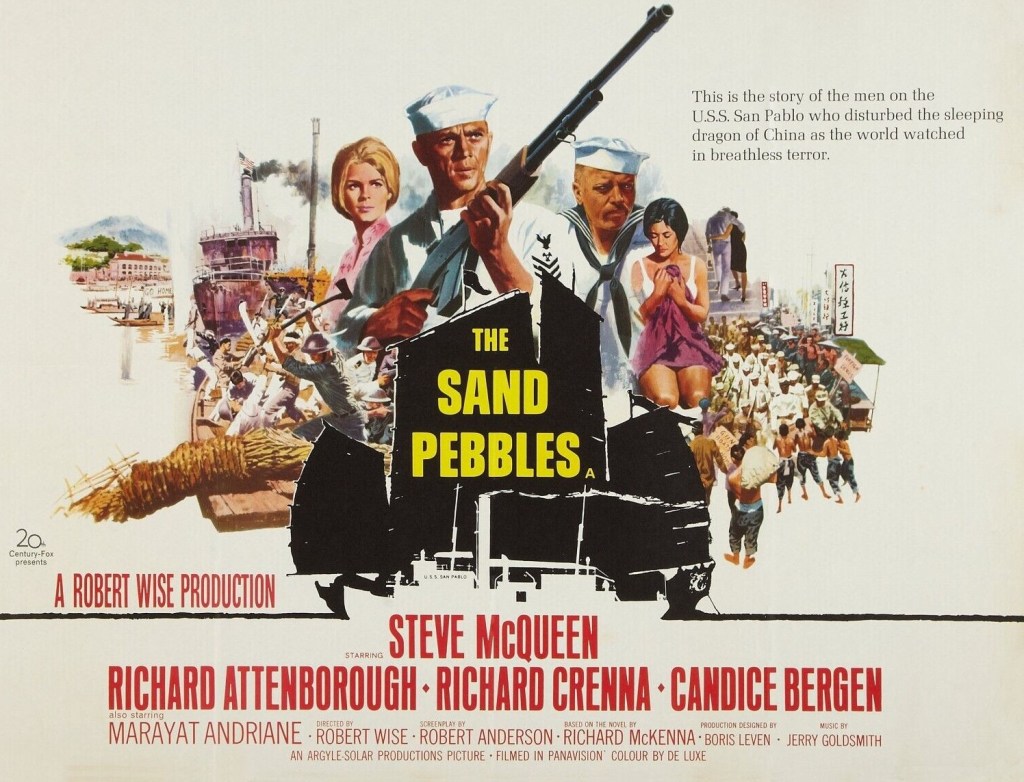
In short, it put the screws on any employees who had a vote. There was the usual public campaign that in those days revolved around ads in the trades, but there was also a behind-the-scenes crusade, calling in favors and debts, putting the squeeze on anyone whose career had depended on or might in the near future depend on the studio. Harris argued that Fox had previously adopted this ploy, pointing to nominations for The Longest Day (1962), Cleopatra (1963) and The Sand Pebbles (1966) but, when compared to Doctor Dolittle, these seemed works of cinematic genius.
In the days before VHS, DVD and digital, the only way for voters to get a first or second look at a prospective candidate was for studios to line up showings in private screening rooms or to hire out a cinema for evening, though it would be pretty safe to assume that if your movie was of the blockbuster variety – as in The Longest Day, Cleopatra and The Sand Pebbles – most voters would have already seen it at least once.
To ease access to Doctor Dolittle, Twentieth Century Fox booked out its own theater, plusher than most movie houses, at its studio for 16 consecutive nights. It threw in free dinner and champagne and presumably there was a high-ranking executive, if not the overall boss, to gladhand his way around the post-screening dining tables to ensure the guests knew just how much the studio was counting on them to do the right thing.
While the ploy worked as a method of finding the movie a place at the nominations high table it didn’t appear to sprinkle magic box office dust on the movie. U.S. rentals only came to $3.5 million, less than 15 per cent of its cost. But, probably, in reality it did. Since there was a considerable gap between U.S. and foreign release, it was often foreign distributors who benefitted most from the Oscar aftermath. In this case, Doctor Dolittle’s foreign box office – $12.8 million – far exceeded domestic. It didn’t mean the movie turned a profit, far from it, but it certainly limited the damage.
The damage, in other ways, could not be measured. A studio had interferered with the sacrosanct. Instead of being lambasted, and this being Hollywood, what could you expect except that in future years other studios would take a similar route, resulting in the kind of questionable nomination still going on today, in fact even more pervasively as a result of an upsurge in pressure groups producing often unlikely candidates.
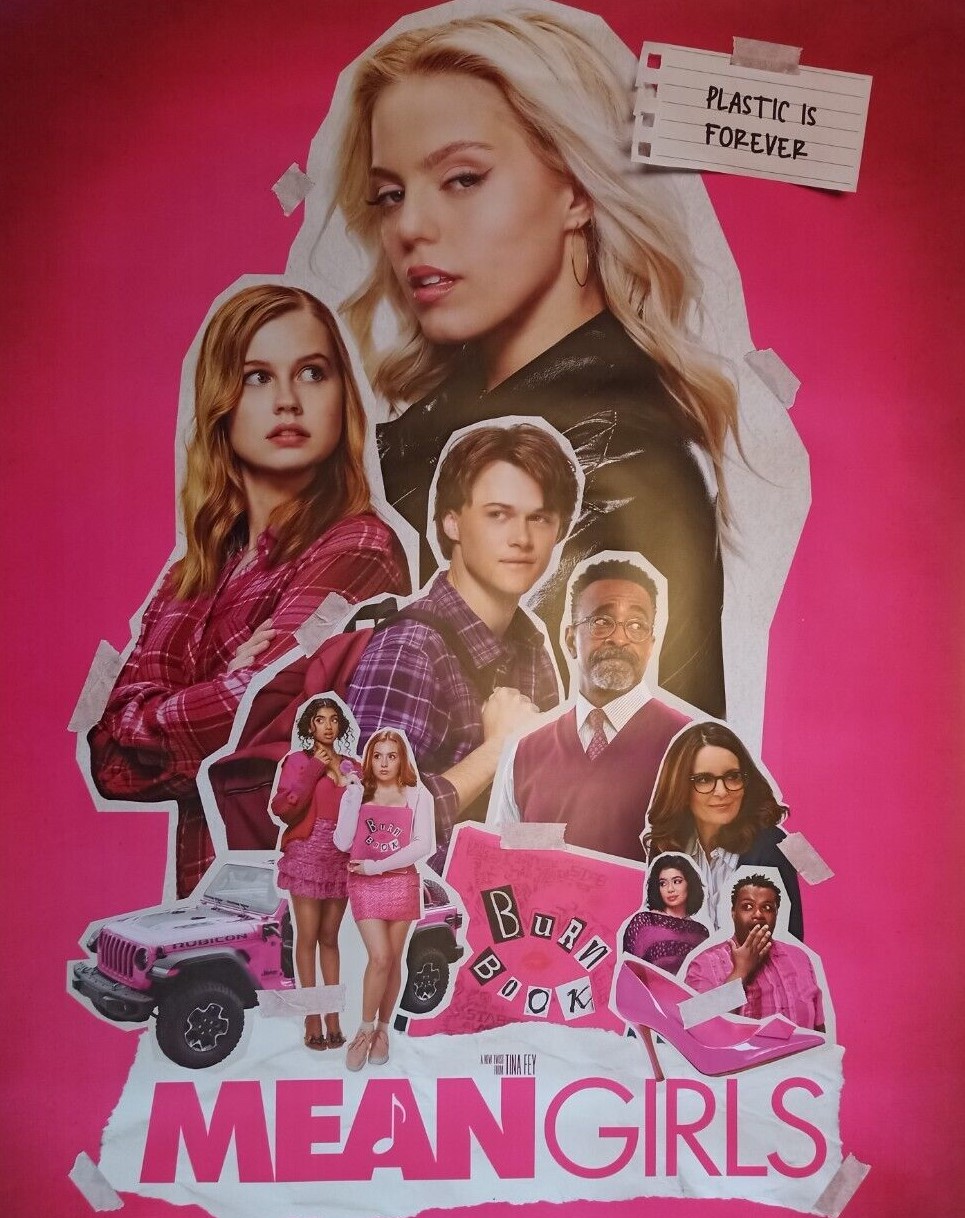
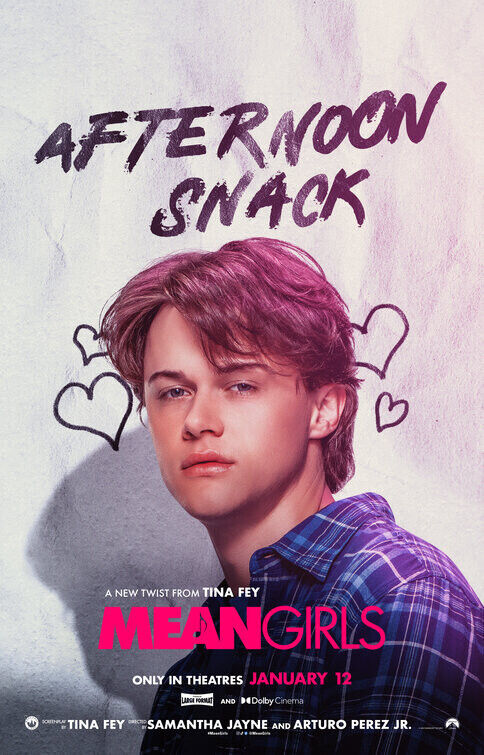
Hollywood has clearly grown leery of the musical after the disastrous public reaction to Steven Spielberg’s much-touted remake of West Side Story (2021). Or of just marketing them. I turned up to see Wonka (2023) not realizing it was pretty much a full-blown musical, because the trailer made little reference to that fact. And the same holds true of Mean Girls. So it’s hardly surprising both received mixed reviews from audiences expecting more straightforward narratives.
Of course, the problem is that musicals in the past came with a substantial in-built audience. No movie was ever made until a musical had ended its Broadway run of four/seven/ten years and hit London’s West End and toured the world and sold millions of copies of the original cast recording so that when the movie finally appeared there was at least the prospect of a decent opening from fans of the stage show. They might gripe at what Hollywood did to their beloved show, but at least they came, and they came back, giving the movie the legendary “legs” if they thought the transformation was good.
I enjoyed Wonka primarily because of the narrative invention and Timothy Chamelet’s terrific performance but the singing and dancing left me cold, the only tune that struck any kind of chord was a leftover from Willie Wonka and the Chocolate Factory (1971). I didn’t come to Mean Girls with trepidation. I had no idea the original had turned into a beloved cult classic and therefore didn’t arrive armed with objections to the various changes.
I only came because there was nothing else. So I double-billed it with a second stab at The Beekeeper (2024) and emerged from the experience wondering why no social media guru had though fit to tag these pictures a la Barbieheimer – Meankeeper has a nice ring to it (can’t be Bee Girls because there already is Invasion of the Bee Girls) – because they made a zingy combination.
What struck me most about Mean Girls was the paradox between outward confidence and inner insecurity. The songs acted as soliloquies or confessions or inner turmoil and occasionally they were employed to help tell the story. As a musical, I thought it was flush with inventiveness, fresh, and contained a number of killer songs. I wasn’t acquainted with any of the cast but most appeared capable of carrying a tune.
But it was the dance numbers that really caught my attention. This was Hollywood throwback. Dancing ensembles appeared out of nowhere, doing incredibly daft routines, using whatever props came to hand, and it proved an insanely infectious success. The characters, of course, are cliches, alpha females and those caught in their thrall or rebelling against their power. It’s hardly original to note that the worst thing that can happen to an alpha female is to get a pimple or put on weight.
In another picture that would have been its downfall. Instead, the actors went overboard with the cliché, tore the face off it, and except for scrambling around at the end trying to find some moralizing conclusion that would satisfy wokeness, the approach worked a treat.
Shorn of the earworm numbers of a hugely successful musical, given I had no idea there would be any singing involved, equally I wasn’t waiting to see what they did with a favorite number, and, unlike Wonka, every time they set the tale to one side and embarked, generally all-out, on a tune, I sat back and lapped it up.
And unlike your standard musical, it was filled with neat twists and ripostes, the screenplay slammed full of zingers, and intelligent ones at that, for example, when the carefully-planned revenge plot backfires and social media goes wild to copy Regina’s (Renee Rapp) mascara-streaked face as the latest must-have look, or when the incapacitated Regina admits to liking her enemy Katie (Angourie Rice) only to admit that’s only probably on account of the medication. The “gossip is bad” notion, on the other hand, feels tacked-on although the close-your-eyes-and-raise-your-hand sequence that nails it is actually well done.
I’m not sure what was changed from the stage show and whether I should be irate or grateful for that, because I really don’t care.
On a footnote, this predilection for every aspiring star to have a crazy name is wearing thin. You can’t possibly remember all the odd combinations or inventions. Presumably, these are intended to attract attention, but when you get so many thrown at you all at once, the mind just freezes into disinterest.
The wife-and-husband team of Samatha Jayne and Arturo Perez Jr, in their debut feature, made a sparkling start to a big-screen career. Tina Fey wrote the sharp screenplay as she did the original 2004 movie, but I don’t know if she wrote the lyrics of Jeff Richmond’s excellent songs.
Like many an actor during the 1950s and 1960s – and it’s still going on – James Garner wanted to take greater control of his career. But he’d been doing that since he started out in the business, going on such an almighty tantrum with Warner Brothers, whose television arm had provided his big break via Maverick (1957-1962), that it resulted in a heavily-publicized spat that ended up in court. Garner objected to the kind of square-jawed roles in relatively lightweight movies (Up Periscope, 1959, Cash McCall, 1960) that his employers deemed most suitable to build his screen persona. He hankered after for more complex material.
Mirisch came to the rescue, hiring him for The Children’s Hour (1961), though only in a third-billed capacity, but thereafter offering him a three-picture deal, an action that appeared to provide him with professional sanctuary and when he received $150,000 for The Great Escape (1963) his actions seemed justified and he was “pegged as the natural successor to Clark Gable.”
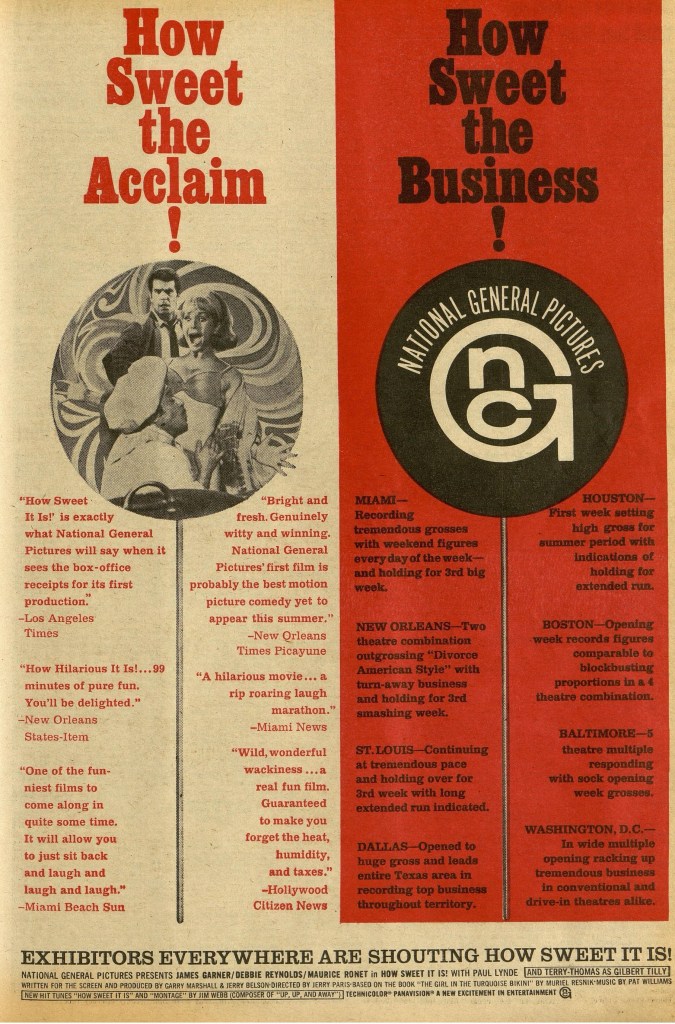
Advert for “How Sweet It Is.”
But his notion of what might appeal to audiences, the kind of amiable almost knowing-wink characters, didn’t go down as well at the box office as he might have imagined. And when he was cast as the lead – though, critically, not guaranteed above-the-title status – in 70mm roadshow Grand Prix (1966) his presence was blamed for the movie not doing as well as expected. And it was soon apparent to all that he was far from a box office high-flyer. In fact, on the domestic market, his movies always made a loss.
Except for The Art of Love (1965), where you could equally argue Dick Van Dyke was the main attraction after the success of Mary Poppins, the movies in which he had been the star (excluding the likes of Move Over, Darling, 1963 and The Americanization of Emily, 1964 where he played second string to Doris Day and Julie Andrews, respectively) took in an average rental of $1.5 million, way below what they cost to make.
He was viewed as a perennial loser in the hard-nosed world of Hollywood that took earnings as its sole measure. Worse, Variety held up to scrutiny his choices, complaining he had “forsaken tough guy roles for indifferent comic assignments and two misjudged roles as a tormented amnesiac” (36 Hours, 1964, and Buddwing/Mister Buddwing, 1966)
Sensing which way the wind was blowing, Garner set up his own production company. He was in good company – Burt Lancaster, John Wayne, Dean Martin, Frank Sinatra among that coterie. Cherokee Productions was intended to be the vehicle by which he would control his own career and prove, once again, that he was better at it than any studio. His final movie as a purely salaried performer was Hour of the Gun (1967) the last picture in his Mirisch deal, which paid him “not much.”
Cherokee announced two pictures to be made in spring and summer 1967, Doll from the Ed McBain thriller and Buffalo Soldiers based on the John Prebble book and with director Ralph Nelson already in tow. Neither saw the light of day.
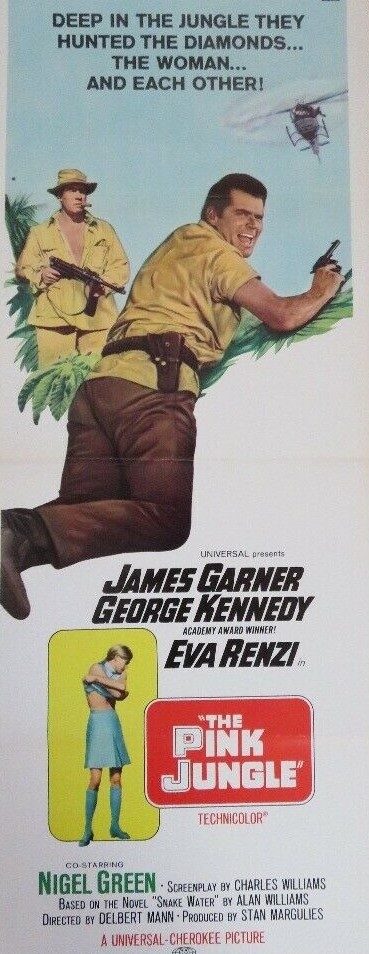
Undeterred, he tried again. This time the slate was more ambitious and achievable as it transpired: comedy How Sweet It Is (1968) co-starring Debbie Reynolds for nascent production company National General, adventure The Jolly Pink Jungle (thankfully retitled The Pink Jungle, 1968), The Sheriff (which became Support Your Local Sheriff, 1969) for United Artists and Buffalo Soldiers (still unmade).
The reason for original title for the “Jungle” picture might have been to avoid confusion with a musical earlier in the decade by Leslie Stevens called The Pink Jungle. According to some sources, it was originally intended to pair Garner with Shirley MacLaine. I never found any mention of her in my research and it seems an unlikely teaming, much as you could see how well it could play, since the actress’s asking price was $750,000 and that would make her the star rather than Garner and I’m guessing the script would be rewritten to tilt in her direction.
Given Universal was intent on not going anywhere near a live jungle it sounded, budget-wise, well out of the MacLaine league and more appropriate for the likes of rising – and cheap – West German star Eva Renzi (Funeral in Berlin, 1966).
The most studio Universal was willing to spend was to enlarge its jungle backlot by seven acres to 20 acres. Renzi had been due to make her Hollywood debut with House of Cards (1968), another Universal picture, opposite George Peppard but when she fell pregnant was replaced by Inger Stevens. The Pink Jungle didn’t get a good rep from anyone, least of all the critics. Garner complained about Renzi, and, even though he was the prime mover behind the picture, said he only did it “for the money” while for her part Renzi ragged Oscar-winning director Delbert Mann.
Neither of the first two Cherokee offerings did much to pep up Garner’s marquee value. How Sweet It Is, budgeted at $3.2 million, only returned $2.7 million in rentals in the U.S. and finished a mediocre forty-third in the annual box office league. The Pink Jungle didn’t feature at all which meant it took in less than $1 million.
Garner redeemed himself with Support Your Local Sheriff, made for a miserly $1.6 million but a worldwide hit, his best-ever performer as star. But oddly enough, it didn’t do that much for Hollywood perception. MGM initially rejected him for his next movie Marlowe (1969), another flop. Cherokee’s next two features, Italian co-production A Man Called Sledge (1970) and Support Your Local Gunfighter didn’t deliver either.
So Garner went back to television. And Warner Brothers. The upshot was J.G. Nichols (1971-1972), another western. The WB deal included movies but only one was made – Skin Game, 1971 – and neither that nor They Only Kill Their Masters (1972) for MGM or Disney pair One Little Indian (1973) and The CastawayCowboy (1974) made much of an impact at the box office. And it wasn’t until, ironically enough, The Rockford Files (1974-1980), produced by Cherokee for Universal, that Garner really re-established his position in the industry.
SOURCES: “James Garner Moves from Actor Towards Future Producer Status,” Variety, October 5, 1966, p5; “James Garner’s Own Plot: Performer to Producer,” Variety, November 1, 1967, p18; “Peak Production Year for Universal Studio,” Box Office, 1967, p5; “Rising Skepticism on Stars,” Variety, May 15, 1968, p1; “Big Rental Films of 1968,” Variety, January 8, 1969, p15; “Garner Weaver Set,” Variety, March 26, 1969, p7; “20-Acre Set Prepared for Jolly Pink Jungle,” Box Office, July 24, 1969, p9; “Garner Kennedy Re-Team in Co-Prod for UA,” Variety, June 10, 1970, p4; “WB-TV Dealt Stake in Garner Series for NBC,” Variety, August 5, 1970, p28.
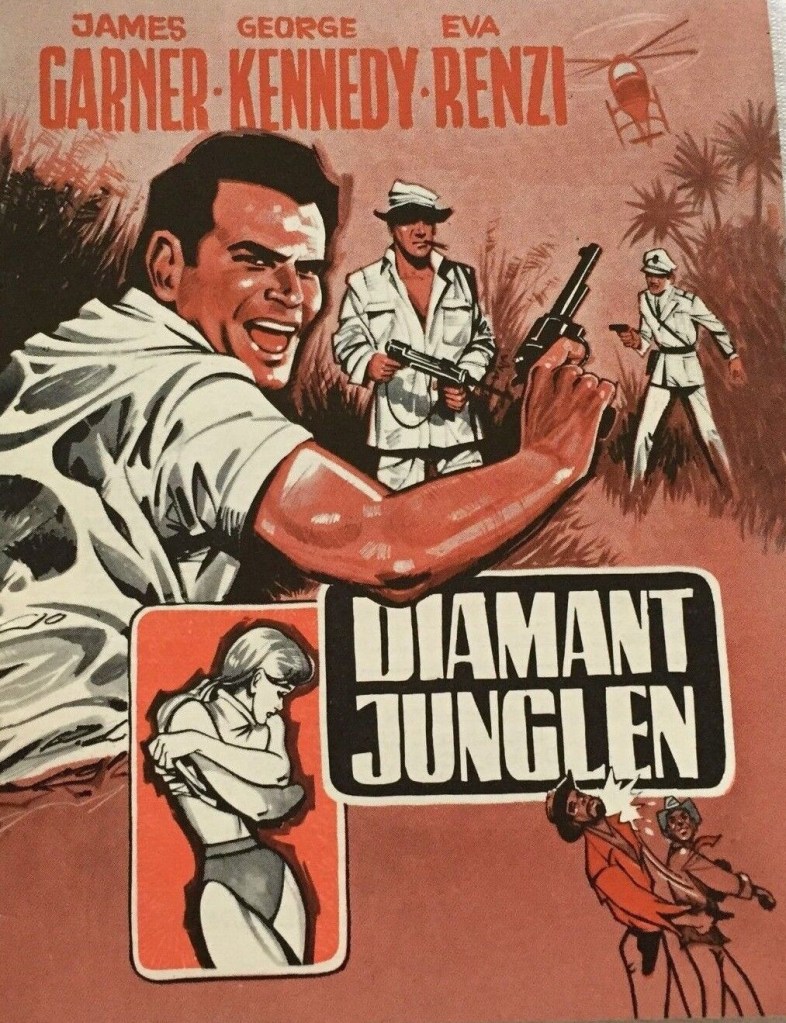
Near miss rather than the spectacular crash dive the poor box office returns suggested. Though it’s scarcely surfaced in five decades. Espionage adventure-cum-treasure hunt is slightly undone by knowing winks to the camera and it won’t take an eagle eye to spot that most of the action doesn’t take place in the jungle at all, although the title is explained in a clever twist at the end.
Shame the script goes AWOL and you might be left lamenting what might have been had it been a hit and the boost it could have given the careers of George Kennedy (Cool Hand Luke, 1967), playing ebulliently against type, and Eva Renzi (A Taste of Excitement, 1967) who proved to have lot more screen charisma than her ensuing roles suggested. Not to mention James Garner (Duel at Diablo, 1966), marquee value taking a hit after a string of flops.
However, if you can accept James Garner as a fashion photographer, and a gag that sees all three male principals decked in out varying shades of lipstick, and shut out the noise of Garner’s character offering commentary on what is about to happen, it’s a pleasant, non-demanding ride, with a believable central romance.
And I learned diamond arithmetic: five carats equals one gram, 28 grams is one ounce so you’re talking a phenomenal amount for a diamond weighing a few ounces never mind a 20lb haul which is where the endless MacGuffins lead. And if Ann-Margret can elect to shoot a fashion spread against the backdrop of motocross (C.C. and Company, 1970), choosing the South American jungle as the ideal spot for a lipstick advert is scarcely a stretch.
The long-winded tale begins with photographer Ben (James Garner) having his consignment of lipstick confiscated by police chief Ortega (Michael Ansara) who suspects they conceal hidden microfilm from the C.I.A. for rebel insurgents. When model Alison (Eva Renzi) arrives by helicopter that’s promptly stolen by South African illegal diamond dealer Ryderbeit (George Kennedy). The stranded couple repair to the nearest town, followed by the cops and by a pair of thugs, where Ryderbeit connects them to Englishman Capt Stopes (George Rose) who boasts a map leading to the lost diamond haul.
There’s no great reason for Ben to get involved, and the script offers nothing compelling, but let’s go for the ride, so suitably prepared (cigars and whisky essentials apparently) they set off with mules into the desert (yep, no jungle) where the model demonstrates her rodeo skills. There, they encounter Australian McClune (Nigel Green), the supposed deceased partner of Stopes, but he dupes them, leaving them stranded without water or mules, in the desert and heads off to find the loot himself. Of course, that does mean he has to come back the same way so the inevitable shootout, compounded by villains and cops, ensues.
Though determinedly sluggish in parts and the introduction of McClune adding little to the scenario, for the most part, although treading a thin line between cliches, it’s enjoyable enough. Ben is surprisingly handy with his fists, Alison has unusual depths and Ryderbeit is an engaging conman.
For a time there’s a bit of a tussle over Alison, as she’s clearly at times more attracted to the “masterful” adventurer Ryderbeit, a cool dude especially when he demonstrates his dance moves, than the cynical Ben. McClune takes a more predatory interest in Alison. But the growing romance between Ben and Alison is gentle stuff and almost required acting of the highest caliber given that the two actors hated each other according to the scuttlebutt.
Guilty of over-plotting and trying hard not to take the scenario seriously enough, even when it’s clear it won’t work unless that does occur, and that as a previous Garner episode proved, as in A Man Could Get Killed (1966), you can easily skirt around dense narrative and espionage malarkey without getting too bogged down. Over-populated, though, with characters and accents vary.
I’m used to Garner’s schtick by now, but Eva Renzi and George Kennedy were revelations, as was Nigel Green (Fraulein Doktor, 1969) also having a ball as a duplicitous character far removed from his usual ramrod-straight persona.
Oscar-winning director Delbert Mann (Mister Buddwing / Buddwing, 1966) does his best but he could have moved it on a bit for the pace seriously slackens at times. Charles Williams (Joy House, 1964) contributed the screenplay based on the novel by namesake Alan Williams.
Far more enjoyable than I expected and worth it for Renzi and Kennedy.
PREVIOUSLY REVIEWED IN THE BLOG: James Garner in Cash McCall (1960), The Wheeler Dealers (1963), Move Over, Darling (1963), The Americanization ofEmily (1964), 36 Hours (1965), The Art of Love (1965), A Man Could Get Killed (1966), Duel at Diablo (1966), Buddwing/Mister Buddwing (1966), Grand Prix (1967), Hour of the Gun (1967), Marlowe (1969); Eva Renzi in Taste of Excitement (1969); George Kennedy in Lonely Are the Brave (1962); Charade (1963), InHarm’s Way (1965), Mirage (1965), Shenandoah (1965), The Sons of Katie Elder (1965), The Flight of the Phoenix (1965), Hurry Sundown (1967), Cool Hand Luke (1967), Bandolero! (1968), Guns of the Magnificent Seven (1969); Delbert Mann directed A Gathering of Eagles (1963), Buddwing/Mister Buddwing (1966), Fitzwilly/Fitzwilly Strikes Back (1967).
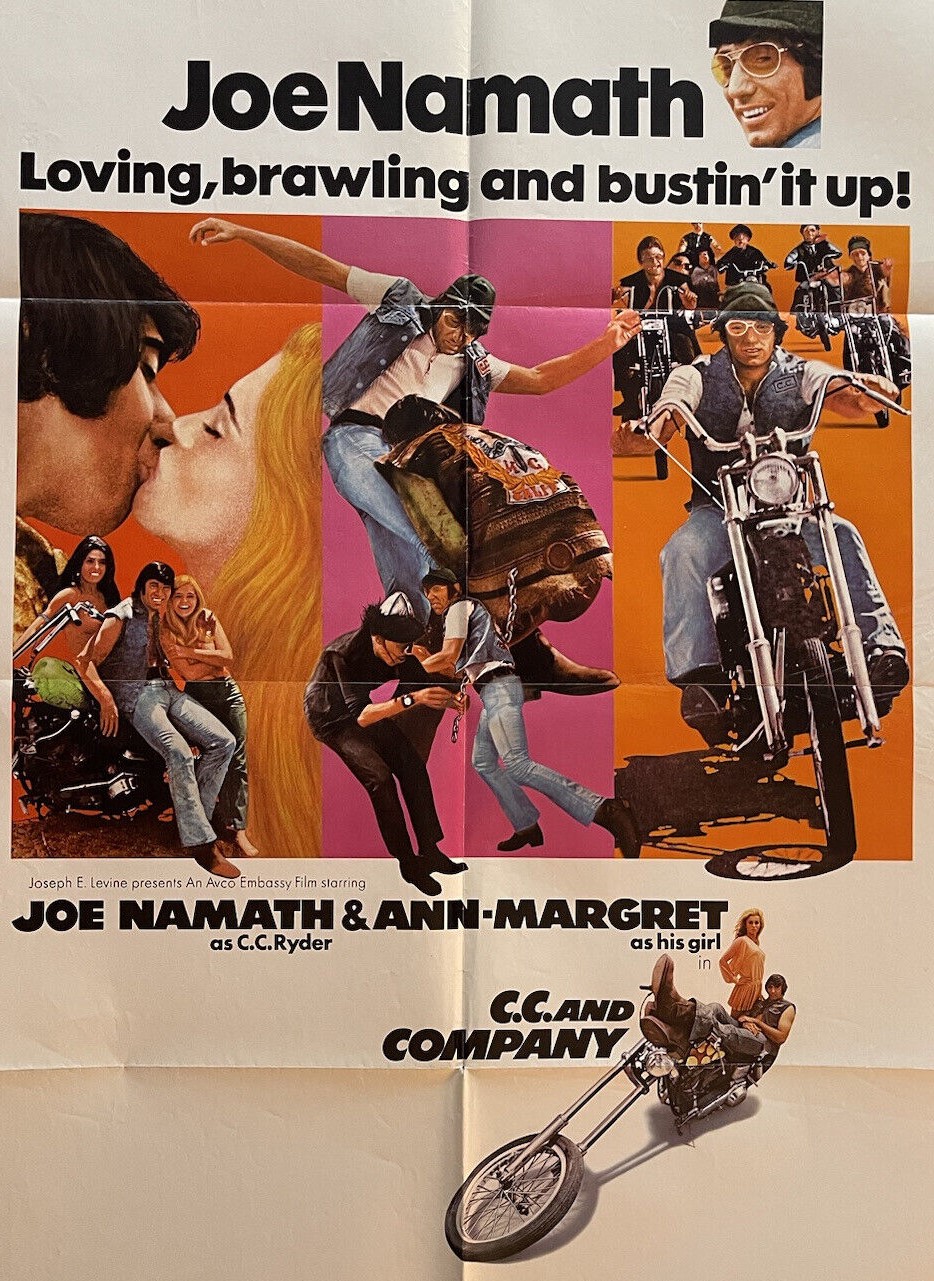
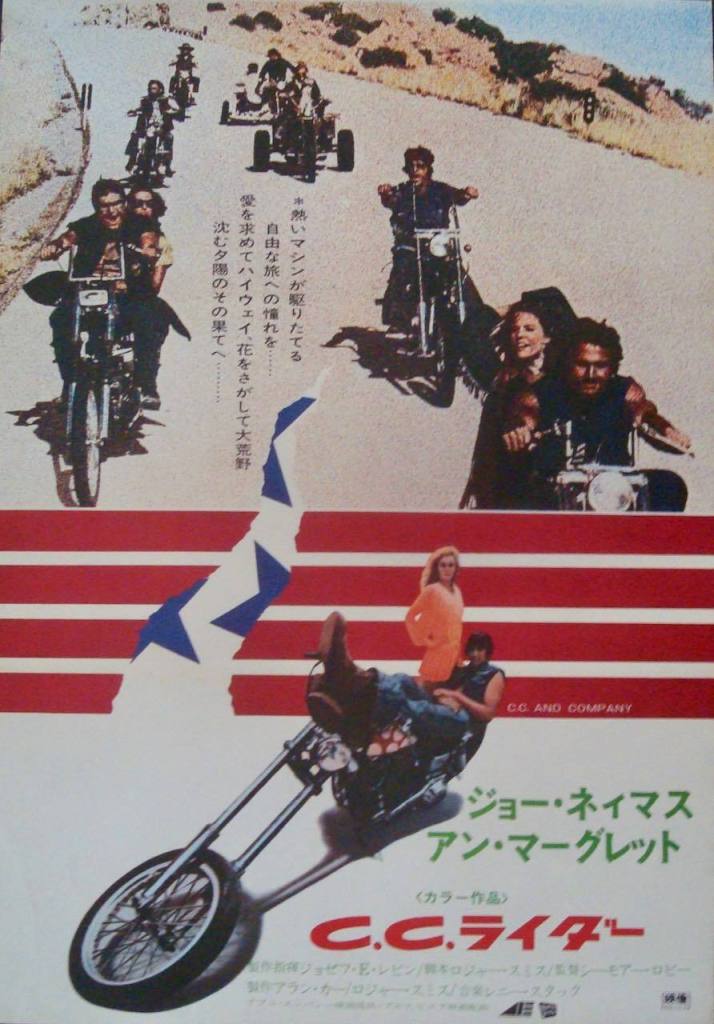
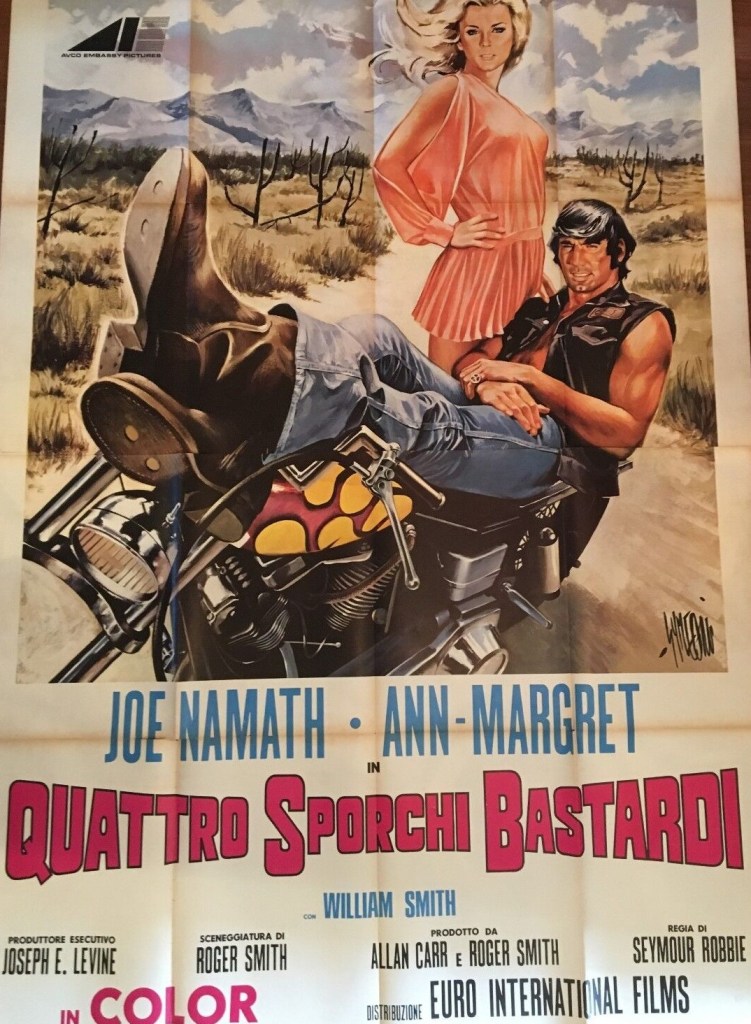
Just terrible. Not even the presence of Ann-Margret (The Swinger, 1966) can save this. Scarcely a single redeeming feature and nothing that might lend itself to shift it into the So Bad It’s Good category. In fact, you would probably put it in a lower class, the So Bad It’s Worse Than You Can Possibly Imagine strata. Little seen for over half a century, and small wonder.
And, boy, did Ann-Margret need a hit after a three-year self-imposed exile in Italy, where she earned big bucks for pictures that hardly got a sniff on the U.S. release circuit, putting an almighty dent in her marquee value. In theory, she should have returned home with a bang, as female lead in a Stanley Kramer production, R.P.M. (1970), the most prestigious picture she had ever been associated with, and easily the best director. But that, riding the counter-culture wave, was a big flop.
This was her second attempt at counter-culture. Motorbike sagas were bankable after the success of Easy Rider (1969) and even as B-pictures had attracted decent audiences for the likes of TheWild Angels (1967) and Run, Angel, Run (1969).
But this was saddled with a terrible star in Joe Namath, and a terrible script by Roger Smith (The First Time, 1969), Ann-Margret’s husband-manager, that puts the wild boys of the highways in a motocross competition, swapping their high-powered bikes for the much smaller Kawasaki engines used in that sport.
If you were American, Joe Namath was a god. If you were foreign, he was a nobody. One of the country’s greatest American football (not soccer!) players, he had made his movie debut in another flop, Norwood (1969). My guess is Ann-Margret was there to help out her husband, also the producer, and beef up the marquee.
But C.C. Ryder (Joe Namath) looks more like an overgrown schoolboy, hulking though he is, than a Hell’s Angel. For the lack of believability he invests in the role you would have done as well with pop star Fabian (Ten Little Indians, 1965).
Anyway, on with the barmy story. So, fashion director Ann (Ann-Margret) has the bright idea, as fashion directors did in those days, of setting up a shoot against the backdrop of a motocross event, kind of like Zabriskie Point (1970) but with bikes. On the way, her car breaks down. The two passing bikers who come to her rescue have something else in mind and she is only saved from rape by the intervention of Ryder.
He belongs to a biking troupe headed by Moon (William Smith), the misogynist’s misogynist, who slaps his women around and sends them out to prostitute themselves on the highways because unlike the enterprising chaps from Easy Rider he’s not got the brains to set up a drugs operation. Then he gets the inspired notion of picking up easy money by sending his guys to compete in the motocross competition because, surely, them being serious motorbike freaks they can beat the hell out of any professional motocross rider who does this for a living.
No doubt audiences will be rooting for the amateurs the way they do for the young kids in other movies that need to put on their own show to save an orphanage or the like.
Naturally, Ryder falls for Ann. Equally naturally, Moon doesn’t like that one bit. And so kidnaps Ann, ensuring Ryder comes to the rescue. Cue a showdown. No doubt we’ll see an almighty battle with chains and wrenches and surely there will be a flashing blade or two as this pair roll around in the dust.
Nope! Let’s just find a handy football stadium and race round the athletic dirt track. That’s bound to be more exciting. You would get more excitement watching goldfish in a bowl.
Theoretically, the combination of Namath and Ann-Margret should have reached the incendiary levels of football star Jim Brown’s sexual tussle with Raquel Welch in 100 Rifles (1969). Nope. Namath has all the screen charisma of a beetle and there’s nothing Ann-Margret can do to help that. You couldn’t have wasted her first nude scene on someone less deserving.
As you might expect, Ann-Margret does get to dance, but for some reason the camera is more focused on Namath who is lacking in the shake-your-booty department.
There is one decent scene and one interesting shot. Unfortunately, the only good scene is the opener, giving a false sense that this might be an interesting picture. It involves Namath “grazing” his way round a supermarket, making up a sandwich from easily available ingredients, even stealing a tissue from a box to wipe his lips. What a rascal, no wonder everyone would be terrified of such a biker. And in the climactic race one of the bikers hits a fence that collapses concertina style.
But that’s it, a 94-minute vanity project that killed off Namath’s movie career and nearly put the kibosh on Ann-Margret’s. You can’t really blame television director Seymour Robbie (Marco, 1973) for failing to improve the material or the stars.
Sometimes being a completist (in this case following Ann-Marget’s career) has its down side.
PREVIOUSLY REVIEWED IN THE BLOG: Ann-Margret in State Fair (1962), Viva Las Vegas (1964), Kitten with a Whip (1964), The Pleasure Seekers (1964), Bus Riley’s Back in Town (1965), Once a Thief (1965), The Cincinnati Kid (1965), Made in Paris (1966), The Swinger (1966), Stagecoach (1966), Appointment in Beirut/Rebus (1968), Criminal Affair/Criminal Symphony (1968).







 The Magnificent 60s