Topkapi (1964) *****

The mother of all heists directed by the father of all heist pictures.

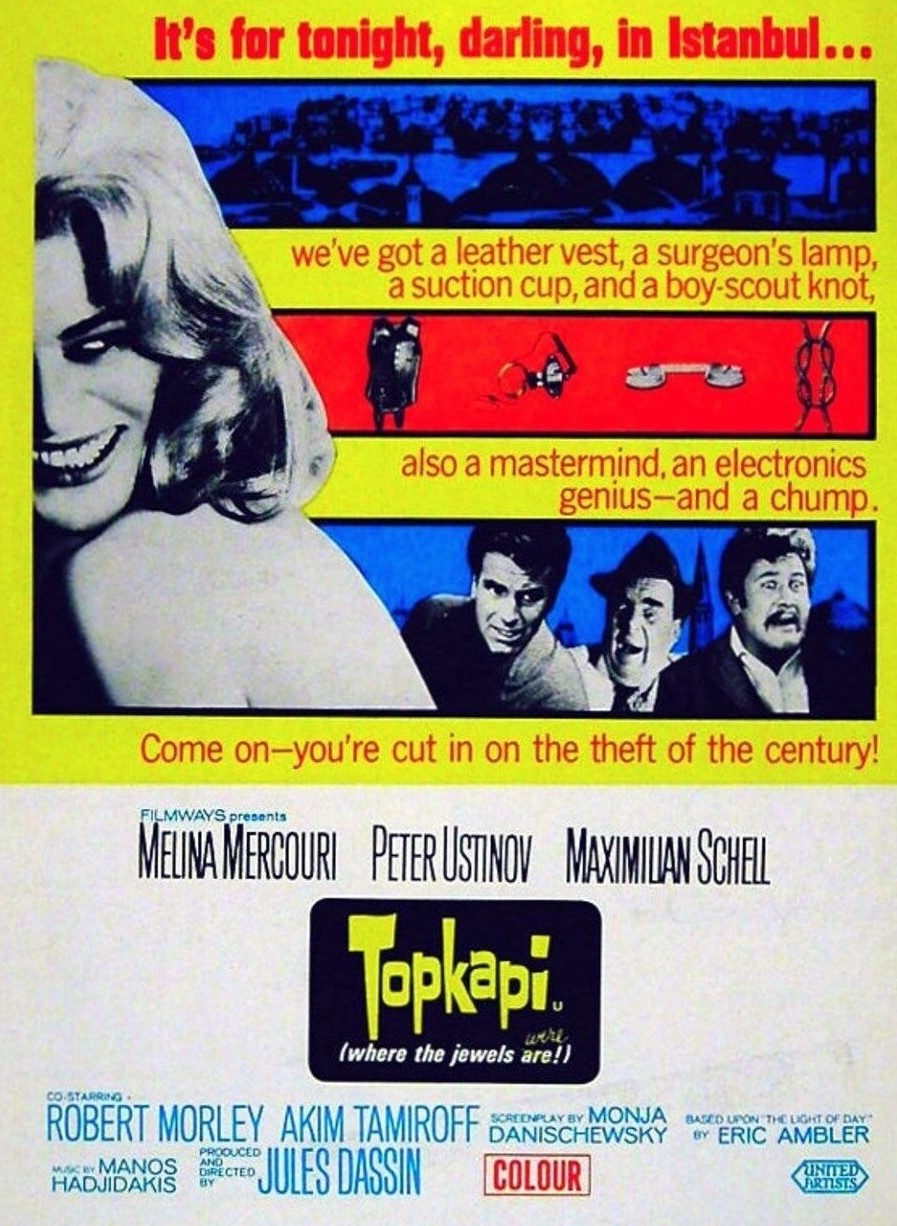
Films as diverse as The Italian Job (1969), Mission Impossible (1996) and Ocean’s Eleven (2001) owe director Jules Dassin a massive debt since he pretty much invented this genre with the French-made Rififi (1955). But that involved professional criminals. Outside of masterminds Elizabeth (Melina Mercouri) and Walter (Maximilian Schell), this crew are amateurs, deliberately chosen for their lack of criminal records and with a mind to the specific tasks required. So we have acrobat Giulio (Gilles Segal), upper-class English gadget inventor Cedric (Robert Morley), strongman Hans (Jess Fisher) and driver Arthur (Peter Ustinov).

The target is the impenetrable, complete with sound-sensitive floor, Topkapi Palace in Istanbul where they plan to steal a priceless emerald-encrusted dagger. The plan is ingenious. Arthur is initially only hired to smuggle the weapons essential to the audacious heist across the border. But when he is caught and forced to cooperate with the Turkish secret police, he is enlisted as a replacement for Hans. Minus the rifles and grenades which at first appeared indispensable to the plan, the thieves come up with an even more inspired alternative involving among other things scampering across rooftops, abseiling, a parrot and slowing down the revolutions of a lighthouse.

Originally intending to betray his colleagues as soon as possible, Arthur falls under the seductive spell of Elizabeth and finds himself recruited as the replacement muscles. Elizabeth exudes such sexuality she has the entire gang in her thrall and makes the cowardly, weak, acrophobic Arthur believe he can overcome all his fears. Like current television sensation Money Heist, Walter engages in a cat-and-mouse game with the police, always one step ahead, with a bagful of red herrings at his disposal, eventually giving the pursuers the slip during a wresting competition held in a massive outdoor arena.

Interestingly, too, this doesn’t have the trope of gangsters at each other’s throats, planning to double-cross one another or bearing old grudges. Nor is this the last robbery for anyone prior to retirement. Equally, nobody challenges the leader. In fact, the entire crew could not be more docile, content to sit at the feet of Elizabeth and Walter, lapping up the former’s flirtation, wondering at the latter’s skill, as if they are all honored to have been chosen.

The climactic heist, carried out minus music, and lasting over 30 minutes is absolutely superb, setting a very high bar for future imitators, and there is a twist ending. Dassin mixes light comedy and high tension with the sultry attractions of Elizabeth to produce an at times breathtaking picture. As well as the heist itself, the wrestling sequence is stunning and the transition of Arthur forms the acting highlight (he won the Best Supporting Actor Oscar).

But all four main stars are superb. Audiences accustomed to a more uptight Maximilian Schell (The Condemned of Altona (1962) will have been surprised by his charming performance. Melina Mercouri (Oscar-nominated for Never on Sunday, 1960) is the archetypal blonde bombshell, liberal with her favours but careful not to favour just one. Although Walter devises the plan, she is actually the criminal supremo, selecting the targets, and then delegating to ensure the tasks are carried out. Robert Morley is having the time of his life. Akim Tamiroff (Lord Jim, 1965) has a cameo as a chef.

A film noir star after Brute Force (1947) and The Naked City (1948) Dassin’s Hollywood career collapsed in the wake of the anti-Communist McCarthy hearings and he was blacklisted. Rififi opened few doors but even the success of Never on Sunday (1960) brought negligible offers. Despite returning to the mainstream with such elan through the conduit of Topkapi, albeit with a European cast, he remained on the Hollywood periphery and although the American-set Uptight (1968) – previously reviewed in the Blog – involved another heist that was primarily the wrapping for social documentary.

More at home with comedies screenwriter Monja Danischewsky (The Battle of the Sexes, 1960) draws out more humour than the source material, Light of Day by noted thriller writer Eric Ambler, would ostensibly suggest.

A delight from start to finish, the crème de la crème of the heist genre, this is unmissable. Dassin can lay claim to being the John Ford of the crime picture.

Warning Shot (1967) ****

So underrated it doesn’t even feature on Wikipedia’s chart of 1960s crime pictures, this tight little gem, with an early reflection on police brutality, a dream cast, violence in slow motion  (prior to The Wild Bunch, 1969, mind you) and a stunning score from Jerry Goldsmith, is definitely in need of resurrection. Astonishing to realize that cop pictures had fallen so out of fashion, that this was the first Hollywood cop film of the decade – outside of a drama like The Chase (1966) – the entire previous output focusing on gangsters with a rare private eye (Harper, 1966) thrown in. With none of the vicious snarl of Madigan (1968) or the brutality of Coogan’s Bluff (1968), this was more in keeping with the later In the Heat of the Night (1967) in terms of the mental and physical barrage endured by the cop.

In thick fog on a stakeout for a serial killer at an apartment block Sgt Tom Valens (David Janssen) kills a potential suspect, wealthy Dr Ruston. Valens claims the suspect was reaching for his gun. Only problem – nobody can find the gun. Up on a potential manslaughter charge, Valens is pressured by boss (Ed Begley), lawyer (Walter Pidgeon) and wife (Joan Collins) to take the rap and plead guilty.  The public and media rage about police brutality. Putting Valens’ testimony in doubt is a recent shooting incident, which left Valens with a stomach wound, and which may have clouded his judgement.

Although suspended, Valens has no alternative but to investigate, interviewing elderly patient Alice (Lillian Gish) whom the doctor was visiting, patient’s neighbour playboy pilot Walt (George Grizzard), doctor’s assistant Liz (Stefanie Powers), doctor’s wife   Doris (Eleanor Parker) and doctor’s stockbroker (George Sanders) without nothing to show for his efforts but a savage beating, filmed in slow motion, inflicted by the doctor’s son and pals, and a further attempt on his life. He gets into more trouble for attempting to smear the doctor as an abortionist (a crime at the time).

The missing gun remains elusive though the direction at times suggests its existence is fiction. The detection is superb, red herrings aplenty, as Valens, the odds against him cheating conviction lengthening by the day, a trial deadline to beat, everyone turning against him, openly castigated as the killer cop, struggles to uncover the truth. And it’s clear he questions reality himself. He has none of the brittle snap of the standard cop and it’s almost as if he expects to be found guilty, that he has stepped over the line.

Along the way is some brilliant dialogue – the seductive drunk wife, “mourning with martinis” suggesting they “rub two losers together” and complaining she has to “lead him by the hand like every other man.”  Cinematography and music combine for a brilliant mournful scene of worn-down cop struggling home with a couple of pints of milk. The after-effects of the stomach injury present him as physically wounded, neither the tough physical specimen of later cop pictures not the grizzled veteran of previous ones.

David Janssen (King of the Roaring 20s, 1960) had not made a picture in four years, his time consumed by the ultra-successful television show The Fugitive, but his quiet, brooding, internalized style and soft spoken manner is ideal for the tormented cop. This also Joan Collins (Esther and the King, 1960) first Hollywood outing in half a decade.

Pick of the supporting cast is former Hollywood top star Eleanor Parker (Detective Story, 1951) more recently exposed to the wider public as the Baroness in The Sound of Music (1965) whose slinky demeanor almost turns the cop’s head. Loading the cast with such sterling actors means that even the bit parts come fully loaded.

In the veteran department are aforementioned famed silent star Lillian Gish (The Birth of a Nation, 1915), Brit  George Sanders (The Falcon series in the 1940s), Walter Pidgeon (Mrs Miniver, 1942) also in his first film in four years, Ed Begley in only his second picture since Sweet Bird of Youth (1962) and Keenan Wynn (Stagecoach, 1966). Noted up-and-coming players include Stefanie Powers (also Stagecoach), Sam Wanamaker (The Spy Who Came in from the Cold, 1965), George Grizzard (Advise and Consent, 1962) and  Carroll O’Connor (A Fever in the Blood, 1961). American television star Steve Allen (College Confidential, 1960) plays a hypocritical pundit.

A sophomore movie for noted television director Buzz Kulik (Villa Rides, 1968), this is easily his best picture, concentrating on character with a great eye for mood. Screenwriter Mann Rubin (Brainstorm, 1965) adapted the Whit Masterson novel 711  – Officer Needs Help. The score is one of the best from Jerry Goldsmith (Seconds, 1966).

Has this emanated from France it would have been covered in critical glory, from the overall unfussy direction, from the presentation of the main character and so many memorable performances and from, to bring it up once again, the awesome music.

Worth catching on Amazon Prime.

The 355 (2022) *** – Seen at the Cinema

Serviceable actioner but proof that if you don’t have a star big enough to front  a shoot-‘em-up then sticking in another three – or four – actresses of equal, middling, or up-and-coming, status won’t do the trick, not if the characters lack the originality of a Bourne or Bryan Mills (Taken, 2008). There’s plenty of bang for your buck, but the story hangs on the old trope of an electronic device that can blackout the world.

I am not sure why Jessica Chastain has never become a bigger box office star. She certainly has the kudos – two Oscar nominationss – and is not shy of taking on difficult subjects (Miss Sloane, 2016) and she’s certainly enjoyed the occasionally leg-up from a series (The Huntsman: Winter’s War, 2015; It Chapter Two, 2019) to boost her box office credentials. But her last venture into the action arena (Ava, 2020) was a box office flop, though possibly you could put the blame on the pandemic. By my count she has been the top-billed star (excluding her X-Men appearance) in her last eight pictures and none have been a hit.

Her presence in the credits would encourage me to stump up my money at the box office but apparently I am in the minority. I could say the same about Penelope Cruz (Parallel Mothers, 2021), the second biggest star here, and while she certainly retains top-billed status in her native Spain, otherwise she is occasionally a female lead but more likely a supporting player.

If I had been putting my money on anyone to take the action box office by storm it would be Diane Kruger who has the meanest stare this side of Lee Van Cleef. But she’s gone down this route to no commercial response before in The Operative (2019) and The Infiltrator (2016), neither fulfilling the promise she showed in Liam Neeson crackerjack Unknown (2011). Bingbing Fan, (Cell Phone 2, 2019) another X-Men alumni, has only recently achieved box office success, but in limited markets. Mexican Oscar-winner Lupita Nyong’o – here billed fourth and sporting a British accent – may well have the biggest fan base of the lot having clocked up appearances in three Star Wars pictures, taken top billing in Us (209) and third billing in Black Panther (2018).

But back to our story. On the run from the C.I.A. Mace (Jessica Chastain) teams up with Marie (Diane Kruger), a loner working for the German secret service, and Khadjiah (Lupito Nyong-o), a digital wizard formerly of the British secret service. Bing, who turns up later, represents the Chinese good guys. Graciela (Penelope Cruz) is the rank outsider, a therapist just caught up in the shenanigans. The action rattles through Paris en route to Marrakesh before a final stop in Shanghai. As you might expect, traitors lurk in various corners.

There are plenty shootouts and opportunities for the team to show off their hand-to-hand skills, but the action is slowed down by soap opera, having to spell out all the backstories of the principals, only one of whom, Marie, has anything worth listening to. Far be it for me to complain about too much emotion, but it took us over a dozen movies to learn anything significant about James Bond’s past, Bourne had no idea who he was, and at the other end of the scale Bryan Mills was so emotionally driven from the outset it formed the film’s core. Here, emotional quandary pops up when convenient. A bit of mystery would have helped more and cut a good 15 minutes off an overlong playing time.

As to the title, that is the only thing that is kept hidden to the end and when the revelation is made you realize it won’t mean a damn thing to the vast majority of the audience. As an origin story, I doubt the current box office receipts are sufficient to spawn future episodes. Which is a shame because having dumped all the emotional baggage in this picture, the characters could have focused more straightforwardly on action and story in the next.

When Box Office Stats Were Born – 1969

On January 1, 1968, U.S. trade newspaper Variety began working on a project that would change forever the way Hollywood operated and the way the public perceived motion pictures. It single-handedly invented box office statistics, the weekly tabulation that is life and death for industry professionals and a terrific game for outsiders, trying to guess how any film will perform in its opening week/weekend.

Although there had been published information on box office, in the 1960s it was not something that generally speaking was of interest to the moviegoer. All the trade papers carried box office details in one way or another. Variety reported the weekly takings in about 300 first-run cinemas in around 20 cities. The rival Box Office magazine considered it more important that figures should relate to a cinema’s average weekly takings and so while not publishing figures produced data on a percentage basis so that managers were not simply blinded by income when they should be concentrating on profit. But while Variety posted a weekly Top 12 chart, it was largely irrelevant because openings were not coordinated as they are now. Variety also produced year-end results but these were based on rentals (i.e. what the studio takes after the cinema share has been parcelled out) rather than gross box office.  

Variety proposed a revolution. Instead of this haphazard manner of gathering statistics, it would turn the whole issue into a cohesive, substantive whole. Investing in an IBM 360 computer, Variety sampled around 650-800 cinemas each week for an entire year in 22-24 of the largest markets plus smaller cities in the country. Given that there were about 14,000 theatres in total in the U.S. this might seem a ridiculously low sample, but in fact about 80% of a movie’s revenues came from a disproportionately small number of cinemas. Cinemas in big cities might have upwards of 1,000 seats with patrons paying top dollar while cinemas in small towns might only have a couple of hundred seats, only play movies for a couple of days, and charge their customers a fraction of big city prices.

Comparisons were made with the Nielsen system used to estimate U.S. television viewing figures which based its reports on a sample of less than 10,000 for an overall audience of 200 million. After running the pilot for a year and comparing it to overall box office, the magazine reckoned that its figures could be multiplied by three to give an accurate measure of how any picture was performing on a nationwide basis.   

The pilot year of 1968 covered  729 titles – far more than might appear in any of the weekly reports – with a total of 35,510 playing weeks and was able to collect figures relating to the number of weeks a movie featured in the chart – i.e. whether a film had “legs” – as well as overall gross. Variety’s previous annual summation involved less than 100 movies because the annual box office chart only covered films which had taken in $1 million or more in rentals. This meant a gross in the region of $2 million.

But low-budget films found it harder to take a big percentage of the box office gross. Where a big picture from a major studio could command at least a 50% share, the smaller pictures often had to do with 30-40% (as I previously reported, Dr No only got bookings in the U.S. by agreeing to take a 30% share of the gross). So for a smaller picture to reach the $1 million rental threshold often meant it had to take in more at the box office than a bigger-budgeted film, perhaps as much as $3 million. Inevitably, such films were not well represented on the annual  chart. In other words, profit outweighed popularity.

But by looking only at gross, and setting down no minimum qualification, the pilot study was able to include far more titles and to bring to wider attention how well, comparatively speaking, some of the less highly-regarded titles performed. By and large box office reporters concentrated on the top films, the roadshows and other big-budget pictures, but “of greater interest,” according to Variety, “is the listing of so many exploitation and sexploitation films about which little is said apart from notorious examples. Reissues, too, are well represented and some are surprisingly high on the list.” 

Variety set out to produce a Weekly Top 50 Chart, based on grosses, to act as “a good barometer of films in current exhibition and their relative positions in regard to each other. The fact that most of the films play through most of the markets results in statistical standardization or any errors in reports and doesn’t change the essential relationship of a film to its competitors.” Receipts for each entry in the Top 50 would show the number of cities and theaters – broken down into Roadshow, First Run and Showcase (ie multiple run) – in which the movie was playing.

The weekly Top 50 made its bow on the April 23, 1969, edition, reporting figures for the week ending April 16. Topping the chart was Disney’s The Love Bug (1968) with $551,000 – equivalent to $4.1 million today – from 15 theaters, mostly First Run with two Showcase bookings. Runner-up Where Eagles Dare (1968) hoisted $396,000 from 22 First Run and 6 Showcases. Third came They Came to Rob Las Vegas (1968) on $311,000 from 44 cinemas, 42 of which were Showcase. Fourth and fifth were long-running musical Roadshows, Oliver! on $308,000 from 16 theaters and Funny Girl on $307,000 from 21. The presence of heist picture They Came to Rob Las Vegas with no major stars taking such a prominent position justified the chart’s existence. Exhibitors risking a booking would see at once that it was best played in a Showcase release and could generate a decent average.

Further down the chart the $116,000 from just three outlets for I Am Curious Yellow (1967), in 22nd spot, indicated its box office potential. That was hardly the case for crime drama The Devil’s Eight (1969) with just $67,000 in its opening week from 15 Showcase engagements. Showing initial promise were Hall Bartlett’s college drama Changes (1969) – $25,000 from three – and British shocker Baby Love with $19,000 from two.

The following week (for week ending April 23) the Top Five were comedy western Support Your Local Sheriff (1969) which cornered $572,000 from 58 theaters – 43 Showcase and 15 First Run – in twelve cities, The Love Bug, Where Eagles Dare, Funny Girl and Oliver!   

SOURCES: Syd Silverman, “Computerized B.O. Chart Due,” Variety, April 16, 1969, page 3; “Computerized Tally of 729 films,” Variety, May 7, 1969, pages 34, 36, 198, 213; “Top 50 Weekly Grosses,” Variety, April 23, 1969, 11; “Top 50 Weekly Grosses,” Variety, April 30, 1969, 13.

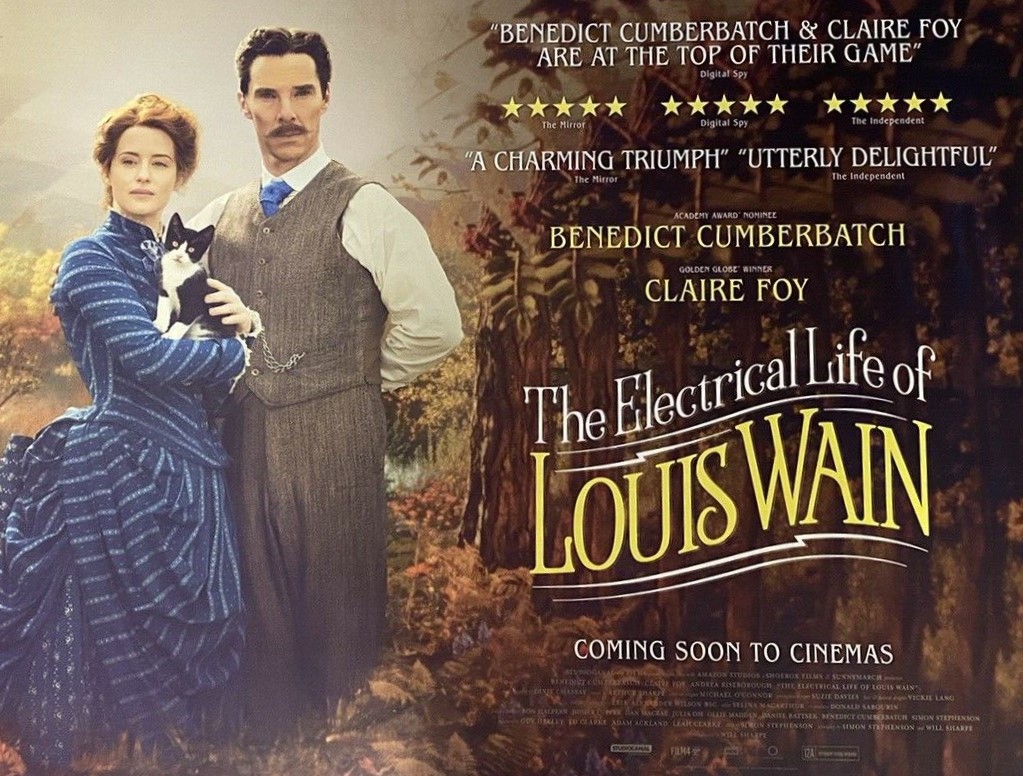
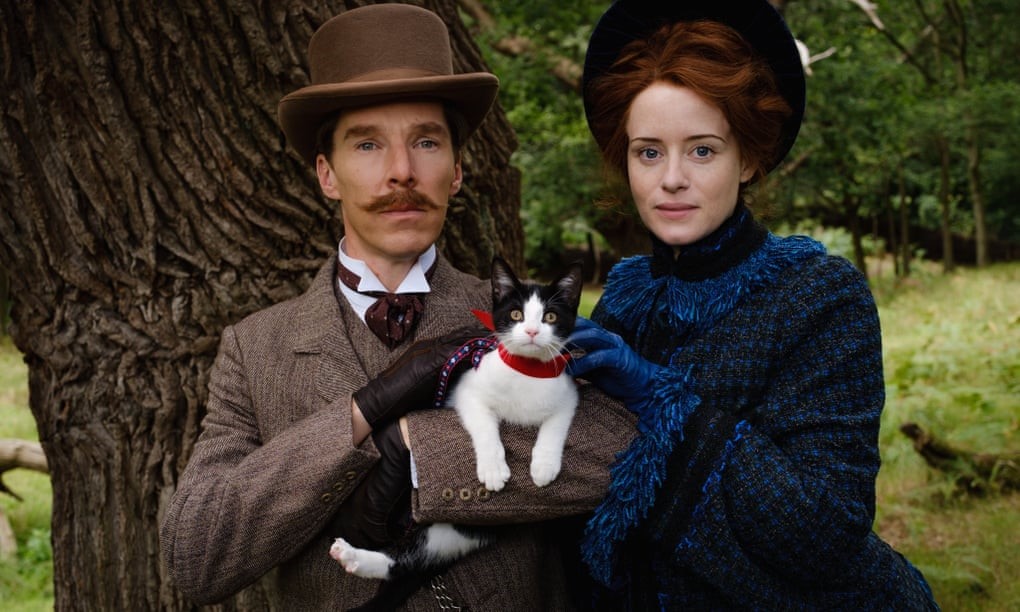
The Electrical Life of Louis Wain (2021) *** – Seen at the Cinema

Contender for worst title of this and any other year, this old-fashioned biopic covers both too much and too little of the life of the eponymous cat illustrator who ended up in a mental asylum. In addition, it’s afflicted by a breezy voice-over that you think belongs to one of the participants until all potential suspects have been killed off and you realise that for no apparent reason the narrative is being delivered by the ubiquitous Olivia Colman. The voice over also serves to cover up what director Will Sharpe fails to properly dramatize.

These deficiencies aside it’s a captivating story with some brilliant acting. Both Benedict Cumberpatch as Wain and Claire Foy as his wife Emily avoid the “strained seriousness” that they fell prey to in potential award-winning projects The Power of the Dog (2021) and a Very British Scandal (2021) in favour of more natural performances that bring both characters to charming life.

As well as inventor, all-round illustrator and amateur boxer Wain became the unlikely poster boy for an emerging generation of cat lovers. The movie also touches on some aspects of Victorian society which provide an interesting contrast to today’s more gender-equal times.  For although the man was the undisputed master of the household, the entire financial burden of bringing up a family fell to him. In Wain’s case, this was inherited, his father having died and left him in charge of a widow and five sisters, with expectations of maintaining a certain standard of middle-class life, and none of the siblings having the decency to get married to alleviate the financial strain.

And all very well from a male perspective if you could take advantage of such a position, with females on hand to meet your every need and never challenge your opinions. Not so easy to maintain if you were of an easy-going disposition with poor business skills and scandalized your siblings by marrying someone below your class, in this case an impoverished governess.

The strain of meeting family obligations, especially with a sister only too willing to remind him of his shortcomings, clearly proves too much for Wain, his earning power diminished by  interest in many other non-remunerative activities. Quite where or when electricity entered the equation is never quite made clear though ongoing nightmares about drowning and imagining he can overhear cats speaking certainly jeopardised his mental health.

By pure accident, at a time when dogs were the prime household pets and cats kept only for the purpose of catching mice, Wain’s cat illustrations became a phenomenon. He would have been wealthy had he retained the copyrights. He fell in love with the thankfully more direct governess and for a time they lived happily together. Ever after was not on the cards once she contracted cancer. The film takes on a different hue once she departs the scene. But eventually his obsession with electricity overcomes him and he ends up in a mental asylum.

The movie covers way too long a period, from his emergence as an artist in 1880 to his commitment in the 1920s. Although Emily features large in the trailer, she is gone too soon and the picture struggles to dramatize his later life. That said, that these shy human creatures emerge from their complicated circumstances to fabricate their own cocoon in the countryside with their beloved cat Peter is a touching tale. The madness that afflicts him may well run in the family, not just in their rampant entitlement, but with one sister carried off to the asylum and the older one a tad neurotic.

Cumberpatch is far better here than in The Power of the Dog where I found his character already too set. Both charming and lacking the guile required to maximize his earning potential, but with a manic nature he can no more soothe than his hair, he dominates the screen so well you are almost taken in by his bizarre theories. As good as he is in love, he is devastating as a man adrift on his own demons. Foy is excellent as the governess doomed to a lifetime of loneliness save for chance encounter with Wain.

Andrea Riseborough (Possessor, 2020) also strikes a chord as the neurotic sister determined to keep family and errant brother together. Toby Jones (Dad’s Army, 2016) plays Wain’s benefactor. The sisters include Sharon Rooney (Dumbo, 2019) and Hayley Squires from television series Adult Material (2020). Putting in a surprise turn as H.G. Wells is musician Nick Cave.

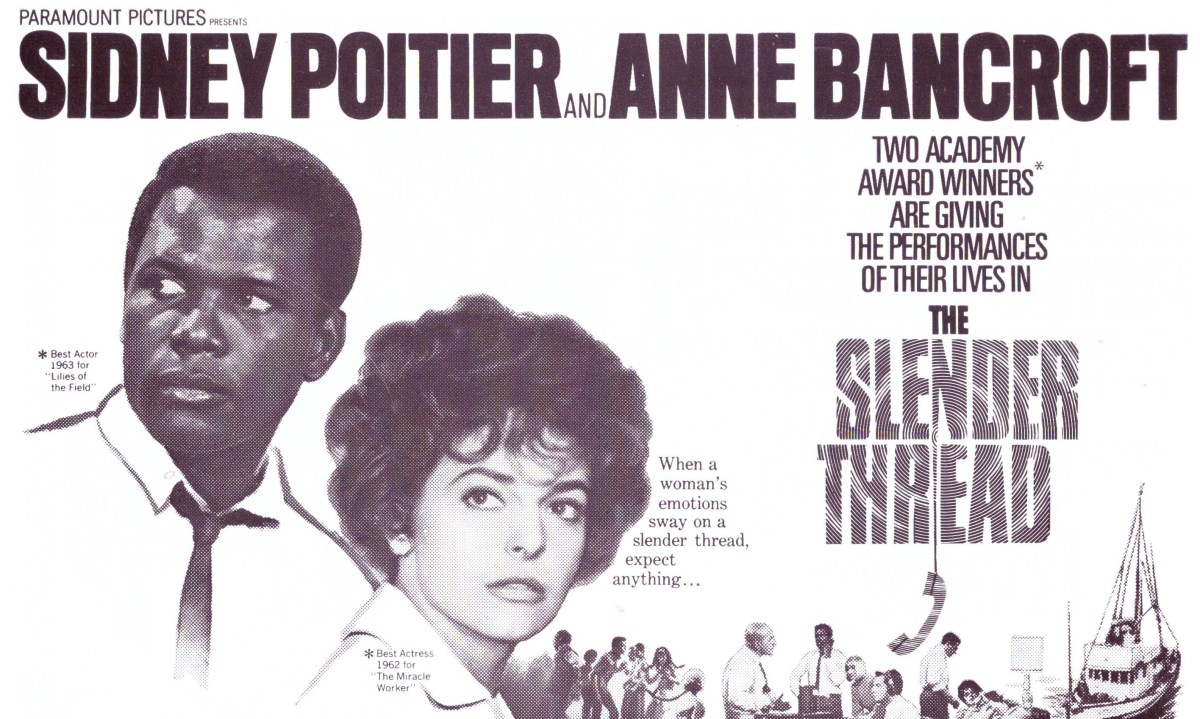
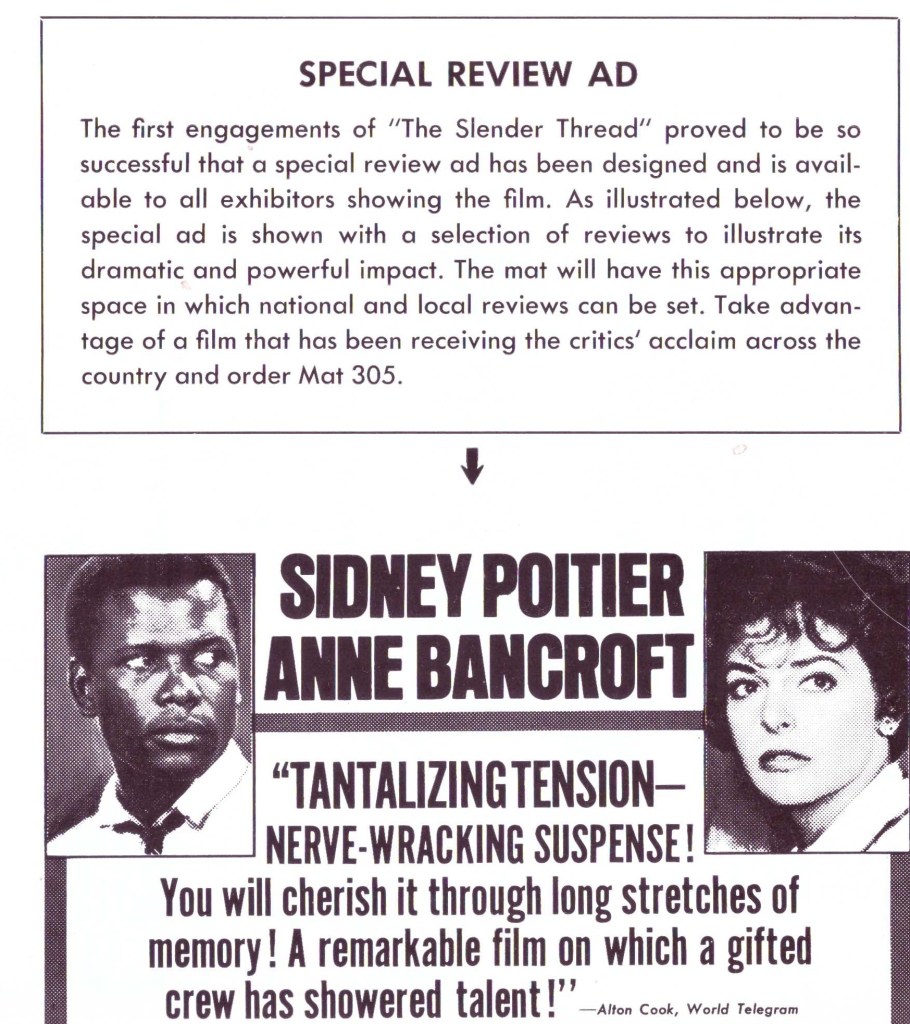
Selling Oscar Winners – Pressbook for “The Slender Thread” (1965)

Just how do you sell a movie about a suicide to an audience for whom such a subject is still taboo? The answer is – you don’t. Instead, you fall back on your stars – and the fact that they are both Oscar winners.

We are pretty used these days to advertising campaigns, especially trailers, focusing on Academy Award recognition – The House of Gucci (2021), for example, boasting umpteen winners and nominees – but it was far rarer in the 1960s when exhibitors expected Pressbooks to provide them with sufficient marketing information to lure in the customers. Oscar success might have been mentioned in passing, forming part of a participant’s biography, but it would not be the entire focal point of the campaign.

The 16-page A3 Pressbook for The Slender Thread does nothing but. There was, of course, a link between the two stars in that Anne Bancroft recipient of the Best Actress Oscar for The Miracle Worker in 1962 had the following year presented Sidney Poitier with his Best Actor gong for Lilies of the Field (1963).

“Two Academy Award winners giving the performances of their lives” is pretty much as far as the tagline writers went in providing exhibitors with something to sell. The subsidiary tagline “when a woman’s emotions sway on a slender thread expect anything” offer little in the way of explaining the film’s content. An image of a phone plays a prominent role in artwork but again without clarifying its purpose. In much smaller writing, at the end of another reference to the Oscars, is the mention of “a motion picture rarely, if ever, surpassed in suspense” but again minus clarification.

You might actually come away with the notion that the drama takes place on the high seas since a ship features in the advertising.

The only other assistance given exhibitors came in the form of reviews which make more mention of suspense. Cue magazine termed it “gripping, bristling tension and suspense all the way.” Kate Cameron in the Daily News concurred – “a high tension suspense film” as did Alton Cook of the World Telegram (“Tantalizing Tension! Nerve-Wracking Suspense!). Nobody mentioned what caused the tension and suspense.

The best bet for tie-ins came from record stores since record label Mercury has organised a “giant merchandising campaign” promoting the Quincy Jones soundtrack. The studio took the chance that exhibitors might take it into their own hands to organise some tie-ups with beauty salons, telephone companies and discotheques since these make an appearance in the picture.     

Quite how 16 pages of the same repeated artwork was meant to inspire exhibitors into, first all, booking the picture, and then, consequently, selling it to moviegoers is never explained.

The Slender Thread (1965) ****

Hollywood paranoia in the 1970s ensured that any type of electronic surveillance was treated with suspicion. Cops, too, were almost certain to be corrupt. Although he would subscribe to such paranoia and implicit corruption in Three Days of the Condor (1973), in his movie debut director Sydney Pollack turns these concepts on their head.

Crisis center volunteer Alan (Sidney Poitier) faces a battle against time to save potential suicide Inga (Anne Bancroft), using his own powers of empathy and persuasion, but helped more than a little by dedicated policemen and the system of tracking calls. On the one hand the ticking clock ensures tension remains high, on the other Alan own’s battle with his nascent abilities brings a high level of anxiety to the proceedings especially as we learn of the particular circumstances driving Inge.

Alan is studying to be a doctor and he carries within him the arrogance of his profession, namely the power to cure. But that is within the realms of the physical. When it comes to dealing with the mental side of a patient he discovers he is ill-equipped. The intimacy he strikes up with Inga ensures he cannot seek relieve by handing over the problem to anyone else, the fear being that the minute he introduces another voice the spell will be broken. His medical training means only that he knows far better than a layman the effect of the pills the woman has taken and can accurately surmise how long she has to live. In the process he experiences a wide range of emotions from caring and sympathetic to angry and frustrated.

By sheer accident Inga’s otherwise loving husband, Mark (Steven Hill), skipper of a fishing vessel, has discovered that their son is not his. On being rejected, she has nothing to live for.

The simple plotline is incredibly effective. The pair never meet but we discover something of Inga’s life through flashbacks as her life gradually unravels and elements of insanity creep in. Alan, meanwhile, is shut in a room, relying on feedback from colleagues such as psychiatrist Dr Coburn (Telly Savalas) and others monitoring the police investigation attempting to discover where she is.

 Initially, the movie treats Seattle as an interesting location with aerial shots over the credits and other scenes on the shore or seafront, but gradually the picture withdraws into itself, the city masked in darkness and the principals locked in their respective rooms.

Sidney Poitier is superb, having to contain his emotions as she tried to deal with a confused woman, at various times thinking he was over the worst only to discover that he was making little headway and if the movie had gone on for another fifteen minute she might have reflected how impotent he had actually been. Anne Bancroft matches him in excellence, in a role that charts disintegration. The fact that their characters never met and that their conversations were conducted entirely by telephone says a lot about their skills as actors in conveying emotion without being in the same room as the person with whom they are trying to communicate.

Telly Savalas (The Dirty Dozen, 1967) delivers a quieter performance than you might expect were you accustomed to his screen tics and flourishes. Ed Asner (The Venetian Affair, 1966) and Steven Hill, in his last film for 15 years, are effective. This was only the second screenplay of the decade by prolific television writer Stirling Silliphant (In the Heat of the Night, 1967).

The bold decision to film in black-and-white pays off, ensuring there is no color to divert the eye, and that dialogue, rather than costumes or scenery dominates. Pollack allows two consummate actors to do their stuff while toning down all other performances, so that background does not detract from foreground. As the High Noon of the psychological thriller this ore than delivers. Gripping stuff. And it’s worth considering the courage required to undertake such subject matter for your first movie.

Winning the Oscar for Lilies of the Field (1963) had not turned Sidney Poitier into a leading man and in fact he took second billing, each time to Richard Widmark, in his next two pictures.  Anne Bancroft was in similar situation after being named Best Actress for The Miracle Worker (1962) and although she took top billing in The Pumpkin Eater (1964) it was her first film after her triumph and, besides, had been made in Britain. And for both 1967 would be when they were both elevated to proper box office stardom.

CATCH-UP: Sidney Poitier performances reviewed on the Blog are Pressure Point (1962), The Long Ships (1964), The Bedford Incident (1965) and Duel at Diablo (1966); regarding Anne Bancroft only The Pumpkin Eater (1964) features here.

The Moon-Spinners (1964) ***

Every new Hayley Mills film was an exercise in transition. Would audiences allow the successful child star – the first for a generation – to grow up? Or would they turn against her as they had Shirley Temple? And would her paymasters Disney in the penultimate film in her contract assist her by offering more mature roles or insist she remained the cute kid? She had already ventured into more adult territory with the British-made The Chalk Garden (1964).

Set on the island of Crete, what starts out as typical Disney travelog – traditional Greek wedding and annual festival parade – soon morphs into darker sub-Hitchcockian territory. Nikki (Hayley Mills) on holiday with her aunt (Joan Greenwood), a collector of folk songs, becomes mixed up with skin diver Mark (Peter McEnery) who appears for reasons unknown to be on the trail of a local man Stratos (Eli Wallach). Young love looks set to blossom except for the villainy afoot. The picture holds on to its various mysteries for too long so exposition comes in a flood in the second act while the third act introduces a new set of characters including British consul (John Le Mesurier) and wealthy yacht owner Madame Habib (legendary silent star Pola Negri).

Along the way some excellent scenes feature: a nerve-tingling high-wire stunt on a revolving windmill, a punch-up on a speeding boat, the drunken wife (Sheila Hancock) of the consul, feral cats in an ancient monument, an old woman thinking she is going crazy when a bottle moves seemingly of its own volition, a hearse doubling as an ambulance, a cowardly leopard and a belter of a slap meted out by Nikki. Mark, physically inhibited by a gunshot wound, has to cede investigation into the nefarious activities to Nikki who in any case has already played the independence card.

Getting all the necessary information to the audience and ensuring various characters are properly introduced without the whole enterprise turning into a turgid mess is a tricky proposition but director James Neilson is equally at home with complicated plot and multi-character scenario from his experience on Dr Syn, Alias the Scarecrow (1963) and with Mills from Summer Magic (1963). And he lets mystery and action take precedence over budding romance, the kiss when it comes hardly going to make an audience swoon, and uses the traditional Greek elements to build up atmosphere.

All in all entertaining enough, especially if viewed as Saturday matinee material, but it’s clear that the leading roles would have worked better if played by older characters as was the case with the source novel by Mary Stewart. Hayley Mills (Pollyanna, 1960) makes a game stab at putting forward a more grown-up persona but relies far too much on the acting tricks that got her into the child-star business in the first place. Even so, once she exerts her independence, she becomes more believable although the idea of a teenager solving a crime creates more problems than it solves in attracting an adult audience.

In his first leading role Peter McEnery (Beat Girl, 1960) impresses. Villainy is a stock in trade for Eli Wallach (The Magnificent Seven, 1960) but here he dials down the brutality. Irene Papas (The Guns of Navarone, 1961) plays his sister and were it not for her husky voice Joan Greenwood  (Tom Jones) would have been a dead ringer for a dotty aunt. It’s a treat to see a famed silent star Pola Negri (Shadows of Paris, 1924) putting in an appearance. Character actors John Le Mesurier (The Liquidator, 1965), Andre Morrell (The Vengeance of She, 1968) and Sheila Hancock (Night Must Fall, 1964) complete the British contingent.   For British television writer Michael Dyne this proved his sole screenplay.

Catch Up: you can follow Hayley Mills’ unfolding career on the Blog through reviews of Pollyanna, The Truth about Spring (1965), Sky, West and Crooked / The Gypsy Girl (1966)  and her adult breakthrough The Family Way (1966). Eli Wallach films reviewed are: The Magnificent Seven, Lord Jim (1965), Genghis Khan (1965) and A Lovely Way to Die (1968).   

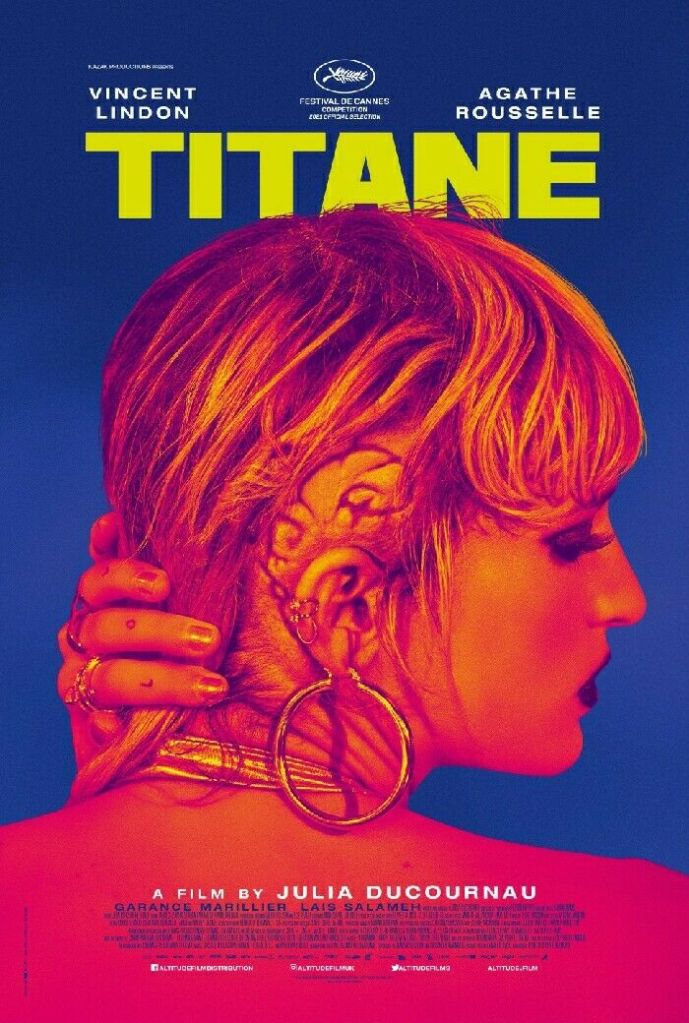
Titane (2021) *****

Perhaps the most unforeseen development of this startling picture is that ruthless serial killer Alexia (Agathe Rousselle) develops a caring relationship with an anguished fire chief father (Vincent Lindon) when masquerading as his long-lost son.  Even when it becomes increasingly clear he is harbouring an imposter his naked need for familial intimacy forces continued acceptance. Of course, given Alexia has been impregnated by an automobile, the cinematic wild ride is hardly over. Not just that the father is inclined to pump himself full of steroids to maintain his failing virility and the firemen let off steam by dancing, with no homoerotic overtones, of dancing among themselves.

But tension never slackens due to the off-the-wall off-the-scale opener that saw her enter the realms of the serial killer and the fact that her nipples start leaking oil. A relationship that could have been creepy and/or unbelievable becomes incredibly tender especially when the so-called boy, as teenagers will, causes his father major embarrassment only this time by revealing a more feminine side to his dancing.

While exploring similar territory to David Cronenberg’s Crash (1996), this shifts into a completely league. With the exception of what she undertakes to create the transformation into a boy, binding her breasts and breaking her nose, the violence is less about self-harm  than straight-out murder, weapon of choice being a handy hatpin. The most bizarre aspect about the enterprise is not the victims mounting up, but the hilarity the film engenders. When Alexis discovers that she has chosen the wrong locale for one of her killings and with a shrug of frustration has to embark on hunting down an entire household you can’t help but laugh. And the meet-cute with a female model is one of the funniest ever put on the screen.

We never find out what has turned her into a murderer especially as she is not gender-specific in this department. A car accident as a child that resulted in her being fitted with some metal has clearly created some affinity with vehicles and she earns a living as a bikini model who drapes herself over motors at car shows to the delight of leering men. Automobiles are more generally seen as expressions of male eroticism so it’s something of a twist that Alexia takes such love to the ultimate extreme.

Outside of superhero and fantasy movies, it’s rare to find a picture that creates its own world and maintains it in consistent fashion. What we learn about this vicious killer is that she needs care as much as anybody else. As the movie shifts from her selfish enjoyment to filling a gap in the fireman’s life it takes us on quite a different journey to that initially suggested.

Director Julia Ducournau (Raw, 2016) presents an unflinching vision that may be too brutal for most tastes. It won the Palme d’Or at Cannes but looks like being ignored by the Oscar fraternity. But the surface is deceptive. If the ending comes as a shocker then you haven’t been paying attention because enough hints are provided as to the potential outcome. And it also means you’ve been ignoring the film’s development which is heading in the direction of togetherness and paternal understanding rather than individual insanity.

In her movie debut Agathe Rousselle is quite astonishing, giving herself up to the needs of a picture that forces tremendous physical demands. It’s a tour de force in what it means to be a committed actor, action driven by character. Oscars have been handed out for a lot less and what makes her characterisation stand out is the transition from woman trapped by a fetish whose only emotional outlet is murder to someone accepting love without question or vicious rejection.

Vincent Lindon (Rodin,2017)  is at the other end of the career scale, with nearly three decades in the business, highlighted by a previous Cannes and Cesar win for The Measure of a Man/ La Loi du Marche (2015). His is a thankless role, at the very least a willing dupe, as much a self-harmer judging from the bruises on his exterior, as likely to be lost and flailing in his jab – a sequence of a forest fire is outstanding – as in his empty emotional life. Hats off also to Lindon, as one of France’s biggest stars, for supporting this project. Without his involvement, funding would have been more difficult.

Titane is a true original with surprising emotional depth.

Can Heironymus Merkin Ever Forget Mercy Humppe and Find True Happiness (1969) **

One of the biggest-ever movie follies, an overblown vanity project with Fellini-esque overtones – written, directed, produced and starring British crooner Anthony Newley (Doctor Dolittle, 1967) – that turned into the first X-rated musical. Bob Fosse mined a similar, almost as seedy, sex-obsessed autobiographical vein in All That Jazz (1979) to critical acclaim whereas the Newley effort met with critical coruscation.

Although primary known as a Broadway star (Stop the World, I Want to Get Off), he had a small but reasonable movie portfolio, star of The Small World of Sammy Lee (1963) and male lead to Sandy Dennis in Sweet November (1968), so in a sense he was ready for the leap into movie stardom, though perhaps not in such grandiose fashion. Had the movie shown the slightest touch of irony, that might have been its saving grace, but the main theme is that women queue up to bed a star who is fed up with bedding women yet appears to revel in his own moral decadence.

The story is so slim it defies belief or arrogance. Hieronymous Merkin (Newley) is preparing to make a film about his own life though he feels he has been controlled from the outset, his child view is that of a marionette with someone else pulling the strings. Once Goodtime Eddie Filth (Milton Berle) sets him on a stage career beauties flock to his side. Although married to Polly Poontang (Joan Collins) he longs to be reunited with earlier lover Mercy Humpe (Connie Kreski). Basically, he keeps asking the universal question besetting all men – if I can have all the sex in the world, why am I not happy?

On the plus side it is certainly audacious, surreal, pretentious, unconventional and gives a good idea of what would happen if a director turned up on a beach in Malta with $1.25 million to spend on whoever happened to be available plus assorted nudes and rolled the camera to see what would happen and then argued with his crew or critics about what was taking place. One big minus is the songs. Newley was a talented lyricist (Goldfinger) and composer as well as performer. But the material here is poor and Newley, despite his Broadway experience, has no idea how to stage a musical.

Cameos abound. You can spot famed comedian George Jessel, singer Stubby Kaye, British entertainer Bruce Forsyth, Tom Stern (The Devil’s Brigade, 1968), and British character actors Patricia Hayes, Victor Spinetti and Judy Cornwell. You may be surprised to learn that the script written in tandem with Herman Raucher (Sweet November) was named Best British Original Screenplay by the Writers Guild of Great Britain.

Theoretically, this is now regarded as a cult classic but I’ve yet to come across a review that treats it as anything other than a self-indulgent curiosity rather than a must-see.

Studio Universal was so embarrassed by the final outcome that it released it in the U.S. under its Regional Film unit “which handles product Universal doesn’t care to go out under its own banner.” The picture was not quite the box office disaster many anticipated after poor runs in New York and Los Angeles. Helped along by a 10-page spread in Playboy it scored substantial business in cities as diverse as Detroit, Louisville and Minneapolis, though not enough, ultimately, to break even.

Given Newley did not make another picture for six years, you might have imagined Hieronymous Merkin spelled the death-knell for his career. But that was not so. After the film opened, he signed a $1 million four-year deal at Caesar’s Palace in Las Vegas, was lining up a Broadway musical about Napoleon and Josephine with Barbra Streisand and was in talks to star in a movie adaptation of his hit musical The Roar of the Crowd.

Afraid you’ll have to dig around on Ebay to find this.

SOURCES: “Newley Making Vegas Bow Aug 7 at Caesar’s Palace,” Variety, June 11, 1969, p76; “Newley-Streisand for B’way Tuner on Nappy-Josie,” Variety, July 2, 1969, p1; “Merkin Dates Overcome Jinx,” Variety, July 9, 1969, p3; “Jack Haley Jr. Setup To Produce, Direct,” Variety, December 24, 1969, p6.

Discover WordPress

A daily selection of the best content published on WordPress, collected for you by humans who love to read.

The Atavist Magazine

by Brian Hannan

WordPress.com News

The latest news on WordPress.com and the WordPress community.