As some of you may have noticed, this isn’t news at all, as for about the last month, I have been posting every day. However, that was never my intention. I had originally planned to review films of the 1960s on Sunday, Wednesday and Friday, but gradually I have expanded the content to include contemporary films and features like Pressbooks, Books into Films, Behind the Scenes and material which goes under the general heading of “Other Stuff” which has a very wide remit.
The 1960s was a period of dramatic change not just in the way films were made, or presented (70mm etc), but in the way they were sold and the way they were shown as the industry moved from films in release moving down a steady food chain that might take a year to complete to movies gradually opening much wider than ever before. And as studios cut down on output, older films, which had previously been dismissed as worthless or as television fodder, were now coming back into the reckoning.
As a result of including material other than just films reviews, I have gradually been posting more often. And it seemed to me I have more than enough material to jsutify continuing in this fashion. but rather than doing this in a haphazard manner, five posts one week, three the next, I thought it would make more sense to bite the bullet and just decided to post every day.
As of tomorrow the format will be as follows: more reviews on a weekly basis of 1960s films with in between items relating to these films or articles about 1960s developments, Pressbooks, Interviews, Behind the Scenes Reports, Book into Film analyses, and pretty much anything else that take my fancy as well as reviews of contemporary films.
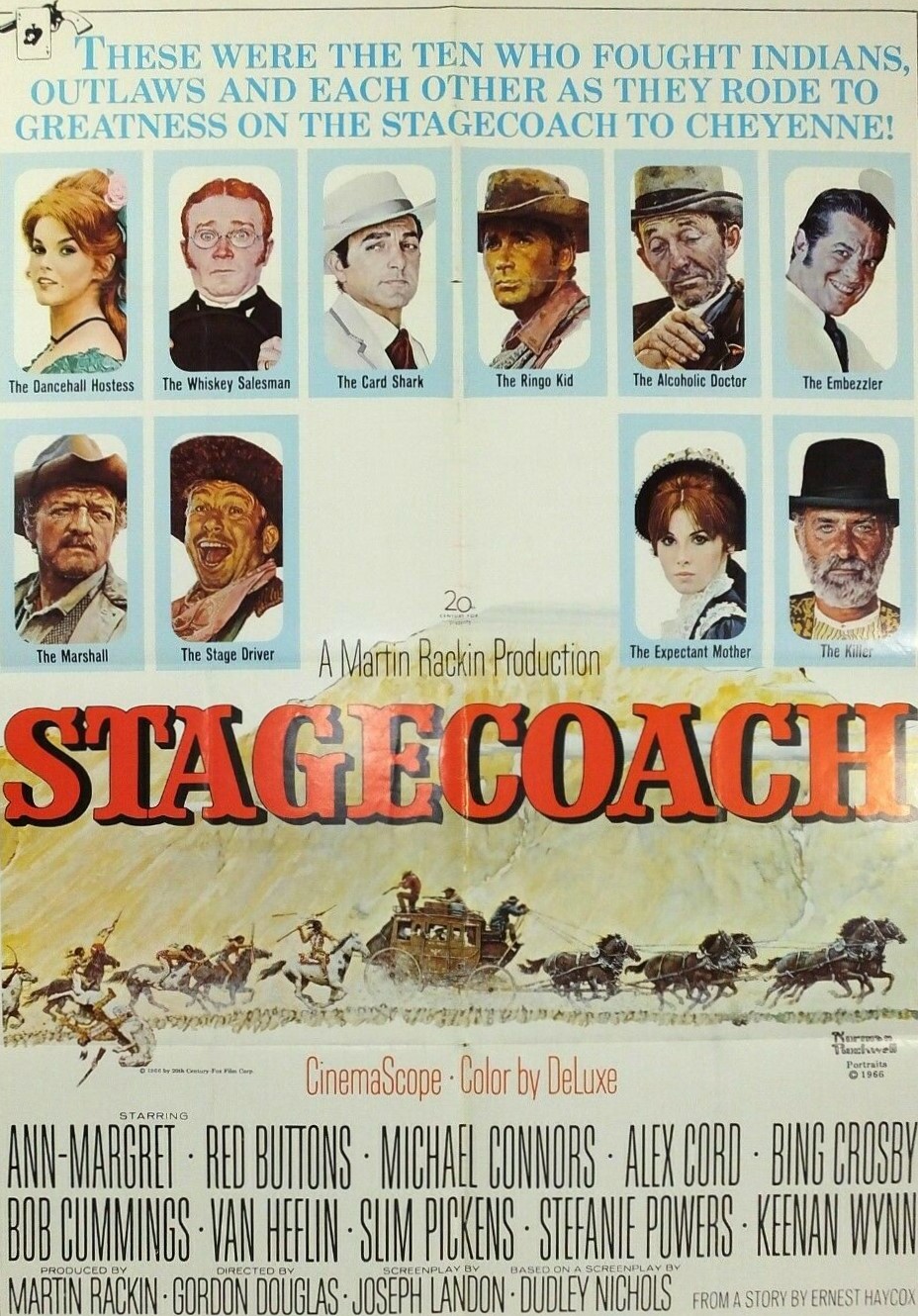
It’s probably sacrilege to admit that I quite enjoyed this. Also it’s been so long since I’ve seen the John Ford original that I could remember very little of the specifics and I haven’t seen the remake before so this was just like watching a new movie.
Basically, it’s the story of a group of passengers taking the stagecoach to Cheyenne for different reasons who are joined by an escaped murderer and shepherded along by the driver and a town marshal. There is some excellent action but mostly it’s a relationship picture, how the characters react to one another and their response to crisis.
Good-time girl Dallas (Ann-Margret) is on the run, banker Gatewood (Bob Cummings) is hiding a stash of stolen money, alcoholic doctor Boone (Bing Crosby) is penniless, liquor salesman Peacock (Red Buttons) is a coward, gambler Hatfield (Mike Connors) has Civil War secrets, pregnant Lucy Mallory (Stefanie Powers) is meeting her cavalry husband in Cheyenne. Ornery Buck (Slim Pickens) is the driver. Curley (Van Heflin) is riding shotgun and when he comes upon stranded escaped murderer the Ringo Kid (Alex Cord) promptly arrests him.
The drama unfolds as the characters confront each other or their own weaknesses. Dallas, who had a high old time as a saloon girl, is way out of her depth in respectable company, concealing the secret of her affair with the married Gatewood. Ringo coaxes her along, bringing her out of her shell, giving her back self-respect, and of course falling in love. Curley, with his eyes on the $500 reward for bringing Ringo in, has no intention of letting the gunslinger take his revenge in Cheyenne on Luke Plummer (Keenan Wynn) who killed his family. Boone and Peacock provide the fun, the doctor spending most of his time separating the salesman from his cargo of booze.
There are endless permutations with a story like this, the kind of material favoured in disaster movies like Airport (1970) and The Towering Inferno (1974) where disparate characters battle for survival. The action is only part of the deal. The picture only truly works if the characters are believable. For that, you need a heap of good acting. The audience could certainly rely on old dependables like Bing Crosby (The Road to Hong Kong, 1962) in his big screen swansong, Van Heflin (Shane, 1953), Red Buttons (Oscar-winner for Sayonara, 1957), Robert Cummings (Saboteur, 1942) and cowboy picture veteran Slim Pickens to put on a good show. But the main dramatic load was to be carried by relative newcomers Ann-Margret and Alex Cord.
Ann-Margret has made her name with sassy light-hearted numbers like The Pleasure Seekers (1964) and had only just stepped up to the dramatic plate with Once a Thief (1965). This was Alex Cord’s sophomore outing after Synanon (1965), the odds stacked against him making any impact in the role which turned John Wayne into a star.
Amazingly, the casting works. Ann-Margret moves from feisty to restrained, meek to the point of being cowed, and for most of the film, far removed from the false gaiety of the saloon, seeks redemption. The cocky trouble-making minx emerges only once, to knock the wind out of Mrs Mallory, but, after taking a tumble down the humility route, gradually steers her way towards a better self, preventing Gatewood from causing chaos, nursing Mallory and inching her way towards true feelings for Ringo. As in the best movies, it’s not for her to open up about her woeful life but for another character, in this case Ringo, to identify her predicament: “What you doin’ about your scars, you got ‘em even if they don’t show…when you goin’ to stand up and stop crawlin’?” When they finally kiss it is one of the most tender kisses you will ever see.
My reservations about Alex Cord’s acting skills were based on his moustachioed performance in Stiletto (1969) but I reversed my opinion after seeing him in The Scorpio Letters (1967) and this is another revelation. As much as he can deliver on the action front, and sports on occasion a mean-eyed look, it’s in the dramatic scenes that he really scores, gentle, vulnerable, caring. He certainly matches the Duke’s trademark diffidence in terms of romance. That the camera can mine depths of expression from both faces proves the calibre of their acting.
If director Gordon Douglas (Rio Conchos, 1964) had more critical standing, his bold long opening aerial tracking shot over rugged forest, mountain and plain before reaching the stagecoach would have received the acclaim accorded Stanley Kubrick for a similar shot in The Shining (1980). The opening also makes it clear how far removed this is from the original, not just in colour obviously, but (although filmed in Colorado) in a different locale, Wyoming, rather than the arid Arizona of Monument Valley. After a brief glimpse of the stagecoach, Douglas switches to a cavalry troop making camp. A soldier going into a wagon is met by a hatchet in the head. The camera tracks the corpse’s blood as it flows down a stream where it alerts another soldier washing clothes. Before he can raise the alarm, he gets a lance in the back.
Where the passengers have heard rumors, quickly dismissed (“nobody got scalped by an old rumor”) of the Sioux (Apaches in the original) on the warpath, the audience has seen the cavalry troop slaughtered, so (in effectively a Hitchcockian device) provides the movie with the tension the on-screen characters initially lack The passengers soon grasp reality when they come across another patrol dead at a staging post, and eventually are battling for their lives when ambushed. But prior to that there is a tense sequence of leading the stagecoach across a narrow mountain ridge during a storm.
There’s a clever reversal before the Sioux onslaught. The passengers think they have seen soldiers approaching, but it is the Sioux wearing cavalry uniforms. There is no river to cross as in the original, but the chase along a mountainous path is breathtaking, aerial and tracking shots given full rein, ending in a shoot-out without (as in the original) the cavalry riding to the rescue.
Douglas has his work cut out with the drama, as various characters confront their issues, and his staging is superb, characters always given reason to move. Screenwriter Joseph Landon (Rio Conchos) borrowed material from the Dudley Nichols original but added and subtracted quite a bit.
At the time critical deification of John Ford had not begun and Hollywood was in a cyclical remake mood – new versions of Beau Geste and Madame X appearing the same year – so Gordon Douglas didn’t quite face a critical backlash, although praise was generally sparse. Judging by the box office it received an audience thumbs-up – as it does from yours truly.
The response to my A-Z of movies reviewed so far was suprisingly strong so I have added an A-Z an added of all the non-movie-review that i have written since I started.
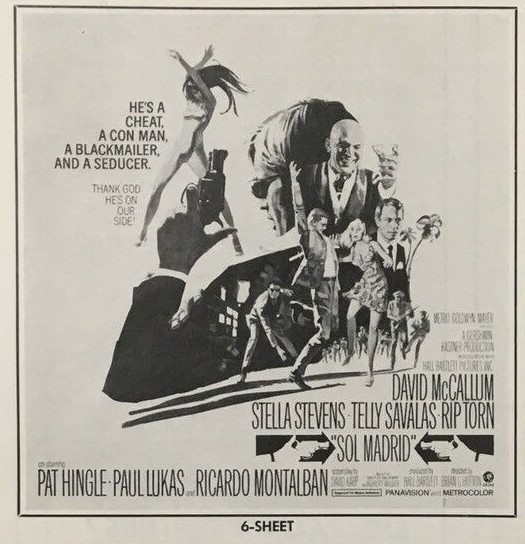
Was it David McCallum’s floppy-haired blondness that prevented him making the jump to movie action hero because, with the ruthlessness of a Dirty Harry, he certainly makes a good stab at it in this slightly convoluted drugs thriller. Never mind being saddled with an odd moniker, the name devised surely only in the hope it would linger in the memory, Sol Madrid (McCallum) is an undercover cop on the trail of the equally blonde, though somewhat more statuesque, Stacey Woodward (Stella Stevens) and Harry Mitchell (Pat Hingle) who have scarpered with a half a million Mafia dollars. Hingle is the Mafia “human computer” who knows everything about the Cosa Nostra’s dealings, Woodward the girlfriend of Mafia don Villanova (Rip Torn).
Sol tracks down Stella easy enough and embarks on the audacious plan of using her share of the loot, a cool quarter of a million, to fund a heroin deal in Mexico with the intention of bringing down both Mexican kingpin Emil Dietrich (Telly Savalas) and, using the on-the-run pair as bait, Villanova. A couple of neat action sequences light this picture up. When Sol and Stella are set upon by two knife-wielding hoods in a car park, he employs a car aerial as a weapon while she taking refuge in a car watches in terror as an assailant batters down the window. Sol has hit on a neat method of transferring the heroin from Tijuana to San Diego and that is filled with genuine tension as is the hand-over where Sol with an unexpected whipcrack slap puts his opposite number in his place.
Meanwhile, Villanova has sent a hitman to Mexico and when that fails turns up himself, kidnapping Stella and planning a degrading revenge. Most of the movie is Sol duelling with Dietrich, suspicion of the other’s motives getting in the way of the trust required to seal a deal, with Mitchell, hiding out in Dietrich’s fortified lair, soon being deemed surplus to requirements. Various complications heighten the tension in their flimsy relationship.
Madrid is Dirty Harry in embryo, determined to bring down the gangsters by whatever means even if that involves going outside the law he is supposed to uphold, incipient romance with Woodward merely a means to an end. McCallum certainly holds his own in the tough guy stakes, whether trading punches or coolly gunning down or ruthlessly drowning enemies he is meant to just capture, and trading steely-eyed looks with his nemesis.
It’s a decent enough effort from director Brian G. Hutton (Where Eagles Dare, 1968), but is let down by the film’s structure, the expected confrontation with Villanova taking far too long, too much time spent on his revenge with Woodward, for whom audience sympathy is slight. Just at the time when Hollywood was exploring the fun side of drug taking – Easy Rider just a year away – this was a more realistic portrayal of the evil of narcotics.
It is also quite prescient, foreshadowing both The Godfather Part II (1974) in the way Villanova has modernised the Mafia, achieving respectability through money laundering, and this century’s television obsession with South American drug cartels with all-out police battles with the Narcos. And there is a bullet-through-the-glasses composition that will be very familiar to fans of The Godfather (1972), and you will also notice a similarity between the feared Luca Brasi and the Mafia hitman Scarpi (Michael Conrad) here. And why we’re at it, Woodward’s predicament is close to Gene Hackman’s in French Connction II (1975).
The action sequences are excellent and fresh. Think Madeleine cowering in terror as the car window is battered in No Time to Die (2021) and you get an idea of the power Hutton brings to the scene of a terrified Woodward hiding in the car. Incidentally, you might think McCallum was more of a secret agent than a cop with the cold-blooded ruthlessness with which he dispatches his enemies.
Stella Stevens (The Silencers, 1966) is the weak link, too shrill and not willing to sully her make-up or hair when her role requires degradation. Her part is better written (“I never met a man who didn’t want to use me”) than Stevens can act and she gets a clincher of the film’s final line. Telly Savalas (The Dirty Dozen, 1967) with his playful villain, though the trademark laugh is in occasional evidence, is in sharp contrast to Rip Torn who is all snarling bad guy. Ricardo Montalban (Madame X, 1966) is Sol’s Mexican sidekick and Paul Lukas, a star of the Hollywood “golden age”, puts in a fleeting appearance.
A total of 23 cinemas – comprising 22,000 seats – made up the roster for London’s West End, the most important cinemagoing location in the United Kingdom. All films had their British (occasional European or World) premiere here. Eleven cinemas could accommodate over 1,000 patrons, the biggest being the Odeon Leicester Square with 1,994 seats. At the other end of the scale and just round the corner from that Odeon was the Cinecenta, a multiplex of four tiny screens, highly unusual in Britain where the doubling and tripling of cinemas was in its infancy.
Although the roadshow was beginning to die the death in the United States, it remained very big business in London. the longest-running film was The Lion in Winter (1968) still taking £4,803 at the 600-seat Odeon Haymarket in its 40th week, equivalent to $11,046 (taking inflation into account that would amount to a colossal $83,248 at today’s prices). So you can see the advantage of letting films run and run in one location rather than shifting them out as soon as possible onto the circuits. Although roadshow tickets were more expensive than continuous performance, there were substantially fewer showings, a roadshow might be screened 15 times a week compared to 35-40 in continuous.
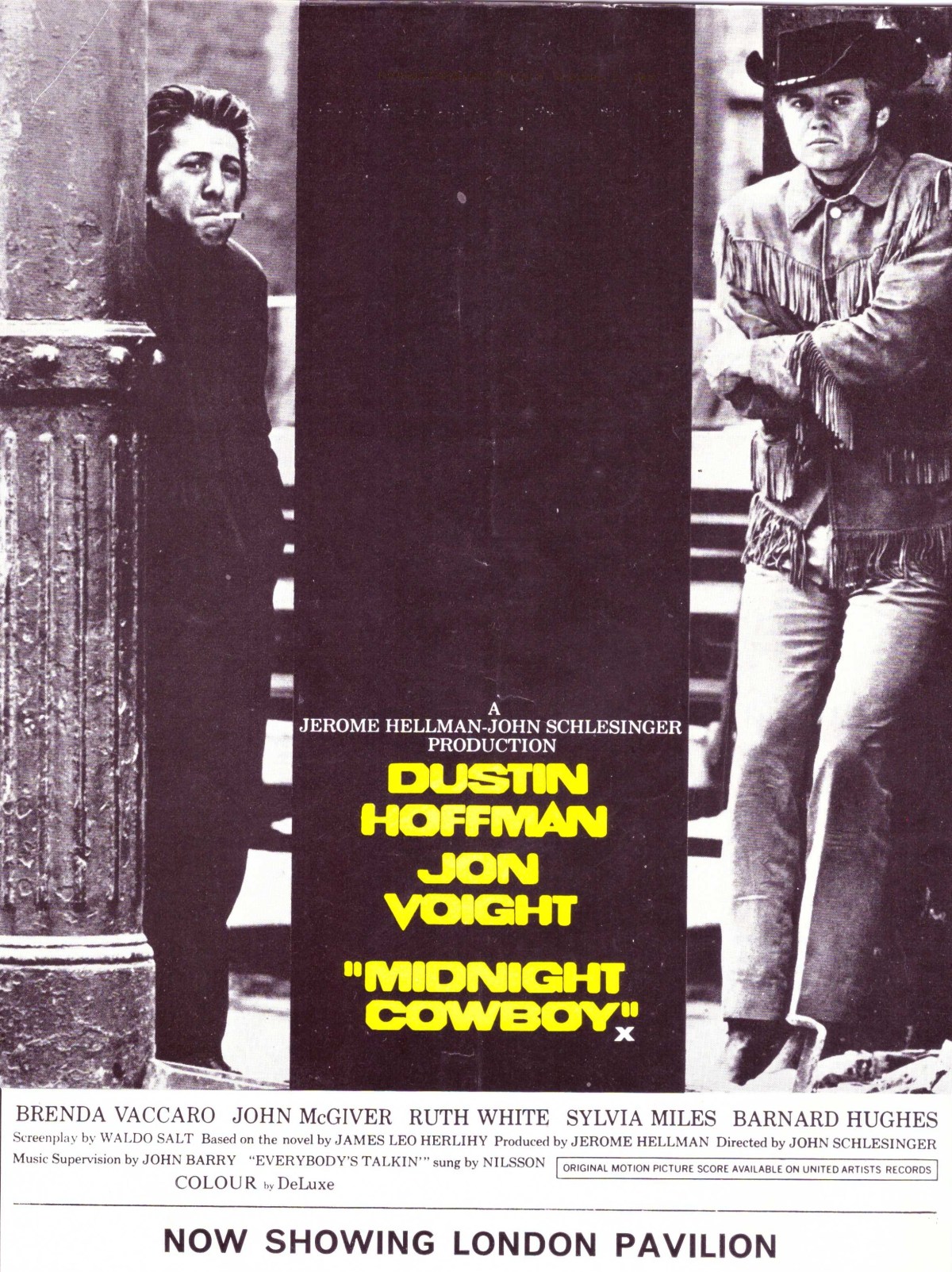
Top film of the week was aerial spectacular roadshow The Battle of Britain (1969) with an all star cast which took in £17,104 ($39,339) in its third week at the 1,654-seat Dominion. Setting a house record in its debut, Midnight Cowboy (1969), going down the continuous performance route at the 1,004-seat London Pavilion, knocked up £11,577 ($26,627). Third, with £8,255 ($18,986) was Oscar-winning musical Oliver! (1968) in its 38th week at the 1,407-seat Leicester Square Theatre.
Sam Peckinpah’s controversially violent The Wild Bunch (1969), blown up to 70mm, came fourth at the 1,568-seat Warner Theatre with £8,091 in its seventh week. The sophomore outing at the Odeon Leicester Square of John Wayne and Rock Hudson in The Undefeated (1969) rammed home £6,094. Holding down sixth spot was the 70mm Cinerama disaster epic Krakatoa-East of Java (1968) with £5,091 in its tenth week at the 1,121-seat Astoria.
The Lion in Winter placed seventh. Eighth was a surprise package, Easy Rider (1969), racking up an extraordinary £4,493 in the tiny 272-seat classic Piccadilly. Omar Sharif as revolutionary Che! (1969) was next, first week at the 1,159-seat Carlton bringing in £4,475. Rounding out the top ten was The Fixer with £4,460 in its second week at the 1,366-seat Empire. The last three movies were all in continuous performance.
Reissues were surprisingly popular. Gone with the Wind (1939), also showing in 70mm, was in its 12th week – after a long run at the Empire – at the 1,360-seat Odeon Marble Arch while The Jolson Story (1946) starring Larry Parks played separate performances at the 1,394 Metropole in an eight-week run.
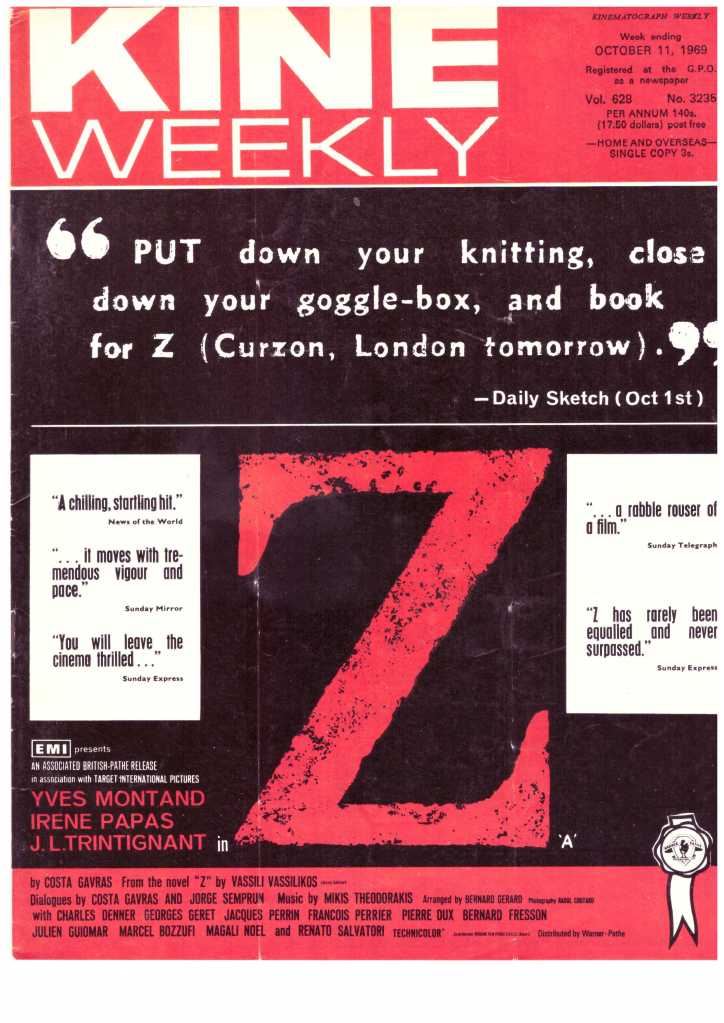
Also making their debuts were Cannes Award Winner Z (1969) at the 546-seat Curzon, The Royal Hunt of the Sun at the 713-seat Odeon St. Martin’s Lane, documentary Footprints on the Moon – Apollo 11 at the 570-seat Rialto, and in move-over The Prime of Miss Jean Brodie at the 550-seat Studio One.
Other long-runners were: Barbra Streisand giving an Oscar-winning performance in musical Funny Girl (1968) in its 38th week at the 760-seat Columbia; Where Eagles Dare (1968), also in 70mm, in its 30th week at the 412-seat Ritz, after a long run at the Empire; Ice StationZebra (1968), filmed in 70mm Cinerama, in its 28th week at the 1,127-seat Casino Cinerama; Robert Aldrich’s The Killing of Sister George (1968) also in its 28th week at the 648-seat Prince Charles; and Oh! What a Lovely War (1969) in its 26th week at the 972-seat paramount.
Other films still showing include The Graduate (1967) in week fourteen at the 154-seat Cinecenta 4 and Goodbye, Columbus (1969) in week five at the 820-seat Plaza.
In those days the length of run a film racked up in the West End impacted on when it would go into general release. So if a film ran for six months in the West End, it could delay its circuit release for that length of time.
Movies were judged as much by length of run as box office. Except in the case of specialize product, a film achieving “legs” was seen as indicative of its future performance. There was subtle marketing going on here – West End films were advertised every day in the London evening newspapers so if a film ran for six months that was six months of daily exposure of that picture for the rest of the city’s inhabitants who, unable to afford West End prices, were desperate for it to appear at their local cinema.
SOURCE: “Box Office Business,” Kine Weekly, October 11, 1969, p8.
it occurred to me that since I have posted over 300 blogs, it must be difficult for newcomers to negotiate their way through the reviews, other than scrolling through every single blog all the way back to the beginning.
So I thought I would have a go at making it easier. To that end I have listed in alphabetical order below all the movies I have reviewed since June 2020. And if you persevere down to the bottom you will a similar A-Z of non-1960s movies reviewed, mostly from 2020 or 2021 but an occasional one outside those years that I took a notion to watch like Gladiator or The Rock.
Unfortunately, there isn’t an automatic link from these titles to the reviews but if you pop any names into the search box they will be found for you.
If you are happening upon the site for the first time this might give you a good idea of the range of films being reviewed.
300 SPARTANS
4 FOR TEXAS
55 DAYS AT PEKING
A FINE PAIR
A HOME OF YOUR OWN
A HOUSE IS NOT A HOME
A LOVELY WAY TO DIE
A STUDY IN TERROR
A TWIST OF SAND
ADVISE AND CONSENT
AFRICA TEXAS STYLE
AGE OF CONSENT
ALVAREZ KELLY
ANGEL WORE RED, THE
APPALOOSA, THE
ARABESQUE
ARRANGEMENT, THE
ASSASSINATION BUREAU, THE
ASSIGNMENT K
BEAT GIRL
BEDFORD INCIDENT, THE
BEDTIME STORY
BEHOLD A PALE HORSE
BIG GAMBLE, THE
BLINDFOLD
BLOW-UP
BLUE MAX, THE
BREAKFAST AT TIFFANY’S
BRIDES OF FU MANCHU, THE
CARRY ON NURSE
CAST A GIANT SHADOW
CHALLENGE FOR ROBIN HOOD
CHASE, THE
CINCINNATI KID, THE
CLAUDELLE INGLISH
COLD WIND IN AUGUST
COOL HAND LUKE
CORRUPT ONES, THE / PEKING MEDALLION, THE
CURSE OF THE CRIMSON ALTAR
DADDY’S GONE A-HUNTING
DANGER ROUTE
DARK OF THE SUN
DAY OF THE TRIFFIDS
DEADLIER THAN THE MALE
DEFECTOR, THE
DEMON, THE
DETECTIVE, THE
DEVIL’S BRIGADE, THE
DEVIL-SHIP PIRATES, THE
DIVORCE AMERICAN STYLE
DOUBLE MAN, THE
DOWNHILL RACER
DR SYN
DUEL AT DIABLO
EAST OF SUDAN
EASY RIDER
ESCAPE FROM ZAHRAIN
ESTHER AND THE KING
FADE IN
FALL OF THE ROMAN EMPIRE
FAMILY WAY, THE
FAREWELL FRIEND / ADIEU L’AMI
FATHOM
FEVER IN THE BLOOD
FIRST MEN IN THE MOON
FIVE GOLDEN DRAGONS
FLIGHT FROM ASHIYA
FLIGHT OF THE PHOENIX
FOUR FEATHERS, THE
FOX, THE
FRIGHTENED CITY
GAMBIT
GIRL ON A MOTORCYCLE
GIRL WITH A PISTOL, THE
GLASS BOTTOM BOAT, THE
GO NAKED IN THE WORLD
GOLDEN CLAWS OF THE CAT GIRL, THE
GOODBYE COLUMBUS
GORGON, THE
GRAND PRIX
GREENGAGE SUMMER, THE
GUNN
GUNS OF DARKNESS
GUNS OF NAVARONE, THE
GUNS OF THE MAGNIFICENT SEVEN
HAMMERHEAD
HAPPENING, THE
HAPPY THIEVES
HARLOW
HATARI
HELLER IN PINK TIGHTS
HERCULES AND THE CAPTIVE WOMEN
HILL, THE
HOSTILE WITNESS
HOTEL
HOUSE OF CARDS
HOW TO STEAL A MILLION
HURRY SUNDOWN
IN SEARCH OF GREGORY
INTERLUDE
INTERNS, THE
INVITATION TO A GUNFIGHTER
IS PARIS BURNING?
ISTANBUL EXPRESS
IT STARTED IN NAPLES
JASON AND THE ARGONAUTS
JUSTINE
KHARTOUM
LES BICHES
LIQUIDATOR, THE
LONG SHIPS, THE
LOST COMMAND
LOST CONTINENT
MACHINE GUN MCCAIN
MAGNIFICENT SEVEN (1960), THE
MAJOR DUNDEE
MAN WHO SHOT LIBERTY VALANCE, THE
MARNIE
MAROC 7
MASQUERADE
MOMENT TO MOMENT
MORGAN, A SUITABLE CASE FOR TREATMENT
MURDER AHOY
NIGHT THEY RAIDED MINSKYS, THE
NO WAY TO TREAT A LADY
NUMBER ONE
OBLONG BOX, THE
OCEAN’S 11
ONCE A THIEF
ONLY WHEN I LARF
OPERATION CROSSBOW
OUR MAN IN MARRAKESH
P.J. / A NEW FACE IN HELL
PAWNBROKER, THE
PENDULUM
PHAROAH
POINT BLANK
POLLYANNA
PRESSURE POINT
PRIZE, THE
PSYCHE ’59
QUILLER MEMORANDUM, THE
RECKONING, THE
RED LINE 7000
RED TENT, THE
RETURN OF THE SEVEN
RETURN TO SENDER
RUNNING MAN, THE
SATAN BUG, THE
SATURDAY NIGHT AND SUNDAY MORNING
SCORPIO LETTERS, THE
SECRET INVASION
SECRET PARTNER, THE
SECRET WAYS, THE
SERGEANTS 3
SEVEN DAYS IN MAY
SEVEN GOLDEN MEN
SEVEN SEAS TO CALAIS
SHE
SHERLOCK HOLMES AND THE DEADLY NECKLACE
SHOES OF THE FISHERMAN, THE
SICILIAN CLAN, THE
SKULL, THE
SKY WEST AND CROOKED
SODOM AND GOMORRAH
SOME LIKE IT HOT
SOUTHERN STAR, THE
SPLIT, THE
STARK FEAR
STILETTO
STRANGE BEDFELLOWS
SUBTERFUGE
SWIMMER, THE
SWORD OF SHERWOOD FOREST
THIS SPORTING LIFE
THREE
THREE INTO TWO WON’T GO
TOBRUK
TOPAZ
TORN CURTAIN
TRUTH ABOUT SPRING, THE
TWO FOR THE ROAD
UNDEFEATED, THE
UNFORGIVEN
UPTIGHT
VENETIAN AFFAIR, THE
VENGEANCE OF SHE, THE
VIKING QUEEN, THE
VILLA RIDES
WACKIEST SHIP IN THE ARMY, THE
WALK DON’T RUN
WHIP AND THE BODY, THE
WRONG BOX, THE
GIANTS OF THESSALY, THE
THIS PROPERY IS CONDEMNED
MORE RECENT FILMS
ANNETTE
BLACK WIDOW
CENSOR, THE
COURIER, THE
DIG, THE
GLADIATOR
GODZILLA VS KONG
HITMAN’S WIFE’S BODYGUARD, THE
IT’S NOT ALL ROCK’N’ROLL
JUDAS AND THE BLACK MESSIAH
JUNGLE CRUISE
LAST BUS, THE
LAST DUEL, THE
LAST LETTER FROM YOUR LOVER, THE
LAST NIGHT IN SOHO
MONSTER HUNTER
NOBODY
NOMADLAND
OLD
PETLA
POSSESSOR
REMINISCENCE
ROCK, THE
SHANG-CHI AND THE LEGEND OF THE SEVEN GOLDEN RINGS
Sly cunning highly original drama hugely enjoyable for a number of reasons, top among which would be Rod Steiger’s serial killer. As the wealthy and cultured Christopher Gill, the actor employs disguise to enter the homes of the unsuspecting. Disguises range from Irish priest, German maintenance man, wig salesman, a woman and even a policeman knocking on doors to advise people not to admit strangers.
Clearly Steiger has a ball with these cameos, but, more importantly, his character pre-empts the celebrity status accorded the modern-day mass murderer. This is a killer who wants everyone to know just how good he is at his self-appointed task, who desperately wants to be on the front pages, who revels in a cat-and-mouse taunting of the police. To be sure, an element of this is played as comedy, but from our perspective, half a century on, it is a terrific characterization of the narcissistic personality, and far more interesting than the psychological impulse that causes him to kill in the first place.
The hapless detective (George Segal) on the receiving end of Gill’s brilliance is named Morris Brummel which means that he is met with laughter anytime he introduces himself since he that is invariably shortened to Mo Brummel, close to Beau Brummel, the famous historical dandy, from whom the cop could not be further removed. And Brummel is not your standard cop, the kind we have seen often who is stewed in alcohol with marital problems, feuding with his bosses and close to burn-out. Brummel would love marital problems if only to get out from under his nagging mother (Eileen Eckhart) , with whom he lives.
He is dogged, but respects authority and takes his demotion like a man. Not coincidentally, killer and cop are linked by mother issues. Although Gill is angry when ignored he does not taunt Brummel the way his mother does. She is ashamed he is a cop and not wealthy like his brother.
Even less standard is the meet-cute. Kate Palmer (Lee Remick) is a useless witness. She can’t remember anything about the priest she passed on the stairs. When the cop arrives, she is hungover and just wants to get back to sleep, and without being aware that Brummel is in fact Jewish praises his nose. Gill is a bit ham-fisted in the seduction department and it is Palmer who makes the running. But although appearing glamorous when first we see her, in reality she is a mundane tour guide. Their romance is conducted on buses and a police river launch, hardly the classic love story.
Although the trio of principals boasted one Oscar and two nominations between them, their careers were at a tricky stage. Winning the Oscar for In the Heat of the Night (1967) did not trigger huge demand for Steiger’s services and he had to skip over to Italy for his next big role. Both Remick and Segal, in freefall after a series of flops, had been working in television. Whether this picture quite rejuvenated their careers is a moot point for the picture was reviled in certain quarters for bringing levity to a serious subject and it was certainly overshadowed in critical terms by The Boston Strangler (1968) a few months later. But all three give excellent performances, especially Steiger and Segal who subjugated screen mannerisms to create more human characters.
While Jack Smight had directed Paul Newman in private eye yarn Harper (1966) the bulk of his movies, regardless of genre, were tinged with comedy. While he allows Steiger full vent for his impersonations, he keeps the actor buttoned-down for most of the time, allowing a more nuanced performance. Violence, too, is almost non-existent, no threshing of limbs of terrified victims. John Gay wrote the screenplay from a novel by William Goldman (who had written the screenplay for Harper) so short it almost constituted a movie treatment.
In reality, the comedy is slight and if you overlook a sequence poking fun at the vertically-challenged, what remains is an examination of propulsion towards fulfilment through notoriety and the irony that the murders elevate into significance the mundane life of the investigating officer.
Catch-Up: George Segal films previously reviewed in the Blog are Invitation to a Gunfighter (1964), Lost Command (1966), The Quiller Memorandum (1966) and The Southern Star (1969). I also covered Rod Steiger in The Pawnbroker (1964).
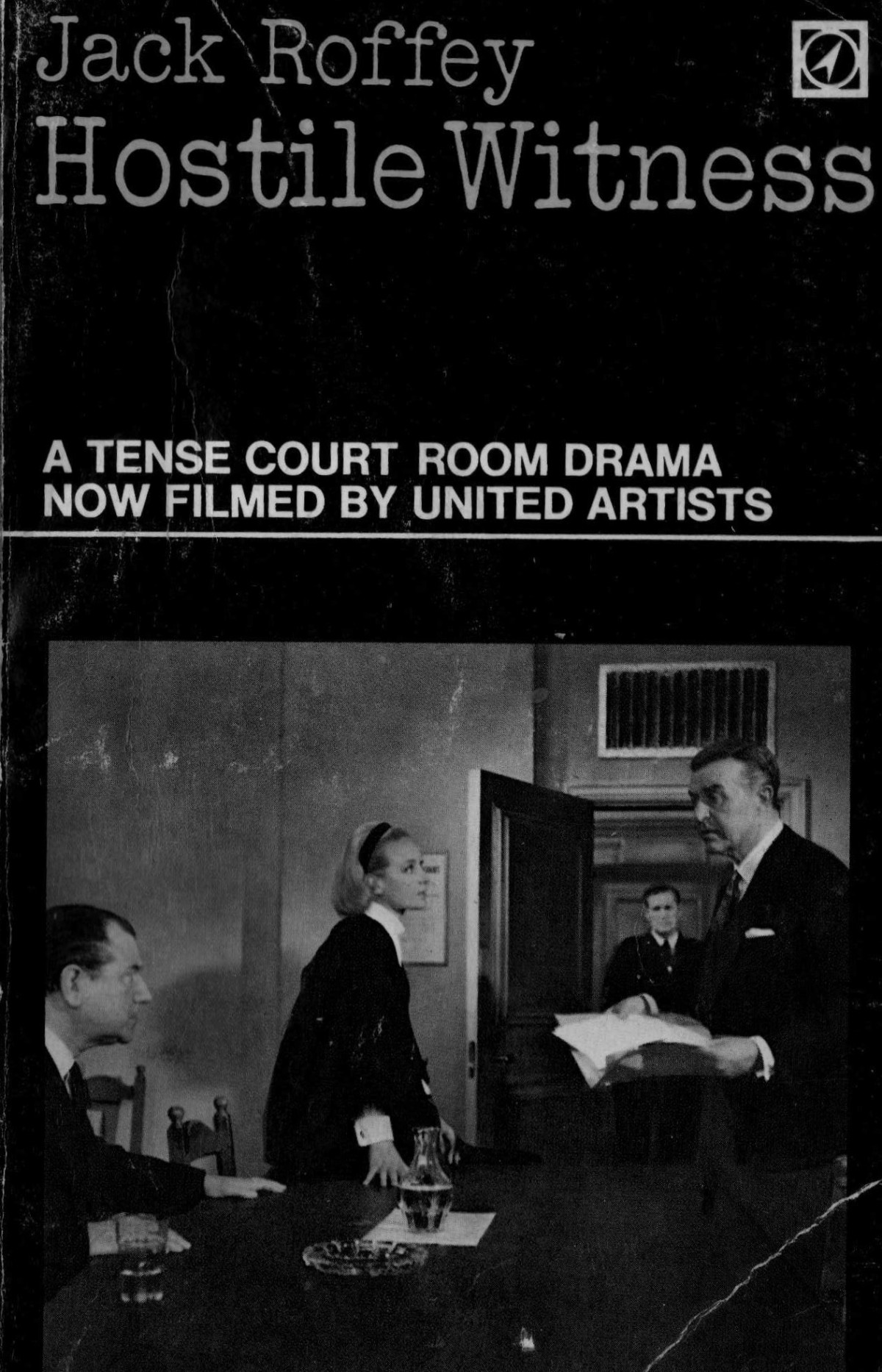
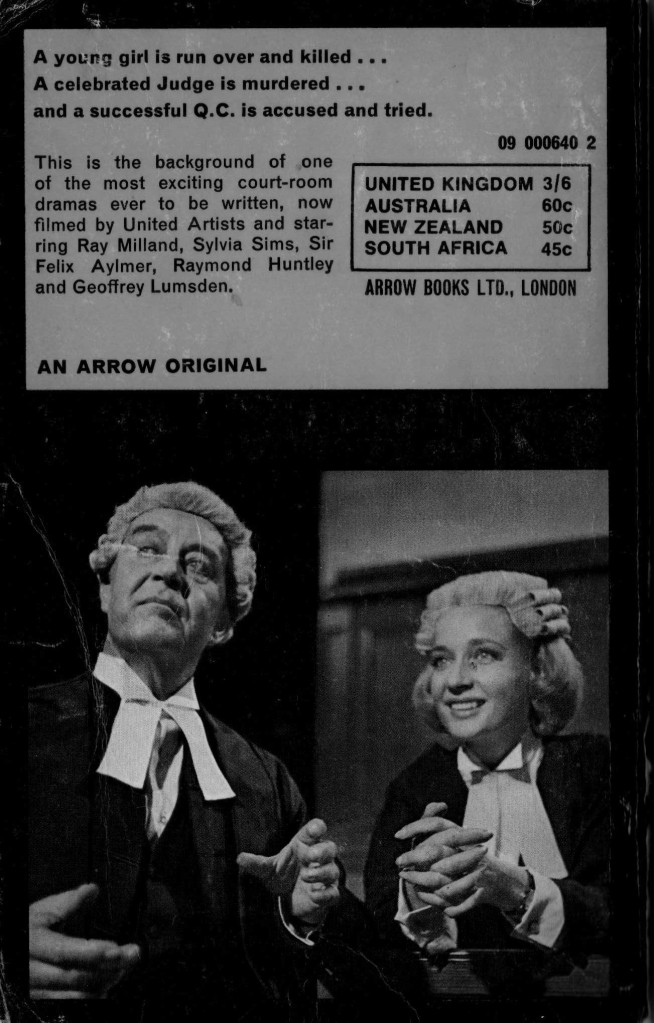
As you will be aware I have been running a little series of how books were adapted into films and I thought it would be interesting to see what happened when the process was the other way round. I have in general about the lucrative business of novelisations of screenplays as movie tie-ins but never examined any single one in particular. But I came across this book in a secondhand bookshop on holiday and gave it a read.
British writer Jack Roffey had turned his play – a hit in London West End and Australia though less so on Broadway – into a screenplay and was inveigled into making a quick buck by churning out the movie tie-in book, published straight into paperback in Britain by Arrow. It turned out to be an interesting exercise because the play was no longer in circulation and the film failed to get a proper release so the book had to survive on its own without the help of movie publicity or posters outside the chain cinemas.
The book is about 60,000 words long while the play/screenplay probably comprised fewer than 5,000 words so that was a lot of padding-out to do, if that was all the author could manage. Interestingly, Roffey proved himself an adept novelist, taking the opportunity to both clarify the proceedings and mystify the reader even more, accentuating the ambiguities of the initial work. Where the movie glosses over main protagonist Simon Crawford’s (Ray Milland in the film) mental difficulties until brought into question during the court case itself, in the book Roffey lays the groundwork more straightforwardly, recounting the period spent in hospital and, more importantly, his rapid decline after returning to work so that by the time he is arrested his mental health is very poor.
Sheila Larkin’s (Sylvia Syms) unspoken feelings for her boss remain just that, but there is a physical closeness – she catches him when he collapses, briefly nursing him, and she is presented as a woman more aware of her own sexuality. And the door is opened later in the book for a relationship – “intimacy umbrellaed them in soft folds, inviting positive expression.” Equally, when given the opportunity to take on the case, her first reaction is fear: “She couldn’t possibly accept it…it would be a terrifying responsibility for a junior of her standing” and she expects the episode to end in abject humiliation until she catches sight of her boss and registers the fear in his eyes. Thus, Roffey is able to get inside all the major characters rather than have the camera – and the shortage of screen time – dictate the point of view. Other characters, some incidental, are also more fully drawn.
While the play’s dialogue would not have sufficed to carry a book of this length, Roffey has to add considerably to his original material, and in most cases extended conversations are made to count. Perhaps most interesting of all since he is in charge, Roffey can dispense with the need to constantly cut back to the accused during the trial to register his facial reactions and that allows the personality of Sheila Larkins to flower and take true centre stage rather than be constantly undercut by continually focusing on Crawford. Roffey was also an expert on court procedure and the opportunity to delve into that gives the book greater authority.
The book is certainly enjoyable and well-written with some sharply observed characterisations. “Mr Justice Gregory came in, diffidently at first, like a small boy at the edge of a pond, who wonders if the ice will hold.” Simon Crawford is introduced in court in the opening page thus: “There was an affected boredom is the half closed grey eyes – a calculated indifference to the heat and the coming verdict.” While Sheila Larkins is the opposite – “properly wrung out.”
There’s style in the descriptions. “Gordon Mews is one of those peaceful backwaters that an earlier and more gracious London put aside for a rainy day, and promptly forgot about.” And the book moves along briskly, a crime thriller with the unlucky caught in a web that is closing in fast. Roffey is able to touch on more specifically Crawford’s disintegration and his shock at being tabbed a criminal. Like the film, it was more than passably entertaining.
Initially promising, ultimately disappointing thriller that proves you should not go to sea without a big budget. Because he is the only skipper to have successfully negotiated the Skeleton Coast off Namibia in South Africa, smuggler Geoffrey Peace (Richard Johnson) gets roped into a scheme by Harry Riker (Jeremy Kemp) and Julie Chambois (Honor Blackman) to collect stolen diamonds.
Peace knows his way around this area thanks to World War Two submarine exploits and that particular expedition is recalled in flashback while its repercussions form part of a plot. Also on board the boat are the goggle-eyed knife-wielding Johann (Peter Vaughn) and Peace’s shipmate David (Roy Dotrice).
Peace has to navigate the treacherous waters of the Skeleton Coast before the team embark on a trek through the desert to find the diamonds, hidden in the unlikely location of a shipwreck, itself in imminent danger of being buried in an avalanche of sand that could be triggered by (shades of Dune) sudden movement or sound.
On paper – and it has been adapted from the bestseller by Geoffrey Jenkins – it has all the ingredients of a top-class thriller but it doesn’t quite gel. For a start, the flashback, where Peace has to hunt down a new class of German submarine and not only sink it but make sure there are no survivors, gets in the way of the action.
The sexual tension you might expect to simmer between Peace and Julie does not appear to exist, the bulk of the threat coming from the villainous-looking pair, Riker and Johann, the former already known to be untrustworthy, the latter too fond of producing a knife at odd occasions. The trek into the desert takes way too long and rather than increase tensions slackens it off and there is no real explanation as to why the ship was lost so far into the desert without entering Clive Cussler archaeological territory.
Extracting the diamonds is certainly a taut scene, with the sand dunes threatening to collapse any moment but the climax you saw coming a long way off and although there is an ironic twist it is not enough to save the picture.
On the plus side, Richard Johnson (Deadlier Than The Male, 1967) shucks off the suave gentleman-spy persona of Bulldog Drummond to emerge as a snarly, believable smuggler. But Honor Blackman (Moment to Moment, 1966) is wasted and this is one of the least effective bad guy portraits from the Jeremy Kemp (The Blue Max, 1966) catalogue. Roy Dotrice (The Heroes of Telemark, 1965) is better value while Peter Vaughn (Hammerhead, 1968), menacing enough just standing still, overplays the villain.
Set up as a thriller very much in the Alistair MacLean vein, this shows just how good MacLean’s material was, how great a command he had of structure and not just of action but twists along the way. A Twist of Sand wobbles once too often in its structure and never quite manages to build up the necessary tension between characters. Although the Skeleton Coast sea-scene falls apart due to defective special effects, the other two sequences at sea are well done, the opening section where Peace is being chased by Royal Navy vessels, and the underwater attack on the German submarine where murky water manages to obscure the effects sufficiently they appear effective enough.
Don Chaffey (The Viking Queen, 1967) does his best with material that’s not quite up to standard. Marvin H. Albert (Tony Rome, 1967) doesn’t do as good a job of adapting other people’s work as he does his own.
Catch-Up: Richard Johnson films previously reviewed in the Blog are The Pumpkin Eater (1964), Khartoum (1966), Deadlier than the Male (1967), and Danger Route (1967).
Adapting a play into a film requires more specialist skills than transforming a book into a movie. A book either needs considerably trimmed (example, The Detective) or the requiring a complete overall (as with Blindfold). It’s much harder to muck around with a play which has usually been well-honed, edited down night after night, from a run on the stage. The main decision the writer charged with the adaptation has to make is a tricky one – whether to open it up or not. Can a play, especially a thriller, sustain the tension it achieved on stage without additional elements – and therefore appear “stagey” on film – or must it be expanded in the hope of generating greater tension or ambiguity, making characters more sympathetic or clarifying the plot. The story in both play and film concerns top lawyer Simon Crawford being arrest for murder.
Jack Roffey, adapting his own play, decided the original needed opening up. The play’s structure consisted of two acts, each containing two scenes. The first scene lasted 21 pages, scenes two and four 23 pages each, while scene three is considerably shorter just 12 pages. So, except for the third scene, the play’s rhythm is consistent. And while this might look as if most scenes last 20-plus minutes, an inordinately long time to sustain rhythm on the screen, there are lot of moment where various characters go offstage to concentrate action between fewer characters, thus heightening tension or creating character conflict.
A lot of information that was imparted purely via dialogue in the play transforms on screen into a series of extra scenes. This is especially true at the beginning. The movie’s opening scene, set in a court and concerning the trial of a brothel-keeper, was not in the play; it was dealt with in passing at the beginning of the play, as a character reporting on the outcome, albeit that some of the reported speech became dialogue in the film. It was probably felt that the movie audience had to be introduced right away to a courtroom since the play’s opening scene takes place entirely outside the courtroom, in the offices of the leading character Simon Crawford (Ray Milland). The play begins in the present and the back story, that Crawford is widowed, recently lost his daughter in a hit-and-run traffic accident, and suffered a nervous breakdown as a result, is dealt with as exactly that – events from the past. The film puts them in the present. We are shown the daughter, who clearly has a strong relationship with her father, we hear the accident (which occurs offscreen), witness Crawford’s unravelling and the murder that forms the core of the story. And we are also treated to some additional scenes, not in the play, including an initial police investigation.
The upshot is that it takes 25 minutes for Crawford to be arrested. Compare that to the play. He announces his imminent arrest within the first five minutes. For pure audience shock the play holds the upper hand. I’m not sure the film ever matches that moment. Pre-arrest, in the film, Crawford’s erratic behaviour and hospital confinement add to a sense that he might be unhinged or, in classic film noir, feeding the audience a line. His state of mind is complicated by making visual some incidents that were just verbal in the play.
There are three major departures from the play. The first was the introduction of a private eye whom Crawford takes by the throat in frustration at the gumshoe producing no results. This suggests early on that Crawford is capable of violence. But it also causes a complication. In the play there is only one main private eye, name of Armitage, whose evidence proves key in the case against Crawford, but he is missing and in fact never appears. Apart from testifying to Crawford’s murderous inclination the introduction of this other private eye, named Rosen, makes little sense. The second is to bring quicker to the fore the involvement of junior lawyer Sheila Larkin (Sylvia Syms in the film). In the play she takes over his defence when her senior quits on a point of principle but in the film it is almost from the start.
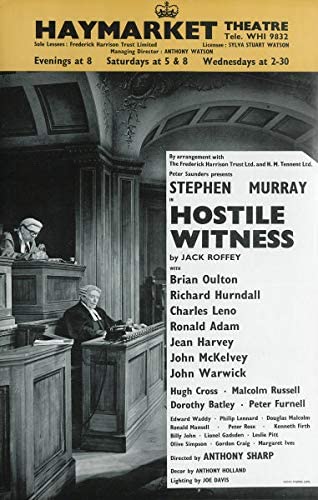
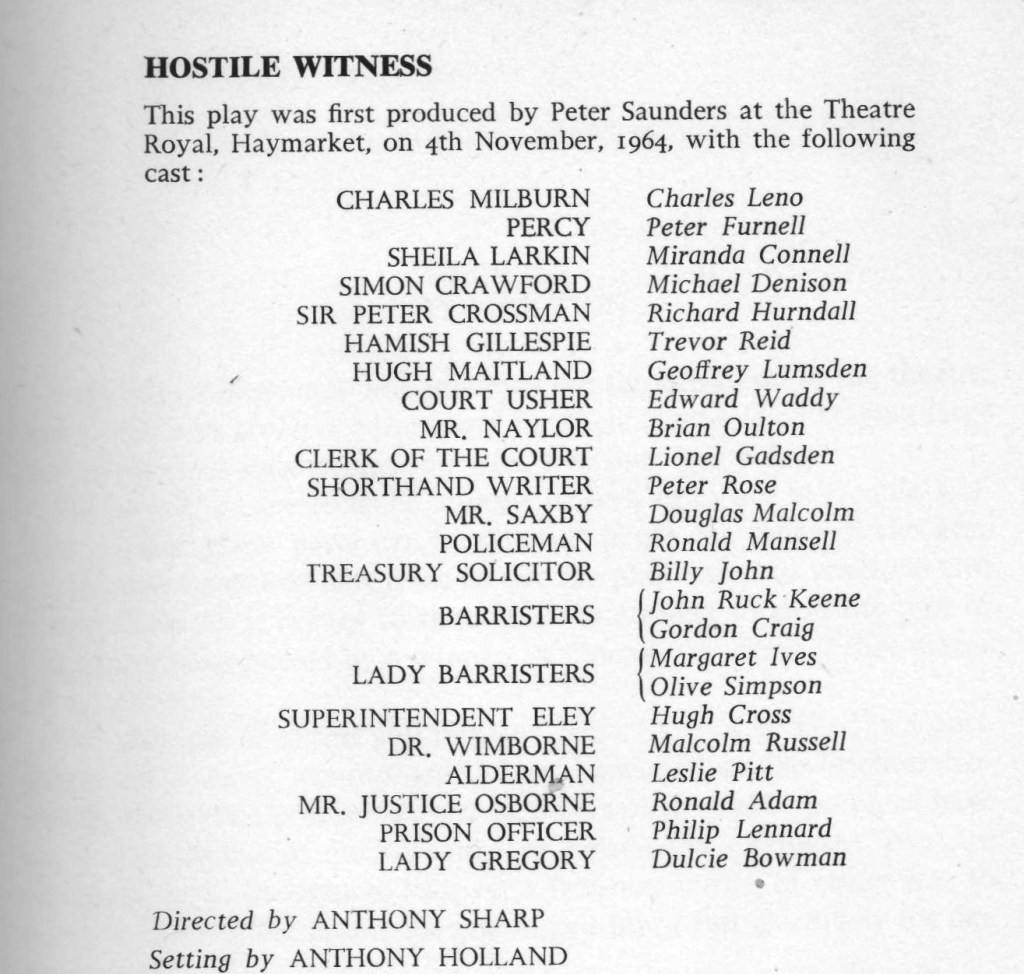
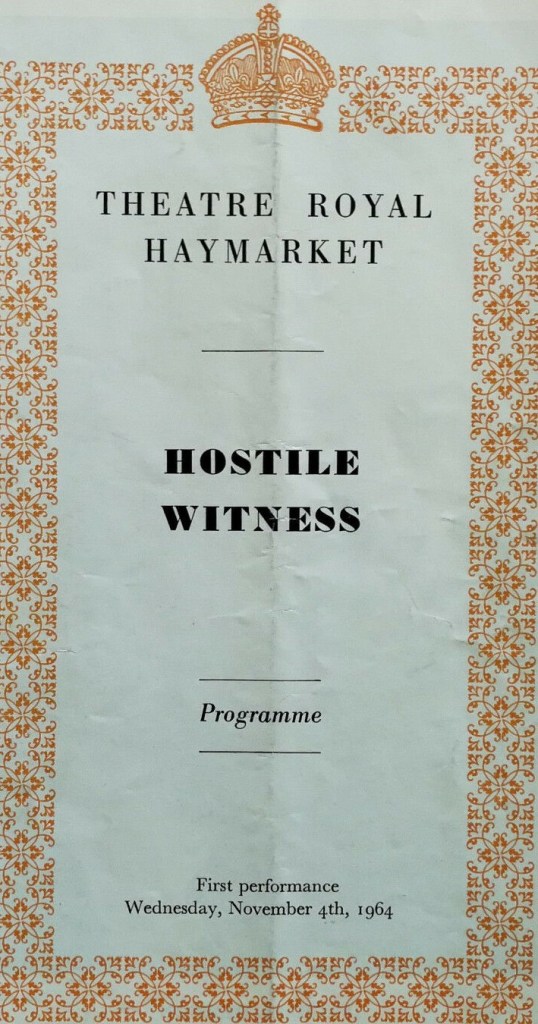
Programme for the premiere of the play in London’s West End.
The third development also involves Larkins. But I’m not sure this one works in building up Crawford-Larkins into a potential May-December relationship. In the play it seems more obvious that Larkins is a daughter substitute rather than a potential love interest but the film adds an additional scene where she brings celebratory goodies to the lawyer and her demeanor suggests sublimated ardor. The way director Ray Milland uses looks between the pair and an occasional touching of hands makes the alternative more obvious.
You could argue that the film could have simply had Crawford arrested in the first five minutes but that would have necessitated police interrogation. The device brilliantly used in the play of imminent arrest would have worked in the film, I believe, and made for a more explosive start, and then either sticking with the play structure or dealing with the backstory in flashbacks.
It’s worth noting that plays on the page look far more intense than screenplays. There is nothing but line after line of dialogue whereas a screenplay always has cuts or directions to interrupt the flow of material. Dialogue, of course, being what a play relies upon more than the camera, Roffey, as the adaptor, was lucky in having so many choice lines at his disposal. Ray Milland, in his role as director, unfortunately, was not able to add atmospheric heft.






 The Magnificent 60s