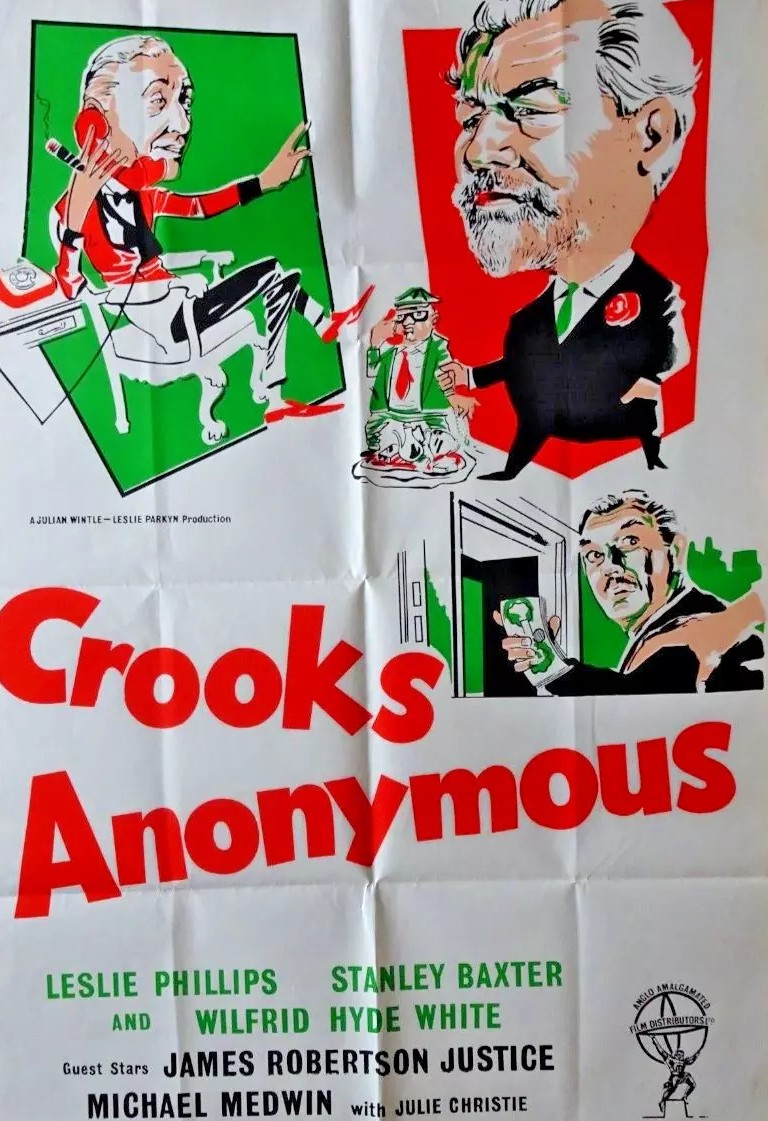
Crooks Anonymous (1962) ***

Charm was in short supply in the 1960s. Sure, for a period you still had Cary Grant but David Niven was as often to be found in an action picture (The Guns of Navarone, 1961) or a drama, and others of the ilk, like Tony Curtis, veered more towards outright comedy. Britain had something of what would today be called a “national treasure,” admittedly a term more likely to be accorded females of the standing of Maggie Smith or Judi Dench; maybe a space might be found for the idiosyncratic Ralph Richardson. Dare I put Leslie Phillips into contention for such an honor?

Once into his mellifluous stride and with his trademark appreciation of female beauty, “Ding dong!” a more welcome remark than the more common “Cor!” or “Strewth” or sheer inuendo, Leslie Phillips, not so well known perhaps in the USA and foreign parts, would fit that definition. He had charm in spades.

Unfortunately, you could split his career into those roles where “ding dong” entered the equation and those it did not. This is one of those, and I have to confess I’m both disappointed and delighted. Dissatisfied because the charm appeared part of his screen persona, but pleased whenever I found out he wasn’t tied down to it and could essay other characters just as well.

Here, here’s shifty criminal Dandy, whose only redeeming feature is that somehow he has acquired a beautiful girlfriend, stripper Babette (Julie Christie), who, despite her profession

appears to have steered cleared of seediness and insists he goes straight before she consents to marriage. And that would be fine, except what can Dandy do when faced with such obvious temptation and jewels left idly on a counter in a jewellery?

When she catches him out, he is sent to the criminal version of Alcoholics Anonymous where he is at the mercy of a particularly sadistic “guardian angel” Widdowes (Stanley Baxter – in a variety of disguises). He is locked in a cell full of safes. Food, cigarettes etc are hidden inside the safes, so to eat and satisfy his smoking habit, he must open them. The logic, presumably, is that he will grow sick and tired of opening so many safes for so little reward.

Maybe it’s the hidden punishments – a touch of electrocution and various other booby traps – that do the trick. Or, it could be the glee of Widdowes. When Dandy finds cigarettes, they come without any means of lighting them. He pleads with Widdowes to point him in the direction of a safe containing means of ignition.Replies the “angel”, “I’m glad you asked that because I’m not going to tell you.”
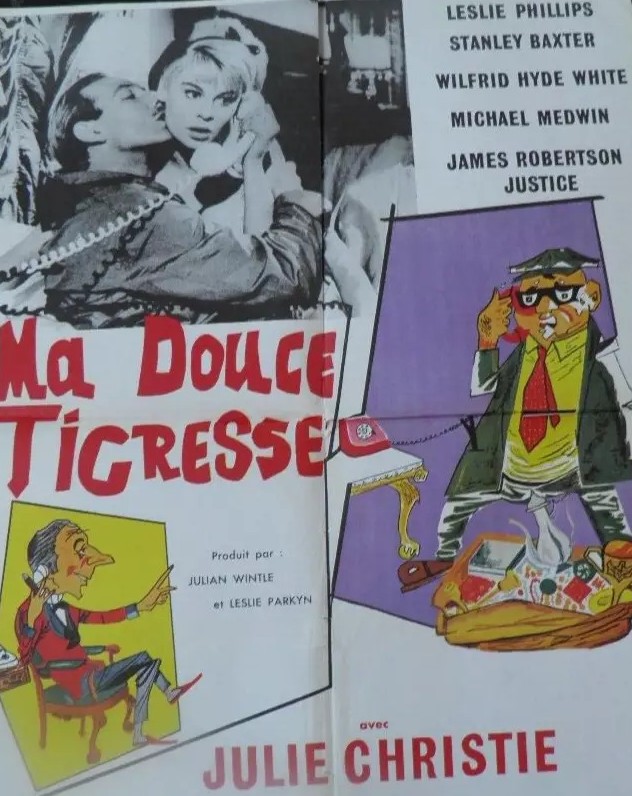
There’s a whole raft of comedy skits revolving around temptation, mostly involving Widdowes in one guise or another. And when the movie stays with Widdowes and a bunch of other reformed criminals, it fairly zips along. But once Dandy is released and plot rears its ugly head it falls back on more cliché elements.

Dandy manages to go straight, employed as a Santa Clause in a department store, while Babette decides to give up her job so both can start afresh. Unfortunately, temptation raises its ugly head to the tune of a quarter of a million pounds and all those goody-two-shoes reformed criminals line up to take a crack at it. The twist, which you’ll already have guessed, is that they have to break into the vault again to return the money they have stolen.

Scottish comedian Stanley Baxter was going through a phase of attempting to become a movie star and was given a fair old crack at it – The Fast Lady (1962) and Father Came Too (1964) followed, the former with both Philips and Christie, the latter with just him.

But what was obvious from Crooks Anonymous was that Baxter was better in disguise – and the more the merrier – than served up straight. He steals the show here where in the other movies his character is more of an irritant.

A well-meaning Leslie Phillips somehow snuffs out the charm and there’s not enough going on between him and Babette when he’s full-on straightlaced. Heretical though it might be, there’s not enough going on with Julie Christie either to suggest she might be Oscar bait. Here’s she’s just another ingenue.

Wilfrid Hyde-White (P.J. / New Face in Hell, 1967), another who generally traded on his charm (in a supporting category of course), is also in the disguise business, so he steals a few scenes, too. James Robertson Justice (Father Came Too) would have stolen the picture from under the noses of Baxter and Phillips had he been given more scenes.

Directed by Ken Annakin (Battle of the Bulge, 1965) from a screenplay by Jack Davies and Henry Blyth (Father Came Too).

I might have preferred Phillips in “ding dong” persona, but this works out okay, especially in the scenes set in the criminal reform school.

Ding dong-ish.

P.J. / New Face in Hell (1968) ****

Exceptional down-and-dirty thriller and throwback film noir woefully underrated on release but with a brilliant mystery (or two), a touch of satire, red herrings, some great lines, and believable characters. Private eye P.J. Detweiler (George Peppard) is so down on his luck he is willing to play the lover so an errant wife can be photographed in a motel room. What little he earns goes on paying is debts. So he can hardly down the chance of serious money as bodyguard to Maureen (Gayle Hunnicutt), mistress of rich businessman William Orbison (Raymond Burr), never mind that she initially treats him as a servant.

Orbison has a legendary mean streak – secretaries have to type closer to the edge of sheets of paper, he forces wife Betty (Colette Gray) to account for every dime of her allowance to the point of almost making her beg. Sadism is another character trait. He is happy not to kill off animals he has shot. The childless millionaire adds Maureen to his will for the sole purpose of upsetting every other potential heir. In front of guests at a prestigious party he forces Betty to acknowledge Maureen’s existence.

This apparently wealthy world is riddled with seedy inhabitants, whose only motivation is  greed, all desperate to retain status or inheritance and enjoying Orbison’s largesse, which, despite his miserly nature, he nonetheless flaunts. As well as Betty enduring ritual humiliation to remain his wife and enjoy a gilded lifestyle, his executive assistant Jason (Jason Evers) accepts being treated as a gofer in order to keep his position and the perks that go with it, and Maureen makes no bones about prostituting herself for temporary and future gain. Everyone has to kowtow, even the occupants of a West Indian island dependent on Orbison for investment, not only a kids choir welcoming Orbison on arrival, but a calypso performer singing a song in his praise.

As various threats, including narrowly missing a bullet, are made against Maureen, making a classical entrance in a red dress and alternating between helpless victim and femme fatale, with her creepy manservant Quell (Severn Darden) reporting on her every move, inevitably Detweiler grows closer to his client, unaware that Orbison is planning to have someone killed.

That someone turns out to be Jason, whom Orbison suspects of clandestine activity with his wife, and whom Detweiler innocently kills. As this takes place on the island, where the death is easily hushed up, Detweiler begins to wonder if he’s a patsy and, paid off by Orbison, undertakes his own investigation, quickly entering more dangerous waters, viciously beaten up at Quell’s behest in a gay bar, narrowly avoiding death in the subway and literally finding himself in the firing line.

Detweiler’s character undergoes transition, too. From begging for scraps and turning the other way so as not to jeopardize easy income, he rediscovers his suit of shining armor, walking down some pretty mean streets, a diligent private eye who can no longer be bought off, determined to get to the bottom of what turns out to be a complicated mystery.

Detweiler is no Marlowe or even Tony Rome, but rather despicable at the outset, employing all sorts of dodges, his interest in Maureen not slackening even after he knows she indulges in a quickie with Orbison. He takes too much at face value.

The unfolding mystery is superbly handled, involving proper clues and investigation, shoot-outs and fisticuffs, the outcome not what you might initially imagine. Although primarily an old school private eye picture, it’s great fun, with some wonderful comedy involving a dog, gentle satire on the West Indian island where whitewash is the order of the day, and some touching romantic foreplay.

Peppard (Pendulum, 1969) is outstanding as the dupe who rediscovers his moral code and his Detweiler is an excellent addition to the ranks of the private eye.  Raymond Burr, a far cry from his Perry Mason (1957-1966) television persona,  is easily one of the worst screen millionaires – on a par with Ralph Richardson in Woman of Straw (1964) in his contempt for humanity – and with his silver hair and bulk and scheming proves a slick adversary. Gayle Hunnicutt (Eye of the Cat, 1969) is allure on legs, brilliantly playing every man in sight, eye never diverted from the main chance.

Brock Peters (The Pawnbroker, 1964) has a standout cameo as the island’s cynical police chief. Susan Saint James (The Name of the Game, 1968-1971) makes her movie debut as Orbison’s slinky sex-mad niece.  Also putting in an appearance are Wilfrid Whyte-Hyde (The Liquidator, 1965) as the island’s accommodating governor, Colleen Gray (Red River, 1948) as the humiliated wife, Severn Darden as the odious Quell, and John Ford regular John Qualen (The Man Who Shot Liberty Valance, 1962).

This was the second of director John Guillermin’s George Peppard trilogy following The Blue Max (1966) and prior to House of Cards (1968). Generally dismissed as a journeyman, Guillermin brings a sly eye to this picture, the send-up of British colonialism, the master-servant aspects, an over-the-shoulder shot of an unknown assassin, the scenes in the bar which is effectively Detweiler’s office, and a brilliant subway death adding layers to the movie. He is bold in his use of close-ups with Hunnicutt, some scenes almost a homage to the Bogart-Bacall chemistry, and brings out a world-weary performance from the usually cocky Peppard.

Philip Reisman Jr. (All the Way Home, 1963) fashioned the screenplay, delivering one of cinema’s most memorable final lines.

Bracketed with Pendulum and House of Cards demonstrates that Peppard is under-rated.

Well worth a watch.

Crooks Anonymous (1962) ***

Charm was in short supply in the 1960s. sure, for a period you still had Cary Grant but David Niven was as often to be found in an action picture (The Guns of Navarone, 1961) or a drama, and others of the ilk, like Tony Curtis, veered more towards outright comedy. Britain had something of what would today be called a “national treasure,” admittedly a term more likely to be accorded females of the standing of Maggie Smith or Judi Dench; maybe a space might be found for the idiosyncratic Ralph Richardson. Dare I put Leslie Phillips into contention for such an honor?

Once into his mellifluous stride and with his trademark appreciation of female beauty, “Ding dong!” a more welcome remark than the more common “Cor!” or “Strewth” or sheer inuendo, Leslie Phillips, not so well known perhaps in the USA and foreign parts, would fit that definition. He had charm in spades.

Unfortunately, you could split his career into those roles where “ding dong” entered the equation and those it did not. This is one of those, and I have to confess I’m both disappointed and delighted. Dissatisfied because the charm appeared part of his screen persona, but pleased whenever I found out he wasn’t tied down to it and could essay other characters just as well.

Here, here’s shifty criminal Dandy, whose only redeeming feature is that somehow he has acquired a beautiful girlfriend, stripper Babette (Julie Christie), who, despite her profession

appears to have steered cleared of seediness and insists he goes straight before she consents to marriage. And that would be fine, except what can Dandy do when faced with such obvious temptation and jewels left idly on a counter in a jewellery?

When she catches him out, he is sent to the criminal version of Alcoholics Anonymous where he is at the mercy of a particularly sadistic “guardian angel” Widdowes (Stanley Baxter – in a variety of disguises). He is locked in a cell full of safes. Food, cigarettes etc are hidden inside the safes, so to eat and satisfy his smoking habit, he must open them. The logic, presumably, is that he will grow sick and tired of opening so many safes for so little reward.

Maybe it’s the hidden punishments – a touch of electrocution and various other booby traps – that do the trick. Or, it could be the glee of Widdowes. When Dandy finds cigarettes, they come without any means of lighting them. He pleads with Widdowes to point him in the direction of a safe containing means of ignition.Replies the “angel”, “I’m glad you asked that because I’m not going to tell you.”

There’s a whole raft of comedy skits revolving around temptation, mostly involving Widdowes in one guise or another. And when the movie stays with Widdowes and a bunch of other reformed criminals, it fairly zips along. But once Dandy is released and plot rears its ugly head it falls back on more cliché elements.

Dandy manages to go straight, employed as a Santa Clause in a department store, while Babette decides to give up her job so both can start afresh. Unfortunately, temptation raises its ugly head to the tune of a quarter of a million pounds and all those goody-two-shoes reformed criminals line up to take a crack at it. The twist, which you’ll already have guessed, is that they have to break into the vault again to return the money they have stolen.

Scottish comedian Stanley Baxter was going through a phase of attempting to become a movie star and was given a fair old crack at it – The Fast Lady (1962) and Father Came Too (1964) followed, the former with both Philips and Christie, the latter with just him.

But what was obvious from Crooks Anonymous was that Baxter was better in disguise – and the more the merrier – than served up straight. He steals the show here where in the other movies his character is more of an irritant.

A well-meaning Leslie Phillips somehow snuffs out the charm and there’s not enough going on between him and Babette when he’s full-on straightlaced. Heretical though it might be, there’s not enough going on with Julie Christie either to suggest she might be Oscar bait. Here’s she’s just another ingenue.

Wilfrid Hyde-White (P.J. / New Face in Hell, 1967), another who generally traded on his charm (in a supporting category of course), is also in the disguise business, so he steals a few scenes, too. James Robertson Justice (Father Came Too) would have stolen the picture from under the noses of Baxter and Phillips had he been given more scenes.

Directed by Ken Annakin (Battle of the Bulge, 1965) from a screenplay by Jack Davies and Henry Blyth (Father Came Too).

I might have preferred Phillips in “ding dong” persona, but this works out okay, especially in the scenes set in the criminal reform school.

Ding dong-ish.

Ten Little Indians (1965) ***

This is more like it. Classic Agatha Christie mystery told in classic fashion but devoid of either of her major sleuths, Hercule Poirot or Miss Marple, and set in the grander equivalent of the country house locale that had become something of a trademark. Here it’s the kind of castle perched atop a mountain, accessible only by cable car unless you have mountaineering skills, that you would need the combined services of Clint Eastwood and Richard Burton to affect a rescue, and as with Where Eagles Dare (1968) the conditions are distinctly wintry.

Ten strangers, including the two servants, have been invited to this retreat by the mysterious Mr Owen. They soon learn they are cut off, telephone lines down, cable car out of commission for a couple of days, nearest village a straight drop 15 miles down a perilous cliff.

All they have in common, as they discover via a taped message delivered by their host, is that they all got away with murder or at the very least a dubious death. There is a private eye on hand, former cop Blore (Stanley Holloway), but he’s lacking in the little grey cells that Poirot put to such clever use in such circumstances. So, like a troupe of actors let down by some stage entrepreneur, they have to get the show on the road themselves, a combined effort to solve the problem.

Not so much why they are gathered here, but why they keep on getting bumped off, and rather in the fashion of the titular song. The movie business wasn’t awash with serial killers though this decade would see nascent interest in this sub-genre, witness Psycho (1960) and The Boston Strangler (1968). But Ms Christie mysteries never really seemed to get going until the death toll had reached multiple figures.

The good element of this kind of movie with a large cast is that each character gets a moment in the sun, here that spotlight largely concerned with what crime they committed for which they were never truly punished. Pop singer Mike (played by pop singer Fabian) gets the ball rolling, explaining that his only punishment for killing someone while driving under the influence was a temporary withdrawal of his license.

And so it goes on, everyone wondering who will be next to be despatched and going from the initial conclusion that Owen is responsible and is hidden somewhere in the house to the obvious one that Owen is one of them. I have to confess I’m easily gulled by the murder mystery and I hadn’t reached that conclusion myself.

The movie’s not necessarily filled with that kind of twist – although there certainly are a good few, some people not as guilty as they might appear, not quite who they appear to be –  more you glancing at the cast list and wondering, by dint of billing or box office pull, who will be next for the chop and unless the director has got the Hitchcock vibe it’s not going to be one of the leads.

So it’s a choice of Hugh Lombard (Hugh O’Brian), secretary Ann Clyde (Shirley Eaton), actress Ilona Bergen (Daliah Lavi), General Mandrake (Leo Genn), Judge Cannon (Wilfrid Hyde White), Dr Armstrong (Dennis Price) and the aforementioned Blore plus servants the Grohmanns (Marianne Hoppe and Mario Adorf). And this isn’t your standard serial killer either with a constant modus operandi that will eventually, through standard detection, trap him or her. Instead, variety is the key. Death by fatal injection, knife, poison, slashed rope.

As the numbers whittle down, and you even feel sorry for the actions of some, the actress, for example, whose husband committed suicide when she left him, the tension mounts. You won’t be on the edge of your seat because there are just too many characters involved for you to become overly concerned with their plight but it’s still has you on the hook. You do want to know whodunit and why and you can be sure Ms Christie, as was her wont, will have some clever final twist.

At least, unlike the later variations on the genre, nobody’s been bumped off because they are too fond of sex, and the violence itself is restrained, almost dignified, and there’s no sign of gender favoritism.

All in all, entertaining stuff, though since by now this kind of murder mystery, given we’ve been through various iterations of Poirot – Albert Finney, Peter Ustinov, Kenneth Branagh et al, not to mention numerous Miss Marples – a lot of this feels like cliché (though that’s a bit like a contemporary audience considering John Ford’s Stagecoach old hat, not realizing this was where many of those western tropes were invented or polished to a high level). And I had to say I had a sneaky hankering for some of the out of left field goings-on of The Alphabet Murders (1965).

Sad to see Hollywood not taking advantage of Daliah Lavi’s acting skills, under-estimated in my opinion after her terrific work in The Demon (1963) and The Whip and the Body (1963). But then this wasn’t Hollywood calling but our old friend producer Harry Alan Towers (Five Golden Dragons, 1967) who specialized in dropping a biggish American name into a B-list all-star-cast.

George Pollock, who helmed this decade’s four Miss Marple movies, enjoys keeping the mystery alive without resorting to a central know-it-all. Everyone cast does what they’re expected to do. Towers wrote the screenplay with his usual partner Peter Yeldham.

Worth considering alongside The Alphabet Murders, but stands up well on its own.  

PREVIOUSLY REVIEWED IN THE BLOG: Hugh O’Brian in In Harm’s Way (1965), Texas: Africa Style (1967); Daliah Lavi in The Demon (1963), The Whip and the Body (1964), Lord Jim (1965), The High Commissioner (1968), Some Girls Do (1969).

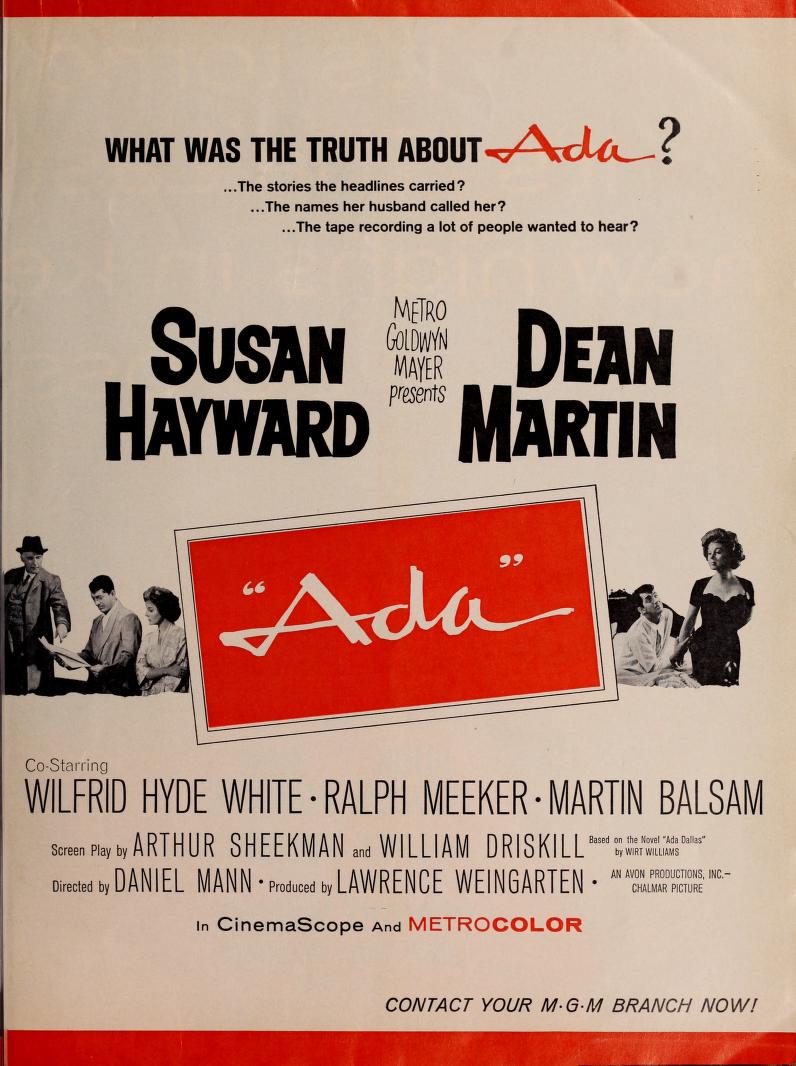
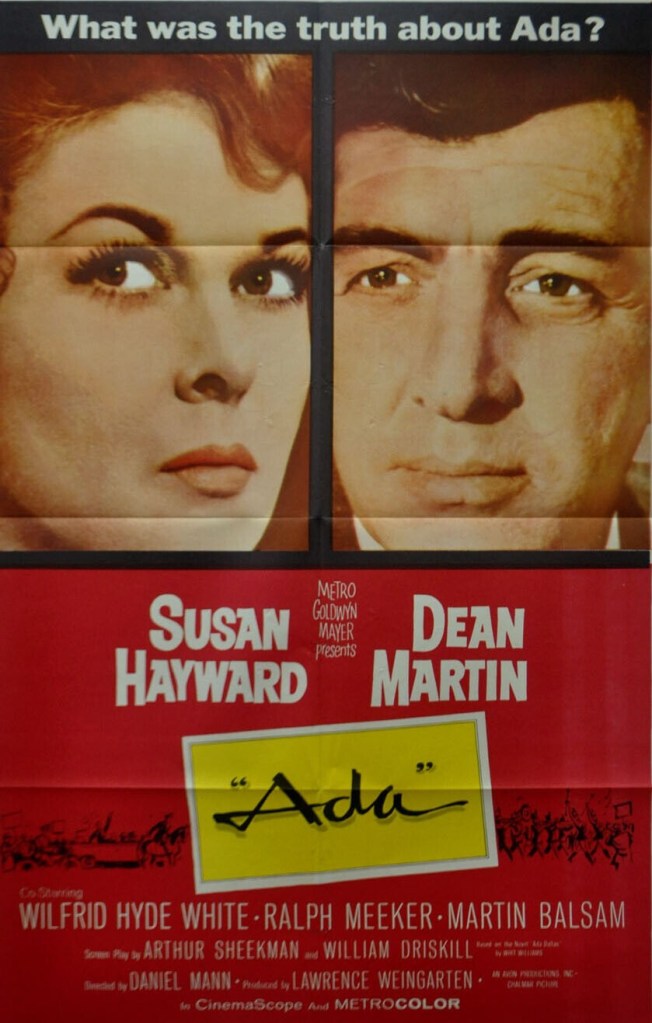
Ada (1961) ****

Oddly enough, this shares some elements with Killers of the Flower Moon. For a start Sylvester (Wilfrid Hyde-White), the political fixer, comes over as Robert DeNiro’s benign uncle, both so low-key, charming and persuasive you’d never believe them capable of  wicked manipulation. In the second place Bo (Dean Martin) is every bit as charming and baffled as Leonardo DiCaprio.

And just as the latter’s role is to worm his way into wealth and power via marriage, so too that’s the route taken by Ada (Susan Hayward), who would be euphemistically known in those days as a “good-time girl.”  

You’d figure this for a mild political satire except for the fact that stooges/buffoons have consistently made their way to the highest political office. As Ada pointedly points out, public appeal is the greatest qualification of any candidate, opportunism a close second.  Bizarre as it seems, Bo is a popular local guitar-playing-singer of the Hank Williams variety, a well-meaning dumb-as-they-come sort, whom Sylvester persuades to run for Governor. In the course of the campaign, as “a present in a back-room saloon,” he is served up Ada with whom he unexpectedly falls in love and marries.

His campaign path is smoothed when one of Sylvester’s hacks leaks news that his rival’s wife is an addict, the woman conveniently shooting her brains out. Naturally, Bo soon realizes he’s the sap, his only job to sign hundreds of legal documents every day, pieces of legislation that as it happens fill the pockets of Sylvester and his buddies.

When Bo’s long-time chum Ronnie (Frank Maxwell) threatens to expose the river of sleaze he is quickly eased out. That leaves an interesting vacancy for Ronnie was Lieutenant-Governor, Bo’s deputy. So, Ada, with a good bit more between the ears than her husband, throws her hat into the ring.

She’s to politics born, a particularly wily creature, able to bring into line the society dames who look down their nose on her, and keep tabs on Sylvester. What she doesn’t realise of course is that once you’ve got a very amenable deputy, that person becomes Acting Governor, and in effect Governor, should anything happen to the incumbent. And should she then decide she’s had enough of the sleaze, then a little poking around in her background should bring her to heel.

So, all the corruption you ever dreamt of, all the smart back-slappers ponying up thousands in campaign contributions in order to seek future reward, all that tax-payers money heading in the rich man’s pocket. Not a lot that’s new there.

What makes this stand out are the performances and the narrative arc. Wilfrid Hyde-White (The Liquidator, 1965) is a sensational casting coup. The British actor specialized in characters oozing wry charm, sometimes verging on the dotty, sometimes a tad idiotic, but never an outright swine. There are a couple of scenes where those mellifluous tones turn in an instant into a sharp crack, the avuncular replaced by the sinister.

And I’m not saying DeNiro copies his aging trick, you know the bit later on in Killers of the Flower Moon, when body no longer as sharp as the mind, the actor begins to drag his leg, and with no reference to that impairment. Well, here, similarly, the fit-as-a-fiddle Sylvester later on, still at the height of his mental powers, is seen being transported in a wheelchair.

The performance of Dean Martin (Rough Night in Jericho, 1967) was oddly dismissed at the time. And yet it was bold playing. He goes from ebullient star, enjoying being feted by all, lousy speeches lapped up by an adoring crowd, to withdrawing into himself as he realizes he has been duped. That doesn’t just take some acting skill, but considerable self-belief, to play a character who undergoes the wrong kind of transformation, not the general redemptive kind, nor sinking into some Oscar-worthy illness, but coming to terms with your own lack of ability.

Of course, Susan Hayward (Stolen Hours, 1963) delivers, as always, her screen wattage burns brighter than virtually any other female star of the period. You know the character expects her past to be exposed at any time, but she dives straight in, determined to tackle the sleaze. There’s a wonderful scene where, her background challenged by the hoity-toity society dames, she puts them in their place with a clever piece of political maneuvering.

Ada totally turns on its head the idea of the political do-gooder. She has none of the usual innocence, nor the ability to capture the crowd by seizing upon an ideal, but she’s more at home by dealing with the sleaze-merchants straight-on, taking apart their schemes in the comfort of the government’s back rooms where until now such deals have been dreamt up.

Director Daniel Mann (Judith, 1966) was known as a woman’s director. Under his direction in the Oscar stakes, Elizabeth Taylor had won for Butterfield 8 (1960), likewise both Anna Magnani for The Rose Tattoo (1955) and Shirley Booth for Come Back, Little Sheba (1953), while Hayward was nominated for I’ll Cry Tomorrow (1955). He not only chose grittier dramas but had the knack of encouraging actresses to let loose, without going overboard, on a part.  

Considerably overlooked and substantially under-rated, but not only prescient regarding future political candidates and the kind of corruption they got involved in (land deals ring a bell?) but elevated by the role of his career by Wilfrid Hyde-White, an unexpectedly good one from Dean Martin and Susan Hayward in top form.

https://amzn.to/3QGZoQC

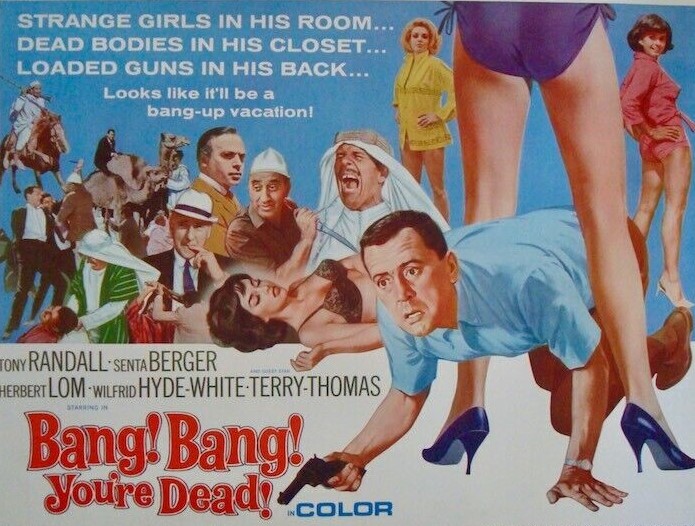
Our Man in Marrakesh / Bang! Bang! You’re Dead! (1966) ***

All hail Senta Berger! Another from the Harry Alan Towers (Five Golden Dragons, 1967) portfolio, this is a spy-thriller mash-up with a bagful of mysteries and a clutch of corpses. At last given a decent leading role, Senta Berger (Istanbul Express, 1968) steals the show from the top-billed Tony Randall (as miscast as Robert Cummings in Five Golden Dragons) and a smorgasbord of European talent including Herbert Lom (The Frightened City, 1961), Terry-Thomas (Danger: Diabolik, 1968), Klaus Kinski (Five Golden Dragons), John Le Mesurier (The Moon-Spinners, 1964) and Wilfrid Hyde-White (Ada, 1961).

In this company, the glamorous Margaret Lee (Five Golden Dragons), as the villain’s  cynical lover (“you are never wrong, cherie, you told me so yourself,” she tells him) is an amuse-bouche. Six travellers – including architect passing himself off as oilman Andrew Jessel (Tony Randall), travel agent George Lilywhite (John Le Mesurier), salesman Arthur Fairbrother (Wilfrid Hyde-White) and tourist Kyra Sanovy (Senta Berger), meeting her fiancé – board a bus from Casablanca airport to Marrakesh. One is carrying $2 million as a bribe to ease through a vote in the United Nations, but the villainous Mr Casimir (Herbert Lom) doesn’t know which one it is.

When Kyra’s fiance’s corpse tumbles out of Andrew’s cupboard, the pair become entangled. Kyra is a born femme fatale, trumping the incompetent Andrew at every turn.  With no shortage of complications, the tale zips along, directed on occasion with considerable verve by Don Sharp (The Devil-Ship Pirates, 1964).

It’s lightweight but no less enjoyable for that and makes a change from the more serious espionage fare (The Spy Who Came in from the Cold, 1965, and The Quiller Memorandum, 1966) beginning to capture the public’s attention. It might make it sound better to say it’s a mixture of The Man Who Knew Too Much (1956) and North by Northwest (1959) and throws a homage bone to Our Man in Havana (1959), but while it plays around with those riffs, it doesn’t give two hoots about focusing on Hitchcockian thrills. It’s more about the fish-out-of-water Yank Andrew being led astray by the sexy Kyra.

There are some inventive double-plays – with a body in the boot Kyra and Andrew are stopped by a cop who tells them their boot is open. An excellent rooftop chase is matched by a car chase. And there’s a terrific shootout. Kinski is at his sinister best and Terry-Thomas a standout in an unusual role as a Berber.

The film was shot on location including the city’s souks, the ruined El Badi Palace and La Mamounia hotel (featured in The Man Who Knew Too Much, 1956).

But Senta Berger seamlessly holds the whole box of tricks together, at once glamorous and sinuous, practical and tough and exuding sympathy, and it’s a joy to see her for a large part of the picture leading Randall by the nose. Quite why this did not lead to bigger Hollywood roles than The Ambushers (1967) remains a mystery.

A blast.

https://amzn.to/46T68Ax

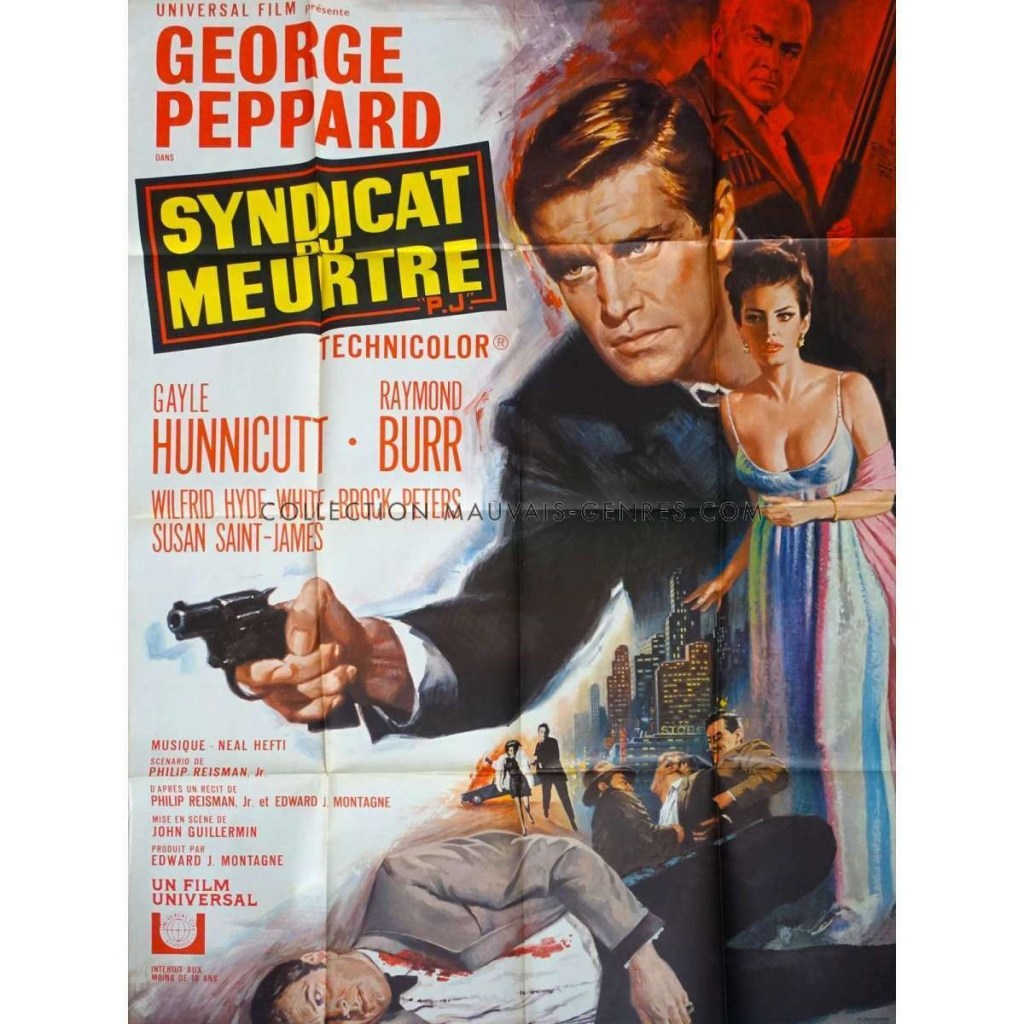
P.J. / New Face in Hell (1968) ****

Exceptional down-and-dirty thriller and throwback film noir woefully underrated on release but with a brilliant mystery (or two), a touch of satire, red herrings, some great lines, and believable characters. Private eye P.J. Detweiler (George Peppard) is so down on his luck he is willing to play the lover so an errant wife can be photographed in a motel room. What little he earns goes on paying is debts. So he can hardly reject the chance of serious money as bodyguard to Maureen (Gayle Hunnicutt), mistress of rich businessman William Orbison (Raymond Burr), never mind that she initially treats him as a servant.

Orbison has a legendary mean streak – to save on paper secretaries have to type closer to the edge of the sheet, he forces wife Betty (Colette Gray) to account for every dime of her allowance to the point of almost making her beg. Sadism is another character trait. He enjoys watching animals die. The childless millionaire adds his mistress to his will for the sole purpose of upsetting every other potential heir. In front of guests at a prestigious party he forces Betty to acknowledge Maureen’s existence.

The title was changed for British audiences and came from a line in the film.

This apparently wealthy world is riddled with seedy inhabitants, whose only motivation is  greed, all desperate to retain status or inheritance and enjoying Orbison’s largesse, which, despite his miserly nature, he nonetheless flaunts. As well as Betty enduring ritual humiliation to enjoy a gilded lifestyle, his executive assistant Jason (Jason Evers) accepts being treated as a gofer in order to keep his position and the perks that go with it, and Maureen makes no bones about prostituting herself for temporary and future gain. Everyone has to kowtow, even the occupants of a West Indian island dependent on Orbison for investment, not only a kids choir welcoming Orbison on arrival, but a calypso performer singing a song in his praise.

As various threats, including narrowly missing a bullet, are made against Maureen, making a classical entrance in a red dress and alternating between helpless victim and femme fatale, with her creepy manservant Quell (Severn Darden) reporting her every move, inevitably Detweiler grows closer to his client, unaware that Orbison is planning to have someone killed.

That someone turns out to be Jason, whom Orbison suspects of clandestine activity with his wife, and whom Detweiler innocently kills. As this takes place on the island, where the death is hushed up, Detweiler begins to wonder if he’s a patsy and, paid off by Orbison, undertakes his own investigation, quickly entering more dangerous waters, viciously beaten up at Quell’s behest in a gay bar, narrowly avoiding death in the subway and literally finding himself in the firing line.

Detweiler’s character undergoes transition, too. From begging for scraps and turning the other way so as not to jeopardize easy income, he rediscovers his suit of shining armor, walking down some pretty mean streets, a diligent private eye who can no longer be bought off, determined to get to the bottom of what turns out to be a complicated mystery. Detweiler is no Marlowe or even Tony Rome, but rather despicable at the outset, employing all sorts of dodges, his interest in Maureen not slackening even after he knows she indulges in a quickie with Orbison. He takes too much at face value.

The unfolding mystery is superbly handled, involving proper clues and investigation, shoot-outs and fisticuffs, the outcome not what you might initially imagine. Although primarily an old school private eye picture, it’s great fun, with some wonderful comedy involving a dog, gentle satire on the West Indian island where political whitewash is the order of the day, and some touching romantic foreplay.

Peppard (Tobruk, 1967) is outstanding as the dupe who rediscovers his moral compass and his Detweiler is an excellent addition to the ranks of the private eye.  Raymond Burr, a far cry from his Perry Mason (1957-1966) television persona,  is easily one of the worst screen millionaires in his contempt for humanity and with his silver hair and bulk and scheming proves a slick adversary. Gayle Hunnicutt (Eye of the Cat, 1969) is allure on legs, brilliantly playing every man in sight, eyes never diverted from the prize.

Brock Peters (The Pawnbroker, 1964) has a standout cameo as the island’s cynical police chief. Susan Saint James (The Name of the Game, 1968-1971) makes her movie debut as Orbison’s slinky sex-mad niece.  Also putting in an appearance are Wilfrid Hyde-white (The Liquidator, 1965) as the island’s sycophantic governor, Colleen Gray (Red River, 1948) as the humiliated wife, Severn Darden (The President’s Analyst, 1967) as the odious Quell and John Ford regular John Qualen (The Man Who Shot Liberty Valance, 1962).

This was the second of director John Guillermin’s George Peppard trilogy following The Blue Max (1966) and prior to House of Cards (1968). Generally dismissed as a journeyman, Guillermin brings a sly eye to this picture, the send-up of British colonialism, the master-servant aspects, an over-the-shoulder shot of an unknown assassin, the scenes in a bar which doubles as Detweiler’s office, the brutal beating in the gay bar, and a brilliant subway sequence adding layers to the movie. He is bold in his use of close-ups with Hunnicutt, some compositions almost a homage to the Bogart-Bacall chemistry, and brings out a world-weary performance from the usually cocky Peppard.

Philip Reisman Jr. (All the Way Home, 1963) fashioned the screenplay, delivering one of cinema’s most memorable final lines.

Discover WordPress

A daily selection of the best content published on WordPress, collected for you by humans who love to read.

The Atavist Magazine

by Brian Hannan

WordPress.com News

The latest news on WordPress.com and the WordPress community.