Come September (1961) ***

The quite superb concept that underpins the traditional unsettling of Rock Hudson is sabotaged by the inclusion of an unnecessary generation gap element and because one of the youngsters is singer Bobby Darin that throws a musical spanner into the works. The basic set-up is that Lisa (Gina Lollobrigida), the Italian lover of wealthy American Robert (Rock Hudson), is fed up with the part-time nature of their relationship. Although their affair dates back six years, it only lasts for the one month (September) he vacations each year in his luxurious villa on the Ligurian coast.

She’s so annoyed at his lack of commitment that she’s about to marry posh Englishman Spencer (Ronald Howard), that imminent event only put off by the unexpected earlier-than-usual arrival of Robert. Matters are further complicated because his enterprising Italian butler Maurice (Walter Slezak) hires out the villa to paying guests for the other eleven months. To explain the owner’s sudden arrival, Maurice persuades his guests to go along with the notion that Robert is a former owner fallen on hard times deluded into thinking he still possesses the property.

The guests are a gaggle of young women, including psychology major Sandy (Sandra Dee) who proceeds to analyze Robert, and they are herded around by formidable chaperone Margaret (Brenda de Banzie) who prevents Lisa sneaking into her lover’s bedroom.

So enough plot to be getting on with. You’d assume Spencer is going to turn up, maybe with his equally formidable sisters, to cause ructions at the villa. Lisa appears to enjoy making Robert wait the way he has kept her wait, so a gentle shift in power, and there’s going to be an inevitable bust-up so we expect a quick shift into the will-she-won’t-she scenario. Plus, there’s the whole issue of Robert claiming back his villa and dealing with the over-entrepreneurial Maurice.

Instead, the second act enters a whole new realm. Unless one of the girls was going to make a play for Robert, there’s not much reason for them to be there except for the nuisance value and to allow Margaret to flex her authority. An unwelcome quartet of young men, led by Tony (Bobby Darin), embark on the equally unwelcome task of wooing of the young ladies, Tony having his eyes on Sandy. Although various romantic entanglements are enacted, that’s not what takes center stage.

Instead, the bulk of the middle section scarcely involves the Robert-Lisa quandary and instead it’s devoted to an endless battle between Tony and Robert as the younger specimen attempts to prove he is mentally and physically superior. Now the one element that had made these Rock Hudson comedies work was his helplessness. He may occasionally be smart or wealthy but the whole point of these stories was for a woman to run rings around him or at the very least drag him way out of his comfort zone.

Seeing Robert best Tony – endlessly – takes the shine off the picture and it’s not until Robert is revealed as a sanctimonious hypocrite, living by a double standard, that the movie catches fire again as Lisa storms off in a huff and we can settle down to some good old-fashioned will-she-won’t-she.

This proves a very successful change of pace for Gina Lollobrigida, and she reveals herself to be such a splendid comedienne that it became part of her repertoire – reunited with Hudson for Strange Bedfellows (1965) and leading a pack of men a merry dance in Buona Sera Mrs Campbell (1968).

There’s nothing particularly wrong with Rock Hudson. He’s good comedy value, but the second act ruins it. Bobby Darin (Pressure Point, 1962) and Sandra Dee (A Man Could Get Killed, 1966) act as if they’re in a completely different movie, of the frothy beach variety. Walter Slezak (The Caper of the Golden Bulls, 1967) is an adept scene-stealer. Look out for Joel Grey (Cabaret, 1972) in an early role and Brenda de Banzie (I Thank a Fool, 1962).

Directed by Robert Mulligan (The Stalking Moon, 1969) with a screenplay by Oscar-winning Stanley Shapiro (Bedtime Story, 1964) and Maurice Richlin (All in a Night’s Work, 1961).

A hybrid that rocks the wrong boat.

Selling the Exotic – Pressbook for “24 Hours to Kill” (1965)

No matter how small a picture, its budget had to stretch to a Pressbook. Even if the movie would end up on the bottom half of a double bill or a drive-in programmer and did not have much to shout about, it still needed a Pressbook. Low-budget films meant low-budget advertising campaigns unless your name was Joe Levine who often spent far more promoting films than he did making them.

The Pressbook was essential because it was the source of the movie’s adverts that could appear in a newspaper – these came in a variety of sizes so an  exhibitor could remove the one most relevant and take it down to their local newspaper to make up the display advertisement. In the pre-digital era, it was a crude as that, adverts were effectively cut and pasted.

While some Pressbooks could run to 16, 20 or 24 A3 pages in full color, the most basic requirement would be four pages, enough to show the ads and get the basic message across. This was of the basic variety. In this case, ads took up the first two-and-a-half pages, leaving a half-page to list the credits and explain the plot. The final page contained information about the stars..  

Perhaps as revenge for producer Harry Alan Towers not coughing up enough money for a decent Pressbook, his name was left off it. Instead, filing his slot was Oliver A. Unger, more famous as a pioneer of syndicated television, importer of foreign films and producer of The Pawnbroker (1964). In reality, he was an executive producer, in those days that function being fulfilled by someone who either invested in the picture upfront or once filming was complete bought territorial rights.

Artwork was minimal, one main advertisement, one alternative. But more or less the same taglines appear in both. Hoping to hook in the audiences was the notion of “perfumed harem…in mysterious Beirut…where every hour can be your wildest.. and your last.”

Usually films like these boasting a flotilla of European beauties devoted some space to explaining their origins and puffing up their potential. Not so here. Space is just too tight. The only actors covered are Lex Barker, Mickey Rooney and Walter Szelak. Strangely, no mention is made of Barker’s socko career as a German western hero – the notion that Europeans could make westerns remained absurd at this point (A Fistful of Dollars would take three years following completion to reach U.S. screens).

According to the Pressbook, Barker more or less jumped straight from Tarzan to this kind of thriller. Though he had been out of the loin-cloth for more than a decade (Tarzan and the She-Devil, 1953, his final appearance), the 40 pictures he had made since then (including La Dolce Vita, 1960) did not merit a sentence. The Pressbook did carry a quotable quote from Barker explaining his reasons for quitting jungle life: “It made me feel like a male Bardot because I was always parading around almost nude.” This was the type of quote that only made sense until you realised that Bardot did not become a star till three years after he quit playing Tarzan. Still, who was going to argue?

A strict regimen of physical exercise allowed him to keep in the shape necessary for the film which required him to “run for his life, rescue a pretty hostess from kidnap by helicopter and fight off thug after thug.” 

Mickey Rooney gets a better write-up, especially for making the rare jump from successful child star to accepted by audiences for his adult roles. Though the writer of the Pressbook never appeared to actually go the movies. Spot the mistake in this sentence: “Last seen in runaway box office hit It’s A Mad, Mad, Mad, Mad, World Rooney now appears for producer Oliver A. Under in a drama equally as challenging.” That the first film was actually a comedy and not a drama never seemed to sink in.

The usual promotional material – suggestions for marketing, maybe a record of the soundtrack available, perhaps a theme song to target radio stations, various stunts – was non-existent even though the movie leant itself to a tie-in with an airline or a travel company especially as the National Lebanese Tourist Council had gone out of its way to accommodate the production.

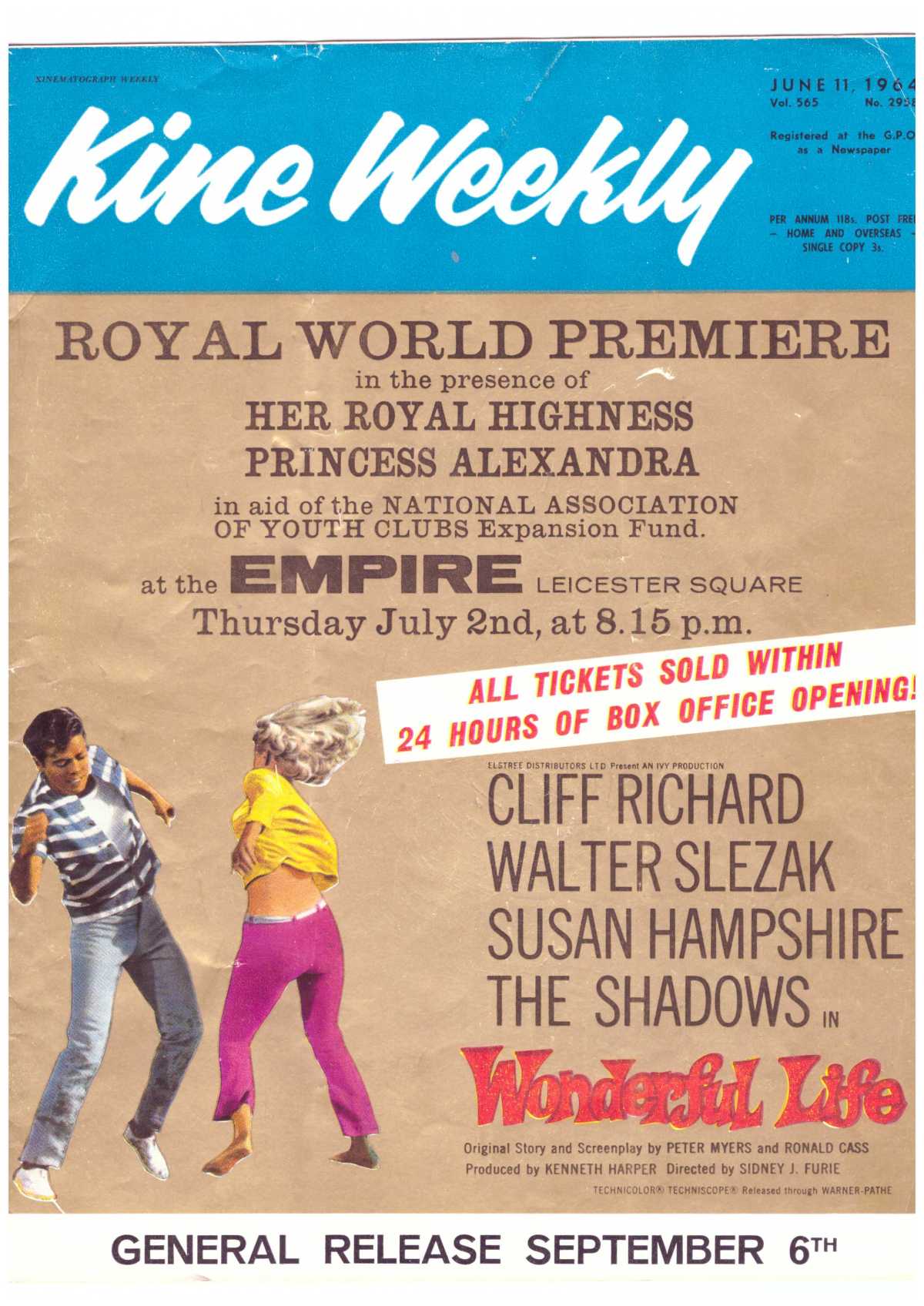
Wonderful Life (1964)****

I have just discovered a new guilty pleasure. I was too young to remember when Cliff Richard was the British equivalent of Elvis and by the time I became aware of him he was already in the family-favorites league with his own television show and popping up in the wider consciousness from time to time with a number one single. But I was conscious that Cliff’s aspiring film career was totally obliterated by the emergence of the Beatles. I found Wonderful Life to be totally innocuous, highly enjoyable, charming fun. There’s no story to speak of beyond an affectionate spoof of Hollywood but it has zest and exuberance and some decent choreography by Gillian Lynne who went on to be deified for her work on the original London productions of Cats and Phantom of the Opera.

But there are some very funny visual gags, beginning with the opening scene when Cliff and Co are waiters on board a ship attending to a drunk whose glass moves out of reach every time the ship rolls. Having caused a power outage, they are chucked overboard in a dinghy and turn up in the Canary Islands where Cliff becomes a stunt man on the terrible Foreign Legion movie directed by a Hollywood ogre (Walter Slezak) and starring incompetent actress Susan Hampshire who has made a career of sorts playing the daughter of a sheik or sultan. You have to like a movie with lines like, “Follow that camel” and a geek (Richard O’Sullivan) whose scientific predictions invariably come undone. Cliff, realizing the lines are better sung than spoken, begins to make a musical on the back of the drama. And it’s true – the lines are good lyrics.

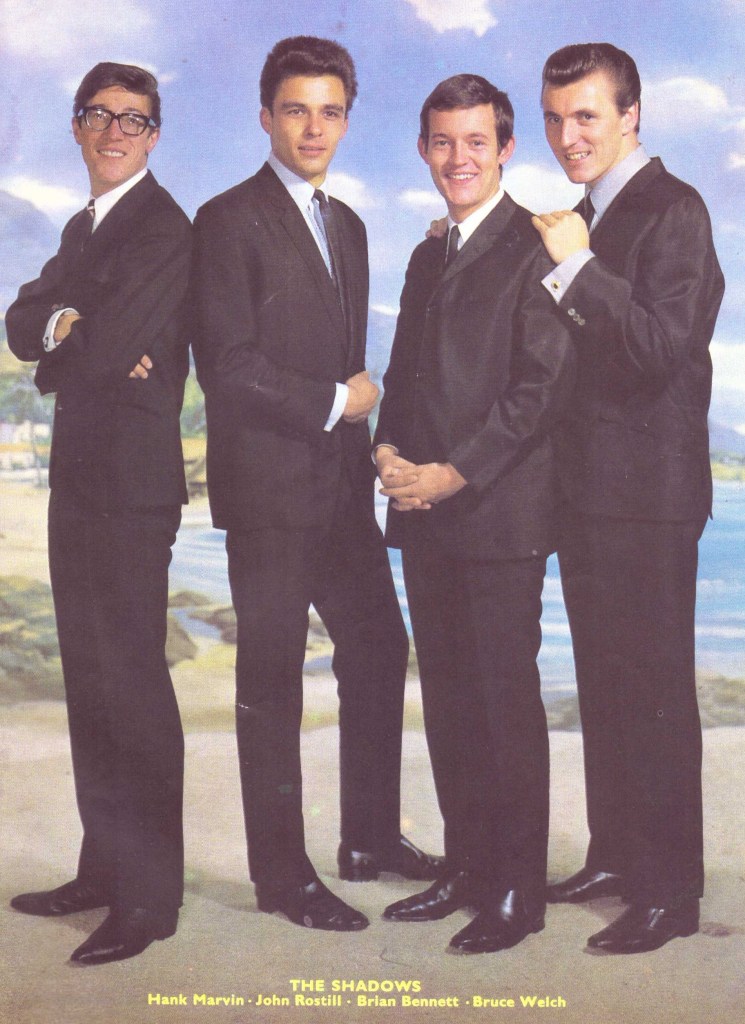
Britain had no reputation for musicals among the Hollywood cognoscenti unless you count the Jessie Mathews and Gracie Fields films of the 1930s which were far too parochial and contrived for American tastes and in terms of invention and musical technique a far cry from Lionel Bart’s Oliver! which would be filmed a couple of years later and in terms of originality not a patch on A Hard Day’s Night (1964) the same year. The songs are evenly contributed by various members of the Shadows – Bruce Welch composed the standout “A Matter of Moments” and with Brian Bennett the theme song – and the Peter Myers-Ronald Cass team who also wrote the screenplay. But this film comes across as naturalistic, rather than the contrivances of most Hollywood musicals. It doesn’t take much for these lads to strike up a song, any excuse will do. And the film is better for the lack of high emotion attached to every lyric.

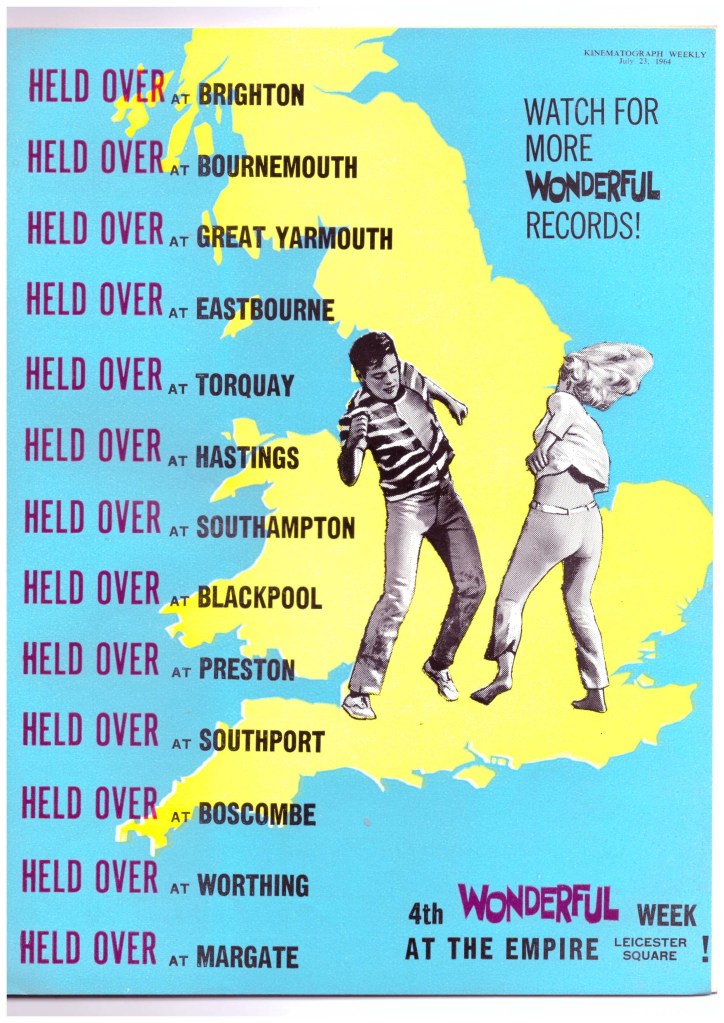
You would be mightily surprised to learn that director Sidney J. Furie’s next film was stylish spy thriller The Ipcress File (1965) followed by Appaloosa (1966) with Marlon Brando and The Naked Runner (1967) starring Frank Sinatra. Here, he is in free-association mode, the ideas tumbling out, especially in the Hollywood parody dance numbers sections where we go from Chaplin pastiche to Greta Garbo and Groucho Marx, Fred Astaire-Ginger Rogers, West Side Story and James Bond. We have gangsters whose violin cases contain violins, a singing cowboy with subtitles (to explain the growth of the foreign movie) and a song about homesickness played out with Battersea Power Station in the background. If anybody can actually act they’re not putting any great effort into it. And that doesn’t matter either. The storyline is no more preposterous than many of the great Hollywood musicals. Everyone looks as if they’re having a whale of a time and I guess that would include the audience because the movie was the fifth-best performer of the year in Britain. This was the type of movie, during the rise of the permissive cinema, that you could take your grandmother to see and still come away surprised you had enjoyed it so much yourself.

Discover WordPress

A daily selection of the best content published on WordPress, collected for you by humans who love to read.

The Atavist Magazine

by Brian Hannan

WordPress.com News

The latest news on WordPress.com and the WordPress community.