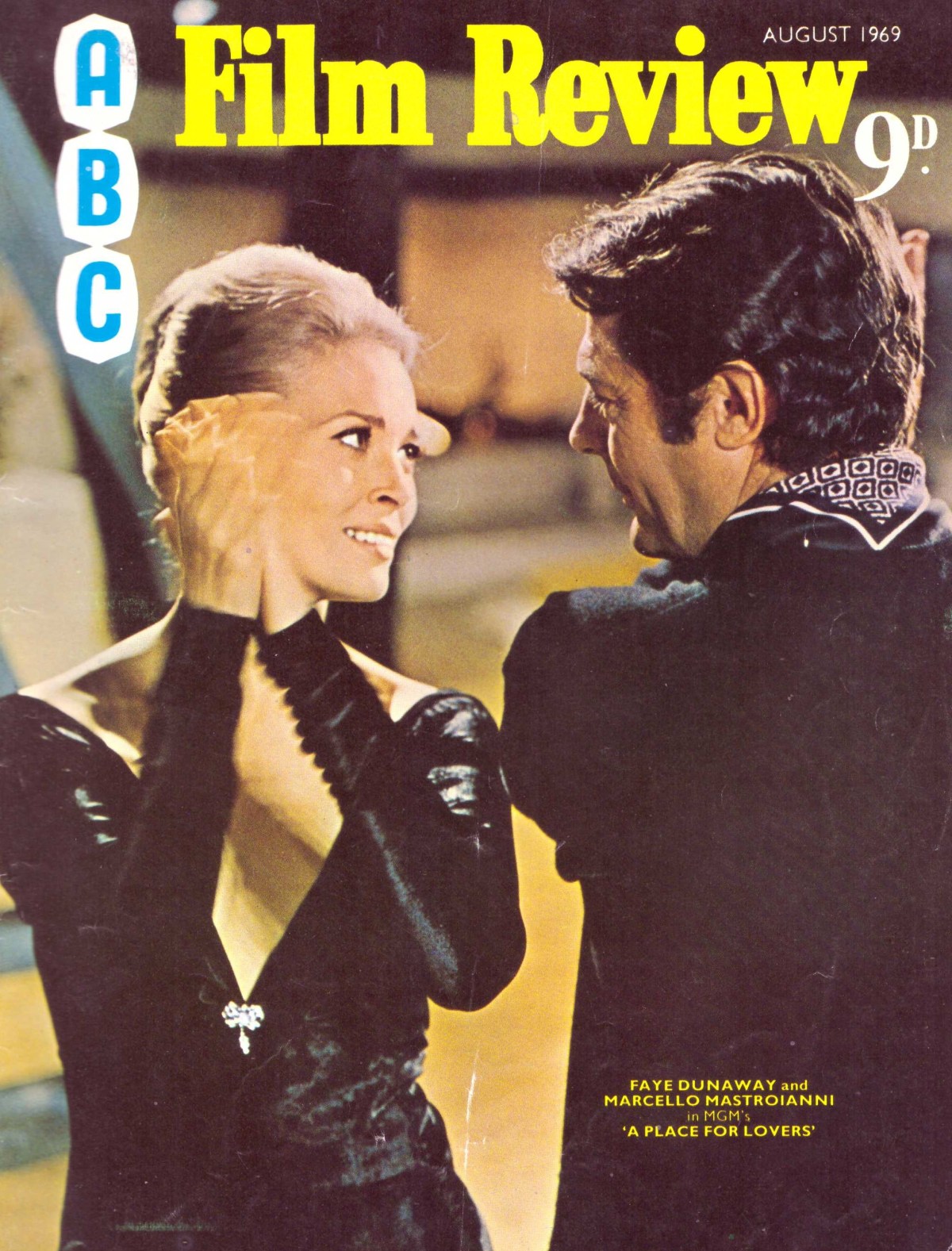
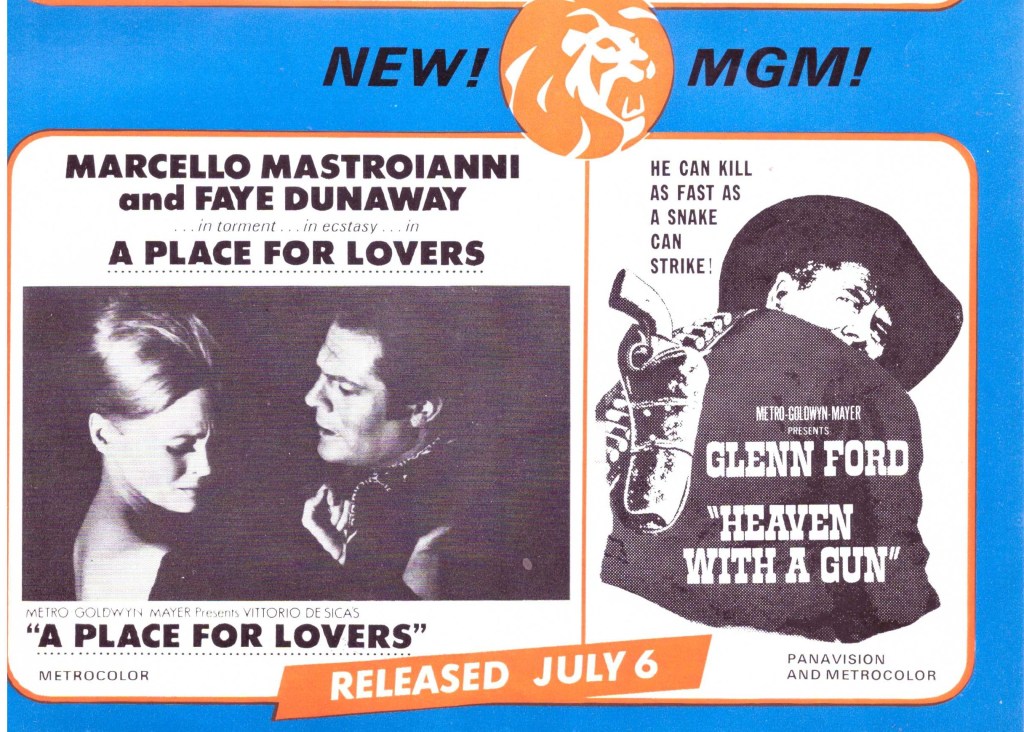
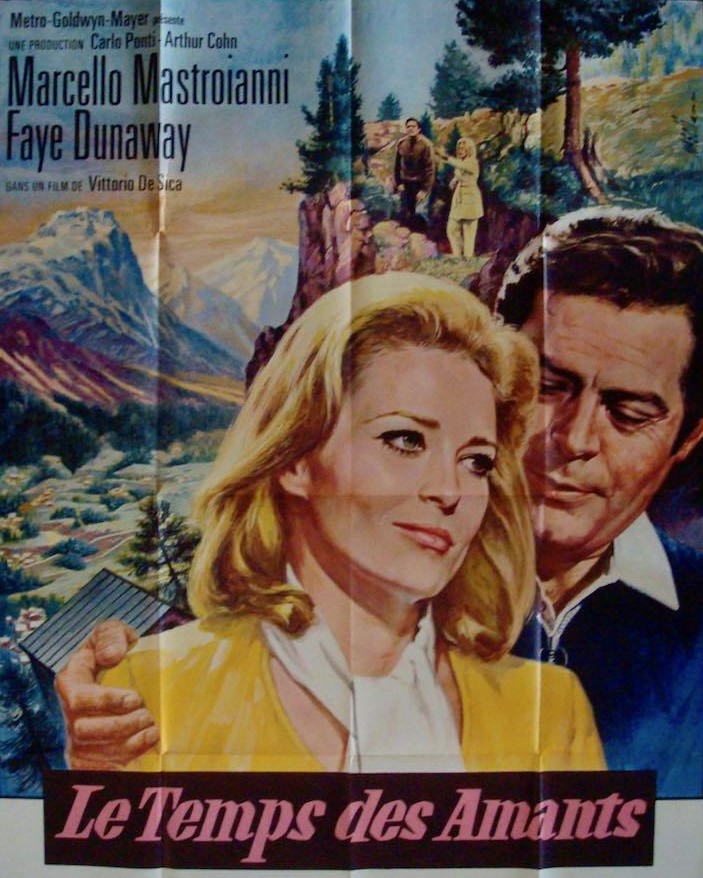
I’ve marked this up since my previous viewing of it. And that’s an exceptionlly rare occurrence. What may not have suited the 1960s audience accustomed to standard boy-meets-girl boy-loses-girl even with whatever complications were available at the time, this should chime more with a contemporary audience seeking more reality and less glorification in a love story.
Not quite the Hollywood romance, too much bellyaching from the male for a start, and a couple of years before Love Story (1971) gave terminal illness a box office shot in the arm, but nonetheless very much an adult love affair and far from deserving a place in the top 50 worst films of all time.
For a start director Vittorio De Sica plays around with audience expectations. This always has the feel of a romance that could end at any time, of characters not quite sure of the other person’s feelings, real love or just sex, the sense of not knowing where this could go, and of where, emotionally, they find themselves. And it begins with confusion, a blaring horn in the background, a close-up of Julia (Faye Dunaway), and then she jiggles around with some bricks in a wall before retrieving a key and finding her way inside a grand though modern Italian pallazo. You’ve no idea why she is here and I guess neither does she.
There’s been no meet-cute and there’s no real intimation of how the attraction began except, judging from a brief flashback, they must have bumped into each other at an airport. That’s my conclusion anyway because the details of the actual meeting are never clarified, like a lot of what subsequently goes on. She hides information from him, he does the same, so for a time feelings are not spelled out. It’s clandestine in all the wrong ways. There’s a separation, a distance, characters often seen in very long shot. Sometimes there are physical barriers between them, a high fence in one instance, as if true intimacy is impossible.
Still no sign of the man she has come to visit. She rescues a stray dog from the town dog collector. It’s an exceptionally grand house, classically designed, marble floors, paintings and artistic artefacts all over the place, but no clutter. When Valerio (Marcello Mastroianni) arrives – it’s his house – he checks the labels on her luggage, presumably finding out her full name, possibly her address, possibly accustomed to lovers providing false information on both counts. We learn he’s a safety-conscious racing driver, a man who requires barriers.
They are on a deadline already. She is only in Italy for a further two days. This is a lie. She has 10 days at her disposal but wants to set the pace, heat up the sexual atmosphere. They make love beside a lake. He takes her to dinner with friends where the entertainment is a lecture on sexual positions shown in art. But after someone suggests a game of what we would these days term speed-dating, he calls an end to the affair, jealous that she would consider spending any time in close proximity to another man.
So that’s it. Grand love affair dead and buried after just one day. Except she turns up next day at a practice at a racing circuit. After they reconcile, she watches in a car mirror as he makes a call in a phone box – speaking to his wife or another lover, we never find out, except her reaction explains it must be either.
There’s little of the sparkling dialog found in Hollywood romances, especially for audiences who grew up on the Tracy-Hepburn pictures, but she tells him that “if you put all the houses I have lived in you would make a good little town” and not just that she had lived a peripatetic lifestyle but that she also had six grandfathers so a rather fluid upbringing. She confesses now she has more time to spare, she just wanted him to ask for it, being stricken by her potential absence an indication in her eyes of true love.
So this is a fragile individual, her smile is always hesitant, external confidence hiding vulnerability. Her face is never flush with passion. When he asks why she never revealed her terminal illness, she replies, “I can’t take any more sad eyes.” There’s an ironic ending.
It is of course set against glorious backdrops but instead of letting the audience wallow in the love affair, as would be the Hollywood temptation, De Sica finds some way of undercutting it. Valerio is never quite sure of her and she is never quite sure of him. Their pasts remain hidden. Their lovemaking beside the lake is interrupted by a hunter bagging game. She coos over a baby only to discover it has an ugly father. She drives too fast even with a racing driver in the passenger seat and she clearly has suicidal tendencies, the love affair almost a salve for her despair.
We could have been presented with the suave charming Marcello Mastroianni (La Dolce Vita, 1960) cliché from a dozen Italian films, but instead he is often jealous, annoyed, real. Faye Dunaway (Bonnie and Clyde, 1967) plays a character who never knows where she stands with her emotions, accepting her fate one moment, determined to end her life the next, and yet still time to dally in a love affair that of course can have no future.
Vittorio De Sica (Two Women, 1960) has fashioned a picture that is neither uplifting nor downhearted, a love affair that lives just for the moment, but with implied complications that could at any moment wreck it, a romance always teetering on the edge.
I’ve no idea what compelled Harry Medved to include this in The Fifty Worst Films of All Time, published in 1978, but you might easily question his judgement on discovering that his list includes Sergei Eisenstein epic Ivan the Terrible, Alain Resnais’s hypnotic Last Year at Marienbad, Otto Preminger’s Hurry Sundown, Alfred Hitchcock’s Jamaica Inn and even such passable entertainments as The Omen.
Maybe you’ve been put off giving this a whirl thanks to the Medved seal of disapproval. A Place for Lovers is not the greatest film ever made, but it’s certainly far from the worst, two striking actors and a director who could never make a terrible picture make sure of that. And, as I mentioned, exerts greater appeal for the contemporary viewer.
No DVD available so you will need to check out Ebay or streaming.
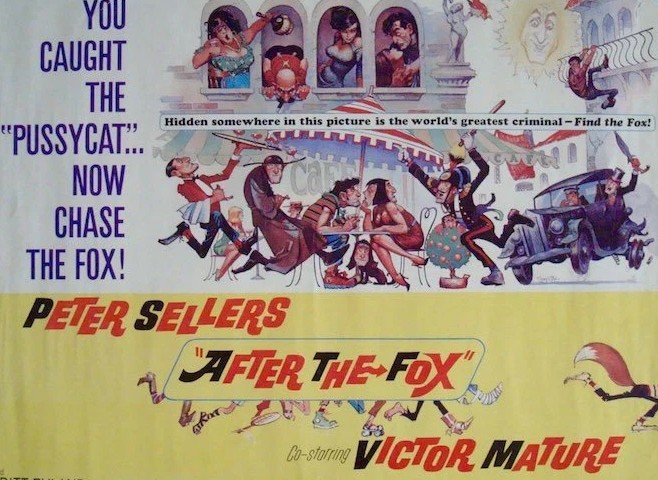
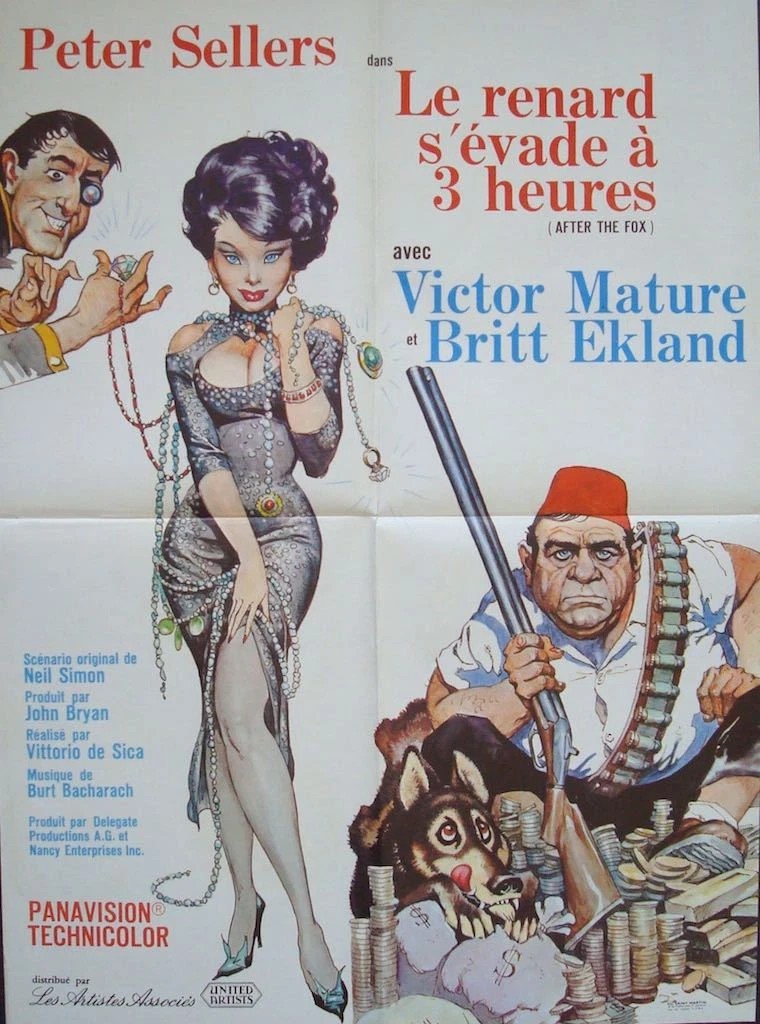
There’s a classic MacGuffin in here somewhere, but I can’t make out if it’s the heist serving the satire on movies or the satire on movies serving the heist. Whatever, this is about the funniest picture you’ll watch on the movie business (much better than Paris When It Sizzles two years earlier). You can keep your royalty and your top politicians dropping in from every corner of the globe, but it’s hard to beat Hollywood landing on your doorstep to transform everyone into a sycophant. To facilitate filming, individual streets and solid blocks will be closed and even businessmen whose businesses are threatened will stick their nose out into the road in the hope of being captured by a stray camera. Everyone wants to be in the movies and how brazenly the movies exploit such naked need.
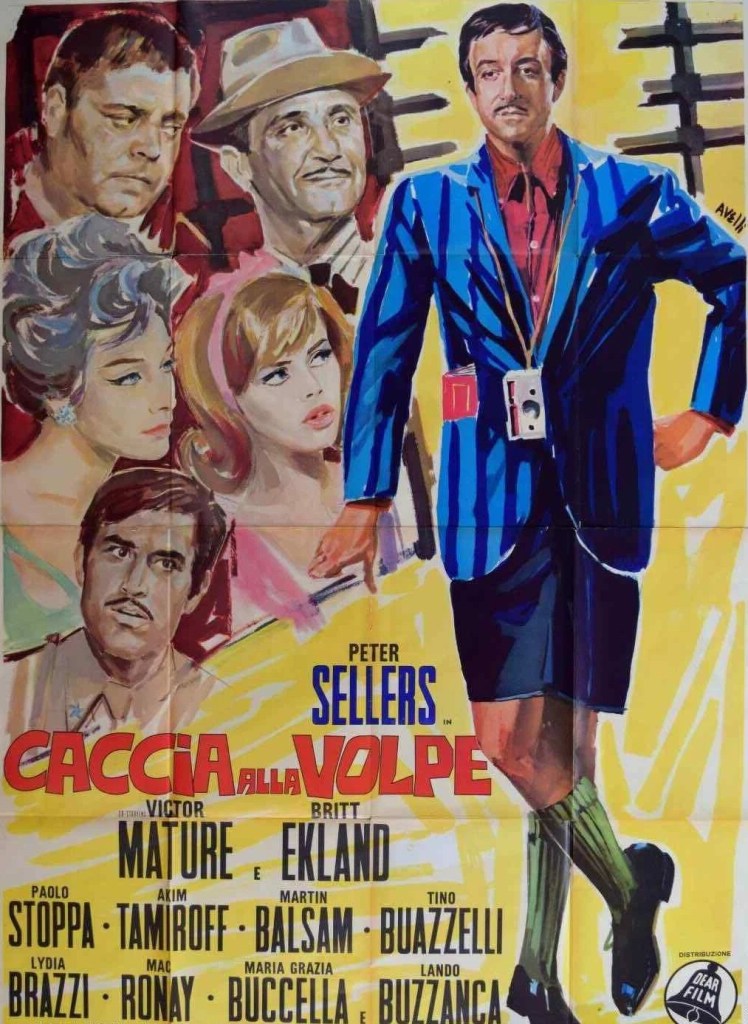
Before we get to the movie part of the story, we find imprisoned top criminal Aldo Vanucci aka “The Fox” (Peter Sellers) escaping from confinement so that he can assist robber Okra (Akim Tamiroff) transport 300 solid gold bars from a heist in Cairo to Italy. Though the heist is deceptively simple (and might even have influenced The Italian Job, 1969), for a time it looks as if this will canter along going nowhere fast while we get bogged down in a subplot concerning the burgeoning acting career of Vanucci’s sister Gina (Britt Ekland). There’s a whole bunch of standard Italian comedy tropes – the dominant Mama, the incompetent crooks and the brother too controlling of his sister.
But once Vanucci hits on a movie shoot as the ideal way to disguise the bringing ashore of the loot into the Italian island of Ischia, he strikes pure comedy gold. The townspeople who might otherwise easily see through a con man are putty in his hands. The local cop comes onside when persuaded he has the cheekbones of actor. Aging vain star Tony Powell (Victor Mature) wearing a trademark trench coat like a latter-day Bogart is an easy catch once you play upon his vanity and even hard-nosed agent Harry (Martin Balsam) is no match for the smooth-talking Vanucci.
Vanucci has mastered the lingo of the film director and can out-lingo everyone in sight. The very idea that he has a hotline to Sophia Loren goes undisputed and Powell is even persuaded that Gina, who has never acted in her life, is the next big thing.
Pick of the marvelous set-pieces is the scene in a restaurant where Vanucci is astonished to find a peach of a girl (Maria Grazia Buccella) speaking in a deep male voice because while she’s opening her mouth the words are being supplied by Okra seated behind her. Not all the best scenes involve Vanucci. Harry tartly batting away Tony’s vanities is priceless while the theft of film equipment while a film director (played by the movie’s director) calls for more dust in a sandstorm is great fun.
Also targeted is the self-indulgence of the arthouse filmmaker determined to add meaning to any picture. Vanucci’s versions of such tropes as lack of communication or a man searching for identity and running away from himself are a joy to behold and one scene of Tony and Gina sitting at opposite ends of a long table at the seashore just about sums the kind of pointless but picturesque sequence likely to be acclaimed in an arthouse “gem.” And you might jump forward to villagers hiding the wine in The Secret of Santa Vittorio (1969) for the sequence where townspeople load up gold into a van, singing jauntily all the time.
Most of all Sellers (A Shot in the Dark, 1964) hits the mark without a pratfall in sight – the only pratfall in the picture is accorded Harry. Unlike The Pink Panther, Sellers doesn’t have to improvise or be funny. He just follows the script and stays true to his character and the one he has just invented of slick director. There’s even a great sting in the tail.
Sellers shows what he can do with drama that skews towards comedy. Though criticized at the time for, effectively, some kind of cultural appropriation – she was a Swede playing an Italian, what a crime! – Britt Ekland (Stiletto, 1969) is perfectly acceptable. Victor Mature (Hannibal, 1960) has a ball sending up the business as do Akim Tamiroff (The Vulture, 1966) and Martin Balsam (The Anderson Tapes, 1971).
Vittorio De Sica (A Place for Lovers, 1969) does pretty well to merge standard Italian broad comedy with several dashes of satire. The big surprise is that Neil Simon (Barefoot in the Park, 1967) wrote the script, helped out by De Sica’s regular collaborator Cesare Zavattini (A Place for Lovers).
I saw this and A Shot in the Dark on successive nights on Amazon Prime. I hadn’t seen either before. They had been received at either ends of the box office spectrum, the Clouseau reprise a big hit, the Hollywood satire a big flop, so I expected my response might reflect that. But, in reality, it was the other way round. I appreciated this one more.
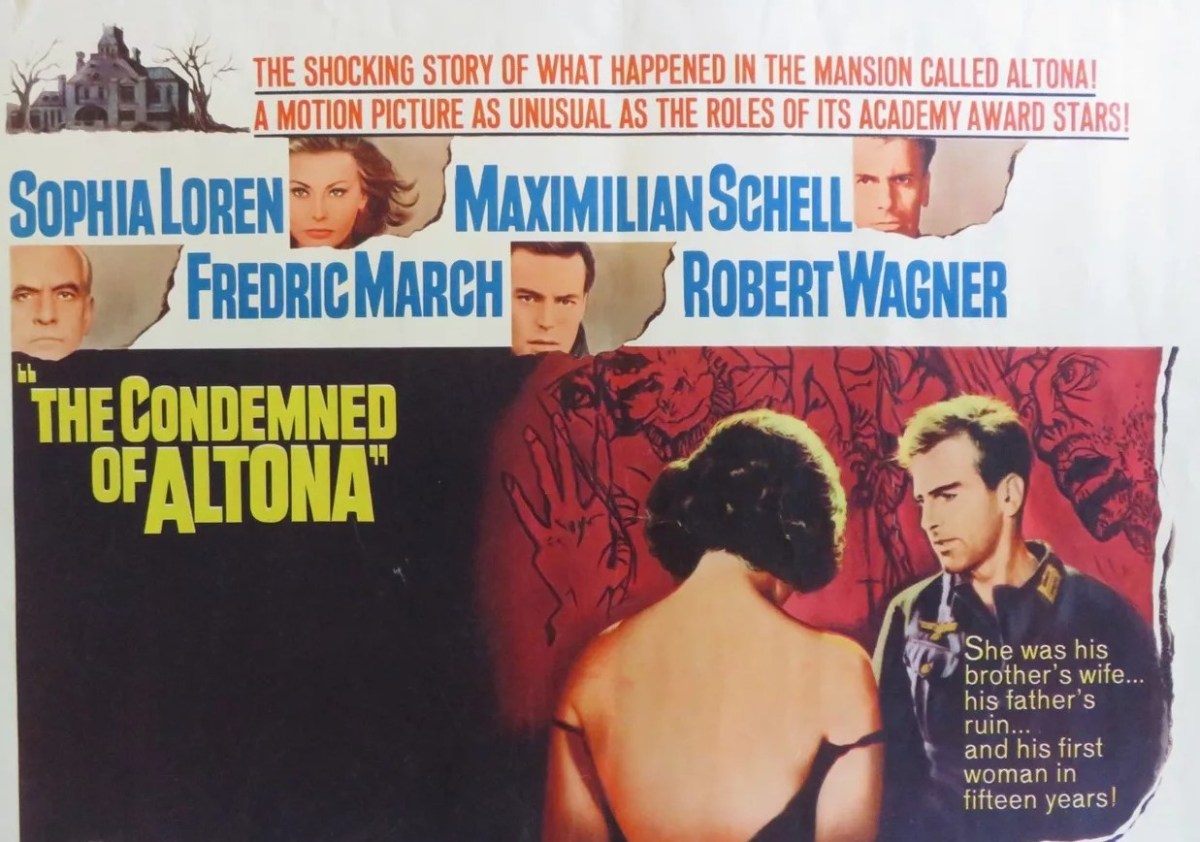
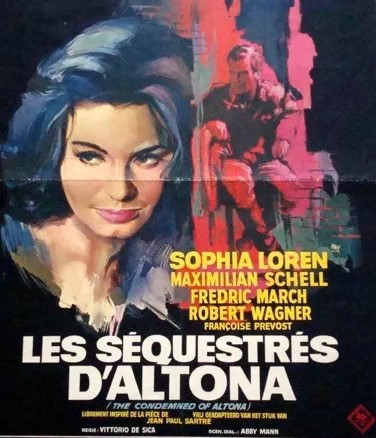
Shades of last year’s Oscar-winning Zone of Interest but with more guilt, some characters dodging it, others driven mad by remembrance of what they did or didn’t do during the Holocaust of World War Two. But mostly, an object lesson in how to expland a play (written by French philosopher Jean-Paul Sartre). Despite top class performances from Sophia Loren (Arabesque, 1966), Maximilian Schell (Counterpoint, 1967), Fredric March (Seven Days in May, 1964) and even, astonishingly, from Robert Wagner (Banning, 1967) it’s director Vitttorio De Sica (A Place for Lovers, 1968), with stunning images and clever camerawork, who steals the show.
You won’t forget in a hurry the outstretched hand of a prisoner in a blizzard condemned to die, nor the skeletal jaw seen through an x-ray machine. The backward crab crawl will remind you of a later movie. De Sica moves the camera every whichway. Aerial and overhead shots are mixed in with the camera swivelling from character to character or suddenly pulling back from a scene and then suddenly he stops you his restraint. But that doesn’t prevent him getting to the heart of the narrative matter and adding in some frisson of accuser attracted to accused.
Set at the end of the 1950s, we begin on a Succession note, but without the contemporary angst and back-stapping. German shipping entrepreneur Albrecht (Fredrich March), a war profiteer turned post-war profiteer having taken advantage of demand in the Germany industrial boom, and now with only months to live, wants to pass on his business to son Werner (Robert Wagner). But Werner shies away, disgusted by his father’s unspoken collaboration with the Nazis during the war, ignoring the argument that the businessman was simply dealing with whatever party was in power. And this would be the narrative, father explaining actions, hoping for expiation, planning for the business to pass down the family line rather than be sold off.
Except that Werner’s left-winger actress wife Johanna (Sophia Loren) discovers there is another contender, the supposedly dead older son Franz (Maximilian Schell) who, instead of being sentenced to death for war crimes and fleeing to Argentina, where he purportedly died, as was the story given out, is actually hiding in the family mansion. He’s pretty much been driven mad, the walls of his substantial hidey-hole daubed with disconcerting images. Windows blocked-up and no knowledge of the outside, wearing his Nazi uniform he envisages a Germany languishing in decay, poverty and hunger. He lives on champagne, oysters and chocolate (so not quite the tough prison regime), and, as discreetly portrayed as was possible at the time, has an incestuous relationship with doting sister Leni (Francoise Prevost), the only human being with whom he is in contact. The inmate, knocking back handfuls of Benzedrine, occupies his time by recording messages to be delivered, he hopes, to Germans many centuries ahead.
Johanna wonders how this mentally-ill man came to be obsessed with guilt and we discover that when he was growing up his father rented out spare land around the mansion to the Nazis for a concentration camp where 30,000 people died. But Franz hid a Jew in the house, was reported to the S.S. by his father, and witnessed the man’s execution, then was punished by being forced to join the Army where he was known as a torturer. Finally, he emerges from isolation and sees a different Germany and confronts his father in a shock ending.
Both Loren and Schell had just won Oscars, for Two Women (1960) – incidentally directed by De Sica – and Judgement at Nuremberg (1961), respectively, so their confrontation, where his initial male dominance (the poster image reflects this scene) settles into a more equal power dynamic. Frederic March is good as the father convinced he has done no wrong and I had to check that this was the same Robert Wagner who had often been indifferent in pictures. De Sica draws great performances from all and layers the whole movie in a doom-laden atmosphere. Written by Abby Mann (Judgement at Nuremberg) and Cesare Zavattini (Woman Times Seven, 1967)
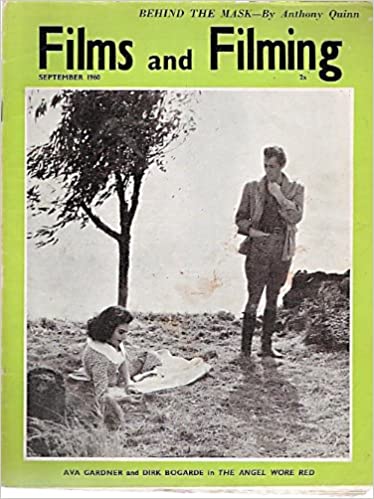
Given that this is filmed in black-and-white, it seems a curious title. So I’m assuming the color is a reference to a scarlet woman which, indeed, Ava Gardner (Mayerling, 1968) is, working in a “cabaret” in an unnamed town at the start of the Spanish Civil War. Strangely enough, the decision to shoot in black-and-white works in the actress’s favor. She was one of the last relics of the Hollywood Golden Age when brilliant cinematographers used innovative lighting to capture on screen not so much great beauty but tantalizing emotion.
The close-up was almost exclusively the preserve of actresses who could convey deep feeling with minute changes of expression or simply through their eyes. Here, a couple of joint close-ups prove the point: Gardner’s face illuminated, even in repose struggling to contain passion; that of lover Dirk Bogarde (Victim, 1961) merely the same as always.
This Italian-American production is a curiosity, part homily, part reverential, part brutal. Arturo (Dirk Bogarde) is a priest on the run from the invading Communist forces. He takes refuge in a cabaret (code for brothel) where he is sheltered by Soedad (Ava Gardner). He has just denounced his faith so when captured is not executed as an enemy of the state, thus allowing him to begin a relationship with her.
They share an unusual type of innocence, Soledad because, as what was known in those days as a woman of easy virtue, she has never known true love, Arturo, for obvious reasons, denied such an emotion. Their trembling acceptance of this wondrous state of affairs is the beauty of the film.
The love story which would surely in any case have a tragic outcome unfortunately too often plays second fiddle to a subsidiary tale of safeguarding a sacred relic – about whose importance, strangely enough, both sides are agreed – and of arguments between various other political elements over the conflict. Hawthorne ( Joseph Cotton), a cynical journalist – are there any other kind? – bears testimony to the opposing perspectives while no-nonsense General Clave (Vittorio de Sica) deplores the “dirty” war. Neither side comes out well in the conflict the Communists, like a mob storming Dracula’s castle, destroy the cathedral, the Republicans committed to killing all prisoners so as not to hold up their advance. Only the clergy retain their principles even when tortured.
No one can portray a fallen woman like Gardner, but even as a mature woman her steps towards true love are hesitant, almost believing it is tucked away beyond the rainbow way out of reach, while inner conflict had become central to the Bogarde screen persona.
Writer-director Nunnally Johnson (The Three Faces of Eve, 1957), in his final movie in the hyphenate capacity, had good reason for choosing to film in black-and white – it permitted use of newsreel footage of diving Stuka bombers and more importantly since much of the story takes place at night it creates a haunted background of dark alleys. Color would have destroyed such a vision. You could argue there is artistic purpose here, filming a country which has fallen into a state of spiritual darkness. But that would not be true of the star – black-and-white allows rare opportunity to show what the camera adores in Ava Gardner, her face, even in repose, absorbing the light, as if she were, indeed, redemption.
A film that doesn’t take sides with characters caught in the middle can’t quite make up its mind where it wants to go.
Garner rather than Bogarde is the reason to see it.
Audrey Hepburn and Cary Grant (later a famous duo in Charade, 1963) were the first names associated with Bonjour Tristesse. The former was mooted soon after the movie rights were sold to French producer Ray Ventura. She remained in the frame after Otto Preminger took over in 1955, when the project was intended for MGM rather than Columbia, at which point Grant was being targeted.
But, unfortunately, this was not being proposed as a dream team. Vittorio De Sica was being lined up to play the father in the Hepburn version that was to be directed by Jean Negulesco.
(You can see why uncovering this information prompted me to have a second shot at a “Behind the Scenes” for this picture. When I did the original article, I didn’t have access to my usual online sources. But after a query from a reader over the success/failure of the movie, and with internet access restored, I began to check out its box office and, in so doing, found a treasure trove of new data.)
Even after Preminger dumped Hepburn – and Maggie MacNamara, star of The Moon Is Blue (1953) for that matter – as being too old, at this point Preminger was not looking in the direction of Jean Seberg either. Instead, he was going down a more traditional route to find an actress to play disturbed teenager Cecile. He embarked on a publicity-driven new star hunt. After in 1956 holding a “talent search for femme lead” in France, the director selected 17-year-old Gisele Franchomme for the role.
But she never made the grade either and was quickly jettisoned for Francoise Arnoul (French Cancan, 1955), aged 25 at the time, with another Frenchwoman, Michele Morgan (Lost Command, 1966), as the older woman who snares Cecile’s father, still to be played by Grant.
It’s hard to visualize now just what a hot number the source material was. The novel by Francoise Sagan had been a massive U.S. bestseller. By September 1955 it was in its ninth hardback printing, shifting 110,000 copies, and in 1956 became Dell’s top-selling paperback of the year. The movie rights had originally sold for just $3,000 to Ventura before Preminger ponied up $100,000 (or $150,000 depending on who you believe and in either case still the highest price ever paid for a French novel) and set the movie up at MGM.
So that studio was determined to strike while the novel was hot, taking advantage of the sensational sales figures achieved by Dell. Preminger had different plans. He had a double whammy in mind, planning to pre-empt the movie with a play written by S.N. Berhman (on loan-out from MGM who took first stab at the screenplay) initially scheduled to hit Broadway more than a year before the film appeared.
Preminger had worked the play-into-movie magic before, directing The Moon Is Blue on Broadway in 1951 two years prior to his controversial movie version. In the end Preminger concluded there was “insufficient time” to put a play into production before he was due to begin shooting.
Although it had originally gone along with the idea of the play to the extent of funding the stage production, MGM grew increasingly anxious about the delay in moving onto the picture-making part of the deal. Originally, it was planned as Preminger’s follow-up to The Man with the Golden Arm (1955) which would have seen it released either in later 1956 or early 1957.
The notion of turning the book into a play first probably caused the parting of the ways between MGM and Preminger, the studio unable to pin him down to a start date that would take advantage of phenomenal public interest. He was a hard guy to pin down, already commissioning Alec Coppel to write the screenplay of The Wheel, his proposed biopic of Gandhi, and he also had an ongoing deal with United Artists. So when MGM pulled out, the director turned to Columbia, planning Bonjour Tristesse as the first film in a multi-picture non-exclusive deal.
You could see why MGM were so anxious to get going. The studio was leading the way in a new trend, “the newest film cycle is controversy,” trumpeted Variety in a front-page splash in 1956, tagging Bonjour Tristesse “an unpleasant tale.”
But there was a better reason to act fast rather than just to be seen as with-it. Not only was the paperback market booming, its fastest-growing sector was the movie tie-in. While the 4,500 titles appearing annually accounted for sales of around 200 million copies, publishers also printed movie tie-ins for another 200 titles.
Movie tie-ins had turned into a publishing phenomenon. Sales of Dell movie tie-in paperbacks rocketed year on year, so much so that the rise in 1959 was 23 per cent over the previous year. Ironically, Preminger’s Anatomy of a Murder (1959) has been the publisher’s top title for that year. Peyton Place had taken the top spot in both 1957 and 1958 – 4.2 million copies in print – with Bonjour Tristesse its top seller in 1956.
Typically, a movie tie-in was, in effect, a follow-up to the initial paperback. Often the tie-in print run was much higher than the initial printing. The tie-in edition for Bridge on the River Kwai, for example, topped 750,000 copies, for Sayonara it was 900,000. Don’t Go Near the Water sold one million in a month. The average movie tie-in print run for Bantam was 200,000-350,000 copies; for Dell 250,000-300,000; for Signet 300,000; Popular Library 250,000-300,000; and Pocket 225,000-375,000.
Paperbacks accessed a new market. Apart from traditional bookshops, they were available in drugstores, newsstands, supermarkets, impulse buys when the reader was purchasing something else. But they provided for studios a powerful marketing tool. Dell advertised that its paperback “bestsellers were movie pre-sellers” and for good reason. Front covers adorned with stills from a forthcoming movie offered studios fresh promotional opportunity. When a big picture was due you could hardly walk down a street without your attention being called to a tie-in.
Paperback sales were also viewed as a providing a strong indication of box office potential. Based on its sales, it was predicted that Bonjour Tristesse would do as well as Old Yeller and Don’t Go Near the Water, which turned into, respectively, the 10th and 14th biggest films of the year. Columbia sales chief Rube Jackter was so confident of success for Bonjour Tristesse that he departed from convention, taking a groundbreaking approach, personally undertaking a nationwide tour to sell the project to his local sales teams. Perhaps he didn’t want to be beaten to the punch by A Certain Smile (1958), Sagan’s sophomore novel, rights selling for $150,000 and eight per cent of the gross.
Newcomer Jean Seberg was in the vanguard of a new talent hunt. Undaunted by his experience with Seberg in Saint Joan and the critical pummelling she had personally taken, Preminger defended his protégé. “I think she has talent. If I’m wrong, I’ll pay for it. I don’t say I’m infallible, but neither are the critics.”
Preminger backed new talent, taking a chance on Maggie MacNamara in The Moon Is Blue, Lee Remick in Anatomy of a Murder and, later, Tom Tryon in The Cardinal (1963) and Carol Lynley in Bunny Lake Is Missing (1965). In the late 1950s, Twentieth Century Fox was particularly active in developing younger – and cheaper – stars. But other studios such as Universal and Paramount (who had picked up Audrey Hepburn in a talent hunt in the earlier part of the decade) were also keen.
Lynley and Remick were among those being tipped for the top in 1959 in addition to Rod Taylor (Dark of the Sun, 1968), Jill St John (Tony Rome, 1967), Stuart Whitman (Rio Conchos, 1964), Troy Donohue (Rome Adventure, 1962), Bradford Dillman (The Bridge at Remagen, 1969), Sandra Dee (A Man Could Get Killed, 1966), John Gavin (Psycho, 1960) and Cliff Robertson (Masquerade, 1965).
Preminger’s cinematographer George Perinal (who had taken over Saint Joan, 1957, at short notice) hankered after using Technirama for the picture until the director pointed out “the difficulties of using such a large camera in the tiny interiors of the locations.” These included an art gallery in Montparnasse round the corner from Notre Dame where Preminger negotiated a one-day rental (and the purchase of a Picasso) from the Japanese owner. Following Saint Joan, Perinal was so taken with the experience of working with Preminger that he had turned down several other offers in order to keep himself free for a possible shot at Bonjour Tristesse.
“A large part of my job,” noted Perinal, “ is keeping out of the way once I had lit the set as Preminger wanted,” leaving the physical shooting to the cameraman. He had “great admiration for Preminger’s methods” since “unlike most directors he doesn’t protect himself by having one or two extra cameras covering the scene from different angle. He knows the angle he is after, and he gets it.” If the rushes proved the scene didn’t go as planned, he simply shot it all over again.
The scene in Maxim’s was filmed for a day and a night, extras being rehearsed in the morning. Most of the takes concentrated on chanteuse Juliette Greco. Francoise Sagan was tapped to write the lyrics for the movie’s theme song, but that didn;t work out instead it’s credited to Jacques Datin.
It’s worth remembering the ease with which top stars travelled. Deborah Kerr had booked passage on the Queen Mary sailing from New York to Cherbourg in the north of France for herself and two children, Melanie and Francesca, and after docking took a leisurely drive down to St Tropez.
As well as paperbacks offering marketing opportunities, the theme song to Bonjour Tristesse was also a promotional tool, Gogi Grant released it as a single, Les Baxter as an instrumental and Janet Blair sang it on British television top show Sunday Night at the London Palladium while the soundtrack album was a premier release for RCA Victor, which backed it up with an advertising campaign.
Released in February 1958 in the U.S., Bonjour Tristesse was one of 35 pictures distributed by Columbia over a six-month period. Thanks to the book sales and the cast, expectations were high. David Niven was riding a commercial (blockbuster Around the World in 80 Days, 1956, still in cinemas) and critical wave (Separate Tables, 1958, would earn him an Oscar). Deborah Kerr remained one of the industry’s most sought-after stars, her commercial and critical standing (three Oscar nominations 1956-1958 in a row) far higher than Niven’s. She had hit box office heights in The King and I (1956) and played opposite such top male stars as William Holden (The Proud and the Profane, 1956), Cary Grant (An Affair to Remember, 1957) and Robert Mitchum (Heaven Knows Mister Allison, 1957).
Robert Coyne of exhibitor alliance Compo rated it potentially one of the year’s “big pictures” along with The Young Lions and Peyton Place. But while enjoying some reasonable results in prestigious first run theaters in hi-hat locations, Bonjour Tristesse quickly fizzled out.
Although a dud in the United States – in terms of rentals it didn’t even clear $1 million – it enjoyed greater success elsewhere, ranking fifth in Japan, 20th in the annual Italian box office race, and in the Top 50 in France, “bang-up business” in journalistic parlance. But it was banned in Ireland. However, suggestions it was a box office smash elsewhere had to be taken with a pinch of salt. It only earned $195,000 in rentals in Japan. So, it is doubtful if it ever reached profitability on initial release.
There was some respite in the critical pummeling of Seberg. Hollywood Reporter, in a favorable review, tabbed her a “delicious little eyeful” noting her style was better suited to this than Saint Joan. And despite her experience of working with the director, the actress, one year later, was reported as “hoping Otto Preminger will come through with a commitment to her” not realising he was on the stage of ducking out of her contract, explaining that there wasn’t a suitable role for her in his next three planned pictures. So that contract, too, went the way of Columbia who tested her for a supporting role in The Beach Boys, a starring vehicle for Kim Novak to be helmed by Charles Vidor.
There was some reassessment of the title post-release. When Columbia sold a batch of 60 movies to television in 1964, Bonjour Tristesse was hailed in the trade advertising campaign as the main attraction, photos of the three stars adorning a full-page advert in Variety. It was reissued in Tokyo in 1981. It was featured in a 15-picture Columbia retrospective at the Museum of Modern Art in New York in 1985.
SOURCES: “Europe,” Hollywood Reporter, August 18, 1954, p7; “Otto Preminger Acquires Bonjour Tristesse Novel,” Hollywood Reporter, April 27, 1955, p2; “Tristesse Legit Version Being Financed by MGM,” Hollywood Reporter, May 31, 1955, p1; “Preminger Gets Behrman To Script Play and Film,” Hollywood Reporter, August 5, 1955, p3; Mike Connolly, “Rambling Reporter,” Hollywood Reporter, August 24, 1955, p2; “M-G Bankrolls Tristesse Legiter,” Variety, September 7, 1955, p3; “Literati,” Variety, September 7, 1955, p69; “Preminger Sets Coppel To Script Wheel,” Hollywood Reporter, January 12, 1956, p3; Stuart Schulberg, “Europe’s Unpampered Stars,” Variety, February 15, 1956, p7; “Chatter,” Variety, February 15, 1956, p74; “Paris,” Hollywood Reporter, May 22, 1956, p20; Mike Connolly, “Rambling Reporter,” Hollywood Reporter, June 8, 1956, p2; “Chatter,” Variety, June 13, 1956, p78; “Looky – We’re Controversial,” Variety, June 26, 1956, p5; “Bonjour Tristesse,” Variety, July 25, 1956, p4; “Chatter,” Variety, August 22, 1956, p62; ”Niven and Kerr Will Star in Tristesse,” Hollywood Reporter, February 21, 1957, p2; “Broadway Ballyhoo,” Hollywood Reporter, April 19, 1957, p10; “Insufficient Time for Tristesse Stage Version,” Variety, March 28, 1956, p2; “Cameraman on the Sidelines,” American Cinematographer, August 1957, p510; “The Note-Book,” Hollywood Reporter, August 5, 1957, p7; “Broadway Ballyhoo,” Hollywood Reporter, August 13, 1957, p4; “Broadway Ballyhoo,” Hollywood Reporter, August 20, 1957, p4; “Preminger,” Variety, October 16, 1957, p75; “Jackter Hits Sticks for Bonjour Release,” Variety, December 18, 1957, p3; “Foreign TV Follow-Up,” Variety, December 18, 1957, p38; Advert, “Dell Book Best-Sellers Are Movie Pre-Sellers,” Hollywood Reporter, January 8, 1958, p5; Review, Hollywood Reporter, January 15, 1958, p3; Advert, Variety, January 22, 1958, p56; RCA Victor advert, Variety, January 29, 1958, p56; Advert, Billboard, January 27, 1958, p49; “Columbia Feeds 35 by August,” Variety, February 5, 1958, p18; “A Film ‘Still’ Big Sell on Paperback,” Variety, March 5, 1958, p7; “Irish Want New Film Censoring,” Variety, June 11, 1958, p11; “Broadway Ballyhoo,” Hollywood Reporter, July 1, 1958, p4; “Sindlinger: And Rebuffed,” Variety, July 2, 1958, p5; “Paris First Runs,” Variety, July 16, 1958, p12; “New York Sound Track,” Variety, July 30, 1958, p21; “Columbia To Test Seberg for Beach Boys Role,“ Hollywood Reporter, August 15, 1958, p1; “Yank Films Still Dominate Italy,” Variety, December 3, 1958, p12; “Top Grossers* of 1958,” Variety, Jan 7, 1959, p48; “Kwai Tops in Japan,” Variety, March 18, 1959, p24; “Nine U.S. Pix,” Variety, May 13, 1959, p12; “Hollywood Takes To Tyros,” Variety, September 2, 1959, p3; “Paperback-Film Zowie Tandem,” Variety, February 3, 1960, p5; Advert, Variety, September 9, 1964, p39; “Bull Takes Charge,” Variety, May 25, 1981, p32; “MoMa Columbia Retro Set,” Variety, January 30, 1985, p4.
* NOTE: Just to confuse things, Variety headlined its annual rentals report as “Top Grossers of 1958” but in the small print clarified that these figures related to “domestic market rentals accruing to distributors (i.e. studios) a distinguished from total theater gross.”
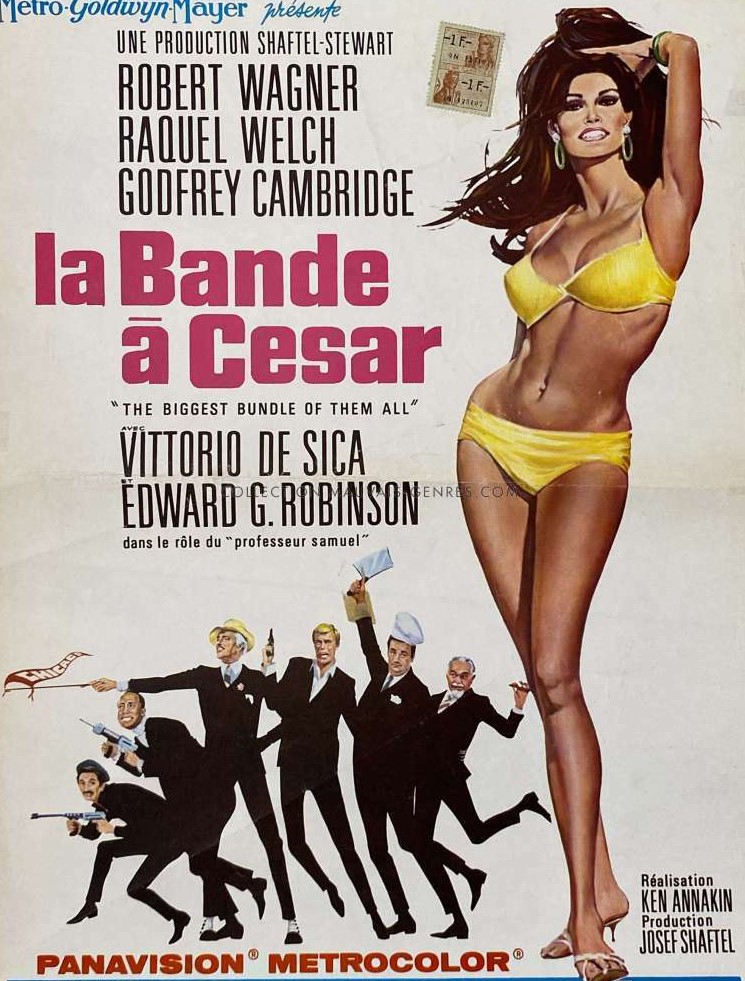
Films that reach the screen two years after filming was completed are generally stinkers. Ken Annakin caper movie The Biggest Bundle of Them All wrapped production in summer 1966 and was not released until January 1968. But the reason was not the usual.
The cause of the unseemly delay was a temper tantrum by Oscar-winning uber-producer Sam Spiegel (Lawrence of Arabia, 1962) who had been working on a similar project about incompetent amateurs kidnapping a gangster kingpin – The Happening (1967) starring Anthony Quinn (previously reviewed in the Blog). After bringing a charge of blatant plagiarism, Spiegel was mollified by being permitted to bring his movie out first, with an inbuilt eight-month gap between both releases, the deal sweetened by a 15% cut of The Biggest Bundle’s profits and the right to vet the script.
Despite success with Those Magnificent Men in Their Flying Machines (1965) and Battle of the Bulge (1965) British director Annakin was at a career impasse. The Fifth Coin written by Francis Ford Coppola and starring George Segal failed to get off the ground. He turned down western Texas Across the River (1966) at a time when Catherine Deneuve and Shirley Maclaine were slotted in for the female roles and was fired from The Perils of Pauline (1967). The Italian Caper as it was then known, recalled Annakin, “did not seem a world-shattering movie but I found the caper fascinating and the cast irresistible.”
Let them eat cheesecake.
It marked the movie debut for producer Josef Shaftel of The Untouchables television fame and for screenwriter Rod Amateau (The Wilby Conspiracy, 1975), also then a television regular although the final script was attributed to another neophyte Sy Salkowitz. The film made the most of Italian locations, Naples and Rome, as well as the South of France and Provence. Annakin caught pneumonia just as shooting was to commence. Shaftel took over for five days only for his material to prove unusable.
Both veteran actors proved easy to direct. “Robinson was like putty in my hands, completely trusting.” And while Vittorio De Sica was every bit as amenable he was inclined to fall asleep on the set as the result of entertaining his mistress the night before. Di Sica was also a compulsive gambler and at one point lost half his salary in a casino.
Raquel Welch, in only her second picture after One Million Years B.C. (1966) – which contained minimal dialogue – was initially a handful. Primarily, this was due to inexperience and her desire to present herself in as alluring a fashion as possible, with impeccable hairstyles and make-up. After she had kept the crew waiting once too often Annakin threatened to eliminate her close-ups unless she respected the shooting schedule.
“On the whole I was quite pleased with the results because she really applied herself and so long as one broke up the scenes into a couple of lines at a time she became able to handle them quite adequately…I was getting along excellently with Raquel – even to the extent of trying to find another picture with her,” Annakin noted in his autobiography. Since this was written three decades after the movie was made, it would have given him ample time to get rid of any latent hostility to the actress. This reaction, it has to be said, is contrary to much of what has been written about Welch’s behavior on the picture. At the time of filming he reported that “she has a marvelous flair for comedy.”
But it appeared that Annakin was the only one who spotted her star potential. “The rest of the cast, especially Bob (Robert Wagner), regarded her as a pin-up girl on the make…none of them thought she was particularly sexy at this time.”
Otherwise, the only other trouble came from Godfrey Cambridge who “had a chip on his shoulder” and from Robert Wagner’s insistence on wearing false eyelashes. Problems arose over the cinematographer’s determination to employ powerful lights even at the height of a Mediterranean summer and a massive dust storm interrupted filming of the final scenes. Annakin also benefitted from the locations and using his experience was able to shift 35 pages of script from interiors to outdoors, completely altering the look of the picture. This made the $2 million movie “look like it cost three or four million,” according to Annakin.
At this point Welch, best known for having been sued by her publicist, was in the process of turning herself into a star in demand. In 1966 Welch was something of a Hollywood secret. She had three pictures in the bank, was working on a fourth and had signed up for a fifth before any of her movies had been released. On the other hand, she was fast becoming one of the most famous faces (and bodies) in the world, on the cover of of hundreds of magazines in Europe, many for the fourth or fifth time.
Having set up a company, Curtwel, managed by husband Patrick Curtis, she would earn $15,570 a week on loan to MGM for a second film Italian movie Shoot, Loud…Louder, I Don’t Understand (1966), considerably more than through her contract with Twentieth Century Fox. A year later she collected £100,000 for two weeks on portmanteau picture The Oldest Profession (1967).
Curtwel was also moving into the production arena, in 1965 attempting to set up No Place for the Dead and the following year optioning the musical comedy The Opposite Sides of the Fence and taking a quarter share in the mooted The Devil’s Discord to star Peter Cushing and Edd Byrnes under the direction of Michael Reeves (Witchfinder General, 1968). None of these ventures materialzed.
As well as having to contend with audience disinterest in the clumsy crook scenario as witnessed by the flop of The Happening, the enforced time gap allowed a second picture featuring bungling criminals called Too Many Crooks (1967) to reach cinemas prior to The Biggest Bundle. However, by January 1968, Welch was a much bigger name on movie marquees, having appeared on 400 international magazine covers and selected by U.S. exhibitors for the International Star of the Year Award while The Biggest Bundle had been preceded by another seven pictures including hits One Million Years B.C. and Fantastic Voyage (1966).
SOURCES: Ken Annakin, So You Wanna Be a Director, (Tomahawk Press, Sheffield 2001), pages 187-194; “Raquel Welch and Manager Form Curtwel Co,” Box Office, May 3, 1965, pW3; “Raquel Welch, Pat Curtis Form Curtwel Prods,” Box Office, October 5, 1965, pSE6; “Toutmasters Sue for 5% of Raquel Welch,” Variety, October 6, 1965, p14; “Raquel Welch in Rome,” Box Office, April 25, 1966, page SE1; “MGM’s Bundle Wrapping at Nice, Orders On Set in 3 Languages,” Variety, July 6, 1966, p7; “8 Pix for 2 Unseen Actresses,” Variety, August 17, 1966, p5; “Businesswoman Side of Raquel Welch,” Variety, November 2, 1966, p20; “Oldest Profession Gets New Locale in West Berlin, Raquel Welch’s 100G Job,” Variety, January 18, 1967, p24; “Columbia-Spiegel Holds 25% Share of MGM’s Bundle,” Variety, December 6, 1967, p3.
Bunch of incompetent crooks kidnap an impoverished Mafia boss who pays his ransom by setting up a major heist. By a stroke of casting alchemy this brings together Cesare (Vittorio De Sica), the epitome of old world Italian charm, knock-out gangster’s moll and scene-stealer-in-chief Juliana (Raquel Welch) replete with scanty knock-out outfits, and criminal mastermind Professor Samuels (Edward G. Robinson). In order to acquire the funds necessary to steal $5 million of platinum ingots from a train – that plan involving a tank and an WW2 bomber – the crew, initially headed by American Harry (Robert Wagner), need to carry out smaller jobs.
Problem is, none of them are any good, not even Cesare, who has lost his flair and botches an attempt to rob an old flame of her jewels. This is a twist on Topkapi (1964) which employed effective amateurs. This bunch can’t even carry out a simple theft from a restaurant. The heist itself is pretty spectacular and innovative. And the movie is quirky, with a darker edge. While there are few belly laughs, the light tone is enough to carry the gentle humor, mostly inspired by the misplaced team, amateurs for various reasons, not necessarily outright lawbreaking, on the run. These include London Cockney mechanic Davey (Davy Kaye), chef Antonio (Francesco Mule) distracted by hunger at every turn, cowardly violinist Benny (Godfrey Cambridge) and Joe (Mickey Knox) with a helluva brood to feed.
The story does a good bit of meandering, as does the camera, much of its focus on the voluptuous charms of Juliana, but the hurt pride of Cesare and the grandiose machinations of the professor keep it on course. The Italian settings, incorporating grand villas and ruins, do no harm either. The heist is terrific and there is a final twist you may or may not see coming. The interplay of characters works best when it involves Juliana, who attempts to twist Cesare around her little finger, that tactic mutual it has to be said, and who keeps the professor on his toes by dancing with him in a disco, and it soon becomes apparent that she has the upper hand over lover-boy Harry.
You could be forgiven for thinking the title refers to Raquel Welch – a cinematic infant at this stage with only One Million Years B.C (1966) in her portfolio – especially when her cleavage and looks receive such prominence, but the caper is classy and different. As well as being obvious she is both sinuous and seductive and clearly has a mind of her own, possibly the most criminally intent of the entire outfit, with weapons the others lack. By this point, she had invented the pop-out bikini, pictures of which had flooded Europe, making her the pin-up par excellence, but those who came to simply gawp quickly realized there was talent behind the body. Although of course there would be those who didn’t care.
De Sica constantly plays around with the idea of being a defunct godfather and Robinson is the antithesis of the gangster roles on which his fame relied. Robert Wagner is less effective, miscast and out of place in such august acting company and losing out to Welch in every scene.
This was a considerable change of pace for British director Ken Annakin after Those Magnificent Men in Their Flying Machines (1965) and Battle of the Bulge (1965) and he brings to this the comedy of the former coupled with the narrative complications of the latter, wrapping everything up in an easy inviting style that makes the most of his stars and the locations. Screenwriter Sy Salkowitz was a television veteran (Perry Mason, The Untouchables et al) , this marking his first venture into the big screen.
Not in the Topkapi class – very little is – but a pleasant diversion nonetheless and for avid Raquel Welch fans, setting aside her outfits, a chance to see her develop more of a screen persona than was permitted in her debut One Million Years B.C.
Thought-provoking drama with a surprisingly contemporary slant set against the grandeur of the Vatican amid geo-political turmoil. At a time of global crisis, dissident Russian archbishop Lakotov (Anthony Quinn) is unexpectedly freed from a labour camp by the Russian premier (Laurence Olivier). Arriving at the Vatican, he is promoted to cardinal by the dying Pope (John Gielgud) before becoming an unexpected contender for Papal office.
The spectacular wealth of the Catholic Church is contrasted with the spectacular poverty of China, on the brink of starvation due to trade sanctions by the United States, nuclear war a potential outcome. The political ideology of Marxism is compared to the equally strict Christian doctrine, of which Lakotov’s friend Father Telemond (Oskar Werner) has fallen foul. There is a sub-plot so mild it scarcely justifies the term concerning television reporter George Faber (David Janssen) torn between wife Ruth (Barbara Jefford) and younger lover Chiara (Rosemary Dexter).
Lakotov is drawn into the Russian-Chinese-American conflict and the battle for the philosophical heart of the Christian faith while bringing personal succour to the lovelorn and performing the only modern miracle easily within his power, which could place the Church in jeopardy, while condemned to the solitariness of his position.
The political and philosophical problems addressed by the picture, which was set 20 years in the future, are just as relevant now. The film’s premise, of course, while intriguing, defies logic and although the climax has a touch of the Hollywood about it nonetheless it follows an argument which has split the Church from time immemorial.
You would not have considered this an obvious candidate for the big-budget 70mm widescreen roadshow treatment, but MGM, after the Church not surprisingly refused access to the Vatican, spent millions of dollars on fabulous sets, including the Sistine Chapel. The roadshow version of the picture, complete with introductory musical overture and an entr’acte at the intermission, is leisurely and absorbing, held together by a stunning – and vastly under-rated – performance by Anthony Quinn (The Lost Command, 1966) who has abandoned his usual bombastic screen persona in pursuit of genuine humility and yet faces his moments when he questions his own faith.
Ruth has a pivotal role in bringing Lakotov down to earth but George has the thankless task, setting aside the quandaries of his love life, of talking the audience through the sacred ceremonies unfolding sumptuously on screen as the cardinals bury one Pope and elect another.
You wouldn’t think, either, that Hollywood could find room in such a big-budget picture for philosophical discussion but questions not only of the existence of God but whether he has abandoned Earth are given considerable scope, as are discussions about Marxism and practical solutions to eternal problems. None of these arguments are particularly new but are given a fair hearing. There is a hint of the Inquisition about the “trial” Telemond faces. Oskar Werner (Interlude, 1968) carries off a difficult role.
David Janssen (Warning Shot, 1967) is mere window dressing and Rosemary Dexter (House of Cards, 1968) mostly decorative but Barbara Jefford (Ulysses, 1967) is good as the wounded wife. Laurence Olivier (Khartoum, 1966) is the pick of the sterling supporting cast which included John Gielgud (Becket, 1964), Burt Kwouk (The Brides of Fu Manchu, 1966), Vittorio de Sica (It Happened in Naples, 1960), Leo McKern (Assignment K, 1968), Frank Finlay (A Study in Terror, 1965), Niall McGinnis (The Viking Queen, 1967) and Clive Revill (Fathom, 1967). In a small role was Isa Miranda, the “Italian Marlene Dietrich,” who had made her name in Max Ophuls Everybody’s Woman (1934) and enjoyed Hollywood success in films like Hotel Imperial (1939) opposite Ray Milland.
Michael Anderson (Operation Crossbow, 1965) directed with some panache from a script by veteran John Patrick (The World of Suzie Wong, 1960) and Scottish novelist James Kennaway (Tunes of Glory, 1960) based on the Morris West bestseller.
I found the whole enterprise totally engrossing, partly because I did not know what to expect, partly through Anderson’s faultless direction, partly it has to be said by the glorious backdrop of the Vatican and the intricacy of the various rites, but mostly from the revelatory Quinn performance. And even if the plot is hardly taut, not in the James Bond clock-ticking class, it still all holds together very well. From the fact that it was a big flop at the time both with the public and the critics, I had expected a stinker and was very pleasantly surprised.
By this point in her career Sophia Loren was adopted by Hollywood primarily as a means of rejuvenating the romantic screen careers of much older male stars. John Wayne was over two decades her senior in Legend of the Lost (1957), Frank Sinatra and Gregory Peck nearly two decades older in The Pride and the Passion (1957, and Cary Grant a full three decades in Houseboat (1958). But where Grant was sprightly enough and with superb comic timing and Loren had the charm to make Houseboat work, the May-December notion lost much of its appeal when translated to her Italian homeland and an aging Clark Gable.
While engaging enough, the tale mostly relies on a stereotypical stuffy American’s encounters with a stereotypical down-to-earth Italian although Loren adds considerable zap with her singing-and-dancing numbers. Lawyer Michael Hamilton (Clark Gable), in Italy to settle his deceased brother’s affairs, discovers the dead man has left behind eight-year-old boy Nando (Marietto) being looked after in haphazard fashion and in impoverished circumstances in Capri by his aunt Lucia (Sophia Loren), a nightclub singer. Determined to give the boy a proper American education, Hamilton engages in a tug-of-war with Lucia.
In truth, Lucia lacks maternal instincts, allowing the boy to stay up till one o’clock in the morning handing out nightclub flyers and not even knowing where the local school is. Hamilton is in turns appalled and attracted to Lucia, in some part pretending romantic interest to come to an out-of-court settlement. To complicate matters, Hamilton is due to get married back home.
At times it is more travelog than romantic comedy, with streets packed for fiestas and cafes full well into the night, a speedboat ride round the glorious bay, another expedition under the majestic caves, a cable car trip up the cliffs to view spectacular scenery, and the local population enjoying their version of la dolce vita. But the piece de resistance is Lucia’s performance in the nightclub, ravishing figure accompanied by more than passable voice as she knocks out “Tu vuo fa L’Americano” (which you might remember from the jazz club scene in The Talented Mr Ripley, 1999). She has a zest that her suitor cannot match but which is of course immensely appealing.
Lucia is torn between giving the boy a better start in life, already insisting for example that he speak English, and holding on to him while street urchin Nando is intent on acting as matchmaker. Most of the humor is somewhat heavy-handed except for a few exceptional lines – complaining that he cannot sleep for the noise outside, Hamilton asks a waiter how these people ever sleep only to receive the immortal reply: “together.”
Gable lacks the double-take that served Cary Grant so well and instead of looking perplexed and captivated mostly looks grumpy. But this is still Gable and the camera still loves him even if he has added a few pounds. He was by now a bigger global star than in the Hollywood Golden Era thanks in part to regular reissues of Gone with the Wind (1939) but mostly to a wider range of roles and he was earning far more than at MGM, in the John Wayne/William Holden league of remuneration. Loren was the leading Italian female star, well ahead in Hollywood eyes of competitors Claudia Cardinale and Gina Lollobrigida, and had the skill, despite whatever age difference was foisted upon her, of making believable any unlikely romance. Here, zest and cunning see her through. Vittorio De Sica (The Angel Wore Red, 1960) has a scene-stealing role as an Italian lawyer with an eye for the ladies.
Director Melville Shavelson (Cast a Giant Shadow,1966) thought he had cracked the problems of the older man-younger girl romance having shepherded Houseboat to box office glory . While this picture doesn’t come unstuck it is nowhere near Houseboat. This turned out to be Gable’s penultimate film, not quite the fitting reminder of a glorious career, and he died shortly after its release. While Loren trod water with this picture she was closing in on a career breakthrough with her Oscar-winning Two Women (1960).
Given that this is filmed in black-and-white, it seems a curious title. So I’m assuming the color is a reference to a scarlet woman which, indeed, Ava Gardner (On the Beach, 1959) is, working in a “cabaret” in an unnamed town at the start of the Spanish Civil War. Strangely enough, the decision to shoot in black-and-white works in the actress’s favor. She was one of the last relics of the Hollywood Golden Age when brilliant cinematographers used innovative lighting to capture on screen not so much great beauty but tantalizing emotion.
The close-up was almost exclusively the preserve of actresses who could convey deep feeling with minute changes of expression or simply through their eyes. Here, a couple of joint close-ups prove the point: Gardner’s face illuminated, struggling to contain passion; that of lover Dirk Bogarde (Song without End, 1960) merely the same as always.
This Italian-American production is part homily, part reverential, part brutal. Bogarde plays a priest on the run from the invading Communist forces during the Spanish Civil War. He takes refuge in a cabaret (code for brothel) where he is sheltered by Gardner. He has just denounced his faith so when captured is not executed as an enemy of the state, thus allowing him to begin a relationship with her. They share an unusual type of innocence, Gardner because, as what was known in those days as a woman of easy virtue, she has never known true love, Bogarde, for obvious reasons, the same. Their trembling acceptance of this wondrous state of affairs is the beauty of the film. No one can portray a fallen woman like Gardner, but even as a mature woman her steps towards true love are hesitant, almost believing it is tucked away beyond the rainbow far out of reach, while inner conflict had become central to the Bogarde screen persona.
The love story which would surely in any case have a tragic outcome unfortunately too often plays second fiddle to a subsidiary tale of safeguarding a sacred relic – about whose importance, strangely enough, both sides are agreed – and of arguments between various other political characters over the conflict. Joseph Cotten as a cynical journalist – are there any other kind? – bears testimony to the opposing perspectives while Vittorio de Sica has a glorious cameo as a no-nonsense general who nonetheless deplores the “dirty” war. Neither side comes out well in the war, the Communists, like a mob storming Dracula’s castle, destroy the cathedral, the Republicans committed to killing all prisoners so as not to hold up the advance of their troops. Only the clergy retain their principles even when tortured.
Writer-director Nunnally Johnson had good reason for choosing to film in black-and white – it permitted use of newsreel footage of diving Stuka bombers and more importantly since much of the story takes place at night it creates a haunted background of dark alleys. Color would have destroyed such a vision. You could argue there is artistic purpose here, filming a country which has fallen into spiritual darkness. But that would not be true of the star – black-and-white allows rare opportunity to show what the camera adores in Gardner, her face, even in repose, absorbing the light, as if she were, indeed, redemption.




 The Magnificent 60s