On Her Majesty’s Secret Service (1969) ***

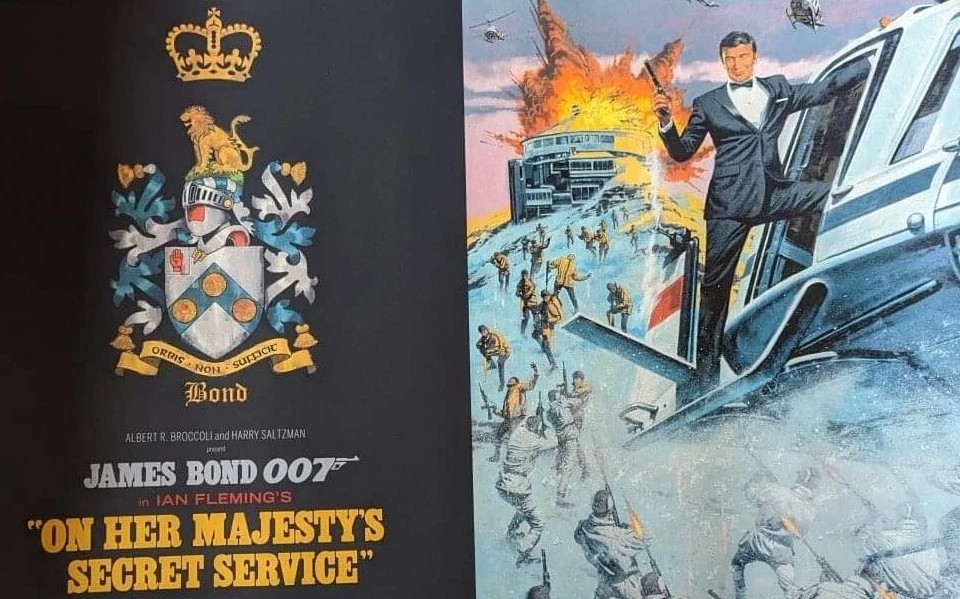
Holds a special place in my movie heart because it was the first James Bond film I ever saw and the first soundtrack I ever bought. Having, by parental opposition, been denied the opportunity to see any of the previous instalments and therefore having little clue as to what Sean Connery brought to the series I wasn’t interested in the fact that he had been replaced. I can’t remember what my younger self thought of the downbeat ending but on the current re-view felt that a rather cursory storyline was only saved by the stunning snow-based stuntwork, two races on skis, one on a bobsleigh, car chase on ice and the kind of helicopter framing against the sun that may well have inspired Francis Ford Coppola in Apocalypse Now (1979).
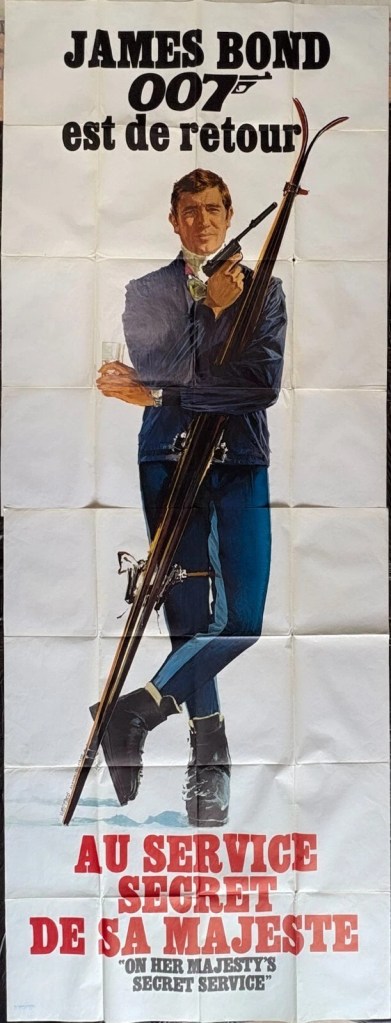
The heraldic subplot bored me as much to tears as it did the assorted dolly birds (to use a by-now-outlawed phrase from the period) and I was struggling to work out exactly what global devastation could be caused by his brainwashed “angels of death” (the aforementioned dolly birds). This is the one where Bond threatens to retire and gets married. Given the current obsession with mental health, the bride has a rather more contemporary outlook than would have been noted at the time. We are introduced to her as a wannabe suicide. Good enough reason for Bond to try and rescue her from the waves, and her mental condition not worthy of comment thereafter.

Turns out she’s the feisty spoiled-brat daughter Tracy (Diana Rigg) of crime bigwig Draco (Gabriele Ferzetti) and Bond persuades that Mr Big to help him snare the bigger Mr Big Blofeld (Telly Savalas), hence the convoluted nonsense about heraldry. There’s the usual quotient of fisticuffs and naturally James Bond doesn’t consider falling in love with Tracy as a barrier to seducing a couple of the resident dolly birds.

I takes an awful long time to click into gear but when it does the stunt work – perhaps the bar now having been raised by Where Eagles Dare (1968) – is awesome. Apart from an occasional bluescreen for a close-up of Bond, clearly all the chases were done, as Christopher Nolan likes to say, “in camera.” And there’s about 30 minutes of full-on non-stop action.
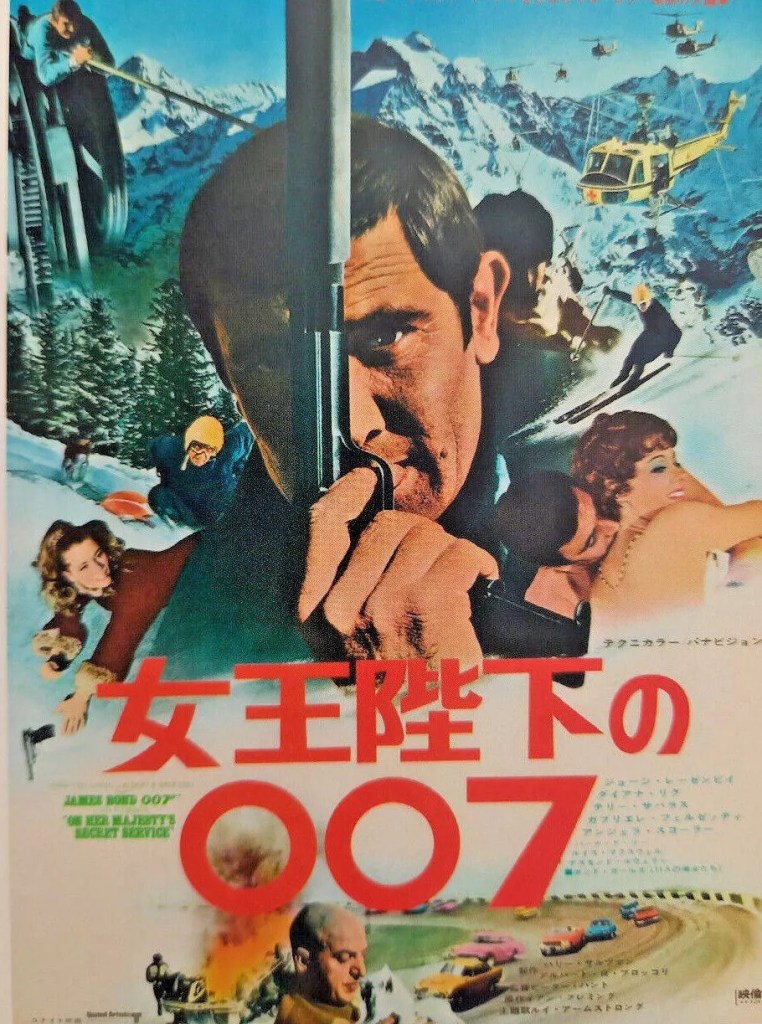
Pre-empting the future eyebrow-raising antics of Roger Moore, I felt George Lazenby was decent enough, bringing a lighter touch than Connery to the proceedings without his inherent sense of danger (which Moore also lacked). Diana Rigg, I felt was miscast, more of a prissy Miss Jean Brodie than a foil for Bond, even if this one was a substitute for the real thing. It was a shame Honor Blackman in Goldfinger (1964) had taken the slinky approach but that would have worked better to hook Bond than earnestness.  

I’m not entirely sure how Blofeld planned to employ his angels of death but the prospect of a gaggle of dolly birds gathering in fields or rivers and being capable of distributing enough toxic material to destabilize the world seems rather ill-thought-out.

Theoretically, this is meant to be one of the better ones in the series but that’s mostly based on the doomed romance and the downbeat ending and I guess that Diana Rigg (The Avengers, 1965-1968) supposedly brought more acting kudos than others in the female lead category. Adopting something close to her Avengers persona would have been more interesting but I guess she was fighting against being typecast.

If you get bored during the endless heraldry nonsense, you can cast your eye over the assortment of Bond girls who include Virginia North (The Long Duel, 1967), Angela Scoular (The Adventurers, 1970), Joanna Lumley (Absolutely Fabulous, 1992-2012), Catherine Schell (Moon Zero Two, 1969), Julie Ege (Creatures the World Forgot, 1971), Anouska Hempel (Black Snake, 1973) and Jenny Hanley (Scars of Dracula, 1970), who, as graduates from this particular talent school, made a greater impact in entertainment than many of their predecessors.

Second unit director Peter Hunt made his full directorial debut but focussed more on his speciality – action – than the drama. Written by series regular Richard Maibaum (Dr No, 1962) and Simon Raven (Unman, Wittering and Zigo, 1971) and more faithful than usual to the Ian Fleming source novel.

Top marks for the action, less so for the rest.
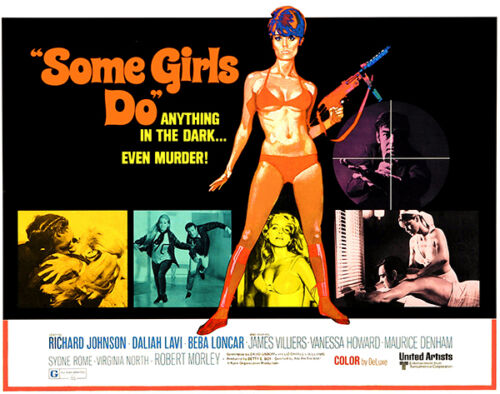
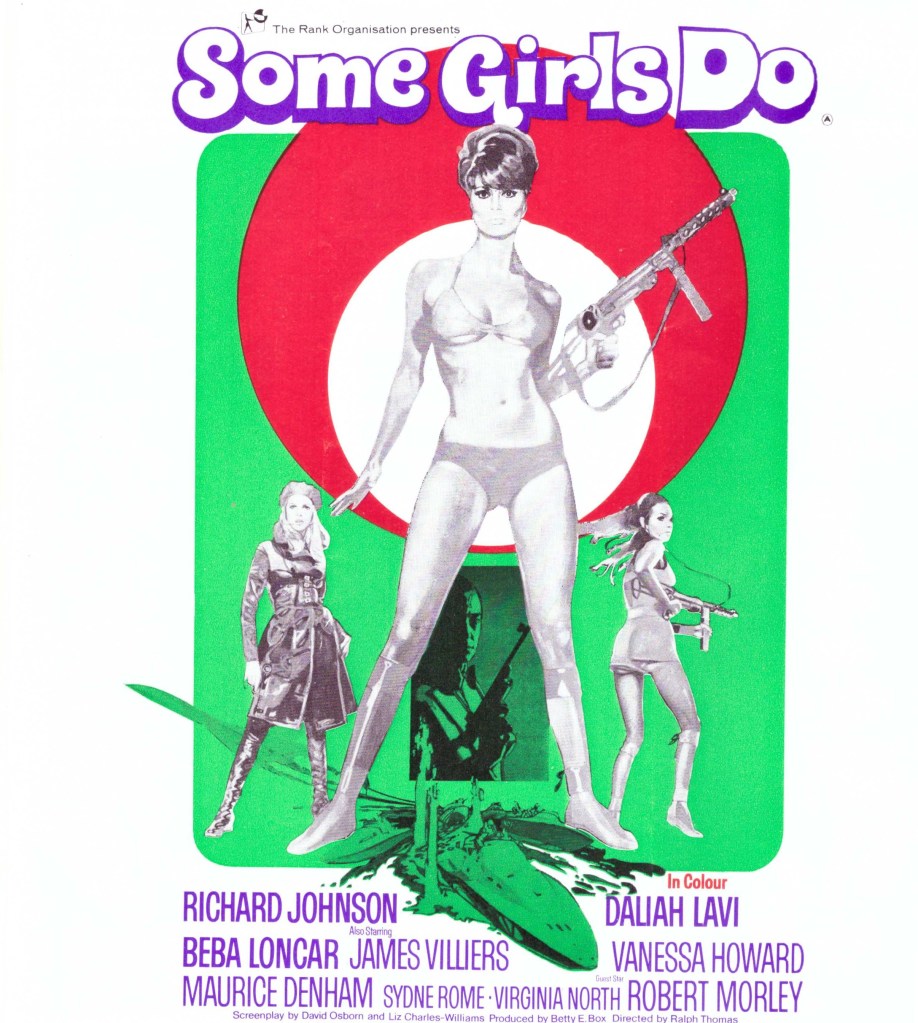
Some Girls Do (1969) ****

Enjoyed this sequel to Deadlier Than the Male (1967) far more than I expected because it sits in its own little world at some point removed from the espionage shenanigans that dominated the decade. Hugh (nee Bulldog) Drummond (Richard Johnson) is neither secret agent nor involved in espionage high jinks, instead employed in the more down-to-earth domain of insurance investigator, albeit where millions are at stake. Although his overall adversary is male, the smooth-talking Carl Petersen (James Villiers), adopting a series of disguises for most of this picture, the real threat comes from a pair of villainesses in the shape of Helga (Daliah Lavi) and Pandora (Beba Loncar). If anything, this pair are a shade more sadistic than Irma and Penelope from the previous outing.

The sequel doubles up – or doubles down – on the female villainy quotient, Petersen having created a race of lethal female robots who spend their time dispatching scientists working on the world’s first supersonic airliner. Global domination is only partly Petersen’s aim since he also stands to gain £8 million ($134 million today) if the plane doesn’t launch on schedule. Livening up proceedings are Flicky (Sydne Rome), a somewhat kooky Drummond fan who has her own agenda, Peregrine “Butch” Carruthers (Ronnie Stevens), a mild-mannered embassy official assigned bodyguard duties, and chef-cum-informant Miss Mary (Robert Morley).

Villiers has found a way of turning an ultrasound device intended originally to aid cheating in a boat race into something far more dangerous. But, of course, for Helga seduction is the main weapon in her armory, and Drummond’s first sighting of her – a superb cinematic moment – is sitting on the branch of a tree wielding a shotgun. Equally inviting are the squadron of gun-toting mini-skirted lasses guarding Petersen’s rocky fortress.

The movie switches between Helga, Pandora and the robots raining down destruction and Drummond trying to prevent it. Dispensing with the boardroom activities that held up the action in Deadlier than the Male, this is a faster-moving adventure, with Drummond occasionally outwitted by Helga and calling on his own repertoire of tricks. Dialog is often sharp with Drummond imparting swift repartee.

The action – on land, sea and air – is a vast improvement on the original. The pick is a motorboat duel, followed closely by Drummond in a glider coming up against a venomous aeroplane and saddled with a defective parachute. And there are the requisite fisticuffs. Various malfunctioning robots supply snippets of humour.

Richard Johnson (A Twist of Sand, 1968) truly found his metier in this character and it was a shame this proved to be the last of the series. Although Daliah Lavi never found a dramatic role to equal her turns in The Demon (1963) and The Whip and the Body (1963) and had graced many an indifferent spy picture as well as The Silencers (1966), she is given better opportunity here to show off her talent. Beba Loncar (Cover Girl, 1968) is her make-up obsessed bitchy buddy. Sydne Rome (What?, 1972) makes an alluring debut. James Villiers (The Touchables, 1968) is the only weak link, lacking the inherent menace of predecessor Nigel Green.

There’s a great supporting cast. Apart from Robert Morley (Genghis Khan, 1965) look out for Maurice Denham  (Danger Route, 1967), Adrienne Posta (To Sir, with Love, 1967) and in her first movie in over a decade Florence Desmond (Three Came Home, 1950). The robotic contingent includes Yutte Stensgaard (Lust for a Vampire, 1971), Virginia North (Deadlier Than the Male), Marga Roche (Man in a Suitcase, 1968), Shakira Caine (wife of Sir Michael), Joanna Lumley (television series Absolutely Fabulous), Maria Aitken also making her debut, twins Dora and Doris Graham and Olga Linden (The Love Factor, 1969).  Peer closely and you might spot Coronation Street veteran Johnny Briggs.

The whole package is put together with some style by British veteran Ralph Thomas (Deadlier than the Male). Screenplay by David Osborn and wife Liz Charles-Williams (Deadlier than the Male) is based on the book by “Sapper”.

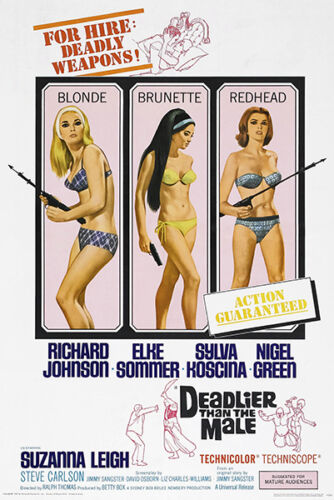
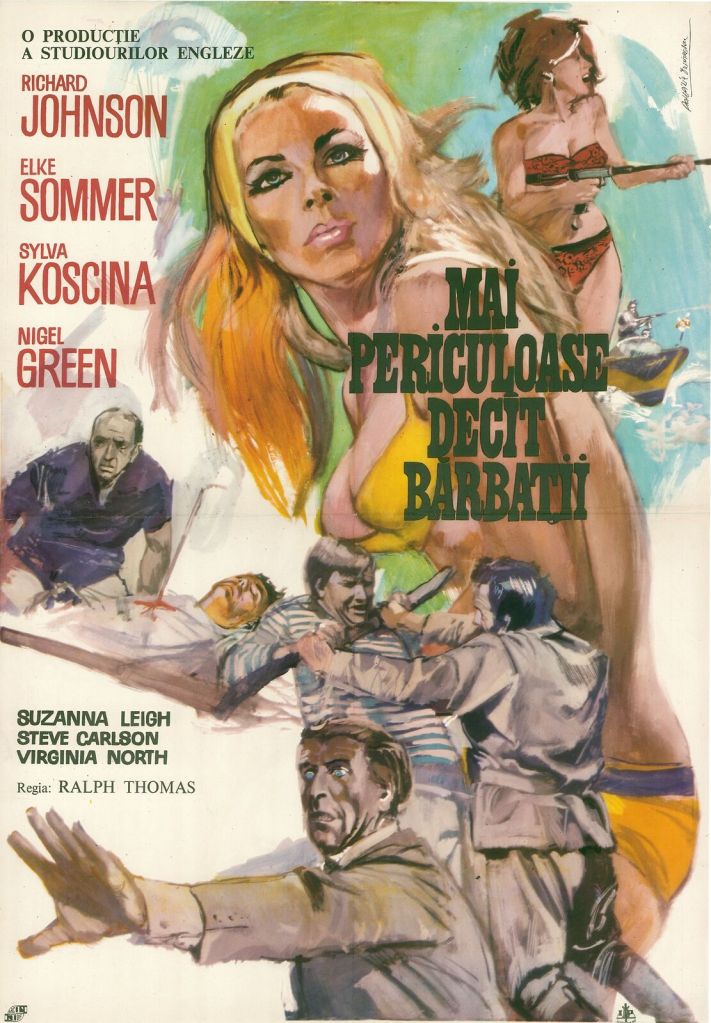
Deadlier than the Male (1967) ****

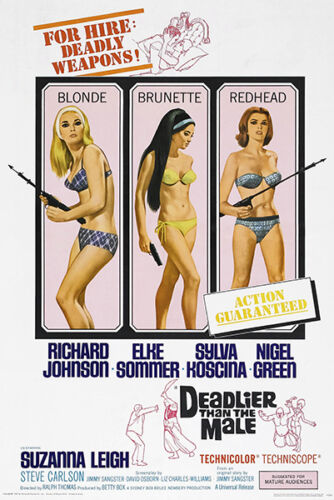
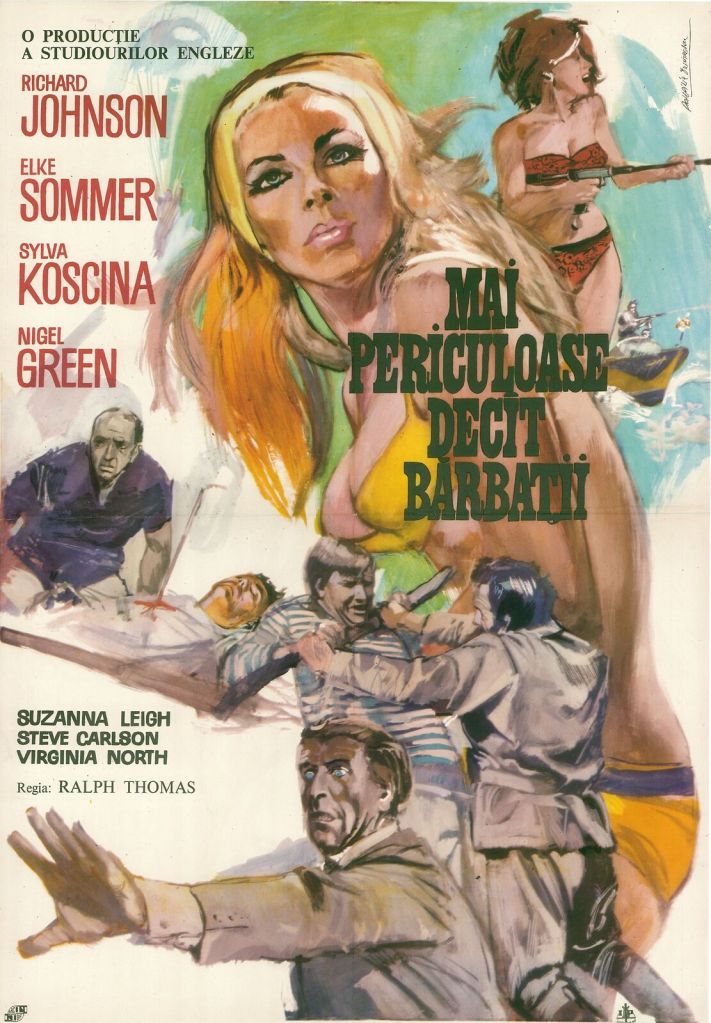
For a movie intended to set up a series character in the vein of James Bond, it was ironic that it was the women who stole the show, not just from their tendency to turn up in bikinis but for their outrageous villainy. Irma (Elke Sommer) and Penelope (Sylva Koscina) are the seductive assassins in the hire of Carl Petersen (Nigel Green) who has designs on an Arab oil empire. On her own Irma dispatches mogul Henry Keller (Dervis Ward) then the pair – emerging from the sea like a pair of latter-day Ursula Andresses – harpoon his colleague Wyngarde (John Stone).  

Soon Hugh Drummond (Richard Johnson), investigating the death of Stone, becomes a target  and that sets him off, with nephew Robert (Steve Carlson) in tow,  to the Mediterranean and the yacht of oil-rich King Fedra (Zia Mohyeddin) where, of course, the girls lie in wait.

Dispensing with the gadgets – except for one item employed by the villainesses – and gimmicks of Bond, but retaining the quips, this is a fun ride with a more down-to-earth leading man – like the early Bonds – smarter girls, a more old-fashioned mystery, hefty thug Chang (Milton Reid)  in the Oddjob mold, a castle doubling as the villain’s lair, a suave master criminal, some detective work, and a super scene involving giant robotic chess men.

The bickering between Irma and Penelope, not just a tad sadistic but a kleptomaniac especially as far as her partner is concerned, coupled with their overweening confidence, makes them much more human than any Bond Girl and the character traits explored have a pay-off at the climax. Equally interesting are the mind games, Drummond vs. Peterson but also Drummond vs. Irma. And that the female baddies see it as points on their scoreboard to seduce Drummond rather than the other way round.

Drummond is every bit as capable a seducer as Bond and equally ruthless, stripping one suspect naked. Petersen is also a clever character, faking his own death and running a very smooth operation, and certainly his recruitment techniques are second to none.

Some ideas were certainly ahead of their time, the chess men are the equivalent of a modern computer game while the human bomb has, unfortunately, entered the modern lexicon and there are enough female serial killers around to prevent anyone believing they are always (to use a sexist phrase) the gentle sex. However, in the middle 1960s, the concept that women would be partial to murder and torture not to mention repeatedly seducing males went so much against the grain of the male authority figures that the British censor slapped an X-certificate on the movie.

Shakespearian actor Richard Johnson was at one time an MGM contract player, but his only previous top-billed outing was the Italian-made The Witch (1966) but he certainly made a splash with this character, investing it with a great deal more gravitas than Derek Flint or Matt Helm. The Teutonic Elke Sommer (The Venetian Affair, 1966) is brilliant as one half of the assassin tag-team with a batch of one-liners for every occasion. Sylva Koscina (A Lovely Way To Die, 1968), nose always put out of joint, almost steals the show.  Nigel Green (Tobruk, 1967), while his usual sardonic self, has the playfulness of the rich and powerful.

Steve Carlsen, in his movie debut, doesn’t make much of an impact in a largely lame role. Zia Mohyeddin has a more interesting role as the oil kingpin wanting to help his people. As you can expect in a spy picture there are a host of beautiful women – Suzanna Leigh (The Lost Continent, 1968) a defector, Virginia North, also making her debut, Justine Lord (Night after Night after Night, 1969), and Didi Sydow in her only screen appearance.

The light comedy experience of director Ralph Thomas (Doctor in Distress, 1963) comes in very handy, as his sense of comic timing is excellent, but, perhaps learning from his previous brush with espionage in Hot Enough for June / Agent 8¾ (1964) brings a bigger punch to the action scenes. And it’s a bold ploy to start with an action sequence revolving around Irma and Penelope rather than our star man.

The screenplay was a team effort – Jimmy Sangster (The Devil-Ship Pirates, 1964), taking a break from Hammer duties, David D. Osborn (Maroc 7, 1967) and Liz Charles-Williams, making her screen debut  – all involved.  This was familiar territory for composer Malcolm Lockyer (Five Golden Men, 1967). British pop act The Walker Brothers had a hit with the theme tune.

This is more fun than camp, not a send-up of the genre like Derek Flint and Matt Helm, but a spy picture with a believable leading men and excellent villains. But the plot is more centered on filthy lucre rather than global control and there is a genuine understanding of how businesses work – takeovers, mergers, dirty dealings – though small wonder Petersen would like to be shot of pedantic boardroom nuisances like Bridgenorth (Leonard Rossiter) – wouldn’t we all?

Bulldog Drummond was an international crime-buster invented by “Sapper,” the pen-name of H.C. McNeile. Bulldog Drummond had been a Hollywood mainstay for over four decades, the twenty-plus pictures attracting stars like Ronald Colman (Bulldog Drummond, 1929, and Bulldog Drummond Strikes Back, 1934), Ray Milland (Bulldog Drummond Escapes, 1937), Walter Pidgeon (Calling Bulldog Drummond, 1951) and a young Ralph Richardson (The Return of Bulldog Drummond, 1934). But the notion, in the Swinging Sixties, of tagging any leading man by the moniker of ‘Bulldog’ did not seem like a good idea, so the character underwent wholesale reinvention, and his nickname is never mentioned. 

The title comes from a line in a poem by Rudyard Kipling, The Female of the Species. That was the original title of the film and also of a Sapper book.

The Long Duel (1967) ****

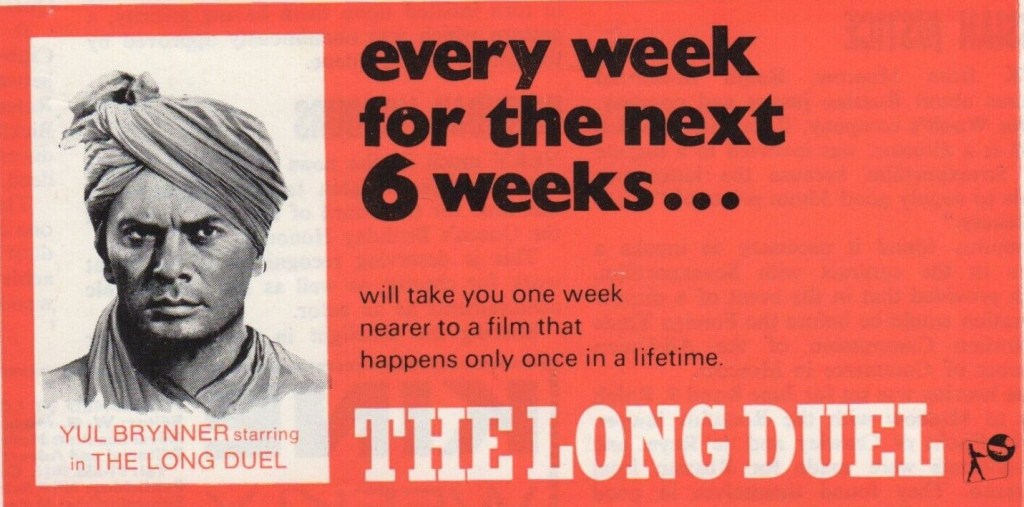
Surprisingly thoughtful action-packed “eastern western”  with obvious parallels to the plight of the Native American. Here, the British attempt to shift nomadic tribesmen from their traditional hunting grounds in north-west India to “resettlements.” Set in post World War One India, the duel in question between tribal chief Sultan (Yul Brynner) and police chief Young (Trevor Howard) brims over with mutual respect.

Unusually intelligent approach for what could otherwise have been a more straight forward action picture, more critical of the British, whose idea of civilization is to turn everything into “a bad replica of Surrey,” than you would have expected for the period. Ruthless pursuit in large part because the British “can’t afford local heroes.”   

After his tribe is taken captive with a view to forced repatriation by boorish police superintendent Stafford (Harry Andrews), Sultan organises a breakout, taking with him heavily pregnant wife Tara (Imogen Hassall) who dies while on the run. The Governor (Maurice Denham) of the province brings in Young – who knows the territory and is more familiar, through a previous career as an anthropologist, with the nomadic lifestyle, and largely sympathetic to their cause – to head up an elite force and bring to justice Sultan, whose men are now murderers.

Young seems lacking in the stiff upper lip department, condemned for “misplaced chivatry,” unwilling to just do his job, and certainly not to blindly obey the more ruthless ignorant Stafford. Aware he is unable to stop what the British would like to call progress, hopes he can ease the transition, avoid driving the tribesmen into the ground and prevent a noble leader like Sultan ending up a despised bandit, the kind who were forever presented as the bad guys in films like North West Frontier / Flame over India (1959).

Young has the sense not to be dragged all over the country searching for his quarry, and sets up his team in more sensible fashion, but still, is largely outwitted by Sultan, especially as Stafford, who later gets in on the act, is too dumb to fall for obvious lures. Adding  complication is the arrival of Stafford’s equally intelligent daughter Jane (Charlotte Rampling), a Cambridge University graduate, who falls for Young.

Thankfully, there’s no need for the British hero to transition from brute into someone more appreciative of the way of life he is forced to destroy – a trope in the American western – and equally there’s no corrupt businessman selling the tribesman weaponry and there’s no savage attack either on innocent women and children, and removal of these narrative cliches allows the movie more freedom to debate the central questions of freedom. The tribesmen acquire rifles and the occasional Gatling gun simply by stealing them from the more inept British soldiers.

Anyone expecting a shoot-out or more likely a swordfght between Sultan and Young will be disappointed, the title, as with the entire picture, is more subtle than that, especially as each, in turn, have the opportunity to save each other’s lives. Eventually, Young’s sympathetic approach is deemed ineffective and Stafford is put in charge, leading to a superb climax.

While Sultan’s nomadic lifestyle is eased by dancing girl Champa (Virginia North), whose loyalty to her lover is soon put to the test, and who is not, surprisingly, necessarily looking for love, his emotions center more around his younger son, whom he doesn’t want to grow up wearting the tag of bandit’s son. The solution to that problem seems a tad simplistic, but still seems to work.

With the feeling of western with splendid use of superb mountainous locales, and excellent widescreen, an astute script opts as much for intelligence as adventure.

One of Yul Brynner’s (The Double Man, 1967) last great roles before he turned into a parody of himself and certainly more than matched by Trevor Howard (Von Ryan’s Express, 1967), given a role with considerable depth and scope. Charlotte Rampling (Three, 1969) also impresses while Virginia North (Deadlier than the Male, 1967) and Imogen Hassall (El Condor, 1970) provide support. Harry Andrews (The Night They Raided Minsky’s / The Night They Invented Striptease, 1968) has played this role before. You can catch Edward Fox (Day of the Jackal, 1973) in a tiny role.

Superbly directed by Ken Annakin (Battle of the Bulge, 1965) from a script by Peter Yeldham (Age of Consent, 1969), Ernest Borneman (Game of Danger, 1954) and Ranveer Singh in his debut.

Well worth a look.

Deadlier than the Male (1967) ****

Now revealed as the first film seen by Quentin Tarantino – at the age of five.

For a movie intended to set up a series character in the vein of James Bond, it was ironic that it was the women who stole the show, not just from their tendency to turn up in bikinis but for their outrageous villainy. Irma (Elke Sommer) and Penelope (Sylva Koscina) are the seductive assassins in the hire of Carl Petersen (Nigel Green) who has designs on an Arab oil empire. On her own Irma dispatches mogul Henry Keller (Dervis Ward) then the pair – emerging from the sea like a pair of latter-day Ursula Andresses – harpoon his colleague Wyngarde (John Stone).   

Soon Hugh Drummond (Richard Johnson), investigating the death of Wyngarde, becomes a target  and that sets him off, with nephew Robert (Steve Carlson) in tow,  to the Mediterranean and the yacht of oil-rich King Fedra (Zia Mohyeddin) where, of course, the girls lie in wait.

Dispensing with the gadgets – except for one item employed by the villainesses – and gimmicks of Bond, but retaining the quips, this is a fun ride with a more down-to-earth leading man – like the early Bonds – smarter girls, a more old-fashioned mystery, a hefty thug Chang (Milton Reid)  in the Oddjob mold, a castle doubling as the villain’s lair, a suave master criminal, some detective work, and a super scene involving giant robotic chess men.

The bickering between Irma and Penelope, who is not just a tad sadistic but a kleptomaniac especially as far as her partner is concerned, coupled with their overweening confidence, makes them much more human than any Bond Girl and the character traits explored have a pay-off at the climax. Equally interesting are the mind games, Drummond vs. Peterson but also Drummond vs. Irma. And that the female baddies see it as points on their scoreboard to seduce Drummond rather than the other way round.

Drummond is every bit as capable a seducer as Bond and equally ruthless, stripping a suspect naked. Petersen is also a clever character, faking his own death and running a very smooth operation, and certainly his recruitment techniques are second to none.

Some ideas were certainly ahead of their time, the chess men are the equivalent of a modern computer game while the human bomb has, unfortunately, entered the modern lexicon and there are enough female serial killers around to prevent anyone believing they are always (to use an outmoded sexist phrase) the gentle sex. However, in the middle 1960s, the concept that women would be partial to murder and torture not to mention repeatedly seducing males went so much against the grain of the male authority figures that the British censor slapped an X-certificate on the movie.

Shakespearian actor Richard Johnson was a one time MGM contract player, but his only previous top-billed outing was the Italian-made The Witch (1966). He certainly made a splash with this character, investing it with a great deal more gravitas than Flint or Helm. The Teutonic Elke Sommer (The Venetian Affair, 1966) is brilliant as one half of the assassin tag-team with a batch of one-liners for every occasion. Sylva Koscina (A Lovely Way To Die, 1968), nose always put out of joint, almost steals the show.  Nigel Green (Tobruk, 1967), while his usual sardonic self, has the playfulness of the rich and powerful.

Steve Carlsen, in his movie debut, doesn’t make much of an impact in a largely lame role. Zia Mohyeddin has a more interesting part as the oil kingpin wanting to help his people. As you can expect in a spy picture there are a host of beautiful women – Suzanna Leigh (The Lost Continent, 1968) a defector, Virginia North, also making her debut, Justine Lord (Night after Night after Night, 1969), and Didi Sydow in her only screen appearance.

The light comedy experience of director Ralph Thomas (Doctor in Distress, 1963) comes is very handy, as his sense of comic timing is excellent, but, perhaps learning from his previous brush with espionage in Agent 8¾ / Hot Enough for June (1964) brings a bigger punch to the action scenes. And it’s a bold ploy to start with an action sequence revolving around Irma and Penelope rather than our star man.

The screenplay was a team effort – Jimmy Sangster (The Devil-Ship Pirates, 1964), taking a break from Hammer duties, David D. Osborn (Maroc 7, 1967) and Liz Charles-Williams, making her screen debut  – all involved.  This was familiar territory for composer Malcolm Lockyer (Five Golden Men, 1967). British pop act The Walker Brothers had a hit with the theme tune.

This is more fun than camp, not a send-up of the genre like Derek Flint and Matt Helm, but a spy picture with a believable leading men and excellent villains. But the plot is more centred on filthy lucre rather than global control and there is a genuine understanding of how businesses work – takeovers, mergers, dirty dealings – though small wonder Petersen would like to be shot of pedantic boardroom nuisances like Bridgenorth (Leonard Rossiter) – wouldn’t we all?

Bulldog Drummond was an international crime-buster invented by “Sapper,” the pen-name of H.C. McNeile. Bulldog Drummond had been a Hollywood mainstay for over four decades, the twenty-plus pictures attracting stars like Ronald Colman (Bulldog Drummond, 1929, and Bulldog Drummond Strikes Back, 1934), Ray Milland (Bulldog Drummond Escapes, 1937), Walter Pidgeon (Calling Bulldog Drummond, 1951) and a young Ralph Richardson (The Return of Bulldog Drummond, 1934). But the notion, in the Swinging Sixties, of tagging any leading man by the moniker of ‘Bulldog’ did not seem like a good idea, so the character underwent wholesale reinvention and his nickname is never mentioned.  

The title comes from a line in a poem by Rudyard Kipling, The Female of the Species. That was the original title of the film and also of a Sapper book.

You can get his on a double bill with the sequel Some Girls Do from Network at a very reasonable price. Will be reviewing Some Girls Do next.

Discover WordPress

A daily selection of the best content published on WordPress, collected for you by humans who love to read.

The Atavist Magazine

by Brian Hannan

WordPress.com News

The latest news on WordPress.com and the WordPress community.