The Twist, the Macarena, Twerking, none of these routines can hold a candle to the Waltz, which has dominated the dance world for centuries. You think maybe Queen invented the idea of audience participating in a tune by dancing and clapping in “We Will Rock You”, well, that had been an integral element of waltzes with a faster rhythm equally for centuries.
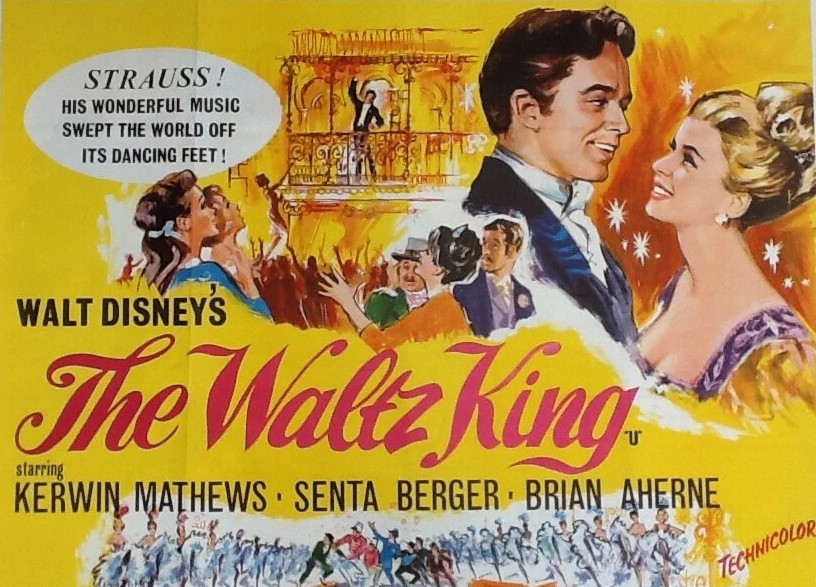
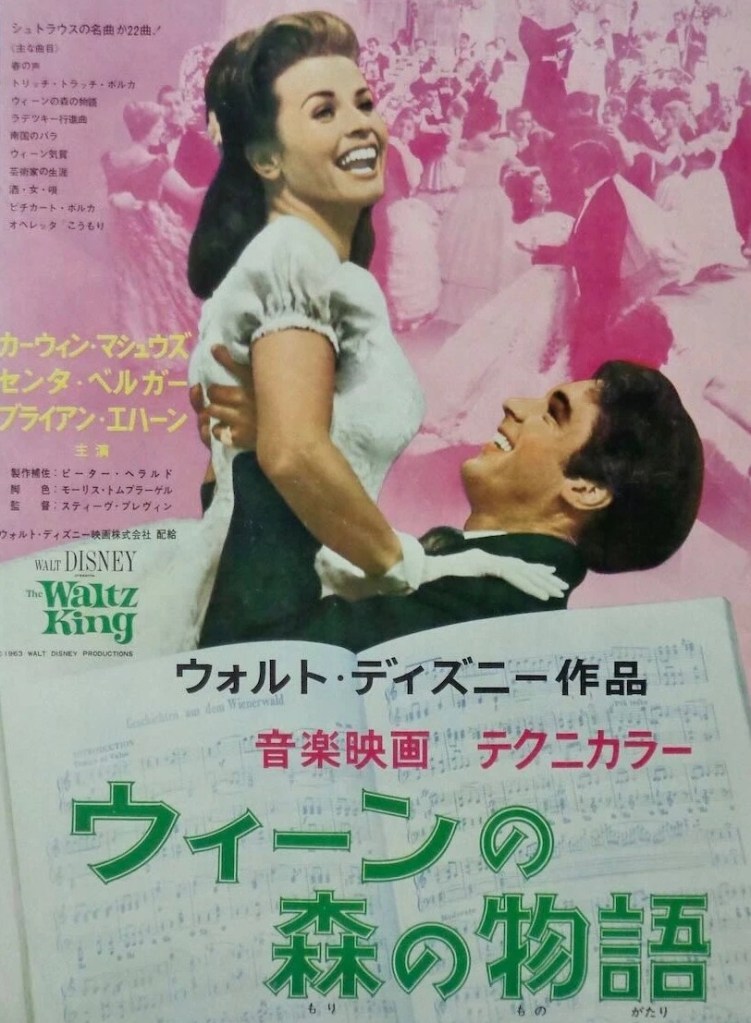
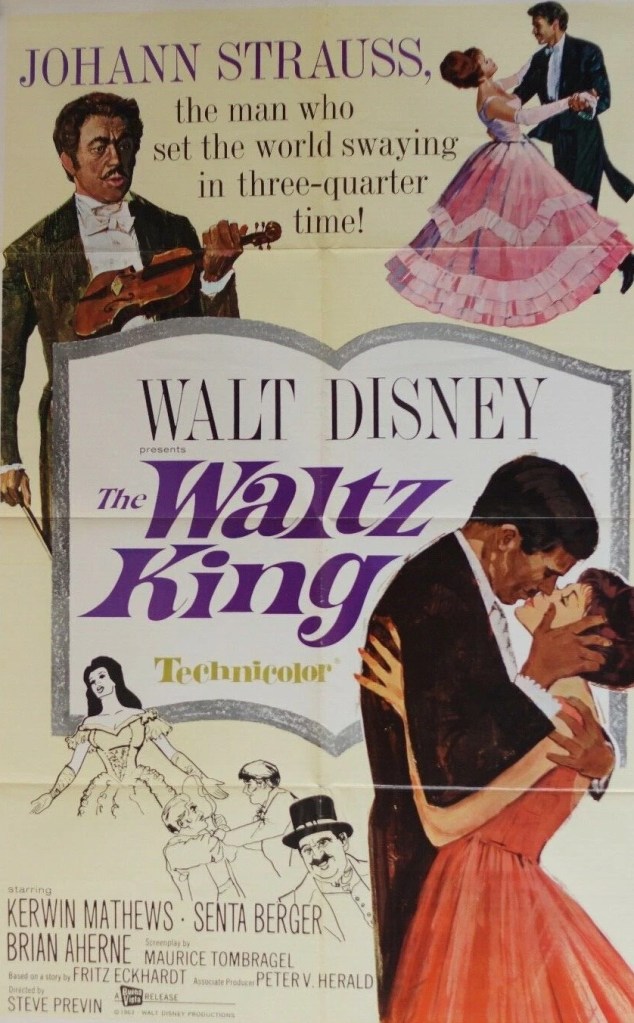
The movie had an unusual trigger. Walt Disney, taking time out from overseeing theme parks and enjoying a period of dominance in Hollywood, had spent some time in Vienna which resulted in this film and the same year’s Miracle of the White Stallions about the World War Two escapades of the Spanish Riding School in Vienna.
As you know I am a conscientious researcher in the matter of Senta Berger Studies and came to this via that connection, but I have always enjoyed movies about creativity whether it is struggling writers, struggling painters, struggling sculptors and struggling composers – you notice the prefix “struggling” is an essential component of such films.
And this will chime also with a contemporary obsession – the nepo baby. There already was a Waltz King in Vienna – Johan Strauss’s (Kerwin Matthews) father (Brian Aherne) also called Johan. He didn’t want this son following in his footsteps not so much because he feared the competition but because he disdained his own work, being at the beck and call of greedy concert promoters and music publishers, being assailed by hundreds of female fans behaving in much the same way as female fans during the rock/pop era, though instead of throwing underwear onto the stage they were apt to bombard the composer with bouquets of flowers each delivered with a note expressing ardent passion.
Father Johan Strauss (known to classical music fans as Johan Strauss I) insists son Johan Strauss ( Johan Strauss II in the classical music business) enter a proper profession, one where position in society was not dependent on the whims of the public. So the young lad was forced to become a lawyer, moonlighting as a violinist with other orchestras hoping his father would not find out. When old man Strauss did find out he was apt to take strenuous action and destroy the young man’s violin.
The elder Strauss was so powerful in his field that music publishers did not dare take on any of the works of his son. So it was lucky that in order to persuade a music publisher to listen to his composition he sits down at a piano in the shop and begins to play at the same time as opera singer Henriette Treffz (Senta Berger) is present. She likes the music and takes a shine to Johan and coughs up so he can employ his own orchestra.
The old man is so angry at being usurped that he conspires to wreck the son’s debut concert by employing a small army of people to hiss, boo and catcall and disrupt the event. Luckily, that plan fails and audiences applaud and the son is on his way. Paternal enmity continues but that matters less as Johan Strauss II becomes a brand name, although he’s subjected to the by-product of fan mania when jealous husbands threaten him with a duel.
But just as The Who and other bands aspired to something more than popular music, so Johan wanted to move beyond the simplicity (in musical terms) of the waltz and up the classical music hierarchy by putting his mind to creating operettas and more sophisticated tunes. That battle involved finding his own voice and once again overcoming opposition.
This being a Disney confection it skirts over politics. Father and son were on opposite sides during the failed Austrian Revolution of 1848 – Strauss Snr composing one of his most famous pieces, the Radetsky March, as a result, the son out of royal favor for a long time. Nor is there time to regale audiences with how Strauss Jr changed his religion to get out of a tricky second marriage.
But like most biopics about classic composers including such Oscar-acclaimed fare as Amadeus (1984) this is a jukebox piece and if nothing else takes your fancy you can sit back and listen to the Johnan Strauss II’s greatest hits which include “The Blue Danube Waltz,” Die Fledermaus and Tales from the Vienna Woods.
Kerwin Matthews (Maniac, 1963) is solid enough in role that in a Disney picture requires less than the likes of Amadeus. And anyway he makes the mistake of signing on for a picture with Senta Berger (Kali-Yug, 1963) who is at her dazzling best. Brian Aherne (Lancelot and Guinevere, 1962) almost twirls his moustache as villain of the piece.
Director Steve Previn (Escapade in Florence, 1962) does a decent enough job with the music an eternal get-out-of-jail-free card. Written by Fritz Eckhardt (Rendezvous in Vienna, 1959) and Maurice Trombagel.(Monkeys, Go Home!, 1967).
Lightweight, for sure, but entertaining and informative enough.
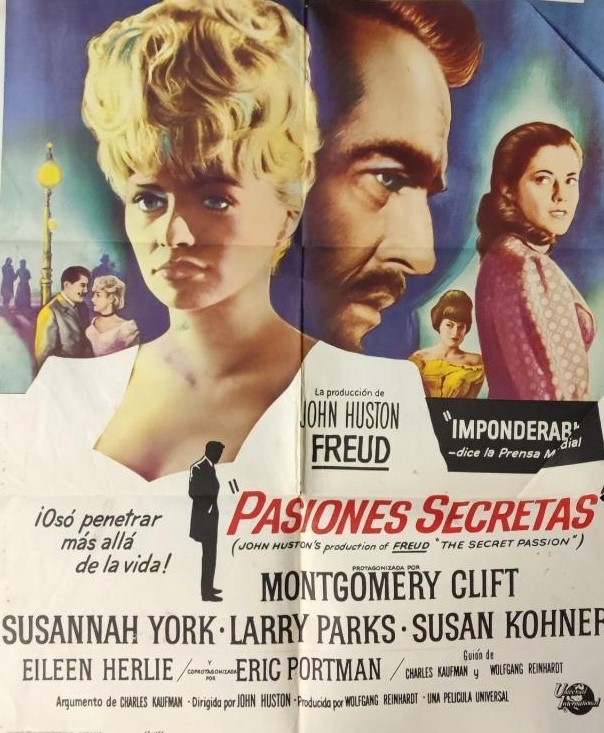
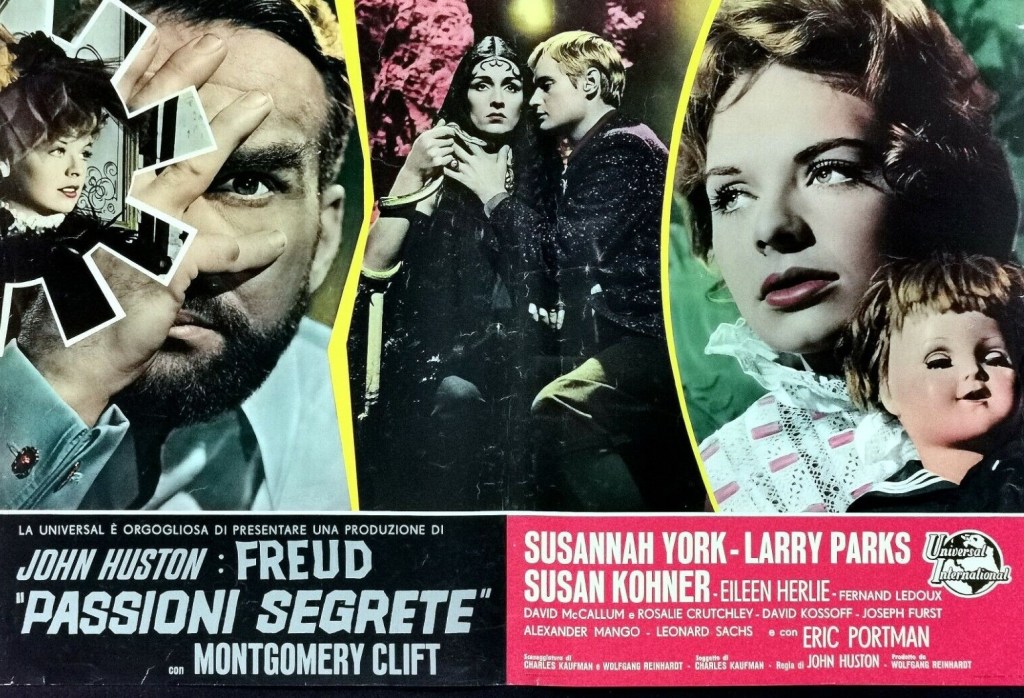
Your leading man is an alcoholic drug-addled star with substantially impaired sight. Your leading lady, in her first major role, decides she knows more about acting than the very experienced director. But in the world of victimhood, who gets the blame? Not of course Montgomery Clift (The Defector, 1964) or Susannah York (Sands of the Kalahari, 1965), but director John Huston (The Night of the Iguana, 1964).
Huston had been trying to put together a movie about the flawed god of psychiatry, Sigmund Freud, for 13 years. In 1949, with a screenplay by Charles Kaufman and backed by Twentieth Century Fox, it was going to be called Dr Freud. That version was still on the stocks a couple of years later. It wasn’t the first attempt to put the Viennese genius’s life on film, in 1940 Warner Brothers announced Edward G. Robinson in The Life of Freud with a script by Gary Endore.
Huston began serious work on the movie in 1956, but it was only greenlit two years later, after he signed a five-picture $20 million deal with new production unit Seven Arts, set up by Ray Stark and Eliot Hyman, future kingpins at Columbia and Warner Bros, respectively. It was to follow The Man Who Would Be King (not finally made until 1975), for which Huston was scouting locations in Afghanistan. At that point Freud was scheduled for 1959. Then it was Unforgiven (1960) and The Misfits (1961) that came first.
Mostly, the delay was caused by the screenplay. Huston had handed the task to celebrated French philosopher and playwright, who with what amounts to contempt for Hollywood, had written a 300-page script. His next attempt was 780-pages. Read that and weep, Christoper Nolan and Martin Scorsese, this was a 10-hour movie. When questioned, Sartre retorted “so make a 10-hour film.” Huston contemplated turning the script into two unrelated movies, perhaps in the vein of Young Tom Edison and Edison, the Man (both 1940).
Sartre spent two weeks at Huston’s home in Ireland, with Reinhardt on hand as well, trying to condense the material. But he spoke so rapidly that Huston confessed “I could barely follow even his basic thought processes….sometimes I’d leave the room in desperation, on the verge of exhaustion from trying to follow what he was saying.” Huston could not fault Sartre’s diligence. The playwright rose at 5am and would have 20-25 pages ready for discussion five hours later.
Sartre was paid $40,000 for his screenplay. Kaufman was brought back on board but his work didn’t gel with Huston’s vision. Wolfgang Reinhardt, whose name also appeared as producer, was more involved on the script. His relationship with Huston went back to Juarez (1939) on which they were co-writers and Dr Ehrlich’s MagicBullet (1940), for which Huston was credited with one-third of the script and Reinhardt was producer. But Reinhardt hadn’t received a screenplay credit since Juarez and his last Hollywood picture as a producer was Caught (1953). More recently, he had found work in Germany on The Trapp Family (1956). According to Huston, he was “misunderstood, distrusted and ill-used in Hollywood.”
Eliot Hyman questioned Reinhardt’s contribution. In addition to snagging $30,000-$35,000 and a 7.5 per cent profit share for his producer duties, Reinhardt was being paid $300 a week plus expenses for screenwriting, fees Hyman considered “out of line.”
Huston was determined that “Freud’s descent into the unconscious should be as terrifying as Dante’s descent into Hell.” Sartre was viewed as having not just objectivity but as someone who knew Freud’s work intimately. But clearly major work was required to trim the Sartre script. It took six months to reduce the material into a workable script. Naturally, Sartre objected to the reworking and wanted his name removed.
Eventually, with the project at an impasse, Huston turned to leading British psychiatrist Dr David Stafford-Clark to provide clarification. Clift, who as a patient had considerable experience of psychiatrists, insisted on joining their discussions, but “his presence served only to delay and confuse.” When asked to leave, he stood outside the door and cried, then “drank himself unconscious.”
That should have been warning enough. Having worked with an equally addled Montgomery Clift on The Misfits (1961), Huston might have thought twice about going back into the lion’s den. But, while not covered in box office glory, The Misfits was superlative, with all three principles turning in excellent performances. And in any case, Clift was the go-to actor for the tortured character.
Eva Marie Saint (The Stalking Moon, 1969) was first choice for the role of troubled teenager Cecily and after she turned it down Huston approached Marilyn Monroe whose psychiatrist advised against it. So, it went to 22-year-old English actress Susannah York, who had attracted Hollywood’s attention after two British films – Tunes of Glory (1960) and Loss of Innocence / The Greengage Summer. Unusually, this was not a romantic part, treatment of this patient critical to Freud’s analytical breakthrough. Karl Malden (Pollyanna, 1960) was offered the second male lead, but due to his unavailability it provided a comeback for Larry Parks (The Jolson Story, 1946) who hadn’t worked in Hollywood since 1954.
Huston recalled, “He had deteriorated to a shocking degree… I should have dropped Monty…but I didn’t. I thought that when we got on the set and he had lines he would be all right.”
Clift continually tried to rewrite the movie. He had got hold of previous copies of the script and produced his own indecipherable version and spoke the lines in an infantile manner. “Finally, I realized this was primarily a stall for time,” said Huston. “Monty was having difficulty memorizing the lines. I was surprized at this because he had done so well during The Misfits.” But those lines were simple compared to the long, complicated speeches of Freud.
“I’m sure Monty had almost no conception of what he said in the picture – yet he had the ability to make you believe what he did.” Eventually, his lines were written on boards, on the labels of bottles, door frames and other places on the set. Added Huston, “There was a mist between him and the rest of the world that you simply couldn’t penetrate.”
Huston also encountered problems with York. “Susannah was the personification of the uninformed arrogance of youth. Shortly, under Monty’s influence, she became convinced she was entitled to scientific opinions regarding a subject of which she was woefully ignorant.”
She and Monty would collaborate to rewrite their scenes. York refused to do a scene as originally written until a call to her agent changed her tune.
It took all Huston’s experience to hold onto his temper but a confrontation with Clift in his dressing-room resulted in a door slammed so hard it shattered a mirror. That was later conflated into Huston smashing furniture and tearing the couch apart. Huston was also blamed for Clift receiving rope burns during the climbing sequence. In fact, the shots were arranged so that after just holding on to the rope for the short period required, the actor could let go and land a few feet down on a pile of mattresses. Instead, he slid down the rope, holding on with his hands.
“My reputation for cruelty appears to stem directly from this one scene,” complained Huston, convinced the rope burns were Clift “for his own reasons beating himself up.”
Cinematographer Douglas Slocombe developed a technique of three-plane camerawork to help audiences distinguish between reality, dreams and memory. Scenes where characters recalled memories were shot through a small clear-glass plate mounted on the lens matte box. Dreams acquired an extreme black-and-white effect with chalky faces and other details standing out as luminous in tunnels of darkness. This was achieved through a combination of dramatic contrast in photography, stock and lab work.
The production spent five weeks at the Bavaria Studios in Munich before shifting to Vienna, which included 10 days of night shooting.
Universal underwrote the movie, and with To Kill a Mockingbird (1962) also on its roster, intended to celebrate its golden anniversary in fine style with “record rentals” from a raft of movies appealing to the public and the critics.
Freud’s daughter Anna and son Ernest didn’t take kindly to Hollywood’s interpretation of their father’s life and disassociated themselves from the movie and the Viennese hierarchy objected to the film’s louche elements.
Filming began in August 21, 1961, including three weeks on location in Vienna, and was due to wrap on December 5. That it took another two months to complete, (final shooting date was February 10, 1962) inflating the budget, was laid at the foot of Clift. Never mind the drink and drugs he was consuming in mighty proportions, he had cataract problems and could hardly see.
Universal sued Clift for $686,000 for not acknowledging his cataract problems prior to filming, an issue that prevented him memorizing his lines. Clift counter-sued for the remaining $150,000 owed from his $200,000 fee, claiming the problems had developed during filming. “I refuse to accede to the defendant’s demand that this condition…was responsible for delays to the picture.” Firemen’s Fund Insurance, whose policy covered the actor for a year from April 1, 1961, with the proviso the movie finished by December 5, 961, denied liability.
Universal was concerned that the title would mean little to the general public and pre-release toyed with changing the title to Freud: The Dark Passion but agreed, in the end, not to “tamper” with it. However, exhibitors disagreed. And once Minneapolis second-run and neighborhood cinema owners refused to book it under the existing title, it was changed to The Secret Passion, which at least got it through the door with bookers even if the public remained wary. On posters, The Secret Passion part of the title grew bigger and bigger until the Freud element almost disappeared. The film was cut after initial release but the DVD shows the full version.
Despite critical approval and a 12-week run in New York and some decent runs in smaller houses in the country’s bigger cities, it was a flop, not managing the $1 million in rentals required to earn a spot on Variety’s annual box office chart.
SOURCES: John Huston, An Open Book (Columbus books, 1988) p294-305; “Memo from Eliot Hyman,” July 15, 1959, United Artists Archive, University of Wisconsin, Box 7, Folder 7; “Endore for Freud,” Hollywood Reporter, February 24, 1940, p2; “Robinson As Freud,” Box Office, March 2, 1940, p2”; “Dr Freud Bio On Fox Docket,” Box Office, September 17, 1949, p19; “20th Lead with Five in Biopic Sweepstakes,” Variety, January 24, 1951, p5; “Freud Biopic 1st Hyman 7-Arter,” Variety, July 30, 1958, p3; “John Huston’s Next Spot – Afghanistan,” Variety, October 15, 1958, p19; “Huston Seeks Saint,” Hollywood Reporter, November 10, 1958, p2; “Universal Unchained,” Variety, August 19, 1959, p5; “Huston in on Freud Biography,” Variety, October 28, 1959, p11; “Sartre Script on Freud: 780 Pages,” Variety, June 29, p3; “Freud Rolls August 21,” Variety, July 26, 1961, p5; “Freud Moves Location,” Hollywood Reporter, October 12, 1961, p6; “Freud on Night Shift,” Hollywood Reporter, October 24, 1961, p3; “Freud Film Not To Liking of Kin,” Variety, November 1, 1961, p2; “Three-Plane Photography Developed for Freud,” Hollywood Reporter, December 19, 1961, p11; “Huston’s Freud Ends Photo Phase,” February 14, 1962, p4; “Universal Sues for $600,000,” Hollywood Reporter, April 30, 1962, p3 “Montgomery Clift’s Eye Trouble,” Variety, June 5, 1963, p5; “U’s Insurance Claim on Monty Clift,” Variety, June 27, 1962, p7; “It’s Plain Freud, U Won’t Tamper,” Variety, October 3, 1962, p3; “Never Heard of Freud,” Variety, October 9, 1963, p5; ’“Top Rental Films of 1963,” Variety, January 8, 1964, p37.
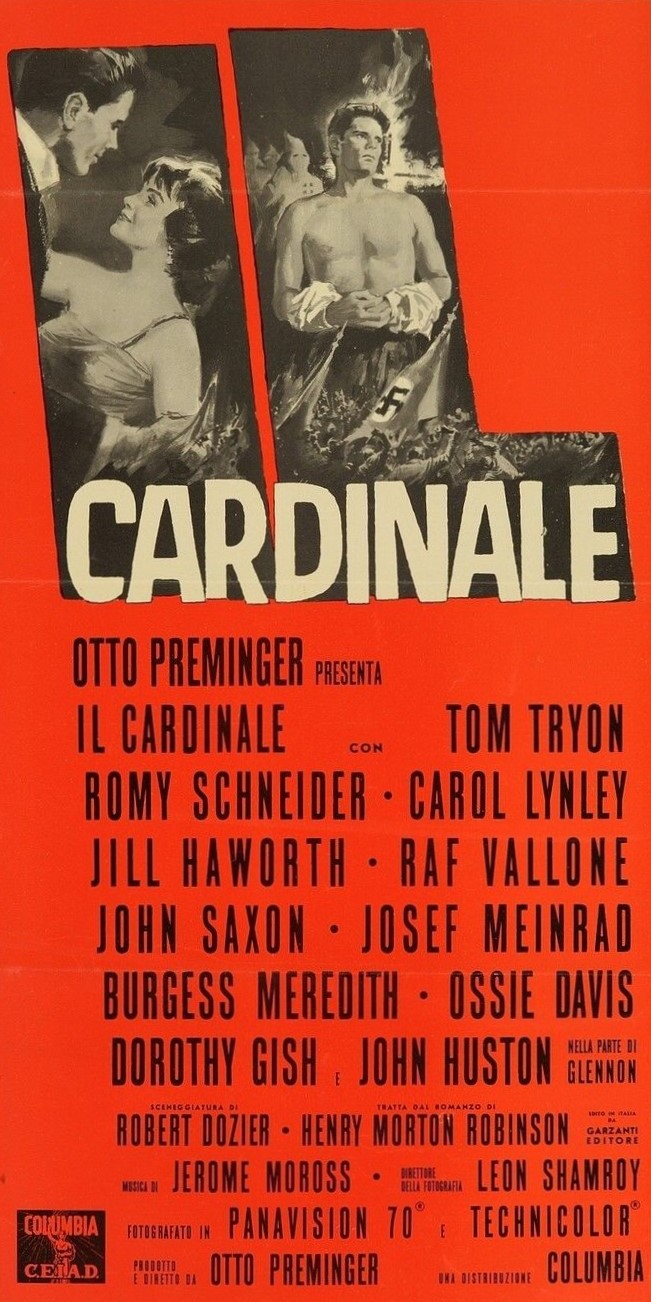
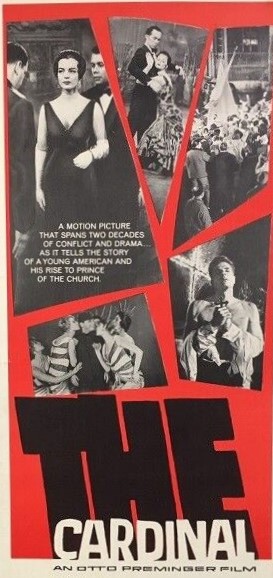
Otto Preminger was beaten to the punch on this one, the scandalous Henry Morton Robinson bestseller snapped up in 1955 by producer Louis de Rochemont (The Roman Spring of Mrs Stone, 1961) who had a tie-up with Columbia. Due to interference from the Catholic Church, de Rochemont dropped his option which Preminger picked up in 1961 while working on Advise and Consent (1962).
The last section of the novel, set in Austria during the Anschluss, reverberated with the director who was born in what was then the Austro-Hungarian Empire and although a Jew was well acquainted with Catholic society. One of his most significant changes to the book was introducing the Austrian cardinal who endorsed Hitler.
The first two screenwriters James Lee (Banning, 1967) and Daniel Taradash (Castle Keep, 1969) failed to whittle down the complex novel to cinematic proportions. So Preminger brought in Robert Dozier (The Big Bounce, 1969) and began working with him in summer 1962 making other alterations to heighten the drama. The incident involving the unborn child of the sister of Fr Fermoyle (Tom Tryon) acquires greater emotional power in the film, touching on the ambiguities inherent in any institution and provoking the priest’s guilt.
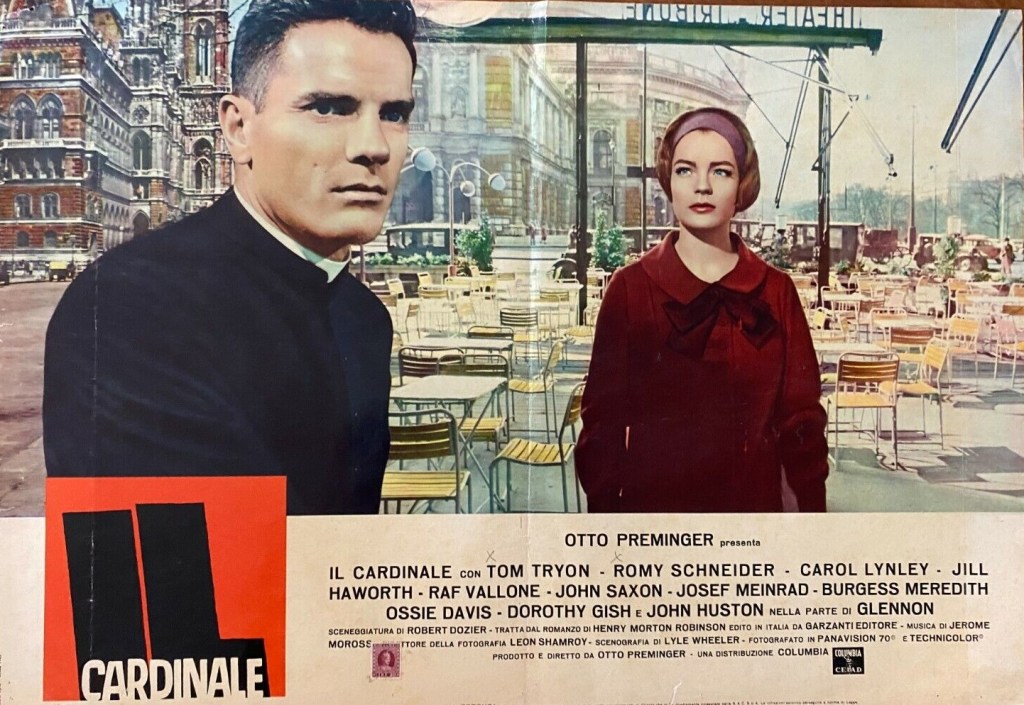
Gore Vidal (The Best Man, 1964) also worked on the script, swapping the novel’s Italian countess for the Viennese Annemarie (Romy Scheider) who, abandoned by the priest had married and was reunited with him prior to the Anschluss, and is sympathetic to Hitler until her husband’s faith endangers them both. Ring Lardner, who had satirized the Catholic church in a recent novel, was the final screenwriter added, his main task to rewrite scenes “to achieve what he (Preminger) wanted,” and, more importantly, to introduce the flashback structure. Ironically, both Vidal and Lardner were atheists.
Tom Tryon and Romy Scheider meet again in Vienna.
The director considered five actors for the leading role – Hugh O’Brian (Africa – Texas Style, 1967), Stuart Whitman (The Commancheros, 1961), Cliff Robertson (The Devil’s Brigade, 1968), Bradford Dillman (Circle of Deception, 1960) and Tom Tryon (In Harm’s Way, 1965), the latter three advancing to the screen-testing stage. The 34-year-old Tryon won the role and a five-picture contract he would later regret. Carol Lynley (Bunny Lake Is Missing, 1965) who plays the priest’s sister also pacted for five movies.
Romy Scheider’s (Triple Cross, 1966) part was enhanced by the work of cinematographer Leon Shamroy who “fell madly in love with her,” resulting in the actress virtually shimmering on screen, never before “looking as beautiful.” Held in warm regard by the director, she was exempt from his tirades.
It took considerable persuasion on the part of Preminger for John Huston to participate. Curd Jurgens, initially cast as the Austrian cardinal, pulled out and was replaced by character actor Josef Meinrad whose lack of English meant he had to learn his lines phonetically.
Tom Tryon described Preminger as “tyrant who ruled by terror.” He was fired on the first day and probably wished the director had not rescinded the decision, for thereafter the actor was tabbed “lazy…a fool…stupid and unprofessional.” Commented Tryon, “I was so frightened he was going to scream that…I (just) wanted the experience to end.”
One scene with John Huston took 78 takes because Tryon could not deliver what the director wanted. And at one point first assistant director Gerry O’Hara (later director of The Bitch, 1979) found the star in tears and refusing to return unless the director agreed not to shout at him. Eventually, during the Italian section of the shoot, Tryon collapsed from nervous exhaustion, and was prescribed two days rest, and after this incident Preminger let up on his demands of the actor.
Explained Preminger, “I probably chose him without deliberation because he is weak.” He felt than an ordinary person would not side with the Church against a family member in a predicament, and that only a person “with weakness in his character” would be believable in the role. The character “fails because when you become a priest you substitute your own judgement and your own feelings for the law of the Church…The big decisions are made for him.” (Quite why he never chose an actor who could portray such weakness is not known.)
Tryon admitted that he owed a brief let-up in the bullying to “Schneider’s benign presence.” He commented, “The only fun I ever had on The Cardinal was a (ballroom) scene I did with Romy.” Prior to turning the cameras, Prior called both over, appeared ready to issue instructions, but instead waved them away “you know what to do.”
Added Schneider, “Preminger taught me an important thing: work fast. It’s true that it greatly helps our acting. Each of his directions, whether of gesture or of intonation, is precise and correct. Even better, it’s the only one possible…Each phrase, each world, each syllable are minutely weighed.” That dexterity applied to his positioning of the camera. He made decisions immediately, never hesitating “over the placement of the camera and each time…it was the simplest, the most natural and, dramatically, the best.”
Ossie Davis (The Scalphunters, 1968), who professed to have enjoyed a marvellous relationship with the director, observed: “I met actors whom Otto liked, I met actors that had no relationship or feelings one way or the other and I met actors who were almost absolutely destroyed, almost literally in panic because of Otto Preminger (who) was always looking for a spark…whether you had the spark or not, he was going to find it and even put it in you.”
But Patrick O’Neal stood his ground. “I woiuld not take it from him.” And they became friends.
The unit shot for five weeks in New England before heading to Vienna, Preminger choosing to stay in the same suite in the Hotel Imperial as appropriated by Hitler when visiting the city. Permission to shoot in the National Library, “one of the most beautiful monuments in the city” was attacked by the current minister of education who wanted the Hitler era erased from memory. And he was barred from using other government buildings for spurious reasons.
After four and a half months in Austria, the unit shifted to Rome, locations including St Peter’s Square and inside St Peter’s Cathedral and the Santa Maria sopra Minerva church, with priests and monks hired as extras for the various ceremonies. The Georgia scenes were shot in Hollywood on the Universal back lot.
Although generally dismissed by the critics and given a hard time as you might expect from the Catholic Church, The Cardinal hit a chord with audiences, who turned it into Premigner’s second-biggest hit of the decade.
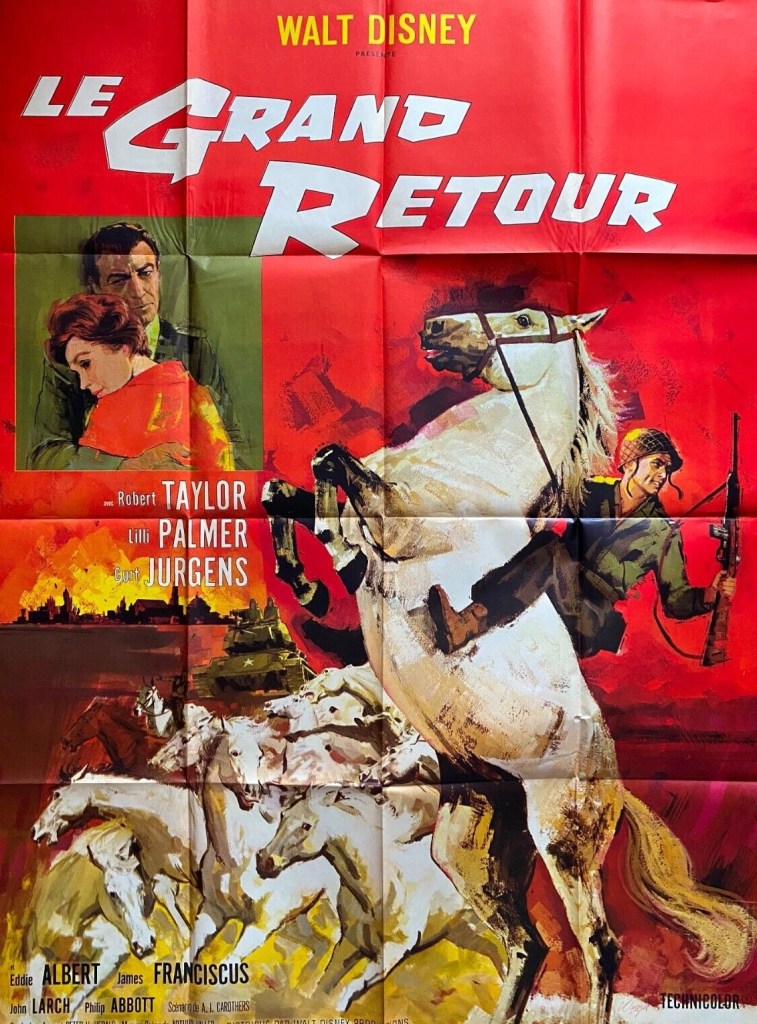
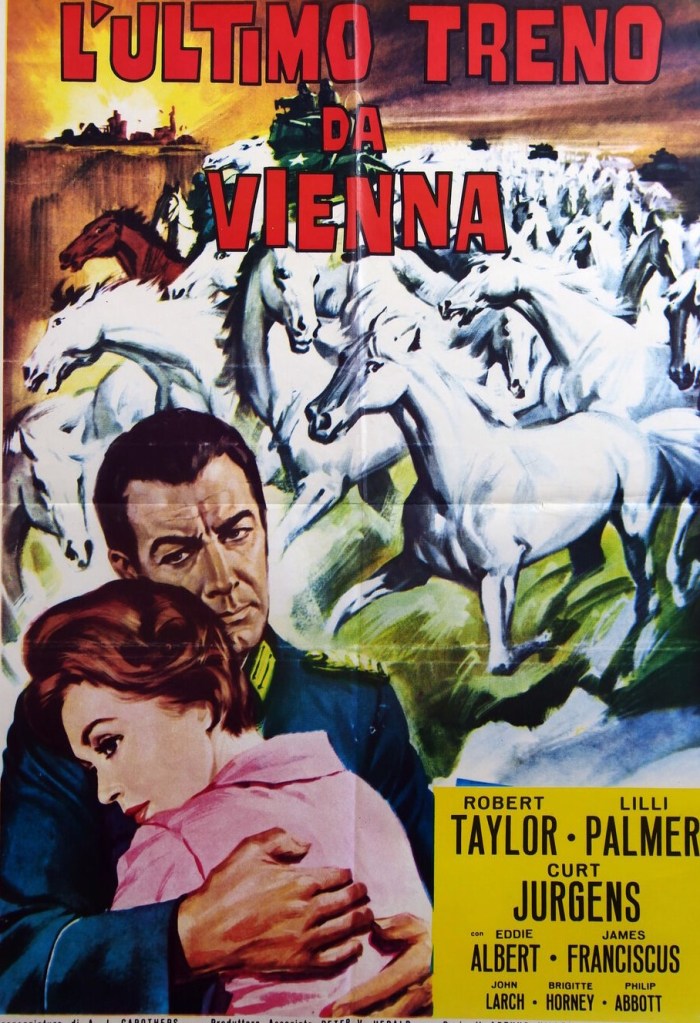
You wouldn’t look to Walt Disney in the 1960s to provide a tyro director with a calling card when so much of that studio’s output was saccharine. But this beautifully-mounted World War Two drama showed there was a new kid in town worth watching, name of Arthur Hiller. And if you always wondered why the later biopic of General Patton showed him in riding gear, that penchant is more clearly explained here.
You might balk, however, at the idea of a bunch of horses being considered in the same category as an art treasure worth protecting from the worst predations of war. And just as with the Von Trapp family, Austrians, despite welcoming the annexation of their country by Hitler in 1938, are given a free pass here.
In case you’re unfamiliar with the subject matter, the Spanish Riding School in Vienna was a celebrated nearly 200-year-old institution in which the famed Lipizzaner white “dancing” horses were put through their paces. With the Second World War coming to a close it was threatened on three fronts: the German Army poached its instructors to man the front line, the invading Russians wanted to appropriate the horses and starving refugees focused on the potential horse meat.
School chief Col Alois Podhajsky (Robert Taylor) and wife Pedena (Lili Palmer) organise an evacuation under the guise of using the horses to draw cartloads of legitimate art treasures. They hole up in the castle of Countess Arco-Valley (Brigitte Horney) but the mares are stolen by the Russians and hidden in Czechoslovakia. (Only the stallions perform, but without the females as breeding stock, the line would become extinct.)
The colonel ditches his German uniform on the arrival of American forces and puts on a performance in a makeshift arena in an attempt to convince Patton (John Larch) to mount a rescue of the captured horses. Patton, we learn here, is a renowned horseman, competed in the equestrian section of the 1912 Olympic Games, and if anyone considers a fabulous horse more valuable than a work of art it’s him. As it happens, there are prisoners to be freed in Czechoslovakia so the horses are included in that mission.
What’s unusual about this animal tale, given Disney’s predilection for anthropomorphising animals, is that it’s not told from the point-of-view of the horses. Nor, as you might have expected, given the studio’s plethora of young talent, turned into the story of a young girl or boy attached to the horses. Instead, the focal point is the impact of the creatures on those around them.
Of course the colonel is bound to be obsessed. But for the ordinary soldiers, who might never appreciate a work of art, they represent a kind of majesty, a grandeur, rising above the horror of war, something well worth the effort of rescue.
What’s even more unusual in saccharine-town is the script’s recognition of the effect of war on humanity. At one point Pedena laments that men are asked to possess “the strength and fury of giants…and then be again the men they were before.” And in some respects acknowledging the beauty of the horses is a step in the right direction. The Yanks are neither celebrated as brave nor foolhardy, in fact mostly they are just working grunts, cleaning out the castle, fixing up the arena, cracking jokes.
Hiller is the big find here. There’s a brilliant scene, all of 40 seconds long (I timed it) that would have been cut out of any other Disney picture. In a chiaroscuro of light, the colonel walks from one end of the deserted Vienna riding hall to the other and his wife, entering the frame, goes to join him. Nothing more is needed to indicate loss. Hiller clearly recognised opportunity and while the film itself is no masterpiece every single frame reveals a talented mind at work, his use of colors and costume, movement within the frame, employing Pedena and the Countess to comment on the action, allowing the inbuilt tension to carry the story without extraneous drama.
You’re mostly likely to remember the performing horses, the balletic choreographed movements, the “airs above the ground,” and indeed Hiller wisely devotes a good 15 minutes to this, but without his input this would either be overly sentimental, saccharine or little more than a documentary. This is a very grown-up picture for Disney.
Robert Taylor (A House Is Not A Home, 1964) was at the tag-end of his career, his first film in four years, but he still has the charisma to carry the film and the gravitas to see it over the line. Lili Palmer (The Counterfeit Traitor, 1962) is well cast as a voice of reason and offering commentary on humanity. Curt Jurgens (Pysche ’59, 1964) has an interesting role, lamenting, as he picks out a classical tune at the piano, how Hitler outlawed famous composers.
There’s a stronger supporting cast than you might expect: Eddie Albert (Captain Newman M.D., 1963) , James Franciscus (Valley of Gwangi, 1969) and German actress Brigitte Horney (The Trygon Factor, 1966).
Somebody certainly took notice of Hiller’s talent because his next films were The Wheeler Dealers (1963) with Lee Remick and James Garner and The Americanization of Emily (1964) with Julie Andrews and Garner. A.J. Carothers (The Happiest Millionaire, 1967) based the screenplay on the book by Alois Podhajsky.
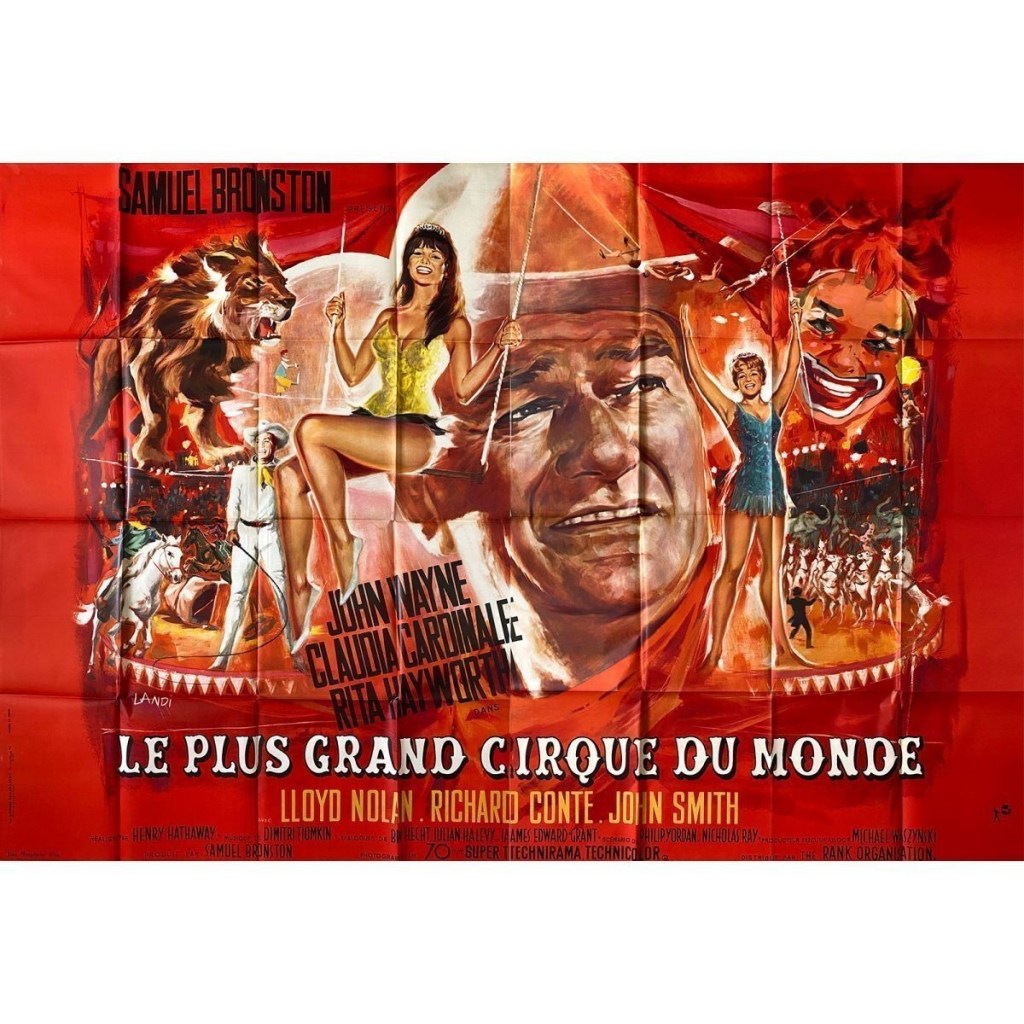
Bookended by disaster – a ship turning turtle, fire raging in the big tent – and kept aloft by giddy circus turns this long-ignored movie in the John Wayne canon is ripe for reassessment. In more down-to-earth mold, with no villains to rein in, no gun-toting required, this calls upon something more basic from the actor, the dramatic skill required to make the audience fix on a strong character within a spectacular screen event.
Presented in stunning Super Technirama, the swansong of maverick producer Samuel Bronston (El Cid, 1961), and mistakenly viewed as little more than a travelog or a compendium of circus acts, this dwells instead on transition and loss as Matt Masters (John Wayne) struggles to allow adopted daughter Toni (Claudia Cardinale) to grow up and to come to terms with the part he played in the romantic calamity – father a high-wire suicide, acrobatic mother Lili (Rita Hayworth) fleeing to Europe – that left her parentless.
It’s no coincidence that sending his three-ring circus cum Wild West Show on a lucrative tour of Europe in the early part of the 20th century provides an opportunity to hunt for Lili, the love of his life. But the circus ship capsizes in Barcelona, leaving Masters penniless, forced to work for a rival European promoter until he can scrape together enough dough to start again. Masters uses the opportunity of traveling through European capitals to scout new acts, including clown Aldo (Richard Conte), a lion-tamer turned tiger-tamer Emile (Hans Dante), and ballerina Katharyna (Giovana) who performs on the high wire while Toni wants to chance her arm against Matt’s objections as an acrobat and flex her romantic muscles in romantic dalliance with Matt’s new partner Steve (John Smith).
The subplots add dramatic heft, the lion-tamer is frightened of tigers, Aldo has vengeance in mind, so in between the scintillating circus acts the storyline is compressed around the drink- and guilt-sodden Lili and conflict on several fronts with Toni while old retainer Cap (Lloyd Nolan) is on hand to pep up or challenge Matt.
You wouldn’t be allowed to make this kind of film these days so it’s worth glorying in the glory days of the circus – dancing horses, lions, tigers, elephants, acrobats and genuinely hilarious clown sequences. It being a three-ring circus there’s always something going on, plus the Wild West element which comprises a stagecoach being attacked.
John Wayne is as befuddled as ever in romance, restricting his trademark double take to astonishment at Tony’s transition to womanhood. There’s an occasional reversal but mostly it’s a battle against the odds, potential triumph leavened by gritty loss.
A modern producer would have switched the disasters – it didn’t really matter how Matt got into a fix. But the capsizing, appearing so early the effect is stunning, is brilliantly handled, not just the rescue of people and animals but Matt in lion-taming mode and ending with a clever coda. In every photograph Lili’s face has been scratched out but in among the saturated notes of Matt’s vital cash box is a picture of her.
Some critics have suggested John Wayne (In Harm’s Way, 1965), recovering from his own financial debacle caused by over-investment in The Alamo (1960), took the role for financial expediency. But I can see the attraction, as I’m sure the actor did. This is a far more rounded character than anything since The Searchers (1956) and he can’t even find redemption from a six-shooter. He’s more protective than aggressive, paternal instinct triggering character reaction, and it’s more of a James Stewart type of role, coming back from adversity, and nothing straightforward about a man whose love affair caused marital disaster.
Critics have also taken pot-shots at Claudia Cardinale (The Pink Panther, 1963) as if she was not already an accomplished actress (a favorite of Visconti, for example) in a compelling role and competing on even terms with a star of John Wayne’s charisma without being able to fall back on the old saw of the romantic interest. Although playing a character nearly a decade younger, Cardinale brings an earthy feistiness to a character with a bucket of decisions to make, turning on its head her relationship with Matt and going through the dramatic hoops with Lili.
Rita Hayworth (The Happy Thieves, 1961) has shucked off the glamor, a worn-down relic of her former self, turning to drink and religion in equal measure in vain hope of finding peace. Veteran Lloyd Nolan (The Double Man, 1967) and Richard Conte (Assault on a Queen, 1966) hold their own, but John Smith (Waco, 1966) does not. Look out for former British star Kay Walsh (A Study in Terror, 1965).
Henry Hathaway (5 Card Stud, 1968) does a terrific job marshalling all the elements, containing the core family drama within the wider action-oriented structure. While there’s never a dull moment, in among all the spectacular scenes are some exhibiting a particularly sensitive directorial touch such as when Matt discovers Lili’s hotel room and reflects on his own misdemeanors.
There were almost as many writers as circus performers – James Edward Grant (The Commancheros, 1961), Ben Hecht (Spellbound, 1945), Julian Zimet (A Place for Lovers, 1968), Bernard Gordon (55 Days at Peking, 1963), Nicholas Ray (The Savage Innocents, 1960) and Philip Yordan (El Cid).
Come at it from the fun perspective and you won’t go wrong. John Wayne completists will adore it.
I was lucky enough to see this is full glorious widescreen at the cinema where it was the Closing Film at this year’s Widescreen Weekend in Bradford. What a way to end a show!
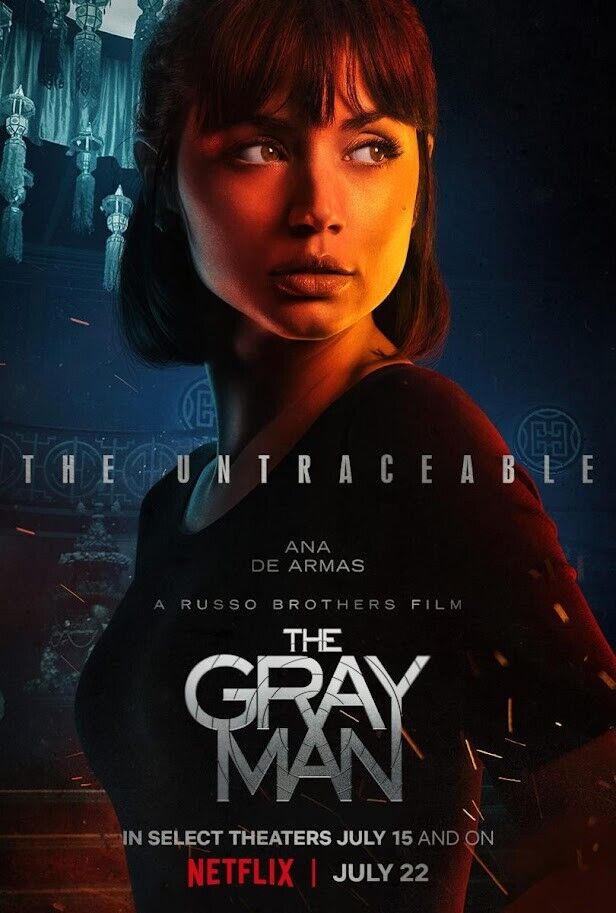
I could have seen this for nothing on Netflix, but instead, hoping to do an action picture justice by seeing it on the big screen, I shelled out my bucks for the privilege. Bourne Ripoff is as much as you need to know. Lazy writing with a bundle of the incongruities you can get away with within the MCU because as long as there’s the requisite action nobody bothers too much about logic.
Don’t be fooled into thinking this is John Wick gone wild. It’s many things gone wild, including a heap of overacting, and a pair of the biggest villainous klutzes you will ever come across. It’s vaguely redeemed by an explosions/ shootout/ tram chase in Vienna but that’s only enough to shift it up from one-star to two. And it’s a shame because Ryan Gosling (First Man, 2018) in his first movie for four years is a believable tough guy in the Bourne tradition and Ana de Armas delivers on the action chops she displayed in No Time to Die (2021).
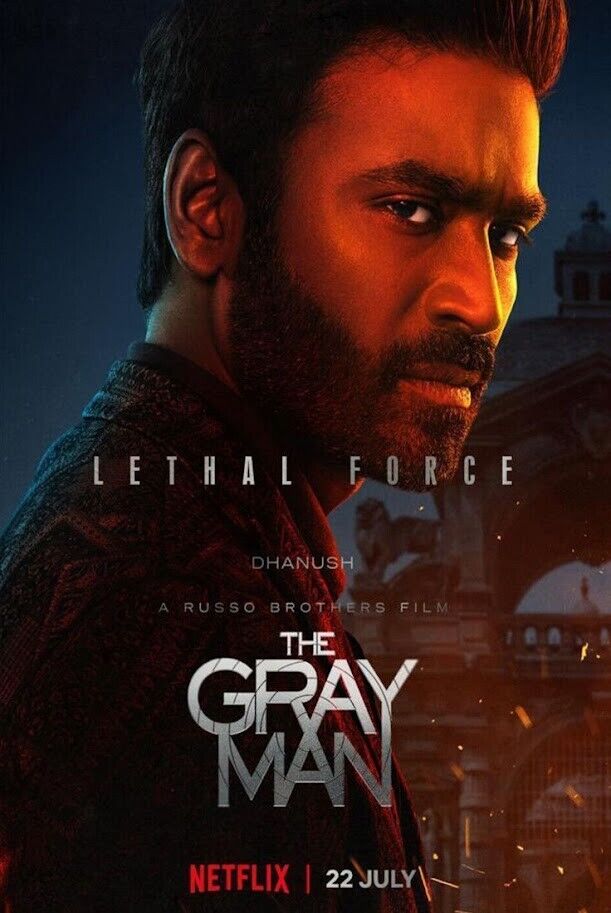
A poster straight out of the Joseph E. Levine playbook. He used to dream up these kind of posters which characters were assigned titles that bore no resemblance to the part they played on screen.
It should be an action romp, but instead it’s a mess. A C.I.A. black ops unit – inventively called the gray department – is hiring convicted killers to knock off anyone they want. Six (Ryan Gosling) got jailed for an insane amount of time, would you believe (nope!) for, as a teenager, killing his dad who was domestically abusing both his sons (trying to drown Six, for example). Six’s latest mission is to kill a guy who turns out to be an assassin in the same line of work but who is blackmailing C.I.A. boss Carmichael (Rege-Jean Page).
There’s nothing cool about Carmichael, he throws coffee at windows when he’s cross, and that sets an awfully bad example because his underling Suzanne (Jessica Henwick) is also prone to getting very cross. But that’s nothing compared to complete nutjob Lloyd (Chris Evans) who enjoys a bit of torture and gives psychopaths a bad name, but if I got this right attended Harvard with Carmichael so that’s okay then. Lloyd is hired to kill Six because he knows too much. And Lloyd calls in other assassins.
Now we’ve had that template in Bourne so what’s going to make it different? I know, let’s ramp it up. Instead of individual assassins, who might display some kind of finesse, let’s have teams of rampaging assassins. You can’t really wreck Vienna with just an assassin or two, you need a whole army.
Danush (Avik San) is an unusual assassin in that he operates on his own, not needing a huge team, but he is also cursed by – remember he’s a ruthless assassin – being suddenly conscience-stricken.
Oh, I forgot to mention Fitzroy (Billy Bob Thornton), the guy who sprung Six from jail but is now retired. Luckily, he happens to have a young niece Claire (Julia Butters). And that comes in handy when Lloyd needs to bring him to heel – and can kidnap the girl. But wait, two years before, Six was assigned to protect Claire and saved her life twice.
Twice? Yep, once from assassination and once when he rushed her to hospital after something went wrong with her pacemaker. Yep, she has some terrible heart disease. But not enough apparently to prevent her being the world’s pacemaker poster girl. Guess what? She can race along the top of a castle and jump 100 feet off a castle wall into a moat.
After being blame-shamed by Carmichael, Six’s C.I.A. sidekick Dani (Ana de Armas) switches sides to help him and can be counted on to turn up to shoot darts at Lloyd and appear with a fast car in time to save Six from assassins on the aforesaid tram. But she’s one of the victims of the lazy writing. She has two clear chances to save the day by marksmanship and fails each time. The first excuse is just so dumb. Thrown a sharpshooting rifle by Six, she discovers this comes minus ammunition. “Never throw a loaded gun,” must be one of the stupidest lines ever written, a lame joke that clearly makes reference to No Time to Die. Armed with another sharpshooting device and with clear line of sight on Lloyd, for reasons that are never made clear she doesn’t shoot.
Did I mention that Six is the kind of tough guy who, armed with little more than a penknife, can saw through a water pipe because the directors want to do some kind of riff on Kingsman: The Secret Service (2014) or that this this is the thriller version of If It’s Tuesday It Must Be Belgium (1969) with a different country about every ten minutes. And if people aren’t losing digits, it’s fingernails.
Ryan Gosling and Ana de Armas come out of this well but Chris Evans (Avengers: Infinity War, 2018), with a Tom Selleck moustache, is just awful, a joke villain, the only surprise being he doesn’t twirl said moustache. It’s almost as if he’s doing his utmost to make people forget he was ever Captain Marvel, but this is to the utmost and beyond. Stick to Bridgerton would be my advice to Rege-Jean Page. Billy Bob Thornton (Bad Santa 2, 2016) plays one of his more restrained characters.
The Russo Brothers (Avengers: Infinity War) throw every trick in the book at the movie without starting from the obvious point – a decent script.
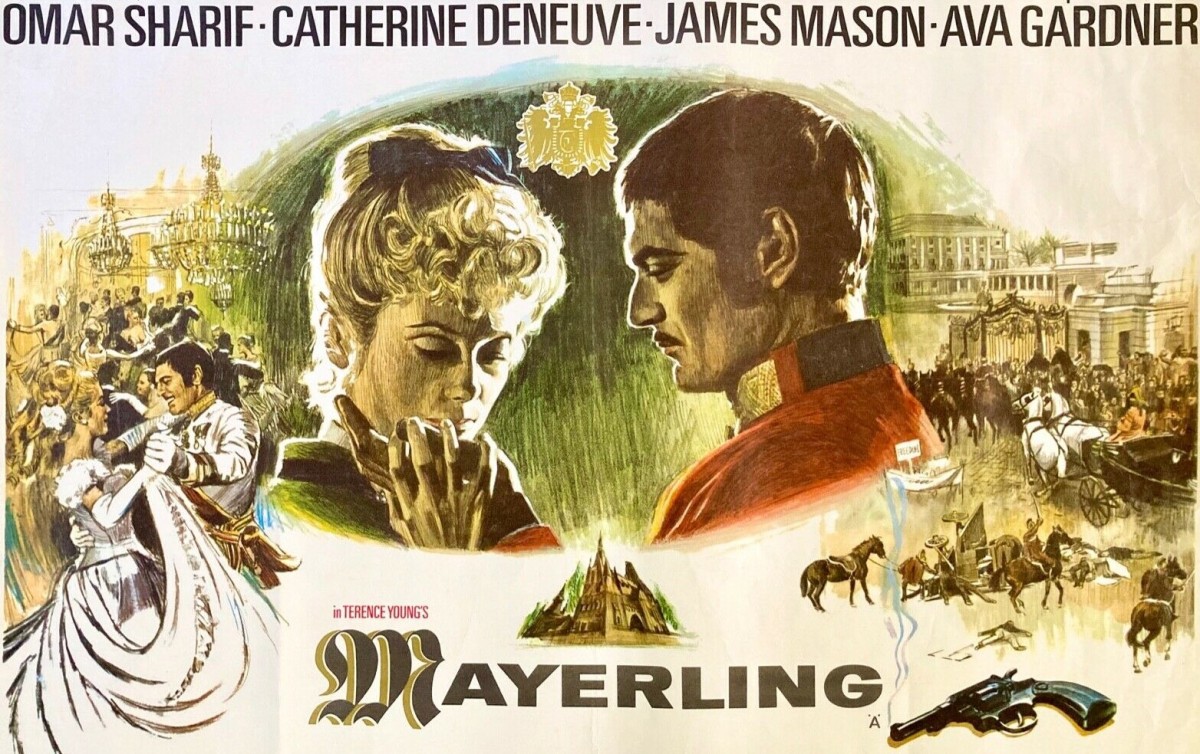
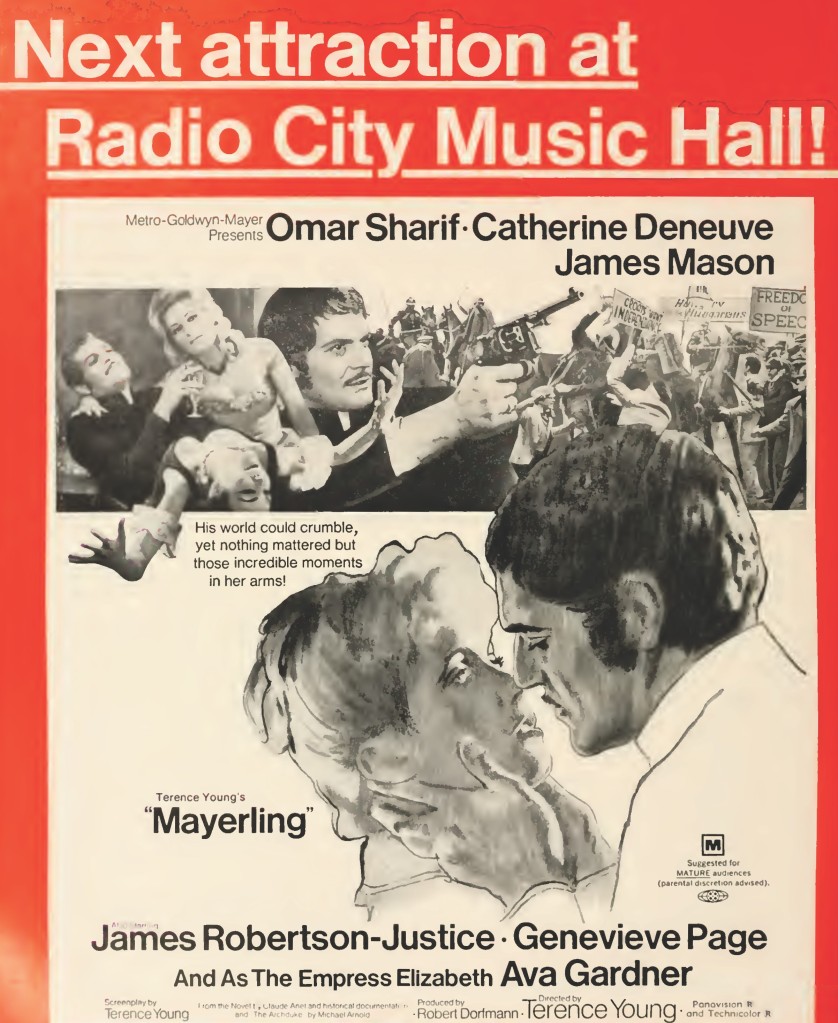
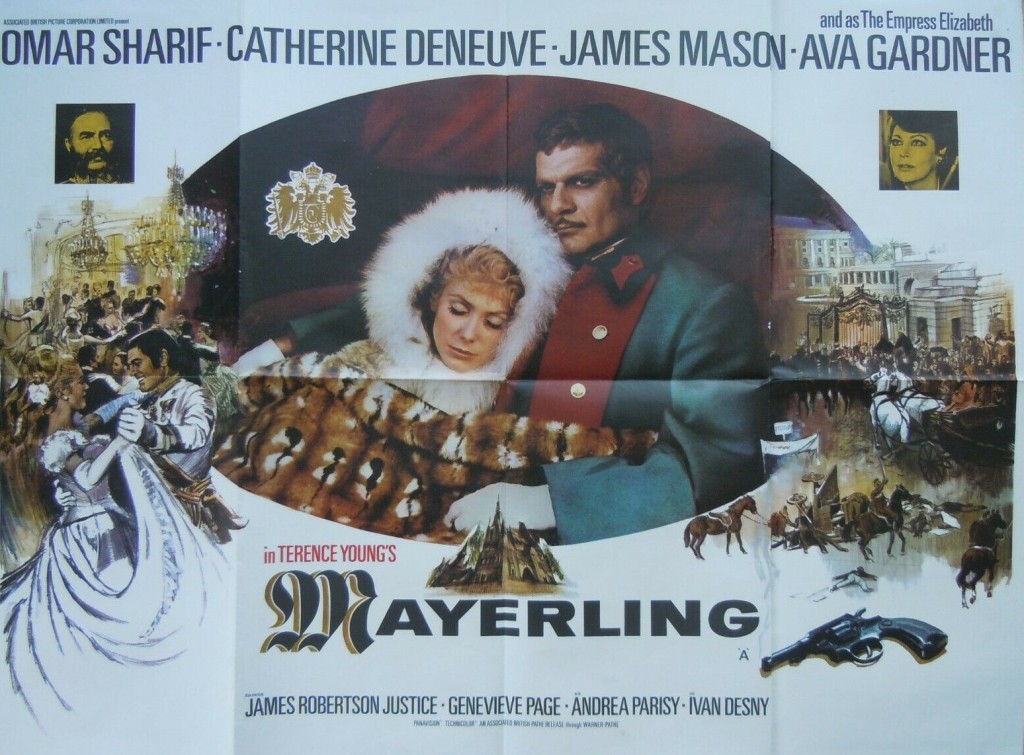
MGM didn’t know how to sell this. So they came up with three different campaigns. The first was the classical illustration of stars Omar Sharif and Catherine Deneuve about to kiss. This image was used for the film’s launch in the U.K. and at the Radio City Music Hall in New York. The artwork could be augmented if need be by various scenes from the film. You would categorize this as the straightforward romantic sell. Sharif after all was the most famous romantic idol of the decade following the monumental success of Doctor Zhivago (1965).
But this was the more liberalized 1969 rather the restrained mid-decade so MGM offered exhibitors the opportunity to promote the picture as a more salacious number, not overdone sexually since that would defeat the purpose of achieving a rating designed to attract the widest possible adult audience, but nonetheless touching on enough of the risqué to satisfy modern cinemagoing taste.
Of the two alternatives, one was considerably more spicy than the other. Using the tagline “No one woman could satisfy him…until he fell in love” this presented Sharif as wanton playboy, wine glass in hand, cavorting with cleavage-ridden woman. The other approach, though technically more reserved, was as provocative since it highlighted Deneuve’s role as a high-class sex worker in Belle de Jour (1967), the sensational arthouse breakout. The connection would not be lost on the more sophisticated members of the audience.
Nor did the Pressbook avoid the more intimate elements of the drama and in fact the biggest article in the promotional material concerned the “emotional incest” between Sharif as the Crown Prince and his mother played by Ava Gardner – “the abnormally close relationship between the two was noted again and again in records of the era” – and in their first scene together “looked like lovers to the silver screen born.”
Historical films lent themselves to the kind of detail that journalists loved and the Pressbook for a movie set in a magnificent Vienna at the end of the nineteenth century capitalized on this. As you might expect, waltzes played a key role in the social life of high society. The Pressbook introduced newspaper editors to the concept of “left-waltzing,” a particularly energetic form of the dance performed on state occasions. This waltz had a “strict etiquette” in that it is “forbidden to reverse no matter how dizzy one gets,” explained director Terence Young. Auditioning for extras to participate was made simpler by eliminating anyone who collided with another dancer.
The Pressbook, unusually, also casts light on directorial technique, again in reference to a waltz. This is the one where Omar Sharif scandalizes the court by opening a ball by dancing with his mistress Catherine Deneuve. Young wanted to create the effect of the whirling couple revolving into a world of their own. To achieve this the stars had to “dance in a perfect circle, keeping a constant distance in the center of the ballroom floor from director of photography Henri Akedan and his revolving camera.”
Initially, Young resorted to “two elaborate and – as it proved – punishing devices since the dance had to be done over and over.” The first saw camera and stars balanced at opposite ends of a rotating “see-saw.” But this moved so fast Sharif lost his balance and Deneuve suffered from dizziness. Next, they were connected by a lasso but this metal contraption struck them so often in the hips it was abandoned. Finally, they reverted to the simplest of solutions, working round a circle chalked on the floor.
To ensure authenticity, Young was able to film at the Hapsburg Palace, the Karlschirche and the Schonbrunn Palace. However, such was the urge to preserve these antiquities, the stars were not permitted to sit on any of the chairs or even get anywhere close to them, so it was standing room only for days at a time. However, the Vienna Opera House of 1888 was reconstructed on Parisian sound stages.
The marketers were able to take advantage of the current fashion for the vintage look as pioneered by the likes of The Beatles. Under the heading “Groovy Gear,” the promotional gurus encouraged exhibitors to target the university crowd and metropolitan areas with a preponderance of young people who would appreciate the “freaky clothes” and “up-town hippy clothing” like the military garb, long topcoats, high boots and fur hats worn in the film. Even so, the Pressbook originators were remarkably unimaginative when it came to dreaming up stunts and promotional gimmicks. Their best suggestions were a Catherine Deneuve look-alike contest and a competition to list all Omar Sharif’s roles. Rather more ambitious was the idea of inviting high school pupils to write an essay on aspects of the period.
You might ask yourself why star Richard Widmark bought the rights to Alistair MacLean Cold War thriller The Last Frontier (title changed to The Secret Ways for American publication and the film) if he was going to ignore so much of the author’s brilliant story. In the original version hero Reynolds (the Widmark character) does not simply fly into Vienna as in the film, but has already crossed the Austrian border into Hungary in a blizzard after hitching a lift in a truck but now is stranded on foot in sub-zero temperatures, 30 miles from Budapest. This is not the only change authorized by Widmark, wearing his producer’s hat.
His Reynolds is a freelance gun for hire clearing a gambling debt and hired by an American spy ring compared to MacLean’s British secret service agent, intensely trained for 18 months for this mission. The mission in MacLean’s book is to rescue/kidnap British scientist Professor Jennings, the world expert on ballistic missiles, with the help of Hungarian resistance leader -Hungary at the time part of the Soviet bloc – Jansci (Wolf Rilla). Widmark eliminated all mention of Jennings. Instead, the task facing his Reynolds is to get Jansci out of Hungary. Widmark’s Jansci is still a resistance leader but doubling up as the professor albeit a straightforward scholar with nothing to do with missiles.
Cover of the Doubleday U.S. hardback edition in 1959.
Combining characters was not unusual in the movie business and Widmark may have deemed it necessary to streamline the plot. But if the idea was to simplify the plot, that hardly explained the existence of Elsa (Senta Berger). She was not in the book. Her sole purpose may have been to provide Widmark with casual romance – a testament in Hollywood terms to his irresistible attraction – early in the story.
This was Alistair Maclean’s first shift away from the trio of war novels, including The Guns of Navarone, which had rocketed him into the bestseller class, and it proved to be a major change of style that created the non-stop thriller template that would underpin the later Fear Is the Key (published in 1961), When Eight Bells Toll (printed in 1966) and Puppet on a Chain (1969 publication), all of which were filmed, which saw loners or secret agents enduring horrific physical abuse as they battled the odds.
MacLean’s Reynolds enters Budapest a captive, rather than as in the Widmark version merely catching a train. Widmark meets Jansci’s daughter Julia (Sonia Ziemann) in Vienna. But in the book the secret agent meets Julia, along with her father, after he is captured by the resistance. In the book Reynold’s kidnap occurs in the first 20 pages, in the film at the halfway mark. From the outset Maclean thrusts his hero pell-mell into action with nary a let-up but in the film the action is punctuated by romance and various political meanderings.
Giving the game away No 1: the back cover of the Fontana paperback movie tie-in explains the plot – and it’s different from the one Widmark filmed.
Perhaps Widmark shied away from the MacLean plot due to budget constraints for the novel is certainly more intense and continually action-packed. Starting with the blizzard and ending with a perilous river crossing, the novel has several scenes which would have looked stupendous on screen. The story Widmark ignored involved the scientist in danger of being removed from Hungary to be returned to the Soviet Union, forcing Reynolds to effect a rescue on board a train, in a devil-may-care episode worthy of James Bond, by separating one car from the rest. There follows a 400-kilometer chase to the Austrian border where, pursued by Hungarian secret police, they cross the river Danube. In a final twist, while the professor and Julia are safe, Jansci refuses to leave his native country.
In various blogs covering the transition of novel into screenplay, I have mostly understood why a screenwriter would delete, alter or embellish plot, characters, time scale and even locale. Sometimes the screenwriter simply comes up with a more believable plot (as in Blindfold) or is required by the sheer length of the novel to make considerable changes. It’s rare for me to think that the screenwriter has taken the wrong approach. I thought The Devil Rides Out could have done with more of the occult background in the Dennis Wheatley novel. Here, it’s quite obvious that Maclean had a far better storyline than the film Widmark chose to make, the blizzard, train and river crossing scenes far more exciting than anything in the finished picture. As I noted, money may have been the issue.
Giving the game away No 2: the back cover of the Pocket Books paperback movie tie-in explains that Reynolds is a British secret service agent – but that’s not how Widmark played him.
However, it’s just as interesting that Widmark and Co. managed to make an enjoyable picture by not following the original story. The role of gambler-gone-bad was more appropriate to the Widmark screen persona than a secret service agent (outside of the humorous Our Man in Havana, there were not many of those around until a few years later). The film did introduce Senta Berger to a wider audience and the plot as it stands made a lot of sense.
The book was published in Britain in 1959 as The Last Frontier. In America the same year Doubleday renamed it The Secret Ways. There was a Victor Mature western called The Last Frontier in 1955 – and the title had also been used in 1932 and 1939 – so unless Richard Widmark had purchased the film rights prior to American publication and announced a name change, then I have no idea why the book title changed.
Sumptuous historical romantic drama set in a fading European empire awash with political intrigue and incipient revolution. Archduke Rudolf (Omar Sharif), married heir to the throne and constantly at odds with rigid father Emperor Franz-Josef (James Mason), sympathizes so strongly with Hungarian dissidents that he threatens to tear apart the Austro-Hungarian Empire. However, when he falls in love with Maria (Catherine Deneuve) and wants to marry her instead that, too, threatens to throw the empire into disarray.
Although dissolute, a mistress (or two) on the side, and addicted to morphine, that is not the way Rudolf is introduced to the audience. Instead, he is one of a string of bloodied men arrested after a demonstration giving his name to an officer in a police station who, once he is recognized, orders all other prisoners be released. He is the poster boy for good royalty. The Hungarians, agitating for independence, want him to become their king.
Beautifully mounted with lavish sets and enough in the way of balls, ballet, processions, horse riding and sleighs to keep up a steady parade of visually interesting distractions, the films steadily builds up an undercurrent of tension, both between father and son and between rebels and ruler. The emperor is a political genius, not just spying on his son, but full of devious devices to hold together whatever threatens to break up the empire.
The romance develops slowly and with true historical perspective, the first kiss they share is not on the lips, Rudolf kisses both her cheeks, she kisses his palm. Yet, there is a real sense that, no matter his power, they can still both be trapped in roles they despise, separated at the whim of parents. Rudolf, as he understands true love for the first time, finds the self-belief to challenge political certainties.
The regal aspects are well done, arguments about the rule of monarchy come over as heated conversation rather than boring debate, the political realities unavoidable. Rudolf, desperate to avoid a future where someone has to die before he has a reason to live. Escape is not an option.
There is a wonderful bitchy atmosphere in the court, where ladies-in-waiting disparage each other behind their backs, one dress described as “wallpaper,” and are forever seeking advancement. Countess Larish (Genevieve Page) is a self-appointed procurer-in-chief for Rudolf, not caring what chaos she causes.
I should add, if you are as ignorant of your European history as myself, that Mayerling is a place not a person. I tell you this so that you don’t make my mistake of waiting for a Mayerling character to appear. The film pointedly avoids a history lesson but it could have spared a minute to explain that the events depicted take place just 20 years after the Austro-Hungarian Empire, the second largest land-mass in Europe, and among the top two or three nations. That would have helped clarify why Franz-Josef was in such a constant state, worried about forces that could break up the empire, and as concerned that his son, living such a debauched life, lacked the personal skills to hold it together after his father’s death.
It is ironic that Rudolf does prove his worth as a result of being briefly separated from Maria, taking the army to task for its incompetent officers and poor maintenance of everything from weaponry to horses.
To his credit director Terence Young (Dr No, 1962) does not rely on Omar Sharif’s soulful brown eyes and instead allows action to convey character and looks and touch the meaning of his love. This is probably Omar Sharif’s best role, one where he clearly made all the acting decisions rather than being over-directed by David Lean as in Doctor Zhivago (1965). Catherine Deneuve is equally impressive as a far-from-docile innocent, especially given the wide range of more sexually aware characters she has created for Repulsion (1965) and Belle de Jour (1967).
James Mason (Age of Consent, 1969) is superb as the conniving emperor, so rigid he will not approve a change of buttons for the army, so cunning that an apparent rapprochement with his son has unseen strings attached. Ava Gardner (55 Days at Peking, 1963) sweeps in briefly as an empress protective of her son and making the best of life in a gilded cage. Also impressive are Genevieve Page (Grand Prix, 1966) and James Robertson Justice (Doctor in Distress, 1963) as the high-living British heir nonetheless under the thumb of his mother Queen Victoria.
Terence Young also wrote the literate, often amusing script, although Denis Cannan (A High Wind in Jamaica, 1965) and Joseph Kessel (Night of the Generals, 1967) are credited with additional dialogue. While Francis Lai (The Golden Claws of the Cat Girl, 1968) wrote the score he relies heavily on classical music from Aram Khachaturian’s Spartacus.
If you come at this not expecting a David Lean style affair full of striking compositions, but an old-fashioned drama advancing at leisurely pace, you will not be disappointed.






 The Magnificent 60s