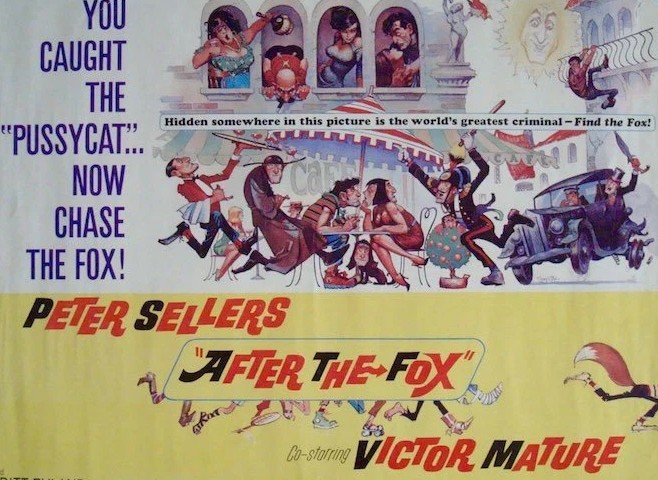
After the Fox (1966) ****

There’s a classic MacGuffin in here somewhere, but I can’t make out if it’s the heist serving the satire on movies or the satire on movies serving the heist. Whatever, this is about the funniest picture you’ll watch on the movie business (much better than Paris When It Sizzles two years earlier). You can keep your royalty and your top politicians dropping in from every corner of the globe, but it’s hard to beat Hollywood landing on your doorstep to transform everyone into a sycophant. To facilitate filming, individual streets and solid blocks will be closed and even businessmen whose businesses are threatened will stick their nose out into the road in the hope of being captured by a stray camera. Everyone wants to be in the movies and how brazenly the movies exploit such naked need.

Before we get to the movie part of the story, we find imprisoned top criminal Aldo Vanucci aka “The Fox” (Peter Sellers) escaping from confinement so that he can assist robber Okra (Akim Tamiroff) transport 300 solid gold bars from a heist in Cairo to Italy. Though the heist is deceptively simple (and might even have influenced The Italian Job, 1969), for a time it looks as if this will canter along going nowhere fast while we get bogged down in a subplot concerning the burgeoning acting career of Vanucci’s sister Gina (Britt Ekland). There’s a whole bunch of standard Italian comedy tropes – the dominant Mama, the incompetent crooks and the brother too controlling of his sister.
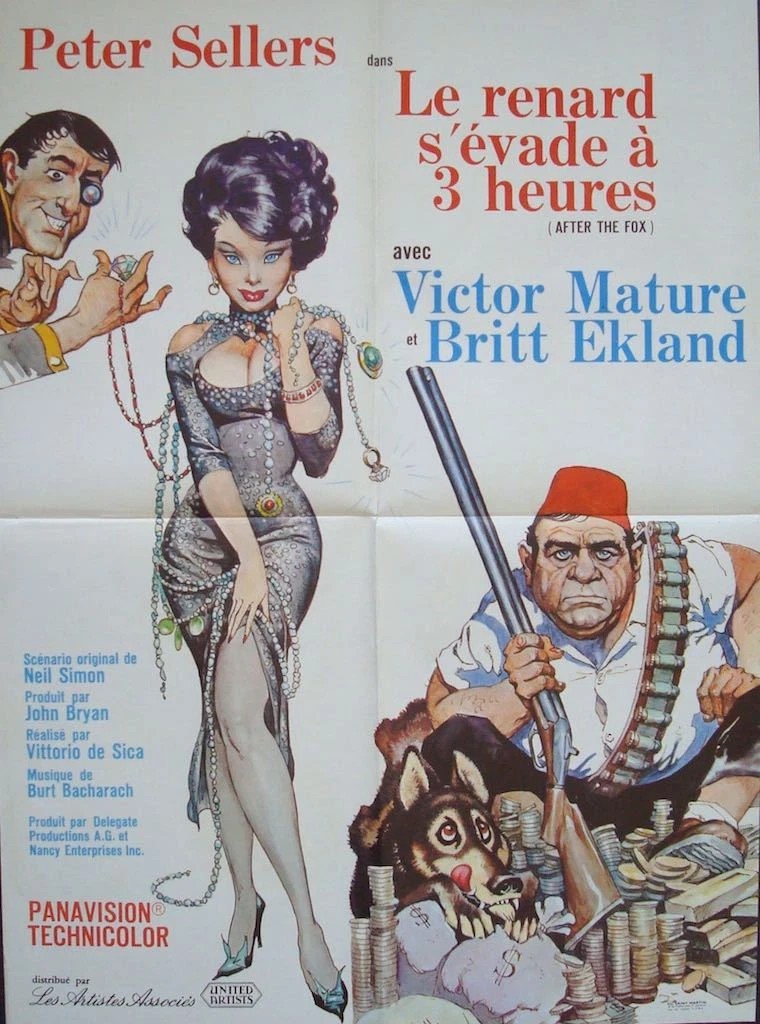
But once Vanucci hits on a movie shoot as the ideal way to disguise the bringing ashore of the loot into the Italian island of Ischia, he strikes pure comedy gold. The townspeople who might otherwise easily see through a con man are putty in his hands. The local cop comes onside when persuaded he has the cheekbones of actor. Aging vain star Tony Powell (Victor Mature) wearing a trademark trench coat like a latter-day Bogart is an easy catch once you play upon his vanity and even hard-nosed agent Harry (Martin Balsam) is no match for the smooth-talking Vanucci.

Vanucci has mastered the lingo of the film director and can out-lingo everyone in sight. The very idea that he has a hotline to Sophia Loren goes undisputed and Powell is even persuaded that Gina, who has never acted in her life, is the next big thing.

Pick of the marvelous set-pieces is the scene in a restaurant where Vanucci is astonished to find a peach of a girl (Maria Grazia Buccella) speaking in a deep male voice because while she’s opening her mouth the words are being supplied by Okra seated behind her. Not all the best scenes involve Vanucci. Harry tartly batting away Tony’s vanities is priceless while the theft of film equipment while a film director (played by the movie’s director) calls for more dust in a sandstorm is great fun.
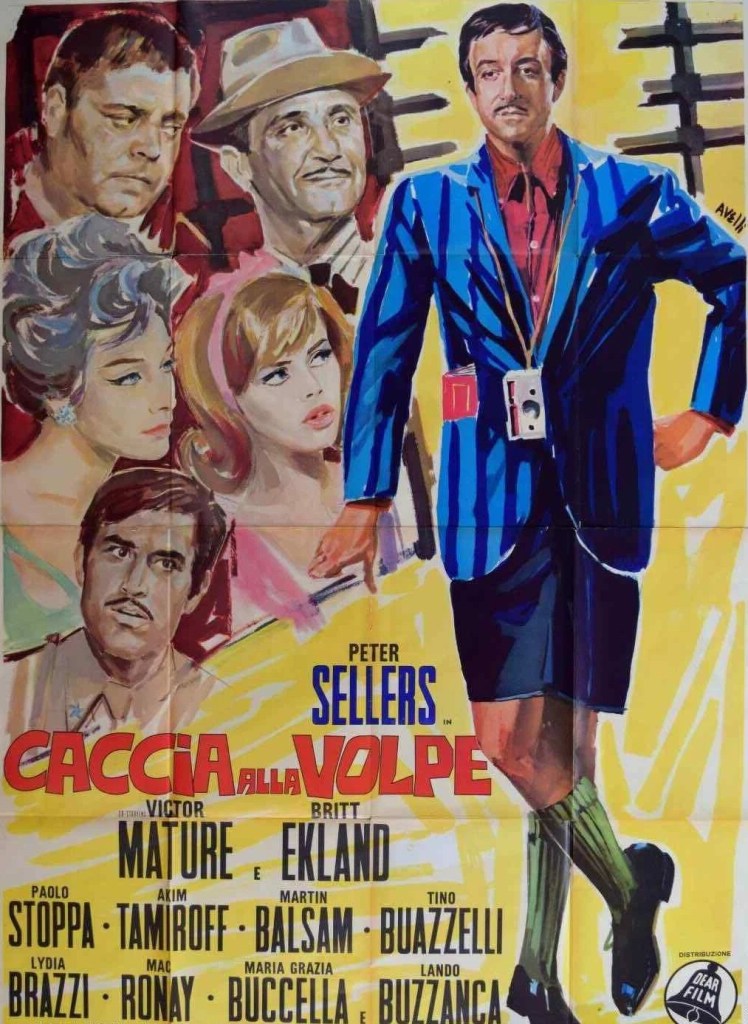
Also targeted is the self-indulgence of the arthouse filmmaker determined to add meaning to any picture. Vanucci’s versions of such tropes as lack of communication or a man searching for identity and running away from himself are a joy to behold and one scene of Tony and Gina sitting at opposite ends of a long table at the seashore just about sums the kind of pointless but picturesque sequence likely to be acclaimed in an arthouse “gem.” And you might jump forward to villagers hiding the wine in The Secret of Santa Vittorio (1969) for the sequence where townspeople load up gold into a van, singing jauntily all the time.

Most of all Sellers (A Shot in the Dark, 1964) hits the mark without a pratfall in sight – the only pratfall in the picture is accorded Harry. Unlike The Pink Panther, Sellers doesn’t have to improvise or be funny. He just follows the script and stays true to his character and the one he has just invented of slick director. There’s even a great sting in the tail.

Sellers shows what he can do with drama that skews towards comedy. Though criticized at the time for, effectively, some kind of cultural appropriation – she was a Swede playing an Italian, what a crime! – Britt Ekland (Stiletto, 1969) is perfectly acceptable. Victor Mature (Hannibal, 1960) has a ball sending up the business as do Akim Tamiroff (The Vulture, 1966) and Martin Balsam (The Anderson Tapes, 1971).

Vittorio De Sica (A Place for Lovers, 1969) does pretty well to merge standard Italian broad comedy with several dashes of satire. The big surprise is that Neil Simon (Barefoot in the Park, 1967) wrote the script, helped out by De Sica’s regular collaborator Cesare Zavattini (A Place for Lovers).

I saw this and A Shot in the Dark on successive nights on Amazon Prime. I hadn’t seen either before. They had been received at either ends of the box office spectrum, the Clouseau reprise a big hit, the Hollywood satire a big flop, so I expected my response might reflect that. But, in reality, it was the other way round. I appreciated this one more.

Go figure.  
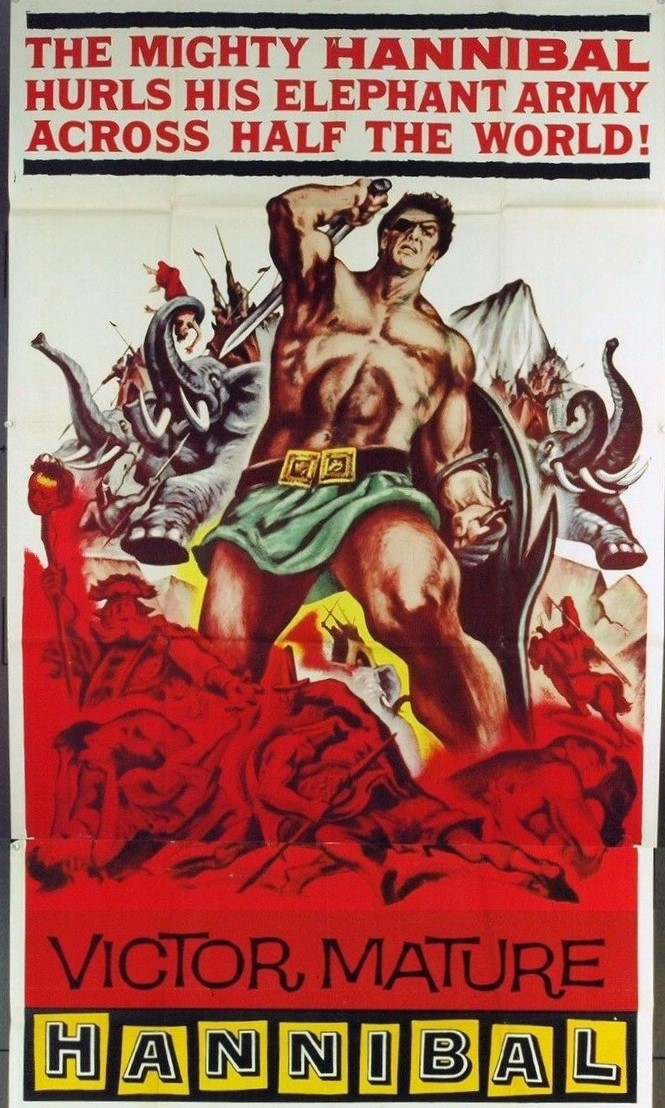
Hannibal (1960) ***

Inconvenient truth never bothered Hollywood scriptwriters when it came to history and here the prospect of solving the “Great Hannibal Mystery” proved irresistible. For in 218 B.C. this invader from Carthage (modern-day Tunisia) had crossed the Alps, battered the Roman army into submission and had Rome at his mercy. But one of the greatest generals of all time did not attack Rome. Why? Love was the answer, according to the filmmakers, following the Romeo and Juliet template.  

I have to admit I didn’t have that on my mind. I was seduced by the poster, the involvement of cult director Edgar G. Ulmer (The Black Cat, 1934), the prospect of an action-packed adventure with marauding elephants and the fact that although familiar with the name Hannibal I had no idea who he was and why he crossed the Alps when surely it would have easier to take a ship from Tunisia to Italy. But I guess star Victor Mature (Samson and Delilah, 1949) was also duped into thinking that if an American nobody like Steve Reeves (Hercules, 1958) could make it big in Italy then so could surely the original Hollywood Mr. Muscles. Mixing the new-look sword-and-sandals genre with the old-style historical epic appeared a potential winner. But I should have guessed that the lean running time of 103 minutes meant an “epic” was out of the question.

The British Trade Descriptions Act would have a field day with the way the posters promoted the elephants. The much-vaunted “army” is scarcely seen in battle and the great beasts looked more cuddly than anything, striding along linked trunk-to-tail.

The picture does take a good while to warm up although the movie begins with a sense of the epic, otherwise how to explain the 15 minutes before Hannibal hoves into view, the preceding period of invaders crossing the Alps short of dramatic incident beyond a couple of men falling to their deaths and the elephants becoming a bit restive. Endless lines of soldiers, in this case stretching into the snowbound horizon, almost becomes a motif, too much valuable time wasted on too many marches.  

Hannibal turns out to be a clever commander, wanting to conquer Rome more by fear than battle, reckoning that if the Italians believed he possessed an unstoppable force they would rush to the negotiating table rather than engage in open battle and risk the destruction of their cities. He sends the captured niece Sylvia (Rita Gam) of Senator Fabius (Gabriele Ferzetti) back to her uncle with frightening tales. This doesn’t fool Fabius who views the woman as a traitor and realizes the pitfalls of surrender. Hannibal and Sylvia getting it together causes discord not just in Rome but in the Carthaginian camp, the delay in attacking the city put down to their romantic dalliance.   

The initial battle scenes come up short, presented primarily in montage, little snippets of fighting here and there, rather than opposing forces facing each other, no sign either of elephants striking terror into the hearts of their opponents. But the later battle more than recompenses. One of the greatest assets of historical and war pictures is the detail given over to strategy. And if filmed properly, you can see plans executed. Hannibal demonstrates his genius by drawing the main Roman phalanxes into a trap, attacking them from both sides and forcing them back towards a river from which there is no escape. Superbly filmed, it’s a bloody conflict (for movies of the period), arms hacked off, faces and bodies weeping with blood. There’s a tragic end to the romance.

Oh, and by the way, Hannibal loses an eye – but it’s not in battle but from conjunctivitis.

I should point out, having done my own digging, but there was a sounder reason than love for Hannibal not advancing on Rome. Simply put, he lacked the machinery to do it. The only way to conquer a city was by siege and to achieve that you needed siege machines which Hannibal lacked. But no matter how much he later tried to draw the Roman armies into the open, he was denied that opportunity by the wily Fabius who, instead, waged a war of attrition.

Hannibal was, in fact, an irritant to Rome for a decade, so this tale is heavily truncated. Although the tale of the strong man brought to his knees by passion is a Hollywood trope – look no further than Samson and Delilah – the lovers fail to strike the necessary sparks, in part because initially Hannibal views Sylvia merely as a tool to achieve a political end and in part because their time together is too limited. This is no grand passion in the vein of Doctor Zhivago (1965).

And that’s a shame because despite (or perhaps because of) his muscles, Victor Mature was no slouch in the romantic sweepstakes, having dallied in the past with the like of Janet Leigh (Safari, 1956), Susan Hayward (Demetrius and the Gladiators, 1954) and Jane Russell (Las Vegas Story, 1952). Here, Mature is better as a leader than a lover. The svelte Rita Gam (The Thief, 1952) – first wife of director Sidney Lumet –  was the opposite of the more voluptuous Italian screen queens of the Sophia Loren/Gina Lollobrigida variety and her career had not really taken off, only eight films prior to Hannibal and only two in the next decade. Paradoxically, she is better battling her uncle and accepting her fate than a woman in the grip of passion.

Gabriele Ferzetti (Once Upon a Time in the West, 1968) makes the most of a complex character. Look out for Rik Battaglia (Sodom and Gomorrah, 1962) as Hannibal’s brother and, as Fabius’s son, Terence Hill (God Forgives…I Don’t, 1967) and in a smaller role his future sidekick Bud Spencer.   

Directorial credit was split between Ulmer and Carlo Ludovico Bragaglia  (Amazons of Rome, 1961) with Mortimer Braus (The Son of Dr Jekyll, 1951), Sandro Continenza (The Inglorious Bastards, 1978) and Ottavia Poggi (Queen of the Nile, 1961) involved in the screenplay.

Discover WordPress

A daily selection of the best content published on WordPress, collected for you by humans who love to read.

The Atavist Magazine

by Brian Hannan

WordPress.com News

The latest news on WordPress.com and the WordPress community.