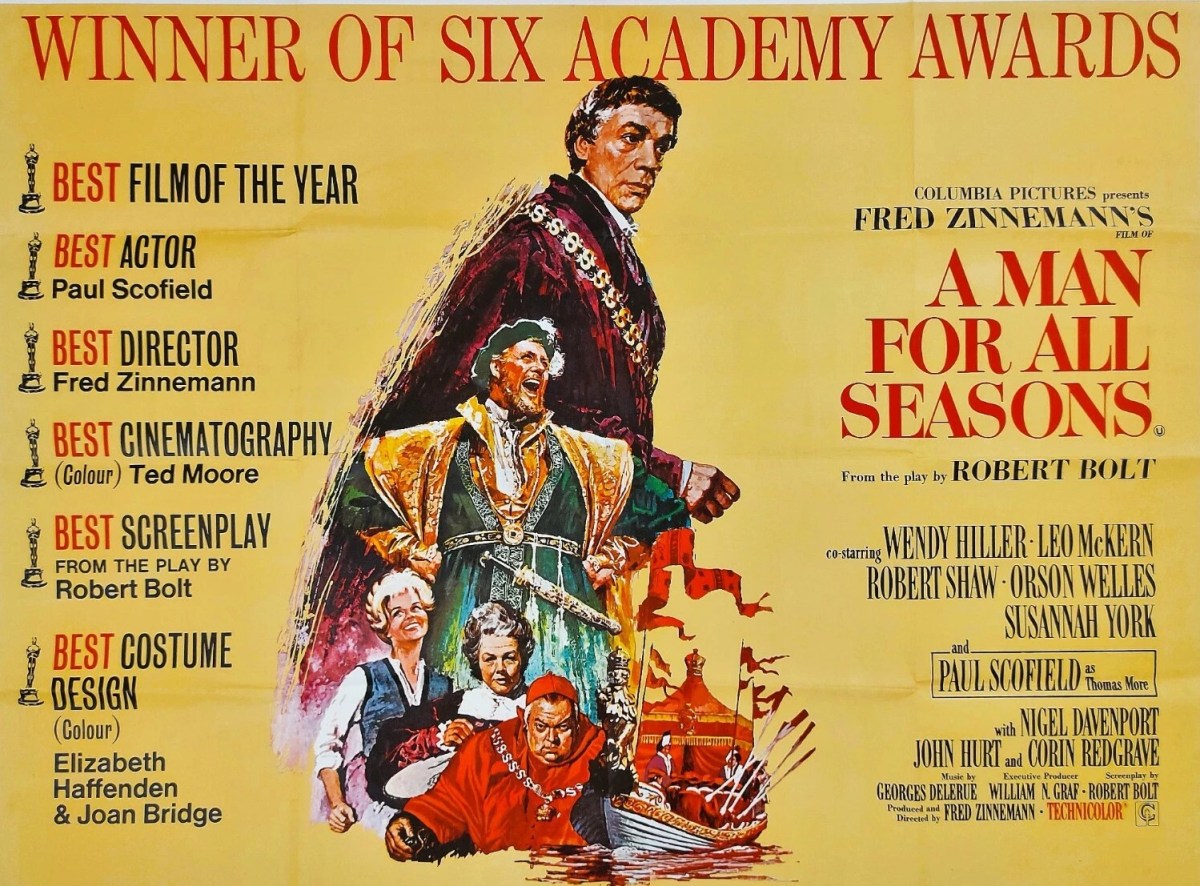
Columbia offset the gamble of turning an award-winning play with a stage star with no movie marquee luster, a co-star who had just about the same pulling power for audiences, and a host of actors nobody had ever heard of by cutting the budget to the bone – the $ 2million spent would barely be enough for a mid-level Hollywood production – even though director Fred Zinnemann belonged in the upper reaches of the Oscar hierarchy with one win and six nominations to his name.
You could even argue that the best-known person in the cast was female lead Susannah York (Sands of the Kalahari, 1965, The 7th Dawn, 1964) or the legendary Orson Welles or even screenwriter Robert Bolt, acclaimed for his work on Lawrence of Arabia (1962) and Doctor Zhivago (1965).
Movie audiences of the period would be hard put to even recognize male lead Paul Scofield, in only his second major screen role after The Train (1964), while Robert Shaw had little more popularity unless you were familiar with From Russia with Love (1963) in which he played a bad guy and Battle of the Bulge (1965). There was a fair chance that Scofield could hit the mark among the upscale stage audiences in London and New York, where he had won a Tony. The play, by Robert Bolt, had proved substantially more popular in terms of length of run and critical esteem in New York than London.
But Zinnemann hadn’t made a picture in six years, not since The Sundowners (1960), having become embroiled in two projects The Day Custer Died (never made) and Hawaii (made but without him) without anything to show for it.
This was a virtue-signaling picture long before the term became over-used. England’s Lord Chancellor Sir Thomas More (Paul Scofield) makes a principled stand against King Henry VIII (Robert Shaw). From today’s perspective, the principled stand is more complex. The idea that the ruler of a country would have to bend the knee to the leader of a religion would not sit well today. You might be unlikely to blame Henry VIII for wanting to break the rules, given he was in dire need of a male heir that his current wife could not supply, especially as without said heir the country would most likely fall into civil war.
You could make a case for Henry VIII being the heroic one, standing up to the Pope, who, for political reasons, as much as anything else, refused to annul the king’s existing marriage. When the Pope didn’t see it the king’s way, Henry VIII decided the only alternative was to break away from the Catholic Church and set himself up as the secular head of the church in England.
And although Thomas More has a fair following today for his philosophy – he wrote Utopia – Robert Bolt was guilty of leaving out aspects of his character which were more unsavory. He was a prime mover in the persecution of Protestants, condemned as “heretics,” but that’s been excised from the story told here in order to present Thomas More as a man of conscience.
Apart from the verbal duel between More and Henry VIII, there’s a rich backdrop of political machination bringing in such names as Thomas Cromwell (Leo McKern) – of Wolf Hall fame – Cardinal Wolsey (Orson Welles), the Duke of Norfolk (Nigel Davenport), William Roper (Corin Redgrave) and Richard Rich (John Hurt). There’s corruption, bribery and betrayal and at times it appears that More is the only one to place any significance on the law.
But More’s no innocent, he’s well used to playing the political game and arguing his case. He only becomes undone by his stand against a king who will brook no opposition.
Paul Scofield has a fine time of it with a well-developed character, gently spoken, appealing to sense and sensibility, and generally well loved by the populace. Although in retrospect I think other Oscar nominees Richard Burton for Who’s Afraid of Virginia Woolf and Michael Caine for Alfie might have been more deserving of the Oscar gong.
Robert Shaw makes a fine opponent, tempering the monarch’s known bluster with a sense of humor. While Paul Scofield tended to steer clear of Hollywood except for films like Scorpio (1973), Robert Shaw went immediately into the male lead in Custer of the West (1967) and eventually became a genuine draw.
The uncredited Vanessa Redgrave (Blow-Up, 1966) was otherwise the star-picker’s pick. Future years would invest greater luster in the supporting cast. John Hurt (Sinful Davey, 1969) the first to be given a tilt at marquee splendor. Leo McKern (Assignment K, 1968) achieved small-screen deification through Rumpole of the Bailey (TV series, 1978-1992). Colin Blakely (The Vengeance of She, 1968) played Dr Watson in Billy Wilder’s The Private Life of Sherlock Holmes (1970).
Robert Bolt deserved his Oscar for the considerable work he put in to converting his stage version for the screen. The staging looks quite stagey to me, but Zinnemann did an excellent job of adding the necessary richness and ensuring the tale was rounded-out.
Not sure I’d place it in the Top Fifty Best-Ever British Films, but it’s still enjoyable even though you might take issue with the issues presented.
We’re two years away from the 100th anniversary of the death of feminist icon and pioneering dancer Isadora Duncan, but this movie has been in cold storage virtually since its release, so I’m wondering whether its sudden appearance on Amazon will trigger any interest in this long-forgotten, heavily edited, commercial flop of a movie.
Due to the clumsy structure it’s occasionally heavy going. We start off in Nice in the South of France where Isadora (Vanessa Redgrave) is dictating her memoirs to journalist (not lover) Roger (John Fraser) and the whole picture is rendered in flashback. And there’s something morbid about this structure, because essentially we’re waiting for her to die. Unfortunately, what she is most remembered for is getting her trademark long scarf tangled in the wheels of a moving Bugatti and snapping her neck. So we’re sitting around waiting for her to hop into a passing Bugatti with a Bugatti (Vladimir Leskovar).
The rest of her life was somewhat fractured, consisting of her leaping from one lover/husband – Gordon Craig (James Fox), Paris Singer (Jason Robards), Romano Romanelli, Sergei Essenin (Ivan Tchenko) – to the next so characters appear and then disappear. Never mind her rebellious nature and determination to forge her own way and reinvent dance, her life was peppered with tragedy – all three of her children died, two drowning in the Seine (a fact repeated in a variety of ways to get the full emotional punch) – so there’s more than enough angst.
Her dancing is exuberant and uninhibited – she wore flowing dresses which looked as though any minute they would slip off her slender frame and there was scandal at one point when she bared her breasts during a performance. The first time she hits the stage is exceptionally ho-hum because it’s in a Paris nightclub and she’s a conventional, if very attractive, dancer of the ooh-la-la persuasion. But when she gets into her stride as a serious dancer, then visually it’s a treat, as she commands the stage – and screen- in a series of sexually provocative sinuous movements.
But, unfortunately, once is enough. You’d have to know a lot more about artistic dance than I do – and I guess the bulk of the original and contemporary cinematic audience – to know what changes she implemented and how, apart from her individual style (she danced solo not as part of an ensemble), her act developed and how it impacted on dance. She ran her own dance schools which probably liberated a ton of young women who were in the mood to be liberated.
But, as a biopic, even with 30 minutes knocked out, it’s way too long at the remaining 140 minutes, and the rest of the cast struggle to offer any competition to the lustrous Isadora.
Vanessa Redgrave, Oscar-nominated, is the best reason to watch and she is certainly compelling and, oddly enough, though there is plenty of incident and drama it somehow isn’t dramatically compelling.
She is generally naïve in her politics and her innocence in this department works to the advantage of the character. But mostly, we flit like a mobile time capsule through different periods, each well defined cinematically, and even though it’s clearly much harder to (in visual terms on film) convince as a genuine dancer than as, for example, a pianist, unless you were an expert on dance you wouldn’t know what to complain about.
You end up with a biopic about an interesting woman rather than a fascinating biopic. Vanessa Redgrave (Blow-Up, 1966) delivers another of her flawed characters and holds the screen effortlessly. The same cannot be said of the insipid males, James Fox (Thoroughly Modern Millie, 1967) and a miscast Jason Robards (Hour of the Gun, 1967).
Hard to know what the plans were of director Karel Reisz (Morgan!/Morgan, A Suitable Case for Treatment, 1966) because this isn’t his 168-minute version (the one that was released in the U.S. after disastrous opening weekend was trimmed to 128 minutes and in the UK to 140 minutes). Written by Melvyn Bragg (Play Dirty, 1969) and Clive Exton (10 Rillington Place, 1969) from a number of sources.
Sheds an interesting, but not enough, light on a legendary character.
Box office hits like Never on Sunday (1960), La Dolce Vita (1960), Zorba the Greek (1964), A Man and a Woman (1966) and Z (1969) gave Hollywood the wrong idea. Studios believed they could take advantage of the cheaper costs of shooting in Europe, set up alliances with critically acclaimed French, Italian, Greek, German and Swedish directors as well as several top overseas marquee names, and create a pipeline of product to fill out release schedules with pictures that were as acceptable to neighborhood cinemas as to arthouses.
The reliance of United Artists on this source was as much to blame for the box office crisis it endured as the other films covered in the first two articles in this series. In many cases, the studio gave directors their head, not reining them in on budgets, allowing several final cut, and assuming that critics and awards at festivals like Cannes, Berlin and Venice would do the job of selling the product to the domestic market.
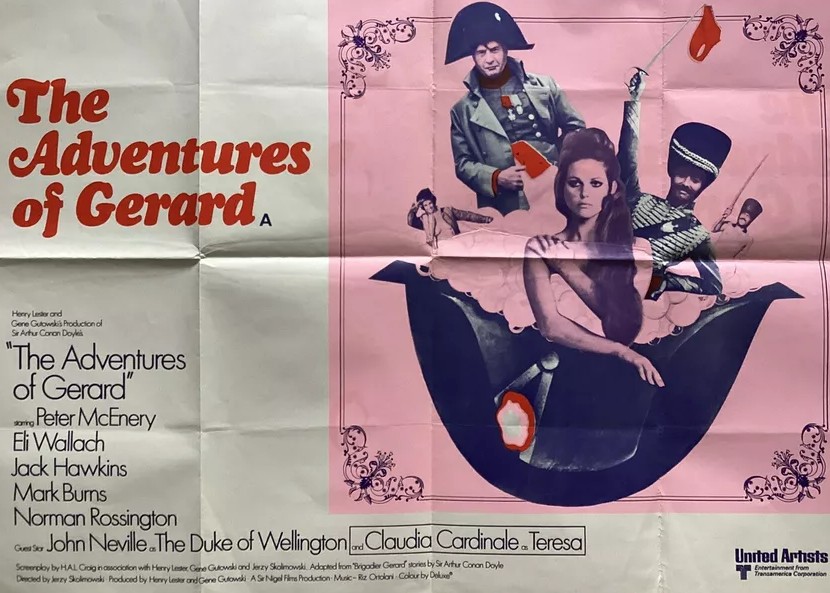
On the basis of Polish director Jerzy Skolimowski winning the Golden Bear at Berlin for Le Depart / The Departure (1967) starring Jean-Luc Godard protege Jean-Pierre Leaud – and its subsequent arthouse success – UA bequeathed him big-budget The Adventures of Gerard (1970), set during the Napoleonic War, based on a book by Sherlock Holmes creator Arthur Conan Doyle, and headlined by rising British star Peter McEnery (Negatives, 1968) and established Italian import Claudia Cardinale (The Professionals, 1966) and a supporting cast including Jack Hawkins and Eli Wallach.
“The picture turned out to be one of the worst disasters in the history of the company,” the company directors told the shareholders. “It was the result of reliance on one of the new fashionable foreign film directors. The picture was beset by problems due to the unprofessional excesses…indulged in by the director.” The outcome was a movie that could not be reshaped into a “more acceptable form” and that ending up occupying “a limbo area between adventure and farce.” Prospects were so poor, the studio doubted if it would even recoup marketing and advertising costs never mind any of the production costs.
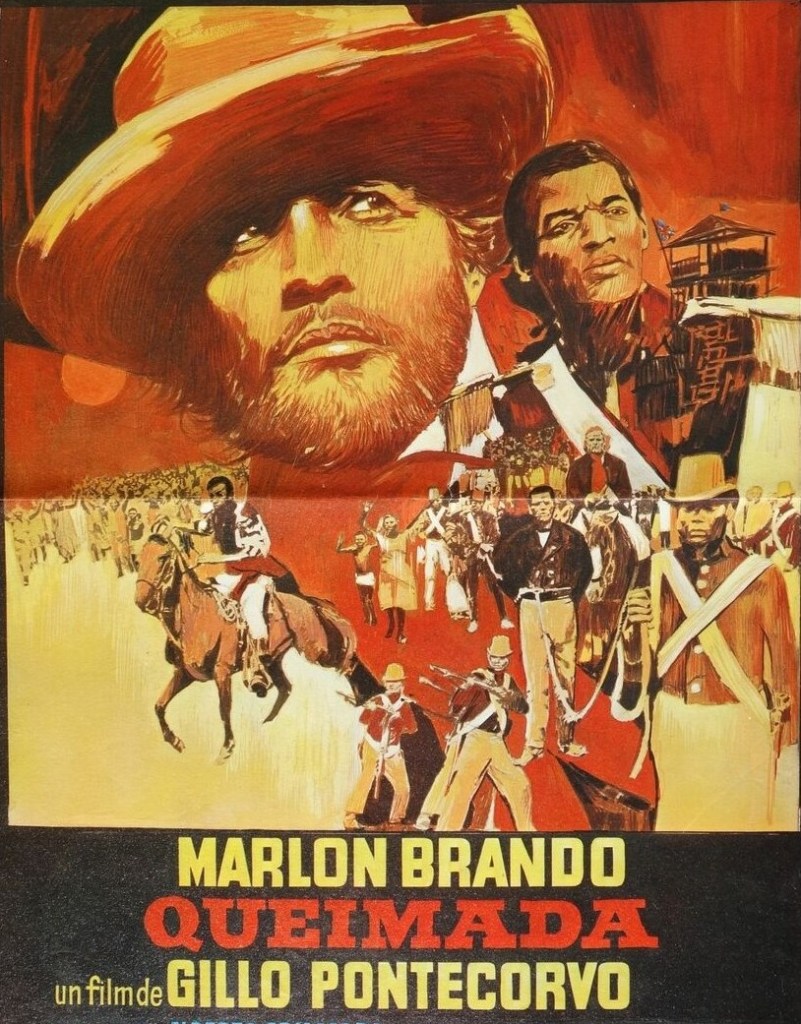
Theoretically, Burn! / Quiemada (1969) should have fared better. At least it had a proper star in Marlon Brando, even though his marquee value was being questioned. This had been placed in the hands of Italian director Gillo Pontecorvo whose The Battle of Algiers (1966) had been nominated for the Best Foreign Language Film Oscar. The studio had hoped to “combine interesting message with entertainment values.” However, personality conflict between director and star saw the picture to go “way over budget.” Prospects remained dim because “despite all efforts to persuade the director to reduce it to realistic length,” it was deemed overlong and “badly cut.” It fell between the stools of the arthouse audience who would have appreciated the message and the action audience who would have welcomed the more commercial elements. It was marked down for “a substantial loss.”
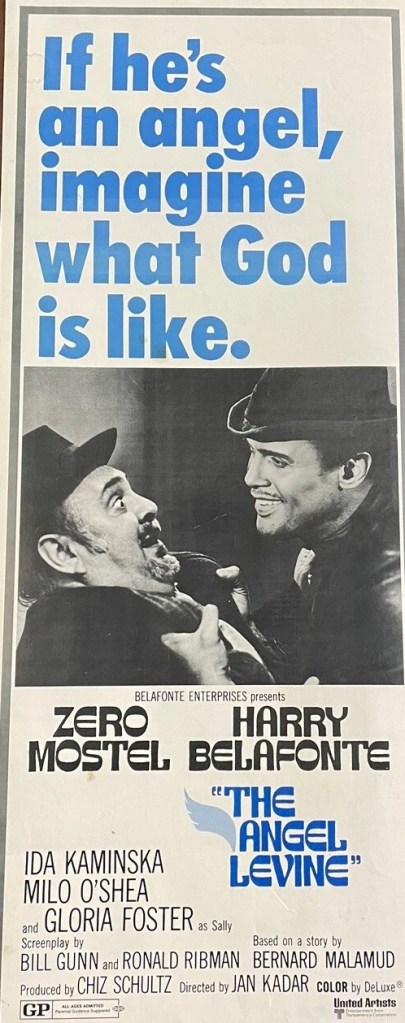
On the strength of a nomination for the Palme D’Or at Cannes for The Shop on Main Street (1965), the studio backed a project by its Hungarian director Jan Kadar. The Angel Levine (1970) attracted investment because the director had achieved “a certain cult,” the recording career of star Harry Belafonte had reached new heights, and the story was supposed to have a special appeal to ethnic groups. “Everything went wrong. The direction and performance came out slow and leaden. The story…didn’t work.” The picture was over budget and overlong. “The director could not be persuaded to make the necessary cuts” resulting in expectation of another “substantial loss.”
Italian director Elio Petri had enjoyed cult success with the offbeat sci fi The 10th Victim (1965) starring Marcello Mastroianni and Ursula Andress. For A Quiet Place in the Country (1968) he had lined up top British Oscar-nominated actress Vanessa Redgrave and rising Italian star Franco Nero who had played lovers in Camelot (1967). It was greenlit at a time when the studio believed there was a wider market among discriminating audiences for foreign films previously restricted to arthouses. But it had become clear that films in this category faced “inevitable loss.”
You probably haven’t heard of That Splendid November (1969), greenlit to “fulfill a pay-or-play commitment to Italian star Gina Lollobrigida” (Strange Bedfellows, 1965). While targeting the European market, it was hoped it would do additional business in America. It didn’t. Once again, the director (Mauro Bolognini) was allowed too much leeway. He had not been “persuaded to make the changes that would improve its chances” while the studio discovered that La Lollo had lost her marquee luster.
However, United Artists had also committed to potential “breakout” pictures, foreign movies aimed at American arthouses. The bulk of the overseas pictures that had thrived in the U.S. had done so via the arthouse circuit after being favorably reviewed by critics. These were considered relatively low-cost and low-risk investments. But, as events proved, these were as big a gamble as more high-budget projects.
Red, White and Zero / The White Bus (1967) proved “an utter failure” despite the presence of three top British directors, Lindsay Anderson (This Sporting Life, 1963), Oscar-winner Tony Richardson (Tom Jones, 1963) and Peter Brook. Although made for the arthouse market, these proved fewer in number than anticipated when the film was greenlit.
A French heist film entitled Score “would not be made today,” admitted the UA executives. Hoping to capitalize on the caper genre, the studio discovered no one was interested. Three French pictures, Philippe de Broca’s Give Her the Moon (1970) starring Philippe Noiret, The American and Lent in the Month of March (1968), were written off due to the softening of the arthouse market, as was Yugoslavian number It Rains in My village (1968) starring Annie Girardot. French/Brazilian Pour Un Amour Lointain (1968), “one of the poorer foreign pictures,” had such dismal prospects it was denied U.S. distribution. German picture Gentlemen in White Vests (1970) lacked appeal even its home market.
SOURCE: “Comments supplementing notes to Balance Sheet and Statement of Operations of United Artists Corporation for 1970,” United Artists Archive, Box 1 Folder 12 (Wisconsin Center for Theater and Film Research).
Marlon Brando’s box office cachet had crashed. He hadn’t made a picture in two years following the flop of Queimada/Burn (1969) which had followed his debilitating box office trend of most of the decade. While his stock remained high enough to headline such big budget numbers as The Chase (1966) and Reflections in a Golden Eye (1967), thereafter confidence in his marquee value tumbled. Apart from Queimada, he had only been signed up for Night of the Following Day (1968), another loser.
But that last picture had brought him into the orbit of independent producer Elliott Kastner (Where Eagles Dare, 1968) who had been a friend of director Hubert Cornfield (Pressure Point, 1962) when they had both worked as agents at MCA. “Although he was crazy,” recalled Kastner, “I loved his writing and his drive.” Kastner was a fan of Cornfield’s earlier movies especially as they had been delivered on short time schedules. “I wanted to do something with Marlon Brando and he wrote Night of the Following Day.”
Brando still had clout in Hollywood. His three-picture deal with Universal obliged the studio to pony up for any (financially viable) projects he put to them. Kastner was delighted to hop over from his base in London to the French location and although the movie continued the actor’s poor reception at the box office, the producer enjoyed the experience.
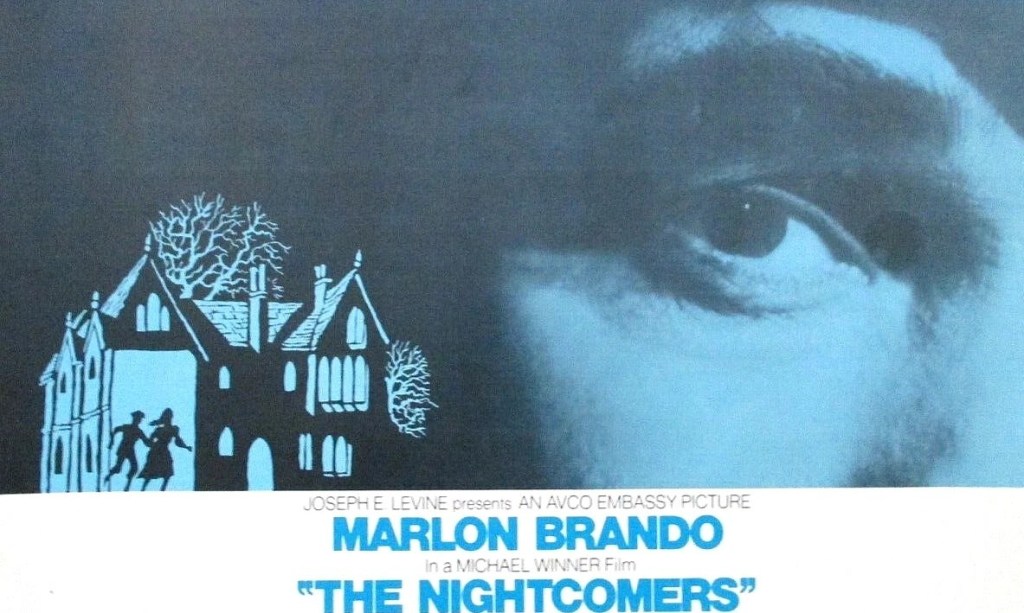
Brando wasn’t averse to the “resting” that most actors endure, stints of unemployment between gigs. So when the actor approached Kastner to work with him again, it took the producer by surprise. “Marlon wanted to do a film,” said Kastner, “which was unusual for Marlon because he hides from work. He wanted to do a film in Europe and he loved staying at my house in the country. I talked to (Brando’s agent) Jay Kanter (who later became Kastner’s business partner) about it and we gave him a screenplay called The Nightcomers…that Michael Winner wanted to direct.”
Kastner had liked Winner’s output and was equally attracted to the fact that he also worked fast. Winner was contemptuous of directors who shot too much footage, especially “coverage”, filming a scene from too many different angles. But he was also a very fast editor. He took an editing caravan with him on location, and after the day’s filming ended at 6pm he spent the next two hours watching rushes and another two hours after that editing. His editor Freddie Wilson said,” His speed of decision in the cutting room saves a great deal of time and money.”
Winner had been sitting on the screenplay by Michael Hastings for some time. “No one was rushing to finance it,” remembered Winner, until Brando showed an interest. Winner arranged to meet the actor at his “modest Japanese-style house” in Los Angeles. However, insurance proved a sticking point following payouts for Quiemada.
“On a personal level,” recollected Kastner, “I thought he (Winner) was a bully with waiters. He was really nasty to people beneath him. I didn’t have much (personal) respect for him but he was very amusing.”
Due to scheduling conflict Vanessa Redgrave (Blow-Up, 1966) turned down the role of Miss Jessel. Winner also offered the part to Britt Ekland (The Double Man, 1967) provided she could bring some financing to the project. In the end, remembered Kastner, “Michael wanted to cast this girl with this big bust who was a halfway decent actor.” Neither Redgrave nor Ekland could compare in the bust measurement department to Stephanie Beacham, so clearly chest size was not a priority.
Kastner reckoned Brando “would bring plenty of poetry” to the project. It was remarkably cheap even for a star of Brando’s fading attraction. The budget was $686,000, of which Kastner received $50,000 as a producer’s fee plus 30% of the profits. Winner deferred his fee, only paid if the movie made money. At that point, Kastner was leading the way in finding funding outside the studio system. Funding for When Eight Bells Toll (1970), for example, was entirely sourced from an American businessman. For The Nightcomers, Kastner located investment of $100,000 from a company called Film & General Investments. Universal was involved through its contract with Brando – paying him his $300,000 salary for this picture to count as the final one on his contract, but declined to distribute the picture. For another producer, this might have been enough to kill off the project, but not for Kastner, who, following his current practice, intending to sell the completed film to a distributor.
As far as Kastner was concerned the movie went into immediate profit. Joe Levine of mini major Avco Embassy, still riding high after the success of The Graduate (1967) and The Lion in Winter (1968), ponied up $1 million for the worldwide rights plus a share of the profits. But Avco also limited its exposure, selling a 40% share to businessman Sigmond Summer for $1 million. (Judging from later legal documents, Universal retained some financial interest in the picture).
Brando had decided Quint was Irish. To learn the dialect, Brando and Winner got together with a group of Irishmen in the back room of a pub, one whom became the actor’s dialog coach on location.
The six-week shoot, on locations in Cambridgeshire, Britain, with Sawston Hall doubling as the mansion, began in January 1971. There was another reason for the speed of the shoot. Winner had contracted with United Artists to make Chato’s Land (1972) and there was no time to spare between the movies. Over 100 actresses auditioned for the role of the female orphan. Winner, seeking “someone over 18 who looked 11,” selected Verna Harvey (she also won a role in Chato’s Land).
Although Winner had gone to some expense to set up a private dining room for the star at Sawston Hall, Brando preferred to eat with the crew. According to Winner, despite Brando’s fearsome reputation, he knew all his lines, immensely patient with his young inexperienced co-stars, concerned about the crew, and, as importantly, arrived on time and even watched rushes, a rarity among the profession. Brando used earplugs to prevent distraction from extraneous noise. During the shoot Francis Ford Coppola flew over to spend time discussing the script of The Godfather with Brando.
Brando initially refused to have stills taken of him during the sex scene and only gave in after considerable persuasion, though he kept his wellington boots on. He wanted to leave the drunk soliloquy to the end of shooting. Though he was actually drunk after consuming a lot of Scotch, “he remembered his lines immaculately…(and) also matched his hand movements and body movements, which is very important in movies,” explained Winner, “because if you have to cut different bits of film together if the body or hands or arms are in a different position you’re in trouble.”
Jerry Fielding didn’t record his score until July during a three-day session with an orchestra of 80 at Cine Tele Sounds Studio. Despite his editing prowess, Winner realized his final version didn’t work. “The first cut was too fast. For a moody period film I’d just messed up. I put back seven minutes (of footage) and spent another three weeks getting it right.”
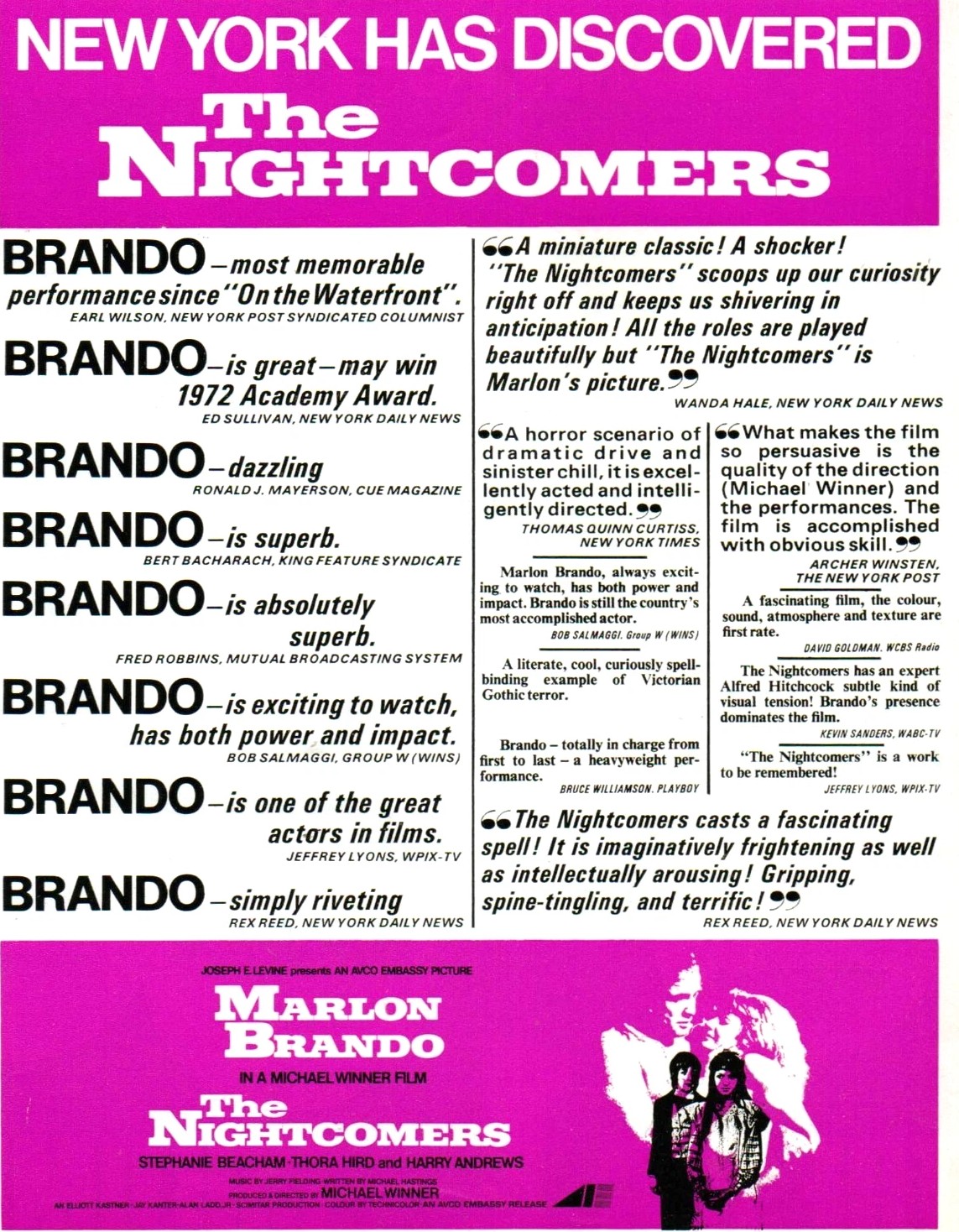
Thanks to its world premiere at the Venice Film Festival alongside the likes of Sunday, Bloody, Sunday (1971), it was touted, perhaps unwisely, as an arthouse picture, rather than majoring on the sex and violence. While Variety tabbed it a “grippingly atmospheric thriller,” only two out of the five most influential New York critics gave it the thumbs-up.
A distribution deal was not struck till the end of 1971. Rather than potentially riding along in the slipstream of The Godfather (1972), which was already attracting huge hype, Avco decided that it was better to come out before the Mafia picture than risk being swamped in its wake. But there was confidence in the project. “Joe Levine thought the film was so brilliant we didn’t have to wait for The Godfather,” related Winner.
It launched first in America, opening in February 1972 – beating The Godfather to the punch by a month – at the 430-seat Baronet arthouse in New York. The opening week of $20,700 was rated “nice” and held well for the second week before plummeting to $11,000 in the third week. It was yanked after six weeks.
By the time it spread out into the rest of the country, The Godfather rollercoaster was well into it stride, but the early release had not particularly gathered any pace and in the aftermath of the Coppola movie it was certainly buried. It opened to $6,500 in Boston compared to The Godfather’s second week of $140,000. There was a “scant” $39,000 from 13 houses in Los Angeles, a “modest” $4,000 in Louisville though $5,000 in San Francisco was rated “brisk” and the same amount in Washington “snappy.
Initially, at least, Britain appeared more propitious. It opened in key West End venue the 1,400-seat Leicester Square Theatre to a “loud” $24,700 and though it dropped $10,100 in the second week, the third and fourth weeks improved on the second. Eight weeks into its West End run, when it was still pulling down $13,300, The Godfather put it to the sword with a record-breaking $191,000 from five West End houses. After that pummelling, The Nightcomers managed only three further weeks.
In fact, the movie did surprisingly well, especially overseas. Total rentals came to $1.69 million, a clear million-dollar profit on the negative cost. While less than half a million came from the U.S., and only $160,000 from Britain, the overseas market kicked in the bulk of revenue – $986,000 – possibly because it was released after The Godfather (1972) rather than, as in the UK and the US, before. In the run-up to and in the wake of The Missouri Breaks (1976), it was included in Brando perspectives at the Museum of Fine Arts, where it was presented as a “novel film…lost in the shadow of The Godfather,” and Carnegie Hall. But an attempt at commercial reissue proved disastrous – a “weak” $1200 in Pittsburgh.
Except from a financial perspective, Kastner wasn’t especially impressed, calling it “grim, boring, contemptuous of story, oblique.” Viewers, including me, beg to disagree.
SOURCES: Elliott Kastner’s Unpublished Memoirs, courtesy of Dillon Kastner; Elliott Kastner Archive, courtesy of Dillon Kastner; Michael Winner, Winner Takes All, (Robson Books, 2004); “Production Review,” Kine Weekly, January 23, 1971, p10; “Not So Young,” Kine Weekly, May 22, 1971, p16;“Jerry Fielding,” Kine Weekly, July 17, 1971, p10; “Michael Winner,” Kine Weekly, August 13, 1971, p10; “Nightcomers to Avemb,” Variety, January, 19,1972, p5; “New York Critics,” Variety, February 23, 1972, p35; “Picture Grosses”, Variety, 1972: February 23-April 26, June 7-14; July 19- Sep 27; “Broadway,” Box Office, February 9, 1976, pE2; “Museum of Fine Arts,” Box Office, October 18.
While Hollywood was capable of dealing with mental illness head-on in pictures like Frank Perry’s David and Lisa (1962), Sam Fuller’s Shock Corridor (1963) and Robert Rossen’s Lilith (1964), the British were more inclined to take an alternative approach. The titular characters of Billy Liar (1963) and this film dealt with awkward reality by creating a fantasy world.
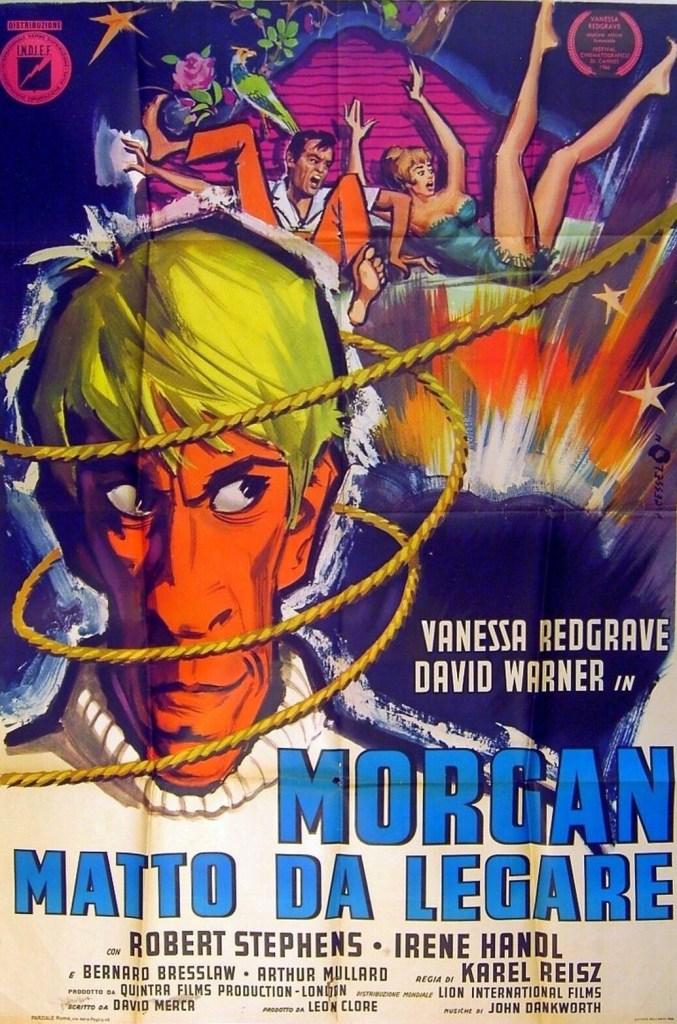
Morgan (David Warner in his first starring role), is a failed artist and virulent communist who cannot come to terms with being divorced by rich Leonie (Vanessa Redgrave) who is planning to marry businessman Napier (Robert Stephens). Morgan forces his way back into his wife’s house and attempts to win her back with nothing stronger than whimsicality and when that fails resorts to kidnap.
And it is clear that she shares his fancy for furry animals, responding to his chest-pounding gorilla impression with tiny pats of her own chest. For a slim guy, Morgan makes a believable stab at a gorilla, shoulders hunched up under his jacket, chest stuck out. And he has an animal’s sense of smell – detecting his rival’s hair oil.
The tone of the film is surreal. Had David Attenborough been a big name then you could have cited him as one of director Karel Reisz’s influences, such was his predilection for inserting wildlife into the proceedings, not just primates but giraffes, a hippo, a peacock and a variety of other creatures. Some are comments on Morgan’s state of mind but after a while it becomes monotonous. The film is clearly intentionally all over the place, the class struggle also taking central stage, but it’s hard work for the viewer. If you had stuck in some psychedelia, the fantasy would have made as much sense as The Trip (1967).
Having said that, towards the end of the picture there is an extraordinary image – possibly stolen from the opening of La Dolce Vita – of Morgan in a straitjacket hanging from a crane. Had that been the film’s starting point, it might have dealt more demonstrably with the subject matter. The whimsy is all very well but the focus on external animals does little to illuminate Morgan’s internal struggle and mental descent.
At this stage of his career, David Warner (Perfect Friday, 1970) exhibited a core instability, although later he was adept at ruthless villains. You could argue he is too charming for the role.
Vanessa Redgrave (Blow-Up, 1966), in her second film and her first starring role, steals the picture, winning her first Oscar nomination (in the same year as sister Lynn for Georgy Girl). She is made of gossamer. Still attracted to a man she knows will only bring her pain, she is far from your normal leading lady. There is a touch of the Audrey Hepburn in her ethereality but she portrays a completely genuine soul, not a manufactured screen personality. Robert Stephens (The Prime of Miss Jean Brodie, 1969) adds a welcome hard core to the frivolity.
But Karel Reisz (Saturday Night and Sunday Morning, 1960) misses the spot. Distinguished British playwright David Mercer adapted his own BBC television work from 1962.
Could have done with taking a step back from the material and offered a more objective assessment.
Movies can break all sorts of rules but they can’t cheat.
A film has to stick to an internal logic. For example, it can’t portray a photographer so obsessed with his calling that he even takes a camera with him to an antique shop and starts shooting off roll and after roll capturing the area’s rundown streets but then the one time he really could do with a camera – to prove there is a corpse at his feet – he is somewhat remiss. Especially when that the movie turns on that plot point.
Setting aside what’s a somewhat contrived snapshot of “Swinging London” there’s a lot to admire here. The absence of music for one thing. Most of the movie runs without musical accompaniment, a bold move since so often we rely on the soundtrack to provide guidance for a scene or an overlay for the entire film. Here, Michelangelo Antonioni (Zabriskie Point, 1970) makes us falls back on our own interpretation.
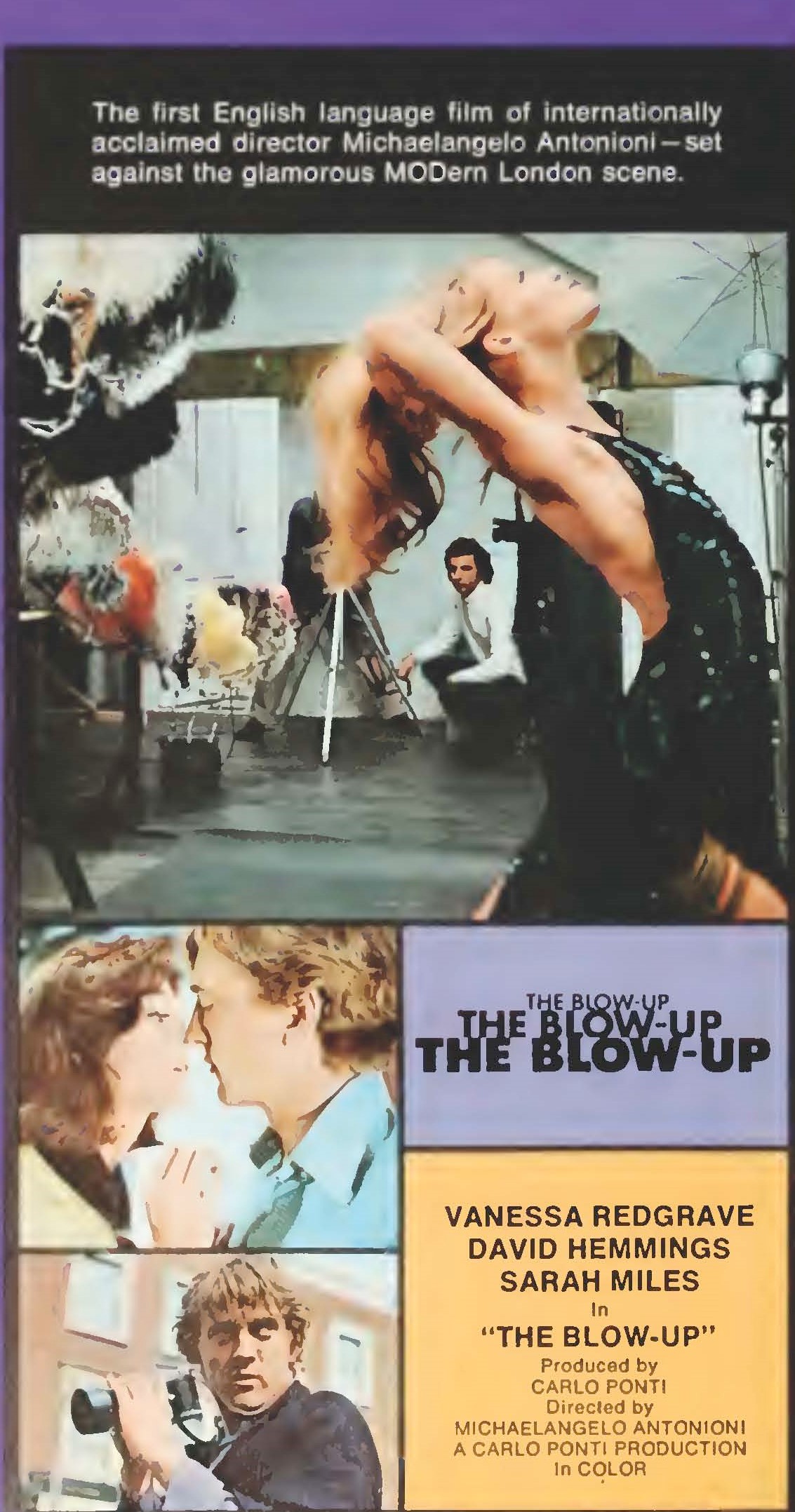
David Hemmings (The Charge of the Light Brigade, 1968), all mop-top and intense stare, is a high-flying high-living fashion photographer in the David Bailey mold (casual sex with wannabe models a perk) who turns investigator on being confronted in a park by Vanessa Redgrave (Hemmings’ adulterous love interest in The Charge of the Light Brigade) after taking snaps she wants back. Tension is sustained by her sudden appearance at his studio, willing to pay with her body for the return of the photos, and then by Hemmings’ careful, photo-by-photo blow-up-by-blow-up analysis that slowly comes closer to the truth.
Everything in his world is judged through a lens, as if he can capture elusive truths, and he has aspirations to being more than a mere fashion adjunct, having spent time taking portraits of down-and-outs. He judges Redgrave as he would a model, she has a good stance and sitting posture. Even by the standards of the permissive society, he is a bit of sexual predator, taking advantage of two giggly model wannabes – Jane Birkin (Wonderwall, 1968) and Gillian Hills (Three, 1969).
But the photography scenes are well done and Antonioni captures the intimacy between model and photographer that create the best images. If you want to see what a model brings to modeling check out real-life model Veruschka posing in an outfit held together by the thinnest of threads, bringing to life the much-touted notion that a model makes love to a camera. If you can get past the cheat and the deliberate obtuseness this creates – and the tsunami of artistic interpretations it inspired about the director’s intent – then it remains intriguing.
This isn’t Hemmings’ greatest work – Fragment of Fear is much better – but it certainly provided him with a marketable movie persona. Redgrave is excellent as the nervy woman willing to do what is required and the movie might have worked better had she had been allocated more screen time and their duel had continued through other scenes. But then that would have been Hitchcock and not Antonioni.
Sarah Miles (The Ceremony, 1963), Peter Bowles (The Charge of the Light Brigade) and John Castle (The Lion in Winter, 1968) have small parts. The film certainly captures the electricity of a photo shoot between a skilled photographer and pliant model, but it also works as an extended metaphor about the elusiveness of cinematic truth.
Despite my misgivings about the “cheat,” an intriguing and satisfying exploration of an artist seeking to jettison the fripperies of his art yet unable to avoid the temptation of enjoying the easy sexual benefits.
It’s worth remembering that Britain, led by roughly the same type of commander lampooned here, won the Crimean War and that initially this particular engagement, despite the deaths, was celebrated for its valour by poet Lord Tennyson, in much the same way as famous defeats like Dunkirk and The Alamo somehow managed to achieve the status of some kind of victory in the public perception. It’s also worth noting that the documentary-style realisation of Dunkirk, (2017) and to that extent Coppola’s Apocalypse Now (1979) owe much to Tony Richardson’s approach, both films more interested in the bigger picture than individual acts of heroism.
And our conscience here, dashing cavalry officer Nolan (David Hemmings), is not quite saintly, engaged in an affair with the wife Clarissa (Vanessa Redgrave) of a friend. Despite the director’s rush to judgement, his approach displays a refreshing change to a genre where acts of selfless courage were the norm. Setting aside the occasional self-reverential artistic lapse, it’s an excellent depiction of class-ridden Britain at war in 1854, an era when military advancement was purchased without any consideration to the leadership skills such high-ranking officers required. I’m never sure if John Ford invented the camaraderie of his Cavalry in westerns, where at dances the officers mixed with the ordinary soldiers, but here the two classes are kept apart.
And while Richardson clearly wants to blame the class system for the military calamity, the outcome is a no-holds-barred ultra-realistic portrayal of war in in all its sordid glory. At its heart are the machinations of senior commanders jostling for position and control and, much as with Field Marshal Montgomery and General Patton in World War Two, allowing personal enmity to affect decisions.
The two biggest culprits are Lord Cardigan (Trevor Howard) and brother-in-law Lord Lucan (Harry Andrews) in charge of the ill-fated charge who openly spout bile at each other, remain deliberately obtuse, and are, nonetheless, a joy to watch. Cardigan is irascible to the point of apoplexy, incredibly brave, vainglorious, a vindictive sex-mad peacock, with an odd selection of principles (refuses to deal with spies, for example). Nothing can beat a quite marvellous spat between the pair over how to pitch tents. Both, however, are a vast improvement on the ineffectual commander-in-chief Lord Raglan (John Gielgud) whose idea of tactics is to “form the infantry nicely” and another commander who refuses to let the simple matter of being under attack ruin his breakfast.
At the other end of the scale are the poor recruits, drawn from the lower classes, so ill-educated they don’t know their left foot from their right (something of a necessity in obeying orders in the field), lured by the promise of glory and a job, and find themselves turned into horsemen in the most brutal fashion.
In the middle is the effete Nolan, initially introduced as the good guy, who believes horses should be treated with kindness and stands up to Cardigan. His romance with Clarissa is a masterpiece of nuance, all furtive glances, hardly a word spoken. And he has a pivotal role in sending the cavalry in the wrong direction at the Battle of Balaclava, causing the fatal charge.
It’s episodic in structure, characters bobbing in and out, some for comedic purposes, and without the battle it’s doubtful the picture would have been made for, excepting the high-level squabbling, there’s little inherently dramatic. And possibly that’s to the movie’s benefit for it clears the way to concentrate on how an army operates and goes to war, the focus, unlike most war or historical pictures, being as much on what goes wrong as goes right. So the horses dying during the voyage and callously dumped overboard and the men marching through Crimean heat and afflicted by cholera take centre stage rather than lavish sequences of soldiers on splendid parade.
On the downside, you have to accept the director’s version of the war’s causes, British imperialism don’t you know, rather than Russian aggression as a result of religious conflict in the Middle East. And there’s narrative indecision, various characters permitted interior monologue for no particular reason except artistic impulse. Mrs Duberley (Jill Bennett) wife of the paymaster (Peter Bowles) is permitted to accompany the expedition for the sole purpose it would appear of being shagged by Cardigan.
The detail of what exactly went wrong on the battlefield is obscured by the fact that Nolan, who hand-delivered the famous order to attack, itself unclear, died in battle, so it’s like one of those Netflix documentaries about unsolved murders, fascinating but ultimately annoying. If incompetence is measured in casualties, apart from this one charge the British came out better than the other participants, 40,000 dead compared to three times as many among their French allies and more than ten times as many among the Russian enemy.
The acting is of a very high quality, David Hemmings (Alfred the Great, 1968) as good as I’ve ever seen him, Vanessa Redgrave (Blow-Up, 1966), except for her deception a Stepford Wife Victorian-style, Trevor Howard (Von Ryan’s Express, 1965) brilliantly outrageous and John Gielgud (Sebastian, 1968) who turns befuddlement into a high art.
Tony Richardson (Tom Jones, 1963) makes some bold choices, not least in what is included and what is left out, the battle of the tents, fake news (from The Times!), soldiers facing the lash, the dashing charge and its terrible aftermath, the animated sequences, and his revolutionary soundtrack. Sergio Leone might have claimed the artistic high ground with the buzzing fly at the start of Once Upon a Time in the West (1969) but there’s little in film music of the time – beyond Bernard Herrmann’s Psycho score – to compare with the sound of a fly playing over the end credits or its inclusion during the march when men are literally dropping like flies. This is a very different kind of curate’s egg, absolutely brilliant in parts, and never dull.
Unfortunately, there’s a topical parallel, Crimea having been invaded several years back by Russia and now the whole region aflame.
This was the first home-grown excursion into the all-star-cast business – other British movies in that ilk, originating from these shores, previously headlined by a Hollywood star like Gregory Peck (The Guns of Navarone, 1961), Kirk Douglas (The Heroes of Telemark, 1965) or George Peppard (The Blue Max, 1966). And I can see why the new box office stars David Hemmings and Vanessa Redgrave, repeating their Blow-Up (1966) teaming, would have, in the narrative sense, occupied center stage. But given nobody knew for certain what caused the disastrous charge and that it would taken place anyway in the picture, the far more entertaining approach would be to concentrate entirely on the likes of the feuding Cardigan and Lucan, two characters who leapt off the screen. Outside of the battle itself, Nolan’s sole purpose, it would seem, was to point out that the army treated its horses badly, a point the audience would have easily picked up without Nolan’s display of alternative horsemanship. Still, all told, at the risk of repeating myself, an excellent watch.
While Hollywood was capable of dealing with mental illness head-on in pictures like Frank Perry’s David and Lisa (1962), Sam Fuller’s Shock Corridor (1963) and Robert Rossen’s Lilith (1964), the British were more inclined to take an alternative approach. The titular characters of Billy Liar (1963) and this film dealt with awkward reality by creating a fantasy world.
Morgan, played by David Warner in his first starring role, is a failed artist and virulent Communist who cannot come to terms with being divorced by rich Vanessa Redgrave who is planning to marry businessman Robert Stephens. Warner forces his way back into his wife’s house and attempts to win her back with nothing stronger than whimsicality and when that fails resorts to kidnap. And it is clear that she shares his fancy for furry animals, responding to his chest-pounding gorilla impression with tiny pats of her own chest. For a slim guy, Warner makes a believable stab at a gorilla, shoulders hunched up under his jacket, chest stuck out. And he has an animal’s sense of smell – detecting his rival’s hair oil.
But Vanessa Redgrave, in her second film and her first starring role, steals the picture, winning her first Oscar nomination (in the same year as sister Lynn for Georgy Girl). She is made of gossamer. Still attracted to a man she knows will only bring her pain, she is far from your normal leading lady. There is a touch of the Audrey Hepburn in her ethereality but she portrays a completely genuine soul, not a manufactured screen personality.
The tone of the film is surreal. Had David Attenborough been a big name then you could have cited him as one of director Karel Reisz’s influences, such was his predilection for inserting wildlife into the proceedings, not just primates but giraffes, a hippo, a peacock and a variety of other creatures. Some are comments on Morgan’s state of mind but after a while it becomes monotonous. The film is clearly intentionally all over the place, the class struggle also taking central stage, but it’s hard work for the viewer.
Having said that, towards the end of the picture there is an extraordinary image – possibly stolen from the opening of La Dolce Vita – of Warner in a straitjacket hanging from a crane. Had that been the film’s starting point, it might have dealt more demonstrably with the subject matter. The whimsy is all very well and Redgrave is delightful and while Warner is clearly on a mental descent the focus on external animals does little to illuminate his internal struggle. Also, having said that, Warner is imminently watchable. He has an intensity that is hard to ignore and usually is cast with that in mind but here his vulnerability, his inability to grasp that he is living in a different reality, is very touching. Even when his imagination is at its most vivid – such as when Redgrave appears at the end supposedly bearing his child – you are partly convinced that this may actually be true. I would have preferred less of the animal imagery and more of Warner’s true reaction to the world around him. It’s a case of performances spoiled by over-direction.
Setting aside the director’s indulgence, the film is remarkable in one other way. It was almost revolutionary to find a British picture that, despite Warner’s working-class agitation, is effectively about joie de vivre as opposed to the more traditional British stiff upper lip, that inbred stoicism afflicting the entire nation regardless of class status. While Lawrence of Arabia (1962) represented an exhibition of flamboyance, again not a British trait, and the truculent Albert Finney in Saturday Night and Sunday Morning (1960) was determined to enjoy life to excess, Warner’s character epitomizes a desire to be free of normal cares in order to live life to the full.
Given the Warner would later be more famous buttoned-down roles – and that, in contrast, Redgrave would later portray another famous flamboyant in Isadora (1968) – it is surprising that this fun aspect of Warner’s screen persona was not called upon more often.
Many of the films from the 1960s are to be found free of charge on TCM and Sony Movies and the British Talking Pictures as well as mainstream television channels. But if this film is not available through these routes, then here is the link to the DVD and/or streaming service.
Movies can break all sorts of rules but they can’t cheat.
A film has to stick to an internal logic. For example, it can’t portray a photographer so obsessed with his calling that he even takes a camera with him to an antique shop and starts shooting off roll and after roll capturing the area’s rundown streets but then the one time he really could do with a camera – to prove there is a corpse at his feet – he is somewhat remiss. Especially when the movie turns on that plot point.
Setting aside what’s a somewhat contrived snapshot of “Swinging London” there’s a lot to admire here. The absence of music for one thing. Most of the movie runs without musical accompaniment, a bold move since so often we rely on the soundtrack to provide guidance for a scene or an overlay for the entire film. Here, Antonioni makes us falls back on our own interpretation.
David Hemmings, all mop-top and intense stare, is a high-flying high-living fashion photographer in the David Bailey mold (casual sex with wannabe models a perk) who turns investigator on being confronted in a park by Vanessa Redgrave after taking snaps she wants back. Tension is sustained by her sudden appearance at his studio, willing to pay with her body for the return of the photos, and then by Hemmings’ careful, photo-by-photo blow-up-by-blow-up analysis that slowly comes closer to the truth.
Everything in his world is judged through a lens, as if he can capture elusive truths, and he has aspirations to being more than a mere fashion adjunct, having spent time taking portraits of down-and-outs. He judges Redgrave as he would a model, she has a good stance and sitting posture. Even by the standards of the permissive society, he is a bit of sexual predator, taking advantage of two giggly model wannabes.
But the photography scenes are well done and Antonioni captures the intimacy between model and photographer that create the best images. If you can get past the cheat and the deliberate obtuseness this creates – and the tsunami of artistic interpretations it inspired about the director’s intent – then it remains intriguing.
This isn’t Hemmings’ greatest work – Fragment of Fear is much better – but it certainly provided him with a marketable movie persona. Redgrave is excellent as the nervy woman willing to do what is required and the movie might have worked better had she had been allocated more screen time and their duel had continued through other scenes. But then that would have been Hitchcock and not Antonioni. I’d have given it a higher score except for the cheat.
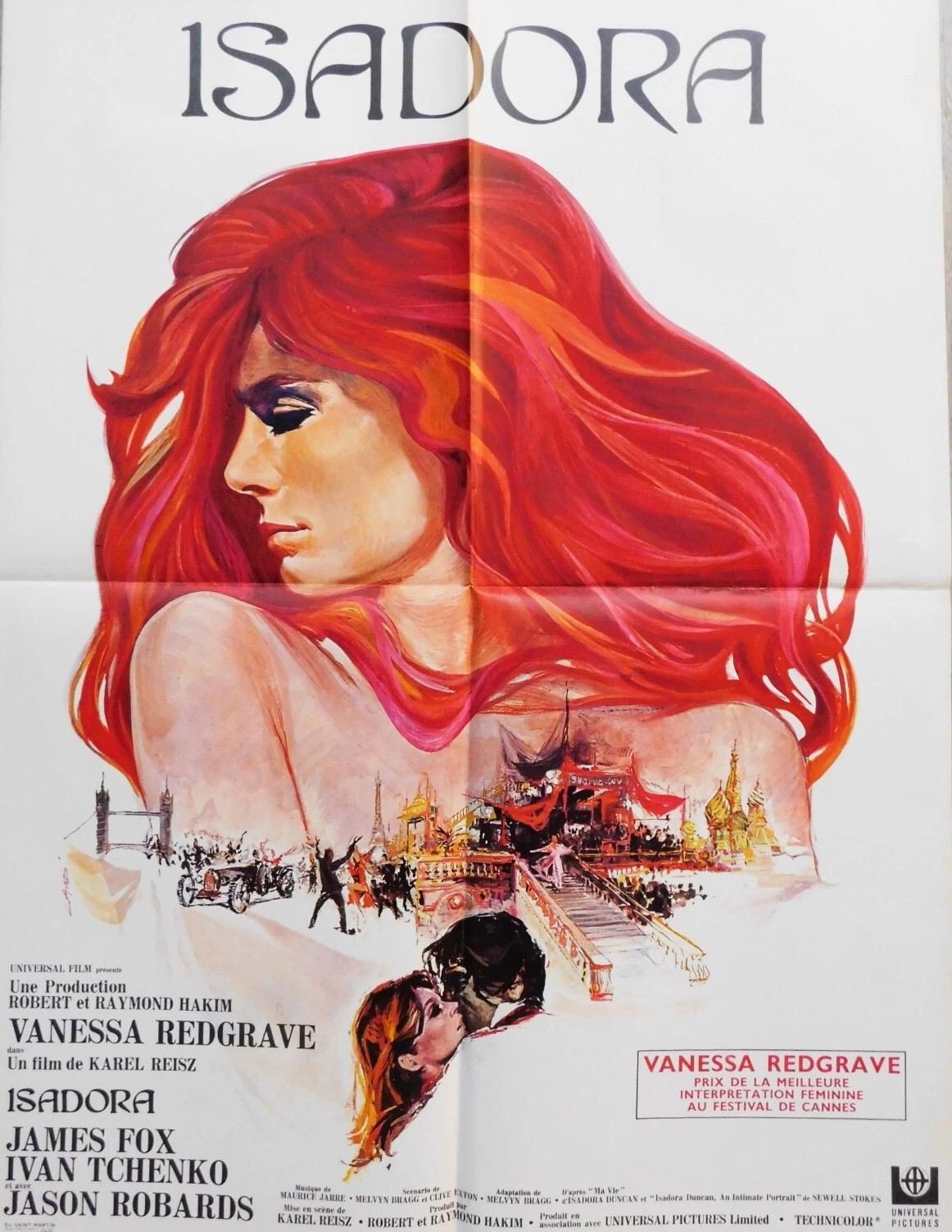
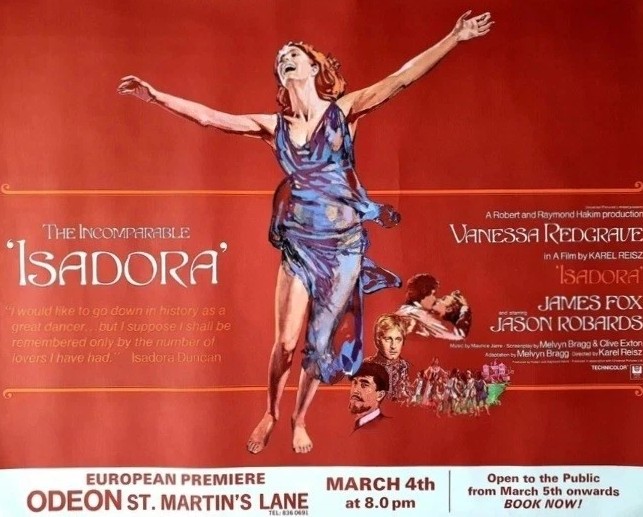
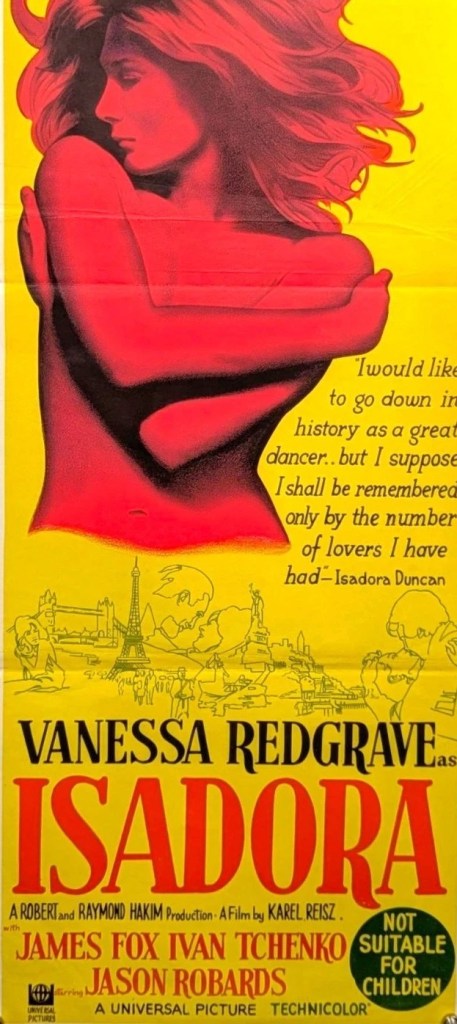
“Only Vanessa Redgrave could portray the full range of emotions in the tour de force title role performance of Isadora,” runs the opening line to the sumptuous 52-page program (cover shown above) that accompanied the film.
Programs like this were part of the package for a movie intended for roadshow. I’ve no idea how many Universal printed but most were shredded since after an initial launch in Los Angeles, the movie was not shown in roadshow in America (though it was overseas). It was also drastically cut from 168 minutes to 138 minutes.
Redgrave had been on the cusp of major stardom after an Oscar nomination for Morgan!(1966) and box office breakout Blow Up (1966) but under-performing Warner Brothers’ musical roadshow Camelot (1967) and flops Charge of the Light Brigade (1968) and A Quiet Place in the Country (1968) had put a dent in her surge to the top of the Hollywood tree.
Directed by Karel Reisz (Saturday Night and Sunday Morning, 1960, and Morgan!), the movie was filmed entirely on location – 72 of them – for six months. Main locations in Britain were Oldway Mansion in Devon and the British Museum.
Different rooms and aspects of South Lodge mansion in London, once owned by the Royces of Rolls-Royce fame, provided backdrops for scenes set in Moscow, Berlin, New York, Chicago and Boston. Yugloslavia doubled up for France and Russia, the Berlin Opera house represented by National Theatre in Rijeka, and the resort of Opatija on the Adriatic standing in for Nice.
The film was produced by the Hakim brothers, better known for arthouse picture like Purple Noon (1960) and Belle de Jour (1967). Jason Robards, on the first of two European excursions that year (the other being Once upon a Time in the West), played one of her many lovers. According to Robards, the art of acting “is an intuitive process; any actor can prepare only so much for any given part and the rest must come from a deep resource within him.” Although Redgrave received an Oscar nomination, the movie made a huge loss.





 The Magnificent 60s