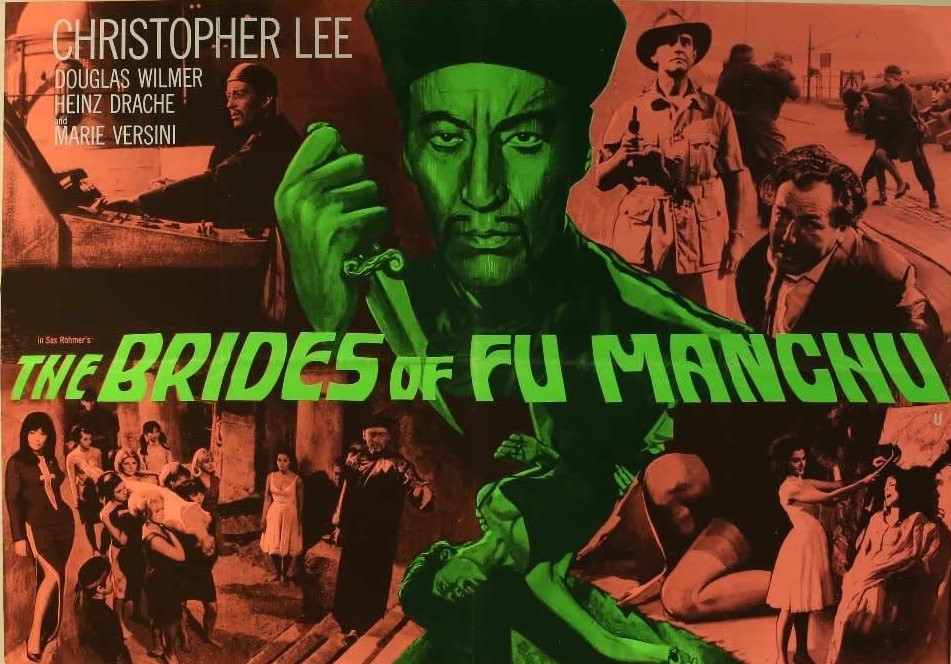
The Brides of Fu Manchu (1966) ***

The 1960s was awash with movie megalomaniacs, most courtesy of the spy vogue. You could also count on secret agents for trailing in their wake bevies of beauties. So no surprise then that criminal mastermind Fu Manchu (Christopher Lee) has his own gang, his “brides,” although they are hardly volunteers, being the kidnapped daughters of top scientists. His plan for global domination this time consists of transmitting energy as sound waves, using miniaturization, a sonic death ray, with enough power to destroy a city.

The result is good hokum, a thriller set in the 1920s with a cracking pace, plenty of action, explosions, burgeoning romance, and a plot that gets more complicated by the minute as a tribe of worthies try out to outwit the evil genius. There is a terrific lair – where the disobedient end up in a snake pit – a passable laboratory, chases, truth serums (“the dust that loosens tongues”), hypnotism, bait-and-switch tricks and decent special effects.  Three stories race along in a parallel pell-mell: Manchu needs one more kidnapping to complete his complement of daughters, while the good guys headed by Fu Manchu’s old adversary Nayland Smith (Douglas Wilmer) are trying to locate the bad guy’s secret location while at the same time attempting to find out where he will strike next. 
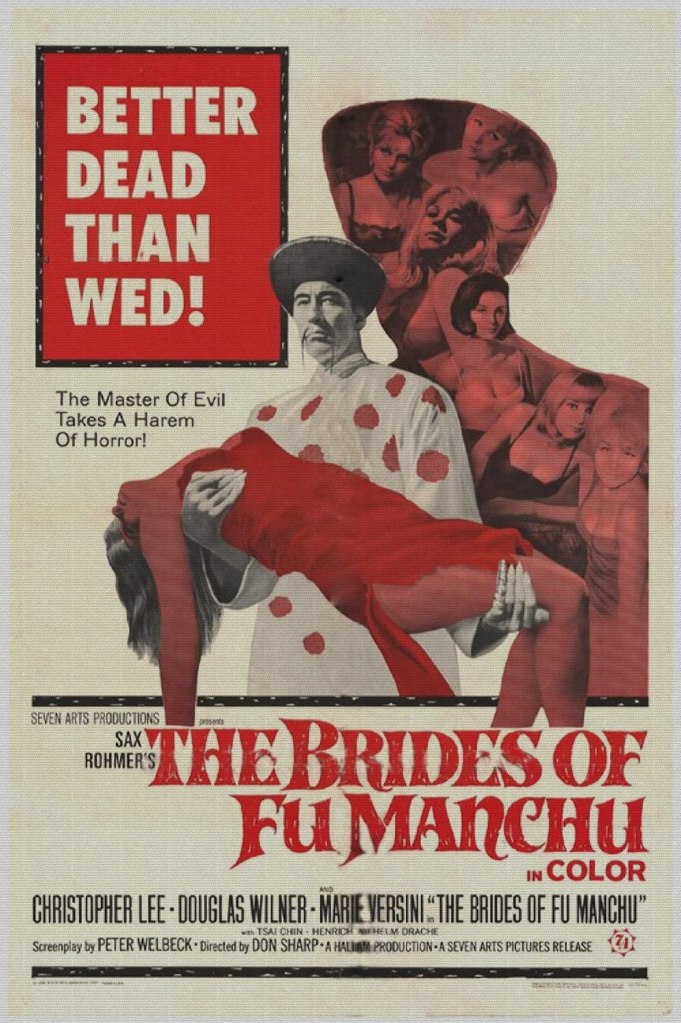
While Fu Manchu is indestructible – supposed dead after the previous film – his henchmen (and henchwomen) are all too human. It takes three attempts to kidnap Manchu’s next victim. They are easily identifiable by their giveaway cummerbunds and bandanas and their method of assault is not kung fu but brawling so a good solid British punch of the old-school soon sorts them out. Manchu’s daughter Lin Tang (Tsai Chin) is a chip off the old block, delighted at any opportunity to torment the brides.  

The brides, in diaphanous gowns that might have been a job-lot from the set of She, are far from compliant, even rebelling at one point, and employing vicious fight tactics. Fans of director Don Sharp will find him every bit as inventive as in The Devil-Ship Pirates (1964) and  Bang, Bang, You’re Dead  (1966) . It’s another Harry Alan Towers (written under his pseudonym Peter Welbeck) effort so that means an international cast.

Two television cops, British Rupert Davies (BBC’s Maigret) and German Heinz Drache (cop in a Francis Durbridge series), plus Francois Mitterand’s brother-in-law Roger Hanin, provide solid support. Not forgetting Burt Kwouk as a henchman. Brides of the year include French Marie Versini (German western Winnetou, 1963) and Rhodesian Carole Gray (Curse of the Fly, 1965). The film did not prove much of a jumping-off point for other brides such as Ulla Berglin, Danielle Defrere and Anje Langstraat, for whom this debut was as far as their careers went.

Christopher Lee, despite the dodgy moustache, is resplendent, exuding evil, and with a gift for rising again (just like Dracula) as he would do for another three films in the series.

aka Mr Chow (2023) ****

Pop quiz: name the only brother and sister who appeared in the same James Bond film. Hint: You Only Live Twice (1967). You might be more familiar with Tsai Chin (The Face of Fu Manchu, 1965, and three sequels) than Michael Chow. Though he had a bigger role in Joanna (1969) and The Touchables (1969) he was never more than a bit player, and often  uncredited (55 Days at Peking, 1963). He also appeared in The Brides of Fu Manchu (1966) and there’s a fair chance you might remember him from Modesty Blaise (1966).

But HBO isn’t noted for devoting a documentary to a bit part player, not even one who can recite the opening of any film you care to mention. This film begins with such a recitation – encompassing the likes of North by Northwest (1959). If ever there was a more arresting opening to a documentary, this is it.

If you’re a fashionista or restaurant fan or gulled by celebrity photos, you’ll more likely know him by the name of Mr Chow, under which he established a chain of spectacularly successful eateries in London, New York and Los Angeles. He wasn’t even a chef, an understandable subject for a docu, what with all the creative endeavor that involves. But there’s no doubt he was creative, if only in reinventing himself. Born Zhou Yinghun, he chose the name “Mr Chow” because it meant people addressing him such manner rather than treating him with a racist epithet.

He might well have deserved a documentary for other reasons. He was the son of one of most famous Chinese opera stars, who reinvented the genre, and he escaped the cull of the intelligentsia instigated by Chairman Mao. His father was imprisoned for years and his mother was “beaten to death.”

The young Chow was living in England at his point, having been sent at a young age to a boarding school there, where racism of course was endemic. He attended art school but when his paintings didn’t sell he made a living from bit parts in movies – he was the child mown down by a car in Violent Saturday (1960), for example.

A Chinaman wanting to set up a business in London in the 1960s had two options: a laundry or a restaurant. But Chow didn’t want to imitate the ubiquitous Chinese restaurant. His artistic side came to the fore via interior design. His venture, in the staid world of the restaurants of the era, was a culture shock. Everything about it was different – no chopsticks and Italian waiters and no dressing for dinner (wear what you like), an anomaly in a high-end operation at the time. But since he attracted more than his fair share of celebrities presumably what they wore was highly acceptable.  

An abundance of charm and connections gained through the movie business provided the funding. But it soon became the “in” place, and every evening was a performance.

By the time HBO came to make a documentary about him – and perhaps this fitted in more with that streamer’s agenda – he had become a proper artist. So much of the film, and indeed a good chunk of the opening section, is devoted to his modernistic artworks which often involved blowtorches, sheets of plastic and a rubber hammer. He exhibits under the name “M” so if you are familiar with the art world that might strike a better chord.

In the fashion of the current docu style, the makers seduce you with interesting material then hit you with a couple of blows you didn’t see coming. The “Shanghai trouble” is one such, which saw both parents killed. But there was also AIDS. His third wife Tina, a famous model, divorced at the time, died of that disease, contracted through a lover, not Chow, and she was one of the first non-homosexual people to be linked with the illness, and one of the first celebrities.

Abandoned, as he saw it, by his mother (in sending him to boarding school) family meant everything and you get the sense that the restaurants were as important as the various wives in creating a loving world. But he is also quite matter-of-fact about the personal calamities – you move on is his doctrine. The racism he endured cut deeper. Even as a famed restaurateur standing outside one of his own restaurants he found it hard to get a taxi to stop.

A handful of celebrities – hardly an all-star cast – pay tribute from Oscar-winning producer Brian Glazer (A Beautiful Mind, 2001) to LL Cool J and author Fran Lebowitz. But the pictures tell a story – Jack Nicholson, Mick Jagger etc are caught on camera having fun. I have to say the one time I went to the LA branch – as the guest of the publisher of Variety magazine – there was not a celebrity in sight (but it was lunch not dinner), though we were seated at Table No 1.

Cunningly directed by Nick Hooker (Agnelli, 2017).

As fascinating a docu as you will come across.

https://www.hbo.com/movies/aka-mr-chow

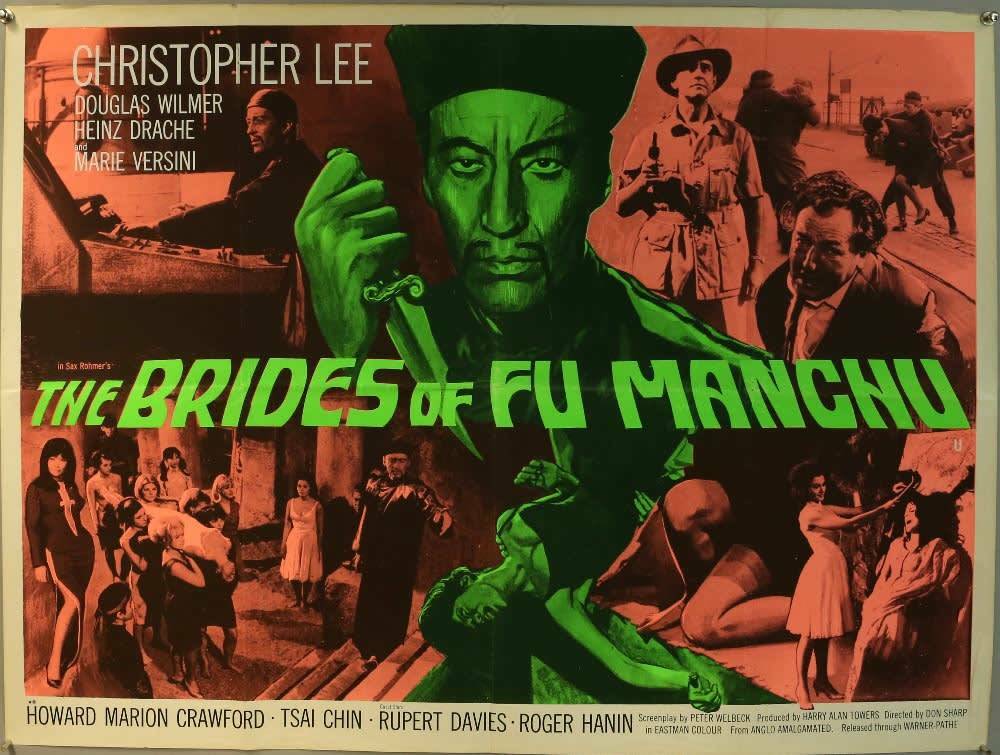
The Brides of Fu Manchu (1966) ****

The 1960s was awash with movie megalomaniacs, most courtesy of the spy vogue. You could also count on secret agents for trailing in their wake bevies of beauties. So no surprise then that criminal mastermind Fu Manchu (Christopher Lee) has his own gang, his “brides,” although they are hardly volunteers, being the kidnapped daughters of top scientists. His plan for global domination this time consists of transmitting energy as sound waves, using miniaturization, a sonic death ray, with enough power to destroy a city.

The result is good hokum, a thriller set in the 1920s with a cracking pace, plenty of action, explosions, burgeoning romance, and  plot that gets more complicated by the minute as a tribe of worthies try out to outwit the evil genius. There is a terrific lair – where the disobedient end up in a snake pit – a passable laboratory, chases, truth serums (“the dust that loosens tongues”), hypnotism, bait-and-switch tricks and decent special effects.  Three stories race along in a parallel pell-mell: Manchu needs one more kidnapping to complete his complement of daughters; the good guys headed by Fu Manchu’s old adversary Nayland Smith (Douglas Wilmer) are trying to locate the bad guy’s secret location while at the same time attempting to find out where he will strike next. 

While Fu Manchu is indestructible – supposed dead after the previous film – his henchmen (and henchwomen) are all too human. It takes three attempts to kidnap Manchu’s next victim. They are easily identifiable by their giveaway cummerbunds and bandannas and their method of assault is not kung fu but brawling so a good solid British punch of the old-school soon sorts them out. Manchu’s daughter Lin Tang (Tsai Chin) is a chip off the old block, delighted at any opportunity to torment the brides.  

The brides wear diaphanous gowns that might have been a job-lot from the set of She, but are far from compliant, even rebelling at one point, and employing vicious fight tactics. Fans of director Don Sharp will find him every bit as inventive as in The Devil-Ship Pirates and Bang, Bang, You’re Dead. It’s another Harry Alan Towers (written under his pseudonym Peter Welbeck) production so that means an international cast. Two television cops, British Rupert Davies (BBC’s Maigret) and German Heinz Drache (cop in a Francis Durbridge series), plus Francois Mitterand’s brother-in-law Roger Hanin, provide solid support. Not forgetting Burt Kwouk as a henchman. Brides of the Year include French Marie Versini (German western Winnetou, 1963) and Rhodesian Carole Gray (Curse of the Fly, 1965). The film did not prove much of a jumping-off point for other brides such as Ulla Berglin, Danielle Defrere and Anje Langstraat, for whom this debut was as far as their careers went.

Christopher Lee, despite the dodgy moustache, is resplendent, exuding evil, and with a gift for rising again (just like Dracula) as he would do for another three films in the series.
Note: The Devil-Ship Pirates and Bang, Bang, You’re Dead are reviewed on this blog.

Discover WordPress

A daily selection of the best content published on WordPress, collected for you by humans who love to read.

The Atavist Magazine

by Brian Hannan

WordPress.com News

The latest news on WordPress.com and the WordPress community.