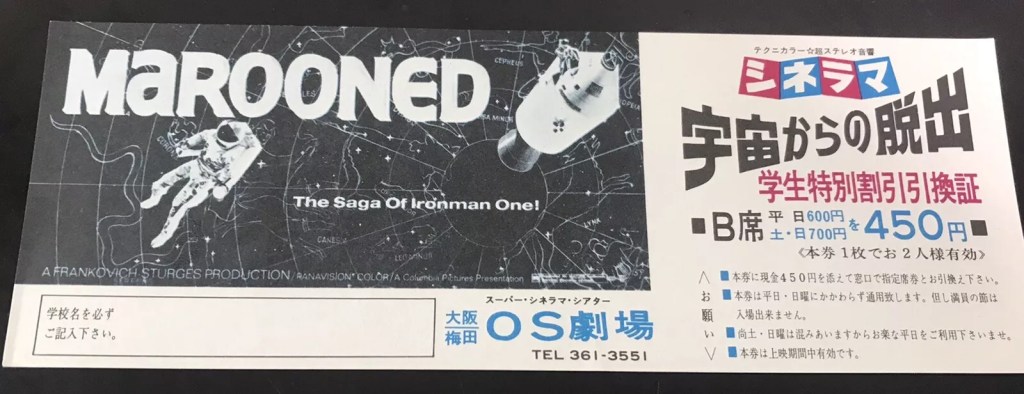
Behind the Scenes: Selling Jeopardy in Space – Pressbook for “Marooned” (1969)

You could come away from the Pressbook/Exhibitors Manual wondering if some of the actors were in the wrong profession, given the number of accomplished pilots on the roster.  James Franciscus held a commercial license for multi-engine planes and had logged three thousand flying hours in three years. Gene Hackman not only had a private flying license but was in the process of building his own biplane.

Producer Mike Frankovich had flown with the US Air Force during World War Two, clocking up 7,000 hours flying time and ending up a colonel. Technical expert George Smith had ejected at 6,000 feet from a plane flying at 800 mph.

Another less well-known fact, Natalie Wood (who was appearing in producer Mike Frankovich’s Bob and Carol and Ted and Alice, 1969) was fluent in Russian and was brought in to translate for a showing of the movie to visiting Russian spacemen. Nancy Kovack, by the way, was equally talented, speaking Persian and other languages.

As much as the main function of the Pressbook was to provide exhibitors with a range of adverts in every conceivable size that they could cut out and take along to their local newspaper, its secondary function was to provide cinema owners with promotional ideas and to provide snippets and articles that could be passed on to a local friendly reporter.  But pickings were slim for jouranlists. Not surprisingly, Gregory Peck didn’t have much say, since whatever he did have to say he’d said already as promotion work for the two other features preceding Marooned this year. And nobody’s spilling the beans on the special effects.

Due to the bulkiness of their space suits, the three actors playing astronauts couldn’t sit down between takes and instead the production employed “the slanted boards usually leaned against by elaborately-gowned female stars to protect their costumes.” (You learn something new about the business every day!). Never mind the bulkiness, the actors spent a chunk of their time in the air and the one day James Franciscus expected to meet acting hero Gregory Peck (they had no scenes together) it proved impossible as when the star visited the capsule set Franciscus was 60 ft in the air.

Richard Crenna got a better response from his young son, who had little concept of what an actor did. But after seeing his dad floating around in space high above him, he reckoned his father was actually a hero

For such a male-oriented picture, Columbia made a big play for the female audience. “The Ladies Love Marooned,” boasted one advert in the 16-page A2 Pressbook/Campaign Manual aimed at exhibitors. Pulling on quotes from critics nobody had really heard of, it managed to present the notion that the picture was as exciting, fascinating, “ingeniously-devised,” and suspenseful for women as much as men, at the same time as focusing on the feminine aspects of the movie – “Lee Grant is a knockout.”

The Pressbook itself allocated editorial space to the three female stars. For Lee Grant the slant was that her talent had been recognized by a host of awards – Emmy, Obie, Best Actress at Cannes plus an Oscar nomination (she would later win an Oscar for Shampoo, 1975). But you have to wonder how an actress would respond to be called, in print, “an egg-head with sex” as was the case with Nancy Kovack. In between turning out such pictures as Tarzan and the Valley of Gold (1966) and this, Kovack had been resident in Iran where she made Diamond 33 (1967) and Night of the Angels (1968). By comparison, Mariette Hartley got off lightly, thanks to her Shakespearian training.

A separate 4-page A2 insert promoted the three Oscar nominations for cinematography, sound and visual effects. “Nominated for 3 Academy Awards,” was the slug accompanying the ads. Never mind the reviews from female critics, much bigger space was devoted here to a rave review form Rex Reed, one of the most famous critics of the day (and star, if that’s the right word, of Myra Breckenridge, 1970), who claimed Marooned was “as exciting, spirited and suspenseful as any spy movie or any cops-and-robbers movie ever made.”

As you might expect, the bulk of the promotional ideas were science-based. Exhibitors were told to target the country’s 2,500 science clubs, the armed forces, the industries that supported the space program and, of course, schools and colleges. Tie-ins had been achieved with 4,500 A&P stores, Jane Parker Donuts, and Philco-Ford dealers.

From a contemporary marketing standpoint, the surprising tie-in was with Omega watches, tagged “the first watch on the moon,” the company’s Speedmaster brand not just worn by the astronauts who did land on the moon in July 1969 but seen in the picture on the wrists of Gregory Peck, Richard Crenna, David Janssen, Gene Hackman and James Franciscus. Over 4,000 dealers were backing the movie.

Model kit manufacturer Revell was offering space suits as prizes in a competition. It distributed more than 42,000 standees and posters and printed five million entry forms. Bantam books was promoting the original novel by Martin Caidin.  That exhibitors would be eager to equip a staff member with an astronaut’s garb and have him/her parade through the streets went without saying. Using lift-off sound effects in a cinema lobby was another idea or turning the entire lobby into a space set.

Rather disconcertingly, the marketing bigwigs thought it would be a clever idea to propose a discussion program on radio or local television on the subject of what would happen if spacemen were marooned, a rather tetchy subject when that became reality.

Unusually, but not surprisingly, the posters stuck with the one tag line: “Three marooned astronauts. And only 55 minutes left to rescue them. While the whole world watches and waits…” and buttressed by some thumbs-up quotes from the likes of reviewers from the New York Times, Redbook, Los Angeles Times and Los Angeles Herald Examiner. In fact, the advertising department took such a shine to Charles Champlin of the LA Times that they cut up his review and stuck snippets of it in three separate ads.

You’ll have seen from the variety of adverts I’ve used to support the review and the Behind the Scenes article earlier in the Blog, that there was a wider range, initially, of adverts, some showing the capsule stuck out in the middle of space. By the time it came to printing this Pressbook, the one for the picture’s general release, all of those were jettisoned in favor of the insipid “thumbs-up” poster with faces to the foreground and the launch in the background, attendant quotes and the “3 Academy award Nominations” slug.

Selling The Rat Pack: Pressbook for “Robin and the 7 Hoods” (1964)

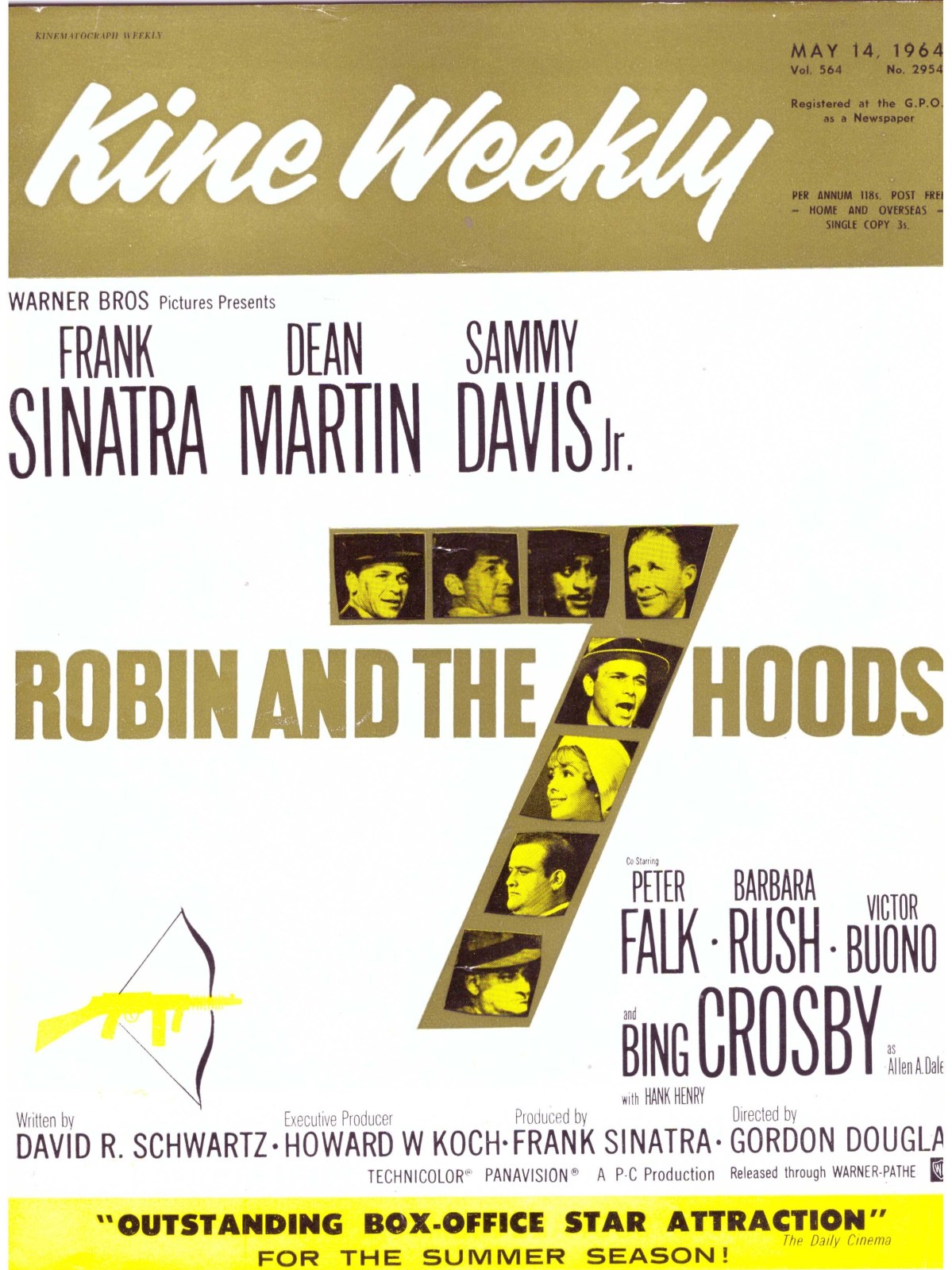
Warner Brothers pushed the boat out for Robin and the 7 Hoods with this lavish Pressbook. Apart from roadshows, most pressbooks of the era were around 16-pages A3. But this stretched to 28 pages with a tremendous range of advertisements, taglines and tie-ups plus, easier to accommodate from the exhibitor’s perspective, a healthy number of relatively straightforward marketing suggestions. On top of that, always a great incentive for cinema managers to rack their brains for good promotional ideas, the studio was offering seven cash prizes worth a total of $1,500 – about $14,000 today – for the best individual campaigns as well as a “special bonus prize” of the golf clubs used by Frank Sinatra, Dean Martin, Sammy Davis Jr. and Bing Crosby for the most original stunt.

With Pressbooks popping through a cinema manager’s door at the rate of one or two or three a week – dependent on how often a picture house changed its program – this one would certainly have made an impact, not so much from its size, but its commitment to the exhibitor. Most Pressbooks began either with information on the stars and the filming or with the advertisements and there was a sense of exhibitors being called upon to fit in with a pre-conceived campaign. Warner Brothers was not the first studio to go down the prize-giving route as a means of attracting attention, but in making the competition the first item on the promotional agenda – two of the first four pages were devoted to it – it certainly ensured it was high priority.

Following the competition came four pages of suggestions for gimmicks, stunts and tie-ins. WB had already tied-up with the The Antique Automobile Club of America and its members were being encouraged to lend out their vehicles to any movie theater planning a stunt. Exhibitors were told that car owners were “pleased to show them off.” There were over 100 chapters/branches of the Club so no shortage of eager participants. A parade of old-time cars in the town or a rally outside the cinema or even a race was guaranteed to attract publicity.

The Roaring 20s was another concept easily adopted – flapper fashions, the Charleston being performed outside the theatre or a dance competition, or girls dressed up in the outfits of the day strolling around town “carrying phonographs and camp stools; at busy intersections they can sit down and play one of the Robin tunes.”  Reward posters could be put up for famous gangsters of the speakeasy period, with photographs of the film’s characters included. A jazz parade was another possibility complete with straw hats and blazers. Setting up a gambling den was another suggestion using “actual gambling equipment captured by the police.”

And all this was before exhibitors could let fly with ideas based on the archery motif since “the words Robin Hood and archery and practically interchangeable.” Archery contests could be staged in a sports store, park, shopping mall or in front of the cinema. Robin Hood hats made of simulated felt with a feather sticking out – or bullet-riddled – were available at a low cost and ideal for giving away to children and to be worn by ushers and other staff as well as employees in other organisations participating in any promotion. Or just handed out to a local restaurant.

On top of that, since this Rat Pack picture was actually a denoted musical in which all the principals sang, there was the best tie-in of all – an original soundtrack album, an easy marketing tool for record shops. WB had also arranged for a book tie-in with Pocket Books, novelization written by Jack Pearl and stocked in 120,000 outlets.  The record, promised WB, would be “on every radio station night and day.” Even though Sinatra was no longer a top recording artist – “My Kind of Town” did not break the Cashbox Top 100 singles chart – his voice and that of his co-stars were exactly the kind of easy listening that appeared to radio addicts fed up with the British Beatle invasion.

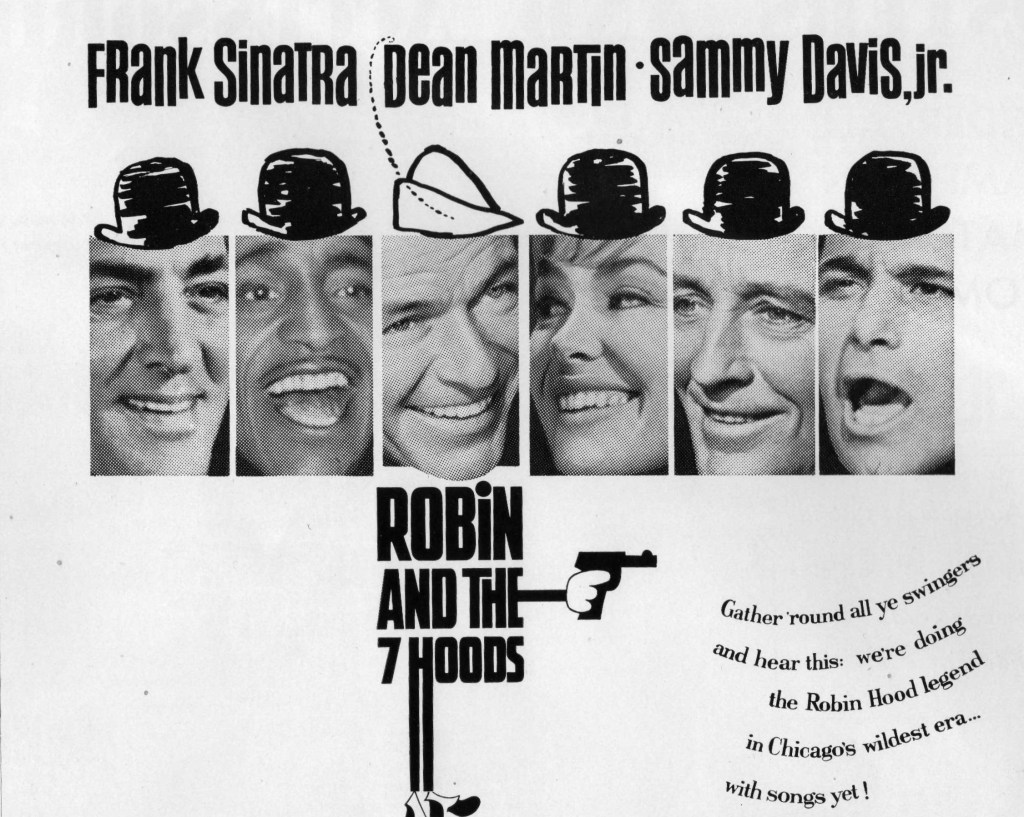
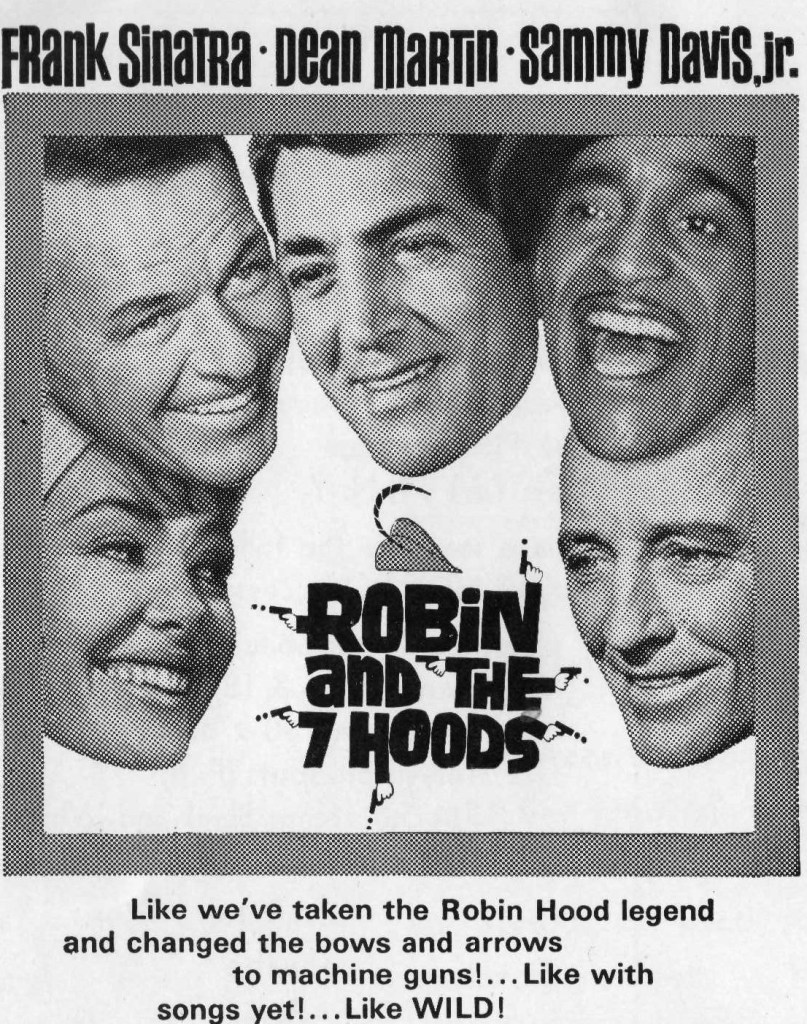
The advertising campaign was fairly straightforward consisting of as many of the stars as could be crammed onto a poster – usually the main four plus either Barbara Rush or Peter Falk, occasionally all six. The tagline went hip: “Like we’ve taken the Robin Hood legend and changed the bows and arrows to machine guns…! Like with songs yet!…Like Wild.” The last word might be changed to “Wow.”  An alternate tagline along similar lines went: “In Merrie Olde Chicago, in the days when King Al ruled the land…” And “Gather round all ye swingers and hear this…we’re doing the Robin Hood legend in Chicago’s wildest era…with songs yet!” A final version ran: “Warner Bros right merrily presents the wild idea of doing the Robin Hood legend in Chicago’s wildest era.”

With the box office and recording firepower of Sinatra, Martin, Davis and Crosby and the range of promotional ideas, there was little need to jazz up the Pressbook with journalistic nuggets, but WB did not stint on this count. The appearance of Edward G. Robinson in the genre and studio where he made his name three decades before in the like of Little Caesar was too good an opportunity to miss – more so when the wardrobe department discovered his suit size had not changed. Other cinematic stalwarts from the early gangster picture days included Allen Jenkins and Jack La Rue, now a restaurant owner and making his first WB movie in 23 years.

Elegance was a keynote for Barbara rush’s femme fatale. Designer Don Feld created a range of dinner gowns, coats and negligees which served almost as a disguise for the hard-as-nails operator. Commented Rush, “I am as tough as daddy and just as blood-thirsty. But I play it sweet throughout and never become hard or evil. The role has more substance when you realize this sweet girl has the ruthlessness of a cobra.” Pool hustler Harold ‘Red’ Baker was hired to teach Dean Martin how to perform like a champion player and also set up the shots for the game between Sinatra and Martin. Baker. But the editorial section ran for only two pages, which was a mighty small proportion of the overall Pressbook.

Selling Sophia Loren – The Pressbook for “It Happened in Naples”

Unusually for a movie of this era, Paramount took one image of Clark Gable and Sophia Loren up close and personal and stuck to it. It was more normal for an marketing campaign to include half a dozen different adverts each with a separate strapline. Here, while the copy occasionally changed the central image remained the same.

Unusually, too, Paramount made a big play of getting critics on board prior to the film’s release. So it came garlanded with the imprimatur of the likes of television host Ed Sullivan, famed critic Louella Parsons and syndicated columnist Dorothy Kilgallen. Plus the studio had embarked on a major promotional campaign in the Sunday supplements of the biggest circulation newspapers in the U.S.

Overall, there was a broad sell. While Clark Gable and Sophia Loren – “two prime examples of cinematic sex appeal” – were of course key, the marketeers also promoted “sensational young Italian boy Marietto” (playing the orphaned Nando) and Carlino, the Neapolitan answer to Elvis Presley who was Loren’s guitar-playing accompanist. In appealing to “those who like poignant drama” it also set out to hook “those who like musicals” as well as moviegoers who “like being magic-carpeted away to far-away places.”  In other words, something for everyone.

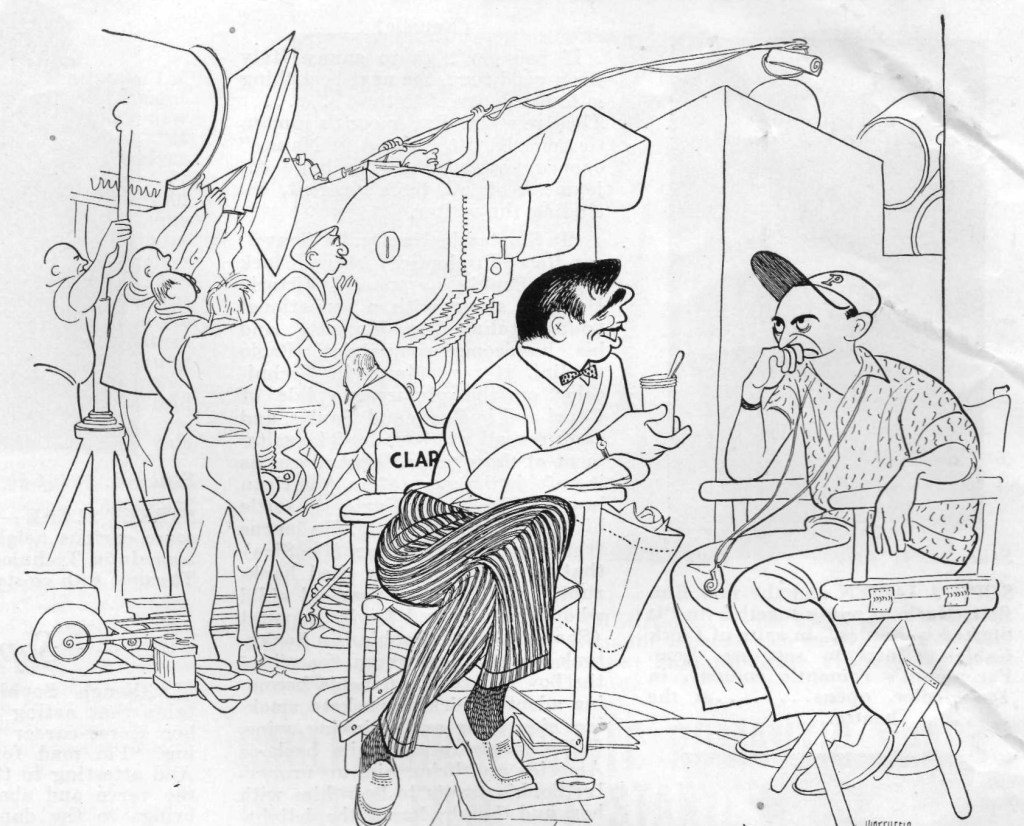
Cartoon of Clark Gable and director Melville Shavelson consulting on set. Cartoons like this were occasionally part of a promotional push, giving newspapers something different to use, and they were seen as a classier promotional device than just stills or adverts.

But the write-ups and photography favor Loren, who displays her legs in a revealing costume, as well as her cleavage and a separate article extols her singing and dancing, the latter described as “her secret career passion.” Audiences were promised an “all-out rock-and-roller.” Loren, of course, had come into her own as a singer in Houseboat (1958), where she performed two songs, but declined offers of a recording career.

The Pressbook is somewhat short on the nuggets that usually accompany this kind of promotional material because the two stars were already so well known. About all potential moviegoers learned about Gable was that he was now such a devoted father he brought his family on location.

There’s certainly a curious piece called “It Hurt Gable More Than Sophia” which, on reading the text, turned out to be untrue. When Gable was called upon to throw Loren out of bed in one scene, he “put too much Gablesque gusto” into it, flipping her out onto the marble floor.  Loren was the one who suffered bruises on legs, hips and shoulders. And in true Hollywood fashion producer Jack Rose “rushed to her aid” but only after ensuring that her startled expression had been captured on camera.

Tie-ups were travel agencies. Italian restaurants and department stores featuring Italian imports were suggested to exhibitors as cost-free ways of encouraging local support. A soundtrack album featuring Loren’s voice was released as well as a paperback novelization targeted at book stores, drug stores, supermarkets and newsstands.

Taglines employed included “you, too, will say it’s wonderful;”  “you’ll loosen up and pleasure up on the isle of Capri;” and “you’ll want to be there when the fun starts.”

Selling “Doctor Zhivago”

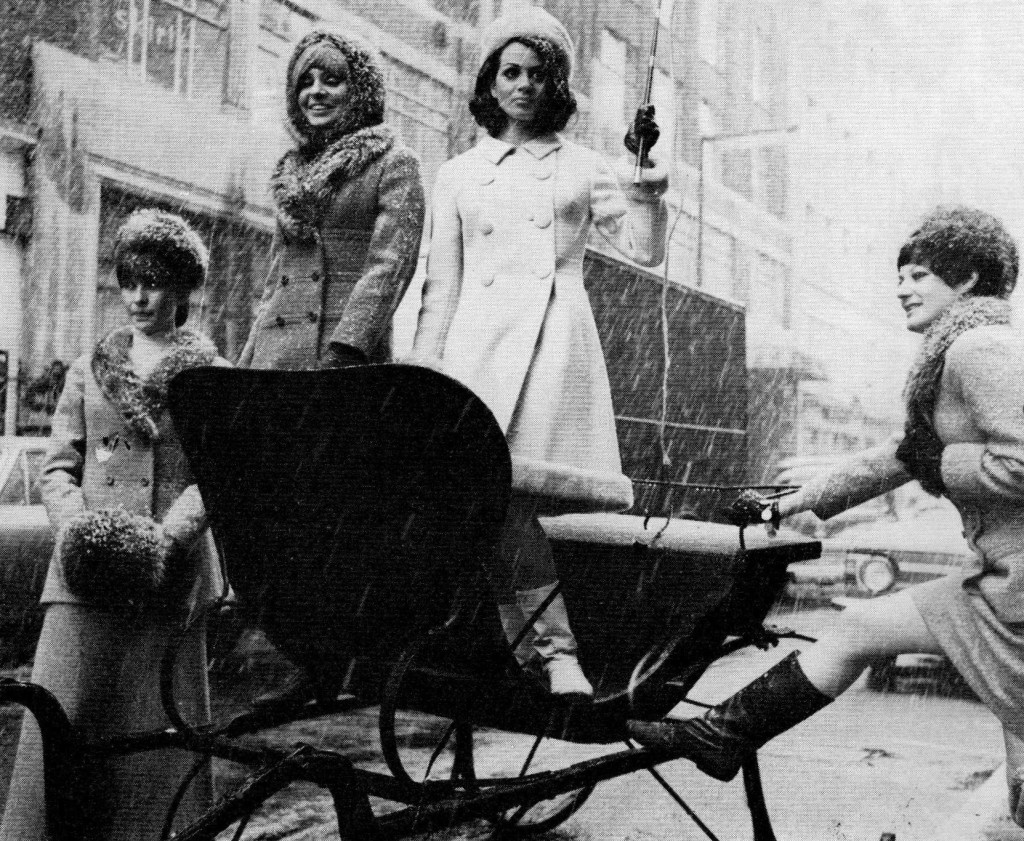
Yesterday was the 55th anniversary of the launch of the European premiere of Doctor Zhivago (1965) in London and would you believe it the English weather came to the promotional aid of the David Lean epic with an unseasonal snow shower as fur-clad models took to the streets on a sleigh. As was common in the 1960s, there was no such thing as a global release date. The film had been launched in the U.S. in December 1965 but only a couple of countries since then, the main drawback being the lack of available prestigious cinemas for a big budget roadshow. The delay was also caused by hope of major success at the Oscars – given Lean’s two previous films had won Best Picture – held in March.

Doctor Zhivago launched at the 1,330-seat Empire, Leicester Square, in the heart of the capital’s West End in the presence of Princess Margaret and with the director and five stars in attendance.  The first public demonstration of colour television in Europe was a feature of the launch, a large screen set up in the theater foyer to relay the arrival of royalty and celebrities to the audience already seated in the cinema.

Typical advert with booking form.

MGM had pulled out all the publicity stops, the massive advertising campaign beginning on February 1, twelve weeks prior to the opening, with the switching-on of a 40ft by 20ft electric sign in Piccadilly Circus. That triggered an advertising campaign in the press about two weeks later announcing the premiere. That served only to stoke up interest, another two weeks elapsing before tickets went on sale. Advertisements ran virtually non-stop in national daily newspapers and London evening papers as well as entertainment and film magazines.

Roadshows benefitted from press advertising more than normal pictures. The bulk of the adverts for Doctor Zhivago carried a booking form so money started rolling in to the cinema long before the first screening. Selling tickets in this way was also a bulwark against sudden changes in weather – torrential rain or glorious sunshine as equally likely to deter moviegoers – whereas if you had already booked your ticket well in advance it did not matter whether you turned up or not, and most people would attend even in sweltering heat rather than forego their ticket.

MGM also undertook the biggest advertising campaign in its history in Britain. Unlike today, when there is one universal advertisement, in those days a film might have half a dozen different pieces of artwork. Doctor Zhivago boasted fifteen. Four weeks ahead of the opening 8,000 double-crown posters were plastered over the city. One-third of the entire London bus fleet carrying such artwork, while 50 Underground stations had 48-sheets (three times the size of the normal posters) on train platforms. In addition, closer to the launch, double quads were posted in a thousand locations. A special mobile box office toured the city advertising the film and selling tickets.

A special “Background to Doctor Zhivago Exhibition” was set up in the Garringes department store opposite Victoria Station, one of the capital’s biggest travel hubs, by the Historical Research Unit and including many costumes from the production. Tie-ins were far more numerous than for the New York launch. Mansfield Fashion launched a range of popular-priced clothing based on the film promoted by a sleigh-ride through London with a bevy of models against the unexpected background of snow on April 14. A more upmarket manufacturer Sidney Massin was promoting a more expensive fur coat.

Among the other fashion tie-ins were: a white coat of Kalgan lamb with a Mongolian lamb collar from Swears and Wells, long black wool coat with white fox fur hood and collar from Femina Furs, fur hats for men and women from Edmund Mann, evening dresses from Berkertex and fur-lined fabrics from Clarewood Fashions. Hardy Amies designed male fur coats for Hepworths department stores and range of gloves for either sex for Dent Allcroft. Worldwide the Zhivago look had been reflected in collections designed by St Laurent, Dior, Cardin, Chanel and Rabanne.

Unseasonal snow in London in mid-April helped the fashion launch.

Outside of fashion, there was a tie-up with Cossack Vodka. There was also a Cossack hair cream while Waddingtons produced a jigsaw puzzle. As well as hardback and paperback editions of the famous Boris Pasternak novel, there was also a hardback of the Robert Bolt Oscar-winning screenplay.  The music also provided promotional crossover, the theme tune and original soundtrack already big hits. BBC2 aired a documentary on the filming of the movie and the stars and director appeared on numerous television and radio talk shows.

BBC News, Pathe newsreel cameras and CBS America all covered the premiere. Stars in attendance were Geraldine Chaplin, Julie Christie, Siobhan McKenna, Ralph Richardson and Rita Tushingham as well as Lean, Bolt and producer Carlo Ponti.

Although the movie failed to win any of the main Oscars, it still took home six: screenplay (Robert Bolt), color cinematography (Freddie Young), color art direction (John Box, Terence Marsh and Dario Simoni), set decoration (also Box, Marsh and Simoni), color costume design (Phyllis Dalton) and music score (Maurice Jarre). MGM promoted these accomplishments in its advertising and revamped its pressbook. And the studio was also able to take advantage of the fact that Julie Christie had been named Best Actress at that year’s Oscars for Darling (1965). Noted the new-look Pressbook: “probably no other motion picture actress has achieved the meteoric success and worldwide fame accorded Julie Christie.”

The Pressbook mainlined on awards of one kind or another. As well as Oscars, the Russian epic had picked up five Golden Globes included Best Dramatic Picture, Best Director and Best Dramatic Actor (Omar Sharif). It was named best film by the New York Daily News and was named one of the year’s top ten by the National Board of Review, and received awards from magazines as diverse as Seventeen, Parents and Scholastic.

Also contained in the Pressbook were snippets that might appeal to local journalists such as: six tons of nails were used in constructing the ten-acre set, Phyllis Dalton created 5,000 costumes and John Box 117 settings, rats in one scene were tested for infections, rumors of Omar Sharif shaving off his normal curly hair were false, movie livestock was donated to a local church at the end of filming.

Separately, a 32-page “Fact Booklet” was compiled for  journalists.

As ever, exhibitors were bombarded with promotional ideas by MGM publicists via the Pressbook. One idea was to ask female members of the audience whether they preferred Omar Sharif clean shaven or with a moustache with the intention of interesting the local women’s editor in the results of the informal survey. Cinema owners were encouraged to send bottles of vodka to entertainment editors with a message in Russian. Empty shop windows were often available “for the asking” from rental specialists and could be used for advertising. Since Zhivago has a son in the film, one aspect encouraged was a “father and son” competition and of course it was a no-brainer to dress doormen and ushers as Cossacks.

MGM had also made special efforts to promote the movie to younger audiences and combined that with marketing the music. More than million copies of the soundtrack album had been sold and “Somewhere My Love,” a single by Teddy Randazzo incorporating lyrics to “Lara’s Theme,” had also caught fire. The combination of records and sheet music plus general publicity material could encourage record store window displays.

One of the taglines I most remember is “one man…two women…and a nation ablaze.” But it was certainly not one of the initial official taglines when the movie was originally launched. Many of the British posters had no tagline at all beyond perhaps “the entertainment event of the year.” The post-Oscar Pressbook went with either “A love caught in the fire of revolution…Turbulent were the times and fiery was the love story of Zhivago, his wife…and the passionate, tender Lara”  or “The story of Zhivago – a man torn between his love for his wife and the passionate and tender Lara…told against the flaming background of revolution.”

SOURCES: Supplement to Kine Weekly, May 5, 1966; MGM Pressbook.

Discover WordPress

A daily selection of the best content published on WordPress, collected for you by humans who love to read.

The Atavist Magazine

by Brian Hannan

WordPress.com News

The latest news on WordPress.com and the WordPress community.