The Leopard (1963) *****

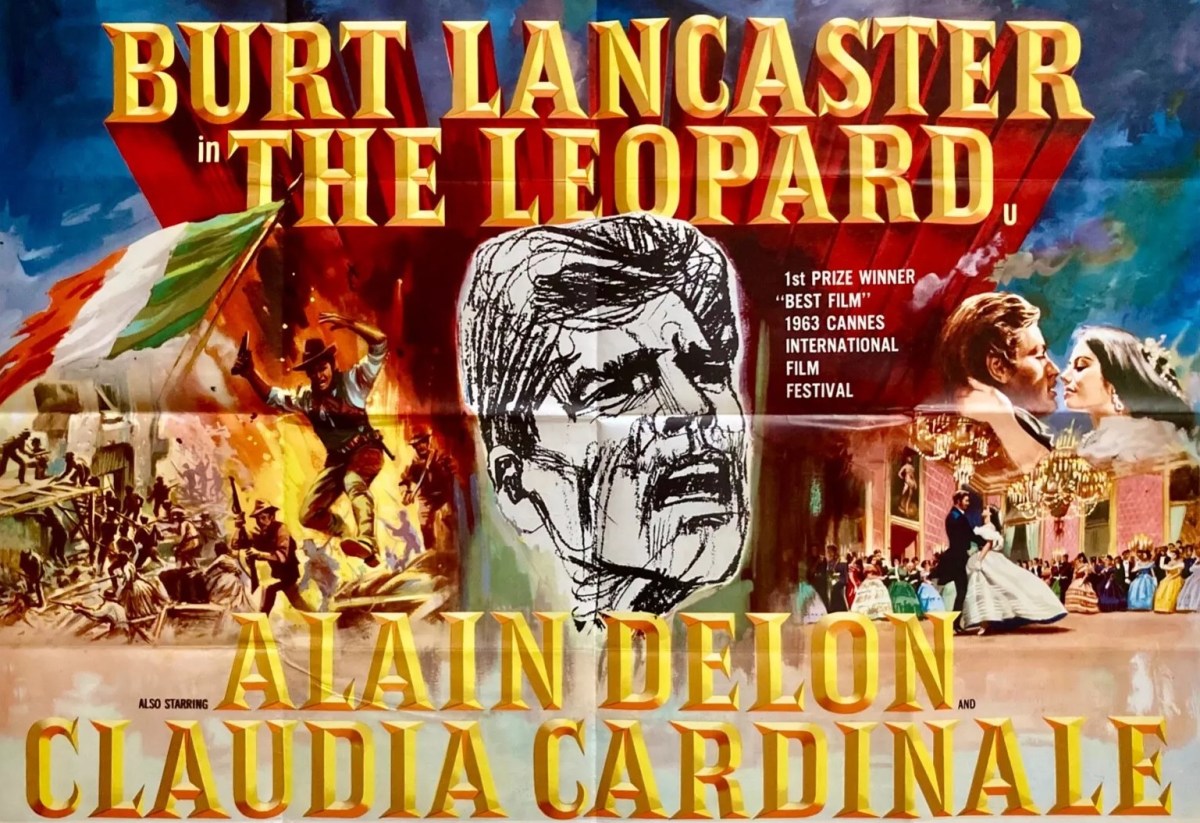
Masterpiece. No other word for the way director Luchino Visconti commands his material with fluid camera and three terrific performances (four, if you count the wily priest). An epic in the old-fashioned sense, combining intelligence, action and romance, though all three underlaid by national or domestic politics. And if you’re going to show crumbling authority you can’t get a better conduit than Burt Lancaster (check out The Swimmer, 1969, for another version of this), physical prowess still to the fore but something missing in the eyes. And all this on sumptuous widescreen.

Only a director of Visconti’s caliber can set the entire tone of the film through what doesn’t happen. We open with a religious service, not a full-scale Mass but recitations of the Rosary, for which the family is gathered in the massive villa of Prince Don Fabrizio Salina (Burt Lancaster). There is an almighty disturbance outside. But nobody dare leave or even react, children silently chided for being distracted, because all eyes are on the Prince and he has not batted an eyelid, worship more important than domestic matters.
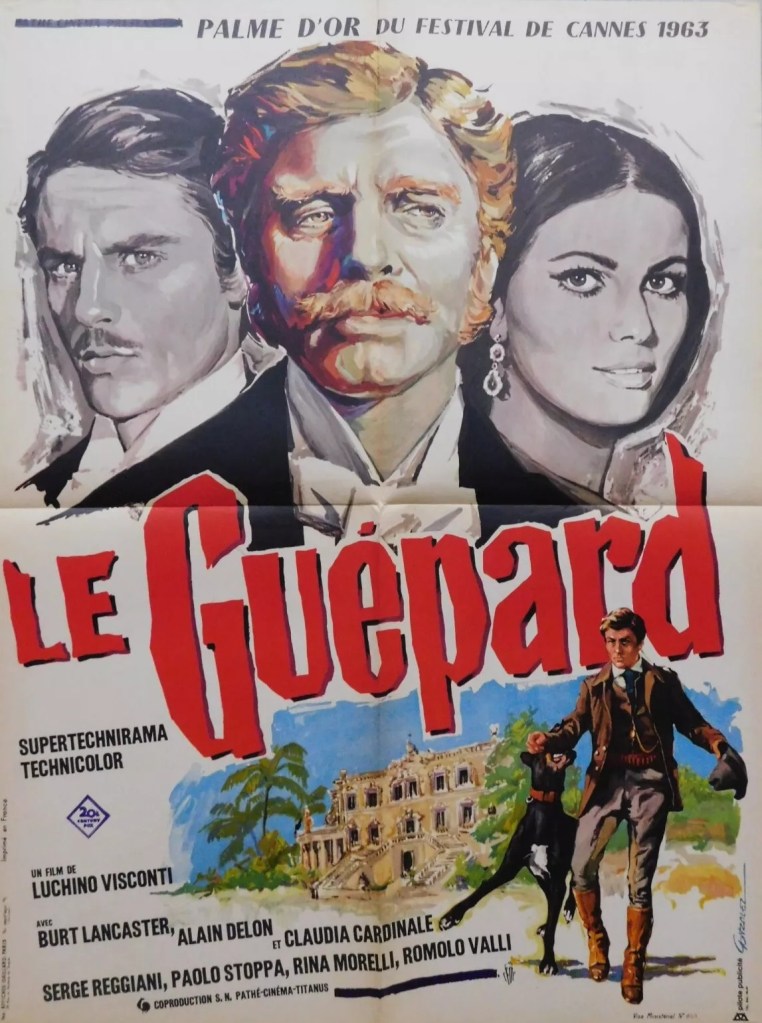
Turns out there’s a dead soldier in the garden, indication of trouble brewing. Italy has been beset with trouble brewing from time immemorial so the Prince isn’t particularly perturbed, even if the worst comes to the worst an accommodation is always reached between the wannabes and the wealthy ruling elite.

There’s a fair bit of political sparring throughout but this is handled with such intelligence it’s involving rather than off-putting. Rebel Garibaldi is on the march, it’s the 1860s and revolution is on the way. But it’s not like the French Revolution with aristocrats executed in their thousands and when Garibaldi’s General (Guiliano Gemma) comes calling he addresses the Prince as “Excellency.”

The Prince is a bit of a hypocrite, not as devout as he’d like everyone to believe. He’s got a mistress stashed away for one thing and for another he blames his wife for the need to satisfy his urges elsewhere, complaining that she’s “the sinner” and that despite him fathering seven children with her he’s never seen her navel. Furthermore, the person he makes this argument to is the priest Fr Pirrone (Romolo Valli), who, knowing which side his bread is buttered on, doesn’t offer much of a challenge.

If you’re not going down the more perilous route of taking up arms, advancement in this society is still best achieved through marriage and the Prince’s ambitious nephew Don Tanacredi (Alain Delon), more politically astute, does this through marriage to Angelica (Claudia Cardinale), daughter of Don Calogeo Sedara (Paolo Stoppa).
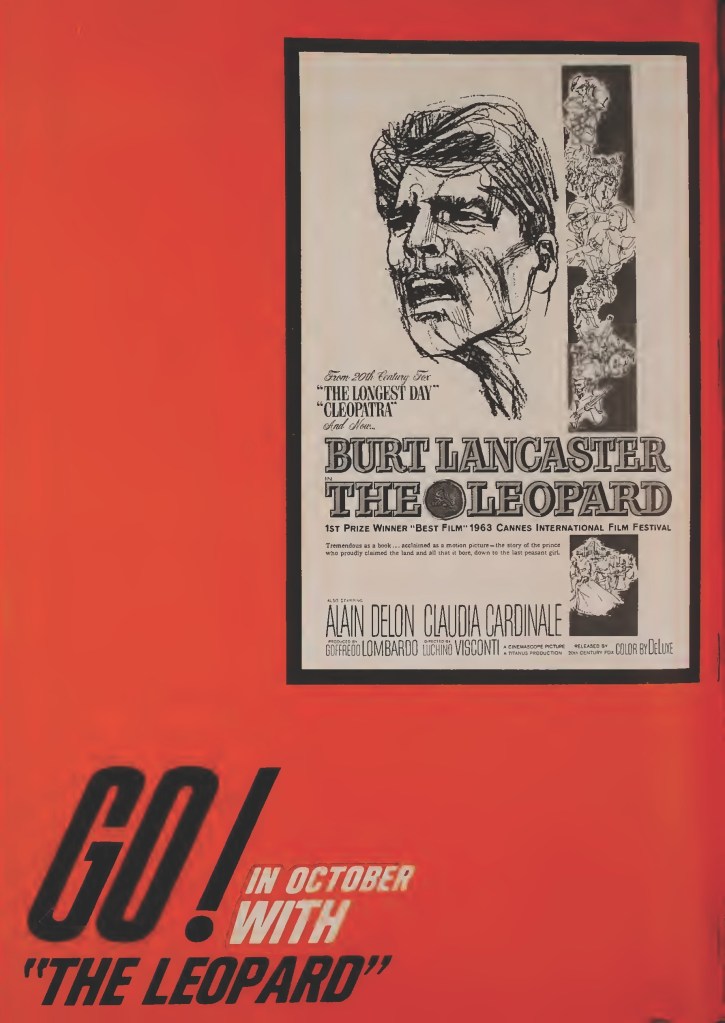
Brutality and elegance sit side by side. You’re not going to forget the mob of women hunting down and hanging a Government police spy nor, equally, the astonishing ball that virtually concludes proceedings, showing that, whatever changes in society take place, those with money and privilege will still hold their own. But that’s only if they do a little bit of bending the knee to the new powers-that-be, something that Tancredi, by now a rebel hero wounded in battle, is more than happy to do, since that procures him even further advancement, but a step too far for the Prince, who at the end retreats into his study, as if this will provide sanctuary from the impending future.

Don’t expect battle on the scale of Lawrence of Arabia (1962), this action is a more scrappy affair, undisciplined red-shirted hordes sweeping through a town and eventually overwhelming cavalry and ranks of infantry.

But if you’re aiming to hold an audience for three hours, a decent script, romantic entanglement and camerawork isn’t enough. You need the actors to step up. Luckily, they do, in spades. Burt Lancaster is easily the pick, towering head and shoulders, and not just in physicality, above the rest, a man who sees his absolute authority draining away in front of his eyes. Alain Delon (Once a Thief, 1965) comes pretty close, though, not afraid to challenge his uncle’s beliefs nor point out his hypocrisy, and adept at picking his way through the new emerging society, his potential ascension to newfound power demonstrated by wearing a war wound bandage wrapped piratically around one eye, as though keeping a foot in both camps. Though American audiences never quite warmed to Delon, he was catnip for the arthouse brigade, courtesy of being anointed by Visconti and Antonioni in, respectively, Rocco and His Brothers (1960) and L’Eclisse  (1962).

Far more than U.S. cinemagoers could imagine, Claudia Cardinale (The Professionals, 1966) also easily straddled commercial and arthouse – Rocco and His Brothers, Fellini’s (1963) – and on her luminous performance here you can see why. You might also spot future Italian stars Terence Hill (My Name Is Nobody, 1970) and Giuliano Gemma (Day of Anger, 1967). Adapted from the bestseller by Giuseppe Tomasi de Lampedusa by the director and his Rocco and his Brothers team of future director Pasquale Festa Campanile (The Libertine, 1968), Suso Cecchi D’Amico,  Enrico Medioli and Massimo Franciosa.

I can’t quite get my head round the audacity of Netflix in attempting a mini-series remake. I’m assuming they’ve had the sense to buy up the rights to the Visconti to prevent anyone comparing the two.

One of the decade’s greatest cinematic achievements.

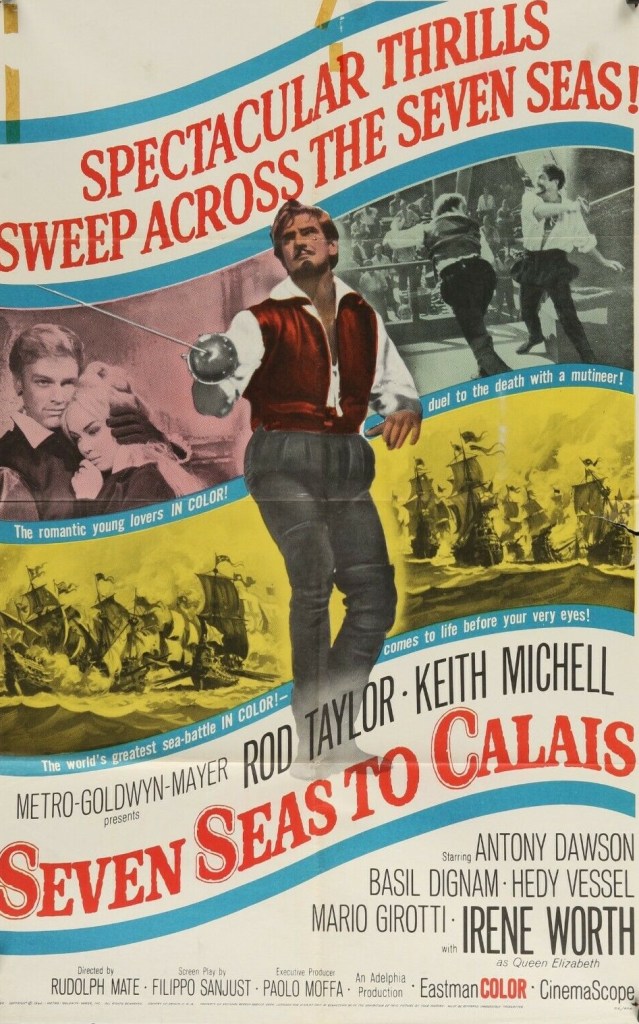
Seven Seas to Calais (1962) ***

In between hi-hat Hollywood endeavors The Time Machine (1960) and The Birds (1963) Rod Taylor made a couple of pit stops in Italy. Here, he tries his hand at a swashbuckler and does a pretty good job of it, depicting famed English naval hero Sir Francis Drake, in a story that covers about a dozen years from him circumnavigating the globe to masterminding the defeat of the Spanish Armada in 1588.

Not content with glorifying tales of his derring-do as he robs the Spanish of their gold, the producers also mine a rich seam of political intrigue as Spanish King Philip II (Emberto Raho) seeks to nullify the English threat first by a treaty and then by conspiracy before full-blown invasion seems the better option.

Queen Elizabeth (Irene Worth) proves a political maestro, telling the Spanish what they want to believe and condemning Drake’s activities in public while in fact privately financing his expedition and waiting for his pirate gold to underpin her navy. 

After putting down a potential mutiny, most of Drake’s time is spent plundering Spanish galleons or gold mines. When not pillaging, Drake takes time out from his adventures to discover potato and tobacco and for a romantic dalliance with what appear to be Native Americans (judging from the feathers they wear) including a young woman called Potato (Rossella D’Aquino). It is left to his number two Malcolm Marsh (Keith Michell) to carry the main subplot which has French beauty Arabella (Edy Vessel) in his absence taking up with Babington (Terence Hill), a traitor with an eye to freeing the imprisoned Mary, Queen of Scots (Esmeralda Ruspoli).

There are more than enough swordfights for purists and Drake employs a certain amount of cunning and bravado in his various piratical enterprises. Clever filming renders the ships  realistic enough though in long shot they do resemble toys. In making it look as though Drake has returned from his voyage in the nick of time to save Elizabeth from the Spanish aggressors, the producers neatly kaleidoscope the actual time frame. Elizabeth takes no prisoners and there are spicy exchanges between the queen and the pirate.

Rod Taylor presents a more muscular and athletic screen person than in any of his previous pictures and exudes authority but he also has a lightness of tone that would become a trademark. However, American stage actress Irene Worth – in her sole movie role of the decade –  just about plays him off the screen, her regal bearing hiding an agile mind.  Keith Michell (The Hellfire Club, 1961) makes a strong impression as does future spaghetti western star Terence Hill, (They Call Me Trinity, 1970) credited here as Mario Girott. Edy Vesssel (The Thief of Baghdad, 1961) only made two more films, although one was Fellini’s (1963). This was the second film outing after Antonioni’s L’Avventura (1960) for Esmeralda Ruspoli

Strangely enough, given the part Drake played in English history, he has been dealt a poor hand in the movies. A British television series Sir Francis Drake (1961-1962) starring Terence Morgan was unlikely to have instigated this picture, so it is odd to rely on Italy for the only movie, regardless of its veracity.

In the portfolio of veteran director Rudolph Mate (When Worlds Collide, 1951), this immediately followed on from The 300 Spartans (1962) but lacks that film’s rigor and vigor.. The script was dreamt up by Filippo Sanjust (also Morgan the Pirate).

Hannibal (1960) ***

Inconvenient truth never bothered Hollywood scriptwriters when it came to history and here the prospect of solving the “Great Hannibal Mystery” proved irresistible. For in 218 B.C. this invader from Carthage (modern-day Tunisia) had crossed the Alps, battered the Roman army into submission and had Rome at his mercy. But one of the greatest generals of all time did not attack Rome. Why? Love was the answer, according to the filmmakers, following the Romeo and Juliet template.  

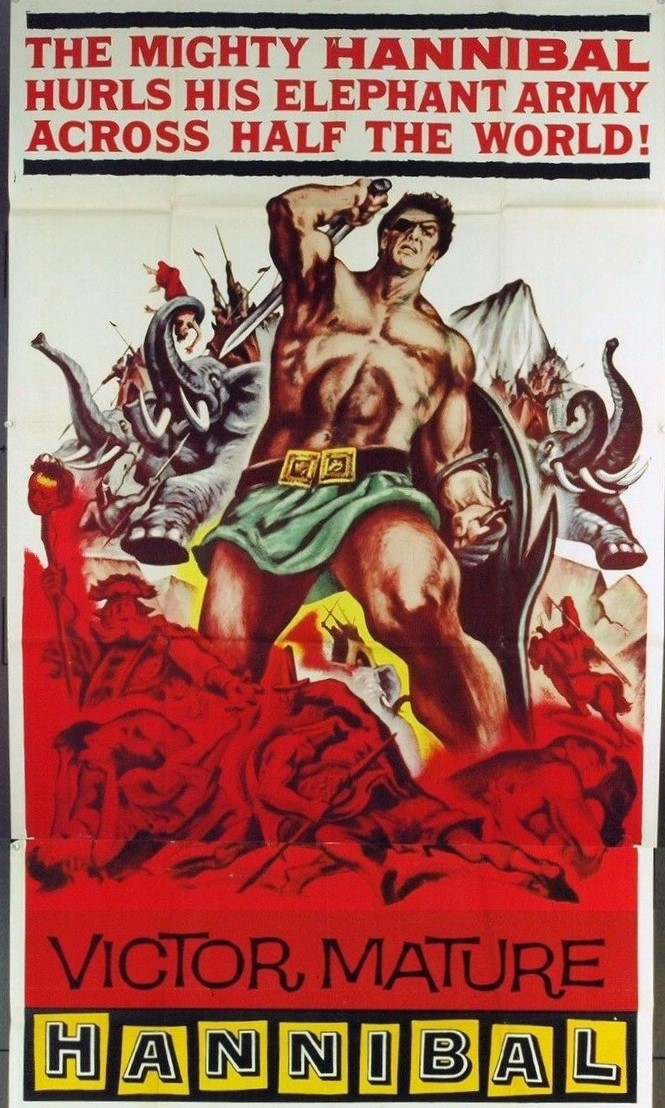
I have to admit I didn’t have that on my mind. I was seduced by the poster, the involvement of cult director Edgar G. Ulmer (The Black Cat, 1934), the prospect of an action-packed adventure with marauding elephants and the fact that although familiar with the name Hannibal I had no idea who he was and why he crossed the Alps when surely it would have easier to take a ship from Tunisia to Italy. But I guess star Victor Mature (Samson and Delilah, 1949) was also duped into thinking that if an American nobody like Steve Reeves (Hercules, 1958) could make it big in Italy then so could surely the original Hollywood Mr. Muscles. Mixing the new-look sword-and-sandals genre with the old-style historical epic appeared a potential winner. But I should have guessed that the lean running time of 103 minutes meant an “epic” was out of the question.

The British Trade Descriptions Act would have a field day with the way the posters promoted the elephants. The much-vaunted “army” is scarcely seen in battle and the great beasts looked more cuddly than anything, striding along linked trunk-to-tail.

The picture does take a good while to warm up although the movie begins with a sense of the epic, otherwise how to explain the 15 minutes before Hannibal hoves into view, the preceding period of invaders crossing the Alps short of dramatic incident beyond a couple of men falling to their deaths and the elephants becoming a bit restive. Endless lines of soldiers, in this case stretching into the snowbound horizon, almost becomes a motif, too much valuable time wasted on too many marches.  

Hannibal turns out to be a clever commander, wanting to conquer Rome more by fear than battle, reckoning that if the Italians believed he possessed an unstoppable force they would rush to the negotiating table rather than engage in open battle and risk the destruction of their cities. He sends the captured niece Sylvia (Rita Gam) of Senator Fabius (Gabriele Ferzetti) back to her uncle with frightening tales. This doesn’t fool Fabius who views the woman as a traitor and realizes the pitfalls of surrender. Hannibal and Sylvia getting it together causes discord not just in Rome but in the Carthaginian camp, the delay in attacking the city put down to their romantic dalliance.   

The initial battle scenes come up short, presented primarily in montage, little snippets of fighting here and there, rather than opposing forces facing each other, no sign either of elephants striking terror into the hearts of their opponents. But the later battle more than recompenses. One of the greatest assets of historical and war pictures is the detail given over to strategy. And if filmed properly, you can see plans executed. Hannibal demonstrates his genius by drawing the main Roman phalanxes into a trap, attacking them from both sides and forcing them back towards a river from which there is no escape. Superbly filmed, it’s a bloody conflict (for movies of the period), arms hacked off, faces and bodies weeping with blood. There’s a tragic end to the romance.

Oh, and by the way, Hannibal loses an eye – but it’s not in battle but from conjunctivitis.

I should point out, having done my own digging, but there was a sounder reason than love for Hannibal not advancing on Rome. Simply put, he lacked the machinery to do it. The only way to conquer a city was by siege and to achieve that you needed siege machines which Hannibal lacked. But no matter how much he later tried to draw the Roman armies into the open, he was denied that opportunity by the wily Fabius who, instead, waged a war of attrition.

Hannibal was, in fact, an irritant to Rome for a decade, so this tale is heavily truncated. Although the tale of the strong man brought to his knees by passion is a Hollywood trope – look no further than Samson and Delilah – the lovers fail to strike the necessary sparks, in part because initially Hannibal views Sylvia merely as a tool to achieve a political end and in part because their time together is too limited. This is no grand passion in the vein of Doctor Zhivago (1965).

And that’s a shame because despite (or perhaps because of) his muscles, Victor Mature was no slouch in the romantic sweepstakes, having dallied in the past with the like of Janet Leigh (Safari, 1956), Susan Hayward (Demetrius and the Gladiators, 1954) and Jane Russell (Las Vegas Story, 1952). Here, Mature is better as a leader than a lover. The svelte Rita Gam (The Thief, 1952) – first wife of director Sidney Lumet –  was the opposite of the more voluptuous Italian screen queens of the Sophia Loren/Gina Lollobrigida variety and her career had not really taken off, only eight films prior to Hannibal and only two in the next decade. Paradoxically, she is better battling her uncle and accepting her fate than a woman in the grip of passion.

Gabriele Ferzetti (Once Upon a Time in the West, 1968) makes the most of a complex character. Look out for Rik Battaglia (Sodom and Gomorrah, 1962) as Hannibal’s brother and, as Fabius’s son, Terence Hill (God Forgives…I Don’t, 1967) and in a smaller role his future sidekick Bud Spencer.   

Directorial credit was split between Ulmer and Carlo Ludovico Bragaglia  (Amazons of Rome, 1961) with Mortimer Braus (The Son of Dr Jekyll, 1951), Sandro Continenza (The Inglorious Bastards, 1978) and Ottavia Poggi (Queen of the Nile, 1961) involved in the screenplay.

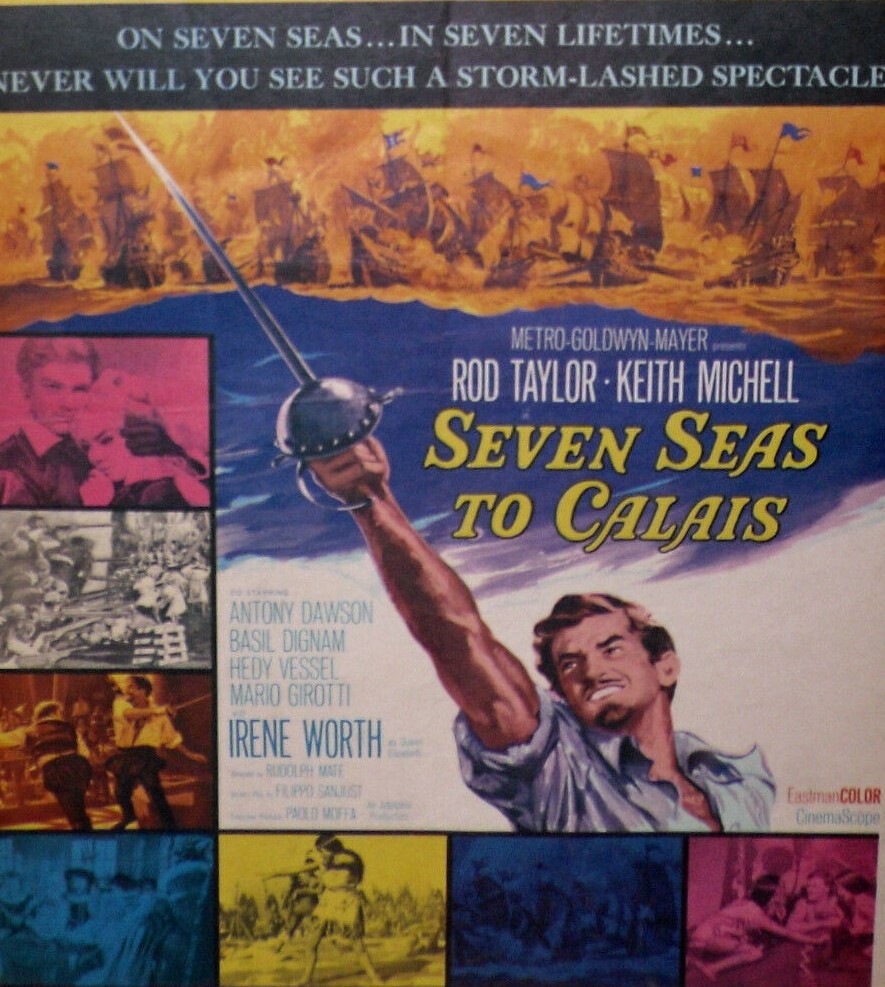
Seven Seas to Calais (1962) ***

In between hi-hat Hollywood endeavors The Time Machine (1960) and The Birds (1963) Rod Taylor made a couple of pit stops in Italy. Here, he tries his hand at a swashbuckler and does a pretty good job of it, depicting famed English naval hero Sir Francis Drake, in a story that covers about a dozen years from him circumnavigating the globe to masterminding the defeat of the Spanish Armada in 1588.

Not content with glorifying tales of his derring-do as he robs the Spanish of their gold, the producers also mine a rich seam of political intrigue as the Spanish King Philip II seeks to nullify the English threat first by a treaty and then by conspiracy before embarking on full-blown invasion. Queen Elizabeth (Irene Worth) proves a political maestro, telling the Spanish what they want to believe and condemning Drake’s activities in public while in fact privately financing his expedition and relying on his booty to fund her navy.  

After putting down a potential mutiny, most of Drake’s time is spent plundering Spanish galleons or gold mines. When not pillaging, Drake takes time out from his adventures to discover potato and tobacco and for a romantic dalliance with what appear to be Native Americans (judging from the feathers they wear) including a young woman called Potato (Rossella D’Aquino). It is left to his number two Malcolm Marsh (Keith Michell) to carry the main subplot which has French beauty Arabella (Edy Vessel) in his absence taking up with Babington (Terence Hill), a traitor with an eye to freeing the imprisoned Mary, Queen of Scots (Esmeralda Ruspoli).

There are more than enough swordfights for purists and Drake employs a certain amount of cunning and bravado in his various piratical enterprises. Clever filming makes the ships look realistic enough, though in long shot they do resemble toys. In making it look as though Drake has returned from his voyage in the nick of time to save Elizabeth from the Spanish aggressors, the producers neatly kaleidoscope the actual time frame. Elizabeth takes no prisoners and there are spicy exchanges between the queen and the pirate.

Rod Taylor presents a more muscular and athletic screen persona than in any of his previous pictures and his presence exudes authority but he also has that lightness of tone that would become a trademark. However, American stage actress Irene Worth just about plays him off the screen, her regal bearing hiding an agile mind.  Keith Michell (The Hellfire Club, 1961) makes a strong impression as does future spaghetti western star Terence Hill, (They Call Me Trinity, 1970) credited here as Mario Girotti. Edy Vessel (The Thief of Baghdad, 1961) only made two more films, although one was Fellini’s (1963). This was the second film outing after Antonioni’s L’Avventura (1960) for Esmeralda Ruspoli

Strangely enough, given the part Drake played in English history, he has been dealt a poor hand in the movies. A British television series Sir Francis Drake (1961-1962) starring Terence Morgan was unlikely to have instigated this picture so it is odd to rely on Italy for the only picture, regardless of its veracity.

In the portfolio of veteran director Rudolph Mate (When Worlds Collide, 1951), this immediately followed on from The 300 Spartans (1962) but lacks that film’s rigor and vigor. The script was dreamt up by Filippo Sanjust (also Morgan the Pirate).

CATCH-UP: Rod Taylor pictures reviewed in the Blog are The Liquidator (1965), The Glass Bottom Boat (1966), Hotel (1967) and Dark of the Sun (1968).

Discover WordPress

A daily selection of the best content published on WordPress, collected for you by humans who love to read.

The Atavist Magazine

by Brian Hannan

WordPress.com News

The latest news on WordPress.com and the WordPress community.