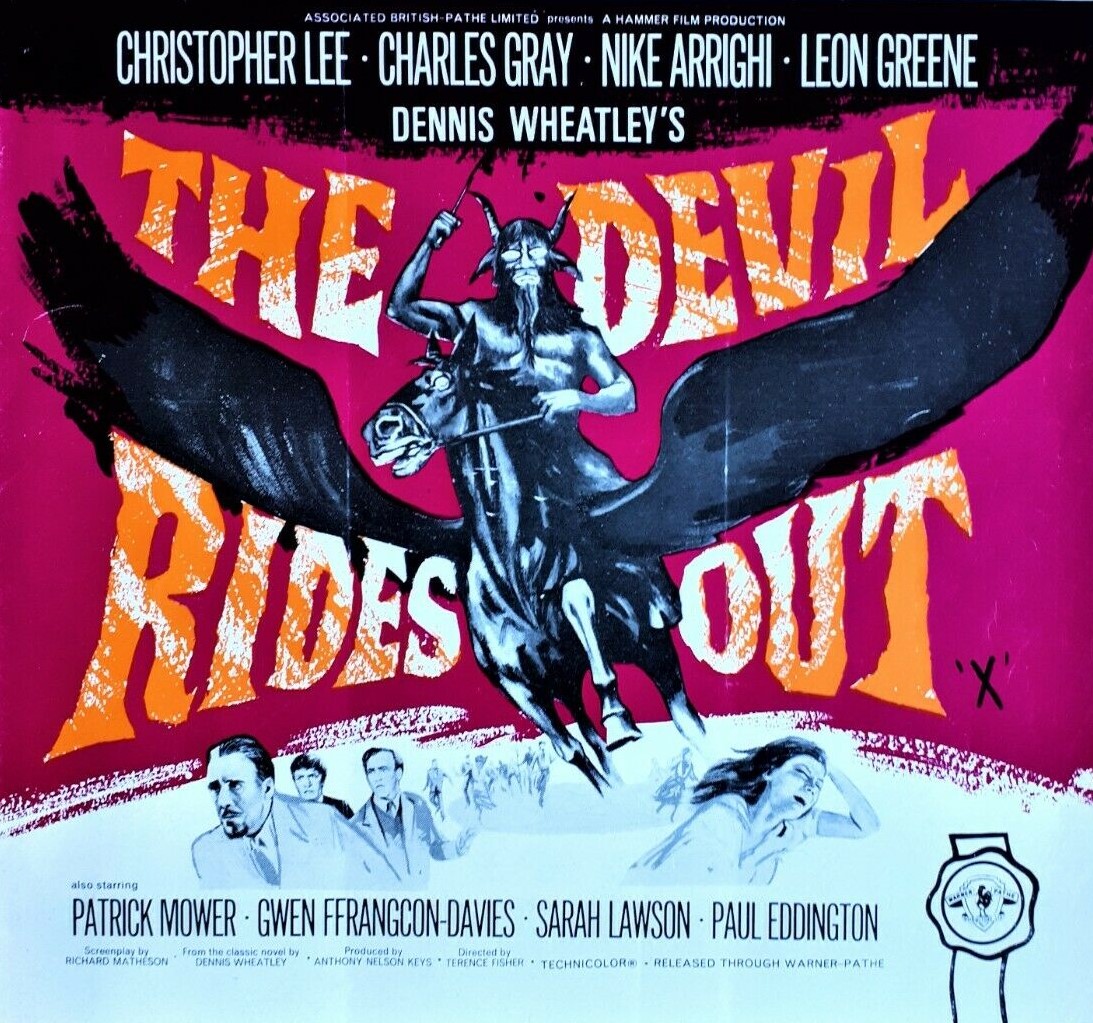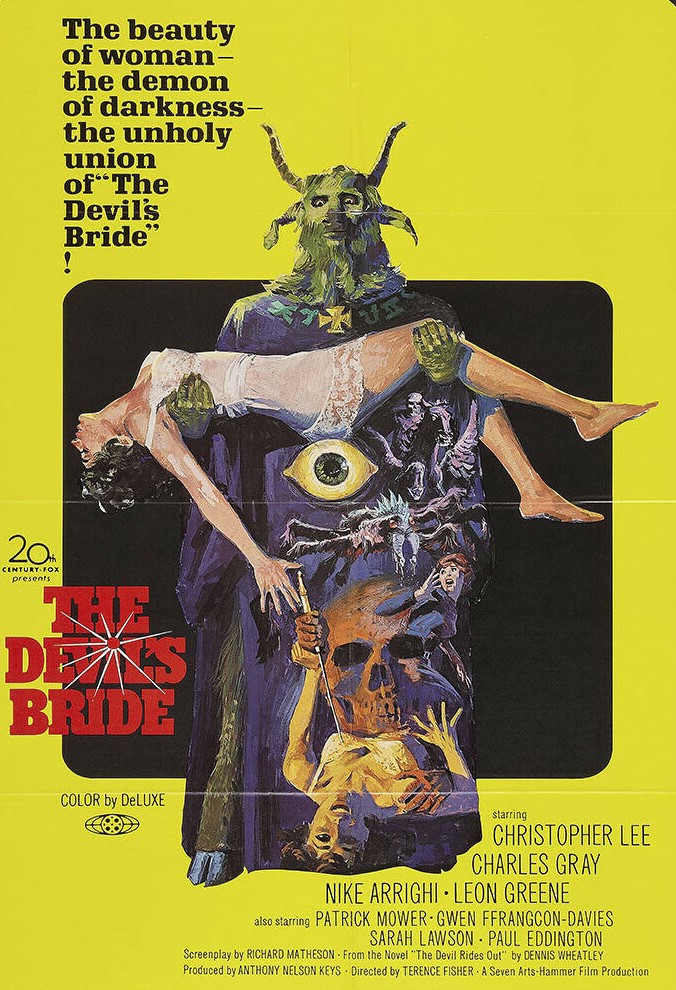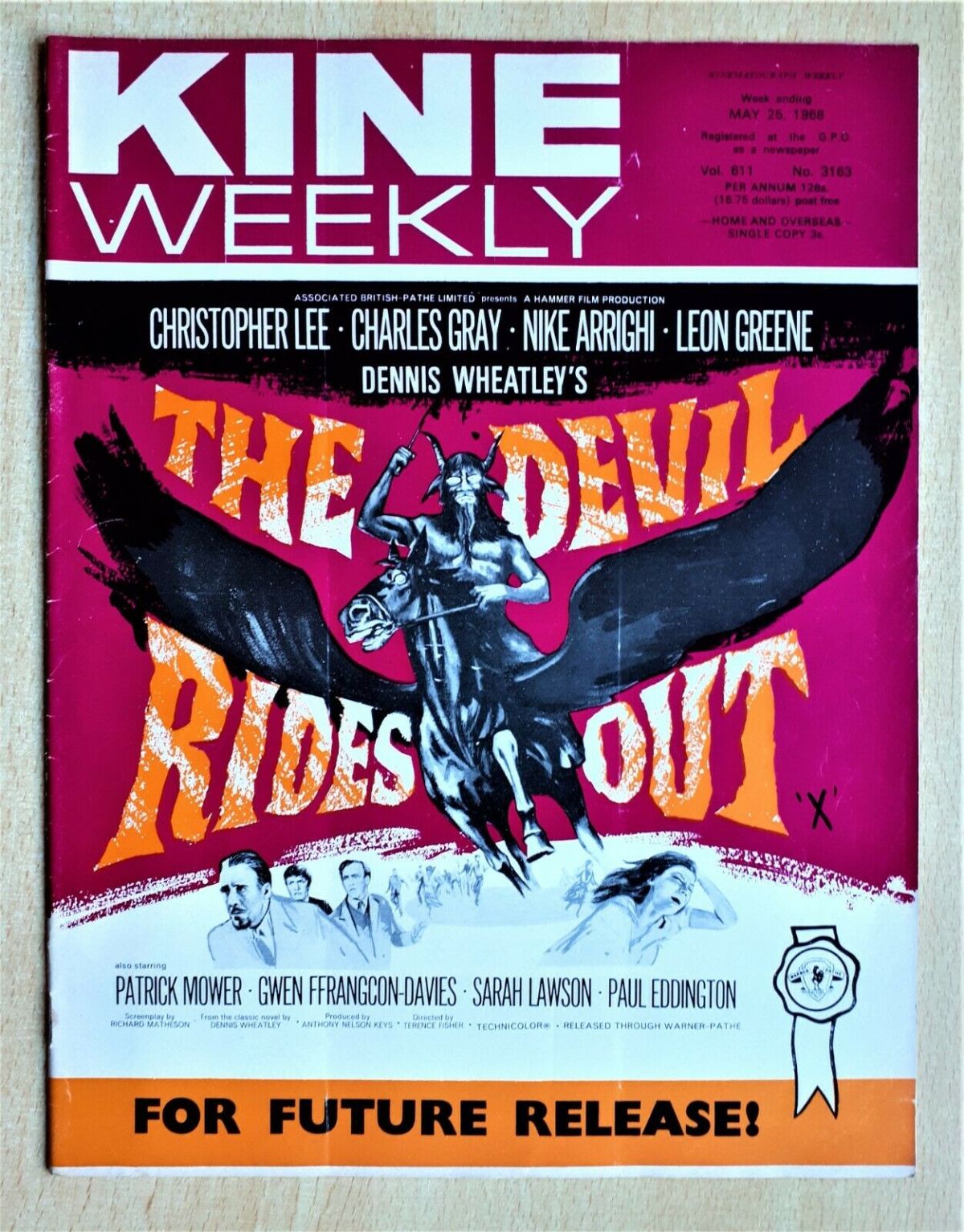
The Devil Rides Out / The Devil’s Bride (1968) ****

Strong contender for Hammer’s film of the decade, a tight adaptation of Dennis Wheatley’s black magic classic with some brilliant set pieces as Nicholas de Richleau (Christopher Lee) battles to prevent his friend Simon (Patrick Mower) falling into the hands of satanist Mocata (Charles Gray).

Initially constructed like a thriller with Simon rescued, then kidnapped, then rescued again, plus a car chase, it then turns into a siege as Richleau and friends, huddled inside a pentagram, attempt to withstand the forces of evil. Sensibly, the script eschews too much mumbo-jumbo – although modern audiences accustomed to arcane exposition through MCU should find no problem accommodating ideas like the Clavicle of Solomon, Talisman of Set and Ipsissimus – in favour of confrontation. 

Unlike most demonic pictures, de Richleau has an array of mystical weaponry and a fund of knowledge to defend his charges so the storyline develops along more interesting lines than the usual notion of innocents drawn into a dark world. In some senses Mocata is a template for the Marvel super-villains with powers beyond human understanding and the same contempt for his victims. And surely this is where Marvel’s creative backroom alighted when it wanted to turn back time. Though with different aims, De Richleau and Mocata are cut from the same cloth, belonging to a world where rites and incantations hold sway. 

While special effects play their part from giant menacing tarantulas and the Angel of Death, the most effective scenes rely on a lot less – Simon strangled by a crucifix, Mocata hypnotizing a woman, a bound girl struggling against possession. Had the film been made a few years later, when Hammer with The Vampire Lovers (1970) and Lust for a Vampire (1971) increased the nudity quotient, and after The Exorcist (1973) had led the way in big bucks special effects, the black mass sequence would have been considerably improved.

The main flaw is the need to stick with the author’s quartet of “modern musketeers” which means the story stretches too far in the wrong directions often at the cost of minimizing the input of de Richleau. In the Wheatley original, the four men are all intrepid, but in the film only two – de Richleau and American aviator Rex van Ryn (Leon Greene) – share those characteristics. At critical points in the narrative, de Richleau just disappears, off to complete his studies into black magic. Where The Exorcist, for example, found in scholarship a cinematic correlative, this does not try.
Christopher Lee (She, 1965), pomp reined in, is outstanding as de Richleau, exuding wisdom while fearful of the consequences of dabbling in black magic, both commanding and chilling. Charles Gray (Masquerade, 1965) is in his element, the calm eloquent charming menace he brings to the role providing him with a template for future villains.  The three other “musketeers” are less effective, Patrick Mower in his movie debut does not quite deliver while Leon Greene (A Challenge for Robin Hood, 1967) and Paul Eddington (BBC television’s Yes, Minister 1980-1984) are miscast. Nike Arrighi, also making her debut as love interest Tanith, is an unusual Hammer damsel-in-distress.

Hammer stalwart Terence Fisher (The Gorgon, 1964) creates a finely-nuanced production, incorporating the grand guignol and the psychological.  Screenwriter Richard Matheson (The Raven, 1963) retains the Wheatley essence while keeping the plot moving. A few years later nudity was no longer be an issue and Hollywood injected big bucks in horror special effects, so with those constraints in mind the studio did a devilish good job.
BOOK INTO FILM

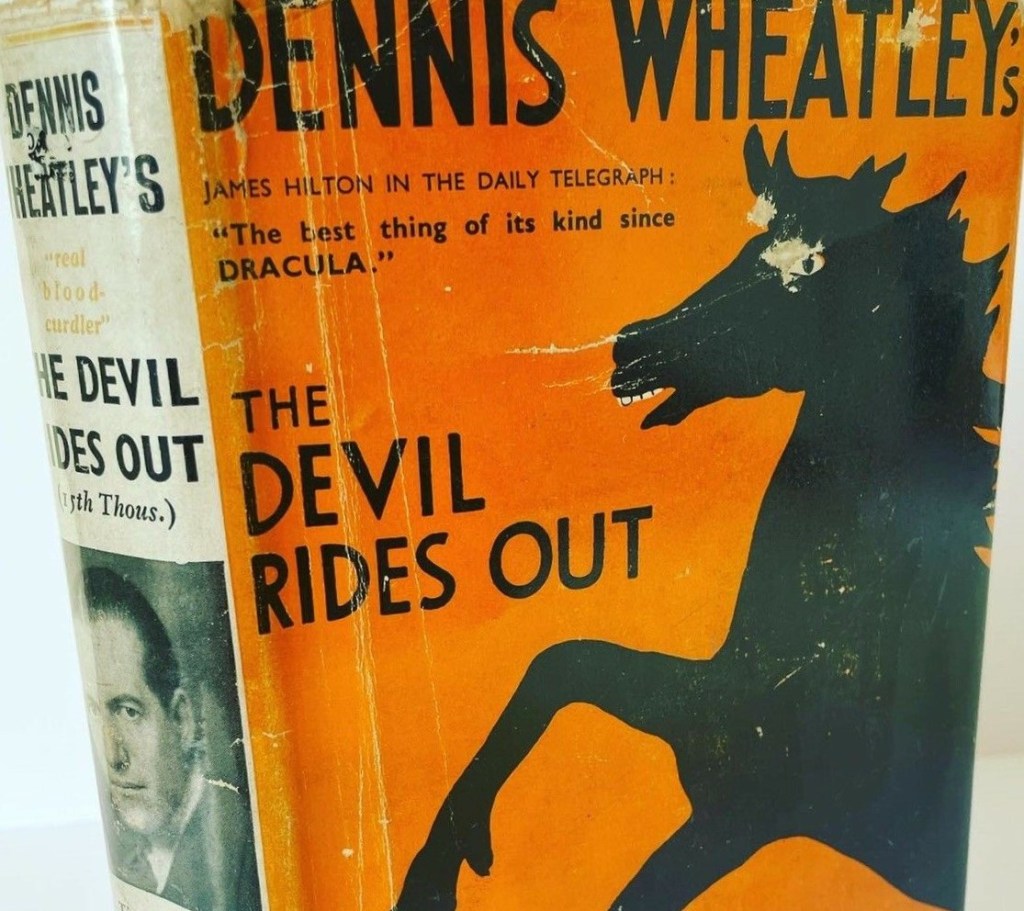
Dennis Wheatley was a prolific bestseller producing three or four titles a year, famous for a historical series set around Napoleonic times, another at the start of the Second World War and a third featuring the “four modern musketeers” that spanned a couple of decades. In addition, he had gained notoriety for books about black magic, which often involved series characters, as well as sundry tales like The Lost Continent.  Although largely out of fashion these days, Wheatley set the tone for brisk thrillers, stories that took place over a short period of time and in which the heroes tumbled from one peril to another. In other words, he created the template for thriller writers like Alistair MacLean and Lee Child.

The Devil Rides Out, his fourth novel, published in 1934, featured the “musketeers” involved in his phenomenally successful debut The Forbidden Territory (1933), and introduced readers to his interest in the occult. Although of differing temperaments and backgrounds his quartet – the Russian-born Duke De Richleau (Christopher Lee in the film), American aviator Rex Van Ryn (Leon Greene) and wealthy Englishmen Richard Eaton (Paul Eddington) and Simon Aron (Patrick Mower) – are intrepid. And while screenwriter Richard Matheson stuck pretty much to the core of the Wheatley story, the film was hampered by the actors. The laid-back Paul Eddington hardly connects with the Wheatley characterization and Patrick Mower is too young for Aron.

As with the book, the story moves swiftly. Worried that   Aron is dabbling in the black arts, De Richleau and Van Ryn go haring down to his country house where they meet black magic high priest Mocata (Charles Gray) and discover tools for satanic worship.  And soon they are embroiled in a duel of wits against Mocata, climaxing in creating a pentagram as a means of warding off evil.
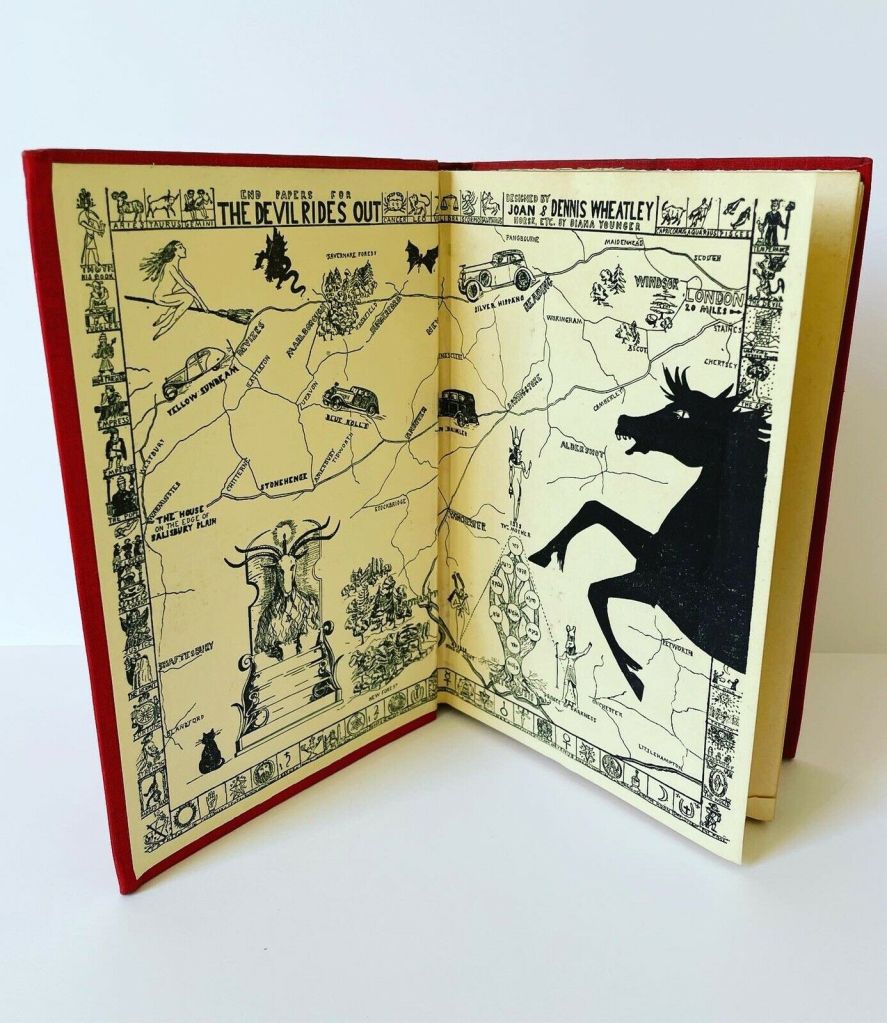
In order not to lose the audience by blinding them with mumbo-jumbo the script takes only the bare bones of the tale, bringing in the occult only when pivotal to the story, and that’s something of a shame. A modern audience, which has grown up on enormously  complicated worlds such as those created for Game of Thrones and the MCU, would probably have welcomed a deeper insight into the occult. While out-and-out thrillers, Wheatley’s novels also contained copious historical information that he was able to dole out even when his heroes were in harm’s way. The Devil Rides Out is not a massive tome so it’s a measure of the author’s skill that he manages to include not just a condensed history of the occult but its inner workings. Every time in the film De Richleau goes off to the British Library for some vital information, his departure generally leaves a hole, since what he returns with does not always seem important enough to justify his absence.

But then the screenwriter was under far more pressure than a novelist. In some respects, this book like few others demonstrated the difference between writing for the screen and writing for a reader. With just 95 minutes at his disposal, Matheson had no time to spare while Wheatley had all the time in the world. Wheatley could happily leave the reader dangling with a hero in peril while dispatching De Richleau on a fact-finding mission, the action held up until his return. It’s interesting that Matheson chose to follow Wheatley’s characterization of De Richleau, who didn’t know everything but knew where to look. Matheson could easily have chosen to make De Richleau all-knowing and thus able to spout a ton of information without ever going off-screen.

But here’s where the book scores over the film. The reader would happily grant Wheatley his apparent self-indulgence because in the book what he imparted on his return, given the leeway to do so, was so fascinating. There are lengthy sections in the book which are history lessons where De Richleau gives readers the inside track on the satanic. In the opening section, once De Richleau and Van Ryn have rescued Aron, the author devotes a full seven pages to a brief introduction to the occult that leaves the reader more likely to want more of that than to find out how the story will evolve.   He has hit on a magic formula that few authors ever approach. To have your background every bit as interesting as the main story is incredibly rare and it allowed Wheatley the opportunity to break off from the narrative to tell the reader more about the occult, which in turn, raised the stakes for the characters involved.

Dennis Wheatley

Effectively, there was too much material for a screenwriter to inflict upon an audience ignorant of the occult. Some decisions were clearly made to limit the need for lengthy exposition. But these often work against the film. For example, Mocata wants the Talisman of Set because it bestows unlimited power with which he can start a world war, but in order to accomplish that he needs to find people with the correct astrological births, namely Simon and Tanith. But this element is eliminated from the story, making Mocata’s motivation merely revenge.  Matheson also removed much of the historical and political background, replaced the swastika as a religious symbol with the more acceptable Christian cross, and deleted references to Marie’s Russian background. Her daughter Fleur becomes Peggy. Matheson also treats some of the esoteric light-heartedly on the assumption that seriousness might be too off-putting.

Overall, the adaptation works, you can hardly argue with the movie’s stature as a Hammer classic, but the more you delve into the book the more you wish there had been a way for much of the material to find its way onscreen and to inform the picture in much the same way as the depth of history and character backstory added to Game of Thrones.
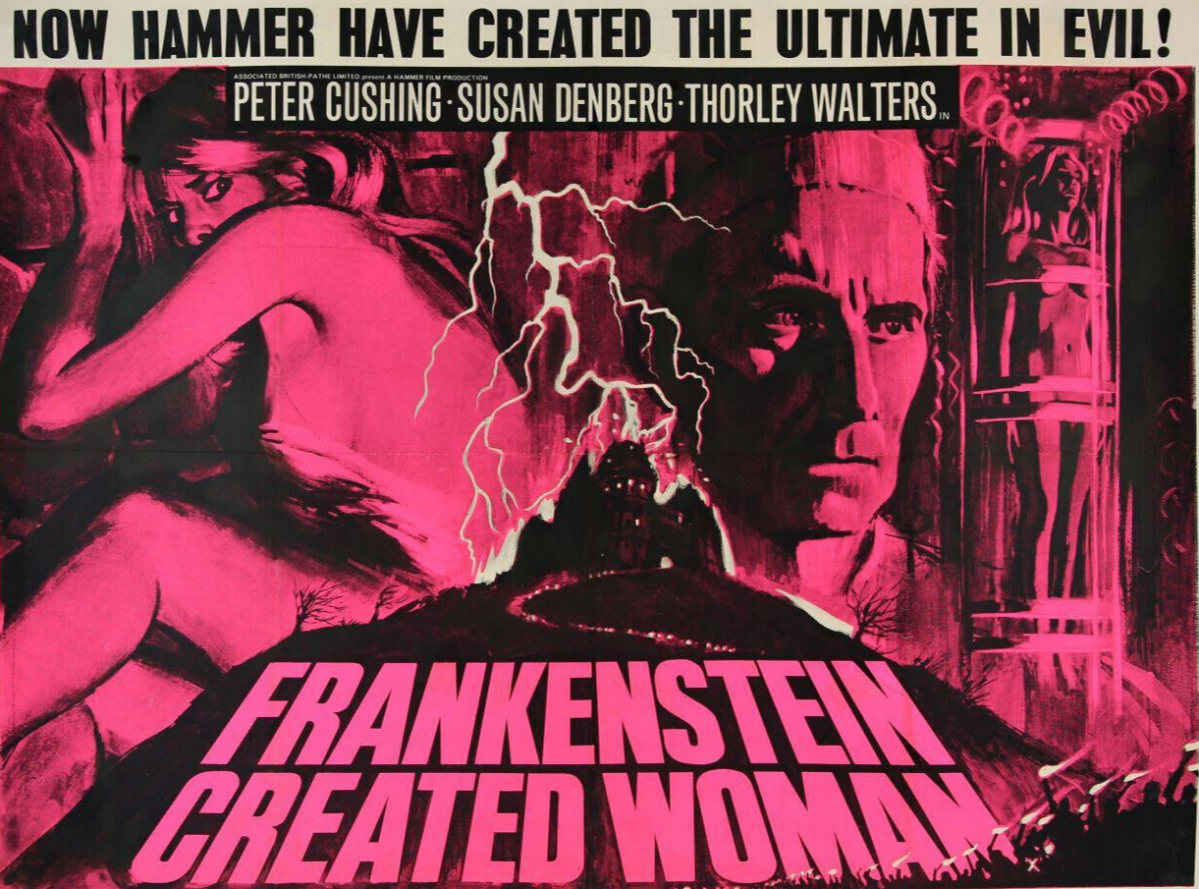
Frankenstein Created Woman (1967) ***

Custom-made for a contemporary audience. How can you fail with a tale about a male brain taking over a female body. Male soul if you want to be strictly correct and metaphysical about it or if you are Martin Scorsese for whom discussion about whether the soul leaves the body after death and exists on some other plane was of the greatest interest. But, yes, so although our hero/villain Baron Frankenstein (Peter Cushing) does create a female instead of a male, and not just with the misogynistic purpose of supplying a monster with a mate, unfortunately in the act of creation the poor woman is saddled with the soul/brain of a man, and, even worse, one with  bloody revenge on his mind.

These days for sure audiences would not have any trouble with female stars carving a swathe through any populace and nobody would require transplanting of  male hormones-soul-brain-whatever to take off on a rampage. But, back in the day, before Hammer went full-tilt-boogie down the lesbian vampire route, it was rare, outside of film noir and exploitationer pictures, for a woman to be so savage. So her actions are viewed with regret rather than roars of approval. But, for once, nobody is taking a torch or axe to the good old Baron.

That’s not all that takes the audience by surprise. The use of a guillotine, ideal for a post-task  dripping of blood, turns out to be widely used in central Europe in the 19th century, hardly surprising since it was a German invention. The movie opens with a young boy, Hans, witnessing his father’s execution on such a device, a point that seems arbitrary but proves pivotal.

The grown-up Hans (Robert Morris) assists Dr Hertz (Thorley Walters) assisting the Baron in some kind of resurrection experiment, the guinea pig being Frankenstein himself. Naturally, for purely metaphysical purposes you understand, the Baron would like to experiment on as barely-dead a cadaver as possible to prove his theories. That this takes a good while to materialize is largely because the narrative has to go all around the houses.

Hans’s lover, disfigured and lame innkeeper’s daughter Christina (Susan Denberg), is taunted by a trio of young swells that results in Hans attacking them. Later, for no particular good reason, the toffs kill the innkeeper, but Hans gets the blame and is sentenced to death. After he is  guillotined, Christina commits suicide by drowning. Both bodies turn up in Frankenstein’s lab at roughly the same time. Complication of course being that a guillotine doesn’t deliver a body intact. Quite how Frankenstein achieves his soul-body transplant is left up to your imagination – the scene promised in the poster is a marketing fiction.

And there’s a touch of Poor Things about the result as Christina wakes up minus scars and disfigurement but with no recollection of her past and needs to be taught who she is. Not that she requires much education in the feminine wiles department and is soon stalking the three young toffs, seducing them with hints of sexual promise before taking savage revenge.

There also a Curse of the Undead element when villagers discover her grave is empty. In fairness to the Baron, he soon realizes what fate had befallen her and tries to ensure that, once her revenge is complete, she can live a different life, although in the way of horror films a happy ending is rarely an option. And in fairness to the Baron the villagers aren’t queueing up to set him alight.

With various subplots to get through, this leaves the Baron out of the picture for considerable periods of time. From a contemporary perspective, there’s a freshness here that will appeal, especially the creation’s desire to discover her purpose in life, her not being bred to fulfil a romantic purpose, and the battle of the male-female will.

Peter Cushing (The Skull, 1965) is as usual splendid, Thorley Walters (Sherlock Holmes and the Deadly Necklace, 1962) presents as an inebriated and impecunious assistant while Austrian Susan Denberg (An American Dream, 1966) does well in the dual role.

Fourth outing in the Hammer series, directed with occasional verve by the reliable Terence Fisher (The Devil Rides Out, 1968) from a screenplay by Anthony Hinds (The Mummy’s Shroud, 1967).

Contemporary appeal and can never go wrong given that it is purportedly one of Martin Scorsese’s favorite films.

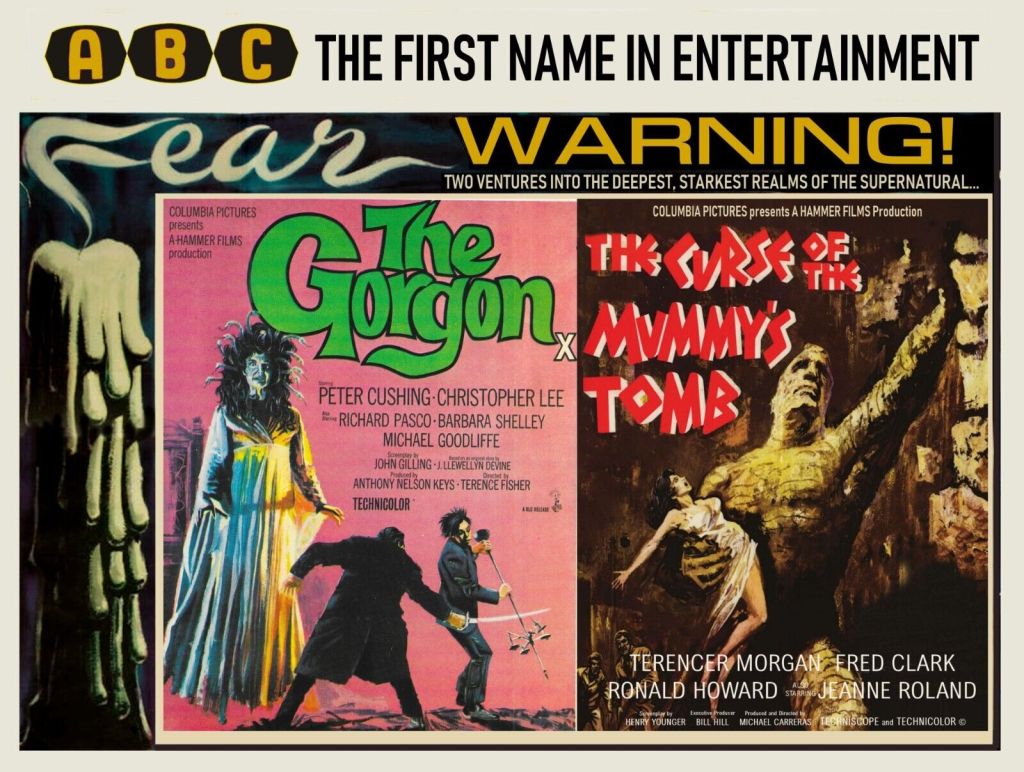
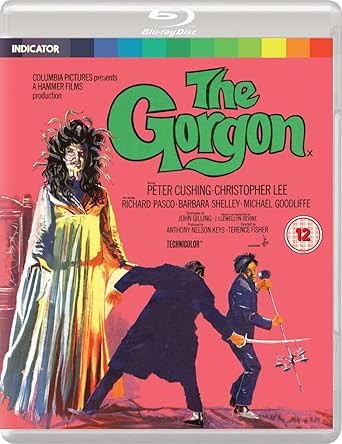
The Gorgon (1964) ***

This impressive Hammer conspiracy-of-silence slow-burner, more thriller than horror, features the triumvirate of Christopher Lee (The Devil Ship Pirates, 1964), Peter Cushing (The Sword of Sherwood Forest, 1960) and Barbara Steele (Dracula, Prince of Darkness, 1966) in untypical roles. Lee and Cushing, of course, had locked horns before, namely in Hammer’s reimagining of the classic Dracula, with the former the charismatic fiend and the latter his nemesis.

Dr Namaroff (Peter Cushing) is a  doctor in an unnamed European turn-of-the-twentieth-century police state who knows more than he is letting on about seven inexplicable deaths in five years and the possibility of a 2,000-year-old myth coming to life and taking on a human form. And with quite a human side, jealous when his assistant Carla (Barbara Shelley) falls for a younger man, Paul (Richard Pascoe). Professor Karl Meister (Christopher Lee) appears late in the day to investigate.

Director Terence Fisher, who had shepherded the studio’s Dracula, Frankenstein, the Mummy and Dr Jekyll franchises through the starting gate, builds up the atmosphere with full moons, haunting voices, fog, sudden sounds, drifting leaves and an abandoned castle forever in shadow. The camera is often a weapon of stealth. Shock is kept to a minimum, fleeting ghostly apparitions and a finger falling off a corpse. Given the limitations of special effects in this era, that was a smart move.

Far better to concentrate on fear of impending doom, a man knowing he is turning to stone, a woman living in terror of being taken over by the phantom. The title gives away the story somewhat – even if you didn’t know the Gorgon was a mythical monster with a headful of snakes and the ability to turn people to stone, that is soon explained. 

Death remains the trigger for action, the suicide of an artist after he has apparently murdered his pregnant girlfriend bringing his father onto the scene and then his brother accompanied by Lee. But all investigation hits a wall of silence after Inspector Kanof (Patrick Troughton) refuses to instigate detection.

The Hammer double bill was a common feature in British cinemas. It also meant Hammer didn’t need to share box office receipts with another company.

At the heart of all the relationships is betrayal. The artist leading his girlfriend on, Namaroff willing to endanger Carla, whom he professes to love, rather than revealing the truth. Even Carla spies on the brother, with whom she is falling in love, in order to gather information for Namaroff. 

Forgive the pun, but Shelley steals the picture. An amnesiac, a victim and finally the lure, she remains enigmatic, a whisper of a woman. It is a haunting portrayal far removed from Hammer’s traditional cleavage queens. This is a very human character who nonetheless must stand guard over herself. Shelleye, here a gentle beauty, initially introduced as merely the love interest, becomes central to the story but without sucking up all the available horror oxygen by over-acting.   

Cushing embroiders his character with little touches, smoking a cigarette in a holder, for example, but Shelley’s character, her distrust of herself, shows in every move she makes.

You would need a heart of stone to be unmoved.

https://amzn.to/41dZqD3

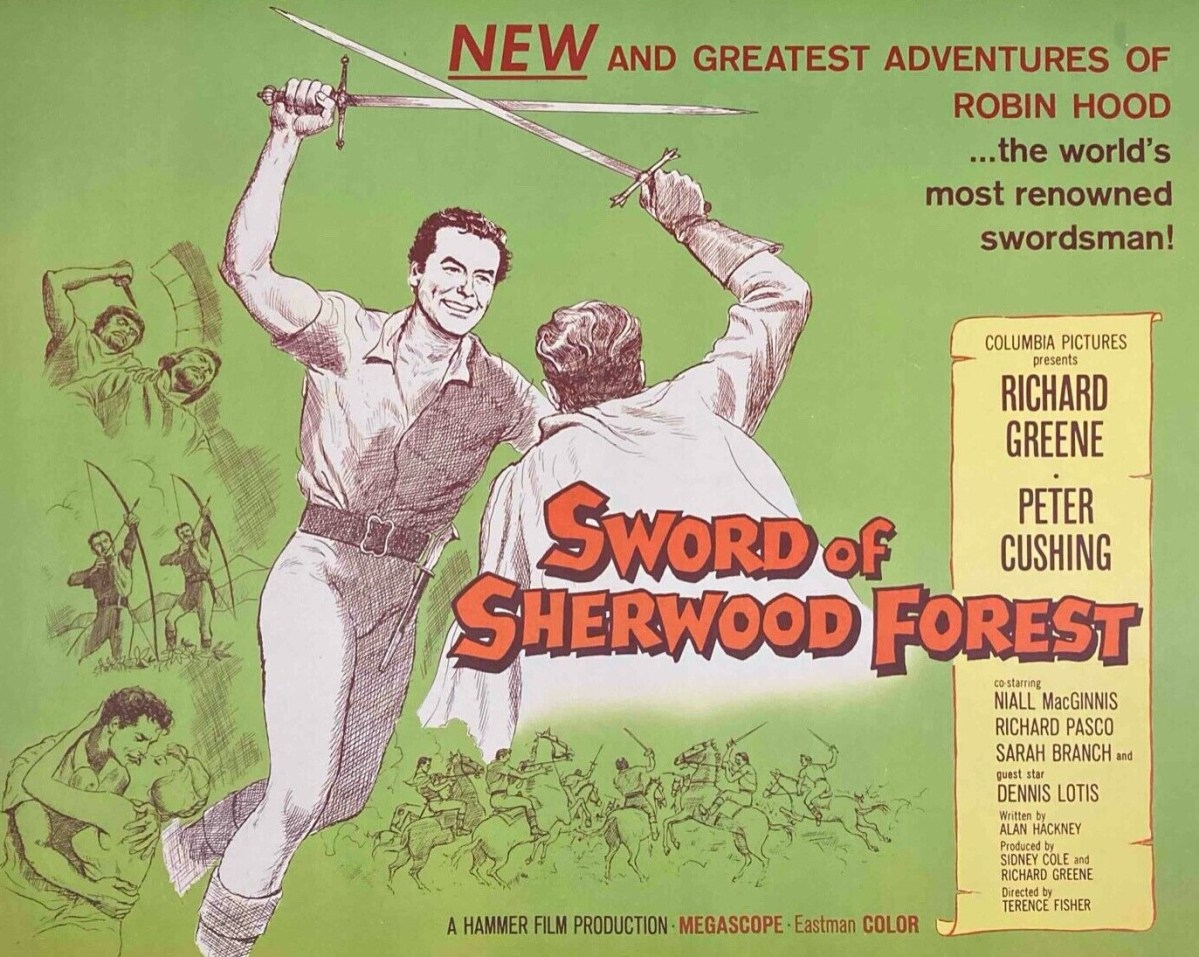
Robin Hood Double Bill: Sword for Sherwood Forest *** (1960) and A Challenge for Robin Hood ***(1967)

The last swashbuckler to cut a genuine dash was The Crimson Pirate (1952) with an athletic Burt Lancaster romancing Virginia Mayo in a big-budget Hollywood spectacular. The chance of Hollywood ponying up for further offerings of this caliber was remote once television began to cut the swashbuckler genre down to small-screen size. Britain’s ITV network churned out series based on Sir Lancelot, William Tell and The Count of Monte Cristo and 30-minute episodes (143 in all) of The Adventures of Robin Hood. So when Hammer decided to rework the series as Sword of Sherwood Forest their first port-of-call was series star Richard Greene.

And to encourage television viewers to follow the adventures of their hero on the big screen, Hammer sensibly dumped the small screen’s black-and-white photography in favour of widescreen color and then lit up the canvas at the outset with aerial tracking shots of the glorious bucolic greenery of the English countryside. Further temptation for staid television viewers came in the form of Maid Marian (Sarah Branch) bathing naked in a lake. Robin Hood is soon hooked. 

Two main plots run side-by-side. The first is obvious. The Sheriff of Nottingham (Peter Cushing) is quietly defrauding people through legal means. The second takes a while to come to fruition. Robin Hood is hired by for his archery skills by the Earl of Newark (Richard Pasco) – he shoots a pumpkin through a spinning wheel, a moving bell and a bullseye through a slit – before it becomes apparent he is being recruited as an assassin. Oliver Reed and Derren Nesbitt put in uncredited appearances and the usual suspects are played by Niall MacGinnis (as Friar Tuck) and Nigel Green (as Little John).

There is sufficient swordfighting to satisfy. Director Terence Fisher (The Gorgon, 1964), more at home with the Hammer horror portfolio, demonstrates a facility with action. Richard Greene (The Blood of Fu Manchu, 1968) makes a breezy hero and Peter Cushing (The Gorgon) resists the tmeptation to camp it up. Screenplay honors went to Alan Hackney (You Must Be Joking! 1965).

Six years on from Sword of Sherwood Forest, the challenge of reviving a moribund genre proved too much for A Challenge for Robin Hood but this second Hammer swashbuckler is a valiant and enjoyable attempt. More in the way of an origin story, this explains how a nobleman turned into an outlaw and how the merry band was formed. For in this tale Robin Hood (Barry Ingham) is a Norman nobleman framed for murder, Will Scarlet (Douglas Mitchell) and Little John (Leon Greene) are castle servants – also Normans – while Maid Marian (Gay Hamilton) is in disguise. Some liberties are taken with the traditional version – there is no fight with Little John, instead, as noted above, they are already acquainted.

There are a couple of excellent set pieces and although the swordfights are not in the athletic league of Errol Flynn they are more inventive than the previous Hammer outing and there is enough derring-do to keep the plot ticking along. Robin’s cousin Roger de Courtenay (Peter Blythe) is the prime villain this time round, the sheriff (John Arnatt), although involved up to the hilt at the end, content to offer acerbic comment from the sidelines.  

When Robin and Friar Tuck escape the castle by jumping into the moat, Will Scarlet is caught and later used as bait. Meanwhile Robin’s archery prowess and leadership skills have impressed the Saxon outlaws hiding in the forest and he takes over as their head. But there are clever ruses, jousting, Robin disguised as a masked monk, torture, and a pie fight.

Director C. M. Pennington-Richards had some swashbuckling form having helmed several episodes of The Buccaneers and Ivanhoe television series but his big screen experience was limited to routine films like Ladies Who Do (1963) with Peggy Mount. This was a departure for scriptwriter Peter Bryan, more used to churning out horror films like The Brides of Dracula (1960) and The Plague of the Zombies (1966), and he has invested the picture with more wittier lines and humorous situations than you might expect.

It’s certainly an escapist holiday treat and unless compared to the likes of the Pirates of the Caribbean or the classic Errol Flynn adventure it stands up very well on its own.

https://amzn.to/3MqhwLO

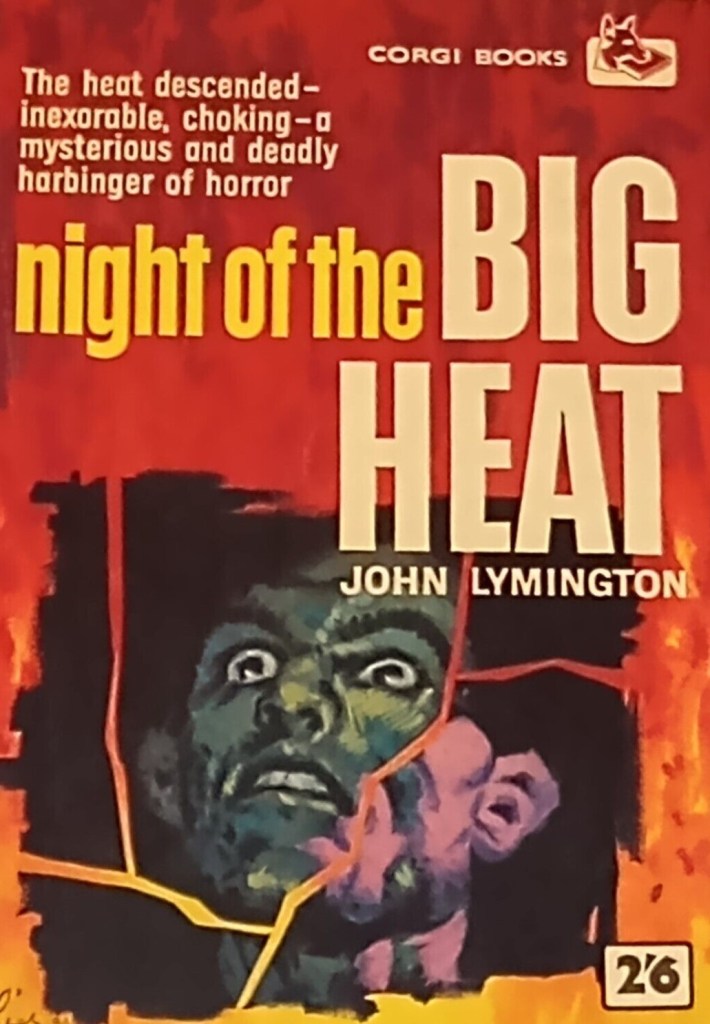
Night of the Big Heat/ Island of the Burning Damned (1967) ***

The Day the Earth Caught Fire (1961) meets War of the Worlds with a nod in the direction of Star Trek.  In the absence of a decent budget director Terence Fisher (Dracula Prince of Darkness, 1966) loads the movie with decent actors and relies of suspense rather than revelation. Ignoring the obvious opportunities for beefcake, partially embraces cheesecake.

While you might anticipate a horde of sweat-soaked men you will be taken by surprise by that most un-English of scenes – delight in a downpour. This is more sensibly located on a remote island rather than a big city and dials down on the preachy stuff, nothing to do with  atomic bombs, but still alien invasion.

Instead of The Old Dark House it’s a very hot English pub in winter – a time when the rest of the country is freezing – where all the characters congregate. We’ve got author Jeff (Patrick Allen), wife and pub landlady Frankie (Sarah Lawson),  local doctor Vernon (Peter Cushing), mysterious guest Godfrey (Christopher Lee), mechanic Tinker (Kenneth Cope) and newly-arrived secretary Angela (Jane Merrow) who has been having an affair with Jeff. 

It’s so hot Angela has to cool off with a lager and lime. The women appear to withstand the heat better than the men who are all in shirtsleeves and soaked through with sweat. Angela’s got the right idea, nipping down to the sea in her bikini, cooling her neck (and cleavage as it happens) with an ice cube.

As well as the unseasonable weather there’s a high-pitched eerie noise that especially afflicts automobile drivers, forcing them off the road. Various characters are despatched before disclosure. There’s a surprisingly vivid slice of sexual competition between the two women for Jeff’s attentions. In an excellent scene the wife works out what’s going by Jeff’s attitude towards Angela.

Naturally, Jeff has little idea how to retrieve the situation and maybe it’s just the acceptable misogyny of the period or maybe Frankie is just a bit dim, but I doubt if many women would be happy to hear husband describe lover as a “common slut” without wondering how often he attracted to such. Luckily, the crisis is much bigger than a marriage being potentially wrecked.

The sight of the eventually sweat-soaked Angela is too much for Tinker resulting in a brutal scene of attempted rape. While the males, except for being overcome by the noise, tended to remain cool, Angela turns hysterical, threatening suicide and murder in turn, but in the context of being shunned by Jeff and attacked by Tinker it’s hardly surprising she’s at the end of her tether.

Turns out the aliens have taken a leaf out of the Star Trek playbook and can beam themselves to Earth and dematerialize and that the endless human search for life among the universe has prodded an alternative life form into action. Seeing Earth as one giant platter of energy, they have landed and started sating their appetites.

It’s a fairly standard premise and exposition is left to Christopher Lee (The Devil Rides Out, 1968) rather than the more obvious choice of Peter Cushing (The Skull, 1965). Audiences expecting Lee and Cushing to be on opposite sides, with the former cast as villain, will be disappointed. Lee takes on the role of scientist that would normally fall to Cushing. He makes a good boffin, snappy, abrupt, remote and luckily without the slightest interest in any of the disporting damsels.

Patrick Allen (Puppet on a Chain, 1970) who spent most of the decade in television, the movies generally only interested in utilising his voice for narration duties (Carry On Up the Khyber, The File on the Golden Goose etc) takes the opportunity to grab the dramatic center, the character who has to work out what’s going on, while given a pair of conflicting love interests to increase the tension.

Jane Merrow (The System/The Girl Getters, 1964) is the surprise. Provided with the only genuine character arc in the picture, she goes from cool, confident, teasing chick to all-get-out-hysterical, but still with several ounces of sense, able to beat off her attacker, and willing to embrace the suicide option rather than being burned alive by invaders. The aliens, you won’t be surprised to learn, are not, despite the build-up, in the slightest bit scary.

But Fisher does a good job and the reason is a watchable low-budget sci-fi shocker.

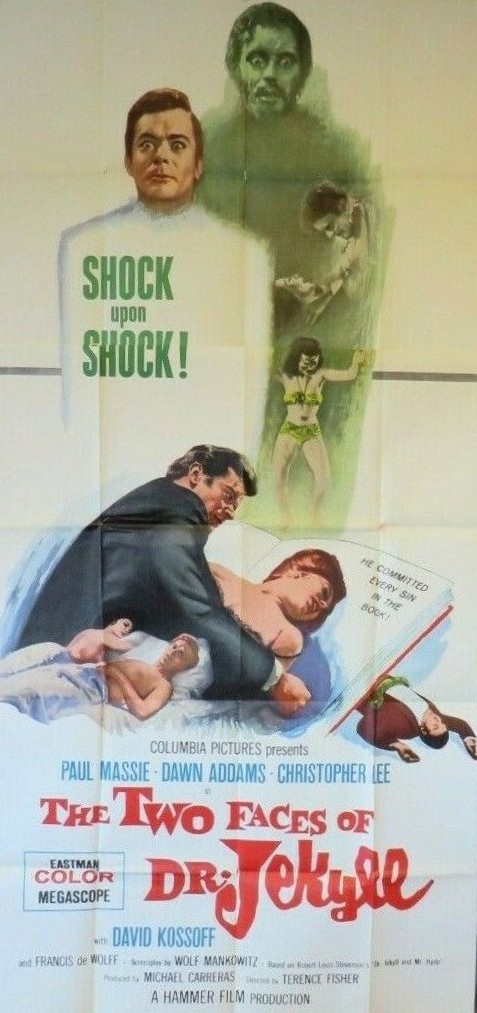
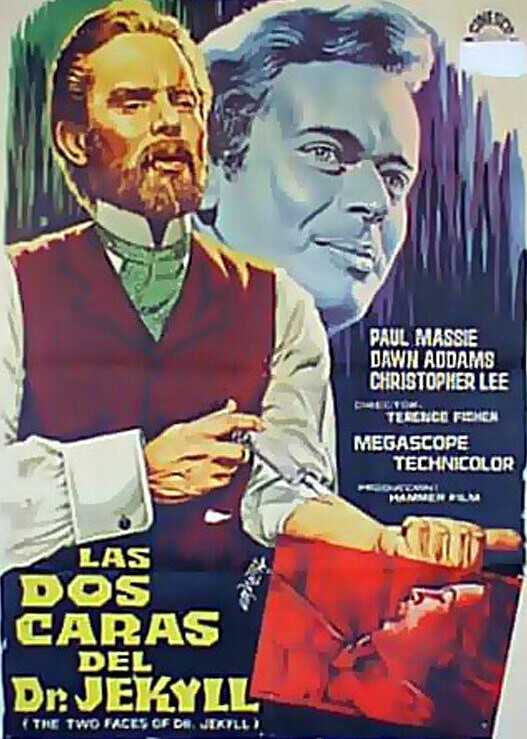
The Two Faces of Dr Jekyll / Jekyll’s Inferno / House of Fright (1960) ****

One of the most shocking films of its day with its unusual focus on sex and violence, this takes the famed Robert Louis Stevenson tale down a different direction in that Dr Jekyll enjoys the base animal instincts he has unleashed with his experiments rather than expressing remorse or guilt. Evil has never been more demonstrably enjoyed.

Dr Jekyll (Paul Massie) is a shy cuckolded scientist when he takes the magic elixir that diverts his dull personality towards a more dynamic, if ultimately perverted, destination. From being fearful of life, he begins to sample its more exotic pleasures under the guidance of louche best friend Paul (Christopher Lee) who is carrying on an affair with the good doctor’s wife Kitty (Dawn Addams).

Not only does the reincarnation of Jekyll as the lusty Hyde consort with prostitutes and manage to snare exotic dancer Maria (Norma Marla), a beautiful woman who would normally be way out of his league,  he develops a fetish for violence, almost beating to death a hooligan (Oliver Reed) in a dodgy club, only prevented from committing his first murder by the intervention of his friend.

Sure, there’s some philosophising about the nature of good and evil and whether violence is inborn or nurtured and there are moments when guilt rears its ugly head, but these are pretty fleeting to be honest, and most of the time he can hardly wait for another draught of his poison in order to shake off his insipid persona and revel in the new creation.

But magic will only take you so far. Believing he is now irresistible to women he fancies his chances with Paul’s amour, who is of course none other than his wife, but she will have none of it, finding him a poor alternative to the charming Paul. In one of the most controversial scenes of the day, and perhaps only ironically acceptable at the time, Hyde proceeds to rape the resisting Kitty. This skirts so close to the edge of taste, not just the worst type of domestic abuse (though husband assaulting wife would be no less unusual in Victorian times than it is now), but almost the neanderthal man taking what he wants, that it makes for uncomfortable viewing, especially as it is presented as a come-uppance for the adulterous hoity-toity Kitty.

Perhaps more interesting is that having won over the cold Maria, a trophy lover on a par with the higher-born Kitty, that’s not enough for Hyde.

Also, for the time, is an extremely risqué scene involving Maria and her snake, especially when having completed the usual survey of her curves, the reptile ends up down her throat. That the Victorians were masters of the art of hypocrisy comes as little surprise, but the extent of it takes the viewer aback.  

There’s another twist. When it becomes apparent that his crimes are about to catch up with him the cunning Jekyll attempts to blame Hyde.   

Sumptuously mounted by Terence Fisher (Dracula, Prince of Darkness, 1966) and with nary an attractive character in sight – none of the innocent victims of the vampire sagas, for example – to leaven the sight of such unmitigated wickedness, the director offers an unique vision of how easy human beings will degenerate given the chance. At the outset Paul appears the most obvious villain, leeching on his friend to pay his gambling debts, while at the same time making hay with his wife. But initial audience sympathy for a wife, presented as a beautiful woman who for the sake of security has made a bad marriage and who needs an outlet for passion, soon dissipates as her true character is revealed.

The refusal to temper the ongoing degeneracy with one good character is a bold choice. Budgetary restrictions eliminated the usual transformation scene but that was probably for the best, since Hyde merges as though from a chrysalis into a stronger personality rather than undergoing some body-wracking physical change. It’s almost as if the director is determined to show how easy, given opportunity, a good but essentially weak man will embrace the dark side.

Accusations that Fisher has failed to bring sufficient suspense to the film I find unfair. Certainly, there’s not the tension of the will-he-be-found-out vein, but since the story is so well-known that appears a redundant course sensibly avoided. The director replaces that with ongoing friction between Jekyll and his friend on the one hand and his wife on the other, both of whom are unaware that the man they know as Jekyll is aware of just what a fool has been made of his alter-ego.

The emphasis instead falls on how and when the cuckold will take his revenge. And although the rape scene is unwelcome, there’s a certain ironic sadness for Jekyll to discover that his new persona is no more attractive to his wife than his old one.

Paul Massie (Call Me Genius, 1961) is of course far removed from an actor like Spencer Tracy (Dr Jekyll and Mr Hyde, 1941) and he relies overmuch on rolling the eyes but even so this is a decent performance. Christopher Lee (Dracula, Prince of Darkness) is the revelation, creating a very believable insidiously charming man who never quite approaches outright villainy. Dawn Addams is excellent as the spoiled entitled wife.

One of the unusual aspects of the picture is that where Hammer had been and would remain a breeding ground for new stars – Christopher Lee a most obvious example – everyone else featured here came to, in cinematic terms only I assure you, an untimely end.

This turned out to be Paul Massie’s only starring role – he only made another three films during the entire decade – and was soon relegated to television. Dawn Addams only managed another nine and, apart from House of Sin/The Liars (1961), spy flick Where the Bullets Fly (1966) might be counted the peak.

David Kossof only made another four, and none beyond 1964. And this was the final film in an extremely brief two-picture career for Norma Marla. Only the uncredited Oliver Reed (Women in Love, 1969) and of course Christopher Lee (Dracula, Prince of Darkness, 1966) went on to bigger and better things.

As did Terence Fisher who helmed most of the best Hammer pictures of the decade. Wolf Mankowitz (The Day the Earth Caught Fire, 1961) wrote the script.

Generally dismissed at the time, this has for good reasons acquired a substantial following and is well worth a look.

The Devil Rides Out / The Devil’s Bride (1968) ****

Strong contender for Hammer’s film of the decade, a tight adaptation of Dennis Wheatley’s black magic classic with some brilliant set pieces as Nicholas de Richleau (Christopher Lee) battles to prevent his friend Simon (Patrick Mower) falling into the hands of satanist Mocata (Charles Gray).

Initially constructed like a thriller with Simon rescued, then kidnapped, then rescued again, plus a car chase, it then turns into a siege as Richleau and friends, huddled inside a pentagram, attempt to withstand the forces of evil. Sensibly, the script eschews too much mumbo-jumbo – although modern audiences accustomed to arcane exposition through MCU should find no problem accommodating ideas like the Clavicle of Solomon, Talisman of Set and Ipsissimus – in favour of confrontation.  

The title was changed for American audiences.

Unlike most demonic pictures, de Richleau has an array of mystical weaponry and a fund of knowledge to defend his charges so the storyline develops along more interesting lines than the usual notion of innocents drawn into a dark world. In some senses Mocata is a template for the Marvel super-villains with powers beyond human understanding and the same contempt for his victims. And surely this is where Marvel’s creative backroom alighted when it wanted to turn back time. Though with different aims, De Richleau and Mocata are cut from the same cloth, belonging to a world where rites and incantations hold sway.  

While special effects play their part from giant menacing tarantulas and the Angel of Death, the most effective scenes rely on a lot less – Simon strangled by a crucifix, Mocata hypnotizing a woman, a bound girl struggling against possession. Had the film been made a few years later, when Hammer with The Vampire Lovers (1970) and Lust for a Vampire (1971) increased the nudity quotient, and after The Exorcist (1973) had led the way in big bucks special effects, the black mass sequence would have been considerably improved.

The main flaw is the need to stick with the author’s quartet of “modern musketeers” which means the story stretches too far in the wrong directions often at the cost of minimizing the input of De Richleau. In the Wheatley original, the four men are all intrepid, but in the film only two – De Richleau and American aviator Rex van Ryn (Leon Greene) – share those characteristics. At critical points in the narrative, De Richleau just disappears, off to complete his studies into black magic. Where The Exorcist, for example, found in scholarship a cinematic correlative, this does not try.

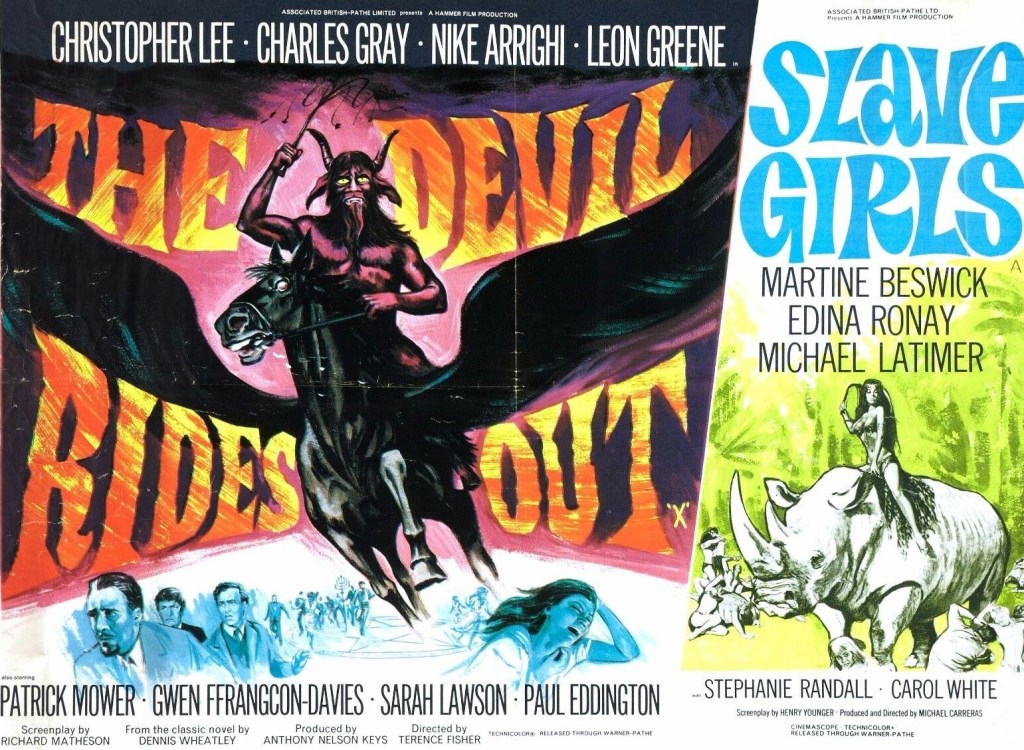
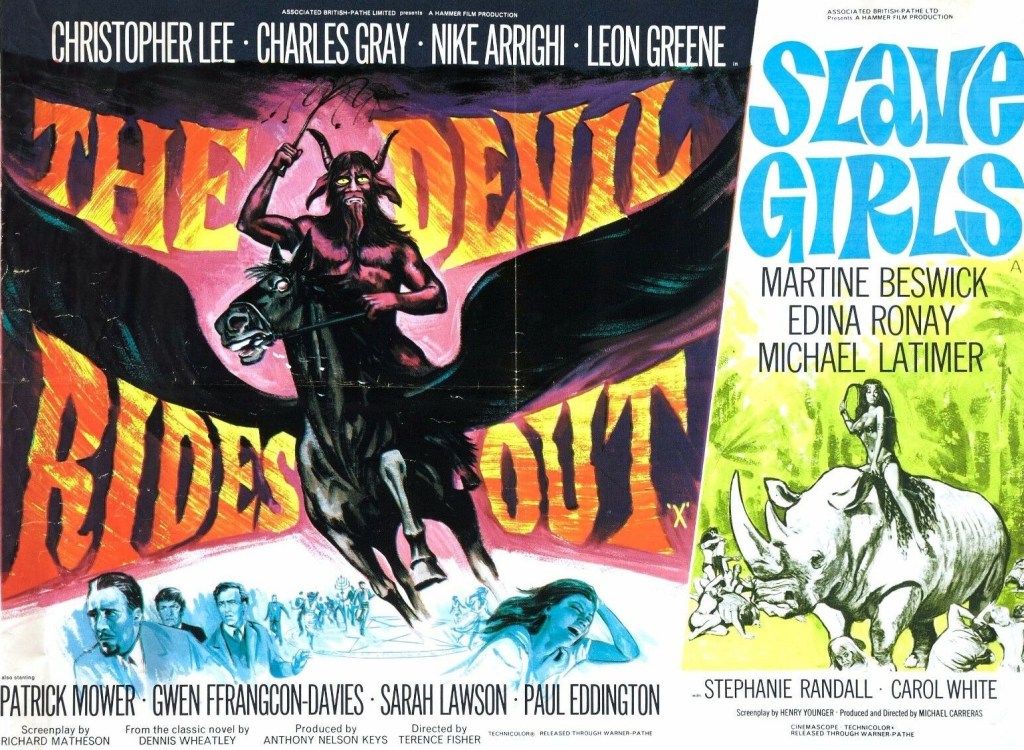
In Britain it was double-billed on the ABC circuit with Slave Girls.

Christopher Lee (She, 1965), pomp reined in, is outstanding as De Richleau, exuding wisdom while fearful of the consequences of dabbling in black magic, both commanding and chilling. Charles Gray (Masquerade, 1965) is in his element, the calm eloquent charming menace he brings to the role providing him with a template for future villains.  The three other “musketeers” are less effective, Patrick Mower in his movie debut does not quite deliver while Leon Greene (A Challenge for Robin Hood, 1967) and Paul Eddington (BBC television’s Yes, Minister 1980-1984) are miscast. Nike Arrighi, also making her debut as love interest Tanith, is an unusual Hammer damsel-in-distress.

Hammer stalwart Terence Fisher (The Gorgon, 1964) creates a finely-nuanced production, incorporating the grand guignol and the psychological.  Richard Matheson (The Raven, 1963) retains the Wheatley essence while keeping the plot moving.

Catch-Up: far from ubiquitous and with a wide range of roles Christopher Lee has appeared several times in the Blog – for Sherlock Holmes and the Deadly Necklace (1962), The Whip and the Body (1963), The Devil-Ship Pirates (1964), The Gorgon (1964), She (1965), The Skull (1965), The Brides of Fu Manchu (1966), Five Golden Dragons (1967), The Curse of the Crimson Altar / The Crimson Cult (1968) and The Oblong Box (1969).

Sherlock Holmes and the Deadly Necklace (1962) **

Sir Arthur Conan Doyle would be turning in his grave. Workmanlike at best, awful at its worst, or a “so-bad-it’s-good” candidate? Christopher Lee goes through the motions, there’s an oddly inserted heist, the continuity goes haywire, and the deduction would not have troubled a child. Even the great sleuth having to match nemesis Moriarty in cunning fails to lift this turgid tale. Despite being made in Germany, all the actors, save Senta Berger, appear injected with a fatal dose of stiff upper lip.

A corpse in the water alerts Sherlock Holmes (Christopher Lee) to the presence of Moriarty (Hans Sohnker) who is hunting Peter Blackburn (Wolfgang Lukschy) who has appropriated Cleopatra’s necklace from an archaeological dig. This takes them to Hampshire where corpses abound but the necklace is gone. Holmes burgles Moriarty’s apartment and steals back the necklace which is sent, in heavily protected police van, to an auction house. Holmes outwits Moriarty by infiltrating the heist the villain has planned.

The best scene comes at the beginning when boys throw stones at something floating in the Thames only to discover it’s a corpse. After that, you can choose from any number of bad scenes. Where do you start? The disguises? Holmes is first seen wearing a false nose to pass himself off as dock worker. An eyepatch is enough to convince Moriarty’s henchmen that Holmes in one of their kind. Bare-handed, Holmes kills an obviously plastic snake. To find out what Moriarty is up to, they listen down a chimney!

The deduction is so awful Dr Watson (Thorley Walters) could have done it. A dying man who manages to whisper one word is unable to whisper two and instead still has the strength to flap his hands in a way that any child in the audience familiar with shadow play would have known signaled a bird. Holmes follows bloody footsteps over grass in the darkness. The hands of a corpse are too calloused to be a high-class gentleman. And that’s as much of the detective’s genius as is on show. Moriarty, who is meant to be ever so bright, offers Holmes £6,000 a year to enter into a criminal partnership with him.

Did I mention the continuity? Holmes, in docker’s disguise, turns up outside his apartment lying on the pavement calling for help. Wounded, perhaps? A bit of a joke? We never find out. Once inside, he just turns back into Sherlock Holmes. In the middle of the Hampshire countryside,  Scotland Yard’s Inspector Cooper (Hans Neilsen) turns up in a trice.

The film has also been dubbed so the performances are all flat except that of Ellen Blackburn (Senta Berger), the only character who injects emotion into the picture. Everybody else is wooden. Christopher Lee bases his entire interpretation of Holmes on his costume, deerstalker prominent and always puffing on his pipe. Austrian Senta Berger at least shows promise and manages to project some personality into her small part.

Made in a Berlin studio, with some location work in Ireland, this German-made movie has a screenplay by Curt Siodmak (The Wolf Man, 1941), purportedly based on the Conan Doyle tale The Valley of Fear. British director Terence Fisher (Sword of Sherwood Forest, 1960) is generally assumed to have helmed this project but the actual credits on the picture have him sharing duties with Frank Winterstein, so perhaps Fisher can be absolved of the complete blame.  

The so-bad-it’s-good category had obviously not been invented in the early 1960s so this picture was shelved in Britain for six years, although shown in Germany and France before then.

CATCH-UP: If you’ve been tracking the often subtle performances – for a glamour queen – of Senta Berger through the Blog, you can also check out my reviews of The Secret Ways (1961), Major Dundee (1965), Cast a Giant Shadow (1966), The Quiller Memorandum (1966), and Bang! Bang! You’re Dead (1966). If you’re a Berger fan or fast becoming one to can see one of her later performances in Istanbul Express (1968) which, by coincidence, is reviewed tomorrow.

Sword of Sherwood Forest (1961) ***

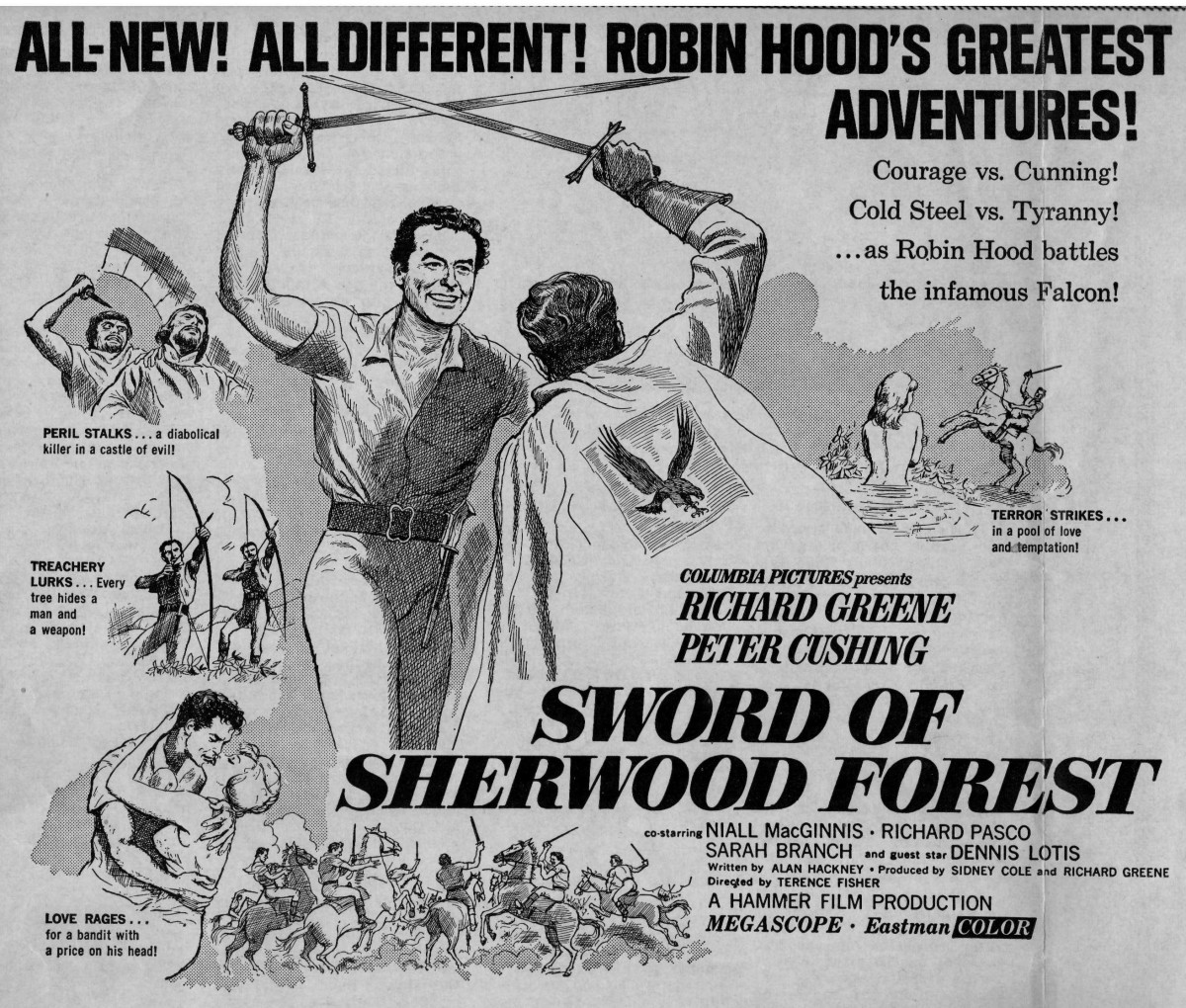
The last swashbuckler to cut a genuine dash was The Crimson Pirate (1952) with an athletic Burt Lancaster romancing Virginia Mayo in a big-budget Hollywood spectacular. The chance of Hollywood ponying up for further offerings of this caliber was remote once television began to cut the swashbuckler genre down to small-screen size. Britain’s ITV network churned out series based on Sir Lancelot, William Tell and The Count of Monte Cristo and 30-minute episodes (143 in all) of The Adventures of Robin Hood. So when Hammer decided to rework the series as a movie, their first port-of-call was series star Richard Greene.

And to encourage television viewers to follow the adventures of their hero on the big screen, Hammer sensibly dumped the small screen’s black-and-white photography in favour of widescreen color and then lit up the canvas at the outset with aerial tracking shots of the glorious bucolic greenery of the English countryside (actually Ireland). Further temptation for staid television viewers came in the form of Maid Marian (Sarah Branch) bathing naked in a lake. Robin Hood is soon hooked.  

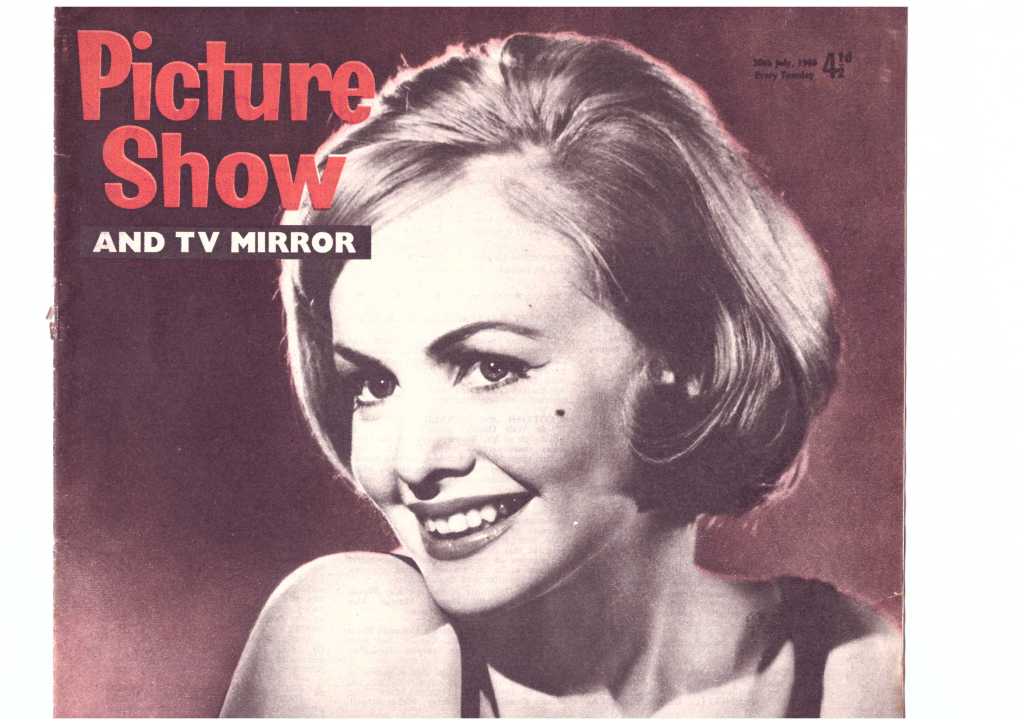
Sarah Branch was given the cover girl treatment in British fan magazine “Picture Show and TV Mirror” but this preceded “Sword of Sherwood Forest” and instead was for “Sands of the Desert” (1960), a Charlie Drake comedy in which she plays a travel agent kidnapped by a sheik. Branch only made four pictures, with Maid Marian her final film role.

Two main plots run side-by-side. The first is obvious. The Sheriff of Nottingham (Peter Cushing) is quietly defrauding people through legal means. The second takes a while to come to fruition. Robin Hood is hired by for his archery skills by the Earl of Newark (Richard Pasco) – he shoots a pumpkin through a spinning wheel, a moving bell and a bullseye through a slit – before it becomes apparent he is being recruited as an assassin. Oliver Reed and Derren Nesbitt put in uncredited appearances and the usual suspects are played by Niall MacGinnis (as Friar Tuck) and Nigel Green (as Little John).

There is sufficient swordfighting to satisfy. Director Terence Fisher, more at home with the Hammer horror portfolio, demonstrates a facility with action. Richard Greene makes a breezy hero and the picture is ideal matinee entertainment.

Many of the films from the 1960s are to be found free of charge on TCM and Sony Movies and the British Talking Pictures as well as mainstream television channels. Films tend to be licensed to any of the above for a specific period of time so you might find access has disappeared. But if this film is not available through these routes, then here is the link to the DVD and/or streaming service.

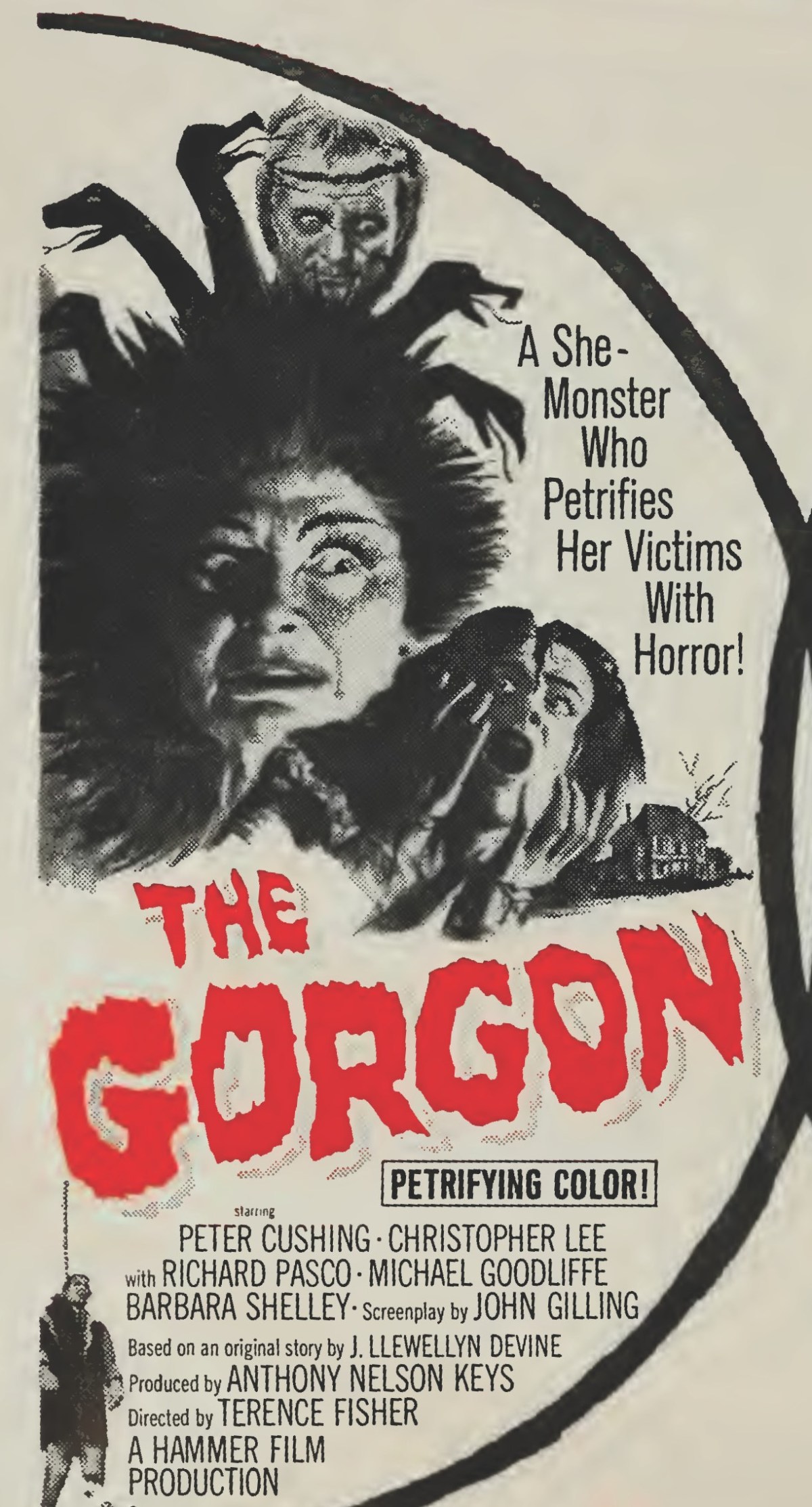
The Gorgon (1964) ****

This impressive Hammer conspiracy-of-silence slow-burner, more thriller than horror, features the triumvirate of Christopher Lee (The Devil Ship Pirates, 1964), Peter Cushing (The Sword of Sherwood Forest, 1960) and Barbara Steele (Black Sunday, 1960) in untypical roles. Lee and Cushing, of course, had locked horns before, namely in Hammer’s reimagining of the classic Dracula, with the former the charismatic fiend and the latter his nemesis.

Here Cushing is a  doctor in a an unnamed European turn-of-the-twentieth-century police state who knows more than he is letting on about seven inexplicable deaths in five years and the possibility of a 2,000-year-old myth coming to life and taking on a human form. And with quite a human side, jealous when his assistant Steele falls for a younger man. Lee is a professor coming late in the day to investigate. Steele, a gentle beauty, initially introduced as merely the love interest, becomes central to the story but without sucking up all the available horror oxygen by over-acting.   

Director Terence Fisher, who had shepherded the studio’s Dracula, Frankenstein, The Mummy and Dr Jekyll franchises through the starting gate, builds up the atmosphere with full moons, haunting voices, fog, sudden sounds, drifting leaves and an abandoned castle forever in shadow. The camera is often a weapon of stealth. Shock is kept to a minimum, fleeting ghostly apparitions and a finger falling off a corpse. Given the limitations of special effects in this era, that was a smart move. Far better to concentrate on fear of impending doom, a man knowing he is turning to stone, a woman living in terror of being taken over by the phantom. The title gives away the story somewhat – even if you didn’t know the Gorgon was a mythical monster with a headful of snakes and the ability to turn people to stone, that is soon explained. 

Death remains the trigger for action, the suicide of an artist after he has apparently murdered his pregnant girlfriend bringing his father onto the scene and then his brother accompanied by Lee. But all investigation hits a wall of silence after police chief (Patrick Troughton) refuses to instigate detection. At the heart of all the relationships is betrayal. The artist leading his girlfriend on, Cushing willing to endanger Steele, whom he professes to love, rather than revealing the truth. Even Steele spies on the brother, with whom she is falling in love, in order to gather information for Cushing. 

Forgive the pun, but Steele steals the picture. An amnesiac, a victim and finally the lure, she remains enigmatic, a whisper of a woman. It is a haunting portrayal far removed from Hammer’s traditional cleavage queens. This is a very human character who nonetheless must stand guard over herself. Cushing embroiders his character with little touches, smoking a cigarette in a holder, for example, but Steele’s character, her distrust of herself, shows in every move she makes.

Many of the films from the 1960s are to be found free of charge on TCM and Sony Movies and the British Talking Pictures as well as mainstream television channels. But if this film is not available through these routes, then here is the link to the DVD and/or streaming service.

Discover WordPress

A daily selection of the best content published on WordPress, collected for you by humans who love to read.

The Atavist Magazine

by Brian Hannan

WordPress.com News

The latest news on WordPress.com and the WordPress community.