The Fighting Prince of Donegal (1966) ***

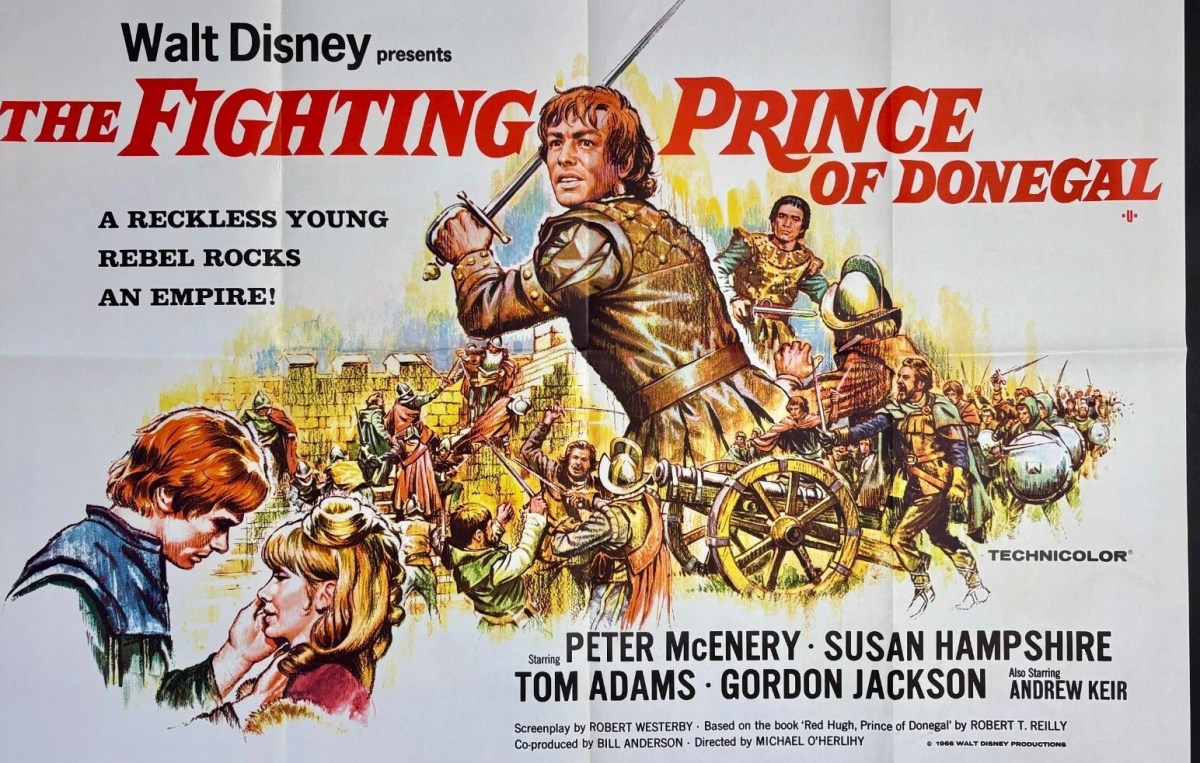
I’m amazed I sat through this without complaint as a kid. This was a rare outing for me, given I grew up in a town without a cinema and the only time I went was for a roadshow musical at Xmas or if we were away on holiday for the summer in towns that were bursting with picture houses. No doubt my parents, of Irish descent, were seduced by the last word of the title while assuming that the second word would be enough to keep us kids happy.

Unfortunately, the title is something of a misnomer. The titular character Hugh O’Donnell (Peter McEnery) spends more time sitting on his backside in a prison than he does engaging in any form of fighting. And in another annoying dupe, swords are scarcely in evidence, the weapon of choice being a wooden club of sorts, so it hardly qualifies as the swashbuckler the poster suggests.

Where Walt Disney was happy to play fast and loose with other aspects of history in other movies, here he cleaves close to the truth – though Hugh didn’t marry a McSweeney and his father didn’t die – so what we get is some kind of rebellion story, as the Irish attempt to rise up against the occupying English in the 1580s. If you are aware of your history, you will know that Oliver Cromwell is to blame for the English re-conquest of Ireland. Various rebellions followed, of which this is one.

It starts off promisingly enough with a nice bit of myth, that when Hugh becomes chief of the Clan O’Donnell he triggers a prophecy that insists the Irish will become free. That’s easier said than done due to the lack of a cohesive rebellion force thanks to infighting and historical distrust between the clans. And when Hugh does attempt to stand up against the British he’s promptly imprisoned – again and again.

A better title would be The Escapologist of Donegal because that’s mostly, except for the beginning and final sections, what this is about. He escapes, is betrayed and recaptured, or escapes, racing through the streets of Dublin, and remains free and then manages to gather the clans under his banner and take on the English.

And, actually, Hugh is not that keen on the use of force to win freedom. He prefers negotiation. So you can imagine how exciting that is for the kids in the audience. He wants to unite all the clans and hope the English will see sense. Luckily, for the frustrated kids in the audience, the English are not inclined to sit around a negotiating table. So, at last, we get a battle.

To save it from just being a history lesson, a romance is sneaked in between Hugh and Kathleen McSweeney (Susan Hampshire), daughter of another clan chief, and who already has an ardent admirer. A wedding is the easiest way to create unity between clans, but, luckily, this isn’t just the political matchmaking that occurred in England and Europe.

But that nascent romance is put on the back burner for most of the picture while Hugh sits in jail or runs around the country in escape mode.

So, a few fights with cudgels and fisticuffs, some bonding with other prisoners, some wooing of the clans until at last at last there is the semblance of a battle.

Nearly 60 years on from first viewing I am not won over. The politics and maneuvering is certainly more interesting to an adult, but I am still miffed at the absence of much actual swordplay – and you know how fond I am of a swashbuckler. It’s just too earnest in setting up a rebellion tale and the escapes have none of the ingenuity we have come to expect from such.

Peter McEnery (The Moon-Spinners, 1964) looks distinctly uncomfortable as a matinee idol of the kind groomed by Disney, especially when you see what he was capable of a few years later in the more scandalous Negatives (1968). Susan Hampshire (The Trygon Factor, 1966) only tops and tails the picture and her entire Disney experience was clearly so miserable she excised it from her biography.

Directed by Michael O’Herlihy (Smith!, 1969) from a screenplay by debutant Robert T. Reilley based on the Robert Westerby novel.

The Trygon Factor (1967) ****

Sublime climax but you need persistence to get through the fog of red herrings. Genre mash-up that flits precariously between whodunit and horror as we slip from a convent of nefarious nuns living in a vast stately home, where half-naked girls pose for photo sessions, and secret messages are smuggled out, to a pre-giallo masked killer with a drowning obsession liable to jump out. Luckily, there’s an equally impressive grand hotel nearby, thankfully minus nuns, but where killers still roam.

I had mistakenly assumed horror because “Trygon” is close to “Tygon,” the British horror outfit taking a more outré approach to the genre than staid old Hammer, and because of the random killings, and a man, Luke (James Culliford), son of the mansion owner Livia Emberday (Cathleen Nesbitt), in the habit of dressing up in weird garb and chopping the heads off flowers with a sword and inclined, in a fit of pique, to smash precious china heirlooms. And because there’s a fair bit of business with a coffin, this being the kind of movie where mourners lean into the casket and kiss the corpse.

If it is, indeed, a corpse. Zombies, anyone? I wouldn’t have been surprised. This is jam-packed with sumptuous misleading incident. Especially, as, for most of the proceedings, it seems like we’re stuck in a detective tale with an inspector who’s clearly never lived a minute in Britain judging from his glowing tan. He’s investigating a missing colleague (Allan Cuthbertson) seen in the opening sequence snooping around the mansion before being passed furtive notes through the gates by a young nun, later rigorously stripped of her habit.

The tan’s probably the giveaway since the immaculately turned-out Supt Cooper-Smith (Stewart Granger) fancies himself as a ladies’ man, first with French receptionist Sophie (Sophie Hardy) who expects a bit of coaxing seduction, and then with Livia’s daughter Trudy (Susan Hampshire), the photographer,  who doesn’t, keener on a speedier route into a man’s affections.

By the time the dust begins to settle, and the top cop harbors suspicions about a dockside warehouse owned by swivel-eyed Hubert (Robert Morley) – although Cooper-Smith’s  investigation technique revolves around plying young women with brandy – we’re drifting between the notion of some mad cult operating in the convent and Luke as the most likely serial killer given his determination to “play” with young women.

But, in fact, just as we’re being lulled into a sense of false security and the idea that we’ve seen this all before, director Cyril Frankel (On the Fiddle, 1961) springs the first of several audacious twists. The idea that the stately home is a front for a gang of thieves might, on the face of it, appear ludicrous except for the skill with which they carry out the heist and that the criminal mastermind is Livia, assisted by equally cunning daughter.

They have imported – in a coffin – a top French safecracker whose tool of choice is the kind of weapon that Thunderbolt and Lightfoot would have envied, if not a villain of James Bond proportions, and although the armament doesn’t spew out laser beams, it has sufficient firepower to render vulnerable the toughest safe. Naturally, Livia organises the break-in to coincide with nearby building works where the thunder of pneumatic drills will drown out any gun fire.

The thieves turn up outside the appointed bank in what appears an official security van, but from the boxes they carry into the target they produce gas masks and proceed to immobilize anyone inside. They’re after gold bullion because, under the guise of manufacturing large candlestick holders for sale to tourists at the stately home, Livia has set up a gold-smelting operation, pouring liquified gold into the base of the candlestick, trademark Trygon. Having re-disguised the French safecracker as a corpse and placed him in a coffin ready for the surreptitious trip home, ruthless Livia instead dumps him into the Thames to drown.

It’s pure luck that our police lothario happens upon the truth and discovers the smelting basement whereupon – twist number two – the delectable Trudy reveals herself to be the serial killer. She kills for “fun” and relishes the prospect of knocking off an “arrogant” male and one too susceptible to her charms to recognize her femme fatale sensibilities

The giallo-esque killings are highlights, one victim drowned in a baptismal font, another in a bathtub. That female’s kicking and screaming isn’t enough, what with the radio turned up loud, to attract the attention of the nubile Sophie next door luxuriating in a bubble bath. But death by piping hot liquid gold takes some beating. And that’s not the sole reason for the X-certificate since the movie taunts the censor in Blow-Up (1966) – minus the attendant hullabaloo – fashion with a brief glimpse of naked female breast.

The prospective audience might have expected a supernatural outcome given director Frankel’s previous outing The Witches (1966) and had they been alerted to the fact that the source material (uncredited) was written Edgar Wallace might have come prepared for some of the twists.   

This is the kind of movie that needs to be viewed backwards because it’s only at the end that you work out what it’s all about and how skilfully the audience has been duped. An object lesson and one that, for example, Zoe Kravitz (Blink Twice, 2024) should have watched to learn how to suck an audience in.

When you consider the movie in reverse, you realize this is really about an exceptionally clever heist and two women who are more than a match for any man. The males here are definitely disposable.

If you wondered why I gave this is a four-star rating rather than the more obvious three stars, it’s because of what’s mostly unsaid, the iceberg of psychology floating beneath the surface, the one that says that British audiences would not tolerate a top-class female criminal gang capable of pulling off a fantastic heist and without compunction killing off any man, including co-workers, who gets in their way. Had it begun from the POV of Lydia and Trudy planning the robbery, and dealt with Cooper-Smith et al as simply hazards of the profession, it might have made a terrific heist picture but then all the fun of the twists and the pulling the wool over audience eyes would be missed.

Susan Hampshire (The Three Lives of Thomasina, 1963) belies her Disney persona with a chilling portrait of an exceptionally smart femme fatale. Stewart Granger (The Last Safari, 1967) looks as if he views the whole boring process of detection as nothing more than the opportunity to try out some chat-up lines.

Cyril Frankel makes no pretence at being a great stylist, but he more than makes up for it by the teasing structure, some of the costumes, the atmosphere and the twists. Derry Quinn (Operation Crossbow, 1965) and Stanley Munro, in his movie debut, devised the screenplay based on a book by Edgar Wallace

Watch – and marvel.

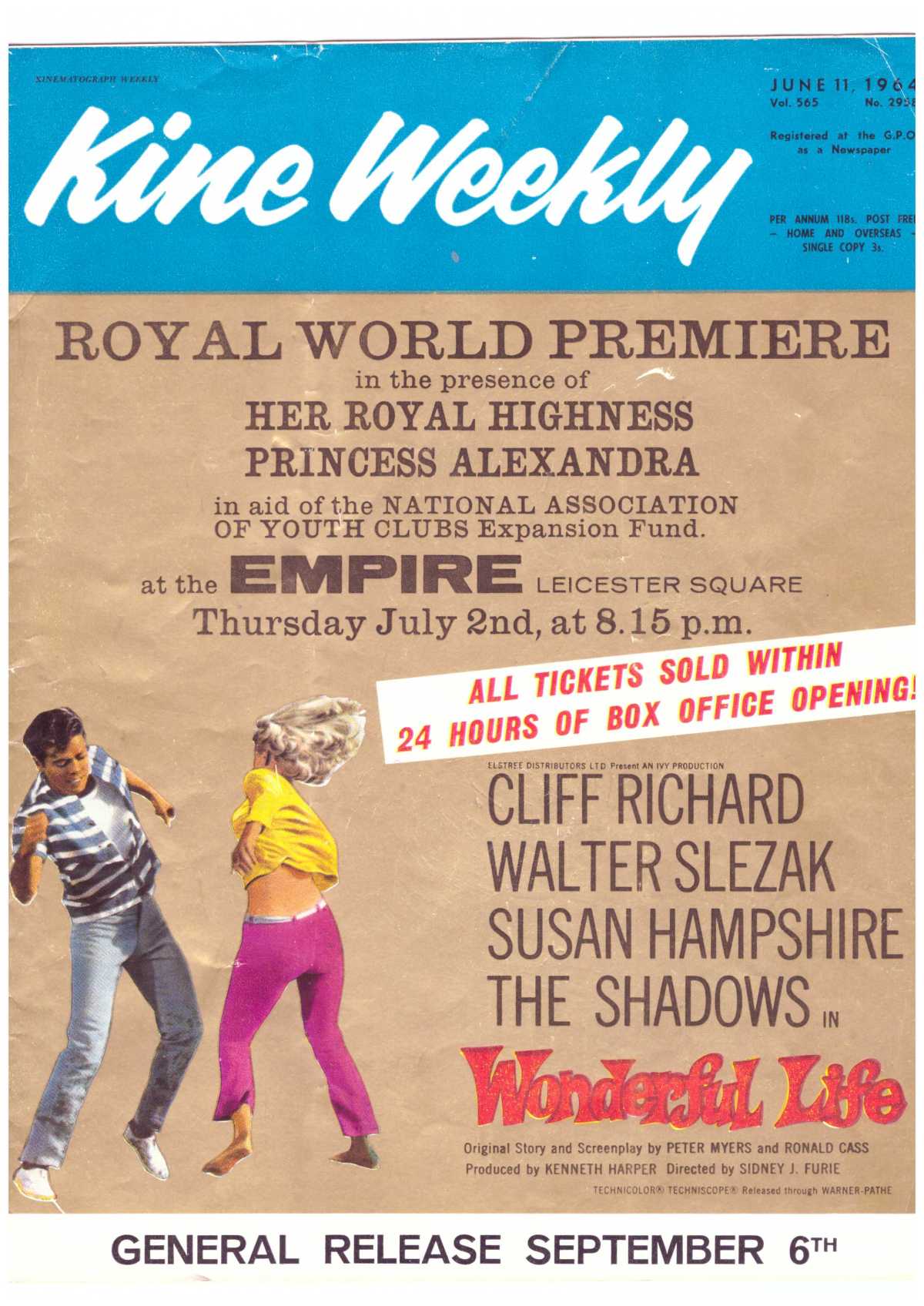
Wonderful Life (1964)****

I have just discovered a new guilty pleasure. I was too young to remember when Cliff Richard was the British equivalent of Elvis and by the time I became aware of him he was already in the family-favorites league with his own television show and popping up in the wider consciousness from time to time with a number one single. But I was conscious that Cliff’s aspiring film career was totally obliterated by the emergence of the Beatles. I found Wonderful Life to be totally innocuous, highly enjoyable, charming fun. There’s no story to speak of beyond an affectionate spoof of Hollywood but it has zest and exuberance and some decent choreography by Gillian Lynne who went on to be deified for her work on the original London productions of Cats and Phantom of the Opera.

But there are some very funny visual gags, beginning with the opening scene when Cliff and Co are waiters on board a ship attending to a drunk whose glass moves out of reach every time the ship rolls. Having caused a power outage, they are chucked overboard in a dinghy and turn up in the Canary Islands where Cliff becomes a stunt man on the terrible Foreign Legion movie directed by a Hollywood ogre (Walter Slezak) and starring incompetent actress Susan Hampshire who has made a career of sorts playing the daughter of a sheik or sultan. You have to like a movie with lines like, “Follow that camel” and a geek (Richard O’Sullivan) whose scientific predictions invariably come undone. Cliff, realizing the lines are better sung than spoken, begins to make a musical on the back of the drama. And it’s true – the lines are good lyrics.

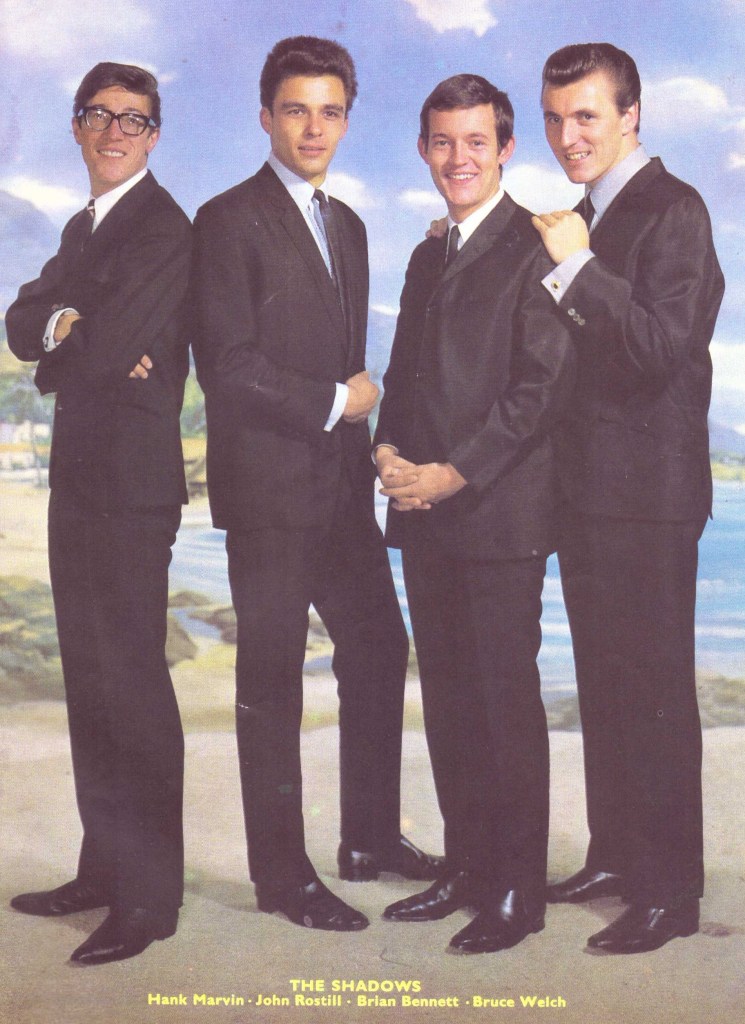
Britain had no reputation for musicals among the Hollywood cognoscenti unless you count the Jessie Mathews and Gracie Fields films of the 1930s which were far too parochial and contrived for American tastes and in terms of invention and musical technique a far cry from Lionel Bart’s Oliver! which would be filmed a couple of years later and in terms of originality not a patch on A Hard Day’s Night (1964) the same year. The songs are evenly contributed by various members of the Shadows – Bruce Welch composed the standout “A Matter of Moments” and with Brian Bennett the theme song – and the Peter Myers-Ronald Cass team who also wrote the screenplay. But this film comes across as naturalistic, rather than the contrivances of most Hollywood musicals. It doesn’t take much for these lads to strike up a song, any excuse will do. And the film is better for the lack of high emotion attached to every lyric.

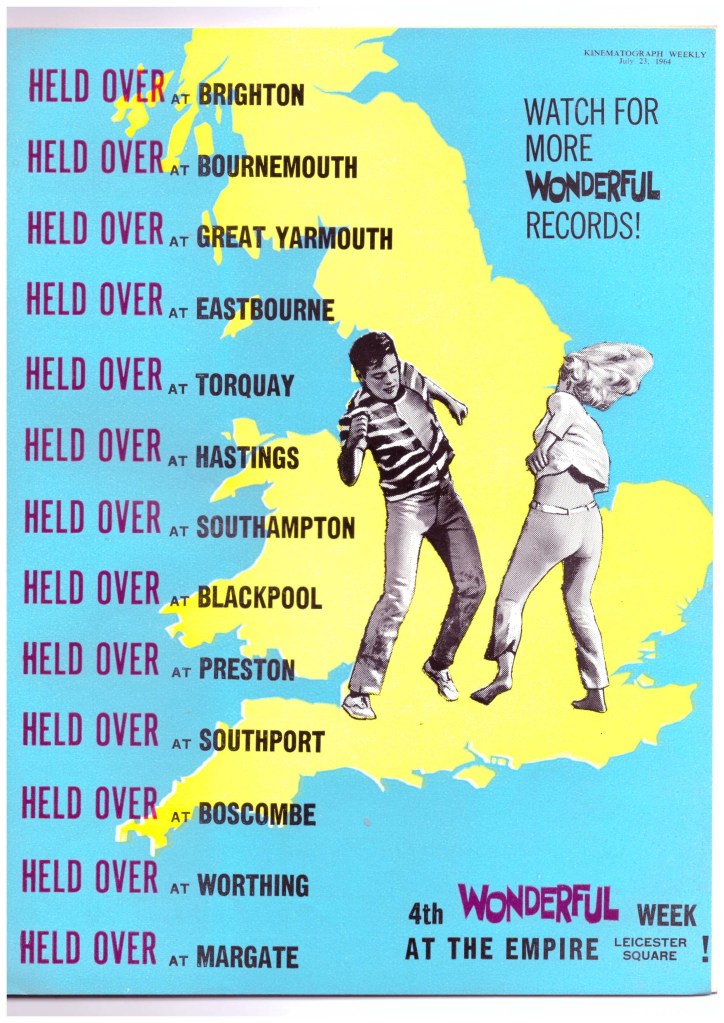
You would be mightily surprised to learn that director Sidney J. Furie’s next film was stylish spy thriller The Ipcress File (1965) followed by Appaloosa (1966) with Marlon Brando and The Naked Runner (1967) starring Frank Sinatra. Here, he is in free-association mode, the ideas tumbling out, especially in the Hollywood parody dance numbers sections where we go from Chaplin pastiche to Greta Garbo and Groucho Marx, Fred Astaire-Ginger Rogers, West Side Story and James Bond. We have gangsters whose violin cases contain violins, a singing cowboy with subtitles (to explain the growth of the foreign movie) and a song about homesickness played out with Battersea Power Station in the background. If anybody can actually act they’re not putting any great effort into it. And that doesn’t matter either. The storyline is no more preposterous than many of the great Hollywood musicals. Everyone looks as if they’re having a whale of a time and I guess that would include the audience because the movie was the fifth-best performer of the year in Britain. This was the type of movie, during the rise of the permissive cinema, that you could take your grandmother to see and still come away surprised you had enjoyed it so much yourself.

Discover WordPress

A daily selection of the best content published on WordPress, collected for you by humans who love to read.

The Atavist Magazine

by Brian Hannan

WordPress.com News

The latest news on WordPress.com and the WordPress community.